1 Samuel 17:22

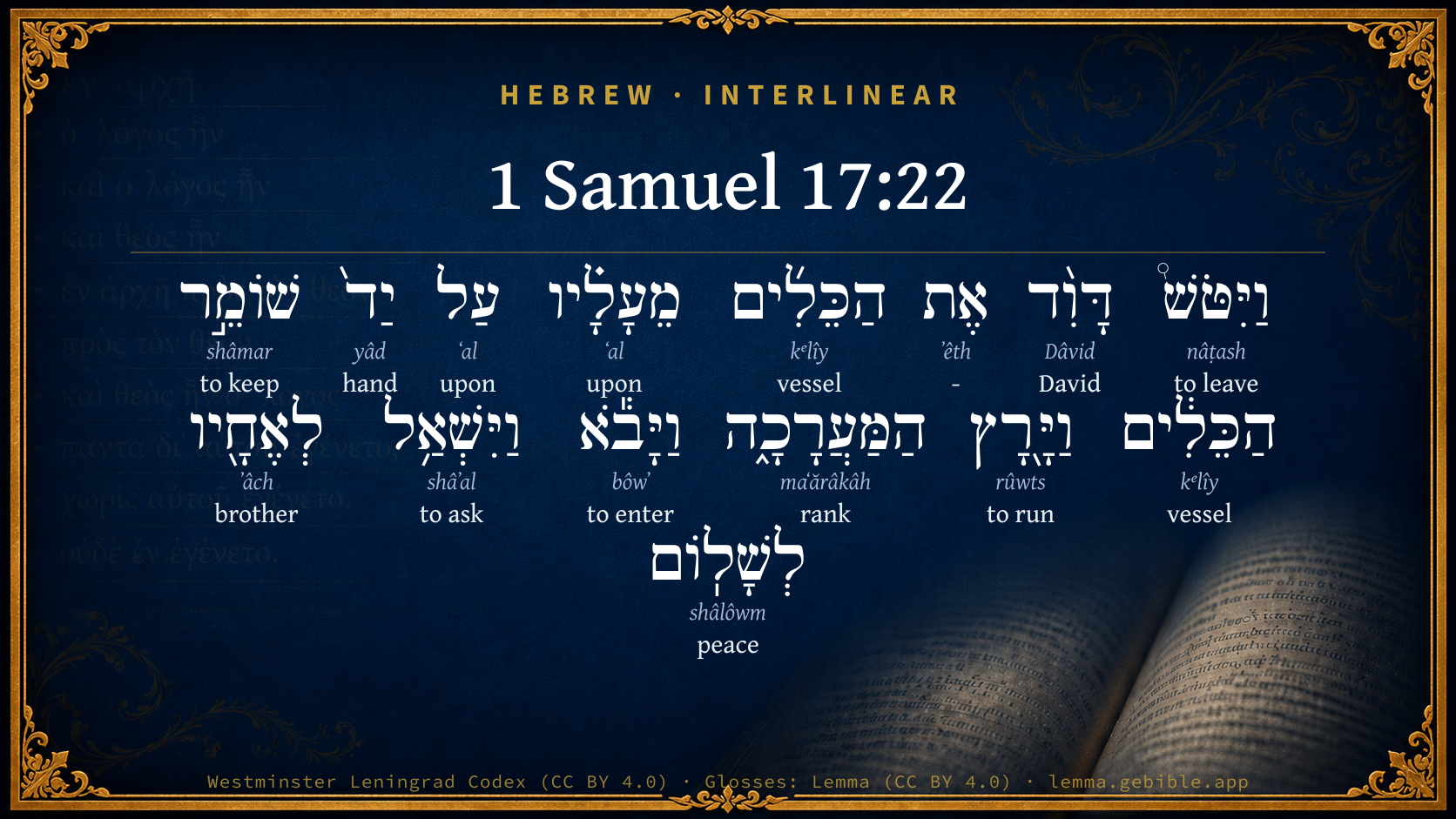
Hebrew (Westminster Leningrad Codex) 1 Samuel 17:22 appears in the Hebrew Old Testament. The text above is from the Westminster Leningrad Codex. Each word links to its Strong’s number, a concise gloss, and parsing drawn from the Open Scriptures Hebrew Bible morphology. Click any word for its full Brown-Driver-Briggs (BDB) entry.
Download image
Cite this verse

1 Samuel 17:22 (World English Bible). Public Domain. Lemma interlinear Bible study tool, https://lemma.gebible.app/v/1-samuel/17/22.

Show BibTeX & RIS
BibTeX
RIS
English Translation
David left his baggage in the hand of the keeper of the baggage, and ran to the army, and came and greeted his brothers.
World English Bible · Public Domain
Download a study sheet

One document with this verse’s original text, its word-by-word gloss line, the meaning frame, cross-references with their text, attributed commentary, and full source and license credits — printable, and it pastes into notes with its structure intact.

This verse Autodidact and up

Study sheet (.html) Plain text (.txt)

A passage Seminary Student

Up to 50 verses in one chapter. A passage sheet keeps up to 6 commentary sources and 12 cross-references per verse, in the order this page ranks them, and says so on the sheet whenever that leaves anything out. Ask for a single verse and you get the Autodidact verse sheet above.

Everything on this page stays free to read, with no account — the sheet is a download of what is already on screen, not access to it.

Want to remove ads? Support Godless Engineer
Compare translations 3

The same verse in 3 English versions, stacked beneath the original-language interlinear above. Click any original word for its lexicon entry.

Each is an independent rendering of the whole verse — the interlinear is not word-aligned to these translations.

Highlighted words mark where these versions differ — a whole-verse word diff, not a word-by-word alignment.

  • World English Bible Public Domain
    David left his baggage in the hand of the keeper of the baggage, and ran to the army, and came and greeted his brothers.
  • King James Version Public Domain
    And David left his carriage in the hand of the keeper of the carriage, and ran into the army, and came and saluted his brethren.
  • unfoldingWord Literal Text CC BY-SA 4.0
    And David left the vessels from upon him in the hand of the keeper of the vessels, and he ran the array. And he came and asked his brothers about peace.

unfoldingWord Literal Text — © unfoldingWord, licensed CC BY-SA 4.0. Word-aligned USFM3 via Door43 (git.door43.org/unfoldingWord/en_ult).

Versions to compare (up to 4)

3 of 4 selected

Show all 18 translations

Every available English version of this verse, each an independent rendering of the whole verse.

  • World English Bible Public Domain
    David left his baggage in the hand of the keeper of the baggage, and ran to the army, and came and greeted his brothers.
  • Berean Standard Bible Public Domain
    Then David left his supplies in the care of the quartermaster and ran to the battle line. When he arrived, he asked his brothers how they were doing.
  • Majority Standard Bible Public Domain
    Then David left his supplies in the care of the quartermaster and ran to the battle line. When he arrived, he asked his brothers how they were doing.
  • King James Version Public Domain
    And David left his carriage in the hand of the keeper of the carriage, and ran into the army, and came and saluted his brethren.
  • American Standard Version (1901) Public Domain
    And David left his baggage in the hand of the keeper of the baggage, and ran to the army, and came and saluted his brethren.
  • Revised Version (1885) Public Domain
    And David left his baggage in the hand of the keeper of the baggage, and ran to the army, and came and saluted his brethren.
  • Geneva Bible (1599) Public Domain
    And Dauid left the things, which hee bare, vnder the handes of the keeper of the cariage, and ranne into the hoste, and came, and asked his brethren howe they did.
  • Douay-Rheims (1899) Public Domain
    And David leaving the vessels which he had brought, under the care of the keeper of the baggage, ran to the place of the battle and asked if all things went well with his brethren.
  • Young's Literal Translation Public Domain
    And David letteth down the goods from off him on the hand of a keeper of the goods, and runneth into the rank, and cometh and asketh of his brethren of welfare.
  • Literal Standard Version CC BY-SA 4.0
    And David lets down the goods from off him on the hand of a keeper of the goods, and runs into the rank, and comes and asks of his brothers of [their] welfare.
  • Unlocked Literal Bible CC BY-SA 4.0
    David left his belongings with the keeper of supplies, ran to the army, and greeted his brothers.
  • unfoldingWord Literal Text CC BY-SA 4.0
    And David left the vessels from upon him in the hand of the keeper of the vessels, and he ran the array. And he came and asked his brothers about peace.
  • Darby Bible Public Domain
    And David left the things he was carrying in the hand of the keeper of the baggage, and ran into the ranks, and came and saluted his brethren.
  • World Messianic Bible Public Domain
    David left his baggage in the hand of the keeper of the baggage and ran to the army, and came and greeted his brothers.
  • Webster's Bible Public Domain
    And David left his furniture in the hand of the keeper of the vessels, and ran into the army, and came and saluted his brethren.
  • Free Bible Version CC BY-SA 4.0
    David left his supplies with the one responsible and ran to the battle line. When he got there he asked his brothers how they were.
  • Bible in Basic English Public Domain
    And David gave his parcels into the hands of the keeper of the army stores, and went running to the army and came to his brothers to get knowledge about them.
  • JPS Tanakh (1917) Public Domain
    And David left his baggage in the hand of the keeper of the baggage, and ran to the army, and came and greeted his brethren.

Literal Standard Version (2020), Covenant Press — licensed CC BY-SA 4.0. Text via the HelloAO Bible API (eBible.org). Unlocked Literal Bible (unfoldingWord) — licensed CC BY-SA 4.0. Text via the HelloAO Bible API (eBible.org). unfoldingWord Literal Text — © unfoldingWord, licensed CC BY-SA 4.0. Word-aligned USFM3 via Door43 (git.door43.org/unfoldingWord/en_ult). Free Bible Version, Dr. Jonathan Gallagher — licensed CC BY-SA 4.0. Text via the HelloAO Bible API (eBible.org).

Word by word

More ways to search: Search by grammar → Find every occurrence → Compare this word →

Practice this passage: Drill this verse → Learn its vocabulary →

הַמַּעֲרָכָ֑ה
maʻărâkâh
H4634
“the · rank”
Particle, Definite Article + Noun, Common, Feminine, Singular, Absolute
Part of Speech
Particle + Noun
Type
Common
Gender
Feminine
Number
Singular
State
Absolute
Full BDB Definition

Origin: from H4633

TWOT: 1694d

row, rank, battle-line - battle-line - rank - row
  1. וַיִּטֹּשׁ֩ nâṭash H5203 “and · to leave” Conjunction + Verb, Qal, Sequential Imperfect, 3rd Person, Masculine, Singular
  2. דָּוִ֨ד Dâvid H1732 “David” Noun, Proper
  3. אֶת ʼêth H853 “-” Particle, Direct Object
  4. הַכֵּלִ֜ים kᵉlîy H3627 “the · vessels” Particle, Definite Article + Noun, Common, Masculine, Plural, Absolute
  5. מֵעָלָ֗יו ʻal H5921 “from · upon · him” Preposition + Preposition + Suffix, Personal, 3rd Person, Masculine, Singular
  6. עַל ʻal H5921 “upon” Preposition
  7. יַד֙ yâd H3027 “hand of” Noun, Common, Both, Singular, Construct
  8. שׁוֹמֵ֣ר shâmar H8104 “keeping” Verb, Qal, Participle Active, Masculine, Singular, Construct
  9. הַכֵּלִ֔ים kᵉlîy H3627 “the · vessels” Particle, Definite Article + Noun, Common, Masculine, Plural, Absolute
  10. וַיָּ֖רָץ rûwts H7323 “and · to run” Conjunction + Verb, Qal, Sequential Imperfect, 3rd Person, Masculine, Singular
  11. וַיָּבֹ֕א bôwʼ H935 “and · to enter” Conjunction + Verb, Qal, Sequential Imperfect, 3rd Person, Masculine, Singular
  12. וַיִּשְׁאַ֥ל shâʼal H7592 “and · to ask” Conjunction + Verb, Qal, Sequential Imperfect, 3rd Person, Masculine, Singular
  13. לְאֶחָ֖יו ʼâch H251 “to/for · brothers · his” Preposition + Noun, Common, Masculine, Plural, Construct + Suffix, Personal, 3rd Person, Masculine, Singular
  14. לְשָׁלֽוֹם shâlôwm H7965 “to/for · peace” Preposition + Noun, Common, Masculine, Singular, Absolute

About this verse

These counts appear in no published source. They are computed here, from the morphology-tagged text and Lemma’s own curated glosses. What Lemma adds →

15
words
13
distinct lemmas
Historical
section

Notable vocabulary

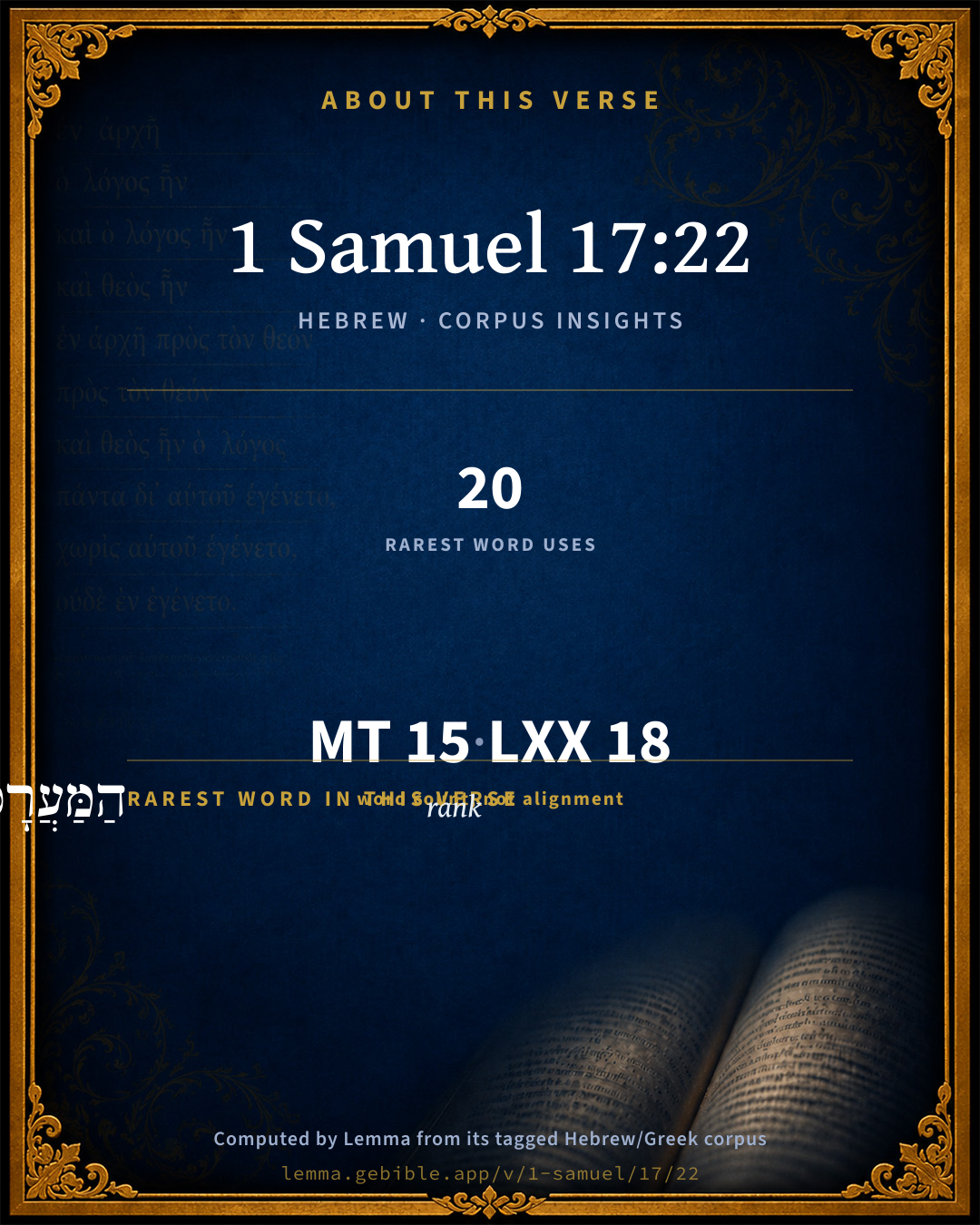
The rarest word here is הַמַּעֲרָכָ֑ה rank H4634 — appearing just 20 times in the whole Hebrew Bible.

Shared distinctive vocabulary

הַמַּעֲרָכָ֑ה rank H4634 occurs in 18 verses of the Hebrew Bible. Also found in:

Grammatical profile

  • 5 verbs
  • 7 nouns
  • 2 prepositions
  • 1 particle

Verb forms

  • וַיִּטֹּשׁ֩ Qal · Sequential Imperfect
  • שׁוֹמֵ֣ר Qal · Participle Active
  • וַיָּ֖רָץ Qal · Sequential Imperfect
  • וַיָּבֹ֕א Qal · Sequential Imperfect
  • וַיִּשְׁאַ֥ל Qal · Sequential Imperfect

Repetition

Words recur within this verse — often emphatic in Hebrew:

  • הַכֵּלִ֜ים vessel H3627 ×2
  • מֵעָלָ֗יו upon H5921 ×2

Hebrew & Septuagint length

In English translation the verse runs 24 words from the Hebrew and 25 from the Septuagint (LXX English) — closely comparable.

A rough comparison of the two English renderings, which tokenize alike — not a word-level alignment.

Word counts can differ between the Hebrew and the Greek without any difference in meaning — e.g. the Hebrew direct-object marker אֵת has no separate Greek word, and Greek often adds the article ὁ.

In the original languages it is 15 Hebrew tokens and 18 Greek tokens — but the two are counted differently (Hebrew bundles its prefixes and suffixes into one token; the Greek is in lemma form), so that isn’t a like-for-like length.

Cross-references

5

Topical passages linked to 1 Samuel 17:22 in the Treasury of Scripture Knowledge — connected by theme and wording, ordered by reader-vote popularity; previews shown in the World English Bible.

  • Genesis 37:14 He said to him, "Go now, see whether it is well with your brothers, and well with the flock; and bring me word again." So he sent him out of the valley of Hebron, and he came to Shechem.
  • Judges 18:15 They turned aside there, and came to the house of the young man the Levite, even to the house of Micah, and asked him of his welfare.
  • Isaiah 10:28 He is come to Aiath, he is passed through Migron; at Michmash he lays up his baggage;
  • Matthew 10:12–13 As you enter into the household, greet it.
  • Luke 10:5–6 Into whatever house you enter, first say, 'Peace be to this house.'

Cross-references courtesy of OpenBible.info (CC BY 4.0).

Hebrew and Greek witnesses Masoretic Hebrew ↔ Greek Septuagint

The same verse in the two great witnesses to the Old Testament, shown verse-for-verse.

These are two independent witnesses, not word-aligned to each other, and the Septuagint is shown in lemma (dictionary) form.

Hebrew 1 Samuel 17:22 Masoretic · Westminster Leningrad Codex

וַיִּטֹּשׁ֩ דָּוִ֨ד אֶת הַכֵּלִ֜ים מֵעָלָ֗יו עַל יַד֙ שׁוֹמֵ֣ר הַכֵּלִ֔ים וַיָּ֖רָץ הַמַּעֲרָכָ֑ה וַיָּבֹ֕א וַיִּשְׁאַ֥ל לְאֶחָ֖יו לְשָׁלֽוֹם

David left his baggage in the hand of the keeper of the baggage, and ran to the army, and came and greeted his brothers.

World English Bible · Public Domain

Greek LXX 1 Samuel 17:22 Septuagint · lemma form

καί ὁράω γολιαδ ὁ δαυίδ καί ἀτιμάζω αὐτός ὅτι αὐτός εἰμί παιδάριον καί αὐτός πυρράκης μετά κάλλος ὀφθαλμός

And David deposited his burden in the hand of a keeper, and ran to the line, and went and asked his brethren how they Were.

LXX2012 (modern English Septuagint) · Public Domain

Hebrew: Westminster Leningrad Codex (CC BY 4.0). Greek: Septuagint (public domain); English from LXX2012 (modern English Septuagint) (Public Domain). How the Septuagint differs from the Hebrew →

Targum (Aramaic paraphrase)

1

The Targum is the ancient Jewish Aramaic paraphrase of the Hebrew Scriptures — an interpretive translation, not the Hebrew text itself. Onkelos (literal) and Pseudo-Jonathan (expansive) render the Torah, and Jonathan the Prophets. Coverage is partial: where no permissively-licensed English translation exists for a verse, only the Aramaic is shown. This is verse-level text, not a word-by-word alignment to the Hebrew.

  1. Targum Jonathan Prophets (Joshua–Malachi)
    וּשְׁבַק דָוִד יַת מָנַיָא דִי עֲלוֹהִי עַל יַד נָטִיר מָנַיָא וּרְהַט לְסִדְרָא וְאָתָא וְשָׁאֵל לַאֲחוֹהִי בִּשְׁלָם:

    (no public-domain English translation for this verse)

    Targum Jonathan — Aramaic: “Mikraot Gedolot” (public domain). English: “Sefaria Community Translation” (CC0 1.0 (public-domain dedication)); “London "Chaldee Paraphrase," 1871” (public domain). Text via Sefaria.

Commentary

Notes on 1 Samuel 17:22 from classic Christian and Jewish commentators (each source and its license shown beneath its notes). The classic Christian expositions comment on the surrounding passage and are grouped to its opening verse, so a note may address several verses; the Jewish commentaries on the Tanakh (Rashi and others) are per-verse, so they appear only where the commentator wrote on this verse.

Lemma curates 59 commentaries, every one of them public domain or Creative Commons licensed, each selected and text-cleaned for this edition rather than reprinted as found. About our sources →

Trapp's Complete Commentary

John Trapp

1Sa 17:22 And David left his carriage in the hand of the keeper of the carriage, and ran into the army, and came and saluted his brethren.

Ver. 22. And David left his carriage.] Bags and such like things, wherein he brought their supplies.

John Trapp, A Commentary or Exposition upon All the Books of the Old and New Testament (1647–1656) — public domain. Text from a community e-Sword module.

Geneva Bible (1599)

Geneva Bible translators

Hebrew, of peace.

Hebrew, vessels.

Geneva Bible (1599) marginal notes — public domain. Text via Bolls.life.

Jamieson, Fausset & Brown

Robert Jamieson, A. R. Fausset & David Brown

left his carriage in the hand of the keeper of the carriage--to make his way to the standard of Judah.

Jamieson, Fausset & Brown — Commentary Critical and Explanatory on the Whole Bible (1871) — public domain (CC PDM 1.0). Text via the HelloAO Bible API.

Ellicott's Commentary for English Readers

(22) And David left his carriage.—That is, his baggage. The word “carriage,” as signifying baggage, is used in the English Version in this archaic sense in Isa_10:28 : “At Michmash he hath laid up his carriages;” and in Act_21:15 : “We took up our carriages.”

A Bible Commentary for English Readers, edited by Charles John Ellicott (1878–1897) — public domain. Text from a community e-Sword module.

The Cambridge Bible for Schools and Colleges

gen. ed. J. J. S. Perowne

22. his carriage … the keeper of the carriage] “Carriage” in the E. V. always signifies “that which is carried,” “baggage.” See Jdg_18:21; Isa_10:28; Act_21:15. The Heb. word is the same as that translated “stuff” in 1Sa_10:22.

The Cambridge Bible for Schools and Colleges (gen. ed. J. J. S. Perowne; Cambridge University Press, 1878–1918) — public domain. Text from a community e-Sword module.

John Gill's Exposition

And David left his carriage in the hand the keeper of the carriage,.... That is, he left load of provisions he brought with him in the hand of the keeper of the bag and baggage of the army, their clothes, and such like things; not having an opportunity to deliver them to his brethren, who were just going to engage in battle:

and ran into the army; which showed the valour and courage of David, who chose rather to expose himself in battle, than to abide with the keeper of the carriages:

and came and saluted his brethren; asked them of their welfare, in his father's name and his own.

John Gill's Exposition of the Whole Bible (1746–1763) — public domain (CC PDM 1.0). Text via the HelloAO Bible API.

Haydock's Catholic Bible Commentary

Brethren. This inquiry seems rather unseasonable, when all were shouting for battle. (Kennicott)

George Leo Haydock (1774–1849), Haydock's Catholic Family Bible and Commentary, 1859 edition — public domain. Excludes Psalms (Douay-Rheims chapter numbering differs from Protestant) and Deuterocanonical books (Catholic canon only).

Matthew Poole's English Annotations

His carriage; the provisions which he had brought to his brethren.

Matthew Poole's English Annotations on the Holy Bible (1683–1685) — public domain. Text from a community e-Sword/MySword module.

Whedon's Commentary on the Bible

Daniel D. Whedon

22. His carriage — That which he carried. Margin, the vessels from upon him. The parched ears, the ten loaves, and the cheeses which Jesse had sent by him to the camp.

The keeper of the carriage — The overseer of the supplies; the quartermaster.

Daniel D. Whedon (gen. ed.), Commentary on the Old and New Testaments (1874–1909) — public domain. Text from a community e-Sword module.

unfoldingWord translationNotes

Door43 World Missions Community

Goliath by name

"whose name was Goliath"

came out of the ranks of the Philistines

"stepped forward from the Philistines' battle line"

translationWords

David

Philistines

Gath

Goliath

name

word

Israel

fear

unfoldingWord translationNotes — © Distant Shores Media and the Door43 World Missions Community, licensed CC BY-SA 4.0. Source: git.door43.org/Door43/en_tn.

Rashi

Rabbi Shlomo Yitzchaki (Rashi)

The keeper of the equipment. Of the soldiers.

Rashi on the Tanakh — English translations: “The Judaica Press complete Tanach with Rashi, translated by A. J. Rosenberg” (CC BY 4.0); “Pentateuch with Rashi's commentary by M. Rosenbaum and A.M. Silbermann, 1929-1934” (public domain); “The Metsudah Tanach series, Lakewood, N.J” (CC BY 4.0); and “The Book of Joshua, Metsudah Publications, 1997” (CC BY 4.0). Text via Sefaria.

Lesson kit

Teaching starters — assembled from the data on this page, not authored interpretation. Every prompt links to the verse data it draws on. Edit before teaching.

1 Samuel, in the Historical, opens this verse with 15 words (13 distinct Hebrew lemmas). Its most distinctive word is maʻărâkâh (“rank”). A historical commentator’s framing appears above. Read the whole chapter for the surrounding context.

Discussion questions

  1. What does “rank” (maʻărâkâh) contribute to the verse as a whole?
  2. Exodus 39:37 shares the word «rank» with this verse. How do the two illuminate each other?
  3. “vessel” occurs 2× in this one verse. What is the effect of the repetition?
  4. The translations on this page render this verse differently — a whole-verse word diff, not a word-by-word alignment. What might account for the different wordings?
  5. The verb «וַיִּטֹּשׁ֩» is Qal Sequential Imperfect. How does its form color the action?
  6. Reading how Trapp's Complete Commentary and Geneva Bible (1599) read this verse, where do the two commentators agree and where do they part?

Things to notice

Reading settings

Reading text

Shown beneath each verse's original-language words.

Old Testament
Old Testament edition

Read the OT as the Masoretic Hebrew (MT) or the Greek Septuagint (LXX).

English shown for the Greek Septuagint (in the Hebrew ↔ Greek comparison).

Comparing translations? Open the Compare panel on any verse page to stack up to four side by side.