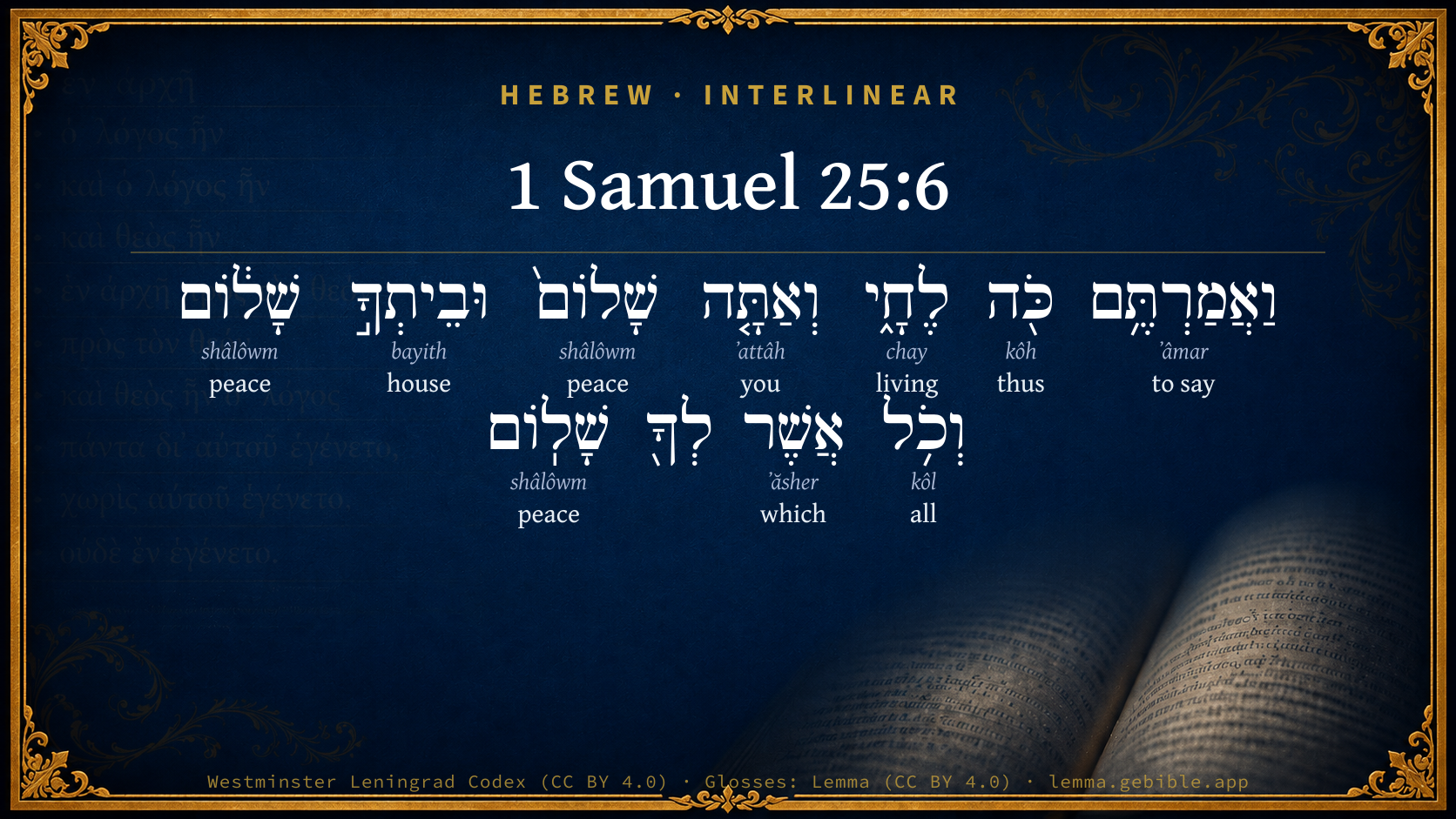
1 Samuel 25:6

Hebrew (Westminster Leningrad Codex) 1 Samuel 25:6 appears in the Hebrew Old Testament. The text above is from the Westminster Leningrad Codex. Each word links to its Strong’s number, a concise gloss, and parsing drawn from the Open Scriptures Hebrew Bible morphology. Click any word for its full Brown-Driver-Briggs (BDB) entry.
Download image
Cite this verse

1 Samuel 25:6 (World English Bible). Public Domain. Lemma interlinear Bible study tool, https://lemma.gebible.app/v/1-samuel/25/6.

Show BibTeX & RIS
BibTeX
RIS
English Translation
and thus shall you tell him who lives [in prosperity], Peace be to you, and peace be to your house, and peace be to all that you have.
World English Bible · Public Domain
Download a study sheet

One document with this verse’s original text, its word-by-word gloss line, the meaning frame, cross-references with their text, attributed commentary, and full source and license credits — printable, and it pastes into notes with its structure intact.

This verse Autodidact and up

Study sheet (.html) Plain text (.txt)

A passage Seminary Student

Up to 50 verses in one chapter. A passage sheet keeps up to 6 commentary sources and 12 cross-references per verse, in the order this page ranks them, and says so on the sheet whenever that leaves anything out. Ask for a single verse and you get the Autodidact verse sheet above.

Everything on this page stays free to read, with no account — the sheet is a download of what is already on screen, not access to it.

Want to remove ads? Support Godless Engineer
Compare translations 3

The same verse in 3 English versions, stacked beneath the original-language interlinear above. Click any original word for its lexicon entry.

Each is an independent rendering of the whole verse — the interlinear is not word-aligned to these translations.

Highlighted words mark where these versions differ — a whole-verse word diff, not a word-by-word alignment.

  • World English Bible Public Domain
    and thus shall you tell him who lives [in prosperity], Peace be to you, and peace be to your house, and peace be to all that you have.
  • King James Version Public Domain
    And thus shall ye say to him that liveth in prosperity, Peace be both to thee, and peace be to thine house, and peace be unto all that thou hast.
  • unfoldingWord Literal Text CC BY-SA 4.0
    And you shall say thus, ‘To life! And peace you and peace your house and peace all that to you.

unfoldingWord Literal Text — © unfoldingWord, licensed CC BY-SA 4.0. Word-aligned USFM3 via Door43 (git.door43.org/unfoldingWord/en_ult).

Versions to compare (up to 4)

3 of 4 selected

Show all 18 translations

Every available English version of this verse, each an independent rendering of the whole verse.

  • World English Bible Public Domain
    and thus shall you tell him who lives [in prosperity], Peace be to you, and peace be to your house, and peace be to all that you have.
  • Berean Standard Bible Public Domain
    and say to him, ‘Long life to you, and peace to you and your house and to all that belongs to you.
  • Majority Standard Bible Public Domain
    and say to him, ‘Long life to you, and peace to you and to your house and to all that belongs to you.
  • King James Version Public Domain
    And thus shall ye say to him that liveth in prosperity, Peace be both to thee, and peace be to thine house, and peace be unto all that thou hast.
  • American Standard Version (1901) Public Domain
    and thus shall ye say to him that liveth `in prosperity', Peace be unto thee, and peace be to thy house, and peace be unto all that thou hast.
  • Revised Version (1885) Public Domain
    and thus shall ye say to him that liveth in prosperity, Peace be both unto thee, and peace be to thine house, and peace be unto all that thou hast.
  • Geneva Bible (1599) Public Domain
    And thus shall ye say for salutation, Both thou, and thine house, and all that thou hast, be in peace, wealth and prosperitie.
  • Douay-Rheims (1899) Public Domain
    And you shall say: Peace be to my brethren, and to thee, and peace to thy house, and peace to all that thou hast.
  • Young's Literal Translation Public Domain
    and said thus: To life! and thou, peace; and thy house, peace; and all that thou hast -- peace!
  • Literal Standard Version CC BY-SA 4.0
    and said thus to the living: And peace to you, and peace to your house, and peace to all that you have!
  • Unlocked Literal Bible CC BY-SA 4.0
    You will say to him, 'Live in prosperity. Peace to you and peace to your house, and peace be to all that you have.
  • unfoldingWord Literal Text CC BY-SA 4.0
    And you shall say thus, ‘To life! And peace you and peace your house and peace all that to you.
  • Darby Bible Public Domain
    And thus shall ye say: Long life [to thee]! and peace be to thee, and peace be to thy house, and peace be to all that thou hast!
  • World Messianic Bible Public Domain
    Tell him, ‘Long life to you! Peace be to you! Peace be to your house! Peace be to all that you have!
  • Webster's Bible Public Domain
    And thus shall ye say to him that liveth in prosperity, Peace be both to thee, and peace be to thy house, and peace be to all that thou hast.
  • Free Bible Version CC BY-SA 4.0
    Tell him, ‘I wish you a long life! Peace to you and your family, and may everything you do prosper.
  • Bible in Basic English Public Domain
    And say this to my brother, May all be well for you: peace be to you and your house and all you have.
  • JPS Tanakh (1917) Public Domain
    and thus ye shall say: All hail! and peace be both unto thee, and peace be to thy house, and peace be unto all that thou hast.

Literal Standard Version (2020), Covenant Press — licensed CC BY-SA 4.0. Text via the HelloAO Bible API (eBible.org). Unlocked Literal Bible (unfoldingWord) — licensed CC BY-SA 4.0. Text via the HelloAO Bible API (eBible.org). unfoldingWord Literal Text — © unfoldingWord, licensed CC BY-SA 4.0. Word-aligned USFM3 via Door43 (git.door43.org/unfoldingWord/en_ult). Free Bible Version, Dr. Jonathan Gallagher — licensed CC BY-SA 4.0. Text via the HelloAO Bible API (eBible.org).

Word by word

More ways to search: Search by grammar → Find every occurrence → Compare this word →

Practice this passage: Drill this verse → Learn its vocabulary →

שָׁלוֹם֙
shâlôwm
H7965
“peace”
Noun, Common, Masculine, Singular, Absolute
Part of Speech
Noun
Type
Common
Gender
Masculine
Number
Singular
State
Absolute
Full BDB Definition

Origin: from H7999

TWOT: 2401a

completeness, soundness, welfare, peace - completeness (in number) - safety, soundness (in body) - welfare, health, prosperity - peace, quiet, tranquillity, contentment - peace, friendship - of human relationships - with God especially in covenant relationship - peace (from war) - peace (as adjective)
  1. וַאֲמַרְתֶּ֥ם ʼâmar H559 “and · to say” Conjunction + Verb, Qal, Sequential Perfect, 2nd Person, Masculine, Plural
  2. כֹּ֖ה kôh H3541 “thus” Adverb
  3. לֶחָ֑י chay H2416 “to/for the · living” Preposition, Determined + Adjective, Adjective, Masculine, Singular, Absolute
  4. וְאַתָּ֤ה ʼattâh H859 “and · you” Conjunction + Pronoun, Personal, 2nd Person, Masculine, Singular
  5. וּבֵיתְךָ֣ bayith H1004 “and · house · your” Conjunction + Noun, Common, Masculine, Singular, Construct + Suffix, Personal, 2nd Person, Masculine, Singular
  6. שָׁל֔וֹם shâlôwm H7965 “peace” Noun, Common, Masculine, Singular, Absolute
  7. וְכֹ֥ל kôl H3605 “and · all” Conjunction + Noun, Common, Masculine, Singular, Absolute
  8. אֲשֶׁר ʼăsher H834 “which” Particle, Relative
  9. שָׁלֽוֹם shâlôwm H7965 “peace” Noun, Common, Masculine, Singular, Absolute

About this verse

These counts appear in no published source. They are computed here, from the morphology-tagged text and Lemma’s own curated glosses. What Lemma adds →

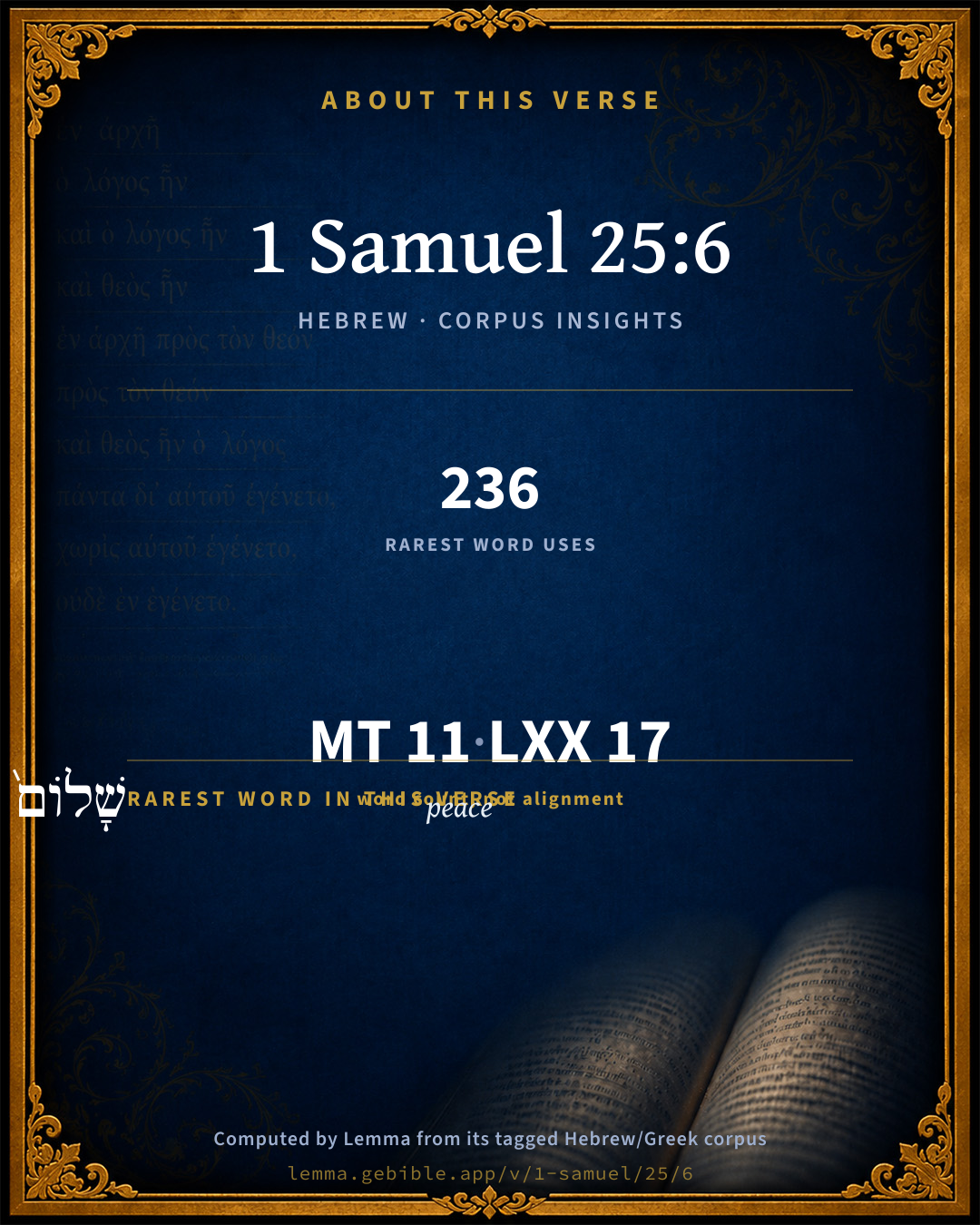
11
words
8
distinct lemmas
Historical
section

Grammatical profile

  • 1 verb
  • 5 nouns
  • 1 adjective
  • 1 pronoun
  • 1 preposition
  • 1 adverb
  • 1 particle

Verb forms

  • וַאֲמַרְתֶּ֥ם Qal · Sequential Perfect

Repetition

A word recurs within this verse — often emphatic in Hebrew:

  • שָׁלוֹם֙ peace H7965 ×3

Hebrew & Septuagint length

In English translation the verse runs 28 words from the Hebrew and 18 from the Septuagint (LXX English) — the Septuagint runs noticeably shorter here. See the side-by-side →

A rough comparison of the two English renderings, which tokenize alike — not a word-level alignment.

Word counts can differ between the Hebrew and the Greek without any difference in meaning — e.g. the Hebrew direct-object marker אֵת has no separate Greek word, and Greek often adds the article ὁ.

In the original languages it is 11 Hebrew tokens and 17 Greek tokens — but the two are counted differently (Hebrew bundles its prefixes and suffixes into one token; the Greek is in lemma form), so that isn’t a like-for-like length.

Cross-references

9

Topical passages linked to 1 Samuel 25:6 in the Treasury of Scripture Knowledge — connected by theme and wording, ordered by reader-vote popularity; previews shown in the World English Bible.

  • 1 Chronicles 12:18 Then the Spirit came on Amasai, who was chief of the thirty, [and he said], "We are yours, David, and on your side, you son of Jesse: peace, peace be to you, and peace be to your helpers; for your God helps you." Then David received them, and made them captains of the band.
  • Psalms 122:7 Peace be within your walls, And prosperity within your palaces.
  • Luke 10:5 Into whatever house you enter, first say, 'Peace be to this house.'
  • 1 Timothy 5:6 But she who gives herself to pleasure is dead while she lives.
  • Matthew 10:12–13 As you enter into the household, greet it.
  • John 14:27 Peace I leave with you. My peace I give to you; not as the world gives, give I to you. Don't let your heart be troubled, neither let it be fearful.
  • 2 Thessalonians 3:16 Now may the Lord of peace himself give you peace at all times in all ways. The Lord be with you all.
  • 2 Samuel 18:28 Ahimaaz called, and said to the king, All is well. He bowed himself before the king with his face to the earth, and said, Blessed be Yahweh your God, who has delivered up the men who lifted up their hand against my lord the king.

Cross-references courtesy of OpenBible.info (CC BY 4.0).

Hebrew and Greek witnesses Masoretic Hebrew ↔ Greek Septuagint

The same verse in the two great witnesses to the Old Testament, shown verse-for-verse.

Here the Septuagint runs noticeably shorter than the Hebrew — LXX2012 (modern English Septuagint) 18 words vs World English Bible 28. A rough length comparison of the two English translations, not a word-level alignment — read both below.

These are two independent witnesses, not word-aligned to each other, and the Septuagint is shown in lemma (dictionary) form.

Hebrew 1 Samuel 25:6 Masoretic · Westminster Leningrad Codex

וַאֲמַרְתֶּ֥ם כֹּ֖ה לֶחָ֑י וְאַתָּ֤ה שָׁלוֹם֙ וּבֵיתְךָ֣ שָׁל֔וֹם וְכֹ֥ל אֲשֶׁר לְךָ֖ שָׁלֽוֹם

and thus shall you tell him who lives [in prosperity], Peace be to you, and peace be to your house, and peace be to all that you have.

World English Bible · Public Domain

Greek LXX 1 Samuel 25:6 Septuagint · lemma form

καί εἶπον ὅδε εἰς ὥρα καί σύ ὑγιαίνω καί ὁ οἶκος σύ καί πᾶς ὁ σός ὑγιαίνω

And thus shall you⌃ say, May you and your house seasonably prosper, and all yours be in prosperity.

LXX2012 (modern English Septuagint) · Public Domain

On this verse, Ellicott's Commentary for English Readers discusses the Septuagint’s reading. Read the note in Commentary ↓

Hebrew: Westminster Leningrad Codex (CC BY 4.0). Greek: Septuagint (public domain); English from LXX2012 (modern English Septuagint) (Public Domain). How the Septuagint differs from the Hebrew →

Targum (Aramaic paraphrase)

1

The Targum is the ancient Jewish Aramaic paraphrase of the Hebrew Scriptures — an interpretive translation, not the Hebrew text itself. Onkelos (literal) and Pseudo-Jonathan (expansive) render the Torah, and Jonathan the Prophets. Coverage is partial: where no permissively-licensed English translation exists for a verse, only the Aramaic is shown. This is verse-level text, not a word-by-word alignment to the Hebrew.

  1. Targum Jonathan Prophets (Joshua–Malachi)
    וְתֵימְרוּן כְּדֵין לְחַיָךְ וְאַתְּ שְׁלָם וּבֵיתָךְ שְׁלָם וְכָל דִילָךְ שְׁלָם:

    (no public-domain English translation for this verse)

    Targum Jonathan — Aramaic: “Mikraot Gedolot” (public domain). English: “Sefaria Community Translation” (CC0 1.0 (public-domain dedication)); “London "Chaldee Paraphrase," 1871” (public domain). Text via Sefaria.

Commentary

Notes on 1 Samuel 25:6 from classic Christian and Jewish commentators (each source and its license shown beneath its notes). The classic Christian expositions comment on the surrounding passage and are grouped to its opening verse, so a note may address several verses; the Jewish commentaries on the Tanakh (Rashi and others) are per-verse, so they appear only where the commentator wrote on this verse.

Lemma curates 59 commentaries, every one of them public domain or Creative Commons licensed, each selected and text-cleaned for this edition rather than reprinted as found. About our sources →

Trapp's Complete Commentary

John Trapp

1Sa 25:6 And thus shall ye say to him that liveth [in prosperity], Peace [be] both to thee, and peace [be] to thine house, and peace [be] unto all that thou hast.

Ver. 6. And thus shall ye say to him that liveth.] Rich men only seem to live, - the Irish ask such what they meant to die; - poor people are reckoned among the dead, as it were; there is little account made of them, they stand for ciphers and shadows.

John Trapp, A Commentary or Exposition upon All the Books of the Old and New Testament (1647–1656) — public domain. Text from a community e-Sword module.

Geneva Bible (1599)

Geneva Bible translators

Hebrew, for life.

Some read, so mayest thou live in prosperity the next year, both thou, etc.

Geneva Bible (1599) marginal notes — public domain. Text via Bolls.life.

Adam Clarke's Commentary

Verse 6. Peace be both to thee] This is the ancient form of sending greetings to a friend: Peace to THEE, peace to thy HOUSEHOLD, and peace to all that THOU HAST. That is, May both thyself, thy family, and all that pertain unto thee, be in continual prosperity!

Perhaps David, by this salutation, wished Nabal to understand that he had acted so towards him and his property that nothing had been destroyed, and that all had been protected; see 1Sa 25:15-17.

Adam Clarke's Commentary on the Bible (1810–1826) — public domain. Text from a community e-Sword/MySword module.

Ellicott's Commentary for English Readers

(6) And thus shall ye say.—On such a festive occasion near a town or village, an Arab sheik of the neighbouring desert would hardly fail to put in a word, either in person or by message; and his message, both in form and substance, would be only the transcript of that of David.—Robinson, Palestine, p. 201.

To him that liveth in prosperity.—Considerable diversity of opinion exists as to the meaning of the Hebrew original here, lechai. The Vulg. alters the text slightly, and renders “to my brother.” The LXX. have an impossible translation—“eis horas,” for times, or for seasons. It is better, however, to take it as a popular expression of congratulation, not found, as Lange well puts it, in the literary language. So Luther, “glück auf,” “may it turn out well,” “may you be prosperous.” The famous Hebrew commentator Raschi, and also the Babylonian Talmud, apparently understand it in this sense.

A Bible Commentary for English Readers, edited by Charles John Ellicott (1878–1897) — public domain. Text from a community e-Sword module.

The Cambridge Bible for Schools and Colleges

gen. ed. J. J. S. Perowne

6. to him that liveth in prosperity] The meaning of the single Heb. word thus rendered is exceedingly obscure. It seems best to explain it as an exclamation, “Hail!” literally, “For life!”

The Cambridge Bible for Schools and Colleges (gen. ed. J. J. S. Perowne; Cambridge University Press, 1878–1918) — public domain. Text from a community e-Sword module.

John Gill's Exposition

And thus shall ye say to him that liveth in prosperity,.... That lives, while others, as David and his men, might be rather said to starve than live; they lived in great meanness, but he in great abundance, and therefore in a capacity to give to others, and particularly to relieve them: or the sense is, they should say to him, "thus" shall it be, or may it be "for life": for the time of life, for the year to come; at this time next year, at next sheep shearing, mayest thou be in as great prosperity then as now, and even all the days of thy life:

peace be both to thee, and peace be to thine house, and peace be unto all that thou hast; that is, all prosperity to thy person in soul and body, to thy family, wife, children and servants, and let the same attend thy estate, cattle, farms, fields, vineyards, and all that belong to thee; and wish for a blessing on him, and his, and all that were his, or he had; a more extensive one could not well be made.

John Gill's Exposition of the Whole Bible (1746–1763) — public domain (CC PDM 1.0). Text via the HelloAO Bible API.

Albert Barnes' Notes on the Bible

That liveth in prosperity - The Hebrew is obscure, and is variously interpreted. The simplest rendering is, “And ye shall say thus about (his) life,” i. e., with reference to his life, health, circumstances, etc.

Albert Barnes' Notes on the Bible (1834–1885) — public domain. Text from a community e-Sword/MySword module.

Matthew Poole's English Annotations

To him that liveth in prosperity, Heb. to him that liveth. Life is oft put for a prosperous and happy life, as in that prayer, Let the king live, 1Sa 10:24; 1Ki 1:25, and in other passages of Scripture, and other authors; for an afflicted and calamitous life is unworthy of the name of life, and is esteemed a kind of death, and oft so called, as 2Co 1:10; 11:23. By this expression David both congratulates Nabal’s felicity, and tacitly minds him of the penury and distress in which David and his men now were.

To thine house, i.e. to all thy family.

Unto all that thou hast; to all thy goods. So David’s prayer is very comprehensive, reaching to his soul, and body, and wife, and children, and servants, and all his estate.

Matthew Poole's English Annotations on the Holy Bible (1683–1685) — public domain. Text from a community e-Sword/MySword module.

Whedon's Commentary on the Bible

Daniel D. Whedon

6. That liveth in prosperity — It is better to regard the word לחיas a salutation, For life! that is, Health! Prosperity! Then render: Thus shall ye say, Health! Peace be both to thee, etc.

Daniel D. Whedon (gen. ed.), Commentary on the Old and New Testaments (1874–1909) — public domain. Text from a community e-Sword module.

The Pulpit Commentary

Vers. 6-8. Say to him that liveth in prosperity. The Hebrew is obscure, but the rendering of the A.V is untenable, and also very tame. Literally it is, "Ye shall say to him, For life!" Probably it was a colloquial form of greeting, and equivalent to "good luck, "success," life in Hebrew being sometimes used for prosperity. So Luther translates it, and Rashi and the Babylonian Talmud are also in its favour. The reading of the Vulgate, "To thy brothers" (be peace), is to be altogether rejected. We hurt them not. Literally, "we caused them no shame", (see Jud_1:18:7) we did nothing to vex and injure them. Really the words mean that David had protected them, and enabled them to feed their flocks in safety. The fact that David waited till the sheep shearing, when hospitality was the rule, proves that he did not levy blackmail upon his countrymen, though necessarily he must have depended upon them for the food indispensabIe for the support of his men. A good day. Ie. a festive day, which should bring us a share in thy prosperity. Thy son David. A title expressive of the reverence due from the youthful David to his senior, and an acknowledgment of Nabal"s superiority over his fugitive neighbour.

The Pulpit Commentary (1880–1919), ed. H.D.M. Spence-Jones & Joseph S. Exell — public domain. Text from a community e-Sword module.

John Wesley's Explanatory Notes

Prosperity - By this expression David both congratulates Nabal's felicity, and tacitly minds him of the distress in which he and his men were.

John Wesley, Explanatory Notes Upon the Whole Bible (1754–1765) — public domain. Text via the GEBible commentary corpus.

Rashi

Rabbi Shlomo Yitzchaki (Rashi)

So. So will he be [shearing] in the coming year. So shall be in the coming year, living and enduring.) Another version is: So to the living. Say this concerning his meal and his wine that you will see, "So is befitting a live man, i.e., an active and esteemed man," as in "…was a live man of many heroic deeds," [i.e.] alive and active in all his deeds.

May it always be so. Good and enduring.

Peace unto you… So shall it be for a long time.

Rashi on the Tanakh — English translations: “The Judaica Press complete Tanach with Rashi, translated by A. J. Rosenberg” (CC BY 4.0); “Pentateuch with Rashi's commentary by M. Rosenbaum and A.M. Silbermann, 1929-1934” (public domain); “The Metsudah Tanach series, Lakewood, N.J” (CC BY 4.0); and “The Book of Joshua, Metsudah Publications, 1997” (CC BY 4.0). Text via Sefaria.

Lesson kit

Teaching starters — assembled from the data on this page, not authored interpretation. Every prompt links to the verse data it draws on. Edit before teaching.

1 Samuel, in the Historical, opens this verse with 11 words (8 distinct Hebrew lemmas). Its most distinctive word is shâlôwm (“peace”). The Greek Septuagint runs shorter here. A historical commentator’s framing appears above. Read the whole chapter for the surrounding context.

Discussion questions

  1. What does “peace” (shâlôwm) contribute to the verse as a whole?
  2. How does 1 Chronicles 12:18, which shares this passage’s theme, read alongside this verse?
  3. What does the repetition of “peace” (3× in this one verse) do in this verse?
  4. The Septuagint runs shorter here than the Hebrew. What might account for the difference?
  5. The translations on this page render this verse differently — a whole-verse word diff, not a word-by-word alignment. What might account for the different wordings?
  6. «וַאֲמַרְתֶּ֥ם» is a Qal Sequential Perfect verb. How does that grammatical form shape the action described?
  7. Compare how Trapp's Complete Commentary and Geneva Bible (1599) read this verse. Where do they agree or differ?

Things to notice

Reading settings

Reading text

Shown beneath each verse's original-language words.

Old Testament
Old Testament edition

Read the OT as the Masoretic Hebrew (MT) or the Greek Septuagint (LXX).

English shown for the Greek Septuagint (in the Hebrew ↔ Greek comparison).

Comparing translations? Open the Compare panel on any verse page to stack up to four side by side.