1 Kings 22:28

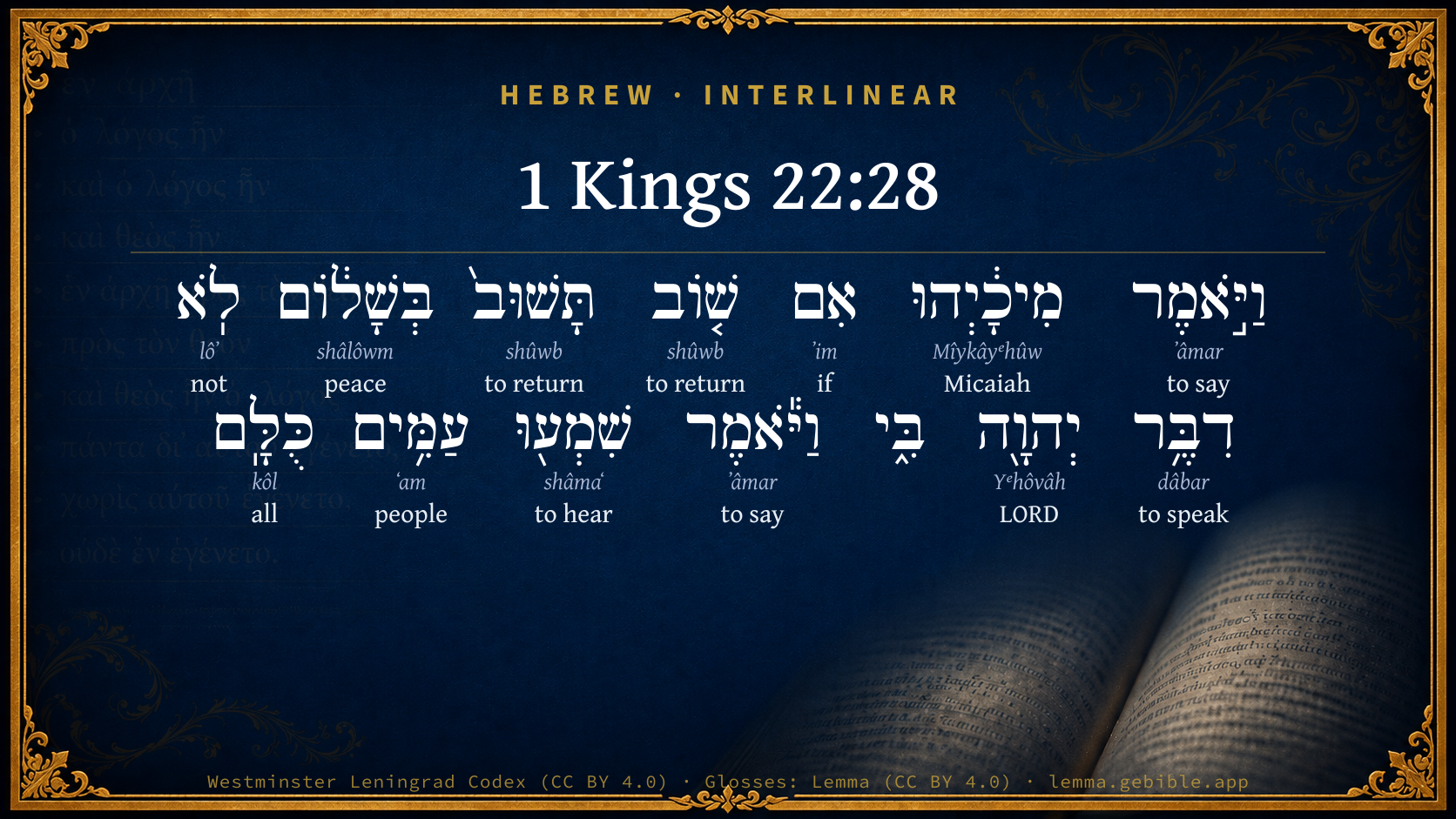
Hebrew (Westminster Leningrad Codex) 1 Kings 22:28 appears in the Hebrew Old Testament. The text above is from the Westminster Leningrad Codex. Each word links to its Strong’s number, a concise gloss, and parsing drawn from the Open Scriptures Hebrew Bible morphology. Click any word for its full Brown-Driver-Briggs (BDB) entry.
Download image
Cite this verse

1 Kings 22:28 (World English Bible). Public Domain. Lemma interlinear Bible study tool, https://lemma.gebible.app/v/1-kings/22/28.

Show BibTeX & RIS
BibTeX
RIS
English Translation
Micaiah said, If you return at all in peace, Yahweh has not spoken by me. He said, Hear, you peoples, all of you.
World English Bible · Public Domain
Download a study sheet

One document with this verse’s original text, its word-by-word gloss line, the meaning frame, cross-references with their text, attributed commentary, and full source and license credits — printable, and it pastes into notes with its structure intact.

This verse Autodidact and up

Study sheet (.html) Plain text (.txt)

A passage Seminary Student

Up to 50 verses in one chapter. A passage sheet keeps up to 6 commentary sources and 12 cross-references per verse, in the order this page ranks them, and says so on the sheet whenever that leaves anything out. Ask for a single verse and you get the Autodidact verse sheet above.

Everything on this page stays free to read, with no account — the sheet is a download of what is already on screen, not access to it.

Want to remove ads? Support Godless Engineer
Compare translations 3

The same verse in 3 English versions, stacked beneath the original-language interlinear above. Click any original word for its lexicon entry.

Each is an independent rendering of the whole verse — the interlinear is not word-aligned to these translations.

Highlighted words mark where these versions differ — a whole-verse word diff, not a word-by-word alignment.

  • World English Bible Public Domain
    Micaiah said, If you return at all in peace, Yahweh has not spoken by me. He said, Hear, you peoples, all of you.
  • King James Version Public Domain
    And Micaiah said, If thou return at all in peace, the LORD hath not spoken by me. And he said, Hearken, O people, every one of you.
  • unfoldingWord Literal Text CC BY-SA 4.0
    And Micaiah said, “If returning, you return in peace, Yahweh has not spoken by me.” And he said, “Listen, peoples, all of them!”

unfoldingWord Literal Text — © unfoldingWord, licensed CC BY-SA 4.0. Word-aligned USFM3 via Door43 (git.door43.org/unfoldingWord/en_ult).

Versions to compare (up to 4)

3 of 4 selected

Show all 18 translations

Every available English version of this verse, each an independent rendering of the whole verse.

  • World English Bible Public Domain
    Micaiah said, If you return at all in peace, Yahweh has not spoken by me. He said, Hear, you peoples, all of you.
  • Berean Standard Bible Public Domain
    But Micaiah replied, “If you ever return safely, the LORD has not spoken through me.” Then he added, “Take heed, all you people!”
  • Majority Standard Bible Public Domain
    But Micaiah replied, “If you ever return safely, the LORD has not spoken through me.” Then he added, “Take heed, all you people!”
  • King James Version Public Domain
    And Micaiah said, If thou return at all in peace, the LORD hath not spoken by me. And he said, Hearken, O people, every one of you.
  • American Standard Version (1901) Public Domain
    And Micaiah said, If thou return at all in peace, Jehovah hath not spoken by me. And he said, Hear, ye peoples, all of you.
  • Revised Version (1885) Public Domain
    And Micaiah said, If thou return at all in peace, the LORD hath not spoken by me. And he said, Hear, ye peoples, all of you.
  • Geneva Bible (1599) Public Domain
    And Michaiah sayde, If thou returne in peace, the Lord hath not spoken by me. And he sayd, Hearken all ye people.
  • Douay-Rheims (1899) Public Domain
    And Micheas said: If thou return in peace, the Lord hath not spoken by me. And he said: Hear, all ye people.
  • Young's Literal Translation Public Domain
    And Micaiah saith, `If thou at all return in peace -- Jehovah hath not spoken by me;' and he saith, `Hear, O peoples, all of them.'
  • Literal Standard Version CC BY-SA 4.0
    And Micaiah says, “If you return in peace at all, YHWH has not spoken by me”; and he says, “Hear, O peoples, all of them.”
  • Unlocked Literal Bible CC BY-SA 4.0
    Then Micaiah said, “If you return safely, then Yahweh has not spoken by me.” Then he added, “Listen to this, all you people.”
  • unfoldingWord Literal Text CC BY-SA 4.0
    And Micaiah said, “If returning, you return in peace, Yahweh has not spoken by me.” And he said, “Listen, peoples, all of them!”
  • Darby Bible Public Domain
    And Micah said, If thou return at all in peace, Jehovah has not spoken by me. And he said, Hearken, O peoples, all of you!
  • World Messianic Bible Public Domain
    Micaiah said, “If you return at all in peace, the LORD has not spoken by me.” He said, “Listen, all you people!”
  • Webster's Bible Public Domain
    And Micaiah said, If thou shalt return at all in peace, the LORD hath not spoken by me. And he said, Hearken, O people, every one of you.
  • Free Bible Version CC BY-SA 4.0
    “If you do in fact return safely then the Lord has not spoken through me,” Micaiah declared. “Pay attention everyone to all I've said!”
  • Bible in Basic English Public Domain
    And Micaiah said, If you come back at all in peace, the Lord has not sent his word by me.
  • JPS Tanakh (1917) Public Domain
    And Micaiah said: 'If thou return at all in peace, the LORD hath not spoken by me.' And he said: 'Hear, ye peoples, all of you.'

Literal Standard Version (2020), Covenant Press — licensed CC BY-SA 4.0. Text via the HelloAO Bible API (eBible.org). Unlocked Literal Bible (unfoldingWord) — licensed CC BY-SA 4.0. Text via the HelloAO Bible API (eBible.org). unfoldingWord Literal Text — © unfoldingWord, licensed CC BY-SA 4.0. Word-aligned USFM3 via Door43 (git.door43.org/unfoldingWord/en_ult). Free Bible Version, Dr. Jonathan Gallagher — licensed CC BY-SA 4.0. Text via the HelloAO Bible API (eBible.org).

Word by word

More ways to search: Search by grammar → Find every occurrence → Compare this word →

Practice this passage: Drill this verse → Learn its vocabulary →

מִיכָ֔יְהוּ
Mîykâyᵉhûw
H4321
“Micaiah”
Noun, Proper
Part of Speech
Noun
Type
Proper
Full BDB Definition

Origin: abbrev. for H4322

TWOT: None

Micah or Micaiah or Michaiah = "who is like God" - an Ephraimite during the period of the judges - son of Imlah and a prophet of Samaria who predicted the defeat and death of king Ahab of Israel - son of Gemariah in the time of Jeremiah
  1. וַיֹּ֣אמֶר ʼâmar H559 “and · to say” Conjunction + Verb, Qal, Sequential Imperfect, 3rd Person, Masculine, Singular
  2. אִם ʼim H518 “if” Conjunction
  3. שׁ֤וֹב shûwb H7725 “to return” Verb, Qal, Infinitive Absolute
  4. תָּשׁוּב֙ shûwb H7725 “to return” Verb, Qal, Imperfect, 2nd Person, Masculine, Singular
  5. בְּשָׁל֔וֹם shâlôwm H7965 “in/at · peace” Preposition + Noun, Common, Masculine, Singular, Absolute
  6. לֹֽא lôʼ H3808 “not” Particle, Negative
  7. דִבֶּ֥ר dâbar H1696 “to speak” Verb, Piel, Perfect, 3rd Person, Masculine, Singular
  8. יְהוָ֖ה Yᵉhôvâh H3068 “LORD” Noun, Proper
  9. וַיֹּ֕אמֶר ʼâmar H559 “and · to say” Conjunction + Verb, Qal, Sequential Imperfect, 3rd Person, Masculine, Singular
  10. שִׁמְע֖וּ shâmaʻ H8085 “hear” Verb, Qal, Imperative, 2nd Person, Masculine, Plural
  11. עַמִּ֥ים ʻam H5971 “peoples” Noun, Common, Masculine, Plural, Absolute
  12. כֻּלָּֽם kôl H3605 “all · their” Noun, Common, Masculine, Singular, Construct + Suffix, Personal, 3rd Person, Masculine, Plural

About this verse

These counts appear in no published source. They are computed here, from the morphology-tagged text and Lemma’s own curated glosses. What Lemma adds →

14
words
11
distinct lemmas
Historical
section

Notable vocabulary

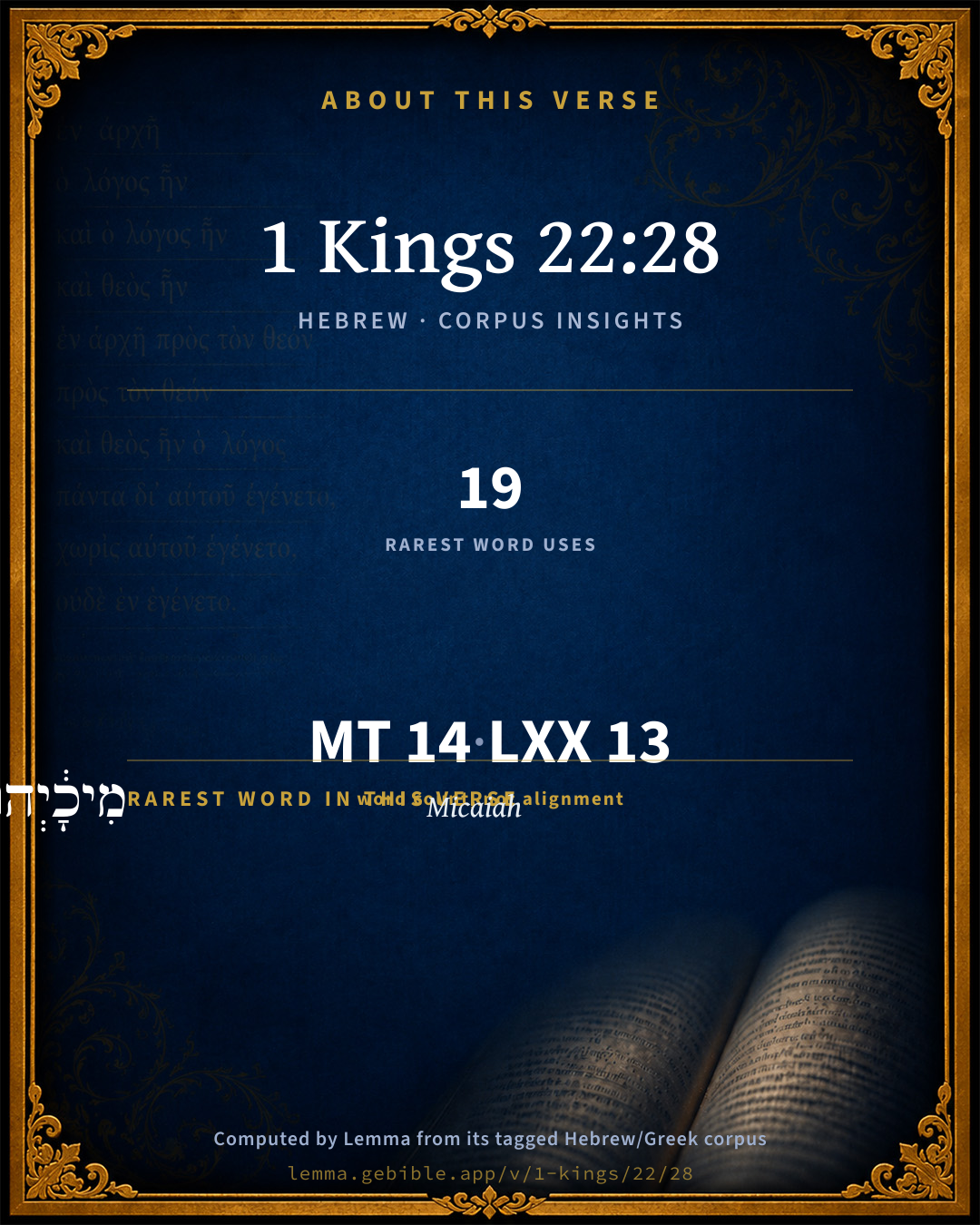
The rarest word here is מִיכָ֔יְהוּ Micaiah H4321 — appearing just 19 times in the whole Hebrew Bible.

Shared distinctive vocabulary

מִיכָ֔יְהוּ Micaiah H4321 occurs in 19 verses of the Hebrew Bible. Also found in:

Grammatical profile

  • 6 verbs
  • 5 nouns
  • 1 preposition
  • 1 conjunction
  • 1 particle

Verb forms

  • וַיֹּ֣אמֶר Qal · Sequential Imperfect
  • שׁ֤וֹב Qal · Infinitive Absolute
  • תָּשׁוּב֙ Qal · Imperfect
  • דִבֶּ֥ר Piel · Perfect
  • וַיֹּ֕אמֶר Qal · Sequential Imperfect
  • שִׁמְע֖וּ Qal · Imperative

Repetition

Words recur within this verse — often emphatic in Hebrew:

  • וַיֹּ֣אמֶר to say H559 ×2
  • שׁ֤וֹב to return H7725 ×2

Hebrew & Septuagint length

In English translation the verse runs 23 words from the Hebrew and 17 from the Septuagint (LXX English) — closely comparable.

A rough comparison of the two English renderings, which tokenize alike — not a word-level alignment.

Word counts can differ between the Hebrew and the Greek without any difference in meaning — e.g. the Hebrew direct-object marker אֵת has no separate Greek word, and Greek often adds the article ὁ.

In the original languages it is 14 Hebrew tokens and 13 Greek tokens — but the two are counted differently (Hebrew bundles its prefixes and suffixes into one token; the Greek is in lemma form), so that isn’t a like-for-like length.

Cross-references

14

Topical passages linked to 1 Kings 22:28 in the Treasury of Scripture Knowledge — connected by theme and wording, ordered by reader-vote popularity; previews shown in the World English Bible.

  • Numbers 16:29 If these men die the common death of all men, or if they be visited after the visitation of all men; then Yahweh hasn't sent me.
  • Micah 1:2 Hear, you peoples, all of you. Listen, O earth, and all that is therein: And let the Lord Yahweh be witness against you, The Lord from his holy temple.
  • Mark 12:37 Therefore David himself calls him Lord, so how can he be his son?" The common people heard him gladly.
  • Acts 13:10–11 and said, "Full of all deceit and all cunning, you son of the devil, you enemy of all righteousness, will you not cease to pervert the right ways of the Lord?
  • Deuteronomy 18:20–22 But the prophet, who shall speak a word presumptuously in my name, which I have not commanded him to speak, or who shall speak in the name of other gods, that same prophet shall die.
  • 1 Kings 18:21–24 Elijah came near to all the people, and said, "How long will you waver between the two sides? If Yahweh is God, follow him; but if Baal, then follow him." The people answered him not a word.
  • 1 Kings 18:36–37 It happened at the time of the offering of the [evening] offering, that Elijah the prophet came near, and said, Yahweh, the God of Abraham, of Isaac, and of Israel, let it be known this day that you are God in Israel, and that I am your servant, and that I have done all these things at your word.
  • 2 Kings 1:10 Elijah answered to the captain of fifty, If I be a man of God, let fire come down from the sky, and consume you and your fifty. Fire came down from the sky, and consumed him and his fifty.
  • 2 Kings 1:12 Elijah answered them, If I be a man of God, let fire come down from the sky, and consume you and your fifty. The fire of God came down from the sky, and consumed him and his fifty.
  • 2 Chronicles 18:27 Micaiah said, If you return at all in peace, Yahweh has not spoken by me. He said, Hear, you peoples, all of you.
  • Isaiah 44:26 who confirms the word of his servant, and performs the counsel of his messengers; who says of Jerusalem, She shall be inhabited; and of the cities of Judah, They shall be built, and I will raise up the waste places of it;
  • Jeremiah 28:8–9 The prophets who have been before me and before you of old prophesied against many countries, and against great kingdoms, of war, and of evil, and of pestilence.
  • Amos 3:1 Hear this word that Yahweh has spoken against you, children of Israel, against the whole family which I brought up out of the land of Egypt, saying:
  • Mark 7:14–15 He called all the multitude to himself, and said to them, "Hear me, all of you, and understand.

Cross-references courtesy of OpenBible.info (CC BY 4.0).

Hebrew and Greek witnesses Masoretic Hebrew ↔ Greek Septuagint

The same verse in the two great witnesses to the Old Testament, shown verse-for-verse.

These are two independent witnesses, not word-aligned to each other, and the Septuagint is shown in lemma (dictionary) form.

Hebrew 1 Kings 22:28 Masoretic · Westminster Leningrad Codex

וַיֹּ֣אמֶר מִיכָ֔יְהוּ אִם שׁ֤וֹב תָּשׁוּב֙ בְּשָׁל֔וֹם לֹֽא דִבֶּ֥ר יְהוָ֖ה בִּ֑י וַיֹּ֕אמֶר שִׁמְע֖וּ עַמִּ֥ים כֻּלָּֽם

Micaiah said, If you return at all in peace, Yahweh has not spoken by me. He said, Hear, you peoples, all of you.

World English Bible · Public Domain

Greek LXX 1 Kings 22:28 Septuagint · lemma form

καί εἶπον μιχαιας ἐάν ἐπιστρέφω ἐπιστρέφω ἐν εἰρήνη οὐ λαλέω κύριος ἐν ἐγώ

And Michaias said, If you return at all in peace, the Lord has not spoken by me.

LXX2012 (modern English Septuagint) · Public Domain

On this verse, Ellicott's Commentary for English Readers discusses the Septuagint’s reading. Read the note in Commentary ↓

Hebrew: Westminster Leningrad Codex (CC BY 4.0). Greek: Septuagint (public domain); English from LXX2012 (modern English Septuagint) (Public Domain). How the Septuagint differs from the Hebrew →

Targum (Aramaic paraphrase)

1

The Targum is the ancient Jewish Aramaic paraphrase of the Hebrew Scriptures — an interpretive translation, not the Hebrew text itself. Onkelos (literal) and Pseudo-Jonathan (expansive) render the Torah, and Jonathan the Prophets. Coverage is partial: where no permissively-licensed English translation exists for a verse, only the Aramaic is shown. This is verse-level text, not a word-by-word alignment to the Hebrew.

  1. Targum Jonathan Prophets (Joshua–Malachi)
    וַאֲמַר מִיכָיְהוּ אִם מֵיתַב תְּתוּב בִּשְׁלָם לָא רַעֲוָא קֳדָם יְיָ בִּי וַאֲמַר שְׁמָעוּ עַמְמַיָא כּוּלְהוֹן:

    (no public-domain English translation for this verse)

    Targum Jonathan — Aramaic: “Mikraot Gedolot” (public domain). English: “Sefaria Community Translation” (CC0 1.0 (public-domain dedication)); “London "Chaldee Paraphrase," 1871” (public domain). Text via Sefaria.

Commentary

Notes on 1 Kings 22:28 from classic Christian and Jewish commentators (each source and its license shown beneath its notes). The classic Christian expositions comment on the surrounding passage and are grouped to its opening verse, so a note may address several verses; the Jewish commentaries on the Tanakh (Rashi and others) are per-verse, so they appear only where the commentator wrote on this verse.

Lemma curates 59 commentaries, every one of them public domain or Creative Commons licensed, each selected and text-cleaned for this edition rather than reprinted as found. About our sources →

Trapp's Complete Commentary

John Trapp

1Ki 22:28 And Micaiah said, If thou return at all in peace, the LORD hath not spoken by me. And he said, Hearken, O people, every one of you.

Ver. 28. If thou return all in peace.] "The hope of unjust men perisheth": {Pro 11:7} Etiam spes valentissima perit, as some render that text: Julian, for instance, when he went out to war against the Persians, breathing out threatenings against the Christians at his return, which was never. And that French king who promised to see with his eyes Anne du Bourg, martyr, burned, had, before that time, one of his eyes thrust out at the jousts, of which wound he died. {a}

{a} Ibid., 1914.

John Trapp, A Commentary or Exposition upon All the Books of the Old and New Testament (1647–1656) — public domain. Text from a community e-Sword module.

Joseph Benson's Commentary

1Ki 22:28. Micaiah said, If thou return, &c., the Lord hath not spoken by me — Let me incur the reproach and punishment of a false prophet; and he — Namely, Micaiah; said, Hearken, O people, every one of you — Knowing in whom he had believed, and being fully assured of the truth of his prophecy, he calls all the people to be witnesses of it.

Joseph Benson's Commentary on the Old and New Testaments (1811–1818) — public domain. Text from a community e-Sword module.

Geneva Bible (1599)

Geneva Bible translators

That when ye shall see these things come to pass, ye may give God the glory, and know that I am his true Prophet.

Geneva Bible (1599) marginal notes — public domain. Text via Bolls.life.

Ellicott's Commentary for English Readers

(28) Hearken, O people.—It is a curious coincidence that these are the opening words of the prophetic Book of Micah. They are not found in some MSS. of the LXX., and are supposed by some to be an early interpolation in this passage from that book.

A Bible Commentary for English Readers, edited by Charles John Ellicott (1878–1897) — public domain. Text from a community e-Sword module.

The Cambridge Bible for Schools and Colleges

gen. ed. J. J. S. Perowne

28. Hearken, O people, every one of you] R.V. Hear, ye peoples, all of you. This sentence is omitted by the LXX. as are also the words ‘And he said’ which precede. In consequence it has been thought that they are no part of the original text, but a marginal note of a later time, which some one put down to shew that the Micaiah here spoken of was the same with Micah the author of the prophecy. For that prophecy (Mic_1:2) opens with this same sentence, and beside this, in 2Ch_18:14 the name Micah occurs in the text for Micaiah. No one however thinks that Micah the prophet lived in Ahab’s days. The R.V. however very properly translates in both places by the same English. For it may be that Micah at his opening took up the burden with which the Scripture record of Micaiah closes.

The plural rendered ‘peoples’ is very frequent in the O. Test., and the R.V. has introduced this rendering commonly. It signifies sometimes the various nations of the world at large, but often, as here, the tribes of Israel. Cf. Gen_49:10; Deu_32:8, &c.

The Cambridge Bible for Schools and Colleges (gen. ed. J. J. S. Perowne; Cambridge University Press, 1878–1918) — public domain. Text from a community e-Sword module.

John Gill's Exposition

And it came to pass, when the captains of the chariots saw Jehoshaphat,.... In his royal robes:

that they said, surely it is the king of Israel; for they might not know the persons either of Ahab or him, but judged by his habit:

and they turned aside to fight against him; pressed upon him with all their force, either to take him or slay him:

and Jehoshaphat cried out; with a loud voice, either to the captains to let them know who he was, or to his men to come to his assistance, or rather to God to help and deliver him; since it is said in Ch2 18:31 that the Lord helped him, and moved or inclined the hearts of the captains to depart from him, as it follows here.

John Gill's Exposition of the Whole Bible (1746–1763) — public domain (CC PDM 1.0). Text via the HelloAO Bible API.

Matthew Poole's English Annotations

The Lord hath not spoken by me; I acknowledge myself to be an impostor, and to deserve death.

He said, i.e. Micaiah, the person last named, being assured of the truth of his prophecy, calls all the people to be witnesses of it.

Matthew Poole's English Annotations on the Holy Bible (1683–1685) — public domain. Text from a community e-Sword/MySword module.

The Pulpit Commentary

And Micaiah said, If thou return at all in peace, the Lord hath not spoken by me. And he said, Hearken, O people Rather, O nations. Audite, populi crones, Vulgate. He appeals, so to speak, to the world, every one of you. It is a curious circumstance that these same words are found at the beginning of the prophecy of Micah. (1Ki_1:2) The coincidence may be purely accidental, or the words may have been borrowed by the prophet, not, indeed, from our historian, but from some record, the substance of which is embodied in this history. Micah lived about a century and a half after Micaiah; about a century before the Book of Kings was given to the world.

The Pulpit Commentary (1880–1919), ed. H.D.M. Spence-Jones & Joseph S. Exell — public domain. Text from a community e-Sword module.

Lesson kit

Teaching starters — assembled from the data on this page, not authored interpretation. Every prompt links to the verse data it draws on. Edit before teaching.

1 Kings, in the Historical, opens this verse with 14 words (11 distinct Hebrew lemmas). Its most distinctive word is Mîykâyᵉhûw (“Micaiah”). A historical commentator’s framing appears above. Read the whole chapter for the surrounding context.

Discussion questions

  1. The word Mîykâyᵉhûw carries the sense “Micaiah.” How does it shape the verse?
  2. How does 1 Kings 22:8, which shares the word «Micaiah», read alongside this verse?
  3. What does the repetition of “to say” (2× in this one verse) do in this verse?
  4. The translations on this page render this verse differently — a whole-verse word diff, not a word-by-word alignment. What might account for the different wordings?
  5. «וַיֹּ֣אמֶר» is a Qal Sequential Imperfect verb. How does that grammatical form shape the action described?
  6. Compare how Trapp's Complete Commentary and Joseph Benson's Commentary read this verse. Where do they agree or differ?

Things to notice

Reading settings

Reading text

Shown beneath each verse's original-language words.

Old Testament
Old Testament edition

Read the OT as the Masoretic Hebrew (MT) or the Greek Septuagint (LXX).

English shown for the Greek Septuagint (in the Hebrew ↔ Greek comparison).

Comparing translations? Open the Compare panel on any verse page to stack up to four side by side.