

Jeremiah 29:7

Hebrew (Westminster Leningrad Codex) Jeremiah 29:7 appears in the Hebrew Old Testament. The text above is from the Westminster Leningrad Codex. Each word links to its Strong’s number, a concise gloss, and parsing drawn from the Open Scriptures Hebrew Bible morphology. Click any word for its full Brown-Driver-Briggs (BDB) entry.
Download image
Cite this verse

Jeremiah 29:7 (World English Bible). Public Domain. Lemma interlinear Bible study tool, https://lemma.gebible.app/v/jeremiah/29/7.

Show BibTeX & RIS
BibTeX
RIS
English Translation
Seek the peace of the city where I have caused you to be carried away captive, and pray to Yahweh for it; for in the peace of it shall you have peace.
World English Bible · Public Domain
Download a study sheet

One document with this verse’s original text, its word-by-word gloss line, the meaning frame, cross-references with their text, attributed commentary, and full source and license credits — printable, and it pastes into notes with its structure intact.

This verse Autodidact and up

Study sheet (.html) Plain text (.txt)

A passage Seminary Student

Up to 50 verses in one chapter. A passage sheet keeps up to 6 commentary sources and 12 cross-references per verse, in the order this page ranks them, and says so on the sheet whenever that leaves anything out. Ask for a single verse and you get the Autodidact verse sheet above.

Everything on this page stays free to read, with no account — the sheet is a download of what is already on screen, not access to it.

Want to remove ads? Support Godless Engineer
Compare translations 3

The same verse in 3 English versions, stacked beneath the original-language interlinear above. Click any original word for its lexicon entry.

Each is an independent rendering of the whole verse — the interlinear is not word-aligned to these translations.

Highlighted words mark where these versions differ — a whole-verse word diff, not a word-by-word alignment.

  • World English Bible Public Domain
    Seek the peace of the city where I have caused you to be carried away captive, and pray to Yahweh for it; for in the peace of it shall you have peace.
  • King James Version Public Domain
    And seek the peace of the city whither I have caused you to be carried away captives, and pray unto the LORD for it: for in the peace thereof shall ye have peace.
  • unfoldingWord Literal Text CC BY-SA 4.0
    Seek the peace of the city where I have caused you to be exiled, and intercede with me on its behalf since there will be peace for you if it is at peace.’

unfoldingWord Literal Text — © unfoldingWord, licensed CC BY-SA 4.0. Word-aligned USFM3 via Door43 (git.door43.org/unfoldingWord/en_ult).

Versions to compare (up to 4)

3 of 4 selected

Show all 18 translations

Every available English version of this verse, each an independent rendering of the whole verse.

  • World English Bible Public Domain
    Seek the peace of the city where I have caused you to be carried away captive, and pray to Yahweh for it; for in the peace of it shall you have peace.
  • Berean Standard Bible Public Domain
    Seek the prosperity of the city to which I have sent you as exiles. Pray to the LORD on its behalf, for if it prospers, you too will prosper.”
  • Majority Standard Bible Public Domain
    Seek the prosperity of the city to which I have sent you as exiles. Pray to the LORD on its behalf, for if it prospers, you too will prosper.”
  • King James Version Public Domain
    And seek the peace of the city whither I have caused you to be carried away captives, and pray unto the LORD for it: for in the peace thereof shall ye have peace.
  • American Standard Version (1901) Public Domain
    And seek the peace of the city whither I have caused you to be carried away captive, and pray unto Jehovah for it; for in the peace thereof shall ye have peace.
  • Revised Version (1885) Public Domain
    And seek the peace of the city whither I have caused you to be carried away captive, and pray unto the LORD for it: for in the peace thereof shall ye have peace.
  • Geneva Bible (1599) Public Domain
    And seeke the prosperitie of the citie, whither I haue caused you to be caried away captiues, and pray vnto the Lord for it: for in the peace thereof shall you haue peace.
  • Douay-Rheims (1899) Public Domain
    And seek the peace of the city, to which I have caused you to be carried away captives; and pray to the Lord for it: for in the peace thereof shall be your peace.
  • Young's Literal Translation Public Domain
    And seek the peace of the city whither I have removed you, and pray for it unto Jehovah, for in its peace ye have peace.
  • Literal Standard Version CC BY-SA 4.0
    and seek the peace of the city to where I have removed you, and pray to YHWH for it, for in its peace you have peace.
  • Unlocked Literal Bible CC BY-SA 4.0
    Seek the peace of the city where I have caused you to be exiled, and intercede with me on its behalf since there will be peace for you if it is at peace.'
  • unfoldingWord Literal Text CC BY-SA 4.0
    Seek the peace of the city where I have caused you to be exiled, and intercede with me on its behalf since there will be peace for you if it is at peace.’
  • Darby Bible Public Domain
    And seek the peace of the city whither I have caused you to be carried away captive, and pray unto Jehovah for it: for in the peace thereof shall ye have peace.
  • World Messianic Bible Public Domain
    Seek the peace of the city where I have caused you to be carried away captive, and pray to the LORD for it; for in its peace you will have peace.”
  • Webster's Bible Public Domain
    And seek the peace of the city whither I have caused you to be carried away captives, and pray to the LORD for it: for in the peace of it ye shall have peace.
  • Free Bible Version CC BY-SA 4.0
    Help make the city where I've exiled you more prosperous. Pray to the Lord for it, since as it prospers, so will you.
  • Bible in Basic English Public Domain
    And be working for the peace of the land to which I have had you taken away prisoners, and make prayer to the Lord for it: for in its peace you will have peace.
  • JPS Tanakh (1917) Public Domain
    And seek the peace of the city whither I have caused you to be carried away captive, and pray unto the LORD for it; for in the peace thereof shall ye have peace.

Literal Standard Version (2020), Covenant Press — licensed CC BY-SA 4.0. Text via the HelloAO Bible API (eBible.org). Unlocked Literal Bible (unfoldingWord) — licensed CC BY-SA 4.0. Text via the HelloAO Bible API (eBible.org). unfoldingWord Literal Text — © unfoldingWord, licensed CC BY-SA 4.0. Word-aligned USFM3 via Door43 (git.door43.org/unfoldingWord/en_ult). Free Bible Version, Dr. Jonathan Gallagher — licensed CC BY-SA 4.0. Text via the HelloAO Bible API (eBible.org).

Word by word

More ways to search: Search by grammar → Find every occurrence → Compare this word →

Practice this passage: Drill this verse → Learn its vocabulary →

וְהִתְפַּֽלְל֥וּ
pâlal
H6419
“and · pray”
Conjunction + Verb, Hithpael, Imperative, 2nd Person, Masculine, Plural
Part of Speech
Conjunction + Verb
Stem
Hithpael
Form
Imperative
Person
2nd Person
Gender
Masculine
Number
Plural
Full BDB Definition

Origin: a primitive root

TWOT: 1776

to intervene, interpose, pray - (Piel) to mediate, judge - (Hithpael) - to intercede - to pray
  1. וְדִרְשׁ֞וּ dârash H1875 “and · seek” Conjunction + Verb, Qal, Imperative, 2nd Person, Masculine, Plural
  2. אֶת ʼêth H853 “-” Particle, Direct Object
  3. שְׁל֣וֹם shâlôwm H7965 “peace of” Noun, Common, Masculine, Singular, Construct
  4. הָעִ֗יר ʻîyr H5892 “the · city” Particle, Definite Article + Noun, Common, Feminine, Singular, Absolute
  5. אֲשֶׁ֨ר ʼăsher H834 “which” Particle, Relative
  6. הִגְלֵ֤יתִי gâlâh H1540 “to uncover” Verb, Hiphil, Perfect, 1st Person, Common, Singular
  7. אֶתְכֶם֙ ʼêth H853 “- · you” Particle, Direct Object + Suffix, Personal, 2nd Person, Masculine, Plural
  8. שָׁ֔מָּה shâm H8033 “there · toward” Adverb + Suffix, Demonstrative
  9. בַעֲדָ֖הּ bᵉʻad H1157 “behind · her” Preposition + Suffix, Personal, 3rd Person, Feminine, Singular
  10. אֶל ʼêl H413 “to” Preposition
  11. יְהוָ֑ה Yᵉhôvâh H3068 “LORD” Noun, Proper
  12. כִּ֣י kîy H3588 “that” Conjunction
  13. בִשְׁלוֹמָ֔הּ shâlôwm H7965 “in/at · peace · her” Preposition + Noun, Common, Masculine, Singular, Construct + Suffix, Personal, 3rd Person, Feminine, Singular
  14. יִהְיֶ֥ה hâyâh H1961 “to be” Verb, Qal, Imperfect, 3rd Person, Masculine, Singular
  15. שָׁלֽוֹם shâlôwm H7965 “peace” Noun, Common, Masculine, Singular, Absolute

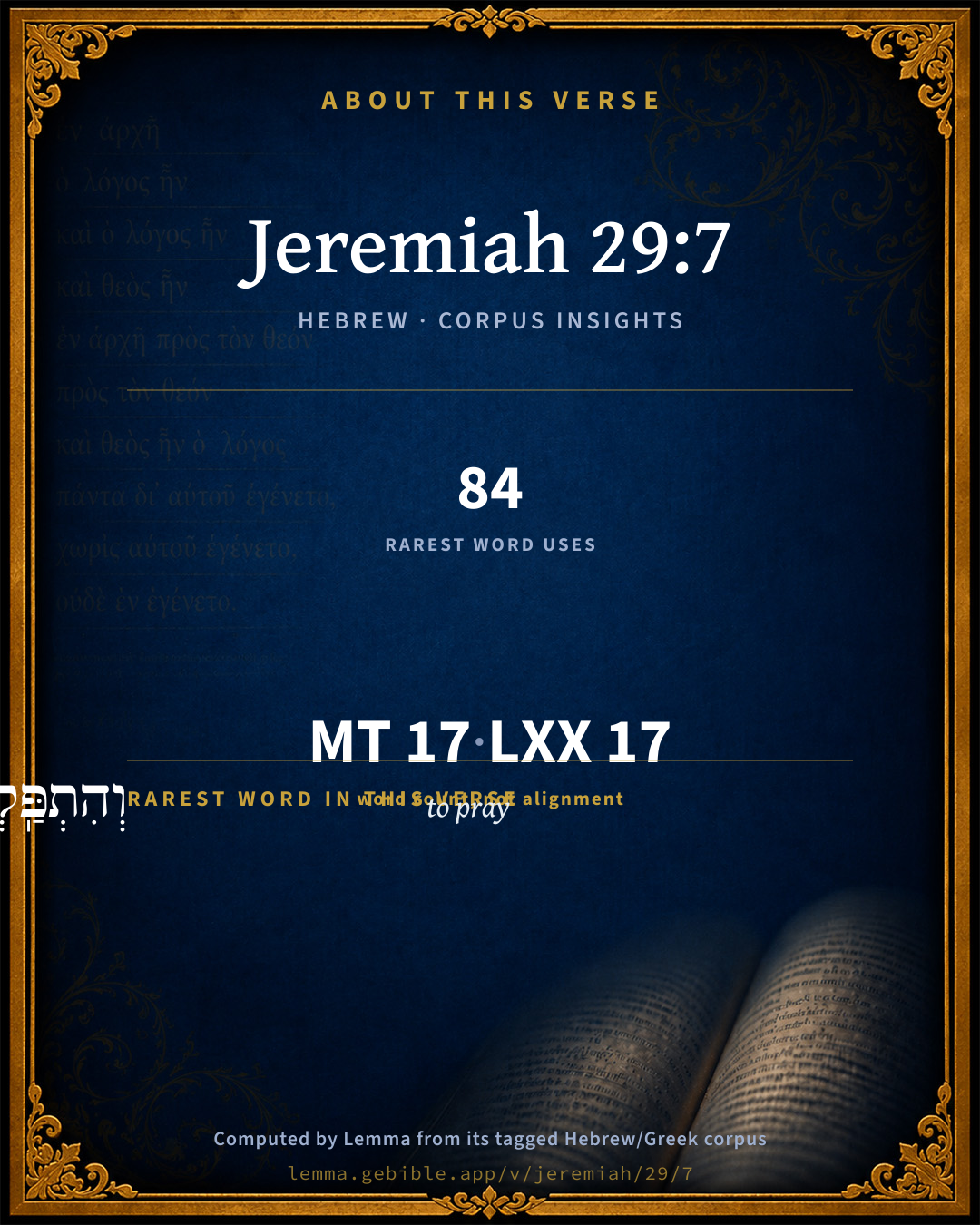
About this verse

These counts appear in no published source. They are computed here, from the morphology-tagged text and Lemma’s own curated glosses. What Lemma adds →

17
words
13
distinct lemmas
Prophets
section

Grammatical profile

  • 4 verbs
  • 5 nouns
  • 3 prepositions
  • 1 conjunction
  • 1 adverb
  • 3 particles

Verb forms

  • וְדִרְשׁ֞וּ Qal · Imperative
  • הִגְלֵ֤יתִי Hiphil · Perfect
  • וְהִתְפַּֽלְל֥וּ Hithpael · Imperative
  • יִהְיֶ֥ה Qal · Imperfect

Repetition

A word recurs within this verse — often emphatic in Hebrew:

  • שְׁל֣וֹם peace H7965 ×3

Hebrew & Septuagint length

In the original languages it is 17 Hebrew tokens and 17 Greek tokens — but the two are counted differently (Hebrew bundles its prefixes and suffixes into one token; the Greek is in lemma form), so that isn’t a like-for-like length.

Cross-references

9

Topical passages linked to Jeremiah 29:7 in the Treasury of Scripture Knowledge — connected by theme and wording, ordered by reader-vote popularity; previews shown in the World English Bible.

  • 1 Timothy 2:1–2 I exhort therefore, first of all, that petitions, prayers, intercessions, and givings of thanks, be made for all men:
  • Ezra 6:10 that they may offer sacrifices of sweet savor to the God of heaven, and pray for the life of the king, and of his sons.
  • Ezra 7:23 Whatever is commanded by the God of heaven, let it be done exactly for the house of the God of heaven; for why should there be wrath against the realm of the king and his sons?
  • 1 Peter 2:13–17 Therefore subject yourselves to every ordinance of man for the Lord's sake: whether to the king, as supreme;
  • Daniel 4:27 Therefore, O king, let my counsel be acceptable to you, and break off your sins by righteousness, and your iniquities by showing mercy to the poor; if there may be a lengthening of your tranquillity.
  • Romans 13:1 Let every soul be in subjection to the higher authorities, for there is no authority except from God, and those who exist are ordained by God.
  • Romans 13:5 Therefore you need to be in subjection, not only because of the wrath, but also for conscience' sake.
  • Daniel 4:19 Then Daniel, whose name was Belteshazzar, was stricken mute for a while, and his thoughts troubled him. The king answered, Belteshazzar, don't let the dream, or the interpretation, trouble you. Belteshazzar answered, My lord, the dream be to those who hate you, and the interpretation of it to your adversaries.
  • Daniel 6:4–5 Then the presidents and the satraps sought to find occasion against Daniel as touching the kingdom; but they could find no occasion nor fault, because he was faithful, neither was there any error or fault found in him.

Cross-references courtesy of OpenBible.info (CC BY 4.0).

Hebrew and Greek witnesses Masoretic Hebrew ↔ Greek Septuagint

The same verse in the two great witnesses to the Old Testament, shown verse-for-verse.

These are two independent witnesses, not word-aligned to each other, and the Septuagint is shown in lemma (dictionary) form.

Hebrew Jeremiah 29:7 Masoretic · Westminster Leningrad Codex

וְדִרְשׁ֞וּ אֶת שְׁל֣וֹם הָעִ֗יר אֲשֶׁ֨ר הִגְלֵ֤יתִי אֶתְכֶם֙ שָׁ֔מָּה וְהִתְפַּֽלְל֥וּ בַעֲדָ֖הּ אֶל יְהוָ֑ה כִּ֣י בִשְׁלוֹמָ֔הּ יִהְיֶ֥ה לָכֶ֖ם שָׁלֽוֹם

Seek the peace of the city where I have caused you to be carried away captive, and pray to Yahweh for it; for in the peace of it shall you have peace.

World English Bible · Public Domain

Greek LXX Structure differs

In the Septuagint, Jeremiah is about an eighth shorter than the Hebrew and arranges its material differently — the Oracles Against the Nations (Hebrew chapters 46–51) appear in the middle of the Greek book, after 25:13. Because the chapter and verse boundaries do not line up, a verse-for-verse comparison with the Hebrew is not shown.

A verse-for-verse comparison isn’t shown here because the chapters and verses don’t line up. Switch to the LXX edition with the MT / LXX toggle above to read the Greek directly.

On this verse, The Cambridge Bible for Schools and Colleges discusses the Septuagint’s reading. Read the note in Commentary ↓

Hebrew: Westminster Leningrad Codex (CC BY 4.0). Greek: Septuagint (public domain); English from a public-domain English Septuagint. How the Septuagint differs from the Hebrew →

Targum (Aramaic paraphrase)

1

The Targum is the ancient Jewish Aramaic paraphrase of the Hebrew Scriptures — an interpretive translation, not the Hebrew text itself. Onkelos (literal) and Pseudo-Jonathan (expansive) render the Torah, and Jonathan the Prophets. Coverage is partial: where no permissively-licensed English translation exists for a verse, only the Aramaic is shown. This is verse-level text, not a word-by-word alignment to the Hebrew.

  1. Targum Jonathan Prophets (Joshua–Malachi)
    וּתְבַעוּ יַת שְׁלַם קַרְתָּא דְאַגְלֵיתִי יַתְכוֹן לְתַמָן וְצַלוּ עֲלָהּ קֳדָם יְיָ אֲרֵי בִשְׁלָמָהּ יְהֵי לְכוֹן שְׁלָם:

    (no public-domain English translation for this verse)

    Targum Jonathan — Aramaic: “Mikraot Gedolot” (public domain). English: “Sefaria Community Translation” (CC0 1.0 (public-domain dedication)); “London "Chaldee Paraphrase," 1871” (public domain). Text via Sefaria.

Commentary

Notes on Jeremiah 29:7 from classic Christian and Jewish commentators (each source and its license shown beneath its notes). The classic Christian expositions comment on the surrounding passage and are grouped to its opening verse, so a note may address several verses; the Jewish commentaries on the Tanakh (Rashi and others) are per-verse, so they appear only where the commentator wrote on this verse.

Lemma curates 59 commentaries, every one of them public domain or Creative Commons licensed, each selected and text-cleaned for this edition rather than reprinted as found. About our sources →

Trapp's Complete Commentary

John Trapp

Jer 29:7 And seek the peace of the city whither I have caused you to be carried away captives, and pray unto the LORD for it: for in the peace thereof shall ye have peace.

Ver. 7. And seek the peace of the city.] Do not tumultuate or seek to break prison, as those seedsmen of sedition, your false prophets, would persuade you, but frame to a peaceable and patient behaviour. "In returning and rest shall ye be saved, in quietness and in confidence shall be your strength" {Isa 30:15}

And pray unto God for it,] sc., That in it you may "lead a peaceable and quiet life, in all godliness and honesty." {1Ti 2:2} Christians should improve their waiting months upon the King of saints, to pray for kings and all that are in authority, though to them they had been tyrants, since it seemeth good to God that they should live under them. The Dutch have a proverb,

“ Arbor honoretur, cuius nos umbra tuetur. ”

John Trapp, A Commentary or Exposition upon All the Books of the Old and New Testament (1647–1656) — public domain. Text from a community e-Sword module.

The Biblical Illustrator

Joseph S. Exell

Jer_29:7

Seek the peace of the city.

The best Christians the best citizens

1. They know that the prosperity of the whole is their own prosperity. They o not, therefore, selfishly seek their own advantage.

2. They actually labour with all diligence for the furtherance of the common good.

3. They employ for this end the power of Christian prayer. (Naegelsbach.)

The duties of Christians to their country

I. What are the things absolutely necessary to the security and prosperity, the true glory and happiness, of our country?

1. The true honour of a nation, like that of the individual, lies in character.

2. The security and prosperity of our nation are inseparably associated with the advancement of religion among the people.

II. What are the best means for securing those things which are essential to our countrys highest welfare?

1. General diffusion of education. Education is a better safeguard of liberty than a standing army.

2. Equally essential that the people be virtuous. Knowledge is power, but unsanctified power is power for evil.

3. The general distribution of the Bible--the great instrument for enlightening the conscience and purifying the heart.

4. Preaching the Gospel Our nature is a wreck, a chaos, which the Cross of Christ alone can adjust.

5. Prayer (2Ch_7:13-14; Psa_106:23; Exo_32:10).

III. What arguments may enforce the duties of personal and combined activity in seeking the highest good of our land?

1. Because our own individual good is intimately connected with its general happiness and prosperity. For in the peace thereof ye shall have peace.

2. We shall thereby recommend the religion we profess.

3. The work of supplying our land with the preached Gospel, and with religious institutions, is the most important work to which Christians can devote their energies. (Samuel Baker, D. D.)

The civil obligations of Christian people

When a man becomes a Christian does he cease to be a member of civil society? Allowing that he be not the owner of the ship, but only a passenger in it, has he nothing to awaken his concern in the voyage? If he be only a traveller towards a better country, is he to be told that because he is at an inn which he is soon to leave, it should not excite any emotion in him, whether it be invaded by robbers, or consumed by flames before the morning? In the peace thereof ye shall have peace. Is not religion variously affected by public transactions? Can a Christian, for instance, be indifferent to the cause of freedom, even on a pious principle? Does not civil liberty necessarily include religious, and is it not necessary to the spreading of the Gospel? (W. Jay.)

The Biblical Illustrator, edited by Joseph S. Exell (c. 1880s–1900s) — public domain. Text from a community e-Sword module.

Geneva Bible (1599)

Geneva Bible translators

The Prophet speaketh not this for the affection that he bare to the tyrant, but that they should pray for the common rest and quietness, that their troubles might not be increased, and that they might with more patience and less grief wait for the time of their deliverance, which God had appointed most certain: for else not only the Israelites, but all the world, yea, and the insensible creatures should rejoice when these tyrants should be destroyed, as Isa. 14:4.

Geneva Bible (1599) marginal notes — public domain. Text via Bolls.life.

Jamieson, Fausset & Brown

Robert Jamieson, A. R. Fausset & David Brown

(Ezr 6:10; Rom 13:1; Ti1 2:2). Not only bear the Babylonian yoke patiently, but pray for your masters, that is, while the captivity lasts. God's good time was to come when they were to pray for Babylon's downfall (Jer 51:35; Psa 137:8). They were not to forestall that time. True religion teaches patient submission, not sedition, even though the prince be an unbeliever. In all states of life let us not throw away the comfort we may have, because we have not all we would have. There is here a foretaste of gospel love towards enemies (Mat 5:44).

Jamieson, Fausset & Brown — Commentary Critical and Explanatory on the Whole Bible (1871) — public domain (CC PDM 1.0). Text via the HelloAO Bible API.

Adam Clarke's Commentary

Verse 7. Seek the peace of the city] Endeavour to promote, as far as you can, the prosperity of the places in which ye sojourn. Let no disaffection appear in word or act. Nothing can be more reasonable than this. Wherever a man lives and has his nourishment and support, that is his country as long as he resides in it. If things go well with that country, his interest is promoted by the general prosperity, he lives at comparative ease, and has the necessaries of life cheaper; and unless he is in a state of cruel servitude, which does not appear to have been the case with those Israelites to whom the prophet writes, (those of the first captivity,) they must be nearly, if not altogether, in as good a state as if they had been in the country that gave them birth. And in this case they were much better off than their brethren now in Judea, who had to contend with famine and war, and scarcely any thing before them but God's curse and extermination.

Adam Clarke's Commentary on the Bible (1810–1826) — public domain. Text from a community e-Sword/MySword module.

John Calvin's Commentaries

Jeremiah goes still farther, even that the Jews had been led to Babylon, on the condition of rendering willing obedience to the authority of King Nebuchadnezzar, and of testifying this by their prayers. He not only bids them patiently to endure the punishment laid on them, but also to be faithful subjects of their conqueror; he not only forbids them to be seditious, but he would have them to obey from the heart, so that God might be a witness of their willing subjection and obedience.

He says, Seek the peace of the city; this may be understood of prayers; for דרש, daresh, often means to pray: but it may suitably be taken here, as I think, in reference to the conduct of the people, as though he had said, that the Jews were to do what they could, to exert themselves to the utmost, so that no harm might happen to the Chaldean monarchy; for they are afterwards directed to pray It may indeed be, that the same thing is repeated in other words; but if any one weighs the subject more fully, he will, I think, assent to what I have stated, that in the first clause the Prophet bids them to be faithful to King Nebuchadnezzar and to his monarchy. Seek, then, the peace of the city: by peace, as it is well known, is to be understood prosperity.

But he was not satisfied with external efforts, but he would have them to pray to God, that all things might turn out prosperously and happily to the Babylonian king, even to the end of their exile; for we must bear in mind that the Prophet had ever that time in view. We hence learn that he exhorted the exiles to bear the yoke of the king of Babylon, during the time allotted to the captivity, for to attempt anything rashly was to fight against God, and that he thus far commanded them quietly to bear that tyrannical government.

He repeats again what he had said, (though I had passed it by,) that they had been carried away captives: for he had spoken of it, “all the captivity which,” he says, “I made to migrate,” or removed, or led captive, “from Jerusalem.” Now, again, he repeats the same thing, that he had carried them away captives, אשו הגליתי, asher egeliti; and he said this, that they might not regard only the avarice, or the ambition, or the pride of King Nebuchadnezzar, but that they might raise up their eyes to heaven, and acknowledge Nebuchadnezzar as the scourge of God, and their exile as a chastisement for their sins. God thus testified that he was the author of their exile, that the Jews might not think that they had to do with a mortal man, but on the contrary, understand that they were kicking against the goad, if they murmured and complained, because they lived under the tyranny of a foreign king. That they might not then be agitated with vain thoughts, God comes forth and says, that the exile was imposed on them by his just judgment, in order that they might know that they would gain nothing by their perverseness, and that they might not be disturbed by an anxious disquietude, nor dare to attempt anything new, for this would be to resist God, and as it were to carry on war with heaven. I will finish here.

John Calvin's Commentaries (1540-1563) — public domain. Text from the Calvin Translation Society English edition (1840s-50s) via the Christian Classics Ethereal Library (ccel.org). Calvin's coverage is partial (roughly two-thirds of the Bible); uncommented books and verses are honest gaps, never fabricated. The 19th-century editor's footnotes and remarks are omitted so the notes are faithfully Calvin's own voice.

Ellicott's Commentary for English Readers

(7) And seek the peace of the city . . .—This was, we may believe, the hardest command of all. To refrain from all curses and imprecations, even from such as came from the lips of those who hung their harps on the willows by the waters of Babylon (Psalms 137), to pray for the peace and prosperity of the city where they were eating the bread of captivity—this surely required an almost superhuman patience. Yet this was the prophet’s counsel. It seems almost to follow—unless we apply Augustine’s rule, Distingue tempora, and refer the psalm to a time prior to Jeremiah’s letter, or nearer the day of vengeance—that those imprecations, natural as they seem, belonged to a lower stage of spiritual progress than that represented by the prophet. He was, to those impatient exiles, as our Lord was to the impatient disciples who sought to call down fire on the village of the Samaritans (Luk_9:54-56). So, we may remember, Christians living under Nero were told to pray for the Emperor (1Ti_2:2).

A Bible Commentary for English Readers, edited by Charles John Ellicott (1878–1897) — public domain. Text from a community e-Sword module.

The Cambridge Bible for Schools and Colleges

gen. ed. J. J. S. Perowne

7. seek the peace of the city] probably referring not to Babylon only, but to any city in which a body of exiles might be planted. LXX have the land, as in Jer_4:29 (see note), perhaps reading here, as they probably did there, the equivalent Hebrew.

The Cambridge Bible for Schools and Colleges (gen. ed. J. J. S. Perowne; Cambridge University Press, 1878–1918) — public domain. Text from a community e-Sword module.

John Gill's Exposition

And seek the peace of the city,.... The prosperity and happiness of Babylon, or any other city in Chaldea, were they were placed: this they were to do by prayer and supplication to God, and by all other means that might be any ways conducive to the good of the state where they were:

whither I have caused you to be carried away captives; and as long as they continued so; for being under the protection of the magistrates of it, though Heathens, they owed them submission, and were under obligation to contribute to their peace and welfare:

and pray unto the Lord for it; the city, where they dwelt; for the continuance, safety, peace, and prosperity of it; and therefore much more ought the natives of a place to seek and pray for its good, and do all that in them lies to promote it; and still more should the saints and people of God pray for the peace of Jerusalem, or the church of God, where they are born, and brought up in a spiritual sense; see Ti1 2:1;

for in the peace thereof shall ye have peace; which is an argument taken from self-interest; intimating, that while the city in which they were was in safety and prosperity, was in a flourishing condition, as to its health and trade, they would partake more or less with them of the same advantages; and on the other hand, should they be distressed with the sword, famine, or pestilence, or any grievous calamity, they would be involved in the same.

John Gill's Exposition of the Whole Bible (1746–1763) — public domain (CC PDM 1.0). Text via the HelloAO Bible API.

Haydock's Catholic Bible Commentary

Peace. We must submit to the magistrates, where we reside, Baruch i. 11., and 1 Timothy ii. 1.

George Leo Haydock (1774–1849), Haydock's Catholic Family Bible and Commentary, 1859 edition — public domain. Excludes Psalms (Douay-Rheims chapter numbering differs from Protestant) and Deuterocanonical books (Catholic canon only).

Matthew Poole's English Annotations

That is, Seek to God for it, or rather live peaceably in it, and by all lawful means seek the welfare of it; do not raise any tumults or seditions, nor take part with those that do. And while your captivity lasts do you pray for it; (from whence those who think that Christ hath added new moral precepts, and reckon this precept of praying for enemies as one, may understand that praying for enemies was but a branch of that love to our neighbour which God required under the Old Testament;) for it was lawful for them to pray against Babylon at other times, Psa 137:8; Jer 51:35; but when God hath put a yoke upon our necks, we must patiently wait until he takes it off. The lawyers say that protection requireth allegiance to governors. This text lets us know also that it requireth our prayers for them, though they be conquerors and tyrants.

For in the peace thereof shall ye have peace; for God having by his providence cast us under their power, our peace dependeth upon theirs.

Matthew Poole's English Annotations on the Holy Bible (1683–1685) — public domain. Text from a community e-Sword/MySword module.

Whedon's Commentary on the Bible

Daniel D. Whedon

7. In the peace thereof shall ye have peace — A truth so fundamental as to be well nigh universal. The life of the individual is laid in that of the community. Only in extremely exceptional cases can he be prosperous while “the city” is in ferment and wretchedness.

Daniel D. Whedon (gen. ed.), Commentary on the Old and New Testaments (1874–1909) — public domain. Text from a community e-Sword module.

The Pulpit Commentary

Seek the peace of the city, etc. Interest yourselves in the peace" or welfare of the city, whether Babylon or any other place where ye may be in exile, and pray for its welfare, for your own well-being is inseparable from it.

Civic duties.

From the duty of the Jews to the cities of their exile we may deduce the still more urgent duties of citizens to their own city,

I ONE OF THE FIRST INTERESTS OF A PEOPLE IS PEACE. There are times when war is necessary and right to defend the hearth and home, to save the weak from oppression, etc. But such war must only be the means for securing a bettor, more lasting peace. The glory of war is an empty dream. The people gain little and suffer much, though the kings may win fame and power.

II PEACE IS TO BE SOUGHT BY THE ACTION OF CITIZENS. Individual men cannot wage a war or declare a truce. But the units constitute nations. If each is peaceable the nation is peaceable. Insignificant people have vast power for harm if they choose to execute it. It should be understood that seditious conduct is not only a political offense; it is a sin in the sight of God, a cruelty to the many people whom it disturbs and injures.

III PRIVATE MEN HAVE PUBLIC DUTIES. We all reap benefits from the state. It is mean to accept them without taking our part in bearing the burdens of the state. There are people who deny the right of Christian men to take part in "worldly politics," yet these people are glad to avail themselves of the protection and other advantages which are provided for them by the secular government they affect to despise. The neglect of public duty evidences a narrow and selfish disposition,

IV PRIVATE MEN ARE BENEFITED BY PUBLIC PROSPERITY. We are members one of another. There is a general harmony and health of the whole body, over and above the well-being of each member, when all work together for the mutual good. As individual men, we have great reason to be thankful for the general prosperity of the nation and for the maintenance of public peace.

V WE SHOULD DISCHARGE OUR DUTIES TO THE STATE THOUGH WE MAY NOT APPROVE OF THE GOVERNMENT. To be in opposition is no excuse for being in sedition. Unless we can change the government it is foolish and wrong to revolt against it. The nation is larger than the government.

The Pulpit Commentary (1880–1919), ed. H.D.M. Spence-Jones & Joseph S. Exell — public domain. Text from a community e-Sword module.

Lesson kit

Teaching starters — assembled from the data on this page, not authored interpretation. Every prompt links to the verse data it draws on. Edit before teaching.

Jeremiah, in the Prophets, opens this verse with 17 words (13 distinct Hebrew lemmas). Its most distinctive word is pâlal (“to pray”). A historical commentator’s framing appears above. Read the whole chapter for the surrounding context.

Discussion questions

  1. What does “to pray” (pâlal) contribute to the verse as a whole?
  2. How does 1 Timothy 2:1–2, which shares this passage’s theme, read alongside this verse?
  3. What does the repetition of “peace” (3× in this one verse) do in this verse?
  4. The translations on this page render this verse differently — a whole-verse word diff, not a word-by-word alignment. What might account for the different wordings?
  5. «וְדִרְשׁ֞וּ» is a Qal Imperative verb. How does that grammatical form shape the action described?
  6. Compare how Trapp's Complete Commentary and The Biblical Illustrator read this verse. Where do they agree or differ?

Things to notice

Reading settings

Reading text

Shown beneath each verse's original-language words.

Old Testament
Old Testament edition

Read the OT as the Masoretic Hebrew (MT) or the Greek Septuagint (LXX).

English shown for the Greek Septuagint (in the Hebrew ↔ Greek comparison).

Comparing translations? Open the Compare panel on any verse page to stack up to four side by side.