

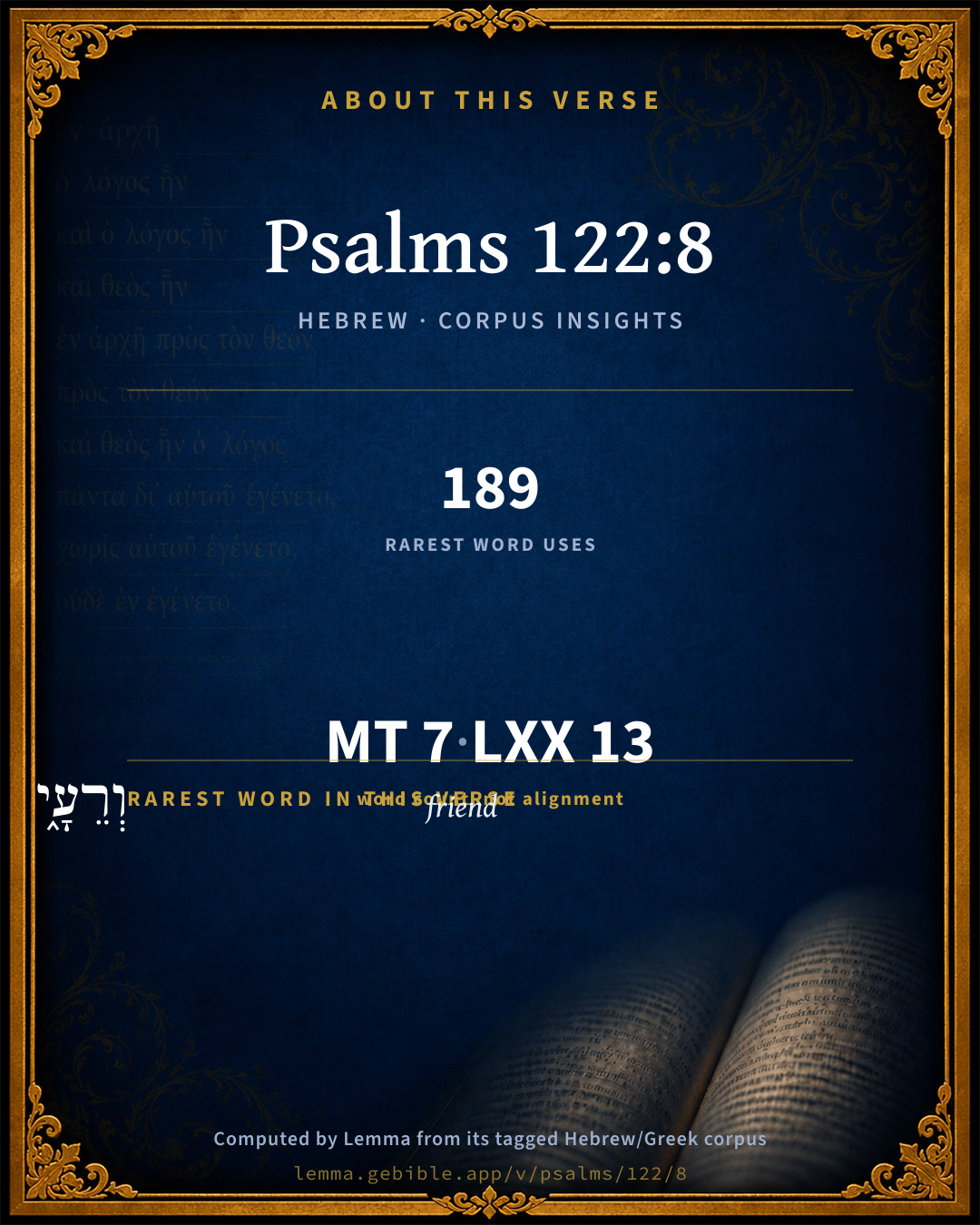
Psalms 122:8

Hebrew (Westminster Leningrad Codex) Psalms 122:8 appears in the Hebrew Old Testament. The text above is from the Westminster Leningrad Codex. Each word links to its Strong’s number, a concise gloss, and parsing drawn from the Open Scriptures Hebrew Bible morphology. Click any word for its full Brown-Driver-Briggs (BDB) entry.
Download image
Cite this verse

Psalms 122:8 (World English Bible). Public Domain. Lemma interlinear Bible study tool, https://lemma.gebible.app/v/psalms/122/8.

Show BibTeX & RIS
BibTeX
RIS
English Translation
For my brothers' and companions' sakes, I will now say, "Peace be within you."
World English Bible · Public Domain
Download a study sheet

One document with this verse’s original text, its word-by-word gloss line, the meaning frame, cross-references with their text, attributed commentary, and full source and license credits — printable, and it pastes into notes with its structure intact.

This verse Autodidact and up

Study sheet (.html) Plain text (.txt)

A passage Seminary Student

Up to 50 verses in one chapter. A passage sheet keeps up to 6 commentary sources and 12 cross-references per verse, in the order this page ranks them, and says so on the sheet whenever that leaves anything out. Ask for a single verse and you get the Autodidact verse sheet above.

Everything on this page stays free to read, with no account — the sheet is a download of what is already on screen, not access to it.

Want to remove ads? Support Godless Engineer
Compare translations 3

The same verse in 3 English versions, stacked beneath the original-language interlinear above. Click any original word for its lexicon entry.

Each is an independent rendering of the whole verse — the interlinear is not word-aligned to these translations.

Highlighted words mark where these versions differ — a whole-verse word diff, not a word-by-word alignment.

  • World English Bible Public Domain
    For my brothers' and companions' sakes, I will now say, "Peace be within you."
  • King James Version Public Domain
    For my brethren and companions' sakes, I will now say, Peace be within thee.
  • unfoldingWord Literal Text CC BY-SA 4.0
    For the sake of my brothers and my companions, let me speak, please, peace in you.

unfoldingWord Literal Text — © unfoldingWord, licensed CC BY-SA 4.0. Word-aligned USFM3 via Door43 (git.door43.org/unfoldingWord/en_ult).

Versions to compare (up to 4)

3 of 4 selected

Show all 18 translations

Every available English version of this verse, each an independent rendering of the whole verse.

  • World English Bible Public Domain
    For my brothers' and companions' sakes, I will now say, "Peace be within you."
  • Berean Standard Bible Public Domain
    For the sake of my brothers and friends, I will say, “Peace be within you.”
  • Majority Standard Bible Public Domain
    For the sake of my brothers and friends, I will say, “Peace be within you.”
  • King James Version Public Domain
    For my brethren and companions' sakes, I will now say, Peace be within thee.
  • American Standard Version (1901) Public Domain
    For my brethren and companions' sakes, I will now say, Peace be within thee.
  • Revised Version (1885) Public Domain
    For my brethren and companions’ sakes, I will now say, Peace be within thee.
  • Geneva Bible (1599) Public Domain
    For my brethren and neighbours sakes I will wish thee now prosperitie.
  • Douay-Rheims (1899) Public Domain
    May the Lord keep thy going in and thy going out; from henceforth now and for ever.
  • Young's Literal Translation Public Domain
    For the sake of my brethren and my companions, Let me speak, I pray thee, `Peace `be' in thee.'
  • Literal Standard Version CC BY-SA 4.0
    For the sake of my brothers and my companions, || Please let me speak, “Peace [be] in you.”
  • Unlocked Literal Bible CC BY-SA 4.0
    For the sake of my brothers and my friends I will say, “May there be peace within you.”
  • unfoldingWord Literal Text CC BY-SA 4.0
    For the sake of my brothers and my companions, let me speak, please, peace in you.
  • Darby Bible Public Domain
    For my brethren and companions' sakes I will say, Peace be within thee!
  • World Messianic Bible Public Domain
    For my brothers’ and companions’ sakes, I will now say, “Peace be within you.”
  • Webster's Bible Public Domain
    For my brethren and companions' sake, I will now say, Peace be within thee.
  • Free Bible Version CC BY-SA 4.0
    On behalf of my family and friends, I will now say, “May you be at peace.”
  • Bible in Basic English Public Domain
    Because of my brothers and friends, I will now say, Let peace be with you.
  • JPS Tanakh (1917) Public Domain
    For my brethren and companions' sakes, I will now say: 'Peace be within thee.'

Literal Standard Version (2020), Covenant Press — licensed CC BY-SA 4.0. Text via the HelloAO Bible API (eBible.org). Unlocked Literal Bible (unfoldingWord) — licensed CC BY-SA 4.0. Text via the HelloAO Bible API (eBible.org). unfoldingWord Literal Text — © unfoldingWord, licensed CC BY-SA 4.0. Word-aligned USFM3 via Door43 (git.door43.org/unfoldingWord/en_ult). Free Bible Version, Dr. Jonathan Gallagher — licensed CC BY-SA 4.0. Text via the HelloAO Bible API (eBible.org).

Word by word

More ways to search: Search by grammar → Find every occurrence → Compare this word →

Practice this passage: Drill this verse → Learn its vocabulary →

וְרֵעָ֑י
rêaʻ
H7453
“and · friends · my”
Conjunction + Noun, Common, Masculine, Plural, Construct + Suffix, Personal, 1st Person, Common, Singular
Part of Speech
Conjunction + Noun
Type
Common
Gender
Masculine
Number
Plural
State
Construct
Full BDB Definition

Origin: from H7462

TWOT: 2186a

friend, companion, fellow, another person - friend, intimate - fellow, fellow-citizen, another person (weaker sense) - other, another (reciprocal phrase)
  1. לְ֭מַעַן maʻan H4616 “for the sake of” Preposition
  2. אַחַ֣י ʼâch H251 “brothers · my” Noun, Common, Masculine, Plural, Construct + Suffix, Personal, 1st Person, Common, Singular
  3. אֲדַבְּרָה dâbar H1696 “to speak” Verb, Piel, Cohortative, 1st Person, Common, Singular
  4. נָּ֖א nâʼ H4994 “please” Particle, Interjection
  5. שָׁל֣וֹם shâlôwm H7965 “peace” Noun, Common, Masculine, Singular, Absolute

About this verse

These counts appear in no published source. They are computed here, from the morphology-tagged text and Lemma’s own curated glosses. What Lemma adds →

7
words
6
distinct lemmas
Wisdom
section

Grammatical profile

  • 1 verb
  • 3 nouns
  • 2 prepositions
  • 1 particle

Verb forms

  • אֲדַבְּרָה Piel · Cohortative

Hebrew & Septuagint length

In English translation the verse runs 14 words from the Hebrew and 16 from the Septuagint (LXX English) — closely comparable.

A rough comparison of the two English renderings, which tokenize alike — not a word-level alignment.

Word counts can differ between the Hebrew and the Greek without any difference in meaning — e.g. the Hebrew direct-object marker אֵת has no separate Greek word, and Greek often adds the article ὁ.

In the original languages it is 7 Hebrew tokens and 13 Greek tokens — but the two are counted differently (Hebrew bundles its prefixes and suffixes into one token; the Greek is in lemma form), so that isn’t a like-for-like length.

Cross-references

7

Topical passages linked to Psalms 122:8 in the Treasury of Scripture Knowledge — connected by theme and wording, ordered by reader-vote popularity; previews shown in the World English Bible.

  • 1 Samuel 25:6 and thus shall you tell him who lives [in prosperity], Peace be to you, and peace be to your house, and peace be to all that you have.
  • Psalms 16:3 As for the saints who are in the earth, They are the excellent ones in whom is all my delight.
  • Psalms 42:4 These things I remember, and pour out my soul within me, How I used to go with the crowd, and led them to the house of God, With the voice of joy and praise, a multitude keeping a holy day.
  • Psalms 119:63 I am a friend of all those who fear you, Of those who observe your precepts.
  • Philippians 2:2–5 make my joy full, by being like-minded, having the same love, being of one accord, of one mind;
  • Ephesians 4:4–6 There is one body, and one Spirit, even as you also were called in one hope of your calling;
  • James 3:13–18 Who is wise and understanding among you? Let him show by his good conduct that his deeds are done in gentleness of wisdom.

Cross-references courtesy of OpenBible.info (CC BY 4.0).

Hebrew and Greek witnesses Masoretic Hebrew ↔ Greek Septuagint

The same verse in the two great witnesses to the Old Testament, shown verse-for-verse.

You’re reading Greek Psalm 121 (Hebrew Psalm 122). The Septuagint counts the superscription, so verse numbers can differ from the Hebrew — chapter-level alignment, not verse-by-verse. Numbering follows Rahlfs.

These are two independent witnesses, not word-aligned to each other, and the Septuagint is shown in lemma (dictionary) form.

Hebrew Psalms 122:8 Masoretic · Westminster Leningrad Codex

לְ֭מַעַן אַחַ֣י וְרֵעָ֑י אֲדַבְּרָה נָּ֖א שָׁל֣וֹם בָּֽךְ

For my brothers' and companions' sakes, I will now say, "Peace be within you."

World English Bible · Public Domain

Greek LXX Greek Psalm 121:8 Septuagint · lemma form

ἕνεκα ὁ ἀδελφός ἐγώ καί ὁ πλησίον ἐγώ λαλέω δή εἰρήνη περί σύ

For the sake of my brethren and my neighbors, I have indeed spoken peace concerning you.

LXX2012 (modern English Septuagint) · Public Domain

Hebrew: Westminster Leningrad Codex (CC BY 4.0). Greek: Septuagint (public domain); English from LXX2012 (modern English Septuagint) (Public Domain). How the Septuagint differs from the Hebrew →

Commentary

Notes on Psalms 122:8 from classic Christian and Jewish commentators (each source and its license shown beneath its notes). The classic Christian expositions comment on the surrounding passage and are grouped to its opening verse, so a note may address several verses; the Jewish commentaries on the Tanakh (Rashi and others) are per-verse, so they appear only where the commentator wrote on this verse.

Lemma curates 59 commentaries, every one of them public domain or Creative Commons licensed, each selected and text-cleaned for this edition rather than reprinted as found. About our sources →

Trapp's Complete Commentary

John Trapp

Psa 122:8 For my brethren and companions’ sakes, I will now say, Peace [be] within thee.

Ver. 8. For my brethren and companions’ sakes] David was not all for himself (as the manner is in these last and loosest times), but, as one of a public spirit, he did

- toti genitum se credere genti.

John Trapp, A Commentary or Exposition upon All the Books of the Old and New Testament (1647–1656) — public domain. Text from a community e-Sword module.

J. A. Alexander on Psalms

Joseph Addison Alexander

8. (Psa 122:8) For the sake of my brethren and my friends, let me speak, Peace (be) within thee. By brethren and friends we are to understand the whole body of the chosen people. For their sake may include the sense of in their behalf. The last clause admits of a different construction, Let me speak peace to thee, literally in thee. See above, on Psa 85:8. The optative meaning of the verb is determined by the particle, the use of which here seems to be imitated in Psa 115:2; Psa 116:4.

Joseph Addison Alexander, The Psalms Translated and Explained (1850) — public domain. Text from a community e-Sword module.

Geneva Bible (1599)

Geneva Bible translators

Not only for mine own sake, but for all the faithful.

Geneva Bible (1599) marginal notes — public domain. Text via Bolls.life.

Adam Clarke's Commentary

Verse 8. For any brethren and companions' sakes] Because this city is the abode of my kinsfolk and countrymen, I will wish it prosperity. I will promote its peace and tranquillity by all means in my power. I will affectionately say, May peace be within thee!

Adam Clarke's Commentary on the Bible (1810–1826) — public domain. Text from a community e-Sword/MySword module.

John Calvin's Commentaries

8. For the sake of my brethren and neighbors. He specifies two causes on account of which he felt a care about the Church, for the purpose of stirring up, by his example, all the faithful to exercise the same care. These words, however, seem to contain a tacit contrast. Among the wicked and malicious he might be the object of suspicion, or, at least, he was in danger of being slandered; as if, in commending Jerusalem, he had rather an eye to his own particular advantage than to the public welfare. In order, therefore, to remove all ground for objecting, that in thus speaking he was craftily endeavoring to establish his own kingdom, he protests, that he is not influenced by personal considerations, but by a concern for the whole Church, which he embraced with a sincere affection of heart. I will speak, says he, O Jerusalem! of thy peace, not because it will be profitable for me or mine, but because thy prosperity shall extend itself to all the children of God; for under the term brethren he doubtless comprehends all believers that he did so, because the worship of God so far from remaining entire would go to ruin unless Jerusalem continued standing. If then the salvation of our brethren is regarded by us as an object of importance, if religion is with us a matter of heart-work, we ought, at the same time, as much as in us lies, to take an interest in the prosperity of the Church. Whence it follows, that such as are indifferent about her condition, are no less cruel than impious; for if she is “the pillar and foundation of truth,” the inevitable consequence of her destruction must be the extinction of true piety. And if the body is destroyed, how can each of the members fail to be involved in destruction? Farther, this passage teaches us, that the Church is not an empty title, but must be sought for where the true religion prevails. Whence it appears, how foolish the Papists are, who, notwithstanding their having rejected and overthrown the doctrine of the Gospel, yet mightily boast of the name of the Church.

John Calvin's Commentaries (1540-1563) — public domain. Text from the Calvin Translation Society English edition (1840s-50s) via the Christian Classics Ethereal Library (ccel.org). Calvin's coverage is partial (roughly two-thirds of the Bible); uncommented books and verses are honest gaps, never fabricated. The 19th-century editor's footnotes and remarks are omitted so the notes are faithfully Calvin's own voice.

Ellicott's Commentary for English Readers

(8) Peace be within thee.—Here the formal greeting actually appears, that which greets every traveller in the East (Joh_20:19). (Comp. Luk_10:5.) The full form appears in 1Sa_25:6.

A Bible Commentary for English Readers, edited by Charles John Ellicott (1878–1897) — public domain. Text from a community e-Sword module.

The Cambridge Bible for Schools and Colleges

gen. ed. J. J. S. Perowne

8. For my brethren and companions’ sakes] Not, for the sake of the nation in general, though doubtless the welfare of the nation was dependent on the welfare of the metropolis: but for the sake of those dwelling in Jerusalem, to whom he feels himself attached in the bonds of closest fellowship. There may be a reference to the circumstances described in Neh_11:1 ff. Some difficulty was found in securing a sufficient population for the city: ten per cent. of the country people were chosen by lot to come into the city; and others volunteered to reside there. “And the people blessed all the men that willingly offered themselves to dwell in Jerusalem.”

I will now say] Let me now say, Peace &c.: or more probably, Let me now speak peace concerning thee, i.e. pray for thy welfare.

The Cambridge Bible for Schools and Colleges (gen. ed. J. J. S. Perowne; Cambridge University Press, 1878–1918) — public domain. Text from a community e-Sword module.

John Gill's Exposition

Because of the house of the Lord our God,.... Not because of his own palace, nor because of his own house and family; nor because of his own personal interest; though all were concerned in the peace of Jerusalem: but chiefly because of the sanctuary of the Lord, as the Targum; because of the worship and service of God in it; because of his great love and zeal for the house and church of the living God, which ate him up, Psa 69:9;

I will seek thy good; the good of Jerusalem, the good of the church of God; do all the good he could to it both with his purse and prayers, and by stirring up others to do the same; see Psa 51:18.

Next: Psalms Chapter 123

John Gill's Exposition of the Whole Bible (1746–1763) — public domain (CC PDM 1.0). Text via the HelloAO Bible API.

Albert Barnes' Notes on the Bible

For my brethren and companions’ sakes - Because they dwell there; or, because they go up there to worship; or, because they love thee, and find their happiness in thee; or, because they are unconverted, and all my hope of their salvation is to be derived from thee - from the church, from the influence of religion.

I will now say, Peace be within thee - I will pray for thy peace, for thy prosperity, for the blessing of God upon thee - because their good, their comfort, their hope of salvation, depends on thee - on the influence which shall go out from thee. So the Christian prays that the church may prosper - that the divine blessing may rest upon it - that there may be in it harmony, peace, love, and zeal - that a blessing may attend the preaching of the gospel - not only because he loves it, and seeks his own comfort and edification in it, but that his friends and kindred - his wife, his parents, his children, his neighbors - those whom he loves, and whose salvation he desires, may be saved. This expresses the true feelings of piety all over the world; this is one of the grounds of the strong love which the friends of God have for the church - because they hope and desire that through the church those most dear to their hearts will find salvation.

Albert Barnes' Notes on the Bible (1834–1885) — public domain. Text from a community e-Sword/MySword module.

Matthew Poole's English Annotations

And this I desire not only nor chiefly for my own security, and for the glory of mine empire, but for the sake of all my fellow citizens, and of all the Israelites, whom, though my subjects, I must own for my brethren and companions in the chief privileges and blessings enjoyed at Jerusalem.

Matthew Poole's English Annotations on the Holy Bible (1683–1685) — public domain. Text from a community e-Sword/MySword module.

The Treasury of David

Charles H. Spurgeon

Ver. 8. For my brethren and companions' sakes, I will now say, Peace be within thee. It is to the advantage of all Israel that there should be peace in Jerusalem. It is for the good of every Christian, yea, of every man, that there should be peace and prosperity in the church. Here our humanity and our common philanthropy assist our religious prayer. By a flourishing church our children, our neighbours, our fellow countrymen are likely to be blest. Moreover, we cannot but pray for a cause with which our dearest relatives and choicest friends are associated: if they labour for it, we must and will pray for it. Here peace is mentioned for the third time. Are not these frequent threes some hint of the Trinity? It would be hard to believe that the triple form of so many parts of the Old Testament is merely accidental. At least, the repetition of the desire displays the writer's high valuation of the blessing mentioned; he would not again and again have invoked peace had he not perceived its extreme desirableness.

Ver. 8. For my brethren and companions' sakes. Because they dwell there; or, because they go up there to worship; or, because they love thee, and find their happiness in thee; or, because they are unconverted, and all my hope of their salvation is to be derived from thee, from the church, from the influence of religion. Albert Barnes.

Ver. 8. My brethren. On another occasion, an elderly native, formerly a cannibal, addressing the Church members, said, "Brethren!" and, pausing for a moment, continued, "Ah! that is a new name; we did not know the true meaning of that word in our heathenism. It is the `Evangelia a Jesu' that has taught us the meaning of `brethren.'" William Gill, in "Gems from the Coral Islands, "1869.

Ver. 8-9. Two great principles are here laid down why we should pray for the church,

1. Love to the brethren: "For my brethren and companions' sakes."

2. Love to God: "Because of the house of the Lord our God I will seek thy good." N. M`michael.

Psalms 122:9*

Charles H. Spurgeon's The Treasury of David (1869–1885) — public domain. Psalms only. Text from a community e-Sword/MySword module.

The Pulpit Commentary

For my brethren and companions" sakes, I will now say, Peace be within thee. The inhabitants of Jerusalem are the writer"s "brethren and companions." He is not a mere pilgrim on a visit to the holy city.

The religious value of the patriotic spirit.

"For my brethren and companions" sakes, I will wish thee prosperity." This may be the expression of a pilgrim on leaving Jerusalem to return to his home. The love of the psalmist for his country was patriotism. Perowne says, "The last four verses of the psalm breathe a spirit of the noblest, most unselfish, patriotism. Not for his own sake, but for the sake of his brethren the people at large and for the sake of his God, his temple, and his service, he wishes peace to Jerusalem, and calls upon others to wish her peace. With love to Israel and love to Jehovah there is naturally united a warm affection for Jerusalem, a hearty interest in her welfare.

I THE PATRIOTIC SPIRIT IS KIN WITH THE RELIGIOUS. The moral value of both is the same, and it lies in taking a man out beyond himself, and interesting him in something other than himself. The patriotic spirit interests him in other people, the religious spirit interests him in God. They are also alike in their power to arouse and culture emotion, and to inspire self-denying acts.

II THE PATRIOTIC SPIRIT NOURISHES THE RELIGIOUS. According to the principle laid down by St. John, "If a man love not his brother whom he hath seen, how can he love God whom he hath not seen?" It is a delusion that religion claims isolation; it is both expressed and nourished through the temporal. Religion separated from life and its common claims and obligations is but weak and deluding sentiment. Patriotic Moses is pious Moses. The separation of Christian men from political, civil, and social interests is entirely a sectarian delusion. The noblest and the healthiest Christian lives have always been, and are always sure to be, in the truest sense patriotic.

III THE PATRIOTIC SPIRIT QUALIFIES THE RELIGIOUS. For while it is quite true that man is not all body and human relations, it is also quite true that he is not all soul and soul-relations. The religious side of man"s nature can be exaggerated, and often is. The unworldly may become a snare as well as the worldly. It is helpful to qualify the heavenly by the duties of the earthly. R.T.

The Pulpit Commentary (1880–1919), ed. H.D.M. Spence-Jones & Joseph S. Exell — public domain. Text from a community e-Sword module.

unfoldingWord translationNotes

Door43 World Missions Community

General Information:

In this section, the writer speaks directly to the city of Jerusalem, as if the city was a person who could hear them. (See: Apostrophe and Personification)

For the sake

"For the well-being"

May there be peace within you

"May the people in you live in peace"

I will seek good for you

The abstract noun "good" can be stated as an action. AT: "I will pray that people treat you well"

translationWords

brother

companion

peace

house of God

God

pray

good

unfoldingWord translationNotes — © Distant Shores Media and the Door43 World Missions Community, licensed CC BY-SA 4.0. Source: git.door43.org/Door43/en_tn.

Rashi

Rabbi Shlomo Yitzchaki (Rashi)

For the sake of Israel, my brethren and my companions

I shall now speak I, King David, [shall now speak] of peace in you.

Rashi on the Tanakh — English translations: “The Judaica Press complete Tanach with Rashi, translated by A. J. Rosenberg” (CC BY 4.0); “Pentateuch with Rashi's commentary by M. Rosenbaum and A.M. Silbermann, 1929-1934” (public domain); “The Metsudah Tanach series, Lakewood, N.J” (CC BY 4.0); and “The Book of Joshua, Metsudah Publications, 1997” (CC BY 4.0). Text via Sefaria.

Lesson kit

Teaching starters — assembled from the data on this page, not authored interpretation. Every prompt links to the verse data it draws on. Edit before teaching.

Psalms, in the Wisdom, opens this verse with 7 words (6 distinct Hebrew lemmas). Its most distinctive word is rêaʻ (“friend”). A historical commentator’s framing appears above. Read the whole chapter for the surrounding context.

Discussion questions

  1. What does “friend” (rêaʻ) contribute to the verse as a whole?
  2. How does 1 Samuel 25:6, which shares this passage’s theme, read alongside this verse?
  3. These translations render this verse differently. What is at stake in choosing one wording over another?
  4. «אֲדַבְּרָה» is a Piel Cohortative verb. How does that grammatical form shape the action described?
  5. Compare how Trapp's Complete Commentary and J. A. Alexander on Psalms read this verse. Where do they agree or differ?

Things to notice

Reading settings

Reading text

Shown beneath each verse's original-language words.

Old Testament
Old Testament edition

Read the OT as the Masoretic Hebrew (MT) or the Greek Septuagint (LXX).

English shown for the Greek Septuagint (in the Hebrew ↔ Greek comparison).

Comparing translations? Open the Compare panel on any verse page to stack up to four side by side.