
Jeremiah 29:11

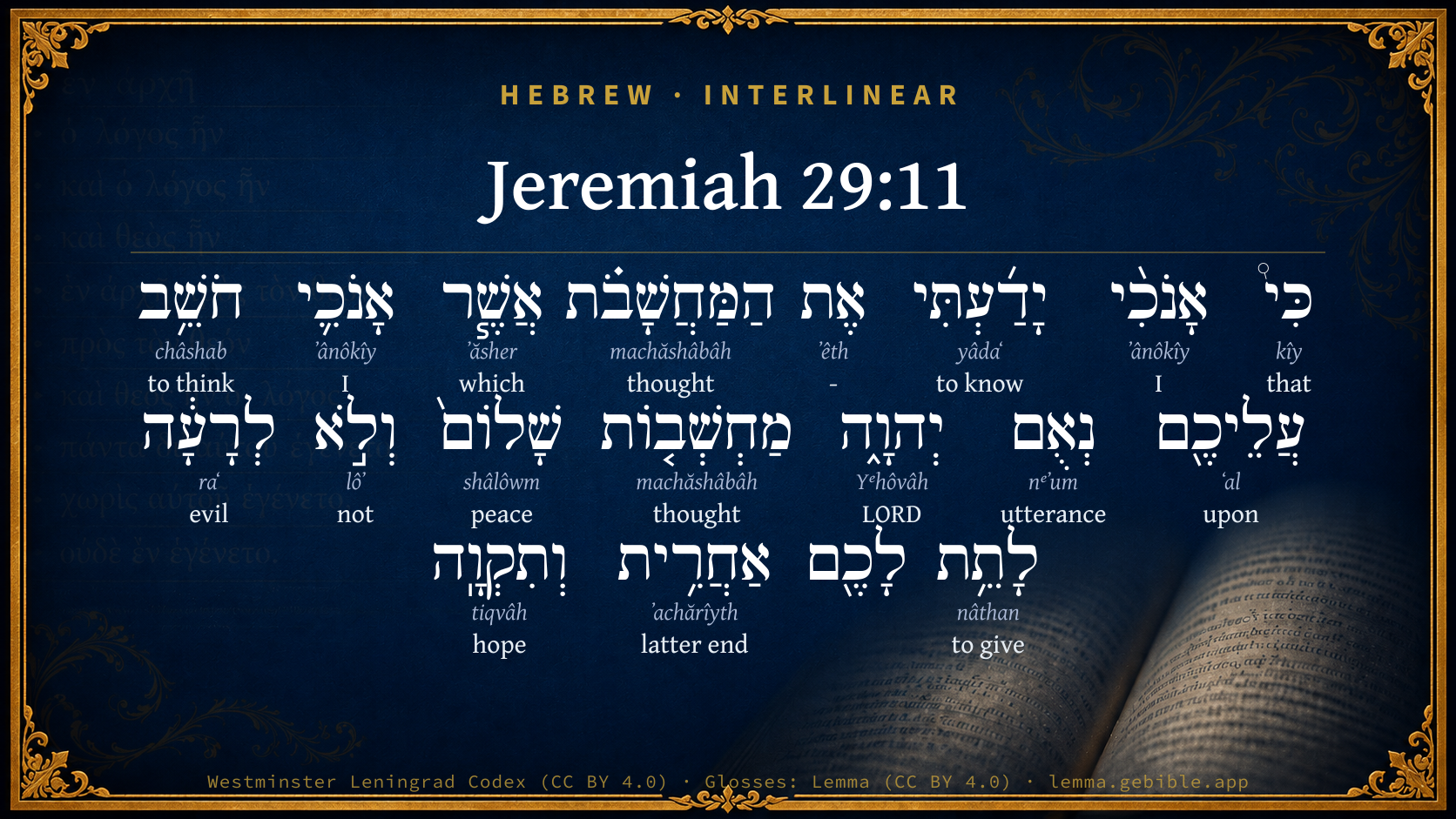
Hebrew (Westminster Leningrad Codex) Jeremiah 29:11 appears in the Hebrew Old Testament. The text above is from the Westminster Leningrad Codex. Each word links to its Strong’s number, a concise gloss, and parsing drawn from the Open Scriptures Hebrew Bible morphology. Click any word for its full Brown-Driver-Briggs (BDB) entry.
Download image
Cite this verse

Jeremiah 29:11 (World English Bible). Public Domain. Lemma interlinear Bible study tool, https://lemma.gebible.app/v/jeremiah/29/11.

Show BibTeX & RIS
BibTeX
RIS
English Translation
For I know the thoughts that I think toward you, says Yahweh, thoughts of peace, and not of evil, to give you hope in your latter end.
World English Bible · Public Domain
Download a study sheet

One document with this verse’s original text, its word-by-word gloss line, the meaning frame, cross-references with their text, attributed commentary, and full source and license credits — printable, and it pastes into notes with its structure intact.

This verse Autodidact and up

Study sheet (.html) Plain text (.txt)

A passage Seminary Student

Up to 50 verses in one chapter. A passage sheet keeps up to 6 commentary sources and 12 cross-references per verse, in the order this page ranks them, and says so on the sheet whenever that leaves anything out. Ask for a single verse and you get the Autodidact verse sheet above.

Everything on this page stays free to read, with no account — the sheet is a download of what is already on screen, not access to it.

Want to remove ads? Support Godless Engineer
Compare translations 3

The same verse in 3 English versions, stacked beneath the original-language interlinear above. Click any original word for its lexicon entry.

Each is an independent rendering of the whole verse — the interlinear is not word-aligned to these translations.

Highlighted words mark where these versions differ — a whole-verse word diff, not a word-by-word alignment.

  • World English Bible Public Domain
    For I know the thoughts that I think toward you, says Yahweh, thoughts of peace, and not of evil, to give you hope in your latter end.
  • King James Version Public Domain
    For I know the thoughts that I think toward you, saith the LORD, thoughts of peace, and not of evil, to give you an expected end.
  • unfoldingWord Literal Text CC BY-SA 4.0
    For I myself know the plans that I have for you—this is Yahweh’s declaration—plans for peace and not for disaster, to give you a future and a hope.

unfoldingWord Literal Text — © unfoldingWord, licensed CC BY-SA 4.0. Word-aligned USFM3 via Door43 (git.door43.org/unfoldingWord/en_ult).

Versions to compare (up to 4)

3 of 4 selected

Show all 18 translations

Every available English version of this verse, each an independent rendering of the whole verse.

  • World English Bible Public Domain
    For I know the thoughts that I think toward you, says Yahweh, thoughts of peace, and not of evil, to give you hope in your latter end.
  • Berean Standard Bible Public Domain
    For I know the plans I have for you, declares the LORD, plans to prosper you and not to harm you, to give you a future and a hope.
  • Majority Standard Bible Public Domain
    For I know the plans I have for you, declares the LORD, plans to prosper you and not to harm you, to give you a future and a hope.
  • King James Version Public Domain
    For I know the thoughts that I think toward you, saith the LORD, thoughts of peace, and not of evil, to give you an expected end.
  • American Standard Version (1901) Public Domain
    For I know the thoughts that I think toward you, saith Jehovah, thoughts of peace, and not of evil, to give you hope in your latter end.
  • Revised Version (1885) Public Domain
    For I know the thoughts that I think toward you, saith the LORD, thoughts of peace, and not of evil, to give you hope in your latter end.
  • Geneva Bible (1599) Public Domain
    For I knowe the thoughtes, that I haue thought towards you, saith the Lord, euen the thoughtes of peace, and not of trouble, to giue you an ende, and your hope.
  • Douay-Rheims (1899) Public Domain
    For I know the thoughts that I think towards you, saith the Lord, thoughts of peace, and not of affliction, to give you an end and patience.
  • Young's Literal Translation Public Domain
    For I have known the thoughts that I am thinking towards you -- an affirmation of Jehovah; thoughts of peace, and not of evil, to give to you posterity and hope.
  • Literal Standard Version CC BY-SA 4.0
    For I have known the thoughts that I am thinking toward you—a declaration of YHWH; thoughts of peace, and not of evil, to give posterity and hope to you.
  • Unlocked Literal Bible CC BY-SA 4.0
    For I myself know the plans that I have for you—this is Yahweh's declaration—plans for peace and not for disaster, to give you a future and a hope.
  • unfoldingWord Literal Text CC BY-SA 4.0
    For I myself know the plans that I have for you—this is Yahweh’s declaration—plans for peace and not for disaster, to give you a future and a hope.
  • Darby Bible Public Domain
    For I know the thoughts that I think toward you, saith Jehovah, thoughts of peace, and not of evil, to give you in your latter end a hope.
  • World Messianic Bible Public Domain
    For I know the thoughts that I think toward you,” says the LORD, “thoughts of peace, and not of evil, to give you hope and a future.
  • Webster's Bible Public Domain
    For I know the thoughts that I think towards you, saith the LORD, thoughts of peace, and not of evil, to give you an expected end.
  • Free Bible Version CC BY-SA 4.0
    I know what I intend to do for you, declares the Lord. I plan good things for you and not bad. I'm going to give you a future and a hope.
  • Bible in Basic English Public Domain
    For I am conscious of my thoughts about you, says the Lord, thoughts of peace and not of evil, to give you hope at the end.
  • JPS Tanakh (1917) Public Domain
    For I know the thoughts that I think toward you, saith the LORD, thoughts of peace, and not of evil, to give you a future and a hope.

Literal Standard Version (2020), Covenant Press — licensed CC BY-SA 4.0. Text via the HelloAO Bible API (eBible.org). Unlocked Literal Bible (unfoldingWord) — licensed CC BY-SA 4.0. Text via the HelloAO Bible API (eBible.org). unfoldingWord Literal Text — © unfoldingWord, licensed CC BY-SA 4.0. Word-aligned USFM3 via Door43 (git.door43.org/unfoldingWord/en_ult). Free Bible Version, Dr. Jonathan Gallagher — licensed CC BY-SA 4.0. Text via the HelloAO Bible API (eBible.org).

Word by word

More ways to search: Search by grammar → Find every occurrence → Compare this word →

Practice this passage: Drill this verse → Learn its vocabulary →

וְתִקְוָֽה
tiqvâh
H8615
“and · hope”
Conjunction + Noun, Common, Feminine, Singular, Absolute
Part of Speech
Conjunction + Noun
Type
Common
Gender
Feminine
Number
Singular
State
Absolute
Full BDB Definition

Origin: from H6960

TWOT: 1994d , 1994e

cord - hope, expectation - hope - ground of hope - things hoped for, outcome
  1. כִּי֩ kîy H3588 “that” Conjunction
  2. אָנֹכִ֨י ʼânôkîy H595 “I” Pronoun, Personal, 1st Person, Common, Singular
  3. יָדַ֜עְתִּי yâdaʻ H3045 “to know” Verb, Qal, Perfect, 1st Person, Common, Singular
  4. אֶת ʼêth H853 “-” Particle, Direct Object
  5. הַמַּחֲשָׁבֹ֗ת machăshâbâh H4284 “the · thoughts” Particle, Definite Article + Noun, Common, Feminine, Plural, Absolute
  6. אֲשֶׁ֧ר ʼăsher H834 “which” Particle, Relative
  7. אָנֹכִ֛י ʼânôkîy H595 “I” Pronoun, Personal, 1st Person, Common, Singular
  8. חֹשֵׁ֥ב châshab H2803 “thinking” Verb, Qal, Participle Active, Masculine, Singular, Absolute
  9. עֲלֵיכֶ֖ם ʻal H5921 “upon · you” Preposition + Suffix, Personal, 2nd Person, Masculine, Plural
  10. נְאֻם nᵉʼum H5002 “utterance of” Noun, Common, Masculine, Singular, Construct
  11. יְהוָ֑ה Yᵉhôvâh H3068 “LORD” Noun, Proper
  12. מַחְשְׁב֤וֹת machăshâbâh H4284 “thoughts of” Noun, Common, Feminine, Plural, Construct
  13. שָׁלוֹם֙ shâlôwm H7965 “peace” Noun, Common, Masculine, Singular, Absolute
  14. וְלֹ֣א lôʼ H3808 “and · not” Conjunction + Particle, Negative
  15. לְרָעָ֔ה raʻ H7451 “to/for · evil” Preposition + Noun, Common, Feminine, Singular, Absolute
  16. לָתֵ֥ת nâthan H5414 “to give” Preposition + Verb, Qal, Infinitive Construct
  17. אַחֲרִ֥ית ʼachărîyth H319 “latter end” Noun, Common, Feminine, Singular, Absolute

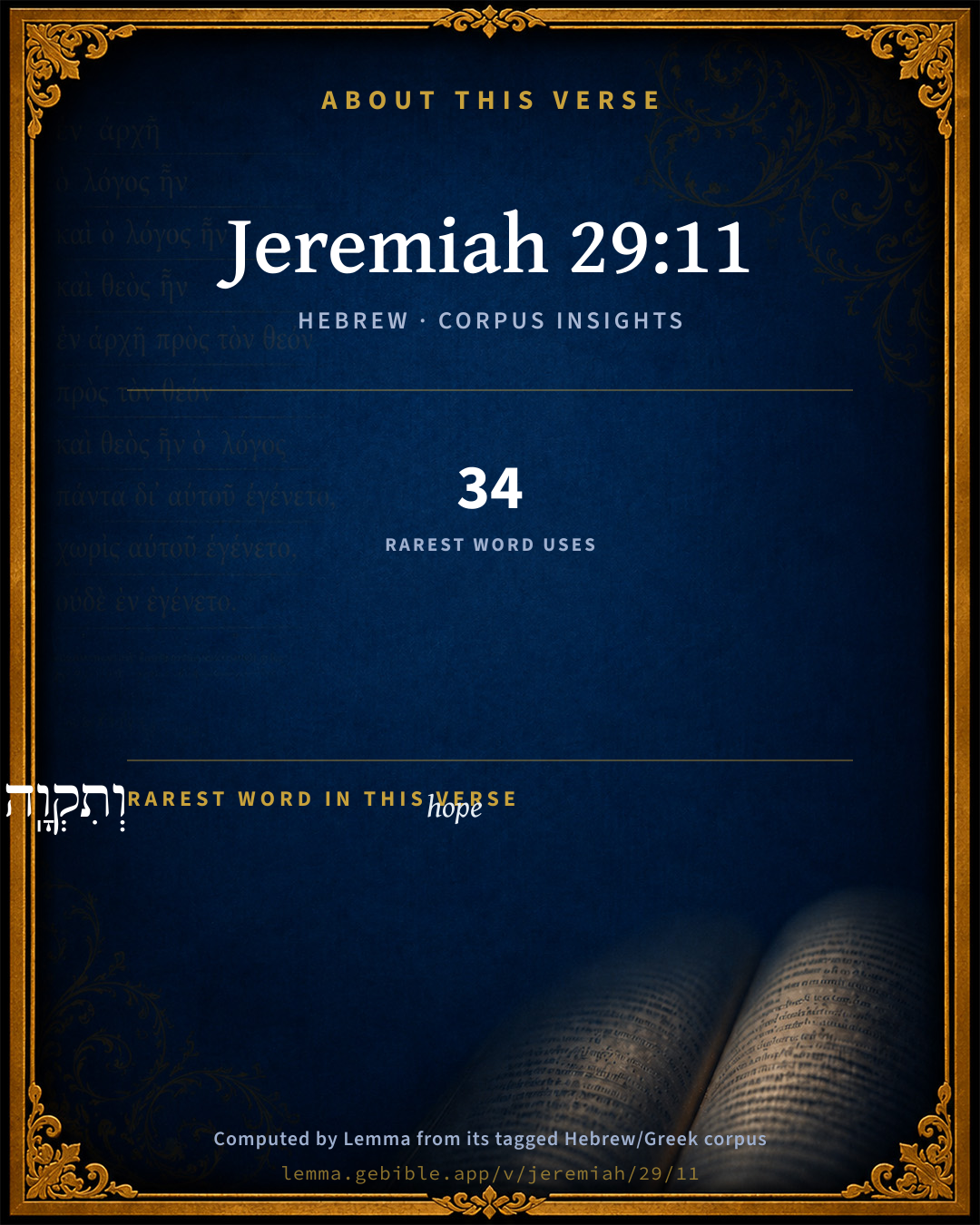
About this verse

These counts appear in no published source. They are computed here, from the morphology-tagged text and Lemma’s own curated glosses. What Lemma adds →

19
words
16
distinct lemmas
Prophets
section

Shared distinctive vocabulary

וְתִקְוָֽה hope H8615 occurs in 33 verses of the Hebrew Bible. Also found in:

Grammatical profile

  • 3 verbs
  • 8 nouns
  • 2 pronouns
  • 2 prepositions
  • 1 conjunction
  • 3 particles

Verb forms

  • יָדַ֜עְתִּי Qal · Perfect
  • חֹשֵׁ֥ב Qal · Participle Active
  • לָתֵ֥ת Qal · Infinitive Construct

Repetition

Words recur within this verse — often emphatic in Hebrew:

  • הַמַּחֲשָׁבֹ֗ת thought H4284 ×2
  • אָנֹכִ֨י I H595 ×2

Cross-references

28

Topical passages linked to Jeremiah 29:11 in the Treasury of Scripture Knowledge — connected by theme and wording, ordered by reader-vote popularity; previews shown in the World English Bible.

  • Isaiah 55:8–12 For my thoughts are not your thoughts, neither are your ways my ways, says Yahweh.
  • Psalms 33:11 The counsel of Yahweh stands fast forever, The thoughts of his heart to all generations.
  • Micah 4:12 But they don't know the thoughts of Yahweh, Neither do they understand his counsel; For he has gathered them like the sheaves to the threshing floor.
  • Psalms 40:5 Many, Yahweh, my God, are the wonderful works which you have done, And your thoughts which are toward us. They can't be set in order to you; If I would declare and speak of them, they are more than can be numbered.
  • Job 23:13 But he stands alone, and who can oppose him? What his soul desires, even that he does.
  • Lamentations 3:26 It is good that a man should hope and quietly wait for the salvation of Yahweh.
  • Isaiah 46:10–11 declaring the end from the beginning, and from ancient times things that are not [yet] done; saying, My counsel shall stand, and I will do all my pleasure;
  • Ezekiel 34:11–31 For thus says the Lord Yahweh: Behold, I myself, even I, will search for my sheep, and will seek them out.
  • Jeremiah 3:12–19 Go, and proclaim these words toward the north, and say, Return, you backsliding Israel, says Yahweh; I will not look in anger on you; for I am merciful, says Yahweh, I will not keep [anger] forever.
  • Jeremiah 31:1–33 At that time, says Yahweh, will I be the God of all the families of Israel, and they shall be my people.
  • Joel 2:28–32 "It will happen afterward, that I will pour out my Spirit on all flesh; And your sons and your daughters will prophesy. Your old men will dream dreams. Your young men will see visions.
  • Isaiah 40:1–31 Comfort you, comfort you my people, says your God.
  • Hosea 14:2–9 Take words with you, and return to Yahweh. Tell him, "Forgive all our sins, And accept that which is good: So we offer like bulls our lips.
  • Zephaniah 3:14–20 Sing, daughter of Zion! Shout, Israel! Be glad and rejoice with all your heart, daughter of Jerusalem.
  • Hosea 2:14–23 "Therefore, behold, I will allure her, And bring her into the wilderness, And speak tenderly to her.
  • Jeremiah 30:18–22 Thus says Yahweh: Behold, I will turn again the captivity of Jacob's tents, and have compassion on his dwelling-places; and the city shall be built on its own hill, and the palace shall be inhabited after its own manner.
  • Zechariah 12:5–10 The chieftains of Judah will say in their heart, 'The inhabitants of Jerusalem are my strength in Yahweh of Hosts their God.'
  • Micah 7:14–20 Shepherd your people with your staff, The flock of your heritage, Who dwell by themselves in a forest, In the midst of fertile pasture land, let them feed; In Bashan and Gilead, as in the days of old.
  • Hosea 3:5 Afterward the children of Israel shall return, and seek Yahweh their God, and David their king, and shall come with trembling to Yahweh and to his blessings in the last days.
  • Zechariah 9:9–17 Rejoice greatly, daughter of Zion! Shout, daughter of Jerusalem! Behold, your king comes to you! He is righteous, and having salvation; Lowly, and riding on a donkey, Even on a colt, the foal of a donkey.
  • Amos 9:8–15 Behold, the eyes of the Lord Yahweh are on the sinful kingdom, and I will destroy it from off the surface of the earth; except that I will not utterly destroy the house of Jacob," says Yahweh.
  • Zechariah 8:14–15 For thus says Yahweh of hosts: "As I thought to do evil to you, when your fathers provoked me to wrath," says Yahweh of Hosts, "and I didn't repent;
  • Ezekiel 36:1–37 You, son of man, prophesy to the mountains of Israel, and say, You mountains of Israel, hear the word of Yahweh.
  • Micah 5:4–7 He shall stand, and shall shepherd in the strength of Yahweh, In the majesty of the name of Yahweh his God: And they will live, for then he will be great to the ends of the earth.
  • Revelation 14:8–14 Another, a second angel, followed, saying, "Babylon the great has fallen, which has made all the nations to drink of the wine of the wrath of her sexual immorality."
  • Ezekiel 39:1–29 You, son of man, prophesy against Gog, and say, Thus says the Lord Yahweh: Behold, I am against you, Gog, prince of Rosh, Meshech, and Tubal:
  • Zechariah 14:20–21 In that day there will be on the bells of the horses, "HOLY TO YAHWEH;" and the pots in Yahweh's house will be like the bowls before the altar.
  • Zechariah 1:6 But my words and my decrees, which I commanded my servants the prophets, didn't they overtake your fathers? "Then they repented and said, 'Just as Yahweh of Hosts determined to do to us, according to our ways, and according to our practices, so he has dealt with us.'"

Cross-references courtesy of OpenBible.info (CC BY 4.0).

Hebrew and Greek witnesses Masoretic Hebrew ↔ Greek Septuagint

The same verse in the two great witnesses to the Old Testament, shown verse-for-verse.

These are two independent witnesses, not word-aligned to each other, and the Septuagint is shown in lemma (dictionary) form.

Hebrew Jeremiah 29:11 Masoretic · Westminster Leningrad Codex

כִּי֩ אָנֹכִ֨י יָדַ֜עְתִּי אֶת הַמַּחֲשָׁבֹ֗ת אֲשֶׁ֧ר אָנֹכִ֛י חֹשֵׁ֥ב עֲלֵיכֶ֖ם נְאֻם יְהוָ֑ה מַחְשְׁב֤וֹת שָׁלוֹם֙ וְלֹ֣א לְרָעָ֔ה לָתֵ֥ת לָכֶ֖ם אַחֲרִ֥ית וְתִקְוָֽה

For I know the thoughts that I think toward you, says Yahweh, thoughts of peace, and not of evil, to give you hope in your latter end.

World English Bible · Public Domain

Greek LXX Structure differs

In the Septuagint, Jeremiah is about an eighth shorter than the Hebrew and arranges its material differently — the Oracles Against the Nations (Hebrew chapters 46–51) appear in the middle of the Greek book, after 25:13. Because the chapter and verse boundaries do not line up, a verse-for-verse comparison with the Hebrew is not shown.

A verse-for-verse comparison isn’t shown here because the chapters and verses don’t line up. Switch to the LXX edition with the MT / LXX toggle above to read the Greek directly.

On this verse, Haydock's Catholic Bible Commentary discusses the Septuagint’s reading. Read the note in Commentary ↓

Hebrew: Westminster Leningrad Codex (CC BY 4.0). Greek: Septuagint (public domain); English from a public-domain English Septuagint. How the Septuagint differs from the Hebrew →

Targum (Aramaic paraphrase)

1

The Targum is the ancient Jewish Aramaic paraphrase of the Hebrew Scriptures — an interpretive translation, not the Hebrew text itself. Onkelos (literal) and Pseudo-Jonathan (expansive) render the Torah, and Jonathan the Prophets. Coverage is partial: where no permissively-licensed English translation exists for a verse, only the Aramaic is shown. This is verse-level text, not a word-by-word alignment to the Hebrew.

  1. Targum Jonathan Prophets (Joshua–Malachi)
    אֲרֵי קֳדָמַי גַלְיָן יַת מַחֲשַׁבְתָּא דִי אֲנָא מְחַשֵׁב עֲלֵיכוֹן אֲמַר יְיָ מַחְשְׁבַת שְׁלָמָא לָא לְבִישָׁא לְמִתַּן לְכוֹן סוֹף וְסִבּוּר:

    (no public-domain English translation for this verse)

    Targum Jonathan — Aramaic: “Mikraot Gedolot” (public domain). English: “Sefaria Community Translation” (CC0 1.0 (public-domain dedication)); “London "Chaldee Paraphrase," 1871” (public domain). Text via Sefaria.

Commentary

Notes on Jeremiah 29:11 from classic Christian and Jewish commentators (each source and its license shown beneath its notes). The classic Christian expositions comment on the surrounding passage and are grouped to its opening verse, so a note may address several verses; the Jewish commentaries on the Tanakh (Rashi and others) are per-verse, so they appear only where the commentator wrote on this verse.

Lemma curates 59 commentaries, every one of them public domain or Creative Commons licensed, each selected and text-cleaned for this edition rather than reprinted as found. About our sources →

Trapp's Complete Commentary

John Trapp

Jer 29:11 For I know the thoughts that I think toward you, saith the LORD, thoughts of peace, and not of evil, to give you an expected end.

Ver. 11. For I know the thoughts that I think.] God’s thoughts run upon his children, the children of affliction especially, as a father’s do upon his dear children. Omnis in Ascanio, &c.

To give you an expected end.] Heb., An end and expectation - i.e., An end of evils past, and expectation of better for the future.

John Trapp, A Commentary or Exposition upon All the Books of the Old and New Testament (1647–1656) — public domain. Text from a community e-Sword module.

Tyndale Open Study Notes

Tyndale Open Resources

29:11 The Lord’s plans for good, to prosper the exiled people and to return them to the land of Judah, gave them a future and a hope. This promise was specific to the exiles in Babylon, but it has given hope to millions of God’s people in various difficult circumstances.

Tyndale Open Study Notes — © Tyndale Open Resources, licensed CC BY-SA 4.0. Text via the HelloAO Bible API.

Jamieson, Fausset & Brown

Robert Jamieson, A. R. Fausset & David Brown

I know--I alone; not the false prophets who know nothing of My purposes, though they pretend to know.

thoughts . . . I think-- (Isa 55:9). Glancing at the Jews who had no "thoughts of peace," but only of "evil" (misfortune), because they could not conceive how deliverance could come to them. The moral malady of man is twofold--at one time vain confidence; then, when that is disappointed, despair. So the Jews first laughed at God's threats, confident that they should speedily return; then, when cast down from that confidence, they sank in inconsolable despondency.

expected end--literally, "end and expectation," that is, an end, and that such an end as you wish for. Two nouns joined by "and," standing for a noun and adjective. So in Jer 36:27, "the roll and the words," that is, the roll of words; Gen 3:16, "sorrow and conception," that is, sorrow in conception. Compare Pro 23:18, where, as here "end" means "a happy issue."

Jamieson, Fausset & Brown — Commentary Critical and Explanatory on the Whole Bible (1871) — public domain (CC PDM 1.0). Text via the HelloAO Bible API.

Adam Clarke's Commentary

Verse 11. Thoughts of peace] Here God gives them to understand,

1. That his love was moved towards them.

2. That he would perform his good word, his promises often repeated, to them.

3. That for the fulfilment of these they must pray, seek, and search.

4. That he would hearken, and they should find him; provided,

5. They sought him with their whole heart, Jer 29:10-13.

Adam Clarke's Commentary on the Bible (1810–1826) — public domain. Text from a community e-Sword/MySword module.

John Calvin's Commentaries

He confirms the same thing, and employs many words, because it was difficult to raise up minds wholly broken down. For the world labors under two extreme evils, — they sink in despair, or are too much exalted by foolish pride: nay, there is no moderation except when ruled by God’s Spirit we recumb on his word; for when they devise vain hopes for themselves, they are immediately rapt up above the clouds, fly here and there, and in short think that they can climb into heaven; this is the excess of vain and foolish confidence: but when they are dejected, then they fall down wholly frightened, nay, being astonished and lifeless they lose every feeling, receive no comfort, and cannot taste of anything which God promises. And both these evils prevailed evidently among the Jews. We have seen how much the Prophet labored to lay prostrate their pride and arrogance; for they laughed at all threatenings, and remained ever secure; though God, as it were, with an armed hand and a drawn sword menaced them with certain destruction, yet nothing moved them. And when they were driven into exile, they were extremely credulous when the false prophets promised them a quick return; while, in the meantime, God, by his servants, shewed to them that he would be gracious to them, and after seventy years would become their deliverer; but they were deaf to all these things, nay, they rejected with disdain all these promises, and said,

“What! will God, forsooth, raise up the dead!” (Ezekiel 37:12)

This, then, is the reason why the Prophet now speaks so largely of their future redemption: it was difficult to persuade the Jews; for as they thought that they would soon return to their own country, they could not endure delay, nor exercise the patience which God commanded. They were at the same time, as we have said, quite confident, inasmuch as the false prophets filled their minds with vain hopes.

He therefore says, I know the thoughts which I think towards you Some think that God claims here, as what peculiarly belongs to him, the foreknowledge of future things; but this is foreign to the Prophet’s meaning. There is here, on the contrary, an implied contrast between the certain counsel of God, and the vain imaginations in which the Jews indulged themselves. The same thing is meant when Isaiah says,

“As far as the heavens are from the earth, so far are my thoughts from your thoughts,” (Isaiah 55:9)

for they were wont absurdly to measure God by their own ideas. When anything was promised, they reasoned about its validity, and looked on all surrounding circumstances; and thus they consulted only their own brains. Hence God reproved them, and shewed how preposterously they acted, and said, that his thoughts were as remote from their thoughts as heaven is from the earth. So also in this place, though the two parts are not here expressed; the Prophet’s object was no other than to shew, that the Jews ought to have surrendered themselves to God, and not to seek to be so acute as to understand how this or that would be done, but to feel convinced that what God had decreed could not be changed.

It must yet be remarked, that he speaks not here of his hidden and incomprehensible counsel. What then are the thoughts of which Jeremiah now speaks? They were those respecting the people’s deliverance, after the time was completed, for God had promised that he would then be propitious to his Church. We hence see that the question here is not about the hidden counsels of God, but that the reference is simply to the word which was well known to the Jews, even to the prophecy of Jeremiah, by which he had predicted that the Jews would be exiles for seventy years, and would at last find that their punishment would be only a small chastisement, as it would only be for a time: I know then my thoughts But still he indirectly condemns the Jews, because they entertained no hope of deliverance except from what came within the reach of their senses. He then teaches us that true wisdom is to obey God, and to surrender ourselves to him; and that when we understand not his counsel, we ought resignedly to wait until the due time shall come.

He says that they were thoughts of peace, that is, of benevolence. Peace, as it has been often said, is taken for felicity, as in Jeremiah 29:7,

“For the peace of Babylon shall be your peace;”

that is, if Babylon be prosperous, you shall be partakers of the same happiness. So now, in this place, God declares that his thoughts were those of peace, for he designed really to shew by the effect his paternal kindness towards his people.

He afterwards adds, that 1 may give you the end and the expectation By אחרית, achrit, which means in Hebrew the last thing, we are to understand here the end, as though he had said, that it was to be deemed as final ruin, when people had been driven away to a foreign land. For it was no small trial when the Jews were deprived of that land which was the rest and habitation of God; it was the same as though they had been cut off from every hope: it was then a sort of repudiation, and repudiation was a kind of death. But here God declares that he would put an end to their exile, as it was to be only for a time. It is hence to be inferred, that the people did not perish when they were led into exile, but that they were only chastised by God’s hand.

He adds expectation, which Jerome has rendered “patience,” but in a very forced manner. There is, indeed, no doubt but that by this second word the Prophet more fully and clearly expressed what he meant by the first word, אחרית, achrit, even the end that was wished or desired, I will then give you the end, even that ye may enjoy the promises, as ye wish and expect, and ought to hope for, since God has made them. Here I will make an end.

John Calvin's Commentaries (1540-1563) — public domain. Text from the Calvin Translation Society English edition (1840s-50s) via the Christian Classics Ethereal Library (ccel.org). Calvin's coverage is partial (roughly two-thirds of the Bible); uncommented books and verses are honest gaps, never fabricated. The 19th-century editor's footnotes and remarks are omitted so the notes are faithfully Calvin's own voice.

Ellicott's Commentary for English Readers

(11) For I know the thoughts . . .—The word used for “saith the Lord” implies that the gracious promise came to the prophet’s soul as an oracle from heaven. In the “thoughts” of God there is, perhaps, a reference to what had been said before of the Babylonian exiles in Jer_24:6.

To give you an expected end.—Better, to give you a future (that which is to be hereafter) and a hope. This is the literal rendering of the words, and it is far more expressive than that of the English version. An “expected end” may be one from which we shrink in fear or dislike. Each word, in the amended translation, has its full meaning. The “future” tells them that their history as a people is not yet over; the “hope” that there is a better time in store for them. To wait for that future, instead of trusting in delusive assurances of immediate release, was the true wisdom of the exiles.

A Bible Commentary for English Readers, edited by Charles John Ellicott (1878–1897) — public domain. Text from a community e-Sword module.

The Cambridge Bible for Schools and Colleges

gen. ed. J. J. S. Perowne

11. For I know] an assurance on Jehovah’s part that He forgets them not, even though they be far from their proper land.

the thoughts that I think] i.e. My purposes.

hope in your latter end] For mg. a latter end and hope cp. Pro_23:18; Pro_24:14; Pro_24:20.

The Cambridge Bible for Schools and Colleges (gen. ed. J. J. S. Perowne; Cambridge University Press, 1878–1918) — public domain. Text from a community e-Sword module.

John Gill's Exposition

For I know the thoughts that I think towards you, saith the Lord,.... The purposes and resolutions of his heart concerning their welfare, particularly the restoration of them to their own land; these were within him, and known to him, and him only; they were remembered by him, and continued with him, as the "thoughts of his heart are to all generations"; and so would not fail of being performed; men think and forget what they have thought of, and so it comes to nothing; but thus it is not with God; he has taken up many thoughts in a way of love, grace, and mercy, concerning sinful men; about their election in Christ; a provision of all spiritual blessings for them; redemption and salvation by Christ; their effectual calling, adoption, and eternal life:

thoughts of peace, and not of evil: or "for evil" (t); these thoughts were concerning the temporal peace and prosperity of the Jews in Babylon, and not of anything to their hurt; yea, even their captivity was for their good, Jer 24:5; and thoughts concerning his spiritual Israel, their peace and reconciliation with God, and the manner of bringing it about, by the blood, sufferings, and death of his Son in human nature, with whom he consulted and agreed about this matter; and concerning their inward spiritual peace of mind and conscience now, and their eternal peace hereafter: nor does he ever think of evil for them; whatever evil he thinks towards others, angels or men, he thinks none towards them; and whatever evil befalls them, he means it for good, and it does work for good unto them; he cannot think otherwise concerning them, consistent with his everlasting and unchangeable love to them; since he has designed so much good for them, does so much to them, and has so much to bestow upon them. The issue of all which is,

to give you an expected end; a very desirable one; such as they wished and hoped to have, and expected; such as would put an end to all their troubles, and put them into the enjoyment of all good things promised and waited for. This, in the mystical sense, may have reference to the Messiah, in whom all God's thoughts of peace, concerning his special people, issue; he is the Alpha and Omega, the beginning and the end, of all things, Rev 1:8; of all things in creation; of the Scriptures, promises and prophecies of it: "the end of the law for righteousness", Rom 10:4, the fulfilling end of it, by his obedience, and sufferings, and death; and who was to come, and did come, at the end of the Jewish world, at the end of their civil and ecclesiastical state: he was long promised and prophesied of and was much waited for and expected, by the saints before the flood; from thence to Moses; from Moses to David; from David to the Babylonian captivity; from thence to the times of his coming, when there was a general expectation of him; and expected end was then given, as an instance of grace and good will to men. It may also be applied to salvation by Christ; the end of all God's gracious purposes and designs; the end of the covenant of grace, the provisions, blessings, and promises of it; the end of Christ's coming into the world, and of his obedience and death; the end of his prayers and preparations now in heaven; and the end of the faith of the saints on earth: this is an end hoped, waited for, and expected by faith; and for which there is good reason; since it is wrought out, prepared, and promised; saints are heirs of it; and now it is nearer than when they believed; and will be bestowed as a free grace gift, through Jesus Christ our Lord; and will be enjoyed as the issue and result of God's eternal thoughts of peace concerning them. Some render it, "an expected reward" (u); which is given at the end of the work: others, "posterity and hope" (w); a numerous posterity, and hope and expectation of good things from the Lord, promised in the days of the Messiah.

(t) "et non in malum", Montanus, Cocceius, Schmidt. (u) "mercedem et quidem expectatam", Piscator; so Ben Melech. (w) "Posteritatem et spem", Schmidt.

John Gill's Exposition of the Whole Bible (1746–1763) — public domain (CC PDM 1.0). Text via the HelloAO Bible API.

Albert Barnes' Notes on the Bible

An expected end - Rather, a future and a hope. The nation shall not come to an end; the exile shall be followed by a restoration.

Albert Barnes' Notes on the Bible (1834–1885) — public domain. Text from a community e-Sword/MySword module.

Haydock's Catholic Bible Commentary

An end. Septuagint, "these things." This version is much abridged. From ver. 15., to 21., is omitted in St. Jerome’s and the Roman edition; but not in the Complutensian or Theodoret. (Calmet) --- Grabe inserts what is wanting, and places the 15th at the end of our 20th verse. (Haydock)

George Leo Haydock (1774–1849), Haydock's Catholic Family Bible and Commentary, 1859 edition — public domain. Excludes Psalms (Douay-Rheims chapter numbering differs from Protestant) and Deuterocanonical books (Catholic canon only).

Matthew Poole's English Annotations

This deliverance will not depend upon your merits, but upon my own mercy and kind thoughts and purposes. I have for the seed of Abraham my servant, and I am resolved in my own thoughts what to do; I intend not the blotting out of the name of Israel from the earth, but to give such an end to their trouble as themselves expect and desire, though not so soon as they may expect it, being deceived by their prophets. There shall be an end of your captivity in my time, and that is after you shall have fulfilled seventy years in that captivity.

Matthew Poole's English Annotations on the Holy Bible (1683–1685) — public domain. Text from a community e-Sword/MySword module.

Whedon's Commentary on the Bible

Daniel D. Whedon

11. An expected end — Literally, a destiny (a future) and a hope; that is, a desirable future.

Daniel D. Whedon (gen. ed.), Commentary on the Old and New Testaments (1874–1909) — public domain. Text from a community e-Sword module.

The Pulpit Commentary

For I knew the thoughts, etc.; i.e. though seventy years must pass over you in exile, yet do not apprehend that I have forgotten you, for I know full well what my purpose is towards you a purpose of restoring to you "peace" and prosperity. An expected end; rather, a future and a hope; i.e. a hopeful future. (comp. Jer_31:17, "There is a hope for thy future That unexpectant apathy which is the terrible accompaniment of so much worldly sorrow was not to be an ingredient in the lot of the Jews.

God"s thoughts concerning us.

I GOD THINKS. If God exists he must be a thinking being. To apply the name "God." to a stream of tendencies, a collection of laws, the totality of being, etc., is to misapply it. Either God is personal or there is no God, for the conception of personality is essential to that of divinity. If God is a person he may be "without parts or passions." The anthropomorphic ideas of repentance, wrath, etc., may be as much mere metaphorical images as those of the eyes and the hands of God; but thinking is essential to the nature of what we understand by a person, by a spiritual being. Unless God thinks, he is no spirit, no person.

II GOD THINKS ABOUT US. As far as he is revealed to us in the Bible and in Christ, and as far as we may verify this revelation by experience, he is directly concerned with his works and his children. His thoughts are not to be imagined as only consisting of vast abstractions, infinite ideals. They may soar to lonely heights where no finite intellect can follow, but they can also stoop to humble concerns of human life. He is but an imperfect thinker who is so absorbed with philosophic speculation that he has no room in his mind to consider his family. The greatest thinker will be wide as well as lofty, able to take in small details in addition to grand abstractions, and, above all, wise to apply the highest thinking to the simplest practical necessity. It is a great comfort for us that God so thinks. With sublime ideas of eternity, and innumerable cares of the universe in his infinite mind, God has yet room for thoughts about us, and condescension to concern himself with them.

III WHAT GOD THINKS ABOUT US IS OF GREAT IMPORTANCE TO US.

1. God thinks what is true and wise and good. If, therefore, we can know God"s thoughts about anything we shall see the thing in its true light. Our thoughts are blinded by prejudice, colored by passion, limited by ignorance, broken, fragmentary, perverted. God"s only are clear and perfect as truth.

2. God"s thoughts are the prelude to his actions. If we know what he thinks concerning us we know how he intends to act. God"s thinking is not the contemplation of the philosopher, it is the consideration of the king. We forget this when we are so very anxious about what the world will think of us and so very indifferent about God"s thoughts concerning us. A brave man will learn to dare the world"s misjudgment, its scorn, its condemnation. But who can face God"s thoughts if they mean evil to us?

IV GOD THINKS THOUGHTS OF PEACE CONCERNING US. So Jeremiah saw in the case of the Jews; so we may see for all mankind how that Christ "has broken down the middle wall of partition between us." Even when God finds it necessary to punish his desire is to bless, and when he chastises it is in mercy, that he may reclaim. But this is not seen at the time. There are things which prevent us from seeing that God"s thoughts are of peace. Thus the peace is not yet enjoyed; when God chastises us it looks as though he meant evil to us, because we feel the blow before we see the good fruit of it; we cannot see God"s thoughts, and must accept them in faith, waiting for a later confirmation of experience. Yet if God does think thoughts of peace concerning us, is it necessary for us to know the exact nature of them? They are known to him if they are not known to us, and he can carry them out without any previous understanding of them on our part.

V GOD S THOUGHTS OF PEACE WILL BE ULTIMATELY REALIZED. God promises that he will make "a future and a hope." God"s best thoughts are not memories, but hopes, promises, intentions. The grandest page of revelation is prophecy. But though these thoughts refer to the future, we must not lose faith in their practical interest.

1. The realization is delayed by our fault, not by God"s will. He thinks, intends peace. But he is hindered from carrying out his intention by our conduct. He waits to be gracious. If, therefore, we prepare ourselves for the accomplishment of God"s thoughts, there is nothing further to prevent us from enjoying the peace they presage.

2. God is as great in power as he is wise and good in thought. He has bestowed upon us the noble but perilous faculty of free will, and we cannot measure the limits of this faculty. Yet we may rest assured that by some means the infinite God can and will ultimately accomplish all his great designs of peace for his children.

Thoughts of peace.

Such is the consoling word that God sends to his "banished ones" in their affliction. He bids his servant "speak comfortably" to them, even now that their "warfare" is only beginning, and they are having their first taste of the bitterness of exile. Blending with the lamentations of the weeping captives as they "hung their harps on the willows by the waters of Babylon," we can imagine that this gracious word would have a more salutary effect upon them than the living voice of the prophet ever had. What message has it for us?

I THE MIND OF GOD IS A PROFOUND MYSTERY TO US, BUT HE KNOWS HIS OWN COUNSELS.

1. God has his thoughts," even as we have ours. We believe in a God who is no mere philosophic abstraction, but a living, personal being, of whose infinite intelligence ours is but the dim and distant reflection.

2. His thoughts are immeasurably higher than ours. "As the heavens are higher than the earth," etc. (Isa_55:9) We cannot solve the mystery or trace the course of our own mental processes, and how should we be able to comprehend his? Our minds, with all their utmost range and activity, move but upon the outskirts of the glorious realm of the infinite and eternal thought of God.

3. His thoughts are all conformed to the eternal truth of things. Indeed, they are themselves the eternal truth of things. For what are all created existences material and spiritual, all laws, forces, etc., but embodiments and reflections of the thoughts" of God? And whatever his purposes maybe they are not variable; they partake of the immutability of his essential nature. "The counsel of the Lord standeth forever, the thoughts of his heart to all generations". (Psa_33:11)

II GOD"S WAYS OF DEALING WITH US ARE OFTEN PERPLEXING, BUT A GRACIOUS PURPOSE GOVERNS ALL. "Thoughts of peace and not of evil." He concealed within his darkest providences.

1. The constitution of the universe, in spite of all its discords, bears abundant witness to the benign spirit that inspires it. We have no sympathy with that gloomy and morbid view of it according to which, for aught that appears, it might have been fashioned by some spirit of cruelty and hate. True as it may be that "the whole creation groaneth and travaileth in pain together," there is proof enough that "God"s tender mercies are over all his works.

2. The Bible has its anomalies, but it is the unfolding of a redemptive purpose. The revelation of God"s mercy towards a guilty, ruined world in the person of the Christ is the key to all its historic dispensations. As every chastisement inflicted on the Jewish people had some gracious design in it as regards themselves, so the whole course of their national life and ecclesiastical polity played its part in the development of that world-wide plan. And through all the changes and storms and conflicts that may yet be in store for the Church and the world, Scripture keeps alive the blessed hope of the future. The prophetic word is "as a light shining in a dark place, until the day dawn and the day-star arise in our hearts". (2Pe_1:19)

3. The saddest experiences in our personal life have their beneficent Divine intent. Every cloud has its "silver lining." Our keenest sorrows often prove to be "celestial benedictions in a dark disguise." God"s "thought of peace" is at the heart of all our earthly tribulations. (Heb_12:6-11)

III THE ISSUE ALWAYS JUSTIFIES GOD"S THOUGHTS AND WAYS. The "expected end," when it comes, never fails to solve the mystery of the path that led to it. The gracious purpose, hidden in the secrecy of the Eternal Mind, veiled under many forms of dark disguise, is then made manifest. God is his own Interpreter, and the day of his glorious self-vindication will surely come. "His ways are love though they transcend Our feeble range of sight, They wind through darkness to their end In everlasting light.

The Pulpit Commentary (1880–1919), ed. H.D.M. Spence-Jones & Joseph S. Exell — public domain. Text from a community e-Sword module.

John Wesley's Explanatory Notes

To give - This deliverance will not depend upon your merits, but upon my own mercy, and kind thoughts and purposes I have for the seed of Abraham my servant, and I am resolved in my own thoughts what to do, I intend not the blotting out of the name of Israel from the earth, but to give such an end to their trouble as themselves expect and desire.

John Wesley, Explanatory Notes Upon the Whole Bible (1754–1765) — public domain. Text via the GEBible commentary corpus.

Lesson kit

Teaching starters — assembled from the data on this page, not authored interpretation. Every prompt links to the verse data it draws on. Edit before teaching.

Jeremiah, in the Prophets, opens this verse with 19 words (16 distinct Hebrew lemmas). Its most distinctive word is tiqvâh (“hope”). A historical commentator’s framing appears above. Read the whole chapter for the surrounding context.

Discussion questions

  1. What does “hope” (tiqvâh) contribute to the verse as a whole?
  2. Joshua 2:18 shares the word «hope» with this verse. How do the two illuminate each other?
  3. “thought” occurs 2× in this one verse. What is the effect of the repetition?
  4. These translations render this verse differently. What is at stake in choosing one wording over another?
  5. The verb «יָדַ֜עְתִּי» is Qal Perfect. How does its form color the action?
  6. Reading how Trapp's Complete Commentary and Tyndale Open Study Notes read this verse, where do the two commentators agree and where do they part?

Things to notice

Reading settings

Reading text

Shown beneath each verse's original-language words.

Old Testament
Old Testament edition

Read the OT as the Masoretic Hebrew (MT) or the Greek Septuagint (LXX).

English shown for the Greek Septuagint (in the Hebrew ↔ Greek comparison).

Comparing translations? Open the Compare panel on any verse page to stack up to four side by side.