
Isaiah 38:17

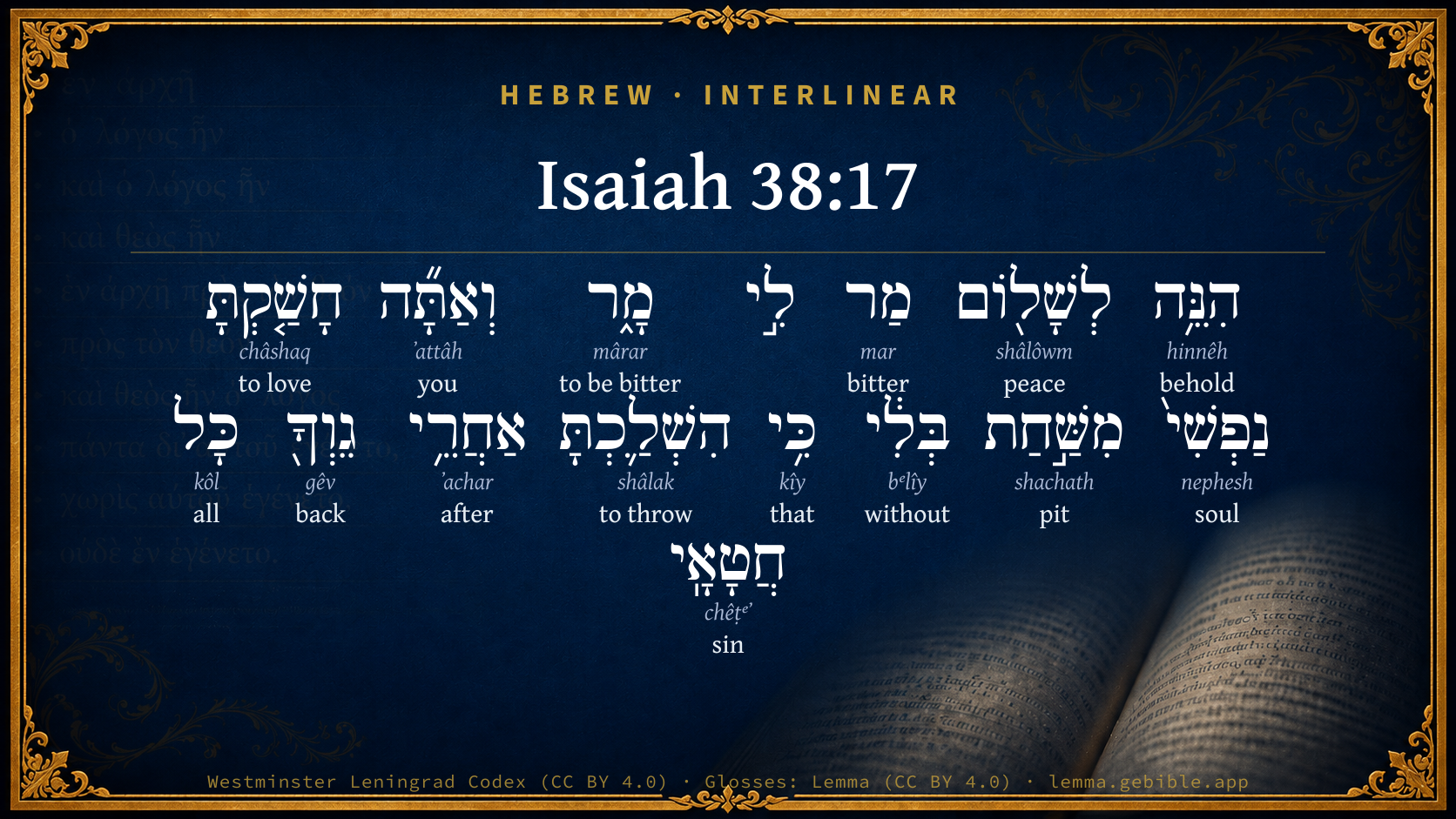
Hebrew (Westminster Leningrad Codex) Isaiah 38:17 appears in the Hebrew Old Testament. The text above is from the Westminster Leningrad Codex. Each word links to its Strong’s number, a concise gloss, and parsing drawn from the Open Scriptures Hebrew Bible morphology. Click any word for its full Brown-Driver-Briggs (BDB) entry.
Download image
Cite this verse

Isaiah 38:17 (World English Bible). Public Domain. Lemma interlinear Bible study tool, https://lemma.gebible.app/v/isaiah/38/17.

Show BibTeX & RIS
BibTeX
RIS
English Translation
Behold, [it was] for [my] peace [that] I had great bitterness: But you have in love to my soul delivered it from the pit of corruption; For you have cast all my sins behind your back.
World English Bible · Public Domain
Download a study sheet

One document with this verse’s original text, its word-by-word gloss line, the meaning frame, cross-references with their text, attributed commentary, and full source and license credits — printable, and it pastes into notes with its structure intact.

This verse Autodidact and up

Study sheet (.html) Plain text (.txt)

A passage Seminary Student

Up to 50 verses in one chapter. A passage sheet keeps up to 6 commentary sources and 12 cross-references per verse, in the order this page ranks them, and says so on the sheet whenever that leaves anything out. Ask for a single verse and you get the Autodidact verse sheet above.

Everything on this page stays free to read, with no account — the sheet is a download of what is already on screen, not access to it.

Want to remove ads? Support Godless Engineer
Compare translations 3

The same verse in 3 English versions, stacked beneath the original-language interlinear above. Click any original word for its lexicon entry.

Each is an independent rendering of the whole verse — the interlinear is not word-aligned to these translations.

Highlighted words mark where these versions differ — a whole-verse word diff, not a word-by-word alignment.

  • World English Bible Public Domain
    Behold, [it was] for [my] peace [that] I had great bitterness: But you have in love to my soul delivered it from the pit of corruption; For you have cast all my sins behind your back.
  • King James Version Public Domain
    Behold, for peace I had great bitterness: but thou hast in love to my soul delivered it from the pit of corruption: for thou hast cast all my sins behind thy back.
  • unfoldingWord Literal Text CC BY-SA 4.0
    Behold, for welfare, bitterness bitter for me. But you, you have held back my soul from the pit of nothingness, for you have thrown all of my sins behind your back.

unfoldingWord Literal Text — © unfoldingWord, licensed CC BY-SA 4.0. Word-aligned USFM3 via Door43 (git.door43.org/unfoldingWord/en_ult).

Versions to compare (up to 4)

3 of 4 selected

Show all 18 translations

Every available English version of this verse, each an independent rendering of the whole verse.

  • World English Bible Public Domain
    Behold, [it was] for [my] peace [that] I had great bitterness: But you have in love to my soul delivered it from the pit of corruption; For you have cast all my sins behind your back.
  • Berean Standard Bible Public Domain
    Surely for my own welfare I had such great anguish; but Your love has delivered me from the pit of oblivion, for You have cast all my sins behind Your back.
  • Majority Standard Bible Public Domain
    Surely for my own welfare I had such great anguish; but Your love has delivered me from the pit of oblivion, for You have cast all my sins behind Your back.
  • King James Version Public Domain
    Behold, for peace I had great bitterness: but thou hast in love to my soul delivered it from the pit of corruption: for thou hast cast all my sins behind thy back.
  • American Standard Version (1901) Public Domain
    Behold, `it was' for `my' peace `that' I had great bitterness: But thou hast in love to my soul delivered it from the pit of corruption; For thou hast cast all my sins behind thy back.
  • Revised Version (1885) Public Domain
    Behold, it was for my peace that I had great bitterness: but thou hast in love to my soul delivered it from the pit of corruption; for thou hast cast all my sins behind thy back.
  • Geneva Bible (1599) Public Domain
    Beholde, for felicitie I had bitter griefe, but it was thy pleasure to deliuer my soule from the pit of corruption: for thou hast cast all my sinnes behinde thy backe.
  • Douay-Rheims (1899) Public Domain
    Behold in peace is my bitterness most bitter: but thou best delivered my soul that it should not perish, thou hast cast all my sins behind thy back.
  • Young's Literal Translation Public Domain
    Lo, to peace He changed for me bitterness, And Thou hast delighted in my soul without corruption, For Thou hast cast behind Thy back all my sins.
  • Literal Standard Version CC BY-SA 4.0
    Behold, He changed bitterness to peace for me, || And You have delighted in my soul without corruption, || For You have cast all my sins behind Your back.
  • Unlocked Literal Bible CC BY-SA 4.0
    It was for my benefit that I experienced such grief. You have rescued me from the pit of destruction; for you have thrown all my sins behind your back.
  • unfoldingWord Literal Text CC BY-SA 4.0
    Behold, for welfare, bitterness bitter for me. But you, you have held back my soul from the pit of nothingness, for you have thrown all of my sins behind your back.
  • Darby Bible Public Domain
    Behold, instead of peace I had bitterness upon bitterness; but thou hast in love delivered my soul from the pit of destruction; for thou hast cast all my sins behind thy back.
  • World Messianic Bible Public Domain
    Behold, for peace I had great anguish, but you have in love for my soul delivered it from the pit of corruption; for you have cast all my sins behind your back.
  • Webster's Bible Public Domain
    Behold, for peace I had great bitterness: but thou hast in love to my soul delivered it from the pit of corruption: for thou hast cast all my sins behind thy back.
  • Free Bible Version CC BY-SA 4.0
    It was definitely for my own good I went through this bitter experience. You in your love saved me from the pit of destruction and you have forgiven all my sins.
  • Bible in Basic English Public Domain
    See, in place of peace my soul had bitter sorrow. but you have kept back my soul from the underworld; for you have put all my sins out of your memory.
  • JPS Tanakh (1917) Public Domain
    Behold, for my peace I had great bitterness; but Thou hast in love to my soul delivered it from the pit of corruption; for Thou hast cast all my sins behind Thy back.

Literal Standard Version (2020), Covenant Press — licensed CC BY-SA 4.0. Text via the HelloAO Bible API (eBible.org). Unlocked Literal Bible (unfoldingWord) — licensed CC BY-SA 4.0. Text via the HelloAO Bible API (eBible.org). unfoldingWord Literal Text — © unfoldingWord, licensed CC BY-SA 4.0. Word-aligned USFM3 via Door43 (git.door43.org/unfoldingWord/en_ult). Free Bible Version, Dr. Jonathan Gallagher — licensed CC BY-SA 4.0. Text via the HelloAO Bible API (eBible.org).

Word by word

More ways to search: Search by grammar → Find every occurrence → Compare this word →

Practice this passage: Drill this verse → Learn its vocabulary →

גֵוְךָ֖
gêv
H1460
“back · your”
Noun, Common, Masculine, Singular, Construct + Suffix, Personal, 2nd Person, Masculine, Singular
Part of Speech
Noun
Type
Common
Gender
Masculine
Number
Singular
State
Construct
Full BDB Definition

Origin: from H1342 [corresponding to H1354 ]

TWOT: 326b

the back, back, midst
  1. הִנֵּ֥ה hinnêh H2009 “behold” Particle, Demonstrative
  2. לְשָׁל֖וֹם shâlôwm H7965 “to/for · peace” Preposition + Noun, Common, Masculine, Singular, Absolute
  3. מַר mar H4751 “bitter” Adjective, Adjective, Masculine, Singular, Absolute
  4. מָ֑ר mârar H4843 “to be bitter” Verb, Qal, Perfect, 3rd Person, Masculine, Singular
  5. וְאַתָּ֞ה ʼattâh H859 “and · you” Conjunction + Pronoun, Personal, 2nd Person, Masculine, Singular
  6. חָשַׁ֤קְתָּ châshaq H2836 “to love” Verb, Qal, Perfect, 2nd Person, Masculine, Singular
  7. נַפְשִׁי֙ nephesh H5315 “soul · my” Noun, Common, Both, Singular, Construct + Suffix, Personal, 1st Person, Common, Singular
  8. מִשַּׁ֣חַת shachath H7845 “from · pit of” Preposition + Noun, Common, Feminine, Singular, Construct
  9. בְּלִ֔י bᵉlîy H1097 “without” Particle, Negative
  10. כִּ֥י kîy H3588 “that” Conjunction
  11. הִשְׁלַ֛כְתָּ shâlak H7993 “to throw” Verb, Hiphil, Perfect, 2nd Person, Masculine, Singular
  12. אַחֲרֵ֥י ʼachar H310 “after” Preposition
  13. כָּל kôl H3605 “all of” Noun, Common, Masculine, Singular, Construct
  14. חֲטָאָֽי chêṭᵉʼ H2399 “sins · my” Noun, Common, Masculine, Plural, Construct + Suffix, Personal, 1st Person, Common, Singular

About this verse

These counts appear in no published source. They are computed here, from the morphology-tagged text and Lemma’s own curated glosses. What Lemma adds →

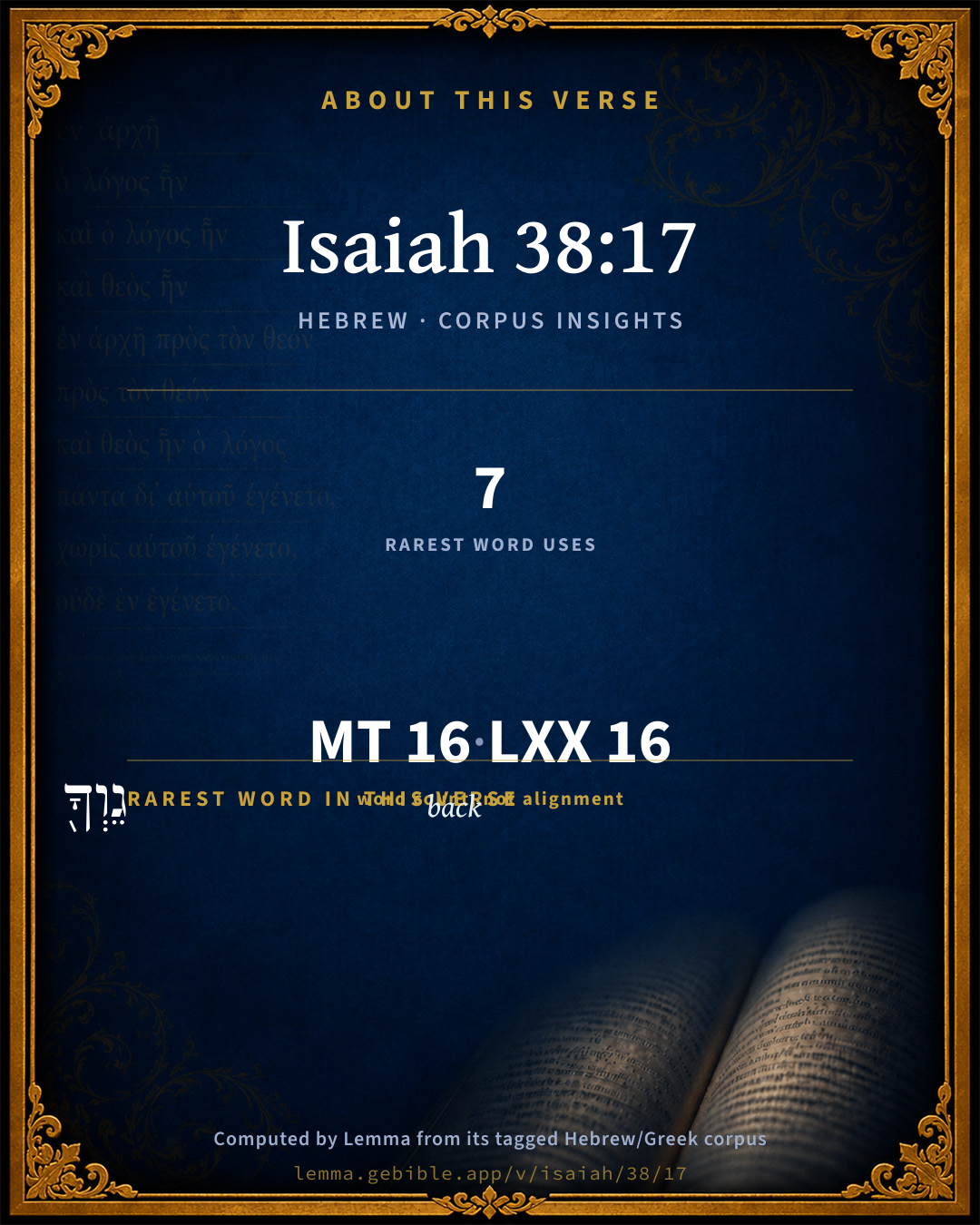
16
words
15
distinct lemmas
Prophets
section

Notable vocabulary

The rarest word here is גֵוְךָ֖ back H1460 — appearing just 7 times in the whole Hebrew Bible.

Shared distinctive vocabulary

גֵוְךָ֖ back H1460 occurs in 7 verses of the Hebrew Bible. Also found in:

Grammatical profile

  • 3 verbs
  • 6 nouns
  • 1 adjective
  • 1 pronoun
  • 2 prepositions
  • 1 conjunction
  • 2 particles

Verb forms

  • מָ֑ר Qal · Perfect
  • חָשַׁ֤קְתָּ Qal · Perfect
  • הִשְׁלַ֛כְתָּ Hiphil · Perfect

Hebrew & Septuagint length

In English translation the verse runs 36 words from the Hebrew and 20 from the Septuagint (LXX English) — the Septuagint runs noticeably shorter here. See the side-by-side →

A rough comparison of the two English renderings, which tokenize alike — not a word-level alignment.

Word counts can differ between the Hebrew and the Greek without any difference in meaning — e.g. the Hebrew direct-object marker אֵת has no separate Greek word, and Greek often adds the article ὁ.

In the original languages it is 16 Hebrew tokens and 16 Greek tokens — but the two are counted differently (Hebrew bundles its prefixes and suffixes into one token; the Greek is in lemma form), so that isn’t a like-for-like length.

Cross-references

13

Topical passages linked to Isaiah 38:17 in the Treasury of Scripture Knowledge — connected by theme and wording, ordered by reader-vote popularity; previews shown in the World English Bible.

  • Isaiah 43:25 I, even I, am he who blots out your transgressions for my own sake; and I will not remember your sins.
  • Jonah 2:6 I went down to the bottoms of the mountains. The earth barred me in forever: Yet have you brought up my life from the pit, Yahweh my God.
  • Micah 7:18–19 Who is a God like you, who pardons iniquity, And passes over the disobedience of the remnant of his heritage? He doesn't retain his anger forever, Because he delights in loving kindness.
  • Psalms 30:3 Yahweh, you have brought up my soul from Sheol. You have kept me alive, that I should not go down to the pit.
  • Jeremiah 31:34 and they shall teach no more every man his neighbor, and every man his brother, saying, Know Yahweh; for they shall all know me, from the least of them to the greatest of them, says Yahweh: for I will forgive their iniquity, and their sin will I remember no more.
  • Psalms 86:13 For your loving kindness is great toward me. You have delivered my soul from the lowest Sheol.
  • Job 3:25–26 For the thing which I fear comes on me, That which I am afraid of comes to me.
  • Psalms 30:6–7 As for me, I said in my prosperity, "I shall never be moved."
  • Psalms 40:2 He brought me up also out of a horrible pit, Out of the miry clay. He set my feet on a rock, And gave me a firm place to stand.
  • Psalms 85:2 You have forgiven the iniquity of your people. You have covered all their sin. Selah.
  • Job 29:18 Then I said, 'I shall die in my own house, I shall number my days as the sand.
  • Psalms 10:2 In arrogance, the wicked hunt down the weak; They are caught in the schemes that they devise.
  • Psalms 88:4–6 I am counted among those who go down into the pit. I am like a man who has no help,

Cross-references courtesy of OpenBible.info (CC BY 4.0).

Hebrew and Greek witnesses Masoretic Hebrew ↔ Greek Septuagint

The same verse in the two great witnesses to the Old Testament, shown verse-for-verse.

Here the Septuagint runs noticeably shorter than the Hebrew — LXX2012 (modern English Septuagint) 20 words vs World English Bible 36. A rough length comparison of the two English translations, not a word-level alignment — read both below.

These are two independent witnesses, not word-aligned to each other, and the Septuagint is shown in lemma (dictionary) form.

Hebrew Isaiah 38:17 Masoretic · Westminster Leningrad Codex

הִנֵּ֥ה לְשָׁל֖וֹם מַר לִ֣י מָ֑ר וְאַתָּ֞ה חָשַׁ֤קְתָּ נַפְשִׁי֙ מִשַּׁ֣חַת בְּלִ֔י כִּ֥י הִשְׁלַ֛כְתָּ אַחֲרֵ֥י גֵוְךָ֖ כָּל חֲטָאָֽי

Behold, [it was] for [my] peace [that] I had great bitterness: But you have in love to my soul delivered it from the pit of corruption; For you have cast all my sins behind your back.

World English Bible · Public Domain

Greek LXX Isaiah 38:17 Septuagint · lemma form

αἱρέω γάρ ἐγώ ὁ ψυχή ἵνα μή ἀποὀλλύω καί ἀποῥίπτω ὀπίσω ἐγώ πᾶς ὁ ἁμαρτία ἐγώ

For you have chosen my soul, that it should not perish: and you have cast all my sins behind me.

LXX2012 (modern English Septuagint) · Public Domain

On this verse, Adam Clarke's Commentary discusses the Septuagint’s reading. Read the note in Commentary ↓

Hebrew: Westminster Leningrad Codex (CC BY 4.0). Greek: Septuagint (public domain); English from LXX2012 (modern English Septuagint) (Public Domain). How the Septuagint differs from the Hebrew →

Targum (Aramaic paraphrase)

1

The Targum is the ancient Jewish Aramaic paraphrase of the Hebrew Scriptures — an interpretive translation, not the Hebrew text itself. Onkelos (literal) and Pseudo-Jonathan (expansive) render the Torah, and Jonathan the Prophets. Coverage is partial: where no permissively-licensed English translation exists for a verse, only the Aramaic is shown. This is verse-level text, not a word-by-word alignment to the Hebrew.

  1. Targum Jonathan Prophets (Joshua–Malachi)
    הָא לְעָבְדֵי אוֹרַיְתָא סַגִי שְׁלָמָא קָדָמָךְ וְאַתְּ מַיְיתֵי מְרִירָא לְרַשִׁיעַיָא בְּכֵן כַּד יְדָעִית יוֹם מוֹתִי שְׁפָכִית דִמְעֲתִי בִּצְלוֹ קֳדָמָךְ מַר לִי סַגִי וְאַתְּ אִתְרְעֵיתָא בְּחַיֵי בְּדִיל דְלָא לְחַבָּלָא נַפְשִׁי אֲרֵי אַרְחֵיקְתָּא מִן קֳדָמָךְ כָּל חֲטָאָי:

    Behold, to them that obey the law, peace shall be multiplied before Thee; but Thou wilt bring bitterness to the wicked: therefore, when I knew the day of my death, I poured out my tears in prayer before Thee; my bitterness was great, but Thou hast had pleasure in my life, not to destroy it; for Thou hast cast all my sins far away from Thy presence.

    Targum Jonathan — Aramaic: “Mikraot Gedolot” (public domain). English: “Sefaria Community Translation” (CC0 1.0 (public-domain dedication)); “London "Chaldee Paraphrase," 1871” (public domain). Text via Sefaria.

Commentary

Notes on Isaiah 38:17 from classic Christian and Jewish commentators (each source and its license shown beneath its notes). The classic Christian expositions comment on the surrounding passage and are grouped to its opening verse, so a note may address several verses; the Jewish commentaries on the Tanakh (Rashi and others) are per-verse, so they appear only where the commentator wrote on this verse.

Lemma curates 59 commentaries, every one of them public domain or Creative Commons licensed, each selected and text-cleaned for this edition rather than reprinted as found. About our sources →

Trapp's Complete Commentary

John Trapp

Isa 38:17 Behold, for peace I had great bitterness: but thou hast in love to my soul [delivered it] from the pit of corruption: for thou hast cast all my sins behind thy back.

Ver. 17. Behold, for peace I had great bitterness.] Mar Mar; the approach of death was to this good man bitter bitterness, and yet Christ had taken away from him the sting or gall of death, so that he might better say than Agag did, "Surely the bitterness of death is past," or than Lucan doth of the Gauls and Britons.

- “ Animmque capaces

Mortis. ”

“Life and spaceous corpse.”

But thou hast in love to my soul.] Or, Thou hast embraced my soul out of the corrupting pit. Complectendi verbum, affectum plane paternum, et stadium iuvandi singulare exprimit.

For thou hast cast all my sins behind thy back.] As an old overworn evidence, that is out of date, and of no use. Here it is well noted that we must set our sins before our face, if we would have God to cast them behind his back. {Psa 50:21; Psa 51:3}

John Trapp, A Commentary or Exposition upon All the Books of the Old and New Testament (1647–1656) — public domain. Text from a community e-Sword module.

The Biblical Illustrator

Joseph S. Exell

Isa_38:17-19

Behold, for peace I had great bitterness

Hezekiahs return of praise for his recovery

I.

A SAD, HEAVY AFFLICTION. Behold, for peace, &c. The affliction is aggravated--

1. By a description of it in its own nature.

(1) In the quality of it--bitterness.

(2) In the quantity of it--great bitterness.

2. By opposition of the blessing which is removed--peace; a word that comprehends an temporal blessings, and more particularly is taken, in Holy Writ, for health--a blessing without which all other blessings have no relish in them.

3. By the surprise of it--Behold! as a strange thing.

4. And this further aggravated it, if we understand it, as we must in a spiritual sense--that, his sickness calling his sins to remembrance, and causing some distrust of Gods love, instead of that peace of conscience he had had heretofore, his spirit was now troubled and greatly embittered. And a wounded spirit, who can bear?

II. A MERCIFUL DELIVERANCE OUT OF THIS AFFLICTION. Thou hast in love, &c. The mercy of the deliverance wants not its heightening circumstances; as--

1. From the efficient cause. It was God delivered him.

2. From the motive or impulsive cause--love.

3. From the danger he was delivered out of, and that no ordinary one--a pit--the pit of corruption, even the grave.

III. A BLESSED IMPROVEMENT OF THIS MERCY. For Thou hast cast, &c. This is the crown of mercies, when temporals are thus accumulated with spirituals; this a recovery indeed, of the whole man, when health is improved unto salvation, and strength of body accompanied with pardon of sins. This is right saving health.

IV. A THANKFUL ACKNOWLEDGMENT OF THIS IMPROVED MERCY. That is set forth--

1. By showing the impossibility for the dead to perform this duty.

2. And then showing, not the possibility only, but the probability, that the living will, i.e., such as Divine mercy continues in life, and especially such as are by that mercy preserved from imminent danger of death.

3. Exemplified in himself. As I do this day. (A. Littleton, D. D.)

The pains and pleasures attending religion

I. THE FELICTIOUS CONDITION OF THE GOOD HEZEKIAH IN THE POSSESSION OF PEACE. Shall I speak of him as a man enjoying health in his body; as a king blessed with prosperity and tranquillity through all his dominions? These are invaluable privileges. Rather let us consider him as a sinner whose, conscience has been sprinkled with the blood of Christ, by virtue of which he enjoys that peace which consists in a sweet sense of the Divine friendship.

II. ATTEND HEZEKIAH WHEN HIS PEACE IS FOLLOWED BY TROUBLE.

III. REFLECT ON THE LOVE OF GOD, DISPLAYED TOWARDS HEZEKIAH in lengthening out his life and pardoning all his sins. (John Rippon.)

The assurance of faith

I. THE DISTRESS Hezekiah was in before our Saviour spoke peace to him, and delivered him from his sins.

II. THE ASSURANCE he had of being pardoned and accepted by his Heavenly Father and saved; and how boldly he testifies that this must be the case with all the children of God.

III. THE CAUSE OF ALL, which he says was the love of Jehovah to him. (John Cennick.)

The purpose of Gods love

The purpose of Gods love is to draw us away from all pits, dejections, humiliations, prostrations, and to give us life, vigour, triumph, sense and guarantee of immortality. (J. Parker, D. D.)

Loves medicines and miracles

I. HEALTHFUL BITTERNESS. You have it in the first sentence, which runs in Hebrew very nearly as follows: Behold, to peace (or to health) my bitter bitterness. This means--

1. That Hezekiah underwent a great, sad, and unexpected change. Let us never boast ourselves of to-morrow, for we know not what a day may bring forth.

2. Hezekiahs condition was one of emphatic sorrow, for he says, Behold, to peace, Marah, Marah--bitter, bitter. Marah was a notable spot in the journeys of the children of Israel, and Hezekiah had come spiritually to a double Marah. Have you ever passed that way and drank of double bitterness--the wormwood and the gall? Some of us know what it means, for we have had at the same time a body racked with pain, and a soul full of heaviness. Perhaps the double Marah has come in another form: it is a time of severe trouble, and just then the friend in whom you trusted has forsaken you. Or, peradventure, you are in temporal difficulties, and at the same time in great spiritual straits. The flying fish is pursued by a fierce enemy in the sea, and when it flies into the air birds of prey are eager afar it; in like manner, both in temporal and spiritual things we are assailed. Deep calleth unto deep.

3. The meaning of our verse is not at all exhausted by this explanation; we find in it a better meaning by far. Behold, to peace bitter bitterness--that is to say the kings double bitterness wrought his peace and health. Take the word in the sense of health first. Many a time when a man has been exceedingly ill the medicine which has met his case has been intensely disagreeable to the taste; but it has operated as a strengthening tonic, it has purged away the cause of the malady, and the man has recovered. Hezekiah bore witness that God had sanctified his bodily sickness and his mental sorrow to his spiritual health. While he lay with his face to the wall, he read a great deal upon that wall which he had seen nowhere else. The kings bitterness of soul led him to repent of his wrongdoing, as he saw wherein he had sinned.

4. This bitter bitterness made Hezekiah see the need of his God more than ever he had seen it before.

II. LOVING DELIVERANCE. The original runs thus: And Thou hast loved my soul from the pit of destruction. Taken in its first sense, the king ascribes to the love of God his deliverance from death and the grave, and praises God for his restoration to the land of the living. But the words of inspired men frequently have a deeper significance than appears upon the surface, and indeed they often conceal an inner sense which perhaps they themselves did not perceive, and hence the kings words are as dark sayings upon a harp full of meaning within meaning. At any rate, taking the language out of the mouth of Hezekiah, we will use it for expressing our own emotions, and give to it a wider sense if such be not the original range of its meaning. Let us notice three things.

1. The deed of grace: Thou hast brought my soul from the pit of corruption.

(1) From the pit of hell.

(2) Of sinfulness, as horrible a pit as hell itself; indeed, under some aspects it is the same thing, for sinfulness is hell, and to live under the power of sin is to be condemned.

(3) From the awful consciousness of wrath under which we once groaned.

2. The power which performed it. Love. Divine love is a catholicon, a universal medicine. No spiritual disease can resist its healing power.

3. The modus operandi of this love. Thou hast embraced my soul out of the pit of corruption. Yonder is the child in the pit, and the father, wishing to save it, goes down into the pit and embraces his beloved one, and so brings him up to life and safety again. After this manner dig Jesus save us. He embraced us by taking our nature, and so becoming one with us. All our lives He communes with us, and embraces us with arms of mighty love, and so uplifts us from the pit of corruption.

III. ABSOLUTE PARDON. For Thou hast cast all my sins behind Thy back. This King Hezekiah mentions as the cause of his restored peace and health. Sin was the foreign element in his spiritual constitution, and as long as it was there it caused fret and worry and spiritual disease. Notice--

1. The burden. Sins.

2. The owner of this burden. My sins.

3. The comprehensiveness of the burden. All my sins. The Lord comes to deal with them. He casts them behind His back. Where can that be? It means annihilation, non-existence. (C. H. Spurgeon.)

Thou hast in love to my soul delivered it

Miracles of love

Thou hast loved my soul out of the pit of corruption (margin).

I. We were in the beginning LOVED INTO GRACE.

1. The love of Christ to sinners was the topic which arrested our solemn attention to the Gospel.

2. We sat in the region of the shadow of death, and would have remained there had we not been loved into faith.

3. At the time when faith came into our hearts, there came with it the sister grace, namely, repentance.

II. We have been LOVED INTO GROWTH IN GRACE. The great motive power urging us onward has always been the self-same love of God. The Lord loves us out of love to sin. He loves us out of the pit of idolatry. There is another pit of corruption into which children of God sometimes fall, namely, that of sluggishness. The only effectual cure for a slumbering Christian is to let him have the love of Christ shed abroad in his heart. The same is true of that abominable pit of selfishness and self-esteem and pride and self-seeking, into which our feet so easily glide. The love of Christ is equally a cure for despondency and unbelief. Many a child of God can bear witness that the Lord has loved him out of his impatience.

III. The Lord will LOVE US OUT OF GRACE INTO GLORY. (C. H. Spurgeon.)

Deliverance from destruction

I have heard a story of a man, who, travelling late and being in drink, rode over a narrow footbridge where there was a great, deep water underneath, that the least trip of the horses foot would have posted the rider to his long home. Next morning, when he came to himself, being asked which way he came, and brought to the place, the apprehension of his last nights adventure did so astonish his sober thoughts, that he fell down dead in the very place at the sight of it. And when we look back upon the follies and vanities of our past lives, how can we but be justly startled, when almost every step we have trod has been upon the brink of destruction! (A. Littleton, D. D.)

Soul-pits abound

I. THE PIT.

1. Horrible.

2. Nigh to every man.

3. Treacherous at its edge.

4. Bottomless.

II. ONE CONSCIOUS OF DELIVERANCE FROM IT.

1. He attributes his deliverance to God.

2. That it was Gods love, and not his merit, that originated his deliverance.

3. That all may possess this consciousness of deliverance.

4. That unless the soul is delivered it will sink into this pit eternally. (W. O.Lilley.)

Thou hast cast all my sins behind Thy back

A sense of pardoned sin

I. A SENSE OF PARDON AS GIVEN BY GOD TO THE SINNER.

1. We are not to wait for this sense of pardon before we come to Christ.

2. This consciousness of pardon includes many things, although it is not alike comprehensive in all souls.

3. But, saith one, How does this sense of pardon come? It comes in different ways and forms. Many men receive their consciousness of pardon in an instant. With others it is of slower growth. This conviction is sometimes conveyed to us in the most extraordinary manner. I have known it brought home to the soul by some singular saying of a minister. At other times, some strange providence has been the singular means of giving joy and relief.

4. Permit me to dwell upon the joy which this sense of pardon creates. It is but taking God at His word, when the soul knows that as a necessary consequence of its faith it is saved. But, besides that, the Spirit beareth witness with our spirit, that we are born of God.

II. A SENSE OF FORGIVENESS ENJOYED BY MAN, NOT AS A SINNER, BUT AS A PARDONED CHILD. I have sometimes heard uninstructed Christians ask how it is that when a man is once pardoned he has nevertheless to ask every day that his sins may be forgiven. The difficulty lies in a forgetfulness of the relationship which Christians sustain to God. As a sinner I come to Christ and trust Him. God is then a Judge; He takes the great book of the court, strikes out my sins, and acquits me. At the same moment, out of His great love, He adopts me into His family. Now I stand in quite a different relationship to Him. I am not so much His subject as His child. He is no longer to me a Judge, but has become a Father. And now I have new laws, a new discipline, new treatment; now I have new obedience. I go and do wrong. What then? Does the Judge come and at once summon me before His throne? No! He is a Father, and that Father brings me up before His face, and frowns on me--nay, takes the rod and begins to scourge me. He never scourged me when He was a Judge. Then, He only threatened to use the axe. If I do that which is wrong, I am bound to go to Him as on a childs knees, and say, Our Father which art in heaven, forgive me these trespasses, as I forgive them that trespass against me. (C. H. Spurgeon.)

Pardon realised

The strangest story I ever remember to have read, with regard to peace given after a long season of despondency, is the case of Mrs. Honeywood. Living in puritanic times, she had been accustomed to hear the most thundering of its preachers. She became so thoroughly broken in peace with the consciousness of sin, that for, I think, some ten years, if not twenty years, the poor woman was given up to despair. It seemed that in this case, a kind of miracle must be wrought to give her peace of mind. One day, an eminent minister of Christ, conversing with her, told her there yet was hope. Grasping a Venice glass that stood on the table, made of the thinnest material that can be conceived, the woman dashed it down on the ground, and said--I am lost, as sure as that glass is broken into a thousand pieces. To her infinite surprise, the glass suffered no damage whatever, but remained without a crack. From that instant she believed that God had spoken to her. She opened her ears to hear the words of the minister, and peace poured into her spirit. (W. O.Lilley.)

Sins behind Gods back

The back of God! Where is that?

I. A MANS SINS. May be--

1. Many.

2. Various

3. Heinous.

(1) They are his curse.

(2) He cannot east them away.

(3) He must own them for ever unless Divine mercy interpose.

II. THEIR DIVINE REMOVAL.

1. God alone has the right to east them away.

2. God alone can.

3. He removes them so as to see them no more for ever.

4. He casts all sin away that is repented of. (W. O. Lilley.)

The Biblical Illustrator, edited by Joseph S. Exell (c. 1880s–1900s) — public domain. Text from a community e-Sword module.

Joseph Benson's Commentary

Isa 38:17. Behold, for peace I had great bitterness — “When I perceived and feared no evil, and seemed to enjoy my usual health, then this terrible evil came upon me.” The Hebrew, however, לשׁלום מר לו מר, may be properly rendered, Behold my grievous anguish is turned into ease; or, My great bitterness was unto peace, that is, became the occasion of my safety and comfort, for it drove me to prayer, and prayer prevailed with God for a gracious answer, and the prolonging of my life. Thou hast in love to my soul, &c. — That is, in kindness to me, (the soul being put for the man,) delivered it from the pit of corruption — This is an emphatical circumstance, for sometimes God prolongs men’s days in anger, foreknowing that they will only fill up still more the measure of their iniquities. For thou hast cast all my sins behind thy back — Thou hast forgiven those sins that brought this affliction upon me, and, upon that account, hast removed the punishment of them.

Joseph Benson's Commentary on the Old and New Testaments (1811–1818) — public domain. Text from a community e-Sword module.

Geneva Bible (1599)

Geneva Bible translators

He esteemeth more the remission of his sins, and God’s favor than a thousand lives.

Whereas I thought to have lived in rest and ease being delivered from mine enemy, I had grief upon grief.

Geneva Bible (1599) marginal notes — public domain. Text via Bolls.life.

Jamieson, Fausset & Brown

Robert Jamieson, A. R. Fausset & David Brown

for peace--instead of the prosperity which I had previously.

great bitterness--literally, "bitterness to me, bitterness"; expressing intense emotion.

in love--literally, "attachment," such as joins one to another tenderly; "Thou hast been lovingly attached to me from the pit"; pregnant phrase for, Thy love has gone down to the pit, and drawn me out from it. The "pit" is here simply death, in Hezekiah's sense; realized in its fulness only in reference to the soul's redemption from hell by Jesus Christ (Isa 61:1), who went down to the pit for that purpose Himself (Psa 88:4-6; Zac 9:11-12; Heb 13:20). "Sin" and sickness are connected (Psa 103:3; compare Isa 53:4, with Mat 8:17; Mat 9:5-6), especially under the Old Testament dispensation of temporal sanctions; but even now, sickness, though not invariably arising from sin in individuals, is connected with it in the general moral view.

cast . . . behind back--consigned my sins to oblivion. The same phrase occurs (Kg1 14:9; Neh 9:26; Psa 50:17). Contrast Psa 90:8, "Thou hast set our iniquities before thee, our secret sins in the light of thy countenance."

Jamieson, Fausset & Brown — Commentary Critical and Explanatory on the Whole Bible (1871) — public domain (CC PDM 1.0). Text via the HelloAO Bible API.

Adam Clarke's Commentary

Verse 17. For peace I had great bitterness - "My anguish is changed into ease"] מר לי מר mar li mar, "mutata mthi est amaritudo." Paronomasia; a figure which the prophet frequently admits. I do not always note it, because it cannot ever be preserved in the translation, and the sense seldom depends upon it. But here it perfectly clears up the great obscurity of the passage. See Lowth on the place.

Thou hast rescued] חשכת chashachta, with כ caph, instead of ק koph; so the Septuagint and Vulgate; Houbigant. See Chappelow on Job 33:18.

From perdition] משחת בלי mishshachath beli, ινα μη αποληται, Sept. ut non periret, "that it may not perish." Vulg. Perhaps inverting the order of the words. See Houbigant.

Thou hast in love to my soul] חשקת chashakta, "thou hast lovingly embraced" or kissed "my soul out of the pit of corruption."

Adam Clarke's Commentary on the Bible (1810–1826) — public domain. Text from a community e-Sword/MySword module.

Ellicott's Commentary for English Readers

(17) For peace I had great bitterness . . .—The words in the Authorised Version read like a retrospect of the change from health to suffering. Really, they express the very opposite. It was for my peace (i.e., for my salvation, in the fullest sense of the word) that it was bitter, was bitter unto me (emphasis of iteration). All things were now seen as “working together for good.”

Thou hast in love to my soul . . .—The italics show that the verbs “delivered it “are not in the present Hebrew text. A slight change, such as might be made to correct an error of transcription, would give that meaning, but as it stands, we have the singularly suggestive phrase, Thou hast loved me out of the pit of corruption. The very love of Jehovah is thought of as ipso facto a deliverance.

Thou hast cast all my sins . . .—As in our Lord’s miracles, the bodily healing was the pledge and earnest of the spiritual. “Arise and walk” guaranteed, “Thy sins be forgiven thee” (Mat_9:2-5). (For the symbols of that forgiveness, comp. Mic_7:19.)

A Bible Commentary for English Readers, edited by Charles John Ellicott (1878–1897) — public domain. Text from a community e-Sword module.

The Cambridge Bible for Schools and Colleges

gen. ed. J. J. S. Perowne

17. Behold, for peace … bitterness) (lit. “it was bitter to me, bitter”), i.e. the bitterness of affliction was mercifully overruled so as to yield “peaceable fruit” through his recovery (cf. Heb_12:11).

but thou hast in love … pit] Lit. (according to the Hebrew text) “and thou hast loved my soul out of the pit …”—a pregnant construction of perhaps unexampled boldness. The true reading probably is “thou hast kept back my soul, &c.” (ḥâsaktâ for ḥâshaqtâ).

For pit of corruption render pit of annihilation.

cast … behind thy back] An image for utter forgetfulness: 1Ki_14:9; Neh_9:26; Psa_50:17. The Psalmist recognises in his deliverance the pledge that his sins are forgiven and forgotten.

The Cambridge Bible for Schools and Colleges (gen. ed. J. J. S. Perowne; Cambridge University Press, 1878–1918) — public domain. Text from a community e-Sword module.

John Gill's Exposition

For the grave cannot praise thee, death can not celebrate thee,.... That is, they that are in the grave, and under the power of death, they cannot celebrate the praises of God with their bodily organs; their souls may praise him in heaven, but they in their bodies cannot till the resurrection morn, or as long as they are under the dominion of the grave; so the Targum,

"they that are in the grave cannot confess before thee, and the dead cannot praise thee;''

in like manner the Septuagint and Arabic versions: this shows the design of God in restoring him from his sickness, and the view he himself had in desiring life, which was to praise the Lord; and which end could not have been answered had he died, and been laid in the grave:

they that go down to the pit cannot hope for thy truth: for the performance of promises, in which the truth and faithfulness of God appear; or for the Messiah, the truth of all the types of the former dispensation; those that go down to the pit of the grave, or are carried and laid there, can have no exercise of faith and hope concerning these things.

John Gill's Exposition of the Whole Bible (1746–1763) — public domain (CC PDM 1.0). Text via the HelloAO Bible API.

Albert Barnes' Notes on the Bible

Behold, for peace - That is, instead of the health, happiness, and prosperity which I had enjoyed, and which I hope still to enjoy.

I had great bitterness - Hebrew, ‘Bitterness to me, bitterness;’ an emphatic expression, denoting intense sorrow.

But thou hast in love to my soul - Margin, ‘Loved my soul from the pit.’ The word which occurs here (חשׁקת châshaqtâ) denotes properly to join or fasten together; then to be attached to anyone; to be united tenderly; to embrace. Here it means that God had loved him, and had thus delivered his soul from death.

Delivered it from the pit of corruption - The word rendered “corruption” (בלי belı̂y), denotes consumption, destruction, perdition. It may be applied to the grave, or to the deep and dark abode of departed spirits; and the phrase here is evidently synonymous with sheol or hades. The grave, or the place for the dead, is often represented as a pit - deep and dark - to which the living descend (Job 17:16; Job 33:18, Job 33:24-25, Job 33:30; Psa 28:1; Psa 30:3; Psa 55:23; Psa 69:15; Psa 88:4; compare Isa 14:15, note, Isa 14:19, note).

For thou hast cast all my sins behind thy back - Thou hast forgiven them; hast ceased to punish me on account of them. This shows that Hezekiah, in accordance with the sentiment everywhere felt and expressed in the Bible, regarded his suffering as the fruit of sin.

Albert Barnes' Notes on the Bible (1834–1885) — public domain. Text from a community e-Sword/MySword module.

Matthew Poole's English Annotations

For peace I had great bitterness; my health and prosperity was quickly changed into bitter sickness and affliction. Or, as others render it, my great bitterness was unto peace; was turned into prosperity, or became the occasion of my safety and further advantages; for that drove me to my prayers, and prayers prevailed with God for a gracious answer, and the prolonging of my life. In love to my soul; in kindness to me, the soul being oft put for the man. This is an emphatical circumstance; for sometimes God prolongs men’s days in anger, and in Order to their greater misery.

Thou hast cast all my sins behind thy back; thou hast forgiven those sins which brought this evil upon me, and upon that account hast removed the punishment of them; which showeth that thou didst this in love to me. The phrase is borrowed from the custom of men, who when they would accurately see and observe any thing, set it before their faces; and when they desire and resolve not to look upon any thing, turn their backs upon it, or cast it behind them.

Matthew Poole's English Annotations on the Holy Bible (1683–1685) — public domain. Text from a community e-Sword/MySword module.

Whedon's Commentary on the Bible

Daniel D. Whedon

17. Behold — Hezekiah here challenges attention to an important fact, namely, In place of my former healthful, peaceful life, I came to have extreme anguish. But God has saved me from the dreaded sheol, the pit of corruption, as it was held by the ancients in its first intention. With all Hezekiah’s rectitude he yet was sinful, and this was his chastisement, meant, however, for his good; and it bringing its appropriate results, no longer were his sins remembered.

Daniel D. Whedon (gen. ed.), Commentary on the Old and New Testaments (1874–1909) — public domain. Text from a community e-Sword module.

The Pulpit Commentary

Behold, for peace I had great bitterness; rather, behold, it was for my peace that I had such bitterness, such bitterness. The pain that I underwent was for the true peace and comfort of my soul. (comp. Psa_94:12 Psa_119:75 Pro_3:12 Heb_12:5-11) Thou hast in love, etc.; literally, thou hast loved my soul back from the pit of destruction as if God"s love, beaming on the monarch"s soul, had drawn it back from the edge of the pit. (comp. Hos_11:4, "I drew them with cords of a man, with bands of love For thou hast cast all my sins behind thy back. Where they could be no more seen, and therefore would be no more remembered. (comp. Mic_7:19 Psa_25:7 Psa_79:8 Isa_43:25 Isa_64:9, etc.) Hezekiah, though lately he protested his integrity (ver. 3). did not mean to say that he was sinless, lie knew that he had sinned; he regarded his sins as having brought down upon him the sentence of death; as God has revoked the sentence, he knows that he has pardoned his sins and put them away from his remembrance.

God"s way with sin.

"For thou hast cast all my sins behind thy back." To cast behind one"s back, in Hebrew and Arabic, is a figure of speech meaning "to forget, to lose sight of, to exclude from view." Roberts, writing of Hindoo life, says, "This metaphor is in common use, and has sometimes a very offensive signification. The expression is used to denote the most complete and contemptuous rejection of a person or thing. "The king has cast his minister behind his back," that is, fully removed him, treated him with sovereign contempt. "Yes, man, I have forgiven you; all your crimes are behind my back; but take care not to offend me again. What Hezekiah realized was that, in responding to his prayer for renewed life, God had graciously removed from consideration the just judgments for which transgressions called. He put them aside, out of sight. Matthew Henry sententiously says, "When we cast our sins behind our back, and take no care to repent of them, God sets them before his face, and is ready to reckon for them; but when we set them before our face, in true repentance, as David did when his sin was ever before him, God casts them behind his back." Two other very striking figures of God"s ways with sin may be recalled.

1. He casts them into the depths of the sea, where they are lost, out of sight, and out of reach, for ever. Lost, as a jewel dropped in mid-ocean.

2. He puts them from us far as east is from west a figure whose fullness of suggestion only unfolds to meditation. There is a north pole and a south pole, giving limits to our conception of north and south. There is no east pole or west pole. East is on everywhere one way, and west is on everywhere the other way. God"s way with sin is

I TO KEEP STRICTEST ACCOUNT OF IT. God "besets us behind and before." "All things are naked and opened unto the eyes of him with whom we have to do." There is a record. Illustrate by the idea that all our actions are photographed on the waves of air, and wafted on to God"s keeping, against the judgment-day. This is sure God is never indifferent to sin. He is strict to behold iniquity.

II TO APPORTION DUE, CORRECTIVE PUNISHMENTS OF IT. Some coming in the way of ordinary and natural results, and some as special Divine judgments. Thank God, his judgments wait close on our sins.

III TO PARDON. In a royal, gracious way, whensoever the sinner humbles himself, and with penitence and confession seeks grace. "Though your sins be as... crimson, they shall be whiter than snow.

IV TO PUT IT FROM CONSIDERATION IN MEETING THE DESIRES AND PRAYERS OF HIS PEOPLE. This is the case before us. This is the marvel of grace. God treats his people as if they were not sinners. He treats them as if standing in the goodness and the rights of his ever-obedient and acceptable Son, Christ Jesus. R.T.

The Pulpit Commentary (1880–1919), ed. H.D.M. Spence-Jones & Joseph S. Exell — public domain. Text from a community e-Sword module.

J. A. Alexander on Isaiah

Joseph Addison Alexander

“Behold, to peace (is turned) my bitter bitterness, and Thou hast loved my soul from the pit of destruction, because Thou hast cast behind Thy back all my sins.” The English Bible, and some other versions, put an opposite meaning on the clause, as a description, not of his restoration but of his affliction. ‘For peace I had great bitterness, or, on my peace (came) great bitterness.’ The other interpretation agrees better with the usage of the preposition and makes the parallelism more exact. We have here another instance of pregnant construction, to love from, (i.e., so to love as to deliver from). This sense is expressed in the English Bible by a circumlocution. The word translated destruction means properly nonentity, annihilation, here put for perdition or destruction from the presence of the Lord and from the glory of his power (2Th 1:9). The last clause shows that Hezekiah regarded the threatened destruction as a punishment of sin. To cast behind one, or behind one’s back, in Hebrew and Arabic, is to forget, lose sight of, or exclude from view. The opposite idea is expressed by the figure of setting or keeping before one’s eyes. (See Psa 90:8; Psa 109:14-15; Jer 16:17; Hos 7:2).

Joseph Addison Alexander, The Prophecies of Isaiah (1846–1847; New York: Scribner, 1870–1878) — public domain. Text from a community e-Sword module.

Rashi

Rabbi Shlomo Yitzchaki (Rashi)

Behold for peace, it is bitter for me, yea it is bitter When I was notified of the tidings of peace, even that was bitter for me, for my recovery was dependent upon the merit of others (v. 5): “So has the Lord God of your father David said...”; (supra 37:35) “For My sake and for the sake of David your father.” Here You let me know that I am a sinner (See Ber. 10b). (So did the Sages explain it, but in order to reconcile the verse, it appears to mean: Behold for peace, it was bitter for me, yea it was bitter - When I was given the news by You that You would save me from the hand of Sennacherib, it was bitter for me, yea it was bitter because of my illness, that I was close to death, and I did not rejoice with the news.) But You desired my soul, that it descend not to the grave.

Rashi on the Tanakh — English translations: “The Judaica Press complete Tanach with Rashi, translated by A. J. Rosenberg” (CC BY 4.0); “Pentateuch with Rashi's commentary by M. Rosenbaum and A.M. Silbermann, 1929-1934” (public domain); “The Metsudah Tanach series, Lakewood, N.J” (CC BY 4.0); and “The Book of Joshua, Metsudah Publications, 1997” (CC BY 4.0). Text via Sefaria.

Ibn Ezra

Rabbi Abraham ibn Ezra

Behold when I hoped for peace, etc., when I was in the middle of my years, (Hezekiah was 39 years old, when he was taken ill); for when the choler is predominant in man, he is ailing in his youth, but healthy in his old age; the reverse takes place, if the phlegm is predominant; but the middle years are generally expected to be peaceful.

מר לי מר I had great bitterness. The repetition indicates emphasis. Some derive מר from תמורה

the reverse. בלי Some compare it with בלתי I am waxed old (Gen. 18:12), and consider it as a noun like פרי fruit meaning corruption. Others say that בלי means in this verse not, and that the sentence is inverted. The first explanation is preferable: And thou hast desired my soul, and brought me up from the pit of corruption.

For thou hast cast all my sins behind thy back. A figure taken from man, that does not see, what is behind his back; for we know, that God, the Creator of all bodies, has no body. This verse proves the assertion of some authorities, that in consequence of a sin committed by him, Hezekiah should have died earlier; and since, as they otherwise stated, he who dies before his fifty-second year suffers the punishment כָּרְת to be cut off,: He who dies in the fiftieth year of his life, dies by the punishment of כָּרֵת; he who dies in the fifty-second year enjoys a death like that of the prophet Samuel. he was grieved, that he should be punished with כָּרְת, not being conscious of having committed a sin deserving it; he says therefore: Remember now, how I have walked before Thee, and have done what is good in Thine eyes (ver. 3); he mentions two things, the thought and the practice. Tradition says, that he had not yet obeyed the commandment to marry..

Ibn Ezra on the Tanakh — English translations: “Sefaria Community Translation” (CC0 1.0 (public-domain dedication)); “Yalkut, Sifsei Chachomim Chumash, Metsudah Publications, 2009” (CC BY 4.0); and “Commentary of Ibn Ezra on Isaiah - trans. by M. Friedlander, 1873” (public domain). Text via Sefaria.

Lesson kit

Teaching starters — assembled from the data on this page, not authored interpretation. Every prompt links to the verse data it draws on. Edit before teaching.

Isaiah, in the Prophets, opens this verse with 16 words (15 distinct Hebrew lemmas). Its most distinctive word is gêv (“back”). The Greek Septuagint runs shorter here. A historical commentator’s framing appears above. Read the whole chapter for the surrounding context.

Discussion questions

  1. The word gêv carries the sense “back.” How does it shape the verse?
  2. Job 30:5 shares the word «back» with this verse. How do the two illuminate each other?
  3. Compared with the Hebrew, the Septuagint runs shorter here. What questions does that raise?
  4. These translations render this verse differently. What is at stake in choosing one wording over another?
  5. The verb «מָ֑ר» is Qal Perfect. How does its form color the action?
  6. Reading how Trapp's Complete Commentary and The Biblical Illustrator read this verse, where do the two commentators agree and where do they part?

Things to notice

Reading settings

Reading text

Shown beneath each verse's original-language words.

Old Testament
Old Testament edition

Read the OT as the Masoretic Hebrew (MT) or the Greek Septuagint (LXX).

English shown for the Greek Septuagint (in the Hebrew ↔ Greek comparison).

Comparing translations? Open the Compare panel on any verse page to stack up to four side by side.