
Jeremiah 34:5

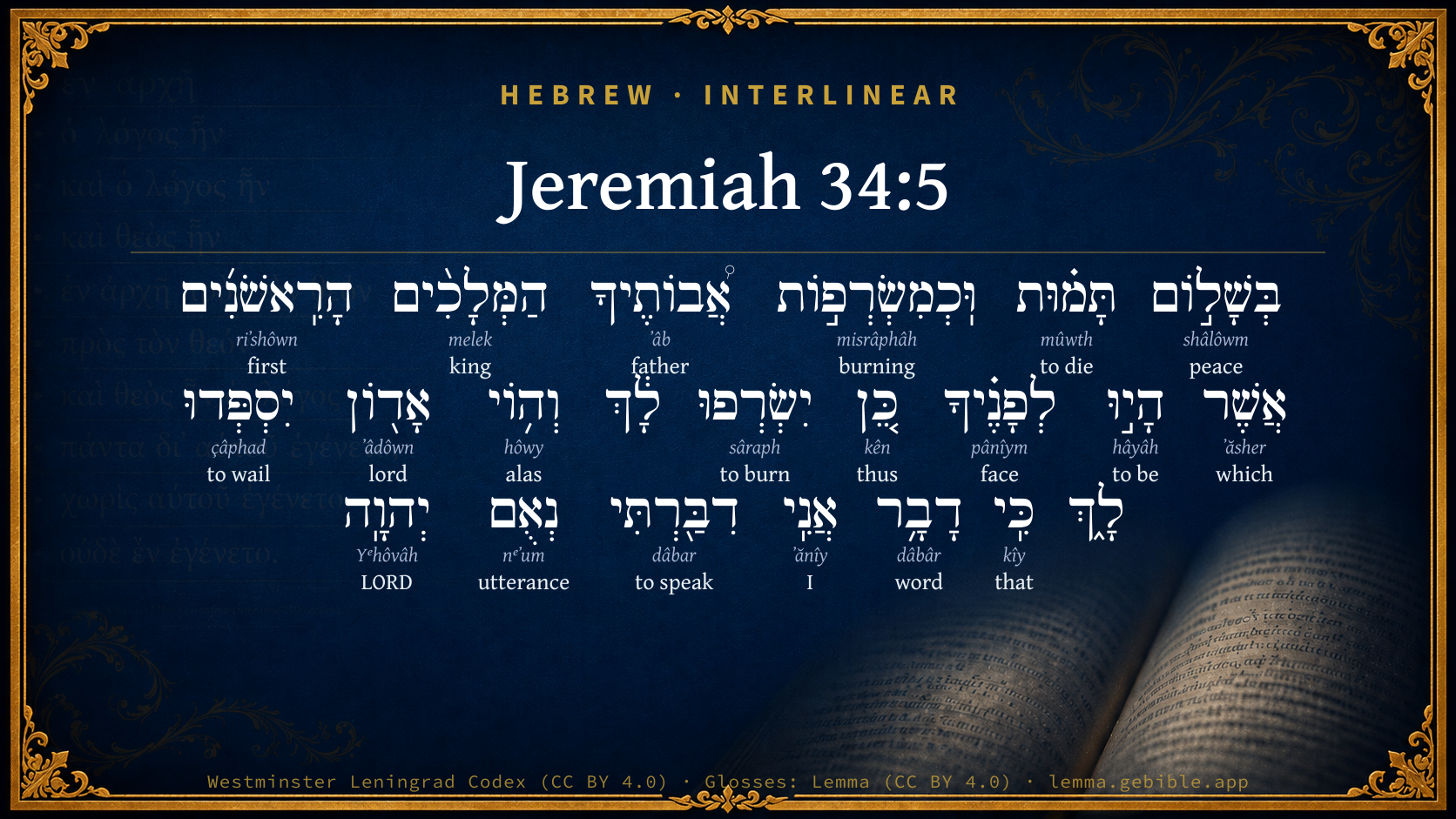
Hebrew (Westminster Leningrad Codex) Jeremiah 34:5 appears in the Hebrew Old Testament. The text above is from the Westminster Leningrad Codex. Each word links to its Strong’s number, a concise gloss, and parsing drawn from the Open Scriptures Hebrew Bible morphology. Click any word for its full Brown-Driver-Briggs (BDB) entry.
Download image
Cite this verse

Jeremiah 34:5 (World English Bible). Public Domain. Lemma interlinear Bible study tool, https://lemma.gebible.app/v/jeremiah/34/5.

Show BibTeX & RIS
BibTeX
RIS
English Translation
you shall die in peace; and with the burnings of your fathers, the former kings who were before you, so shall they make a burning for you; and they shall lament you, [saying], Ah Lord! for I have spoken the word, says Yahweh.
World English Bible · Public Domain
Download a study sheet

One document with this verse’s original text, its word-by-word gloss line, the meaning frame, cross-references with their text, attributed commentary, and full source and license credits — printable, and it pastes into notes with its structure intact.

This verse Autodidact and up

Study sheet (.html) Plain text (.txt)

A passage Seminary Student

Up to 50 verses in one chapter. A passage sheet keeps up to 6 commentary sources and 12 cross-references per verse, in the order this page ranks them, and says so on the sheet whenever that leaves anything out. Ask for a single verse and you get the Autodidact verse sheet above.

Everything on this page stays free to read, with no account — the sheet is a download of what is already on screen, not access to it.

Want to remove ads? Support Godless Engineer
Compare translations 3

The same verse in 3 English versions, stacked beneath the original-language interlinear above. Click any original word for its lexicon entry.

Each is an independent rendering of the whole verse — the interlinear is not word-aligned to these translations.

Highlighted words mark where these versions differ — a whole-verse word diff, not a word-by-word alignment.

  • World English Bible Public Domain
    you shall die in peace; and with the burnings of your fathers, the former kings who were before you, so shall they make a burning for you; and they shall lament you, [saying], Ah Lord! for I have spoken the word, says Yahweh.
  • King James Version Public Domain
    But thou shalt die in peace: and with the burnings of thy fathers, the former kings which were before thee, so shall they burn odours for thee; and they will lament thee, saying, Ah lord! for I have pronounced the word, saith the LORD.
  • unfoldingWord Literal Text CC BY-SA 4.0
    You will die in peace. As in the funeral burning of your ancestors, the kings who were before you, they will burn your body. They will say, “Woe, master!” They will lament for you. Now I have spoken—this is Yahweh’s declaration.’”

unfoldingWord Literal Text — © unfoldingWord, licensed CC BY-SA 4.0. Word-aligned USFM3 via Door43 (git.door43.org/unfoldingWord/en_ult).

Versions to compare (up to 4)

3 of 4 selected

Show all 18 translations

Every available English version of this verse, each an independent rendering of the whole verse.

  • World English Bible Public Domain
    you shall die in peace; and with the burnings of your fathers, the former kings who were before you, so shall they make a burning for you; and they shall lament you, [saying], Ah Lord! for I have spoken the word, says Yahweh.
  • Berean Standard Bible Public Domain
    you will die in peace. As spices were burned for your fathers, the former kings who preceded you, so people will burn spices for you and lament, ‘Alas, O master!’ For I Myself have spoken this word, declares the LORD.”
  • Majority Standard Bible Public Domain
    you will die in peace. As spices were burned for your fathers, the former kings who preceded you, so people will burn spices for you and lament, ‘Alas, O master!’ For I Myself have spoken this word, declares the LORD.”
  • King James Version Public Domain
    But thou shalt die in peace: and with the burnings of thy fathers, the former kings which were before thee, so shall they burn odours for thee; and they will lament thee, saying, Ah lord! for I have pronounced the word, saith the LORD.
  • American Standard Version (1901) Public Domain
    thou shalt die in peace; and with the burnings of thy fathers, the former kings that were before thee, so shall they make a burning for thee; and they shall lament thee, `saying', Ah Lord! for I have spoken the word, saith Jehovah.
  • Revised Version (1885) Public Domain
    thou shalt die in peace; and with the burnings of thy fathers, the former kings which were before thee, so shall they make a burning for thee; and they shall lament thee, saying, Ah lord! for I have spoken the word, saith the LORD.
  • Geneva Bible (1599) Public Domain
    But thou shalt die in peace: and according to the burning for thy fathers the former Kings which were before thee, so shall they burne odours for thee, and they shall lament thee, saying, Oh lorde: for I haue pronounced the worde, sayth the Lord.
  • Douay-Rheims (1899) Public Domain
    But thou shalt die in peace, and according to the burnings of thy fathers, the former kings that were before thee, so shall they burn thee: and they shall mourn for thee, saying: Alas, Lord: for I have spoken the word, saith the Lord.
  • Young's Literal Translation Public Domain
    in peace thou diest, and with the burnings of thy fathers, the former kings who have been before thee, so they make a burning for thee; and Ah, lord, they lament for thee, for the word I have spoken -- an affirmation of Jehovah.'
  • Literal Standard Version CC BY-SA 4.0
    you die in peace, and with the burnings of your fathers, the former kings who have been before you, so they make a burning for you; and, Oh, lord, they lament for you, for the word I have spoken—a declaration of YHWH.”
  • Unlocked Literal Bible CC BY-SA 4.0
    You will die in peace. As in the funeral burning of your ancestors, the kings who were before you, they will burn your body. They will say, “Woe, master!” They will lament for you. Now I have spoken—this is Yahweh's declaration.'”
  • unfoldingWord Literal Text CC BY-SA 4.0
    You will die in peace. As in the funeral burning of your ancestors, the kings who were before you, they will burn your body. They will say, “Woe, master!” They will lament for you. Now I have spoken—this is Yahweh’s declaration.’”
  • Darby Bible Public Domain
    thou shalt die in peace, and with the burnings of thy fathers, the former kings that were before thee, so shall they burn for thee; and they will lament for thee, Ah, lord! for I have spoken the word, saith Jehovah.
  • World Messianic Bible Public Domain
    You will die in peace; and with the burnings of your fathers, the former kings who were before you, so they will make a burning for you. They will lament you, saying, “Ah Lord!” for I have spoken the word,’ says the LORD.”
  • Webster's Bible Public Domain
    But thou shalt die in peace: and with the burnings of thy fathers, the former kings who were before thee, so shall they burn odors for thee; and they will lament thee, saying, Ah lord! for I have pronounced the word, saith the LORD.
  • Free Bible Version CC BY-SA 4.0
    you will die in peace. You will have a proper funeral with incense burned for you as they did for your forefathers, the kings who ruled before you. They will weep for you, crying, “The king is dead.” I myself am telling you this, declares the Lord.
  • Bible in Basic English Public Domain
    You will come to your end in peace; and such burnings as they made for your fathers, the earlier kings before you, will be made for you; and they will be weeping for you and saying, Ah lord! for I have said the word, says the Lord.
  • JPS Tanakh (1917) Public Domain
    thou shalt die in peace; and with the burnings of thy fathers, the former kings that were before thee, so shall they make a burning for thee; and they shall lament thee: 'Ah lord!' for I have spoken the word, saith the LORD.

Literal Standard Version (2020), Covenant Press — licensed CC BY-SA 4.0. Text via the HelloAO Bible API (eBible.org). Unlocked Literal Bible (unfoldingWord) — licensed CC BY-SA 4.0. Text via the HelloAO Bible API (eBible.org). unfoldingWord Literal Text — © unfoldingWord, licensed CC BY-SA 4.0. Word-aligned USFM3 via Door43 (git.door43.org/unfoldingWord/en_ult). Free Bible Version, Dr. Jonathan Gallagher — licensed CC BY-SA 4.0. Text via the HelloAO Bible API (eBible.org).

Word by word

More ways to search: Search by grammar → Find every occurrence → Compare this word →

Practice this passage: Drill this verse → Learn its vocabulary →

וּֽכְמִשְׂרְפ֣וֹת
misrâphâh
H4955
“and · like/as · burnings of”
Conjunction + Preposition + Noun, Common, Feminine, Plural, Construct
Part of Speech
Conjunction + Preposition + Noun
Type
Common
Gender
Feminine
Number
Plural
State
Construct
Full BDB Definition

Origin: from H8313

TWOT: 2292d

a burning
  1. בְּשָׁל֣וֹם shâlôwm H7965 “in/at · peace” Preposition + Noun, Common, Masculine, Singular, Absolute
  2. תָּמ֗וּת mûwth H4191 “to die” Verb, Qal, Imperfect, 2nd Person, Masculine, Singular
  3. אֲ֠בוֹתֶיךָ ʼâb H1 “fathers · your” Noun, Common, Masculine, Plural, Construct + Suffix, Personal, 2nd Person, Masculine, Singular
  4. הַמְּלָכִ֨ים melek H4428 “the · kings” Particle, Definite Article + Noun, Common, Masculine, Plural, Absolute
  5. הָרִֽאשֹׁנִ֜ים riʼshôwn H7223 “the · first” Particle, Definite Article + Adjective, Adjective, Masculine, Plural, Absolute
  6. אֲשֶׁר ʼăsher H834 “which” Particle, Relative
  7. הָי֣וּ hâyâh H1961 “to be” Verb, Qal, Perfect, 3rd Person, Common, Plural
  8. לְפָנֶ֗יךָ pânîym H6440 “to/for · face(s) · your” Preposition + Noun, Common, Both, Plural, Construct + Suffix, Personal, 2nd Person, Masculine, Singular
  9. כֵּ֚ן kên H3651 “thus” Particle, Demonstrative
  10. יִשְׂרְפוּ sâraph H8313 “to burn” Verb, Qal, Imperfect, 3rd Person, Masculine, Plural
  11. וְה֥וֹי hôwy H1945 “and · alas” Conjunction + Particle, Interjection
  12. אָד֖וֹן ʼâdôwn H113 “lord” Noun, Common, Masculine, Singular, Absolute
  13. יִסְפְּדוּ çâphad H5594 “to wail” Verb, Qal, Imperfect, 3rd Person, Masculine, Plural
  14. כִּֽי kîy H3588 “that” Conjunction
  15. דָבָ֥ר dâbâr H1697 “word” Noun, Common, Masculine, Singular, Absolute
  16. אֲנִֽי ʼănîy H589 “I” Pronoun, Personal, 1st Person, Common, Singular
  17. דִבַּ֖רְתִּי dâbar H1696 “to speak” Verb, Piel, Perfect, 1st Person, Common, Singular
  18. נְאֻם nᵉʼum H5002 “utterance of” Noun, Common, Masculine, Singular, Construct
  19. יְהוָֽה Yᵉhôvâh H3068 “LORD” Noun, Proper

About this verse

These counts appear in no published source. They are computed here, from the morphology-tagged text and Lemma’s own curated glosses. What Lemma adds →

22
words
20
distinct lemmas
Prophets
section

Notable vocabulary

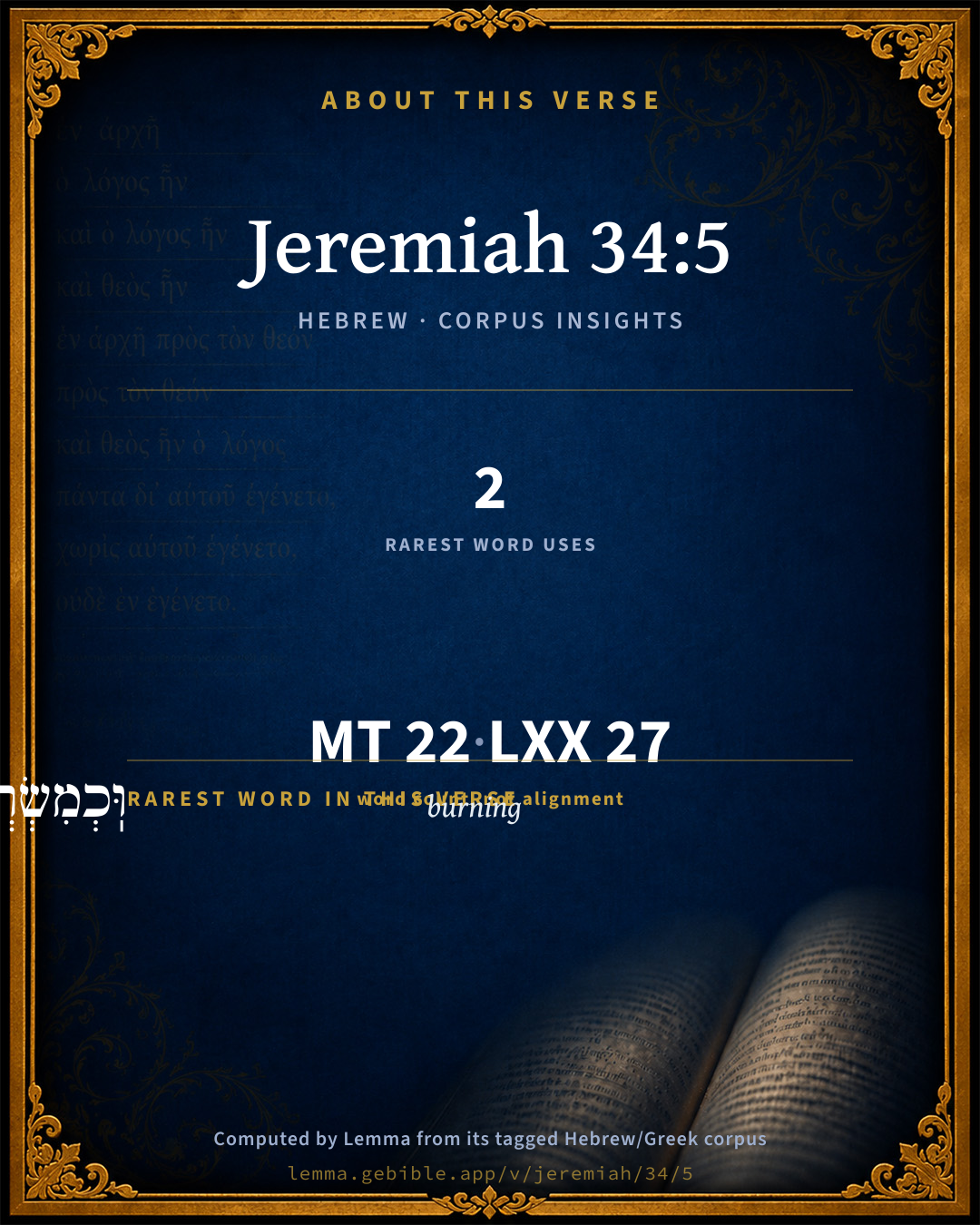
The rarest word here is וּֽכְמִשְׂרְפ֣וֹת burning H4955 — appearing just 2 times in the whole Hebrew Bible.

Shared distinctive vocabulary

וּֽכְמִשְׂרְפ֣וֹת burning H4955 occurs in 2 verses of the Hebrew Bible. Also found in:

Grammatical profile

  • 5 verbs
  • 9 nouns
  • 1 adjective
  • 1 pronoun
  • 2 prepositions
  • 1 conjunction
  • 3 particles

Verb forms

  • תָּמ֗וּת Qal · Imperfect
  • הָי֣וּ Qal · Perfect
  • יִשְׂרְפוּ Qal · Imperfect
  • יִסְפְּדוּ Qal · Imperfect
  • דִבַּ֖רְתִּי Piel · Perfect

Hebrew & Septuagint length

In the original languages it is 22 Hebrew tokens and 27 Greek tokens — but the two are counted differently (Hebrew bundles its prefixes and suffixes into one token; the Greek is in lemma form), so that isn’t a like-for-like length.

Cross-references

8

Topical passages linked to Jeremiah 34:5 in the Treasury of Scripture Knowledge — connected by theme and wording, ordered by reader-vote popularity; previews shown in the World English Bible.

  • 2 Chronicles 16:14 They buried him in his own tombs, which he had hewn out for himself in the city of David, and laid him in the bed which was filled with sweet odors and various kinds [of spices] prepared by the perfumers' are: and they made a very great burning for him.
  • Jeremiah 22:18 Therefore thus says Yahweh concerning Jehoiakim the son of Josiah, king of Judah: they shall not lament for him, [saying], Ah my brother! or, Ah sister! They shall not lament for him, [saying] Ah lord! or, Ah his glory!
  • 2 Kings 22:20 Therefore, behold, I will gather you to your fathers, and you shall be gathered to your grave in peace, neither shall your eyes see all the evil which I will bring on this place. They brought the king word again.
  • 2 Chronicles 21:19–20 It happened, in process of time, at the end of two years, that his bowels fell out by reason of his sickness, and he died of sore diseases. His people made no burning for him, like the burning of his fathers.
  • 2 Chronicles 34:28 Behold, I will gather you to your fathers, and you shall be gathered to your grave in peace, neither shall your eyes see all the evil that I will bring on this place, and on the inhabitants of it. They brought back word to the king.
  • Lamentations 4:20 The breath of our nostrils, the anointed of Yahweh, was taken in their pits; Of whom we said, Under his shadow we shall live among the nations.
  • Ezekiel 17:16 As I live, says the Lord Yahweh, surely in the place where the king dwells who made him king, whose oath he despised, and whose covenant he broke, even with him in the midst of Babylon he shall die.
  • Daniel 2:46 Then the king Nebuchadnezzar fell on his face, and worshiped Daniel, and commanded that they should offer an offering and sweet odors to him.

Cross-references courtesy of OpenBible.info (CC BY 4.0).

Hebrew and Greek witnesses Masoretic Hebrew ↔ Greek Septuagint

The same verse in the two great witnesses to the Old Testament, shown verse-for-verse.

These are two independent witnesses, not word-aligned to each other, and the Septuagint is shown in lemma (dictionary) form.

Hebrew Jeremiah 34:5 Masoretic · Westminster Leningrad Codex

בְּשָׁל֣וֹם תָּמ֗וּת וּֽכְמִשְׂרְפ֣וֹת אֲ֠בוֹתֶיךָ הַמְּלָכִ֨ים הָרִֽאשֹׁנִ֜ים אֲשֶׁר הָי֣וּ לְפָנֶ֗יךָ כֵּ֚ן יִשְׂרְפוּ לָ֔ךְ וְה֥וֹי אָד֖וֹן יִסְפְּדוּ לָ֑ךְ כִּֽי דָבָ֥ר אֲנִֽי דִבַּ֖רְתִּי נְאֻם יְהוָֽה

you shall die in peace; and with the burnings of your fathers, the former kings who were before you, so shall they make a burning for you; and they shall lament you, [saying], Ah Lord! for I have spoken the word, says Yahweh.

World English Bible · Public Domain

Greek LXX Structure differs

In the Septuagint, Jeremiah is about an eighth shorter than the Hebrew and arranges its material differently — the Oracles Against the Nations (Hebrew chapters 46–51) appear in the middle of the Greek book, after 25:13. Because the chapter and verse boundaries do not line up, a verse-for-verse comparison with the Hebrew is not shown.

A verse-for-verse comparison isn’t shown here because the chapters and verses don’t line up. Switch to the LXX edition with the MT / LXX toggle above to read the Greek directly.

Hebrew: Westminster Leningrad Codex (CC BY 4.0). Greek: Septuagint (public domain); English from a public-domain English Septuagint. How the Septuagint differs from the Hebrew →

Targum (Aramaic paraphrase)

1

The Targum is the ancient Jewish Aramaic paraphrase of the Hebrew Scriptures — an interpretive translation, not the Hebrew text itself. Onkelos (literal) and Pseudo-Jonathan (expansive) render the Torah, and Jonathan the Prophets. Coverage is partial: where no permissively-licensed English translation exists for a verse, only the Aramaic is shown. This is verse-level text, not a word-by-word alignment to the Hebrew.

  1. Targum Jonathan Prophets (Joshua–Malachi)
    בִּשְׁלָמָא תְמוּת וּבִיקִידוּת אֲבָהָתָךְ מַלְכַיָא קֳדָמָאֵי דַהֲווֹ קֳדָמָךְ כֵּן יוֹקְדוּן עֲלָךְ וַי עַל מַלְכָּא יִסְפְּדוּן עֲלָךְ אֲרֵי פִּתְגָמָא אֲנָא מַלְלֵית אֲמַר יְיָ:

    (no public-domain English translation for this verse)

    Targum Jonathan — Aramaic: “Mikraot Gedolot” (public domain). English: “Sefaria Community Translation” (CC0 1.0 (public-domain dedication)); “London "Chaldee Paraphrase," 1871” (public domain). Text via Sefaria.

Commentary

Notes on Jeremiah 34:5 from classic Christian and Jewish commentators (each source and its license shown beneath its notes). The classic Christian expositions comment on the surrounding passage and are grouped to its opening verse, so a note may address several verses; the Jewish commentaries on the Tanakh (Rashi and others) are per-verse, so they appear only where the commentator wrote on this verse.

Lemma curates 59 commentaries, every one of them public domain or Creative Commons licensed, each selected and text-cleaned for this edition rather than reprinted as found. About our sources →

Trapp's Complete Commentary

John Trapp

Jer 34:5 [But] thou shalt die in peace: and with the burnings of thy fathers, the former kings which were before thee, so shall they burn [odours] for thee; and they will lament thee, [saying], Ah lord! for I have pronounced the word, saith the LORD.

Ver. 5. But thou shalt die in peace.] Yet not as his father Josiah did, in that peace of God, unless he amended his manners, for he was reckoned among the naughty figs.

And with the burnings of thy fathers, the former kings.] With the usual solemnities at the exequies of the better sort of kings: Nec una fuit veteribus sepeliendi ratio. See 2Ch 16:14; 2Ch 21:19. The Jews have a tradition that Nebuchadnezzar, upon a festival day, caused him to be brought out of prison, and so abused him before his princes to make them sport, that for shame and grief thereof he died soon after; and then Nebuchadnezzar, to make him some recompense, caused him to be honourably buried, suffering his former subjects to burn sweet odours and to bewail his death. {a}

And they will lament thee.] The dues of the dead are, honorifice lugeri et honeste sepeliri, to be honourably lamented and laid up; which yet is not granted to all good men, but heaven makes amends. Planctus haec fuit formula iuxta Seder Olam, Heu! quia mortuus est Rex Zedechias bibens faeces omnium cetatum; i.e., Luens peccata priorum saeculorum - interprete Genebrardo.

For I have pronounced the word.] Both the comminatory part of this message and the consolatory. But Zedekiah was so moved at the former that he regarded not the latter.

{a} Joseph. Antiq., lib. x. cap. 11.

John Trapp, A Commentary or Exposition upon All the Books of the Old and New Testament (1647–1656) — public domain. Text from a community e-Sword module.

Geneva Bible (1599)

Geneva Bible translators

Not of any violent death.

The Jews shall lament for thee their lord and king.

Geneva Bible (1599) marginal notes — public domain. Text via Bolls.life.

Jamieson, Fausset & Brown

Robert Jamieson, A. R. Fausset & David Brown

the burnings of thy fathers--Thy funeral shall be honored with the same burning of aromatic spices as there was at the funerals of thy fathers (Ch2 16:14; Ch2 21:19). The honors here mentioned were denied to Jehoiakim (Jer 22:18).

Ah, lord!--The Hebrews in their chronology (Sederolam) mention the wailing used over him, "Alas! King Zedekiah is dead, drinking the dregs (that is, paying the penalty for the sins) of former ages."

Jamieson, Fausset & Brown — Commentary Critical and Explanatory on the Whole Bible (1871) — public domain (CC PDM 1.0). Text via the HelloAO Bible API.

Adam Clarke's Commentary

Verse 5. Thou shalt die in peace] Thou shalt not die a violent death; and at thy death thou shalt have all those funereal solemnities which were usual at the demise of kings. See 2Ch 16:14.

So shall they burn odours for thee] Scented wood and other odoriferous substances are placed on the funeral pile of the rich Hindoos, and burned with the body.

And they will lament thee, saying, Ah lord!] They will recite the funeral dirge that begins with those words. See Clarke on Jer 22:18.

Adam Clarke's Commentary on the Bible (1810–1826) — public domain. Text from a community e-Sword/MySword module.

John Calvin's Commentaries

In peace, he says, shalt thou die, and then adds, with the burnings of thy fathers shall they burn thee, and lament over thee, “Alas! Lord.” Here is added another comfort, — that when Zedekiah should die, there would be some to bury him, not only in a humane, but also in an honorable manner. And burial in many places is reckoned as one of God’s favors, as in life God shews himself kind and bountiful to us when we are in health and in vigor. For as health and food sufficient for the necessities of life, are evidences of God’s love, so is burial after death; for burial distinguishes men from brutes. When a wild beast dies, his carcase is left to putrify. Why are men buried, except in hope of the resurrection, as though they were laid up in a safe place till the time of restoration? Burial, then, as it is a symbol of our immortality, makes a distinction between us and brute animals after death. In death itself there is no difference; the death of a man and the death of a dog, have no certain marks to distinguish the one from the other. Then it is God’s will that there should be some monument, that men might understand how nmch more excellent: is their condition than that of brute animals. Hence then it is, that when God favors us with a burial, he shows his paternal care towards us. On the contrary, when the body of any one is cast away, it is in itself a sign of God’s displeasure, as it appeared before, when the Prophet said of Jehoiakim that his burial would be that of an ass, (Jeremiah 22:19) As then Jehoiakim was threatened with the burial of an ass, so now he promises an honorable burial to Zedekiah.

I said that this is true, when the thing is in itself considered. For it sometimes happens that the most wicked are buried with honor and great pomp, when the children of God are either burnt or torn by wild beasts. Known is that complaint of the Psalmist, that the bodies of the saints were cast away and became food to birds and wild beasts. (Psalm 79:2) And it is said of the rich man, who lived in splendor, that he died and was buried, but there is no mention made of the burial of Lazarus. (Luke 16:22) We ought not then simply to conclude, that those are miserable who are not buried, and that those are blessed who obtain the honor of a burial. As the sun is said to rise on the children of God and on strangers, so also after death, as burial is a temporal benefit, it may be considered as belonging indiscriminately to the good and to the bad. It may on the contrary be, that God should deprive his children of a burial; yet still that truth remains fixed, that burial in itself is an evidence of God’s favor; and that; when any one is cast away and denied a burial, it is a sign of God’s displeasure. When yet we come to individuals, the Lord turns a temporal punishment into a benefit to his own people; and makes his temporal blessings to serve for a heavier condemnation to all the reprobate and ungodly, hence they were barbarous who dared to deride burial, as the Cynics did, who treated burial with contempt. This was inhumanity.

But we ought to hold these points, — that as God supplies us with bread, wine, and water, and other necessaries of life, in order to feed us, and to preserve us in health and rigor, so we ought to regard burial; but when the faithful are exposed to hunger, when they die through cold or nakedness, or when they are made subject to other evils, and when they are treated ignominiously after death, all this turns out for their salvation, for the Lord regards their good even when he seems to afflict them with adversities.

This, then, is the reason why the Prophet now in some measure mitigates the sorrow of Zedekiah, by saying,. They shall bury thee, and with the burnings of thy fathers shall they burn thee This was not a common but a royal mode of burial. He then promises, that after many degradations and reproaches, God would at length shew him, when dead, some favor. But one may say, what would this avail Zedekiah? for his body would then be without sense or feeling. But. it was well to hear of this kindness of God, for he might thereby conclude that God would be at length merciful to him, if he really humbled himself. There is then no doubt but that a hope of pardon was promised to him, though he was to be sharply and severely chastised even until he died. God then intended that this symbol should ever be remembered by him, that he might not wholly despair. We now then understand why the Prophet promised this to Zedekiah, not that it might be a matter of interest to him to be buried with honor, but that he might have some conception of God’s kindness and mercy.

Now we know that the dead bodies of kings were burnt at a great expense; many precious odors were procured, a fire was kindled, and the bodies were seared; not that they were reduced to ashes, (for this was not the custom, as among the Romans and other nations, who burnt the bodies of the dead, and gathered the ashes) But among the Jews, the body was never burnt; only they kindled a fire around the dead body, that putrefaction might not take place. The bodies of the dead were dried by a slow fire. This was not indeed commonly done, but only at the burials of kings, as it appears from the case of Asa and of others. (2 Chronicles 16:14)

Then he says, With the burnings of thy fathers shall they burn thee, and they shall lament thee, “Alas! Lord,” it may be asked, whether these lamentations were approved by God? To this there is a ready answer, — that the Prophet does not here commend immoderate mourning, and cryings, and ejaculations, when he says, they shall lament thee, but that he took the expression from what was commonly done, as though he had said, “They shall perform for thee this office of humanity, such as is usually done over the remains of kings in full power, in the day of their prosperity.” God, then, in speaking here of lamentation and mourning, does not commend them as virtues, or as worthy of praise, but refers only to what was then commonly done. But we know what Paul especially teaches us, — that we are so to moderate our sorrow, as not to be like the unbelieving, who have no hope, (1 Thessalonians 4:13) for they think that death is the death of the soul as well as of the body: they therefore lament their dead as for ever lost; and they also murmur against God, and sometimes utter horrid blasphemies. Paul then would have us to be moderate in our sorrow. He does not condemn sorrow altogether, but only requires it to be moderate, so that we may shew what influence the hope of resurrection has over us.

And yet there is no doubt but that men, in this respect, exceed moderation. It has commonly been the case almost in all ages to be ostentatious in mourning for the dead. For not only are they without genuine feeling in lamenting for their friends or relatives, but they are carried away by a sort of ambition, while burying the dead with great noise and lamentation. When they are alone they contain themselves, so that at least they make no noise; but when they go out before others, they break forth into noisy lamentations. It hence appears that, as I have said, mourning is often ostentatious. But as men have from the beginning gone astray in this respect, greater care ought to be taken by us, that each of us may check and restrain himself. Still it is natural, as I have said, to weep for the dead; but doubtless, it may be said, the ejaculations mentioned by the Prophet cannot be approved; for to what purpose was it to cry, “Alas! Lord; our king is dead,” and things of the same kind? But we ought to bear in mind, that eastern nations were always excessive in this respect, and we find them to be so at this day. The warmer the climate the more given to gestures and ceremonies the people are. In these cold regions gesticulations and crying out, “Alas! Lord, alas! father,” would be deemed impertinent and foolish. But where they tear off their hair, and also cut themselves and tear their cheeks not only with their nails, but also with knives, — where they do these things, they also utter these ejaculations spoken of by the Prophet.

John Calvin's Commentaries (1540-1563) — public domain. Text from the Calvin Translation Society English edition (1840s-50s) via the Christian Classics Ethereal Library (ccel.org). Calvin's coverage is partial (roughly two-thirds of the Bible); uncommented books and verses are honest gaps, never fabricated. The 19th-century editor's footnotes and remarks are omitted so the notes are faithfully Calvin's own voice.

Ellicott's Commentary for English Readers

(5) And with the burnings of thy fathers . . .—Spices and perfumes were burnt as a mark of honour at the burial of kings and persons of high rank, and this is the burning here referred to (2Ch_16:14; 2Ch_21:19). The Hebrews never adopted the practice of burial by cremation, and for the most part embalmed their dead after the manner of Egypt (comp. Gen_50:2; Joh_19:39-40).

They will lament thee, saying, Ah lord! . . .—The words derive their full effect from their contrast with the prediction which the prophet had uttered (Jer_22:18) as to the burial of Jehoiakim without any of the usual honours of the funeral dirges of the mourners. Here he comforts Zedekiah with the thought that no such shameful end was in store for him, leaving the place where he was to die uncertain.

A Bible Commentary for English Readers, edited by Charles John Ellicott (1878–1897) — public domain. Text from a community e-Sword module.

The Cambridge Bible for Schools and Colleges

gen. ed. J. J. S. Perowne

5. shall they make a burning] Apparently some honorific burning of spices as an accompaniment of burial. See 2Ch_16:14; 2Ch_21:19.

Ah lord!] See on Jer_22:18.

The Cambridge Bible for Schools and Colleges (gen. ed. J. J. S. Perowne; Cambridge University Press, 1878–1918) — public domain. Text from a community e-Sword module.

John Gill's Exposition

But thou shall die in peace,.... Upon his bed, a natural death, and in good friendship with the king of Babylon; and, it may be, in peace with God; for before his death, some time in his captivity, he might be brought to true repentance for his sins:

and with the burnings of thy fathers, the former kings which were before thee: so shall they burn odours for thee. The sense is, that he should have an honourable burial; and that sweet odours and spices should be burned for him, as were for the kings of Judah his predecessors, particularly Asa, Ch2 16:14. Josephus says (b), that Nebuchadnezzar buried him in a royal manner; though this seems to refer to what the people of the Jews in Babylon would do in honour of him, by burning for him. The Rabbins say, as Jarchi, Kimchi, and Ben Melech observe, that they burned their beds and ministering vessels, or household goods (c), as was usual on such occasions. The Talmudist (d) a say, all this honour was done him for that single act of ordering Jeremiah to be taken out of the dungeon; for this was done honour to persons: so, when Gamaliel the elder died, Onkelos the proselyte burned for him seventy Tyrian pounds (e); not such a quantity of money, but goods that were worth so much; and this was a custom with the Heathens, who used to burn the bodies of the dead, to burn their garments with them, and their armour, and whatever were valuable and esteemed of by them life; and particularly odoriferous things, as frankincense, saffron, myrrh, spikenard, cassia, and cinnamon (f); and which seem to be meant here, by comparing the passage with the case of Asa before mentioned; for though the word "odours" is not in the text, it seems rightly enough supplied by us, as it is by other interpreters (g). The Vulgate Latin version very wrongly translates it, "and shall burn thee"; for it was not the manner of the Jews to burn the bodies of the dead, but to inter them in the earth; and so Tacitus (h) observes, it was the custom of the Jews not to burn, but after the manner of the Egyptians to bury in the earth nor does it appear to have been the custom of the Babylonians or Chaldeans, as should seem from the account that is given of the death and burial of the Babylonian monarch in Isa 14:4;

and they will lament, saying, Ah lord! alas! our lord the king is dead. The form of lamentation said over him, as the Jews record (i), was,

"alas! King Zedekiah, who is dead, drank the dregs of all ages;''

was punished for the sins of men in all generations past:

for I have pronounced the word, saith the Lord; both that which respects his captivity, and that which refers to his death; the manner of it, and his honourable interment, which shall be accomplished.

(b) Antiqu. Jud. l. 10. c. 8. sect. 7. (c) Vid. T. Avoda Zara, fol. 11. 1. (d) T. Bab. Moed Katon, fol. 28. 2. (e) T. Bab. Avoda Zara, fol. 11. 1. (f) Vid. Kirehman. de Fuuer. Roman. l. 3. c. 5. (g) "Sub. myropolae", Munster; "aromata odorata, sive res odoriferas", Vatablus; "ustiones odorum", Junius & Tremellius. (h) Histor. l. 5. c. 5. (i) Seder Olam Rabba, c. 28. p. 81.

John Gill's Exposition of the Whole Bible (1746–1763) — public domain (CC PDM 1.0). Text via the HelloAO Bible API.

Albert Barnes' Notes on the Bible

In peace - See Jer 12:12 note.

Burn odors - “Make a burning.” The burning was probably that of piles of wood, and spices were added only as an special honor. It was not a Jewish custom to burn the dead. As these burnings depended upon the estimation in which the dead king was held, the verse implies a prosperous reign, such as Zedekiah might have had as an obedient vassal to BabyIon.

I have pronounced the word - I have spoken the word.

Albert Barnes' Notes on the Bible (1834–1885) — public domain. Text from a community e-Sword/MySword module.

Haydock's Catholic Bible Commentary

Peace. That is, by a natural death. (Challoner) --- Burn thee, like Asa; (2 Paralipomenon xvi. 14.; Calmet) or aromatical spices were only burnt over their dead bodies, which were also embalmed. (Sanctius; Vatable, &c.) --- Tostat says that Sedecias was intoxicated, for sport, (Habacuc ii. 15.) and died of grief in prison, chap. lii. 11. (Calmet) --- The king of Babylon would probably not refuse him a decent burial. (Watson, Let. vi.)

George Leo Haydock (1774–1849), Haydock's Catholic Family Bible and Commentary, 1859 edition — public domain. Excludes Psalms (Douay-Rheims chapter numbering differs from Protestant) and Deuterocanonical books (Catholic canon only).

Matthew Poole's English Annotations

This only place informeth us concerning the manner of Zedekiah’s death, and that both negatively and positively. Negatively, that he did not die by the sword, the king of Babylon took him, killed his sons before his eyes, then put out his eyes, and bound him in chains, Jer 39:7, but killed him not, as we learn from this text; but he died a natural death, which is here meant by dying in peace; and had an honourable burial, which the king of Babylon would not allow Jehoiakim, as we read, Jer 22:18,19; he was buried with the burial of an ass, and his body was cast out of the gates of Jerusalem, and no man lamented for him; but as to Zedekiah, they burned sweet odours for him, (after the manner of the burial of kings, 2Ch 16:14) and made solemn lamentation for him. The Jews, in their chronology, called by them Seder Olam, give us the form of their lamentation, thus: Alas! Zedekiah is dead, who drank the dregs of all ages; that is, who was punished for the sins of all former ages.

Matthew Poole's English Annotations on the Holy Bible (1683–1685) — public domain. Text from a community e-Sword/MySword module.

Whedon's Commentary on the Bible

Daniel D. Whedon

5. Burn (odours) for thee — See 2Ch_16:14; 2Ch_21:19. Some have understood this to imply an actual burning of the body; but this does not seem to have been customary among the Hebrews.

Daniel D. Whedon (gen. ed.), Commentary on the Old and New Testaments (1874–1909) — public domain. Text from a community e-Sword module.

The Pulpit Commentary

With the burnings of thy fathers. It was customary to burn spices at royal funerals. (2Ch_16:14 2Ch_21:19) Saying, Ah lord!. (see on Jer_22:18) The second of the group of prophecies in Jer 34 Jer 35 is composed of vers. 8-22. It contains a denunciation of the Jews who, at the beginning of the siege, had emancipated their Hebrew slaves, (according to Exo_21:1-4 Deu_15:12) but after the withdrawal of the Chaldeans had resumed possession of them. Ver. 21 is couched in a form which indicates the precise date of the prophecy, viz. before the Chaldeans returned to renew the siege of Jerusalem.

The Pulpit Commentary (1880–1919), ed. H.D.M. Spence-Jones & Joseph S. Exell — public domain. Text from a community e-Sword module.

John Wesley's Explanatory Notes

Ah Lord - The Jews in their chronology, give us the form of the lamentation thus. Alas! Zedekiah is dead, who drank the dregs of all ages: that is, who was punished for the sins of all former ages.

John Wesley, Explanatory Notes Upon the Whole Bible (1754–1765) — public domain. Text via the GEBible commentary corpus.

Rashi

Rabbi Shlomo Yitzchaki (Rashi)

You shall die in peace Our Sages stated that Nebuchadnezzar died during his lifetime (Moed Katan 28b), for all the days of Nebuchadnezzar his prisoners were not freed from their imprisonment, and when Nebuchadnezzar died, Zedekiah emerged from the prison. He died the next day and was buried with pomp.

and with the burnings of your forefathers So was their custom, to burn for the kings their bier and the utensils they used.

Rashi on the Tanakh — English translations: “The Judaica Press complete Tanach with Rashi, translated by A. J. Rosenberg” (CC BY 4.0); “Pentateuch with Rashi's commentary by M. Rosenbaum and A.M. Silbermann, 1929-1934” (public domain); “The Metsudah Tanach series, Lakewood, N.J” (CC BY 4.0); and “The Book of Joshua, Metsudah Publications, 1997” (CC BY 4.0). Text via Sefaria.

Lesson kit

Teaching starters — assembled from the data on this page, not authored interpretation. Every prompt links to the verse data it draws on. Edit before teaching.

Jeremiah, in the Prophets, opens this verse with 22 words (20 distinct Hebrew lemmas). Its most distinctive word is misrâphâh (“burning”). A historical commentator’s framing appears above. Read the whole chapter for the surrounding context.

Discussion questions

  1. How does “burning” (misrâphâh) shape what this verse is saying?
  2. How does Isaiah 33:12, which shares the word «burning», read alongside this verse?
  3. These translations render this verse differently. What is at stake in choosing one wording over another?
  4. «תָּמ֗וּת» is a Qal Imperfect verb. How does that grammatical form shape the action described?
  5. Compare how Trapp's Complete Commentary and Geneva Bible (1599) read this verse. Where do they agree or differ?

Things to notice

Reading settings

Reading text

Shown beneath each verse's original-language words.

Old Testament
Old Testament edition

Read the OT as the Masoretic Hebrew (MT) or the Greek Septuagint (LXX).

English shown for the Greek Septuagint (in the Hebrew ↔ Greek comparison).

Comparing translations? Open the Compare panel on any verse page to stack up to four side by side.