
Zechariah 8:19

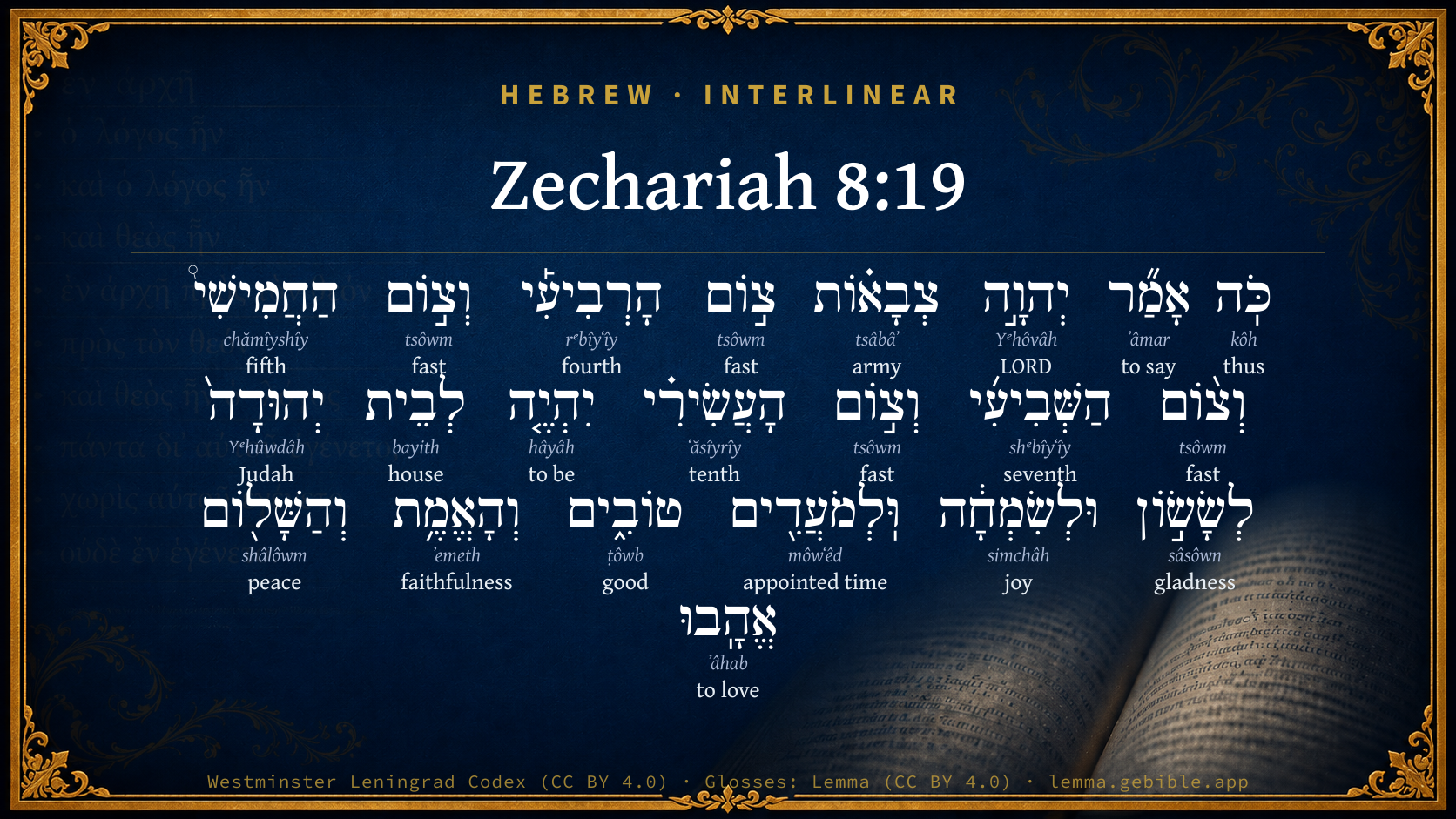
Hebrew (Westminster Leningrad Codex) Zechariah 8:19 appears in the Hebrew Old Testament. The text above is from the Westminster Leningrad Codex. Each word links to its Strong’s number, a concise gloss, and parsing drawn from the Open Scriptures Hebrew Bible morphology. Click any word for its full Brown-Driver-Briggs (BDB) entry.
Download image
Cite this verse

Zechariah 8:19 (World English Bible). Public Domain. Lemma interlinear Bible study tool, https://lemma.gebible.app/v/zechariah/8/19.

Show BibTeX & RIS
BibTeX
RIS
English Translation
Thus says Yahweh of Hosts: "The fasts of the fourth fifth, seventh, and tenth months shall be for the house of Judah joy and gladness, and cheerful feasts. Therefore love truth and peace."
World English Bible · Public Domain
Download a study sheet

One document with this verse’s original text, its word-by-word gloss line, the meaning frame, cross-references with their text, attributed commentary, and full source and license credits — printable, and it pastes into notes with its structure intact.

This verse Autodidact and up

Study sheet (.html) Plain text (.txt)

A passage Seminary Student

Up to 50 verses in one chapter. A passage sheet keeps up to 6 commentary sources and 12 cross-references per verse, in the order this page ranks them, and says so on the sheet whenever that leaves anything out. Ask for a single verse and you get the Autodidact verse sheet above.

Everything on this page stays free to read, with no account — the sheet is a download of what is already on screen, not access to it.

Want to remove ads? Support Godless Engineer
Compare translations 3

The same verse in 3 English versions, stacked beneath the original-language interlinear above. Click any original word for its lexicon entry.

Each is an independent rendering of the whole verse — the interlinear is not word-aligned to these translations.

Highlighted words mark where these versions differ — a whole-verse word diff, not a word-by-word alignment.

  • World English Bible Public Domain
    Thus says Yahweh of Hosts: "The fasts of the fourth fifth, seventh, and tenth months shall be for the house of Judah joy and gladness, and cheerful feasts. Therefore love truth and peace."
  • King James Version Public Domain
    Thus saith the LORD of hosts; The fast of the fourth month, and the fast of the fifth, and the fast of the seventh, and the fast of the tenth, shall be to the house of Judah joy and gladness, and cheerful feasts; therefore love the truth and peace.
  • unfoldingWord Literal Text CC BY-SA 4.0
    “Yahweh of hosts says this: The fasts of the month, the fifth month, the seventh month, and the tenth month will become times of joy, gladness, and happy festivals for the house of Judah! Therefore love truth and peace!

unfoldingWord Literal Text — © unfoldingWord, licensed CC BY-SA 4.0. Word-aligned USFM3 via Door43 (git.door43.org/unfoldingWord/en_ult).

Versions to compare (up to 4)

3 of 4 selected

Show all 18 translations

Every available English version of this verse, each an independent rendering of the whole verse.

  • World English Bible Public Domain
    Thus says Yahweh of Hosts: "The fasts of the fourth fifth, seventh, and tenth months shall be for the house of Judah joy and gladness, and cheerful feasts. Therefore love truth and peace."
  • Berean Standard Bible Public Domain
    “This is what the LORD of Hosts says: The fasts of the fourth, the fifth, the seventh, and the tenth months will become times of joy and gladness, cheerful feasts for the house of Judah. Therefore you are to love both truth and peace.”
  • Majority Standard Bible Public Domain
    “This is what the LORD of Hosts says: The fasts of the fourth, the fifth, the seventh, and the tenth months will become times of joy and gladness, cheerful feasts for the house of Judah. Therefore you are to love both truth and peace.”
  • King James Version Public Domain
    Thus saith the LORD of hosts; The fast of the fourth month, and the fast of the fifth, and the fast of the seventh, and the fast of the tenth, shall be to the house of Judah joy and gladness, and cheerful feasts; therefore love the truth and peace.
  • American Standard Version (1901) Public Domain
    Thus saith Jehovah of hosts: The fast of the fourth `month', and the fast of the fifth, and the fast of the seventh, and the fast of the tenth, shall be to the house of Judah joy and gladness, and cheerful feasts; therefore love truth and peace.
  • Revised Version (1885) Public Domain
    Thus saith the LORD of hosts: The fast of the fourth month, and the fast of the fifth, and the fast of the seventh, and the fast of the tenth, shall be to the house of Judah joy and gladness, and cheerful feasts; therefore love truth and peace.
  • Geneva Bible (1599) Public Domain
    Thus sayth the Lord of hostes, The fast of the fourth moneth, and the fast of the fift, and the fast of the seuenth, and the fast of the tenth, shall be to the house of Iudah ioy and gladnes, and prosperous hie feasts: therefore loue the trueth and peace.
  • Douay-Rheims (1899) Public Domain
    Thus saith the Lord of hosts: The fast of the fourth month, and the fast of the fifth, and the fast of the seventh, and the fast of the tenth shall be to the house of Juda, joy, and gladness, and great solemnities: only love ye truth and peace.
  • Young's Literal Translation Public Domain
    `Thus said Jehovah of Hosts: The fast of the fourth, and the fast of the fifth, and the fast of the seventh, and the fast of the tenth `months', are to the house of Judah for joy and for rejoicing, and for pleasant appointed seasons, and the truth and the peace they have loved.
  • Literal Standard Version CC BY-SA 4.0
    “Thus said YHWH of Hosts: The fast of the fourth, and the fast of the fifth, and the fast of the seventh, and the fast of the tenth [months], are to the house of Judah for joy and for rejoicing, and for pleasant appointed times, and the truth and the peace they have loved.
  • Unlocked Literal Bible CC BY-SA 4.0
    “Yahweh of hosts says this: The fasts of the fourth month, the fifth month, the seventh month, and the tenth month will become times of joy, gladness, and happy festivals for the house of Judah! Therefore love truth and peace!
  • unfoldingWord Literal Text CC BY-SA 4.0
    “Yahweh of hosts says this: The fasts of the month, the fifth month, the seventh month, and the tenth month will become times of joy, gladness, and happy festivals for the house of Judah! Therefore love truth and peace!
  • Darby Bible Public Domain
    Thus saith Jehovah of hosts: The fast of the fourth [month] and the fast of the fifth, and the fast of the seventh, and the fast of the tenth, shall be to the house of Judah joy and gladness, and cheerful gatherings. Love ye then truth and peace.
  • World Messianic Bible Public Domain
    The LORD of Hosts says: “The fasts of the fourth, fifth, seventh, and tenth months shall be for the house of Judah joy, gladness, and cheerful feasts. Therefore love truth and peace.”
  • Webster's Bible Public Domain
    Thus saith the LORD of hosts; The fast of the fourth month, and the fast of the fifth, and the fast of the seventh, and the fast of the tenth, shall be to the house of Judah joy and gladness, and cheerful feasts; therefore love the truth and peace.
  • Free Bible Version CC BY-SA 4.0
    This is what the Lord Almighty says: The fasts you observe in the fourth, fifth, seventh, and tenth month will become times of joy and happiness for the people of Judah—they will be festivals of celebration. But love truth and peace.
  • Bible in Basic English Public Domain
    This is what the Lord of armies has said: The times of going without food in the fourth month and in the fifth and the seventh and the tenth months, will be for the people of Judah times of joy and happy meetings; so be lovers of good faith and of peace.
  • JPS Tanakh (1917) Public Domain
    'Thus saith the LORD of hosts: The fast of the fourth month, and the fast of the fifth, and the fast of the seventh, and the fast of the tenth, shall be to the house of Judah joy and gladness, and cheerful seasons; therefore love ye truth and peace.

Literal Standard Version (2020), Covenant Press — licensed CC BY-SA 4.0. Text via the HelloAO Bible API (eBible.org). Unlocked Literal Bible (unfoldingWord) — licensed CC BY-SA 4.0. Text via the HelloAO Bible API (eBible.org). unfoldingWord Literal Text — © unfoldingWord, licensed CC BY-SA 4.0. Word-aligned USFM3 via Door43 (git.door43.org/unfoldingWord/en_ult). Free Bible Version, Dr. Jonathan Gallagher — licensed CC BY-SA 4.0. Text via the HelloAO Bible API (eBible.org).

Word by word

More ways to search: Search by grammar → Find every occurrence → Compare this word →

Practice this passage: Drill this verse → Learn its vocabulary →

לְשָׂשׂ֣וֹן
sâsôwn
H8342
“to/for · gladness”
Preposition + Noun, Common, Masculine, Singular, Absolute
Part of Speech
Preposition + Noun
Type
Common
Gender
Masculine
Number
Singular
State
Absolute
Full BDB Definition

Origin: from H7797

TWOT: 2246a

gladness, joy, exultation, rejoicing - exultation, joy
  1. כֹּֽה kôh H3541 “thus” Adverb
  2. אָמַ֞ר ʼâmar H559 “to say” Verb, Qal, Perfect, 3rd Person, Masculine, Singular
  3. יְהוָ֣ה Yᵉhôvâh H3068 “LORD” Noun, Proper
  4. צְבָא֗וֹת tsâbâʼ H6635 “armies” Noun, Common, Both, Plural, Absolute
  5. צ֣וֹם tsôwm H6685 “fast of” Noun, Common, Masculine, Singular, Construct
  6. הָרְבִיעִ֡י rᵉbîyʻîy H7243 “the · fourth” Particle, Definite Article + Adjective, Ordinal number, Masculine, Singular, Absolute
  7. וְצ֣וֹם tsôwm H6685 “and · fast of” Conjunction + Noun, Common, Masculine, Singular, Construct
  8. הַחֲמִישִׁי֩ chămîyshîy H2549 “the · fifth” Particle, Definite Article + Adjective, Ordinal number, Masculine, Singular, Absolute
  9. וְצ֨וֹם tsôwm H6685 “and · fast of” Conjunction + Noun, Common, Masculine, Singular, Construct
  10. הַשְּׁבִיעִ֜י shᵉbîyʻîy H7637 “the · seventh” Particle, Definite Article + Adjective, Ordinal number, Masculine, Singular, Absolute
  11. וְצ֣וֹם tsôwm H6685 “and · fast of” Conjunction + Noun, Common, Masculine, Singular, Construct
  12. הָעֲשִׂירִ֗י ʻăsîyrîy H6224 “the · tenth” Particle, Definite Article + Adjective, Ordinal number, Masculine, Singular, Absolute
  13. יִהְיֶ֤ה hâyâh H1961 “to be” Verb, Qal, Imperfect, 3rd Person, Masculine, Singular
  14. לְבֵית bayith H1004 “to/for · house of” Preposition + Noun, Common, Masculine, Singular, Construct
  15. יְהוּדָה֙ Yᵉhûwdâh H3063 “Judah” Noun, Proper
  16. וּלְשִׂמְחָ֔ה simchâh H8057 “and · to/for · joy” Conjunction + Preposition + Noun, Common, Feminine, Singular, Absolute
  17. וּֽלְמֹעֲדִ֖ים môwʻêd H4150 “and · to/for · appointed times” Conjunction + Preposition + Noun, Common, Masculine, Plural, Absolute
  18. טוֹבִ֑ים ṭôwb H2896 “good” Adjective, Adjective, Masculine, Plural, Absolute
  19. וְהָאֱמֶ֥ת ʼemeth H571 “and · the · faithfulness” Conjunction + Particle, Definite Article + Noun, Common, Feminine, Singular, Absolute
  20. וְהַשָּׁל֖וֹם shâlôwm H7965 “and · the · peace” Conjunction + Particle, Definite Article + Noun, Common, Masculine, Singular, Absolute
  21. אֱהָֽבוּ ʼâhab H157 “love” Verb, Qal, Imperative, 2nd Person, Masculine, Plural

About this verse

These counts appear in no published source. They are computed here, from the morphology-tagged text and Lemma’s own curated glosses. What Lemma adds →

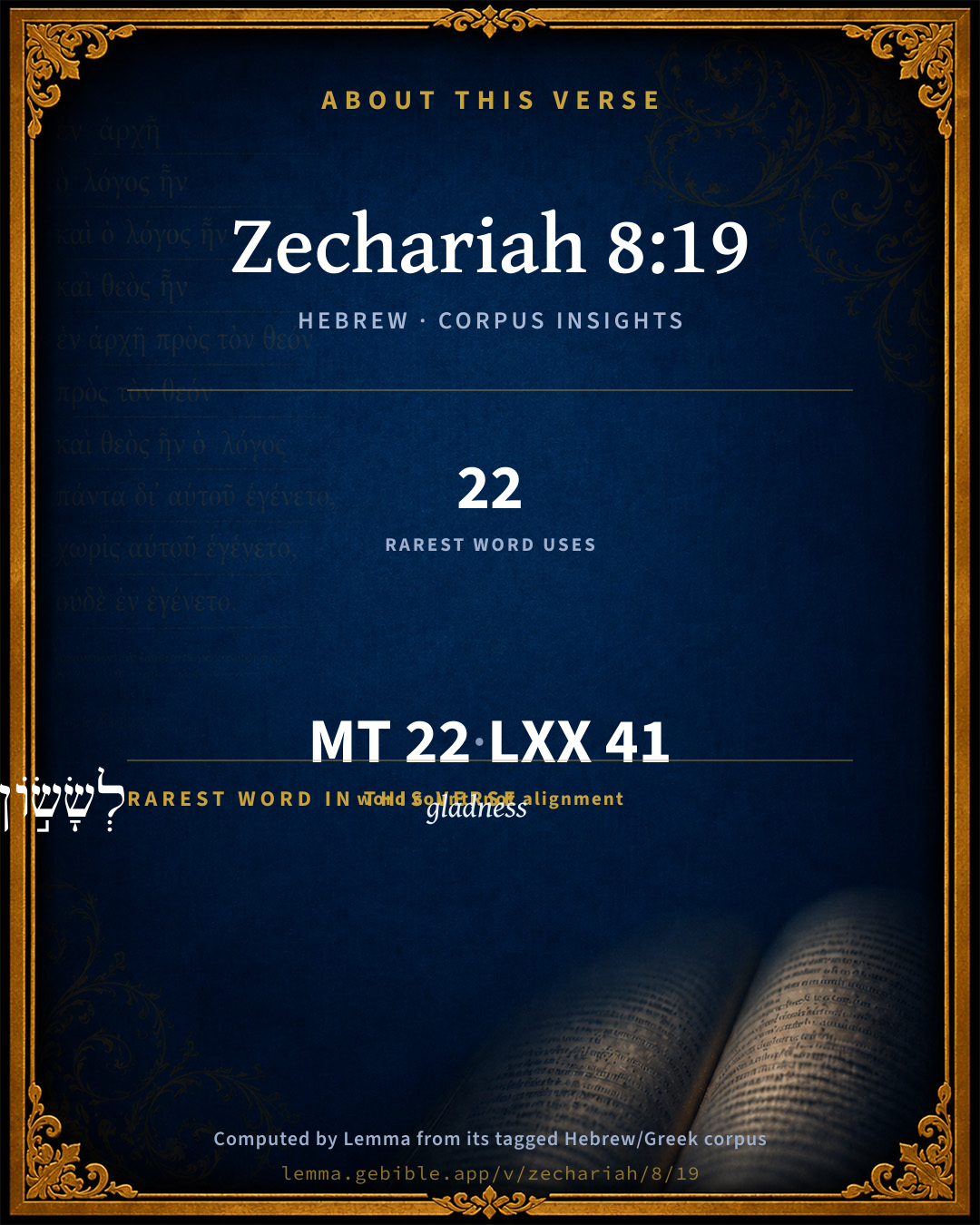
22
words
19
distinct lemmas
Prophets
section

Notable vocabulary

The rarest word here is לְשָׂשׂ֣וֹן gladness H8342 — appearing just 22 times in the whole Hebrew Bible.

Shared distinctive vocabulary

לְשָׂשׂ֣וֹן gladness H8342 occurs in 22 verses of the Hebrew Bible. Also found in:

Grammatical profile

  • 3 verbs
  • 13 nouns
  • 5 adjectives
  • 1 adverb

Verb forms

  • אָמַ֞ר Qal · Perfect
  • יִהְיֶ֤ה Qal · Imperfect
  • אֱהָֽבוּ Qal · Imperative

Repetition

A word recurs within this verse — often emphatic in Hebrew:

  • צ֣וֹם fast H6685 ×4

Hebrew & Septuagint length

In English translation the verse runs 33 words from the Hebrew and 46 from the Septuagint (LXX English) — closely comparable.

A rough comparison of the two English renderings, which tokenize alike — not a word-level alignment.

Word counts can differ between the Hebrew and the Greek without any difference in meaning — e.g. the Hebrew direct-object marker אֵת has no separate Greek word, and Greek often adds the article ὁ.

In the original languages it is 22 Hebrew tokens and 41 Greek tokens — but the two are counted differently (Hebrew bundles its prefixes and suffixes into one token; the Greek is in lemma form), so that isn’t a like-for-like length.

Cross-references

20

Topical passages linked to Zechariah 8:19 in the Treasury of Scripture Knowledge — connected by theme and wording, ordered by reader-vote popularity; previews shown in the World English Bible.

  • Jeremiah 39:2 in the eleventh year of Zedekiah, in the fourth month, the ninth day of the month, a breach was made in the city),
  • Zechariah 8:16 These are the things that you shall do: speak every man the truth with his neighbor. Execute the judgment of truth and peace in your gates,
  • Zechariah 7:3 and to speak to the priests of the house of Yahweh of Hosts, and to the prophets, saying, "Should I weep in the fifth month, separating myself, as I have done these so many years?"
  • Zechariah 7:5 "Speak to all the people of the land, and to the priests, saying, 'When you fasted and mourned in the fifth and in the seventh month for these seventy years, did you at all fast to me, really to me?
  • 2 Kings 25:25 But it happened in the seventh month, that Ishmael the son of Nethaniah, the son of Elishama, of the royal seed came, and ten men with him, and struck Gedaliah, so that he died, and the Jews and the Chaldeans that were with him at Mizpah.
  • Psalms 30:11 You have turned my mourning into dancing for me. You have removed my sackcloth, and clothed me with gladness,
  • Jeremiah 52:4 It happened in the ninth year of his reign, in the tenth month, in the tenth day of the month, that Nebuchadrezzar king of Babylon came, he and all his army, against Jerusalem, and encamped against it; and they built forts against it round about.
  • 2 Kings 25:3–4 On the ninth day of the [fourth] month the famine was sore in the city, so that there was no bread for the people of the land.
  • Luke 1:74–75 To grant to us that we, being delivered out of the hand of our enemies, should serve him without fear,
  • Isaiah 12:1 In that day you will say, "I will give thanks to you, Yahweh; for though you were angry with me, your anger has turned away and you comfort me.
  • Isaiah 35:10 and the ransomed of Yahweh shall return, and come with singing to Zion; and everlasting joy shall be on their heads: they shall obtain gladness and joy, and sorrow and sighing shall flee away.
  • Jeremiah 52:12–15 Now in the fifth month, in the tenth day of the month, which was the nineteenth year of king Nebuchadrezzar, king of Babylon, came Nebuzaradan the captain of the guard, who stood before the king of Babylon, into Jerusalem:
  • Esther 9:22 as the days in which the Jews had rest from their enemies, and the month which was turned to them from sorrow to gladness, and from mourning into a good day; that they should make them days of feasting and gladness, and of sending portions one to another, and gifts to the needy.
  • Jeremiah 52:6–7 In the fourth month, in the ninth day of the month, the famine was sore in the city, so that there was no bread for the people of the land.
  • Titus 2:11–12 For the grace of God has appeared, bringing salvation to all men,
  • Revelation 22:15 Outside are the dogs, the sorcerers, the sexually immoral, the murderers, the idolaters, and everyone who loves and practices falsehood.
  • Esther 8:17 In every province, and in every city, wherever the king's commandment and his decree came, the Jews had gladness and joy, a feast and a good day. Many from among the peoples of the land became Jews; for the fear of the Jews was fallen on them.
  • Isaiah 51:11 The ransomed of Yahweh shall return, and come with singing to Zion; and everlasting joy shall be on their heads: they shall obtain gladness and joy; [and] sorrow and sighing shall flee away.
  • Jeremiah 31:12–13 They shall come and sing in the height of Zion, and shall flow to the goodness of Yahweh, to the grain, and to the new wine, and to the oil, and to the young of the flock and of the herd: and their soul shall be as a watered garden; and they shall not sorrow any more at all.
  • Jeremiah 41:1–3 Now it happened in the seventh month, that Ishmael the son of Nethaniah, the son of Elishama, of the seed royal and [one of] the chief officers of the king, and ten men with him, came to Gedaliah the son of Ahikam to Mizpah; and there they ate bread together in Mizpah.

Cross-references courtesy of OpenBible.info (CC BY 4.0).

Hebrew and Greek witnesses Masoretic Hebrew ↔ Greek Septuagint

The same verse in the two great witnesses to the Old Testament, shown verse-for-verse.

These are two independent witnesses, not word-aligned to each other, and the Septuagint is shown in lemma (dictionary) form.

Hebrew Zechariah 8:19 Masoretic · Westminster Leningrad Codex

כֹּֽה אָמַ֞ר יְהוָ֣ה צְבָא֗וֹת צ֣וֹם הָרְבִיעִ֡י וְצ֣וֹם הַחֲמִישִׁי֩ וְצ֨וֹם הַשְּׁבִיעִ֜י וְצ֣וֹם הָעֲשִׂירִ֗י יִהְיֶ֤ה לְבֵית יְהוּדָה֙ לְשָׂשׂ֣וֹן וּלְשִׂמְחָ֔ה וּֽלְמֹעֲדִ֖ים טוֹבִ֑ים וְהָאֱמֶ֥ת וְהַשָּׁל֖וֹם אֱהָֽבוּ

Thus says Yahweh of Hosts: "The fasts of the fourth fifth, seventh, and tenth months shall be for the house of Judah joy and gladness, and cheerful feasts. Therefore love truth and peace."

World English Bible · Public Domain

Greek LXX Zechariah 8:19 Septuagint · lemma form

ὅδε λέγω κύριος παντοκράτωρ νηστεία ὁ τετράς καί νηστεία ὁ πέμπτος καί νηστεία ὁ ἕβδομος καί νηστεία ὁ δέκατος εἰμί ὁ οἶκος ιουδα εἰς χαρά καί εἰς εὐφροσύνη καί εἰς ἑορτή ἀγαθός καί εὐφραίνω καί ὁ ἀλήθεια καί ὁ εἰρήνη ἀγαπάω

Thus says the Lord Almighty, The fourth fast, and the fifth fast, and the seventh fast, and the tenth fast, shall be to the house of Juda for joy and gladness, and for good feasts; and you⌃ shall rejoice; and love you⌃ the truth and peace.

LXX2012 (modern English Septuagint) · Public Domain

On this verse, Ellicott's Commentary for English Readers discusses the Septuagint’s reading. Read the note in Commentary ↓

Hebrew: Westminster Leningrad Codex (CC BY 4.0). Greek: Septuagint (public domain); English from LXX2012 (modern English Septuagint) (Public Domain). How the Septuagint differs from the Hebrew →

Targum (Aramaic paraphrase)

1

The Targum is the ancient Jewish Aramaic paraphrase of the Hebrew Scriptures — an interpretive translation, not the Hebrew text itself. Onkelos (literal) and Pseudo-Jonathan (expansive) render the Torah, and Jonathan the Prophets. Coverage is partial: where no permissively-licensed English translation exists for a verse, only the Aramaic is shown. This is verse-level text, not a word-by-word alignment to the Hebrew.

  1. Targum Jonathan Prophets (Joshua–Malachi)
    כִּדְנַן אֲמַר יְיָ צְבָאוֹת צוֹמָא רְבִיעָאָה וְצוֹמָא חֲמִישָׁאָה וְצוֹמָא שְׁבִיעָאָה וְצוֹמָא עֲשִׂירָאָה יְהֵי לְבֵית יְהוּדָה לְבִיעַ וּלְחֶדְוָא וּלְמוֹעֲדִין טָבִין וְקוּשְׁטָא וּשְׁלָמָא רְחִימָא:

    (no public-domain English translation for this verse)

    Targum Jonathan — Aramaic: “Mikraot Gedolot” (public domain). English: “Sefaria Community Translation” (CC0 1.0 (public-domain dedication)); “London "Chaldee Paraphrase," 1871” (public domain). Text via Sefaria.

Commentary

Notes on Zechariah 8:19 from classic Christian and Jewish commentators (each source and its license shown beneath its notes). The classic Christian expositions comment on the surrounding passage and are grouped to its opening verse, so a note may address several verses; the Jewish commentaries on the Tanakh (Rashi and others) are per-verse, so they appear only where the commentator wrote on this verse.

Lemma curates 59 commentaries, every one of them public domain or Creative Commons licensed, each selected and text-cleaned for this edition rather than reprinted as found. About our sources →

Trapp's Complete Commentary

John Trapp

Zec 8:19 Thus saith the LORD of hosts; The fast of the fourth [month], and the fast of the fifth, and the fast of the seventh, and the fast of the tenth, shall be to the house of Judah joy and gladness, and cheerful feasts; therefore love the truth and peace.

Ver. 19. The fast of the fourth month] Wherein the city was taken, 2Ki 25:3.

And the fast of the fifth, and the fast of the seventh] See Zec 7:3; Zec 7:5.

And the fast of the tenth] Wherein Jerusalem was first beleaguered, 2Ki 25:1. This last mentioned was first taken up, upon a like occasion, as the Emperor of Constantinople (when the city was besieged by the Turk’s army) being certainly advertised of the enemies’ purpose for a general assault shortly to be given, first commended the defence of himself and the city to the Almighty God by general fasting and prayer; and afterwards appointed every captain and commander to some certain place of the wall for defence thereof.

Shall be to the house of Judah joy and gladness] God promiseth to turn their fasting into feasting, all their sadness into gladness, all their sighing into singing, all their tears into triumphs; and so gives a short but sweet answer to their demand about fasting after a larger and most excellent preface tending to Christian practice, and making much more to their benefit and comfort than the final decision of the main question proposed by them to the prophet. Finally, for a perclose, he leaves this with them by way of injunction.

Therefore love the truth and peace] q.d. Since your fasts are now abrogated, and the ceremonious observation thereof (the bodily exercise, the external abstinence, wherein ye placed so much holiness) abolished. Therefore love the truth, the substance of religion, the duties of piety and charity. Let go these needless ceremonies, taken up by yourselves; and though of a good intent, yet of an evil event; for you have made too much ado about them, with neglect of the one thing necessary. And now learn and labour to receive the love of the truth, that ye may be saved, 2Th 2:10, to speak the truth in love, Eph 4:15, to do the truth, 1Jn 1:6 ne dicta factis deficientibus ernbescant, lest your lives give your lips the lie. So will God say, "Surely they are my people, children that will not lie: so he will be your Saviour," Isa 63:8. So shall there be peace and truth in your days. Should we have peace upon any terms, peace without truth, it would be but like those short interims between the Egyptian plagues. Peace we may want and have truth; yea, peace we may have to buy truth; but we may not give truth to buy peace. He purchaseth peace at too dear a rate that pays his integrity to get it. "If it be possible, as much as in you lies, have peace with all men," Rom 12:18. But if you cannot compass it but with loss of truth and shipwreck of conscience, let it go; and ere long the fruit of righteousness shall be peace, God will make thine enemies to be at peace with thee, Isa 32:17. The historian tells us, that Numa’s temple of old had this inscription, πιστεως και ειρηνης ειπον. The temple of faith and peace; but faith first, and then peace. Keep in with God, that he be not a terror to thee (as Jeremiah prays), and then seek peace with men and ensue it, 1Pe 3:10-11, as ever thou desirest long life, and good days, cheerful feasts, as here in the text (called good days, Est 8:17), as ever thou hopest to have the calendar of thy life crowned with many festivals.

John Trapp, A Commentary or Exposition upon All the Books of the Old and New Testament (1647–1656) — public domain. Text from a community e-Sword module.

The Biblical Illustrator

Joseph S. Exell

Zec_8:19

Therefore love the truth and peace

The love of the truth

This solemn admonition may seem to derive additional weight from the consideration that it is almost the concluding message which the prophet Zechariah delivered to his countrymen.

(Probably only the first eight chapters were written by Zechariah.) The admonition was well suited to the particular condition of the Jews at that time. The warning is even more applicable to us, baptized Christians. As Christians it is expected of us that we should love the truth and peace. Attend especially to the love for religious truth. Many take for granted that it signifies little whether they embrace the truth or not. Religion is not a matter which comes much into their thoughts. It is a common sentiment, that if a person is but sincere in his religion, it signifies little what that religion is, true or false; if he is but sincere and in earnest, he is, they think, equally acceptable in the sight of God. Others cannot be said to love the truth, in that they do not put their hearts and minds to it, but satisfy themselves with shallow and imperfect views on the greatest and most concerning of all subjects.

1. Those who have no care for religious truth. It is a dictate not merely of religion, but even of natural piety and common sense, that we should make such inquiry as we can into the truth of our spiritual condition.

2. Those who think sincerity sufficient. Persons who think one belief is as good as another, strike at the very foundations of all religious truth.

3. Those who do not put their minds and hearts to the truth. Their religion, though good so far as it goes, is yet of a very shallow and imperfect character. Let not serious and thoughtful minds be frightened at the name of bigotry, or any other term of reproach, but steadily cherish in themselves a substantial love of Gods holy truth, always remembering that the truth will stand, and nothing else will. There is a good kind of bigotry, when we resolve to stand firm on faith and obedience, in faith relying on Gods Word, and in obedience on His will, however made known to us. (Sermons by Contrib. Tracts for the Times. )

Love to the truth and peace

Unperverted love is one of the noblest, most useful, and comprehensive affections of the heart. Essential to the moral nature of man, it is, as refined by the energies of the Spirit, and suitably exercised, the fulfilling of the law, the sum of religion, and our assimilation to the God of love. No arguments can be necessary to prove that truth is better than error, and peace than contention. In order that the returned captives might at once express their gratitude for the past, and insure continued and increasing prosperity, the prophet delivers the injunction in the text, Therefore love the truth and peace. It is not restrictively the truth of judgment, nor the speaking of truth between man and man, but religious truth in general, or the mind and will of God made known to them in the law and by the prophets, which the house of Jacob are here required to love: and therefore, agreeably to the economy under which she is placed, the truth to be loved by the Christian Church is the entire system of evangelical doctrine, or the truth as it is in Jesus. The peace which is to be loved in conjunction with the truth, is that good understanding and spirit of conciliation, which ought to characterise the embodied friends of religion.

I. Truth and peace are subjects of high importance in themselves and to the Church of Christ. That evangelical truth is highly important, and ought to be dearly valued, will be conceded by all, the moment we think of it as Gods revealed will to men for salvation. With the true knowledge of it, eternal life is closely, inseparably connected. In a general view, it is the only appointed and approved means of the worlds moral transformation. To the individual believing sinner, it is the blessed instrument of his illumination and progressive sanctity. An accurate comparison of it with truth of every other kind would only serve to establish its glorious superiority. We learn the unspeakable value of the truth from the wonderful concern that the God of truth Himself has had and uniformly manifested about it. The supereminent importance of evangelical truth might be demonstrated from the evil nature, the ruinous consequences of error. But, in connection with truth, peace also is of high importance in itself and in the Church. Peace of any kind, and particularly peace in the household of faith, if built upon right principles, will be dearly valued by every wise and good mind. In proportion as the friends of religion live peaceably among them selves, they are just what it becomes them to be. Peace of the right kind has a most benign influence on the spiritual interests of the Church.

II. It may be the attainment of the Church to have the possession of the truth and peace at the same time. Absolutely, or without any exception, this has rarely or ever been. Still in some happy degree it may be the attainment of the Church in her aggregate state Christendom, it must be confessed, furnishes at present no very favourable specimen of the point in hand. But this neither disproves our position, nor forbids the hope that it shall yet be realised.

III. Though both are very precious, truth is yet entitled to the first and preeminent consideration of the Church. Rightly do we associate truth with the very idea of the Church. We cannot think of what the Church owes to the truth, and not insist that, next to its Divine Author, it merits her first consideration. To it she owes her very existence. In forming, however, a comparative estimate between truth and peace, it would not be right to exalt truth at the expense of peace. Everything bland in language, and courteous in demeanour--everything comprised in the meekness of wisdom and the gentleness of Christ--every attainable degree of patience and candour in research--these and a thousand other things are to be offered, and willingly offered, at the shrine of holy concord. It is possible to give away too much, even for precious peace. Such a case would occur if amity were purchased by the surrender of any saving truth. For the sake of internal tranquillity, the Church may and ought to give away much of her own; but she has no right to barter the truth of God for peace with man. On the other hand, however, so inestimably precious is truth, that more than its worth cannot be given for it. Such views are, indeed, in letter and spirit at variance with a given species of modern liberality.

IV. The best and surest peace in the Church is that which has truth for its foundation. The precedence of truth is not a mere arbitrary, but, if we would enjoy true peace, a necessary distinction. Truth is as essential to the being of peace as the cause to the effect, and must precede it, as the foundation must be laid before the superstructure.

V. The great things which the Lord hath done for the Church, or engages to do, lay her under sacred obligations to love the truth and peace. Obviously the text assumes the form of deduction. Learn from this subject--

1. The moral nature of the true glory of the Church.

2. That genuine love to the truth and peace would be a presage of good to the Church.

3. That the ministers of religion have a most honourable and delightful employ. In a ministerial sense, peace makers between God and man, and so also between man and man. Our vocation gives scope to all our powers and our unwearied exertions.

4. This subject gives us right to insist that the members of our association should be, without exception, the sincere and ardent lovers of truth and peace. (Robert Muter, D. D.)

On reading works of fiction

When the use and fiction is so general, it would be of little avail to speak against it. God has made the imagination part of our nature for wise purposes, no doubt; and so long as those purposes are ascertained and kept in view, there cannot be much danger. The mind cannot be always on the stretch. If fiction is occasionally used to refresh weary powers, to lift up into the world of fancy for a time, one who is tired of walking on the dusty road of existence, such an indulgence is not to be blamed; nor is it inconsistent with that love of truth which is essential to the mind of a man as well as the character of a Christian. But there is danger of excess in this indulgence; these luxuries cannot be the daily bread of the mind. The effect of these fictions on the mind exactly resembles the effect of rich and stimulating food on the body. That caution is necessary may be seen from the tendency of this taste for fiction to become excessive and engrossing. And fact proves it to be an unhealthy taste, and one which cannot be indulged without injury to the mind. There is no danger that the taste for reading true history will ever become excessive:--it is healthy in itself, and indicates right action in the mind. The taste for fiction dislodges and removes better tastes from the mind. Let your taste for fiction be so much indulged that you can no longer relish reading for improvement, and the injury is done; the mind is no longer healthy. There is another danger, arising from the fact, that the mind is passive, perfectly passive, in this kind of reading. In reading for improvement the mind is active. In reading for ammusement the mind is not in action. It originates no trains of thought; it gains no new strength, nor power of action; but, on the contrary, subsides into a luxurious, dreamy state, very much resembling that produced by narcotics, and which, fascinating though it is, destroys all moral and intellectual energy, and makes self-indulgence the ruling principle within. There is little force in the common saying, that good moral instruction can be given in a fictitious form. Nobody doubts this; but there is another question, Can such instruction be taken in a fictitious form? Emotions which do not lead to action grow less and less every time they are repeated. Tears are shed, as usual, for they cost nothing, but the heart grows cold. Fictions only produce a fictitious benevolence. A reader of fiction becomes the sure victim of the immoral and unprincipled author whom he reads. His moral and religious sensibility will be impaired. Of course all writers of fiction are not immoral. If there are not many writers of this description, if the majority are of a higher order, still the very best of them will do injury, because they will create a taste for fiction which can only be fed by fiction. When the works of the best writers are exhausted, the reader will resort to others less worthy; he will not perceive the degenerating change that goes on within him; he will not be conscious that his moral sense is dead and all his soul in ruins. This unconsciousness of danger is one of the most fearful things in all diseases of the mind and heart. If any one would know the signs of danger, I say, that if he has lost the taste, or never formed the taste for reading for improvement, there is injury already done. If he finds that it gives him no pleasure to exert his powers, that improvement alone has no attractions, that he turns to his fiction like the intemperate man to his glass, then the charge, Love the truth, should be a serious sound to him. It reminds him of a perverted taste, of a neglected duty; and of a change, too, which must be made before the purposes of life can be fulfilled. (W. B. O. Peabody, D. D.)

The Biblical Illustrator, edited by Joseph S. Exell (c. 1880s–1900s) — public domain. Text from a community e-Sword module.

Joseph Benson's Commentary

Zec 8:19. The fast of the fourth month and of the fifth, &c. — See the note on Zec 7:5. The siege of Jerusalem was begun in the tenth month, and in the fourth of the year following the city was taken. God here informs the people, by his prophet, in answer to the question proposed, chap. Zec 7:3, that they might now disuse these fasts, and lay aside the mournful ceremonies with which they had been solemnized, the judgments, which had given occasion to them, being removed. Therefore — Rather, but, love the truth and peace — But take care to have a regard to truth in your dealings and conversation with each other; and cultivate a meek and peaceable disposition; which will be far more pleasing to God than any of your outward performances. Such divine instructions as these prepared men’s minds for the reception of the gospel. See Jer 31:33.

Joseph Benson's Commentary on the Old and New Testaments (1811–1818) — public domain. Text from a community e-Sword module.

Tyndale Open Study Notes

Tyndale Open Resources

8:19 Here the Lord finally answers the question posed by the delegates from Bethel (7:2-3). • The fast in early summer commemorated the breaching of Jerusalem’s walls (2 Kgs 25:3-4; Jer 52:6-7). The midsummer fast lamented the burning of Solomon’s Temple (2 Kgs 25:8-10; Jer 52:12-14). The fast in autumn marked the assassination of Gedaliah, governor of Jerusalem (2 Kgs 25:22-25; Jer 41:1-3) or the Day of Atonement (Lev 23:26-32). The fast in winter recalled the beginning of the siege of Jerusalem (2 Kgs 25:1; Jer 52:4). • The fasts will turn to feasts when God restores Israel and sets his glory among the nations (Isa 65:18-19).

Tyndale Open Study Notes — © Tyndale Open Resources, licensed CC BY-SA 4.0. Text via the HelloAO Bible API.

Geneva Bible (1599)

Geneva Bible translators

Which fast was appointed when the city was besieged, and was the first fast of these four: and here the Prophet showeth, that if the Jews will repent, and turn wholly to God, they shall have no more occasion to fast, or to show signs of heaviness: for God will send them joy and gladness.

Geneva Bible (1599) marginal notes — public domain. Text via Bolls.life.

Jamieson, Fausset & Brown

Robert Jamieson, A. R. Fausset & David Brown

fast of . . . fourth month--On the fourth month of the eleventh year of Zedekiah's reign, on the ninth day, Jerusalem was taken (Jer 39:2; Jer 52:6-7). It was therefore made a fast day.

fifth . . . seventh--(See on Zac 7:3; Zac 7:5).

tenth--On the tenth month and tenth day, in the ninth year of Zedekiah, the siege began (Jer 52:4).

therefore love the truth--or, "only love." English Version is better. God's blessing covenanted to Israel is not made to depend on Israel's goodness: but Israel's goodness should follow as the consequence of God's gracious promises (Zac 8:16-17; Zac 7:9-10). God will bless, but not those who harden themselves in sin.

Jamieson, Fausset & Brown — Commentary Critical and Explanatory on the Whole Bible (1871) — public domain (CC PDM 1.0). Text via the HelloAO Bible API.

Adam Clarke's Commentary

Verse 19. The fast of the fourth month] To commemorate the taking of Jerusalem; 2Kg 25:3; Jer 39:2; Jer 52:6-7.

The fast of the fifth] In memory of the ruin of the temple, 2Kg 25:8; Jer 52:12-13.

The fast of the seventh] For the murder of Gedaliah, Jer 41:1-17.

The fast of the tenth] In commemoration of the siege of Jerusalem, which began on the tenth day of the tenth month; 2Kg 25:1; Jer 52:4; Eze 24:1-2; and see on Zec 7:3; Zec 7:5.

Cheerful feasts] Ye shall find all your evils so completely redressed, that these mournful fasts shall be turned into joyful feasts.

Adam Clarke's Commentary on the Bible (1810–1826) — public domain. Text from a community e-Sword/MySword module.

John Calvin's Commentaries

He confirms the same truth, that such would be the restoration of the Church that all the memory of their sorrows would be obliterated. We have already said, that some fasts were observed by the Jews after the destruction of their city. Before two only were mentioned, but now the Prophet names four. In the fourth month the city was taken, and in the fifth the temple was destroyed and burnt down; in the seventh was Gedaliah slain, who had remained with the residue of the people who had been gathered by him; and the fast of the tenth month, as some think, was appointed when the city was besieged. If so, the fast of the tenth month preceded the rest, then followed the fast of the fourth month, in the third place the fast of the fifth month, and, lastly, the fast of the seventh month, on account of the death of Gedaliah.

These then were tokens of mourning to the time of the restoration; for when the city was besieged, God raised up, as it were, a sign of dreadful vengeance; and when Nebuchadnezzar broke through the wall of the city, it was then openly forsaken by God; after the burning of the temple there remained no hope, except that some of the common people continued in the land under the protection of Gedaliah. The root, as it were, of the people was cut off, but some thin fibres were remaining; and when even these were torn asunder, when all who could be found were led into exile, the favor of God had wholly disappeared as to the outward appearance. It behaved then the Jews to be in mourning and humiliation, that they might seek pardon from God. We shall not then say, that these fasts were without reason, and foolishly appointed by them, for they were at liberty to testify their sorrow; nay, it was an act of piety humbly in their guilt to deprecate the wrath of the celestial Judge, when they perceived that he was displeased with them. But God now promises joy, which was to extinguish all sorrow, as the rising of the sun drives away all the darkness of the night.

But the Prophet seems to allude to what he had before taught when he indirectly taunted the Jews, because they were too anxious about keeping fasts, while they neglected the main things. But the simple meaning is, that if the Jews really repented and sincerely sought to return to God’s favor, there would be an end to all their miseries, so that there would be no need of fasting.

We must also remember that the design of fasting is this, that those who have sinned may humble themselves before God, and go as suppliants before his throne, that they may confess their sins and condemn themselves. Fasting then is, as it were, the habit of criminals when they desire to obtain pardon from God; for Christ says, that there is no fasting at marriages and during festal days. (Matthew 9:15.) We then see that there is here promised a restoration which was to put an end to every former cause of sorrow among the people; not that these fasts of themselves displeased God, for they were appointed, as we have said, for a good purpose — that the people might thus exercise themselves in acts of piety, and also stimulate and support their hope till the time of their deliverance; but Zechariah pursues what he had begun — that God was now plainly reconciled, for he favored his people, and proved this by the blessings he bestowed.

With regard to festal days, we know that among other things they are expressly mentioned by Moses, “Thou shalt rejoice before thy God.” (Deuteronomy 12:18.) When therefore the Jews celebrated their festal meetings, it was the same as though they stood before God, and were thus fully persuaded that they were in his presence. Forasmuch then as God thus designed to exhilarate his people by festivals, the Prophet does not without reason say, that the fasts, which had been signs of mourning, would be turned into joy and into festal days. Moreover, the Prophet thus speaks, because the observance of the law, which prevailed while the people were in a state of security, had been interrupted in their exile — as though he had said, “As food expelled you to a foreign land, and made you while exiles from your country to grieve and mourn, so now being restored you shall have joy, and religiously keep your festal days.” And thus he indirectly reproves the Jews for having deprived themselves of their festal days, in which the law invited them to rejoice, for they had profaned them. God would not have suffered to be discontinued what he had commanded, had not religion been corrupted; for on this account it was that things changed for the worse, and that sorrow succeeded, which is here designated by fastings.

At length he concludes by saying, Love ye then truth and peace. By truth he means integrity, as we have said before; and Zechariah includes in this word the whole of what is just and right: for when our hearts are cleansed, then the rule of justice and equity is observed. When then we deal sincerely with our neighbors, all the duties of love freely flow from within as from a fountain. As to the word peace, it may be explained in two ways: either as in the former instance when he mentioned the judgment of peace in the sense of judgment rightly formed, and thus to love peace is to love good order; or it may be taken for God’s blessing, as though the Prophet said, “If ye wish to be in a good and prosperous state, observe integrity towards one another; for God will ever be present by his blessing, provided ye be sincere and faithful. Ye have in a manner sought a curse for yourselves, and dried up as it were the fountain of God’s blessings by your wickedness and your frauds. If then truth reign among you, all felicity shall accompany it; for the Lord will bless you.” I shall not proceed farther now.

John Calvin's Commentaries (1540-1563) — public domain. Text from the Calvin Translation Society English edition (1840s-50s) via the Christian Classics Ethereal Library (ccel.org). Calvin's coverage is partial (roughly two-thirds of the Bible); uncommented books and verses are honest gaps, never fabricated. The 19th-century editor's footnotes and remarks are omitted so the notes are faithfully Calvin's own voice.

Ellicott's Commentary for English Readers

(19) “The fast of the fourth [month].”—LXX., after the analogy of Gen_1:31, renders “the fourth fast,” and so also with the others.

A Bible Commentary for English Readers, edited by Charles John Ellicott (1878–1897) — public domain. Text from a community e-Sword module.

The Cambridge Bible for Schools and Colleges

gen. ed. J. J. S. Perowne

19. The fast of the fourth month] had been instituted, because on that day, under the extremity of famine, Jerusalem opened her gates to Nebuchadnezzar. Jer_39:2-3; Jer_52:6-7.

the fast of the tenth] The siege of Jerusalem by Nebuchadnezzar commenced in that month. 2Ki_25:1; Jer_39:1.

therefore love] Lit. and (in order that this may happen to you, as the condition of the fulfilment of the promise), love truth and peace. Comp. Zec_8:16-17.

The Cambridge Bible for Schools and Colleges (gen. ed. J. J. S. Perowne; Cambridge University Press, 1878–1918) — public domain. Text from a community e-Sword module.

John Gill's Exposition

And the inhabitants of one city shall go to another,.... Which shows their concern for the spiritual welfare of each other, their zeal for the honour and glory of God, and their readiness to attend divine worship:

saying, Let us go speedily to pray before the Lord; for pardoning, justifying, and sanctifying grace which shows their sense of need of these things, and that they are only to be had of the Lord; and that their case required haste, and would admit of no delay:

and to seek the Lord of hosts: by prayer and supplication, as before: the Chaldee paraphrase is, "to seek doctrine from the Lord of hosts"; to learn the truths of his Gospel; to know his will, and be informed of the right way of worshipping him, as well as to seek to Christ for life and salvation:

I will go also; that is, "this shall say to that", as the Targum supplies it; one shall say to another, and express himself in such language, by way of example and encouragement.

John Gill's Exposition of the Whole Bible (1746–1763) — public domain (CC PDM 1.0). Text via the HelloAO Bible API.

Albert Barnes' Notes on the Bible

The fast of the fourth month - On the ninth day “of the fourth month” of Zedekiah’s eleventh year, Jerusalem, in the extremity of famine, opened to Nebuchadnezzar, and his princes sat in her gate; in the “tenth month” of his ninth year Nebuchadnezzar began the siege. Ezekiel was bidden “on its tenth day; write thee the name of the day, of this same day,” Eze 24:1-2, as the beginning of God’s uttermost judgments against “the bloody city” . The days of national sorrow were to be turned late exuberant joy, “joy and gladness and cheerful feasts” Est 8:17; Est 9:19, Est 9:22; Ecc 7:14, for the sorrows, which they commemorated, were but the harbingers of joy, when the chastisements were ended; only He adds, love the truth and peace; for such love whereby they would be Israelites indeed, in whose spirits is no guile, were the conditions of their participating the blessings of the Gospel, of which he goes on to speak;

Albert Barnes' Notes on the Bible (1834–1885) — public domain. Text from a community e-Sword/MySword module.

Haydock's Catholic Bible Commentary

Fast. They fasted on the ninth day of the fourth month, because on that day Nabuchodonosor took Jerusalem, Jeremias lii. 6. On the tenth day of the fifth month, because on that day the temple was burnt, Jeremias lii. 12. On the third day of the seventh month, for the murder of Godolias, Jeremias xli. 2. And on the tenth day of the tenth month, because on that day the Chaldeans began to besiege Jerusalem, 4 Kings xxv. 1. All these fasts, if they will be obedient for the future, shall be changed (as is here promised) into joyful solemnities. (Challoner) --- They had only inquired about the fasts of the fifth and seventh months but the two others were also to be omitted in times of joy. (Worthington) --- The Jews still observe all four. (Basnage v. 16.) --- They fast on the seventeenth of the fourth month, because the breach was then made in the walls, (Calmet) and Moses broke the tables of the law, according to the Jews, in St. Jerome. The ninth of the fifth month is also kept instead of the tenth, on which day the city was taken by the Chaldeans; (Calmet) and the Romans burnt the temple in the same month, as the Israelites had then formerly been sentenced to wander in the desert. (St. Jerome) --- It would be difficult for the Jews to prove all these assertions.

George Leo Haydock (1774–1849), Haydock's Catholic Family Bible and Commentary, 1859 edition — public domain. Excludes Psalms (Douay-Rheims chapter numbering differs from Protestant) and Deuterocanonical books (Catholic canon only).

Matthew Poole's English Annotations

This 19th verse is a final decision of the proposed case, and the whole of this verse stands on a proviso or condition, that they do those things required, Zec 8:16,17; then shall their fasting cease, and turn into joy and feasts.

The fast of the fourth month; wherein the city was taken by the Babylonians, who on the ninth day of this month broke into the city, Jer 52:6,7.

Of the fifth; of which on the tenth day the temple was burnt.

Of the seventh; wherein Gedaliah was killed, Jer 41:1.

Of the tenth; on the tenth day whereof the king of Babylon’s army sat down before the city and besieged it.

Shall be to the house of Judah joy and gladness; good days, in which they shall rejoice for all the goodness that God hath showed them in their private affairs.

And cheerful feasts, for public; these days of fasting shall be turned into solemn and public festivals, days of thanksgiving to the Lord, for turning back their captivity, and restoring church and state.

Therefore love the truth and peace; let your hearty affection be set on truth in all concerns of religion, and on peace in all converse with your neighbours.

Matthew Poole's English Annotations on the Holy Bible (1683–1685) — public domain. Text from a community e-Sword/MySword module.

The Pulpit Commentary

The fast of the fourth month, etc. (For the occasions of these fasts, see note on Zec_7:3) Jerome gives the later Jewish traditions concerning them. The fast of the seventh day of the fourth month commemorated the breaking of the two tables of the commandments by Moses, as well as the first breach in the walls of Jerusalem; that of the fifth month was observed in memory of the return of the spies sent to explore Canaan, and the consequent punishment of forty years" wandering in the wilderness, as well as of the burning of the temple by the Chaldeans; that in the tenth month was appointed because it was then that Ezekiel and the captive Jews received intelligence of the complete destruction of the temple. Joy and gladness. The observance of these fasts seems, by the Lord"s answer, to have been neither enjoined nor forbidden; but as for their sins their festivals had been turned into mourning, (Amo_8:10) so now their fasts should be turned into joyful feasts, and former miseries should be forgotten in the presence of the blessings now showered upon them. Therefore love the truth and peace. This is the condition of the fulfilment of the promise, (ver. 16; Zec_7:9) here again forcibly impressed.

The Pulpit Commentary (1880–1919), ed. H.D.M. Spence-Jones & Joseph S. Exell — public domain. Text from a community e-Sword module.

John Wesley's Explanatory Notes

Thus saith the Lord - This verse is a final decision of the case: provided they do these things required, ver. 16, 17, then shall the fasting cease, and turn into joyful feasts. The fourth month - Wherein the city was taken by the Babylonians. The fifth - In which the temple was burnt. The seventh - Wherein Gedaliah was killed. The tenth - On the tenth day whereof the king of Babylon's army sat down before the city.

John Wesley, Explanatory Notes Upon the Whole Bible (1754–1765) — public domain. Text via the GEBible commentary corpus.

Scofield Reference Notes

C. I. Scofield

fourth month i.e. July.

fifth month i.e. August.

seventh month i.e. October.

tenth month i.e. January.

The Scofield Reference Bible (1917 edition), notes by C. I. Scofield — public domain. Text from a community e-Sword module.

Rashi

Rabbi Shlomo Yitzchaki (Rashi)

the fast of the fourth [month] The fast of Tammuz, which is the fourth of the months.

the fast of the fifth [month] of Av.

the fast of the seventh [month] The third of Tishri, when Gedaliah was assassinated.

and the fast of the tenth [month] Of Teveth.

Rashi on the Tanakh — English translations: “The Judaica Press complete Tanach with Rashi, translated by A. J. Rosenberg” (CC BY 4.0); “Pentateuch with Rashi's commentary by M. Rosenbaum and A.M. Silbermann, 1929-1934” (public domain); “The Metsudah Tanach series, Lakewood, N.J” (CC BY 4.0); and “The Book of Joshua, Metsudah Publications, 1997” (CC BY 4.0). Text via Sefaria.

Radak

Rabbi David Kimhi (Radak)

The fast of the fourth — This is Tammuz, when they fasted in exile on the seventeenth of the month, the day that the city was broken into.

And the fast of the fifth — This is Av, when they fasted on the ninth.

And the fast of the seventh — This is the fast of Gedaliah, as we explained above. And the fast of the tenth — This is the Tenth of Tevet, when the king of Babylon began to besiege Jerusalem.

Will be All of these fasts had been kept for the house of Judah during the Second Temple period, because the Ten Tribes had not returned.

And the truth and peace you will love This will happen provided that you love the truth and peace as I commanded you.

Radak on the Tanakh — English translations: “Sefaria Community Translation” (CC0 1.0 (public-domain dedication)); “Eliyahu Munk, HaChut Hameshulash” (CC BY 4.0); “Rabbi Mike Feuer, Jerusalem Anthology” (CC BY 4.0); and “R. David Kimhi on the first book of Psalms, Translated by R.G. Finch, London, 1919” (public domain). Text via Sefaria.

Lesson kit

Teaching starters — assembled from the data on this page, not authored interpretation. Every prompt links to the verse data it draws on. Edit before teaching.

Zechariah, in the Prophets, opens this verse with 22 words (19 distinct Hebrew lemmas). Its most distinctive word is sâsôwn (“gladness”). A historical commentator’s framing appears above. Read the whole chapter for the surrounding context.

Discussion questions

  1. The word sâsôwn carries the sense “gladness.” How does it shape the verse?
  2. How does Esther 8:16, which shares the word «gladness», read alongside this verse?
  3. What does the repetition of “fast” (4× in this one verse) do in this verse?
  4. These translations render this verse differently. What is at stake in choosing one wording over another?
  5. «אָמַ֞ר» is a Qal Perfect verb. How does that grammatical form shape the action described?
  6. Compare how Trapp's Complete Commentary and The Biblical Illustrator read this verse. Where do they agree or differ?

Things to notice

Reading settings

Reading text

Shown beneath each verse's original-language words.

Old Testament
Old Testament edition

Read the OT as the Masoretic Hebrew (MT) or the Greek Septuagint (LXX).

English shown for the Greek Septuagint (in the Hebrew ↔ Greek comparison).

Comparing translations? Open the Compare panel on any verse page to stack up to four side by side.