
Deuteronomy 20:11

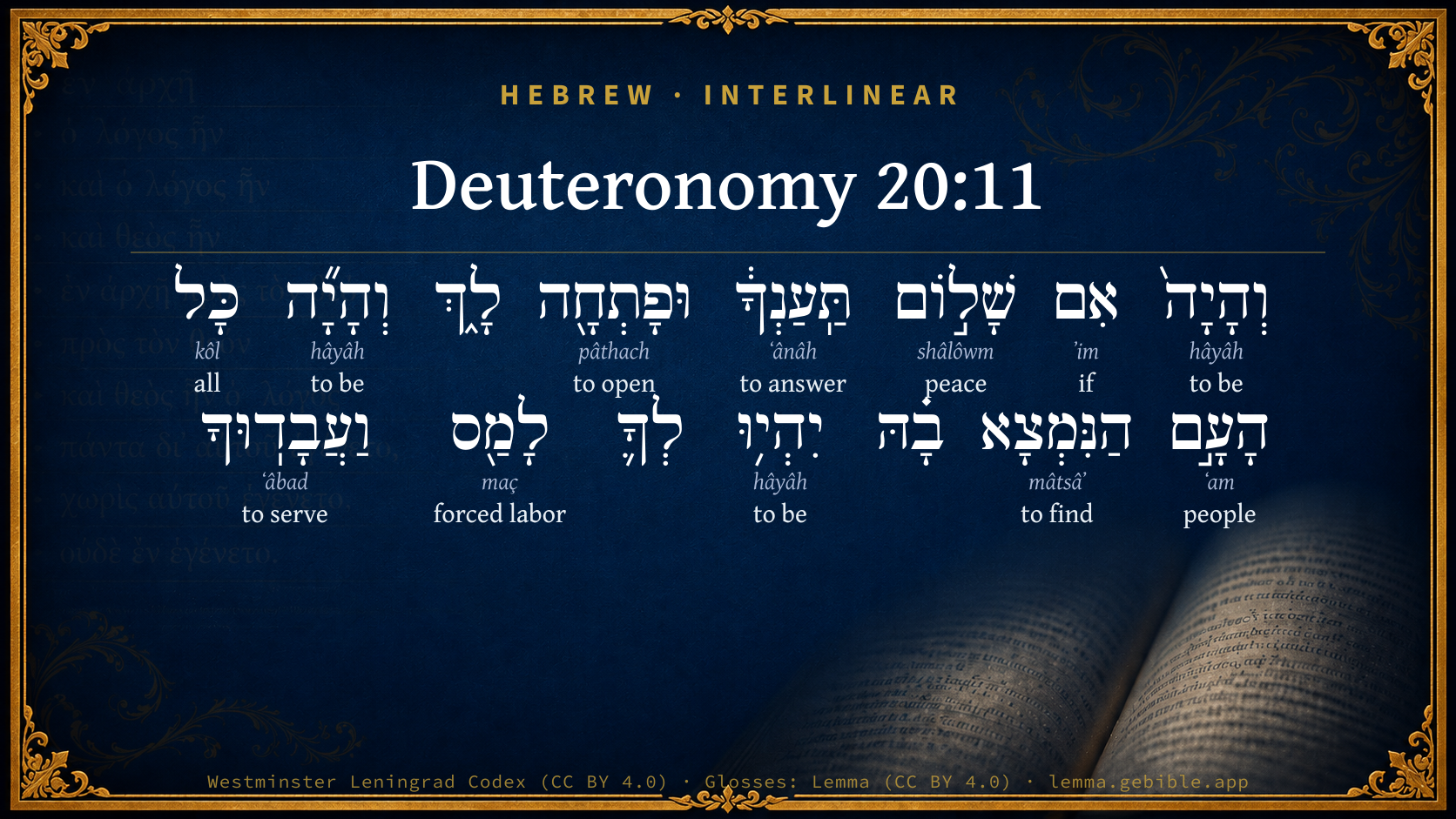
Hebrew (Westminster Leningrad Codex) Deuteronomy 20:11 appears in the Hebrew Old Testament. The text above is from the Westminster Leningrad Codex. Each word links to its Strong’s number, a concise gloss, and parsing drawn from the Open Scriptures Hebrew Bible morphology. Click any word for its full Brown-Driver-Briggs (BDB) entry.
Download image
Cite this verse

Deuteronomy 20:11 (World English Bible). Public Domain. Lemma interlinear Bible study tool, https://lemma.gebible.app/v/deuteronomy/20/11.

Show BibTeX & RIS
BibTeX
RIS
English Translation
It shall be, if it make you answer of peace, and open to you, then it shall be, that all the people who are found therein shall become tributary to you, and shall serve you.
World English Bible · Public Domain
Download a study sheet

One document with this verse’s original text, its word-by-word gloss line, the meaning frame, cross-references with their text, attributed commentary, and full source and license credits — printable, and it pastes into notes with its structure intact.

This verse Autodidact and up

Study sheet (.html) Plain text (.txt)

A passage Seminary Student

Up to 50 verses in one chapter. A passage sheet keeps up to 6 commentary sources and 12 cross-references per verse, in the order this page ranks them, and says so on the sheet whenever that leaves anything out. Ask for a single verse and you get the Autodidact verse sheet above.

Everything on this page stays free to read, with no account — the sheet is a download of what is already on screen, not access to it.

Want to remove ads? Support Godless Engineer
Compare translations 3

The same verse in 3 English versions, stacked beneath the original-language interlinear above. Click any original word for its lexicon entry.

Each is an independent rendering of the whole verse — the interlinear is not word-aligned to these translations.

Highlighted words mark where these versions differ — a whole-verse word diff, not a word-by-word alignment.

  • World English Bible Public Domain
    It shall be, if it make you answer of peace, and open to you, then it shall be, that all the people who are found therein shall become tributary to you, and shall serve you.
  • King James Version Public Domain
    And it shall be, if it make thee answer of peace, and open unto thee, then it shall be, that all the people that is found therein shall be tributaries unto thee, and they shall serve thee.
  • unfoldingWord Literal Text CC BY-SA 4.0
    And it will be, if it answers, ‘Peace,’ and opens to you, then it will be, all the people found in it shall become for you as forced labor and serve you.

unfoldingWord Literal Text — © unfoldingWord, licensed CC BY-SA 4.0. Word-aligned USFM3 via Door43 (git.door43.org/unfoldingWord/en_ult).

Versions to compare (up to 4)

3 of 4 selected

Show all 18 translations

Every available English version of this verse, each an independent rendering of the whole verse.

  • World English Bible Public Domain
    It shall be, if it make you answer of peace, and open to you, then it shall be, that all the people who are found therein shall become tributary to you, and shall serve you.
  • Berean Standard Bible Public Domain
    If they accept your offer of peace and open their gates, all the people there will become forced laborers to serve you.
  • Majority Standard Bible Public Domain
    If they accept your offer of peace and open their gates, all the people there will become forced laborers to serve you.
  • King James Version Public Domain
    And it shall be, if it make thee answer of peace, and open unto thee, then it shall be, that all the people that is found therein shall be tributaries unto thee, and they shall serve thee.
  • American Standard Version (1901) Public Domain
    And it shall be, if it make thee answer of peace, and open unto thee, then it shall be, that all the people that are found therein shall become tributary unto thee, and shall serve thee.
  • Revised Version (1885) Public Domain
    And it shall be, if it make thee answer of peace, and open unto thee, then it shall be, that all the people that is found therein shall become tributary unto thee, and shall serve thee.
  • Geneva Bible (1599) Public Domain
    And if it answere thee againe peaceably, and open vnto thee, then let all the people that is founde therein, be tributaries vnto thee, and serue thee.
  • Douay-Rheims (1899) Public Domain
    If they receive it, and open the gates to thee, all the people that are therein, shall be saved, and shall serve thee paying tribute.
  • Young's Literal Translation Public Domain
    and it hath been, if Peace it answer thee, and hath opened to thee, then it hath come to pass -- all the people who are found in it are to thee for tributaries, and have served thee.
  • Literal Standard Version CC BY-SA 4.0
    and it has been, if it answers you [with] peace, and has opened to you, then it has come to pass, all the people who are found in it are for tributaries to you, and have served you.
  • Unlocked Literal Bible CC BY-SA 4.0
    If they accept your offer and open their gates to you, all the people who are found in it must become forced labor for you and must serve you.
  • unfoldingWord Literal Text CC BY-SA 4.0
    And it will be, if it answers, ‘Peace,’ and opens to you, then it will be, all the people found in it shall become for you as forced labor and serve you.
  • Darby Bible Public Domain
    And it shall be, if it make thee answer of peace, and open unto thee, then all the people that are found therein shall be tributaries unto thee, and they shall serve thee.
  • World Messianic Bible Public Domain
    It shall be, if it gives you answer of peace and opens to you, then it shall be that all the people who are found therein shall become forced laborers to you, and shall serve you.
  • Webster's Bible Public Domain
    And it shall be, if it shall make thee answer of peace, and open to thee, then it shall be, that all the people that are found therein, shall be tributaries to thee, and they shall serve thee.
  • Free Bible Version CC BY-SA 4.0
    If they accept your offer of peace and open their gates to you, all the inhabitants will become your slave-laborers.
  • Bible in Basic English Public Domain
    And if it gives you back an answer of peace, opening its doors to you, then all the people in it may be put to forced work as your servants.
  • JPS Tanakh (1917) Public Domain
    And it shall be, if it make thee answer of peace, and open unto thee, then it shall be, that all the people that are found therein shall become tributary unto thee, and shall serve thee.

Literal Standard Version (2020), Covenant Press — licensed CC BY-SA 4.0. Text via the HelloAO Bible API (eBible.org). Unlocked Literal Bible (unfoldingWord) — licensed CC BY-SA 4.0. Text via the HelloAO Bible API (eBible.org). unfoldingWord Literal Text — © unfoldingWord, licensed CC BY-SA 4.0. Word-aligned USFM3 via Door43 (git.door43.org/unfoldingWord/en_ult). Free Bible Version, Dr. Jonathan Gallagher — licensed CC BY-SA 4.0. Text via the HelloAO Bible API (eBible.org).

Word by word

More ways to search: Search by grammar → Find every occurrence → Compare this word →

Practice this passage: Drill this verse → Learn its vocabulary →

לָמַ֖ס
maç
H4522
“to/for · forced labor”
Preposition + Noun, Common, Masculine, Singular, Absolute
Part of Speech
Preposition + Noun
Type
Common
Gender
Masculine
Number
Singular
State
Absolute
Full BDB Definition

Origin: from H4549

TWOT: 1218

gang or body of forced labourers, task-workers, labour band or gang, forced service, task-work, serfdom, tributary, tribute, levy, taskmasters, discomfited - labour-band, labour-gang, slave gang - gang-overseers - forced service, serfdom, tribute, enforced payment
  1. וְהָיָה֙ hâyâh H1961 “and · to be” Conjunction + Verb, Qal, Sequential Perfect, 3rd Person, Masculine, Singular
  2. אִם ʼim H518 “if” Conjunction
  3. שָׁל֣וֹם shâlôwm H7965 “peace” Noun, Common, Masculine, Singular, Absolute
  4. תַּֽעַנְךָ֔ ʻânâh H6030 “to answer · you” Verb, Qal, Imperfect, 3rd Person, Feminine, Singular + Suffix, Personal, 2nd Person, Masculine, Singular
  5. וּפָתְחָ֖ה pâthach H6605 “and · to open” Conjunction + Verb, Qal, Sequential Perfect, 3rd Person, Feminine, Singular
  6. וְהָיָ֞ה hâyâh H1961 “and · to be” Conjunction + Verb, Qal, Sequential Perfect, 3rd Person, Masculine, Singular
  7. כָּל kôl H3605 “all of” Noun, Common, Masculine, Singular, Construct
  8. הָעָ֣ם ʻam H5971 “the · people” Particle, Definite Article + Noun, Common, Masculine, Singular, Absolute
  9. הַנִּמְצָא mâtsâʼ H4672 “the · finding” Particle, Definite Article + Verb, Niphal, Participle Active, Masculine, Singular, Absolute
  10. יִהְי֥וּ hâyâh H1961 “to be” Verb, Qal, Imperfect, 3rd Person, Masculine, Plural
  11. וַעֲבָדֽוּךָ ʻâbad H5647 “and · to serve · you” Conjunction + Verb, Qal, Sequential Perfect, 3rd Person, Common, Plural + Suffix, Personal, 2nd Person, Masculine, Singular

About this verse

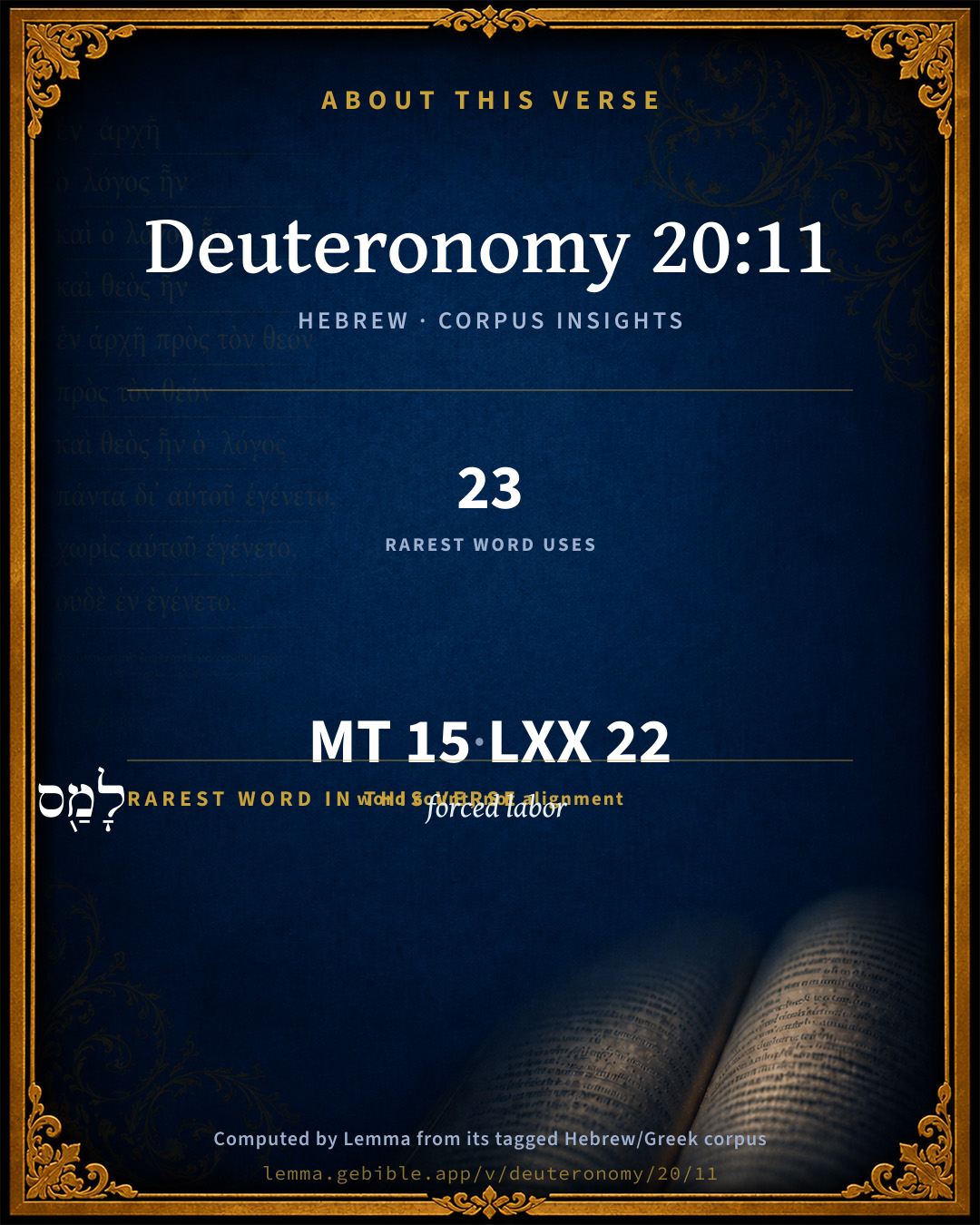
These counts appear in no published source. They are computed here, from the morphology-tagged text and Lemma’s own curated glosses. What Lemma adds →

15
words
10
distinct lemmas
Pentateuch
section

Notable vocabulary

The rarest word here is לָמַ֖ס forced labor H4522 — appearing just 23 times in the whole Hebrew Bible.

Shared distinctive vocabulary

לָמַ֖ס forced labor H4522 occurs in 22 verses of the Hebrew Bible. Also found in:

Grammatical profile

  • 7 verbs
  • 4 nouns
  • 3 prepositions
  • 1 conjunction

Verb forms

  • וְהָיָה֙ Qal · Sequential Perfect
  • תַּֽעַנְךָ֔ Qal · Imperfect
  • וּפָתְחָ֖ה Qal · Sequential Perfect
  • וְהָיָ֞ה Qal · Sequential Perfect
  • הַנִּמְצָא Niphal · Participle Active
  • יִהְי֥וּ Qal · Imperfect
  • וַעֲבָדֽוּךָ Qal · Sequential Perfect

Repetition

A word recurs within this verse — often emphatic in Hebrew:

  • וְהָיָה֙ to be H1961 ×3

Hebrew & Septuagint length

In English translation the verse runs 35 words from the Hebrew and 29 from the Septuagint (LXX English) — closely comparable.

A rough comparison of the two English renderings, which tokenize alike — not a word-level alignment.

Word counts can differ between the Hebrew and the Greek without any difference in meaning — e.g. the Hebrew direct-object marker אֵת has no separate Greek word, and Greek often adds the article ὁ.

In the original languages it is 15 Hebrew tokens and 22 Greek tokens — but the two are counted differently (Hebrew bundles its prefixes and suffixes into one token; the Greek is in lemma form), so that isn’t a like-for-like length.

Cross-references

10

Topical passages linked to Deuteronomy 20:11 in the Treasury of Scripture Knowledge — connected by theme and wording, ordered by reader-vote popularity; previews shown in the World English Bible.

  • Leviticus 25:42–46 For they are my servants, whom I brought forth out of the land of Egypt. They shall not be sold as slaves.
  • Joshua 9:22–23 Joshua called for them, and he spoke to them, saying, Why have you deceived us, saying, We are very far from you; when you dwell among us?
  • Joshua 9:27 That day Joshua made those wood cutters and drawers of water for the congregation, and for the altar of Yahweh, to this day, in the place which he should choose.
  • Joshua 11:19–20 There was not a city that made peace with the children of Israel, save the Hivites the inhabitants of Gibeon: they took all in battle.
  • Joshua 16:10 They didn't drive out the Canaanites who lived in Gezer: but the Canaanites dwell in the midst of Ephraim to this day, and are become servants to do forced labor.
  • Judges 1:28 It happened, when Israel had grown strong, that they put the Canaanites to forced labor, and did not utterly drive them out.
  • Judges 1:30–35 Zebulun didn't drive out the inhabitants of Kitron, nor the inhabitants of Nahalol; but the Canaanites lived among them, and became subject to forced labor.
  • 1 Kings 9:21–22 their children who were left after them in the land, whom the children of Israel were not able utterly to destroy, of them did Solomon raise a levy of bondservants to this day.
  • Psalms 120:7 I am for peace, But when I speak, they are for war.
  • Luke 19:14 But his citizens hated him, and sent an envoy after him, saying, 'We don't want this man to reign over us.'

Cross-references courtesy of OpenBible.info (CC BY 4.0).

Hebrew and Greek witnesses Masoretic Hebrew ↔ Greek Septuagint

The same verse in the two great witnesses to the Old Testament, shown verse-for-verse.

These are two independent witnesses, not word-aligned to each other, and the Septuagint is shown in lemma (dictionary) form.

Hebrew Deuteronomy 20:11 Masoretic · Westminster Leningrad Codex

וְהָיָה֙ אִם שָׁל֣וֹם תַּֽעַנְךָ֔ וּפָתְחָ֖ה לָ֑ךְ וְהָיָ֞ה כָּל הָעָ֣ם הַנִּמְצָא בָ֗הּ יִהְי֥וּ לְךָ֛ לָמַ֖ס וַעֲבָדֽוּךָ

It shall be, if it make you answer of peace, and open to you, then it shall be, that all the people who are found therein shall become tributary to you, and shall serve you.

World English Bible · Public Domain

Greek LXX Deuteronomy 20:11 Septuagint · lemma form

ἐάν μέν εἰρηνικός ἀποκρίνω σύ καί ἀναοἴγω σύ εἰμί πᾶς ὁ λαός ὁ εὑρίσκω ἐν αὐτός εἰμί σύ φορολόγητος καί ὑπήκοοι σύ

If then they should answer peaceably to you, and open to you, it shall be that all the people found in it shall be tributary and subject to you.

LXX2012 (modern English Septuagint) · Public Domain

Hebrew: Westminster Leningrad Codex (CC BY 4.0). Greek: Septuagint (public domain); English from LXX2012 (modern English Septuagint) (Public Domain). How the Septuagint differs from the Hebrew →

Targum (Aramaic paraphrase)

2

The Targum is the ancient Jewish Aramaic paraphrase of the Hebrew Scriptures — an interpretive translation, not the Hebrew text itself. Onkelos (literal) and Pseudo-Jonathan (expansive) render the Torah, and Jonathan the Prophets. Coverage is partial: where no permissively-licensed English translation exists for a verse, only the Aramaic is shown. This is verse-level text, not a word-by-word alignment to the Hebrew.

  1. Targum Onkelos Torah (Genesis–Deuteronomy)
    וִיהֵי אִם שְׁלַם תַּעֲנִנָךְ וְתִפְתַּח לָךְ וִיהֵי כָּל עַמָא דְיִשְׁתְּכַח בַּהּ יְהוֹן לָךְ מַסְקֵי מִסִין וְיִפְלְחֻנָךְ

    (no public-domain English translation for this verse)

    Targum Onkelos — Aramaic: “Onkelos Genesis” (public domain); “Onkelos Exodus” (public domain); “Onkelos Leviticus” (public domain); “Onkelos Numbers” (public domain); “Onkelos Deuteronomy” (public domain). English: “Sefaria Community Translation” (CC0 1.0 (public-domain dedication)); “J.W. Etheridge. The Targums of Onkelos and Jonathan Ben Uzziel on the Pentateuch. London: Longmans, Green, 1862” (public domain). Text via Sefaria.

  2. Targum Pseudo-Jonathan Torah (Genesis–Deuteronomy)
    וִיהֵי אִין מִלִּין דִּשְׁלָם תְּתִיב לְכוֹן וְתִפְתַּח לְכוֹן פּוּלְוָותָהּ וִיהֵי כָּל עַמָּא דְּמִשְׁתַּכַּח בָּהּ יְהוֹן לְמִסְקֵי מִיסִין וְיִפְלְחוּנְכוֹן

    and if they answer you with words of peace, and open their gates to you, all the people whom you find therein shall be tributaries, and serve you.

    Targum Pseudo-Jonathan — Aramaic: “Targum Jonathan on Genesis” (public domain); “Targum Jonathan on Exodus” (public domain); “Targum Jonathan on Leviticus” (public domain); “Targum Jonathan on Numbers” (public domain); “Targum Jonathan on Deuteronomy” (public domain). English: “The Targum of Jonathan ben Uzziel, trans. J. W. Etheridge, London, 1862” (public domain). Text via Sefaria.

Commentary

Notes on Deuteronomy 20:11 from classic Christian and Jewish commentators (each source and its license shown beneath its notes). The classic Christian expositions comment on the surrounding passage and are grouped to its opening verse, so a note may address several verses; the Jewish commentaries on the Tanakh (Rashi and others) are per-verse, so they appear only where the commentator wrote on this verse.

Lemma curates 59 commentaries, every one of them public domain or Creative Commons licensed, each selected and text-cleaned for this edition rather than reprinted as found. About our sources →

Trapp's Complete Commentary

John Trapp

Deu 20:11 And it shall be, if it make thee answer of peace, and open unto thee, then it shall be, [that] all the people [that is] found therein shall be tributaries unto thee, and they shall serve thee.

Ver. 11. And open unto thee.] As Tournay in France did to our Henry VIII, with ten thousand pound sterling for the citizens’ redemption; yet was it ever till then counted so invincible, that this sentence was engraven over one of the gates, Iannes ton me a perda ton pucellage, thou hast never lost thy maidenhead. {a}

{a} Speed’s Hist of Engl., 1001.

John Trapp, A Commentary or Exposition upon All the Books of the Old and New Testament (1647–1656) — public domain. Text from a community e-Sword module.

Tyndale Open Study Notes

Tyndale Open Resources

20:11 forced labor: Involuntary service was pressed upon prisoners of war and sometimes on Israelites (1 Kgs 5:13-18; 9:15, 21; 12:18).

Tyndale Open Study Notes — © Tyndale Open Resources, licensed CC BY-SA 4.0. Text via the HelloAO Bible API.

Geneva Bible (1599)

Geneva Bible translators

If it accept peace.

Geneva Bible (1599) marginal notes — public domain. Text via Bolls.life.

The Cambridge Bible for Schools and Colleges

gen. ed. J. J. S. Perowne

11. tributary] Heb. la-mas. Mas means a body of forced labourers, e.g. of Israelites in Egypt, Exo_1:11, or of Solomon’s levies for work in Lebanon and upon his buildings, 1Ki_5:13 (27), Deu_9:15; but frequently of the Canaanite peoples surviving among Israel, J, Jos_16:10; Jos_17:13, Jdg_1:30; Jdg_1:33; Jdg_1:35; while both J and P say that the Gibeonites who were admitted to league with Israel upon their statement that they had come from a distance, were, on the discovery of their fraud, condemned to be hewers of wood and drawers of water. Such forced labour was recognised as the natural fate of the defeated, Isa_31:8.

The Cambridge Bible for Schools and Colleges (gen. ed. J. J. S. Perowne; Cambridge University Press, 1878–1918) — public domain. Text from a community e-Sword module.

John Gill's Exposition

And it shall be, if it make thee answer of peace,.... Comply with the terms of peace offered:

and open unto thee; the gates of the city and its garrisons, and deliver all into their hands:

then it shall be that all the people that is found therein; some having made their escape before the surrender of the city:

shall be tributaries unto thee: pay a yearly tax imposed upon them, as the Moabites sometimes did, and which was paid in lambs and rams with the wool, Kg2 3:4

and they shall serve thee; not as slaves, or be in continual bondage and servitude; but upon occasion be called out to any public service, as joining them against their enemies, rebuilding palaces and cities, or repairing walls of cities, and the like; and in general acknowledge their dominion over them, and their own subjection to them, by paying an annual tribute, or sending gifts unto them; thus the Moabites, Syrians, and Edomites, became the servants of David, Sa2 8:2.

John Gill's Exposition of the Whole Bible (1746–1763) — public domain (CC PDM 1.0). Text via the HelloAO Bible API.

Haydock's Catholic Bible Commentary

Tribute. This was usually imposed by the victor, to defray the expenses of the war, and to prevent its breaking out again. The kings of Moab had to pay 100,000 rams, and as many sheep, to the kings of Juda, 4 Kings iii. 4. Hiram gave 120 talents of gold to Solomon, by way of tribute, 3 Kings ix. 15. Josue and Solomon condemned some of the Chanaanites to manual labour, 2 Paralipomenon viii. 8.

George Leo Haydock (1774–1849), Haydock's Catholic Family Bible and Commentary, 1859 edition — public domain. Excludes Psalms (Douay-Rheims chapter numbering differs from Protestant) and Deuterocanonical books (Catholic canon only).

Matthew Poole's English Annotations

By their purses, and by their labours too, as appears from 1Ki 9:15; 2Ch 8:7,8

Matthew Poole's English Annotations on the Holy Bible (1683–1685) — public domain. Text from a community e-Sword/MySword module.

Whedon's Commentary on the Bible

Daniel D. Whedon

11. If… answer of peace,… tributaries — If the city opened its gates and peacefully surrendered, all the inhabitants were to be spared, but they were to be tributaries of the Israelites.

Daniel D. Whedon (gen. ed.), Commentary on the Old and New Testaments (1874–1909) — public domain. Text from a community e-Sword module.

The Pulpit Commentary

Shall be tributaries unto thee, and they shall serve thee; literally, shall be to thee for tribute and service. The word rendered by "tribute" ( denotes properly tribute service, service rendered as a tribute, whether for a season or in perpetuity. (cf. Gen_49:15; Jud 1:30, 33, 35; 1Ki_5:13 1Ki_9:21; Isa_31:8 Authorized Version, "discomfited

The Pulpit Commentary (1880–1919), ed. H.D.M. Spence-Jones & Joseph S. Exell — public domain. Text from a community e-Sword module.

Rashi

Rabbi Shlomo Yitzchaki (Rashi)

כל העם הנמצא בה ALL THE PEOPLE THAT IS FOUND THEREIN [SHALL BE TRIBUTARIES] — all: even if you find in it persons belonging to the seven nations which you have been commanded to exterminate, you are allowed to keep them alive (Sifrei Devarim 200:2).

למס ועבדוך [ALL THE PEOPLE … SHALL BE] TRIBUTARIES [UNTO THEE], AND THEY SHALL SERVE THEE — You must not accept their surrender until they take upon themselves both the payment of tribute and servitude (one alone is not sufficient) (Sifrei Devarim 200:3).

Rashi on the Tanakh — English translations: “The Judaica Press complete Tanach with Rashi, translated by A. J. Rosenberg” (CC BY 4.0); “Pentateuch with Rashi's commentary by M. Rosenbaum and A.M. Silbermann, 1929-1934” (public domain); “The Metsudah Tanach series, Lakewood, N.J” (CC BY 4.0); and “The Book of Joshua, Metsudah Publications, 1997” (CC BY 4.0). Text via Sefaria.

Ramban (Nachmanides)

Rabbi Moshe ben Nachman (Ramban / Nachmanides)

TRIBUTARIES UNTO THEE, AND THEY SHALL SERVE THEE. “[Their surrender is not to be accepted] until they accept tribute and servitude upon themselves.” This is the language of Rabbeinu Shlomo [Rashi]. And in the Sifre the Rabbis have said: 200. “If they say ‘We accept tribute upon ourselves but not servitude’, or ‘servitude but not tribute,’ they are not to heed them until they accept both upon themselves.”Now the purport of the tribute was that the king of Israel or the Sanhedrin could impose a levy upon them, [drafting men] to build the king’s palace and his store-cities, also the House of G-d. The servitude was that any Israelite could take one of them to be the hewer of his wood and the drawer of his water and pay him proper wages. This is the sense of what is written in connection with Solomon a levy of bondservants, meaning that they took upon themselves [both] tribute and servitude as is the law of the Torah. [However, the law of the Torah is] not as is written, And it came to pass, when Israel was waxen strong, that they put the Canaanites to tribute, but did not drive them out entirely, for “servitude” is not mentioned there. Instead it was like a king who bribes a more powerful king not to wage war against him.Know that the matter of the Gibeonites came to pass because they did not know the law of Israel with respect to proclaiming peace, and therefore they put forward their plan, before Joshua’s proclamation arrived. Hence they said, and we were sore afraid for our lives., Verse 24. Or it may be that, at first they did not wish to hearken to Joshua’s offer [thus laying themselves open to invasion], and in the end they became frightened and disguised themselves as strangers, as it is written, And when the inhabitants of Gibeon heard what Joshua had done unto Jericho and to Ai, they also did work wilily., Verses 3-4. Their trickery helped them yet in that they did not become their servants, but their confederates.The Israelites were irritated at them and would have killed them had it not been for the oath of the princes, Verse 19. because the Gibeonites should have taken upon themselves tribute and servitude, as we have said, while they [the princes] made a covenant with them to be equal and to be their confederates helping each other in their wars. They made peace with them [the Gibeonites] because they had thought that they were [from] very distant cities, from the peoples against whom they [the Israelites] had no intention of advancing. Therefore, Joshua cursed the Gibeonites, saying, Now therefore ye are cursed, Verse 23. meaning that they are of the accursed peoples whom the Eternal had cursed, and he did to them according to the law appropriate to be applied to them, to fulfill that which is written concerning them, tributaries unto thee, and they shall serve thee, that they be hewers of wood and drawers of water for the congregation, and for the altar of the Eternal, Verse 27. this being the tribute and the servitude, as we have explained.And some scholars say that the meaning of the verse, And it shall be, if it make thee answer of peace etc. is [that it applies only to an answer given] at the time of the proclamation [of peace]. But if at first they refused to make peace, we no longer accept them. The Gibeonites refused at first to hearken to Joshua’s proclamation and the law therefore did not require the Israelites to accept them. And Harav Rabbi Moshe [ben Maimon] wrote that “they were irritated at them because [they tricked the Israelites into] making a covenant with them, when it is said, Thou shalt make no covenant with them, nor with their gods.” But this does not appear to be correct, for the Gibeonites had surely taken upon themselves not to worship idols, as they said, thy servants are come because of the name of the Eternal thy G-d. Therefore, Joshua did not have to tell them afterwards that they must take upon themselves to worship G-d. And if so, it was permissible for the Israelites to make that covenant with them, just as they were permitted to dwell in the Land, for both, [the making of a covenant, and the dwelling in the Land] were prohibited only before repentance [from the sin of idolatry], as He said, lest they make thee sin against Me, and so also He said, Thou shalt make no covenant with them, or with their gods. But the explanation of the Gibeonite affair is as we have said.

Ramban (Nachmanides) on the Tanakh — English translation: “Commentary on the Torah by Ramban (Nachmanides). Translated and annotated by Charles B. Chavel. New York, Shilo Pub. House, 1971-1976” (CC BY 4.0). Text via Sefaria.

Lesson kit

Teaching starters — assembled from the data on this page, not authored interpretation. Every prompt links to the verse data it draws on. Edit before teaching.

Deuteronomy, in the Pentateuch, opens this verse with 15 words (10 distinct Hebrew lemmas). Its most distinctive word is maç (“forced labor”). A historical commentator’s framing appears above. Read the whole chapter for the surrounding context.

Discussion questions

  1. The word maç carries the sense “forced labor.” How does it shape the verse?
  2. How does Genesis 49:15, which shares the word «forced labor», read alongside this verse?
  3. What does the repetition of “to be” (3× in this one verse) do in this verse?
  4. These translations render this verse differently. What is at stake in choosing one wording over another?
  5. «וְהָיָה֙» is a Qal Sequential Perfect verb. How does that grammatical form shape the action described?
  6. Compare how Trapp's Complete Commentary and Tyndale Open Study Notes read this verse. Where do they agree or differ?

Things to notice

Reading settings

Reading text

Shown beneath each verse's original-language words.

Old Testament
Old Testament edition

Read the OT as the Masoretic Hebrew (MT) or the Greek Septuagint (LXX).

English shown for the Greek Septuagint (in the Hebrew ↔ Greek comparison).

Comparing translations? Open the Compare panel on any verse page to stack up to four side by side.