
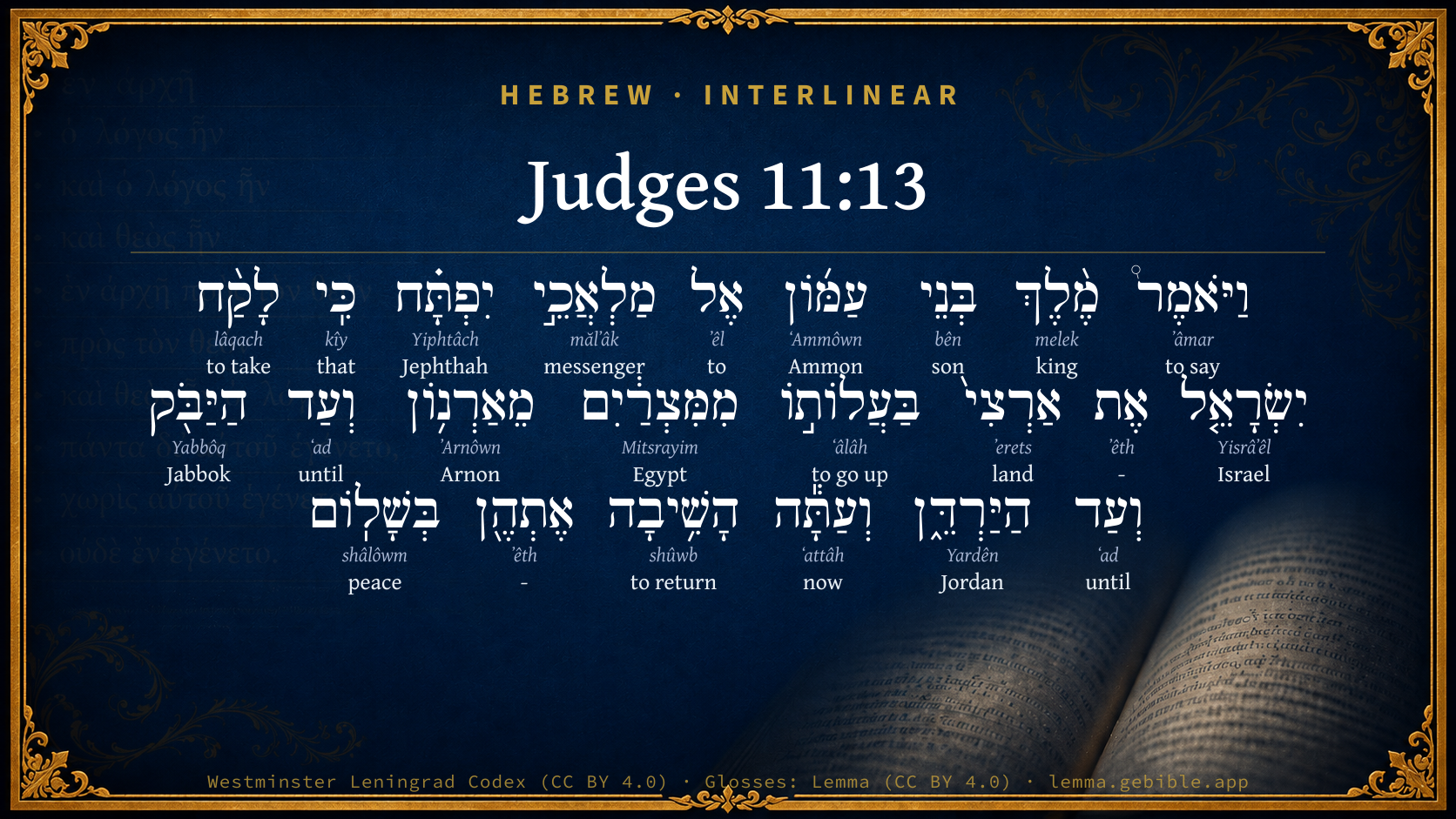
Judges 11:13

Hebrew (Westminster Leningrad Codex) Judges 11:13 appears in the Hebrew Old Testament. The text above is from the Westminster Leningrad Codex. Each word links to its Strong’s number, a concise gloss, and parsing drawn from the Open Scriptures Hebrew Bible morphology. Click any word for its full Brown-Driver-Briggs (BDB) entry.
Download image
Cite this verse

Judges 11:13 (World English Bible). Public Domain. Lemma interlinear Bible study tool, https://lemma.gebible.app/v/judges/11/13.

Show BibTeX & RIS
BibTeX
RIS
English Translation
The king of the children of Ammon answered to the messengers of Jephthah, Because Israel took away my land, when he came up out of Egypt, from the Arnon even to the Jabbok, and to the Jordan: now therefore restore those [lands] again peaceably.
World English Bible · Public Domain
Download a study sheet

One document with this verse’s original text, its word-by-word gloss line, the meaning frame, cross-references with their text, attributed commentary, and full source and license credits — printable, and it pastes into notes with its structure intact.

This verse Autodidact and up

Study sheet (.html) Plain text (.txt)

A passage Seminary Student

Up to 50 verses in one chapter. A passage sheet keeps up to 6 commentary sources and 12 cross-references per verse, in the order this page ranks them, and says so on the sheet whenever that leaves anything out. Ask for a single verse and you get the Autodidact verse sheet above.

Everything on this page stays free to read, with no account — the sheet is a download of what is already on screen, not access to it.

Want to remove ads? Support Godless Engineer
Compare translations 3

The same verse in 3 English versions, stacked beneath the original-language interlinear above. Click any original word for its lexicon entry.

Each is an independent rendering of the whole verse — the interlinear is not word-aligned to these translations.

Highlighted words mark where these versions differ — a whole-verse word diff, not a word-by-word alignment.

  • World English Bible Public Domain
    The king of the children of Ammon answered to the messengers of Jephthah, Because Israel took away my land, when he came up out of Egypt, from the Arnon even to the Jabbok, and to the Jordan: now therefore restore those [lands] again peaceably.
  • King James Version Public Domain
    And the king of the children of Ammon answered unto the messengers of Jephthah, Because Israel took away my land, when they came up out of Egypt, from Arnon even unto Jabbok, and unto Jordan: now therefore restore those lands again peaceably.
  • unfoldingWord Literal Text CC BY-SA 4.0
    And the king of the sons of Ammon said to the messengers of Jephthah, “Because Israel took my land in his coming up from Egypt, from the Arnon and to the Jabbok and to the Jordan. So now return them in peace.”

unfoldingWord Literal Text — © unfoldingWord, licensed CC BY-SA 4.0. Word-aligned USFM3 via Door43 (git.door43.org/unfoldingWord/en_ult).

Versions to compare (up to 4)

3 of 4 selected

Show all 18 translations

Every available English version of this verse, each an independent rendering of the whole verse.

  • World English Bible Public Domain
    The king of the children of Ammon answered to the messengers of Jephthah, Because Israel took away my land, when he came up out of Egypt, from the Arnon even to the Jabbok, and to the Jordan: now therefore restore those [lands] again peaceably.
  • Berean Standard Bible Public Domain
    The king of the Ammonites answered Jephthah’s messengers, “When Israel came up out of Egypt, they seized my land, from the Arnon to the Jabbok and all the way to the Jordan. Now, therefore, restore it peaceably.”
  • Majority Standard Bible Public Domain
    The king of the Ammonites answered Jephthah’s messengers, “When Israel came up out of Egypt, they seized my land, from the Arnon to the Jabbok and all the way to the Jordan. Now, therefore, restore it peaceably.”
  • King James Version Public Domain
    And the king of the children of Ammon answered unto the messengers of Jephthah, Because Israel took away my land, when they came up out of Egypt, from Arnon even unto Jabbok, and unto Jordan: now therefore restore those lands again peaceably.
  • American Standard Version (1901) Public Domain
    And the king of the children of Ammon answered unto the messengers of Jephthah, Because Israel took away my land, when he came up out of Egypt, from the Arnon even unto the Jabbok, and unto the Jordan: now therefore restore those `lands' again peaceably.
  • Revised Version (1885) Public Domain
    And the king of the children of Ammon answered unto the messengers of Jephthah, Because Israel took away my land, when he came up out of Egypt, from Arnon even unto Jabbok, and unto Jordan: now therefore restore those lands again peaceably.
  • Geneva Bible (1599) Public Domain
    And the King of the children of Ammon answered vnto the messengers of Iphtah, Because Israel tooke my lande, when they came vp from Egypt, from Arnon vnto Iabbok, and vnto Iorden: now therefore restore those lands quietly.
  • Douay-Rheims (1899) Public Domain
    And he answered them: I Because Israel took away my land when he came up out of Egypt, from the confines of the Arnon unto the Jaboc and the Jordan: now therefore restore the same peaceably to me.
  • Young's Literal Translation Public Domain
    And the king of the Bene-Ammon saith unto the messengers of Jephthah, `Because Israel took my land in his coming up out of Egypt, from Arnon, and unto the Jabbok, and unto the Jordan; and now, restore them in peace.'
  • Literal Standard Version CC BY-SA 4.0
    And the king of the sons of Ammon says to the messengers of Jephthah, “Because Israel took my land in his coming up out of Egypt, from Arnon, and to the Jabbok, and to the Jordan; and now, restore them in peace.”
  • Unlocked Literal Bible CC BY-SA 4.0
    The king of the people of Ammon answered to the messengers of Jephthah, “Because when Israel came up out of Egypt, they seized my land from the Arnon to the Jabbok, over to the Jordan. Now give back those lands in peace.”
  • unfoldingWord Literal Text CC BY-SA 4.0
    And the king of the sons of Ammon said to the messengers of Jephthah, “Because Israel took my land in his coming up from Egypt, from the Arnon and to the Jabbok and to the Jordan. So now return them in peace.”
  • Darby Bible Public Domain
    And the king of the Ammonites answered the messengers of Jephthah, "Because Israel on coming from Egypt took away my land, from the Arnon to the Jabbok and to the Jordan; now therefore restore it peaceably."
  • World Messianic Bible Public Domain
    The king of the children of Ammon answered the messengers of Jephthah, “Because Israel took away my land when he came up out of Egypt, from the Arnon even to the Jabbok, and to the Jordan. Now therefore restore that territory again peaceably.”
  • Webster's Bible Public Domain
    And the king of the children of Ammon answered to the messengers of Jephthah, Because Israel took away my land, when they came out of Egypt, from Arnon even to Jabbok, and to Jordan: now therefore restore those lands again peaceably.
  • Free Bible Version CC BY-SA 4.0
    The king of the Ammonites replied to Jephthah's messengers, “Israel seized my land when they came from Egypt. It extended from the Arnon River to the Jabbok River, and across to the Jordan River. So give it back and there'll be no fighting.”
  • Bible in Basic English Public Domain
    And the king of the children of Ammon said to the men sent by Jephthah, Because Israel, when he came up out of Egypt, took away my land, from the Arnon as far as the Jabbok and as far as Jordan: so now, give me back those lands quietly.
  • JPS Tanakh (1917) Public Domain
    And the king of the children of Ammon answered unto the messengers of Jephthah: 'Because Israel took away my land, when he came up out of Egypt, from the Arnon even unto the Jabbok, and unto the Jordan; now therefore restore those cities peaceably.'

Literal Standard Version (2020), Covenant Press — licensed CC BY-SA 4.0. Text via the HelloAO Bible API (eBible.org). Unlocked Literal Bible (unfoldingWord) — licensed CC BY-SA 4.0. Text via the HelloAO Bible API (eBible.org). unfoldingWord Literal Text — © unfoldingWord, licensed CC BY-SA 4.0. Word-aligned USFM3 via Door43 (git.door43.org/unfoldingWord/en_ult). Free Bible Version, Dr. Jonathan Gallagher — licensed CC BY-SA 4.0. Text via the HelloAO Bible API (eBible.org).

Word by word

More ways to search: Search by grammar → Find every occurrence → Compare this word →

Practice this passage: Drill this verse → Learn its vocabulary →

הַיַּבֹּ֖ק
Yabbôq
H2999
“the · Jabbok”
Particle, Definite Article + Noun, Proper
Part of Speech
Particle + Noun
Type
Proper
Full BDB Definition

Origin: probably from H1238

TWOT: None

Jabbok = "emptying" - a stream which intersects the mountain range of Gilead, and falls into the Jordan on the east about midway between the Sea of Galilee and the Dead Sea
  1. וַיֹּאמֶר֩ ʼâmar H559 “and · to say” Conjunction + Verb, Qal, Sequential Imperfect, 3rd Person, Masculine, Singular
  2. מֶ֨לֶךְ melek H4428 “king of” Noun, Common, Masculine, Singular, Construct
  3. בְּנֵי bên H1121 “sons of” Noun, Common, Masculine, Plural, Construct
  4. עַמּ֜וֹן ʻAmmôwn H5983 “Ammon” Noun, Proper
  5. אֶל ʼêl H413 “to” Preposition
  6. מַלְאֲכֵ֣י mălʼâk H4397 “messengers of” Noun, Common, Masculine, Plural, Construct
  7. יִפְתָּ֗ח Yiphtâch H3316 “Jephthah” Noun, Proper
  8. כִּֽי kîy H3588 “that” Conjunction
  9. לָקַ֨ח lâqach H3947 “to take” Verb, Qal, Perfect, 3rd Person, Masculine, Singular
  10. יִשְׂרָאֵ֤ל Yisrâʼêl H3478 “Israel” Noun, Proper
  11. אֶת ʼêth H853 “-” Particle, Direct Object
  12. אַרְצִי֙ ʼerets H776 “land · my” Noun, Common, Both, Singular, Construct + Suffix, Personal, 1st Person, Common, Singular
  13. בַּעֲלוֹת֣וֹ ʻâlâh H5927 “in/at · to go up · him” Preposition + Verb, Qal, Infinitive Construct + Suffix, Personal, 3rd Person, Masculine, Singular
  14. מִמִּצְרַ֔יִם Mitsrayim H4714 “from · Egypt” Preposition + Noun, Proper
  15. מֵאַרְנ֥וֹן ʼArnôwn H769 “from · Arnon” Preposition + Noun, Proper
  16. וְעַד ʻad H5704 “and · until” Conjunction + Preposition
  17. וְעַד ʻad H5704 “and · until” Conjunction + Preposition
  18. הַיַּרְדֵּ֑ן Yardên H3383 “the · Jordan” Particle, Definite Article + Noun, Proper
  19. וְעַתָּ֕ה ʻattâh H6258 “and · now” Conjunction + Adverb
  20. הָשִׁ֥יבָה shûwb H7725 “return” Verb, Hiphil, Imperative, 2nd Person, Masculine, Singular + Suffix, h
  21. אֶתְהֶ֖ן ʼêth H853 “- · them” Particle, Direct Object + Suffix, Personal, 3rd Person, Feminine, Plural
  22. בְּשָׁלֽוֹם shâlôwm H7965 “in/at · peace” Preposition + Noun, Common, Masculine, Singular, Absolute

About this verse

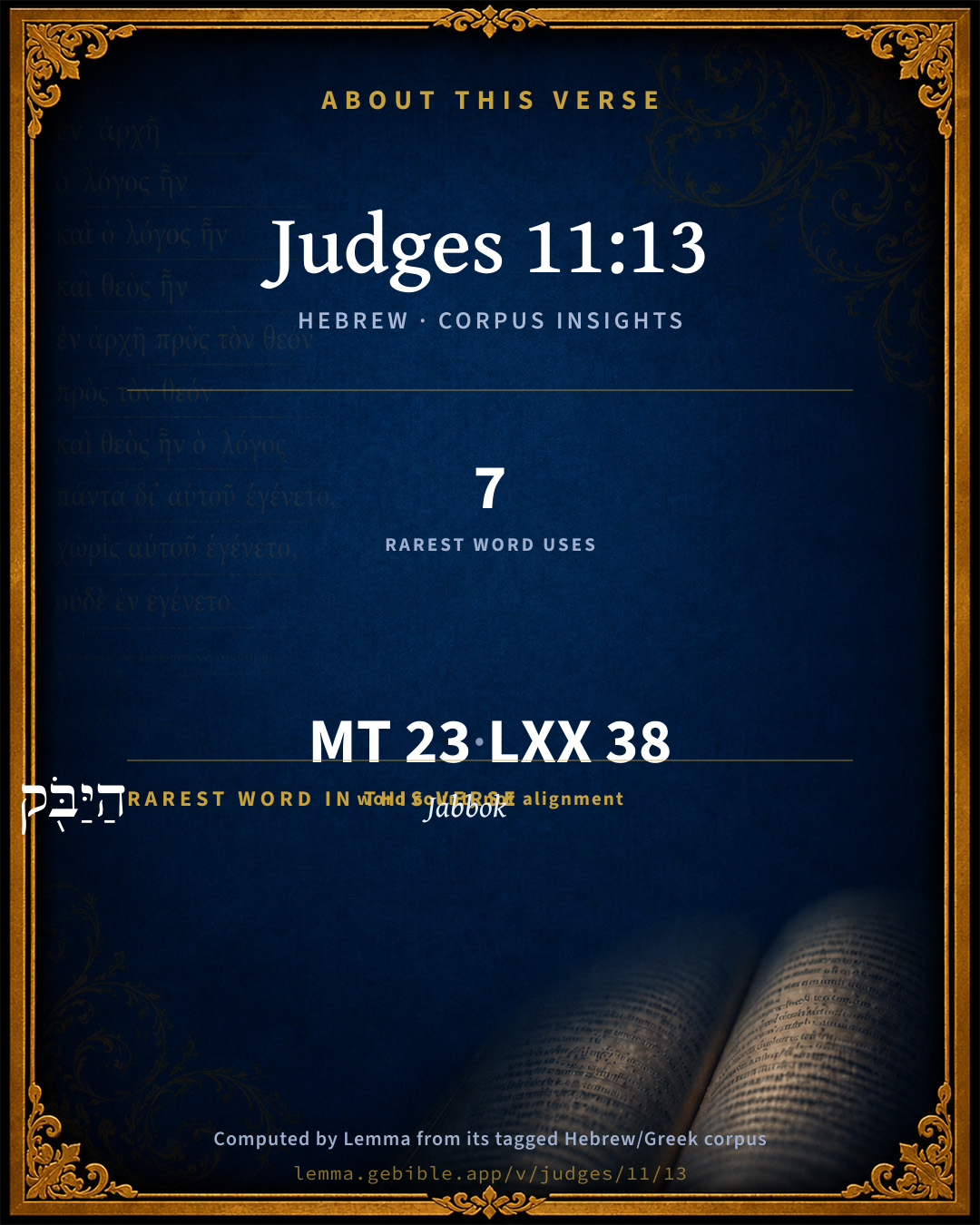
These counts appear in no published source. They are computed here, from the morphology-tagged text and Lemma’s own curated glosses. What Lemma adds →

23
words
21
distinct lemmas
Historical
section

Notable vocabulary

The rarest word here is הַיַּבֹּ֖ק Jabbok H2999 — appearing just 7 times in the whole Hebrew Bible.

Shared distinctive vocabulary

הַיַּבֹּ֖ק Jabbok H2999 occurs in 7 verses of the Hebrew Bible. Also found in:

Grammatical profile

  • 4 verbs
  • 12 nouns
  • 3 prepositions
  • 1 conjunction
  • 1 adverb
  • 2 particles

Verb forms

  • וַיֹּאמֶר֩ Qal · Sequential Imperfect
  • לָקַ֨ח Qal · Perfect
  • בַּעֲלוֹת֣וֹ Qal · Infinitive Construct
  • הָשִׁ֥יבָה Hiphil · Imperative

Repetition

A word recurs within this verse — often emphatic in Hebrew:

  • וְעַד until H5704 ×2

Hebrew & Septuagint length

In English translation the verse runs 44 words from the Hebrew and 42 from the Septuagint (LXX English) — closely comparable.

A rough comparison of the two English renderings, which tokenize alike — not a word-level alignment.

Word counts can differ between the Hebrew and the Greek without any difference in meaning — e.g. the Hebrew direct-object marker אֵת has no separate Greek word, and Greek often adds the article ὁ.

In the original languages it is 23 Hebrew tokens and 38 Greek tokens — but the two are counted differently (Hebrew bundles its prefixes and suffixes into one token; the Greek is in lemma form), so that isn’t a like-for-like length.

Cross-references

6

Topical passages linked to Judges 11:13 in the Treasury of Scripture Knowledge — connected by theme and wording, ordered by reader-vote popularity; previews shown in the World English Bible.

  • Genesis 32:22 He rose up that night, and took his two wives, and his two handmaids, and his eleven sons, and passed over the ford of the Jabbok.
  • Numbers 21:24–26 Israel struck him with the edge of the sword, and possessed his land from the Arnon to the Jabbok, even to the children of Ammon; for the border of the children of Ammon was strong.
  • Deuteronomy 2:37 only to the land of the children of Ammon you didn't come near; all the side of the river Jabbok, and the cities of the hill-country, and wherever Yahweh our God forbade us.
  • Deuteronomy 3:16 To the Reubenites and to the Gadites I gave from Gilead even to the valley of the Arnon, the middle of the valley, and the border [of it], even to the river Jabbok, which is the border of the children of Ammon;
  • Proverbs 19:5 A false witness shall not be unpunished. He who pours out lies shall not go free.
  • Proverbs 19:9 A false witness shall not be unpunished. He who utters lies shall perish.

Cross-references courtesy of OpenBible.info (CC BY 4.0).

Hebrew and Greek witnesses Masoretic Hebrew ↔ Greek Septuagint

The same verse in the two great witnesses to the Old Testament, shown verse-for-verse.

These are two independent witnesses, not word-aligned to each other, and the Septuagint is shown in lemma (dictionary) form.

Hebrew Judges 11:13 Masoretic · Westminster Leningrad Codex

וַיֹּאמֶר֩ מֶ֨לֶךְ בְּנֵי עַמּ֜וֹן אֶל מַלְאֲכֵ֣י יִפְתָּ֗ח כִּֽי לָקַ֨ח יִשְׂרָאֵ֤ל אֶת אַרְצִי֙ בַּעֲלוֹת֣וֹ מִמִּצְרַ֔יִם מֵאַרְנ֥וֹן וְעַד הַיַּבֹּ֖ק וְעַד הַיַּרְדֵּ֑ן וְעַתָּ֕ה הָשִׁ֥יבָה אֶתְהֶ֖ן בְּשָׁלֽוֹם

The king of the children of Ammon answered to the messengers of Jephthah, Because Israel took away my land, when he came up out of Egypt, from the Arnon even to the Jabbok, and to the Jordan: now therefore restore those [lands] again peaceably.

World English Bible · Public Domain

Greek LXX Judges 11:13 Septuagint · lemma form

καί εἶπον βασιλεύς υἱός αμμων πρός ὁ ἄγγελος ιεφθαε ὅτι λαμβάνω ἰσραήλ ὁ γῆ ἐγώ ἐν ὁ ἀναβαίνω αὐτός ἐκ αἴγυπτος ἀπό αρνων καί ἕως ιαβοκ καί ἕως ὁ ἰορδάνης καί νῦν ἐπιστρέφω αὐτός ἐν εἰρήνη καί πορεύομαι

And the king of the children of Ammon said to the messengers of Jephthae, Because Israel took my land when he went up out of Egypt, from Arnon to Jaboc, and to Jordan: now then return them peaceably and I will depart.

LXX2012 (modern English Septuagint) · Public Domain

Hebrew: Westminster Leningrad Codex (CC BY 4.0). Greek: Septuagint (public domain); English from LXX2012 (modern English Septuagint) (Public Domain). How the Septuagint differs from the Hebrew →

Targum (Aramaic paraphrase)

1

The Targum is the ancient Jewish Aramaic paraphrase of the Hebrew Scriptures — an interpretive translation, not the Hebrew text itself. Onkelos (literal) and Pseudo-Jonathan (expansive) render the Torah, and Jonathan the Prophets. Coverage is partial: where no permissively-licensed English translation exists for a verse, only the Aramaic is shown. This is verse-level text, not a word-by-word alignment to the Hebrew.

  1. Targum Jonathan Prophets (Joshua–Malachi)
    וַאֲמַר מַלְכָּא דִבְנֵי עַמוֹן לְאִזְגַדֵי יִפְתָּח אֲרֵי נְסִיב יִשְׂרָאֵל יַת אַרְעִי בְּמִסְקֵיהּ מִמִצְרַיִם מֵאַרְנוֹנָא וְעַד יוּבְקָא וְעַד יַרְדְנָא וּכְעַן אֲתֵיב יַתְהֶן בִּשְׁלָם:

    (no public-domain English translation for this verse)

    Targum Jonathan — Aramaic: “Mikraot Gedolot” (public domain). English: “Sefaria Community Translation” (CC0 1.0 (public-domain dedication)); “London "Chaldee Paraphrase," 1871” (public domain). Text via Sefaria.

Commentary

Notes on Judges 11:13 from classic Christian and Jewish commentators (each source and its license shown beneath its notes). The classic Christian expositions comment on the surrounding passage and are grouped to its opening verse, so a note may address several verses; the Jewish commentaries on the Tanakh (Rashi and others) are per-verse, so they appear only where the commentator wrote on this verse.

Lemma curates 59 commentaries, every one of them public domain or Creative Commons licensed, each selected and text-cleaned for this edition rather than reprinted as found. About our sources →

Trapp's Complete Commentary

John Trapp

Jdg 11:13 And the king of the children of Ammon answered unto the messengers of Jephthah, Because Israel took away my land, when they came up out of Egypt, from Arnon even unto Jabbok, and unto Jordan: now therefore restore those [lands] again peaceably.

Ver. 13. Because Israel took away my land.] This was a lie; but that is a small matter with many, where anything is to be gotten. Hegesippus saith of Pilate, that he was Vir nequam et parvi faciens mendacium, a naughty man, and one that made no bones of a lie. All this country that the king of Ammon layeth claim to, was first the Moabites’, and from them won by Sihon king of Amorites, and from him by the Israelites.

John Trapp, A Commentary or Exposition upon All the Books of the Old and New Testament (1647–1656) — public domain. Text from a community e-Sword module.

Joseph Benson's Commentary

Jdg 11:13. Because Israel took away my land — The land was not theirs when the Israelites conquered it, but the land of Sihon, king of the Amorites. For as to the country of the Ammonites, God expressly charged the children of Israel not to meddle with it, Deu 2:19. It is true, this land, which they now claimed, had formerly belonged to the Moabites, but Sihon had made a conquest of it, and driven them out, as we read Num 21:26.

Joseph Benson's Commentary on the Old and New Testaments (1811–1818) — public domain. Text from a community e-Sword module.

Geneva Bible (1599)

Geneva Bible translators

Hebrew, in peace.

Geneva Bible (1599) marginal notes — public domain. Text via Bolls.life.

Jamieson, Fausset & Brown

Robert Jamieson, A. R. Fausset & David Brown

the king of Ammon . . ., Because Israel took away my land--(See on Deu 2:19). The subject of quarrel was a claim of right advanced by the Ammonite monarch to the lands which the Israelites were occupying. Jephthah's reply was clear, decisive, and unanswerable;--first, those lands were not in the possession of the Ammonites when his countrymen got them, and that they had been acquired by right of conquest from the Amorites [Jdg 11:21]; secondly, the Israelites had now, by a lapse of three hundred years of undisputed possession, established a prescriptive right to the occupation [Jdg 11:22-23]; and thirdly, having received a grant of them from the Lord, his people were entitled to maintain their right on the same principle that guided the Ammonites in receiving, from their god Chemosh, the territory they now occupied [Jdg 11:24]. This diplomatic statement, so admirable for the clearness and force of its arguments, concluded with a solemn appeal to God to maintain, by the issue of events, the cause of right and justice [Jdg 11:27].

Jamieson, Fausset & Brown — Commentary Critical and Explanatory on the Whole Bible (1871) — public domain (CC PDM 1.0). Text via the HelloAO Bible API.

Adam Clarke's Commentary

Verse 13. From Arnon even unto Jabbok, and unto Jordan] That is, all the land that had formerly belonged to the Amorites, and to the Moabites, who it seems were confederates on this occasion.

Adam Clarke's Commentary on the Bible (1810–1826) — public domain. Text from a community e-Sword/MySword module.

Ellicott's Commentary for English Readers

(13) Because Israel took away my land.—This was a very plausible plea, but was not in accordance with facts. The Israelites had been distinctly forbidden to war against the Moabites and Ammonites (Deu_2:9; Deu_2:19); but when Sibon, king of the Amorites, had refused them permission to pass peaceably through his land, and had even come out to battle against them, they had defeated him and seized his territory. It was quite true that a large district in this territory had originally belonged to Moab and Ammon, and had been wrested from them by Sihon (Num_21:21-30; Jos_12:2; Jos_12:5); but that was a question with which the Israelites had nothing to do, and it was absurd to expect that they would shed their blood to win settlements for the sole purpose of restoring them to nations which regarded them with the deadliest enmity.

From Arnon even unto Jabbok.—The space occupied by Gad and Reuben. The Arnon (“noisy” ) is now the Wady Modjeb. It was the southern boundary of Reuben, and its deep rocky ravine separated that tribe from Moab. The Jabbok (“pouring out”) was originally the “border of the children of Ammon” (Deu_3:16; Num_21:24). It is nearly midway between the Dead Sea and the Sea of Galilee, and is now called the Wady Zurka.

A Bible Commentary for English Readers, edited by Charles John Ellicott (1878–1897) — public domain. Text from a community e-Sword module.

John Gill's Exposition

And the king of the children of Ammon answered unto the messengers of Jephthah,.... Who this king of Ammon was is not said, however he returned an answer to Jephthah's messengers, which they brought to him, and it was to this purpose; that the reason of his invading the land, and bringing war into it, was:

because Israel took away my land when they came out of Egypt; not as soon as they came out of Egypt, for it was thirty nine years afterwards, and upwards, even a little before they entered into the land of Canaan; and the land they took was not theirs, but in the possession of Sihon and Og, kings of the Amorites; though indeed, before their conquest of it, it had been in the hands of the Moabites and Ammonites, and who being confederates, or subjects of the same king, is here claimed by the king of the children of Ammon:

from Arnon even unto Jabbok, and unto Jordan; the river Arnon was the border between Moab and the Amorites, and the river Jabbok was the border of the children of Ammon, Num 21:13, the one was to the south of the country claimed, and the other to the north and to the west, which was Jordan, and the wilderness to the east, Jdg 11:22,

now therefore restore these lands again peaceably; this is demanded or proposed as terms or conditions of peace, and what would prevent a war, and nothing short of this would do it.

John Gill's Exposition of the Whole Bible (1746–1763) — public domain (CC PDM 1.0). Text via the HelloAO Bible API.

Albert Barnes' Notes on the Bible

From Arnon even unto Jabbok ... - The land bounded by the Arnon on the south, by the Jabbok on the north, by the Jordan on the west, and by the wilderness on the east was, of old, the kingdom of Sihon, but then the territory of Reuben and Gad.

Albert Barnes' Notes on the Bible (1834–1885) — public domain. Text from a community e-Sword/MySword module.

Haydock's Catholic Bible Commentary

To me. The king falsely asserts, that all the country between the Arnon and the Jaboc belonged to him when Moses took it. The Ammonites had possession when the Israelites arrived, and it had formerly been occupied by Moab, and not by Ammon, Deuteronomy ii. 19., and 37; (Menochius) unless both might claim different parts. (Calmet)

George Leo Haydock (1774–1849), Haydock's Catholic Family Bible and Commentary, 1859 edition — public domain. Excludes Psalms (Douay-Rheims chapter numbering differs from Protestant) and Deuterocanonical books (Catholic canon only).

Matthew Poole's English Annotations

My land, i.e. this land of Gilead, which was mine, but unjustly taken from me, by Sihon and Og, the kings of the Amorites, and the injury perpetuated by Israel’s detaining it from me. This land, before the conquests of Sihon and Og, belonged partly to the Ammonites, as is affirmed, Jos 13:25; and partly and principally to the Moabites, as appears from Num 21:24,26; Deu 3:11. And indeed Moab and Ammon did for the most part join their interests and their forces, as appears from Scripture story; and as Balak the king of the Moabites acted for the Ammonites, so now the king of Ammon seems to act for the Moabites; either as being now his subjects, or as his confederates; whence it comes to pass that Moab and Ammon are here promiscuously mentioned, as Jdg 11:15,17,18,25; and Chemosh, the known god of the Moabites, Num 21:29; 1Ki 11:33; 2Ki 23:13; Jer 48:13,46, is here called the god of the Ammonites, Jdg 11:24, though, to speak strictly, Moloch or Milcom was their god, 1Ki 11:5,7,33; 2Ki 23:13.

Matthew Poole's English Annotations on the Holy Bible (1683–1685) — public domain. Text from a community e-Sword/MySword module.

Whedon's Commentary on the Bible

Daniel D. Whedon

13. Israel took away my land — This was probably in a certain sense tree, for, according to Jos_13:24-25, Moses gave to the tribe of Gad half the land of the children of Ammon; and though Israel captured the land from Arnon even unto Jabbok, not of Moab nor of Ammon, but of Sihon, king of the Amorites, yet Sihon had previously fought against the king of Moab, and taken all his land out of his hand. See Num_21:24-26. So, though Israel strictly observed the divine order (Deu_2:9; Deu_2:19) not to disturb Moab or Ammon, they took from the Amorites lands which seem to have anciently belonged to those descendants of Lot. Israel was not to blame for conquering these lands of Sihon, and fairly owned them by the right of conquest, yet both Ammonites and Moabites might feel that they were the ancient owners. But having neglected their claim for three hundred years, (Jdg_11:26,) it was idle for them to urge it now.

Daniel D. Whedon (gen. ed.), Commentary on the Old and New Testaments (1874–1909) — public domain. Text from a community e-Sword module.

The Pulpit Commentary

And the king, etc. The Ammonite king stated his ground of quarrel very distinctly. He claimed the land between the Amen and the Jabbok as Ammonitish or Moabitish territory, and demanded its surrender as the only condition of peace. It appears from Jos_13:25 that part of the land of the tribe of Gad, that, namely, "on the western side of the upper Jabbok," had once belonged to the Ammonites, but had been conquered by the Amorites, from whom Israel took it, together with that which had formerly belonged to the Moabites.

The Pulpit Commentary (1880–1919), ed. H.D.M. Spence-Jones & Joseph S. Exell — public domain. Text from a community e-Sword module.

John Wesley's Explanatory Notes

My land - That is, this land of Gilead, which was mine, but unjustly taken from me, by Sihon and Og, the kings of the Ammonites; and the injury perpetuated by Israel's detaining it from me. This land, before the conquests of Sihon and Og, belonged partly to the Ammonites, and partly to the Moabites. And indeed, Moab and Ammon did for the most part join their interests and their forces.

John Wesley, Explanatory Notes Upon the Whole Bible (1754–1765) — public domain. Text via the GEBible commentary corpus.

Lesson kit

Teaching starters — assembled from the data on this page, not authored interpretation. Every prompt links to the verse data it draws on. Edit before teaching.

Judges, in the Historical, opens this verse with 23 words (21 distinct Hebrew lemmas). Its most distinctive word is Yabbôq (“Jabbok”). A historical commentator’s framing appears above. Read the whole chapter for the surrounding context.

Discussion questions

  1. How does “Jabbok” (Yabbôq) shape what this verse is saying?
  2. Genesis 32:22 shares the word «Jabbok» with this verse. How do the two illuminate each other?
  3. “until” occurs 2× in this one verse. What is the effect of the repetition?
  4. These translations render this verse differently; the difference is in the English rendering, not the original. What questions does that raise?
  5. The verb «וַיֹּאמֶר֩» is Qal Sequential Imperfect. How does its form color the action?
  6. Reading how Trapp's Complete Commentary and Joseph Benson's Commentary read this verse, where do the two commentators agree and where do they part?

Things to notice

Reading settings

Reading text

Shown beneath each verse's original-language words.

Old Testament
Old Testament edition

Read the OT as the Masoretic Hebrew (MT) or the Greek Septuagint (LXX).

English shown for the Greek Septuagint (in the Hebrew ↔ Greek comparison).

Comparing translations? Open the Compare panel on any verse page to stack up to four side by side.