
Isaiah 9:7

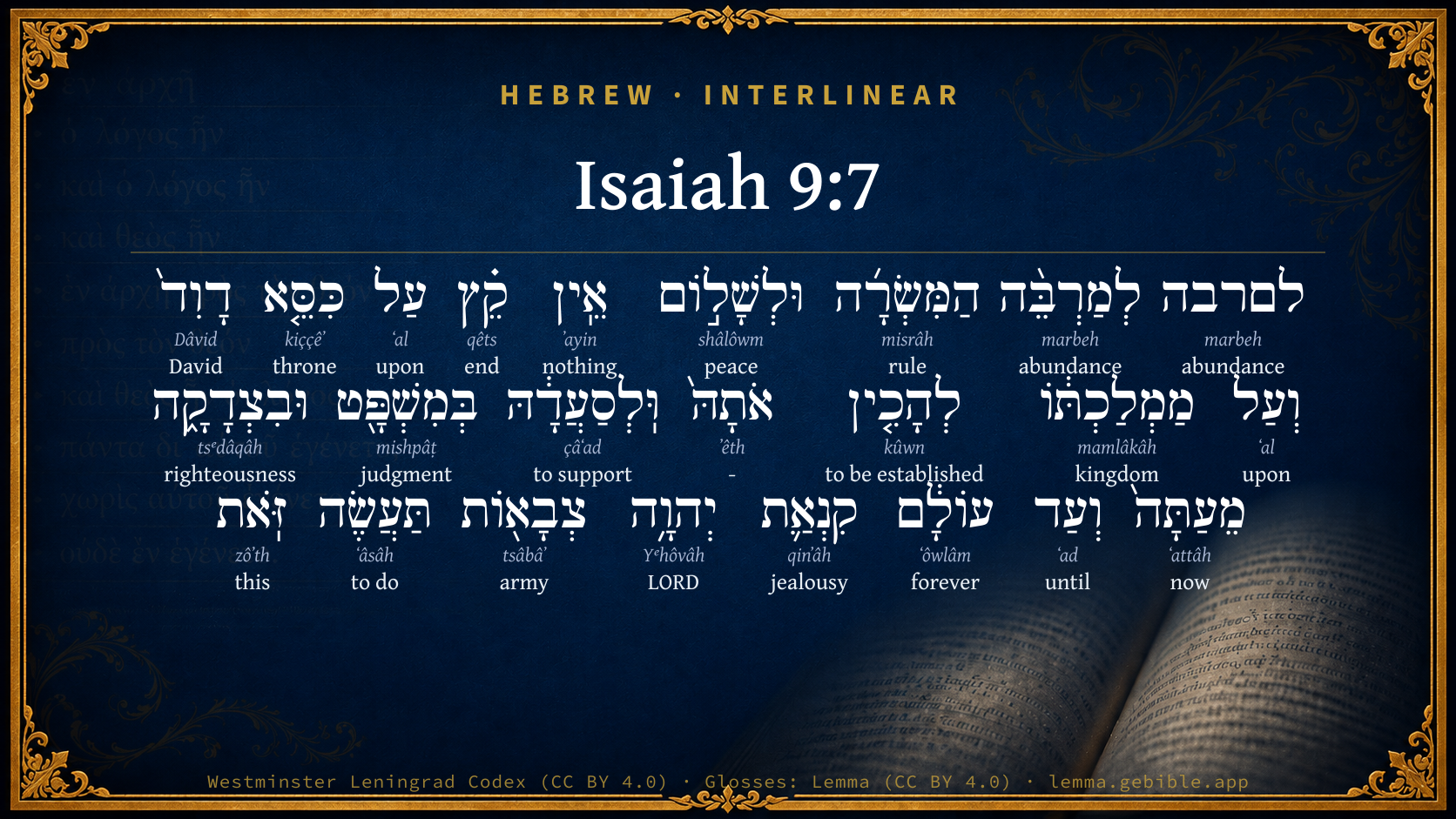
Hebrew (Westminster Leningrad Codex) Isaiah 9:7 appears in the Hebrew Old Testament. The text above is from the Westminster Leningrad Codex. Each word links to its Strong’s number, a concise gloss, and parsing drawn from the Open Scriptures Hebrew Bible morphology. Click any word for its full Brown-Driver-Briggs (BDB) entry.
Download image
Cite this verse

Isaiah 9:7 (World English Bible). Public Domain. Lemma interlinear Bible study tool, https://lemma.gebible.app/v/isaiah/9/7.

Show BibTeX & RIS
BibTeX
RIS
English Translation
Of the increase of his government and of peace there shall be no end, on the throne of David, and on his kingdom, to establish it, and to uphold it with justice and with righteousness from henceforth even forever. The zeal of Yahweh of Hosts will perform this.
World English Bible · Public Domain
Highlights
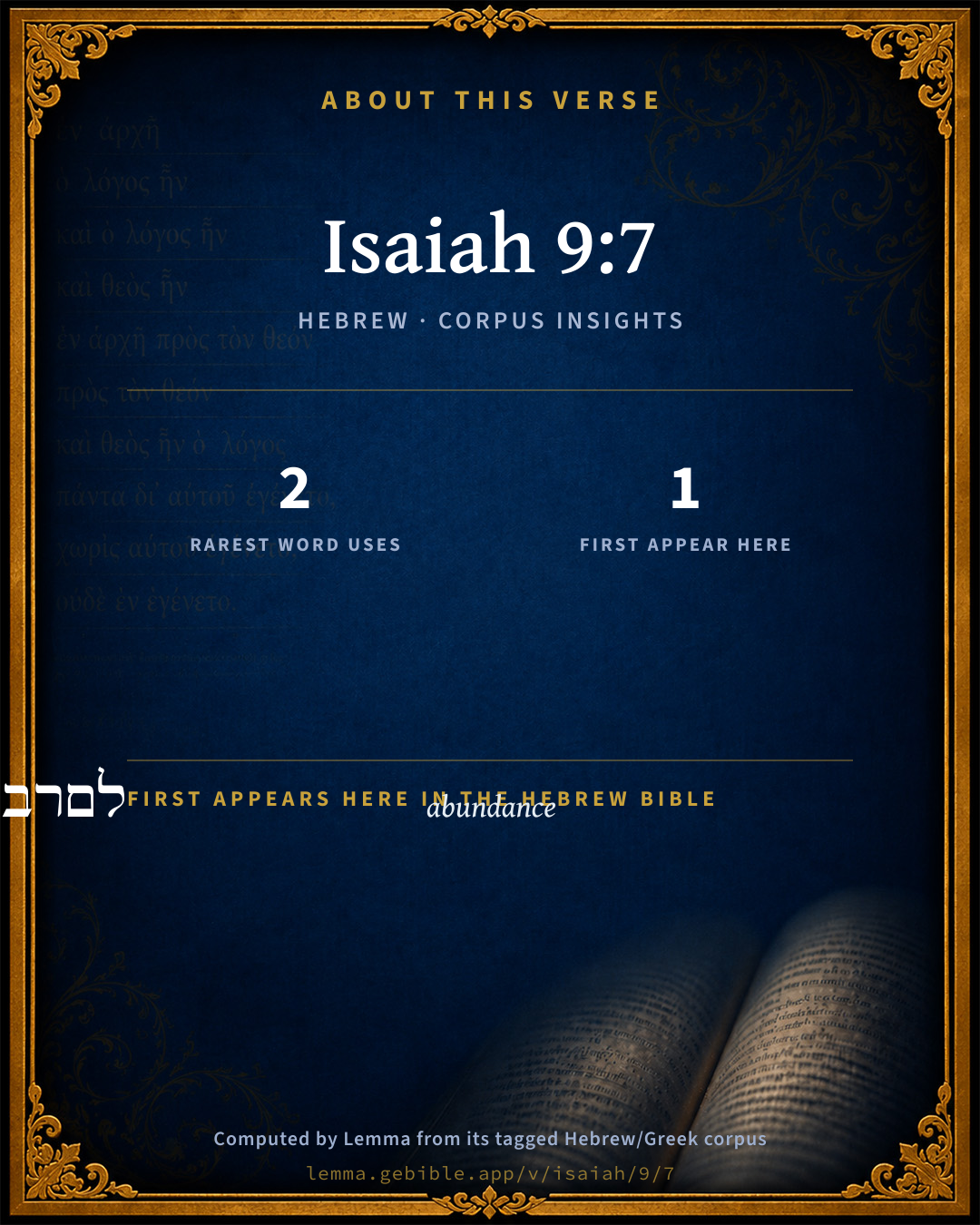
  • 1 first appearance in the Hebrew Bible
Full analysis ↓
Download a study sheet

One document with this verse’s original text, its word-by-word gloss line, the meaning frame, cross-references with their text, attributed commentary, and full source and license credits — printable, and it pastes into notes with its structure intact.

This verse Autodidact and up

Study sheet (.html) Plain text (.txt)

A passage Seminary Student

Up to 50 verses in one chapter. A passage sheet keeps up to 6 commentary sources and 12 cross-references per verse, in the order this page ranks them, and says so on the sheet whenever that leaves anything out. Ask for a single verse and you get the Autodidact verse sheet above.

Everything on this page stays free to read, with no account — the sheet is a download of what is already on screen, not access to it.

Want to remove ads? Support Godless Engineer
Compare translations 3

The same verse in 3 English versions, stacked beneath the original-language interlinear above. Click any original word for its lexicon entry.

Each is an independent rendering of the whole verse — the interlinear is not word-aligned to these translations.

Highlighted words mark where these versions differ — a whole-verse word diff, not a word-by-word alignment.

  • World English Bible Public Domain
    Of the increase of his government and of peace there shall be no end, on the throne of David, and on his kingdom, to establish it, and to uphold it with justice and with righteousness from henceforth even forever. The zeal of Yahweh of Hosts will perform this.
  • King James Version Public Domain
    Of the increase of his government and peace there shall be no end, upon the throne of David, and upon his kingdom, to order it, and to establish it with judgment and with justice from henceforth even for ever. The zeal of the LORD of hosts will perform this.
  • unfoldingWord Literal Text CC BY-SA 4.0
    Of the increase of the dominion and of peace there will be no end, on the throne of David and over his kingdom, to establish it and to sustain it with justice and with righteousness, from now and until forever. The zeal of Yahweh of Armies will do this. q1

unfoldingWord Literal Text — © unfoldingWord, licensed CC BY-SA 4.0. Word-aligned USFM3 via Door43 (git.door43.org/unfoldingWord/en_ult).

Versions to compare (up to 4)

3 of 4 selected

Show all 18 translations

Every available English version of this verse, each an independent rendering of the whole verse.

  • World English Bible Public Domain
    Of the increase of his government and of peace there shall be no end, on the throne of David, and on his kingdom, to establish it, and to uphold it with justice and with righteousness from henceforth even forever. The zeal of Yahweh of Hosts will perform this.
  • Berean Standard Bible Public Domain
    Of the increase of His government and peace there will be no end. He will reign on the throne of David and over his kingdom, to establish and sustain it with justice and righteousness from that time and forevermore. The zeal of the LORD of Hosts will accomplish this.
  • Majority Standard Bible Public Domain
    Of the increase of His government and peace there will be no end. He will reign on the throne of David and over his kingdom, to establish and sustain it with justice and righteousness from that time and forevermore. The zeal of the LORD of Hosts will accomplish this.
  • King James Version Public Domain
    Of the increase of his government and peace there shall be no end, upon the throne of David, and upon his kingdom, to order it, and to establish it with judgment and with justice from henceforth even for ever. The zeal of the LORD of hosts will perform this.
  • American Standard Version (1901) Public Domain
    Of the increase of his government and of peace there shall be no end, upon the throne of David, and upon his kingdom, to establish it, and to uphold it with justice and with righteousness from henceforth even for ever. The zeal of Jehovah of hosts will perform this.
  • Revised Version (1885) Public Domain
    Of the increase of his government and of peace there shall be no end, upon the throne of David, and upon his kingdom, to establish it, and to uphold it with judgment and with righteousness from henceforth even for ever. The zeal of the LORD of hosts shall perform this.
  • Geneva Bible (1599) Public Domain
    The increase of his gouernement and peace shall haue none end: he shall sit vpon the throne of Dauid, and vpon his kingdome, to order it, and to stablish it with iudgement and with iustice, from hencefoorth, euen for euer: the zeale of the Lord of hostes will performe this.
  • Douay-Rheims (1899) Public Domain
    His empire shall be multiplied, and there shall be no end of peace: he shall sit upon the throne of David, and upon his kingdom; to establish it and strengthen it with judgment and with justice, from henceforth and for ever: the zeal of the Lord of hosts will perform this.
  • Young's Literal Translation Public Domain
    To the increase of the princely power, And of peace, there is no end, On the throne of David, and on his kingdom, To establish it, and to support it, In judgment and in righteousness, Henceforth, even unto the age, The zeal of Jehovah of Hosts doth this.
  • Literal Standard Version CC BY-SA 4.0
    Of the increase of [His] dominion, || And of peace, there is no end, || On the throne of David, and on His kingdom, || To establish it, and to support it, || In judgment and in righteousness, || From now on, even for all time, || The zeal of YHWH of Hosts does this.
  • Unlocked Literal Bible CC BY-SA 4.0
    Of the increase of his government and of peace there will be no end, as he rules on the throne of David, and over his kingdom, to establish it and sustain it with justice and with righteousness from this time onward and for evermore. The zeal of Yahweh of hosts will do this.
  • unfoldingWord Literal Text CC BY-SA 4.0
    Of the increase of the dominion and of peace there will be no end, on the throne of David and over his kingdom, to establish it and to sustain it with justice and with righteousness, from now and until forever. The zeal of Yahweh of Armies will do this. q1
  • Darby Bible Public Domain
    Of the increase of his government and of peace there shall be no end, upon the throne of David and over his kingdom, to establish it, and to uphold it with judgment and with righteousness, from henceforth even for ever. The zeal of Jehovah of hosts will perform this.
  • World Messianic Bible Public Domain
    Of the increase of his government and of peace there shall be no end, on David’s throne, and on his kingdom, to establish it, and to uphold it with justice and with righteousness from that time on, even forever. The zeal of the LORD of Hosts will perform this.
  • Webster's Bible Public Domain
    Of the increase of his government and peace there shall be no end, upon the throne of David, and upon his kingdom, to order it, and to establish it with judgment and with justice from henceforth even for ever. The zeal of the LORD of hosts will perform this.
  • Free Bible Version CC BY-SA 4.0
    His rule and the peace he brings know no limits and will never come to an end. He will sit on David's throne and rule his kingdom, making it secure. He will operate from principles of justice and goodness, from the time he begins his rule and for all eternity. The Lord Almighty is determined to make this happen.
  • Bible in Basic English Public Domain
    Of the increase of his rule and of peace there will be no end, on the seat of David, and in his kingdom; to make it strong, supporting it with wise decision and righteousness, now and for ever. By the fixed purpose of the Lord of armies this will be done.
  • JPS Tanakh (1917) Public Domain
    (9-6) That the government may be increased, and of peace there be no end, upon the throne of David, and upon his kingdom, to establish it, and to uphold it through justice and through righteousness from henceforth even for ever. The zeal of the LORD of hosts doth perform this.

Literal Standard Version (2020), Covenant Press — licensed CC BY-SA 4.0. Text via the HelloAO Bible API (eBible.org). Unlocked Literal Bible (unfoldingWord) — licensed CC BY-SA 4.0. Text via the HelloAO Bible API (eBible.org). unfoldingWord Literal Text — © unfoldingWord, licensed CC BY-SA 4.0. Word-aligned USFM3 via Door43 (git.door43.org/unfoldingWord/en_ult). Free Bible Version, Dr. Jonathan Gallagher — licensed CC BY-SA 4.0. Text via the HelloAO Bible API (eBible.org).

Word by word

More ways to search: Search by grammar → Find every occurrence → Compare this word →

Practice this passage: Drill this verse → Learn its vocabulary →

הַמִּשְׂרָ֜ה
misrâh
H4951
“the · rule”
Particle, Definite Article + Noun, Common, Feminine, Singular, Absolute
Part of Speech
Particle + Noun
Type
Common
Gender
Feminine
Number
Singular
State
Absolute
Full BDB Definition

Origin: from H8280

TWOT: 2288a

rule, dominion, government
  1. לםרבה marbeh H4766 “to/for · abundance of” Preposition + Noun, Common, Masculine, Singular, Construct
  2. לְמַרְבֵּ֨ה marbeh H4766 “to/for · abundance of” Preposition + Noun, Common, Masculine, Singular, Construct
  3. וּלְשָׁל֣וֹם shâlôwm H7965 “and · to/for · peace” Conjunction + Preposition + Noun, Common, Masculine, Singular, Absolute
  4. אֵֽין ʼayin H369 “nothing” Particle, Negative
  5. קֵ֗ץ qêts H7093 “end” Noun, Common, Masculine, Singular, Absolute
  6. עַל ʻal H5921 “upon” Preposition
  7. כִּסֵּ֤א kiççêʼ H3678 “throne of” Noun, Common, Masculine, Singular, Construct
  8. דָוִד֙ Dâvid H1732 “David” Noun, Proper
  9. וְעַל ʻal H5921 “and · upon” Conjunction + Preposition
  10. מַמְלַכְתּ֔וֹ mamlâkâh H4467 “kingdom · his” Noun, Common, Feminine, Singular, Construct + Suffix, Personal, 3rd Person, Masculine, Singular
  11. לְהָכִ֤ין kûwn H3559 “to be established” Preposition + Verb, Hiphil, Infinitive Construct
  12. אֹתָהּ֙ ʼêth H853 “- · her” Particle, Direct Object + Suffix, Personal, 3rd Person, Feminine, Singular
  13. וּֽלְסַעֲדָ֔הּ çâʻad H5582 “and · to support · her” Conjunction + Preposition + Verb, Qal, Infinitive Construct + Suffix, Personal, 3rd Person, Feminine, Singular
  14. בְּמִשְׁפָּ֖ט mishpâṭ H4941 “in/at · judgment” Preposition + Noun, Common, Masculine, Singular, Absolute
  15. וּבִצְדָקָ֑ה tsᵉdâqâh H6666 “and · in/at · righteousness” Conjunction + Preposition + Noun, Common, Feminine, Singular, Absolute
  16. מֵעַתָּה֙ ʻattâh H6258 “from · now” Preposition + Adverb
  17. וְעַד ʻad H5704 “and · until” Conjunction + Preposition
  18. עוֹלָ֔ם ʻôwlâm H5769 “forever” Noun, Common, Masculine, Singular, Absolute
  19. קִנְאַ֛ת qinʼâh H7068 “jealousy of” Noun, Common, Feminine, Singular, Construct
  20. יְהוָ֥ה Yᵉhôvâh H3068 “LORD” Noun, Proper
  21. צְבָא֖וֹת tsâbâʼ H6635 “armies” Noun, Common, Both, Plural, Absolute
  22. תַּעֲשֶׂה ʻâsâh H6213 “to do” Verb, Qal, Imperfect, 3rd Person, Feminine, Singular
  23. זֹּֽאת zôʼth H2063 “this” Pronoun, Demonstrative, Feminine, Singular

About this verse

These counts appear in no published source. They are computed here, from the morphology-tagged text and Lemma’s own curated glosses. What Lemma adds →

24
words
22
distinct lemmas
Prophets
section

Notable vocabulary

The rarest word here is הַמִּשְׂרָ֜ה rule H4951 — appearing just 2 times in the whole Hebrew Bible.

First appearance in Scripture

This word makes its first canonical appearance in the Hebrew Bible here:

  • לםרבה abundance H4766

Shared distinctive vocabulary

הַמִּשְׂרָ֜ה rule H4951 occurs in 2 verses of the Hebrew Bible. Also found in:

Grammatical profile

  • 3 verbs
  • 14 nouns
  • 1 pronoun
  • 3 prepositions
  • 1 adverb
  • 2 particles

Verb forms

  • לְהָכִ֤ין Hiphil · Infinitive Construct
  • וּֽלְסַעֲדָ֔הּ Qal · Infinitive Construct
  • תַּעֲשֶׂה Qal · Imperfect

Repetition

Words recur within this verse — often emphatic in Hebrew:

  • לםרבה abundance H4766 ×2
  • עַל upon H5921 ×2

Hebrew & Septuagint length

In English translation the verse runs 48 words from the Hebrew and 51 from the Septuagint (LXX English) — closely comparable.

A rough comparison of the two English renderings, which tokenize alike — not a word-level alignment.

Word counts can differ between the Hebrew and the Greek without any difference in meaning — e.g. the Hebrew direct-object marker אֵת has no separate Greek word, and Greek often adds the article ὁ.

Cross-references

25

Topical passages linked to Isaiah 9:7 in the Treasury of Scripture Knowledge — connected by theme and wording, ordered by reader-vote popularity; previews shown in the World English Bible.

  • Luke 1:32–33 He will be great, and will be called the Son of the Most High. The Lord God will give him the throne of his father, David,
  • Daniel 2:44 In the days of those kings shall the God of heaven set up a kingdom which shall never be destroyed, nor shall the sovereignty of it be left to another people; but it shall break in pieces and consume all these kingdoms, and it shall stand forever.
  • Daniel 7:14 There was given him dominion, and glory, and a kingdom, that all the peoples, nations, and languages should serve him: his dominion is an everlasting dominion, which shall not pass away, and his kingdom that which shall not be destroyed.
  • 2 Samuel 7:16 Your house and your kingdom shall be made sure for ever before you: your throne shall be established forever.
  • Psalms 45:4–6 In your majesty ride on victoriously on behalf of truth, humility, and righteousness. Let your right hand display awesome deeds.
  • Daniel 7:27 The kingdom and the dominion, and the greatness of the kingdoms under the whole the sky, shall be given to the people of the saints of the Most High: his kingdom is an everlasting kingdom, and all dominions shall serve and obey him.
  • Daniel 2:35 Then was the iron, the clay, the brass, the silver, and the gold, broken in pieces together, and became like the chaff of the summer threshing floors; and the wind carried them away, so that no place was found for them: and the stone that struck the image became a great mountain, and filled the whole earth.
  • Isaiah 32:1–2 Behold, a king shall reign in righteousness, and princes shall rule in justice.
  • Jeremiah 23:5 Behold, the days come, says Yahweh, that I will raise to David a righteous Branch, and he shall reign as king and deal wisely, and shall execute justice and righteousness in the land.
  • Jeremiah 33:15–21 In those days, and at that time, will I cause a Branch of righteousness to grow up to David; and he shall execute justice and righteousness in the land.
  • 1 Corinthians 15:24–28 Then the end comes, when he will deliver up the Kingdom to God, even the Father; when he will have abolished all rule and all authority and power.
  • Hebrews 1:8 but of the Son he says, "Your throne, O God, is forever and ever; The scepter of uprightness is the scepter of your Kingdom.
  • Isaiah 16:5 A throne shall be established in loving kindness; and one shall sit thereon in truth, in the tent of David, judging, and seeking justice, and swift to do righteousness.
  • Psalms 89:35–37 Once have I sworn by my holiness, I will not lie to David.
  • Isaiah 42:3–4 A bruised reed will he not break, and a dimly burning wick will he not quench: he will bring forth justice in truth.
  • Isaiah 37:32 For out of Jerusalem shall go forth a remnant, and out of Mount Zion those who shall escape. The zeal of Yahweh of Hosts will perform this.
  • Psalms 2:8 Ask of me, and I will give the nations for your inheritance, The uttermost parts of the earth for your possession.
  • Psalms 72:1–3 God, give the king your justice; Your righteousness to the royal son.
  • Psalms 72:7–11 In his days, the righteous shall flourish, And abundance of peace, until the moon is no more.
  • Isaiah 59:16–17 He saw that there was no man, and wondered that there was no intercessor: therefore his own arm brought salvation to him; and his righteousness, it upheld him.
  • Ezekiel 36:21–23 But I had regard for my holy name, which the house of Israel had profaned among the nations, where they went.
  • 2 Kings 19:31 For out of Jerusalem shall go forth a remnant, and out of Mount Zion those who shall escape: the zeal of Yahweh shall perform this.
  • Isaiah 63:4–6 For the day of vengeance was in my heart, and the year of my redeemed is come.
  • Isaiah 11:3–5 His delight shall be in the fear of Yahweh; and he shall not judge after the sight of his eyes, neither decide after the hearing of his ears;
  • Revelation 19:11 I saw the heaven opened, and behold, a white horse, and he who sat on it is called Faithful and True. In righteousness he judges and makes war.

Cross-references courtesy of OpenBible.info (CC BY 4.0).

Hebrew and Greek witnesses Masoretic Hebrew ↔ Greek Septuagint

The same verse in the two great witnesses to the Old Testament, shown verse-for-verse.

These are two independent witnesses, not word-aligned to each other, and the Septuagint is shown in lemma (dictionary) form.

Hebrew Isaiah 9:7 Masoretic · Westminster Leningrad Codex

לםרבה לְמַרְבֵּ֨ה הַמִּשְׂרָ֜ה וּלְשָׁל֣וֹם אֵֽין קֵ֗ץ עַל כִּסֵּ֤א דָוִד֙ וְעַל מַמְלַכְתּ֔וֹ לְהָכִ֤ין אֹתָהּ֙ וּֽלְסַעֲדָ֔הּ בְּמִשְׁפָּ֖ט וּבִצְדָקָ֑ה מֵעַתָּה֙ וְעַד עוֹלָ֔ם קִנְאַ֛ת יְהוָ֥ה צְבָא֖וֹת תַּעֲשֶׂה זֹּֽאת

Of the increase of his government and of peace there shall be no end, on the throne of David, and on his kingdom, to establish it, and to uphold it with justice and with righteousness from henceforth even forever. The zeal of Yahweh of Hosts will perform this.

World English Bible · Public Domain

Greek LXX Isaiah 9:7 Septuagint · lemma form

θάνατος ἀποστέλλω κύριος ἐπί ἰακώβ καί ἔρχομαι ἐπί ἰσραήλ

His government shall be great, and of his peace there is no end: it shall be upon the throne of David, and upon his kingdom, to establish it, and to support it with judgment and with righteousness, from henceforth and forever. The seal of the Lord of hosts shall perform this.

LXX2012 (modern English Septuagint) · Public Domain

On this verse, The Cambridge Bible for Schools and Colleges discusses the Septuagint’s reading. Read the note in Commentary ↓

Hebrew: Westminster Leningrad Codex (CC BY 4.0). Greek: Septuagint (public domain); English from LXX2012 (modern English Septuagint) (Public Domain). How the Septuagint differs from the Hebrew →

Targum (Aramaic paraphrase)

1

The Targum is the ancient Jewish Aramaic paraphrase of the Hebrew Scriptures — an interpretive translation, not the Hebrew text itself. Onkelos (literal) and Pseudo-Jonathan (expansive) render the Torah, and Jonathan the Prophets. Coverage is partial: where no permissively-licensed English translation exists for a verse, only the Aramaic is shown. This is verse-level text, not a word-by-word alignment to the Hebrew.

  1. Targum Jonathan Prophets (Joshua–Malachi)
    פִּתְגָמָא שְׁלַח יְיָ בִּדְבֵית יַעֲקֹב וְאִשְׁתְּמַע בְּיִשְׂרָאֵל:

    The Lord sent a word into the house of Jacob, and it was heard in Israel.

    Targum Jonathan — Aramaic: “Mikraot Gedolot” (public domain). English: “Sefaria Community Translation” (CC0 1.0 (public-domain dedication)); “London "Chaldee Paraphrase," 1871” (public domain). Text via Sefaria.

Commentary

Notes on Isaiah 9:7 from classic Christian and Jewish commentators (each source and its license shown beneath its notes). The classic Christian expositions comment on the surrounding passage and are grouped to its opening verse, so a note may address several verses; the Jewish commentaries on the Tanakh (Rashi and others) are per-verse, so they appear only where the commentator wrote on this verse.

Lemma curates 59 commentaries, every one of them public domain or Creative Commons licensed, each selected and text-cleaned for this edition rather than reprinted as found. About our sources →

The Cambridge Bible for Schools and Colleges

gen. ed. J. J. S. Perowne

7. The extension and consolidation of the Messiah’s rule.

Of the increase … end] Rather, For the increase of authority and for peace without end, &c. The final M (ם) in the original points to some uncertainty of text, which can also be traced in the translation of the LXX. It is thought by some to have arisen through dittography of the last two letters of Isa_9:6; Isa_9:7 would then begin “increased is authority.” But the Qìrê gives the better sense.

upon the throne … kingdom] On the throne and kingdom of David. The Messiah succeeds to David’s throne and is doubtless conceived as his lineal descendant.

to order it] Better, to confirm it. The throne is established (Pro_20:28; Isa_16:5) not by force and conquest but by the moral qualities of judgment and righteousness (see ch. Isa_1:21) in the government.

the zeal of the Lord of hosts will perform this] exactly as ch. Isa_37:32. The word “zeal” or “jealousy” is used of passion in a variety of senses, but chiefly with the implied idea of resentment. When applied to Jehovah it appears always to express the reaction of His holiness called forth by some injury to His honour. Perhaps the closest parallel to the idea here is Zec_1:14; Zec_8:2 “I am jealous for Zion with a great jealousy.”

The Cambridge Bible for Schools and Colleges (gen. ed. J. J. S. Perowne; Cambridge University Press, 1878–1918) — public domain. Text from a community e-Sword module.

Trapp's Complete Commentary

John Trapp

Isa 9:7 Of the increase of [his] government and peace [there shall be] no end, upon the throne of David, and upon his kingdom, to order it, and to establish it with judgment and with justice from henceforth even for ever. The zeal of the LORD of hosts will perform this.

Ver. 7. Of the increase of his government there shall be no end.] Here the mere final in the middle of the word Lemarbeh hath occasioned some to give many guesses at the reason of it; {Hebrew Text Note} yea, to conceit many mysteries, where wiser men can find no such matter. It is a good note which one giveth here, viz., that the more Christ’s government increaseth in the soul, the more peace there is. See Isa 32:17 Psa 119:136.

To establish it.] Or, Support it, uphold it. Bασιλευς as if Bασις του λαου. A king hath his name in Greek from being the foundation of the people. This King of kings is only worthy of that name; he is not maintained and supported by us and our subsidies, but we by him, and by the supplies of his Spirit. {Php 1:19} All our springs are in him. {Psa 87:7}

The zeal of the Lord of hosts,] i.e., The philanthropy {Tit 3:4} and free grace of God. {a} Dilexisti me, Domine, magis quam te, You love me, oh God, more than yourself, saith a father. Let us reciprocate, by being zealous of good works, fervent in spirit, serving the Lord. And when Satan telleth us of our no merits, tell we him that the "zeal of the Lord of hosts shall do it" notwithstanding.

{a} Non amat qui non zelat. He does not love him who is not zealous.

John Trapp, A Commentary or Exposition upon All the Books of the Old and New Testament (1647–1656) — public domain. Text from a community e-Sword module.

The Biblical Illustrator

Joseph S. Exell

Isa_9:7

Of the increase of His government and peace there shall be no end

The missionary work

I.

WHAT IS THE WORK TO BE PERFORMED AND WHOSE AGENCY SHALL ACCOMPLISH IT?

1. The missionary work is the increase of Messiahs government and peace: the proclamation of Messiah as King of kings and Lord of lords throughout the universe; the establishment of peace among men, because He hath made peace for them through the blood of His Cross.

2. The zeal of the Lord of hosts will perform this.

II. WHAT ARE THE INSTRUMENTS WHOM THE LORD OF HOSTS WILL EMPLOY in the accomplishment of this seemingly impossible work? They are themselves subjects of the Kingdom which they aim to extend, and adorers of the one name which they desire to exalt, believers in the Word which they combine to diffuse, holding substantially the same truths, maintaining steadfastly some fellowship with those to whom the Lord Jesus proclaimed in the days of His flesh, Go ye, and to whom He graciously declared, Lo, I am with you alway, even to the end of the world.

III. WHAT IS OUR OWN DUTY AND OBLIGATION IN REFERENCE TO THIS WORK? As we are Britons, the missionary work belongs to us from our country; as we are Christians, from our profession; as we are churchmen, it appeals to us from our very prayers, for how can we implore our blessed Lord to bring home to His flock the infidel, the heretic, the beguiled Romanist, the benighted idolater, unless we are prepared, as far as in us lies, to prepare the way of the Lord, and make in the desert a highway for our God? But neither as Britons, nor as Christians, nor as churchmen, shall we ever learn our duty from any teacher but Gods Word, or perform it through any power but that of Gods Spirit. Besides, while the missionary work, being a work of faith, is therefore acceptable to God, it is also profitable to ourselves; it awakens brotherly affections, it kindles a holy zeal, it expands Christian charity, it brings us into communion with the excellent of the earth, it cements our fellowship with each other, and with Christ; by engaging in it heart and soul, we not only apprehend the brotherhood of man, but we anticipate the brotherhood of heaven, when they shall come from the east, and from the west, and from the north, and from the south, and sit down in the kingdom of God. Nor is the missionary work profitable only to the heathen and to our own souls, but to those who dwell immediately around us. What we attempt abroad we shall never be content to leave undone at home. (T. Dale, M. A.)

The increase of His government

I. THE INCREASE OF HIS GOVERNMENT. This implies--

1. The extended diffusion of the knowledge of His Gospel.

2. The triumphs of His grace over the sin and misery of man.

3. The diffusion of the peaceful influence of the Gospel in calming the passions, and allaying the violence of unhappy men.

4. The annihilation of all that opposes His progress.

II. HOW IS THE GOVERNMENT OF CHRIST TO INCREASE? By the agency of miracles? No; the age of miracles is gone. By the distribution of the Bible, and suitable tracts, by pious individuals? Doubtless this may be the means of great usefulness. By the education of the young? We look for something more than all this. How then shall it be increased? By the instrumentality of the preached Gospel accompanied by the influences of the Holy Spirit.

III. WHERE IS THE NECESSITY OR CERTAINTY OF THIS INCREASE OF THE SAVIOURS GOVERNMENT?

1. In the Divine appointment.

2. In the claims of His mediatorial sacrifice (Php_2:8-11).

3. In the very nature of His exaltation (Eph_1:21-22).

4. In the events which have taken place in the theatre of the world Hag_2:7).

5. In the proofs with which we are furnished of the final evangelisation of the world. (E. Parsons.)

The government of the Prince of Peace

I. THE VAST AMPLITUDE AND GROWING EXTENT OF THE MESSIAHS KINGDOM.

II. THE MEANS BY WHICH THE KINGDOM IS GROWING. (R. Macculloch.)

Christian peace conditional

His government and peace. Note that combination. It contains a truth much needed in these times. There is no peace without government. Liberty and independence are our favourite watchwords; liberty for the community, liberty for the individual. Obedience, order, self-control, are less enthusiastically praised. Yet we cannot have the one without the other. We need no appeal to history, no a priori conjectures, to convince us of the truth, that peace and government must go hand in hand. The experience of our own times, the experience of each mans daily life, is ample to teach us that. Every newspaper we take up is full of such lessons. Every reproach of conscience tells the same.

1. Is it not so in the State? Whence comes the want of peace in our sister island? Whence come the perplexity and the insecurity which are such a stain on our civilisation, and which make statesmen well-nigh despair? Is it not because government has become impossible, while law is neutralised and defiled by the unscrupulous opposition of a rival and self-constituted power?

2. Is it not so in ourselves? Whence comes the want of peace in our own hearts? Is it not because of the want of government there; while passion, and self-indulgence, and the fashion of the world, usurp in turn the authority of conscience? What we fancy, what comes easiest to us, what other men do, these constitute our rule of life: not the dictates of conscience, not the will of God, not the example of Jesus Christ. We most of us wish for peace, as we most of us wish for heaven; but we take little means of winning either the one or the other. The cry for personal freedom, for liberty of thought and conscience, is on every lip; but we are most of us more eager to win the power of doing what we choose, than careful to choose what is best. Self-knowledge, self-control, self-renunciation--this is the only road. And while you pursue it, liberty will come unsought; for the highest liberty of all is to be free from the tyranny of self. Self-government is only another name for that service which is perfect freedom. Perfect peace is found in the absolute surrender of self to One who cannot abuse so tremendous a trust. And with this peace in your own hearts you will almost without effort, almost without knowing it, bring peace to others. (A. Plummer, M. A.)

He will do it

Charles, King of Sweden, father of the great Gustavus Adolphus, was an ardent Protestant, and purposed for his country more good than he was able to accomplish. His son, who gave early promise of his brilliant qualities, was his fathers great hope. Often when a scheme of reformation, yet impracticable, was referred to, the king would lay his hand upon the boys head and say to the bystanders, He will do it. So with respect to all which cannot now be accomplished, our faith should look confidently to Great Davids greater Son, in whose reign it will surely be effected. (Sunday School Teacher.)

The empire is peace

Napoleon, standing amid the ambassadors of Europe, reassured the entire continent by the utterance of his New Years motto, The empire is peace. But with far greater truth may we apply the words to Jesus Christ, the Prince of Peace, whose rule over the soul is the synonym of peace unspeakable and full of glory. And as His government spreads further and further over the soul, with its growing area there is growing peace, until they shall both become complete to all the heights, and depths, and breadths of blessedness. Of the increase or his government, and of our peace, there is no end. (F. B. Meyer B. A.)

Christs influence ever increasing

Speaking on the day of Mr. Gladstones funeral, the Rev. F.B. Meyer said: One of the marks which distinguish Jesus Christ from every human teacher and reformer is the fact that His influence is ever increasing. The influence of Gladstone, today so great, will diminish year by year, but Jesus Christs influence was never so great as it is now.

The zeal of the Lord of hosts will perform this

The zeal of the Lord

The zeal translates our English version, but no one English word will give it. It is that mixture of hot honour and affection to which jealousy in its good sense comes near. (Prof. G. A. Smith, D. D.)

Claiming and reckoning.

If we ask anything according to His will, we know that He hears us; and if we know that He hears us, we know that we have the petition that we desired of Him--not only that it will be our, but that it is our, to be used forthwith for His glory, because the zeal of the Lord of hosts will perform it.

1. Are you in need of counsel? Reverently and thoughtfully claim the wisdom of the Counsellor; reckon that you have it, and act to the best of your judgment, believing that His wisdom is threading it with its unseen direction. And when you have acted, whatever be the results, dare to believe that you were directed to do the best thing, and never look back.

2. Are you in need of strength? Reverently and believingly claim the power of the Mighty God, and reckon that it is yours; and go forth to any work to which He may call yon, believing that you are adequately equipped. You will not know what power you have till you begin to use it.

3. Are you in need of unchanging love and affection, in a world of incessant disappointment, in which the warmest friendships cool/ and the dearest friends die? Reverently and gladly avail yourself of the love of me Father of the Ages, the I AM, who is the same yesterday, today, and forever.

4. Do you want peace? Reverently and trustfully claim His peace, who is the Prince of Peace; and know that it is yours in the depths of your soul, though the surface of your life be still swept by storms. These are two great words--claim Gods fulness, and reckon that whatever you can claim is yours, although no answering emotion assures you that it is. Dare to act in faith, stepping out in the assurance that you have what you have claimed, and doing just as you would do if you felt to have it. But this is only possible when you have put the government, where God the Father has placed it, on the shoulders of Jesus. It is there by right, but it must be also there by choice and acquiescence. (F. B. Meyer, B. A.)

The Biblical Illustrator, edited by Joseph S. Exell (c. 1880s–1900s) — public domain. Text from a community e-Sword module.

Joseph Benson's Commentary

Isa 9:7. Of the increase of his government, &c. — His peaceable and happy government shall be enlarged without end: either without end of duration, for ever, as is expressed in a following clause of this verse, or without limitation: his peaceable and happy government shall be extended to all the ends of the earth. Upon the throne of David — The throne which was promised to David, and to his seed for ever; from henceforth, &c. — From the beginning of it unto all eternity. The zeal of the Lord of hosts, &c. — This great work shall be brought to pass by Almighty God, out of that fervent affection which he hath to his own glory, to the honour of his Son, and to his people.

Joseph Benson's Commentary on the Old and New Testaments (1811–1818) — public domain. Text from a community e-Sword module.

The Preacher's Complete Homiletical Commentary

Joseph S. Exell (gen. ed.)

THE EMPIRE OF CHRIST

Isa_9:7. Of the increase of His government, &c.

If any man asks, “Concerning whom does the Prophet write these things?” the answer is, “Concerning Christ.” “Of the increase of His government and peace there shall be no end” [911] The world has seen many great empires, that bade fair to be everlasting, crumble away; and in view of the history of the past, it is unreasonable to believe that any modern empire, except so far as it is obedient to Christ, will be more durable. This is a world of change, and it is vain to hope that political revelations are altogether things of the past. Two thousand years hence, should the present era so long continue, the map of the world will be very different from what it is to-day. But the empire of Christ is to continue for ever. Unlike all other empires, it is to be continually progressing in extent and cohesion.

[911] Upon the throne of David. This was in accordance with the promise made to David (1Ki_8:25; 2Sa_7:12-13; Psa_132:11). This promise was understood as referring to the Messiah. The primary idea is, that He should be descended in the line of David, and accordingly the New Testament writers are often at pains to show that the Lord Jesus was of that family (Luk_2:4). When it is said that He would sit upon the throne of David, it is not to be taken literally. The peculiarity of the reign of David was, that he reigned over the people of God.… To sit upon the throne of David, therefore, means to reign over the people of God; and in this sense the Messiah sits on his throne.—Barnes.

The angel who came to Mary affirmed these very things of the Son then to be born (Luk_1:32-33).—Cowles.

What are our grounds for believing this?

I. The distinct promises of Scripture (Psa_2:8; Psa_22:27; Psa_72:8-11; Dan_7:13-14). For a Christian this is sufficient. But even to those whose reverence for God’s Word is most profound and unquestioning, it is interesting to see—

II. That the nature of things [914] is all in favour of the fulfilment of this prediction. Under this division of our subject, look at some of the differences between all human empires and the empire of Christ.

1. As to their origin. They have usually been created by the genius and energy of some great man. But even such men as David, Alexander, and Cæsar are mortal, and because it is impossible to secure a constant succession of men of genius, the empires they found crumble away. To David and Solomon succeeds a Rehoboam. and Rehoboam means ruin. But Christ wields the enormous “power of an endless life” [917]

2. As to their progress.

(1.) Vast empires fall to pieces by reason of their very vastness. Time brings many changes even to great empires, and among them at least a temporary weakening of the central power; the heart is enfeebled, and the whole body is enfeebled and begins to decay.

(2.) Great empires afford multiplied opportunities for great corruption, and this ultimately kills a state.

(3.) Great empires include many conflicting interests; there is a perpetual struggle to maintain the balance of power; mutinies and rebellions are inevitable, and in the end some of these are successful, and the empire is broken. But none of these things can happen in the empire of Christ; none of these causes will tend to check the increase of His government.

3. As to their aims. This is a consideration even more important and vital than the others. All empires have really had for their aim the aggrandisement of some ambitious man or nation. The inspiring motive has been supremely selfish. Hence fraud and force have been unhesitatingly employed for their advancement, and, because God really rules on earth as well as in heaven, these things, though they secure a temporary triumph, ultimately lead to inevitable ruin (H. E. I. 4612, P. D. 2544, 2995). By similar means the great empire has to be maintained, and in every part of it there are millions watching for an opportunity to subvert it by the same means; because its aims are selfish, it is hated, not loved, by those over whom it triumphs. But the inspiring aims of Christ’s empire are righteousness and peace it is to extend these blessings that His limitless resources are employed; the manner in which these resources is employed is in accordance with the ends sought; and hence

(1) all the laws of God’s universe are on His side, and

(2) He is loved most intensely precisely by those over whom His authority is most completely established [920] III. If any further confirmation of our faith in Christ’s ultimate triumph is needed, we have it in the history of the world since His crucifixion. When He was crucified they nailed over His head the inscription, “THE KING OF THE JEWS.” It was intended to be an act of mockery; it was the declaration of a great truth. And since then He has become the King of the Gentiles also. The mighty empire that tried to stop the progress of His kingdom was ground to powder in the conflict. And now by all the most powerful kingdoms of the earth He is, nominally at least, acknowledged as the supreme Authority. That which is nominal shall become real (Rev_11:15).

[914] According to my view of the Unity of the Divine nature, God is one, as we meet Him in the Old Testament and the Oldest; in the New and the Newest. There are four Testaments: an Oldest and an Old, a New and a Newest. The Oldest Testament is the Nature of Things. The newest is Christ’s continued life in the present influences of the Holy Spirit. The oldest and the newest are unwritten; the old and new are written; but the voices of the four are one.—Joseph Cook.

[917] See Bushnell’s sermon on “The Power of an Endless Life,” in “The New Life,” pp. 287–307.

[920] The remarkably emphatic repetition of the idea of His ruling in righteousness, justice, and real benevolence, suggests how fearfully the world has been misgoverned, and how little the great body of human government in even civilised nations have sought and practically secured the welfare of the millions.—Cowles.

Concerning the complete fulfilment of the prediction of our text, we need therefore have no fear. And hence,—

1. We can look without dismay at the mighty forces arrayed against Christ and His truth,—heathenism abroad and infidelity at home (H. E. I. 642).

2. We can look forward to the future of the world with hope. A golden age is yet to dawn (H. E. I. 3421–3423).

3. We can labour for the extension of Christ’s kingdom with all the hopeful energy of those who know that the end of all their efforts is not failure, but a glorious success (H. E. I. 979, 1161, 1162, 1166–1168).

THE SECURITY FOR THE FULFILMENT OF GOD’S PROMISES

Isa_9:7. The zeal of the Lord of hosts will perform this.

It may be affirmed with equal truth, that from what zeal is in man we may know what it is in God; and that from what zeal is in man we cannot tell what it is in God (H. E. I. 2229–2240). We can tell what its nature is, but we cannot tell its power.

1. Zeal is in man an intense passionateness of desire for the accomplishment of some purpose; this leads to an energy and continuity of action that in many cases triumphs over obstacles, and accomplishes what seemed impossible. True zeal in man is intelligent, calm, persistent, and unweariable; and all this we know it must be in God.

2. But what its power is in God we cannot tell. Water in the mass, and fire in the mass, is an utterly different thing from water or fire on a small scale [923] “The zeal of the Lord of hosts” is a tremendous conception which the mind cannot grasp.

[923] The nature of water in a little pool left on the sea-shore by the receding tide is the same as in the great sea itself; but from the little pool we cannot form any conjecture as to the power of water when moving in mighty waves. So with fire,—its nature is the same in a lighted match and in a great conflagration such as reduced Chicago to ashes; but how different its power in the two cases! Scientific observers have left it on record, that while watching that conflagration it was revealed to them for the first time what power there is latent in fire, when massed in a great body; when at its height, solid granite buildings were consumed and passed away as if they had been made of thin pasteboard.

This declaration is the consummation and crown of a great promise concerning the Messiah. It is the guarantee that, great as that promise is, it shall not remain unfulfilled; the heart of God is set upon its accomplishment, and He is “the Lord of hosts.” We have here a general and blessed principle, applicable to all God’s promises. For two reasons many human purposes remain unfulfilled: those who entertain them are not in earnest about them, or they lack power to carry them into effect. But both these essential requisites meet in God—earnestness and power. He makes no promise lightly; He attaches importance to every pledge He has ever entered into; and He will never lack resources to enable Him to fulfil His promises, according to the largest interpretation that can be put upon them (Eph_3:20).

Let us use this declaration for the comforting and strengthening of our hearts. There are many great and precious promises,

I. Concerning the extension of Christ’s kingdom, e.g., in the words preceding our text. It is declared that the influence and authority of Christ shall be unceasingly exerted with constantly augmenting effect, until all the disorder and misery of the world shall be brought to an end. So glowing is the picture given by the prophets of the world’s future, that we are tempted to fear that it will never be realised. But “the zeal of the Lord of hosts will perform this”; and those who by their prayers, efforts, and sacrifices are trying to contribute to the extension of Christ’s kingdom, may rejoice in the assurance that they are not labouring in vain, nor spending their strength for nought (H. E. I. 979, 1161, 1162, 1166–1168; P. D. 475, 517, 2465, 2466).

II. Concerning the temporal well-being of Christ’s people.

(1.) Deliverance in time of danger (Isa_54:17). Illustrate by the account of the deliverance of Hezekiah (Isaiah 37), noting especially that the promise then given was enforced by the very same declaration: “the zeal of the Lord of hosts shall do this” ( v. 32; H. E. I. 4058).

(2.) Supply for all temporal necessities (Mat_6:25-34; H. E. I. 4507).

III. Concerning the spiritual necessities and ultimate perfection of Christ’s people. After each of them Faith sees written, though not with ink, “The zeal of the Lord of hosts will perform this” (H. E. I. 1063–1071, 1106, 1112–1119). By and by there is to be a great gathering of Christ’s ransomed ones in the heavenly world, and this will then be their grateful acknowledgment (Jos_23:14). Meanwhile, whensoever in our search of the Scriptures we find a promise specially adapted to our needs, let us lay hold of it, saying with joyful confidence, “The zeal of the Lord of hosts will perform this!”

The Preacher's Complete Homiletical Commentary (gen. ed. Joseph S. Exell; Funk & Wagnalls, c. 1892) — public domain (pre-1929). A full-Bible homiletical/sermon-outline anthology covering 65 of 66 books (2 John is absent from the source module). Text from a community e-Sword module.

Tyndale Open Study Notes

Tyndale Open Resources

9:7 Like Ahaz, this ruler will be a descendant of David. Unlike Ahaz and the rulers of Jerusalem (1:21-23), he would trust God and rule with justice and righteousness (11:1-3). Jesus the Messiah reigns for all eternity (Luke 1:32-33).

Tyndale Open Study Notes — © Tyndale Open Resources, licensed CC BY-SA 4.0. Text via the HelloAO Bible API.

Geneva Bible (1599)

Geneva Bible translators

His singular love and care for his elect.

Geneva Bible (1599) marginal notes — public domain. Text via Bolls.life.

Jamieson, Fausset & Brown

Robert Jamieson, A. R. Fausset & David Brown

Of . . . increase . . . no end--His princely rule shall perpetually increase and be unlimited (Dan 2:44).

throne of David-- (Kg1 8:25; Psa 2:6; Psa 132:11; Jer 3:17-18 Eze 34:23-26; Eze 37:16, Eze 37:22; Luk 1:32-33; Act 2:30).

judgment . . . justice--It is not a kingdom of mere might, and triumph of force over enemies, but of righteousness (Isa 42:21; Psa 45:6-7), attainable only in and by Messiah.

zeal, &c.--including not only Christ's hidden spiritual victory over Satan at the first coming, but the open one accompanied with "judgments" on Antichrist and every enemy at the second coming (Isa 59:17; Psa 9:6-8).

Delivered a little later than the previous one. The ninth and tenth chapters ought to have been so divided. The present division into chapters was made by Cardinal Hugo, in A.D. 1250; and into verses, by Robert Stephens, the famous printer of Paris, in 1551. After the Assyrian invasion of Syria, that of Ephraim shall follow (Kg2 16:9); Isa 9:8-11, Isa 9:17-20, foretell the intestine discords in Israel after Hoshea had slain Pekah (A.D. 739), that is, just after the Assyrian invasions, when for seven years it was stripped of magistrates and torn into factions. There are four strophes, each setting forth Ephraim's crime and consequent punishment, and ending with the formula, "For all this His anger is not turned away," &c. (Isa 9:12, Isa 9:17, Isa 9:21, and Isa 10:4).

Jamieson, Fausset & Brown — Commentary Critical and Explanatory on the Whole Bible (1871) — public domain (CC PDM 1.0). Text via the HelloAO Bible API.

Adam Clarke's Commentary

Verse 7. Of the increase] In the common Hebrew Bibles, and in many MSS., this word is written with the close or final למרבה ם. But in twelve of Kennicott's MSS., and twelve of De Rossi's, it is written with the open mem; but here it is supposed to contain mysteries, viz., that Jerusalem shall be shut up, closed, and confined, till the days of the Messiah.

This is an illustrious prophecy of the incarnation of Christ, with an enumeration of those characters in which he stands most nearly related to mankind as their Saviour; and of others by which his infinite majesty and Godhead are shown. He shall appear as a child, born of a woman, born as a Jew, under the law, but not in the way of ordinary generation. He is a Son given-the human nature, in which the fulness of the Godhead was to dwell, being produced by the creative energy of the Holy Ghost in the womb of the Virgin. See Mt 1:20-21; Mt 1:23; Mt 1:25, and Lu 1:35, and Isa 7:14, and the notes on those passages. As being God manifested in the flesh, he was wonderful in his conception, birth, preaching, miracles, sufferings, death, resurrection, and ascension; wonderful in his person, and wonderful in his working. He is the Counsellor that expounds the law; shows its origin, nature, and claims; instructs, pleads for the guilty; and ever appears in the presence of God for men. He is the mighty God; God essentially and efficiently prevailing against his enemies, and destroying ours. He is the Father of eternity; the Origin of all being, and the Cause of the existence, and particularly the Father, of the spirits of all flesh. The Prince of peace-not only the Author of peace, and the Dispenser of peace, but also he that rules by peace, whose rule tends always to perfection, and produces prosperity. Of the increase of his government-this Prince has a government, for he has all power both in heaven and in earth: and his government increases, and is daily more and more extended, and will continue till all things are put under his feet. His kingdom is ordered-every act of government regulated according to wisdom and goodness; is established so securely as not to be overthrown; and administered in judgment and justice, so as to manifest his wisdom, righteousness, goodness, and truth. Reader, such is that Jesus who came into the world to save sinners! Trust in HIM!

Isa 9:8-10:4. This whole passage reduced to its proper and entire form, and healed of the dislocation which it suffers by the absurd division of the chapters, makes a distinct prophecy, and a just poem, remarkable for the regularity of its disposition and the elegance of its plan. It has no relation to the preceding or following prophecy; though the parts, violently torn asunder, have been, on the one side and the other, patched on to them. Those relate principally to the kingdom of Judah; this is addressed exclusively to the kingdom of Israel. The subject of it is a denunciation of vengeance awaiting their crimes. It is divided into four parts, each threatening the particular punishment of some grievous offence-of their pride, of their perseverance in their vices, of their impiety, and of their injustice. To which is added a general denunciation of a farther reserve of Divine wrath, contained in a distich, before used by the prophet on a like occasion, Isa 5:25, and here repeated after each part. This makes the intercalary verse of the poem; or, as we call it, the burden of the song.

"Post hoc comma (cap. ix. 4) interponitur spatium unius lineae, in Cod. 2 et 3: idemque observatur in 245. in quo nullum est spatium ad finem capitis ix." Kennicott, Var. Lect.

"After this clause (Isa 9:4) is interposed the space of one line in Cod. 2 and 3. The same is likewise observed in Cod. 245, in which no space exists at the end of chap. ix."

Adam Clarke's Commentary on the Bible (1810–1826) — public domain. Text from a community e-Sword/MySword module.

Ellicott's Commentary for English Readers

(7) Of the increase . . .—Better, “For the increase of the government, and for peace with no end . . . The “throne of David,” though in harmony with the whole body of prophetic tradition as to the Messiah, may be noted as the first appearance of that tradition in Isaiah.

Henceforth even for ever.—The words admit, as in the parallels of Psa_21:4; Psa_61:6-7; 2Sa_7:12-16, of being interpreted of the perpetuity of the dynasty of which the anointed king is to be the founder; but the “Everlasting Father “of the context, and the parallels of Psa_45:6; Psa_110:4, are in favour of its referring to a personal immortality of sovereignty.

The zeal of the Lord of hosts will perform . . .—As in Greek so in Hebrew, we have the same root-word and root-idea for “zeal” and “jealousy,” and here, perhaps, the latter thought is dominant. It is because Jehovah loves the daughter of Zion with an absorbing love that He purposes such great things for her future, and that what He purposes will be assuredly performed. (Comp. Eze_5:13.)

A Bible Commentary for English Readers, edited by Charles John Ellicott (1878–1897) — public domain. Text from a community e-Sword module.

John Gill's Exposition

Of the increase of his government,.... That is, of the Prince of peace, on whose shoulders it is; which, from small beginnings, will rise to a very great pitch and height of glory; this is signified by the stone cut out of the mountain without hands; that smote the image, became a great mountain, and filled the whole earth, Dan 2:34 and by the parable of the mustard seed, the least of all seeds, and yet, when grown up, becomes a great tree, in which the birds of the air build their nests, Mat 13:31. Christ's kingdom and interest, his dominion and government, may be said to be increased, when his Gospel is spread far and near, which is called the Gospel of the kingdom, and the doctrines of it, the mysteries of the kingdom; by means of which men become subjects of it, and so his kingdom is enlarged. At first it was only preached in Judea; and then it was carried into the Gentile world, where it met with great success, and was spread to the overthrow of Paganism in the Roman empire; a stop was put to its progress by the appearance and power of antichrist, the man of sin; but at the Reformation it broke out again, and spread itself over many nations; and though of late years there has been a decline, in the latter day the knowledge of it will cover the earth, as the waters do the sea, and multitudes shall be converted by it; which is meant by the increase of Christ's government. In the days of his flesh on earth, few believed in him; after his ascension to heaven, there was a large increase of his followers in Jerusalem, and in the Gentile world; the Gospel being preached there, more were the children of the desolate than of the married wife; large numbers were converted, and churches raised and formed everywhere; and in the latter day the church shall fill the earth, and the kingdoms of this world will become the church of Christ; all nations will flow unto it; the people of the Jews, in a body, will be converted, and the fulness of the Gentiles will be brought in; the interest of Christ, which made so contemptible a figure at first, consisting chiefly of the poor of this world, harassed with persecution, and disturbed by heretics, will now make a very great one; the kings of the earth coming into it, the wealth and riches of the world falling into the hands of the saints, the greatness of the kingdom under the whole heaven being given to them; Christianity will be the universal religion of men, and which will be attended with the greatest spirituality, holiness of life, purity of doctrine, worship, and discipline, and freedom from persecution, as follows. In the word rendered, "of the increase", the letter in the middle of it, is shut, which in other places is open. The Jews seek for mysteries in this. Aben Ezra says, it respects the miracle of the sun, whose shadow returned back in Hezekiah's time; this is said, to serve an hypothesis; Kimchi observes, on the contrary, that in, Ezra (it is in Neh 2:13) the same letter at the end of a word is open, which used to be shut, where mention is made of the walls of Jerusalem being broken down; and thinks is has this mystery in it, that at the time of the salvation, the walls of Jerusalem, that were broken down during the captivity, should be stopped up, and then the government should be opened, which was shut, until the King Messiah came. If there is any mystery in this, it may denote that the government of Christ, which would be for a time straitened, and kept in narrow bounds and limits, should hereafter be extended throughout the world, to the four corners of it, to be firm and stable, perfect and complete; which the figure of this letter, being, shut, and foursquare, may be an emblem of. See Rev 21:16.

And peace there shall be no end; this respects both the increase and perpetuity of the peace of Christ's kingdom. The peace of believers, under the Gospel dispensation, is greater than that of the saints under the legal dispensation, whose sacrifices could not remove a consciousness of sin and its guilt; and who, through various laws threatening with death, were all their lifetime subject to bondage; but great is the peace of New Testament saints, through the blood, righteousness, and sacrifice of Christ, and which may be increased more and more; and in the latter day there will be more peace among themselves; Ephraim shall not envy Judah, nor Judah vex Ephraim; the sticks of Joseph and Judah shall be one nor will there ever be any more discord between Jew and Gentile, the lion and the lamb shall lie down together; there will be no more war among the nations, after the battle of Armageddon; and no more persecution, after the slaughter of the witnesses; and this abundance of peace, spiritual and temporal, will be as long as the moon endures, Psa 72:7 and all this will issue in eternal peace in the world to come:

upon the throne of David, and upon his kingdom; that is, on it the Prince of peace shall sit, who is David's son, according to the flesh, and so his heir; see Luk 1:32 and which must be understood spiritually of the church and people of Christ, who are his throne and kingdom; in whose hearts he reigns by his grace and Spirit:

to order it; dispose, rectify, put into form and order, and adorn and beautify, by enacting laws for them, writing them on their hearts, and putting his Spirit within them, to enable them to keep them; and by setting persons over them, under him, as deputies and sub-governors, guides and rulers, to explain his laws, and enforce them; to teach them to observe all things commanded by him; to whom he gives gifts for usefulness and service; and whose ministry he blesses, for the conversion and gathering in of others, and so repairs and glorifies the house of his kingdom; and also by granting his presence in his word and ordinances:

and to establish it with justice and judgment; by convincing men by his Spirit of righteousness and judgment; by revealing in his Gospel his own righteousness to them; by forming in their hearts the new man, which is created in righteousness and true holiness; by teaching them to live soberly, righteously, and godly; and by protecting them from all their enemies: and so he establishes particular believers in the faith of himself, and with the doctrine of faith, that they persevere to the end; and his whole church upon himself, the Rock of ages, that the gates of hell shall not prevail against it; and in the latter day he will establish it upon the top of the mountains, Isa 2:2,

from henceforth, even for ever; Christ's throne is for ever and ever, his kingdom is an everlasting one; he will have no successor in it, nor any rival that shall ever dispossess him of it; all other kingdoms will cease, but his will remain for ever: though this clause, according to the accents, is to be connected with what follows (w), thus,

from henceforth, even for ever. The zeal of the Lord of hosts will perform this; all that is said in this verse, and in the context, respecting the incarnation of Christ and his kingdom; the veracity, faithfulness, and power of God, are engaged to perform whatever he has purposed and promised; and his zeal, which is no other than his fervent flaming love, will move him to it, and is effectual to accomplish it; his fervent love for his own glory, which is his ultimate end in all his works of nature, providence, and grace, will engage him to fulfil whatever is foretold concerning the birth of Christ, and redemption by him, and his offices and kingdom; since this is greatly concerned in all these things, his zeal or fervent love to his Son, shown in giving all things into his hands, in committing all judgment to him, that men may honour him as they do the Father, will move him to increase his government and peace, and make him his firstborn higher than the kings of the earth; and his zeal or fervent love to his people will put him upon all this, since it is for their good, as well as for his own glory, and the honour of his Son; what the queen of Sheba said of Solomon may be said of Christ and his people, Kg1 10:9.

(w) So Junius and Tremellius, whom Reinbeck commends, De Accent. p. 387.

John Gill's Exposition of the Whole Bible (1746–1763) — public domain (CC PDM 1.0). Text via the HelloAO Bible API.

Albert Barnes' Notes on the Bible

Of the increase ... - The word rendered “government” here, משׂרה mis'râh, means properly his government as a prince - his principality, and is a continuation of the idea in the previous verse, ‘the Prince of Peace.’ It means that his reign as a prince of peace - in extending and promoting peace, shall be unlimited.

And peace - This does not signify in the original, as our translation would seem to do, that there should be no end to the increase of his peace, but that there should be no limit to peace, that is, that his reign should be one of unlimited peace. The whole is a description of a prosperous, wide-extended, ever-growing and unlimited empire of peace.

No end - The word used here - קץ qêts - may refer either to space or time. The connection, however, seems to confine it to time, and to mean simply that over his wide-extended and peaceful principality he should reign forever.

Upon the throne of David - See the note at Act 2:30. This was in accordance with the promise made to David; 1Ki 8:25; 2Sa 7:12-13; Psa 132:11. This promise was understood as referring to the Messiah. The primary idea is, that he should be descended in the line of David, and accordingly the New Testament writers are often at pains to show that the Lord Jesus was of that family; Luk 2:4. When it is said that he would sit upon the throne of David, it is not to be taken literally. The uniqueness of the reign of David was, that he reigned over the people of God. He was chosen for this purpose from humble life; was declared in his administration to be a man after God’s own heart; and his long and prosperous reign was a reign over the people of God. To sit upon the throne of David, therefore, means to reign over the people of God; and in this sense the Messiah sat on his throne. There is also a similarity in the two administrations, in the fact that the Messiah was taken from humble life. and that his reign will be far-extended and prosperous. But the main idea of resemblance is, that the reign of each extended over the people of God.

And upon his kingdom - That is, over the kingdom of the people of God. It does not mean particularly the Jews, but all those over whom the divine administration should be set up.

To order it - To raise up, or confirm it. The word, also, is sometimes used to denote to found a kingdom. Here it means to confirm it, to cause it to stand.

And to establish it - To place it on a firm foundation; to make it firm.

With judgment ... - That is, under an administration that shall be just and right. Most kingdoms have been those of blood, and have been established by iniquity, and by the unjust overthrow of others. But the administration of the Messiah shall be established in righteousness, and shall be destined to extend and perpetuate justice and righteousness forever. “From henceforth.” That is, from the time which was the period of the prophet’s vision, when he saw in vision the Messiah rising in the dark parts of Galilee; Notes, Isa 9:1-2.

The zeal - The word used here denotes “ardor,” intense desire in accomplishing an object; and means that the establishment of this kingdom was an object of intense and ardent desire on the part of Yahweh. It is also implied that nothing else than the zeal of Yahweh could do it. We may remark here:

(1) That if Yahweh feels so intense a desire for this, then the subjects of the Messiah’s reign should also feel this.

(2) If Yahweh feels this zeal, and if he will certainly accomplish this, then Christians should be encouraged in their efforts to spread the gospel. His purpose to do this is their only encouragement - and a sufficient encouragement - to excite their zeal in this great and glorious work.

Albert Barnes' Notes on the Bible (1834–1885) — public domain. Text from a community e-Sword/MySword module.

Haydock's Catholic Bible Commentary

Peace. Christ gives it, and propagates his Church, Hebrews xii. 2.

George Leo Haydock (1774–1849), Haydock's Catholic Family Bible and Commentary, 1859 edition — public domain. Excludes Psalms (Douay-Rheims chapter numbering differs from Protestant) and Deuterocanonical books (Catholic canon only).

Matthew Poole's English Annotations

Of the increase of his government and peace there shall be no end; his peaceable and happy government shall be enlarged without end; either without end of duration, for ever; but that is expressed in a following clause of this verse: or without end of limitation, or without bounds. It shall not be confined to a narrow spot of ground, the land of Canaan, but shall be extended far and wide to all the ends of the earth.

The throne of David; which was promised to David, and to his seed for ever.

With judgment and with justice; not with oppression and tyranny, by which other kingdoms are commonly managed, but by the administration of justice.

From henceforth even for ever; from the beginning of it unto all eternity.

The zeal of the Lord of hosts will perform this; this great work, which surpasseth all the power and skill of men, shall be brought to pass by Almighty God, out of that fervent affection which he hath to his own name and glory, and to the honour of his dearly beloved Son, and unto his church and people.

Matthew Poole's English Annotations on the Holy Bible (1683–1685) — public domain. Text from a community e-Sword/MySword module.

Whedon's Commentary on the Bible

Daniel D. Whedon

7. Of the increase — More literally, To the increase and prevalence.

Of his government — His princedom, sovereignty, rule, and peace. The essence of his universal rule is peace and harmony and love.

No end — No limit. From Zion, as the figurative starting point, over the whole earth and the whole universe it shall extend. 2Sa_7:11-16; Luk_1:32-34.

Upon the throne of David — As explained by the above texts.

To order it — The type of its construction is seen in 2Sa_13:13; Psa_89:2. The heavenly antitype shall far exceed this.

To establish it — Give it its eternally fixed character.

With judgment and with justice — These are favourite terms with our prophet, (see Isa_1:27; Isa_11:3,) denoting pure truth, and power and righteousness.

Such shall be the character of Messiah’s kingdom as the only proper spiritual succession to the Davidic kingdom. 2Sa_7:12. And for this will the zeal — the earnest care, even jealousy — of the Lord of hosts — of Him who commands all agencies in the universe — be manifest. Hitherto, Davidic sovereignty among the true Israel had been matter of faith and hope only. But prophecy now sees the zeal of Jehovah in earnest for its realization. The word “zeal” is an earnest word. Literally, it seems to mean glowing fire, from קנא, (kana,) to be deep red. Delitzsch regards it as containing one of the deepest ideas of the Old Testament. It is two-sided. When used as here, it implies that Jehovah intensely loves his nation. But the fire of love has for its obverse side the fire of wrath. And upon this side the prophetic discourse is about to turn.

Daniel D. Whedon (gen. ed.), Commentary on the Old and New Testaments (1874–1909) — public domain. Text from a community e-Sword module.

The Pulpit Commentary

Of the increase of his government and peace there shall be no end. The Messiah"s kingdom shall ever increase more and more; there shall be no limits to it; ultimately it shall fill the world. (comp. Mat_28:18, Mat_28:19) The continual spread of Christianity tends to the accomplishment of this prophecy. Upon the throne of David, and upon his kingdom. That the Messiah is to sit on the throne of David, suggests, but does not absolutely imply, his Davidic descent. That descent is, however, announced with sufficient clearness in Isa_11:1, Isa_11:10. To order it, and to establish it. A gradual establishment of the kingdom would seem to be implied, such as is taught also in the parables of the mustard seed and the leaven. From henceforth even forever. The kingdom is to be both universal in respect of extent (see the first note on the verse), and in respect of duration eternal. The zeal; or, jealousy . God"s jealousy of his own honor, which is bound up with the prosperity and final triumph of his people over all their enemies, will assure the performance of all that is here prophesied.

Ver. 7. The continuity of a kingdom founded on righteousness.

"A King shall reign in righteousness." "Of the increase of his government and prosperity there shall be no end... To establish it with judgment and with justice from henceforth even forever." David"s reign, as that of the first and most faithful theocratic king, is the imperfect earthly type of the ideal kingdom, founded on righteousness, and ruled in righteousness. Whatever may have been the personal infirmities of David, officially he was thoroughly loyal and true to the Divine supremacy, and, speaking in human measures, it may be said of him, "Righteousness was the girdle of his loins, and faithfulness the girdle of his reins." Messiah"s spiritual reign is the complete antitype and realization of the righteous kingdom. His people are, ideally, "all holy;" they are called to be holy, pledged to strive after holiness, and Messiah rules them in righteousness.

I THE FOUNDATION OF THE RIGHTEOUS KINGDOM. That is, the vindication and manifestation of the Divine righteousness, in the obedience, submission, life, and death of the Lord Jesus. He "magnified the Law and made it honorable." In him righteousness and peace kissed each other." The spiritual kingdom could have no other basis than God"s righteousness, and Jesus must clear that righteousness of all misapprehension, and show men how it lies as the corner-stone of the kingdom which he built up.

II THE INCREASE OF THE RIGHTEOUS KINGDOM. It must be progressive, because it has vitality, which necessarily involves increase and growth; it must be aggressive, because there is a war-spirit in all righteousness; it cannot abide quietly beside evil, or rest until all evil is conquered and won. It is as light, and must conflict with darkness. It must be universal; for, being the kingdom of the one God, it is the kingdom of all men everywhere. There is no end to the labors of the servants of this kingdom, until the very utmost limits of the earth are reached. Men must know the name of God the Savior, from "the rising of the sun unto the going down of the same.

III THE STABILITY OF THE RIGHTEOUS KINGDOM. It is the kingdom of God, the good, the right; and it is kin with him, and stable as he is. "Who shall harm you, if ye be followers of that which is good?" Evil can never become so strong as good. Good has always God "at the back of it." And security means peace and prosperity. The first and essential work of all governments is to obtain perfect security for life and for property.

Then commerce will flourish, and civilization will advance. Men can trust the government, and adventure their wealth in business enterprise. The righteous kingdom of Messiah gives absolute security to its members. No man in it ever wants to wrong his brother, so no disturbances come to shake its stability.

IV THE PERPETUITY OF THE RIGHTEOUS KINGDOM. No forces can ever arise in any age to stop it. National sins bring on the destruction of nations. Right must be eternal. It can never be replaced by a better. "Against it the gates of hell cannot prevail." It may, in conclusion, be shown that the rule of righteousness ensures peace, power, prosperity, universal piety towards God, and universal brotherhood amongst men. R.T.

The Pulpit Commentary (1880–1919), ed. H.D.M. Spence-Jones & Joseph S. Exell — public domain. Text from a community e-Sword module.

John Wesley's Explanatory Notes

No end - His peaceable and happy government shall be extended to all the ends of the earth. The throne - Which was promised to David, and to his seed forever. For ever - From the beginning of it to all eternity. The zeal - This great work shall be brought to pass by almighty God, out of that fervent affection which he hath to his own glory, to the honour of his son, and to his people.

John Wesley, Explanatory Notes Upon the Whole Bible (1754–1765) — public domain. Text via the GEBible commentary corpus.

Keil & Delitzsch

C. F. Keil & F. Delitzsch

"To the increase of government and to peace without end, upon the throne of David, and over his Kingdom, to strengthen it, and to support it through judgment and righteousness from henceforth even for ever. The jealousy of Jehovah of hosts will fulfil this." למרבּה (written with Mêm clausum in the middle of the one word, and, according to Elias Levita, properly to be read רבּה לם, iis magnificando, in accordance with this way of writing the word)

(Note: When Bar-Kappara says (b. Sanhedrin 94a) that God designed to make Hezekiah the Messiah and Sennacherib Gog and Magog, but that Hezekiah was not found worthy of this, and therefore the Mem of l'marbeh was closed, there is so far some sense in this, that the Messianic hopes really could centre for a certain time in Hezekiah; whereas the assertion of a certain Hillel (ib. 98b), that Hezekiah was actually the Messiah of Israel, and no other was to be expected, is nothing but the perverted fancy of an empty brain. For an instance of the opposite, see Neh 2:13, פרוצים הם, on which passage the Midrash observes, "The broken walls of Jerusalem will be closed in the day of salvation, and the government which has been closed up to the time of the King Messiah will be opened then."))

is not a participle here, but a substantive after the forms מראה, מעשׂה, and that not from הרבּה, but from רבה, an infinitive noun expressing, according to its formation, the practical result of an action, rather than the abstract idea.

(Note: We have already observed at p. 101, that this substantive formation had not a purely abstract meaning even at the first. Frst has given the correct explanation in his Lehrgebude der Aram. Idiome, 130.)

Ever extending dominion and endless peace will be brought in by the sublime and lofty King's Son, when He sits upon the throne of David and rules over David's kingdom. He is a semper Augustus, i.e., a perpetual increaser of the kingdom; not by war, however, but with the spiritual weapons of peace. And within He gives to the kingdom "judgment" (mishpât) and "righteousness" (zedâkâh), as the foundations and pillars of its durability: mishpât, judgment or right, which He pronounces and ordains; and righteousness, which He not only exercises Himself, but transfers to the members of His kingdom. This new epoch of Davidic sovereignty was still only a matter of faith and hope. But the zeal of Jehovah was the guarantee of its realization. The accentuation is likely to mislead here, inasmuch as it makes it appear as though the words "from henceforth even for ever" (me‛attâh v‛ad ōlâm) belonged to the closing sentence, whereas the eternal perspective which they open applies directly to the reign of the great Son of David, and only indirectly to the work of the divine jealousy. "Zeal," or jealousy, kin'âh, lit., glowing fire, from קנּא, Arab. kanaa, to be deep red (Deu 4:24), is one of the deepest of the Old Testament ideas, and one of the most fruitful in relation to the work of reconciliation. It is two-sided. The fire of love has for its obverse the fire of wrath. For jealousy contends for the object of its love against everything that touches either the object or the love itself.

(Note: Cf., Weber, On the Wrath of God (p. xxxv). It is evident that by kin'âh, ζῆλος, we are to understand the energy of love following up its violated claims upon the creature, from the comparison so common in the Scriptures between the love of God to His church and connubial affection. It is the jealousy of absolute love, which seeks to be loved in return, and indeed demands undivided love, and asserts its claim to reciprocity of love wherever this claim is refused. In a word, it is the self-vindication of scornful love. But this idea includes not only jealousy seeking the recovery of what it has lost, but also jealousy that consumes what cannot be saved (Nah 1:2; Heb 10:27); and the Scriptures therefore deduce the wrath, by which the love resisted affirms itself, and the wrath which meets those who have resisted love in the form of absolute hostility-in other words, the jealousy of love as well as the jealousy of hatred-not from love and holiness as two entirely distinct sources, but from the single source of absolute holy love, which, just because it is absolute and holy, repels and excludes whatever will not suffer itself to be embraced (Jos 24:19).)

Jehovah loves His nation. That He should leave it in the hands of such bad Davidic kings as Ahaz, and give it up to the imperial power of the world, would be altogether irreconcilable with this love, if continued long. But His love flares up, consumes all that is adverse, and gives to His people the true King, in whom that which was only foreshadowed in David and Solomon reaches its highest antitypical fulfilment. With the very same words, "the zeal of Jehovah of hosts," etc., Isaiah seals the promise in Isa 37:32.

Keil & Delitzsch — Biblical Commentary on the Old Testament (1861–1891) — public domain (CC PDM 1.0). Text via the HelloAO Bible API. (Old Testament only.)

J. A. Alexander on Isaiah

Joseph Addison Alexander

The reign of this king shall be progressive and perpetual, because founded in justice and secured by the distinguishing favor of Jehovah. “To the increase of the government (or power) and to the peace (or prosperity of this reign) there shall be no end, upon the throne of David and upon His kingdom, to establish it and to confirm it, in justice and in righteousness, from henceforth and forever, the zeal of Jehovah of Hosts shall do this.” A striking parallel is furnished by the prophecy in Mic 5:2-4. There, as here, a king is promised who should be the son of David, and should reign over all the earth in peace and righteousness forever. It is there expressed, and here implied, that this king should re-unite the divided house of Israel, although this is but a small part of the increase promised, which includes the calling of the Gentiles also. Peace here denotes not only peace as opposed to war, intestine (civil) strife, or turbulence, but welfare and prosperity in general as opposed to want and sorrow.

The reign here predicted was to be not only peaceful but in every respect prosperous. And this prosperity, like the reign of which it is predicted, is to have no limit either temporal or local. It is to be both universal and eternal. There is nothing to preclude the very widest explanation of the terms employed. The endless increase of power and prosperity on the throne of David means of course that the Prince, whose reign was to be thus powerful and prosperous, would be a descendant of David. This is indeed a repetition and explanation of a promise given to David (2Sa 7:11-16; 1Ki 8:25), and repeatedly referred to by him (2Sa 23:1-5; Psalms 45; Psalms 72; Psalms 89; Psalms 132). Hence the Messiah is not only called the Branch or Son of David (2Sa 7:12-13; Jer 23:5; Jer 33:15) but David himself (Jer 30:9; Eze 34:23-24; Eze 37:24; Hos 3:5).

The two reigns are identified, not merely on account of an external resemblance or a typical relation, but because the one was really a restoration or continuation of the other. Both kings were heads of the same body, the one a temporal head, the other spiritual, the one temporary, the other eternal. The Jewish nation, as a spiritual body, is really continued in the Christian church.

The subject of the prophecy is the reign of the Messiah; the effect predicted, its stability and increase; the means to be employed, judgment and justice; the efficient cause, the zeal of Jehovah. The justice spoken of is that of the Messiah and His subjects. All the acts of His administration will be righteous, and the effect of this upon His people will be righteousness on their part, and this prevalence of righteousness will naturally generate the increase and stability here promised. The word translated zeal expresses the complex idea of strong affection comprehending or attended by a jealous preference of one above another. It is used in the Old Testament to signify not only God’s intense love for His people but His jealousy in their behalf, that is to say, His disposition to protect and favor them at the expense of others. Sometimes, moreover, it includes the idea of a jealous care of His own honor, or a readiness to take offence at any thing opposed to it, and a determination to avenge it when insulted. The expressions are derived from the dialect of human passion, but describe something absolutely right on God’s part for the very reasons which demonstrate its absurdity and wickedness on man’s.

These two ideas of God’s jealous partiality for His own people, and His jealous sensibility respecting His own honor, are promiscuously blended in the usage of the word, and are perhaps both included in the case before us. Both for His own sake and His people’s, He would bring these events to pass. Or rather the two motives are identical, that is to say, the one includes the other. The welfare of the church is only to be sought so far as it promotes God’s glory, and a zeal which makes the glory of the church an object to be aimed at for its own sake, cannot be a zeal for God, or is at best a zeal for God but not according to knowledge. The mention of God’s jealousy or zeal as the procuring cause of this result affords a sure foundation for the hopes of all believers. His zeal is not a passion but a principle of powerful and certain operation. The astonishing effect produced by feeble means in the promotion, preservation, and extension of Christ’s kingdom, can only be explained upon the principle that the zeal of the Lord of Hosts effected it. The expressions of the verse before us were applied to Christ, before His birth, by Gabriel, when he said to Mary (Luk 1:32-34), ‘He shall be great, and shall be called the Son of the Highest, and the Lord God shall give unto Him the throne of His father David, and He shall reign over the house of Jacob forever, and of His kingdom there shall be no end.’

Joseph Addison Alexander, The Prophecies of Isaiah (1846–1847; New York: Scribner, 1870–1878) — public domain. Text from a community e-Sword module.

Scofield Reference Notes

C. I. Scofield

throne of David

The "throne of David" is a phrase as definite, historic, historically, as "throne of the Caesars," and as little admits of "spiritualizing." Luk 1:32; Luk 1:33. See "Kingdom (O.T.). (See Scofield "Zec 12:8"). "Davidic Covenant," See Scofield "2Sa 7:16", Act 15:14-16.

The Scofield Reference Bible (1917 edition), notes by C. I. Scofield — public domain. Text from a community e-Sword module.

Rashi

Rabbi Shlomo Yitzchaki (Rashi)

The Lord has sent a word against Jacob [i.e.,] the prophecy that he prophesied concerning the punishment of Pekah son of Remaliah.

and it has fallen in Israel From now, it will be fulfilled concerning them.

Rashi on the Tanakh — English translations: “The Judaica Press complete Tanach with Rashi, translated by A. J. Rosenberg” (CC BY 4.0); “Pentateuch with Rashi's commentary by M. Rosenbaum and A.M. Silbermann, 1929-1934” (public domain); “The Metsudah Tanach series, Lakewood, N.J” (CC BY 4.0); and “The Book of Joshua, Metsudah Publications, 1997” (CC BY 4.0). Text via Sefaria.

Ibn Ezra

Rabbi Abraham ibn Ezra

A word. A prophecy or Divine decree.

And it hath lighted, etc. Repetition of the same idea as usual.

Ibn Ezra on the Tanakh — English translations: “Sefaria Community Translation” (CC0 1.0 (public-domain dedication)); “Yalkut, Sifsei Chachomim Chumash, Metsudah Publications, 2009” (CC BY 4.0); and “Commentary of Ibn Ezra on Isaiah - trans. by M. Friedlander, 1873” (public domain). Text via Sefaria.

Lesson kit

Teaching starters — assembled from the data on this page, not authored interpretation. Every prompt links to the verse data it draws on. Edit before teaching.

Isaiah, in the Prophets, opens this verse with 24 words (22 distinct Hebrew lemmas). Its most distinctive word is misrâh (“rule”). A historical commentator’s framing appears above. Read the whole chapter for the surrounding context.

Discussion questions

  1. How does “rule” (misrâh) shape what this verse is saying?
  2. This is the first place “abundance” appears in Scripture (first appears here). What does its debut here establish?
  3. How does Isaiah 9:6, which shares the word «rule», read alongside this verse?
  4. What does the repetition of “abundance” (2× in this one verse) do in this verse?
  5. These translations render this verse differently. What is at stake in choosing one wording over another?
  6. «לְהָכִ֤ין» is a Hiphil Infinitive Construct verb. How does that grammatical form shape the action described?
  7. Compare how The Cambridge Bible for Schools and Colleges and Trapp's Complete Commentary read this verse. Where do they agree or differ?

Things to notice

  • 1 word makes its first canonical appearance in Scripture here.
  • These translations choose different wording for 23 words in this verse.
  • “abundance” occurs 2× in this single verse.
  • 22 distinct Hebrew lemmas span 24 words in this verse.

Reading settings

Reading text

Shown beneath each verse's original-language words.

Old Testament
Old Testament edition

Read the OT as the Masoretic Hebrew (MT) or the Greek Septuagint (LXX).

English shown for the Greek Septuagint (in the Hebrew ↔ Greek comparison).

Comparing translations? Open the Compare panel on any verse page to stack up to four side by side.