1 Samuel 17:18

Hebrew (Westminster Leningrad Codex) 1 Samuel 17:18 appears in the Hebrew Old Testament. The text above is from the Westminster Leningrad Codex. Each word links to its Strong’s number, a concise gloss, and parsing drawn from the Open Scriptures Hebrew Bible morphology. Click any word for its full Brown-Driver-Briggs (BDB) entry.
Download image
Cite this verse

1 Samuel 17:18 (World English Bible). Public Domain. Lemma interlinear Bible study tool, https://lemma.gebible.app/v/1-samuel/17/18.

Show BibTeX & RIS
BibTeX
RIS
English Translation
and bring these ten cheeses to the captain of their thousand, and look how your brothers fare, and take their pledge.
World English Bible · Public Domain
Highlights
  • 2 first appearances in the Hebrew Bible
Full analysis ↓
Download a study sheet

One document with this verse’s original text, its word-by-word gloss line, the meaning frame, cross-references with their text, attributed commentary, and full source and license credits — printable, and it pastes into notes with its structure intact.

This verse Autodidact and up

Study sheet (.html) Plain text (.txt)

A passage Seminary Student

Up to 50 verses in one chapter. A passage sheet keeps up to 6 commentary sources and 12 cross-references per verse, in the order this page ranks them, and says so on the sheet whenever that leaves anything out. Ask for a single verse and you get the Autodidact verse sheet above.

Everything on this page stays free to read, with no account — the sheet is a download of what is already on screen, not access to it.

Want to remove ads? Support Godless Engineer
Compare translations 3

The same verse in 3 English versions, stacked beneath the original-language interlinear above. Click any original word for its lexicon entry.

Each is an independent rendering of the whole verse — the interlinear is not word-aligned to these translations.

Highlighted words mark where these versions differ — a whole-verse word diff, not a word-by-word alignment.

  • World English Bible Public Domain
    and bring these ten cheeses to the captain of their thousand, and look how your brothers fare, and take their pledge.
  • King James Version Public Domain
    And carry these ten cheeses unto the captain of their thousand, and look how thy brethren fare, and take their pledge.
  • unfoldingWord Literal Text CC BY-SA 4.0
    And bring these ten cuts of cheese to the commander of the thousand. And observe your brothers about peace, and take their pledge.

unfoldingWord Literal Text — © unfoldingWord, licensed CC BY-SA 4.0. Word-aligned USFM3 via Door43 (git.door43.org/unfoldingWord/en_ult).

Versions to compare (up to 4)

3 of 4 selected

Show all 18 translations

Every available English version of this verse, each an independent rendering of the whole verse.

  • World English Bible Public Domain
    and bring these ten cheeses to the captain of their thousand, and look how your brothers fare, and take their pledge.
  • Berean Standard Bible Public Domain
    Take also these ten portions of cheese to the commander of their unit. Check on the welfare of your brothers and bring back an assurance from them.
  • Majority Standard Bible Public Domain
    Take also these ten portions of cheese to the commander of their unit. Check on the welfare of your brothers and bring back an assurance from them.
  • King James Version Public Domain
    And carry these ten cheeses unto the captain of their thousand, and look how thy brethren fare, and take their pledge.
  • American Standard Version (1901) Public Domain
    and bring these ten cheeses unto the captain of their thousand, and look how thy brethren fare, and take their pledge.
  • Revised Version (1885) Public Domain
    and bring these ten cheeses unto the captain of their thousand, and look how thy brethren fare, and take their pledge.
  • Geneva Bible (1599) Public Domain
    Also carie these ten fresh cheeses vnto the captaine, and looke howe thy brethren fare, and receiue their pledge.
  • Douay-Rheims (1899) Public Domain
    And carry these ten little cheeses to the tribune: and go see thy brethren, if they are well: and learn with whom they are placed.
  • Young's Literal Translation Public Domain
    and these ten cuttings of the cheese thou dost take in to the head of the thousand, and thy brethren thou dost inspect for welfare, and their pledge dost receive.'
  • Literal Standard Version CC BY-SA 4.0
    and take these ten cuttings of the cheese to the head of the one thousand, and inspect your brothers for welfare, and receive their pledge.”
  • Unlocked Literal Bible CC BY-SA 4.0
    Also bring these ten cheeses to the captain of their thousand. See how your brothers are doing and bring back some proof that they are doing well.
  • unfoldingWord Literal Text CC BY-SA 4.0
    And bring these ten cuts of cheese to the commander of the thousand. And observe your brothers about peace, and take their pledge.
  • Darby Bible Public Domain
    and carry these ten cheeses to the captain of the thousand, and visit thy brethren to see how they are, and take a pledge of them.
  • World Messianic Bible Public Domain
    and bring these ten cheeses to the captain of their thousand; and see how your brothers are doing, and bring back news.”
  • Webster's Bible Public Domain
    And carry these ten cheeses to the captain of their thousand, and see how thy brethren fare, and take their pledge.
  • Free Bible Version CC BY-SA 4.0
    Take these ten cheese pieces to their commander. Check carefully to see how your brothers are doing and bring back their news.”
  • Bible in Basic English Public Domain
    And take these ten cheeses to the captain of their thousand, and see how your brothers are and come back with a sign to say how they are.
  • JPS Tanakh (1917) Public Domain
    And bring these ten cheeses unto the captain of their thousand, and to thy brethren shalt thou bring greetings, and take their pledge;

Literal Standard Version (2020), Covenant Press — licensed CC BY-SA 4.0. Text via the HelloAO Bible API (eBible.org). Unlocked Literal Bible (unfoldingWord) — licensed CC BY-SA 4.0. Text via the HelloAO Bible API (eBible.org). unfoldingWord Literal Text — © unfoldingWord, licensed CC BY-SA 4.0. Word-aligned USFM3 via Door43 (git.door43.org/unfoldingWord/en_ult). Free Bible Version, Dr. Jonathan Gallagher — licensed CC BY-SA 4.0. Text via the HelloAO Bible API (eBible.org).

Word by word

More ways to search: Search by grammar → Find every occurrence → Compare this word →

Practice this passage: Drill this verse → Learn its vocabulary →

עֲרֻבָּתָ֖ם
ʻărubbâh
H6161
“pledge · their”
Noun, Common, Feminine, Singular, Construct + Suffix, Personal, 3rd Person, Masculine, Plural
Part of Speech
Noun
Type
Common
Gender
Feminine
Number
Singular
State
Construct
Full BDB Definition

Origin: fem. pass. part. of H6048 in the sense of a bargain or exchange

TWOT: TWOT - 1686a

pledge, token, bond, surety, thing exchanged
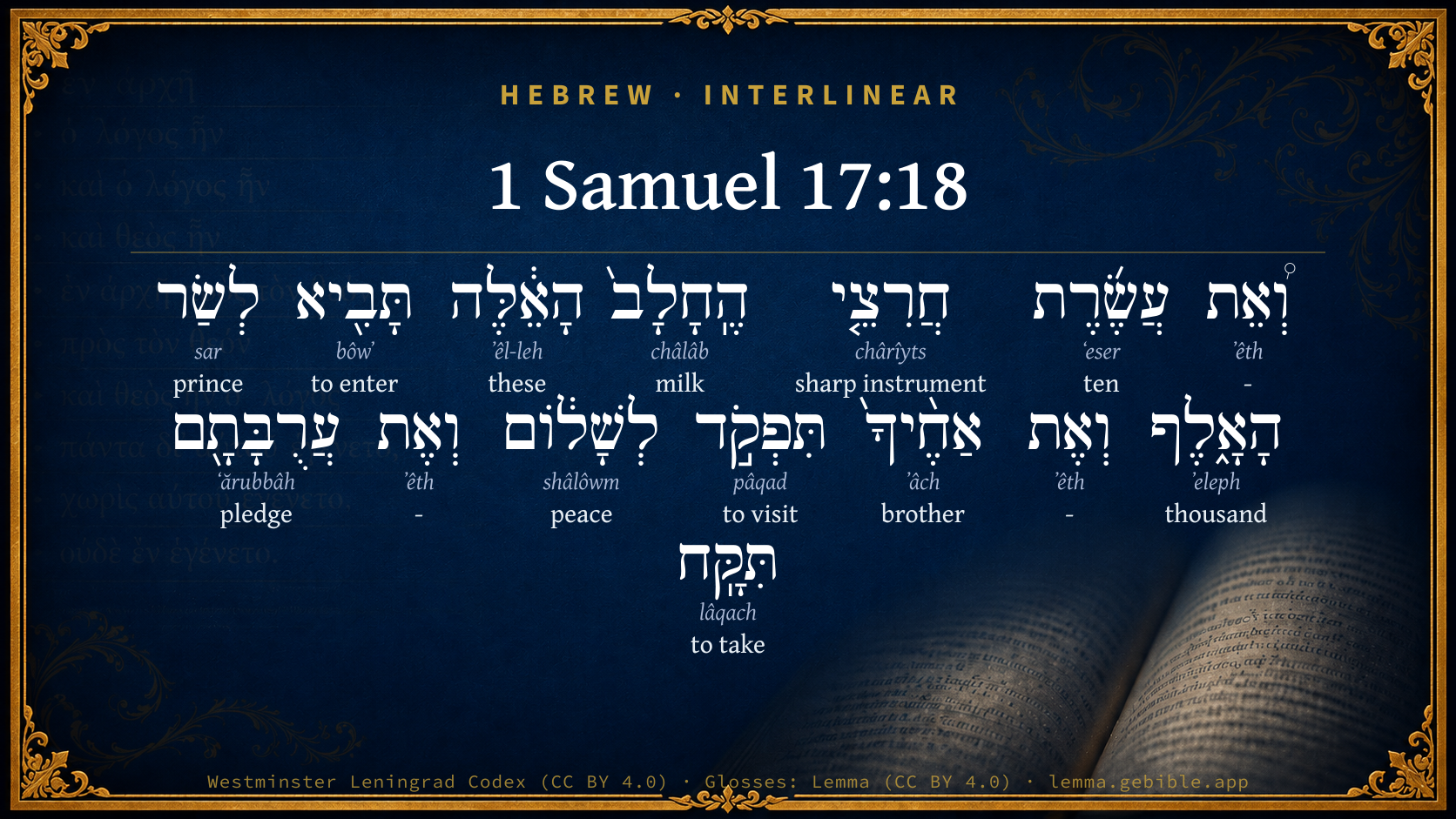
  1. וְ֠אֵת ʼêth H853 “and · -” Conjunction + Particle, Direct Object
  2. עֲשֶׂ֜רֶת ʻeser H6235 “ten” Adjective, Cardinal number, Masculine, Singular, Construct
  3. חֲרִצֵ֤י chârîyts H2757 “sharp instruments of” Noun, Common, Masculine, Plural, Construct
  4. הֶֽחָלָב֙ châlâb H2461 “the · milk” Particle, Definite Article + Noun, Common, Masculine, Singular, Absolute
  5. הָאֵ֔לֶּה ʼêl-leh H428 “the · these” Particle, Definite Article + Pronoun, Demonstrative, Common, Plural
  6. תָּבִ֖יא bôwʼ H935 “to enter” Verb, Hiphil, Imperfect, 2nd Person, Masculine, Singular
  7. לְשַׂר sar H8269 “to/for · prince of” Preposition + Noun, Common, Masculine, Singular, Construct
  8. הָאָ֑לֶף ʼeleph H505 “the · thousand” Particle, Definite Article + Adjective, Cardinal number, Both, Singular, Absolute
  9. וְאֶת ʼêth H853 “and · -” Conjunction + Particle, Direct Object
  10. אַחֶ֨יךָ֙ ʼâch H251 “brothers · your” Noun, Common, Masculine, Plural, Construct + Suffix, Personal, 2nd Person, Masculine, Singular
  11. תִּפְקֹ֣ד pâqad H6485 “to visit” Verb, Qal, Imperfect, 2nd Person, Masculine, Singular
  12. לְשָׁל֔וֹם shâlôwm H7965 “to/for · peace” Preposition + Noun, Common, Masculine, Singular, Absolute
  13. וְאֶת ʼêth H853 “and · -” Conjunction + Particle, Direct Object
  14. תִּקָּֽח lâqach H3947 “to take” Verb, Qal, Imperfect, 2nd Person, Masculine, Singular

About this verse

These counts appear in no published source. They are computed here, from the morphology-tagged text and Lemma’s own curated glosses. What Lemma adds →

15
words
13
distinct lemmas
Historical
section

Notable vocabulary

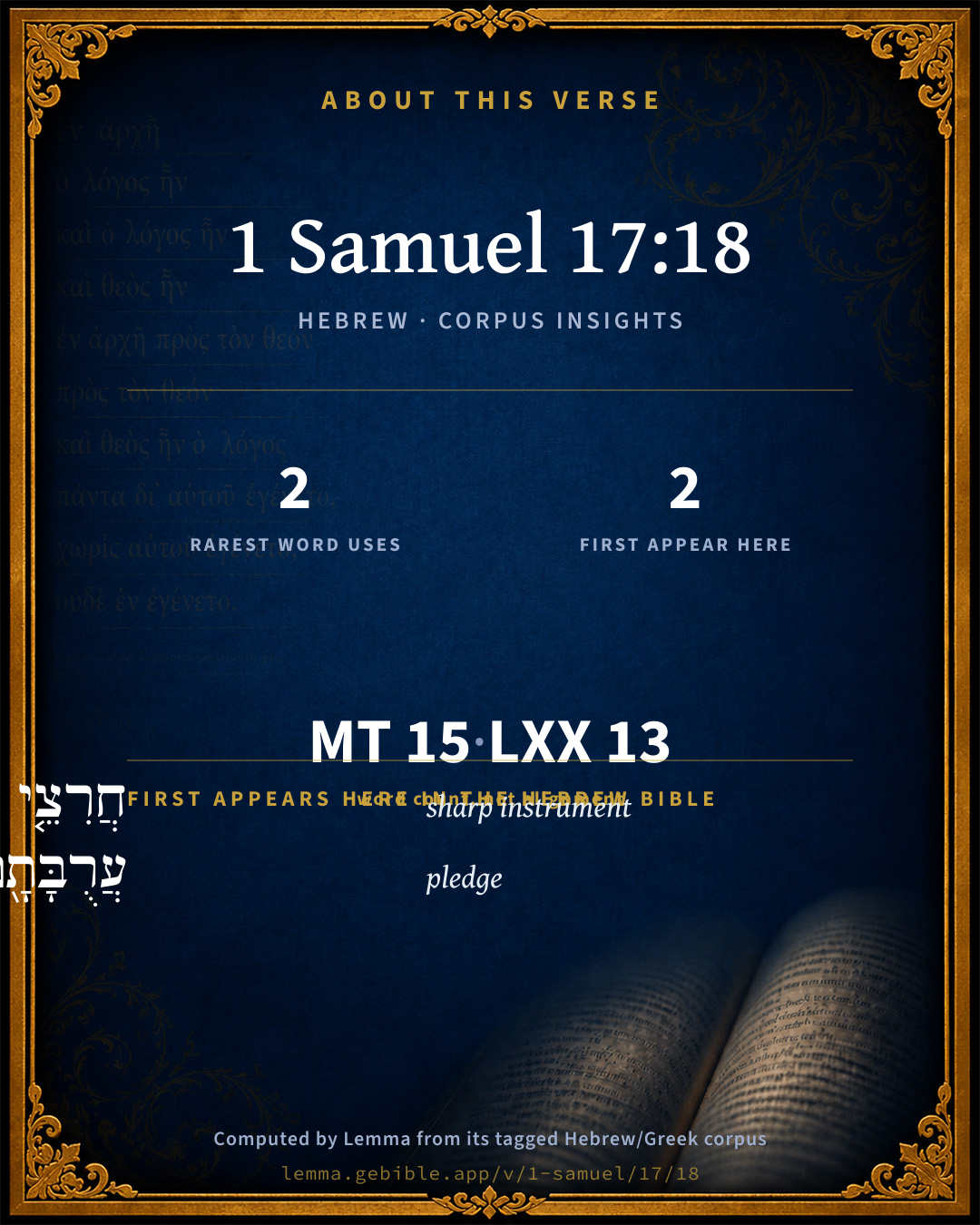
The rarest word here is עֲרֻבָּתָ֖ם pledge H6161 — appearing just 2 times in the whole Hebrew Bible.

First appearance in Scripture

These words make their first canonical appearance in the Hebrew Bible here:

  • חֲרִצֵ֤י sharp instrument H2757
  • עֲרֻבָּתָ֖ם pledge H6161

Shared distinctive vocabulary

עֲרֻבָּתָ֖ם pledge H6161 occurs in 2 verses of the Hebrew Bible. Also found in:

Grammatical profile

  • 3 verbs
  • 6 nouns
  • 2 adjectives
  • 1 pronoun
  • 3 particles

Verb forms

  • תָּבִ֖יא Hiphil · Imperfect
  • תִּפְקֹ֣ד Qal · Imperfect
  • תִּקָּֽח Qal · Imperfect

Hebrew & Septuagint length

In English translation the verse runs 21 words from the Hebrew and 28 from the Septuagint (LXX English) — closely comparable.

A rough comparison of the two English renderings, which tokenize alike — not a word-level alignment.

Word counts can differ between the Hebrew and the Greek without any difference in meaning — e.g. the Hebrew direct-object marker אֵת has no separate Greek word, and Greek often adds the article ὁ.

In the original languages it is 15 Hebrew tokens and 13 Greek tokens — but the two are counted differently (Hebrew bundles its prefixes and suffixes into one token; the Greek is in lemma form), so that isn’t a like-for-like length.

Cross-references

6

Topical passages linked to 1 Samuel 17:18 in the Treasury of Scripture Knowledge — connected by theme and wording, ordered by reader-vote popularity; previews shown in the World English Bible.

  • Genesis 37:14 He said to him, "Go now, see whether it is well with your brothers, and well with the flock; and bring me word again." So he sent him out of the valley of Hebron, and he came to Shechem.
  • 1 Samuel 16:20 Jesse took a donkey loaded with bread, and a bottle of wine, and a kid, and sent them by David his son to Saul.
  • 2 Samuel 17:29 and honey, and butter, and sheep, and cheese of the herd, for David, and for the people who were with him, to eat: for they said, The people are hungry, and weary, and thirsty, in the wilderness.
  • Job 10:10 Haven't you poured me out like milk, And curdled me like cheese?
  • Acts 15:36 After some days Paul said to Barnabas, "Let's return now and visit our brothers in every city in which we proclaimed the word of the Lord, to see how they are doing."
  • 1 Thessalonians 3:5–6 For this cause I also, when I couldn't stand it any longer, sent that I might know your faith, for fear that by any means the tempter had tempted you, and our labor would have been in vain.

Cross-references courtesy of OpenBible.info (CC BY 4.0).

Hebrew and Greek witnesses Masoretic Hebrew ↔ Greek Septuagint

The same verse in the two great witnesses to the Old Testament, shown verse-for-verse.

These are two independent witnesses, not word-aligned to each other, and the Septuagint is shown in lemma (dictionary) form.

Hebrew 1 Samuel 17:18 Masoretic · Westminster Leningrad Codex

וְ֠אֵת עֲשֶׂ֜רֶת חֲרִצֵ֤י הֶֽחָלָב֙ הָאֵ֔לֶּה תָּבִ֖יא לְשַׂר הָאָ֑לֶף וְאֶת אַחֶ֨יךָ֙ תִּפְקֹ֣ד לְשָׁל֔וֹם וְאֶת עֲרֻבָּתָ֖ם תִּקָּֽח

and bring these ten cheeses to the captain of their thousand, and look how your brothers fare, and take their pledge.

World English Bible · Public Domain

Greek LXX 1 Samuel 17:18 Septuagint · lemma form

καί ἐνδύω σαούλ ὁ δαυίδ μανδύας καί περικεφαλαία χαλκοῦς περί ὁ κεφαλή αὐτός

And you shall carry to the captain of the thousand these ten cheeses of milk, and you shall see how your brethren fare, and learn what they lack.

LXX2012 (modern English Septuagint) · Public Domain

On this verse, Haydock's Catholic Bible Commentary discusses the Septuagint’s reading. Read the note in Commentary ↓

Hebrew: Westminster Leningrad Codex (CC BY 4.0). Greek: Septuagint (public domain); English from LXX2012 (modern English Septuagint) (Public Domain). How the Septuagint differs from the Hebrew →

Targum (Aramaic paraphrase)

1

The Targum is the ancient Jewish Aramaic paraphrase of the Hebrew Scriptures — an interpretive translation, not the Hebrew text itself. Onkelos (literal) and Pseudo-Jonathan (expansive) render the Torah, and Jonathan the Prophets. Coverage is partial: where no permissively-licensed English translation exists for a verse, only the Aramaic is shown. This is verse-level text, not a word-by-word alignment to the Hebrew.

  1. Targum Jonathan Prophets (Joshua–Malachi)
    וְיַת עֲסַר גוּבְנִין דַחֲלָבָא הָאִלֵין תּוֹבֵיל לְרַב אַלְפָא וְיַת אַחָיךְ תַּסְעַר לִשְׁלָם וְיַת טִיבֵיהוֹן תַּיְתֵי:

    (no public-domain English translation for this verse)

    Targum Jonathan — Aramaic: “Mikraot Gedolot” (public domain). English: “Sefaria Community Translation” (CC0 1.0 (public-domain dedication)); “London "Chaldee Paraphrase," 1871” (public domain). Text via Sefaria.

Commentary

Notes on 1 Samuel 17:18 from classic Christian and Jewish commentators (each source and its license shown beneath its notes). The classic Christian expositions comment on the surrounding passage and are grouped to its opening verse, so a note may address several verses; the Jewish commentaries on the Tanakh (Rashi and others) are per-verse, so they appear only where the commentator wrote on this verse.

Lemma curates 59 commentaries, every one of them public domain or Creative Commons licensed, each selected and text-cleaned for this edition rather than reprinted as found. About our sources →

Trapp's Complete Commentary

John Trapp

1Sa 17:18 And carry these ten cheeses unto the captain of [their] thousand, and look how thy brethren fare, and take their pledge.

Ver. 18. Look how thy brethren fare.] Great is a parent’s care.

“ Omnis in Ascanio churi stat cura parentis. ”

And take their pledge.] Redeem what they have pawned, and bring me commendations from them.

John Trapp, A Commentary or Exposition upon All the Books of the Old and New Testament (1647–1656) — public domain. Text from a community e-Sword module.

Geneva Bible (1599)

Geneva Bible translators

If they have laid anything to gage for their necessity, redeem it out.

Geneva Bible (1599) marginal notes — public domain. Text via Bolls.life.

Jamieson, Fausset & Brown

Robert Jamieson, A. R. Fausset & David Brown

carry these ten cheeses to the captain--to enlist his kind attention. Oriental cheeses are very small; and although they are frequently made of so soft a consistence as to resemble curds, those which David carried seem to have been fully formed, pressed, and sufficiently dried to admit of their being carried.

take their pledge--Tokens of the soldiers' health and safety were sent home in the convenient form of a lock of their hair, or piece of their nail, or such like.

Jamieson, Fausset & Brown — Commentary Critical and Explanatory on the Whole Bible (1871) — public domain (CC PDM 1.0). Text via the HelloAO Bible API.

Adam Clarke's Commentary

Verse 18. Carry these ten cheeses] Cheeses of milk, says the margin. In the East they do not make what we call cheese: they press the milk but slightly, and carry it in rush baskets. It is highly salted, and little different from curds.

Adam Clarke's Commentary on the Bible (1810–1826) — public domain. Text from a community e-Sword/MySword module.

Ellicott's Commentary for English Readers

(18) Look how thy brethren fare.—The same learned commentator (Wordsworth), following out this curious line of Patristic interpretation, remarks on these words: “David is sent by his father to his brethren from Bethlehem. So the Divine David, Jesus Christ, who was born at Bethlehem, was sent to His brethren by his Heavenly Father.” He completes the analogy between David and Christ by pointing out how David was ill-received by his brethren, though he came at his father’s bidding to show them an act of kindness; so Christ, when sent by His Father from heaven on an embassy of love, was ill-received by His own brethren, the Jews. “He came unto His own, and His own received Him not” (Joh_1:11).

A Bible Commentary for English Readers, edited by Charles John Ellicott (1878–1897) — public domain. Text from a community e-Sword module.

The Cambridge Bible for Schools and Colleges

gen. ed. J. J. S. Perowne

18. look how thy brethren fare] Visit thy brethren and enquire after their welfare. Cp. Gen_37:14.

take their pledge] Bring home some token from them that they are well: the equivalent of a letter.

The Cambridge Bible for Schools and Colleges (gen. ed. J. J. S. Perowne; Cambridge University Press, 1878–1918) — public domain. Text from a community e-Sword module.

John Gill's Exposition

And carry these ten cheeses unto the captain of their thousand,.... Their chiliarch or colonel, who had the command of 1000 men, and under whom Jesse's sons fought; Jarchi thinks this was Jonathan, who had 1000 men with him at Gibeah, and so now, Sa1 13:2, these cheeses were sent by Jesse to the captain, to be distributed among his men, or a present to himself, that he might use his sons well who were under his command:

and look how thy brethren fare; whether in good health, in good spirits, and in safety:

and take their pledge; that is, if they had been obliged for want of money to pawn any of their clothes, or what they had with them to buy food with, that he would redeem and take up the pledge, by paying the money for which they were pawned; for it is thought that soldiers at this time were not maintained at the expense of the king and government, but at their own, and the families to which they belonged: though some are of opinion that this was some token which they had sent by a messenger to their father, by which he might know he came from them, so Ben Gersom; and which David was now to take with him, and return it; or a token that he was to bring from them, whereby he might be assured of their welfare; and so the Targum, "and bring their goodness", a token of their being in good health. The Jews (z) understand it of bills of divorce to be given to their wives, that if they should die in battle, or be taken captive, that their wives might marry after three years.

(z) Hieron. Trad. Heb. in lib. Reg. fol. 76. D.

John Gill's Exposition of the Whole Bible (1746–1763) — public domain (CC PDM 1.0). Text via the HelloAO Bible API.

Albert Barnes' Notes on the Bible

Take their pledge - i. e., bring back what they have to say in return.

Albert Barnes' Notes on the Bible (1834–1885) — public domain. Text from a community e-Sword/MySword module.

Haydock's Catholic Bible Commentary

Cheeses. Hebrew, "of milk." Septuagint, "pieces of soft cheese:" erts is no where else used to denote cheese. This was a present (Calmet) for (Hebrew) "the Chiliarch." --- Placed, who is their immediate officer. (Haydock) --- Hebrew, "how they are mixed:" their company. Septuagint, &c., "what they stand in need of." Symmachus, "Thou shalt receive their pay." Syriac and Arabic, "what news." Others would translate, "their pledge," or bill of divorce to their wives, that, in case they be made prisoners for three years, the latter may be allowed to marry. (Trad. Heb.[Hebrew tradition?]) (Calmet)

George Leo Haydock (1774–1849), Haydock's Catholic Family Bible and Commentary, 1859 edition — public domain. Excludes Psalms (Douay-Rheims chapter numbering differs from Protestant) and Deuterocanonical books (Catholic canon only).

Matthew Poole's English Annotations

Unto the captain of their thousand; in whose power it was in a great measure, either to preserve them, or to expose them to utmost hazards.

Take their pledge, i.e. bring me some token of their welfare from them.

Matthew Poole's English Annotations on the Holy Bible (1683–1685) — public domain. Text from a community e-Sword/MySword module.

Whedon's Commentary on the Bible

Daniel D. Whedon

18. Cheeses — Literally, cuttings of the milk. That is, say some, slices of curdled milk. Cheese is not common at the present day among the Bedouin Arabs, but there is in use among them a substance, consisting of coagulated buttermilk, which is dried until it becomes quite hard, and is then ground.

Their pledge — A token from them that they are alive and well.

Daniel D. Whedon (gen. ed.), Commentary on the Old and New Testaments (1874–1909) — public domain. Text from a community e-Sword module.

John Wesley's Explanatory Notes

Pledge - That is, bring me some token of their welfare.

John Wesley, Explanatory Notes Upon the Whole Bible (1754–1765) — public domain. Text via the GEBible commentary corpus.

Rashi

Rabbi Shlomo Yitzchaki (Rashi)

Cheeses. [Targum Yonoson renders] 'cheeses.'

To the captain of the thousand. I say 'to the captain of that thousand to which his brothers belong,' for all the tribes had captains of thousands according to their thousands. But I have heard, that 'to the captain of the thousand' refers to Yonoson, concerning whom [Scripture] stated, 'And a thousand were with Yonoson in Givas Binyomin'.

And take the tidings of their welfare. The assurance of their salvation and their welfare you shall take into your ears and to your heart, and tell it to me. And so did Targum Yonoson render, 'and their welfare you shall bring.'

Tidings of their welfare. This is an expression of salvation, as in 'Assure your servant for good'; garantis in O.F. Our Rabbis said [it means] that he should take a divorce from them, and deliver it to their wives, to break the connection [עֵרוּב] between him [husband] and her [wife].

Rashi on the Tanakh — English translations: “The Judaica Press complete Tanach with Rashi, translated by A. J. Rosenberg” (CC BY 4.0); “Pentateuch with Rashi's commentary by M. Rosenbaum and A.M. Silbermann, 1929-1934” (public domain); “The Metsudah Tanach series, Lakewood, N.J” (CC BY 4.0); and “The Book of Joshua, Metsudah Publications, 1997” (CC BY 4.0). Text via Sefaria.

Lesson kit

Teaching starters — assembled from the data on this page, not authored interpretation. Every prompt links to the verse data it draws on. Edit before teaching.

1 Samuel, in the Historical, opens this verse with 15 words (13 distinct Hebrew lemmas). Its most distinctive word is ʻărubbâh (“pledge”). A historical commentator’s framing appears above. Read the whole chapter for the surrounding context.

Discussion questions

  1. How does “pledge” (ʻărubbâh) shape what this verse is saying?
  2. 2 words make their first appearance in Scripture here. What does this debut establish?
  3. How does Proverbs 17:18, which shares the word «pledge», read alongside this verse?
  4. The translations on this page render this verse differently — a whole-verse word diff, not a word-by-word alignment. What might account for the different wordings?
  5. «תָּבִ֖יא» is a Hiphil Imperfect verb. How does that grammatical form shape the action described?
  6. Compare how Trapp's Complete Commentary and Geneva Bible (1599) read this verse. Where do they agree or differ?

Things to notice

Reading settings

Reading text

Shown beneath each verse's original-language words.

Old Testament
Old Testament edition

Read the OT as the Masoretic Hebrew (MT) or the Greek Septuagint (LXX).

English shown for the Greek Septuagint (in the Hebrew ↔ Greek comparison).

Comparing translations? Open the Compare panel on any verse page to stack up to four side by side.