Psalms 38:3

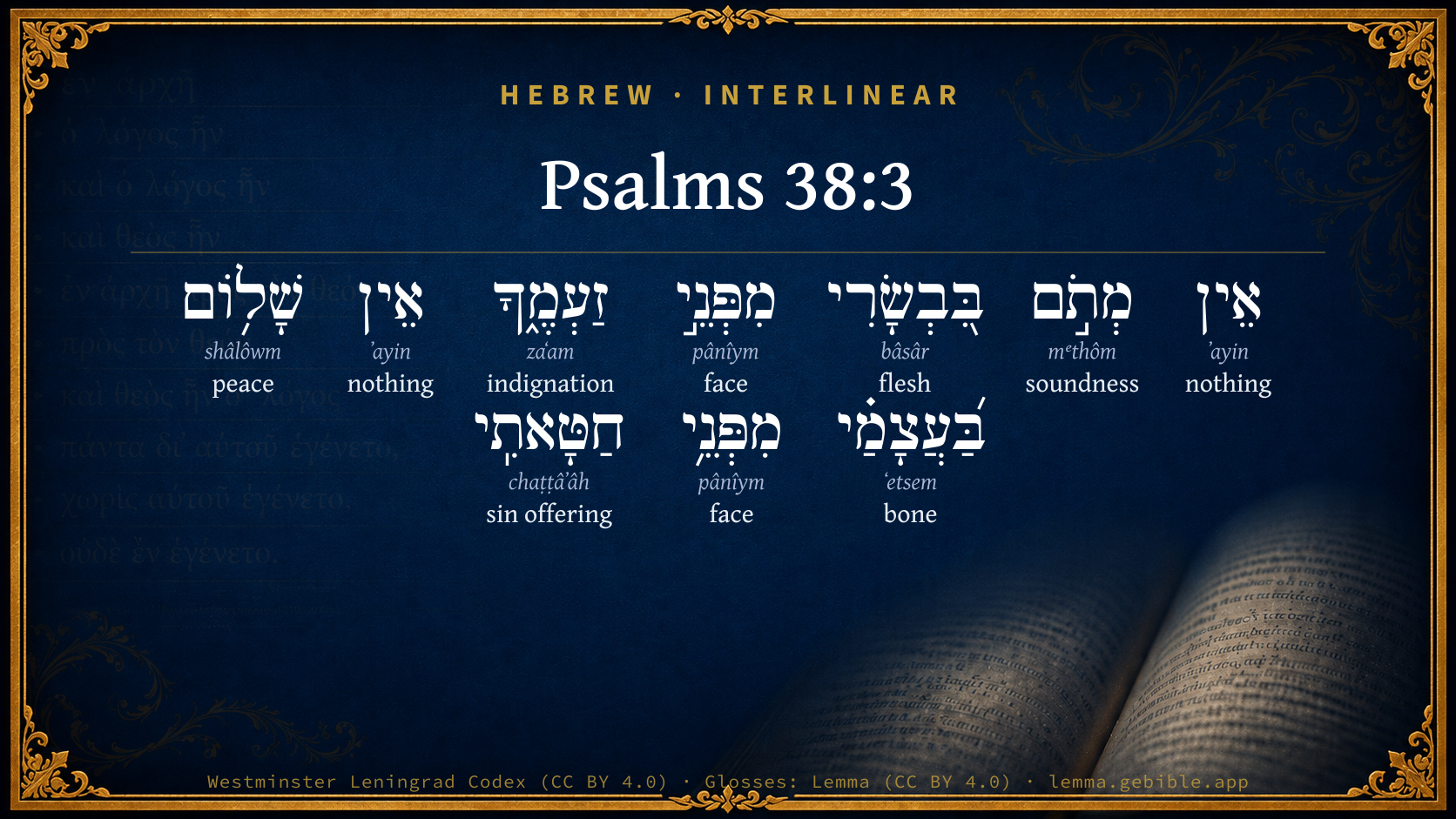
Hebrew (Westminster Leningrad Codex) Psalms 38:3 appears in the Hebrew Old Testament. The text above is from the Westminster Leningrad Codex. Each word links to its Strong’s number, a concise gloss, and parsing drawn from the Open Scriptures Hebrew Bible morphology. Click any word for its full Brown-Driver-Briggs (BDB) entry.
Download image
Cite this verse

Psalms 38:3 (World English Bible). Public Domain. Lemma interlinear Bible study tool, https://lemma.gebible.app/v/psalms/38/3.

Show BibTeX & RIS
BibTeX
RIS
English Translation
There is no soundness in my flesh because of your indignation, Neither is there any health in my bones because of my sin.
World English Bible · Public Domain
Highlights
  • 1 first appearance in the Hebrew Bible
Full analysis ↓
Download a study sheet

One document with this verse’s original text, its word-by-word gloss line, the meaning frame, cross-references with their text, attributed commentary, and full source and license credits — printable, and it pastes into notes with its structure intact.

This verse Autodidact and up

Study sheet (.html) Plain text (.txt)

A passage Seminary Student

Up to 50 verses in one chapter. A passage sheet keeps up to 6 commentary sources and 12 cross-references per verse, in the order this page ranks them, and says so on the sheet whenever that leaves anything out. Ask for a single verse and you get the Autodidact verse sheet above.

Everything on this page stays free to read, with no account — the sheet is a download of what is already on screen, not access to it.

Want to remove ads? Support Godless Engineer
Compare translations 3

The same verse in 3 English versions, stacked beneath the original-language interlinear above. Click any original word for its lexicon entry.

Each is an independent rendering of the whole verse — the interlinear is not word-aligned to these translations.

Highlighted words mark where these versions differ — a whole-verse word diff, not a word-by-word alignment.

  • World English Bible Public Domain
    There is no soundness in my flesh because of your indignation, Neither is there any health in my bones because of my sin.
  • King James Version Public Domain
    There is no soundness in my flesh because of thine anger; neither is there any rest in my bones because of my sin.
  • unfoldingWord Literal Text CC BY-SA 4.0
    There is no soundness in my flesh from the face of your indignation; there is no peace in my bones from the face of my sin.

unfoldingWord Literal Text — © unfoldingWord, licensed CC BY-SA 4.0. Word-aligned USFM3 via Door43 (git.door43.org/unfoldingWord/en_ult).

Versions to compare (up to 4)

3 of 4 selected

Show all 18 translations

Every available English version of this verse, each an independent rendering of the whole verse.

  • World English Bible Public Domain
    There is no soundness in my flesh because of your indignation, Neither is there any health in my bones because of my sin.
  • Berean Standard Bible Public Domain
    There is no soundness in my body because of Your anger; there is no rest in my bones because of my sin.
  • Majority Standard Bible Public Domain
    There is no soundness in my body because of Your anger; there is no rest in my bones because of my sin.
  • King James Version Public Domain
    There is no soundness in my flesh because of thine anger; neither is there any rest in my bones because of my sin.
  • American Standard Version (1901) Public Domain
    There is no soundness in my flesh because of thine indignation; Neither is there any health in my bones because of my sin.
  • Revised Version (1885) Public Domain
    There is no soundness in my flesh because of thine indignation; neither is there any health in my bones because of my sin.
  • Geneva Bible (1599) Public Domain
    There is nothing sound in my flesh, because of thine anger: neither is there rest in my bones because of my sinne.
  • Douay-Rheims (1899) Public Domain
    For thy arrows are fastened in me: and thy hand hath been strong upon me.
  • Young's Literal Translation Public Domain
    Soundness is not in my flesh, Because of Thine indignation, Peace is not in my bones because of my sin.
  • Literal Standard Version CC BY-SA 4.0
    Soundness is not in my flesh, || Because of Your indignation, || Peace is not in my bones, || Because of my sin.
  • Unlocked Literal Bible CC BY-SA 4.0
    My whole body is sick because of your anger; there is no health in my bones because of my sin.
  • unfoldingWord Literal Text CC BY-SA 4.0
    There is no soundness in my flesh from the face of your indignation; there is no peace in my bones from the face of my sin.
  • Darby Bible Public Domain
    There is no soundness in my flesh because of thine indignation; no peace in my bones, because of my sin.
  • World Messianic Bible Public Domain
    There is no soundness in my flesh because of your indignation, neither is there any health in my bones because of my sin.
  • Webster's Bible Public Domain
    \\38:2\\For thy arrows stick fast in me, and thy hand falleth heavy upon me.
  • Free Bible Version CC BY-SA 4.0
    Because you're so upset with me, not a single part of my body is healthy; I am completely sick because of my sins.
  • Bible in Basic English Public Domain
    My flesh is wasted because of your wrath; and there is no peace in my bones because of my sin.
  • JPS Tanakh (1917) Public Domain
    (38-4) There is no soundness in my flesh because of Thine indignation; neither is there any health in my bones because of my sin.

Literal Standard Version (2020), Covenant Press — licensed CC BY-SA 4.0. Text via the HelloAO Bible API (eBible.org). Unlocked Literal Bible (unfoldingWord) — licensed CC BY-SA 4.0. Text via the HelloAO Bible API (eBible.org). unfoldingWord Literal Text — © unfoldingWord, licensed CC BY-SA 4.0. Word-aligned USFM3 via Door43 (git.door43.org/unfoldingWord/en_ult). Free Bible Version, Dr. Jonathan Gallagher — licensed CC BY-SA 4.0. Text via the HelloAO Bible API (eBible.org).

Word by word

More ways to search: Search by grammar → Find every occurrence → Compare this word →

Practice this passage: Drill this verse → Learn its vocabulary →

מְתֹ֣ם
mᵉthôm
H4974
“soundness”
Noun, Common, Masculine, Singular, Absolute
Part of Speech
Noun
Type
Common
Gender
Masculine
Number
Singular
State
Absolute
Full BDB Definition

Origin: from H8552

TWOT: 2522e

soundness, entirety, entire
  1. אֵין ʼayin H369 “nothing” Particle, Negative
  2. בִּ֭בְשָׂרִי bâsâr H1320 “in/at · flesh · my” Preposition + Noun, Common, Masculine, Singular, Construct + Suffix, Personal, 1st Person, Common, Singular
  3. מִפְּנֵ֣י pânîym H6440 “from · face(s) of” Preposition + Noun, Common, Both, Plural, Construct
  4. זַעְמֶ֑ךָ zaʻam H2195 “indignation · your” Noun, Common, Masculine, Singular, Construct + Suffix, Personal, 2nd Person, Masculine, Singular
  5. אֵין ʼayin H369 “nothing” Particle, Negative
  6. שָׁל֥וֹם shâlôwm H7965 “peace” Noun, Common, Masculine, Singular, Absolute
  7. בַּ֝עֲצָמַ֗י ʻetsem H6106 “in/at · bones · my” Preposition + Noun, Common, Feminine, Plural, Construct + Suffix, Personal, 1st Person, Common, Singular
  8. מִפְּנֵ֥י pânîym H6440 “from · face(s) of” Preposition + Noun, Common, Both, Plural, Construct
  9. חַטָּאתִֽי chaṭṭâʼâh H2403 “sin offering · my” Noun, Common, Feminine, Singular, Construct + Suffix, Personal, 1st Person, Common, Singular

About this verse

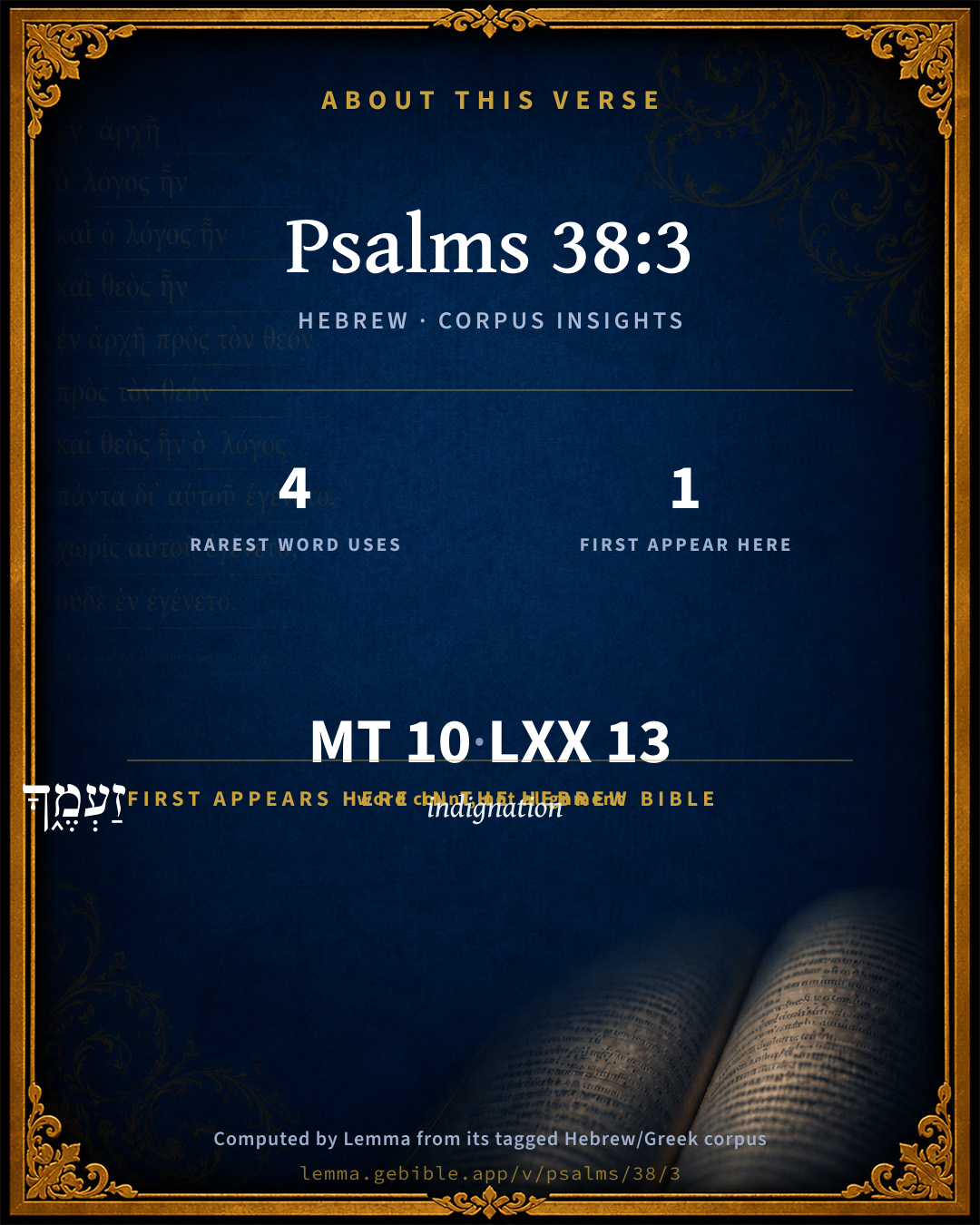
These counts appear in no published source. They are computed here, from the morphology-tagged text and Lemma’s own curated glosses. What Lemma adds →

10
words
8
distinct lemmas
Wisdom
section

Notable vocabulary

The rarest word here is מְתֹ֣ם soundness H4974 — appearing just 4 times in the whole Hebrew Bible.

First appearance in Scripture

This word makes its first canonical appearance in the Hebrew Bible here:

  • זַעְמֶ֑ךָ indignation H2195

Shared distinctive vocabulary

מְתֹ֣ם soundness H4974 occurs in 4 verses of the Hebrew Bible. Also found in:

Grammatical profile

  • 8 nouns
  • 2 particles

Repetition

Words recur within this verse — often emphatic in Hebrew:

  • אֵין nothing H369 ×2
  • מִפְּנֵ֣י face H6440 ×2

Hebrew & Septuagint length

In English translation the verse runs 23 words from the Hebrew and 23 from the Septuagint (LXX English) — the same length.

A rough comparison of the two English renderings, which tokenize alike — not a word-level alignment.

Word counts can differ between the Hebrew and the Greek without any difference in meaning — e.g. the Hebrew direct-object marker אֵת has no separate Greek word, and Greek often adds the article ὁ.

In the original languages it is 10 Hebrew tokens and 13 Greek tokens — but the two are counted differently (Hebrew bundles its prefixes and suffixes into one token; the Greek is in lemma form), so that isn’t a like-for-like length.

Cross-references

11

Topical passages linked to Psalms 38:3 in the Treasury of Scripture Knowledge — connected by theme and wording, ordered by reader-vote popularity; previews shown in the World English Bible.

  • Psalms 6:2 Have mercy on me, Yahweh, for I am faint. Yahweh, heal me, for my bones are troubled.
  • Psalms 51:8 Let me hear joy and gladness, That the bones which you have broken may rejoice.
  • Psalms 31:9–10 Have mercy on me, Yahweh, for I am in distress. My eye, my soul, and my body waste away with grief.
  • Isaiah 1:5–6 Why should you be beaten more, That you revolt more and more? The whole head is sick, And the whole heart faint.
  • Lamentations 3:40–42 Let us search and try our ways, and turn again to Yahweh.
  • 2 Chronicles 26:19 Then Uzziah was angry; and he had a censer in his hand to burn incense; and while he was angry with the priests, the leprosy broke forth in his forehead before the priests in the house of Yahweh, beside the altar of incense.
  • Job 2:7–8 So Satan went forth from the presence of Yahweh, and struck Job with painful sores from the sole of his foot to his head.
  • Job 33:19–22 He is chastened also with pain on his bed, With continual strife in his bones;
  • Psalms 90:7–8 For we are consumed in your anger. We are troubled in your wrath.
  • Psalms 102:3 For my days consume away like smoke. My bones are burned as a firebrand.
  • Psalms 102:5 By reason of the voice of my groaning, My bones stick to my skin.

Cross-references courtesy of OpenBible.info (CC BY 4.0).

Hebrew and Greek witnesses Masoretic Hebrew ↔ Greek Septuagint

The same verse in the two great witnesses to the Old Testament, shown verse-for-verse.

You’re reading Greek Psalm 37 (Hebrew Psalm 38). The Septuagint counts the superscription, so verse numbers can differ from the Hebrew — chapter-level alignment, not verse-by-verse. Numbering follows Rahlfs.

These are two independent witnesses, not word-aligned to each other, and the Septuagint is shown in lemma (dictionary) form.

Hebrew Psalms 38:3 Masoretic · Westminster Leningrad Codex

אֵין מְתֹ֣ם בִּ֭בְשָׂרִי מִפְּנֵ֣י זַעְמֶ֑ךָ אֵין שָׁל֥וֹם בַּ֝עֲצָמַ֗י מִפְּנֵ֥י חַטָּאתִֽי

There is no soundness in my flesh because of your indignation, Neither is there any health in my bones because of my sin.

World English Bible · Public Domain

Greek LXX Greek Psalm 37:3 Septuagint · lemma form

ὅτι ὁ βέλος σύ ἐνπήγνυμι ἐγώ καί ἐπιστηρίζω ἐπί ἐγώ ὁ χείρ σύ

For there is no health in my flesh because of your anger; there is no peace to my bones because of my sins.

LXX2012 (modern English Septuagint) · Public Domain

On this verse, Ellicott's Commentary for English Readers discusses the Septuagint’s reading. Read the note in Commentary ↓

Hebrew: Westminster Leningrad Codex (CC BY 4.0). Greek: Septuagint (public domain); English from LXX2012 (modern English Septuagint) (Public Domain). How the Septuagint differs from the Hebrew →

Commentary

Notes on Psalms 38:3 from classic Christian and Jewish commentators (each source and its license shown beneath its notes). The classic Christian expositions comment on the surrounding passage and are grouped to its opening verse, so a note may address several verses; the Jewish commentaries on the Tanakh (Rashi and others) are per-verse, so they appear only where the commentator wrote on this verse.

Lemma curates 59 commentaries, every one of them public domain or Creative Commons licensed, each selected and text-cleaned for this edition rather than reprinted as found. About our sources →

Trapp's Complete Commentary

John Trapp

Psa 38:3 [There is] no soundness in my flesh because of thine anger; neither [is there any] rest in my bones because of my sin.

Ver. 3. There is no soundness in my flesh because of thine anger] This was the immediate cause of David’s misery, it came from love displeased; and scandalous sins seldom scape better. But, blessed be our Almighty physician, who bringeth health out of sickness, by bringing thereby the body of death into a consumption.

Neither is there any rest in my bones] Bis repetit, more lugentium. He saith the same thing twice, as mourners use to do; but with an aggravation of his pain, reaching to his very bones.

Because of my sin] This was the remote cause of his present sufferings; and is the true mother of all man’s misery. Now when these two (God’s wrath and man’s sin) meet in the soul, as medicine and sickness in the stomach, there must needs be much unrest till they be vomited up by confession. It is as natural for guilt to breed disquiet as for putrid matter to breed vermin. Let God therefore be justified, and every mouth stopped.

John Trapp, A Commentary or Exposition upon All the Books of the Old and New Testament (1647–1656) — public domain. Text from a community e-Sword module.

The Biblical Illustrator

Joseph S. Exell

Psa_38:3

There is no soundness in my flesh because of Thine anger.

--He proceedeth to exaggerate and amplify the greatness of his grief from the universality thereof; that his sickness was not laid on any one part of his body, but upon his whole flesh, and upon all his bones. His flesh is his exterior part, his bones his interior. Albeit the ulcers and wounds of his flesh were very sensible to him, and more horrible in the eyes of men who beheld them (as that of Job and Lazarus), which he might have apprehended deeply when as by them he was made contemptible in the eyes of men: yet his inward pain, which was more felt than seen, maketh him thus pitifully to cry. Wherein we have these things to consider.

1. That as all members agreed together to the performance of his filthy lust, so every one of them receiveth a deserved punishment. And it is good for man that he should be thus chastised in this world for a little time, rather than that he should be reserved for everlasting darkness, where every member shall receive eternal pain for their sin. For as sin pleaseth nature, so doth it destroy and consume nature.

2. He setteth forth the cause of those punishments, even Gods wrath, because of his sin. For when those two meet together, they are as fire and flax; Gods wrath as fire, will soon devour the stubble of our sins.

3. Observe that David maketh not Gods wrath the only cause of his miseries and heavy sickness; for that were to charge God of unrighteousness; but he justifieth God, when he acknowledgeth that his own sin was the cause of all his evils. And surely we can never give sufficient honour to God, except we free Him of all imputations of unjust dealing, and acknowledge ourselves to be the cause of our own miseries. (A. Symson.)

The Biblical Illustrator, edited by Joseph S. Exell (c. 1880s–1900s) — public domain. Text from a community e-Sword module.

The Treasury of David

Charles H. Spurgeon

Ver. 3. There is no soundness in my flesh because of thine anger. Mental depression tells upon the bodily frame; it is enough to create and foster every disease, and is in itself the most painful of all diseases. Soul sickness tells upon the entire frame; it weakens the body, and then bodily weakness reacts upon the mind. One drop of divine anger sets the whole of our blood boiling with misery. Neither is there any rest in my bones because of my sin. Deeper still the malady penetrates, till the bones, the more solid parts of the system, are affected. No soundness and no rest are two sad deficiencies; yet these are both consciously gone from every awakened conscience until Jesus gives relief. God's anger is a fire that dries up the very marrow; it searches the secret parts of the belly. A man who has pain in his bones tosses to and fro in search of rest, but he finds none; he becomes worn out with agony, and in so many cases a sense of sin creates in the conscience a horrible unrest which cannot be exceeded in anguish except by hell itself.

Ver. 3. Thine anger...my sin. I, alas! am as an anvil under two hammers; one of thine anger, another of my sin; both of them beating incessantly upon me; the hammer of thine anger beating upon my flesh and making that unsound; the hammer of my sin beating upon my bones and making them unquiet; although indeed both beat upon both; but thine anger more upon my flesh, as being more sensible; my sin more upon my bones, as being more obdurate. God's anger and sin are the two efficient causes of all misery; but the procatarctic (as applied to diseases, signifies the exciting cause) cause indeed is sin: God's anger, like the house that Samson pulled upon his own head, falls not upon us but when we pull it upon ourselves by sin. Sir Richard Baker.

Ver. 3. My flesh...my bones. I know by the unsoundness of my flesh that God is angry with me; for if it were not for his anger my flesh would be sound: but what soundness can there be in it now, when God's angry hand lies beating upon it continually, and never ceaseth? I know by the unquietness of my bones that I have sin in my bosom; for if it were not for sin my bones would be quiet. But what quietness can be in them now, when sin lies gnawing upon them incessantly with the worm of remorse? One would think my bones were far enough removed and closely enough hidden from sins doing them any hurt: yet see the searching nature, the venomous poison of sin, which pierceth through my flesh, and makes unquietness in my very bones. I know my flesh is guilty of many faults, by which it justly deserves unsoundness; but what have my bones done? for they minister no fuel to the flames of my flesh's sensuality; and why then should they be troubled? But are not my bones supporters of my flesh, and are they not by this at least accessory to my flesh's faults? As accessories, then, they are subject to the same punishment the flesh itself is, which is the principal. Sir Richard Baker.

Ver. 3. neither is there any rest in my bones because of my sin. A Christian in this life is like quicksilver, which hath a principle of motion in itself, but not of rest: we are never quiet, but as the ball upon the racket, or the ship upon the waves. As long as we have sin, this is like quicksilver: a child of God is full of motion and disquiet...We are here in a perpetual hurry, in a constant fluctuation; our life is like the tide; sometimes ebbing, sometimes flowing; here is no rest; and the reason is because we are out of centre. Everything is in motion till it comes at the centre; Christ is the centre of the soul; the needle of the compass trembles till it comes to the North Pole. Thomas Watson.

Ver. 3. Learn here of beggars how to procure succour and relief. Lay open thy sores, make known thy need, discover all thy misery, make not thy case better than it is. Beggars by experience find that the more miserable they appear to be, the more they are pitied, the more succoured; and yet the mercies of the most merciful men are but as drops in comparison of the oceans of God's mercies; and among men there are many, like the priest and Levite in the parable Lu 10:30-32, that can pass by a naked, wounded man, left half dead, and not pity him nor succour him. But God, like the merciful Samaritan, hath always compassion on such as with sense of their misery are forced to cry out and crave help. Read how Job, Job 6:1-30 and Job 7:1-21; David, Ps 38:3, etc., Hezekiah, Isa 38:10, etc., and other like saints poured out their complaints before the Lord, and withal observe what mercy was showed them of the Lord, and you may have in them both good patterns how to behave yourselves in like cases, and good encouragement so to do. This is it which God expects of us, and whereunto he desireth to bring us, that seeing our own emptiness and insufficiency, and the impotency and disability of others to help us, we should in all humility fly to his mercy. William Gouge.

Ver. 3. (last clause). Sin causes unrest. He who cures it alone gives rest. Dwell on both facts.

Psalms 38:4*

Charles H. Spurgeon's The Treasury of David (1869–1885) — public domain. Psalms only. Text from a community e-Sword/MySword module.

Joseph Benson's Commentary

Psa 38:3-6. There is no soundness, &c. — My disease or grief hath seized upon all the parts of my body, my very bones not excepted, so that my bed can give me no rest; because of my sin — Which hath provoked thee to deal thus severely with me. For my iniquities, &c. — Or, the punishment of my iniquities, as this word is frequently used; are gone over my head — Like deep waters, wherewith I am overwhelmed. My wounds are corrupt — The bruises and sores, caused by my disease, are not only painful, but loathsome to myself and others; because of my foolishness — As a just punishment of my folly; whereby, to satisfy my unreasonable desires, I have inconsiderately offended thee, 2Sa 11:2-4. I am troubled — ינעוותי, nagnaveeti, I am distorted, or depressed; or, as it is expressed by another word, signifying the same thing, bowed down, namely, in my body, as diseased persons generally are, and withal dejected in my mind. I go mourning — Hebrew, in black; the sign of mourning, which may here be taken figuratively. When I rise out of my bed, and walk, or rather creep about in my chamber, I do it with a sad heart and a dejected countenance. Or going may be here meant of his languishing, or going toward the grave, as this same word is used sometimes.

Joseph Benson's Commentary on the Old and New Testaments (1811–1818) — public domain. Text from a community e-Sword module.

J. A. Alexander on Psalms

Joseph Addison Alexander

4. (Psa 38:3). There is no sound place in my flesh because of thine anger; there is no peace in my bones because of my sin. Here begins a more particular description of the sufferings indicated by the general terms of the preceding verse. The first thing mentioned is his bodily suffering, as a token of God's wrath and an effect of his own sin, by which that wrath had been provoked. Flesh and bones are put for the whole bodily frame. The word translated sound place is a local noun, as indicated by its form, and not an abstract (soundness). It occurs only in this passage and in Isaiah's imitation of it (Isa 1:6). There, as here, the body is represented as one bruise, in which there is no sound place, i.e. no spot free from pain or soreness.—Because of, literally from the face of, from the presence of, from before, the phrase being primarily used to denote fear or flight before an enemy. Peace may be taken in the wide sense of well-being, good condition, health (see above, on Psa 37:11); but it more probably denotes peace in the strict sense, i.e. rest or freedom from the disquietude produced by pain.

Joseph Addison Alexander, The Psalms Translated and Explained (1850) — public domain. Text from a community e-Sword module.

Tyndale Open Study Notes

Tyndale Open Resources

38:3 Sin can lead to sickness and even death (1 Cor 11:30). Whether the psalmist actually felt physically ill or his sickness was a metaphor for emotional turmoil, he knew that it came from God and threatened his life (see Pss 32:3; 39:10).

Tyndale Open Study Notes — © Tyndale Open Resources, licensed CC BY-SA 4.0. Text via the HelloAO Bible API.

Geneva Bible (1599)

Geneva Bible translators

David acknowledgeth God to be just in his punishments, because his sins had deserved much more.

Geneva Bible (1599) marginal notes — public domain. Text via Bolls.life.

Adam Clarke's Commentary

Verse 3. No soundness in my flesh] This seems to refer to some disorder which so affected the muscles as to produce sores and ulcers; and so affected his bones as to leave him no peace nor rest. In short, he was completely and thoroughly diseased; and all this he attributes to his sin, either as being its natural consequence, or as being inflicted by the Lord as a punishment on its account.

Adam Clarke's Commentary on the Bible (1810–1826) — public domain. Text from a community e-Sword/MySword module.

John Calvin's Commentaries

3. There is no soundness in my flesh because of thy anger Others translate, There is no beauty; but this does not seem to be so suitable. In the clause which follows, David ascribes to God the praise of righteousness, without which, the acknowledgement which he formerly made would be of little avail; nay, instead of this, such an acknowledgement sometimes rather exasperates the minds of men, so that they provoke the wrath of God still more, by charging him with cruelty, and pouring forth horrible blasphemies against him. Nothing, therefore, can be more preposterous, than to imagine that there is in God a power so supreme and absolute, (as it is termed,) as to deprive him of his righteousness. David, as soon as he recognised his affliction as coming from God, turns to his own sin as the cause of the Divine displeasure; for he had already been fully satisfied in his own mind, that he is not like a tyrant who exercises cruelty needlessly and at random, but a righteous judge, who never manifests his displeasure by inflicting judgments but when he is grievously offended. If, then, we would render to God the praise which is due to him, let us learn by the example of David to connect our sins with his wrath.

John Calvin's Commentaries (1540-1563) — public domain. Text from the Calvin Translation Society English edition (1840s-50s) via the Christian Classics Ethereal Library (ccel.org). Calvin's coverage is partial (roughly two-thirds of the Bible); uncommented books and verses are honest gaps, never fabricated. The 19th-century editor's footnotes and remarks are omitted so the notes are faithfully Calvin's own voice.

Ellicott's Commentary for English Readers

(3) Rest . . .—Better, health. The Hebrew is from a root meaning to be whole. Peace (see margin), the reading of the LXX. and Vulg. is a derived meaning.

A Bible Commentary for English Readers, edited by Charles John Ellicott (1878–1897) — public domain. Text from a community e-Sword module.

The Cambridge Bible for Schools and Colleges

gen. ed. J. J. S. Perowne

3. His own sin is the cause of the divine indignation which inflicts the chastisement; and while God’s wrath assaults him from without, the fever of sin consumes him from within. With this verse and Psa_38:5, comp. Isaiah’s description of the deep-seated disease of Israel’s body corporate (Isa_1:5-6).

anger] Better as R.V. indignation, as in Psa_7:11; Psa_102:10.

rest] R.V. health; lit., wholeness or peace. For in my bones see Psa_6:2, note.

The Cambridge Bible for Schools and Colleges (gen. ed. J. J. S. Perowne; Cambridge University Press, 1878–1918) — public domain. Text from a community e-Sword module.

John Gill's Exposition

For mine iniquities are gone over mine head,.... Like an inundation of waters, as the waves and billows of the sea; for the waters to come up to the neck or chin shows great danger; but when they go over the head the case is desperate, and a person is sinking and drowning; compare with this Psa 69:1; the simile may denote both the number and weight of sins, and also signifies the overwhelming distress the psalmist was in, under a view of them;

as an heavy burden, they are too heavy for me; the guilt of sin upon the conscience, without a view of pardon, lies heavy indeed, and makes a man a burden to himself, as it did Job, Job 7:20; yea, sin is not only grieving and afflicting to pardoned ones, and who know they are pardoned, but it is a burden to them under which they groan; nor is it possible for any so to bear it as to satisfy and make atonement for it; none but Christ could ever do this, and he has done it; nor is there any relief for burdened souls, but by looking to a sin bearing and sin atoning Saviour, and by casting the burden upon him, who invites them to him for rest.

John Gill's Exposition of the Whole Bible (1746–1763) — public domain (CC PDM 1.0). Text via the HelloAO Bible API.

Albert Barnes' Notes on the Bible

There is no soundness in my flesh - There is no sound place in my flesh; there is no part of my body that is free from disease. The word used here - מתם methôm - occurs only in Jdg 20:48, where it is rendered “men;” in Isa 1:6, and in this place, where it is rendered “soundness.” See the notes at Isa 1:6. It means that the body was wholly diseased; but what was the nature of the disease we are not informed. It would seem, however, that it was some cutaneous disease, or some disease that produced outward and loathsome eruptions that made his friends withdraw from him, Psa 38:7, Psa 38:11; compare Psa 41:8.

Because of thine anger - That is, he regarded this as a punishment for sin; a specific manifestation of the divine displeasure on account of some particular offence or act of transgression. He does not refer, however, to the particular sin which he regarded as the cause of his sickness, and it is probable that this is just an instance of that state of mind, often morbid, in which we consider a particular calamity that comes upon us as a special proof of the divine displeasure. There are, undoubtedly, cases when sickness may be properly thus regarded; but it should be observed that, as this is not the universal rule in regard to sickness and other trials - as they come upon us under general laws, and because in sweeping over a community they often fall upon the righteous as well as the wicked, - we should not infer at once, when we are sick or otherwise afflicted, that it is for any “particular” sin, or that it is proof of any special displeasure of God against us. It is undoubtedly right to regard all affliction as having a close connection with sin, and to allow any calamity to suggest to us the idea of our depravity, for sin is the original cause of all the wretchedness and woe on earth; but under this general law we cannot always determine the “particular” reason why calamity comes on us. It may have other purposes and ends than that of being a specific punishment for our offences.

Neither is there any rest in my bones - Margin: “peace” or “health.” The Hebrew word means “peace.” The idea is, that there was no comfort; no rest. His bones were filled with constant pain. The flesh “and the bones” constitute the entire man; and the idea here is, that he was universally diseased. The disease pervaded every part of the body.

Because of my sin - Regarding his sin as the immediate cause of his suffering. In a general sense, as has been remarked above, it is not wrong to regard sin as the cause of all our misery, and we may allow our suffering to be, in some degree, a measure or gauge of the evil of sin. The error consists in our regarding a particular form of trial as the punishment of a particular sin. The effect in the case of tile psalmist was undoubtedly to bring to remembrance his sins; to impress his mind deeply with a sense of the evil of sin; to humble him at the recollection of guilt. This effect is not improper or undesirable, provided it does not lead us to the conclusion, often erroneous, that our affliction has come upon us on account of a particular transgression. That may be so indeed; but the idea that that is the universal rule in regard to affliction is one which we are not required to entertain. See the notes at Luk 13:1-5.

Albert Barnes' Notes on the Bible (1834–1885) — public domain. Text from a community e-Sword/MySword module.

Matthew Poole's English Annotations

My disease or grief hath seized upon all the parts of my body, my very bones not excepted, so that my bed can give me no rest;

because of my sin, which hath provoked thee to deal, thus severely with me.

Matthew Poole's English Annotations on the Holy Bible (1683–1685) — public domain. Text from a community e-Sword/MySword module.

Whedon's Commentary on the Bible

Daniel D. Whedon

3. Neither… rest in my bones—The depth of the wounds had disturbed the solid frame-work of the man.

Because of my sin—This is the office of all corrective visitation—to call to mind the fact and horrible turpitude of sin. It was God’s arrows—God’s hard pressing hand, his anger—which troubled him.

Daniel D. Whedon (gen. ed.), Commentary on the Old and New Testaments (1874–1909) — public domain. Text from a community e-Sword module.

The Pulpit Commentary

There is no soundness in my flesh because of thine anger. The psalmist begins with a description of his bodily troubles; and, first of all, declares that there is "no soundness in his flesh," i.e. no healthiness, no feeling of vigour, no vital strength. Neither is there any rest in my bones, he says, because of my sin. His bones ache continually, and give him no rest. (comp. Psa_6:2 Psa_22:14 Psa_31:10 Psa_42:10; and Job_30:17, Job_30:30)

The Pulpit Commentary (1880–1919), ed. H.D.M. Spence-Jones & Joseph S. Exell — public domain. Text from a community e-Sword module.

John Wesley's Explanatory Notes

Sin - Which hath provoked thee to deal thus severely with me.

John Wesley, Explanatory Notes Upon the Whole Bible (1754–1765) — public domain. Text via the GEBible commentary corpus.

unfoldingWord translationNotes

Door43 World Missions Community

General Information:

David continues describing what his guilt and shame does to his body. He uses hyperbole to emphasize the effects of this lesson.

there is no health in my bones because of my sin

Here "my bones" represents the body of the writer. AT: "my whole body is diseased because of my sin" (See: Synecdoche)

my iniquities overwhelm me

The writer's iniquities are spoken of as if they are a flood of water that covers him. AT: "my iniquities cover me like a flood" (See: Metaphor)

they are a burden too heavy for me

The writer's iniquities are spoken of as if they are a heavy load that he cannot lift. AT: "they are like a load that is too heavy for me to lift" (See: Metaphor)

translationWords

body

sin

iniquity

unfoldingWord translationNotes — © Distant Shores Media and the Door43 World Missions Community, licensed CC BY-SA 4.0. Source: git.door43.org/Door43/en_tn.

Rashi

Rabbi Shlomo Yitzchaki (Rashi)

have been shot Heb. נחתו, have been cast. The expression of נחת applies to the bending of a bow, and since the arrows are shot by bending the bow, he wrote נחתו בי [literally] “were bent in me.” Similarly, (in Exod. 15:9): “I will unsheath my sword (אריק חרבי),” [lit. I emptied my sword.] The Torah should have written: אריק תערי, I will empty my sheath, but because when they draw the sword from its sheath, the sheath is emptied of it, he therefore relates the emptying to the sword. Similarly, (above 18:35): “a copper bow was bent (ונחתה).” The “nun” is not a radical, because, if it were a radical, it would have to be ננחתו, but the “nun” of נחתו, and so ותנחת, is not a radical but is sometimes dropped, like the “nun” of נגף, to smite; נשך, to bite; נדר, to vow; נקם, to avenge. And when it is passive we say: נִגַּף, smitten; נִשַׁךְ, bitten; נִדַּר, vowed; נִקַּם, avenged, like נִנְקַם, נִנְדַּר, נִנְשַׁךְ, נִנְגַּף. The “dagesh” in the word replaces the “nun.” Similarly (in Lev. 26:36), a rattling (נִדַף) leaf,” (in Lam. 3:49), “My eyes stream (נִגְרָה),” like נִנְגְּרָה. So does he say נִחֲתוּ like נִנְחֲתוּ, and so (above 18:35): “and a copper bow was bent (וְנִּחֲתָה),” like וְנִנְחֲתָה. It was customary for the “cheth” to be treated like the letters that do accept a “dagesh” in most places, e.g. (in I Kings 13:18): “He lied (כִּחֶשׁ) to him,” in the form that is punctuated by a “dagesh,” [i.e., the pi’el conjugation,] like דִבֶּר spoke, from the same conjugation as וַיְדַבֶּר, כִּחֶשׁ from the same conjugation as (Gen. 18: 15): “And Sarah lied (וַתְּכַחֵשׁ),” and we do not say כֵּחַשׁ as we say from הַמְבָרֵךְ, בֵּרַךְ and we do not say בִּרֵךְ as we say דִּבֵּר, because the power of the “dagesh”; is not recognizable in the “resh,” but in the “cheth” the power of the “dagesh” is recognizable, and so (in Deut. 32:5): “Have they injured (שִׁחֵת) Him?” like כִּפֵר, atoned, דִּבֵּר, spoke. Here, too, he says, נִחֲתוּ like נִגְּשׁוּ they approached, נִתְּנוּ, they were given, from the roots נחת, נגש, נתן, the “nun” being a defective radical, replaced by a “dagesh” in the passive voice. So is (I Sam. 2: 4): “The bows of the mighty are broken (חתים),” from the root נחת and חתת as you say from נסב, סבב, from נשם, שמם; (Lev. 26:22), “and your ways shall become desolate (וְנָשַׁמוּ),” (ibid. verse 32), “shall wonder (וְשָׁמְמוּ) over it.” Similarly, בָּלַל, נָבֹל, (Gen. 11:9) “for there the Lord confused בָּלַל” (ibid. verse 7) “and let us confuse (וְנָבְלָה) their language there.” So does he say נחת and חתת in the active voice.

and Your hand has come down upon me This is the explanation of “Your arrows have been shot into me.” And this is its interpretation: What bent the bow to shoot the arrows? Your hand has come down upon the bow to shoot arrows at me. ותנחת is an expression of ותרד, it came down, and in this the “nun” is a radical. Similarly (18:35), “and a copper bow was broken (ונחתה),” in which the “nun” is not a radical.

Rashi on the Tanakh — English translations: “The Judaica Press complete Tanach with Rashi, translated by A. J. Rosenberg” (CC BY 4.0); “Pentateuch with Rashi's commentary by M. Rosenbaum and A.M. Silbermann, 1929-1934” (public domain); “The Metsudah Tanach series, Lakewood, N.J” (CC BY 4.0); and “The Book of Joshua, Metsudah Publications, 1997” (CC BY 4.0). Text via Sefaria.

Lesson kit

Teaching starters — assembled from the data on this page, not authored interpretation. Every prompt links to the verse data it draws on. Edit before teaching.

Psalms, in the Wisdom, opens this verse with 10 words (8 distinct Hebrew lemmas). Its most distinctive word is mᵉthôm (“soundness”). A historical commentator’s framing appears above. Read the whole chapter for the surrounding context.

Discussion questions

  1. What does “soundness” (mᵉthôm) contribute to the verse as a whole?
  2. The word “indignation” first appears here in Scripture. What is being introduced at this debut?
  3. Judges 20:48 shares the word «soundness» with this verse. How do the two illuminate each other?
  4. “nothing” occurs 2× in this one verse. What is the effect of the repetition?
  5. The translations on this page render this verse differently — a whole-verse word diff, not a word-by-word alignment. What might account for the different wordings?
  6. Reading how Trapp's Complete Commentary and The Biblical Illustrator read this verse, where do the two commentators agree and where do they part?

Things to notice

Reading settings

Reading text

Shown beneath each verse's original-language words.

Old Testament
Old Testament edition

Read the OT as the Masoretic Hebrew (MT) or the Greek Septuagint (LXX).

English shown for the Greek Septuagint (in the Hebrew ↔ Greek comparison).

Comparing translations? Open the Compare panel on any verse page to stack up to four side by side.