Psalms 4:8

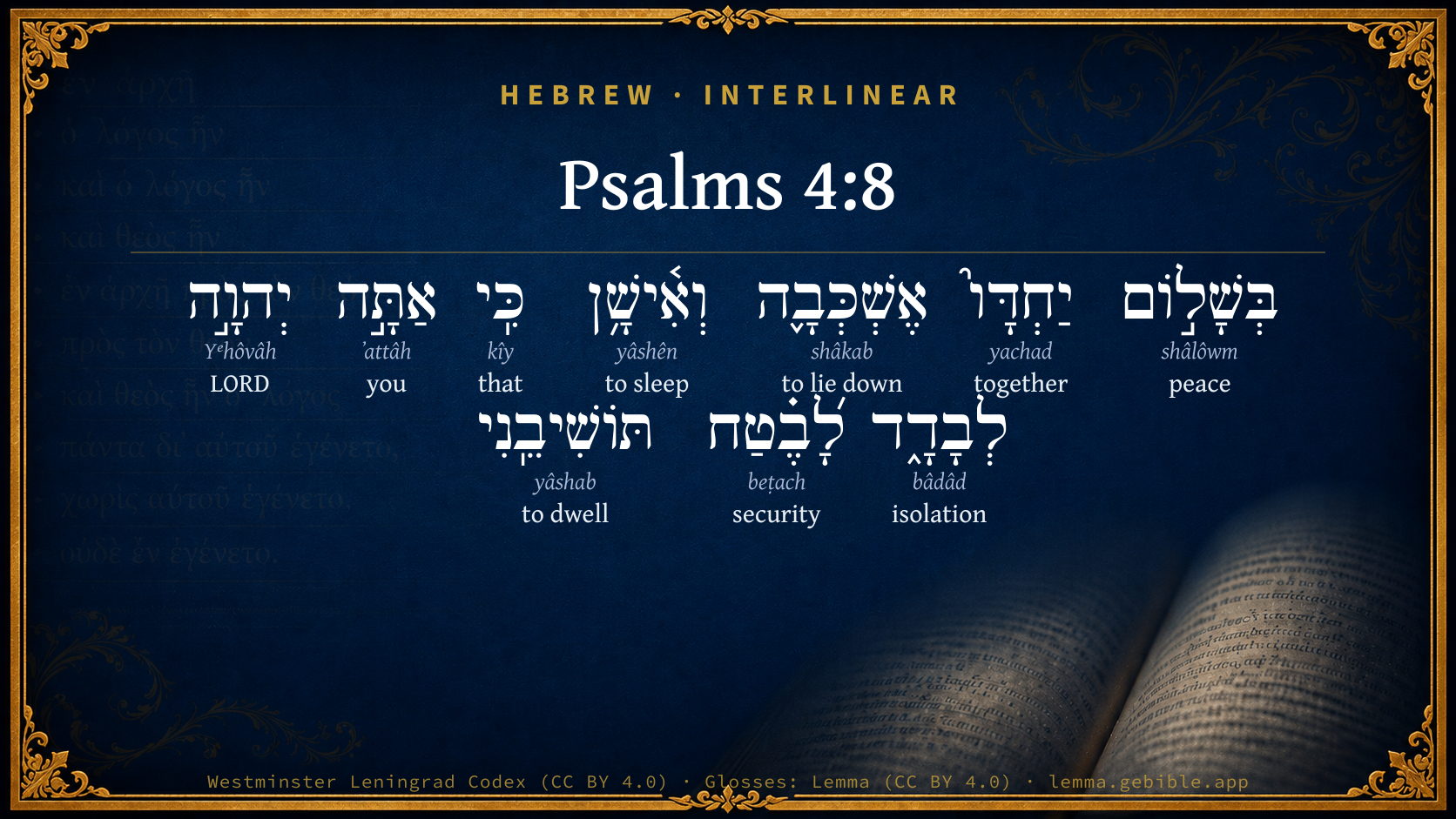
Hebrew (Westminster Leningrad Codex) Psalms 4:8 appears in the Hebrew Old Testament. The text above is from the Westminster Leningrad Codex. Each word links to its Strong’s number, a concise gloss, and parsing drawn from the Open Scriptures Hebrew Bible morphology. Click any word for its full Brown-Driver-Briggs (BDB) entry.
Download image
Cite this verse

Psalms 4:8 (World English Bible). Public Domain. Lemma interlinear Bible study tool, https://lemma.gebible.app/v/psalms/4/8.

Show BibTeX & RIS
BibTeX
RIS
English Translation
In peace I will both lay myself down and sleep, For you, Yahweh alone, make me live in safety.
World English Bible · Public Domain
Download a study sheet

One document with this verse’s original text, its word-by-word gloss line, the meaning frame, cross-references with their text, attributed commentary, and full source and license credits — printable, and it pastes into notes with its structure intact.

This verse Autodidact and up

Study sheet (.html) Plain text (.txt)

A passage Seminary Student

Up to 50 verses in one chapter. A passage sheet keeps up to 6 commentary sources and 12 cross-references per verse, in the order this page ranks them, and says so on the sheet whenever that leaves anything out. Ask for a single verse and you get the Autodidact verse sheet above.

Everything on this page stays free to read, with no account — the sheet is a download of what is already on screen, not access to it.

Want to remove ads? Support Godless Engineer
Compare translations 3

The same verse in 3 English versions, stacked beneath the original-language interlinear above. Click any original word for its lexicon entry.

Each is an independent rendering of the whole verse — the interlinear is not word-aligned to these translations.

Highlighted words mark where these versions differ — a whole-verse word diff, not a word-by-word alignment.

  • World English Bible Public Domain
    In peace I will both lay myself down and sleep, For you, Yahweh alone, make me live in safety.
  • King James Version Public Domain
    I will both lay me down in peace, and sleep: for thou, LORD, only makest me dwell in safety.
  • unfoldingWord Literal Text CC BY-SA 4.0
    In peace I will both lie down and sleep, for you alone, Yahweh, cause me to dwell securely.

unfoldingWord Literal Text — © unfoldingWord, licensed CC BY-SA 4.0. Word-aligned USFM3 via Door43 (git.door43.org/unfoldingWord/en_ult).

Versions to compare (up to 4)

3 of 4 selected

Show all 18 translations

Every available English version of this verse, each an independent rendering of the whole verse.

  • World English Bible Public Domain
    In peace I will both lay myself down and sleep, For you, Yahweh alone, make me live in safety.
  • Berean Standard Bible Public Domain
    I will lie down and sleep in peace, for You alone, O LORD, make me dwell in safety.
  • Majority Standard Bible Public Domain
    I will lie down and sleep in peace, for You alone, O LORD, make me dwell in safety.
  • King James Version Public Domain
    I will both lay me down in peace, and sleep: for thou, LORD, only makest me dwell in safety.
  • American Standard Version (1901) Public Domain
    In peace will I both lay me down and sleep; For thou, Jehovah, alone makest me dwell in safety. Psalm 5 For the Chief Musician; with the Nehiloth. A Psalm of David.
  • Revised Version (1885) Public Domain
    In peace will I both lay me down and sleep: for thou, LORD, alone makest me dwell in safety.
  • Geneva Bible (1599) Public Domain
    I will lay mee downe, and also sleepe in peace: for thou, Lord, onely makest me dwell in safetie.
  • Douay-Rheims (1899) Public Domain
    By the fruit of their corn, their wine and oil, they are multiplied.
  • Young's Literal Translation Public Domain
    In peace together I lie down and sleep, For Thou, O Jehovah, alone, In confidence dost cause me to dwell!
  • Literal Standard Version CC BY-SA 4.0
    Together I lie down and sleep in peace, || For You, O YHWH, alone, || Cause me to dwell in confidence!
  • Unlocked Literal Bible CC BY-SA 4.0
    It is in peace that I will lie down and sleep, for you alone, Yahweh, make me safe and secure.
  • unfoldingWord Literal Text CC BY-SA 4.0
    In peace I will both lie down and sleep, for you alone, Yahweh, cause me to dwell securely.
  • Darby Bible Public Domain
    In peace will I both lay me down and sleep; for thou, Jehovah, alone makest me to dwell in safety.
  • World Messianic Bible Public Domain
    In peace I will both lay myself down and sleep, for you alone, LORD, make me live in safety.
  • Webster's Bible Public Domain
    \\4:7\\Thou hast put gladness in my heart, more than in the time when their corn and their wine increased.
  • Free Bible Version CC BY-SA 4.0
    I will lie down in peace and sleep, for you, Lord, alone keep me safe.
  • Bible in Basic English Public Domain
    I will take my rest on my bed in peace, because you only, Lord, keep me safe.
  • JPS Tanakh (1917) Public Domain
    (4-9) In peace will I both lay me down and sleep; for Thou, LORD, makest me dwell alone in safety.

Literal Standard Version (2020), Covenant Press — licensed CC BY-SA 4.0. Text via the HelloAO Bible API (eBible.org). Unlocked Literal Bible (unfoldingWord) — licensed CC BY-SA 4.0. Text via the HelloAO Bible API (eBible.org). unfoldingWord Literal Text — © unfoldingWord, licensed CC BY-SA 4.0. Word-aligned USFM3 via Door43 (git.door43.org/unfoldingWord/en_ult). Free Bible Version, Dr. Jonathan Gallagher — licensed CC BY-SA 4.0. Text via the HelloAO Bible API (eBible.org).

Word by word

More ways to search: Search by grammar → Find every occurrence → Compare this word →

Practice this passage: Drill this verse → Learn its vocabulary →

לְבָדָ֑ד
bâdâd
H910
“to/for · isolation”
Preposition + Noun, Common, Masculine, Singular, Absolute
Part of Speech
Preposition + Noun
Type
Common
Gender
Masculine
Number
Singular
State
Absolute
Full BDB Definition

Origin: from H909

TWOT: 201b

isolation, withdrawal, separation (noun masculine) - an isolated city - alone (adverb) - security (figuratively)
  1. בְּשָׁל֣וֹם shâlôwm H7965 “in/at · peace” Preposition + Noun, Common, Masculine, Singular, Absolute
  2. יַחְדָּו֮ yachad H3162 “together” Adverb
  3. אֶשְׁכְּבָ֪ה shâkab H7901 “to lie down” Verb, Qal, Cohortative, 1st Person, Common, Singular
  4. וְאִ֫ישָׁ֥ן yâshên H3462 “and · to sleep” Conjunction + Verb, Qal, Imperfect, 1st Person, Common, Singular
  5. כִּֽי kîy H3588 “that” Conjunction
  6. אַתָּ֣ה ʼattâh H859 “you” Pronoun, Personal, 2nd Person, Masculine, Singular
  7. יְהוָ֣ה Yᵉhôvâh H3068 “LORD” Noun, Proper
  8. לָ֝בֶ֗טַח beṭach H983 “to/for · security” Preposition + Noun, Common, Masculine, Singular, Absolute
  9. תּוֹשִׁיבֵֽנִי yâshab H3427 “to dwell · me” Verb, Hiphil, Imperfect, 2nd Person, Masculine, Singular + Suffix, Personal, 1st Person, Common, Singular

About this verse

These counts appear in no published source. They are computed here, from the morphology-tagged text and Lemma’s own curated glosses. What Lemma adds →

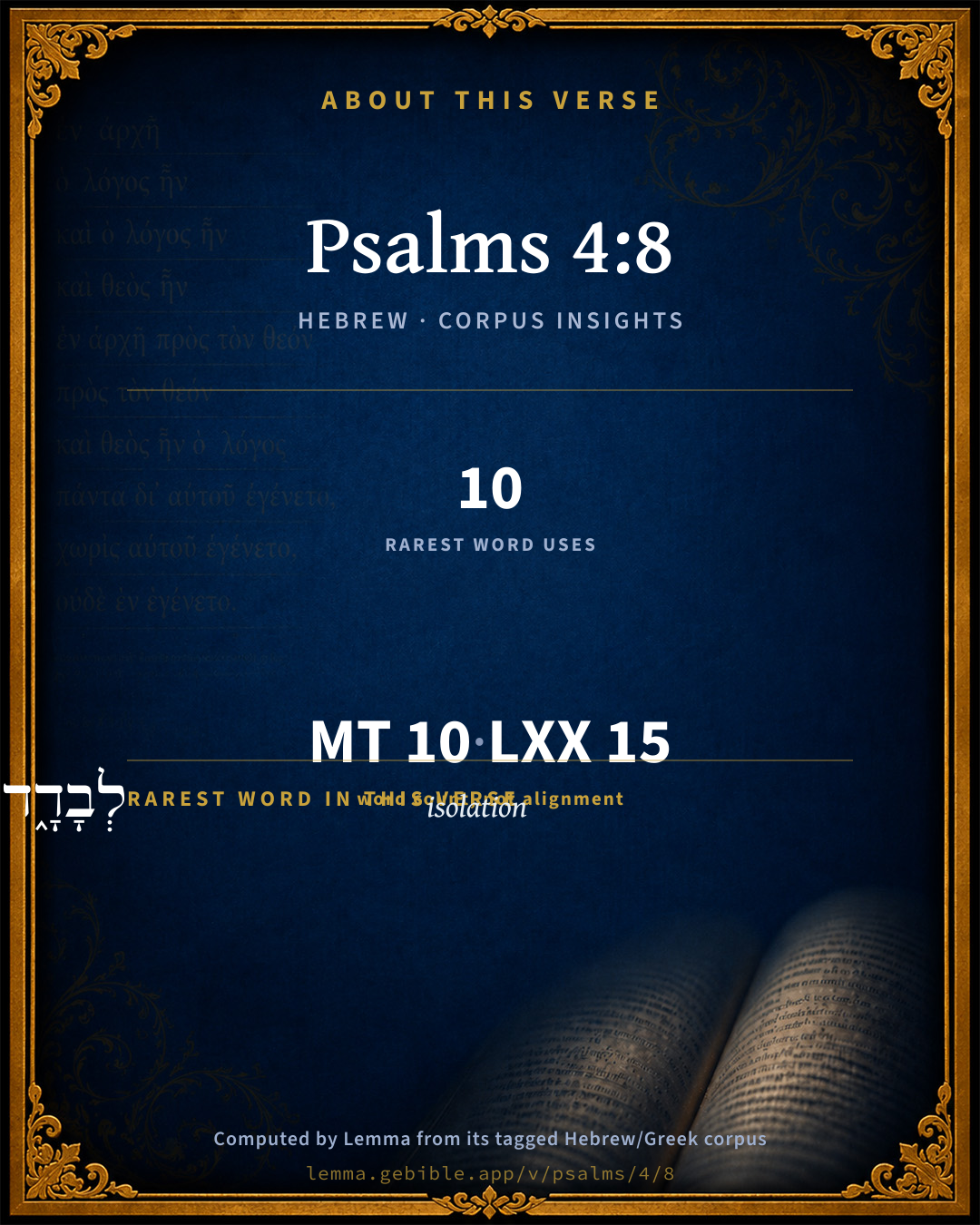
10
words
10
distinct lemmas
Wisdom
section

Notable vocabulary

The rarest word here is לְבָדָ֑ד isolation H910 — appearing just 10 times in the whole Hebrew Bible.

Shared distinctive vocabulary

לְבָדָ֑ד isolation H910 occurs in 10 verses of the Hebrew Bible. Also found in:

Grammatical profile

  • 3 verbs
  • 4 nouns
  • 1 pronoun
  • 1 conjunction
  • 1 adverb

Verb forms

  • אֶשְׁכְּבָ֪ה Qal · Cohortative
  • וְאִ֫ישָׁ֥ן Qal · Imperfect
  • תּוֹשִׁיבֵֽנִי Hiphil · Imperfect

Hebrew & Septuagint length

In English translation the verse runs 19 words from the Hebrew and 19 from the Septuagint (LXX English) — the same length.

A rough comparison of the two English renderings, which tokenize alike — not a word-level alignment.

Word counts can differ between the Hebrew and the Greek without any difference in meaning — e.g. the Hebrew direct-object marker אֵת has no separate Greek word, and Greek often adds the article ὁ.

In the original languages it is 10 Hebrew tokens and 15 Greek tokens — but the two are counted differently (Hebrew bundles its prefixes and suffixes into one token; the Greek is in lemma form), so that isn’t a like-for-like length.

Cross-references

14

Topical passages linked to Psalms 4:8 in the Treasury of Scripture Knowledge — connected by theme and wording, ordered by reader-vote popularity; previews shown in the World English Bible.

  • Proverbs 3:24 When you lie down, you will not be afraid. Yes, you will lie down, and your sleep will be sweet.
  • Psalms 3:5 I laid myself down and slept. I awakened; for Yahweh sustains me.
  • Job 11:18–19 You shall be secure, because there is hope; Yes, you shall search, and shall take your rest in safety.
  • Psalms 16:8–9 I have set Yahweh always before me. Because he is at my right hand, I shall not be moved.
  • 1 Thessalonians 5:10 who died for us, that, whether we wake or sleep, we should live together with him.
  • Deuteronomy 12:10 But when you go over the Jordan, and dwell in the land which Yahweh your God causes you to inherit, and he gives you rest from all your enemies round about, so that you dwell in safety;
  • Leviticus 25:18–19 "'Therefore you shall do my statutes, and keep my ordinances and do them; and you shall dwell in the land in safety.
  • Leviticus 26:5 Your threshing shall reach to the vintage, and the vintage shall reach to the sowing time; and you shall eat your bread to the full, and dwell in your land safely.
  • Hosea 2:18 In that day I will make a covenant for them with the animals of the field, And with the birds of the sky, And with the creeping things of the ground. I will break the bow, the sword, and the battle out of the land, And will make them lie down safely.
  • Revelation 14:13 I heard the voice from heaven saying, "Write, 'Blessed are the dead who die in the Lord from now on.'" "Yes," says the Spirit, "that they may rest from their labors; for their works follow with them."
  • 1 Thessalonians 4:13–14 But we don't want you to be ignorant, brothers, concerning those who have fallen asleep, so that you don't grieve like the rest, who have no hope.
  • Deuteronomy 33:27–29 The eternal God is [your] dwelling-place, Underneath are the everlasting arms. He thrust out the enemy from before you, Said, Destroy.
  • Ezekiel 34:25 I will make with them a covenant of peace, and will cause evil animals to cease out of the land; and they shall dwell securely in the wilderness, and sleep in the woods.
  • Romans 8:35–39 Who shall separate us from the love of Christ? Could oppression, or anguish, or persecution, or famine, or nakedness, or peril, or sword?

Cross-references courtesy of OpenBible.info (CC BY 4.0).

Hebrew and Greek witnesses Masoretic Hebrew ↔ Greek Septuagint

The same verse in the two great witnesses to the Old Testament, shown verse-for-verse.

You’re reading Greek Psalm 4 (Hebrew Psalm 4). The Septuagint counts the superscription, so verse numbers can differ from the Hebrew — chapter-level alignment, not verse-by-verse. Numbering follows Rahlfs.

These are two independent witnesses, not word-aligned to each other, and the Septuagint is shown in lemma (dictionary) form.

Hebrew Psalms 4:8 Masoretic · Westminster Leningrad Codex

בְּשָׁל֣וֹם יַחְדָּו֮ אֶשְׁכְּבָ֪ה וְאִ֫ישָׁ֥ן כִּֽי אַתָּ֣ה יְהוָ֣ה לְבָדָ֑ד לָ֝בֶ֗טַח תּוֹשִׁיבֵֽנִי

In peace I will both lay myself down and sleep, For you, Yahweh alone, make me live in safety.

World English Bible · Public Domain

Greek LXX Greek Psalm 4:8 Septuagint · lemma form

δίδωμι εὐφροσύνη εἰς ὁ καρδία ἐγώ ἀπό καιρός σῖτος καί οἶνος καί ἔλαιον αὐτός πληθύνω

I will both lie down in peace and sleep: for you, Lord, only have caused me to dwell securely.

LXX2012 (modern English Septuagint) · Public Domain

On this verse, Ellicott's Commentary for English Readers discusses the Septuagint’s reading. Read the note in Commentary ↓

Hebrew: Westminster Leningrad Codex (CC BY 4.0). Greek: Septuagint (public domain); English from LXX2012 (modern English Septuagint) (Public Domain). How the Septuagint differs from the Hebrew →

Commentary

Notes on Psalms 4:8 from classic Christian and Jewish commentators (each source and its license shown beneath its notes). The classic Christian expositions comment on the surrounding passage and are grouped to its opening verse, so a note may address several verses; the Jewish commentaries on the Tanakh (Rashi and others) are per-verse, so they appear only where the commentator wrote on this verse.

Lemma curates 59 commentaries, every one of them public domain or Creative Commons licensed, each selected and text-cleaned for this edition rather than reprinted as found. About our sources →

Trapp's Complete Commentary

John Trapp

Psa 4:8 I will both lay me down in peace, and sleep: for thou, LORD, only makest me dwell in safety.

Ver. 8. I will both lay me down in peace, and sleep] Heb. In peace together will I lie down and sleep; that is, saith the Syriac interpreter, Non solum cubabo sed etiam dormiam, I will not only lie down, but also sleep; which many cannot do for fears and cares, those gnats that keep them waking. The Arabic hath it, I sleep as securely in adversity as those can that are in prosperity. Others thus, I will lay me down together with the joy before spoken of, and confidence in God; this shall be my bed fellow; and then I am sure to rest sweetly and safely. For, Thou, Lord, only makest, thou settest me in safety, thou givest to thy beloved sleep, Psa 127:2; that is, extraordinary quiet refreshing sleep, as the learned note upon the Aleph quiescent in שׁבא which is not usual.

John Trapp, A Commentary or Exposition upon All the Books of the Old and New Testament (1647–1656) — public domain. Text from a community e-Sword module.

The Biblical Illustrator

Joseph S. Exell

Psa_4:8

I will both lay me down in peace, and sleep: for Thou, Lord, only makest me dwell in safety.

Signs of a quiet spirit

In the text are two subjects. Davids privilege or happiness itself. The ground or foundation of this his happiness. In the letter and proposition of it, we have the comfortableness and advantage of natural rest. In the scope and drift of it, we have the comfortableness and advantage of Gods favour. The security and fearlessness of a godly person, who is in the love and favour of God, and hath this evidenced and made good to his soul. He is one that is free from all inordinate disturbance, and disquietness of spirit. Those who are reconciled to God, and in His love, have privileges beyond others, so as in patience to possess their souls, in the midst of the greatest outward trouble. This is grounded upon that persuasion which they have of God Himself, and of His affections towards them. It is implied, that none can well thus compose themselves, but those which are thus affected. None can lie down in peace and sleep securely, but those who have made their peace with God, and are in favour with Him. A guilty conscience can never lie down in quiet. Great estates in the world are, for the most part, occasions of great distraction and disquietness of spirit, and such as are subject to break men of their natural rest. Why could David sleep with his estate, rather than his enemies with theirs? Because his was sanctified and sweetened to him by the love of God. Note the ground of the godly mans composure. Thou, Lord, only makest me dwell in safety. The blessing itself--a safe and secure habitation. As we desire to dwell safely, let us be careful to dwell holily: and that includes piety and religion; justice, honesty, and righteousness; peace, friendship, love and quietness of spirit; charity and giving to the poor. This blessing flows from God Himself. It is not a business of mere casualty, theres a providence in it. Not a business of mere endeavour, it comes by the blessing of God. (T. Horton, D. D.)

How to close the day with God

This may be understood, either figuratively, of the repose of the soul, in the assurance of Gods grace, or literally, of the repose of the body, under the protection of His providence. The Psalmist having given the preference to Gods favour above any good, having chosen that, and portioned himself in that, here expresses his great complacency in the choice he had made. Those who have the assurances of Gods favour toward them, may enjoy, and should labour after, a holy serenity and security of mind. It is the privilege of good people that they may be thus easy and satisfied; and it is their duty to use the means appointed for the obtaining it. The Psalmist, after an anxious day, now retires to his chamber with the words, I will lay me down in peace, and sleep. Here we have Davids pious thoughts when he was going to bed. Observe his confidence in God, his composedness in himself Doctrine: As we must begin the day with God, and wait upon Him all the day, so we must endeavour to close it with Him. Let us retire to lay us down. Some sit up to do mischief to their neighbours; others sit up in pursuit of the world and the wealth of it; others sit up in the indulgence of their pleasures. But let us lay down with thankfulness to God, and with thoughts of dying; with penitent reflections upon the sins of the day, and with humble supplications for the mercies of the night. We should be convinced of it that we are still contracting guilt. We should examine our consciences, that we may find out our particular transgressions of the day past. We should renew our repentance, for whatever we find has been amiss in us. We should make a fresh application of the blood of Christ to our souls, for the remission of our sins, and the gracious acceptance of our repentance. We should apply ourselves to the throne of grace for peace and pardon. Let us also lie down with humble supplication for the mercies of the night. We must pray, that our outward man may be under the care of Gods holy angels, who are the ministers of His providence. We must pray, that our inward man may be under the influences of His Holy Spirit, who is the author and fountain of His grace. And when we lay down, our care and endeavour must be to lay us down in peace. Let us lie down in peace with God; for without this there can be no peace at all. Let us lie down in peace with all men: we are concerned to go to sleep, as well as to die, in charity. Let us lie down at peace with ourselves. But when may we lie down in peace at night? If we have, by the grace of God, in some measure done the work of the day, and filled it up with duty. If we have by faith, and patience, and submission to the Divine will, reconciled ourselves to all the events of the day so as to be uneasy at nothing that God has done. If we have renewed our repentance for sin. If we have put ourselves under the Divine protection. If we have cast all our cares for the day following upon God. Having laid ourselves down in peace, we must compose ourselves to sleep. It is by the power of Gods providence that we are kept safe in the night. (Matthew Henry.)

Sleep

Sleep is the image of death. Jesus Christ abolished the terrors of the first death, the death of the body. In the text is not a prayer of David, but a determination on his part. To a certain extent, peaceful sleep depends upon ourselves. A peaceful state of mind has a great deal to do with the power of enjoying Gods gift of sleep. And, similarly, a peaceful death depends on ourselves. There is such a thing as the quietness of a stupefied conscience. How may we, as far as conscience is concerned, carry out the resolution that we will lie down in peace?

1. By doing all that in us lies to preserve a peaceful conscience during the day. Begin the day with earnest prayer. Our morning prayers may show us what we wish to be, but the temptations of the day show us what we are. Our consciences cannot but be injured, if we are guilty of faults and errors during the day, and take no account of them at the dose of the day. Self-examination gives an earnestness and a reality to the prayer for pardon. If it be true that the last sleep of all makes the sleep of each night more solemn, it is also true that each nights sleep makes the last sleep of all less strange. What is each day but a picture of the whole life, and each night but a picture of death? Then we must do all that in us lies to preserve a peaceful conscience during the years of life. (W. H. Ranken, M. A.)

The Christian good night

This is one of the many verses in the Bible, especially in the Psalms, which, must come home to every heart of man, if read with any degree of simple faith. It sets full before us the most comfortable and refreshing picture or a devout, sober, honest person, after his days work is ended, his passions kept in order, his sins repented of, and his prayers seriously said, laying himself down to his nights rest, in the full consciousness that he is neither alone nor unguarded; that as there has been a merciful Eye watching over him, a mighty Hand stretched out to guard him, through the dangers and temptations of the day, so it will be with him in the night also. This entire rest and tranquillity of Gods faithful servants, when they lay them down on their bed at night, is beautifully expressed in the text, I will lay me down all together; all my powers of mind and body agreeing, as it were, one with another; not torn by violent passions, by desire on the one hand, and remorse on the other. How catholic, how universal is the thought expressed by the Psalmist. There is no one condition of life that it suits better than another. The need of taking rest is an universal law of Gods providence over men here in this lower world. As death, so sleep may be truly called a great leveller. As sleep is the image of death, and as the slumber of every night is a kind of sacramental token of that last long sleep, these words may be used for a dying Christian also. Only a Christian has a warrant from Holy Scripture to regard death as no more than a quiet sleep. The Father, acknowledging them as His children, receives them at their death into the everlasting arms. As all the blessings which we have or hope for depend on the Passion of our Lord and Saviour, so this blessing of taking our rest, whether in our bed or in the grave, seems to bear an especial relation to the mystery of the burial of Jesus Christ. Our warrant for our hope is that the Son of God died for us, bought us to be His own in such sort, that we should be really joined to Him, mystically made members of His body. As members, inseparable members, of the Man Christ Jesus, we hope to have our bodies buried with Him; and for our souls, our true selves, we hope that when they pass away from our bodies they may be with Him that day in Paradise. Except we have this hope in us, we cannot apply to ourselves the comfortable words of this Psalm. How is it that in sleep, and still more in death, Christian men may humbly depend on a peculiar presence of our Lord Jesus Christ to guard them?

1. Because He is King, who has promised, He that keepeth thee will not sleep.

2. In this act of lying down comes in the remembrance and the power of our Lords sacrifice. That deep sleep of His, on the Cross and in the grave, has sanctified and blessed the sleep of all penitent Christians for all time to come, whether in their beds or in the bosom of the earth. Sin and its punishment, disease and misery, is the great disturber of sleep. Then to have a reasonable hope, grounded on a good conscience, that blemished as you are with many infirmities, you have not forfeited the blessing of Christs death; this is the secret of good nights, and a comfortable death time. Again, we are taught in Holy Scripture to regard the Holy Sacrament of the Body and Blood of Christ as one very especial safeguard for the sleeping, until they wake, and for the dead, until they rise again. (Contributors to Tracts for the Times.)

A good night watchman

I have noticed in the books of travellers, this observation, We found it exceedingly difficult to obtain a tent keeper who could keep awake at night. One gentleman speaks of discovering a thief in his tent, and when he went outside to call the watchman he found that the man had gone so soundly to sleep that he could only be aroused by one or two gentle kicks. When a man has been travelling with you all day, it is unreasonable to expect him to keep awake through the night to, take care of you. Hence the beauty of the words, Behold He that keepeth Israel. etc. (C. H. Spurgeon.)

.

Psa_5:1-12

The Biblical Illustrator, edited by Joseph S. Exell (c. 1880s–1900s) — public domain. Text from a community e-Sword module.

The Treasury of David

Charles H. Spurgeon

Ver. 8. When you have walked with God from morning until night, it remaineth that you conclude the day well, when you would give yourself to rest at night. Wherefore, first, look back and take a strict view of your whole carriage that day past. Reform what you find amiss; and rejoice, or be grieved, as you find you have done well or ill, as you have advanced or declined in grace that day. Secondly, since you cannot sleep in safety if God, who is your keeper (Ps 121:4-5), do not wake and watch for you (Ps 127:1); and though you have God to watch when you sleep, you cannot be safe, if he that watcheth be your enemy. Wherefore it is very convenient that at night you renew and confirm your peace with God by faith and prayer, commending and committing yourself to God's tuition by prayer (Ps 3:4-5 Ps 92:2), with thanksgiving before you go to bed. Then shall you lie down in safety. Ps 4:8. All this being done, yet while you are putting off your apparel, when you are lying down, and when you are in bed, before you sleep, it is good that you commune with your own heart. Ps 4:4. If possibly you can fall asleep with some heavenly meditation, then will your sleep be more sweet (Pr 3:21, 24-25); and more secure (Pr 6:21-22); your dreams fewer, or more comfortable; your head will be fuller of good thoughts (Pr 6:22), and your heart will be in a better frame when you awake, whether in the night or in the morning. Condensed from Henry Scudder's Daily Walk, 1633.

Ver. 8. I will both, etc. We have now to retire for a moment from the strife of tongues and the open hostility of foes, into the stillness and privacy of the chamber of sleep. Here, also, we find the "I will" of trust. I will both lay me down in peace, and sleep; for thou, Lord, only makest me dwell in safety. God is here revealed to us as exercising personal care in the still chamber. And there is something here which should be inexpressibly sweet to the believer, for this shows the minuteness of God's care, the individuality of his love; how it condescends and stoops, and acts, not only in great, but also in little spheres; not only where glory might be procured from great results, but where nought is to be had save the gratitude and love of a poor feeble creature, whose life has been protected and preserved, in a period of helplessness and sleep. How blessed would it be if we made larger recognition of God in the still chamber; if we thought of him as being there in all hours of illness, of weariness, and pain; if we believed that his interest and care are as much concentrated upon the feeble believer there as upon his people when in the wider battle field of the strife of tongues. There is something inexpressibly touching in this "lying down" of the Psalmist. In thus lying down he voluntarily gave up any guardianship of himself; he resigned himself into the hands of another; he did so completely, for in the absence of all care he slept; there was here a perfect trust. Many a believer lies down, but it is not to sleep. Perhaps he feels safe enough so far as his body is concerned, but cares and anxieties invade the privacy of his chamber; they come to try his faith and trust; they threaten, they frighten, and alas! prove too strong for trust. Many a poor believer might say, "I will lay me down, but not to sleep." The author met with a touching instance of this, in the case of an aged minister whom he visited in severe illness. This worthy man's circumstances were narrow, and his family trials were great; he said, "The doctor wants me to sleep, but how can I sleep with care sitting on my pillow?" It is the experience of some of the Lord's people, that although equal to an emergency or a continued pressure, a re-action sets in afterwards; and when they come to be alone their spirits sink, and they do not realise that strength from God, or feel that confidence in him which they felt while the pressure was exerting its force. ... There is a trial in stillness; and oftentimes the still chamber makes a larger demand upon loving trust than the battle field. O that we could trust God more and more with personal things! O that he were the God of our chamber, as well as of our temples and houses! O that we could bring him more and more into the minutiae of daily life! If we did thus, we should experience a measure of rest to which we are, perhaps, strangers now; we should have less dread of the sick chamber; we should have that unharassed mind which conduces most to repose, in body and soul; we should be able to say, "I will lie down and sleep, and leave to-morrow with God!" Ridley's brother offered to remain with him during the night preceeding his martyrdom, but the bishop declined, saying, that "he meant to go to bed, and sleep as quietly as ever he did in his life." Philip Bennett Power's `I Wills' of the Psalms.

Ver. 8. Due observation of Providence will both beget and secure inward tranquillity in your minds amidst the vicissitudes and revolutions of things in this unstable vain world. I will both lay me down in peace, and sleep; for the Lord only maketh me dwell in safety. He resolves that sinful fears of events shall not rob him of his inward quiet, nor torture his thoughts with anxious presages; he will commit all his concerns into that faithful fatherly hand that had hitherto wrought all things for him; and he means not to lose the comfort of one night's rest, nor bring the evil of to-morrow upon the day; but knowing in whose hand he was, wisely enjoys the sweet felicity of a resigned will. Now this tranquillity of our minds is as much begotten and preserved by a due consideration of providence as by anything whatsoever. John Flavel, 1627-1691.

Ver. 8. Happy is the Christian, who having nightly with this verse, committed himself to his bed as to his grave, shall at last, with the same words, resign himself to his grave as to his bed, from which he expects in due time to arise, and sing a morning hymn with the children of the resurrection. George Horne, D.D., 1776.

Ver. 8. Sleep,

"How blessed was that sleep The sinless Saviour knew! In vain the storm-sinds blew, Till he awoke to others woes, And hushed the billows to repose.

How beautiful is sleep The sleep that Christians know! Ye mourners! cease your woe, While soft upon his Saviour's breast, The righteous sinks to endless rest."

Mrs. M'Cartree.

Ver. 8. The peace and safety of the good man. Joseph Lathrop, D.D., 1805.

Ver. 8. A bedchamber for believers, a vesper song to sing in it, and a guard to keep the door.

Ver. 8. The Christian's good night.

Ver. 2-8. The means which a believer should use to win the ungodly to Christ.

(1) Expostulation, ver. 2. (2) Instruction, ver. 3. (3) Exhortation, ver. 4-5. (4) Testimony to the blessedness of true religion as in ver. 6-7. (5) Exemplification of that testimony by the peace of faith,

ver. 8.

Choice and Practical Expositions on four select Psalms: namely the Fourth Psalm in eight Sermons, etc. By THOMAS HORTON, D.D. 1675.

Meditations, Critical and Practical, on Psalm IV., in Archbishop Leighton's Works.

Charles H. Spurgeon's The Treasury of David (1869–1885) — public domain. Psalms only. Text from a community e-Sword/MySword module.

Joseph Benson's Commentary

Psa 4:8. I will lay me down in peace — In tranquillity of mind, resting securely upon God’s promises, and the conduct of his wise and gracious providence. For thou, Lord, only makest me to dwell in safety — I owe not my safety to my own valour or wisdom, nor to the courage of my followers, but to thee only. Or, Thou, Lord, makest me to dwell alone in safety — Though I be, in a manner, alone, forsaken and destitute of friends or helpers, yet I am not alone, for God is with me: though I have no guards to attend me, the Lord alone is sufficient to protect me. He can do it himself when all other defences fail. “Happy the Christian who, having nightly, with this verse, committed himself to his bed as to his grave, shall, at last, with the same words, resign himself to the grave, as to his bed, from which he expects, in due time, to rise, and sing a morning hymn, with the children of the resurrection.” — Horne.

Joseph Benson's Commentary on the Old and New Testaments (1811–1818) — public domain. Text from a community e-Sword module.

J. A. Alexander on Psalms

Joseph Addison Alexander

8. The faith, of which his enemies were destitute, he possessed in such a measure, that the mere anticipation of God's favour made him happier, in the midst of his distresses, than his foes in the actual possession of their temporal advantages. Thou hast given gladness in my heart, not to my heart, but to me in my heart, i. e. a real, inward, heartfelt gladness, more than the time, or more than when, i. e. more than they ever enjoyed when their corn and their wine abounded, or increased. The original nouns properly denote the new corn and wine of the passing year, the fresh fruits of the field and vineyard. The reference may be either to the proverbial joy of harvest and of vintage, or to the abundant stores of David's enemies contrasted with his own condition when dependent on a faithful servant for subsistence (2Sa 16:1-2).

With this faith in the divine protection, he has nothing even to disturb his rest. In peace, tranquillity, composure, at once, or at the same time, by the same act, I will lie down and will sleep, or rather go to sleep, fall asleep, which is the meaning of the Hebrew verb in Gen 2:21; Gen 41:5, 1Ki 19:5, and elsewhere. Nothing could be more natural and beautiful, as a description of complete tranquillity, than this trait borrowed from the physical habits of the young, the healthy, and those free from all anxiety, to whom the act of lying down and that of sleeping are almost coincident. The ground of this security is given in the last clause. For thou, Lord, Jehovah, alone in safety, or security, wilt make me dwell. The future form, though not exclusive of the present (see above, on Psa 2:2), should be retained because it indicates the Psalmist's assured hope of something not yet realised, and is thus in perfect keeping with Psa 4:8.

Alone may be connected with what goes before: for thou Lord, and no other, thou, even though all other friends and advantages should fail me, art sufficient to protect and provide for me. Or it may be connected with what follows: alone, in safety, thou wilt make me dwell. There is then an allusion to the repeated application of the same Hebrew word to Israel as dwelling apart from other nations under God's protection and in the enjoyment of his favour. See Num 23:9, Deu 33:28-29, and compare Mic 7:14, Jer 49:31, Deu 4:7-8, 2Sa 7:23. What was originally said of the people is then transferred, as in Psa 4:4 above, to David, not as a private member of the ancient church, however excellent, but as its theocratic head and representative, in whom, as afterwards more perfectly in Christ, the promises to Israel were verified and realised. This last interpretation of alone is so striking, and agrees so well with the other allusions in this context to the Pentateuch, e. g. to Lev 25:18-19, and Deu 33:12 in this verse, and to Num 6:24-26 in Psa 4:7, that some combine the two constructions, and suppose alone to have a kind of double sense, as if he had said, Thou alone wilt make me dwell alone. Although the form of this verse has respect to the particular historical occasion of the psalm, the sentiment is so expressed as to admit of an unforced application to the ease of every suffering believer, and to the distresses of the church at large, for whose use it was not only left on record but originally written.

Joseph Addison Alexander, The Psalms Translated and Explained (1850) — public domain. Text from a community e-Sword module.

Tyndale Open Study Notes

Tyndale Open Resources

4:8 Peace comes from God’s blessing and protection (4:6; see 37:11).

Tyndale Open Study Notes — © Tyndale Open Resources, licensed CC BY-SA 4.0. Text via the HelloAO Bible API.

Geneva Bible (1599)

Geneva Bible translators

This word in Hebrew may be referred to God, as it is here translated, or to David, signifying that he should dwell as joyful alone, as if he had many about him, because the Lord is with him.

Geneva Bible (1599) marginal notes — public domain. Text via Bolls.life.

Jamieson, Fausset & Brown

Robert Jamieson, A. R. Fausset & David Brown

both lay me down, &c.--or, will lie down at once, and sleep in sure confidence and quiet repose (Psa 3:5).

Next: Psalms Chapter 5

Jamieson, Fausset & Brown — Commentary Critical and Explanatory on the Whole Bible (1871) — public domain (CC PDM 1.0). Text via the HelloAO Bible API.

Adam Clarke's Commentary

Verse 8. I will both lay me down in peace, and sleep] Most men lie down, and most sleep, daily, for without rest and sleep life could not be preserved; but alas! how few lie down in peace! peace with their own consciences, and peace with God! David had then two great blessings, rest by sleep, and peace in his soul. He had a happy soul; and when he lay down on his bed, his body soon enjoyed its repose, as the conscience was in peace. And he had a third blessing, a confidence that he should sleep in safety. And it was so. No fearful dreams disturbed his repose, for he had a mind tranquillized by the peace of God. As to his body, that enjoyed its due rest, for he had not overloaded nature either with dainties or superfluities. Reader, are not many of thy sleepless hours to be attributed to thy disordered soul-to a sense of guilt on thy conscience, or to a fear of death and hell?

Pray incessantly till thou get the light of God's countenance, till his Spirit bear witness with thine that thou art a child of God. Then thy repose will do thee good: and even in thy sleep thy happy soul will be getting forward to heaven.

ANALYSIS OF THE FOURTH PSALM

There are THREE parts in this Psalm: -

I. An entrance, or petition for audience, Ps 4:1.

II. An apostrophe to his enemies, which is, 1. Reprehensive, Ps 4:2-3. 2. Admonitory, Ps 4:4-5.

III. A petition for himself and God's people, Ps 4:6-8.

I. He proposes his request and suit for audience. "Hear me when I call;" and this he founds on four arguments:

1. God has promised to hear me when I call: "Call upon me in trouble, and I will hear thee." I call; hear me, therefore, when I call.

2. His own innocence: "Hear me, O God of my righteousness."

3. He requests no more than what God had done for him at other times: Thou hast enlarged me in trouble, and why not now?

4. It was mercy and favour to answer him then; it will be the same to do it again: "Have mercy on me, and hear."

II. His petition being thus proposed and ended, he proceeds to the doctrinal part; and, turning himself to his enemies, 1. He sharply reproves them; 2. Then warns them, and gives them good counsel.

1. He turns his speech from God to men; the chief but the worst of men. beney ish, "ye eminent men." Not plebeians, but nobles. The charge he lays to them, 1. They "turned his glory into shame." They endeavoured to dishonour him whom God had called and anointed to the kingdom. 2. "They loved vanity." A vain attempt they were in love with. 3. "They sought after falsity." They pursued that which would deceive them; they would find at last that treachery and iniquity lied to itself. 4. That this charge might have the more weight, he figures it with a stinging interrogation, How long? Their sin had malice and pertinacity in it; and he asks them how long they intended to act thus.

And that they might, if possible, be drawn from their attempts, he sends them a noverint, know ye, which has two clauses: 1. Let them know that God hath set apart him that is godly for himself. 2. That God will hear, when either he or any good man calls upon him.

2. The reproof being ended, he gives them good counsel: -

1. That though they be angry, they ought not to let the sun go down upon their wrath.

2. That they commune with their own hearts - their conscience. That they do this on their beds, when secluded from all company, when passion and self-interest did not rule; and then they would be the better able to judge whether they were not in an error, whether their anger were not causeless, and their persecution unjust?

3. That they offer the sacrifice of righteousness-that they serve and worship God with an honest, sincere, and contrite heart.

4. That they put their trust in the Lord; trusting no more to their lies, nor loving their vanities, but relying on God's promises.

III. The third part begins with this question, Who will show us any good? 1. Who will show us that good which will make us happy? To which David, in effect, returns this answer, that it is not bona animi, intellectual gifts; nor bona fortunae, earthly blessings; nor bona corporis, corporeal endowments: but the light of God's countenance. 2. Therefore he prefers his petition: "Lord, lift thou up the light of thy countenance upon us." God's countenance is his grace, his favour, his love, and the light of his countenance, the exhibition and expression of this grace, favour, and love; in which alone lies all the happiness of man. Of this David expresses two effects, gladness and security: -

1. Gladness and joy far beyond that which may be had from any temporal blessings: "Thou hast put gladness in my heart more than in the time that their corn, and wine, and oil increased; gladness beyond the joy in harvest; and this joy is from the light of God's countenance. Thou puttest. THOU, by way of eminence.

2. Security, expressed under the metaphor of sleep: "I will lay me down in peace, and sleep;" just as in a time of peace, as if there were no war nor preparation for battle.

3. To which he adds the reason: "For thou Lord, alone makest me to dwell in safety." I am safe, because I enjoy the light of thy countenance.

Adam Clarke's Commentary on the Bible (1810–1826) — public domain. Text from a community e-Sword/MySword module.

John Calvin's Commentaries

He concludes, by stating, that as he is protected by the power of God, he enjoys as much security and quiet as if he had been defended by all the garrisons on earth. Now, we know, that to be free from all fear, and from the torment and vexation of care, is a blessing to be desired above all other things. This verse, therefore, is a confirmation of the former sentence, intimating that David justly prefers the joy produced by the light of God’s fatherly love before all other objects for inward peace of mind certainly surpasses all the blessings of which we can form any conception. Many commentators explain this place as expressing David’s hope, that his enemies will be reconciled to him, so that he may sleep with them in peace, God having granted him the peculiar privilege of being able to rest without being disturbed or disquieted by any man. But in my judgment the proper meaning is this, that he will live as quietly and securely alone, as in the midst of a great host of men, because God defends him for in the words, I will sleep together, I consider the particle as to be understood, as if the reading were as together, that is to say, as with a multitude. Some refer לבדד, lebadad, alone, to God, translating the words thus, Thou alone, O Lord, hast set me in safety; but this I do not at all approve, because, by taking away the contrast between these two words, together and alone, much of the beauty of the sentence is lost. In short, David boasts that the protection of God alone was sufficient, and that under it he sleeps as securely, although destitute of all human guardianship, as if he had had many to keep watch and ward continually over him, or as if he had been defended on all sides by a great company. Let us therefore, learn from his example, to yield this honor to God — to believe, that although there may appear no help for us from men, yet under his hand alone we are kept in peace and safety, as if we were surrounded by a great host.

John Calvin's Commentaries (1540-1563) — public domain. Text from the Calvin Translation Society English edition (1840s-50s) via the Christian Classics Ethereal Library (ccel.org). Calvin's coverage is partial (roughly two-thirds of the Bible); uncommented books and verses are honest gaps, never fabricated. The 19th-century editor's footnotes and remarks are omitted so the notes are faithfully Calvin's own voice.

Ellicott's Commentary for English Readers

(8) Both.—Better, and at once. So the LXX. and Vulg.: “At the very moment.” (Comp. Isa_42:14.) This, too, is the meaning of “withal,” used to render the same Hebrew word in Psa_141:10.

Thou, Lord, only.—The authority of all the ancient Versions, including the LXX. and Vulg., is for taking the adverb with the predicate, not with the subject as in the Authorised Version: “Thou, Jehovah, makest me to dwell alone in safety.” We see from Jer_49:31, Mic_7:14, that isolation from other nations was, in the Hebrew view, a guarantee against danger. This certainly favours the view that the poem is national rather than individual.

For the concluding verses of the psalm Luther had a great affection, and desired Ludvig Teuffel to set them as the words of a requiem for him.

A Bible Commentary for English Readers, edited by Charles John Ellicott (1878–1897) — public domain. Text from a community e-Sword module.

The Cambridge Bible for Schools and Colleges

gen. ed. J. J. S. Perowne

8. In peace will I lay me down and sleep at once: no fears or anxieties delaying slumber. In Psa_3:5 he recorded his experience: here he gives expression to the trust which sprang from it.

for thou Lord, only] For it is thou, Lord, alone, who &c. This exquisite expression of absolute confidence, the rhythm of which in the original is as reposeful as the thought, gives an excellent sense in connexion with the context. ‘Many’ had declared that he was abandoned by God as well as man (Psa_3:2), but in unshaken faith he claims Jehovah as his sole protector, beside whom he needs no other.

But the word rendered ‘alone’ elsewhere means apart, when joined with verbs denoting dwelling. Thus it is used of Israel, isolated and separate from the nations, in Num_23:9; and in Deu_33:28; Jer_49:31, it is combined with the word here rendered ‘in safety’. So probably the meaning is, ‘It is Thou, Lord, who makest me dwell apart in safety:’ isolated from my foes in Thy safe keeping. Hence R.V. marg. gives, in solitude.

The Cambridge Bible for Schools and Colleges (gen. ed. J. J. S. Perowne; Cambridge University Press, 1878–1918) — public domain. Text from a community e-Sword module.

John Gill's Exposition

I will both lay me down in peace, and sleep,.... Signifying, that he had such a calmness and serenity of mind, amidst all his troubles, that he could not only lay himself down in great peace, and much composure of mind, but sleep also, and that as soon as laid down almost; some lay themselves down, but cannot sleep, through the anxiety of their minds; but the psalmist could do both: or the word rendered "both" may he translated "together" (u); and the sense be either that he would lie down and sleep together with his friends, committing himself and them to the care and protection of God; or that he should lie down and sleep together with his enemies; meaning that he was assured that there would quickly be a reconciliation and peace between them; see Pro 16:7;

for thou, Lord, only makest me dwell in safety; suggesting that his protection and safety were owing to the power and presence of God only; and that was the reason of the tranquillity of his mind, and why he slept so quietly in the night watches, though in such danger from his enemies; or "thou, Lord, makest me only" or "alone" (w), being solitary and destitute of friends, to dwell in safety; finder the shadow of thy wings, encompassed by thy favour, and surrounded by thy power; see Deu 33:28.

(u) "simul", Musculus, Junius & Tremellius, Piscator, Gejerus, Cocceius. (w) "me solum", Cocceius; "me seorsim", Gejerus.

Next: Psalms Chapter 5

John Gill's Exposition of the Whole Bible (1746–1763) — public domain (CC PDM 1.0). Text via the HelloAO Bible API.

Albert Barnes' Notes on the Bible

I will both lay me down in peace, and sleep - The word “both” here means “at the same time;” that is, I will alike be in peace, and I will lie down and will sleep; I will have a mind at peace (or, in tranquility) when I lie down, and will sleep calmly. This is said in view of his confidence in God, and of his belief that God would preserve him. He had put his trust in him; he had sought his happiness in him, and now he felt assured that he had nothing to fear, and, at peace with God, he would lie down and compose himself to rest. This is the counterpart of what is said in Psa 3:5. There he says in the morning, that, though surrounded by fear, he “had” been permitted to lie calmly down and sleep; here he says, that, though he is surrounded by fear, he has such confidence in God, that he “will” give himself to quiet slumber. His mind was free from anxiety as to the result of the present troubles; he had calm confidence in God; he committed all to him; and thus gave himself to rest. No one can fail to admire the beauty of this; and no one can fail to perceive that entire confidence in God, and an assurance that all things are under his control, are best adapted of all things to give peaceful days and nights.

For thou, Lord, only makest me dwell in safety - There are two ideas here:

(a) One a confidence that he would abide in safety;

(b) the other, that he owed this entirely to the Lord.

He had no power to defend himself, and yet he felt assured that he would be safe - for he put his trust entirely in the Lord. The whole language implies unwavering trust or confidence in God, and is thus instructive and useful for all. It teaches us:

(1) that in the midst of troubles we may put our trust in God; and

(2) that religion is adapted to make the mind calm in such circumstances, and to enable its possessor to lie down without anxiety in the slumbers of the night, and to pursue without anxiety the duties of the day.

Albert Barnes' Notes on the Bible (1834–1885) — public domain. Text from a community e-Sword/MySword module.

Matthew Poole's English Annotations

Both: this word relates to the two following verbs; as soon as I am laid down, I will quietly compose myself to sleep; whereas many lie down upon their beds, and cannot sleep through distracting cares or troubles. Or, in like manner, i.e. as they do who have abundance of corn and wine, of whom he last spoke, Luk 12:19. In peace; either,

1. In outward peace or safety, as the next clause explains it. Or,

2. In inward peace or tranquillity of mind, as Luk 2:29, resting securely upon God’s promises, and the conduct of his wise and gracious providence.

Thou, Lord, only makest me dwell in safety; I owe not my safety to my own valour or wisdom, nor to the courage of my followers, but to thee only. Or, thou, Lord, makest me to dwell alone in safety; either,

1. Alone, or apart from mine enemies: compare Deu 33:28. Or rather,

2. Though I be in a manner alone, i.e. forsaken and destitute of friends or helpers, as that word is used, Psa 112:7; Lam 1:1.

Matthew Poole's English Annotations on the Holy Bible (1683–1685) — public domain. Text from a community e-Sword/MySword module.

Whedon's Commentary on the Bible

Daniel D. Whedon

8. I will… lay me down in peace—The highest sensible evidence of a composed faith. It is fit that this sweet evening psalm should close with a sweet good night. See Psa_127:2.

Daniel D. Whedon (gen. ed.), Commentary on the Old and New Testaments (1874–1909) — public domain. Text from a community e-Sword module.

The Pulpit Commentary

I will both lay me down in peace, and sleep. (comp. Psa_3:5) His confidence in God enables David to lay himself down calmly and tranquilly to sleep, whatever dangers threaten him. He seeks his couch, and at once (wDjy) slumber visits him. No anxious thoughts keep him tossing on his bed for hours. For thou, Lord, only makest me dwell in safety. David has a satisfaction in thinking that it is God only who watches over him. All other help would be vain, superfluous. God alone brought Israel through the wilderness; (Deu_32:12) God alone established Israel in Canaan. (Psa_44:2, Psa_44:3) David feels that he needs no second helper and protector.

The Pulpit Commentary (1880–1919), ed. H.D.M. Spence-Jones & Joseph S. Exell — public domain. Text from a community e-Sword module.

John Wesley's Explanatory Notes

In peace - In tranquility of mind, resting securely upon God's promises.

John Wesley, Explanatory Notes Upon the Whole Bible (1754–1765) — public domain. Text via the GEBible commentary corpus.

Keil & Delitzsch

C. F. Keil & F. Delitzsch

(Heb.: 4:9) Thus then he lies down to sleep, cheerfully and peacefully. The hymn closes as it began with a three line verse. יחדּוּ (lit., in its unions = collectively, Olshausen, 135, c, like כּלּו altogether, בּעתּו at the right time) is by no means unemphatic; nor is it so in Psa 19:10 where it means "all together, without exception." With synonymous verbs it denotes the combination of that which they imply, as Isa 42:14. It is similar in Psa 141:10 where it expresses the coincidence of the fall of his enemies and the escape of the persecuted one. So here: he wishes to go to sleep and also at once he falls asleep (ואישׁן in a likewise cohortative sense = ואישׁנה). His God makes him to dwell in seclusion free of care. לברד is a first definition of condition, and לבטח a second. The former is not, after Deu 32:12, equivalent to לבדּך, an addition which would be without any implied antithesis and consequently meaningless. One must therefore, as is indeed required by the situation, understand לבדד according to Num 23:9; Mic 7:14; Deu 33:28; Jer 49:31. He needs no guards for he is guarded round about by Jahve and kept in safety. The seclusion, בּדד, in which he is, is security, בּטח, because Jahve is near him. Under what a many phases and how sweetly the nature of faith is expressed in this and the foregoing Psalm: his righteousness, exaltation, joy, peace, contentment in God! And how delicately conceived is the rhythm! In the last line the evening hymn itself sinks to rest. The iambics with which it closes are like the last strains of a lullaby which die away softly and as though falling asleep themselves. Dante is right when he says in his Convito, that the sweetness of the music had harmony of the Hebrew Psalter is lost in the Greek and Latin translations.

Keil & Delitzsch — Biblical Commentary on the Old Testament (1861–1891) — public domain (CC PDM 1.0). Text via the HelloAO Bible API. (Old Testament only.)

Radak

Rabbi David Kimhi (Radak)

Thou hast put gladness in my heart: – Behold, they requite me evil for good, but, as for me, there was gladness in my heart at their prosperity – that is,

From the time when their corn and wine multiplied: – and they are rejoicing at my evil. And the meaning of Thou hast put is in the sense of what they have said (Babli, Yoma 38 b, and in other places), “He who comes to be purified is helped.” And it is a good way for a man to rejoice in the prosperity of his fellows. And him who walks in a good way God helps and directs: and this is the force of Thou hast put.

Radak on the Tanakh — English translations: “Sefaria Community Translation” (CC0 1.0 (public-domain dedication)); “Eliyahu Munk, HaChut Hameshulash” (CC BY 4.0); “Rabbi Mike Feuer, Jerusalem Anthology” (CC BY 4.0); and “R. David Kimhi on the first book of Psalms, Translated by R.G. Finch, London, 1919” (public domain). Text via Sefaria.

Ibn Ezra

Rabbi Abraham ibn Ezra

You put (נָתַתָּה - natattah): They [the "many" from v. 7] desire that we should not see good, yet I was joyful (sameach) when seeing them in a good state.

And the meaning of You put [joy in my heart] is: Because You gave me a good heart (lev tov), desiring good for everyone. And Rabbi Yehuda ibn Balaam said: That [the phrase] "from the time their grain" (me-et deganam) is inverted (hafukh). The true [intended order] is "from the time their grain and their wine increased" (me-et rabbu deganam ve-tirosham). But there is no need (ve-ein tzorekh) to invert words spoken by the Holy Spirit (be-ruach ha-kodesh).

Ibn Ezra on the Tanakh — English translations: “Sefaria Community Translation” (CC0 1.0 (public-domain dedication)); “Yalkut, Sifsei Chachomim Chumash, Metsudah Publications, 2009” (CC BY 4.0); and “Commentary of Ibn Ezra on Isaiah - trans. by M. Friedlander, 1873” (public domain). Text via Sefaria.

Lesson kit

Teaching starters — assembled from the data on this page, not authored interpretation. Every prompt links to the verse data it draws on. Edit before teaching.

Psalms, in the Wisdom, opens this verse with 10 words (10 distinct Hebrew lemmas). Its most distinctive word is bâdâd (“isolation”). A historical commentator’s framing appears above. Read the whole chapter for the surrounding context.

Discussion questions

  1. What does “isolation” (bâdâd) contribute to the verse as a whole?
  2. Numbers 23:9 shares the word «isolation» with this verse. How do the two illuminate each other?
  3. These translations render this verse differently; the difference is in the English rendering, not the original. What questions does that raise?
  4. The verb «אֶשְׁכְּבָ֪ה» is Qal Cohortative. How does its form color the action?
  5. Reading how Trapp's Complete Commentary and The Biblical Illustrator read this verse, where do the two commentators agree and where do they part?

Things to notice

Reading settings

Reading text

Shown beneath each verse's original-language words.

Old Testament
Old Testament edition

Read the OT as the Masoretic Hebrew (MT) or the Greek Septuagint (LXX).

English shown for the Greek Septuagint (in the Hebrew ↔ Greek comparison).

Comparing translations? Open the Compare panel on any verse page to stack up to four side by side.