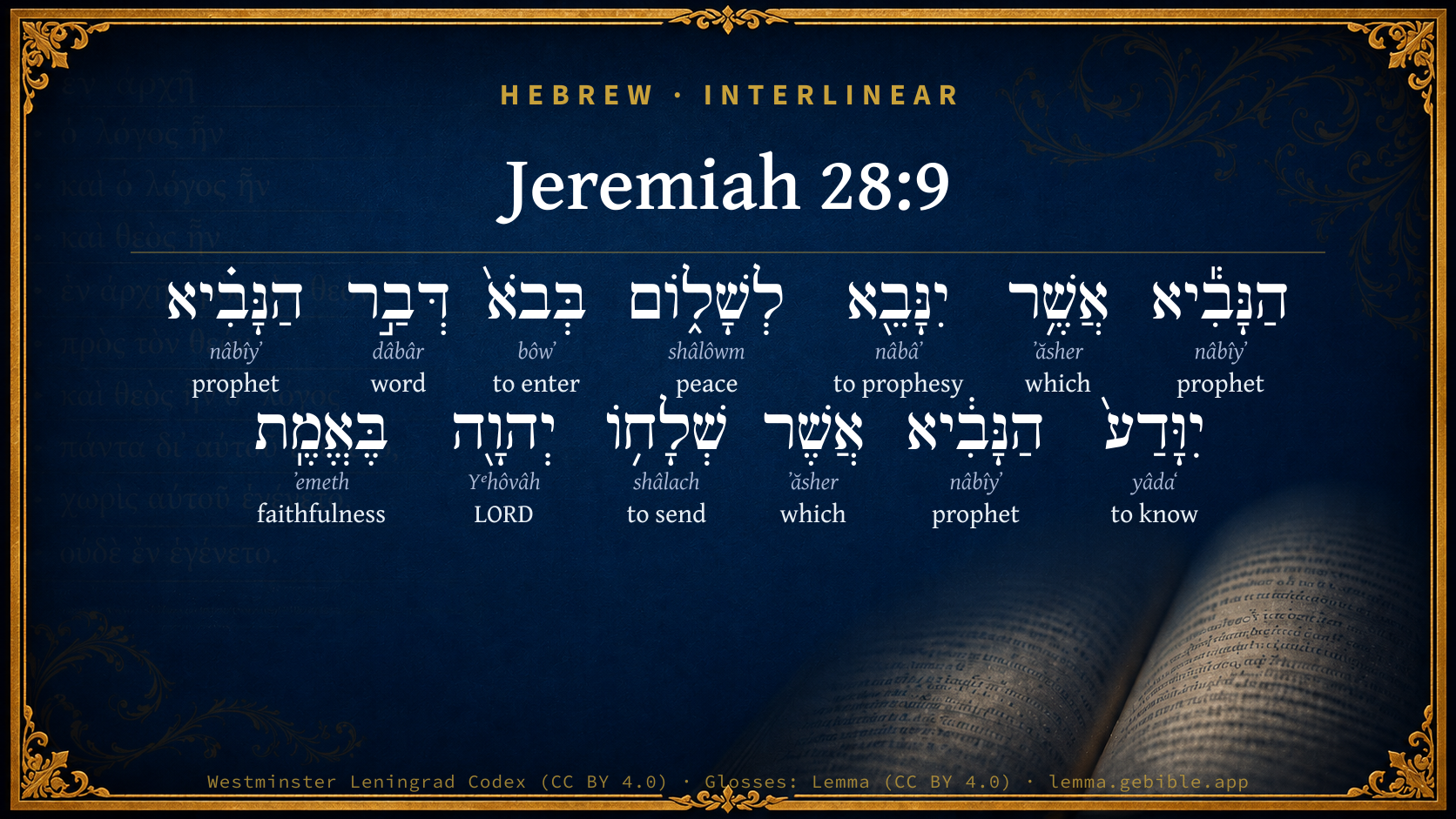
Jeremiah 28:9

Hebrew (Westminster Leningrad Codex) Jeremiah 28:9 appears in the Hebrew Old Testament. The text above is from the Westminster Leningrad Codex. Each word links to its Strong’s number, a concise gloss, and parsing drawn from the Open Scriptures Hebrew Bible morphology. Click any word for its full Brown-Driver-Briggs (BDB) entry.
Download image
Cite this verse

Jeremiah 28:9 (World English Bible). Public Domain. Lemma interlinear Bible study tool, https://lemma.gebible.app/v/jeremiah/28/9.

Show BibTeX & RIS
BibTeX
RIS
English Translation
The prophet who prophesies of peace, when the word of the prophet shall happen, then shall the prophet be known, that Yahweh has truly sent him.
World English Bible · Public Domain
Download a study sheet

One document with this verse’s original text, its word-by-word gloss line, the meaning frame, cross-references with their text, attributed commentary, and full source and license credits — printable, and it pastes into notes with its structure intact.

This verse Autodidact and up

Study sheet (.html) Plain text (.txt)

A passage Seminary Student

Up to 50 verses in one chapter. A passage sheet keeps up to 6 commentary sources and 12 cross-references per verse, in the order this page ranks them, and says so on the sheet whenever that leaves anything out. Ask for a single verse and you get the Autodidact verse sheet above.

Everything on this page stays free to read, with no account — the sheet is a download of what is already on screen, not access to it.

Want to remove ads? Support Godless Engineer
Compare translations 3

The same verse in 3 English versions, stacked beneath the original-language interlinear above. Click any original word for its lexicon entry.

Each is an independent rendering of the whole verse — the interlinear is not word-aligned to these translations.

Highlighted words mark where these versions differ — a whole-verse word diff, not a word-by-word alignment.

  • World English Bible Public Domain
    The prophet who prophesies of peace, when the word of the prophet shall happen, then shall the prophet be known, that Yahweh has truly sent him.
  • King James Version Public Domain
    The prophet which prophesieth of peace, when the word of the prophet shall come to pass, then shall the prophet be known, that the LORD hath truly sent him.
  • unfoldingWord Literal Text CC BY-SA 4.0
    The prophet who prophesies of peace, when the word of the prophet comes, the prophet will be known whom Yahweh sent in truth.”

unfoldingWord Literal Text — © unfoldingWord, licensed CC BY-SA 4.0. Word-aligned USFM3 via Door43 (git.door43.org/unfoldingWord/en_ult).

Versions to compare (up to 4)

3 of 4 selected

Show all 18 translations

Every available English version of this verse, each an independent rendering of the whole verse.

  • World English Bible Public Domain
    The prophet who prophesies of peace, when the word of the prophet shall happen, then shall the prophet be known, that Yahweh has truly sent him.
  • Berean Standard Bible Public Domain
    As for the prophet who prophesies peace, only if the word of the prophet comes true will the prophet be recognized as one the LORD has truly sent.”
  • Majority Standard Bible Public Domain
    As for the prophet who prophesies peace, only if the word of the prophet comes true will the prophet be recognized as one the LORD has truly sent.”
  • King James Version Public Domain
    The prophet which prophesieth of peace, when the word of the prophet shall come to pass, then shall the prophet be known, that the LORD hath truly sent him.
  • American Standard Version (1901) Public Domain
    The prophet that prophesieth of peace, when the word of the prophet shall come to pass, then shall the prophet be known, that Jehovah hath truly sent him.
  • Revised Version (1885) Public Domain
    The prophet which prophesieth of peace, when the word of the prophet shall come to pass, then shall the prophet be known, that the LORD hath truly sent him.
  • Geneva Bible (1599) Public Domain
    And the Prophet which prophecieth of peace, when the word of the Prophet shall come to passe, then shall the Prophet be knowen that the Lord hath truely sent him.
  • Douay-Rheims (1899) Public Domain
    The prophet that prophesied peace when his word shall come to pass, the prophet shall be known, whom the Lord hath sent in truth.
  • Young's Literal Translation Public Domain
    The prophet who doth prophesy of peace -- by the coming in of the word of the prophet, known is the prophet that Jehovah hath truly sent him.'
  • Literal Standard Version CC BY-SA 4.0
    The prophet who prophesies of peace, by the word of the prophet coming to pass, the prophet is known [as] one whom YHWH has truly sent.”
  • Unlocked Literal Bible CC BY-SA 4.0
    So the prophet who prophesies that there will be peace—if his word comes true, then it will be known that he is indeed a prophet sent out by Yahweh.”
  • unfoldingWord Literal Text CC BY-SA 4.0
    The prophet who prophesies of peace, when the word of the prophet comes, the prophet will be known whom Yahweh sent in truth.”
  • Darby Bible Public Domain
    The prophet that prophesieth of peace, when the word of the prophet shall come to pass, shall be known as the prophet whom Jehovah hath really sent.
  • World Messianic Bible Public Domain
    As for the prophet who prophesies of peace, when the word of the prophet happens, then the prophet will be known, that the LORD has truly sent him.”
  • Webster's Bible Public Domain
    The prophet who prophesieth of peace, when the word of the prophet shall come to pass, then shall the prophet be known, that the LORD hath truly sent him.
  • Free Bible Version CC BY-SA 4.0
    When it comes to a prophet who prophesies peace, see if their prophecies come true. Only that will prove they are really sent by the Lord.”
  • Bible in Basic English Public Domain
    The prophet whose words are of peace, when his words come true, will be seen to be a prophet whom the Lord has sent.
  • JPS Tanakh (1917) Public Domain
    The prophet that prophesieth of peace, when the word of the prophet shall come to pass, then shall the prophet be known, that the LORD hath truly sent him.'

Literal Standard Version (2020), Covenant Press — licensed CC BY-SA 4.0. Text via the HelloAO Bible API (eBible.org). Unlocked Literal Bible (unfoldingWord) — licensed CC BY-SA 4.0. Text via the HelloAO Bible API (eBible.org). unfoldingWord Literal Text — © unfoldingWord, licensed CC BY-SA 4.0. Word-aligned USFM3 via Door43 (git.door43.org/unfoldingWord/en_ult). Free Bible Version, Dr. Jonathan Gallagher — licensed CC BY-SA 4.0. Text via the HelloAO Bible API (eBible.org).

Word by word

More ways to search: Search by grammar → Find every occurrence → Compare this word →

Practice this passage: Drill this verse → Learn its vocabulary →

יִנָּבֵ֖א
nâbâʼ
H5012
“to prophesy”
Verb, Niphal, Imperfect, 3rd Person, Masculine, Singular
Part of Speech
Verb
Stem
Niphal
Form
Imperfect
Person
3rd Person
Gender
Masculine
Number
Singular
Full BDB Definition

Origin: a primitive root

TWOT: 1277

to prophesy - (Niphal) - to prophesy - under influence of divine spirit - of false prophets - (Hithpael) - to prophesy - under influence of divine spirit - of false prophets
  1. הַנָּבִ֕יא nâbîyʼ H5030 “the · prophet” Particle, Definite Article + Noun, Common, Masculine, Singular, Absolute
  2. אֲשֶׁ֥ר ʼăsher H834 “which” Particle, Relative
  3. לְשָׁל֑וֹם shâlôwm H7965 “to/for · peace” Preposition + Noun, Common, Masculine, Singular, Absolute
  4. בְּבֹא֙ bôwʼ H935 “in/at · to enter” Preposition + Verb, Qal, Infinitive Construct
  5. דְּבַ֣ר dâbâr H1697 “word of” Noun, Common, Masculine, Singular, Construct
  6. הַנָּבִ֗יא nâbîyʼ H5030 “the · prophet” Particle, Definite Article + Noun, Common, Masculine, Singular, Absolute
  7. יִוָּדַע֙ yâdaʻ H3045 “to know” Verb, Niphal, Imperfect, 3rd Person, Masculine, Singular
  8. הַנָּבִ֔יא nâbîyʼ H5030 “the · prophet” Particle, Definite Article + Noun, Common, Masculine, Singular, Absolute
  9. אֲשֶׁר ʼăsher H834 “which” Particle, Relative
  10. שְׁלָח֥וֹ shâlach H7971 “to send · him” Verb, Qal, Perfect, 3rd Person, Masculine, Singular + Suffix, Personal, 3rd Person, Masculine, Singular
  11. יְהוָ֖ה Yᵉhôvâh H3068 “LORD” Noun, Proper
  12. בֶּאֱמֶֽת ʼemeth H571 “in/at · faithfulness” Preposition + Noun, Common, Feminine, Singular, Absolute

About this verse

These counts appear in no published source. They are computed here, from the morphology-tagged text and Lemma’s own curated glosses. What Lemma adds →

13
words
10
distinct lemmas
Prophets
section

Grammatical profile

  • 4 verbs
  • 7 nouns
  • 2 particles

Verb forms

  • יִנָּבֵ֖א Niphal · Imperfect
  • בְּבֹא֙ Qal · Infinitive Construct
  • יִוָּדַע֙ Niphal · Imperfect
  • שְׁלָח֥וֹ Qal · Perfect

Repetition

Words recur within this verse — often emphatic in Hebrew:

  • הַנָּבִ֕יא prophet H5030 ×3
  • אֲשֶׁ֥ר which H834 ×2

Cross-references

6

Topical passages linked to Jeremiah 28:9 in the Treasury of Scripture Knowledge — connected by theme and wording, ordered by reader-vote popularity; previews shown in the World English Bible.

  • Deuteronomy 18:22 when a prophet speaks in the name of Yahweh, if the thing doesn't follow, nor happen, that is the thing which Yahweh has not spoken: the prophet has spoken it presumptuously, you shall not be afraid of him.
  • Jeremiah 6:14 They have healed also the hurt of my people slightly, saying, Peace, peace; when there is no peace.
  • Jeremiah 4:10 Then said I, Ah, Lord Yahweh! surely you have greatly deceived this people and Jerusalem, saying, You shall have peace; whereas the sword reaches to the life.
  • Jeremiah 8:11 They have healed the hurt of the daughter of my people slightly, saying, Peace, peace; when there is no peace.
  • Jeremiah 14:13 Then said I, Ah, Lord Yahweh! behold, the prophets tell them, You shall not see the sword, neither shall you have famine; but I will give you assured peace in this place.
  • Ezekiel 13:10–16 Because, even because they have seduced my people, saying, Peace; and there is no peace; and when one builds up a wall, behold, they daub it with whitewash:

Cross-references courtesy of OpenBible.info (CC BY 4.0).

Hebrew and Greek witnesses Masoretic Hebrew ↔ Greek Septuagint

The same verse in the two great witnesses to the Old Testament, shown verse-for-verse.

These are two independent witnesses, not word-aligned to each other, and the Septuagint is shown in lemma (dictionary) form.

Hebrew Jeremiah 28:9 Masoretic · Westminster Leningrad Codex

הַנָּבִ֕יא אֲשֶׁ֥ר יִנָּבֵ֖א לְשָׁל֑וֹם בְּבֹא֙ דְּבַ֣ר הַנָּבִ֗יא יִוָּדַע֙ הַנָּבִ֔יא אֲשֶׁר שְׁלָח֥וֹ יְהוָ֖ה בֶּאֱמֶֽת

The prophet who prophesies of peace, when the word of the prophet shall happen, then shall the prophet be known, that Yahweh has truly sent him.

World English Bible · Public Domain

Greek LXX Structure differs

In the Septuagint, Jeremiah is about an eighth shorter than the Hebrew and arranges its material differently — the Oracles Against the Nations (Hebrew chapters 46–51) appear in the middle of the Greek book, after 25:13. Because the chapter and verse boundaries do not line up, a verse-for-verse comparison with the Hebrew is not shown.

A verse-for-verse comparison isn’t shown here because the chapters and verses don’t line up. Switch to the LXX edition with the MT / LXX toggle above to read the Greek directly.

Hebrew: Westminster Leningrad Codex (CC BY 4.0). Greek: Septuagint (public domain); English from a public-domain English Septuagint. How the Septuagint differs from the Hebrew →

Targum (Aramaic paraphrase)

1

The Targum is the ancient Jewish Aramaic paraphrase of the Hebrew Scriptures — an interpretive translation, not the Hebrew text itself. Onkelos (literal) and Pseudo-Jonathan (expansive) render the Torah, and Jonathan the Prophets. Coverage is partial: where no permissively-licensed English translation exists for a verse, only the Aramaic is shown. This is verse-level text, not a word-by-word alignment to the Hebrew.

  1. Targum Jonathan Prophets (Joshua–Malachi)
    נְבִיָא דְיִתְנַבֵּא לִשְׁלָמָא בְּמֵיתֵי פִתְגַם נְבִיָא יִתְיְדַע נְבִיָא דְשַׁלְחֵיהּ יְיָ בִּקְשׁוֹט:

    (no public-domain English translation for this verse)

    Targum Jonathan — Aramaic: “Mikraot Gedolot” (public domain). English: “Sefaria Community Translation” (CC0 1.0 (public-domain dedication)); “London "Chaldee Paraphrase," 1871” (public domain). Text via Sefaria.

Commentary

Notes on Jeremiah 28:9 from classic Christian and Jewish commentators (each source and its license shown beneath its notes). The classic Christian expositions comment on the surrounding passage and are grouped to its opening verse, so a note may address several verses; the Jewish commentaries on the Tanakh (Rashi and others) are per-verse, so they appear only where the commentator wrote on this verse.

Lemma curates 59 commentaries, every one of them public domain or Creative Commons licensed, each selected and text-cleaned for this edition rather than reprinted as found. About our sources →

Trapp's Complete Commentary

John Trapp

Jer 28:9 The prophet which prophesieth of peace, when the word of the prophet shall come to pass, [then] shall the prophet be known, that the LORD hath truly sent him.

Ver. 9. The prophet which prophesieth of peace.] As thou now doest, but time will confute thee, and event will show thee to be a liar. Two years time will be soon come up, &c. How many that have taken upon them to predict the very year and day of the last judgment have been thus confuted and confounded! See Deu 18:22.

John Trapp, A Commentary or Exposition upon All the Books of the Old and New Testament (1647–1656) — public domain. Text from a community e-Sword module.

Jamieson, Fausset & Brown

Robert Jamieson, A. R. Fausset & David Brown

peace--Hananiah had given no warning as to the need of conversion, but had foretold prosperity unconditionally. Jeremiah does not say that all are true prophets who foretell truths in any instance (which Deu 13:1-2, disproves); but asserts only the converse, namely, that whoever, as Hananiah, predicts what the event does not confirm, is a false prophet. There are two tests of prophets: (1) The event, Deu 18:22. (2) The word of God, Isa 8:20.

Jamieson, Fausset & Brown — Commentary Critical and Explanatory on the Whole Bible (1871) — public domain (CC PDM 1.0). Text via the HelloAO Bible API.

Adam Clarke's Commentary

Verse 9. When the word of the prophet shall come to pass] Here is the criterion. He is a true prophet who specifies things that he says shall happen, and also fixes the time of the event; and the things do happen, and in that time.

You say that Nebuchadnezzar shall not overthrow this city; and that in two years from this time, not only the sacred vessels already taken away shall be restored, but also that Jeconiah and all the Jewish captives shall be restored, and the Babylonish yoke broken, see Jer 28:2-4. Now I say that Nebuchadnezzar will come this year, and destroy this city, and lead away the rest of the people into captivity, and the rest of the sacred vessels; and that there will be no restoration of any kind till seventy years from this time.

Adam Clarke's Commentary on the Bible (1810–1826) — public domain. Text from a community e-Sword/MySword module.

John Calvin's Commentaries

Jeremiah seems here to conclude that those alone are to be deemed true prophets who prove by the event that they have been sent from above; and it not only appears that this may be gathered from his words, but it may also be shewn to be the definition of a true prophet; for when the event corresponds with the prophecy, there is no doubt but that he who predicted what comes to pass must have been sent by God. But we must bear in mind what is said in Deuteronomy 13:1, 2, where God reminds the people that even when the event answers to the prophecy, the prophets are not to be thoughtlessly and indiscriminately believed, as though they predicted what was true;

“for God,” he says, “tries thee,” that is, proves thy faith, whether thou wilt be easily carried away by every wind of doctrine.”

But there are two passages, spoken by Moses himself, which at the first sight seem to militate the one against the other. We have already quoted the first from Deuteronomy 13; we have the other in the Deuteronomy 18:18,

“The prophet who has predicted what is found to be true, I have sent him.”

God seems there to acknowledge as his faithful servants those who foretell what is true. But Moses had before reminded the people that even impostors sometimes speak the truth, but that they ought not on this account to be believed. But we must remember what God often declares by Isaiah, when he claims to himself alone the foreknowledge of things,

“Go,” he says, “and inquire whether the gods of the Gentiles will answer as to future things.” (Isaiah 44:7)

We see that God ascribes to himself alone this peculiarity, that he foreknows future events and testifies respecting them. And surely nothing can be more clear than that God alone can speak of hidden things: men, indeed, can conjecture this or that, but they are often mistaken.

With regard to the devil, I pass by those refined disquisitions with which Augustine especially wearied himself; for above all other things he toiled on this point, how the devils reveal future and hidden things? He speculated, as I have said, in too refined a manner. But the solution of the difficulty, as to the subject now in hand, may be easily given. We first conclude, that future events cannot be known but by God alone, and that, therefore, prescience is his exclusive property, so that nothing that is future or hidden can be predicted but by him alone. But, then, it does not follow that God does not permit liberty to the devil and his ministers to foretell something that is true. How? As the case was with Balaam, who was an impostor, ready to let on hire or to sell his prophecies, as it is well known, and yet he was a prophet. But it was a peculiar gift to foretell things: whence had he this? Not from the devil any farther than it pleased God; and yet the truth had no other fountain than God himself and his Spirit. When, therefore, the devil declares what is true, it is as it were extraneous and adventitious.

Now, as we have said, that God is the source of truth, it follows that the prophets sent by him cannot be mistaken; for they exceed not the limits of their call, and so they do not speak falsely of hidden things; but when they declare this or that, they have him as their teacher. But these terms, as they say, are not convertible — to foretell what is true and to be a true prophet: for some, as I have said, predict what is found afterwards by trial and experience to be true, and yet they are impostors; nor did God, in the eighteenth chapter of Deuteronomy, intend to give a certain definition by which his own prophets are to be distinguished; but as he saw that the Israelites would be too credulous, so as greedily to lay hold on anything that might have been said, he intended to restrain that excess, and to correct that immoderate ardor. Hence he commanded them to expect the event, as though he had said, “If any arise among you who will promise this or that in my name, do not immediately receive what they may announce; but the event will shew whether I have sent them.” So also, in this place, Jeremiah says, that the true prophets of God had spoken efficiently, as they had predicted nothing but what God had ratified and really proved to have come from him.

Thus, then, we ought to think of most, that is, that those who predict what is true are for the most part the prophets of God: this is to be taken as the general rule. But we cannot hence conclude, that all those who apparently predict this or that, are sent by God, so that the whole of what they teach is true: for one particular prophecy would not be sufficient to prove the truth of all that is taught and preached. It is enough that God condemns their vanity who speak from their own hearts or from their own brains, when the event does not correspond. At the same time he points out his own prophets by this evidence, — that he really shews that he has sent them, when he fulfils what has been predicted by them. As to false prophets there is a special reason why God permits to them so much liberty, for the world is worthy of such reward, when it willingly offers itself to be deceived. Satan, the father of lies, lays everywhere his snares for men, and they who run into them, and wish to cast themselves on his tenterhooks, deserve to be given up to believe a lie, as they will not, as Paul says, believe the truth. (2 Thessalonians 2:10, 11.)

We now then see what was the object of Jeremiah: his design was not to prove that all were true prophets who predicted something that was true, for this was not, his subject; but he took up another point, — that all who predicted this or that, which was afterwards found to be vain, were thus convicted of falsehood. If then any one predicted what was to be, and the thing itself came not to pass, it was a sufficient proof of his presumption: it hence appeared, that he was not sent of God as he boasted. This was the object of Jeremiah, nor did he go beyond it; for he did not discuss the point, whether all who predicted true things were sent from above, and whether all their doctrines were to be credited and they believed indiscriminately; this was not the subject handled by Jeremiah; but he shewed that Hananiah was a false prophet, for it would appear evident after two years that he had vainly spoken of what he had not received from God’s Spirit. And the same thing Moses had in view, as I have already explained.

As to the prophets, who had been in all ages and prophesied respecting many lands and great kingdoms, they must be considered as exclusively the true prophets: for though there had been some prophets among heathen nations, yet Jeremiah would not have thought them worthy of so great an honor; and it would have been to blend together sacred and profane things, had he placed these vain foretellers and the true prophets in the same rank. But we know that all God’s servants had so directed their discourse to the elect people, as yet to speak of foreign kingdoms and of far countries; and this has not been without reason distinctly expressed; for when they spoke of any monarchy they could not of themselves conjecture what would be: it was therefore necessary for them thus to speak by the impulse of the Holy Spirit. Were I disposed to assume more than what is lawful, and to pretend that I possess some special gift of prophesying, I could more easily lie and deceive, were I to speak only of one city, and of the state of things open before my eyes, than if I extended my predictions to distant countries: when therefore Jeremiah says that the prophets had spoken of divers and large countries, and of most powerful kingdoms, he intimates that their predictions could not have been ascribed to human conjectures; for were any one possessed of the greatest acuteness, and were he to surpass angels in intelligence, he yet could not predict what is hereafter to take place in lands beyond the seas But whatever had been predicted by the prophets, God sanctioned it by the events of time. It then follows that their call was at the same time sanctioned; that is, when God as it were ratified from heaven what they had spoken on earth. Whether therefore the prophets spoke of peace, that is, of prosperity, or of war, famine, and pestilence, when experience proved that true which they had said, their own authority was at the same time confirmed, as though God had shewed that they had been sent by him.

We must also notice the word באמת, beamet, he says that God sent them in truth He condemns here the boldness which impostors ever assume; for they surpass God’s faithful servants in boasting that they have been sent. As then they were thus insolent, and by a fallacious pretense of having been called to their office, deceived unwary men, the Prophet adds here this clause, intimating that they were not all sent in truth. He thus conceded some sort of a call to these unprincipled men, but yet shewed how much they differed from God’s servants, whose call was sealed by God himself. It follows —

John Calvin's Commentaries (1540-1563) — public domain. Text from the Calvin Translation Society English edition (1840s-50s) via the Christian Classics Ethereal Library (ccel.org). Calvin's coverage is partial (roughly two-thirds of the Bible); uncommented books and verses are honest gaps, never fabricated. The 19th-century editor's footnotes and remarks are omitted so the notes are faithfully Calvin's own voice.

Ellicott's Commentary for English Readers

(9) The prophet which prophesieth of peace.—“Peace,” with its Hebrew associations, includes all forms of national prosperity, and is therefore contrasted with famine and pestilence, not less than with war. The obvious reference to the test of a prophet’s work, as described in Deu_18:22, shows, as other like references, the impression which that book had made on the prophet’s mind.

A Bible Commentary for English Readers, edited by Charles John Ellicott (1878–1897) — public domain. Text from a community e-Sword module.

John Gill's Exposition

The prophet which prophesieth of peace,.... Of prosperity, of good things, as Hananiah did, and which are always acceptable to men; and such a prophet is agreeable to them:

when the word of the Lord shall come to pass; when the prophecy of good things, which he delivers in the name of the Lord, shall be filled:

then shall the prophet be known that the Lord hath truly sent him; and not till then; it is the event that must make it manifest: in the other case it may be in a good measure known before it comes to pass, and, whether it comes to pass or not, that a prophet is a true prophet; because his prophecies are agreeable to the word and the declared will of God; contain evils threatened on account of sin, and in order to bring men to repentance, which must needs be right; and besides, they have no interest of their own to serve, but run contrary to the stream of the people, and are exposed to their rage and censure: whereas, a man that prophesies of peace, he is more to be suspected of flattering the people, and of prophesying out of his own heart; and nothing but the event can show him a true prophet; which if he delivers with a proviso, that the people do not do that which is evil in the sight of God, to provoke him to deny them the promised good, is always certainly fulfilled; and if it is not, then he appears manifestly a false prophet.

John Gill's Exposition of the Whole Bible (1746–1763) — public domain (CC PDM 1.0). Text via the HelloAO Bible API.

Haydock's Catholic Bible Commentary

Truth. This criterion was given by Moses; and another was assigned in case the prophet attempted to introduce idolatry, which was not here the case, Deuteronomy xiii., and xviii. 20. (Calmet)

George Leo Haydock (1774–1849), Haydock's Catholic Family Bible and Commentary, 1859 edition — public domain. Excludes Psalms (Douay-Rheims chapter numbering differs from Protestant) and Deuterocanonical books (Catholic canon only).

Matthew Poole's English Annotations

By peace is here meant prosperity, all good being by the Hebrews usually understood under the notion of peace. The prophets either prophesied evil or good, according as God revealed his will unto them; what way was for them to discover whether the prophets were truly sent of God, yea or no? It was known by the event: this was the rule God set, Deu 18:22,

When a prophet speaketh in the name of the Lord, if the thing follow not, nor come to pass, that is the thing which the Lord hath not spoken. But this was not true on the contrary part, for a prophet might speak a thing, which thing might come to pass, and yet be none of the Lord’s prophets, nor be hearkened to, as appeareth from Deu 13:1-3. Some have thought that prophecies concerning good things always were brought to pass if the prophet were a true prophet, but it appeareth otherwise from Jer 18:9,10. Prophecies both concerning good and evil might not come to pass, and yet the prophet be a true prophet, in case the manners of the people altered; for in all promises or threatenings of temporal good or evil there is a condition to be understood; God neither by his promises bindeth himself to do good to wicked men, nor by his threatenings tieth up his own hands from showing mercy to such as turn good: but some observe yet this difference, that good things are in Scripture never absolutely promised, but they come certainly to pass, and are fulfilled; but God for terror often threateneth evil things, without expressing any condition, when notwithstanding a condition is understood, upon the fulfilling of which the threatening cometh not to pass, as it was in the case of Nineveh, upon the prophecy of Jonah. But the greater difficulty is to determine by what rule they could judge one a true or false prophet, if they might not always judge by the event, the coming or not coming to pass of what he prophesied. I answer, they were to judge from the word of God, as well as from the event, Isa 8:20; therefore, Deu 13:1-3, the people were commanded not to hearken to that prophet which should confirm what he said by a sign or wonder, if his scope were by it to persuade people to idolatry. So that if a prophet prophesied good and prosperity to any people, the people were to consider what his scope was, and whether what he prophesied was according to the law of God, which speaketh no good to a wicked impenitent people; and though what he said came to pass, yet he was to be determined no true prophet, if what he said were contrary to God’s revealed will, or his scope in speaking of it was to harden people in sinful courses, or to seduce them from the right ways of God. Jeremiah here, as to the trial of the truth of his and Hananiah’s contrary prophecies, appealeth to the event, telling him that he as a man heartily wished that his words might prove true.

Matthew Poole's English Annotations on the Holy Bible (1683–1685) — public domain. Text from a community e-Sword/MySword module.

Whedon's Commentary on the Bible

Daniel D. Whedon

9. Shall come to pass — The event is a test, though not the only test, of prophecy. This it is which is here appealed to, and Jeremiah shows at once his faith and his moderation by proposing to abide the test.

Daniel D. Whedon (gen. ed.), Commentary on the Old and New Testaments (1874–1909) — public domain. Text from a community e-Sword module.

Lesson kit

Teaching starters — assembled from the data on this page, not authored interpretation. Every prompt links to the verse data it draws on. Edit before teaching.

Jeremiah, in the Prophets, opens this verse with 13 words (10 distinct Hebrew lemmas). Its most distinctive word is nâbâʼ (“to prophesy”). A historical commentator’s framing appears above. Read the whole chapter for the surrounding context.

Discussion questions

  1. How does “to prophesy” (nâbâʼ) shape what this verse is saying?
  2. Deuteronomy 18:22 shares this passage’s theme. How do the two illuminate each other?
  3. “prophet” occurs 3× in this one verse. What is the effect of the repetition?
  4. These translations render this verse differently. What is at stake in choosing one wording over another?
  5. The verb «יִנָּבֵ֖א» is Niphal Imperfect. How does its form color the action?
  6. Reading how Trapp's Complete Commentary and Jamieson, Fausset & Brown read this verse, where do the two commentators agree and where do they part?

Things to notice

Reading settings

Reading text

Shown beneath each verse's original-language words.

Old Testament
Old Testament edition

Read the OT as the Masoretic Hebrew (MT) or the Greek Septuagint (LXX).

English shown for the Greek Septuagint (in the Hebrew ↔ Greek comparison).

Comparing translations? Open the Compare panel on any verse page to stack up to four side by side.