
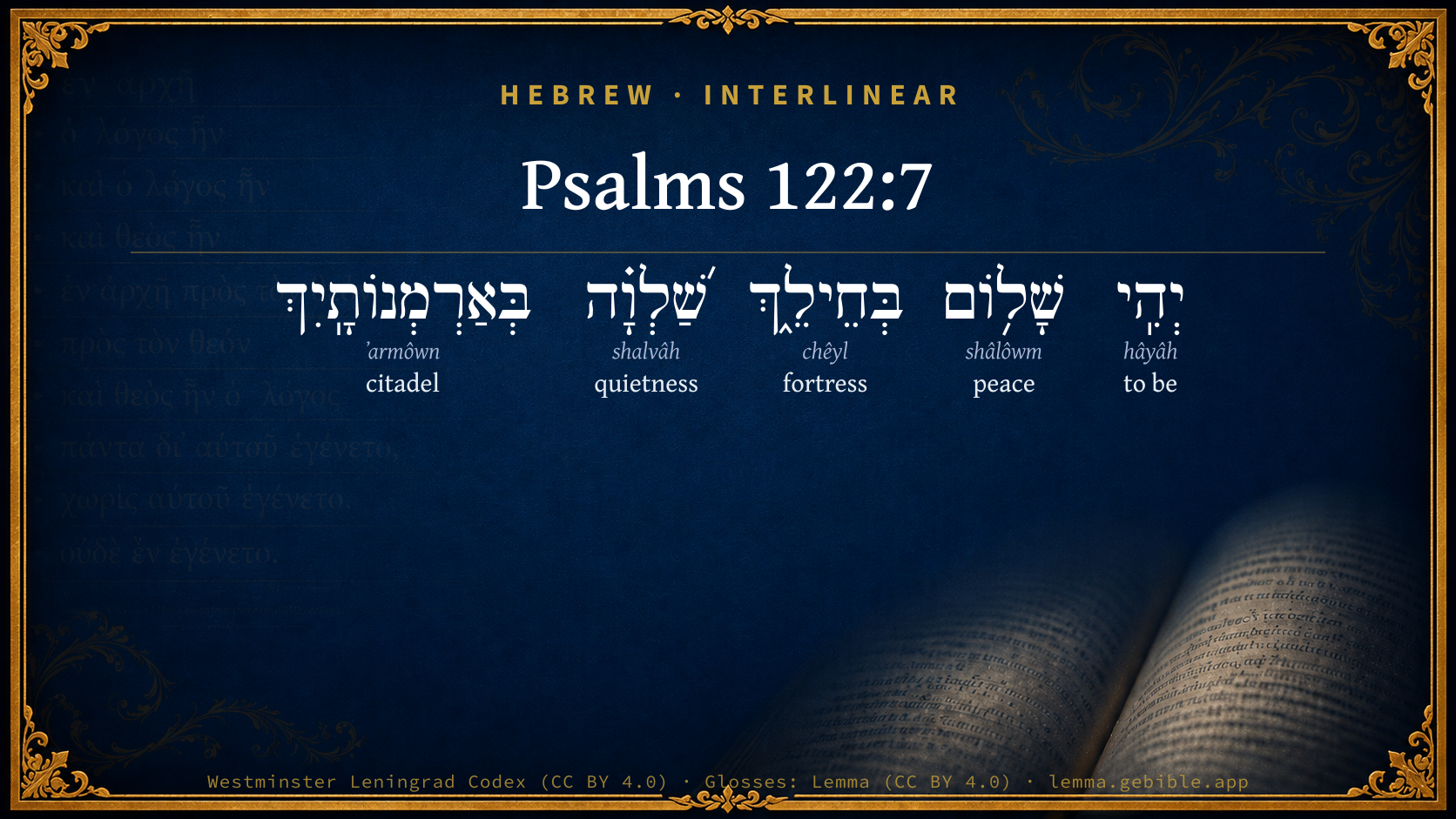
Psalms 122:7

Hebrew (Westminster Leningrad Codex) Psalms 122:7 appears in the Hebrew Old Testament. The text above is from the Westminster Leningrad Codex. Each word links to its Strong’s number, a concise gloss, and parsing drawn from the Open Scriptures Hebrew Bible morphology. Click any word for its full Brown-Driver-Briggs (BDB) entry.
Download image
Cite this verse

Psalms 122:7 (World English Bible). Public Domain. Lemma interlinear Bible study tool, https://lemma.gebible.app/v/psalms/122/7.

Show BibTeX & RIS
BibTeX
RIS
English Translation
Peace be within your walls, And prosperity within your palaces.
World English Bible · Public Domain
Highlights
  • 1 first appearance in the Hebrew Bible
Full analysis ↓
Download a study sheet

One document with this verse’s original text, its word-by-word gloss line, the meaning frame, cross-references with their text, attributed commentary, and full source and license credits — printable, and it pastes into notes with its structure intact.

This verse Autodidact and up

Study sheet (.html) Plain text (.txt)

A passage Seminary Student

Up to 50 verses in one chapter. A passage sheet keeps up to 6 commentary sources and 12 cross-references per verse, in the order this page ranks them, and says so on the sheet whenever that leaves anything out. Ask for a single verse and you get the Autodidact verse sheet above.

Everything on this page stays free to read, with no account — the sheet is a download of what is already on screen, not access to it.

Want to remove ads? Support Godless Engineer
Compare translations 3

The same verse in 3 English versions, stacked beneath the original-language interlinear above. Click any original word for its lexicon entry.

Each is an independent rendering of the whole verse — the interlinear is not word-aligned to these translations.

Highlighted words mark where these versions differ — a whole-verse word diff, not a word-by-word alignment.

  • World English Bible Public Domain
    Peace be within your walls, And prosperity within your palaces.
  • King James Version Public Domain
    Peace be within thy walls, and prosperity within thy palaces.
  • unfoldingWord Literal Text CC BY-SA 4.0
    Let there be peace within your rampart, prosperity in your citadels.

unfoldingWord Literal Text — © unfoldingWord, licensed CC BY-SA 4.0. Word-aligned USFM3 via Door43 (git.door43.org/unfoldingWord/en_ult).

Versions to compare (up to 4)

3 of 4 selected

Show all 18 translations

Every available English version of this verse, each an independent rendering of the whole verse.

  • World English Bible Public Domain
    Peace be within your walls, And prosperity within your palaces.
  • Berean Standard Bible Public Domain
    May there be peace within your walls, and prosperity inside your fortresses.”
  • Majority Standard Bible Public Domain
    May there be peace within your walls, and prosperity inside your fortresses.”
  • King James Version Public Domain
    Peace be within thy walls, and prosperity within thy palaces.
  • American Standard Version (1901) Public Domain
    Peace be within thy walls, And prosperity within thy palaces.
  • Revised Version (1885) Public Domain
    Peace be within thy walls, and prosperity within thy palaces.
  • Geneva Bible (1599) Public Domain
    Peace be within thy walles, and prosperitie within thy palaces.
  • Douay-Rheims (1899) Public Domain
    The Lord keepeth thee from all evil: may the Lord keep thy soul.
  • Young's Literal Translation Public Domain
    Peace is in thy bulwark, rest in thy high places,
  • Literal Standard Version CC BY-SA 4.0
    Peace is in your bulwark, rest in your high places,
  • Unlocked Literal Bible CC BY-SA 4.0
    May there be peace within the walls that defend you, and may they have peace within your fortresses.”
  • unfoldingWord Literal Text CC BY-SA 4.0
    Let there be peace within your rampart, prosperity in your citadels.
  • Darby Bible Public Domain
    Peace be within thy bulwarks, prosperity within thy palaces.
  • World Messianic Bible Public Domain
    Peace be within your walls, and prosperity within your palaces.
  • Webster's Bible Public Domain
    Peace be within thy walls, and prosperity within thy palaces.
  • Free Bible Version CC BY-SA 4.0
    May there be peace within your walls, and safety within your fortresses.
  • Bible in Basic English Public Domain
    May peace be inside your walls, and wealth in your noble houses.
  • JPS Tanakh (1917) Public Domain
    Peace be within thy walls, and prosperity within thy palaces.

Literal Standard Version (2020), Covenant Press — licensed CC BY-SA 4.0. Text via the HelloAO Bible API (eBible.org). Unlocked Literal Bible (unfoldingWord) — licensed CC BY-SA 4.0. Text via the HelloAO Bible API (eBible.org). unfoldingWord Literal Text — © unfoldingWord, licensed CC BY-SA 4.0. Word-aligned USFM3 via Door43 (git.door43.org/unfoldingWord/en_ult). Free Bible Version, Dr. Jonathan Gallagher — licensed CC BY-SA 4.0. Text via the HelloAO Bible API (eBible.org).

Word by word

More ways to search: Search by grammar → Find every occurrence → Compare this word →

Practice this passage: Drill this verse → Learn its vocabulary →

About this verse

These counts appear in no published source. They are computed here, from the morphology-tagged text and Lemma’s own curated glosses. What Lemma adds →

5
words
5
distinct lemmas
Wisdom
section

Notable vocabulary

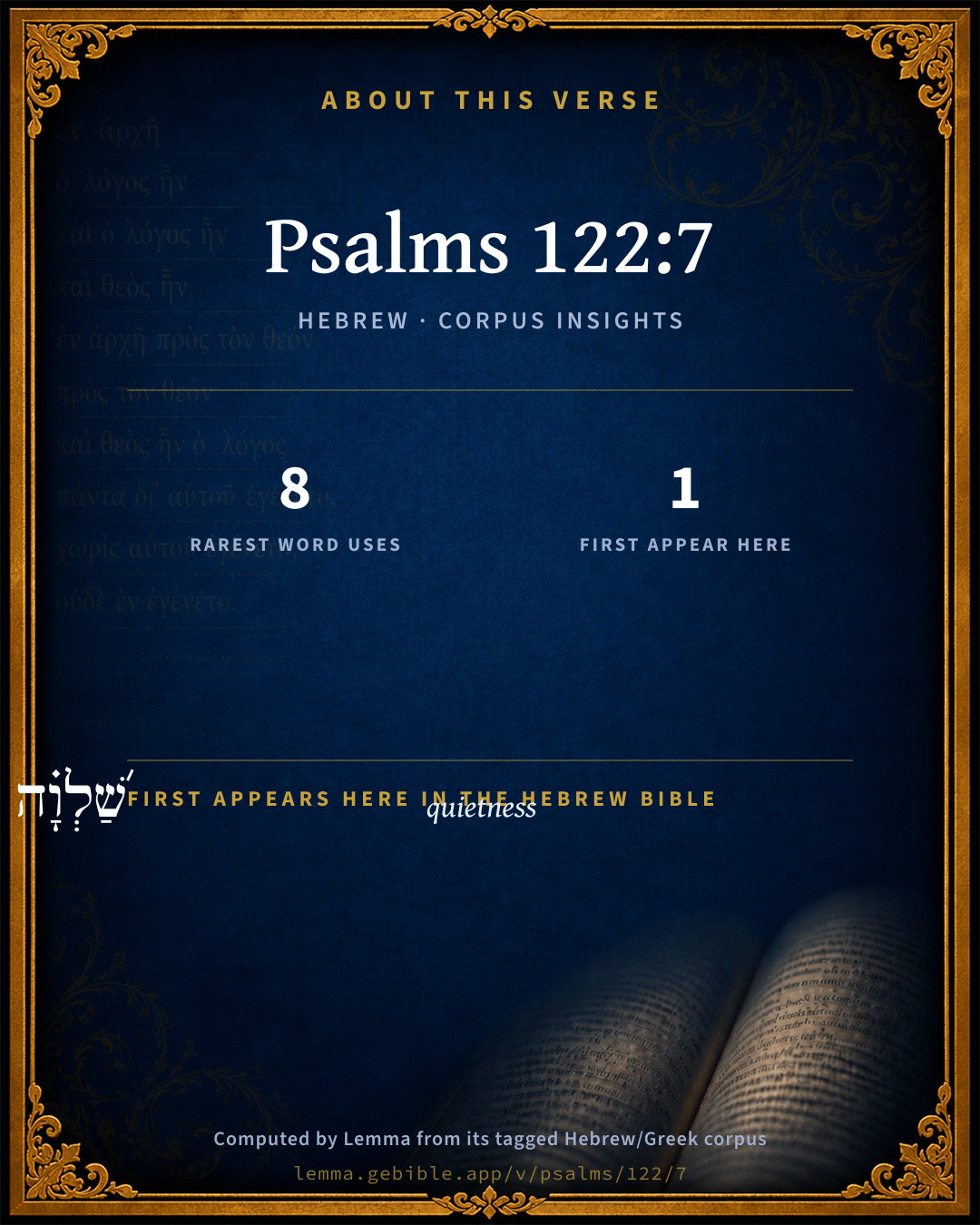
The rarest word here is שַׁ֝לְוָ֗ה quietness H7962 — appearing just 8 times in the whole Hebrew Bible.

First appearance in Scripture

This word makes its first canonical appearance in the Hebrew Bible here:

  • שַׁ֝לְוָ֗ה quietness H7962

Shared distinctive vocabulary

שַׁ֝לְוָ֗ה quietness H7962 occurs in 8 verses of the Hebrew Bible. Also found in:

Grammatical profile

  • 1 verb
  • 4 nouns

Verb forms

  • יְהִֽי Qal · Jussive

Hebrew & Septuagint length

In English translation the verse runs 10 words from the Hebrew and 13 from the Septuagint (LXX English) — closely comparable.

A rough comparison of the two English renderings, which tokenize alike — not a word-level alignment.

Word counts can differ between the Hebrew and the Greek without any difference in meaning — e.g. the Hebrew direct-object marker אֵת has no separate Greek word, and Greek often adds the article ὁ.

Cross-references

7

Topical passages linked to Psalms 122:7 in the Treasury of Scripture Knowledge — connected by theme and wording, ordered by reader-vote popularity; previews shown in the World English Bible.

  • John 14:27 Peace I leave with you. My peace I give to you; not as the world gives, give I to you. Don't let your heart be troubled, neither let it be fearful.
  • Isaiah 54:13 All your children shall be taught of Yahweh; and great shall be the peace of your children.
  • James 3:18 Now the fruit of righteousness is sown in peace by those who make peace.
  • Psalms 48:3 God has shown himself in her citadels as a refuge.
  • Psalms 48:13 Mark well her bulwarks. Consider her palaces, That you may tell it to the next generation.
  • Isaiah 9:7 Of the increase of his government and of peace there shall be no end, on the throne of David, and on his kingdom, to establish it, and to uphold it with justice and with righteousness from henceforth even forever. The zeal of Yahweh of Hosts will perform this.
  • 1 Chronicles 12:18 Then the Spirit came on Amasai, who was chief of the thirty, [and he said], "We are yours, David, and on your side, you son of Jesse: peace, peace be to you, and peace be to your helpers; for your God helps you." Then David received them, and made them captains of the band.

Cross-references courtesy of OpenBible.info (CC BY 4.0).

Hebrew and Greek witnesses Masoretic Hebrew ↔ Greek Septuagint

The same verse in the two great witnesses to the Old Testament, shown verse-for-verse.

You’re reading Greek Psalm 121 (Hebrew Psalm 122). The Septuagint counts the superscription, so verse numbers can differ from the Hebrew — chapter-level alignment, not verse-by-verse. Numbering follows Rahlfs.

These are two independent witnesses, not word-aligned to each other, and the Septuagint is shown in lemma (dictionary) form.

Hebrew Psalms 122:7 Masoretic · Westminster Leningrad Codex

יְהִֽי שָׁל֥וֹם בְּחֵילֵ֑ךְ שַׁ֝לְוָ֗ה בְּאַרְמְנוֹתָֽיִךְ

Peace be within your walls, And prosperity within your palaces.

World English Bible · Public Domain

Greek LXX Greek Psalm 121:7 Septuagint · lemma form

γίγνομαι δή εἰρήνη ἐν ὁ δύναμις σύ καί εὐθηνία ἐν ὁ πυργοβάρις σύ

Let peace, I pray, be within your host, and prosperity in your palaces.

LXX2012 (modern English Septuagint) · Public Domain

Hebrew: Westminster Leningrad Codex (CC BY 4.0). Greek: Septuagint (public domain); English from LXX2012 (modern English Septuagint) (Public Domain). How the Septuagint differs from the Hebrew →

Commentary

Notes on Psalms 122:7 from classic Christian and Jewish commentators (each source and its license shown beneath its notes). The classic Christian expositions comment on the surrounding passage and are grouped to its opening verse, so a note may address several verses; the Jewish commentaries on the Tanakh (Rashi and others) are per-verse, so they appear only where the commentator wrote on this verse.

Lemma curates 59 commentaries, every one of them public domain or Creative Commons licensed, each selected and text-cleaned for this edition rather than reprinted as found. About our sources →

Trapp's Complete Commentary

John Trapp

Psa 122:7 Peace be within thy walls, [and] prosperity within thy palaces.

Ver. 7. Peace be within thy walls] David had no sooner admonished others of their duty, but himself beginneth to them, Quod iussit et gessit. what he ordered he accomplished.

John Trapp, A Commentary or Exposition upon All the Books of the Old and New Testament (1647–1656) — public domain. Text from a community e-Sword module.

The Biblical Illustrator

Joseph S. Exell

Psa_122:7-8

Peace be within thy walls.

The peace and prosperity of Jerusalem

The leading elements which constitute a prosperous Church are--

I. Purity of doctrine. It is fashionable to sneer at doctrine, to talk flippantly about gnawing at the dry bones of doctrine, to endorse the sentiment of the poet who would hand over doctrine to bigots to fight about and would be satisfied with the right life. There is a fallacy here. How can we tell what the right life is if we do not learn it from doctrine? As believers in the fact of a revelation, and that the Bible contains that revelation, we maintain that the man whose life is in the right is a man who knows what the doctrine of Gods Word is concerning right living.

II. Spirituality. True religion is a life as well as a belief, a life founded upon a belief, but always a life. That life is produced by the Holy Spirit, who takes the things which are Christs, and shows them unto us. True religion has to do with the spirit of man. It cleanses the fountain, and the streams which issue therefrom are pure. The man who has spirituality is a man of religious principle. He is the same whatever he does and wherever he goes. He is the same in politics as in ecclesiastics. He is a Christian in buying and in selling, a Christian at home and abroad, on land and on sea.

III. Brotherly love. The Church is a family, the Head of which is Christ. The same spirit that is found in the Head is also found in the members of the family. Now, just as the members of a family love one another because of their blood-tie--relationship--so the members of the household of faith should recognize and exemplify their oneness in Christ. A minister was once asked what he thought of the doctrine of the mutual recognition of the saints in heaven. He replied, I am much more concerned about the duty of my people to recognize one another here upon earth. The reply was caustic, but perhaps it was needed. Christians should love one another. They have the same Saviour and the same Spirit, and they travel the same journey. Alike they have encouragements and discouragements, conflicts and victories, duties and trials, and at last they shall be received into one everlasting home.

IV. Earnest work. By exercise muscle is developed and the whole system is maintained in a state of vigour. Persons engaged in mental or sedentary employments cannot with impunity disregard this law of health. Just so is it in the domain of the spiritual. Exercise is necessary for spiritual development and spiritual strength. Here is another view: God has made Christian work imperative. He is pleased to employ His people in saying to them, Go, work in My vineyard. As among them there is a great variety of talent, so in the vineyard there are many kinds of work. Every gift, no matter how humble, can find a field for exercise. (John Currie, D. D.)

The Biblical Illustrator, edited by Joseph S. Exell (c. 1880s–1900s) — public domain. Text from a community e-Sword module.

J. A. Alexander on Psalms

Joseph Addison Alexander

7. (Psa 122:7) Peace be within thy rampart, and repose within thy palaces. Peace and repose from all distracting causes, of whatever nature. Rampart, breast-work, circumvallation. Rampart and palaces are put for the outer and inner masses of building. Compare Psa 48:14.

Joseph Addison Alexander, The Psalms Translated and Explained (1850) — public domain. Text from a community e-Sword module.

Geneva Bible (1599)

Geneva Bible translators

The favor of God prosper thee both within and without.

Geneva Bible (1599) marginal notes — public domain. Text via Bolls.life.

Adam Clarke's Commentary

Verse 7. Peace be within thy walls] This is the form of prayer that they are to use: "May prosperity ever reside within thy walls, on all the people that dwell there; and tranquillity within thy palaces or high places, among the rulers and governors of the people."

Adam Clarke's Commentary on the Bible (1810–1826) — public domain. Text from a community e-Sword/MySword module.

John Calvin's Commentaries

7. Peace be within thy bulwarks, etc. The two clauses express the same sentiment, and, therefore, the meaning of the first is gathered from the second. The term peace signifies nothing else than prosperity. The noun שלוה, shalvah, in the second clause, sometimes signifies rest, but it is more frequently taken for abundance or prosperity On this account I have translated the noun בחילך, bechelech, within thy bulwark Calvin’s meaning is, that as the nouns peace and prosperity have a corresponding signification, he was of opinion, that there existed a similar correspondence between the other two nouns.

The Latin copy here reads, “sed ad mores alludens;” but mores is evidently a typographical error for muros The French version has “mais sous ceste similitude des murs ”

John Calvin's Commentaries (1540-1563) — public domain. Text from the Calvin Translation Society English edition (1840s-50s) via the Christian Classics Ethereal Library (ccel.org). Calvin's coverage is partial (roughly two-thirds of the Bible); uncommented books and verses are honest gaps, never fabricated. The 19th-century editor's footnotes and remarks are omitted so the notes are faithfully Calvin's own voice.

The Cambridge Bible for Schools and Colleges

gen. ed. J. J. S. Perowne

7. walls … palaces] The same words are found in Psa_48:13. Chçl denotes the outer wall or rampart: armôn includes all conspicuous buildings, such as forts and towers as well as palaces.

There is an assonance between the words for ‘peace’ (shâlôm) and ‘prosperity’ (shalvâh) and the name Jerusalem. Whether the name of the city is etymologically connected with the root shlm is doubtful; but the sound of the name suggests the words for peace and prosperity, and the Psalmist prays that the nomen may be an omen, and that Jerusalem may enjoy the peace of which her name is an augury.

The Cambridge Bible for Schools and Colleges (gen. ed. J. J. S. Perowne; Cambridge University Press, 1878–1918) — public domain. Text from a community e-Sword module.

John Gill's Exposition

For my brethren and companions' sakes,.... Who were regenerated by the spirit of God; adopted into his family, and children of the same father; stood in the same relation to Christ the firstborn, and members of the same church; and so brethren: partners in the same blessings and promises of the covenant; partakers of the same grace; joined together in religious worship; shared in the same joys and griefs; travellers together to the same heavenly country, and entitled to the same glory and happiness. So David, though a king, reckoned his meanest subjects as such, who were spiritual men; and for their sakes, through the goodwill, love, and affection he bore to them, he would set praying souls an example, and by it enforce his own exhortation, as follows:

I will now say, peace be within thee; now and always put up this petition, and not put it off to longer time; that peace and prosperity may always attend the church of God, as well as the city of Jerusalem, literally considered, and the inhabitants of it.

John Gill's Exposition of the Whole Bible (1746–1763) — public domain (CC PDM 1.0). Text via the HelloAO Bible API.

Albert Barnes' Notes on the Bible

Peace be within thy walls - The word here rendered walls, means properly an host, an army; then a fortification, an entrenchment, especially the ditch or trench with the low wall or breastwork which surrounds it. Gesenius, Lexicon. It refers here to the fortifications or defenses around Jerusalem.

And prosperity - Peace; the same word which is used in the previous verse, and expressing the same idea - that of tranquility.

Within thy palaces - This word properly means a “fortress,” “castle;” then, a palace, a residence of a king or a prince, 1Ki 16:18; 2Ki 15:25; Isa 25:2. The idea is, that such places abounded in Jerusalem; and the prayer is, that in those abodes of power, where the rulers of the land resided, there might be peace. The particular reason for this prayer is suggested in the following verse.

Albert Barnes' Notes on the Bible (1834–1885) — public domain. Text from a community e-Sword/MySword module.

Matthew Poole's English Annotations

Within thy walls; in all thy dwellings.

Within thy palaces; especially in the court and the dwellings of the princes and rulers, whose welfare is a public blessing to all the people.

Matthew Poole's English Annotations on the Holy Bible (1683–1685) — public domain. Text from a community e-Sword/MySword module.

The Treasury of David

Charles H. Spurgeon

Ver. 7. Peace be within thy walls. See how the poet personifies the church, and speaks to it: his heart is with Zion, and therefore his conversation runs in that direction. A second time is the sweet favour of peace earnestly sought after: "There is none like it, give it me." Walls were needed to keep out the foe, but it was asked of the Lord that those walls might prove sufficient for her security. May the munitions of rock so securely defend the city of God that no intruder may ever enter within her enclosure. May her ramparts repose in safety. Three walls environed her, and thus she had a trinity of security.

And prosperity within thy palaces, or "Repose within thy palaces." Peace is prosperity; there can be no prosperity which is not based on peace, nor can there long be peace if prosperity be gone, for decline of grace breeds decay of love. We wish for the church rest from internal dissension and external assault: war is not her element, but we read of old, "Then had the churches rest; and walking in the fear of the Lord, and in the comfort of the Holy Ghost, were multiplied." The bird of Paradise is not a sternly petrel: her element is not the hurricane of debate, but the calm of communion.

Observe that our Jerusalem is a city of palaces: kings dwell within her walls, and God himself is there. The smallest Church is worthy of higher honour than the greatest confederacies of nobles. The order of the New Jerusalem is of more repute in heaven than the knights of the Golden Fleece. For the sake of all the saintly spirits which inhabit the city of God we may well entreat for her the boons of lasting peace and abounding prosperity.

Ver. 7. Peace be within thy walls. The Church is a war town, and a walled town, which is situated among enemies, and may not trust them who are without, but must be upon its keeping, as the type thereof, Jerusalem, with her walls and towers, did shadow forth. David Dickson.

Ver. 7. Within thy walls. Or, To thy outward wall. Josephus tells us (Book V.) that there were at Jerusalem three ranges or rows of walls. The sense here is, Let no enemy approach so much as to thy out works to disturb thee. Thomas Fenton.

Ver. 7.

1. Where peace is most desirable: "Within thy walls." Within town walls, within house walls, but principally within temple walls.

2. Where prosperity is most desirable.

a) In the closet.

b) In the church. These are the palaces of the Great King; "The ivory palaces whereby they have made thee glad." G. R.

Ver. 7. The connection between peace and prosperity.

Ver. 7. Thy walls.

1. Enquire why the church needs walls.

2. Enquire what are the walls of a church.

3. Enquire on which side of them we are.

Ver. 7. The church a palace.

1. Intended for the great King.

2. Inhabited by the royal family.

3. Adorned with regal splendour.

4. Guarded by special power.

5. Known as the court of the blessed and only potentate.

Psalms 122:8*

Charles H. Spurgeon's The Treasury of David (1869–1885) — public domain. Psalms only. Text from a community e-Sword/MySword module.

The Pulpit Commentary

Peace be within thy walls, and prosperity within thy palaces. The prayer, which he would have others offer, the psalmist now offers himself. The prayer embraces, first, the whole community; then, especially those who have the direction and government of it.

The Pulpit Commentary (1880–1919), ed. H.D.M. Spence-Jones & Joseph S. Exell — public domain. Text from a community e-Sword module.

Lesson kit

Teaching starters — assembled from the data on this page, not authored interpretation. Every prompt links to the verse data it draws on. Edit before teaching.

Psalms, in the Wisdom, opens this verse with 5 words (5 distinct Hebrew lemmas). Its most distinctive word is shalvâh (“quietness”). A historical commentator’s framing appears above. Read the whole chapter for the surrounding context.

Discussion questions

  1. The word shalvâh carries the sense “quietness.” How does it shape the verse?
  2. The word “quietness” first appears here in Scripture. What is being introduced at this debut?
  3. Proverbs 1:32 shares the word «quietness» with this verse. How do the two illuminate each other?
  4. These translations render this verse differently; the difference is in the English rendering, not the original. What questions does that raise?
  5. The verb «יְהִֽי» is Qal Jussive. How does its form color the action?
  6. Reading how Trapp's Complete Commentary and The Biblical Illustrator read this verse, where do the two commentators agree and where do they part?

Things to notice

  • 1 word makes its first canonical appearance in Scripture here.
  • These translations choose different wording for 6 words in this verse.
  • 5 distinct Hebrew lemmas span 5 words in this verse.

Reading settings

Reading text

Shown beneath each verse's original-language words.

Old Testament
Old Testament edition

Read the OT as the Masoretic Hebrew (MT) or the Greek Septuagint (LXX).

English shown for the Greek Septuagint (in the Hebrew ↔ Greek comparison).

Comparing translations? Open the Compare panel on any verse page to stack up to four side by side.