Ezekiel 13:10

Hebrew (Westminster Leningrad Codex) Ezekiel 13:10 appears in the Hebrew Old Testament. The text above is from the Westminster Leningrad Codex. Each word links to its Strong’s number, a concise gloss, and parsing drawn from the Open Scriptures Hebrew Bible morphology. Click any word for its full Brown-Driver-Briggs (BDB) entry.
Download image
Cite this verse

Ezekiel 13:10 (World English Bible). Public Domain. Lemma interlinear Bible study tool, https://lemma.gebible.app/v/ezekiel/13/10.

Show BibTeX & RIS
BibTeX
RIS
English Translation
Because, even because they have seduced my people, saying, Peace; and there is no peace; and when one builds up a wall, behold, they daub it with whitewash:
World English Bible · Public Domain
Highlights
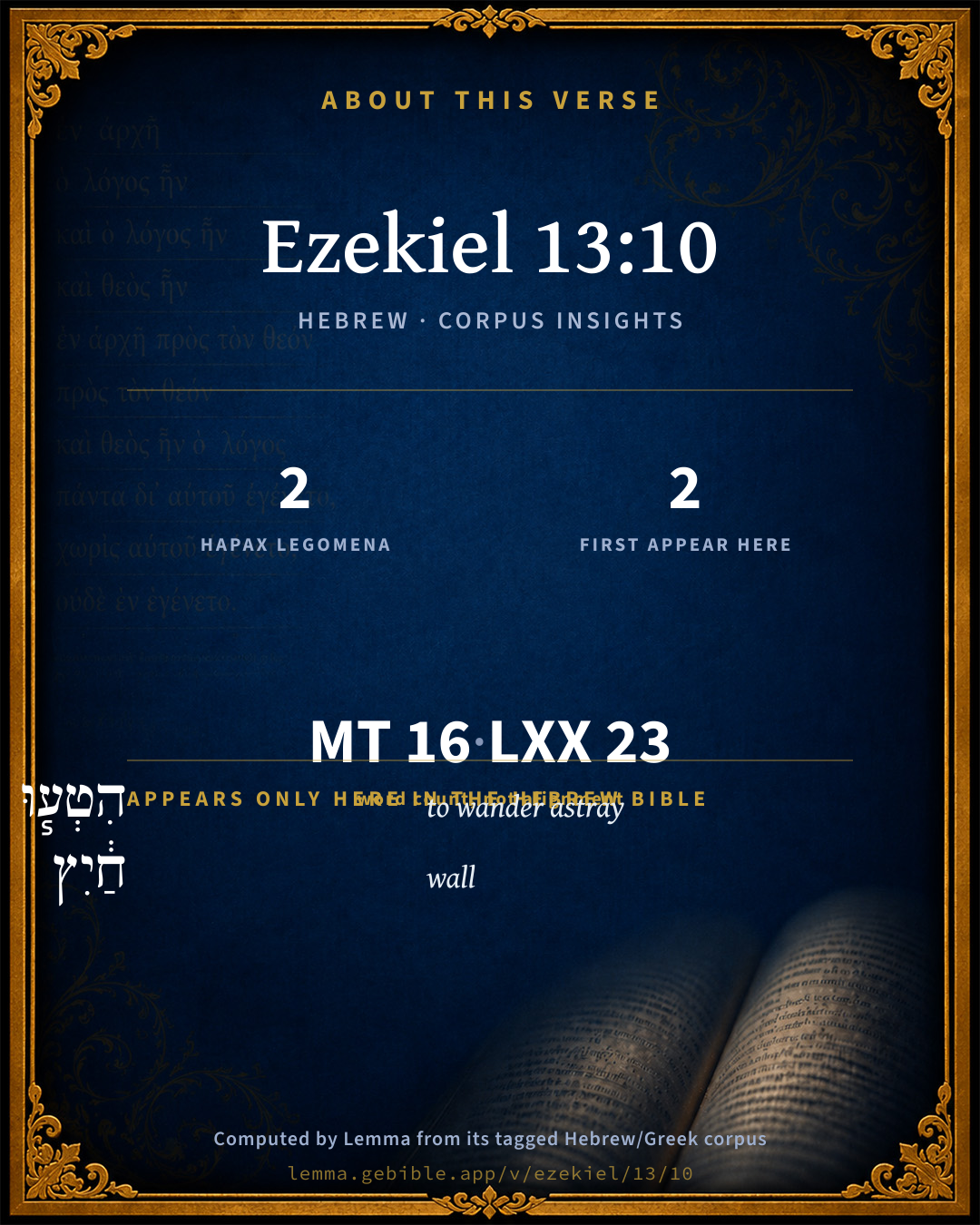
  • 2 hapax legomena — only here in the Hebrew Bible
  • 2 first appearances in the Hebrew Bible
Full analysis ↓
Download a study sheet

One document with this verse’s original text, its word-by-word gloss line, the meaning frame, cross-references with their text, attributed commentary, and full source and license credits — printable, and it pastes into notes with its structure intact.

This verse Autodidact and up

Study sheet (.html) Plain text (.txt)

A passage Seminary Student

Up to 50 verses in one chapter. A passage sheet keeps up to 6 commentary sources and 12 cross-references per verse, in the order this page ranks them, and says so on the sheet whenever that leaves anything out. Ask for a single verse and you get the Autodidact verse sheet above.

Everything on this page stays free to read, with no account — the sheet is a download of what is already on screen, not access to it.

Want to remove ads? Support Godless Engineer
Compare translations 3

The same verse in 3 English versions, stacked beneath the original-language interlinear above. Click any original word for its lexicon entry.

Each is an independent rendering of the whole verse — the interlinear is not word-aligned to these translations.

Highlighted words mark where these versions differ — a whole-verse word diff, not a word-by-word alignment.

  • World English Bible Public Domain
    Because, even because they have seduced my people, saying, Peace; and there is no peace; and when one builds up a wall, behold, they daub it with whitewash:
  • King James Version Public Domain
    Because, even because they have seduced my people, saying, Peace; and there was no peace; and one built up a wall, and, lo, others daubed it with untempered morter:
  • unfoldingWord Literal Text CC BY-SA 4.0
    Because of this, and because they led my people astray and said, “Peace!” when there is no peace, they are building a wall that they will paint with whitewash.’

unfoldingWord Literal Text — © unfoldingWord, licensed CC BY-SA 4.0. Word-aligned USFM3 via Door43 (git.door43.org/unfoldingWord/en_ult).

Versions to compare (up to 4)

3 of 4 selected

Show all 18 translations

Every available English version of this verse, each an independent rendering of the whole verse.

  • World English Bible Public Domain
    Because, even because they have seduced my people, saying, Peace; and there is no peace; and when one builds up a wall, behold, they daub it with whitewash:
  • Berean Standard Bible Public Domain
    Because they have led My people astray, saying, ‘Peace,’ when there is no peace, and whitewashing any flimsy wall that is built,
  • Majority Standard Bible Public Domain
    Because they have led My people astray, saying, ‘Peace,’ when there is no peace, and whitewashing any flimsy wall that is built,
  • King James Version Public Domain
    Because, even because they have seduced my people, saying, Peace; and there was no peace; and one built up a wall, and, lo, others daubed it with untempered morter:
  • American Standard Version (1901) Public Domain
    Because, even because they have seduced my people, saying, Peace; and there is no peace; and when one buildeth up a wall, behold, they daub it with untempered `mortar':
  • Revised Version (1885) Public Domain
    Because, even because they have seduced my people, saying, Peace; and there is no peace; and when one buildeth up a wall, behold, they daub it with untempered mortar:
  • Geneva Bible (1599) Public Domain
    And therefore, because they haue deceiued my people, saying, Peace, and there was no peace: and one buylt vp a wall, and behold, the others daubed it with vntempered morter,
  • Douay-Rheims (1899) Public Domain
    Because they have deceived my people, saying: Peace, and there is no peace: and the people built up a wall, and they daubed it with dirt without straw.
  • Young's Literal Translation Public Domain
    Because, even because, they did cause My people to err, Saying, Peace! and there is no peace, And that one is building a wall, And lo, they are daubing it with chalk.
  • Literal Standard Version CC BY-SA 4.0
    Because, even because, they caused My people to err, || Saying, Peace! And there is no peace, || And that one is building a wall, || And behold, they are coating it with chalk.
  • Unlocked Literal Bible CC BY-SA 4.0
    Because of this, and because they led my people astray and said, “Peace!” when there is no peace, they are building a wall that they will paint with whitewash.'
  • unfoldingWord Literal Text CC BY-SA 4.0
    Because of this, and because they led my people astray and said, “Peace!” when there is no peace, they are building a wall that they will paint with whitewash.’
  • Darby Bible Public Domain
    Because, yea because they have seduced my people, saying, Peace! and there is no peace; and one buildeth up a wall, and lo, they daub it with untempered [mortar] --
  • World Messianic Bible Public Domain
    “‘Because, even because they have seduced my people, saying, “Peace;” and there is no peace. When one builds up a wall, behold, they plaster it with whitewash.
  • Webster's Bible Public Domain
    Because, even because they have seduced my people, saying, Peace; and there was no peace; and one built up a wall, and lo, others daubed it with untempered mortar:
  • Free Bible Version CC BY-SA 4.0
    They have deceived my people by saying, ‘We shall have peace,’ when there won't be any peace. It's like they're putting a coat of whitewash on an unstable wall of loose stones that the people have built.
  • Bible in Basic English Public Domain
    Because, even because they have been guiding my people into error, saying, Peace; when there is no peace; and in the building of a division wall they put whitewash on it:
  • JPS Tanakh (1917) Public Domain
    Because, even because they have led My people astray, saying: Peace, and there is no peace; and when it buildeth up a slight wall, behold, they daub it with whited plaster;

Literal Standard Version (2020), Covenant Press — licensed CC BY-SA 4.0. Text via the HelloAO Bible API (eBible.org). Unlocked Literal Bible (unfoldingWord) — licensed CC BY-SA 4.0. Text via the HelloAO Bible API (eBible.org). unfoldingWord Literal Text — © unfoldingWord, licensed CC BY-SA 4.0. Word-aligned USFM3 via Door43 (git.door43.org/unfoldingWord/en_ult). Free Bible Version, Dr. Jonathan Gallagher — licensed CC BY-SA 4.0. Text via the HelloAO Bible API (eBible.org).

Word by word

More ways to search: Search by grammar → Find every occurrence → Compare this word →

Practice this passage: Drill this verse → Learn its vocabulary →

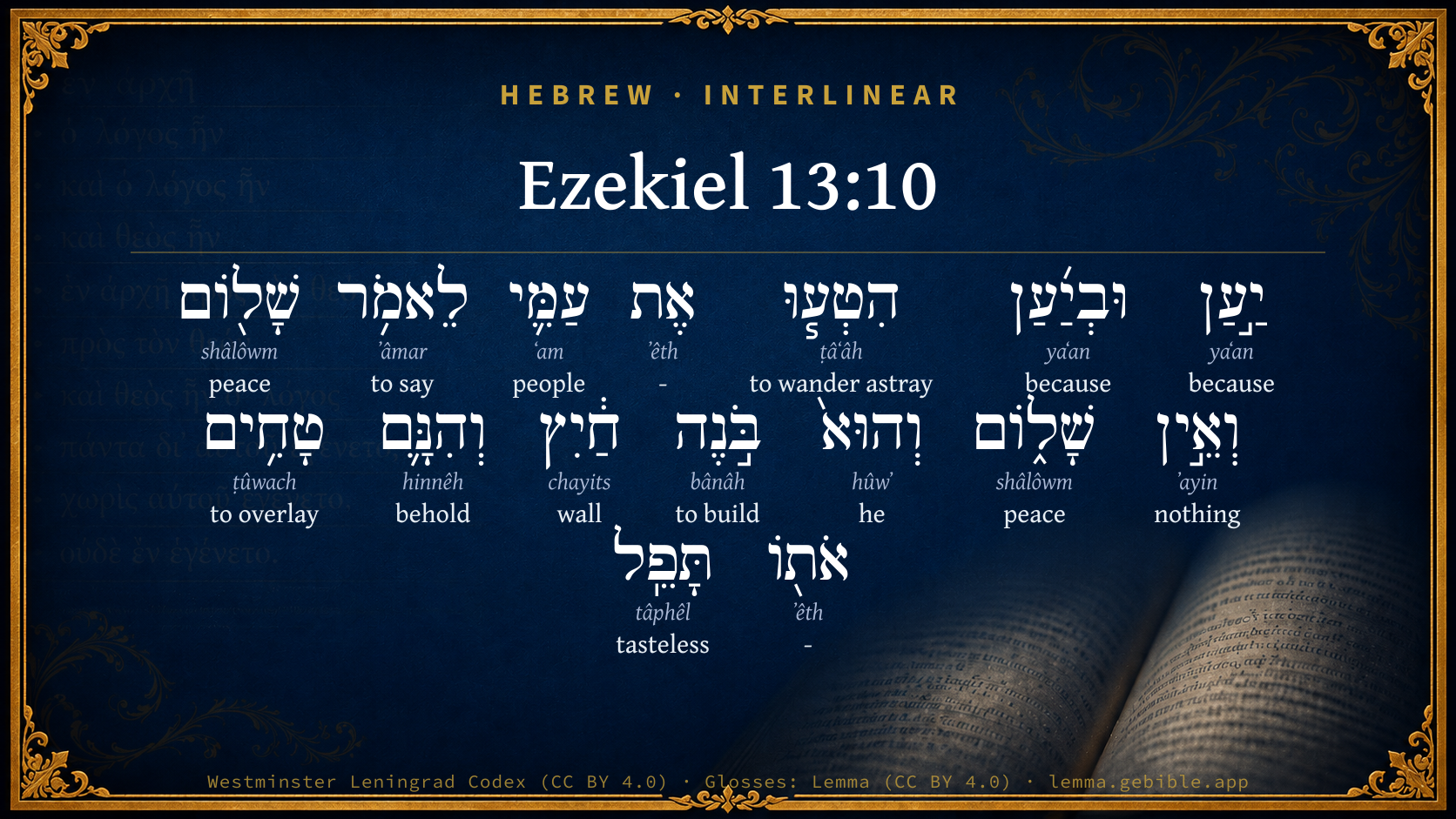
הִטְע֧וּ
ṭâʻâh
H2937
“to wander astray”
Verb, Hiphil, Perfect, 3rd Person, Common, Plural
Part of Speech
Verb
Stem
Hiphil
Form
Perfect
Person
3rd Person
Gender
Common
Number
Plural
Full BDB Definition

Origin: a primitive root

TWOT: 814

to wander, stray, wander astray, err - (Hiphil) - to seduce - to cause to go astray
  1. יַ֣עַן yaʻan H3282 “because” Conjunction
  2. וּבְיַ֜עַן yaʻan H3282 “and · in/at · because” Conjunction + Preposition + Conjunction
  3. אֶת ʼêth H853 “-” Particle, Direct Object
  4. עַמִּ֛י ʻam H5971 “people · my” Noun, Common, Masculine, Singular, Construct + Suffix, Personal, 1st Person, Common, Singular
  5. לֵאמֹ֥ר ʼâmar H559 “to say” Preposition + Verb, Qal, Infinitive Construct
  6. שָׁל֖וֹם shâlôwm H7965 “peace” Noun, Common, Masculine, Singular, Absolute
  7. וְאֵ֣ין ʼayin H369 “and · nothing” Conjunction + Particle, Negative
  8. שָׁל֑וֹם shâlôwm H7965 “peace” Noun, Common, Masculine, Singular, Absolute
  9. וְהוּא֙ hûwʼ H1931 “and · he” Conjunction + Pronoun, Personal, 3rd Person, Masculine, Singular
  10. בֹּ֣נֶה bânâh H1129 “building” Verb, Qal, Participle Active, Masculine, Singular, Absolute
  11. חַ֔יִץ chayits H2434 “wall” Noun, Common, Masculine, Singular, Absolute
  12. וְהִנָּ֛ם hinnêh H2009 “and · behold · them” Conjunction + Particle, Demonstrative + Suffix, Personal, 3rd Person, Masculine, Plural
  13. טָחִ֥ים ṭûwach H2902 “overlaying” Verb, Qal, Participle Active, Masculine, Plural, Absolute
  14. אֹת֖וֹ ʼêth H853 “- · him” Particle, Direct Object + Suffix, Personal, 3rd Person, Masculine, Singular
  15. תָּפֵֽל tâphêl H8602 “tasteless” Noun, Common, Masculine, Singular, Absolute

About this verse

These counts appear in no published source. They are computed here, from the morphology-tagged text and Lemma’s own curated glosses. What Lemma adds →

16
words
13
distinct lemmas
Prophets
section

Notable vocabulary

2 hapax legomena — words that appear only here in the entire Hebrew Bible:

  • הִטְע֧וּ to wander astray H2937
  • חַ֔יִץ wall H2434

First appearance in Scripture

These words make their first canonical appearance in the Hebrew Bible here:

  • הִטְע֧וּ to wander astray H2937
  • חַ֔יִץ wall H2434

Shared distinctive vocabulary

תָּפֵֽל tasteless H8602 occurs in 7 verses of the Hebrew Bible. Also found in:

Grammatical profile

  • 4 verbs
  • 5 nouns
  • 1 pronoun
  • 2 conjunctions
  • 4 particles

Verb forms

  • הִטְע֧וּ Hiphil · Perfect
  • לֵאמֹ֥ר Qal · Infinitive Construct
  • בֹּ֣נֶה Qal · Participle Active
  • טָחִ֥ים Qal · Participle Active

Repetition

Words recur within this verse — often emphatic in Hebrew:

  • יַ֣עַן because H3282 ×2
  • שָׁל֖וֹם peace H7965 ×2

Hebrew & Septuagint length

In English translation the verse runs 28 words from the Hebrew and 27 from the Septuagint (LXX English) — closely comparable.

A rough comparison of the two English renderings, which tokenize alike — not a word-level alignment.

Word counts can differ between the Hebrew and the Greek without any difference in meaning — e.g. the Hebrew direct-object marker אֵת has no separate Greek word, and Greek often adds the article ὁ.

In the original languages it is 16 Hebrew tokens and 23 Greek tokens — but the two are counted differently (Hebrew bundles its prefixes and suffixes into one token; the Greek is in lemma form), so that isn’t a like-for-like length.

Cross-references

24

Topical passages linked to Ezekiel 13:10 in the Treasury of Scripture Knowledge — connected by theme and wording, ordered by reader-vote popularity; previews shown in the World English Bible.

  • Ezekiel 13:16 [to wit], the prophets of Israel who prophesy concerning Jerusalem, and who see visions of peace for her, and there is no peace, says the Lord Yahweh.
  • Ezekiel 22:28 Her prophets have daubed for them with whitewash, seeing false visions, and divining lies to them, saying, Thus says the Lord Yahweh, when Yahweh has not spoken.
  • 2 Kings 21:9 But they didn't listen: and Manasseh seduced them to do that which is evil more than did the nations whom Yahweh destroyed before the children of Israel.
  • Jeremiah 6:14 They have healed also the hurt of my people slightly, saying, Peace, peace; when there is no peace.
  • Jeremiah 8:11 They have healed the hurt of the daughter of my people slightly, saying, Peace, peace; when there is no peace.
  • Jeremiah 14:13 Then said I, Ah, Lord Yahweh! behold, the prophets tell them, You shall not see the sword, neither shall you have famine; but I will give you assured peace in this place.
  • 2 Chronicles 18:12 The messenger who went to call Micaiah spoke to him, saying, Behold, the words of the prophets [declare] good to the king with one mouth: let your word therefore, Please be like one of theirs, and speak you good.
  • Proverbs 12:26 A righteous person is cautious in friendship, But the way of the wicked leads them astray.
  • Isaiah 30:10 who tell the seers, "Don't see;" and to the prophets, "Don't prophesy to us right things, speak to us smooth things, prophesy deceits,
  • Isaiah 57:21 There is no peace, says my God, to the wicked.
  • Jeremiah 4:10 Then said I, Ah, Lord Yahweh! surely you have greatly deceived this people and Jerusalem, saying, You shall have peace; whereas the sword reaches to the life.
  • Jeremiah 5:31 the prophets prophesy falsely, and the priests bear rule by their means; and my people love to have it so: and what will you do in the end of it?
  • Jeremiah 8:15 We looked for peace, but no good came; [and] for a time of healing, and, behold, dismay!
  • Jeremiah 23:13–15 I have seen folly in the prophets of Samaria; they prophesied by Baal, and caused my people Israel to err.
  • Jeremiah 23:17 They say continually to those who despise me, Yahweh has said, You shall have peace; and to everyone who walks in the stubbornness of his own heart they say, No evil shall come on you.
  • Jeremiah 28:9 The prophet who prophesies of peace, when the word of the prophet shall happen, then shall the prophet be known, that Yahweh has truly sent him.
  • Jeremiah 50:6 My people have been lost sheep: their shepherds have caused them to go astray; they have turned them away on the mountains; they have gone from mountain to hill; they have forgotten their resting-place.
  • Ezekiel 7:25 Destruction comes; and they shall seek peace, and there shall be none.
  • Micah 2:11 If a man walking in a spirit of falsehood lies: 'I will prophesy to you of wine and of strong drink;' He would be the prophet of this people.
  • Malachi 3:15 Now we call the proud happy; yes, those who work wickedness are built up; yes, they tempt God, and escape.'
  • 1 Timothy 4:1 But the Spirit says expressly that in later times some will fall away from the faith, paying attention to seducing spirits and doctrines of demons,
  • 2 Timothy 3:13 But evil men and impostors will grow worse and worse, deceiving and being deceived.
  • 1 John 2:26 These things I have written to you concerning those who would lead you astray.
  • Revelation 2:20 But I have this against you, that you tolerate your woman, Jezebel, who calls herself a prophetess. She teaches and seduces my servants to commit sexual immorality, and to eat things sacrificed to idols.

Cross-references courtesy of OpenBible.info (CC BY 4.0).

Hebrew and Greek witnesses Masoretic Hebrew ↔ Greek Septuagint

The same verse in the two great witnesses to the Old Testament, shown verse-for-verse.

These are two independent witnesses, not word-aligned to each other, and the Septuagint is shown in lemma (dictionary) form.

Hebrew Ezekiel 13:10 Masoretic · Westminster Leningrad Codex

יַ֣עַן וּבְיַ֜עַן הִטְע֧וּ אֶת עַמִּ֛י לֵאמֹ֥ר שָׁל֖וֹם וְאֵ֣ין שָׁל֑וֹם וְהוּא֙ בֹּ֣נֶה חַ֔יִץ וְהִנָּ֛ם טָחִ֥ים אֹת֖וֹ תָּפֵֽל

Because, even because they have seduced my people, saying, Peace; and there is no peace; and when one builds up a wall, behold, they daub it with whitewash:

World English Bible · Public Domain

Greek LXX Ezekiel 13:10 Septuagint · lemma form

ἀντί ὅς ὁ λαός ἐγώ πλανάω λέγω εἰρήνη εἰρήνη καί οὐ εἰμί εἰρήνη καί οὗτος οἰκοδομέω τοῖχος καί αὐτός ἀλείφω αὐτός εἰ πίπτω

Because they have caused my people to err, saying, Peace; and there is no peace; and one builds a wall, and they plaster it, —it shall fall.

LXX2012 (modern English Septuagint) · Public Domain

Hebrew: Westminster Leningrad Codex (CC BY 4.0). Greek: Septuagint (public domain); English from LXX2012 (modern English Septuagint) (Public Domain). How the Septuagint differs from the Hebrew →

Targum (Aramaic paraphrase)

1

The Targum is the ancient Jewish Aramaic paraphrase of the Hebrew Scriptures — an interpretive translation, not the Hebrew text itself. Onkelos (literal) and Pseudo-Jonathan (expansive) render the Torah, and Jonathan the Prophets. Coverage is partial: where no permissively-licensed English translation exists for a verse, only the Aramaic is shown. This is verse-level text, not a word-by-word alignment to the Hebrew.

  1. Targum Jonathan Prophets (Joshua–Malachi)
    חֲלַף דְאִתְנַבִּיאוּ שְׁקַר וַחֲלַף דְאַטְעִיאוּ יַת עַמִי לְמֵימָר שְׁלָמָא וְלֵית שְׁלָם וְאִינוּן דָמָן לִדְבָנֵי מְחִיצָא וְשָׁעֵיָע לֵיהּ טִין פַּטִיר דְלָא תֲבָן:

    (no public-domain English translation for this verse)

    Targum Jonathan — Aramaic: “Mikraot Gedolot” (public domain). English: “Sefaria Community Translation” (CC0 1.0 (public-domain dedication)); “London "Chaldee Paraphrase," 1871” (public domain). Text via Sefaria.

Commentary

Notes on Ezekiel 13:10 from classic Christian and Jewish commentators (each source and its license shown beneath its notes). The classic Christian expositions comment on the surrounding passage and are grouped to its opening verse, so a note may address several verses; the Jewish commentaries on the Tanakh (Rashi and others) are per-verse, so they appear only where the commentator wrote on this verse.

Lemma curates 59 commentaries, every one of them public domain or Creative Commons licensed, each selected and text-cleaned for this edition rather than reprinted as found. About our sources →

Matthew Henry's Commentary

We have here more plain dealing with the false prophets, and some further articles of their doom. We have seen the people made ashamed of the false prophets (though sometimes they had been fond of them) and casting them away, as they shall do their false gods, with indignation; now here we find them as much ashamed of their false prophecies, which they had sometimes depended upon with much assurance. Observe,

I. How the people are deceived by the false prophets. Those flatterers seduce them, saying, Peace, and there was no peace, Eze 13:10. They pretended to have seen visions of peace, Eze 13:16. But that could not be, for there was no peace, saith the Lord God. There was no prosperity designed for them, and therefore there could be no ground for their security; yet they told them that God was at peace with them, and had mercy in reserve for them, and that the war they were engaged in with the Chaldeans should soon end in an honourable peace, and their land should enjoy a happy repose and tranquillity. They told the idolaters and other sinners that there was neither harm nor danger in the way they were in. Thus they seduced God's people; they put a cheat upon them, led them into mistakes, and drew them aside out of that way of repentance and reformation which the other prophets were endeavouring to bring them into. Note, Those are the most dangerous seducers who suggest to sinners that which tends to lessen their dread of sin and their fear of God. Now this is compared to the building of a slight rotten wall, or, according to our Saviour's similitude, which is to the same purport with this (Mat 7:26), the building of a house upon the sand, which seems to be a shelter and protection for a while, but will fall when a storm comes. One false prophet built the wall, set up the notion that God was not at all displeased with Jerusalem, but that the city should be confirmed in its flourishing state, and be victorious over the powers that now threatened it. This notion was very pleasing, and he that started it made himself very acceptable by it and was caressed by every body, which invited others to say the same. They made the matter look yet more plausible and promising; they daubed the wall, which the first had built, but it was with untempered mortar, sorry stuff, that will not bind nor hold the bricks together; they had no ground for what they said, nor had it any consistency with itself, but was like ropes of sand. They did not strengthen the wall, were in no care to make it firm, to see that they went upon sure grounds; they only daubed it to hide the cracks and make it look well to the eye. And the wall thus built, when it comes to any stress, much more to any distress, will bulge and totter, and come down by degrees. Note, Doctrines that are groundless, though ever so grateful, that are not built upon a scripture foundation nor fastened with a scripture cement, though ever so plausible, ever so pleasing, are not of any worth, nor will stand men in any stead; and those hopes of peace and happiness which are not warranted by the word of God will but cheat men, like a wall that is well daubed indeed, but ill-built.

II. How they will be soon undeceived by the judgment of God, which, we are sure, is according to truth. 1. God will in anger bring a terrible storm that shall beat fiercely and furiously upon the wall. The descent which the Chaldean army shall make upon Judah, and the siege which they shall lay to Jerusalem, will be as an overflowing shower, or inundation (such as Solomon calls a sweeping rain that leaves no food, Pro 28:3), will bear down all before it, as the deluge did in Noah's time: You, O great hailstones! shall fall, the artillery of heaven, every hailstone like a cannon-ball, battering this wall, and with these a stormy wind, which is sometimes so strong as to rend the rocks (Kg1 19:11), much more an ill-built wall, Eze 13:11. But that which makes this rain, and hail, and wind, most terrible is that they arise from the wrath of God, and are enforced by that; it is that which sends them; it is that which gives them the setting on (Eze 13:13); it is a stormy wind in my fury, and an overflowing shower in my anger, and great hailstones in my fury. The fury of Nebuchadnezzar and his princes, who highly resented Zedekiah's treachery, made the invasion very formidable, but that was nothing in comparison with God's displeasure. The staff in their hand is my indignation, Isa 10:5. Note, An angry God has winds and storms at command wherewith to alarm secure sinners; and his wrath makes them frightful and forcible indeed; for who can stand before him when he is angry? 2. This storm shall overturn the wall: it shall fall, and the wind shall rend it (Eze 13:11), the hailstones shall consume it (Eze 13:13); I will break it down (Eze 13:14) and bring it to the ground, so that the foundation thereof shall be discovered; it will appear how false, how rotten it was, to the prophetical reproach of the builders. When the Chaldean army has made Judah and Jerusalem desolate then this credit of the prophets, and the hopes of the people, will both sink together; the former will be found false in flattering the people and the latter foolish in suffering themselves to be imposed upon by them, and so exposed to so much the greater confusion, when the judgment shall surprise them in their security. Note, Whatever men think to shelter themselves with against the judgments of God, while they continue unreformed, will prove but a refuge of lies and will not profit them in the day of wrath. See Isa 28:17. Men's anger cannot shake that which God has built (for the blast of the terrible ones is but as a storm against the wall, which makes a great noise, but never stirs the wall; see Isa 25:4), but God's anger will overthrow that which men have built in opposition to him. They and all their attempts, they and all the securities wherein they intrench themselves, shall be as a bowing wall and as a tottering fence (Psa 62:3, Psa 62:10); and when their vain predictions are disproved, and their vain expectations disappointed, then it will be discovered that there was no ground for either, Hab 3:13. The day will declare what every man's work is, and the fire will try it, Co1 3:13. 3. The builders of the wall, and those that daubed it, will themselves be buried in the ruins of it: It shall fall, and you shall be consumed in the midst thereof, Eze 13:14. And thus the threatenings of God's wrath, and all the just intentions of it, shall be accomplished to the uttermost, both upon the wall and upon those that have daubed it, Eze 13:15. The same judgments that will prove the false prophets to be false will punish them for their falsehood; and they themselves shall be involved in the calamity which they made the people believe there was no danger of, and become monuments of that justice which they bade defiance to. Thus, if the blind lead the blind, both the blind leaders and the blind followers will fall together into the ditch. Note, Those that deceive others will in the end prove to have deceived themselves; and no doom will be more fearful than that of unfaithful ministers, that flattered sinners in their sins. 4. Both the deceivers and the deceived, when they thus perish together, will justly be ridiculed and triumphed over (Eze 13:12): When the wall has fallen shall it not be said unto you, by those that gave credit to the true prophets, and feared the word of the Lord, "Now where is the daubing wherewith you have daubed the wall? What has become of all the fine soft words and fair promises wherewith you flattered your wicked neighbours, and all the assurances you gave them that the troubles of the nation should soon be at an end?" The righteous shall laugh at them, the righteous God shall, righteous men shall, saying, Lo, this is the man that made not God his strength, Psa 52:6, Psa 52:7. I also will laugh at your calamity, Pro 1:26. They will say unto you (Eze 13:15), "The wall is no more, neither he that daubed it; your hopes have vanished, and those that supported them, even the prophets of Israel," Eze 13:16. Note, Those that usurp the honours that do not belong to them will shortly be filled with the shame that does.

Matthew Henry's Commentary on the Whole Bible (1708–1710) — public domain (CC PDM 1.0). Text via the HelloAO Bible API.

Trapp's Complete Commentary

John Trapp

Eze 13:10 Because, even because they have seduced my people, saying, Peace; and [there was] no peace; and one built up a wall, and, lo, others daubed it with untempered [morter]:

Ver. 10. Because, even because.] Heb., For that, and for that; an angry epizeuxis. {a} See Eze 13:8.

Saying, Peace, peace.] Making all fair weather before them, whenas the storm of God’s wrath (never to be blown over) was bursting out upon them.

And one built up a wall.] Ipse oedificabat parietem; one of the devil’s chief dirt-daubers, such as was Shemaiah, Hananiah, &c., {Jer 29:31} who, together with their women upholsterers that sewed pillows to all arm holes, {Eze 13:18} made foul work, and did much mischief among God’s people; like as do the Jesuits and Jesuitists (into whom all the old seducers have fled and hid themselves) at this day.

And, lo, others daubed it.] By cunning collusion they plastered and parjetted over the mud walls that was so set up. Ita extruunt illi vel potius destruunt ecclesiam Dei; { b} such proper builders were these. Like unto whom are the Popish priests, who bring the poor people into a fool’s paradise, and such idle ministers among us as shoot off at best, a few popguns against gross sins; or when they have done their worst at it, lick them whole again with, I hope better things of you, or, I hope there are none such here, &c. Many silly people also judge themselves honest because the daubing minister will give them the beggarly passport, and so die like lambs, being woefully cheated, and willing to be so. {Jer 5:31 Mat 24:11}

With untempered mortar.] Which will make but a bulging wall, not like to stand long.

{a} A figure by which a word is repeated with vehemence or emphasis. ŒD

{b} Jun

John Trapp, A Commentary or Exposition upon All the Books of the Old and New Testament (1647–1656) — public domain. Text from a community e-Sword module.

The Biblical Illustrator

Joseph S. Exell

Eze_13:10-12

One built up a wall, and lo, others daubed it with untempered mortar.

The wall daubed with untempered mortar

I. The text speaks of a wall. Men look about them to discover some sort of wall or other behind which to shelter from conscience and Divine threatening. I suppose this is because conscience is not quite dead in any man. In some men it has been so drugged and chloroformed that it never seems to act with anything like vigour, and when it speaks it is only with a still small voice, and not at all with the thunder which its voice ought to have to the mind of men; yet that little relic of conscience, which with a microscope you can detect in all men, needs to be pacified, and men are glad if by any lie, however barefaced, they can create an excuse by which they may go on quietly in their sins.

1. Perhaps the greatest wall behind which men shelter themselves is that of utter indifference to anything like Divine truth. Some silly dancer at the opera, some new invention, some novel trick of legerdemain, some fresh anything or nothing, and the world is all agog; but as to things which will outlast sun and moon, and stand fast when yon blue heaven, like a scroll, has been rolled up and put away--these all-important things our wiseacres think but trifles, and they continue trampling Gods eternal truth beneath their feet, as swine do trample pearls, and rushing madly after the bubbles of this world, as though they were all that men were made to hunt after.

2. Numbers, however, are not quite so stupid, so besotted, so blind, so brutalised as to put up with this. Like a crying child, their conscience will be heard. Like a horse leech, it ever cries Give, give, and will not be content. Who comes next? Who is the anointed one of Satan to quiet this spirit? Who will yield a quietus to a mind alarmed? See the wall of ceremonies behind which many rest so contentedly.

3. You may be building another wall, namely, that of self-righteousness. How many have been piling up their wall, and gathering their wood, their hay, their stubble, with which to erect a defence to screen themselves from God by their own doings?

II. Whenever a man tries to build a wall behind which to shelter, he always finds a volunteer band of ready assistants.

1. For instance, a man who is easy in his pleasures, how many will help him to continue at his ease! He is right, says one; You are a good fellow, says another; and they both try to keep him in countenance by their company.

2. Another company of scoffers will loudly boast themselves, and cry, Yes, you are all right in continuing in neglect of God and of Divine truth, because the saints are no better than they should be. I remember what So-and-so did once--he was a deacon; and I know the inconsistencies of Mr. Zealous, and he is one of the parsons.

3. A numerous body of daubers gather at the sign of the Sneerer, in Atheist Street; and with their doubts, or their supposed doubts, of inspiration and biblical authenticity, are ready to daub and plaster any amount of wall an inch thick.

4. If the wall be built of ceremonies, how many are busy daubing that! What multitudes of books are streaming from the press, books of ability, too, all going to show that salvation is infallibly connected with a mechanical process, conducted by specified officials, and not a spiritual work independent of all outward performances!

III. The Word of God declares that this wall will not stand. The wall to which Ezekiel alludes is one of the cob walls in the East, daubed with bad mortar, which had not been well tempered, that is to say, not well mixed with the straw which they use in place of the hair which we use in England; when the rain comes, it softens the whole structure of such a wall, melts it, and washes it quite away. Such a deluge as that is coming ere long to try and test every human hope.

1. It comes to some men when they enter upon times of spiritual trial.

2. But if the test come not thus it will usually come at death.

3. And if death does not do it--for some men die like lambs, and like sheep are they laid in the grave; but the worm shall feed upon them--if death does not do it, the judgment shall.

IV. If we shall be found lost at the last, it will be an everlasting reproach to us that we once accepted the false helps of our friends. Where is the daubing wherewith ye have daubed it? That voice may proceed from many lips.

1. It may come from the lips of Jesus. I said unto you, Come unto Me and live, but you would not come; you refused the refuge which I presented to you, and you chose your own works, and rested in ceremonies of your own devising, and now where is the daubing wherewith ye have daubed it?

2. I could imagine such a voice as that coming from a faithful minister, or other Christian labourer, who may have honestly pointed out to you the one and only way of salvation.

3. And there shall come another voice, with quite another tone-a hoarse and horrible voice--a voice full of malice and grim laughter, which shall say, Where is the daubing wherewith ye have daubed it? You shall understand it to be the voice of him who once deceived you--the fallen spirit, the devil.

4. There shall be heard amidst that thick darkness and horrid gloom, that never shall be broken by a ray of light, another voice which once you knew. Perhaps the husband shall hear the voice of the wife, who shall say, Ah! where is the daubing wherewith ye have daubed it? You would not let me go to the house of God; you laughed me out of my religion. I was once a young woman unmarried, who cared for the things of God in some respects; you courted me and enticed me away from my fathers God, and then you laughed me out of my prayers and Sabbath worship; you have laughed me into hell, but you cannot laugh me out of it again.

5. And then, last of all, your own conscience, from which you never can escape, which is, perhaps, the worm that never dies, and the flame which kindles the fire of remorse that never shall be quenched, your conscience will say to you, Where is the daubing wherewith you have daubed it? (C. H. Spurgeon.)

Prophets feeble and yielding

The figure incisively describes the futile projects of the people and the feeble flattery and approval of the prophets. When a weak man cannot originate anything himself, he acquires a certain credit (at least in his own eyes) by strong approval of the schemes of others, saying, Right! I give it my cordial approval, and, indeed, would have suggested it. What made the prophets whitewash the wall which the people built was partly the feeling that from the place they occupied they must do something, and maintain their credit as leaders even when being led; and partly, perhaps, that, having no higher wisdom than the mass, they quite honestly approved their policy. Being sharers with them in the spirit of the time, they readily acquiesced in their enterprises. (A. B. Davidson, D. D.)

False hopes

I. What are the foundations of this fabric?

1. It is built upon falsehood. Observe, it is here imputed to these false prophets that they led the people to suppose that their state by nature was not one of enmity with God,--that, in fact, they were at peace with Him. Now, this falsehood is manifest. We are not at peace by nature. We all know that God has a strife with man, a righteous ground of controversy with every man born into the world. Our first conscious thoughts are those of disaffection and dislike to holiness; and our first voluntary actions are to take up arms against God. We, then, are not at peace, but at enmity with God. How was this breach to be made up? Usually, a vanquished foe expects to buy peace at a large price; but we had nothing to pay. It remained, therefore, that the benignant Being with whom we had been carrying on this fruitless and ungrateful warfare should Himself originate a scheme of reconciliation. We know that Christ is our peace, and our only peace. He brings peace, He preaches peace, He bestows peace. To as many as received Him, gave He power to become the sons of God. Being justified by faith, we have peace with God. This is the foundation, and other can no man lay. He who shall dare to build on any other shall see the fabric perish before the overflowing shower, and the stormy wind shall rend it.

2. It is not laid deeply enough. In the fourteenth verse it is said, with regard to this foundation, The foundation thereof shall be discovered, laid bare, open to the sight of the beholder. The image is commonly used in Scripture to denote that which is superficial and unsound. Everything that is to be firm strikes deeply into the ground. Job speaks of having the root of the matter in himself; and the stony ground, hearer, fell, we are told, because there was in him no depth of earth. What is the kind of foundation here spoken of? Doubtless, we must take it as applying here to a religion which rests upon slight convictions of sin,--little sense of its heinousness and guilt. The Spirit convinces of sin, to lead to Him that shall take all sin away. The Spirit of God opens no wounds, except with a view the more effectually and kindly to bind them up.

3. Another element of this unstable foundation is presumption, an unwarrantable appropriation of the promises; as if the benefit of an amnesty could be extended to those who were still in an attitude of rebellion; as if the promises of salvation could still be held out to those who continued in unrepented sin. This is strongly marked in the latter part of the twenty-second verse. It may be a grievous error in a teacher, according to the first part of that verse, to make the hearts of the righteous sad, whom God hath not made sad; but surely it is a much more grievous error to hold out the promise of life to those to whom, as yet, God has not given peace. Our Lord must be our example here.

II. What are the walls of this fabric? In other words, by what supports and excuses do men keep this unsound and unscriptural hope together? One built up a wall, and others daubed it with untempered mortar. The meaning of the prophets allusion will be best explained by a reference to Jewish domestic architecture. Although hewn stones were employed for the purpose of very large buildings, for small houses a tile was commonly used, formed of white clay and baked in the sun. These tiles were cemented together by mortar, which, as among ourselves, was made to acquire a certain adhesive property by means of straw and chaff. Travellers tell us that whole villages are formed of houses built with this white clay or tile, and they tell us, further, that after rain the filth occasioned by the dissolving of the cement will make the ways in front of the houses perfectly impassable; whilst, if the mortar which has been used has been very badly tempered, that is, very imperfectly mixed with the straw or the chaff, it is no uncommon thing to see the house fall down entirely, under the violence or dissolving action of the rain, the very effect which we see alluded to in the text. What a picture have we here of the refuges which worldly men make for themselves against that day, when judgment shall be laid to the line and righteousness to the plummet! Oh, how many of these slight walls are people running up every day! There is the wall of evil example, by which a man fortifies himself in his low standard of personal and practical godliness by what he sees in someone around him. There is the wall of pretended necessity; the urgent claims of daily life making it, as he alleges, impossible for him to attend to the cares of his family and the interests of his soul. There is the wall of constitutional impediment, the pretence that something in our peculiar temperament and constitution or circumstances makes it so difficult for us to attend to the things of our salvation. There is the wall of perverted doctrine, where men, waiting for some impulse from above, knowing that Divine grace must begin the work, say, they can do nothing themselves, they must wait till God by His Spirit changes their hearts. And then there is the wall of good intentions, the purpose of serving God, but not now, the miserable promise that we will give to God the remnant of our days, that He shall have the reversion of our convenient season. Oh, how many of these flimsy fabrics will fall, and do fall daily, before the first breath of the Divine displeasure. But observe, further, it is said that when one built the wall, another daubed it with untempered mortar. This seems to intimate to us that foolish and unconverted men are in the habit of encouraging each other in their foolish hopes: justifying one another in their vain excuses; each confirming the reasonableness of the others pretences, and then going away confirmed and strengthened in his own.

III. These false hopes shall be thrown down. This false builder shall wake and see the crumbling of his own wretched wall; this mere dauber shall see the melting and dissolving of his own untempered mortar, that God alone may be exalted in that day, and that every unscriptural and unauthorised, unsanctioned hope may perish. And oh, will not the weakness and instability of this wall appear before this hurricane of Divine indignation comes upon us? When the silver cord is loosed, and the golden bowl is broken; when the pitcher is broken at the fountain, shall we not then perceive that we have been building upon a treacherous foundation? But then, if we feel it in that day, what shall we feel in that remoter time, when the storm of the Divine indignation shall come upon the whole world? (D. Moore, M. A.)

The false prophet

The false prophets are much in evidence up to the point of the fall of Jerusalem. Ezekiel accuses them of the crime of the hireling shepherd: they used the flock to make wages, and so became the type for all time of those who make

The symbols of atoning grace

An office key.

The false prophet gained favour with the military party in the nation, by his telling advocacy of a vast and well-prepared army and of brilliant foreign alliances, he won favour with the clerical party by not demanding too much virtue, either from the individual or from the State. As a class they had a ready apology for every shifting policy. True, the apology, although always ready, was only an apology--or, to use the prophets own figure, it was only a daubing of the ill-built wall with untempered mortar (Eze_13:8-16)--that is to say, when any project or scheme of policy is being promoted, they stand by glozing it over with fine words, flattering its promoters, and uttering profuse assurances of its success. The daub, in hiding the infamy, hurries the disaster. Ye, O great hailstones, shall fall; and a stormy wind shall rend it. When the scheme has failed, when God has suddenly intercepted a peoples mad pride, the false prophet may be--may be--called to account: Lo, when the wall is fallen, shall it not be said unto you, Where is the daubing wherewith ye have daubed it? But it may happen, in a nations downfall and the daze of its calamity, that the moral collapse is so complete that the man who daubed the wall escapes unblamed--but not the man who was honest enough to say plainly from the first that it was a mere daub! But, blamed or not of the men he has misled, the false prophet shall not go unpunished. I the Lord will answer him by Myself. Above all things, may Gods mercy save us from having, under such conditions, to bear Gods answer, by Himself! (H. E. Lewis.)

The Biblical Illustrator, edited by Joseph S. Exell (c. 1880s–1900s) — public domain. Text from a community e-Sword module.

Joseph Benson's Commentary

Eze 13:10-15. They have seduced my people, &c. — Have made my people to err, both with respect to the greatness of their own guilt, and my displeasure on account of it, as if both were less than they really are, and no great danger was to be apprehended. They deceived them, by assuring them that none of those judgments should overtake them which Jeremiah and the other true prophets threatened them with, and they spoke peace to men’s consciences upon false grounds and principles. Thus they obstructed and drew them out of the way of that repentance and reformation into which the other prophets were endeavouring to bring them. And, observe, reader, those are the most dangerous seducers who suggest to sinners that which tends to lessen their dread of sin, or their fear of God. These are compared to men who build a slight tottering wall, which others daub with untempered mortar; sorry stuff which will not bind nor hold the bricks together; doctrines not grounded on, nor according with, the word of God. Say unto them that it shall fall — When they have the greatest need of defence, and when they least apprehend such an event. There shall be an overflowing shower, &c. — Terrible judgments from God, often compared in Scripture to storms and tempests, the artillery of heaven, especially when he executes his judgments by a victorious army. Shall it not be said, Where is the daubing? &c. — Then it will be asked, by way of taunt and reproach, where are the remedies you had provided, and in which you persuaded all to put confidence? I will even rent it with a stormy wind in my fury — Rather, in my indignation. Under these metaphors is foretold the destruction of Jerusalem, and the Jewish state by the Chaldean army. Thus the Chaldee paraphrase expounds it: “I will bring a mighty king with the force of a whirlwind, and a destroying people, as it were an overflowing storm, and powerful princes like great hailstones.” So will I break down the wall, &c. — Thus will I overthrow all your false confidences, and all the remedies which ye have provided against the ruin of the state; and ye yourselves that were so confident of safety shall be consumed. The Chaldee paraphrase reads, I will destroy the city wherein ye have uttered these false prophecies, which exposition accords with the next words, And ye shall be consumed in the midst thereof; that is, shall be destroyed in the same common calamity. And ye shall know, &c. — Those that deceived others will in the end be found to have deceived themselves. And no doom will be more fearful than that of unfaithful ministers. Thus will I accomplish my wrath, &c. — Fulfil what my prophets foretold; and will say unto you — Will show by the awful event; The wall is no more, neither they that daubed it — The city is no more, nor the false prophets.

Joseph Benson's Commentary on the Old and New Testaments (1811–1818) — public domain. Text from a community e-Sword module.

Tyndale Open Study Notes

Tyndale Open Resources

13:10-16 The people’s “righteousness” was a flimsy wall in danger of collapse. Rather than doing the hard work of constructing their wall properly by calling the people to repentance, the false prophets were content to give it a coat of whitewash by telling the people that peace would come to Jerusalem. This external touch-up made the wall appear more solid than it was. Its true weakness would be exposed by a heavy rainstorm. Water would flow into the unsealed cracks, wash away the mortar, and allow the stones to fall away. In this case, the storm would be the great flood of God’s anger, which would destroy the people’s pretense to righteousness and the false prophets who had encouraged it. Meanwhile, they would have no peace.

Tyndale Open Study Notes — © Tyndale Open Resources, licensed CC BY-SA 4.0. Text via the HelloAO Bible API.

Geneva Bible (1599)

Geneva Bible translators

Whereas the true Prophets prophesied the destruction of the city to bring the people to repentance, the false prophets spake the contrary, and flattered them in their vanities, so that what one false prophet said (which is here called the building of the wall) another false prophet would affirm, though he had neither occasion nor good ground to bear him.

Read Jer. 6:14.

Geneva Bible (1599) marginal notes — public domain. Text via Bolls.life.

Jamieson, Fausset & Brown

Robert Jamieson, A. R. Fausset & David Brown

Because, even because--The repetition heightens the emphasis.

Peace--safety to the nation. Ezekiel confirms Jer 6:14; Jer 8:11.

one--literally, "this one"; said contemptuously, as in Ch2 28:22.

a wall--rather, "a loose wall." Ezekiel had said that the false prophets did not "go up into the gaps, or make up the breaches" (Eze 13:5), as good architects do; now he adds that they make a bustling show of anxiety about repairing the wall; but it is without right mortar, and therefore of no use.

one . . . others--besides individual effort, they jointly co-operated to delude the people.

daubed . . . with untempered mortar--as sand without lime, mud without straw [GROTIUS]. FAIRBAIRN translates, "plaster it with whitewash." But besides the hypocrisy of merely outwardly "daubing" to make the wall look fair (Mat 23:27, Mat 23:29; Act 23:3), there is implied the unsoundness of the wall from the absence of true uniting cement; the "untempered cement" answering to the lie of the prophets, who say, in support of their prophecies, "Thus saith the Lord, when the Lord hath not spoken" (Eze 22:28).

Jamieson, Fausset & Brown — Commentary Critical and Explanatory on the Whole Bible (1871) — public domain (CC PDM 1.0). Text via the HelloAO Bible API.

Adam Clarke's Commentary

Verse 10. One built up a wall] A true prophet is as a wall of defense to the people. These false prophets pretend to be a wall of defense; but their wall is bad, and their mortar is worse. One gives a lying vision, another pledges himself that it is true; and the people believe what they say, and trust not in God, nor turn from their sins. The city is about to be besieged; it needs stronger fortifications than what it possesses. The prophet should be as a brazen wall for its defence; and such my prophets would have been had the people received the word from my mouth. But ye have prevented this by your lying vanities; and when you have perverted the people, you pretend to raise up a rampart of specious prophecy, full of fine promises, for their defence. What one false prophet says, another confirms; and this is like daubing over a bad wall with bad mortar, which prevents its blemishes and weaknesses being discovered, though it has no tendency to strengthen the building.

Adam Clarke's Commentary on the Bible (1810–1826) — public domain. Text from a community e-Sword/MySword module.

John Calvin's Commentaries

Here Ezekiel pursues the same metaphor which he had used with a very slight difference, for there is such an agreement that the connection is apparent between the former and the present sentence. He had said that the false prophets did not go up to the breaches, and did not restore the hedges of the house of Israel: we have explained these words thus — teachers who discharge their duties honestly and sincerely are like builders, who, if they see a breach in a wall, instantly and carefully repair it: they are like gardeners who do not allow either a field or a vineyard to be exposed to wild beasts. As, then, he had formerly said that these false prophets did not go up to the breach through their not being affected by the dispersion of the people, but knowingly and willingly betrayed the people’s safety through open and gross perfidy; so also he now says, that they built a wall indeed, but without mortar. The word תפל, thephel, “untempered,” is variously explained, but I doubt not the Prophet meant sand without lime. Jerome thinks it to be mortar without chaff; but my view is better, namely, that they built only in appearance; and in this the image which the Prophet now uses differs from the preceding one. He had said before, they did not go up to the breach; he now grants them more — that they really built; but it is easy to reconcile the two assertions: since they did not go up to the breach to provide safety for the people; and yet they feigned themselves anxious, and seemed as if they wished to restore the ruins. But while the Prophet merely grants their intention, he adds that they were bad builders, just as if any one should heap together a quantity of sand, and moisten it with water, yet it would profit him nothing; for the sand disperses by itself, and grows solid by lime alone, and thus becomes cement. Therefore the Prophet means that those impostors accomplish nothing seriously; and when they show great anxiety and care, that is in vain, because they only heap up sand and dust when they ought to temper the mortar with sand and lime. We understand then how these two places mutually agree: because, even because they have deceived my people: this is without a figure. Now he adds figuratively, they have built up a wall, but they have daubed it only with untempered mortar, that is, sand.

The kind of fallacies are now mentioned: because they said, Peace, when there was no peace. We yesterday reminded you that impostors have something in common with God’s true servants, just as Satan transforms himself into an angel of light. (2 Corinthians 11:14.) We know that all the prophets were always messengers of peace: now this agrees chiefly with the good news, How beautiful are the feet of those who preach the gospel of peace. (Isaiah 52:7; Romans 10:15.) Whenever God commends his own word, he adds its character of peace. For when he is justly at enmity with us, there is one way of reconciliation and remission of sin. This springs from the preaching of the gospel. The prophets formerly discharged this duty; and when these impostors strove to deceive the people, they stripped off their masks and deceived the simple through the difficulty of discerning between themselves and the true servants of God. And yet, as we said yesterday, no one could be deceived except through their own fault. For God, indeed, offers us peace, and invites us to reconciliation by his own prophets; but on this condition, that we make war with our own lusts. This, then, is one way of being at peace with God by becoming enemies to ourselves, and fighting earnestly against the depraved and vicious desires of the flesh. But how do false prophets preach peace? Why! so that miserable and abandoned men may sleep in the midst of their sins. We must diligently attend, then, to this difference, that we may safely embrace the peace which is offered us by true prophets, and be on our guard against the snares of those who fallaciously flatter us with peace, because under promise of reconciliation they foment hostilities between God and ourselves.

John Calvin's Commentaries (1540-1563) — public domain. Text from the Calvin Translation Society English edition (1840s-50s) via the Christian Classics Ethereal Library (ccel.org). Calvin's coverage is partial (roughly two-thirds of the Bible); uncommented books and verses are honest gaps, never fabricated. The 19th-century editor's footnotes and remarks are omitted so the notes are faithfully Calvin's own voice.

Ellicott's Commentary for English Readers

(10) One built up a wall.—The original word is used for a partition wall—of course a comparatively slight wall—as noted in the margin; in Eze_13:12, however, the ordinary word for an outer, or a city wall, is used. One of the false prophets would build a wall, set up of his own device—some vision as a defence against the warnings of calamity; and his fellows would join in his deceit by covering this wall “with untempered mortar.” The word is not the usual one for plaster, and indeed is used in this sense only in these verses and in Eze_22:28. Elsewhere, the word is used in Job_6:6 = unsavoury, Lam_2:14= foolish things, and a closely-related form in Jer_23:13=folly (marg., an absurd thing). Here (and also in Eze_13:11; Eze_13:14-15) it must mean plaster, but the use of the word elsewhere shows plainly enough what sort of plaster is intended. Calvin understands it of mortar mixed with sand and water only, the lime being left out. It is still a common practice in the East, as it has always been, to cover over their walls with stucco. In this case the other false prophets are represented as joining with the one who built the wall by covering over its weaknesses and defects with a fair-seeming plaster. (Comp. Mat_23:27; Act_23:3.) They helped on the delusion by giving it the weight of their influence, and persuading the people to believe a lie.

A Bible Commentary for English Readers, edited by Charles John Ellicott (1878–1897) — public domain. Text from a community e-Sword module.

The Cambridge Bible for Schools and Colleges

gen. ed. J. J. S. Perowne

10–16. The prophets whitewash the tottering wall which the people build

10. Because, even because] A solemn and emphatic introduction of the offence of the prophets; ch. Eze_36:3; Lev_26:43.

seduced] Or, led astray.

peace; and there was no peace] “Peace” includes security and prosperity; cf. Mic_3:5; Jer_6:14; Jer_8:11; Jer_23:17.

and one built up a wall] Rather: and it (the people) buildeth up a wall, and behold they (the prophets) daub it with whitewash, or plaster. The word for “wall” (occurring only here) is not the usual one, though similar to the one common in Arab.; in usage it may have meant “a slight wall,” as marg., or a partition. The figure incisively describes the futile projects of the people, and the feeble flattery and approval of the prophets. When a weak man cannot originate anything himself, he acquires a certain credit (at least in his own eyes) by strong approval of the schemes of others, saying, Right! I give it my cordial approval, and indeed would have suggested it. What made the prophets whitewash the wall which the people built was partly the feeling that from the place they occupied they must do something, and maintain their credit as leaders even when being led; and partly perhaps that having no higher wisdom than the mass they quite honestly approved their policy. Being sharers with them in the spirit of the time they readily acquiesced in their enterprises.

11 seq. Threat of destruction under the figure of a hailstorm, which shall sweep away the wall and those who daub it with whited plaster.

The Cambridge Bible for Schools and Colleges (gen. ed. J. J. S. Perowne; Cambridge University Press, 1878–1918) — public domain. Text from a community e-Sword module.

John Gill's Exposition

Lo, when the wall is fallen,.... Jerusalem is taken:

shall it not be said unto you; the false prophets, by the people who had been deceived by them:

where is the daubing wherewith ye have daubed it? what is become of all your promises of peace, and assurance of safety and prosperity; your smooth words and plausible arguments; your specious pretences, and flattering prophecies? thus would they be insulted by those they had deceived, as well as laughed at by such who disregarded their predictions, and believed the prophets of the Lord.

John Gill's Exposition of the Whole Bible (1746–1763) — public domain (CC PDM 1.0). Text via the HelloAO Bible API.

Albert Barnes' Notes on the Bible

Wall - A partition wall; in Eze 13:12, the word used is the usual word for the outer wall of a house or city. The fall of the partition wall would perhaps involve the fall of the whole house.

Untempered morter - Or, whited plaster, employed to patch up a wall, so as to give it an appearance (without the reality) of strength and beauty. Compare Mat 23:27. In the original there is a play upon a word rendered “folly” in Jer 23:13.

Albert Barnes' Notes on the Bible (1834–1885) — public domain. Text from a community e-Sword/MySword module.

Haydock's Catholic Bible Commentary

Straw. Iniquity ruins my people, (Calmet) and these do not endeavour to reform their manners. (Haydock) --- They ought to demolish such a work, and not dab it over. (Theodoret) --- One false prophet builds, and another strives to support his authority; (Junius) or God has given the people his law, but these people corrupt it. (St. Jerome) --- A wall built without proper mortar, will easily be washed down: so vain hopes of security, without amendment, deceive the people. (Worthington)

George Leo Haydock (1774–1849), Haydock's Catholic Family Bible and Commentary, 1859 edition — public domain. Excludes Psalms (Douay-Rheims chapter numbering differs from Protestant) and Deuterocanonical books (Catholic canon only).

Matthew Poole's English Annotations

The verse is a transition to a new subject, or rather to a new manner of discovering and condemning the sin of the false prophets.

They have seduced my people; made my people to err, both in their apprehension of their sin and danger, and of my displeasure and threats, as if all were less than it was, and there needed no repentance, or submission to the Babylonish king.

Peace; all will be well; no war, or else victory; no more going into captivity, but a speedy return of those that are in captivity: when nothing of all this, but the contrary, was to be told them; universal calamity was at the door, and these varlets promise universal tranquillity and plenty.

One; some one or other chief among the false prophets, as Hananiah, Jer 28:15, and Shemaiah, Jer 29:31, or Ahab son of Kolaiah, Jer 29:21,22. When the state of the church was shattered and ready to fall, these chief false prophets would undertake to repair and build it, but indeed all was a mere contrived cheat, like as if a pretended architect should promise to build a wall substantial and sound, but a pack of deceitful builders in confederacy with this one set to laying the stones, and then with dirt instead of mortar, with melting and dissolving mire instead of holding and well-tempered cement, daub the wall. So the chief seducers cry, Peace, peace, and all the kennel of lesser cheats follow full cry, Peace, peace. Within two years shall the king of Babylon cease, saith one, Jer 28:11, and all the inferior prophets applaud the conjecture, and persuade the people to believe it; but the end will evince them liars, as in the following verse.

Matthew Poole's English Annotations on the Holy Bible (1683–1685) — public domain. Text from a community e-Sword/MySword module.

Whedon's Commentary on the Bible

Daniel D. Whedon

10. One built up a wall, and lo, others daubed it with untempered mortar — Literally, it [the people] buildeth up a little wall, and they [the prophets] daub it with whited plaster. The people, believing that no danger is ahead, build their defenses carelessly and the false prophets approve the policy. They whitewash the actions of the godless government officials and declare that the city is perfectly safe. But in vain do they seek with their whited plaster to hide the imperfections of the city wall and fill in with mortar what should have been laid with solid stone.

Daniel D. Whedon (gen. ed.), Commentary on the Old and New Testaments (1874–1909) — public domain. Text from a community e-Sword module.

The Pulpit Commentary

Peace, when there was no peace. This, as in Mic_3:5; Jer_6:14 Jer_23:17; Zec_10:2, was the root evil of the false prophet"s work. He lulled men into a false security, and so narcotized their consciences. One built up a wall. The imagery starts from the picture of a ruined city already implied in vers. 4 and 5, and expands into a parable in which we note a parallelism

(1) to Isaiah"s picture of dishonest and unsafe building; (Eze_30:13)

(2) to our Lord"s parable at the end of the sermon on the mount. (Mat_7:24, Mat_7:25; Luk_6:47-49)

With an incisive sarcasm, Ezekiel describes what we should call the "scamp-work" of their spiritual building. They profess to be "repairers of the breach" (Isa_58:12) in the walls of the spiritual Zion, and this is how they set about it. One built up a wall. This may point to a false prophet, but the "one" (Hebrew, "he") is probably indefinite, like the French on, equivalent to "some one." Some scheme is devised, an Egyptian alliance or the like, to which the people look for safety. It is, as in the margin of the Authorized Version, a "slight wall," such as was used for partition walls inside houses. They make it do duty as an outside wall (kir in ver. 12). It has no sure "footings," and materials and workmanship are alike defective. The false prophets would smear it over with untempered mortar (the Hebrew word is found only here and in Eze_22:28, and is probably an example of Ezekiel"s acquaintance with the technical vocabulary of his time) with a stucco or plaster, which is hardly better than whitewash (compare the "whitened" or plastered wall or sepulchre of Mat_23:27; Luk_11:44; Act_23:3) used to hide its detects and give it a semblance of solidity. They come, that is, with smooth words and promises of peace.

False peace.

"Peace; and there was no peace.

I MEN CRAVE PEACE. A city is alarmed at the prospect of an attack. War stands with famine and plague as one of the three great scourges of man, and it is the greatest of the three. There is a worse war than that of man with his fellow the war of sin against the soul, the war of the soul against God. This spiritual war wounds, slays, devastates, terrorizes. It is true that many who wage it never confess its hurtfulness, and even profess a joy in their condition. But when men retire into the silence of their own souls they must feel that the unrest within, which perhaps they do not yet ascribe to their sinful alienation from God, is a source of utter weariness, perhaps even of soul agony. Cowper exclaims

Oh for a lodge in some vast wilderness, Some boundless contiguity of shade, Where rumour of oppression and deceit, Of unsuccessful or successful war, Might never reach me more!

II THERE ARE FALSE PROMISES OF PEACE. Ezekiel"s contemporary prophets promised peace, though Jerusalem was threatened with destruction by the true prophets of God.

1. The peace of unbelief. The threatenings of judgment are discredited. Future punishment is regarded as an invention of the priests to keep their dupes in subjection.

2. The peace of self-satisfaction. The true prophets denounced sin; but the false prophets flattered with smooth words. There is a teaching which minimizes sin and guilt, and so lulls the alarmed conscience to sleep.

3. The peace of presumption. The false teachers taught their hearers to presume on the favour of God, and to assume that God would never suffer Jerusalem to be destroyed. So men now abuse the revelation of God"s love by assuming that he will never smite in anger.

III WORDS OF PEACE WILL NOT CREATE PEACE. The prophets might say "peace;" but there would be no more peace for all their reiteration of the pleasant message. Smooth doctrines do not make smooth facts. We may enjoy a rosy theology with no shadows in its ideas; but if there are shadows in life, they will not be softened thereby. The future is not shaped by our notions of what it should be; neither is real peace given in the present by mere words of peace. The need is deeper than that which any assuring language can satisfy. The unrest of the soul calls for an active, powerful pacifying. Till that is experienced the soul will be restless still.

IV CHRIST ALONE BRINGS TRUE PEACE. There is a peace of God, but it is not to be got through flattering words and pleasant assurances. Perhaps storms and trouble will precede it. At least there must be the break up of the false peace in the revolution of complete repentance. Then Christ will not only speak peace; he comes to make peace. (Eph_2:15) His peace is brought about by his victory over sin, which is the one fundamental cause of war between the soul and God, and of unrest in the soul itself. Christ reconciles us to God by his cross, and brings our souls into harmony with the will of God. This is the only sure and solid peace.

Vers. 10-16. The vanity of flattering counsel.

It has often been observed regarding the recorded discourses of the Lord Jesus, that his severest denunciations were directed against the hypocritical professors of religion, especially such as misled their fellow men into error and sin. The same may be said of Ezekiel; his language, when exposing the hollow pretensions of the false and foolish prophets, who by their advice were leading the people into destruction, becomes almost invective. The particular offence of which these hypocrites were guilty was this they encouraged the people, in opposition to the declarations of Jehovah by his prophets, to believe that the nation stood in no special danger; they professed to "see visions of peace" for Jerusalem; and they by this means hindered the people from repentance and reformation, in which alone lay the possibility of salvation. In Ezekiel"s view these false prophets pretended to build up the edifice of national stability and prosperity upon unsound foundations and with untempered mortar; all defects were smeared with plaster and concealed from an ordinary observer. The prophet, however, foretold the approach of torrents of rain and hailstones, by which the worthlessness of this pretentious work should be revealed, and the work should be utterly destroyed.

I AN INSECURE FOUNDATION AND STRUCTURE. Spiritual work is often compared to the labour of a builder. The wise and faithful teacher and counsellor lays a sound foundation, builds with strong and approved material, carries out a wise plan with patience and efficiency, and brings his work to a prosperous issue when the topstone is laid with rejoicing. Far otherwise is it with the worldly and crafty, who build for their own selfish purposes, who are careless as to the basis upon which they rear the edifice, as to the substance, and the workmanship. All they care for is the appearance presented by their work. When they labour professedly for the good of their fellow men, they are like the builder who uses rotten stone and daubs it with untempered mortar. The structure is for a time imposing to the eye of the beholder; defects are hidden, and all looks well. Those who mislead the Lord"s people are in the habit of saying, "Peace!" when there is no peace. Their visions are illusive, and their prophecies are falsehoods.

II STORM AND RAIN. The plausible appearance is but for a season. Time tries all. There is ever a day of reckoning at hand. The prophet of the Lord reminds pretenders and hypocrites that an overflowing shower, great hailstones, and a stormy wind shall come. The anger and fury of the Lord wilt not always be restrained. It was so in the history of the Jewish people. Smooth things had been prophesied, but not with Divine authority. The peace was superficial and brief. The calamites which false counsellors had represented as imaginary proved to be an awful reality. What, then, became of the work which had been carried out with loud professions of authority, and which had appeared to the unobservant so fair and sound? The wall was broken down, the daubing disappeared, and they who daubed it were no more seen. "Who can abide the day of his coming.?" In the hour of trial there is no security save in a Divine foundation, in workmanship wrought upon Divine principles and in accordance with Divine plans. The building which is of God shall stand. But the worthlessness of all beside shall be made manifest. What is not of God shall be swept away by the flood and tempest of inevitable judgment.

APPLICATION.

1. The solemnity and responsibility of the ministry to souls are impressivelytaught in the imagery of this passage. Let every man take heed what and how he builds.

2. The importance is made apparent of applying to wise and faithfulcounsellors It is not the learned, the prudent, the pretentious, who must needs be right and trustworthy. Let every man try the spirits, whether they are taught of God. T.

HOMILIES BY W. JONES

Vers. 10-16. The foolish builders a parable.

In order to make the lesson more impressive and more abiding, it is repeated in the form of a parable. Our generous God takes immense pains to engrave his truth on human hearts.

I NATIONAL POLITY IS ANALOGOUS TO A BUILDING. As the human body requires some sort of material dwelling to protect it from external evils, so society requires some system of national administration that shall protect it against external foes. That administration, to be successful, must be a combination of wisdom and strength an edifice both moral and material. If a nation cannot withstand all invaders by means of its armies and its fortresses, it must maintain itself by means of mutual treaty and mutual concord. Some defence it must have.

II THIS BUILDING WAS FRAMED WITH SLENDER AND SUPERFICIAL MATERIALS. The weakness and rottenness of the walls were concealed with untempered plaster and with mere whitewash. An unsound and leaky ship is made no more seaworthy by painting her in gay colours. Plausible words do not make a sound policy, neither does good raiment make an honest man. Solid foundations and sound materials are essential to make a wall safe or a national policy prosperous.

III THERE WAS AN EVIL CONSPIRACY. "One built up a wall, and, lo, others daubed it with untempered mortar." Evil men will do. in combination with each other, deeds they would not venture on alone. Union is strength, even in wickedness. The base policy would commend itself all the more to popular acceptance if it had the support (apparently independent) of several advocates. It is a crime to lend ourselves to an enterprise merely because it has the sanction of numbers. The quality of its supporters must be pondered.

IV TESTING EVENTS WERE AT HAND. Every wall or building is designed to resist wind and rain. If it cannot do this, its purpose is vain. If it succumbs to storm, it is worse than useless; it adds to the peril. It is safer to be in the open field during a storm than to be within a rickety house. The very provision made for security, if it be ill founded and ill constructed, becomes a new danger. The Jews were aware that extraordinary danger was imminent, and therefore ought to have been the more careful in their sound defence of the state. Recklessness is only sham courage, and is the foe of wisdom.

V OVERTHROW WAS CERTAIN. If God be against our plans, success is impossible. No human undertaking can resist Omnipotence. The destruction was foretold, but the warning only excited ridicule. It was not simply that the cunning policy of these men should be overthrownthat would be a small evil; but the overthrow would be destruction to their persons and destruction to the kingdom. They were involving a nation in disaster. We know not where the mischief of evil deeds will end.

VI GREAT REPROACH WILL ENSUE.. "Lo, when the wall is fallen, shall it not be said unto you, Where is the daubing wherewith ye have daubed it?" The surrounding nations were eagerly watching how this nation, which boasted of Jehovah as their God, would deport itself. If it was seen that the princes and captains were bolstering up the kingdom with craft and intrigue and falsehood, they would despise their professed faith yea, despise their God. The names of these foolish builders would bebandied about as a byword and a reproach. Their ill fame would follow them through many generations. Perpetual discredit and reprobation are a part of God"s punishment. D.

Vers. 10-12. False hopes encouraged and destroyed.

even because they have seduced my people, saying, Peace; and there was no peace," etc. We have in our text

I FALSE PROPHETS PROCLAIMING A DELUSIVE SALVATION. The false prophets of Israel assured the people that by reason of their alliance with Egypt they were quite safe against Nebuchadnezzar the King of Babylon, and should soon be utterly independent of his control. Thus "they seduced the people, saying, Peace; and there was no peace". (cf. Jer_6:14 Jer_23:16, 17 27:14-16 28:1-4, 15 29:8, 9) The conduct of these ancient prophets has its analogue in spiritual relations. When religious teachers proclaim their own fancies or speculations as Divine revelations; when they present the traditions and creeds of men as the saving truth of God; when they lead men to expect salvation apart from sincere repentance for sin, and hearty faith in the Lord Jesus Christ, and loyal obedience to his will, then are they false prophets, "saying, Peace; and there is no peace.

II SINFUL AND MISGUIDED PEOPLE TRUSTING IN A DELUSIVE SALVATION. The Jews believed their false prophets, and strengthened their alliance with Egypt, and cherished their vain hope of safety, independence, and prosperity; and the false prophets encouraged them in this course. The misguided people built up a slight wall, and the misleading prophets daubed it with untempered mortar. And in spiritual things men are building walls for their personal salvation apart from Jesus Christ. Some build the wall of external morality. They are diligent in the cultivation of correct and virtuous conduct, without any vitalizing and inspiring faith and love. Their gospel is one of good works and of fancied personal merit. A delusive confidence is theirs. Others build the wall of theological orthodoxy. They hold what they regard as a sound creed, and in some cases are zealous in maintaining it against everything and every one that appears opposed to it, and because of this they consider that their salvation is sure. But their assurance is vain. Others build the wail of Church membership, deeming their eternal interests secure because they are members of a Christian Church. But their names may be enrolled in the register of a true Church on earth, but have no place "in the Lamb"s book of life." And others build the wail of religious observances. They have been duly baptized and confirmed, they partake of the communion of the body and blood of our Saviour, and are exemplary in their attendance at public worship, and therefore they conclude that their salvation is assured. Perilous, and if persisted in fatal, is their delusion. Flimsy walls are these, each and all of them. Yet there are not wanting religious teachers to encourage builders such as these, and to daub their slight walls with untempered mortar.

III FALSE HOPES OF SALVATION SWEPT AWAY BY THE GREAT GOD. "Say unto them which daub it with untempered mortar, that it shall fall," etc. (ver. 11).

1. A period is approaching when the works and hopes of men will be severely tested. "There shall be an overflowing shower; and ye, O great hailstones, shall fall; and a stormy wind shall rend it." Our Lord spake in a very similar strain of his hearers, and how they and their works would be tried. "Whosoever heareth these sayings of mine, and doeth them," etc.. (Mat_7:24-27) And St. Paul wrote, "The fire shall prove each man"s work of what sort it is." The testing time sometimes occurs in this life. Change of circumstances, temptation, affliction, the near approach of death, each of these sometimes proves a crucial test of the character and the hopes of men. And after death "God shall bring every work into judgment, with every hidden thing, whether it be good or whether it be evil.

2. In the great testing time no works and hopes shall abide but those which accord with the will of God. The slight wall of these foolish builders, daubed with untempered mortar by these false prophets, would be rent and destroyed by the storms of God. The Chaldean army would soon shatter the unsubstantial fabric of their vain hopes, and destroy both them and their city. And in the spiritual testing every faith which does not work through love, and cleanse the heart and life, will prove a fatal delusion. Every character which is not founded upon Christ, and fashioned after his, will be found ruinously defective. (cf. Isa_28:16, Isa_28:17; 1Co_3:11)

IV THE UTTER FAILURE OF THE VAIN HOPES WHICH THEY ENCOURAGED WILL COVER THE FALSE PROPHETS WITH REPROACH AND SHAME. "Lo, when the wall is fallen, shall it not be said unto you, Where is the daubing wherewith ye have daubed it?" The detection of false prophets is certain, and will certainly be followed by bitter derision. "What cause," says Greenhill, "bad these prophets to blush, when God brought Nebuchadnezzar to besiege the city, when the wails were broken down, and they discovered to be false prophets, and their foundation, with which they upheld the hope of this people, to be lies, flatteries, and false divinations!" Unspeakably terrible will be the retribution of those who, professing to make known the will of God, have misled others in respect to the things which make for their eternal peace. The bitter reproaches of those whom they have ruinously deceived, and the just punishment adjudged them by the holy Lord God, will be a doom of intolerable anguish.

CONCLUSION.

1. Let religious teachers regard it as of supreme importance that their teaching be in harmony with the will of God.

2. Let every one earnestly inquire upon what foundation, with whatmaterials, and in what manner, he is building his personal character and his religious hopes. W.J.

The Pulpit Commentary (1880–1919), ed. H.D.M. Spence-Jones & Joseph S. Exell — public domain. Text from a community e-Sword module.

John Wesley's Explanatory Notes

Peace - They told sinners, no harm would happen to them. And those are the most dangerous seducers, who suggest to sinners that which tends to lessen their dread of sin, or their fear of God. These are compared to men who build a slight tottering wall, which others daub with untempered mortar; sorry stuff, that will not bind, nor hold the bricks together: doctrines not grounded on the word of God.

John Wesley, Explanatory Notes Upon the Whole Bible (1754–1765) — public domain. Text via the GEBible commentary corpus.

unfoldingWord translationNotes

Door43 World Missions Community

General Information:

In these verses, Yahweh speaks of the false security that the prophets have given to the people by speaking of peace as if the prophets had built a poorly-constructed wall and covered it over with white paint in order to make it look good. (See: Metaphor)

Because of this

The word "this" refers to the prophets reporting false visions to the people and telling them lies.

they led my people astray

Yahweh speaks of the prophets deceiving the people and getting them to believe lies as if the prophets had led the people away from the path upon which they should have been walking. (See: Metaphor)

they are building a wall that they will paint with whitewash

Here "a wall" stands for peace and security that the false prophets told the people that Yahweh was promising to give them. (See: Metaphor)

whitewash ... whitewashing

The word "whitewash" refers to a white liquid mixture or paint used to cover up impurities and make surfaces white.

I will send hailstones to make it fall down, and a windstorm wind to break it down

Yahweh refers to the judgment that he will send upon the people as if it were a severe storm that breaks down the wall. (See: Metaphor)

hailstones

balls of ice that sometimes falls from the sky during a rainstorm.

Have others not said to you, "Where is the whitewash that you put on it?"

Yahweh asks this rhetorical question to emphasize that others will ask the prophets what happened to their whitewash. AT: "Others will certainly say to you, 'Where is the whitewash that you put on it?'" (See: Rhetorical Question)

Where is the whitewash that you put on it?

Possible meanings are 1) that this is an honest question for which the people expect and answer or 2) this is a rhetorical question that the people ask out of sarcasm. AT: "The whitewash that you put on it did no good." (See: Rhetorical Question)

translationWords

astray

peace

unfoldingWord translationNotes — © Distant Shores Media and the Door43 World Missions Community, licensed CC BY-SA 4.0. Source: git.door43.org/Door43/en_tn.

Rashi

Rabbi Shlomo Yitzchaki (Rashi)

and it is building a flimsy wall And behold My people are like builders of a partition, and the prophets are plastering with daub-earth similar to lime cement, but which does not resist the rains.

daub Heb. תָּפֵל, ajo[s]tamanz in Old French, coating, layer, and others say: plastre, plaster.

Rashi on the Tanakh — English translations: “The Judaica Press complete Tanach with Rashi, translated by A. J. Rosenberg” (CC BY 4.0); “Pentateuch with Rashi's commentary by M. Rosenbaum and A.M. Silbermann, 1929-1934” (public domain); “The Metsudah Tanach series, Lakewood, N.J” (CC BY 4.0); and “The Book of Joshua, Metsudah Publications, 1997” (CC BY 4.0). Text via Sefaria.

Lesson kit

Teaching starters — assembled from the data on this page, not authored interpretation. Every prompt links to the verse data it draws on. Edit before teaching.

Ezekiel, in the Prophets, opens this verse with 16 words (13 distinct Hebrew lemmas). Its most distinctive word is ṭâʻâh (“to wander astray”). A historical commentator’s framing appears above. Read the whole chapter for the surrounding context.

Discussion questions

  1. The word ṭâʻâh carries the sense “to wander astray.” How does it shape the verse?
  2. This verse holds 2 words here found nowhere else in the Hebrew Bible. What might the rare words draw attention to?
  3. 2 words here appear for the first time in Scripture. What is being introduced at this debut?
  4. Job 6:6 shares the word «tasteless» with this verse. How do the two illuminate each other?
  5. “because” occurs 2× in this one verse. What is the effect of the repetition?
  6. The translations on this page render this verse differently — a whole-verse word diff, not a word-by-word alignment. What might account for the different wordings?
  7. The verb «הִטְע֧וּ» is Hiphil Perfect. How does its form color the action?
  8. Reading how Matthew Henry's Commentary and Trapp's Complete Commentary read this verse, where do the two commentators agree and where do they part?

Things to notice

  • 2 words in this verse appear nowhere else in the Hebrew Bible.
  • 2 words make their first canonical appearance in Scripture here.
  • This verse counts 16 Hebrew ↔ 23 Greek words.
  • These translations choose different wording for 23 words in this verse.
  • “because” occurs 2× in this single verse.

Reading settings

Reading text

Shown beneath each verse's original-language words.

Old Testament
Old Testament edition

Read the OT as the Masoretic Hebrew (MT) or the Greek Septuagint (LXX).

English shown for the Greek Septuagint (in the Hebrew ↔ Greek comparison).

Comparing translations? Open the Compare panel on any verse page to stack up to four side by side.