
Zechariah 8:12

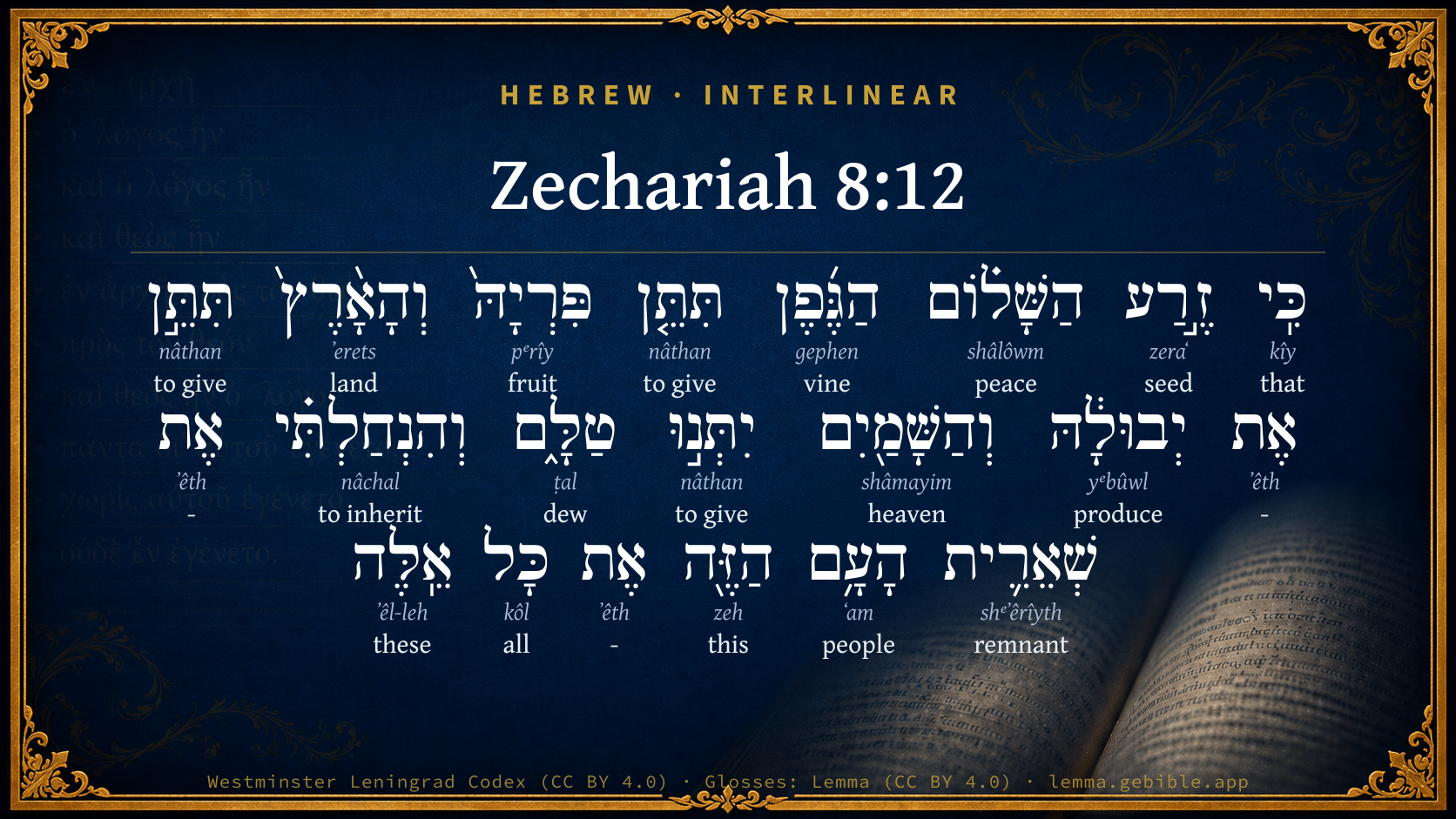
Hebrew (Westminster Leningrad Codex) Zechariah 8:12 appears in the Hebrew Old Testament. The text above is from the Westminster Leningrad Codex. Each word links to its Strong’s number, a concise gloss, and parsing drawn from the Open Scriptures Hebrew Bible morphology. Click any word for its full Brown-Driver-Briggs (BDB) entry.
Download image
Cite this verse

Zechariah 8:12 (World English Bible). Public Domain. Lemma interlinear Bible study tool, https://lemma.gebible.app/v/zechariah/8/12.

Show BibTeX & RIS
BibTeX
RIS
English Translation
"For the seed of peace and the vine will yield its fruit, and the ground will give its increase, and the heavens will give their dew; and I will cause the remnant of this people to inherit all these things.
World English Bible · Public Domain
Download a study sheet

One document with this verse’s original text, its word-by-word gloss line, the meaning frame, cross-references with their text, attributed commentary, and full source and license credits — printable, and it pastes into notes with its structure intact.

This verse Autodidact and up

Study sheet (.html) Plain text (.txt)

A passage Seminary Student

Up to 50 verses in one chapter. A passage sheet keeps up to 6 commentary sources and 12 cross-references per verse, in the order this page ranks them, and says so on the sheet whenever that leaves anything out. Ask for a single verse and you get the Autodidact verse sheet above.

Everything on this page stays free to read, with no account — the sheet is a download of what is already on screen, not access to it.

Want to remove ads? Support Godless Engineer
Compare translations 3

The same verse in 3 English versions, stacked beneath the original-language interlinear above. Click any original word for its lexicon entry.

Each is an independent rendering of the whole verse — the interlinear is not word-aligned to these translations.

Highlighted words mark where these versions differ — a whole-verse word diff, not a word-by-word alignment.

  • World English Bible Public Domain
    "For the seed of peace and the vine will yield its fruit, and the ground will give its increase, and the heavens will give their dew; and I will cause the remnant of this people to inherit all these things.
  • King James Version Public Domain
    For the seed shall be prosperous; the vine shall give her fruit, and the ground shall give her increase, and the heavens shall give their dew; and I will cause the remnant of this people to possess all these things.
  • unfoldingWord Literal Text CC BY-SA 4.0
    For seeds of peace will be sown; the climbing vine will give its fruit and the earth will give its produce; the skies will give their dew, for I will make the remnant of this people inherit all these things.

unfoldingWord Literal Text — © unfoldingWord, licensed CC BY-SA 4.0. Word-aligned USFM3 via Door43 (git.door43.org/unfoldingWord/en_ult).

Versions to compare (up to 4)

3 of 4 selected

Show all 18 translations

Every available English version of this verse, each an independent rendering of the whole verse.

  • World English Bible Public Domain
    "For the seed of peace and the vine will yield its fruit, and the ground will give its increase, and the heavens will give their dew; and I will cause the remnant of this people to inherit all these things.
  • Berean Standard Bible Public Domain
    “For the seed will be prosperous, the vine will yield its fruit, the ground will yield its produce, and the skies will give their dew. To the remnant of this people I will give all these things as an inheritance.
  • Majority Standard Bible Public Domain
    “For the seed will be prosperous, the vine will yield its fruit, the ground will yield its produce, and the skies will give their dew. To the remnant of this people I will give all these things as an inheritance.
  • King James Version Public Domain
    For the seed shall be prosperous; the vine shall give her fruit, and the ground shall give her increase, and the heavens shall give their dew; and I will cause the remnant of this people to possess all these things.
  • American Standard Version (1901) Public Domain
    For `there shall be' the seed of peace; the vine shall give its fruit, and the ground shall give its increase, and the heavens shall give their dew; and I will cause the remnant of this people to inherit all these things.
  • Revised Version (1885) Public Domain
    For there shall be the seed of peace; the vine shall give her fruit, and the ground shall give her increase, and the heavens shall give their dew; and I will cause the remnant of this people to inherit all these things.
  • Geneva Bible (1599) Public Domain
    For the seede shall be prosperous: the vine shall giue her fruite, and the ground shall giue her increase, and the heauens shall giue their dewe, and I will cause the remnant of this people to possesse all these things.
  • Douay-Rheims (1899) Public Domain
    But there shall be the seed of peace: the vine shall yield her fruit, and the earth shall give her increase, and the heavens shall give their dew: and I will cause the remnant of this people to possess all these things.
  • Young's Literal Translation Public Domain
    Because of the sowing of peace, The vine doth give her fruit, And the earth doth give her increase, And the heavens do give their dew, And I have caused the remnant of this people To inherit all these.
  • Literal Standard Version CC BY-SA 4.0
    Because of the sowing of peace, || The vine gives her fruit, || And the earth gives her increase, || And the heavens give their dew, || And I have caused the remnant of this people || To inherit all these.
  • Unlocked Literal Bible CC BY-SA 4.0
    For seeds of peace will be sown; the climbing vine will give its fruit and the earth will give its produce; the skies will give their dew, for I will make the remnant of this people inherit all these things.
  • unfoldingWord Literal Text CC BY-SA 4.0
    For seeds of peace will be sown; the climbing vine will give its fruit and the earth will give its produce; the skies will give their dew, for I will make the remnant of this people inherit all these things.
  • Darby Bible Public Domain
    for the seed shall be prosperous, the vine shall give its fruit, and the ground shall give its produce, and the heavens shall give their dew; and I will cause the remnant of this people to possess all these [things].
  • World Messianic Bible Public Domain
    “For the seed of peace and the vine will yield its fruit, and the ground will give its increase, and the heavens will give their dew. I will cause the remnant of this people to inherit all these things.
  • Webster's Bible Public Domain
    For the seed shall be prosperous; the vine shall give her fruit, and the ground shall give her increase, and the heavens shall give their dew; and I will cause the remnant of this people to possess all these things.
  • Free Bible Version CC BY-SA 4.0
    They will sow in peace; the vine will produce grapes; the soil will grow crops and the heavens will water them. I will make sure this happens to all those who remain of this people.
  • Bible in Basic English Public Domain
    For I will let the seed of peace be planted; the vine will give her fruit and the land will give her increase and the heavens will give their dew; and I will give to the rest of this people all these things for their heritage.
  • JPS Tanakh (1917) Public Domain
    For as the seed of peace, the vine shall give her fruit, and the ground shall give her increase, and the heavens shall give their dew; and I will cause the remnant of this people to inherit all these things.

Literal Standard Version (2020), Covenant Press — licensed CC BY-SA 4.0. Text via the HelloAO Bible API (eBible.org). Unlocked Literal Bible (unfoldingWord) — licensed CC BY-SA 4.0. Text via the HelloAO Bible API (eBible.org). unfoldingWord Literal Text — © unfoldingWord, licensed CC BY-SA 4.0. Word-aligned USFM3 via Door43 (git.door43.org/unfoldingWord/en_ult). Free Bible Version, Dr. Jonathan Gallagher — licensed CC BY-SA 4.0. Text via the HelloAO Bible API (eBible.org).

Word by word

More ways to search: Search by grammar → Find every occurrence → Compare this word →

Practice this passage: Drill this verse → Learn its vocabulary →

יְבוּלָ֔הּ
yᵉbûwl
H2981
“produce · her”
Noun, Common, Masculine, Singular, Construct + Suffix, Personal, 3rd Person, Feminine, Singular
Part of Speech
Noun
Type
Common
Gender
Masculine
Number
Singular
State
Construct
Full BDB Definition

Origin: from H2986

TWOT: 835c

produce, fruit, produce (of the soil)
  1. כִּֽי kîy H3588 “that” Conjunction
  2. זֶ֣רַע zeraʻ H2233 “seed of” Noun, Common, Masculine, Singular, Construct
  3. הַשָּׁל֗וֹם shâlôwm H7965 “the · peace” Particle, Definite Article + Noun, Common, Masculine, Singular, Absolute
  4. הַגֶּ֜פֶן gephen H1612 “the · vine” Particle, Definite Article + Noun, Common, Both, Singular, Absolute
  5. תִּתֵּ֤ן nâthan H5414 “to give” Verb, Qal, Imperfect, 3rd Person, Feminine, Singular
  6. פִּרְיָהּ֙ pᵉrîy H6529 “fruit · her” Noun, Common, Masculine, Singular, Construct + Suffix, Personal, 3rd Person, Feminine, Singular
  7. וְהָאָ֨רֶץ֙ ʼerets H776 “and · the · land” Conjunction + Particle, Definite Article + Noun, Common, Both, Singular, Absolute
  8. תִּתֵּ֣ן nâthan H5414 “to give” Verb, Qal, Imperfect, 3rd Person, Feminine, Singular
  9. אֶת ʼêth H853 “-” Particle, Direct Object
  10. וְהַשָּׁמַ֖יִם shâmayim H8064 “and · the · heaven(s)” Conjunction + Particle, Definite Article + Noun, Common, Masculine, Plural, Absolute
  11. יִתְּנ֣וּ nâthan H5414 “to give” Verb, Qal, Imperfect, 3rd Person, Masculine, Plural
  12. טַלָּ֑ם ṭal H2919 “dew · their” Noun, Common, Masculine, Singular, Construct + Suffix, Personal, 3rd Person, Masculine, Plural
  13. וְהִנְחַלְתִּ֗י nâchal H5157 “and · to inherit” Conjunction + Verb, Hiphil, Perfect, 1st Person, Common, Singular
  14. אֶת ʼêth H853 “-” Particle, Direct Object
  15. שְׁאֵרִ֛ית shᵉʼêrîyth H7611 “remnant of” Noun, Common, Feminine, Singular, Construct
  16. הָעָ֥ם ʻam H5971 “the · people” Particle, Definite Article + Noun, Common, Masculine, Singular, Absolute
  17. הַזֶּ֖ה zeh H2088 “the · this” Particle, Definite Article + Pronoun, Demonstrative, Masculine, Singular
  18. אֶת ʼêth H853 “-” Particle, Direct Object
  19. כָּל kôl H3605 “all of” Noun, Common, Masculine, Singular, Construct
  20. אֵֽלֶּה ʼêl-leh H428 “these” Pronoun, Demonstrative, Common, Plural

About this verse

These counts appear in no published source. They are computed here, from the morphology-tagged text and Lemma’s own curated glosses. What Lemma adds →

21
words
17
distinct lemmas
Prophets
section

Notable vocabulary

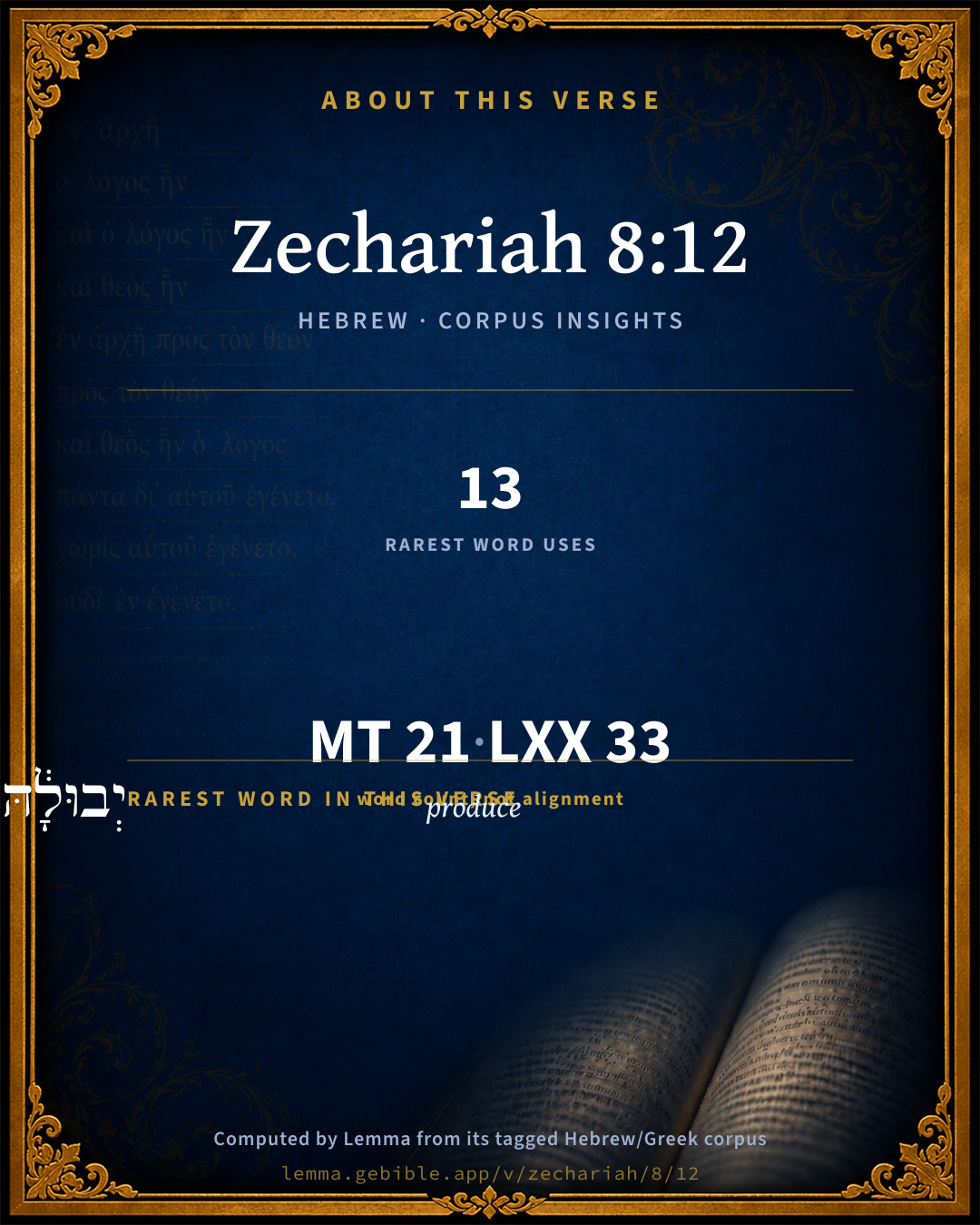
The rarest word here is יְבוּלָ֔הּ produce H2981 — appearing just 13 times in the whole Hebrew Bible.

Shared distinctive vocabulary

יְבוּלָ֔הּ produce H2981 occurs in 13 verses of the Hebrew Bible. Also found in:

Grammatical profile

  • 4 verbs
  • 11 nouns
  • 2 pronouns
  • 1 conjunction
  • 3 particles

Verb forms

  • תִּתֵּ֤ן Qal · Imperfect
  • תִּתֵּ֣ן Qal · Imperfect
  • יִתְּנ֣וּ Qal · Imperfect
  • וְהִנְחַלְתִּ֗י Hiphil · Perfect

Repetition

A word recurs within this verse — often emphatic in Hebrew:

  • תִּתֵּ֤ן to give H5414 ×3

Hebrew & Septuagint length

In English translation the verse runs 40 words from the Hebrew and 41 from the Septuagint (LXX English) — closely comparable.

A rough comparison of the two English renderings, which tokenize alike — not a word-level alignment.

Word counts can differ between the Hebrew and the Greek without any difference in meaning — e.g. the Hebrew direct-object marker אֵת has no separate Greek word, and Greek often adds the article ὁ.

In the original languages it is 21 Hebrew tokens and 33 Greek tokens — but the two are counted differently (Hebrew bundles its prefixes and suffixes into one token; the Greek is in lemma form), so that isn’t a like-for-like length.

Cross-references

29

Topical passages linked to Zechariah 8:12 in the Treasury of Scripture Knowledge — connected by theme and wording, ordered by reader-vote popularity; previews shown in the World English Bible.

  • Leviticus 26:4–5 then I will give you your rains in their season, and the land shall yield its increase, and the trees of the field shall yield their fruit.
  • Deuteronomy 33:13 Of Joseph he said, Blessed of Yahweh be his land, For the precious things of the heavens, for the dew, For the deep that couches beneath,
  • Genesis 27:28 God give you of the dew of the sky, of the fatness of the earth, and plenty of grain and new wine.
  • Matthew 6:33 But seek first God's Kingdom, and his righteousness; and all these things will be given to you as well.
  • Ezekiel 34:26–27 I will make them and the places round about my hill a blessing; and I will cause the shower to come down in its season; there shall be showers of blessing.
  • Ezekiel 36:30 I will multiply the fruit of the tree, and the increase of the field, that you may receive no more the reproach of famine among the nations.
  • Joel 2:22 Don't be afraid, you animals of the field; For the pastures of the wilderness spring up, For the tree bears its fruit. The fig tree and the vine yield their strength.
  • Haggai 1:10 Therefore for your sake the heavens withhold the dew, and the earth withholds its fruit.
  • Haggai 2:19 Is the seed yet in the barn? Yes, the vine, the fig tree, the pomegranate, and the olive tree haven't brought forth. From this day will I bless you.'"
  • Zechariah 8:6 Thus says Yahweh of Hosts: "If it is marvelous in the eyes of the remnant of this people in those days, should it also be marvelous in my eyes?" says Yahweh of Hosts.
  • Genesis 26:12 Isaac sowed in that land, and reaped in the same year one hundred times what he planted. Yahweh blessed him.
  • Deuteronomy 28:4–12 Blessed shall be the fruit of your body, and the fruit of your ground, and the fruit of your animals, the increase of your cattle, and the young of your flock.
  • Psalms 67:6–7 The earth has yielded its increase. God, even our own God, will bless us.
  • Isaiah 30:23 He will give the rain for your seed, with which you shall sow the ground; and bread of the increase of the ground, and it shall be fat and plenteous. In that day shall your cattle feed in large pastures;
  • Isaiah 61:7 Instead of your shame [you shall have] double; and instead of dishonor they shall rejoice in their portion: therefore in their land they shall possess double; everlasting joy shall be to them.
  • Hosea 14:5 I will be like the dew to Israel. He will blossom like the lily, And send down his roots like Lebanon.
  • Amos 9:13–15 "Behold, the days come," says Yahweh, "That the plowman shall overtake the reaper, And the one treading grapes him who sows seed; And sweet wine will drip from the mountains, And flow from the hills.
  • 1 Corinthians 3:21 Therefore let no one boast in men. For all things are yours,
  • James 3:18 Now the fruit of righteousness is sown in peace by those who make peace.
  • Deuteronomy 32:2 My doctrine shall drop as the rain; My speech shall condense as the dew, As the small rain on the tender grass, As the showers on the herb.
  • Deuteronomy 33:28 Israel dwells in safety, The fountain of Jacob alone, In a land of grain and new wine; Yes, his heavens drop down dew.
  • Psalms 72:3 The mountains shall bring prosperity to the people. The hills bring the fruit of righteousness.
  • Proverbs 3:9–10 Honor Yahweh with your substance, With the first fruits of all your increase:
  • Proverbs 19:12 The king's wrath is like the roaring of a lion, But his favor is like dew on the grass.
  • Ezekiel 36:12 Yes, I will cause men to walk on you, even my people Israel; and they shall possess you, and you shall be their inheritance, and you shall no more henceforth bereave them of children.
  • Hosea 2:21–23 It will happen in that day, I will respond," says Yahweh, I will respond to the heavens, And they will respond to the earth;
  • Obadiah 1:17–20 But in Mount Zion, there will be those who escape, and it will be holy. The house of Jacob will possess their possessions.
  • Micah 4:6–7 "In that day," says Yahweh, "I will assemble that which is lame, And I will gather that which is driven away, And that which I have afflicted;
  • 1 Kings 17:1 Elijah the Tishbite, who was of the foreigners of Gilead, said to Ahab, As Yahweh, the God of Israel, lives, before whom I stand, there shall not be dew nor rain these years, but according to my word.

Cross-references courtesy of OpenBible.info (CC BY 4.0).

Hebrew and Greek witnesses Masoretic Hebrew ↔ Greek Septuagint

The same verse in the two great witnesses to the Old Testament, shown verse-for-verse.

These are two independent witnesses, not word-aligned to each other, and the Septuagint is shown in lemma (dictionary) form.

Hebrew Zechariah 8:12 Masoretic · Westminster Leningrad Codex

כִּֽי זֶ֣רַע הַשָּׁל֗וֹם הַגֶּ֜פֶן תִּתֵּ֤ן פִּרְיָהּ֙ וְהָאָ֨רֶץ֙ תִּתֵּ֣ן אֶת יְבוּלָ֔הּ וְהַשָּׁמַ֖יִם יִתְּנ֣וּ טַלָּ֑ם וְהִנְחַלְתִּ֗י אֶת שְׁאֵרִ֛ית הָעָ֥ם הַזֶּ֖ה אֶת כָּל אֵֽלֶּה

"For the seed of peace and the vine will yield its fruit, and the ground will give its increase, and the heavens will give their dew; and I will cause the remnant of this people to inherit all these things.

World English Bible · Public Domain

Greek LXX Zechariah 8:12 Septuagint · lemma form

ἀλλά ἤ δεικνύω εἰρήνη ὁ ἄμπελος δίδωμι ὁ καρπός αὐτός καί ὁ γῆ δίδωμι ὁ γένημα αὐτός καί ὁ οὐρανός δίδωμι ὁ δρόσος αὐτός καί κατακληρονομέω ὁ κατάλοιπος ὁ λαός ἐγώ πᾶς οὗτος

But I will show peace: the vine shall yield her fruit, and the land shall yield her produce, and the heaven shall give its dew: and I will give as an inheritance all these things to the remnant of my people.

LXX2012 (modern English Septuagint) · Public Domain

On this verse, The Pulpit Commentary discusses the Septuagint’s reading. Read the note in Commentary ↓

Hebrew: Westminster Leningrad Codex (CC BY 4.0). Greek: Septuagint (public domain); English from LXX2012 (modern English Septuagint) (Public Domain). How the Septuagint differs from the Hebrew →

Targum (Aramaic paraphrase)

1

The Targum is the ancient Jewish Aramaic paraphrase of the Hebrew Scriptures — an interpretive translation, not the Hebrew text itself. Onkelos (literal) and Pseudo-Jonathan (expansive) render the Torah, and Jonathan the Prophets. Coverage is partial: where no permissively-licensed English translation exists for a verse, only the Aramaic is shown. This is verse-level text, not a word-by-word alignment to the Hebrew.

  1. Targum Jonathan Prophets (Joshua–Malachi)
    אֲרֵי בְעִדָנָא הַהִיא זַרְעָא יְהֵי שְׁלַם גוּפְנָא תִּתֵּן אִבָּהּ וְאַרְעָא תִּתֵּן יַת עֲלַלְתָּהּ וּשְׁמַיָא שַׁמְשִׁינוּנוּן בְּטַלְהוֹן וְאַחְסִין לִשְׁאָרָא דְעַמָא הָדֵין יַת כָּל בִּרְכָתָא הָאִלֵין:

    (no public-domain English translation for this verse)

    Targum Jonathan — Aramaic: “Mikraot Gedolot” (public domain). English: “Sefaria Community Translation” (CC0 1.0 (public-domain dedication)); “London "Chaldee Paraphrase," 1871” (public domain). Text via Sefaria.

Commentary

Notes on Zechariah 8:12 from classic Christian and Jewish commentators (each source and its license shown beneath its notes). The classic Christian expositions comment on the surrounding passage and are grouped to its opening verse, so a note may address several verses; the Jewish commentaries on the Tanakh (Rashi and others) are per-verse, so they appear only where the commentator wrote on this verse.

Lemma curates 59 commentaries, every one of them public domain or Creative Commons licensed, each selected and text-cleaned for this edition rather than reprinted as found. About our sources →

Trapp's Complete Commentary

John Trapp

Zec 8:12 For the seed [shall be] prosperous; the vine shall give her fruit, and the ground shall give her increase, and the heavens shall give their dew; and I will cause the remnant of this people to possess all these [things].

Ver. 12. For the seed shall be prosperous] Or, full and perfect, as the Chaldee hath it; it shall be fruitful and yield a plentiful crop, such as shall every way answer the desire of the husbandman. Instead of your recent scarcity (whereof see Hag 1:9, with the notes) you shall abound with plenty of all things, feeding of the fat, and drinking of the sweet, and having your heart filled with food and gladness, Act 14:17. More particularly:

The vine shall give her fruit] So that ye shall swim in wine.

And the ground shall give her increase] Her full burden of the best; so that your floors shall swell, and your tables sweat with sweetest varieties.

And the heavens shall give their dew] That womb of the morning wherein the fruits are conceived.

And I will cause the remnant of this people to possess all these things] Whereas people are apt to attribute too much to means and second causes of plenty and prosperity, God assumes the honour of all to himself. Rain and fruitful seasons are his gift, Act 14:17. And, Hos 2:22, he resolveth the genealogy of grain and wine into himself: I will hear the heaven, and the heaven shall hear the earth, &c. And, both here and elsewhere he giveth us to know that the reward of religion is abundance of outward blessings; which yet are not always entailed to godliness (whatever Jesuits tell us of the Church’s prosperity and plenty, fetching her mark from the market), to the end that it may he admired for itself, and not for these transitory trappings.

John Trapp, A Commentary or Exposition upon All the Books of the Old and New Testament (1647–1656) — public domain. Text from a community e-Sword module.

Tyndale Open Study Notes

Tyndale Open Resources

8:12 Peace (Hebrew shalom) is an important theme underlying Zechariah’s message (8:10, 12, 16, 19). God’s presence in the rebuilt Temple would bring peace to Judah (see Hag 2:6-9). Zechariah uses the agricultural cycle to represent God’s blessing (see Hag 2:18-19), which would reverse the drought conditions that Haggai described (Hag 1:10). • The small community that returned to Judah from exile was called the remnant. Theologically, the remnant is a bridge between God’s punishment and his promised restoration (see Hag 1:12, 14).

Tyndale Open Study Notes — © Tyndale Open Resources, licensed CC BY-SA 4.0. Text via the HelloAO Bible API.

Jamieson, Fausset & Brown

Robert Jamieson, A. R. Fausset & David Brown

seed . . . prosperous--that is, shall not fair to yield abundantly (Hos 2:21-22; Hag 2:19). Contrast with this verse Hag 1:6, Hag 1:9-11; Hag 2:16.

dew--especially beneficial in hot countries where rain is rare.

Jamieson, Fausset & Brown — Commentary Critical and Explanatory on the Whole Bible (1871) — public domain (CC PDM 1.0). Text via the HelloAO Bible API.

Adam Clarke's Commentary

Verse 12. For the seed shall be prosperous] Ye shall be a holy and peaceable people; and God will pour down his blessing on yourselves, your fields, and your vineyards.

Adam Clarke's Commentary on the Bible (1810–1826) — public domain. Text from a community e-Sword/MySword module.

John Calvin's Commentaries

Here Zechariah promises the continuance of God’s favor, which the Jews had now begun to taste. God then had in part openly showed that he was a Father to the Jews, by dealing liberally with them: but in order more fully to strengthen them in their perseverance, Zechariah says that this favor would be continued.

And he says first, that there would be the seed of peace. Some think that it is called the seed of peace because the cultivation of the fields, while the assaults of enemies were dreaded, was deserted; no one dared to bring out his oxen or his horses, and then even when the husbandmen sowed their fields, it was not done as in seasons of quietness and security. As then the fields, when badly cultivated in times of war, do not produce a full crop, so they think that it is called the seed of peace, when husbandmen are permitted to employ necessary labor, when they are free from every fear, and devote securely their toils on the cultivation and the sowing of their fields. Others explain the seed of peace to be this — that it is so when neither storms, nor tempests, nor mildew, nor any other evils do any harm to the corn and fruit. But as שלום, shelum, means often in Hebrew prosperity, we may so take it here, that it would be the seed of peace, that is, that the seed would be prosperous; and this interpretation seems to me less strained. It shall then be the seed of peace, that is, it shall prosper according to your labor; what is sown shall produce its proper fruit.

There is added an explanation — The vine shall yield its fruit, and the earth shall yield its increase, and the heaven shall yield its dew. We hence conclude that it was called the seed of peace, because the husbandmen gained their object when the earth, irrigated by the dew of heaven, was not sterile, and when the produce was abundant, when there was plenty of corn and wine, and of other things. There is then peace or prosperity as to the seed, when the corn grows according to our wishes, and comes to maturity, and when heaven responds to the earth, and withholds not its dew, as we have seen in another place. In short, God testifies that the remnant of his people should abound in all good things, for the heaven would not withhold from them its rain, nor the earth shut up its bowels.

But God ever recalls his people to himself, that they may depend on his blessing; for it would be a cold doctrine were we not persuaded of this — that the earth is not otherwise fruitful than as God gives it the power of generating and of bringing forth. We ought therefore ever to regard the blessing of God, and to ask of him to supply us with food, and to pray him every day, as we are taught, to give us our daily bread. But few do this from the heart, and hardly one in a hundred so turns his thoughts to God’s hand as firmly to believe that he daily receives from him his daily food. We now understand what the Prophet means in these words. It now follows —

John Calvin's Commentaries (1540-1563) — public domain. Text from the Calvin Translation Society English edition (1840s-50s) via the Christian Classics Ethereal Library (ccel.org). Calvin's coverage is partial (roughly two-thirds of the Bible); uncommented books and verses are honest gaps, never fabricated. The 19th-century editor's footnotes and remarks are omitted so the notes are faithfully Calvin's own voice.

Ellicott's Commentary for English Readers

(12) For the seed . . . prosperous.—Comp. the Syriac, “for the seed shall be peace.” Better, as in margin, For the seed of peace—viz., “the vine,” which is so called because it can flourish only in times of peace: so that to sit under the vine and under the fig. tree is a common figure to denote the enjoyment of peace and prosperity. For the word “seed” applied to the vine, comp. Jer_2:21.

Comp. 1Ma_14:8 : “Then did they till their ground in peace, and the earth gave her increase, and the trees of the field their fruit.”

A Bible Commentary for English Readers, edited by Charles John Ellicott (1878–1897) — public domain. Text from a community e-Sword module.

The Cambridge Bible for Schools and Colleges

gen. ed. J. J. S. Perowne

12. the seed shall be prosperous] Lit. The seed of peace (there shall be). This gives a very good sense, when we remember that the Hebrew words here used have a wide meaning. Seed is not only that which is sown, but sometimes seed-time, or sowing (Gen_8:22), sometimes produce or harvest (Job_39:12). Peace is prosperity and plenty. So that the words may be paraphrased, The processes of agriculture shall prosper. Another rendering, however, according to which this clause is in apposition with the words immediately following, The seed (or plant) of peace, namely, the vine, shall give, &c., has been strongly supported. The vine is then thought to be called “the seed of peace,” because “it can only flourish in peaceful times, and not when the land is laid waste by enemies.” But one fails to see how this is a peculiarity of the vine. It would seem to be equally true of corn and other products of the earth. Moreover, such an apposition destroys the balance of the three following clauses, which form a threefold expansion of the general statement with which the verse begins. In the Speaker’s Commentary it is said, “The vine is pre-eminently a plant of peace.” But in all the passages referred to in support of the assertion the fig-tree is associated with the vine. It is difficult, therefore, to see how the vine can be singled out as the plant of peace.

to possess] Lit. to inherit. Comp. ὁ νικῶν κληρονμήσει ταῦτα, Rev_21:7.

The Cambridge Bible for Schools and Colleges (gen. ed. J. J. S. Perowne; Cambridge University Press, 1878–1918) — public domain. Text from a community e-Sword module.

John Gill's Exposition

And it shall come to pass, that as ye were a curse among the heathen,.... Reproached, vilified, and called accursed by them; see Jer 24:9 as true Christians, and real believers in Christ, are by the men of this world, Co1 4:12,

O house of Judah, and house of Israel; both being carried captive at different times, and were typical of the true and Spiritual Israel of God:

so will I save you, and ye shall be a blessing; be blessed in themselves with the above blessings of plenty and prosperity in outward things; see Hag 2:19 and a blessing to others, and blessed by them; and all those who are saved in the Lord with an everlasting salvation are blessed with all spiritual blessings in him:

fear not; neither their enemies, nor the accomplishment of these promises:

but let your hands be strong; as in Zac 8:9.

John Gill's Exposition of the Whole Bible (1746–1763) — public domain (CC PDM 1.0). Text via the HelloAO Bible API.

Albert Barnes' Notes on the Bible

For the seed shall be peace - o“Your seed shall be peace and a blessing, so that they will call it ‘a seed of peace.’” The unusual construction is perhaps adopted, in order to suggest a further meaning. It is a reversal of the condition, just spoken of, when there was “no peace to him that went, or to him that returned.”

The vine shall give her fruit and the ground shall give her increase - The old promise in the law on obedience Lev 26:4, as the exact contrary was threatened on disobedience Lev 26:20. It had been revived in the midst of promise of spiritual blessing and of the coming of Christ, in Ezekiel Eze 34:27. Ribera: “By the metaphor of sensible things he explains (as the prophets often do) the abundance of spiritual good in the time of the new law, as did Hosea Hos 2:21-22, Joel Joe 2:23-25; Joe 3:18, Amos Amo 9:13, and many others.” “And I will cause the remnant of the people to inherit.” Ribera: “As if he said, I promised these things not to you who live now, but to the future remnant of your people, that is, those who shall believe in Christ and shall be saved, while the rest perish. These shall possess these spiritual goods, which I promise now, under the image of temporal.” As our Lord said, “He that overcometh shall inherit all things, and I will be his God, and he shall be My son” Rev 21:7.

Albert Barnes' Notes on the Bible (1834–1885) — public domain. Text from a community e-Sword/MySword module.

Matthew Poole's English Annotations

For the seed, which before brought nothing, or very little, forth, shall now prosper into a plentiful harvest, such as Mal 3:10.

The vine shall give her fruit: this was very much the wealth and support of that people; this had been blasted, as Hag 1:11, now it shall be blest, and bring forth her expected fruit.

The ground shall give her increase; summarily, the ground you plant shall abundantly bring forth her fruit to your satisfaction.

The heavens shall give their dew; the heavens, which before were as brass, and made your earth as iron, hard, barren, shall now drop down their rain, and make the earth fruitful. Much like that Psa 72:3; Hos 2:18.

I will cause, by my special, singular providence, and blessing on them.

To possess; to enjoy, have the things, and the comfort of them; whereas before, though they ate, they were not satisfied, had not enough, Hag 1:6.

Matthew Poole's English Annotations on the Holy Bible (1683–1685) — public domain. Text from a community e-Sword/MySword module.

The Pulpit Commentary

The seed shall be prosperous; literally, (there shall be) the seed of peace. The crops sown shall be crops of peace, safe and secure, in contradistinction to the threat in Lev_26:16, that the seed should be sown in vain, for it should be devoured by an enemy (Knabenbauer). Or, more generally, all farming labours shall succeed and prosper. Jerome"s paraphrase is, "There shall be universal peace and joy;" Septuagint," But I will show forth peace." Another way of understanding the words which has found much favour with modern commentators is to take the clause in apposition with the words immediately following; thus: "The seed (i.e. growth) of peace, the vine, shall give its fruit." But there is no especial reason why the vine should be called "the seed of peace." It is not peculiar among fruit trees for requiring a time of peace for its cultivation. And the term "seed" is very inappropriate to the vine, which was not raised from seed, but from cuttings and layers. Perowne also points out that such a rendering destroys the balance of the three following clauses, which explain and expand the general statement that agriculture shall prosper. Dr. Alexander takes "the seed of peace" to be that from which peace springs; i.e. that peace should be radically established in the land, and from this fact the results following should ensue. This affords a very good sense; but it is probably a metaphor quite unintended by the prophet. The Syriac reads differently, "The seed shall be safe." The remnant (see on ver. 11). To possess; to inherit; Septuagint, etc. kataklhronomhsw . (Rev_21:7) This promise recalls the blessings in the old Law. (Lev_26:4,de Lev 33:28 Psa_67:6)

The Pulpit Commentary (1880–1919), ed. H.D.M. Spence-Jones & Joseph S. Exell — public domain. Text from a community e-Sword module.

Lesson kit

Teaching starters — assembled from the data on this page, not authored interpretation. Every prompt links to the verse data it draws on. Edit before teaching.

Zechariah, in the Prophets, opens this verse with 21 words (17 distinct Hebrew lemmas). Its most distinctive word is yᵉbûwl (“produce”). A historical commentator’s framing appears above. Read the whole chapter for the surrounding context.

Discussion questions

  1. What does “produce” (yᵉbûwl) contribute to the verse as a whole?
  2. Leviticus 26:4 shares the word «produce» with this verse. How do the two illuminate each other?
  3. “to give” occurs 3× in this one verse. What is the effect of the repetition?
  4. These translations render this verse differently. What is at stake in choosing one wording over another?
  5. The verb «תִּתֵּ֤ן» is Qal Imperfect. How does its form color the action?
  6. Reading how Trapp's Complete Commentary and Tyndale Open Study Notes read this verse, where do the two commentators agree and where do they part?

Things to notice

Reading settings

Reading text

Shown beneath each verse's original-language words.

Old Testament
Old Testament edition

Read the OT as the Masoretic Hebrew (MT) or the Greek Septuagint (LXX).

English shown for the Greek Septuagint (in the Hebrew ↔ Greek comparison).

Comparing translations? Open the Compare panel on any verse page to stack up to four side by side.