
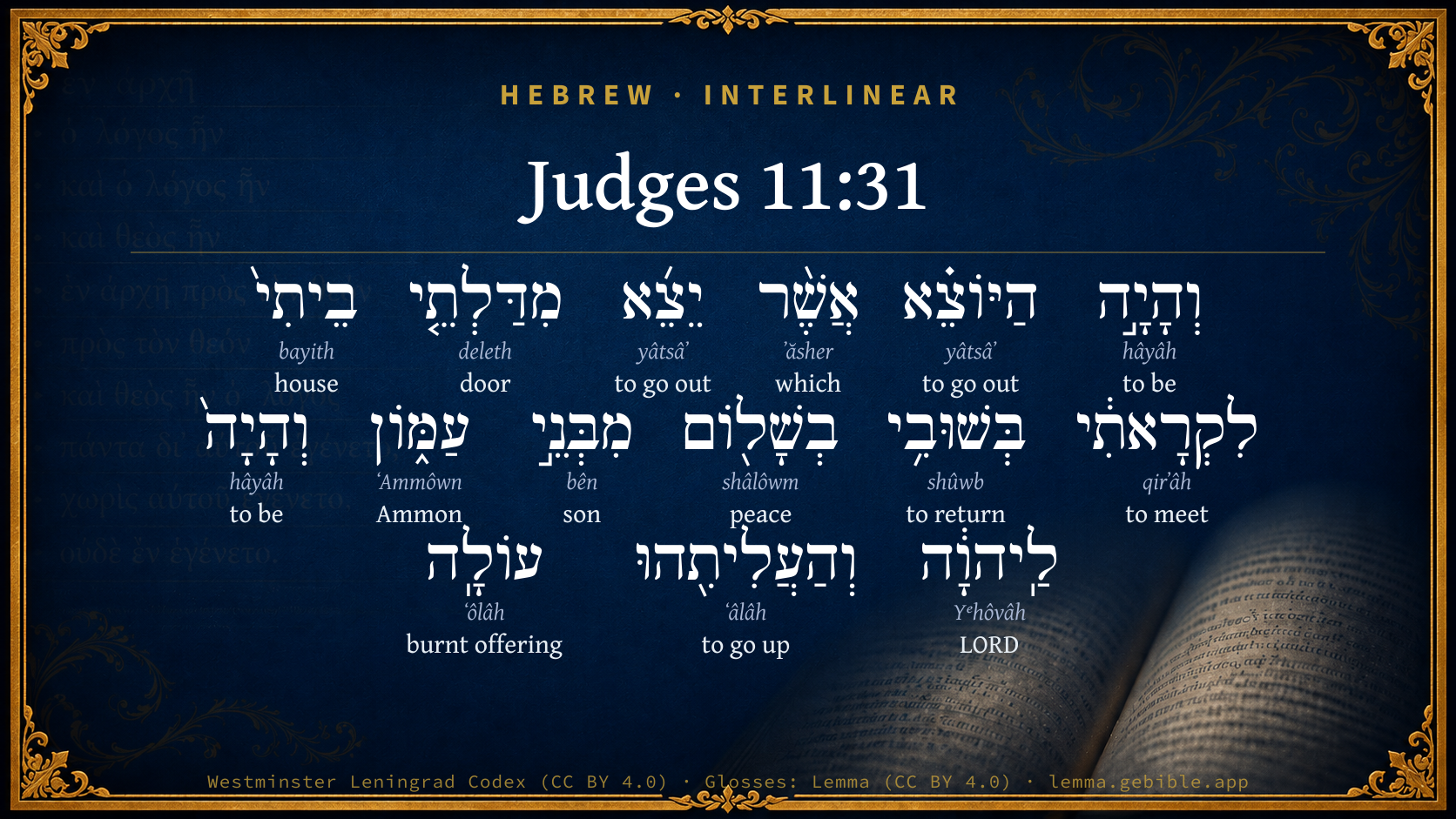
Judges 11:31

Hebrew (Westminster Leningrad Codex) Judges 11:31 appears in the Hebrew Old Testament. The text above is from the Westminster Leningrad Codex. Each word links to its Strong’s number, a concise gloss, and parsing drawn from the Open Scriptures Hebrew Bible morphology. Click any word for its full Brown-Driver-Briggs (BDB) entry.
Download image
Cite this verse

Judges 11:31 (World English Bible). Public Domain. Lemma interlinear Bible study tool, https://lemma.gebible.app/v/judges/11/31.

Show BibTeX & RIS
BibTeX
RIS
English Translation
then it shall be, that whatever comes forth from the doors of my house to meet me, when I return in peace from the children of Ammon, it shall be Yahweh's, and I will offer it up for a burnt offering.
World English Bible · Public Domain
Download a study sheet

One document with this verse’s original text, its word-by-word gloss line, the meaning frame, cross-references with their text, attributed commentary, and full source and license credits — printable, and it pastes into notes with its structure intact.

This verse Autodidact and up

Study sheet (.html) Plain text (.txt)

A passage Seminary Student

Up to 50 verses in one chapter. A passage sheet keeps up to 6 commentary sources and 12 cross-references per verse, in the order this page ranks them, and says so on the sheet whenever that leaves anything out. Ask for a single verse and you get the Autodidact verse sheet above.

Everything on this page stays free to read, with no account — the sheet is a download of what is already on screen, not access to it.

Want to remove ads? Support Godless Engineer
Compare translations 3

The same verse in 3 English versions, stacked beneath the original-language interlinear above. Click any original word for its lexicon entry.

Each is an independent rendering of the whole verse — the interlinear is not word-aligned to these translations.

Highlighted words mark where these versions differ — a whole-verse word diff, not a word-by-word alignment.

  • World English Bible Public Domain
    then it shall be, that whatever comes forth from the doors of my house to meet me, when I return in peace from the children of Ammon, it shall be Yahweh's, and I will offer it up for a burnt offering.
  • King James Version Public Domain
    Then it shall be, that whatsoever cometh forth of the doors of my house to meet me, when I return in peace from the children of Ammon, shall surely be the LORD's, and I will offer it up for a burnt offering.
  • unfoldingWord Literal Text CC BY-SA 4.0
    then it shall be, the one coming out, whoever comes out of the doors of my house to greet me in my returning in peace from the sons of Ammon, that he will be to Yahweh, and I will offer him a burnt offering.”

unfoldingWord Literal Text — © unfoldingWord, licensed CC BY-SA 4.0. Word-aligned USFM3 via Door43 (git.door43.org/unfoldingWord/en_ult).

Versions to compare (up to 4)

3 of 4 selected

Show all 18 translations

Every available English version of this verse, each an independent rendering of the whole verse.

  • World English Bible Public Domain
    then it shall be, that whatever comes forth from the doors of my house to meet me, when I return in peace from the children of Ammon, it shall be Yahweh's, and I will offer it up for a burnt offering.
  • Berean Standard Bible Public Domain
    then whatever comes out the door of my house to greet me on my triumphant return from the Ammonites will belong to the LORD, and I will offer it up as a burnt offering.”
  • Majority Standard Bible Public Domain
    then whatever comes out the door of my house to greet me on my triumphant return from the Ammonites will belong to the LORD, and I will offer it up as a burnt offering.”
  • King James Version Public Domain
    Then it shall be, that whatsoever cometh forth of the doors of my house to meet me, when I return in peace from the children of Ammon, shall surely be the LORD's, and I will offer it up for a burnt offering.
  • American Standard Version (1901) Public Domain
    then it shall be, that whatsoever cometh forth from the doors of my house to meet me, when I return in peace from the children of Ammon, it shall be Jehovah's, and I will offer it up for a burnt-offering.
  • Revised Version (1885) Public Domain
    then it shall be, that whatsoever cometh forth of the doors of my house to meet me, when I return in peace from the children of Ammon, it shall be the LORD’S, and I will offer it up for a burnt offering.
  • Geneva Bible (1599) Public Domain
    Then that thing that commeth out of the doores of mine house to meete me, when I come home in peace from the children of Ammon, shall be the Lordes, and I will offer it for a burnt offering.
  • Douay-Rheims (1899) Public Domain
    Whosoever shall first come forth out of the doors of my house, and shall meet me when I return in peace from the children of Ammon, the same will I offer a holocaust to the Lord.
  • Young's Literal Translation Public Domain
    then it hath been, that which at all cometh out from the doors of my house to meet me in my turning back in peace from the Bene-Ammon -- it hath been to Jehovah, or I have offered up for it -- a burnt-offering.'
  • Literal Standard Version CC BY-SA 4.0
    then it has been, that which comes out from the doors of my house at all to meet me in my turning back in peace from the sons of Ammon—it has been for YHWH, or I have offered up a burnt-offering for it.”
  • Unlocked Literal Bible CC BY-SA 4.0
    then whatever comes out of the doors of my house to meet me when I return in peace from the people of Ammon will belong to Yahweh, and I will offer it up as a burnt offering.”
  • unfoldingWord Literal Text CC BY-SA 4.0
    then it shall be, the one coming out, whoever comes out of the doors of my house to greet me in my returning in peace from the sons of Ammon, that he will be to Yahweh, and I will offer him a burnt offering.”
  • Darby Bible Public Domain
    then whoever comes forth from the doors of my house to meet me, when I return victorious from the Ammonites, shall be the LORD's, and I will offer him up for a burnt offering."
  • World Messianic Bible Public Domain
    then it shall be, that whatever comes out of the doors of my house to meet me when I return in peace from the children of Ammon, it shall be the LORD’s, and I will offer it up for a burnt offering.”
  • Webster's Bible Public Domain
    Then it shall be, that whatever cometh out of the doors of my house to meet me, when I return in peace from the children of Ammon, shall surely be the LORD'S, and I will offer it for a burnt-offering.
  • Free Bible Version CC BY-SA 4.0
    I will dedicate to the Lord whatever comes out of the door of my house to meet me on my safe return from the battle. I will present it as a burnt offering.”
  • Bible in Basic English Public Domain
    Then whoever comes out from the door of my house, meeting me when I come back in peace from the children of Ammon, will be the Lord's and I will give him as a burned offering.
  • JPS Tanakh (1917) Public Domain
    then it shall be, that whatsoever cometh forth of the doors of my house to meet me, when I return in peace from the children of Ammon, it shall be the LORD'S, and I will offer it up for a burnt-offering.'

Literal Standard Version (2020), Covenant Press — licensed CC BY-SA 4.0. Text via the HelloAO Bible API (eBible.org). Unlocked Literal Bible (unfoldingWord) — licensed CC BY-SA 4.0. Text via the HelloAO Bible API (eBible.org). unfoldingWord Literal Text — © unfoldingWord, licensed CC BY-SA 4.0. Word-aligned USFM3 via Door43 (git.door43.org/unfoldingWord/en_ult). Free Bible Version, Dr. Jonathan Gallagher — licensed CC BY-SA 4.0. Text via the HelloAO Bible API (eBible.org).

Word by word

More ways to search: Search by grammar → Find every occurrence → Compare this word →

Practice this passage: Drill this verse → Learn its vocabulary →

מִדַּלְתֵ֤י
deleth
H1817
“from · doors of”
Preposition + Noun, Common, Feminine, Dual, Construct
Part of Speech
Preposition + Noun
Type
Common
Gender
Feminine
Number
Dual
State
Construct
Full BDB Definition

Origin: from H1802

TWOT: 431a , e

door, gate - a door - a gate - (figuratively) - of chest lid - of crocodile jaws - of doors of the heavens - of an easily-accessible woman
  1. וְהָיָ֣ה hâyâh H1961 “and · to be” Conjunction + Verb, Qal, Sequential Perfect, 3rd Person, Masculine, Singular
  2. הַיּוֹצֵ֗א yâtsâʼ H3318 “the · going out” Particle, Definite Article + Verb, Qal, Participle Active, Masculine, Singular, Absolute
  3. אֲשֶׁ֨ר ʼăsher H834 “which” Particle, Relative
  4. יֵצֵ֜א yâtsâʼ H3318 “to go out” Verb, Qal, Imperfect, 3rd Person, Masculine, Singular
  5. בֵיתִי֙ bayith H1004 “house · my” Noun, Common, Masculine, Singular, Construct + Suffix, Personal, 1st Person, Common, Singular
  6. לִקְרָאתִ֔י qirʼâh H7125 “to meet · me” Preposition + Verb, Qal, Infinitive Construct + Suffix, Personal, 1st Person, Common, Singular
  7. בְּשׁוּבִ֥י shûwb H7725 “in/at · to return · me” Preposition + Verb, Qal, Infinitive Construct + Suffix, Personal, 1st Person, Common, Singular
  8. בְשָׁל֖וֹם shâlôwm H7965 “in/at · peace” Preposition + Noun, Common, Masculine, Singular, Absolute
  9. מִבְּנֵ֣י bên H1121 “from · sons of” Preposition + Noun, Common, Masculine, Plural, Construct
  10. עַמּ֑וֹן ʻAmmôwn H5983 “Ammon” Noun, Proper
  11. וְהָיָה֙ hâyâh H1961 “and · to be” Conjunction + Verb, Qal, Sequential Perfect, 3rd Person, Masculine, Singular
  12. לַֽיהוָ֔ה Yᵉhôvâh H3068 “to/for · LORD” Preposition + Noun, Proper
  13. וְהַעֲלִיתִ֖הוּ ʻâlâh H5927 “and · to go up · him” Conjunction + Verb, Hiphil, Sequential Perfect, 1st Person, Common, Singular + Suffix, Personal, 3rd Person, Masculine, Singular
  14. עוֹלָֽה ʻôlâh H5930 “burnt offering” Noun, Common, Feminine, Singular, Absolute

About this verse

These counts appear in no published source. They are computed here, from the morphology-tagged text and Lemma’s own curated glosses. What Lemma adds →

15
words
13
distinct lemmas
Historical
section

Grammatical profile

  • 7 verbs
  • 7 nouns
  • 1 particle

Verb forms

  • וְהָיָ֣ה Qal · Sequential Perfect
  • הַיּוֹצֵ֗א Qal · Participle Active
  • יֵצֵ֜א Qal · Imperfect
  • לִקְרָאתִ֔י Qal · Infinitive Construct
  • בְּשׁוּבִ֥י Qal · Infinitive Construct
  • וְהָיָה֙ Qal · Sequential Perfect
  • וְהַעֲלִיתִ֖הוּ Hiphil · Sequential Perfect

Repetition

Words recur within this verse — often emphatic in Hebrew:

  • וְהָיָ֣ה to be H1961 ×2
  • הַיּוֹצֵ֗א to go out H3318 ×2

Hebrew & Septuagint length

In English translation the verse runs 41 words from the Hebrew and 46 from the Septuagint (LXX English) — closely comparable.

A rough comparison of the two English renderings, which tokenize alike — not a word-level alignment.

Word counts can differ between the Hebrew and the Greek without any difference in meaning — e.g. the Hebrew direct-object marker אֵת has no separate Greek word, and Greek often adds the article ὁ.

Cross-references

11

Topical passages linked to Judges 11:31 in the Treasury of Scripture Knowledge — connected by theme and wording, ordered by reader-vote popularity; previews shown in the World English Bible.

  • Psalms 66:13–14 I will come into your temple with burnt offerings. I will pay my vows to you,
  • Leviticus 27:11–12 If it is any unclean animal, of which they do not offer as an offering to Yahweh, then he shall set the animal before the priest;
  • Leviticus 27:28–29 "'Notwithstanding, no devoted thing, that a man shall devote to Yahweh of all that he has, whether of man or animal, or of the field of his possession, shall be sold or redeemed: every devoted thing is most holy to Yahweh.
  • Deuteronomy 23:18 You shall not bring the hire of a prostitute, or the wages of a dog, into the house of Yahweh your God for any vow: for even both these are an abomination to Yahweh your God.
  • 1 Samuel 1:11 She vowed a vow, and said, Yahweh of hosts, if you will indeed look on the affliction of your handmaid, and remember me, and not forget your handmaid, but will give to your handmaid a man-child, then I will give him to Yahweh all the days of his life, and there shall no razor come on his head.
  • 1 Samuel 1:28 therefore also I have granted him to Yahweh; as long as he lives he is granted to Yahweh. He worshiped Yahweh there.
  • 1 Samuel 2:18 But Samuel ministered before Yahweh, being a child, girded with a linen ephod.
  • 1 Samuel 14:24 The men of Israel were distressed that day; for Saul had adjured the people, saying, Cursed be the man who eats any food until it be evening, and I be avenged on my enemies. So none of the people tasted food.
  • 1 Samuel 14:44 Saul said, God do so and more also; for you shall surely die, Jonathan.
  • Isaiah 66:3 He who kills an ox is as he who kills a man; he who sacrifices a lamb, as he who breaks a dog's neck; he who offers an offering, [as he who offers] pig's blood; he who burns frankincense, as he who blesses an idol. Yes, they have chosen their own ways, and their soul delights in their abominations:
  • Leviticus 27:2–3 "Speak to the children of Israel, and say to them, 'When a man makes a vow, the persons shall be for Yahweh by your valuation.

Cross-references courtesy of OpenBible.info (CC BY 4.0).

Hebrew and Greek witnesses Masoretic Hebrew ↔ Greek Septuagint

The same verse in the two great witnesses to the Old Testament, shown verse-for-verse.

These are two independent witnesses, not word-aligned to each other, and the Septuagint is shown in lemma (dictionary) form.

Hebrew Judges 11:31 Masoretic · Westminster Leningrad Codex

וְהָיָ֣ה הַיּוֹצֵ֗א אֲשֶׁ֨ר יֵצֵ֜א מִדַּלְתֵ֤י בֵיתִי֙ לִקְרָאתִ֔י בְּשׁוּבִ֥י בְשָׁל֖וֹם מִבְּנֵ֣י עַמּ֑וֹן וְהָיָה֙ לַֽיהוָ֔ה וְהַעֲלִיתִ֖הוּ עוֹלָֽה

then it shall be, that whatever comes forth from the doors of my house to meet me, when I return in peace from the children of Ammon, it shall be Yahweh's, and I will offer it up for a burnt offering.

World English Bible · Public Domain

Greek LXX Judges 11:31 Septuagint · lemma form

καί εἰμί ὁ ἐκπορεύομαι ὅς ἐάν ἐκἔρχομαι ἀπό ὁ θύρα ὁ οἶκος ἐγώ εἰς συνάντησις ἐγώ ἐν ὁ ἐπιστρέφω ἐγώ ἐν εἰρήνη ἀπό υἱός αμμων καί εἰμί ὁ κύριος ἀναφέρω αὐτός ὁλοκαύτωμα

then it shall come to pass that whoever shall first come out of the door of my house to meet me when I return in peace from the children of Ammon, he shall be the Lord's: I will offer him up for a whole burnt offering.

LXX2012 (modern English Septuagint) · Public Domain

On this verse, Ellicott's Commentary for English Readers discusses the Septuagint’s reading. Read the note in Commentary ↓

Hebrew: Westminster Leningrad Codex (CC BY 4.0). Greek: Septuagint (public domain); English from LXX2012 (modern English Septuagint) (Public Domain). How the Septuagint differs from the Hebrew →

Targum (Aramaic paraphrase)

1

The Targum is the ancient Jewish Aramaic paraphrase of the Hebrew Scriptures — an interpretive translation, not the Hebrew text itself. Onkelos (literal) and Pseudo-Jonathan (expansive) render the Torah, and Jonathan the Prophets. Coverage is partial: where no permissively-licensed English translation exists for a verse, only the Aramaic is shown. This is verse-level text, not a word-by-word alignment to the Hebrew.

  1. Targum Jonathan Prophets (Joshua–Malachi)
    וִיהֵי דְיִפּוֹק מֵפַק בַּר מִדָשֵׁי בֵיתִי לָקֳדָמוּתִי כַּד אֵתוּב בִּשְׁלָם מִבְּנֵי עַמוֹן וִיהֵי קֳדָם יְיָ וְאַסְקִינֵיהּ עֲלָתָא:

    (no public-domain English translation for this verse)

    Targum Jonathan — Aramaic: “Mikraot Gedolot” (public domain). English: “Sefaria Community Translation” (CC0 1.0 (public-domain dedication)); “London "Chaldee Paraphrase," 1871” (public domain). Text via Sefaria.

Commentary

Notes on Judges 11:31 from classic Christian and Jewish commentators (each source and its license shown beneath its notes). The classic Christian expositions comment on the surrounding passage and are grouped to its opening verse, so a note may address several verses; the Jewish commentaries on the Tanakh (Rashi and others) are per-verse, so they appear only where the commentator wrote on this verse.

Lemma curates 59 commentaries, every one of them public domain or Creative Commons licensed, each selected and text-cleaned for this edition rather than reprinted as found. About our sources →

Trapp's Complete Commentary

John Trapp

Jdg 11:31 Then it shall be, that whatsoever cometh forth of the doors of my house to meet me, when I return in peace from the children of Ammon, shall surely be the LORD’S, and I will offer it up for a burnt offering.

Ver. 31. Shall surely be the Lord’s, and I will offer it up.] Or, Or I will offer it up; for Fau is sometimes a conjunction disjunctive, as Gen 26:11 Exo 21:10; Exo 21:15; as if he should say, I will sacrifice it, if lawfully I may; or consecrate it unto God howsoever, if it be not fit for sacrifice.

John Trapp, A Commentary or Exposition upon All the Books of the Old and New Testament (1647–1656) — public domain. Text from a community e-Sword module.

Joseph Benson's Commentary

Jdg 11:31. Shall surely be the Lord’s, and I will offer it up for a burnt- offering — Dr. Waterland translates it, shall be consecrated to the Lord, or, I will offer it, &c. “It is very evident,” says Dr. Dodd, “that this translation of Dr. Waterland must be right, because it was impossible that Jephthah should mean to offer for a burnt-offering whatever came forth of the doors of his house to meet him, since it was possible for him to have been met by several things which it would have been sacrilegious for him to have offered to the Lord; and indeed the event sufficiently proves the propriety of this interpretation, since he was met by that which no vow, however solemn, could justify him in offering up. This is Mr. Locke’s opinion, in his gloss upon the place.” See the note on Jdg 11:39-40.

Joseph Benson's Commentary on the Old and New Testaments (1811–1818) — public domain. Text from a community e-Sword module.

Jamieson, Fausset & Brown

Robert Jamieson, A. R. Fausset & David Brown

whatsoever cometh forth of the doors of my house to meet me--This evidently points not to an animal, for that might have been a dog; which, being unclean, was unfit to be offered; but to a person, and it looks extremely as if he, from the first, contemplated a human sacrifice. Bred up as he had been, beyond the Jordan, where the Israelitish tribes, far from the tabernacle, were looser in their religious sentiments, and living latterly on the borders of a heathen country where such sacrifices were common, it is not improbable that he may have been so ignorant as to imagine that a similar immolation would be acceptable to God. His mind, engrossed with the prospect of a contest, on the issue of which the fate of his country depended, might, through the influence of superstition, consider the dedication of the object dearest to him the most likely to ensure success.

shall surely be the Lord's; and [or] I will offer it up for a burnt offering--The adoption of the latter particle, which many interpreters suggest, introduces the important alternative, that if it were a person, the dedication would be made to the service of the sanctuary; if a proper animal or thing, it would be offered on the altar.

Jamieson, Fausset & Brown — Commentary Critical and Explanatory on the Whole Bible (1871) — public domain (CC PDM 1.0). Text via the HelloAO Bible API.

Adam Clarke's Commentary

Verse 31. Shall surely be the Lord's, and I will offer it up for a burnt-offering.] The text is והיה ליהוה והעליתיהו עולה vehayah layhovah, vehaalithihu olah; the translation of which, according to the most accurate Hebrew scholars, is this: I will consecrate it to the Lord, or I will offer it for a burnt-offering; that is, "If it be a thing fit for a burnt-offering, it shall be made one; if fit for the service of God, it shall be consecrated to him." That conditions of this kind must have been implied in the vow, is evident enough; to have been made without them, it must have been the vow of a heathen, or a madman. If a dog had met him, this could not have been made a burnt-offering; and if his neighbour or friend's wife, son, or daughter, c., had been returning from a visit to his family, his vow gave him no right over them. Besides, human sacrifices were ever an abomination to the Lord and this was one of the grand reasons why God drove out the Canaanites, c., because they offered their sons and daughters to Molech in the fire, i.e., made burnt-offerings of them, as is generally supposed. That Jephthah was a deeply pious man, appears in the whole of his conduct and that he was well acquainted with the law of Moses, which prohibited all such sacrifices, and stated what was to be offered in sacrifice, is evident enough from his expostulation with the king and people of Ammon, Jdg 11:14-27. Therefore it must be granted that he never made that rash vow which several suppose he did; nor was he capable, if he had, of executing it in that most shocking manner which some Christian writers ("tell it not in Gath") have contended for. He could not commit a crime which himself had just now been an executor of God's justice to punish in others.

It has been supposed that "the text itself might have been read differently in former times; if instead of the words והעליתיהו עולה, I will offer IT a burnt-offering, we read והעליתי הוא עולה, I will offer HIM (i.e., the Lord) a burnt-offering: this will make a widely different sense, more consistent with everything that is sacred; and it is formed by the addition of only a single letter, (א aleph,) and the separation of the pronoun from the verb. Now the letter א aleph is so like the letter ע ain, which immediately follows it in the word עולה olah, that the one might easily have been lost in the other, and thus the pronoun be joined to the verb as at present, where it expresses the thing to be sacrificed instead of the person to whom the sacrifice was to be made. With this emendation the passage will read thus: Whatsoever cometh forth of the doors or my house to meet me - shall be the Lord's; and I will offer HIM a burnt-offering." For this criticism there is no absolute need, because the pronoun הו hu, in the above verse, may with as much propriety be translated him as it. The latter part of the verse is, literally, And I will offer him a burnt-offering, עולה olah, not לעולה leolah, FOR a burnt-offering, which is the common Hebrew form when for is intended to be expressed. This is strong presumption that the text should be thus understood: and this avoids the very disputable construction which is put on the ו vau, in והעליתיהו vehaalithihu, OR I will offer IT up, instead of AND I will offer HIM a burnt-offering.

"From Jdg 11:39 it appears evident that Jephthah's daughter was not SACRIFICED to God, but consecrated to him in a state of perpetual virginity; for the text says, She knew no man, for this was a statute in Israel. ותהי חק בישראל vattehi chok beyishrael; viz., that persons thus dedicated or consecrated to God, should live in a state of unchangeable celibacy. Thus this celebrated place is, without violence to any part of the text, or to any proper rule of construction, cleared of all difficulty, and caused to speak a language consistent with itself, and with the nature of God."

Those who assert that Jephthah did sacrifice his daughter, attempt to justify the opinion from the barbarous usages of those times: but in answer to this it may be justly observed, that Jephthah was now under the influence of the Spirit of God, Jdg 11:29; and that Spirit could not permit him to imbrue his hands in the blood of his own child; and especially under the pretence of offering a pleasing sacrifice to that God who is the Father of mankind, and the Fountain of love, mercy, and compassion.

The versions give us but little assistance in clearing the difficulties of the text. In the Targum of Jonathan there is a remarkable gloss which should be mentioned, and from which it will appear that the Targumist supposed that the daughter of Jephthah was actually sacrificed: "And he fulfilled the vow which he had vowed upon her; and she knew no man: and it was made a statute in Israel, [that no man should offer his son or his daughter for a burnt-offering, as did Jephthah the Gileadite, who did not consult Phinehas the priest; for if he had consulted Phinehas the priest, he would have redeemed her with money."]

The Targumist refers here to the law, Le 27:1-5, where the Lord prescribes the price at which either males or females, who had been vowed to the Lord, might be redeemed. "When a man shall make a singular vow, the persons shall be for the Lord at thy estimation: the male from twenty years old even unto sixty, shall be fifty shekels of silver; and if it be a female, then thy estimation shall be thirty shekels; and from five years old unto twenty years, the male twenty shekels, and for the female ten." This also is an argument that the daughter of Jephthah was not sacrificed; as the father had it in his power, at a very moderate price, to have redeemed her: and surely the blood of his daughter must have been of more value in his sight than thirty shekels of silver.

Dr. Hales has entered largely into the subject: his observations may be seen at the end of this chapter.

Adam Clarke's Commentary on the Bible (1810–1826) — public domain. Text from a community e-Sword/MySword module.

Ellicott's Commentary for English Readers

(31) Whatsoever cometh forth.—The true rendering undoubtedly is, Whosoever cometh forth (LXX., ὁ ἐκπορευόμενος; Vulg., quicunque). Nothing can be clearer than that the view held of this passage, from early Jewish days down to the Middle Ages, and still held by nearly all unbiased commentators, is the true one, and alone adequately explains the text: viz., that Jephthah, ignorant as he was—being a man of semi-heathen parentage, and long familiarised with heathen surroundings—contemplated a human sacrifice. To say that he imagined that an animal would “come forth of the doors of his house to meet him” on his triumphant return is a notion which even St. Augustine ridicules. The offer to sacrifice a single animal—even if we could suppose an animal “coming forth to meet” Jephthah—would be strangely inadequate. It would be assumed as a matter of course that not one, but many holocausts of animals would express the gratitude of Israel. Pfeiffer sensibly observes (Dub. vexata, p. 356): “What kind of vow would it be if some great prince or general should say, ‘O God, if Thou wilt give me this victory, the first calf that meets me shall be Thine?’” Jephthah left God, as it were, to choose His own victim, and probably anticipated that it would be some slave. The notion of human sacrifice was all but universal among ancient nations, and it was specially prevalent among the Syrians, among whom Jephthah had lived for so many years, and among the Phœnicians, whose gods had been recently adopted by the Israelites (Jdg_10:6). Further than this, it was the peculiar worship of the Moabites and Ammonites, against whom Jephthah was marching to battle; and one who had been a rude freebooter, in a heathen country and a lawless epoch, when constant and grave violations of the Law were daily tolerated, might well suppose in his ignorance that Jehovah would need to be propitiated by some offering as costly as those which bled on the altars of Chemosh and Moloch. Human sacrifice had been “the first thought of Balak in the extremity of his terror” (Mic_6:7), and “the last expedient of Balak’s successor” (2Ki_3:27)—Stanley, i. 358. If it be urged that after the great lesson which had been taught to Abraham at Jehovah-jireh the very notion of human sacrifice ought to have become abhorrent to any Israelite, especially as it had been expressly forbidden in the Law (Lev_18:21; Deu_12:31, &c), one more than sufficient answer is that even in the wilderness Israel had been guilty of Moloch-worship (Eze_20:26; Jer_49:1; Melcom, Amo_5:26; Act_7:43). The Law was one thing; the knowledge of it and the observance of it was quite another. During this period we find the Law violated again and again, even by judges like Gideon and Samson; and the tendency to violate it by human sacrifices lasted down to the far more enlightened and civilised days of Ahaz and Manasseh (2Ch_28:3; 2Ch_33:6). Indeed, we find the priests expressly sanctioning, even in the palmiest days of David’s reign, an execution which, to the vulgar, would bear an aspect not far removed from human sacrifice, or (rather) which might easily be confused with the spirit which led to it (2Sa_21:1-9). If, again, it be said that the possibility of Jephthah’s being guilty of so rash and evil a vow is excluded by the phrase that “the Spirit of the Lord came upon him,” such reasoning is to substitute idle fancies for clear facts. The Spirit of the Lord “clothed” Gideon, yet he set up an illegal worship. The “Spirit of the Lord” came upon Saul (1Sa_19:23), yet Saul contemplated slaying his own son out of regard for no less foolish a vow (1Sa_14:44). The “Spirit of the Lord” came upon David “from that day forward” on which Samuel anointed him (1Sa_16:13), yet he could sink into adultery and murder. The phrase must not be interpreted of high or permanent spiritual achievement, but of Divine strength granted for a particular end.

And I will offer it up for a burnt offering.—The margin gives the alternative reading or instead of and. This is due to the same feeling which made our translators adopt the rendering “whatsoever.” They are practically following R. Kimchi in the attempt to explain away, out of deference to modern notions, the plain meaning of the Bible. It is true that vau, “and,” is sometimes practically disjunctive (or, rather, is used where a disjunctive might be used), but to take it so here is to make nonsense of the clause, for if any person or thing was made “a burnt offering” it was necessarily “the Lord’s” (Exo_13:2, &c.), so that there can be no alternative here. The “and” is exactly analogous to the “and” between the two clauses of Jacob’s (Gen_28:21-22) and of Hannah’s vow (1Sa_1:11). The “it will I offer” ought to be, “I will offer him.”

A Bible Commentary for English Readers, edited by Charles John Ellicott (1878–1897) — public domain. Text from a community e-Sword module.

The Cambridge Bible for Schools and Colleges

gen. ed. J. J. S. Perowne

31. whatsoever … it shall be … I will offer it up] whosoever … he shall be … I will offer him up, so LXX, Vulgate, Peshitto Jephthah had in his mind a human victim1[44]

[44] Early Arabian religion before Mohammed furnishes a parallel: “Al-Mundhir [king of al-Ḥîrah] had made a vow that on a certain day in each year he would sacrifice the first person he saw; ‘Abîd came in sight on the unlucky day, and was accordingly killed, and the altar smeared with his blood.” Lyall, Ancient Arabian Poetry, p. xxviii, cf. p. xxvii.

. It is unnecessary to mention the various expedients which have been adopted in order to escape the plain meaning of the words. Nothing is said about Jephthah’s rashness; nor are we told that there was anything displeasing to Jehovah in the nature of the vow; the narrative emphasizes in the issue the grief of Jephthah and the pitiful fate of his daughter. At a crisis or under the influence of despair, when ordinary sacrifices seemed unavailing and at all costs the divine help must be secured, Semitic religion had recourse to human sacrifices. Among the Hebrews in the rude, early days such a sacrifice was possible (as here), but in time it was felt to be contrary to the spirit of the religion of Jehovah (Genesis 22); the hideous practice revived, however, in the period of Ahaz and Manasseh (2Ki_16:3; 2Ki_17:17; 2Ki_21:6 etc., Mic_6:7), and was denounced by the prophets (Jer_7:31; Jer_19:5 etc., Eze_16:20 f., Eze_23:39) and forbidden by the law (Deu_12:31; Deu_18:10, Lev_18:21; Lev_20:2). Among the neighbouring peoples, e.g. the Moabites (2Ki_3:27), the Canaanites or Phoenicians (Philo Bybl., Fragm. Hist. Gr. iii. 570; Porphyry, de Abstin. ii. 56 etc.), the Babylonians in Samaria (2Ki_17:31), the practice continued. In 1Sa_15:33, 2Sa_21:1-9 the reference is not to human sacrifice, but to a religious execution or ḥerem. Recent excavations in Palestine (e.g. at Gezer) have revealed many remains of human sacrifices; see Stanley A. Cook, Religion of Ancient Palestine, pp. 38 ff.

The Cambridge Bible for Schools and Colleges (gen. ed. J. J. S. Perowne; Cambridge University Press, 1878–1918) — public domain. Text from a community e-Sword module.

John Gill's Exposition

And he smote them from Aroer,.... A city which lay near the river Arnon, on the borders of Moab, Deu 3:12.

even till thou come to Minnith; which seems to have been a place famous for wheat, Eze 27:17 so David de Pomis (a) says it was a place where the best wheat grew. Jerom says (b) in his time was shown a village called Mannith, four miles from Esbus (or Heshbon), as you go to Philadelphia. Josephus (c) calls it Maniathe, and it is thought by some to be the Anitha of Ptolemy (d), which he places in Arabia Petraea even "twenty cities"; which he pursued them through and took:

and unto the plain of the vineyards, with a very great slaughter; or, Abel Ceramim. Jerom says (e) in his time was seen a village called Abela, planted with vineyards, seven miles from Philadelphia:

thus the children of Ammon were subdued before the children of Israel; so that they were not able to oppress them any more.

(a) Tzemach David, fol. 81. 3. (b) De loc. Heb. fol. 93. E. (c) Antiqu. l. 5. c. 7. sect. 10. (d) Geograph. l. 5. c. 17. (e) De loc. Heb. fol. 88. K.

John Gill's Exposition of the Whole Bible (1746–1763) — public domain (CC PDM 1.0). Text via the HelloAO Bible API.

Albert Barnes' Notes on the Bible

The words of this verse prove conclusively that Jephthah intended his vow to apply to human beings, not animals: for only one of his household could be expected to come forth from the door of his house to meet him. They also preclude any other meaning than that Jephthah contemplated a human sacrifice. This need not, however, surprise us, when we recollect his Syrian birth and long residence in a Syrian city, where such fierce rites were probably common. The Syrians and Phoenicians were conspicuous among the ancient pagan nations for human sacrifices, and the transfer, under such circumstances, to Yahweh of the rites with which the false gods were honored, is just what one might expect. The circumstance of the Spirit of the Lord coming on Jephthah Jdg 11:29 is no difficulty; as it by no means follows that because the Spirit of God endued him with supernatural valor and energy for vanquishing the Ammonites, He therefore also endued him with spiritual knowledge and wisdom. The Spirit of the Lord came upon Gideon, but that did not prevent his erring in the matter of the ephod Jdg 8:27. Compare 1Co 12:4-11; Gal 2:11-14.

Albert Barnes' Notes on the Bible (1834–1885) — public domain. Text from a community e-Sword/MySword module.

Haydock's Catholic Bible Commentary

Whosoever, &c. Some are of opinion, that the meaning of this vow of Jephte, was to consecrate to God whatsoever should first meet him, according to the condition of the thing; so as to offer it up as a holocaust, if it were such a thing as might be so offered by the law; or to devote it otherwise to God, if it were not such as the law allowed to be offered in sacrifice. And therefore they think the daughter of Jephte was not slain by her father, but only consecrated to perpetual virginity. But the common opinion followed by the generality of the holy fathers and divines is, that she was offered as a holocaust, in consequence of her father’s vow: and that Jephte did not sin, at least not mortally, neither in making nor in keeping his vow; since he is no ways blamed for it in scripture; and was even inspired by God himself to make the vow, (as appears from ver. 29, 30.) in consequence of which he obtained the victory; and therefore he reasonably concluded that God, who is the master of life and death, was pleased, on this occasion, to dispense with his own law; and that it was the divine will he should fulfil his vow. (Challoner) --- St. Thomas [Aquinas] (2. 2. q. 88. a. 2.) acknowledges that Jephte was inspired to make a vow, and his devotion herein is praised by the apostle, Hebrews xi. 32. But he afterwards followed his own spirit, in delivering himself, without mature deliberation, and in executing what he had so ill engaged himself, to perform. This decision seems to be the most agreeable to the Scripture, and to the holy fathers. St. Jerome (in Jer. vii.) says, non sacrificium placet, sed animus offerentis. "If Jephte offered his virgin daughter, it was not the sacrifice, but the good will of the offerer which deserves applause." Almost all the ancients seem to agree that the virgin was really burnt to death; and the versions have whosoever, which intimates that Jephte intended to offer a human victim; particularly as he could not expect a beast fit for such a purpose, would come out of the doors of his house to meet him. (Calmet) --- Yet many of the moderns, considering how much such things are forbidden by God, cannot persuade themselves that Jephte should be so ignorant of the law, or that the priests and people of Israel should suffer him to transgress it. The original may be rendered as well, "whatsoever proceedeth....shall surely be the Lord’s, and (Protestants) or I will offer it up for a holocaust." (Pagnin. &c.) --- The version of Houbigant is very favourable to this opinion. See Hook’s Principia. --- It is supposed that the sacrifice of Iphigenia, which took place about this time, (Aulis. v. 26,) was only in imitation of this of Jephte’s daughter. But the poets say, that Diana saved her life, and substituted a doe in her place; (Ovid, Met. xii.) which, if true, would make the conformity more striking, if we admit that the sacrifice of Jephte’s daughter was not carried into effect. Iphigenia was made a priestess of Dians, to whom human victims were immolated. The daughter of Jephte, whom the false Philo calls Seila, was consecrated to the Lord, and shut up (Haydock) to lead a kind of monastic life; as the wives of David, (2 Kings xx. 3.; Grotius) after they had been dishonoured, were obliged to live in a state of continency. Although (Haydock) forced chastity be not a virtue, (Calmet) yet Jephte had no reason to believe that his daughter would not enter into the spirit of his vow, and embrace that state for God’s honour and service. We know that she gave her entire consent to whatever might be the nature of his vow; and surely she would be as ready to refrain from marriage, however desirable at that time, as to be burnt alive, which would effectually prevent her from becoming a mother, ver. 37. To require this of her, was not, at least, more cruel in her father than to offer her in sacrifice. Then Chaldean paraphrast says, "Jephte did not consult Phinees, the priest, or he might have redeemed her;" and Kimchi gives us a very mean idea, both of Jephte and of the high priest, the great Phinees, whom the Rabbins foolishly suppose was still living, and of course above 300 years old, ver. 26. --- "Phinees said, He wants me, let him come to me. But Jephte, the head of the princes of Israel, shall I go to him? During this contest the girl perished." To such straits are those reduced who wish to account for the neglect of Jephte in redeeming his daughter, as the Targum observes, was lawful for a sum of money, Leviticus xxvii. 2, 3, 28. --- But (Haydock) his vow was of the nature of the cherom, which allowed of no redemption, and required death. (Calmet) --- On this point, however, interpreters are not agreed, and this manner of devoting to death, probably, regarded only the enemies of God, or such things as were under a person’s absolute dominion. (Haydock) --- If a dog had first come out to meet Jephte, could he have offered it up for a holocaust? Certainly not, (Grotius) because it was prohibited, (Deuteronomy xxiii. 18,) to offer even its price, (Haydock) and only oxen, sheep, goats, turtles and doves, were the proper victims. If, therefore, a person made a vow, of a man, he was to be consecrated to the Lord, (Grotius) like Samuel, and he might marry. But a woman could not, as she was already declared the servant of the Lord, and was not at liberty to follow her husband. (Amama) --- We need not herein labour to defend the conduct of Jephte. The Scripture does not canonize him on this account. If he did wrong, his repentance, and other heroic acts of virtue, might justly entitle him to be ranked among the saints of the old law. (St. Augustine, q. 49) --- "Shew me the man who has not fallen into sin....Jephte returned victorious from the enemy, but in the midst of his triumph, he was overcome by his own vow, so that he thought it proper to requite the piety of his daughter, who came out to meet him, by parricide. In the first place, what need was there of making a vow so hastily, to promise things uncertain, the event of which he knew not, instead of what was certain? Then why did he perform so sorrowful a vow to the Lord God, by shedding blood?" (St. Ambrose, Apol. Dav. i. 4.) --- This saint adopts the common opinion that Jephte really immolated his daughter. But he is far from thinking that he was influenced by the holy spirit to make the vow, otherwise he would never represent it in such odious colours. If God had required the life of Jephte’s daughter, as he did formerly command Abraham to sacrifice his son, the obedience and faith of the former would have been equally applauded, as the good will of the latter. But most of those who embrace the opinion that Jephte sacrificed his daughter, are forced to excuse or to condemn the action. They suppose that he was permitted to fulfil his vow, that others might be deterred from making similar promises, without the divine authority. (St. Chrysostom, hom. xiv. ad pop. Ant.; St. Jerome, contra Jov. i.) "I shall never, says St. Ambrose (Off. iii. 12,) be induced to believe that Jephte, the prince, did not promise incautiously that he would immolate whatever should meet him "at the door of his own house;" whence he seems to take whosoever in the same latitude as we have given in the Hebrew. He concludes, "I cannot accuse the man who was obliged to fulfil his vow," &c. We may imitate his moderation, (Haydock) rather than adopt the bold language of one who has written notes on the Protestant Bible, (1603) who says, without scruple, that by this rash vow and wicked performance, his victory was defaced; and again, that he was overcome with blind zeal, not considering whether the vow was lawful or not. (Worthington). --- If Jephte was under the immediate influence of the Holy Ghost in what he did, as Salien believes, and the context by no means disproves, we ought to admire the faith of this victorious judge, though he gave way to the feelings of human nature, ver. 35. We should praise his fidelity either in sacrificing or in consecrating his daughter to God’s service in perpetual virginity: but if he followed his own spirit, we cannot think that he was so ill-informed or so barbarous as to murder his daughter, nor that she would consent to an impiety which so often disgraced the pagan superstition, though she might very well agree to embrace that better part, which her father and God himself, by a glorious victory, seems to have marked out for her. Amid the variety of opinions which have divided the learned on this subject, infidels can derive no advantage or solid proof against the divine authority of the Scripture, and of our holy religion. The fact is simply recorded. People are at liberty to form what judgment of it they think most rational. If they decide that Jepthe was guilty of an oversight, or of a downright impiety, it will in the first place be difficult for them to prove it to the general satisfaction; and when they have done so, they will only evince that he was once a sinner, and under this idea the word of God gives him no praise. But if he did wrong in promising, as many of the Fathers believe, he might be justified in fulfilling his vow, as God might intimate to him both interiorly, and by granting him the victory, that he dispensed with his own law, and required this sort of victim in order to foreshew the bloody sacrifice of Jesus Christ for our sins, (Serarius and Salien, in the year of the world 2850) or the state of virginity which his blessed Mother and so many nuns and others in the Christian Church embrace with fervour. --- Peace, with victory. --- Same. Hebrew, "it shall be the Lord’s, and (or) I will make it ascend a whole burnt offering." (Haydock) --- The particle ve often signifies or as well as and, and it is explained in this sense here by the two Kimchis, by Junius, &c. See Exodus xxi. 17. Piscator says, the first part of the sentence determines that whatever the thing was it should be consecrated to the Lord, with the privilege of being redeemed, (Leviticus xxvii. 11,) and the second shews that it should be immolated, if it were a suitable victim. (Amama)

George Leo Haydock (1774–1849), Haydock's Catholic Family Bible and Commentary, 1859 edition — public domain. Excludes Psalms (Douay-Rheims chapter numbering differs from Protestant) and Deuterocanonical books (Catholic canon only).

Whedon's Commentary on the Bible

Daniel D. Whedon

31. Whatsoever cometh forth of the doors of my house to meet me — Rather, whosoever comes forth. It is hardly possible to avoid the conviction that Jephthah had a human being in his mind. For what else could he expect to come out of the doors of his house to meet him? Surely not a cow, nor a sheep, nor a goat, nor a herd of these animals, for their place was not in his house, or else, as Hengstenberg remarks, “the house of the Gileadite chieftain must have been a kind of Noah’s Ark — cattle and men in one room, going out and in at the same door, stall-fed alike — a thing surely not to be seriously thought of. Every thing that we know of the arrangements of houses among the Hebrews is against it.” And surely not a dog, or any unclean animal. No animal, clean or unclean, would be dignified with such lofty emphasis, for “how strange it would be,” says Pfeiffer, “if some great prince or general should say, ‘O God, if thou wilt grant me this victory, the first calf that comes to meet me shall be thine!’” If he meant to offer an animal, would he not have selected the best of his flocks, and have offered, not a single victim, and the first he found, but many sacrifices? Every feature of the passage indicates that Jephthah consciously vowed the sacrifice of a human being, and the tremendous force and awful solemnity of the vow appear in the very fact that not a common but an uncommon offering is pledged, and the victim is to be taken from the members of his own household. And as the most loving and affectionate would be likely to be the first to come and meet him, he hazards even that contingency, holding nothing back, but leaving it, as it were, for the Lord to select the victim.

When I return in peace — Having conquered the enemy, and thus secured a lasting peace.

Shall surely be the Lord’s, and I will offer it up for a burnt offering — Some have construed this passage so as to give the suffix pronoun it or him (הו) a dative sense, and refer it to the Lord. Thus, I will offer HIM (that is, to Jehovah) a burnt offering. In this case the vow is made to contemplate two distinct things, (1) a person to be consecrated to Jehovah, and (2) the additional offering of a burnt sacrifice. But such a construction would be a solecism in Hebrew. Were the sense dative, as above indicated, לו, to him, would have been used, for the suffix to the verb is always the accusative. In 2Ki_3:27, where it is said the king of Moab took his son and offered him a burnt offering upon the wall, we have precisely the same construction. Compare also 1Sa_7:9. This explanation must therefore be rejected as critically untenable.

The marginal reading, OR I will offer, etc., is also untenable. According to this reading the import of the vow would be, as Kimchi and others have paraphrased it, “I will offer it for a burnt offering if it be fit for such a purpose, or, if not fit, I will consecrate it to the Lord.” But every passage in which Vav (ו) is supposed to be used disjunctively is capable of a different explanation. The notion that the Hebrew language is so destitute of connecting particles that Vav must be often used in a disjunctive sense is an almost inexcusable blunder, especially when it is brought to bear on the simple and positive phraseology of Jephthah’s vow. It does not appear that this vow was uttered in the heat of battle or in a moment of confusion. If Jephthah contemplated divers methods of fulfilling it, the Hebrew language did not lack words by which to express precisely his intention. If he meant to say or, there was the proper disjunctive או, which is used more than a hundred times in the Old Testament in the sense of or.

Another attempt to escape the obvious import of the vow is to take the word עולה, burnt offering, in a figurative or spiritual sense. But such a deep spiritual sense of burnt offerings as this passage would involve was alien to the age of the Judges, and no passage in the whole Old Testament can be found where the word in question has such a meaning. Every passage cited in Hengstenberg’s essay on this subject fails most signally to help his argument. Hos_14:2; Psa_40:7-9; Psa_51:17; Psa_119:108. Take, for instance, the passage oftenest quoted, Psa_51:16-17, where the spiritual idea of sacrifices in general is expressed, and the sacrifice of a broken and contrite heart, so far from being identified with burnt offering, is put in direct opposition to it. The whole attempt to put a figurative or spiritual sense upon the word עולה, especially in our text, is a manifest striving after something which the Scriptures nowhere offer, and a prodigious effort to get rid of the common meaning of an oft-recurring word.

It follows, then, that the only translation of this verse that will bear the test of criticism is substantially the following: “Whosoever comes forth from the doors of my house to meet me, when I return in peace from the sons of Ammon, shall be for Jehovah, and I will offer him for a burnt offering.” The last sentence is not tautological nor superfluous, but epexegetical of what immediately precedes, and shows the manner in which he meant to consecrate to the Lord the first person that came to meet him on his return home. So the language of Jephthah’s vow, according to the only defensible meaning of the words, clearly involved a human sacrifice.

Daniel D. Whedon (gen. ed.), Commentary on the Old and New Testaments (1874–1909) — public domain. Text from a community e-Sword module.

Radak

Rabbi David Kimhi (Radak)

Shall be offered by me as an offering The opinion of our rabbis of blessed memory regarding this is known, and my lord and father, that the explanation of "shall be offered by me", the vav [ו] is disjunctive, with the same function as "or". And it can be explained as follows: "And it will be for God," i.e. sanctified [הקדש], if it is unsuitable for a burnt offering. Or it "shall be offered by me as a burnt offering," if it is suitable for a burnt offering. And similar to this, the vav of "He who strikes his father or [ו] his mother" (Exodus 21:15) signifies "or". And it is well explained, and so it seems to me from the verse, for it is not death, because the verse would say "And I will weep for my life" -- rather, [she will weep] that she has not known a man [because in fact the verse says "I will weep for my maidenhood" (Judges 11:37)]. And that which it also says, "he did to her as he had vowed to do" (Judges 11:39), and it does not say "He offered her as a burnt offering." This shows us that she was celibate/separated, and this is what he had vowed -- that she should be for God. This seems to me to be according to the plain meaning of the verses, and the words of our rabbis of blessed memory; if they [the words] were accepted into their hands as an acceptance, it is our duty to accept them [?].

Radak on the Tanakh — English translations: “Sefaria Community Translation” (CC0 1.0 (public-domain dedication)); “Eliyahu Munk, HaChut Hameshulash” (CC BY 4.0); “Rabbi Mike Feuer, Jerusalem Anthology” (CC BY 4.0); and “R. David Kimhi on the first book of Psalms, Translated by R.G. Finch, London, 1919” (public domain). Text via Sefaria.

Lesson kit

Teaching starters — assembled from the data on this page, not authored interpretation. Every prompt links to the verse data it draws on. Edit before teaching.

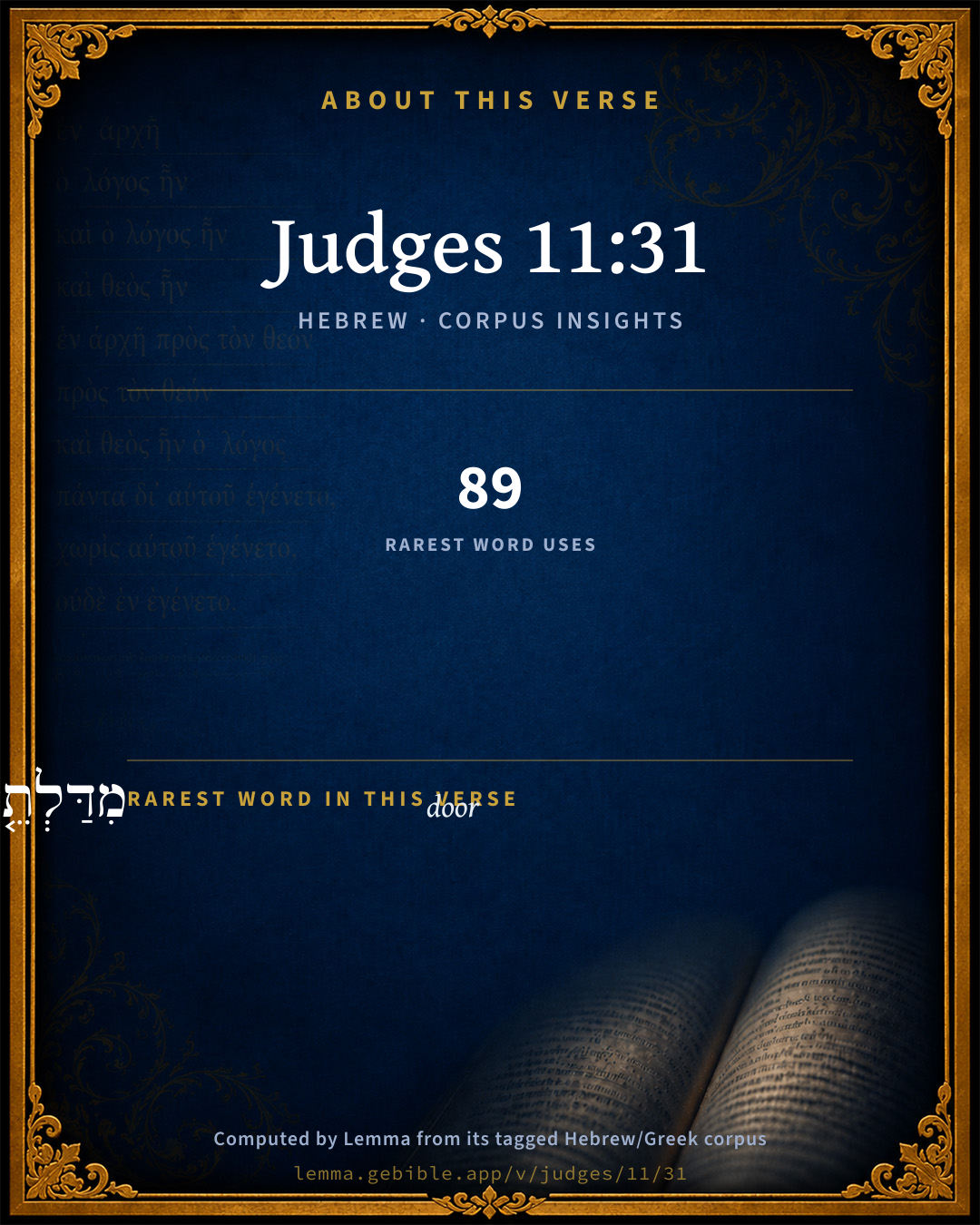
Judges, in the Historical, opens this verse with 15 words (13 distinct Hebrew lemmas). Its most distinctive word is deleth (“door”). A historical commentator’s framing appears above. Read the whole chapter for the surrounding context.

Discussion questions

  1. What does “door” (deleth) contribute to the verse as a whole?
  2. Psalms 66:13–14 shares this passage’s theme. How do the two illuminate each other?
  3. “to be” occurs 2× in this one verse. What is the effect of the repetition?
  4. These translations render this verse differently; the difference is in the English rendering, not the original. What questions does that raise?
  5. The verb «וְהָיָ֣ה» is Qal Sequential Perfect. How does its form color the action?
  6. Reading how Trapp's Complete Commentary and Joseph Benson's Commentary read this verse, where do the two commentators agree and where do they part?

Things to notice

Reading settings

Reading text

Shown beneath each verse's original-language words.

Old Testament
Old Testament edition

Read the OT as the Masoretic Hebrew (MT) or the Greek Septuagint (LXX).

English shown for the Greek Septuagint (in the Hebrew ↔ Greek comparison).

Comparing translations? Open the Compare panel on any verse page to stack up to four side by side.