
Psalms 72:7

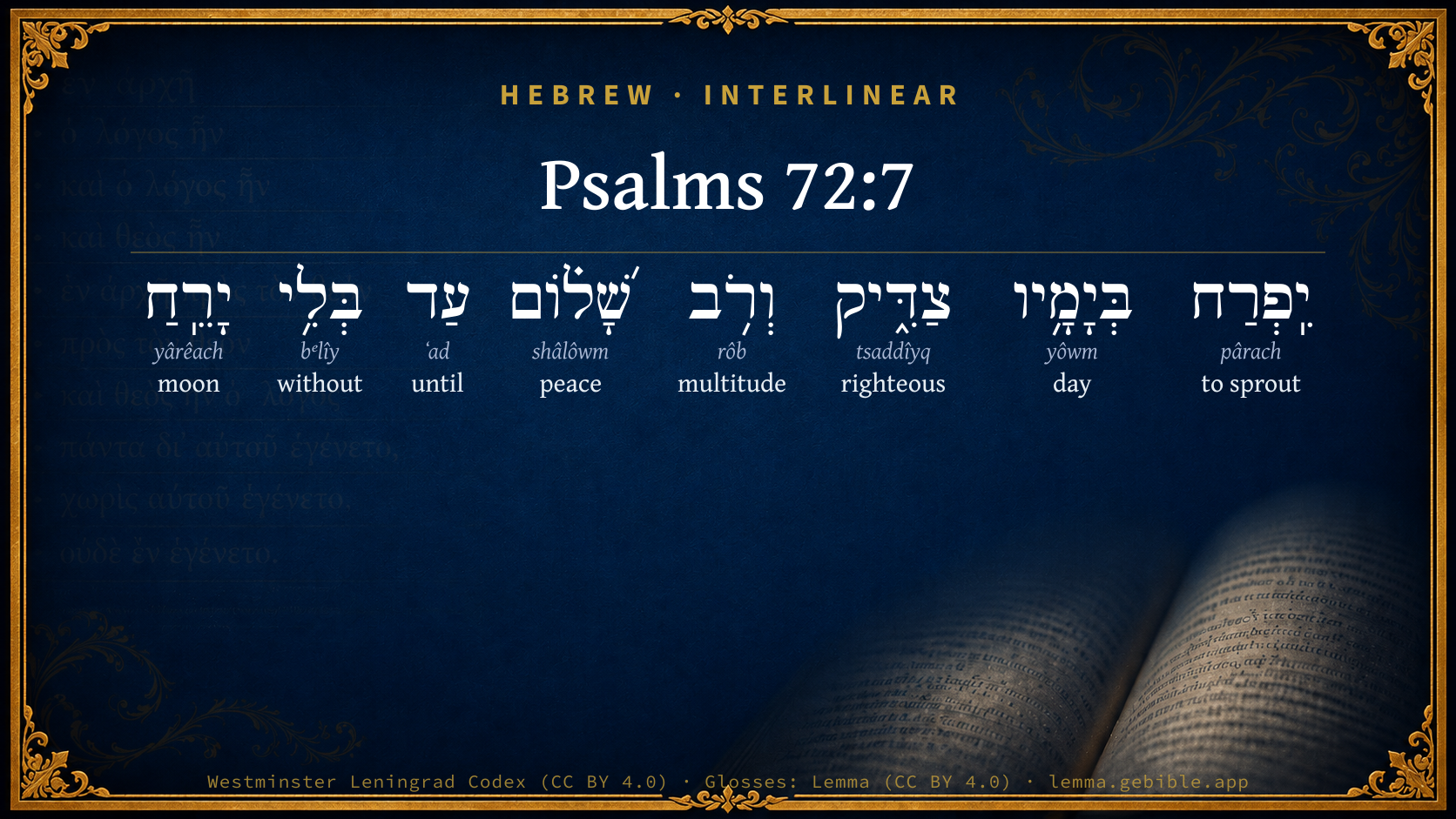
Hebrew (Westminster Leningrad Codex) Psalms 72:7 appears in the Hebrew Old Testament. The text above is from the Westminster Leningrad Codex. Each word links to its Strong’s number, a concise gloss, and parsing drawn from the Open Scriptures Hebrew Bible morphology. Click any word for its full Brown-Driver-Briggs (BDB) entry.
Download image
Cite this verse

Psalms 72:7 (World English Bible). Public Domain. Lemma interlinear Bible study tool, https://lemma.gebible.app/v/psalms/72/7.

Show BibTeX & RIS
BibTeX
RIS
English Translation
In his days, the righteous shall flourish, And abundance of peace, until the moon is no more.
World English Bible · Public Domain
Download a study sheet

One document with this verse’s original text, its word-by-word gloss line, the meaning frame, cross-references with their text, attributed commentary, and full source and license credits — printable, and it pastes into notes with its structure intact.

This verse Autodidact and up

Study sheet (.html) Plain text (.txt)

A passage Seminary Student

Up to 50 verses in one chapter. A passage sheet keeps up to 6 commentary sources and 12 cross-references per verse, in the order this page ranks them, and says so on the sheet whenever that leaves anything out. Ask for a single verse and you get the Autodidact verse sheet above.

Everything on this page stays free to read, with no account — the sheet is a download of what is already on screen, not access to it.

Want to remove ads? Support Godless Engineer
Compare translations 3

The same verse in 3 English versions, stacked beneath the original-language interlinear above. Click any original word for its lexicon entry.

Each is an independent rendering of the whole verse — the interlinear is not word-aligned to these translations.

Highlighted words mark where these versions differ — a whole-verse word diff, not a word-by-word alignment.

  • World English Bible Public Domain
    In his days, the righteous shall flourish, And abundance of peace, until the moon is no more.
  • King James Version Public Domain
    In his days shall the righteous flourish; and abundance of peace so long as the moon endureth.
  • unfoldingWord Literal Text CC BY-SA 4.0
    May the righteous flourish in his days, and abundance of peace until the moon not.

unfoldingWord Literal Text — © unfoldingWord, licensed CC BY-SA 4.0. Word-aligned USFM3 via Door43 (git.door43.org/unfoldingWord/en_ult).

Versions to compare (up to 4)

3 of 4 selected

Show all 18 translations

Every available English version of this verse, each an independent rendering of the whole verse.

  • World English Bible Public Domain
    In his days, the righteous shall flourish, And abundance of peace, until the moon is no more.
  • Berean Standard Bible Public Domain
    May the righteous flourish in his days and prosperity abound, until the moon is no more.
  • Majority Standard Bible Public Domain
    May the righteous flourish in his days and prosperity abound until the moon is no more.
  • King James Version Public Domain
    In his days shall the righteous flourish; and abundance of peace so long as the moon endureth.
  • American Standard Version (1901) Public Domain
    In his days shall the righteous flourish, And abundance of peace, till the moon be no more.
  • Revised Version (1885) Public Domain
    In his days shall the righteous flourish; and abundance of peace, till the moon be no more.
  • Geneva Bible (1599) Public Domain
    In his dayes shall the righteous florish, and abundance of peace shalbe so long as the moone endureth.
  • Douay-Rheims (1899) Public Domain
    In his days shall justice spring up, and abundance of peace, till the moon be taken sway.
  • Young's Literal Translation Public Domain
    Flourish in his days doth the righteous, And abundance of peace till the moon is not.
  • Literal Standard Version CC BY-SA 4.0
    The righteous flourish in His days, || And abundance of peace until the moon is not.
  • Unlocked Literal Bible CC BY-SA 4.0
    May the righteous flourish in his days, and may there be an abundance of peace till the moon is no more.
  • unfoldingWord Literal Text CC BY-SA 4.0
    May the righteous flourish in his days, and abundance of peace until the moon not.
  • Darby Bible Public Domain
    In his days shall the righteous flourish, and abundance of peace till the moon be no more.
  • World Messianic Bible Public Domain
    In his days, the righteous shall flourish, and abundance of peace, until the moon is no more.
  • Webster's Bible Public Domain
    In his days shall the righteous flourish; and abundance of peace so long as the moon endureth.
  • Free Bible Version CC BY-SA 4.0
    May those who live right prosper under his rule; may there be great prosperity until the moon is no more.
  • Bible in Basic English Public Domain
    In his days may the upright do well, living in peace as long as there is a moon in heaven.
  • JPS Tanakh (1917) Public Domain
    In his days let the righteous flourish, and abundance of peace, till the moon be no more.

Literal Standard Version (2020), Covenant Press — licensed CC BY-SA 4.0. Text via the HelloAO Bible API (eBible.org). Unlocked Literal Bible (unfoldingWord) — licensed CC BY-SA 4.0. Text via the HelloAO Bible API (eBible.org). unfoldingWord Literal Text — © unfoldingWord, licensed CC BY-SA 4.0. Word-aligned USFM3 via Door43 (git.door43.org/unfoldingWord/en_ult). Free Bible Version, Dr. Jonathan Gallagher — licensed CC BY-SA 4.0. Text via the HelloAO Bible API (eBible.org).

Word by word

More ways to search: Search by grammar → Find every occurrence → Compare this word →

Practice this passage: Drill this verse → Learn its vocabulary →

About this verse

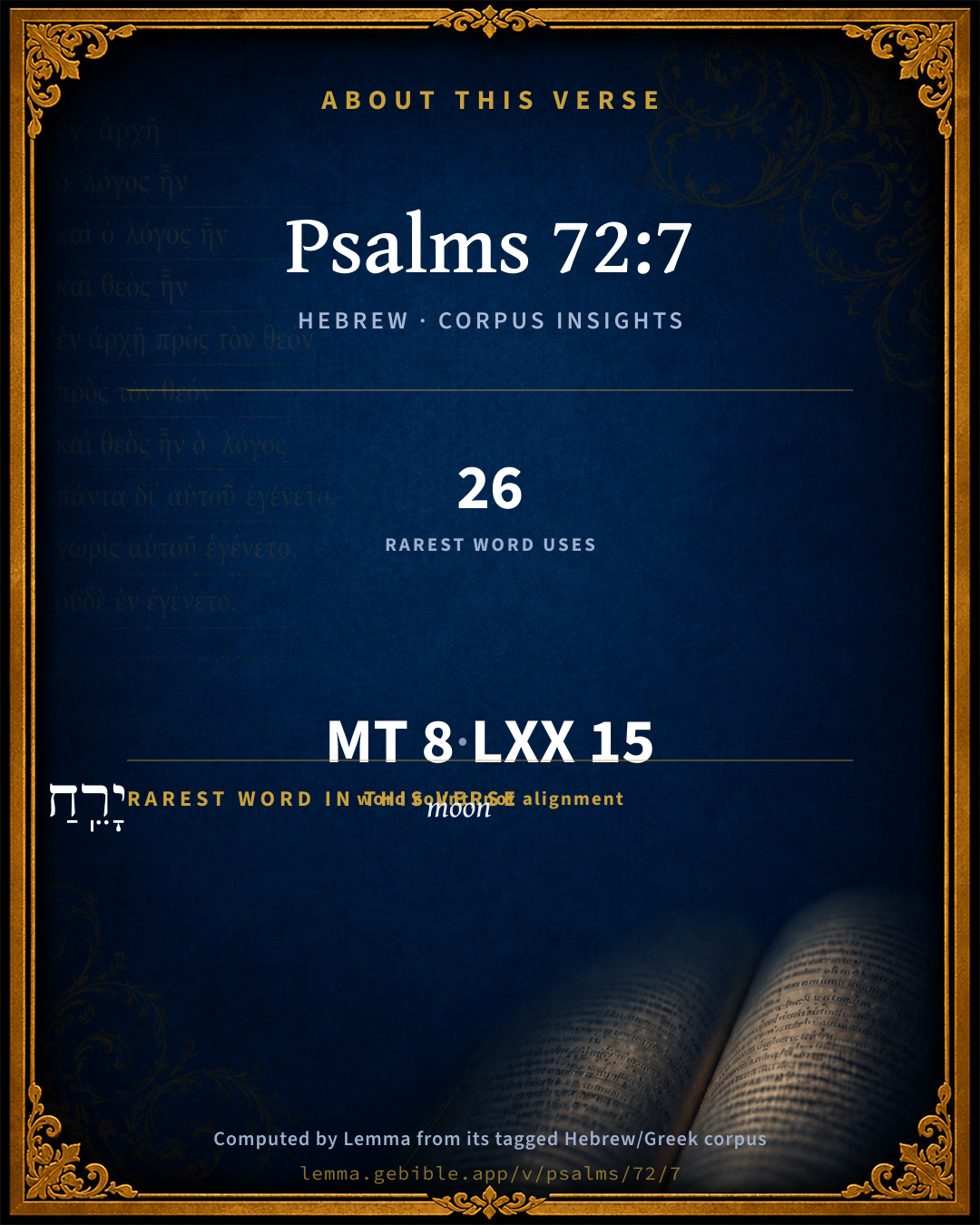
These counts appear in no published source. They are computed here, from the morphology-tagged text and Lemma’s own curated glosses. What Lemma adds →

8
words
8
distinct lemmas
Wisdom
section

Shared distinctive vocabulary

יָרֵֽחַ moon H3394 occurs in 26 verses of the Hebrew Bible. Also found in:

Grammatical profile

  • 1 verb
  • 4 nouns
  • 1 adjective
  • 1 preposition
  • 1 particle

Verb forms

  • יִֽפְרַח Qal · Imperfect

Hebrew & Septuagint length

In English translation the verse runs 17 words from the Hebrew and 16 from the Septuagint (LXX English) — closely comparable.

A rough comparison of the two English renderings, which tokenize alike — not a word-level alignment.

Word counts can differ between the Hebrew and the Greek without any difference in meaning — e.g. the Hebrew direct-object marker אֵת has no separate Greek word, and Greek often adds the article ὁ.

In the original languages it is 8 Hebrew tokens and 15 Greek tokens — but the two are counted differently (Hebrew bundles its prefixes and suffixes into one token; the Greek is in lemma form), so that isn’t a like-for-like length.

Cross-references

22

Topical passages linked to Psalms 72:7 in the Treasury of Scripture Knowledge — connected by theme and wording, ordered by reader-vote popularity; previews shown in the World English Bible.

  • Isaiah 2:4 He will judge between the nations, And will decide concerning many peoples; And they shall beat their swords into plowshares, And their spears into pruning-hooks. Nation shall not lift up sword against nation, Neither shall they learn war any more.
  • Malachi 4:2 But to you who fear my name shall the sun of righteousness arise with healing in its wings. You will go out, and leap like calves of the stall.
  • Psalms 92:12 The righteous shall flourish like the palm tree. He will grow like a cedar in Lebanon.
  • Isaiah 60:22 The little one shall become a thousand, and the small one a strong nation; I, Yahweh, will hasten it in its time.
  • Isaiah 54:11–17 you afflicted, tossed with tempest, and not comforted, behold, I will set your stones in beautiful colors, and lay your foundations with sapphires.
  • Luke 2:14 "Glory to God in the highest, On earth peace, good will toward men."
  • 1 Kings 4:25 Judah and Israel lived safely, every man under his vine and under his fig tree, from Dan even to Beersheba, all the days of Solomon.
  • 1 Chronicles 22:8–9 But the word of Yahweh came to me, saying, You have shed blood abundantly, and have made great wars: you shall not build a house to my name, because you have shed much blood on the earth in my sight.
  • Psalms 132:15–18 I will abundantly bless her provision. I will satisfy her poor with bread.
  • Isaiah 9:6–7 For to us a child is born, to us a son is given; and the government shall be on his shoulder: and his name shall be called Wonderful, Counselor, Mighty God, Everlasting Father, Prince of Peace.
  • Isaiah 11:6–9 The wolf shall dwell with the lamb, and the leopard shall lie down with the kid; and the calf and the young lion and the fattened calf together; and a little child shall lead them.
  • Isaiah 32:3–8 The eyes of those who see shall not be dim, and the ears of those who hear shall listen.
  • Isaiah 32:15–20 until the Spirit be poured on us from on high, and the wilderness become a fruitful field, and the fruitful field be esteemed as a forest.
  • Isaiah 35:1–10 The wilderness and the dry land shall be glad; and the desert shall rejoice, and blossom as the rose.
  • Isaiah 55:10–13 For as the rain comes down and the snow from the sky, and doesn't return there, but waters the earth, and makes it bring forth and bud, and gives seed to the sower and bread to the eater;
  • Isaiah 60:1 Arise, shine; for your light is come, and the glory of Yahweh is risen on you.
  • Isaiah 61:3–6 to appoint to those who mourn in Zion, to give to them a garland for ashes, the oil of joy for mourning, the garment of praise for the spirit of heaviness; that they may be called trees of righteousness, the planting of Yahweh, that he may be glorified.
  • Isaiah 61:10–11 I will greatly rejoice in Yahweh, my soul shall be joyful in my God; for he has clothed me with the garments of salvation, he has covered me with the robe of righteousness, as a bridegroom decks himself with a garland, and as a bride adorns herself with her jewels.
  • Daniel 2:44 In the days of those kings shall the God of heaven set up a kingdom which shall never be destroyed, nor shall the sovereignty of it be left to another people; but it shall break in pieces and consume all these kingdoms, and it shall stand forever.
  • Luke 1:33 and he will reign over the house of Jacob forever. There will be no end to his Kingdom."
  • Acts 4:32 The multitude of those who believed were of one heart and soul. Not one of them claimed that anything of the things which he possessed was his own, but they had all things in common.
  • Ephesians 2:14–17 For he is our peace, who made both one, and broke down the middle wall of partition,

Cross-references courtesy of OpenBible.info (CC BY 4.0).

Hebrew and Greek witnesses Masoretic Hebrew ↔ Greek Septuagint

The same verse in the two great witnesses to the Old Testament, shown verse-for-verse.

You’re reading Greek Psalm 71 (Hebrew Psalm 72). The Septuagint counts the superscription, so verse numbers can differ from the Hebrew — chapter-level alignment, not verse-by-verse. Numbering follows Rahlfs.

These are two independent witnesses, not word-aligned to each other, and the Septuagint is shown in lemma (dictionary) form.

Hebrew Psalms 72:7 Masoretic · Westminster Leningrad Codex

יִֽפְרַח בְּיָמָ֥יו צַדִּ֑יק וְרֹ֥ב שָׁ֝ל֗וֹם עַד בְּלִ֥י יָרֵֽחַ

In his days, the righteous shall flourish, And abundance of peace, until the moon is no more.

World English Bible · Public Domain

Greek LXX Greek Psalm 71:7 Septuagint · lemma form

ἀνατέλλω ἐν ὁ ἡμέρα αὐτός δικαιοσύνη καί πλῆθος εἰρήνη ἕως ὅς ἀντι ἀνααἱρέω ὁ σελήνη

In his days shall righteousness spring up; and abundance of peace till the moon be removed.

LXX2012 (modern English Septuagint) · Public Domain

On this verse, The Cambridge Bible for Schools and Colleges discusses the Septuagint’s reading. Read the note in Commentary ↓

Hebrew: Westminster Leningrad Codex (CC BY 4.0). Greek: Septuagint (public domain); English from LXX2012 (modern English Septuagint) (Public Domain). How the Septuagint differs from the Hebrew →

Commentary

Notes on Psalms 72:7 from classic Christian and Jewish commentators (each source and its license shown beneath its notes). The classic Christian expositions comment on the surrounding passage and are grouped to its opening verse, so a note may address several verses; the Jewish commentaries on the Tanakh (Rashi and others) are per-verse, so they appear only where the commentator wrote on this verse.

Lemma curates 59 commentaries, every one of them public domain or Creative Commons licensed, each selected and text-cleaned for this edition rather than reprinted as found. About our sources →

Trapp's Complete Commentary

John Trapp

Psa 72:7 In his days shall the righteous flourish; and abundance of peace so long as the moon endureth.

Ver. 7. In his days shall the righteous flourish] As watered gardens, Jer 31:12, or as the willows by the water courses, Isa 44:4, παντα καλως εσται.

And abundance of peace] The work of righteousness shall be peace, and the effects of righteousness quietness, and assurance for ever, Isa 32:17. Christ’s subjects have peace, peace, Isa 25:3, a multiplied peace, a multiplied pardon, Isa 55:7; where sin aboundeth grace superaboundeth; neither can they commit more than God will remit unto them.

John Trapp, A Commentary or Exposition upon All the Books of the Old and New Testament (1647–1656) — public domain. Text from a community e-Sword module.

Joseph Benson's Commentary

Psa 72:7. In his days shall the righteous flourish — As the wicked shall be discountenanced and punished, so good men shall be encouraged, advanced, and multiplied. And abundance of peace as long as the moon endureth — That is, as long as time and the world shall last. Which neither was nor could be the case under the reign of Solomon, which was not of very long duration, and the peace of whose kingdom was sadly disturbed, and almost wholly lost after his death; but which was, and more especially hereafter will be, undoubtedly and eminently accomplished in Christ, who came to bring peace on earth, Luk 2:14, and left it as a legacy to his disciples, Joh 14:27.

Joseph Benson's Commentary on the Old and New Testaments (1811–1818) — public domain. Text from a community e-Sword module.

J. A. Alexander on Psalms

Joseph Addison Alexander

Psa 72:7. In his days shall the righteous sprout, spring up, or shoot forth, and abundance of peace, till the failure (or cessation) of the moon. The idea is the same as in Psa 72:3; Psa 72:5, with a slight change in the form of the expression. By a lively figure, the righteous man is substituted for righteousness in the abstract, as the fruit of the earth and the productive cause of peace. The idea of perpetuity is again conveyed by repeating one of the comparisons in Psa 72:5.

Joseph Addison Alexander, The Psalms Translated and Explained (1850) — public domain. Text from a community e-Sword module.

Adam Clarke's Commentary

Verse 7. In his days shall the righteous flourish] There was nothing but peace and prosperity all the days of Solomon: for, "In his days Judah and Israel dwelt safely; every man under his vine and under his fig-tree, from Dan even to Beersheba;" 1Kg 4:25.

So long as the moon endureth] עד בלי ירח ad beli yareach, "Till there be no more moon."

Adam Clarke's Commentary on the Bible (1810–1826) — public domain. Text from a community e-Sword/MySword module.

John Calvin's Commentaries

7. In his days shall the righteous flourish It is unnecessary for me frequently to repeat what I have once stated, that all these sentences depend upon the first verse. David, therefore, prayed that the king might be adorned with righteousness and judgment, that the just might flourish and the people prosper. This prediction receives its highest fulfillment in Christ. It was, indeed, the duty of Solomon to maintain the righteous; but it is the proper office of Christ to make men righteous. He not only gives to every man his own, but also reforms their hearts through the agency of his Spirit. By this means he brings righteousness back, as it were, from exile, which otherwise would be altogether banished from the world. Upon the return of righteousness there succeeds the blessing of God, by which he causes all his children to rejoice in the way of making them to perceive that under their King, Christ, every provision is made for their enjoying all manner of prosperity and felicity. If any would rather take the word peace in its proper and more restricted signification, I have no objections to it. And, certainly, to the consummation of a happy life, nothing is more desirable than peace; for amidst the turmoils and contentions of war, men derive almost no good from having an abundance of all things, as it is then wasted and destroyed. Moreover, when David represents the life of the king as prolonged to the end of the world, this shows more clearly that he not only comprehends his successors who occupied an earthly throne, but that he ascends even to Christ, who, by rising from the dead, obtained for himself celestial life and glory, that he might govern his Church for ever.

John Calvin's Commentaries (1540-1563) — public domain. Text from the Calvin Translation Society English edition (1840s-50s) via the Christian Classics Ethereal Library (ccel.org). Calvin's coverage is partial (roughly two-thirds of the Bible); uncommented books and verses are honest gaps, never fabricated. The 19th-century editor's footnotes and remarks are omitted so the notes are faithfully Calvin's own voice.

Ellicott's Commentary for English Readers

(7) Flourish—i.e., spring up and grow like vegetation after rain.

Endureth.—See margin, and comp. Job_14:12, “till the heavens be no more.”

A Bible Commentary for English Readers, edited by Charles John Ellicott (1878–1897) — public domain. Text from a community e-Sword module.

The Cambridge Bible for Schools and Colleges

gen. ed. J. J. S. Perowne

7. flourish] The metaphor follows naturally upon that of the preceding verse. Cp. Pro_11:28; Psa_92:12-13. For the righteous LXX, Jer., Syr. read righteousness, which suits the parallelism better.

so long as the moon endureth] Lit. as R.V., till the moon be no more; for all time. Cp. Job_14:12.

The Cambridge Bible for Schools and Colleges (gen. ed. J. J. S. Perowne; Cambridge University Press, 1878–1918) — public domain. Text from a community e-Sword module.

John Gill's Exposition

In his days shall the righteous flourish,.... As the grass of the field, Psa 72:16; the dews and rain of grace descending upon them; and as a branch, Pro 11:28. They being branches in Christ the vine, flourish and bring forth fruit; and as the palm tree, Psa 92:12; which the more it is pressed with weights, the more it grows; so they, the more they are afflicted, as the Israelites, the more they grow in grace and experience, and become fruitful in every good word and work; which is owing to their being planted in a good soil, in the house and courts of the Lord, where the word is preached, and ordinances administered; to their being rooted and grounded in the love of God and grace of Christ; to their being watered continually with the dews of divine favour; enjoying the bright shining of the sun of righteousness, and the refreshing gales of the divine Spirit, like the south wind upon them, causing their spices to flow out. The Targum is,

"in his days the righteous shall be multiplied;''

when the forces and fulness of the Gentiles shall be brought in, and the nation of the Jews shall be born at once: in the latter days of the Messiah, all the Lord's people shall be righteous; and none but righteous persons shall dwell in the new heavens and earth, Isa 60:21, Pe2 3:13. This is to be understood not of persons outwardly righteous only; nor that are so in their own conceit; nor that seek for righteousness by the works of the law, or depend on an external profession of religion; for such never flourish, nor grow in grace, who have no grace to grow in: but of such that are justified by the righteousness of Christ, have faith in him, and the seed of grace implanted in them. This is interpreted of the Messiah, by a Jewish writer (x); who observes, that in his days the priesthood shall return, and the rod of Aaron shall flourish;

and abundance of peace, so long as the moon endureth; alluding, no doubt, to the name of Solomon, which signifies peace; and to that peace and prosperity which were enjoyed under his reign, and was a shadow of what would be in the times of Christ: universal peace, in a temporal sense, was in the times of Augustus, in which Christ was born, and in whose reign the temple of Janus was shut, a sure sign of peace (y). Spiritual peace was made with God by his blood, and all things were reconciled by him, whether in heaven or in earth; Jew and Gentile were made both one, and reconciled in one body; and abundance of spiritual peace is enjoyed by those that believe in Christ: they are kept in perfect peace, and filled with it; and in the latter day there will be abundance of peace among the saints, There will be no disputes nor discord among them; no envying nor vexing one another; no animosities or contentions about religious matters; for they will then see eye to eye: and they will be at peace with the men of the world; there will be no more wars in the earth, nor bloodshed, nor persecution. And this shall endure till there is no moon, till there shall be no need of one; as there will not in the New Jerusalem state, in which there will be no night.

(x) Baal Hatiurim in Numb. fol. 169. 3. (y) Vell. Patercul. Hist. Rom. l. 2. Aurel. Victor. de Vir. Illust. Addit. c. 2. de Caesar. c. 1.

John Gill's Exposition of the Whole Bible (1746–1763) — public domain (CC PDM 1.0). Text via the HelloAO Bible API.

Albert Barnes' Notes on the Bible

In his days shall the righteous flourish - It will be a period when just and upright people will be protected, or when they shall receive the countenance of him who reigns. The administration of the kingdom that is to be set up will be in favor of righteousness or justice. The word “flourish” here is derived from the growth of plants - as plants sprout, or spring up - an emblem of prosperity.

And abundance of peace - literally, “multitude of peace;” that is, The things which produce peace, or which indicate peace, will not be few, but numerous; they will abound everywhere. They will be found in towns and villages, and private dwellings; in the calm and just administration of the affairs of the State; in abundant harvests; in intelligence, in education, and in undisturbed industry; in the protection extended to the rights of all.

So long as the moon endureth - Margin, as in Hebrew, “until there be no moon.” That is, until the moon shall cease to shine upon the earth. See Psa 72:5.

Albert Barnes' Notes on the Bible (1834–1885) — public domain. Text from a community e-Sword/MySword module.

Matthew Poole's English Annotations

Shall the righteous flourish; as the wicked shall be discountenanced and punished, so good men shall be encouraged, and advanced, and multiplied.

So long as the moon endureth, i.e. as long as time and the world shall last; which neither was nor could be true of Solomon, who lived not long, and the peace of whose kingdom was sadly disturbed, and in a manner wholly lost, presently after his death, but was undoubtedly and eminently accomplished in Christ, who brought peace upon earth, Luk 2:14, and left it as his legacy to his disciples, Joh 14:27.

Matthew Poole's English Annotations on the Holy Bible (1683–1685) — public domain. Text from a community e-Sword/MySword module.

The Treasury of David

Charles H. Spurgeon

Ver. 7. In his days shall the righteous flourish. Beneath the deadly Upas of unrighteous rule no honest principles can be developed, and good men can scarcely live; but where truth and uprightness are on the throne, the best of men prosper most. A righteous king is the patron and producer of righteous subjects. None flourish under Nero but those who are monsters like himself: like will to like; and under the gentle Jesus the godly find a happy shelter.

And abundance of peace so long as the moon endureth. Where Jesus reigns he is known as the true Melchizedek, king both of righteousness and peace. Peace based upon right is sure to be lasting, but no other will be. Many a so called Holy Alliance has come to the ground ere many moons have filled their horns, because craft formed the league, perjury established it, and oppression was the design of it; but when Jesus shall proclaim the great Truce of God, he will ordain perpetual peace, and men shall learn war no more. The peace which Jesus brings is not superficial or short lived; it is abundant in its depth and duration. Let all hearts and voices welcome the King of nations; Jesus the Good, the Great, the Just, the Ever blessed.

Ver. 7. Righteous. Peace. Do you ask what he is individually? The answer is, "King of Righteousness:" a being loving righteousness, working righteousness, promoting righteousness, procuring righteousness, imparting righteousness to those whom he saves, perfectly sinless, and the enemy and abolisher of all sin. Do you ask what he is practically, and in relation to the effect of his reign? The answer is, "King of Peace:" a sovereign whose kingdom is a shelter for all who are miserable, a covert for all who are persecuted, a resting place for all who are weary, a home for the destitute, and a refuge for the lost. Charles Stanford.

Ver. 7. Abundance of peace. Literally, multitude of peace; that is, the things which produce peace, or which indicate peace, will not be few, but numerous; they will abound everywhere. They will be found in towns and villages, and private dwellings; in the calm and just administration of the affairs of the State; in abundant harvests; in intelligence, in education, and in undisturbed industry; in the protection extended to the rights of all. Albert Barnes.

Ver. 7. So long as the moon endureth. It does not necessarily follow from these words that the moon will ever cease to exist. The idea, commonly held, of the annihilation of the starry firmament is without foundation in Scripture. Such an idea has a pernicious influence on the human mind, inasmuch as it leads men to depreciate that which bears in such striking character the stamp and impress of the divine glory. Frederic Fysh.

Ver. 7.

I. The righteous flourish more at one season than

another.

II. They flourish most when Jesus is with them: in his

days, etc.

III. The fruit of their growth is proportionately

abundant: and abundance, etc. G. Rogers.

Ver. 7. Abundance of peace. Abundant overtures of peace, abundant redemption making peace, abundant pardon conferring peace, abundant influences of the Spirit sealing peace, abundant promises guaranteeing peace, abundant love spreading peace, etc.

Psalms 72:8*

Charles H. Spurgeon's The Treasury of David (1869–1885) — public domain. Psalms only. Text from a community e-Sword/MySword module.

Whedon's Commentary on the Bible

Daniel D. Whedon

7. Shall the righteous flourish—The highest proof of a righteous government and of a prosperous people.

Moon endureth—See Psa_72:5

Daniel D. Whedon (gen. ed.), Commentary on the Old and New Testaments (1874–1909) — public domain. Text from a community e-Sword module.

The Pulpit Commentary

In his days shall the righteous flourish. In Messiah"s days, when his kingdom is fully established, the righteous will flourish and prosper, since the wicked will not be suffered to hinder them (comp. ver. 4; and see Butler"s "Analogy," pt. 1, ch. 3). And abundance of peace so long as the moon endureth; literally, till there be no longer a moon (comp. ver. 5).

The Pulpit Commentary (1880–1919), ed. H.D.M. Spence-Jones & Joseph S. Exell — public domain. Text from a community e-Sword module.

Rashi

Rabbi Shlomo Yitzchaki (Rashi)

May the righteous flourish in his days Israel.

and much peace will flourish in his days, and this peace will last forever. Now all this prayer was fulfilled except this thing, because Solomon sinned. Therefore his kingdom did not endure, for the kingship was given to David on this condition (I Kings 2: 4): “If your children take heed to their way,” but Israel sinned in his days. As it is said (ibid. 4: 20): “Judah and Israel [were] many, as the sand, etc.” And Israel flourished in his days, as it is said... And there was much peace, as it is said (ibid. 5:5): “And Judah and Israel dwelt safely, every man under his vine and under his fig tree, etc., all the days of Solomon.”

Rashi on the Tanakh — English translations: “The Judaica Press complete Tanach with Rashi, translated by A. J. Rosenberg” (CC BY 4.0); “Pentateuch with Rashi's commentary by M. Rosenbaum and A.M. Silbermann, 1929-1934” (public domain); “The Metsudah Tanach series, Lakewood, N.J” (CC BY 4.0); and “The Book of Joshua, Metsudah Publications, 1997” (CC BY 4.0). Text via Sefaria.

Lesson kit

Teaching starters — assembled from the data on this page, not authored interpretation. Every prompt links to the verse data it draws on. Edit before teaching.

Psalms, in the Wisdom, opens this verse with 8 words (8 distinct Hebrew lemmas). Its most distinctive word is yârêach (“moon”). A historical commentator’s framing appears above. Read the whole chapter for the surrounding context.

Discussion questions

  1. How does “moon” (yârêach) shape what this verse is saying?
  2. Genesis 37:9 shares the word «moon» with this verse. How do the two illuminate each other?
  3. These translations render this verse differently. What is at stake in choosing one wording over another?
  4. The verb «יִֽפְרַח» is Qal Imperfect. How does its form color the action?
  5. Reading how Trapp's Complete Commentary and Joseph Benson's Commentary read this verse, where do the two commentators agree and where do they part?

Things to notice

Reading settings

Reading text

Shown beneath each verse's original-language words.

Old Testament
Old Testament edition

Read the OT as the Masoretic Hebrew (MT) or the Greek Septuagint (LXX).

English shown for the Greek Septuagint (in the Hebrew ↔ Greek comparison).

Comparing translations? Open the Compare panel on any verse page to stack up to four side by side.