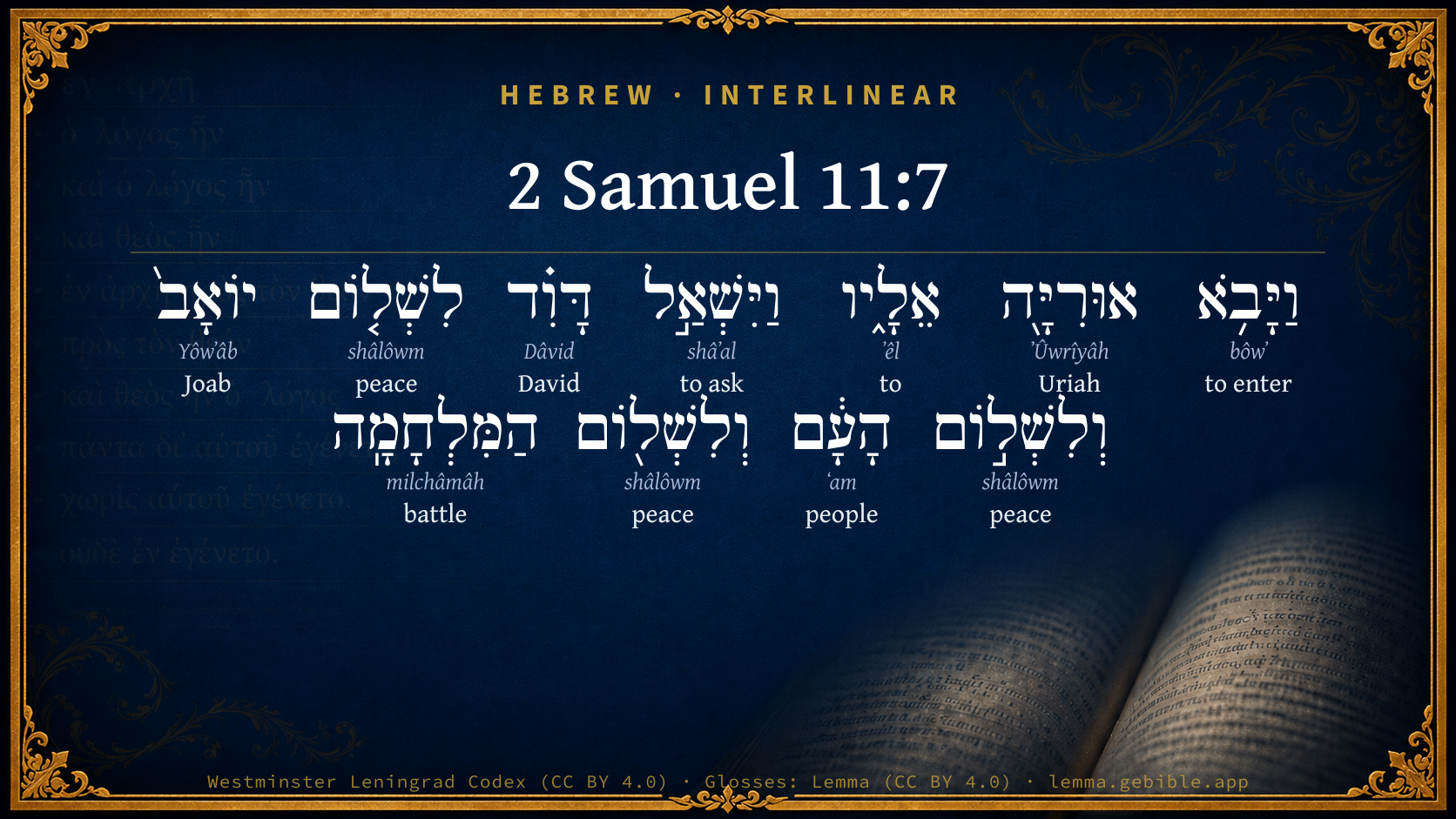
2 Samuel 11:7

Hebrew (Westminster Leningrad Codex) 2 Samuel 11:7 appears in the Hebrew Old Testament. The text above is from the Westminster Leningrad Codex. Each word links to its Strong’s number, a concise gloss, and parsing drawn from the Open Scriptures Hebrew Bible morphology. Click any word for its full Brown-Driver-Briggs (BDB) entry.
Download image
Cite this verse

2 Samuel 11:7 (World English Bible). Public Domain. Lemma interlinear Bible study tool, https://lemma.gebible.app/v/2-samuel/11/7.

Show BibTeX & RIS
BibTeX
RIS
English Translation
When Uriah was come to him, David asked of him how Joab did, and how the people fared, and how the war prospered.
World English Bible · Public Domain
Download a study sheet

One document with this verse’s original text, its word-by-word gloss line, the meaning frame, cross-references with their text, attributed commentary, and full source and license credits — printable, and it pastes into notes with its structure intact.

This verse Autodidact and up

Study sheet (.html) Plain text (.txt)

A passage Seminary Student

Up to 50 verses in one chapter. A passage sheet keeps up to 6 commentary sources and 12 cross-references per verse, in the order this page ranks them, and says so on the sheet whenever that leaves anything out. Ask for a single verse and you get the Autodidact verse sheet above.

Everything on this page stays free to read, with no account — the sheet is a download of what is already on screen, not access to it.

Want to remove ads? Support Godless Engineer
Compare translations 3

The same verse in 3 English versions, stacked beneath the original-language interlinear above. Click any original word for its lexicon entry.

Each is an independent rendering of the whole verse — the interlinear is not word-aligned to these translations.

Highlighted words mark where these versions differ — a whole-verse word diff, not a word-by-word alignment.

  • World English Bible Public Domain
    When Uriah was come to him, David asked of him how Joab did, and how the people fared, and how the war prospered.
  • King James Version Public Domain
    And when Uriah was come unto him, David demanded of him how Joab did, and how the people did, and how the war prospered.
  • unfoldingWord Literal Text CC BY-SA 4.0
    And Uriah came to him, and David asked about the welfare of Joab and about the welfare of the people and about the welfare of the war.

unfoldingWord Literal Text — © unfoldingWord, licensed CC BY-SA 4.0. Word-aligned USFM3 via Door43 (git.door43.org/unfoldingWord/en_ult).

Versions to compare (up to 4)

3 of 4 selected

Show all 18 translations

Every available English version of this verse, each an independent rendering of the whole verse.

  • World English Bible Public Domain
    When Uriah was come to him, David asked of him how Joab did, and how the people fared, and how the war prospered.
  • Berean Standard Bible Public Domain
    When Uriah came to him, David asked how Joab and the troops were doing with the war.
  • Majority Standard Bible Public Domain
    When Uriah came to him, David asked how Joab and the troops were doing and how the war was going.
  • King James Version Public Domain
    And when Uriah was come unto him, David demanded of him how Joab did, and how the people did, and how the war prospered.
  • American Standard Version (1901) Public Domain
    And when Uriah was come unto him, David asked of him how Joab did, and how the people fared, and how the war prospered.
  • Revised Version (1885) Public Domain
    And when Uriah was come unto him, David asked of him how Joab did, and how the people fared, and how the war prospered.
  • Geneva Bible (1599) Public Domain
    And when Vriah came vnto him, Dauid demanded him how Ioab did, and howe the people fared, and how the warre prospered.
  • Douay-Rheims (1899) Public Domain
    And Urias came to David. And David asked how Joab did, and the people, and how the war was carried on.
  • Young's Literal Translation Public Domain
    and Uriah cometh unto him, and David asketh of the prosperity of Joab, and of the prosperity of the people, and of the prosperity of the war.
  • Literal Standard Version CC BY-SA 4.0
    and Uriah comes to him, and David asks of the prosperity of Joab, and of the prosperity of the people, and of the prosperity of the war.
  • Unlocked Literal Bible CC BY-SA 4.0
    When Uriah arrived, David asked him how Joab was, how the army was doing, and how the war was going.
  • unfoldingWord Literal Text CC BY-SA 4.0
    And Uriah came to him, and David asked about the welfare of Joab and about the welfare of the people and about the welfare of the war.
  • Darby Bible Public Domain
    And when Urijah had come to him, David asked how Joab prospered, and how the people prospered, and how the war prospered.
  • World Messianic Bible Public Domain
    When Uriah had come to him, David asked him how Joab did, and how the people fared, and how the war prospered.
  • Webster's Bible Public Domain
    And when Uriah had come to him, David inquired of him how Joab did, and how the people did, and how the war prospered.
  • Free Bible Version CC BY-SA 4.0
    When Uriah came to see him, David asked him how Joab was doing, and how the army was doing, and how the war was going.
  • Bible in Basic English Public Domain
    And when Uriah came to him, David put questions to him about how Joab and the people were, and how the war was going.
  • JPS Tanakh (1917) Public Domain
    And when Uriah was come unto him, David asked of him how Joab did, and how the people fared, and how the war prospered.

Literal Standard Version (2020), Covenant Press — licensed CC BY-SA 4.0. Text via the HelloAO Bible API (eBible.org). Unlocked Literal Bible (unfoldingWord) — licensed CC BY-SA 4.0. Text via the HelloAO Bible API (eBible.org). unfoldingWord Literal Text — © unfoldingWord, licensed CC BY-SA 4.0. Word-aligned USFM3 via Door43 (git.door43.org/unfoldingWord/en_ult). Free Bible Version, Dr. Jonathan Gallagher — licensed CC BY-SA 4.0. Text via the HelloAO Bible API (eBible.org).

Word by word

More ways to search: Search by grammar → Find every occurrence → Compare this word →

Practice this passage: Drill this verse → Learn its vocabulary →

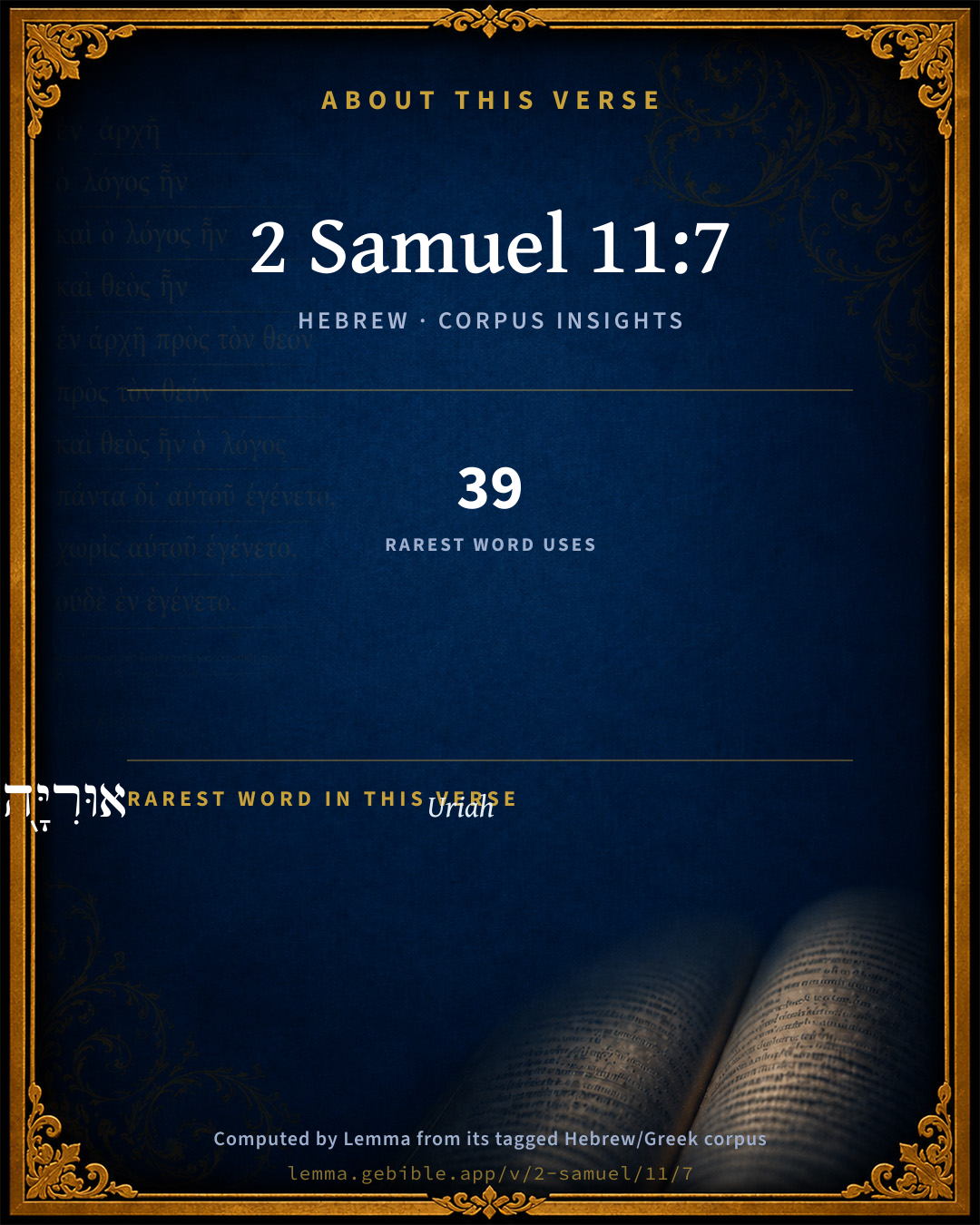
אוּרִיָּ֖ה
ʼÛwrîyâh
H223
“Uriah”
Noun, Proper
Part of Speech
Noun
Type
Proper
Full BDB Definition

Origin: from H217 and H3050

TWOT: None

Uriah or Urijah = "Jehovah (Yahweh) is my light (flame)" - Hittite husband of Bathsheba - a priest who built king Ahaz' heathen altar - a priest who rebuilt Jerusalem's wall - a prophet slain by Jehoiakim
  1. וַיָּבֹ֥א bôwʼ H935 “and · to enter” Conjunction + Verb, Qal, Sequential Imperfect, 3rd Person, Masculine, Singular
  2. אֵלָ֑יו ʼêl H413 “to · him” Preposition + Suffix, Personal, 3rd Person, Masculine, Singular
  3. וַיִּשְׁאַ֣ל shâʼal H7592 “and · to ask” Conjunction + Verb, Qal, Sequential Imperfect, 3rd Person, Masculine, Singular
  4. דָּוִ֗ד Dâvid H1732 “David” Noun, Proper
  5. לִשְׁל֤וֹם shâlôwm H7965 “to/for · peace of” Preposition + Noun, Common, Masculine, Singular, Construct
  6. יוֹאָב֙ Yôwʼâb H3097 “Joab” Noun, Proper
  7. וְלִשְׁל֣וֹם shâlôwm H7965 “and · to/for · peace of” Conjunction + Preposition + Noun, Common, Masculine, Singular, Construct
  8. הָעָ֔ם ʻam H5971 “the · people” Particle, Definite Article + Noun, Common, Masculine, Singular, Absolute
  9. וְלִשְׁל֖וֹם shâlôwm H7965 “and · to/for · peace of” Conjunction + Preposition + Noun, Common, Masculine, Singular, Construct
  10. הַמִּלְחָמָֽה milchâmâh H4421 “the · battle” Particle, Definite Article + Noun, Common, Feminine, Singular, Absolute

About this verse

These counts appear in no published source. They are computed here, from the morphology-tagged text and Lemma’s own curated glosses. What Lemma adds →

11
words
9
distinct lemmas
Historical
section

Shared distinctive vocabulary

אוּרִיָּ֖ה Uriah H223 occurs in 33 verses of the Hebrew Bible. Also found in:

Grammatical profile

  • 2 verbs
  • 8 nouns
  • 1 preposition

Verb forms

  • וַיָּבֹ֥א Qal · Sequential Imperfect
  • וַיִּשְׁאַ֣ל Qal · Sequential Imperfect

Repetition

A word recurs within this verse — often emphatic in Hebrew:

  • לִשְׁל֤וֹם peace H7965 ×3

Hebrew & Septuagint length

In English translation the verse runs 23 words from the Hebrew and 26 from the Septuagint (LXX English) — closely comparable.

A rough comparison of the two English renderings, which tokenize alike — not a word-level alignment.

Word counts can differ between the Hebrew and the Greek without any difference in meaning — e.g. the Hebrew direct-object marker אֵת has no separate Greek word, and Greek often adds the article ὁ.

Cross-references

3

Topical passages linked to 2 Samuel 11:7 in the Treasury of Scripture Knowledge — connected by theme and wording, ordered by reader-vote popularity; previews shown in the World English Bible.

  • Genesis 37:14 He said to him, "Go now, see whether it is well with your brothers, and well with the flock; and bring me word again." So he sent him out of the valley of Hebron, and he came to Shechem.
  • 1 Samuel 17:22 David left his baggage in the hand of the keeper of the baggage, and ran to the army, and came and greeted his brothers.
  • Genesis 29:6 He said to them, "Is it well with him?" They said, "It is well. See, Rachel, his daughter, is coming with the sheep."

Cross-references courtesy of OpenBible.info (CC BY 4.0).

Hebrew and Greek witnesses Masoretic Hebrew ↔ Greek Septuagint

The same verse in the two great witnesses to the Old Testament, shown verse-for-verse.

These are two independent witnesses, not word-aligned to each other, and the Septuagint is shown in lemma (dictionary) form.

Hebrew 2 Samuel 11:7 Masoretic · Westminster Leningrad Codex

וַיָּבֹ֥א אוּרִיָּ֖ה אֵלָ֑יו וַיִּשְׁאַ֣ל דָּוִ֗ד לִשְׁל֤וֹם יוֹאָב֙ וְלִשְׁל֣וֹם הָעָ֔ם וְלִשְׁל֖וֹם הַמִּלְחָמָֽה

When Uriah was come to him, David asked of him how Joab did, and how the people fared, and how the war prospered.

World English Bible · Public Domain

Greek LXX 2 Samuel 11:7 Septuagint · lemma form

καί παραγίγνομαι ουριας καί εἰςἔρχομαι πρός αὐτός καί ἐπιἐρωτάω δαυίδ εἰς εἰρήνη ιωαβ καί εἰς εἰρήνη ὁ λαός καί εἰς εἰρήνη ὁ πόλεμος

And Urias arrived and went in to him, and David asked him how Joab was, and how the people were, and how the war went on.

LXX2012 (modern English Septuagint) · Public Domain

Hebrew: Westminster Leningrad Codex (CC BY 4.0). Greek: Septuagint (public domain); English from LXX2012 (modern English Septuagint) (Public Domain). How the Septuagint differs from the Hebrew →

Targum (Aramaic paraphrase)

1

The Targum is the ancient Jewish Aramaic paraphrase of the Hebrew Scriptures — an interpretive translation, not the Hebrew text itself. Onkelos (literal) and Pseudo-Jonathan (expansive) render the Torah, and Jonathan the Prophets. Coverage is partial: where no permissively-licensed English translation exists for a verse, only the Aramaic is shown. This is verse-level text, not a word-by-word alignment to the Hebrew.

  1. Targum Jonathan Prophets (Joshua–Malachi)
    וַאֲתָא אוּרִיָה לְוָתֵיהּ וּשְׁאַל לֵיהּ דָוִד לִשְׁלַם יוֹאָב וְלִשְׁלַם עַמָא וְלִשְׁלַם עַבְדֵי קְרָבָא:

    (no public-domain English translation for this verse)

    Targum Jonathan — Aramaic: “Mikraot Gedolot” (public domain). English: “Sefaria Community Translation” (CC0 1.0 (public-domain dedication)); “London "Chaldee Paraphrase," 1871” (public domain). Text via Sefaria.

Commentary

Notes on 2 Samuel 11:7 from classic Christian and Jewish commentators (each source and its license shown beneath its notes). The classic Christian expositions comment on the surrounding passage and are grouped to its opening verse, so a note may address several verses; the Jewish commentaries on the Tanakh (Rashi and others) are per-verse, so they appear only where the commentator wrote on this verse.

Lemma curates 59 commentaries, every one of them public domain or Creative Commons licensed, each selected and text-cleaned for this edition rather than reprinted as found. About our sources →

Trapp's Complete Commentary

John Trapp

2Sa 11:7 And when Uriah was come unto him, David demanded [of him] how Joab did, and how the people did, and how the war prospered.

Ver. 7. How Joab did, and how the people did.] David was but a bungler at committing and covering his sin. Lust was but a stranger to him, as Peter Martyr observeth from that passage in Nathan’s parable. {2Sa 12:4} What poor queries were these to put to such a man as Uriah! What weak pretences for fetching him home from such a service! Might not a meaner man have made as good a messenger? Some conceive that Uriah hereupon began to suspect somewhat, and to grow jealous of his beautiful wife, so that he would not come at her.

And how the war prospered.] Heb., Of the peace of the war; that is, in what forwardness the war was for a peaceable conclusion.

John Trapp, A Commentary or Exposition upon All the Books of the Old and New Testament (1647–1656) — public domain. Text from a community e-Sword module.

The Cambridge Bible for Schools and Colleges

gen. ed. J. J. S. Perowne

6–13. Uriah summoned to Jerusalem

7. David demanded, &c.] David sent for Uriah ostensibly to bring him word about the progress of the war. Uriah, as one of the “mighty men,” no doubt held some command in the army.

demanded] Rather, asked. The use of demand, like Fr. demander, meaning simply ‘to ask,’ is an archaism.

The Cambridge Bible for Schools and Colleges (gen. ed. J. J. S. Perowne; Cambridge University Press, 1878–1918) — public domain. Text from a community e-Sword module.

John Gill's Exposition

And when Uriah was come unto him,.... To David, to whom he came first, before he went to his own house, desirous of knowing what was the special business of the king with him:

David demanded of him how Joab did, and how the people did, and how the war prospered; he asked of the welfare of Joab the general, and of the common soldiers, and of the warriors, as the Targum, the mighty men that went along with Joab, Sa2 10:7. David seems to have been at a loss what to say to him. These questions were so mean and trivial, that it might justly give Uriah some suspicion that it could never he on this account, that he was sent for; since David could not want intelligence of such things, expresses being daily sending him.

John Gill's Exposition of the Whole Bible (1746–1763) — public domain (CC PDM 1.0). Text via the HelloAO Bible API.

Albert Barnes' Notes on the Bible

David was forced to stoop to falsehood and dissimulation in the vain hope of hiding his sin.

Albert Barnes' Notes on the Bible (1834–1885) — public domain. Text from a community e-Sword/MySword module.

Matthew Poole's English Annotations

Frivolous questions, which any common messenger could have answered; which probably made Uriah suspect that there was some other secret cause why he was sent for. And he might understand something, either by David’s messengers, 2Sa 11:4, or by some of his own family, concerning her being sent for to the court; which, together with other circumstances, might give him cause of further suspicion. Yet such might be the questions (though not here particularly mentioned) concerning those heads, as every private person might not be acquainted with, nor able to resolve, but such only as were acquainted with the counsel of war.

Matthew Poole's English Annotations on the Holy Bible (1683–1685) — public domain. Text from a community e-Sword/MySword module.

Lesson kit

Teaching starters — assembled from the data on this page, not authored interpretation. Every prompt links to the verse data it draws on. Edit before teaching.

2 Samuel, in the Historical, opens this verse with 11 words (9 distinct Hebrew lemmas). Its most distinctive word is ʼÛwrîyâh (“Uriah”). A historical commentator’s framing appears above. Read the whole chapter for the surrounding context.

Discussion questions

  1. What does “Uriah” (ʼÛwrîyâh) contribute to the verse as a whole?
  2. 2 Samuel 11:3 shares the word «Uriah» with this verse. How do the two illuminate each other?
  3. “peace” occurs 3× in this one verse. What is the effect of the repetition?
  4. The translations on this page render this verse differently — a whole-verse word diff, not a word-by-word alignment. What might account for the different wordings?
  5. The verb «וַיָּבֹ֥א» is Qal Sequential Imperfect. How does its form color the action?
  6. Reading how Trapp's Complete Commentary and The Cambridge Bible for Schools and Colleges read this verse, where do the two commentators agree and where do they part?

Things to notice

Reading settings

Reading text

Shown beneath each verse's original-language words.

Old Testament
Old Testament edition

Read the OT as the Masoretic Hebrew (MT) or the Greek Septuagint (LXX).

English shown for the Greek Septuagint (in the Hebrew ↔ Greek comparison).

Comparing translations? Open the Compare panel on any verse page to stack up to four side by side.