
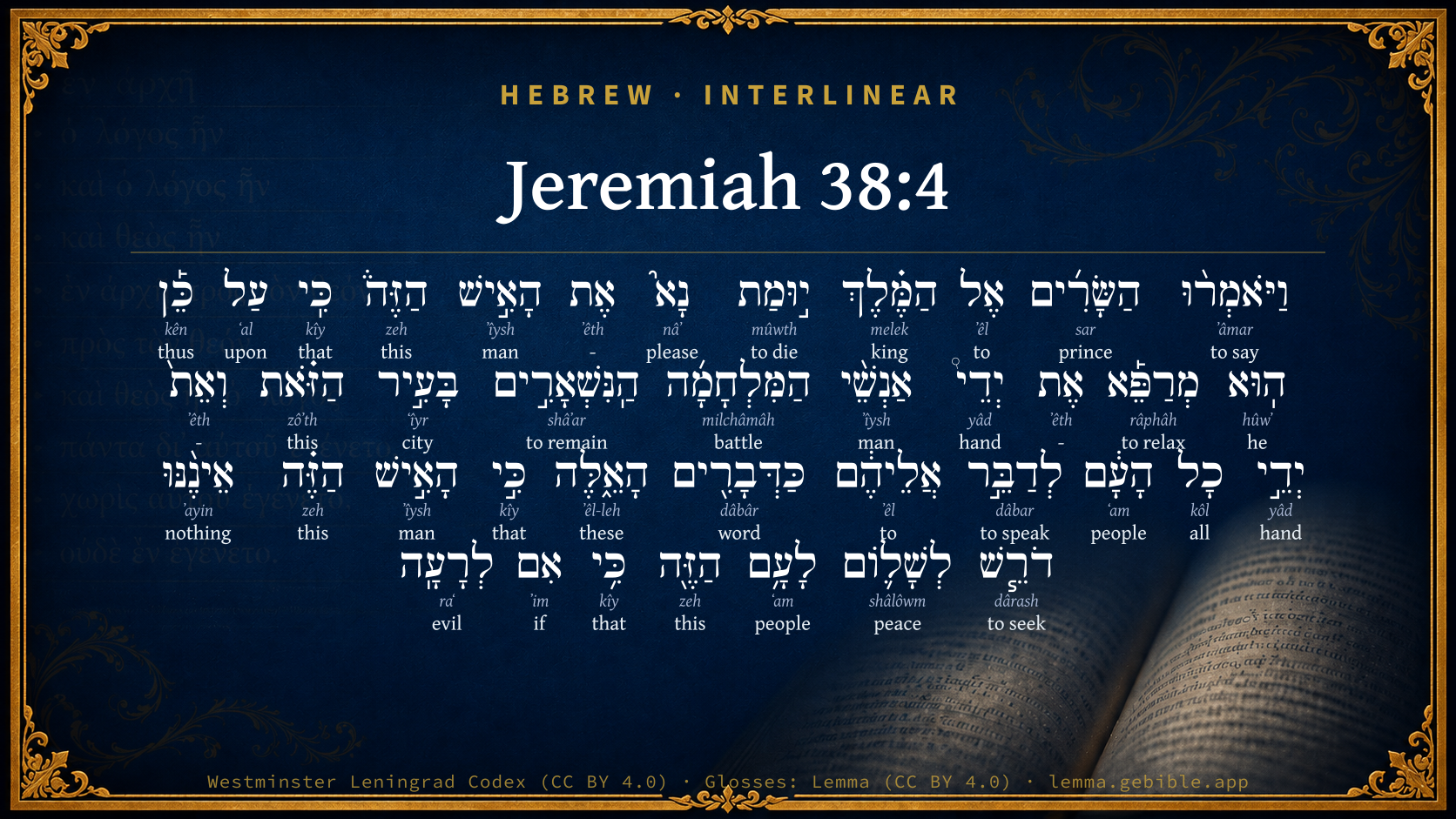
Jeremiah 38:4

Hebrew (Westminster Leningrad Codex) Jeremiah 38:4 appears in the Hebrew Old Testament. The text above is from the Westminster Leningrad Codex. Each word links to its Strong’s number, a concise gloss, and parsing drawn from the Open Scriptures Hebrew Bible morphology. Click any word for its full Brown-Driver-Briggs (BDB) entry.
Download image
Cite this verse

Jeremiah 38:4 (World English Bible). Public Domain. Lemma interlinear Bible study tool, https://lemma.gebible.app/v/jeremiah/38/4.

Show BibTeX & RIS
BibTeX
RIS
English Translation
Then the princes said to the king, Let this man, we pray you, be put to death; because he weakens the hands of the men of war who remain in this city, and the hands of all the people, in speaking such words to them: for this man doesn't seek the welfare of this people, but the hurt.
World English Bible · Public Domain
Download a study sheet

One document with this verse’s original text, its word-by-word gloss line, the meaning frame, cross-references with their text, attributed commentary, and full source and license credits — printable, and it pastes into notes with its structure intact.

This verse Autodidact and up

Study sheet (.html) Plain text (.txt)

A passage Seminary Student

Up to 50 verses in one chapter. A passage sheet keeps up to 6 commentary sources and 12 cross-references per verse, in the order this page ranks them, and says so on the sheet whenever that leaves anything out. Ask for a single verse and you get the Autodidact verse sheet above.

Everything on this page stays free to read, with no account — the sheet is a download of what is already on screen, not access to it.

Want to remove ads? Support Godless Engineer
Compare translations 3

The same verse in 3 English versions, stacked beneath the original-language interlinear above. Click any original word for its lexicon entry.

Each is an independent rendering of the whole verse — the interlinear is not word-aligned to these translations.

Highlighted words mark where these versions differ — a whole-verse word diff, not a word-by-word alignment.

  • World English Bible Public Domain
    Then the princes said to the king, Let this man, we pray you, be put to death; because he weakens the hands of the men of war who remain in this city, and the hands of all the people, in speaking such words to them: for this man doesn't seek the welfare of this people, but the hurt.
  • King James Version Public Domain
    Therefore the princes said unto the king, We beseech thee, let this man be put to death: for thus he weakeneth the hands of the men of war that remain in this city, and the hands of all the people, in speaking such words unto them: for this man seeketh not the welfare of this people, but the hurt.
  • unfoldingWord Literal Text CC BY-SA 4.0
    So the officials said to the king, “Let this man die, for in this way he is weakening the hands of the fighting men who remain in this city, and the hands of all the people. He is proclaiming these words, for this man is not working for safety for this people, but disaster.”

unfoldingWord Literal Text — © unfoldingWord, licensed CC BY-SA 4.0. Word-aligned USFM3 via Door43 (git.door43.org/unfoldingWord/en_ult).

Versions to compare (up to 4)

3 of 4 selected

Show all 18 translations

Every available English version of this verse, each an independent rendering of the whole verse.

  • World English Bible Public Domain
    Then the princes said to the king, Let this man, we pray you, be put to death; because he weakens the hands of the men of war who remain in this city, and the hands of all the people, in speaking such words to them: for this man doesn't seek the welfare of this people, but the hurt.
  • Berean Standard Bible Public Domain
    Then the officials said to the king, “This man ought to die, for he is discouraging the warriors who remain in this city, as well as all the people, by speaking such words to them; this man is not seeking the well-being of these people, but their ruin.”
  • Majority Standard Bible Public Domain
    Then the officials said to the king, “This man ought to die, for he is discouraging the warriors who remain in this city, as well as all the people, by speaking such words to them; this man is not seeking the well-being of these people, but their ruin.”
  • King James Version Public Domain
    Therefore the princes said unto the king, We beseech thee, let this man be put to death: for thus he weakeneth the hands of the men of war that remain in this city, and the hands of all the people, in speaking such words unto them: for this man seeketh not the welfare of this people, but the hurt.
  • American Standard Version (1901) Public Domain
    Then the princes said unto the king, Let this man, we pray thee, be put to death; forasmuch as he weakeneth the hands of the men of war that remain in this city, and the hands of all the people, in speaking such words unto them: for this man seeketh not the welfare of this people, but the hurt.
  • Revised Version (1885) Public Domain
    Then the princes said unto the king, Let this man, we pray thee, be put to death; forasmuch as he weakeneth the hands of the men of war that remain in this city, and the hands of all the people, in speaking such words unto them: for this man seeketh not the welfare of this people, but the hurt.
  • Geneva Bible (1599) Public Domain
    Therefore the Princes sayd vnto the King, We beseech you, let this man be put to death: for thus hee weakeneth the hands of the men of warre that remaine in this citie, and the hands of all the people, in speaking such wordes vnto them: for this man seeketh not the wealth of this people, but the hurt.
  • Douay-Rheims (1899) Public Domain
    And the princes said to the king: We beseech thee that this man may be put to death: for on purpose he weakeneth the hands of the men of war, that remain in this city, and the hands of the people, speaking to them according to these words: for this man seeketh not peace to this people, but evil.
  • Young's Literal Translation Public Domain
    And the heads say unto the king, `Let, we pray thee, this man be put to death, because that he is making feeble the hands of the men of war, who are left in this city, and the hands of all the people, by speaking unto them according to these words, for this man is not seeking for the peace of this people, but for its evil.'
  • Literal Standard Version CC BY-SA 4.0
    And the heads say to the king, “Now let this man be put to death, because that he is making feeble the hands of the men of war who are left in this city, and the hands of all the people, by speaking to them according to these words, for this man is not seeking for the peace of this people, but for its calamity.”
  • Unlocked Literal Bible CC BY-SA 4.0
    So the officials said to the king, “Let this man die, for in this way he is weakening the hands of the fighting men who remain in this city, and the hands of all the people. He is proclaiming these words, for this man is not working for safety for this people, but disaster.”
  • unfoldingWord Literal Text CC BY-SA 4.0
    So the officials said to the king, “Let this man die, for in this way he is weakening the hands of the fighting men who remain in this city, and the hands of all the people. He is proclaiming these words, for this man is not working for safety for this people, but disaster.”
  • Darby Bible Public Domain
    And the princes said unto the king, Let this man, we pray thee, be put to death; for why should he weaken the hands of the men of war that remain in this city, and the hands of all the people, in speaking to them according to these words? for this man seeketh not the welfare of this people, but the hurt.
  • World Messianic Bible Public Domain
    Then the princes said to the king, “Please let this man be put to death, because he weakens the hands of the men of war who remain in this city, and the hands of all the people, in speaking such words to them; for this man doesn’t seek the welfare of this people, but harm.”
  • Webster's Bible Public Domain
    Therefore the princes said to the king, We beseech thee, let this man be put to death: for thus he weakeneth the hands of the men of war that remain in this city, and the hands of all the people, in speaking such words to them: for this man seeketh not the welfare of this people, but the hurt.
  • Free Bible Version CC BY-SA 4.0
    The officers told the king, “This man deserves to die because he's demoralizing the defenders left in the city, and all the people too, by telling them this. This man isn't trying to help these people, he's only going to destroy them.”
  • Bible in Basic English Public Domain
    Then the rulers said to the king, Let this man be put to death, because he is putting fear into the hearts of the men of war who are still in the town, and into the hearts of the people, by saying such things to them: this man is not working for the well-being of the people, but for their damage.
  • JPS Tanakh (1917) Public Domain
    Then the princes said unto the king: 'Let this man, we pray thee, be put to death; forasmuch as he weakeneth the hands of the men of war that remain in this city, and the hands of all the people, in speaking such words unto them; for this man seeketh not the welfare of this people, but the hurt.'

Literal Standard Version (2020), Covenant Press — licensed CC BY-SA 4.0. Text via the HelloAO Bible API (eBible.org). Unlocked Literal Bible (unfoldingWord) — licensed CC BY-SA 4.0. Text via the HelloAO Bible API (eBible.org). unfoldingWord Literal Text — © unfoldingWord, licensed CC BY-SA 4.0. Word-aligned USFM3 via Door43 (git.door43.org/unfoldingWord/en_ult). Free Bible Version, Dr. Jonathan Gallagher — licensed CC BY-SA 4.0. Text via the HelloAO Bible API (eBible.org).

Word by word

More ways to search: Search by grammar → Find every occurrence → Compare this word →

Practice this passage: Drill this verse → Learn its vocabulary →

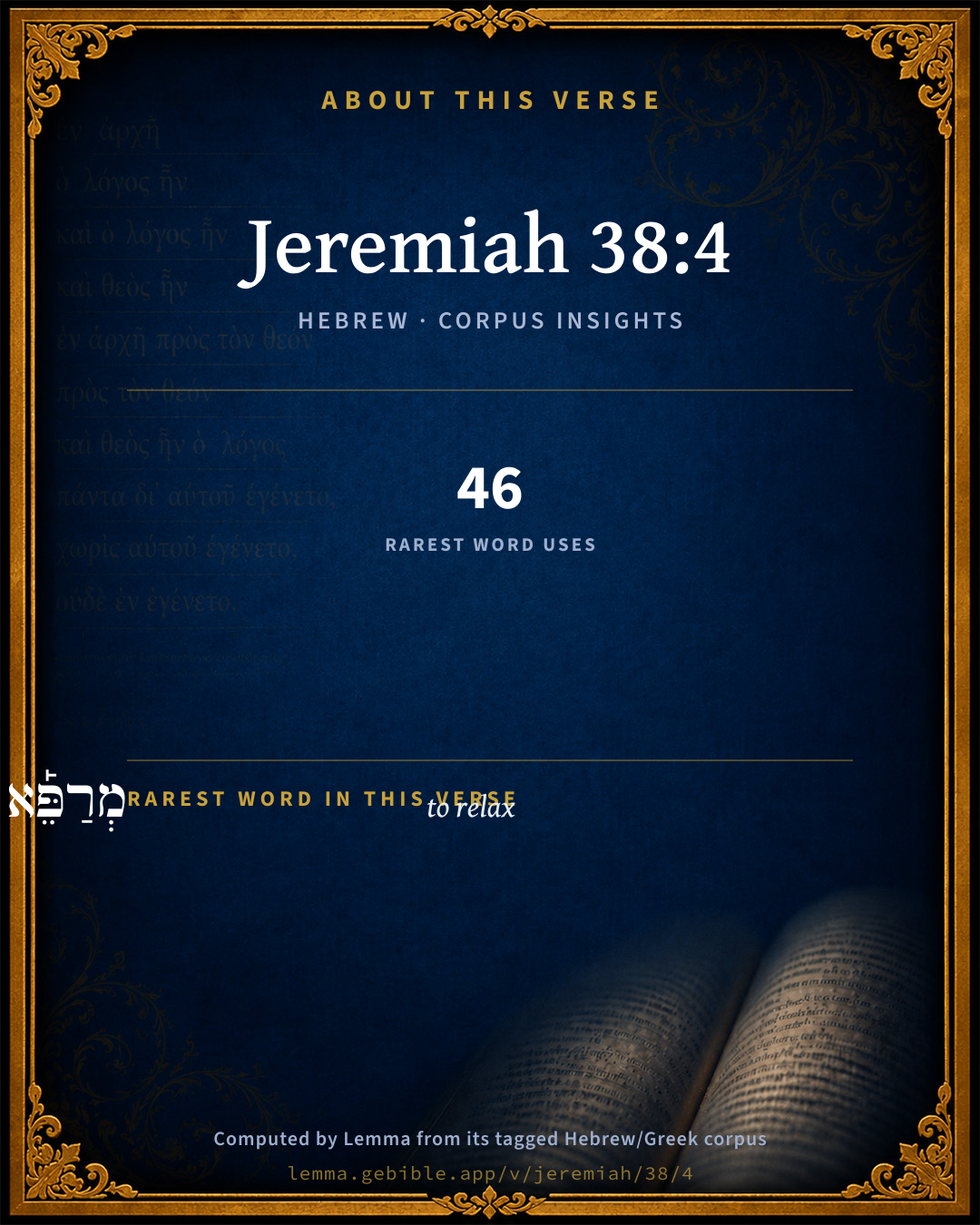
מְרַפֵּ֡א
râphâh
H7503
“relaxing”
Verb, Piel, Participle Active, Masculine, Singular, Absolute
Part of Speech
Verb
Stem
Piel
Form
Participle Active
Gender
Masculine
Number
Singular
State
Absolute
Full BDB Definition

Origin: a primitive root

TWOT: 2198

to sink, relax, sink down, let drop, be disheartened - (Qal) - to sink down - to sink, drop - to sink, relax, abate - to relax, withdraw - (Niphal) idle (participle) - (Piel) to let drop - (Hiphil) - to let drop, abandon, relax, refrain, forsake - to let go - to refrain, let alone - to be quiet - (Hithpael) to show oneself slack
  1. וַיֹּאמְר֨וּ ʼâmar H559 “and · to say” Conjunction + Verb, Qal, Sequential Imperfect, 3rd Person, Masculine, Plural
  2. הַשָּׂרִ֜ים sar H8269 “the · princes” Particle, Definite Article + Noun, Common, Masculine, Plural, Absolute
  3. אֶל ʼêl H413 “to” Preposition
  4. הַמֶּ֗לֶךְ melek H4428 “the · king” Particle, Definite Article + Noun, Common, Masculine, Singular, Absolute
  5. י֣וּמַת mûwth H4191 “to die” Verb, Hophal, Jussive, 3rd Person, Masculine, Singular
  6. נָא֮ nâʼ H4994 “please” Particle, Exhortation
  7. אֶת ʼêth H853 “-” Particle, Direct Object
  8. הָאִ֣ישׁ ʼîysh H376 “the · man” Particle, Definite Article + Noun, Common, Masculine, Singular, Absolute
  9. הַזֶּה֒ zeh H2088 “the · this” Particle, Definite Article + Pronoun, Demonstrative, Masculine, Singular
  10. כִּֽי kîy H3588 “that” Conjunction
  11. עַל ʻal H5921 “upon” Preposition
  12. כֵּ֡ן kên H3651 “thus” Particle, Demonstrative
  13. הֽוּא hûwʼ H1931 “he” Pronoun, Personal, 3rd Person, Masculine, Singular
  14. אֶת ʼêth H853 “-” Particle, Direct Object
  15. יְדֵי֩ yâd H3027 “hands of” Noun, Common, Both, Dual, Construct
  16. אַנְשֵׁ֨י ʼîysh H376 “men of” Noun, Common, Masculine, Plural, Construct
  17. הַמִּלְחָמָ֜ה milchâmâh H4421 “the · battle” Particle, Definite Article + Noun, Common, Feminine, Singular, Absolute
  18. הַֽנִּשְׁאָרִ֣ים shâʼar H7604 “the · remaining” Particle, Definite Article + Verb, Niphal, Participle Active, Masculine, Plural, Absolute
  19. בָּעִ֣יר ʻîyr H5892 “in/at the · city” Preposition, Determined + Noun, Common, Feminine, Singular, Absolute
  20. הַזֹּ֗את zôʼth H2063 “the · this” Particle, Definite Article + Pronoun, Demonstrative, Feminine, Singular
  21. וְאֵת֙ ʼêth H853 “and · -” Conjunction + Particle, Direct Object
  22. יְדֵ֣י yâd H3027 “hands of” Noun, Common, Both, Dual, Construct
  23. כָל kôl H3605 “all of” Noun, Common, Masculine, Singular, Construct
  24. הָעָ֔ם ʻam H5971 “the · people” Particle, Definite Article + Noun, Common, Masculine, Singular, Absolute
  25. לְדַבֵּ֣ר dâbar H1696 “to speak” Preposition + Verb, Piel, Infinitive Construct
  26. אֲלֵיהֶ֔ם ʼêl H413 “to · them” Preposition + Suffix, Personal, 3rd Person, Masculine, Plural
  27. כַּדְּבָרִ֖ים dâbâr H1697 “like/as the · words” Preposition, Determined + Noun, Common, Masculine, Plural, Absolute
  28. הָאֵ֑לֶּה ʼêl-leh H428 “the · these” Particle, Definite Article + Pronoun, Demonstrative, Common, Plural
  29. כִּ֣י kîy H3588 “that” Conjunction
  30. הָאִ֣ישׁ ʼîysh H376 “the · man” Particle, Definite Article + Noun, Common, Masculine, Singular, Absolute
  31. הַזֶּ֗ה zeh H2088 “the · this” Particle, Definite Article + Pronoun, Demonstrative, Masculine, Singular
  32. אֵינֶ֨נּוּ ʼayin H369 “nothing · him” Particle, Negative + Suffix, Personal, 3rd Person, Masculine, Singular
  33. דֹרֵ֧שׁ dârash H1875 “seeking” Verb, Qal, Participle Active, Masculine, Singular, Absolute
  34. לְשָׁל֛וֹם shâlôwm H7965 “to/for · peace” Preposition + Noun, Common, Masculine, Singular, Absolute
  35. לָעָ֥ם ʻam H5971 “to/for the · people” Preposition, Determined + Noun, Common, Masculine, Singular, Absolute
  36. הַזֶּ֖ה zeh H2088 “the · this” Particle, Definite Article + Pronoun, Demonstrative, Masculine, Singular
  37. כִּ֥י kîy H3588 “that” Conjunction
  38. אִם ʼim H518 “if” Conjunction
  39. לְרָעָֽה raʻ H7451 “to/for · evil” Preposition + Noun, Common, Feminine, Singular, Absolute

About this verse

These counts appear in no published source. They are computed here, from the morphology-tagged text and Lemma’s own curated glosses. What Lemma adds →

40
words
29
distinct lemmas
Prophets
section

Shared distinctive vocabulary

מְרַפֵּ֡א to relax H7503 occurs in 45 verses of the Hebrew Bible. Also found in:

Grammatical profile

  • 6 verbs
  • 15 nouns
  • 6 pronouns
  • 3 prepositions
  • 4 conjunctions
  • 6 particles

Verb forms

  • וַיֹּאמְר֨וּ Qal · Sequential Imperfect
  • י֣וּמַת Hophal · Jussive
  • מְרַפֵּ֡א Piel · Participle Active
  • הַֽנִּשְׁאָרִ֣ים Niphal · Participle Active
  • לְדַבֵּ֣ר Piel · Infinitive Construct
  • דֹרֵ֧שׁ Qal · Participle Active

Repetition

Words recur within this verse — often emphatic in Hebrew:

  • הָאִ֣ישׁ man H376 ×3
  • יְדֵי֩ hand H3027 ×2
  • הָעָ֔ם people H5971 ×2
  • הַזֶּה֒ this H2088 ×3
  • כִּֽי that H3588 ×3
  • אֶל to H413 ×2

Cross-references

20

Topical passages linked to Jeremiah 38:4 in the Treasury of Scripture Knowledge — connected by theme and wording, ordered by reader-vote popularity; previews shown in the World English Bible.

  • Jeremiah 26:11 Then spoke the priests and the prophets to the princes and to all the people, saying, This man is worthy of death; for he has prophesied against this city, as you have heard with your ears.
  • Acts 16:20 When they had brought them to the magistrates, they said, "These men, being Jews, are agitating our city,
  • Exodus 5:4 The king of Egypt said to them, "Why do you, Moses and Aaron, take the people from their work? Get back to your burdens!"
  • 1 Kings 18:17–18 It happened, when Ahab saw Elijah, that Ahab said to him, Is it you, you troubler of Israel?
  • 1 Kings 21:20 Ahab said to Elijah, Have you found me, my enemy? He answered, I have found you, because you have sold yourself to do that which is evil in the sight of Yahweh.
  • Nehemiah 6:9 For they all would have made us afraid, saying, Their hands shall be weakened from the work, that it not be done. But now, [God], strengthen you my hands.
  • Jeremiah 29:7 Seek the peace of the city where I have caused you to be carried away captive, and pray to Yahweh for it; for in the peace of it shall you have peace.
  • Amos 7:10 Then Amaziah the priest of Beth El sent to Jeroboam king of Israel, saying, "Amos has conspired against you in the midst of the house of Israel. The land is not able to bear all his words.
  • 2 Chronicles 24:21 They conspired against him, and stoned him with stones at the commandment of the king in the court of the house of Yahweh.
  • Ezra 4:12 Be it known to the king, that the Jews who came up from you are come to us to Jerusalem; they are building the rebellious and the bad city, and have finished the walls, and repaired the foundations.
  • Jeremiah 26:21–23 and when Jehoiakim the king, with all his mighty-men, and all the princes, heard his words, the king sought to put him to death; but when Uriah heard it, he was afraid, and fled, and went into Egypt:
  • Jeremiah 36:12–16 he went down into the king's house, into the scribe's chamber: and, behold, all the princes were sitting there, [to wit], Elishama the scribe, and Delaiah the son of Shemaiah, and Elnathan the son of Achbor, and Gemariah the son of Shaphan, and Zedekiah the son of Hananiah, and all the princes.
  • Ezekiel 22:27 Her princes in the midst of it are like wolves ravening the prey, to shed blood, [and] to destroy souls, that they may get dishonest gain.
  • Micah 3:1–3 I said, "Please listen, you heads of Jacob, And rulers of the house of Israel: Isn't it for you to know justice?
  • Luke 23:2 They began to accuse him, saying, "We found this man perverting the nation, forbidding paying taxes to Caesar, and saying that he himself is Christ, a king."
  • John 11:46–50 But some of them went away to the Pharisees, and told them the things which Jesus had done.
  • Acts 17:6 When they didn't find them, they dragged Jason and certain brothers before the rulers of the city, crying, "These who have turned the world upside down have come here also,
  • Acts 24:5 For we have found this man to be a plague, an instigator of insurrections among all the Jews throughout the world, and a ringleader of the sect of the Nazarenes.
  • Acts 28:22 But we desire to hear from you what you think. For, as concerning this sect, it is known to us that everywhere it is spoken against."
  • Zephaniah 3:1–3 Woe to her who is rebellious and polluted, the oppressing city!

Cross-references courtesy of OpenBible.info (CC BY 4.0).

Hebrew and Greek witnesses Masoretic Hebrew ↔ Greek Septuagint

The same verse in the two great witnesses to the Old Testament, shown verse-for-verse.

These are two independent witnesses, not word-aligned to each other, and the Septuagint is shown in lemma (dictionary) form.

Hebrew Jeremiah 38:4 Masoretic · Westminster Leningrad Codex

וַיֹּאמְר֨וּ הַשָּׂרִ֜ים אֶל הַמֶּ֗לֶךְ י֣וּמַת נָא֮ אֶת הָאִ֣ישׁ הַזֶּה֒ כִּֽי עַל כֵּ֡ן הֽוּא מְרַפֵּ֡א אֶת יְדֵי֩ אַנְשֵׁ֨י הַמִּלְחָמָ֜ה הַֽנִּשְׁאָרִ֣ים בָּעִ֣יר הַזֹּ֗את וְאֵת֙ יְדֵ֣י כָל הָעָ֔ם לְדַבֵּ֣ר אֲלֵיהֶ֔ם כַּדְּבָרִ֖ים הָאֵ֑לֶּה כִּ֣י הָאִ֣ישׁ הַזֶּ֗ה אֵינֶ֨נּוּ דֹרֵ֧שׁ לְשָׁל֛וֹם לָעָ֥ם הַזֶּ֖ה כִּ֥י אִם לְרָעָֽה

Then the princes said to the king, Let this man, we pray you, be put to death; because he weakens the hands of the men of war who remain in this city, and the hands of all the people, in speaking such words to them: for this man doesn't seek the welfare of this people, but the hurt.

World English Bible · Public Domain

Greek LXX Structure differs

In the Septuagint, Jeremiah is about an eighth shorter than the Hebrew and arranges its material differently — the Oracles Against the Nations (Hebrew chapters 46–51) appear in the middle of the Greek book, after 25:13. Because the chapter and verse boundaries do not line up, a verse-for-verse comparison with the Hebrew is not shown.

A verse-for-verse comparison isn’t shown here because the chapters and verses don’t line up. Switch to the LXX edition with the MT / LXX toggle above to read the Greek directly.

Hebrew: Westminster Leningrad Codex (CC BY 4.0). Greek: Septuagint (public domain); English from a public-domain English Septuagint. How the Septuagint differs from the Hebrew →

Targum (Aramaic paraphrase)

1

The Targum is the ancient Jewish Aramaic paraphrase of the Hebrew Scriptures — an interpretive translation, not the Hebrew text itself. Onkelos (literal) and Pseudo-Jonathan (expansive) render the Torah, and Jonathan the Prophets. Coverage is partial: where no permissively-licensed English translation exists for a verse, only the Aramaic is shown. This is verse-level text, not a word-by-word alignment to the Hebrew.

  1. Targum Jonathan Prophets (Joshua–Malachi)
    וַאֲמַרוּ רַבְרְבַיָא לְמַלְכָּא יִתְקְטֵיל כְּעַן גַבְרָא הָדֵין אֲרֵי עַל כֵּן הוּא מְרַשֵׁל יַת יְדֵי גַבְרֵי עָבְדֵי קְרָבָא דְאִשְׁתָּאֲרוּ בְּקַרְתָּא הָדָא וְיַת יְדֵי כָל עַמָא לְמֵלָלָא עִמְהוֹן כְּפִתְגָמַיָא הָאִלֵין אֲרֵי גַבְרָא הָדֵין לֵיתוֹהִי תָּבַע לִשְׁלָמָא לְעַמָא הָדֵין אֱלָהֵן לְבִישׁוּ:

    (no public-domain English translation for this verse)

    Targum Jonathan — Aramaic: “Mikraot Gedolot” (public domain). English: “Sefaria Community Translation” (CC0 1.0 (public-domain dedication)); “London "Chaldee Paraphrase," 1871” (public domain). Text via Sefaria.

Commentary

Notes on Jeremiah 38:4 from classic Christian and Jewish commentators (each source and its license shown beneath its notes). The classic Christian expositions comment on the surrounding passage and are grouped to its opening verse, so a note may address several verses; the Jewish commentaries on the Tanakh (Rashi and others) are per-verse, so they appear only where the commentator wrote on this verse.

Lemma curates 59 commentaries, every one of them public domain or Creative Commons licensed, each selected and text-cleaned for this edition rather than reprinted as found. About our sources →

Trapp's Complete Commentary

John Trapp

Jer 38:4 Therefore the princes said unto the king, We beseech thee, let this man be put to death: for thus he weakeneth the hands of the men of war that remain in this city, and the hands of all the people, in speaking such words unto them: for this man seeketh not the welfare of this people, but the hurt.

Ver. 4. For thus he weakeneth the hands of the men of war.] Thus out of carnal policy is piety impugned. So 1Ki 12:27 Joh 11:48 Jer 38:1.

John Trapp, A Commentary or Exposition upon All the Books of the Old and New Testament (1647–1656) — public domain. Text from a community e-Sword module.

Tyndale Open Study Notes

Tyndale Open Resources

38:4 The officials apparently believed that the morale of the men resisting the Babylonian army outside the walls of the city would be harmed if Jeremiah continued to prophesy, so they put him on trial for treason.

Tyndale Open Study Notes — © Tyndale Open Resources, licensed CC BY-SA 4.0. Text via the HelloAO Bible API.

Geneva Bible (1599)

Geneva Bible translators

Or, discourageth.

Thus we see how the wicked when they cannot abide to hear the truth of God’s word, seek to put the ministers to death, as transgressors of policies.

Geneva Bible (1599) marginal notes — public domain. Text via Bolls.life.

Jamieson, Fausset & Brown

Robert Jamieson, A. R. Fausset & David Brown

Had Jeremiah not had a divine commission, he might justly have been accused of treason; but having one, which made the result of the siege certain, he acted humanely as interpreter of God's will under the theocracy, in advising surrender (compare Jer 26:11).

Jamieson, Fausset & Brown — Commentary Critical and Explanatory on the Whole Bible (1871) — public domain (CC PDM 1.0). Text via the HelloAO Bible API.

Adam Clarke's Commentary

Verse 4. Let this man be put to death] And they gave their reasons plain enough: but the proof was wanting.

Adam Clarke's Commentary on the Bible (1810–1826) — public domain. Text from a community e-Sword/MySword module.

John Calvin's Commentaries

Now the princes add, Die let this man, because in this manner, or therefore, that is, on account of his bad counsel, he weakens the hands of the men of war, etc. Here hand is to be taken for valor, for deeds are mainly performed by the hands. Hence to loosen or weaken the hands means the same as to render men inert, or so idle as not to move a finger. Then the princes accused Jeremiah on this account, that he terrified the men of war and thus rendered them listless. It was a specious charge; but the slander had nothing to support it; for Jeremiah could not have been condemned as a public enemy to his country, when he earnestly exhorted them to flee and gave no hope to the people, in order they might all, despairing of deliverance, willingly surrender themselves to their enemies.

A question may be raised here, whether it is lawful for a private individual to persuade subjects to violate their oath of allegiance to their king or prince. I now call Prophets private persons; for I have in view civil order. Jeremiah, indeed, sustained a public character, for he was God’s Prophet; but as to the government of the city he was a private individual, one of the people. It seems, then, that the Prophet had passed over the limits of what is right, when he persuaded the people to revolt, for that could not have been done without forfeiting allegiance to the king. To this I answer, that the Prophet was invested with a special command, and that, therefore, he did nothing presumptuously or rashly. Though, then, the people had pledged to the end their faith to the king, yet as God had now delivered the city to the Chaldeans, the obligation of the oath ceased; for when governments are changed, whatever the subjects had promised is no longer binding. As, for example, when any country has a prince, he binds the whole people to himself by an oath, so that they may all abide in their allegiance. When any one invades that country, the subjects incur the charge of perfidy if they come not forward and assist their prince, as they had promised; but when a foreign enemy takes possession of the whole land, the obligation of the oath ceases; for it is not in the power of the people to set up princes, because it belongs to God to change governments as he pleases. Since, then, this power belongs to God alone, while a prince rules, the people ought resolutely to continue obedient to him, as their legitimate prince, set over them by God. But this was not at that time the case with the Jews; for though the Chaldeans had not yet entered the city, yet God had declared that they were its masters. The people, then, were not to wait until the Chaldeans broke in into the city, burnt its houses, and killed all they met with; but it ought to have been sufficient for them that the prediction of the Prophet was the decree or sentence of God, by which they were given up to the Chaldeans.

The question as to Jeremiah and all others in similar circumstances, is now answered: for when any one sees only some danger at hand, he ought not, on that account, to persuade the people to forsake their prince; but every one who seeks to be God’s faithful servant, will risk his own life in the defense of his king. When called to his council, he will advise what is useful and right; but he will not stir up commotions and tumults: on the contrary, he would rather die a hundred times than cause the people to revolt either by his counsels or by his influence. But the case of Jeremiah, as it has been said, was peculiar; for God had made known his purpose as to the Chaldeans. Hence Jeremiah did not only prudently persuade the people to do what he deemed necessary, but he also discharged faithfully his office as a Prophet: nor did he give any other counsel than what he had been commanded to give: nay, he commanded them, by authority, to pass over to the Chaldeans, for it was according to God’s will.

The princes, however, brought this charge against him, that he weakened the hands, etc.; and added, In this manner he seeks not the good of the people, when he thus speaks, (peace here is to be taken for what is good or useful,) but he seeks evil This they slanderously added, for Jeremiah, as far as he could, consulted the public good, he wished the city to continue safe; had it been in his power, he would have put to flight all the Chaldeans; but he could not carry on war with God, under whose banner the Chaldeans fought. Jeremiah then sought the good of the people, but he could not resist God, and therefore he gave way to the divine decree: he saw no other remedy than this, that the Jews should undergo a temporary punishment, and be chastised by an exile, so that they might return afterwards into their own country. Had it been possible, as I have said, he would have kept the people from every injury; but this was not now practicable; for God had pronounced that it was all over with the kingdom and the city, until the Jews were punished by an exile of seventy years. There was then a second good or benefit, so that exile might be: more tolerable to the miserable, or captivity become milder: and this good was, to come of their own accord to King Nebuchadnezzar, and to suffer themselves to be led forth to the Chaldeans. This was the second good.

Jeremiah then, seeing that the city, the kingdom, and the Temple were not to stand, was anxious to urge with all his might what remained to be done, in order that the city might at least continue as it was, while the inhabitants migrated into another land, so that afterwards they might return to it. This was the best thing for the people, because God had determined to drive them all into exile. It was then absurd to bring against him this unjust charge, that he sought not the good of the people, but their ruin.

But as we said yesterday, all the sayings and doings of the saints have been always unjustly condemned. And if the same thing happen to us at this day, let us patiently bear it. We also see that it has been always objected to the Prophets and faithful teachers, as a crime, that they did not consult the public good, as all ungodly men at this day bring the same charge against us, especially the couriers, who take it as granted, that were anything changed, it would be the cause of all kinds of disturbances; and hence they think, that their religion could not possibly fall without ruin to the public good. Hence it comes, that the free preaching of the Gospel is disliked by them, as though it brought with it some public calamity. Therefore they call us turbulent; and they say that we go astray through ignorance: though we are not avowedly enemies to the public good, yet we do not understand how kingdoms are to be governed; and hence we rashly stir up the greatest tumults. All these reproaches we have to bear, as Jeremiah did, when, with a quiet mind, he endured the hatred which the princes unjustly produced against him, on account of his doctrine, which yet he had announced by God’s command, and which was necessary for the safety of the city and people; for the Jews could not, against God’s will, remain in their city, from which God had resolved to remove them. When, therefore, Jeremiah saw that the city could not be defended against the Chaldeans, even had he been the only counselor of the king, and not God’s Prophet, what could he have advised better or more beneficial, than to anticipate the extreme cruelty of their enemies, and at least to do all they could, that the city might not be burnt with fire, and that the slaughter of the people might not be universal, but that they might continue alive, with the loss only of their property? He could not then have brought a better counsel. But, as I have already said, nothing is deemed good or useful by the ungodly, except liberty perversely to resist God. This was the reason why they so unjustly accused God’s Prophet. It follows —

John Calvin's Commentaries (1540-1563) — public domain. Text from the Calvin Translation Society English edition (1840s-50s) via the Christian Classics Ethereal Library (ccel.org). Calvin's coverage is partial (roughly two-thirds of the Bible); uncommented books and verses are honest gaps, never fabricated. The 19th-century editor's footnotes and remarks are omitted so the notes are faithfully Calvin's own voice.

Ellicott's Commentary for English Readers

(4) Let this man be put to death.—The hatred of the princes of Judah becomes more bitter than ever, and they seek to overcome the king’s lingering reverence for the prophet. In the reign of Jehoiakim they had said that he was worthy of death (Jer_26:11). Within the last few weeks he had been thrown into a loathsome dungeon, from which the king had but just delivered him. Now they press for a yet severer sentence. The weak king, conscious of his want of power to resist, yields a reluctant consent. The whole history reminds us of Pilate’s conduct in circumstances more or less analogous.

A Bible Commentary for English Readers, edited by Charles John Ellicott (1878–1897) — public domain. Text from a community e-Sword module.

The Cambridge Bible for Schools and Colleges

gen. ed. J. J. S. Perowne

4. the men of war that remain] Cp. Jer_38:22. The expression may indicate that many had gone over to the Chaldaeans, a fact which is also implied in Jer_38:19. Doubtless also a considerable number had gone into exile already, and to them we must add those who had fallen in the siege.

The Cambridge Bible for Schools and Colleges (gen. ed. J. J. S. Perowne; Cambridge University Press, 1878–1918) — public domain. Text from a community e-Sword module.

John Gill's Exposition

Therefore the princes said unto the king,.... The four princes mentioned in Jer 38:1, having heard what Jeremiah said to the people, laid the case before the king, and addressed him upon it in the following manner:

we beseech thee, let this man be put to death; or,

"let this man now be put to death,''

as the Targum. They speak very disrespectfully of the prophet, him "this man"; and with great authority to the and not in a submissive supplicating way, as we render it; the king, being in distress, was in their hands; he stood in fear of them, and could do nothing against their will and pleasure; and they urge that he might die instantly; they were for taking away his life at once. The reason they give follows:

for thus he weakeneth the hands of the men of war that remain in this city, and the hands of all the people, in speaking such words to them; dispirited the soldiers who were set for the defence of the city, such of them as were left, who were not taken off by the sword, famine, or pestilence; since, if what Jeremiah said was true, all attempts to defend it must be in vain; and the people be without any hope of being delivered out of the hands of the enemy:

for this man seeketh not the welfare of this people, but the hurt; than which nothing was more false; for the prophet foreseeing that their lives were in danger, through the sword, famine, or pestilence, by continuing in the city, advised them to go out of it, and surrender to the Chaldeans, whereby they would be preserved.

John Gill's Exposition of the Whole Bible (1746–1763) — public domain (CC PDM 1.0). Text via the HelloAO Bible API.

Albert Barnes' Notes on the Bible

For thus ... - Because he makes the men of war dispirited. No doubt this was true. Jeremiah, however, did not speak as a private person, but as the representative of the government; the temporal ruler in a theocracy being responsible directly to God.

Albert Barnes' Notes on the Bible (1834–1885) — public domain. Text from a community e-Sword/MySword module.

Matthew Poole's English Annotations

The prophet now seemeth under sad circumstances, the princes seek his life, though for delivering no other doctrine than he had been preaching for twenty years; their pretence was, his discouraging and weakening the military part of the city, letting them know that they laboured in vain, for the city was not defensible. This they interpret a seeking not the welfare of the people, but their hurt, though indeed their welfare was that alone which he sought, knowing that there was no other way for any of them to save their lives but by submitting to the Chaldeans; though the great men (being persons God had determined to ruin) would not believe it, and would have the welfare and hurt of the place determined by their opinions.

Matthew Poole's English Annotations on the Holy Bible (1683–1685) — public domain. Text from a community e-Sword/MySword module.

Whedon's Commentary on the Bible

Daniel D. Whedon

4. He weakeneth the hands — True, but there was no treason in his heart, and so the charge that he seeketh not the welfare of this people, but the hurt, was not true.

Daniel D. Whedon (gen. ed.), Commentary on the Old and New Testaments (1874–1909) — public domain. Text from a community e-Sword module.

The Pulpit Commentary

For thus; literally, for therefore; i.e. because he is left in impunity. (comp. the use of the phrase in Jer_29:28) He weakeneth the hands of the men of war; i.e. he dispirits them. It is important to get this "outside view" of the preaching of Jeremiah. There is evidently some excuse for the opponents of Jeremiah. It was a matter of life and death to resist the Chaldeans, and Jeremiah was, according to the politicians, playing into the hands of the enemy (see further in general Introduction). The addition of the words, that remain, shows that the bitter end of the resistance was fast approaching.

HOMILIES BY A.F. MUIR Vers. 4-13. Foreshadowings and analogies of the cross.

The pitiable fate of Jeremiah, so uncalled for and unexpected both in its inflictions and deliverances, the light and shade so strongly contrasted, become charged as we proceed with a certain suggestiveness of something unspeakably greater yet to come. In other words, Jeremiah is perceived to be not only a prophet, but a type of Christ. The charge of treason, the defiance of legal safeguards and requirements by the princes, the wavering and helplessness of the king, the living death in the miry dungeon, and the resurrection through the kind aid of Ebed-Melech, are types of the most unmistakable kind of the characteristic redemptive experiences of the Man of sorrows. And this is only one out of many proofs that human history, especially sacred history, betrays a system of correspondence in its events with those which constituted the earthly experience of the Messiah.

I THEY CALL ATTENTION TO THE MANIFESTATION OF CHRIST AND HELP TO FIX AND IDENTIFY IT. All along the line of Old Testament revelation there were these finger posts or indicators of the coming struggle between righteousness and sin. The cross is closely associated with the very first pages of revelation, and gives meaning and connection to the loftiest, deepest, and most anomalous utterances and occurrences of the Old Testament. With its many anticipations, echoes, and secondaries, the cross of Christ asserts itself as the central and most commanding principle of human history.

II THEY REVEAL THE SAME LAW OPERATING THROUGHOUT THE WORLD"S HISTORY AND HUMAN EXPERIENCE. Prehistoric myths and heathen religions, although incapable of attaining to such a Divine conception, yet presuppose and grope after it. And in many an illustrious and obscure human consciousness had the cross made its impress ere the Redeemer of mankind was called upon to suffer.

1. They proved the necessity of Christ"s sufferings. As the true character of the issue between good and evil declared itself more and more plainly, it became evident that some more decisive determination of it must take place. Each previous or subsequent experience of the conflict is indecisive and incomplete apart from the Messianic sufferings. Christ must needs suffer, if only to bring to a head and final settlement the long pending question as to whether good or evil is the true law of human life and of the world. It was no accidental, abnormal series of occurrences that constituted our Saviours experience, but the culmination of ages of mutual development in the forces of righteousness and sin, and the true exponent of their respective characters and tendencies.

2. They helped go deepen and educate the spiritual sense of men, and to prepare them for a true appreciation of the mystery of the cross. It is the cross in us that leads us to the cross without. The deep tribulation of the saints of the early Church led them to more profound conceptions of moral action and spiritual requirement. Jeremiah was here a type of Judah, the feet of whose king were" in the mire" (ver. 22). Each occasion like this of Jeremiah"s condemnation and imprisonment was a loud warning of the possibilities of evil that were still in the womb of time, and showed the direction of the tendency of the world spirit. It showed, too, how closely related was the life of men with the unseen and the eternal. A moral order behind the chain of events was continually declaring itself. Its very peculiarities and anomalies demonstrated the existence of a higher law. The awful depths and heights yet to be attained by the moral nature of man were suggested, and the certainty gradually induced that the kingdom of light would yet meet and overcome the force of the kingdom of darkness. The faith, obedience, and meekness of man would yet be vindicated by the invincible power and authority of God. M.

HOMILIES BY S. CONWAY Ver. 4. Counted an enemy for speaking the truth.

"Hast thou found me, O mine enemy?" said Ahab to Elijah. The Israelites were about to stone the two faithful spies. And here the prophet of God was, as in these other and in many more instances, counted an enemy for speaking the truth. And a like alienation of mind and heart often takes place now for the same reason the telling of unwelcome truth. Now, note

I WHEREFORE DO MEN SO DISLIKE TRUTH? Some of the reasons are:

1. Because truth must often say many things that are unpleasing. No matter by what voice the message comes Scripture, conscience, or our fellow men, truth at times will become censure, and that hurts our self-love.

2. We are not really in earnest in our desire to be set right. We profess to be so, but we are not. "I have been a great sinner," said a sick man to his minister, who was sitting by his bedside. "Yes," said the minister, "you have," "Who told you, I should like to know?" angrily exclaimed the sick man indignant that anything more special and personal than vague general confession should be thought to be needed by him. He had no desire for cure, but only for comfort.

3. Pride has much to do with this dislike of truth. Our reprover becomes for the time being our superior, stands above and over us, and we do not like this.

4. There may be real difference of opinion on the point in dispute; hence the censured has the further offence of being condemned on what he deems partial evidence.

5. Because of our suspicion of the motives of him who speaks the unwelcome truth. We are slow to credit such with purity and unselfishness of motive. We think not only of what is said, but of who says it

II HENCE IT IS VERY DIFFICULT TO TELL UNPLEASANT TRUTHS. Most men avoid it, will say nothing, will shirk the duty by every conceivable means. No one likes to act the part of the candid friend. None like to be the bearers of ill tidings. David"s servants feared to tell him that his child was dead. How we admire, because of its rarity and difficulty, the fidelity of Nathan"s "Thou art the man"!

III BUT NEVERTHELESS SUCH TRUTH OUGHT TO BE SPOKEN WHEN NECESSARY. It is not always necessary. Often not wise. "The chapter of accidents is the Bible of the fool." To let hard facts speak is sometimes best. But not always. Hence when unwelcome truth has to be spoken, take care:

1. To be very certain of your ground. Do not go upon mere rumour. Let your proof be full, clear, and strong.

2. Let the purity of your motive in speaking, the unselfishness and the love for your brother which prompt you, be made manifest.

3. Choose fit times, tones, and words. Many reserve their telling of such truths for moments when they are in a passion; then they will blurt it out, and, of course, only do more harm than good.

4. Be strengthened by the remembrance of the duty you owe your brother, and the accusation he will have against you of blood guiltiness, if you fail to tell him the truth, unwelcome though it be.

IV SUCH TRUTH SO SPOKEN, IF REJECTED, IS FOLLOWED BY THE CONDEMNATION OF GOD ON THEM WHO REJECT IT. It is part of that condemnation that men take friends for foes, as Ahab did, and foes for friends. They love flattery and hate truth; the blind lead the blind, and with the inevitable result. Therefore let our feeling be that of the psalmist, who said, "Let the righteous smite me; it shall be kindness: and let him reprove me; it shall be an excellent oil, which shall not break my head. C.

HOMILIES BY D. YOUNG Ver. 4. Prophecy and patriotism.

I THE ETHICS OF PATRIOTISM. Here are foul men who go to the king with a complaint against Jeremiah; and in doing so they do not take low ground. Indeed, there are many people interested in affairs of state who would say they took very high ground. What sounds more plausible than to say that a whole country should never be more united than when the common enemy attacks it? Should there not at such a time be mutual encouragement, the bold and brave men of a state striving to animate all the citizens with their own and our and resolution? Thus the whole question is opened up with respect to a man"s allegiance to his country. How far does the claim extend of a country upon those who live under its laws, having their person and their property protected by these laws? That national history, great national events, patriotic feelings, have their place in the machinery of government, every Christian would allow; but it may not be so easy to settle exactly what that place is. Everything turns on what should have the first place in a man"s affection, duty, and service; and so we have the example of Jeremiah here to guide us. He, a Jewish prophet, teaches us

II THE FIRST DUTY OF A CHRISTIAN. From this world"s point of view Jeremiah did an eminently unpatriotic thing. Instead of uniting the people into resistance, he, as it were, divided them into two classes. He made it a time for individual and not for common action. But, after all, in every conflict there comes a time for yielding; the attacking party must retire in failure, or the defending party submit in defeat. To Jeremiah it was given to see the certain result. He knew that not the Chaldeans but Jehovah himself had to be reckoned with. The first duty of a prophet was to Jehovah, and so for that matter was the first duty of every Israelite. Thus in the same way, the first duty of a Christian is to Christ. He who serves Christ most completely serves his country best. In such a service the Christian may be misrepresented, miscalled, stamped even as traitor, but that only means that he is called to pass through Jeremiah"s experience here. Why, even a man of pagan Rome can teach us in this matter; for Cicero, in the fourth book of his "De Officiis," speaking of gradations of duty in the state, says that a citizen"s first duty is to the immortal gods, and his second to his country. "Render unto Caesar the things that are Caesar"s, and to God the things that are God"s. Y.

The Pulpit Commentary (1880–1919), ed. H.D.M. Spence-Jones & Joseph S. Exell — public domain. Text from a community e-Sword module.

Scofield Reference Notes

C. I. Scofield

let this man

See Jer 26:11.

The fundamental reason why the prophetic warnings of the Old and New Testaments are unwelcome to an unreasoning optimism.

The Scofield Reference Bible (1917 edition), notes by C. I. Scofield — public domain. Text from a community e-Sword module.

unfoldingWord translationNotes

Door43 World Missions Community

Let this man die

"Order someone to kill this man"

he is weakening the hands of the fighting men who remain in this city, and the hands of all the people

Weak hands are a metonym for a person who is afraid. AT: "he is causing the soldiers and all the people in the city to lose courage" (See: Metonymy)

for this man is not working for safety for this people, but disaster

"for Jeremiah is not working to help this people be safe, but he is working for bad things to happen to this people"

Look

"Listen carefully"

he is in your hand

The hand is a metonym for the power that the hand has. AT: "you are able do whatever you want with him" (See: Metonymy)

translationWords

die

preach

Zedekiah

unfoldingWord translationNotes — © Distant Shores Media and the Door43 World Missions Community, licensed CC BY-SA 4.0. Source: git.door43.org/Door43/en_tn.

Rashi

Rabbi Shlomo Yitzchaki (Rashi)

since he weakens (a lacher in O.F.), an expression of weakness.

Rashi on the Tanakh — English translations: “The Judaica Press complete Tanach with Rashi, translated by A. J. Rosenberg” (CC BY 4.0); “Pentateuch with Rashi's commentary by M. Rosenbaum and A.M. Silbermann, 1929-1934” (public domain); “The Metsudah Tanach series, Lakewood, N.J” (CC BY 4.0); and “The Book of Joshua, Metsudah Publications, 1997” (CC BY 4.0). Text via Sefaria.

Lesson kit

Teaching starters — assembled from the data on this page, not authored interpretation. Every prompt links to the verse data it draws on. Edit before teaching.

Jeremiah, in the Prophets, opens this verse with 40 words (29 distinct Hebrew lemmas). Its most distinctive word is râphâh (“to relax”). A historical commentator’s framing appears above. Read the whole chapter for the surrounding context.

Discussion questions

  1. What does “to relax” (râphâh) contribute to the verse as a whole?
  2. Exodus 4:26 shares the word «to relax» with this verse. How do the two illuminate each other?
  3. “man” occurs 3× in this one verse. What is the effect of the repetition?
  4. The translations on this page render this verse differently — a whole-verse word diff, not a word-by-word alignment. What might account for the different wordings?
  5. The verb «וַיֹּאמְר֨וּ» is Qal Sequential Imperfect. How does its form color the action?
  6. Reading how Trapp's Complete Commentary and Tyndale Open Study Notes read this verse, where do the two commentators agree and where do they part?

Things to notice

Reading settings

Reading text

Shown beneath each verse's original-language words.

Old Testament
Old Testament edition

Read the OT as the Masoretic Hebrew (MT) or the Greek Septuagint (LXX).

English shown for the Greek Septuagint (in the Hebrew ↔ Greek comparison).

Comparing translations? Open the Compare panel on any verse page to stack up to four side by side.