
1 Kings 4:24

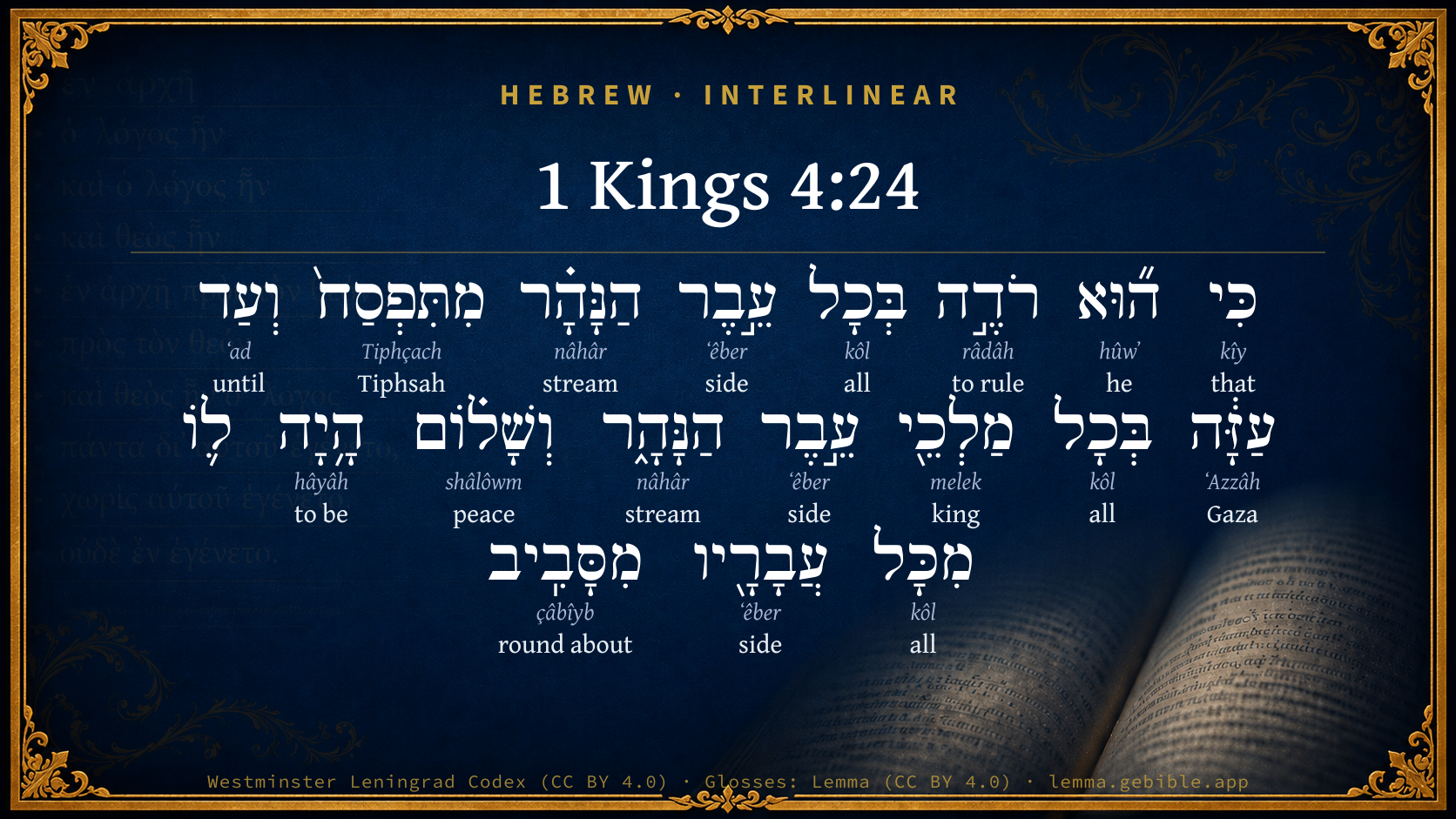
Hebrew (Westminster Leningrad Codex) 1 Kings 4:24 appears in the Hebrew Old Testament. The text above is from the Westminster Leningrad Codex. Each word links to its Strong’s number, a concise gloss, and parsing drawn from the Open Scriptures Hebrew Bible morphology. Click any word for its full Brown-Driver-Briggs (BDB) entry.
Download image
Cite this verse

1 Kings 4:24 (World English Bible). Public Domain. Lemma interlinear Bible study tool, https://lemma.gebible.app/v/1-kings/4/24.

Show BibTeX & RIS
BibTeX
RIS
English Translation
For he had dominion over all [the region] on this side the River, from Tiphsah even to Gaza, over all the kings on this side the River: and he had peace on all sides round about him.
World English Bible · Public Domain
Highlights Full analysis ↓
Download a study sheet

One document with this verse’s original text, its word-by-word gloss line, the meaning frame, cross-references with their text, attributed commentary, and full source and license credits — printable, and it pastes into notes with its structure intact.

This verse Autodidact and up

Study sheet (.html) Plain text (.txt)

A passage Seminary Student

Up to 50 verses in one chapter. A passage sheet keeps up to 6 commentary sources and 12 cross-references per verse, in the order this page ranks them, and says so on the sheet whenever that leaves anything out. Ask for a single verse and you get the Autodidact verse sheet above.

Everything on this page stays free to read, with no account — the sheet is a download of what is already on screen, not access to it.

Want to remove ads? Support Godless Engineer
Compare translations 3

The same verse in 3 English versions, stacked beneath the original-language interlinear above. Click any original word for its lexicon entry.

Each is an independent rendering of the whole verse — the interlinear is not word-aligned to these translations.

Highlighted words mark where these versions differ — a whole-verse word diff, not a word-by-word alignment.

  • World English Bible Public Domain
    For he had dominion over all [the region] on this side the River, from Tiphsah even to Gaza, over all the kings on this side the River: and he had peace on all sides round about him.
  • King James Version Public Domain
    For he had dominion over all the region on this side the river, from Tiphsah even to Azzah, over all the kings on this side the river: and he had peace on all sides round about him.
  • unfoldingWord Literal Text CC BY-SA 4.0
    For he ruled over everything beyond the River from Tiphsah and to Gaza, over all of the kings of beyond the River. And peace was to him from all of his sides, from all around.

unfoldingWord Literal Text — © unfoldingWord, licensed CC BY-SA 4.0. Word-aligned USFM3 via Door43 (git.door43.org/unfoldingWord/en_ult).

Versions to compare (up to 4)

3 of 4 selected

Show all 18 translations

Every available English version of this verse, each an independent rendering of the whole verse.

  • World English Bible Public Domain
    For he had dominion over all [the region] on this side the River, from Tiphsah even to Gaza, over all the kings on this side the River: and he had peace on all sides round about him.
  • Berean Standard Bible Public Domain
    For Solomon had dominion over everything west of the Euphrates—over all the kingdoms from Tiphsah to Gaza—and he had peace on all sides.
  • Majority Standard Bible Public Domain
    For Solomon had dominion over everything west of the Euphrates—over all the kingdoms from Tiphsah to Gaza—and he had peace on all sides.
  • King James Version Public Domain
    For he had dominion over all the region on this side the river, from Tiphsah even to Azzah, over all the kings on this side the river: and he had peace on all sides round about him.
  • American Standard Version (1901) Public Domain
    For he had dominion over all `the region' on this side the River, from Tiphsah even to Gaza, over all the kings on this side the River: and he had peace on all sides round about him.
  • Revised Version (1885) Public Domain
    For he had dominion over all the region on this side the River, from Tipsah even to Gaza, over all the kings on this side the River: and he had peace on all sides round about him.
  • Geneva Bible (1599) Public Domain
    For he ruled in all the region on the other side of the Riuer, from Tiphsah euen vnto Azzah, ouer all the Kings on the other side the Riuer: and he had peace round about him on euery side.
  • Douay-Rheims (1899) Public Domain
    For he had all the country which was beyond the river, from Thaphsa to Gazan, and all the kings of those countries: and he had peace on every side round about.
  • Young's Literal Translation Public Domain
    for he is ruling over all beyond the river, from Tiphsah and unto Gaza, over all the kings beyond the river, and he hath peace from all his servants round about.
  • Literal Standard Version CC BY-SA 4.0
    for he is ruling over all beyond the river, from Tiphsah and to Gaza, over all the kings beyond the River, and he has peace from all his surrounding servants.
  • Unlocked Literal Bible CC BY-SA 4.0
    For he had dominion over all the region on this side of the River, from Tiphsah as far as to Gaza, over all the kings on this side the River, and he had peace on all sides around him.
  • unfoldingWord Literal Text CC BY-SA 4.0
    For he ruled over everything beyond the River from Tiphsah and to Gaza, over all of the kings of beyond the River. And peace was to him from all of his sides, from all around.
  • Darby Bible Public Domain
    For he had dominion over all on this side the river, from Tiphsah as far as Gazah, over all the kings on this side the river; and he had peace on all sides round about.
  • World Messianic Bible Public Domain
    For he had dominion over all on this side of the River, from Tiphsah even to Gaza, over all the kings on this side of the River; and he had peace on all sides around him.
  • Webster's Bible Public Domain
    For he had dominion over all the region on this side the river, from Tiphsah even to Azzah, over all the kings on this side of the river: and he had peace on all sides around him.
  • Free Bible Version CC BY-SA 4.0
    For Solomon ruled over the whole region west of the Euphrates, from Tiphsah to Gaza—over all the kingdoms west of the Euphrates. And he had peace on all sides around him. He had peace on every border.
  • Bible in Basic English Public Domain
    For he had authority over all the country on this side of the River, from Tiphsah to Gaza, over all the kings on this side of the River; and he had peace round him on every side.
  • JPS Tanakh (1917) Public Domain
    (5-4) For he had dominion over all the region on this side the River, from Tiphsah even to Gaza, over all the kings on this side the River; and he had peace on all sides round about him.

Literal Standard Version (2020), Covenant Press — licensed CC BY-SA 4.0. Text via the HelloAO Bible API (eBible.org). Unlocked Literal Bible (unfoldingWord) — licensed CC BY-SA 4.0. Text via the HelloAO Bible API (eBible.org). unfoldingWord Literal Text — © unfoldingWord, licensed CC BY-SA 4.0. Word-aligned USFM3 via Door43 (git.door43.org/unfoldingWord/en_ult). Free Bible Version, Dr. Jonathan Gallagher — licensed CC BY-SA 4.0. Text via the HelloAO Bible API (eBible.org).

Word by word

More ways to search: Search by grammar → Find every occurrence → Compare this word →

Practice this passage: Drill this verse → Learn its vocabulary →

מִתִּפְסַח֙
Tiphçach
H8607
“from · Tiphsah”
Preposition + Noun, Proper
Part of Speech
Preposition + Noun
Type
Proper
Full BDB Definition

Origin: from H6452

TWOT: None

Tiphsah = "cross over" - a place at the northeast limit of Solomon's empire; located on the Euphrates river - a place in the northern kingdom of Israel which king Menahem attacked and where he ripped open all the pregnant women - might be the same as 1
  1. כִּי kîy H3588 “that” Conjunction
  2. ה֞וּא hûwʼ H1931 “he” Pronoun, Personal, 3rd Person, Masculine, Singular
  3. רֹדֶ֣ה râdâh H7287 “ruling” Verb, Qal, Participle Active, Masculine, Singular, Absolute
  4. בְּכָל kôl H3605 “in/at · all of” Preposition + Noun, Common, Masculine, Singular, Construct
  5. עֵ֣בֶר ʻêber H5676 “side of” Noun, Common, Masculine, Singular, Construct
  6. הַנָּהָ֗ר nâhâr H5104 “the · stream” Particle, Definite Article + Noun, Common, Masculine, Singular, Absolute
  7. וְעַד ʻad H5704 “and · until” Conjunction + Preposition
  8. עַזָּ֔ה ʻAzzâh H5804 “Gaza” Noun, Proper
  9. בְּכָל kôl H3605 “in/at · all of” Preposition + Noun, Common, Masculine, Singular, Construct
  10. מַלְכֵ֖י melek H4428 “kings of” Noun, Common, Masculine, Plural, Construct
  11. עֵ֣בֶר ʻêber H5676 “side of” Noun, Common, Masculine, Singular, Construct
  12. הַנָּהָ֑ר nâhâr H5104 “the · stream” Particle, Definite Article + Noun, Common, Masculine, Singular, Absolute
  13. וְשָׁל֗וֹם shâlôwm H7965 “and · peace” Conjunction + Noun, Common, Masculine, Singular, Absolute
  14. הָ֥יָה hâyâh H1961 “to be” Verb, Qal, Perfect, 3rd Person, Masculine, Singular
  15. מִכָּל kôl H3605 “from · all of” Preposition + Noun, Common, Masculine, Singular, Construct
  16. עֲבָרָ֖יו ʻêber H5676 “sides · his” Noun, Common, Masculine, Plural, Construct + Suffix, Personal, 3rd Person, Masculine, Singular
  17. מִסָּבִֽיב çâbîyb H5439 “from · round about” Preposition + Noun, Common, Both, Singular, Absolute

About this verse

These counts appear in no published source. They are computed here, from the morphology-tagged text and Lemma’s own curated glosses. What Lemma adds →

19
words
13
distinct lemmas
Historical
section

Notable vocabulary

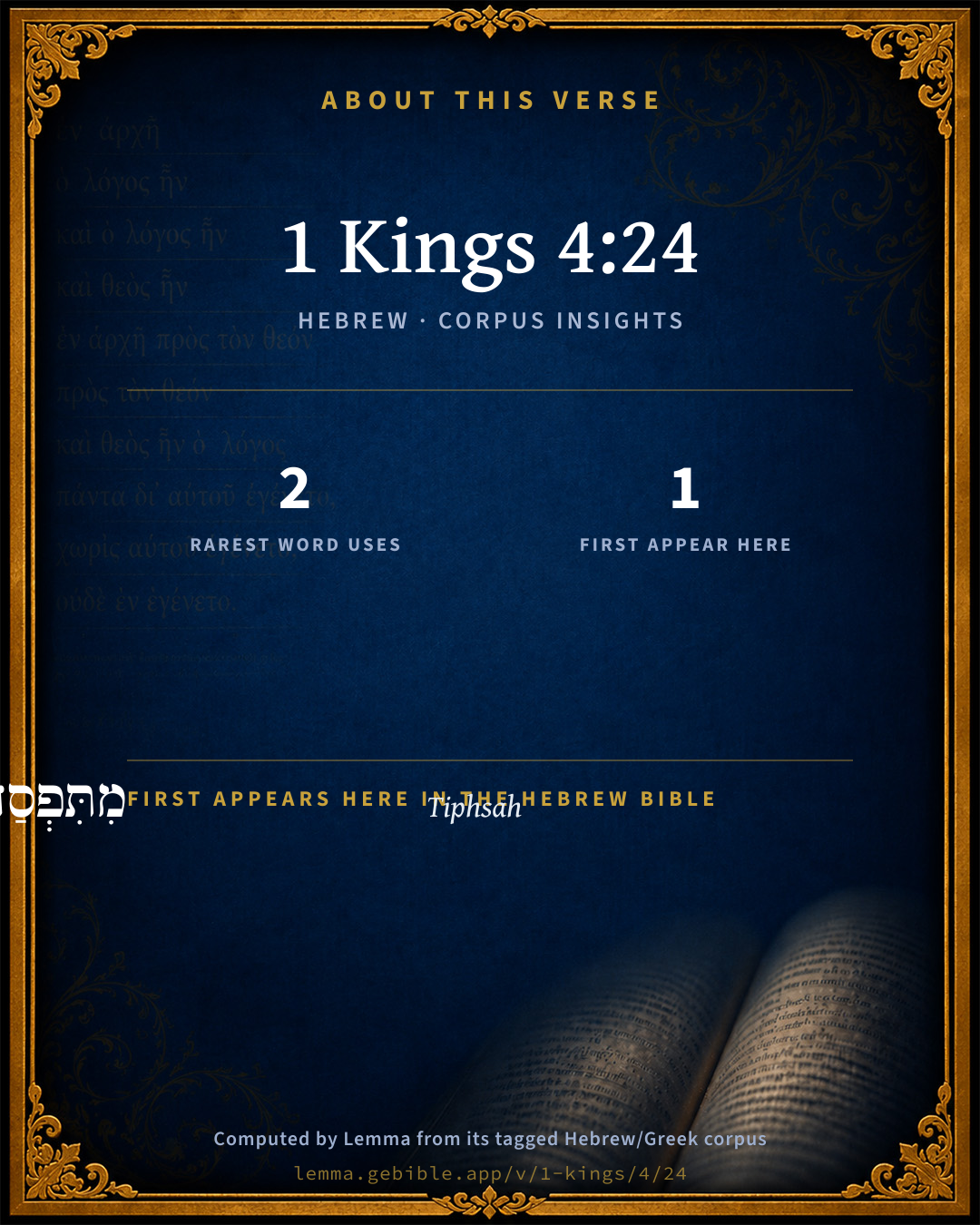
The rarest word here is מִתִּפְסַח֙ Tiphsah H8607 — appearing just 2 times in the whole Hebrew Bible.

First appearance in Scripture

This word makes its first canonical appearance in the Hebrew Bible here:

  • מִתִּפְסַח֙ Tiphsah H8607

Shared distinctive vocabulary

מִתִּפְסַח֙ Tiphsah H8607 occurs in 2 verses of the Hebrew Bible. Also found in:

Grammatical profile

  • 2 verbs
  • 13 nouns
  • 1 pronoun
  • 2 prepositions
  • 1 conjunction

Verb forms

  • רֹדֶ֣ה Qal · Participle Active
  • הָ֥יָה Qal · Perfect

Repetition

Words recur within this verse — often emphatic in Hebrew:

  • בְּכָל all H3605 ×3
  • עֵ֣בֶר side H5676 ×3
  • הַנָּהָ֗ר stream H5104 ×2

Hebrew & Septuagint length

In English translation the verse runs 37 words from the Hebrew and 19 from the Septuagint (LXX English) — the Septuagint runs noticeably shorter here. See the side-by-side →

A rough comparison of the two English renderings, which tokenize alike — not a word-level alignment.

Word counts can differ between the Hebrew and the Greek without any difference in meaning — e.g. the Hebrew direct-object marker אֵת has no separate Greek word, and Greek often adds the article ὁ.

Cross-references

11

Topical passages linked to 1 Kings 4:24 in the Treasury of Scripture Knowledge — connected by theme and wording, ordered by reader-vote popularity; previews shown in the World English Bible.

  • 1 Chronicles 22:9 Behold, a son shall be born to you, who shall be a man of rest; and I will give him rest from all his enemies round about; for his name shall be Solomon, and I will give peace and quietness to Israel in his days:
  • Psalms 72:11 Yes, all kings shall fall down before him. All nations shall serve him.
  • Genesis 10:19 The border of the Canaanites was from Sidon, as you go toward Gerar, to Gaza; as you go toward Sodom, Gomorrah, Admah, and Zeboiim, to Lasha.
  • 1 Kings 4:21 Solomon ruled over all the kingdoms from the River to the land of the Philistines, and to the border of Egypt: they brought tribute, and served Solomon all the days of his life.
  • 1 Kings 5:4 But now Yahweh my God has given me rest on every side; there is neither adversary, nor evil occurrence.
  • Psalms 72:3 The mountains shall bring prosperity to the people. The hills bring the fruit of righteousness.
  • Psalms 72:7–8 In his days, the righteous shall flourish, And abundance of peace, until the moon is no more.
  • Isaiah 9:7 Of the increase of his government and of peace there shall be no end, on the throne of David, and on his kingdom, to establish it, and to uphold it with justice and with righteousness from henceforth even forever. The zeal of Yahweh of Hosts will perform this.
  • Luke 2:14 "Glory to God in the highest, On earth peace, good will toward men."
  • Hebrews 7:1–2 For this Melchizedek, king of Salem, priest of God Most High, who met Abraham returning from the slaughter of the kings and blessed him,
  • Judges 16:1 Samson went to Gaza, and saw there a prostitute, and went in to her.

Cross-references courtesy of OpenBible.info (CC BY 4.0).

Hebrew and Greek witnesses Masoretic Hebrew ↔ Greek Septuagint

The same verse in the two great witnesses to the Old Testament, shown verse-for-verse.

Here the Septuagint runs noticeably shorter than the Hebrew — LXX2012 (modern English Septuagint) 19 words vs World English Bible 37. A rough length comparison of the two English translations, not a word-level alignment — read both below.

These are two independent witnesses, not word-aligned to each other, and the Septuagint is shown in lemma (dictionary) form.

Hebrew 1 Kings 4:24 Masoretic · Westminster Leningrad Codex

כִּי ה֞וּא רֹדֶ֣ה בְּכָל עֵ֣בֶר הַנָּהָ֗ר מִתִּפְסַח֙ וְעַד עַזָּ֔ה בְּכָל מַלְכֵ֖י עֵ֣בֶר הַנָּהָ֑ר וְשָׁל֗וֹם הָ֥יָה ל֛וֹ מִכָּל עֲבָרָ֖יו מִסָּבִֽיב

For he had dominion over all [the region] on this side the River, from Tiphsah even to Gaza, over all the kings on this side the River: and he had peace on all sides round about him.

World English Bible · Public Domain

Greek LXX 1 Kings 4:24 Septuagint · lemma form
For he had dominion on this side the river, and he was at peace on all sides round about.

LXX2012 (modern English Septuagint) · Public Domain

Hebrew: Westminster Leningrad Codex (CC BY 4.0). Greek: Septuagint (public domain); English from LXX2012 (modern English Septuagint) (Public Domain). How the Septuagint differs from the Hebrew →

Commentary

Notes on 1 Kings 4:24 from classic Christian and Jewish commentators (each source and its license shown beneath its notes). The classic Christian expositions comment on the surrounding passage and are grouped to its opening verse, so a note may address several verses; the Jewish commentaries on the Tanakh (Rashi and others) are per-verse, so they appear only where the commentator wrote on this verse.

Lemma curates 59 commentaries, every one of them public domain or Creative Commons licensed, each selected and text-cleaned for this edition rather than reprinted as found. About our sources →

Trapp's Complete Commentary

John Trapp

1Ki 4:24 For he had dominion over all [the region] on this side the river, from Tiphsah even to Azzah, over all the kings on this side the river: and he had peace on all sides round about him.

Ver. 24. On this side the river,] viz., Euphrates.

From Tiphsah.] Called afterwards Amphipolis. {a}

Even to Azzah.] Called also Gaza. {Jer 25:20}

And he had peace on all sides.] Wherein also he became a lively type of Christ the Prince of Peace, {Isa 9:6} who as he was brought from heaven with that song of peace, {Luk 2:14} so he returned up again with that farewell of peace, {Joh 14:27} leaving to the world the doctrine of peace, the gospel of peace, {Eph 2:17} which worketh that peace that passeth understanding. {Php 4:7}

{a} Plin., lib. v. cap. 24.

John Trapp, A Commentary or Exposition upon All the Books of the Old and New Testament (1647–1656) — public domain. Text from a community e-Sword module.

Joseph Benson's Commentary

1Ki 4:24. From Tiphsah even to Azzah — Either that Tiphsah (2Ki 15:16) which was in the kingdom of Israel within Jordan; or, rather, another place of that name upon the Euphrates, even that eminent city which is mentioned by Ptolemy, and Strabo, and Pliny, called Thapsarum. And this best agrees with the following Azzah, which was the border of Canaan in the south and west, as Tiphsah was in the north and east. And so his dominion is described by both its borders. Over all kings — Who owned subjection, and payed tribute to him.

Joseph Benson's Commentary on the Old and New Testaments (1811–1818) — public domain. Text from a community e-Sword module.

Tyndale Open Study Notes

Tyndale Open Resources

4:24-25 each family had its own home and garden: Solomon’s subjects lived under ideal conditions that foreshadowed the coming messianic era (Mic 4:4), enjoying widespread prosperity and tranquility.

Tyndale Open Study Notes — © Tyndale Open Resources, licensed CC BY-SA 4.0. Text via the HelloAO Bible API.

Geneva Bible (1599)

Geneva Bible translators

Or, Gaza.

For they were all tributaries unto him.

Geneva Bible (1599) marginal notes — public domain. Text via Bolls.life.

Jamieson, Fausset & Brown

Robert Jamieson, A. R. Fausset & David Brown

from Tiphsah--that is, Thapsacus, a large and flourishing town on the west bank of the Euphrates, the name of which was derived from a celebrated ford near it, the lowest on that river.

even to Azzah--that is, Gaza, on the southwestern extremity, not far from the Mediterranean.

Jamieson, Fausset & Brown — Commentary Critical and Explanatory on the Whole Bible (1871) — public domain (CC PDM 1.0). Text via the HelloAO Bible API.

Ellicott's Commentary for English Readers

(24) Azzah is the well-known Philistine city, Gaza.

A Bible Commentary for English Readers, edited by Charles John Ellicott (1878–1897) — public domain. Text from a community e-Sword module.

The Cambridge Bible for Schools and Colleges

gen. ed. J. J. S. Perowne

24. on this side the river] The side intended is of course here quite plain. It is the country west of the Euphrates towards Palestine. But the same Hebrew came to be used by those who were dwelling east of the Euphrates (cp. Ezr_4:6; Ezr_6:6; Ezr_7:21; Ezr_7:25; Ezr_8:36; Neh_2:7) when they spake of Palestine. So Cisalpina was used of Gaul south of the Alps, not only by those living there, but by those who lived on the other side of the Alpine range.

Tiphsah] i.e. Thapsacus on the west side of the river Euphrates. It was here that Cyrus crossed the river in the expedition of the Ten Thousand.

to Azzah] i.e. Gaza, one of the five famous cities of the Philistines toward the south of the Holy Land.

and he had peace on all sides] According to the promise implied in his name. See 1Ch_22:9 ‘His name shall be Solomon and I will give peace (shalom) and quietness unto Israel in his days.’

The Cambridge Bible for Schools and Colleges (gen. ed. J. J. S. Perowne; Cambridge University Press, 1878–1918) — public domain. Text from a community e-Sword module.

John Gill's Exposition

And these officers provided victuals for King Solomon,.... The twelve before mentioned; and this is repeated here, after the account of his horses, to observe, that they provided for them also, as well as for the sake of what follows; that the large provision made by them was not only for Solomon's family and domestic servants, but for strangers from different arts, who came upon messages to him, or to visit him, and to behold the splendour of his court:

and for all that came to Solomon's table; which was an open table for all comers, as there were some from all parts of the earth, Kg1 4:34;

every man in his month; each of the twelve officers provided food in the month assigned to him:

they lacked nothing; they always had enough to supply the king with, and they failed not in the performance of their duty, nor came short of their salaries, being fully and punctually paid them.

John Gill's Exposition of the Whole Bible (1746–1763) — public domain (CC PDM 1.0). Text via the HelloAO Bible API.

Albert Barnes' Notes on the Bible

On this side the river - i. e., the region west of the Euphrates.

Tiphsah, or Tiphsach, the place on the Euphrates called Thapsacus. The word means “ford,” or “passage,” being formed from פסח pâsach, “to pass over” (compare “paschal”). It is the modern Suriyeh, forty-five miles below Balls, at the point where the Euphrates changes its course from south to southeast by east. The stream is fordable here, and nowhere else in this part of its course. Solomon’s possession of Thapsacus would have been very favorable to his schemes of land commerce 1Ki 9:19.

To Azzah - i. e., Gaza.

All the kings - Compare Josh. 12:9-24. In Philistia, small as it was, there were five kings 1Sa 6:18. Syria was divided into numerous small states, as many as thirty-two kings being mentioned on one occasion 1Ki 20:1. The Hittites were ruled by a great number of chieftains or princes 1Ki 10:29; 2Ki 7:6. twelve are mentioned in the Assyrian inscriptions.

Albert Barnes' Notes on the Bible (1834–1885) — public domain. Text from a community e-Sword/MySword module.

Haydock's Catholic Bible Commentary

Beyond. Hebrew, "on the side of," without determining on which, Deuteronomy i. --- Thaphsa. The famous Thapsacus, on the Euphrates. --- To Gazan. Hebrew Hazza. This name is written in a different manner from Gaza, and may signify a country of the Medes, on the frontiers of Armenia. But, as it is pronounced almost alike and the parallel passage determines for the country of the Philistines, (ver. 21,) we may explain it of Gaza. (Calmet)

George Leo Haydock (1774–1849), Haydock's Catholic Family Bible and Commentary, 1859 edition — public domain. Excludes Psalms (Douay-Rheims chapter numbering differs from Protestant) and Deuterocanonical books (Catholic canon only).

Matthew Poole's English Annotations

Tiphsah; either that Tiphsah, 2Ki 15:16, which was in the kingdom of Israel within Jordan; or rather, another place of that name upon the river now mentioned, to wit, Euphrates, even that eminent city which is mentioned by Ptolemy, and Strabo, and Pliny, called Thapsarum. And this best agrees with the following

Azzah, which was the border of Canaan in the south and west, Gen 10:19; Deu 2:23, as Tiphsah was in the north and east. And so his dominion is described by both its borders.

All the kings on this side the river; who owned subjection and paid tribute to him.

Matthew Poole's English Annotations on the Holy Bible (1683–1685) — public domain. Text from a community e-Sword/MySword module.

Whedon's Commentary on the Bible

Daniel D. Whedon

24. On this side the river — Literally, beyond the river. The phrase designates the country west of the Euphrates; and in the time of our author it had already come to be used in this fixed geographical sense. Compare the phrase beyond Jordan, Jos_1:14, note. So, says Rawlinson, “a Gaul, writing at Narbo or Lugdunum under the early Roman empire, must have spoken of his own country as Gallia transalpina.” Compare Ezr_4:10, note.

Tiphsah — Formerly a large and important city on the western bank of the Euphrates, more than three hundred miles above Babylon; the Thapsacus of the Greeks and Romans, and the modern Suriyeh. Here was the great crossing place for the armies or caravans, and perhaps Solomon’s occupation of the place was for the purpose of establishing commercial intercourse with Central Asia. “A paved causeway is visible on either side of the river at Suriyeh, and a long line of mounds may be traced, disposed, something like those of Nineveh, in the form of an irregular parallelogram. These mounds probably mark the site of the ancient city.” — G. Rawlinson.

Azzah — The same as Gaza, and a more correct form of anglicising the Hebrew name. On Gaza, the chief capital of the Philistines, see at Gen_10:19, and Jdg_16:1.

Over all the kings — Many petty kings dwelt in this territory. Compare note on Jdg_1:7.

Daniel D. Whedon (gen. ed.), Commentary on the Old and New Testaments (1874–1909) — public domain. Text from a community e-Sword module.

The Pulpit Commentary

For the connexion seems to be: Solomon could well support such lavish expenditure, because he had dominion over all the region on this side rbeB strictly means, on the other side, beyond (rb, transiit). But here it must obviously mean on the west side, for Solomon"s rule did not extend east of the Euphrates. The use of this word in this sense (Jos_5:1 Jos_9:1 Jos_12:7; 1Ch_26:30; Ezr_8:36; Neh_2:7) is generally accounted for on the supposition that the writers were living in Babylon in the time of the captivity; but this appears to be by no means certain. (See, e.g., Ezr_4:10, Ezr_4:11) The truth seems to be, not that "the expression belonged to the time of the captivity, but was retained after the return anti without regard to its geographical signification, just, for instance, like the expression, Gallia Trans-alpina (Bahr), but that from the first it was employed, now of one side, now of the other, of the Jordan; of the west in Gen_1:10, Gen_1:11; Jos_9:1, etc.; of the east in Num_22:1 Num_32:32; "and even in the same chapter is used first of one and then of the other Deu_3:8, Deu_3:20, 25" (Spk. Comm. on, Deu_1:1) and that it was subsequently applied, with similar variations of meaning, to the Euphrates. See Introduction, sect. 5. from Tiphsah cf.P; 2Ki_15:16, apparently the town on the west bank of the Euphrates, known to the Greeks as Thapsacus. It derived its name from the fact that the river at that point was fordable js = pass over; hspTi= crossing. A bridge of boats was maintained here by the Persians. It was here that the river was forded by Cyrus and the Ten Thousand, and was crossed by the armies of Darius Codomannus and Alexander to Azzah i.e., Gaza, now called Guzzeh, the southernmost city of Philistia, ten miles from the Mediterranean, and the last town in Palestine on the Egyptian frontier. Cf. ver. 21, over the kings on this side the river "Petty kings were numerous at this time in all the countries dependent upon Judaea" (Rawlinson). Cf. 1Sa_6:16; 2Sa_8:3-10 1Ki_20:1. The "kings on this side the river" were those of Syria (2Sa_8:6. Cf. 10:19) conquered by David, and of Philistia,: 2Sa_8:1 and he had peace on all sides Heb. from all his servants round about him in fulfilment of 1Ch_22:9. The objection of Thenius that this statement contradicts that of ch. 11:23, sqq., is hardly deserving of serious notice. The reign of Solomon, on the whole, was undoubtedly a peaceful one.

The Pulpit Commentary (1880–1919), ed. H.D.M. Spence-Jones & Joseph S. Exell — public domain. Text from a community e-Sword module.

John Wesley's Explanatory Notes

Tiphsah - Either that Tiphsah, 2 Kings xv, 16, which was in the kingdom of Israel within Jordan; or, rather, another place of that name upon Euphrates, even that eminent city which is mentioned by Ptolemy, and Strabo, and Pliny, called Thapsarum. And this best agrees with the following: Azzah, which was the border of Canaan in the south and west, as Tiphsah was in the north and east. And so his dominion is described by both its borders. All kings - Who owned subjection, and paid tribute to him.

John Wesley, Explanatory Notes Upon the Whole Bible (1754–1765) — public domain. Text via the GEBible commentary corpus.

unfoldingWord translationNotes

Door43 World Missions Community

Tiphsah

name of a piece of land

Judah and Israel

The words "Judah" and "Israel" are metonyms for the people of Judah and Israel. (See: Metonymy)

every man under his vine and under his fig tree

"each family had their own garden with grapevines and fig trees," This showed that the people lived in safety and peace, since they were not at war and had time to grow their gardens.

from Dan to Beersheba

This represents the whole land of Israel from Dan in the north to Beersheba in the south. (See: Merism)

translationWords

dominion

Gaza

peace

vine

fig

Dan

Beersheba

unfoldingWord translationNotes — © Distant Shores Media and the Door43 World Missions Community, licensed CC BY-SA 4.0. Source: git.door43.org/Door43/en_tn.

Lesson kit

Teaching starters — assembled from the data on this page, not authored interpretation. Every prompt links to the verse data it draws on. Edit before teaching.

1 Kings, in the Historical, opens this verse with 19 words (13 distinct Hebrew lemmas). Its most distinctive word is Tiphçach (“Tiphsah”). The Greek Septuagint runs shorter here. A historical commentator’s framing appears above. Read the whole chapter for the surrounding context.

Discussion questions

  1. How does “Tiphsah” (Tiphçach) shape what this verse is saying?
  2. This is the first place “Tiphsah” appears in Scripture (first appears here). What does its debut here establish?
  3. How does 2 Kings 15:16, which shares the word «Tiphsah», read alongside this verse?
  4. What does the repetition of “all” (3× in this one verse) do in this verse?
  5. The Septuagint runs shorter here than the Hebrew. What might account for the difference?
  6. These translations render this verse differently. What is at stake in choosing one wording over another?
  7. «רֹדֶ֣ה» is a Qal Participle Active verb. How does that grammatical form shape the action described?
  8. Compare how Trapp's Complete Commentary and Joseph Benson's Commentary read this verse. Where do they agree or differ?

Things to notice

  • 1 word makes its first canonical appearance in Scripture here.
  • These translations choose different wording for 13 words in this verse.
  • “all” occurs 3× in this single verse.
  • 13 distinct Hebrew lemmas span 19 words in this verse.

Reading settings

Reading text

Shown beneath each verse's original-language words.

Old Testament
Old Testament edition

Read the OT as the Masoretic Hebrew (MT) or the Greek Septuagint (LXX).

English shown for the Greek Septuagint (in the Hebrew ↔ Greek comparison).

Comparing translations? Open the Compare panel on any verse page to stack up to four side by side.