
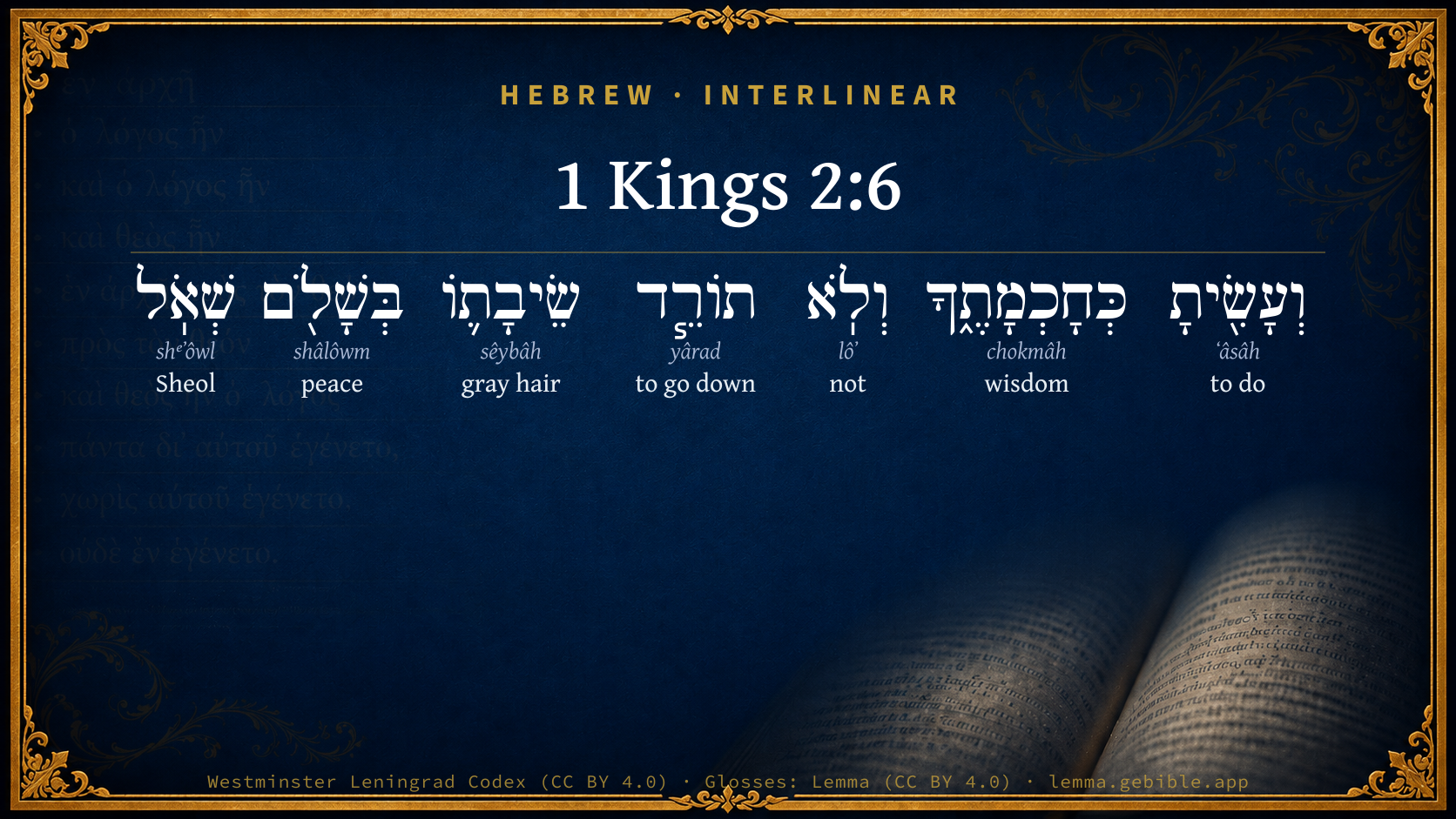
1 Kings 2:6

Hebrew (Westminster Leningrad Codex) 1 Kings 2:6 appears in the Hebrew Old Testament. The text above is from the Westminster Leningrad Codex. Each word links to its Strong’s number, a concise gloss, and parsing drawn from the Open Scriptures Hebrew Bible morphology. Click any word for its full Brown-Driver-Briggs (BDB) entry.
Download image
Cite this verse

1 Kings 2:6 (World English Bible). Public Domain. Lemma interlinear Bible study tool, https://lemma.gebible.app/v/1-kings/2/6.

Show BibTeX & RIS
BibTeX
RIS
English Translation
Do therefore according to your wisdom, and don't let his gray head go down to Sheol in peace.
World English Bible · Public Domain
Download a study sheet

One document with this verse’s original text, its word-by-word gloss line, the meaning frame, cross-references with their text, attributed commentary, and full source and license credits — printable, and it pastes into notes with its structure intact.

This verse Autodidact and up

Study sheet (.html) Plain text (.txt)

A passage Seminary Student

Up to 50 verses in one chapter. A passage sheet keeps up to 6 commentary sources and 12 cross-references per verse, in the order this page ranks them, and says so on the sheet whenever that leaves anything out. Ask for a single verse and you get the Autodidact verse sheet above.

Everything on this page stays free to read, with no account — the sheet is a download of what is already on screen, not access to it.

Want to remove ads? Support Godless Engineer
Compare translations 3

The same verse in 3 English versions, stacked beneath the original-language interlinear above. Click any original word for its lexicon entry.

Each is an independent rendering of the whole verse — the interlinear is not word-aligned to these translations.

Highlighted words mark where these versions differ — a whole-verse word diff, not a word-by-word alignment.

  • World English Bible Public Domain
    Do therefore according to your wisdom, and don't let his gray head go down to Sheol in peace.
  • King James Version Public Domain
    Do therefore according to thy wisdom, and let not his hoar head go down to the grave in peace.
  • unfoldingWord Literal Text CC BY-SA 4.0
    And you shall act according to your wisdom, and you shall not let his gray hair go down in peace to Sheol.

unfoldingWord Literal Text — © unfoldingWord, licensed CC BY-SA 4.0. Word-aligned USFM3 via Door43 (git.door43.org/unfoldingWord/en_ult).

Versions to compare (up to 4)

3 of 4 selected

Show all 18 translations

Every available English version of this verse, each an independent rendering of the whole verse.

  • World English Bible Public Domain
    Do therefore according to your wisdom, and don't let his gray head go down to Sheol in peace.
  • Berean Standard Bible Public Domain
    So act according to your wisdom, and do not let his gray head go down to Sheol in peace.
  • Majority Standard Bible Public Domain
    So act according to your wisdom, and do not let his gray head go down to Sheol in peace.
  • King James Version Public Domain
    Do therefore according to thy wisdom, and let not his hoar head go down to the grave in peace.
  • American Standard Version (1901) Public Domain
    Do therefore according to thy wisdom, and let not his hoar head go down to Sheol in peace.
  • Revised Version (1885) Public Domain
    Do therefore according to thy wisdom, and let not his hoar head go down to the grave in peace.
  • Geneva Bible (1599) Public Domain
    Doe therefore according to thy wisdome, and let thou not his hoare head go downe to the graue in peace.
  • Douay-Rheims (1899) Public Domain
    Do therefore according to thy wisdom, and let not his hoary head go down to hell in peace.
  • Young's Literal Translation Public Domain
    and thou hast done according to thy wisdom, and dost not let his old age go down in peace to Sheol.
  • Literal Standard Version CC BY-SA 4.0
    and you have done according to your wisdom, and do not let his old age go down in peace to Sheol.
  • Unlocked Literal Bible CC BY-SA 4.0
    Deal with Joab by the wisdom you have learned, but do not let his gray head go down to the grave in peace.
  • unfoldingWord Literal Text CC BY-SA 4.0
    And you shall act according to your wisdom, and you shall not let his gray hair go down in peace to Sheol.
  • Darby Bible Public Domain
    And thou shalt do according to thy wisdom, and not let his hoar head go down to Sheol in peace.
  • World Messianic Bible Public Domain
    Do therefore according to your wisdom, and don’t let his gray head go down to Sheol in peace.
  • Webster's Bible Public Domain
    Do therefore according to thy wisdom, and let not his hoary head go down to the grave in peace.
  • Free Bible Version CC BY-SA 4.0
    Do what you think is right, but don't let his gray head go down peacefully into the grave.
  • Bible in Basic English Public Domain
    So be guided by your wisdom, and let not his white head go down to the underworld in peace.
  • JPS Tanakh (1917) Public Domain
    Do therefore according to thy wisdom, and let not his hoar head go down to the grave in peace.

Literal Standard Version (2020), Covenant Press — licensed CC BY-SA 4.0. Text via the HelloAO Bible API (eBible.org). Unlocked Literal Bible (unfoldingWord) — licensed CC BY-SA 4.0. Text via the HelloAO Bible API (eBible.org). unfoldingWord Literal Text — © unfoldingWord, licensed CC BY-SA 4.0. Word-aligned USFM3 via Door43 (git.door43.org/unfoldingWord/en_ult). Free Bible Version, Dr. Jonathan Gallagher — licensed CC BY-SA 4.0. Text via the HelloAO Bible API (eBible.org).

Word by word

More ways to search: Search by grammar → Find every occurrence → Compare this word →

Practice this passage: Drill this verse → Learn its vocabulary →

About this verse

These counts appear in no published source. They are computed here, from the morphology-tagged text and Lemma’s own curated glosses. What Lemma adds →

7
words
7
distinct lemmas
Historical
section

Notable vocabulary

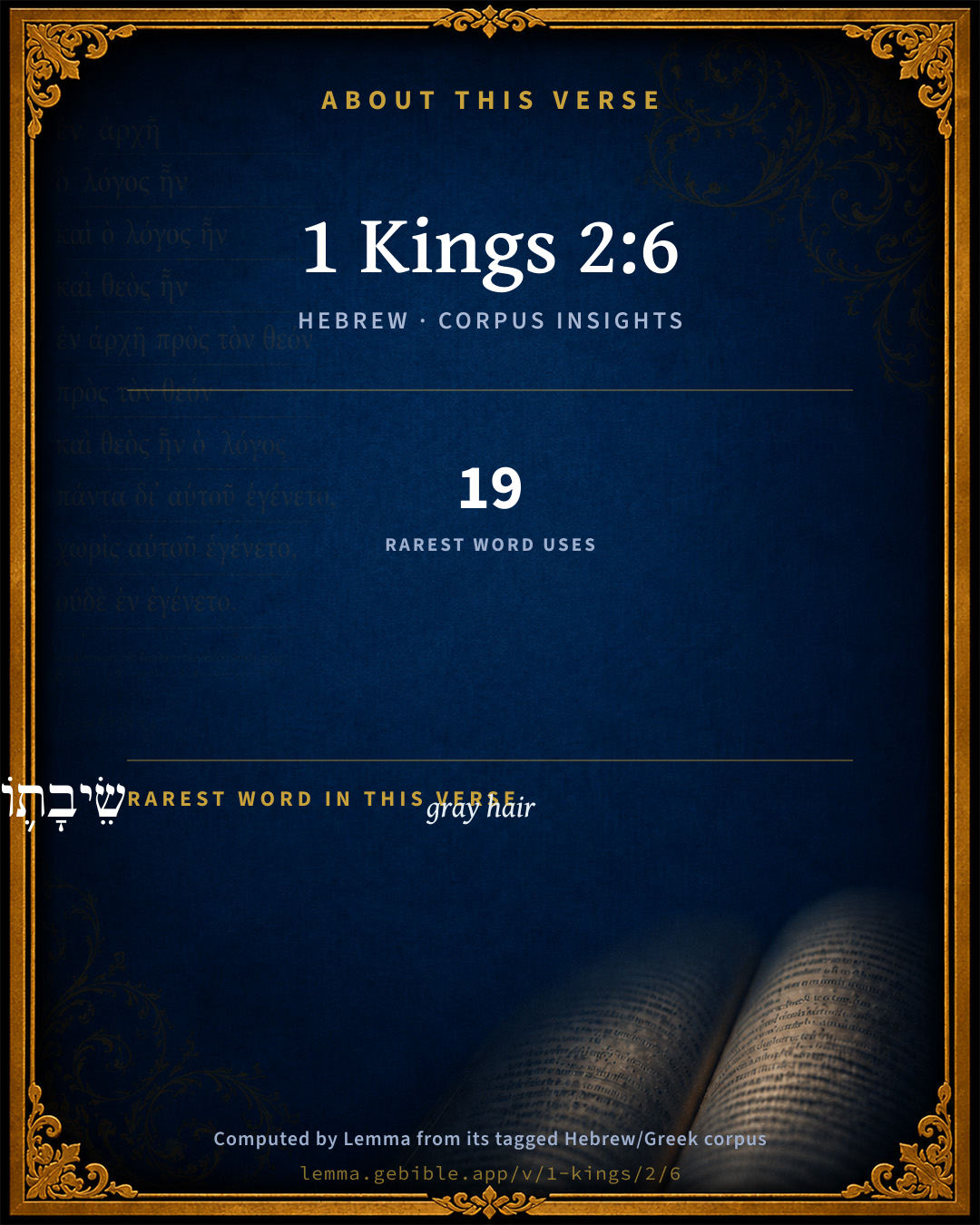
The rarest word here is שֵׂיבָת֛וֹ gray hair H7872 — appearing just 19 times in the whole Hebrew Bible.

Shared distinctive vocabulary

שֵׂיבָת֛וֹ gray hair H7872 occurs in 19 verses of the Hebrew Bible. Also found in:

Grammatical profile

  • 2 verbs
  • 4 nouns
  • 1 particle

Verb forms

  • וְעָשִׂ֖יתָ Qal · Sequential Perfect
  • תוֹרֵ֧ד Hiphil · Imperfect

Hebrew & Septuagint length

In English translation the verse runs 18 words from the Hebrew and 24 from the Septuagint (LXX English) — closely comparable.

A rough comparison of the two English renderings, which tokenize alike — not a word-level alignment.

Word counts can differ between the Hebrew and the Greek without any difference in meaning — e.g. the Hebrew direct-object marker אֵת has no separate Greek word, and Greek often adds the article ὁ.

Cross-references

14

Topical passages linked to 1 Kings 2:6 in the Treasury of Scripture Knowledge — connected by theme and wording, ordered by reader-vote popularity; previews shown in the World English Bible.

  • 1 Kings 2:9 Now therefore don't hold him guiltless, for you are a wise man; and you will know what you ought to do to him, and you shall bring his gray head down to Sheol with blood.
  • Psalms 37:37 Mark the perfect man, and see the upright, For there is a future for the man of peace.
  • Proverbs 20:26 A wise king winnows out the wicked, And drives the threshing wheel over them.
  • Proverbs 28:17 A man who is tormented by life blood will be a fugitive until death; No one will support him.
  • Ecclesiastes 8:11 Because sentence against an evil work is not executed speedily, therefore the heart of the sons of men is fully set in them to do evil.
  • Isaiah 48:22 There is no peace, says Yahweh, to the wicked.
  • Isaiah 57:21 There is no peace, says my God, to the wicked.
  • Genesis 42:38 He said, "My son shall not go down with you; for his brother is dead, and he only is left. If harm happens to him by the way in which you go, then you will bring down my gray hairs with sorrow to Sheol."
  • Numbers 35:33 So you shall not pollute the land in which you are: for blood, it pollutes the land; and no expiation can be made for the land for the blood that is shed therein, but by the blood of him who shed it.
  • 1 Kings 2:28–34 The news came to Joab; for Joab had turned after Adonijah, though he didn't turn after Absalom. Joab fled to the Tent of Yahweh, and caught hold on the horns of the altar.
  • 2 Kings 22:20 Therefore, behold, I will gather you to your fathers, and you shall be gathered to your grave in peace, neither shall your eyes see all the evil which I will bring on this place. They brought the king word again.
  • Isaiah 57:2 He enters into peace; they rest in their beds, each one who walks in his uprightness.
  • Isaiah 65:20 There shall be no more there an infant of days, nor an old man who has not filled his days; for the child shall die one hundred years old, and the sinner being one hundred years old shall be accursed.
  • Genesis 9:6 Whoever sheds man's blood, by man will his blood be shed, for in the image of God made he man.

Cross-references courtesy of OpenBible.info (CC BY 4.0).

Hebrew and Greek witnesses Masoretic Hebrew ↔ Greek Septuagint

The same verse in the two great witnesses to the Old Testament, shown verse-for-verse.

These are two independent witnesses, not word-aligned to each other, and the Septuagint is shown in lemma (dictionary) form.

Hebrew 1 Kings 2:6 Masoretic · Westminster Leningrad Codex

וְעָשִׂ֖יתָ כְּחָכְמָתֶ֑ךָ וְלֹֽא תוֹרֵ֧ד שֵׂיבָת֛וֹ בְּשָׁלֹ֖ם שְׁאֹֽל

Do therefore according to your wisdom, and don't let his gray head go down to Sheol in peace.

World English Bible · Public Domain

Greek LXX 1 Kings 2:6 Septuagint · lemma form

καί ποιέω κατά ὁ σοφία σύ καί οὐ καταἄγω ὁ πολιά αὐτός ἐν εἰρήνη εἰς ᾅδης

Therefore you shall deal with him according to your wisdom, and you shall not bring down his grey hairs in peace to the grave.

LXX2012 (modern English Septuagint) · Public Domain

Hebrew: Westminster Leningrad Codex (CC BY 4.0). Greek: Septuagint (public domain); English from LXX2012 (modern English Septuagint) (Public Domain). How the Septuagint differs from the Hebrew →

Targum (Aramaic paraphrase)

1

The Targum is the ancient Jewish Aramaic paraphrase of the Hebrew Scriptures — an interpretive translation, not the Hebrew text itself. Onkelos (literal) and Pseudo-Jonathan (expansive) render the Torah, and Jonathan the Prophets. Coverage is partial: where no permissively-licensed English translation exists for a verse, only the Aramaic is shown. This is verse-level text, not a word-by-word alignment to the Hebrew.

  1. Targum Jonathan Prophets (Joshua–Malachi)
    וְתַעְבֵּיד כְּחוּכְמָתָךְ וְלָא תָחֵית שִׂיבָתֵיהּ בִּשְׁלָמָא לִשְׁאוֹל:

    (no public-domain English translation for this verse)

    Targum Jonathan — Aramaic: “Mikraot Gedolot” (public domain). English: “Sefaria Community Translation” (CC0 1.0 (public-domain dedication)); “London "Chaldee Paraphrase," 1871” (public domain). Text via Sefaria.

Commentary

Notes on 1 Kings 2:6 from classic Christian and Jewish commentators (each source and its license shown beneath its notes). The classic Christian expositions comment on the surrounding passage and are grouped to its opening verse, so a note may address several verses; the Jewish commentaries on the Tanakh (Rashi and others) are per-verse, so they appear only where the commentator wrote on this verse.

Lemma curates 59 commentaries, every one of them public domain or Creative Commons licensed, each selected and text-cleaned for this edition rather than reprinted as found. About our sources →

Trapp's Complete Commentary

John Trapp

1Ki 2:6 Do therefore according to thy wisdom, and let not his hoar head go down to the grave in peace.

Ver. 6. Do therefore according to thy wisdom,] q.d., He is of a turbulent spirit, and will be apt enough to give thee just occasion to fall upon him. See that it be thoroughly done, for it lieth upon my conscience, that he hath hitherto passed unpunished. Of his adultery and murder we hear not a word, because he had made a thorough peace with God for those sins in his lifetime; he had compounded with his judge, &c.: but the cases of Joab and Shimei troubled him on his death bed.

And let not his hoar head, &c.] Let him be well punished, though he is now old, and hath done great exploits.

John Trapp, A Commentary or Exposition upon All the Books of the Old and New Testament (1647–1656) — public domain. Text from a community e-Sword module.

Joseph Benson's Commentary

1Ki 2:6. Do therefore according to thy wisdom — What in reason and justice thou seest to be fit. For though I was forced to forbear him, I never forgave him. Let not his hoar head go down to the grave in peace — Punish him according to his demerits. “This dying order of David,” says Dr. Dodd, referring to Dr. Chandler, “was an order worthy of a good king, and fit to be given in the last moments of his life. The crimes which drew down this punishment upon Joab, have already been expatiated upon. Many reasons concurred to prevent David’s calling him to an account; but it is plain he never forgot nor forgave his crime: nay, he could not, consistently with the law, have forgiven him if he had been inclined to it. His deferring his punishment so long, was no reason why he should always do it. Reasons of state prevented its being inflicted before, and reasons of state required its being put in execution at this juncture. In time of war it was dangerous to attempt it, on account of the power, influence, and military skill of Joab; in time of peace it was safe, because Joab’s power was then upon the decline, and his services were unnecessary. Joab was ambitions, enterprising, and restless, and having not proved very loyal to the father, might have practised the same perfidy against the son; who being young, and scarcely settled in his throne, might have suffered from his treachery, his want of fidelity, and his ambitions views, which were insatiable.”

Joseph Benson's Commentary on the Old and New Testaments (1811–1818) — public domain. Text from a community e-Sword module.

Jamieson, Fausset & Brown

Robert Jamieson, A. R. Fausset & David Brown

Do . . . according to thy wisdom--Joab's immense popularity with the army required that any proceedings instituted against him should be taken with great prudence and deliberation.

Jamieson, Fausset & Brown — Commentary Critical and Explanatory on the Whole Bible (1871) — public domain (CC PDM 1.0). Text via the HelloAO Bible API.

Adam Clarke's Commentary

Verse 6. Let not his hoar head go down to the grave in peace.] It would have been an insult to justice not to have taken the life of Joab. David was culpable in delaying it so long; but probably the circumstances of his government would not admit of his doing it sooner. According to the law of God, Joab, having murdered Abner and Amasa, should die. And had not David commanded Solomon to perform this act of justice, he could not have died in the approbation of his Maker.

Adam Clarke's Commentary on the Bible (1810–1826) — public domain. Text from a community e-Sword/MySword module.

The Cambridge Bible for Schools and Colleges

gen. ed. J. J. S. Perowne

6. Do therefore according to thy wisdom] Compare 1Ki_2:9. The wisdom to which David in both cases alludes is a politic method of bringing these men to do something for which they might be put to death. Such men were specially dangerous in the court of a young king.

his hoar head] Most likely Joab was already an old man not much younger than David himself. This may account for some of the freedom of his speech to the king.

go down to the grave in peace] The advice is put in a more direct form in 1Ki_2:9, concerning Shimei, ‘Bring his hoar head down to the grave with blood.’

The Hebrew construction (the jussive after לא not אל) seems to imply a suggestion rather than a direct command. ‘I recommend you not to let,’ &c.

The Cambridge Bible for Schools and Colleges (gen. ed. J. J. S. Perowne; Cambridge University Press, 1878–1918) — public domain. Text from a community e-Sword module.

John Gill's Exposition

Do therefore according to thy wisdom,.... Which though young began to appear in him, even in the life of his father; he therefore exhorts him to use the wisdom he had, and take the first and fittest opportunity to cut him off for his former murders and late treason, as a dangerous man to his government and the peace of it:

and let not his hoary head go down to the grave in peace; that is, let him not die a natural, but a violent death; and let not his grey hairs be any argument for sparing him, or any reason for delaying the taking of him off, because he would in course die quickly; for he must be now an old man, as old as David, or perhaps older; since he had been his general forty years, even all the time of his reign; see Sa2 2:13.

John Gill's Exposition of the Whole Bible (1746–1763) — public domain (CC PDM 1.0). Text via the HelloAO Bible API.

Albert Barnes' Notes on the Bible

His hoar head - Joab, though the nephew of David, was probably not very greatly his junior, David being the youngest of the family, and Zeruiah, as is most likely, one of the eldest.

Albert Barnes' Notes on the Bible (1834–1885) — public domain. Text from a community e-Sword/MySword module.

Haydock's Catholic Bible Commentary

To hell. This word hell doth not signify the place or state of damnation; but the place and state of the dead. (Challoner) --- It would have been a great scandal if this murderer had died quietly in his old age. Joab had rendered great services to his uncle, for which he had been rewarded. He had been at the head of the armies 40 years. His great age rendered him now less formidable; particularly as the nation enjoyed peace.

George Leo Haydock (1774–1849), Haydock's Catholic Family Bible and Commentary, 1859 edition — public domain. Excludes Psalms (Douay-Rheims chapter numbering differs from Protestant) and Deuterocanonical books (Catholic canon only).

Matthew Poole's English Annotations

According to thy wisdom, i.e. what in reason and justice thou seest fit. For though I was forced to forbear him when it was in a manner out of my power to punish him, yet I never forgave him; and therefore do thou wisely and severely examine all his actions, and particularly this last rebellion, and punish him according to his demerits.

Let not his hoar head go down to the grave in peace; though he be old, having been the general of the army forty years, yet do not suffer him to die a natural death, but cut him off by the sword of justice.

Matthew Poole's English Annotations on the Holy Bible (1683–1685) — public domain. Text from a community e-Sword/MySword module.

Whedon's Commentary on the Bible

Daniel D. Whedon

6. His hoar head — Gray hairs are venerable, but the hoary headed sinner is not to be saved by his whitened locks. Joab was doubtless younger than David, but still far gone in years. We need not deny that David had feelings of personal revenge towards this man who had injured him so much, for we are not to look for the saintliness required by the New Testament in even the noble David. This dying charge, however, was evidently not the offspring of personal revenge, but a measure of administrative wisdom.

Daniel D. Whedon (gen. ed.), Commentary on the Old and New Testaments (1874–1909) — public domain. Text from a community e-Sword module.

The Pulpit Commentary

Do therefore according to thy wisdom. (cf. Pro_20:26) It needed great discretion in exacting the punishment of death in theease of one who was so powerful, who had such influence with the army and the people, whose crimes had been passed over for so long a time, to whom David was so much indebted Joab had partly won and had twice preserved for him his crown and to whom he was allied by ties of blood. To act precipitately or unwisely might provoke a revolution, and let not his hoar head see on ver. 9. Joab, though David"s nephew, could not have been much his junior, and David was now seventy go down to the grave in peace. He must die a violent, not a natural death, as Corn. a Lap. This expression, no doubt, looks vindictive, but that is solely because we forget the character of the Old Testament dispensation (as one of temporal rewards and punishments. See the "Expositor," vol. 3. p. 114), the position of David as king (as the authorized dispenser of punishments, and as responsible to God for dispensing them without fear or favour), and the principles of the Mosaic code (as a lex talionis, demanding blood for blood, and requiring the magistrates and people to purge themselves of the guilt of blood by demanding "the blood of him that shed it"). Let these considerations be borne in mind, and there is absolutely no warrant for charging David with malevolence. Wordsworth lays stress on the fact that Joab had not repented of his crimes. But we need have recourse to no such suppositions. The Jewish law afforded no place of repentance to the murderer. No amount of contrition would cleanse the land of blood. The temporal penalty must be paid. In the case of David himself, it was only commuted by special revelation, (2Sa_12:10, 2Sa_12:13, 2Sa_12:14) not remitted.

The Pulpit Commentary (1880–1919), ed. H.D.M. Spence-Jones & Joseph S. Exell — public domain. Text from a community e-Sword module.

John Wesley's Explanatory Notes

Do therefore - That is, what in reason and justice thou seest fit. For tho' I was forced to forbear him, yet I never forgave him; punish him according to his demerits.

John Wesley, Explanatory Notes Upon the Whole Bible (1754–1765) — public domain. Text via the GEBible commentary corpus.

Scofield Reference Notes

C. I. Scofield

grave

Heb. "Sheol," (See Scofield "Hab 2:5").

The Scofield Reference Bible (1917 edition), notes by C. I. Scofield — public domain. Text from a community e-Sword module.

Rashi

Rabbi Shlomo Yitzchaki (Rashi)

And do not let his greying head go down to the grave in peace. Do not let him die a natural death [causing him] to fall into Gehinnom.

Rashi on the Tanakh — English translations: “The Judaica Press complete Tanach with Rashi, translated by A. J. Rosenberg” (CC BY 4.0); “Pentateuch with Rashi's commentary by M. Rosenbaum and A.M. Silbermann, 1929-1934” (public domain); “The Metsudah Tanach series, Lakewood, N.J” (CC BY 4.0); and “The Book of Joshua, Metsudah Publications, 1997” (CC BY 4.0). Text via Sefaria.

Lesson kit

Teaching starters — assembled from the data on this page, not authored interpretation. Every prompt links to the verse data it draws on. Edit before teaching.

1 Kings, in the Historical, opens this verse with 7 words (7 distinct Hebrew lemmas). Its most distinctive word is sêybâh (“gray hair”). A historical commentator’s framing appears above. Read the whole chapter for the surrounding context.

Discussion questions

  1. How does “gray hair” (sêybâh) shape what this verse is saying?
  2. How does Genesis 15:15, which shares the word «gray hair», read alongside this verse?
  3. The translations on this page render this verse differently — a whole-verse word diff, not a word-by-word alignment. What might account for the different wordings?
  4. «וְעָשִׂ֖יתָ» is a Qal Sequential Perfect verb. How does that grammatical form shape the action described?
  5. Compare how Trapp's Complete Commentary and Joseph Benson's Commentary read this verse. Where do they agree or differ?

Things to notice

Reading settings

Reading text

Shown beneath each verse's original-language words.

Old Testament
Old Testament edition

Read the OT as the Masoretic Hebrew (MT) or the Greek Septuagint (LXX).

English shown for the Greek Septuagint (in the Hebrew ↔ Greek comparison).

Comparing translations? Open the Compare panel on any verse page to stack up to four side by side.