
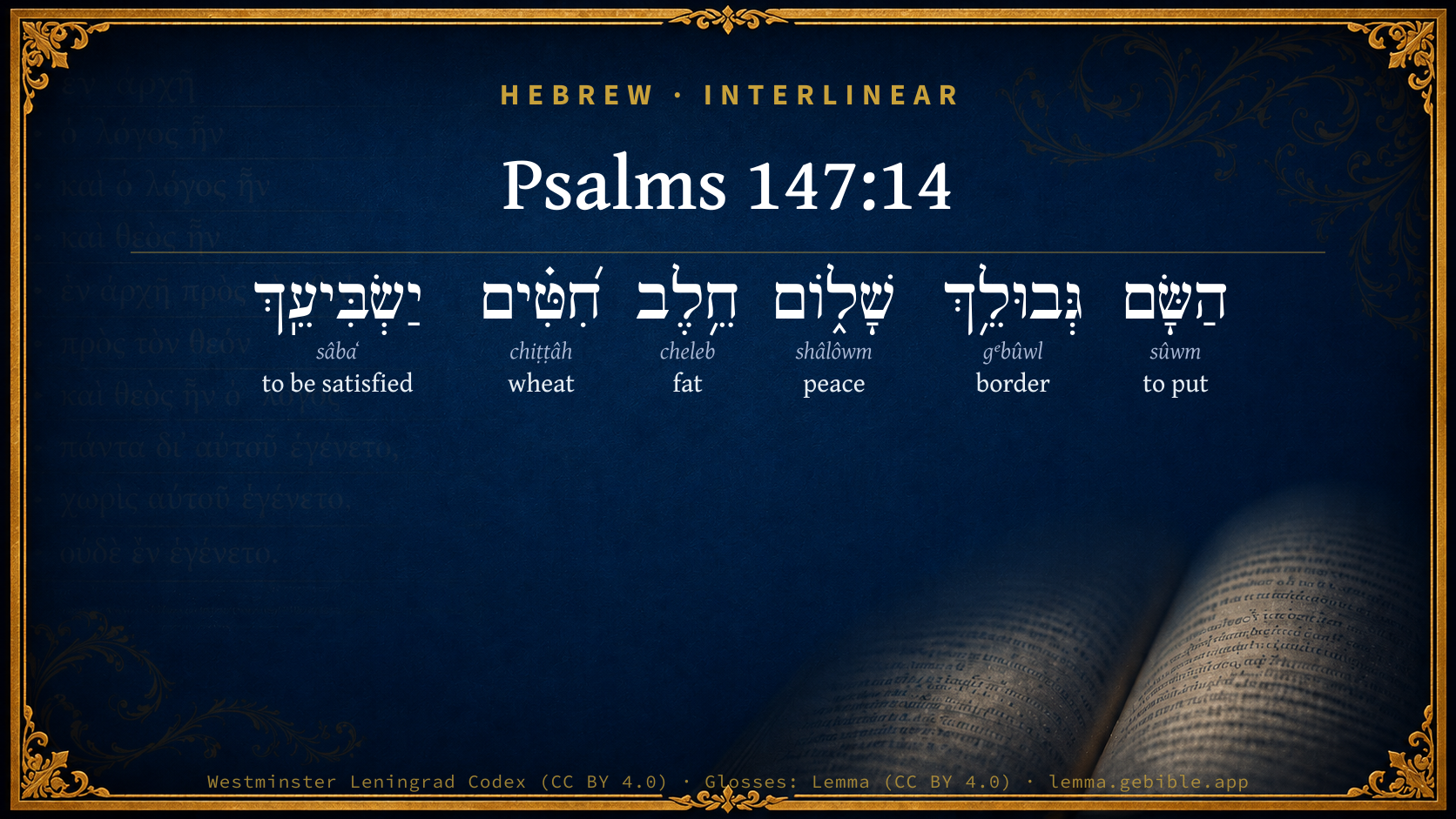
Psalms 147:14

Hebrew (Westminster Leningrad Codex) Psalms 147:14 appears in the Hebrew Old Testament. The text above is from the Westminster Leningrad Codex. Each word links to its Strong’s number, a concise gloss, and parsing drawn from the Open Scriptures Hebrew Bible morphology. Click any word for its full Brown-Driver-Briggs (BDB) entry.
Download image
Cite this verse

Psalms 147:14 (World English Bible). Public Domain. Lemma interlinear Bible study tool, https://lemma.gebible.app/v/psalms/147/14.

Show BibTeX & RIS
BibTeX
RIS
English Translation
He makes peace in your borders. He fills you with the finest of the wheat.
World English Bible · Public Domain
Download a study sheet

One document with this verse’s original text, its word-by-word gloss line, the meaning frame, cross-references with their text, attributed commentary, and full source and license credits — printable, and it pastes into notes with its structure intact.

This verse Autodidact and up

Study sheet (.html) Plain text (.txt)

A passage Seminary Student

Up to 50 verses in one chapter. A passage sheet keeps up to 6 commentary sources and 12 cross-references per verse, in the order this page ranks them, and says so on the sheet whenever that leaves anything out. Ask for a single verse and you get the Autodidact verse sheet above.

Everything on this page stays free to read, with no account — the sheet is a download of what is already on screen, not access to it.

Want to remove ads? Support Godless Engineer
Compare translations 3

The same verse in 3 English versions, stacked beneath the original-language interlinear above. Click any original word for its lexicon entry.

Each is an independent rendering of the whole verse — the interlinear is not word-aligned to these translations.

Highlighted words mark where these versions differ — a whole-verse word diff, not a word-by-word alignment.

  • World English Bible Public Domain
    He makes peace in your borders. He fills you with the finest of the wheat.
  • King James Version Public Domain
    He maketh peace in thy borders, and filleth thee with the finest of the wheat.
  • unfoldingWord Literal Text CC BY-SA 4.0
    The one putting peace your borders, he satisfies you the fat of wheat.

unfoldingWord Literal Text — © unfoldingWord, licensed CC BY-SA 4.0. Word-aligned USFM3 via Door43 (git.door43.org/unfoldingWord/en_ult).

Versions to compare (up to 4)

3 of 4 selected

Show all 17 translations

Every available English version of this verse, each an independent rendering of the whole verse.

  • World English Bible Public Domain
    He makes peace in your borders. He fills you with the finest of the wheat.
  • Berean Standard Bible Public Domain
    He makes peace at your borders; He fills you with the finest wheat.
  • Majority Standard Bible Public Domain
    He makes peace at your borders; He fills you with the finest wheat.
  • King James Version Public Domain
    He maketh peace in thy borders, and filleth thee with the finest of the wheat.
  • American Standard Version (1901) Public Domain
    He maketh peace in thy borders; He filleth thee with the finest of the wheat.
  • Revised Version (1885) Public Domain
    He maketh peace in thy borders; he filleth thee with the finest of the wheat.
  • Geneva Bible (1599) Public Domain
    He setteth peace in thy borders, and satisfieth thee with the floure of wheate.
  • Young's Literal Translation Public Domain
    Who is making thy border peace, `With' the fat of wheat He satisfieth Thee.
  • Literal Standard Version CC BY-SA 4.0
    Who is making your border peace, || He satisfies you [with] the fat of wheat.
  • Unlocked Literal Bible CC BY-SA 4.0
    He brings prosperity inside your borders, he satisfies you with the finest of wheat.
  • unfoldingWord Literal Text CC BY-SA 4.0
    The one putting peace your borders, he satisfies you the fat of wheat.
  • Darby Bible Public Domain
    He maketh peace in thy borders; he satisfieth thee with the finest of the wheat.
  • World Messianic Bible Public Domain
    He makes peace in your borders. He fills you with the finest of the wheat.
  • Webster's Bible Public Domain
    He maketh peace in thy borders, and filleth thee with the finest of the wheat.
  • Free Bible Version CC BY-SA 4.0
    He keeps the borders of your land safe from attack; he provides you with plenty of the finest wheat.
  • Bible in Basic English Public Domain
    He gives peace in all your land, making your stores full of fat grain.
  • JPS Tanakh (1917) Public Domain
    He maketh thy borders peace; He giveth thee in plenty the fat of wheat.

Literal Standard Version (2020), Covenant Press — licensed CC BY-SA 4.0. Text via the HelloAO Bible API (eBible.org). Unlocked Literal Bible (unfoldingWord) — licensed CC BY-SA 4.0. Text via the HelloAO Bible API (eBible.org). unfoldingWord Literal Text — © unfoldingWord, licensed CC BY-SA 4.0. Word-aligned USFM3 via Door43 (git.door43.org/unfoldingWord/en_ult). Free Bible Version, Dr. Jonathan Gallagher — licensed CC BY-SA 4.0. Text via the HelloAO Bible API (eBible.org).

Word by word

More ways to search: Search by grammar → Find every occurrence → Compare this word →

Practice this passage: Drill this verse → Learn its vocabulary →

About this verse

These counts appear in no published source. They are computed here, from the morphology-tagged text and Lemma’s own curated glosses. What Lemma adds →

6
words
6
distinct lemmas
Wisdom
section

Shared distinctive vocabulary

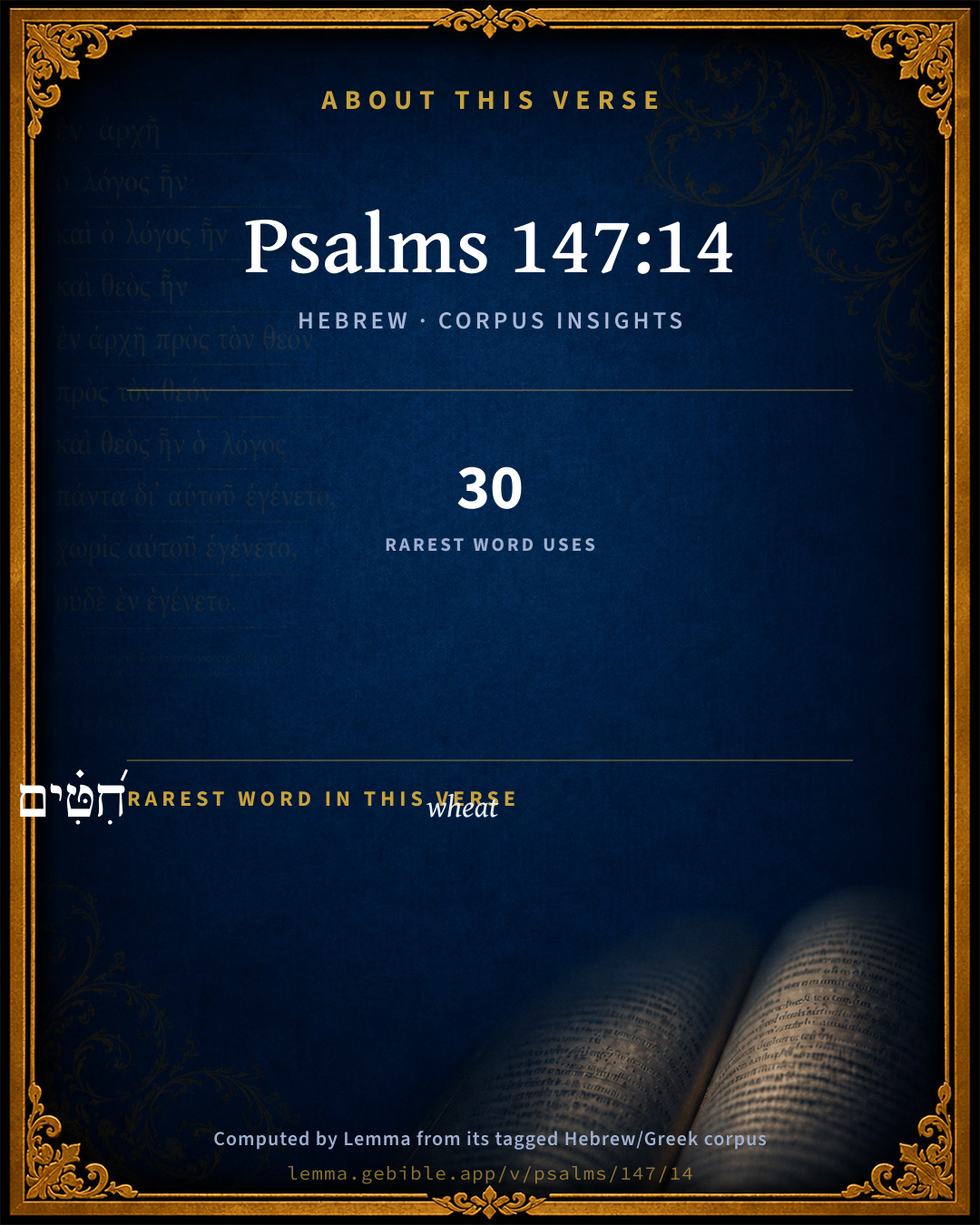
חִ֝טִּ֗ים wheat H2406 occurs in 30 verses of the Hebrew Bible. Also found in:

Grammatical profile

  • 2 verbs
  • 4 nouns

Verb forms

  • הַשָּׂם Qal · Participle Active
  • יַשְׂבִּיעֵֽךְ Hiphil · Imperfect

Cross-references

14

Topical passages linked to Psalms 147:14 in the Treasury of Scripture Knowledge — connected by theme and wording, ordered by reader-vote popularity; previews shown in the World English Bible.

  • Psalms 29:11 Yahweh will give strength to his people. Yahweh will bless his people with peace.
  • Isaiah 60:17–18 For brass I will bring gold, and for iron I will bring silver, and for wood brass, and for stones iron. I will also make your officers peace, and righteousness your ruler.
  • Psalms 81:16 But he would have also fed them with the finest of the wheat. I will satisfy you with honey out of the rock."
  • Psalms 132:15 I will abundantly bless her provision. I will satisfy her poor with bread.
  • Deuteronomy 32:14 Butter of the herd, and milk of the flock, With fat of lambs, Rams of the breed of Bashan, and goats, With the finest of the wheat; Of the blood of the grape you drank wine.
  • Leviticus 26:6 "'I will give peace in the land, and you shall lie down, and no one will make you afraid; and I will remove evil animals out of the land, neither shall the sword go through your land.
  • Deuteronomy 8:7–8 For Yahweh your God brings you into a good land, a land of brooks of water, of springs and springs, flowing forth in valleys and hills;
  • 1 Chronicles 22:9 Behold, a son shall be born to you, who shall be a man of rest; and I will give him rest from all his enemies round about; for his name shall be Solomon, and I will give peace and quietness to Israel in his days:
  • Psalms 122:6 Pray for the peace of Jerusalem. Those who love you will prosper.
  • Isaiah 66:12 For thus says Yahweh, Behold, I will extend peace to her like a river, and the glory of the nations like an overflowing stream: and you shall suck [of it]; you shall be borne on the side, and shall be dandled on the knees.
  • Zechariah 9:8 I will encamp around my house against the army, That none pass through or return; And no oppressor will pass through them any more: For now I have seen with my eyes.
  • Psalms 132:11 Yahweh has sworn to David in truth. He will not turn from it: "I will set the fruit of your body on your throne.
  • Isaiah 9:6–7 For to us a child is born, to us a son is given; and the government shall be on his shoulder: and his name shall be called Wonderful, Counselor, Mighty God, Everlasting Father, Prince of Peace.
  • Ezekiel 27:17 Judah, and the land of Israel, they were your traffickers: they traded for your merchandise wheat of Minnith, and confections, and honey, and oil, and balm.

Cross-references courtesy of OpenBible.info (CC BY 4.0).

Hebrew and Greek witnesses Masoretic Hebrew ↔ Greek Septuagint

The same verse in the two great witnesses to the Old Testament, shown verse-for-verse.

You’re reading Greek Psalm 146 (Hebrew Psalm 147). The Septuagint counts the superscription, so verse numbers can differ from the Hebrew — chapter-level alignment, not verse-by-verse. Numbering follows Rahlfs.

These are two independent witnesses, not word-aligned to each other, and the Septuagint is shown in lemma (dictionary) form.

Hebrew Psalms 147:14 Masoretic · Westminster Leningrad Codex

הַשָּׂם גְּבוּלֵ֥ךְ שָׁל֑וֹם חֵ֥לֶב חִ֝טִּ֗ים יַשְׂבִּיעֵֽךְ

He makes peace in your borders. He fills you with the finest of the wheat.

World English Bible · Public Domain

Hebrew: Westminster Leningrad Codex (CC BY 4.0). Greek: Septuagint (public domain); English from a public-domain English Septuagint. How the Septuagint differs from the Hebrew →

Commentary

Notes on Psalms 147:14 from classic Christian and Jewish commentators (each source and its license shown beneath its notes). The classic Christian expositions comment on the surrounding passage and are grouped to its opening verse, so a note may address several verses; the Jewish commentaries on the Tanakh (Rashi and others) are per-verse, so they appear only where the commentator wrote on this verse.

Lemma curates 59 commentaries, every one of them public domain or Creative Commons licensed, each selected and text-cleaned for this edition rather than reprinted as found. About our sources →

Trapp's Complete Commentary

John Trapp

Psa 147:14 He maketh peace [in] thy borders, [and] filleth thee with the finest of the wheat.

Ver. 14. He maketh peace in thy borders] Peace, peace, Isa 26:3, peace of country and of conscience.

And filleth thee with the finest of the wheat] Heb. with the fat of wheat, called fat of kidneys of wheat, Deu 32:14. See Psa 81:16. Judaea was once called and counted Sumen totius terrae, breeding sow of the whole earth, not so much for the nature of the country, as for the blessing of God thereupon; for now it is nothing so fruitful. But the saints have still the bread of angels, a feast "of fat things full of marrow, of wines on the lees well refined," Isa 25:6.

John Trapp, A Commentary or Exposition upon All the Books of the Old and New Testament (1647–1656) — public domain. Text from a community e-Sword module.

The Biblical Illustrator

Joseph S. Exell

Psa_147:14-15

He maketh peace in thy borders.

Peace at home and prosperity abroad: a Missionary Sermon

The prosperity of the Church is described in this psalm.

I. What are the points which constitute the healthiness of the Church at home? To begin with the most important--the true piety of all her members. If we could to-morrow bring into the Church a sufficient number of ungodly but moral men to double our numbers, our subscriptions, our places of worship and our missionaries, it would be a curse and not a blessing. Next, the soundness of that Gospel which we proclaim and preach. When I have read the conflict between the mighty man who made these walls echo with his voice, Mr. Whitefield, and that other mighty man, equally useful in his day, Mr. Wesley, I have felt that they contended for the same truths, and that the vitality of godliness was not at issue in the controversy. But there are vital truths, and for these we must contend even to the death. The spirit of union. We must needs have divers communions, because we cannot see eye to eye in discipline, while nevertheless we are really and vitally one. I am sure the more we come to know each other, the better we love one another. Constant activity. The Church gets dull, listless and heavy at times. Abundant prayer.

II. The connection between a healthy home Church and the spread of Christs Kingdom abroad. It is clear enough. The whole missionary enterprise will fall to pieces, bit by bit, if we be not in spiritual health. There is a well of water springing up, and the people of the district flock to it. Suddenly the secret spring begins to fail; by some means or another the water is gone to another place, and the spring is no more there. Soon would it come to pass that where multitudes of men and women were wont to drink with joy and gladness there is not a single person to be seen. So with our missionary success should the Church at home degenerate. The inconsistencies of English Christians have proved one of the greatest barriers to Christs Kingdom in other lands.

III. Then if all this be true, then let us remember that it must also have a connection with our own personal standing in the sight of God. If one member be unhealthy in the body, the unhealthiness of that member does to a degree taint the whole. If every man mended one all would be mended. Responsibility to God for the souls of men is cast on each one of us. When you stand by the grave of some neighbour, can you look down into the grave and say, I did all that was in the power of mortal man for that souls salvation? No, you cannot. I am afraid that none of us, or but very few, when we hear of the death of friends, can say, If that man perish, I did not leave a stone unturned. Who has done all he might? (C. H. Spurgeon.)

The Divine efficiency illustrated in the blessing of peace

I. The peace of nations.

1. A blessing.

2. A promised blessing.

3. A blessing for the improvement of which nations are accountable.

4. A blessing in which the Church hath interest (Jer_29:7; Jam_4:1).

II. The efficiency of the Lord our God in the peace of nations.

1. The peace of nations is within His all-comprehending purpose. The time in which the peace is concluded, the articles, the nations comprehended in it, and, in a word, every circumstance is according to the pleasure and purpose of the will of God, who hath foreordained whatsoever cometh to pass.

2. The Lord disposes the events of war in such a manner as to open the way to a peace. Victories and conquests on the one side, and losses and defeats on the other, are balanced by His wisdom and justice, and overruled for hastening and facilitating accommodations between the belligerent and contending powers.

3. Inclinations to peace, formed by His invisible and unperceived efficiency in the minds of princes and cabinet ministers, are called into exercise and motion by the operations of His providence.

4. Negotiations for peace are begun, and carried on, and con-eluded under His eye.

5. The conditions of peace are settled by His efficiency.

6. The success of negotiations for peace is of the Lord.

III. Praise the Lords efficiency in the peace of nations.

1. Believe His efficiency.

2. Confess it.

3. Rejoice in it. (A. Shanks.)

Filleth thee with the finest of the wheat.

The blessing of plenty

I. The good mentioned. The finest of the wheat is--

1. A blessing (Zec_9:17).

2. A promised blessing (Joe_2:23-24).

3. A blessing which, without impeaching the goodness and faithfulness of the promiser, may be denied, confiscated, and cursed.

4. A blessing for which they who receive it are accountable. The Lord is our judge as well as our benefactor.

5. A blessing in which the Church hath interest. In the members of this holy society there is a bodily and a spiritual part. The Lord is the former and nourisher of them both.

II. The efficiency of the Lord our God in filling us with the finest of the wheat.

1. The discretion which prepareth the land for sowing the wheat is inspired and taught by the Lord.

2. The dying of the wheat under the clod.

3. The revival of the wheat.

4. The springing and growth of the wheat.

5. Wheat-harvest is of the Lord. He appointeth the weeks, and by His power in the atmosphere disposeth winds and clouds and rain to keep it back, or bring it forward, to make it prosperous or calamitous, according to His counsel and pleasure.

III. Conclusion. Use the finest of the wheat, and all the goods of the season--

1. Thankfully.

2. Wisely and discreetly.

3. Charitably.

4. Temperately.

5. Believingly. (A. Shanks.)

The Biblical Illustrator, edited by Joseph S. Exell (c. 1880s–1900s) — public domain. Text from a community e-Sword module.

J. A. Alexander on Psalms

Joseph Addison Alexander

14. (Psa 147:14) (It is) he that makes thy border peace, (and with) the fat of wheat he satisfies thee. He that makes, literally the (one) placing. Border is put for all that it contains or bounds, thy territory or domain. To make it peace is to make it peaceful or to give it peace. See Isa 54:12. With the last clause compare Psa 81:16, Deu 32:14.

Joseph Addison Alexander, The Psalms Translated and Explained (1850) — public domain. Text from a community e-Sword module.

Geneva Bible (1599)

Geneva Bible translators

Hebrew, fat.

Geneva Bible (1599) marginal notes — public domain. Text via Bolls.life.

Jamieson, Fausset & Brown

Robert Jamieson, A. R. Fausset & David Brown

maketh . . . borders--or, territories (Gen 23:17; Isa 54:12).

filleth thee, &c.--(Compare Margin).

Jamieson, Fausset & Brown — Commentary Critical and Explanatory on the Whole Bible (1871) — public domain (CC PDM 1.0). Text via the HelloAO Bible API.

Adam Clarke's Commentary

Verse 14. He maketh peace] They were now no longer troubled with the Samaritans, Moabites, &c.

Adam Clarke's Commentary on the Bible (1810–1826) — public domain. Text from a community e-Sword/MySword module.

Ellicott's Commentary for English Readers

(14) Maketh peace.—Or, placing as thy border peace.

Finest of the wheat.—Literally, fat of wheat. (See Psa_81:16.)

A Bible Commentary for English Readers, edited by Charles John Ellicott (1878–1897) — public domain. Text from a community e-Sword module.

The Cambridge Bible for Schools and Colleges

gen. ed. J. J. S. Perowne

14. satisfleth thee with the fat of wheat] Fulfilling His ancient promises. Cp. Psa_81:16; Deu_32:14.

The Cambridge Bible for Schools and Colleges (gen. ed. J. J. S. Perowne; Cambridge University Press, 1878–1918) — public domain. Text from a community e-Sword module.

John Gill's Exposition

He maketh peace in thy borders,.... Which are usually most infested by enemies, It may denote the universality of peace throughout the land, in all the parts and borders of it; and be understood of the outward peace of the church with her enemies, and of the abundance and continuance of it in the latter day; and of that concord and harmony that shall be among the members of it; and also of that inward spiritual conscience peace each enjoy through believing; and which is in and from Christ, and flows from his blood and righteousness, applied for pardon and justification; and is another reason for praising the Lord;

and filleth thee with the finest of the wheat; or, "fat of the wheat" (s); the best of it; see Deu 32:14; which is the choicest of grain, and makes the best of bread, and especially the finest flour of it; and to be filled and satisfied with this, or to have enough of it, is a great temporal blessing. Here it may be understood spiritually of the Gospel, which may be compared to wheat, and the finest of it, for its excellency and purity, for its solidity and substantiality; with which the chaff of human doctrine is not to be mentioned, Jer 23:28; and for its salutary nourishing and strengthening virtue; and especially of Christ, the sum and substance of it, sometimes compared to a corn of wheat, Joh 12:24; for his superior excellency to all others, and the purity of his nature; for his great fruitfulness, and for being suitable food to his people; the bread of life, for which he is prepared by his sufferings and death; which may be signified by the beating out of the corn, and grinding the wheat, and making it into bread, fit for use: and for this spiritual food believers are abundantly thankful, and have reason to praise the Lord.

(s) "adipe", Montanus, Pagninus, Tigurine version, Musculus, Junius & Tremellius, Piscator, Cocceius, Gejerus, Michaelis.

John Gill's Exposition of the Whole Bible (1746–1763) — public domain (CC PDM 1.0). Text via the HelloAO Bible API.

Albert Barnes' Notes on the Bible

He maketh peace in thy borders - Margin, he maketh thy border peace. The word border here refers to a boundary, and stands for all the domain or territory included within the boundaries of a country. The idea is that peace prevailed throughout the land.

And filleth thee with the finest of the wheat - Margin, as in Hebrew, fat of wheat. Literally, “He satisfies thee with the fat of wheat.” There is no want of wheat, and that of the best kind. Compare the notes at Psa 132:15 : “I will satisfy her poor with bread.”

Albert Barnes' Notes on the Bible (1834–1885) — public domain. Text from a community e-Sword/MySword module.

Matthew Poole's English Annotations

In thy borders; in all thy land, even to its utmost borders, which are most liable to the incursion of enemies.

Matthew Poole's English Annotations on the Holy Bible (1683–1685) — public domain. Text from a community e-Sword/MySword module.

The Treasury of David

Charles H. Spurgeon

Ver. 14. He maketh peace in thy borders. Even to the boundaries quiet extends; no enemies are wrangling with the borderers. If there is peace there, we may be sure that peace is everywhere. "When a man's ways please the Lord he maketh even his enemies to be at peace with him." Peace is from the God of peace. Considering the differing constitutions, conditions, tastes, and opinions of men, it is a work of God when in large churches unbroken peace is found year after year; and it is an equal wonder if worldlings, instead of persecuting the godly, treat them with marked respect. He who builds Zion is also her Peace maker, the Lord and Giver of peace. And filleth thee with the finest of the wheat. Peace is attended with plenty, plenty of the best food, and of the best sort of that food. It is a great reason for thanksgiving when men's wants are so supplied that they are filled: it takes much to fill some men: perhaps none ever are filled but the inhabitants of Zion; and they are only to be filled by the Lord himself. Gospel truth is the finest of the wheat, and those are indeed blessed who are content to be filled therewith, and are not hungering after the husks of the world. Let those who are filled with heavenly food fill their mouths with heavenly praise.

Ver. 14. He maketh peace in thy borders, etc. There is a political peacepeace in city and country; this is the fairest flower of a Prince's crown; peace is the best blessing of a nation. It is well with bees when there is a noise; but it is best with Christians when, as in the building of the Temple, there is no noise of hammer heard. Peace brings plenty along with it; how many miles would some go on pilgrimage to purchase this peace! Therefore the Greeks made Peace to be the nurse of Pluto, the God of wealth. Political plants thrive best in the sunshine of peace. "He maketh peace in thy borders, and filleth thee with the finest of the wheat." The ancients made the harp the emblem of peace: how sweet would the sounding of this harp be after the roaring of the cannon! All should study to promote this political peace. The godly man, when he dies, "enters into peace" (Isa 57:2); but while he lives, peace must enter into him. Thomas Watson.

Ver. 14. He maketh peace. The Hebrews observe that all the letters in the name of God are literae quiescentes, letters of rest. God only is the centre where the soul may find rest: God only can speak peace to the conscience. John Stoughton, 1639.

Ver. 14. Finest of the wheat. If men give much it is in cheap and coarse commodity. Quantity and quality are only possible with human production in in verse ratio; but the Lord gives the most and best of all supplies to his pensioners. How truly the believer under the gospel knows the inner spirit of the meaning here! The Lord Jesus Christ says, "My peace I give unto you." And when he sets us at rest and all is reconciliation and peace, then he feeds us with himself his body, the finest wheat, and his blood, the richest wine. Johannes Paulus Palanterius.

Ver. 14-15. See "Spurgeon's Sermons", No. 425: "Peace at Home, and Prosperity Abroad."

Ver. 14-15. Church blessings.

1. Peace.

2. Food.

3. Missionary energy.

4. The presence of God: the source of all blessing.

Psalms 147:15*

Charles H. Spurgeon's The Treasury of David (1869–1885) — public domain. Psalms only. Text from a community e-Sword/MySword module.

The Pulpit Commentary

He maketh peace in thy borders. The completion of the walls and gates of Jerusalem brought to an end the troubles caused by Sanballat, Tobiah, and Geshem, and established general peace and tranquility in Israel. And filleth thee with the finest of the wheat; literally, with the fat of wheat; i.e. wheat in abundance and of good quality. The prosperity of Nehemiah"s time appears in Neh_10:28-39 Neh_12:44-47 Neh_13:12-15.

The Pulpit Commentary (1880–1919), ed. H.D.M. Spence-Jones & Joseph S. Exell — public domain. Text from a community e-Sword module.

John Wesley's Explanatory Notes

Borders - In all thy land, even to its utmost borders.

John Wesley, Explanatory Notes Upon the Whole Bible (1754–1765) — public domain. Text via the GEBible commentary corpus.

Rashi

Rabbi Shlomo Yitzchaki (Rashi)

the best of the wheat Heb. חלב, lit. fat. The best, fat wheat kernels.

Rashi on the Tanakh — English translations: “The Judaica Press complete Tanach with Rashi, translated by A. J. Rosenberg” (CC BY 4.0); “Pentateuch with Rashi's commentary by M. Rosenbaum and A.M. Silbermann, 1929-1934” (public domain); “The Metsudah Tanach series, Lakewood, N.J” (CC BY 4.0); and “The Book of Joshua, Metsudah Publications, 1997” (CC BY 4.0). Text via Sefaria.

Lesson kit

Teaching starters — assembled from the data on this page, not authored interpretation. Every prompt links to the verse data it draws on. Edit before teaching.

Psalms, in the Wisdom, opens this verse with 6 words (6 distinct Hebrew lemmas). Its most distinctive word is chiṭṭâh (“wheat”). A historical commentator’s framing appears above. Read the whole chapter for the surrounding context.

Discussion questions

  1. The word chiṭṭâh carries the sense “wheat.” How does it shape the verse?
  2. How does Genesis 30:14, which shares the word «wheat», read alongside this verse?
  3. The translations on this page render this verse differently — a whole-verse word diff, not a word-by-word alignment. What might account for the different wordings?
  4. «הַשָּׂם» is a Qal Participle Active verb. How does that grammatical form shape the action described?
  5. Compare how Trapp's Complete Commentary and The Biblical Illustrator read this verse. Where do they agree or differ?

Things to notice

Reading settings

Reading text

Shown beneath each verse's original-language words.

Old Testament
Old Testament edition

Read the OT as the Masoretic Hebrew (MT) or the Greek Septuagint (LXX).

English shown for the Greek Septuagint (in the Hebrew ↔ Greek comparison).

Comparing translations? Open the Compare panel on any verse page to stack up to four side by side.