
Proverbs 12:20

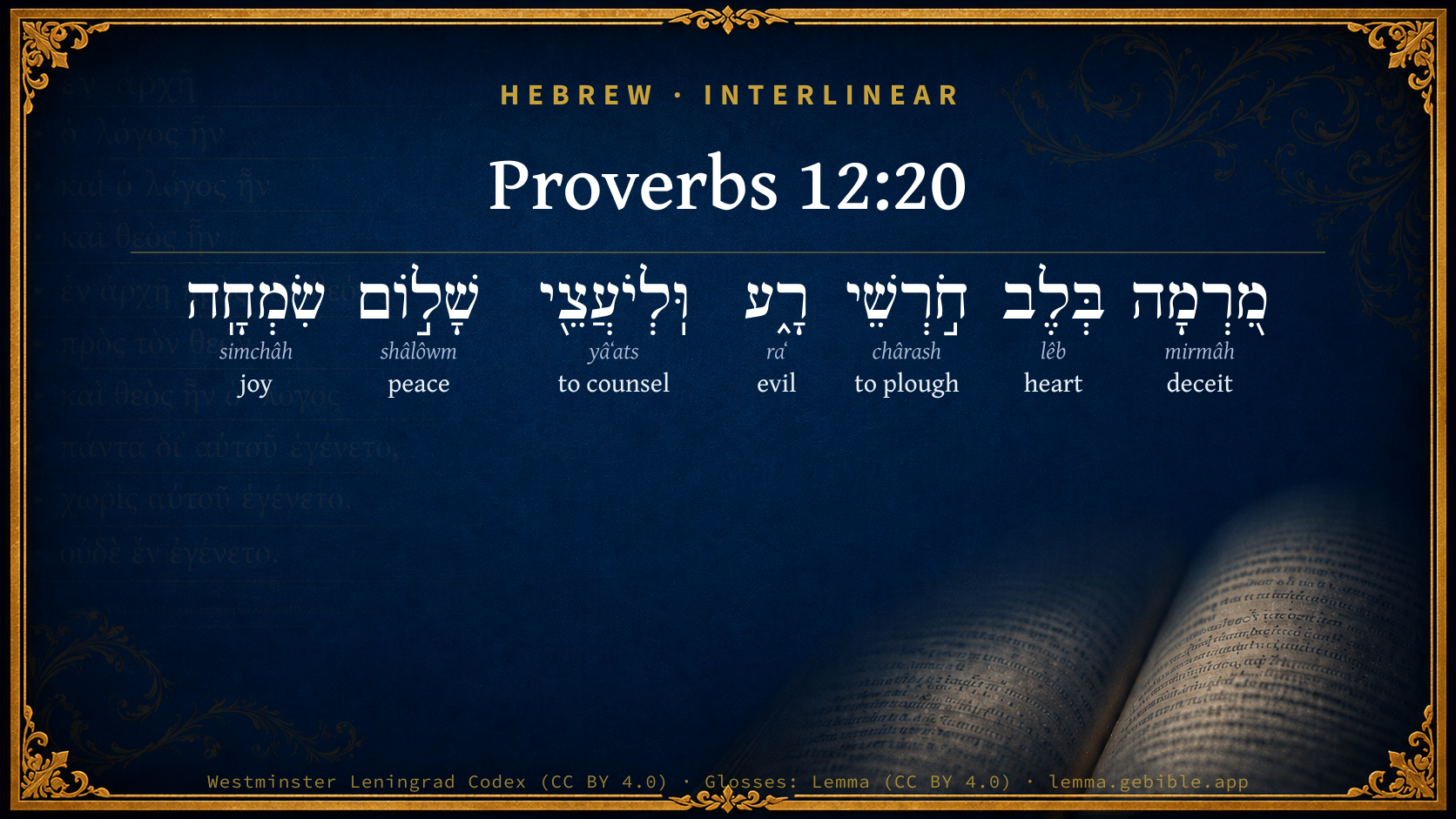
Hebrew (Westminster Leningrad Codex) Proverbs 12:20 appears in the Hebrew Old Testament. The text above is from the Westminster Leningrad Codex. Each word links to its Strong’s number, a concise gloss, and parsing drawn from the Open Scriptures Hebrew Bible morphology. Click any word for its full Brown-Driver-Briggs (BDB) entry.
Download image
Cite this verse

Proverbs 12:20 (World English Bible). Public Domain. Lemma interlinear Bible study tool, https://lemma.gebible.app/v/proverbs/12/20.

Show BibTeX & RIS
BibTeX
RIS
English Translation
Deceit is in the heart of those who plot evil, But joy comes to the promoters of peace.
World English Bible · Public Domain
Download a study sheet

One document with this verse’s original text, its word-by-word gloss line, the meaning frame, cross-references with their text, attributed commentary, and full source and license credits — printable, and it pastes into notes with its structure intact.

This verse Autodidact and up

Study sheet (.html) Plain text (.txt)

A passage Seminary Student

Up to 50 verses in one chapter. A passage sheet keeps up to 6 commentary sources and 12 cross-references per verse, in the order this page ranks them, and says so on the sheet whenever that leaves anything out. Ask for a single verse and you get the Autodidact verse sheet above.

Everything on this page stays free to read, with no account — the sheet is a download of what is already on screen, not access to it.

Want to remove ads? Support Godless Engineer
Compare translations 3

The same verse in 3 English versions, stacked beneath the original-language interlinear above. Click any original word for its lexicon entry.

Each is an independent rendering of the whole verse — the interlinear is not word-aligned to these translations.

Highlighted words mark where these versions differ — a whole-verse word diff, not a word-by-word alignment.

  • World English Bible Public Domain
    Deceit is in the heart of those who plot evil, But joy comes to the promoters of peace.
  • King James Version Public Domain
    Deceit is in the heart of them that imagine evil: but to the counsellors of peace is joy.
  • unfoldingWord Literal Text CC BY-SA 4.0
    Deceit in the heart of devisers of evil, but joy for advisers of peace.

unfoldingWord Literal Text — © unfoldingWord, licensed CC BY-SA 4.0. Word-aligned USFM3 via Door43 (git.door43.org/unfoldingWord/en_ult).

Versions to compare (up to 4)

3 of 4 selected

Show all 18 translations

Every available English version of this verse, each an independent rendering of the whole verse.

  • World English Bible Public Domain
    Deceit is in the heart of those who plot evil, But joy comes to the promoters of peace.
  • Berean Standard Bible Public Domain
    Deceit is in the hearts of those who devise evil, but the counselors of peace have joy.
  • Majority Standard Bible Public Domain
    Deceit is in the hearts of those who devise evil, but the counselors of peace have joy.
  • King James Version Public Domain
    Deceit is in the heart of them that imagine evil: but to the counsellors of peace is joy.
  • American Standard Version (1901) Public Domain
    Deceit is in the heart of them that devise evil; But to the counsellors of peace is joy.
  • Revised Version (1885) Public Domain
    Deceit is in the heart of them that devise evil: but to the counsellors of peace is joy.
  • Geneva Bible (1599) Public Domain
    Deceite is in the heart of them that imagine euill: but to the counsellers of peace shall be ioye.
  • Douay-Rheims (1899) Public Domain
    Deceit is in the heart of them that think evil things: but joy followeth them that take counsels of peace.
  • Young's Literal Translation Public Domain
    Deceit `is' in the heart of those devising evil, And to those counselling peace `is' joy.
  • Literal Standard Version CC BY-SA 4.0
    Deceit [is] in the heart of those devising evil, || But for counselors of peace—joy.
  • Unlocked Literal Bible CC BY-SA 4.0
    There is deceit in the hearts of those who plan to do evil, but joy comes to the advisors of peace.
  • unfoldingWord Literal Text CC BY-SA 4.0
    Deceit in the heart of devisers of evil, but joy for advisers of peace.
  • Darby Bible Public Domain
    Deceit is in the heart of them that devise evil; but to the counsellors of peace is joy.
  • World Messianic Bible Public Domain
    Deceit is in the heart of those who plot evil, but joy comes to the promoters of peace.
  • Webster's Bible Public Domain
    Deceit is in the heart of them that imagine evil: but to the counselors of peace is joy.
  • Free Bible Version CC BY-SA 4.0
    Deceit is in the mind of those planning evil, but those who plan peace have joy.
  • Bible in Basic English Public Domain
    Deceit is in the heart of those whose designs are evil, but for those purposing peace there is joy.
  • JPS Tanakh (1917) Public Domain
    Deceit is in the heart of them that devise evil; but to the counsellors of peace is joy.

Literal Standard Version (2020), Covenant Press — licensed CC BY-SA 4.0. Text via the HelloAO Bible API (eBible.org). Unlocked Literal Bible (unfoldingWord) — licensed CC BY-SA 4.0. Text via the HelloAO Bible API (eBible.org). unfoldingWord Literal Text — © unfoldingWord, licensed CC BY-SA 4.0. Word-aligned USFM3 via Door43 (git.door43.org/unfoldingWord/en_ult). Free Bible Version, Dr. Jonathan Gallagher — licensed CC BY-SA 4.0. Text via the HelloAO Bible API (eBible.org).

Word by word

More ways to search: Search by grammar → Find every occurrence → Compare this word →

Practice this passage: Drill this verse → Learn its vocabulary →

About this verse

These counts appear in no published source. They are computed here, from the morphology-tagged text and Lemma’s own curated glosses. What Lemma adds →

7
words
7
distinct lemmas
Wisdom
section

Shared distinctive vocabulary

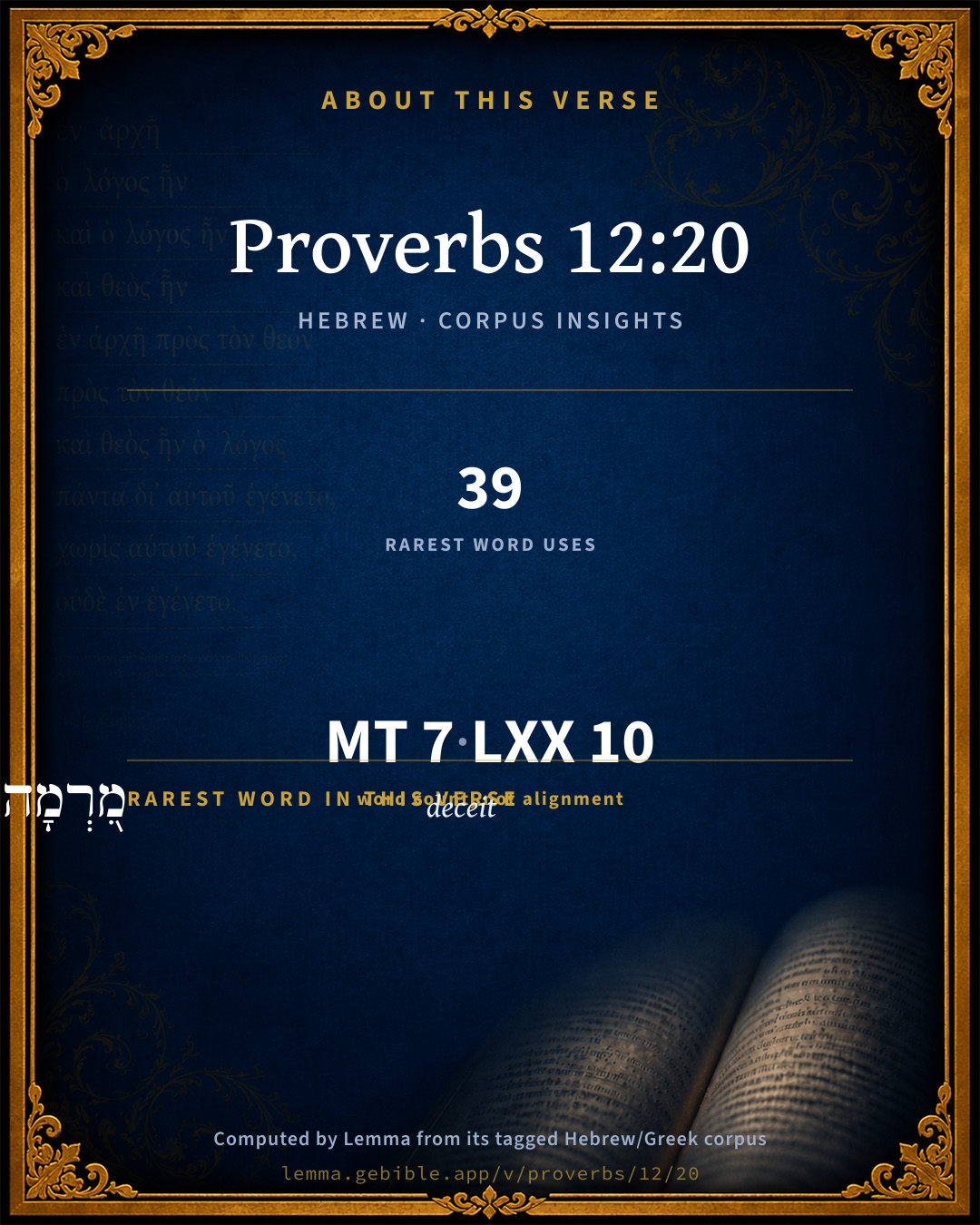
מִ֭רְמָה deceit H4820 occurs in 38 verses of the Hebrew Bible. Also found in:

Grammatical profile

  • 2 verbs
  • 4 nouns
  • 1 adjective

Verb forms

  • חֹ֣רְשֵׁי Qal · Participle Active
  • וּֽלְיֹעֲצֵ֖י Qal · Participle Active

Hebrew & Septuagint length

In English translation the verse runs 18 words from the Hebrew and 18 from the Septuagint (LXX English) — the same length.

A rough comparison of the two English renderings, which tokenize alike — not a word-level alignment.

Word counts can differ between the Hebrew and the Greek without any difference in meaning — e.g. the Hebrew direct-object marker אֵת has no separate Greek word, and Greek often adds the article ὁ.

In the original languages it is 7 Hebrew tokens and 10 Greek tokens — but the two are counted differently (Hebrew bundles its prefixes and suffixes into one token; the Greek is in lemma form), so that isn’t a like-for-like length.

Cross-references

11

Topical passages linked to Proverbs 12:20 in the Treasury of Scripture Knowledge — connected by theme and wording, ordered by reader-vote popularity; previews shown in the World English Bible.

  • Matthew 5:9 Blessed are the peacemakers, For they shall be called children of God.
  • 1 Peter 3:8–13 Finally, be all like-minded, compassionate, loving as brothers, tenderhearted, courteous,
  • Proverbs 12:12 The wicked desires the plunder of evil men, But the root of the righteous flourishes.
  • Proverbs 26:24–26 A malicious man disguises himself with his lips, But he harbors evil in his heart.
  • Jeremiah 17:16 As for me, I have not hurried from being a shepherd after you; neither have I desired the woeful day; you know: that which came out of my lips was before your face.
  • Zechariah 6:13 even he shall build the temple of Yahweh; and he shall bear the glory, and shall sit and rule on his throne; and he shall be a priest on his throne; and the counsel of peace shall be between them both.
  • Mark 7:21–22 For from within, out of the hearts of men, proceed evil thoughts, adulteries, sexual sins, murders, thefts,
  • Hebrews 12:14 Follow after peace with all men, and the sanctification without which no man will see the Lord,
  • Isaiah 9:6–7 For to us a child is born, to us a son is given; and the government shall be on his shoulder: and his name shall be called Wonderful, Counselor, Mighty God, Everlasting Father, Prince of Peace.
  • Mark 12:14–17 When they had come, they asked him, "Teacher, we know that you are honest, and don't defer to anyone; for you aren't partial to anyone, but truly teach the way of God. Is it lawful to pay taxes to Caesar, or not?
  • Romans 1:29 being filled with all unrighteousness, sexual immorality, wickedness, covetousness, maliciousness; full of envy, murder, strife, deceit, evil habits, secret slanderers,

Cross-references courtesy of OpenBible.info (CC BY 4.0).

Hebrew and Greek witnesses Masoretic Hebrew ↔ Greek Septuagint

The same verse in the two great witnesses to the Old Testament, shown verse-for-verse.

These are two independent witnesses, not word-aligned to each other, and the Septuagint is shown in lemma (dictionary) form.

Hebrew Proverbs 12:20 Masoretic · Westminster Leningrad Codex

מִ֭רְמָה בְּלֶב חֹ֣רְשֵׁי רָ֑ע וּֽלְיֹעֲצֵ֖י שָׁל֣וֹם שִׂמְחָֽה

Deceit is in the heart of those who plot evil, But joy comes to the promoters of peace.

World English Bible · Public Domain

Greek LXX Proverbs 12:20 Septuagint · lemma form

δόλος ἐν καρδία τεκταίνω κακός ὁ δέ βούλομαι εἰρήνη εὐφραίνω

There is deceit in the heart of him that imagines evil; but they that love peace shall rejoice.

LXX2012 (modern English Septuagint) · Public Domain

On this verse, The Pulpit Commentary discusses the Septuagint’s reading. Read the note in Commentary ↓

Hebrew: Westminster Leningrad Codex (CC BY 4.0). Greek: Septuagint (public domain); English from LXX2012 (modern English Septuagint) (Public Domain). How the Septuagint differs from the Hebrew →

Commentary

Notes on Proverbs 12:20 from classic Christian and Jewish commentators (each source and its license shown beneath its notes). The classic Christian expositions comment on the surrounding passage and are grouped to its opening verse, so a note may address several verses; the Jewish commentaries on the Tanakh (Rashi and others) are per-verse, so they appear only where the commentator wrote on this verse.

Lemma curates 59 commentaries, every one of them public domain or Creative Commons licensed, each selected and text-cleaned for this edition rather than reprinted as found. About our sources →

Trapp's Complete Commentary

John Trapp

Pro 12:20 Deceit [is] in the heart of them that imagine evil: but to the counsellors of peace [is] joy.

Ver. 20. Deceit is in the heart of them, &c.] Incendiaries and make-baits, counsellors of contention, have twenty devices to make trouble, and to put all into a combustion; but they shall either be defeated of their purposes, or have small joy of their achievements; - witness our late English boutifeaus, with the whole nation of Ignatius, whose practice is to machinate mischief, and breed hate; being herein no less dangerous than once those Jews were, who, before they were banished hence, threw bags of poison into the wells and fountains that the people were to drink from, and so endeavoured to poison them all. The just judgment of God upon Nicholas Saunders, priest, the firebrand of Ireland, 1580 AD, spent with famine and forsaken of all help, is most worthy to be kept in perpetual remembrance. He being impatiently grieved at the evil success of his rebellion with Earl Desmond, and seeing that neither the Pope’s blessing, nor the consecrated banner, nor the plume of phoenix feathers, so said to be at least, sent from Rome, could do him any help, lost himself, and ran stark mad, wandering up and down in the mountains and woods, and, finding no comfort, died miserably. {a} Thus God met with a restless and wretched man, and that foul mouth was stopped with famine that was ever open to sow sedition and stir up rebellions against the state.

But to the counsellors of peace there is joy.] They shall have peace for peace: peace of conscience for peace of country, pax pectoris peace of the heart for pax temporis; peace of time, they shall be called and counted the children of peace, yea, "the children of God," have the comfort and credit of it, {Mat 5:9} {See Trapp on "Mat 5:9"} as Augustus Caesar and our Henry VII had; who as he went into banishment together with the public peace, so he brought it back with him at his return, and was afterwards wont to say, If we princes should take every occasion that is offered, the world should never be quiet, but wearied with continual wars.

{a} Bishop Carleton’s Thankf. Remem., p. 49.

John Trapp, A Commentary or Exposition upon All the Books of the Old and New Testament (1647–1656) — public domain. Text from a community e-Sword module.

The Biblical Illustrator

Joseph S. Exell

Pro_12:20

Deceit is in the heart of them that imagine evil.

A denunciation of wicked men

I. A description of their persons.

1. They are evil-doers, but more especially, the practiser, the artificer in evil; one wholly bent upon sin; the body and mind occupied in executing and acting corrupt desires.

2. Nor is every evil aimed at, but evil in a high degree, evil against others--mischief.

3. This man is subtle in his evil. He is a cunning workman, sly, subtle, and close devising and effecting his mischief. Like a witty handicraftsman, he is most silent when he is most upon his inventions. It is a sign of an extreme wicked man, to be an inventor of evil, a plotter and deviser of mischief. As a coney-catcher lives by his wits, so sin and sinners by their wiles. But whence this?

(1) Satan at first transformed himself into an angel of light; then no marvel if his ministers do so.

(2) They seem just, religious, peaceable, and honest men, knowing that the less they be suspected, the more successful their plots are likely to be.

(3) Never was any mischief more mischievous than that which is veiled with good pretences of peace or religion.

II. The condition of these persons. Their deceit returns into the heart that first hatched it, i.e., brings certain woe and unavoidable mischief on themselves, to the breaking of their own hearts. Whence note, that the greatest workers of sin and mischief are greatest workers of their own woe.

1. There is no small heaviness and unquietness in the heart while it is plotting and hammering evil.

2. Whomsoever they deceive, they cannot deceive God, who will make them the greatest deceivers of themselves.

3. How just it is, that what pleasure they conceive in inventing mischief, they should lose it by the fruit of their mischievous inventions.

4. Sin is a sure paymaster, and her wages are death.

5. The sorrow of their sin comes with much and daily addition, and pierces the mans heart as a sword. Beware of devising mischief against the Church of God, His servants and holy religion. Consider hereunto--

(1) The power of God, which all wicked men together are not able to resist.

(2) The wisdom of God, who hath seven eyes, and all upon the Church for good.

(3) The justice of God, with whom it is righteous that wicked men in devising mischief should provide their own rods.

(4) Evil men lay all their plots on a sandy and slippery foundation, which will bring down all the house and frame on their own heads. Let not good men be disquieted at any such plots, which shall all redound upon their enemies themselves. (T. Taylor.)

Self-deceit

The word rendered deceit may be understood as including deceit practised on a mans self as well as on others, and here it may have the sense of self-deceit. Eminent translators have rendered the word, in its present connection, disappointment; frustrated hope. Those who imagine evil dare not avow their designs. Dissimulation and craft are productive of incessant apprehension and anxiety. They necessarily engender self-dissatisfaction and tremor, and that from the very dread of detection, frustration, and consequent evil to themselves, instead of to those against whom they were plotting. (R. Wardlaw.)

The Biblical Illustrator, edited by Joseph S. Exell (c. 1880s–1900s) — public domain. Text from a community e-Sword module.

Joseph Benson's Commentary

Pro 12:20-21. Deceit is in the heart of them that imagine evil — Either, 1st, Deceit toward others, whom they design to deceive, and then to destroy, while good counsellors bring safety and joy to others: or, rather, 2d, To themselves. So the sense of the verse is, They whose hearts devise mischief against others, shall be deceived in their hopes, and bring that trouble upon themselves which they design against others: but they who, by good counsels, labour to promote the peace and happiness of others, shall reap the comfort and benefit of it themselves. There shall no evil happen to the just — Either of sin or suffering, as the next clause explains this: no such evil shall befall them as commonly befalls the wicked, who are overwhelmed, or utterly destroyed by it; whereas good men are supported under their troubles, and shall be delivered out of them, and receive much benefit by them.

Joseph Benson's Commentary on the Old and New Testaments (1811–1818) — public domain. Text from a community e-Sword module.

The Preacher's Complete Homiletical Commentary

Joseph S. Exell (gen. ed.)

CRITICAL NOTES.—

Pro_12:20. Delitzsch reads, “cause joy.”

MAIN HOMILETICS OF Pro_12:20

JOY FROM PEACE

I. There must be counsel if there is to be peace. There can be no peace either in a soul, a family, or a nation, where there is no counsel given and taken. There must be some centre of authority and rule whence counsel issues, if there is to be any order, and where there is no order there can be no peace. The peace of the text must be peace based upon righteousness, indeed all that bears the name that is not built upon this foundation, is false and transitory. It is like that house built upon the sand, which, when the winds come, is swept away, although it may look like a solid structure on a summer day. It is “the work of righteousness,” that “shall be peace, and the effect of righteousness, quietness and assurance for ever.” “The mountains shall bring peace … by righteousness (Psa_72:3; Isa_32:17).

II. Where there is true peace by righteousness there will be joy. Joy is the overflow of peace. Peace is like a river flowing tranquilly between its banks, and joy is like the same river when there is such a volume of water that it overflows the banks. When there is “an abundance of peace” in a soul, or a family, or a nation, it must overflow into joy—it must take a more active form. (The subject of the first clause of this verse has been treated before. See on Pro_12:5).

OUTLINES AND SUGGESTIVE COMMENTS

That deceit is in the heart of him who deviseth evil appears to be a platitude, for the devising is directed against a neighbour. But, in the first place, it says that the evil which a man hatches against another always issues in a fraudulent malicious deception of the same; and, secondly, it says, when taken into connection with the second clause, that with the deception he always at the same time prepares for him sorrow. The contrast denotes not those who give counsel to contending parties to conclude peace, but such as devise peace—viz., in reference to the neighbour, for the word means not merely to impart counsel, but also mentally to devise, to resolve upon, to decree. Hitzig and Zöckler give to peace the general idea of welfare, and interpret joy as the inner joy of a good conscience. But as the deception in the first clause is not self-deception, but the deception of another, so the joy is not that which men procure for others. Thoughts of peace for one’s neighbour are always thoughts of procuring joy for him, as thoughts of evil are thoughts of deceit; and thus of procuring sorrow for him.—Delitzsch.

Evil counsel most hurteth those that give it. By deceit is here meant a deceitful reward; or an issue of a matter deceiving a man’s expectation.—Muffet.

They shall have peace for peace; peace of conscience for peace of country; pax pectoris for pax temporis. They shall be called and counted the children of peace; yea, the children of God.—Trapp.

First, no man can soundly seek to reconcile man to God, or one man to another, or give direction for his neighbour’s welfare, unless he himself be reconciled to God, and peaceable towards men, and have Christian love in his heart, and these graces are never separated from holy comfort and gladness. For the same sap that sendeth forth the one, doth in like manner also yield the other, as the apostle testifieth (Gal_5:22; Rom_14:17). Secondly, if their counsel be embraced and followed, the good effect thereof, with God’s blessing, besides thanks and kindness which the parties holpen by their counsel, will yield to them; as David to Abigail, and Naaman to Elisha, etc. Thirdly, though their advice be rejected, yet, as Isaiah saith, their reward is with the Lord, and they shall be glorious in His eyes (Isa_49:4-5).—Dod.

Deceit is in the heart (or cometh back to the heart) of them that imagine evil (or practise mischief).

I. The persons are described. They are evil-doers, but not every evil-doer, but the practiser, the trader, the artificer in evil, one wholly bent upon sin, not every bungler or beginner, but an expert workman, that can despatch more business of sin in one day than some other in a month or a year. Nor is every evil here aimed at, but evil against others—mischief. Many evil men are only greatest enemies to themselves, intent to serve and satisfy their own lusts; but these with whom we have now to do, always have evil in their hearts or hands, in their consultations and executions, whereby to hurt others. Again, this man in our text is subtle in evil; as he is a cunning workman and active in high designs of evil, so he carrieth his business as subtilely, for which the whole work carries in the original the name of deceit, pretending all fair weather, as still water is deepest and most dangerous, or like a waterman that looks one way and rows another.

II. The condition of these persons. Their deceit returns to them that first hatched it; that is, brings unavoidable mischief on themselves.

1. There is no small unquietness in the heart, while it is plotting evil.

2. Whomsoever they deceive, they cannot deceive God, who will make them deceivers of themselves (See Job_5:12-13).

3. Whereas sin is a sure paymaster, and the wages death, the sin of these men must needs slay them and play the part both of an officer to apprehend them, of a gaoler to hold them, and of an executioner to bring them to shameful death.—Thos. Taylor, 1650.

The Preacher's Complete Homiletical Commentary (gen. ed. Joseph S. Exell; Funk & Wagnalls, c. 1892) — public domain (pre-1929). A full-Bible homiletical/sermon-outline anthology covering 65 of 66 books (2 John is absent from the source module). Text from a community e-Sword module.

Matthew Henry's Commentary

Note, 1. Those that devise mischief contrive, for the accomplishing of it, how to impose upon others; but it will prove, in the end, that they deceive themselves. Those that imagine evil, under colour of friendship, have their hearts full of this and the other advantage and satisfaction which they shall gain by it, but it is all a cheat. Let them imagine it ever so artfully, deceivers will be deceived. 2. Those that consult the good of their neighbours, that study the things which make for peace and give peaceable advice, promote healing attempts and contrive healing methods, and, according as their sphere is, further the public welfare, will have not only the credit, but the comfort of it. They will have joy and success, perhaps beyond their expectation. Blessed are the peace-makers.

Matthew Henry's Commentary on the Whole Bible (1708–1710) — public domain (CC PDM 1.0). Text via the HelloAO Bible API.

Jamieson, Fausset & Brown

Robert Jamieson, A. R. Fausset & David Brown

that imagine--or, "plan" (Pro 3:29). They design a deceitful course, to which, with all its evils and dangers to others and themselves, the happiness of peace-makers is opposed (compare Mat 5:9; Rom 12:18).

Jamieson, Fausset & Brown — Commentary Critical and Explanatory on the Whole Bible (1871) — public domain (CC PDM 1.0). Text via the HelloAO Bible API.

Ellicott's Commentary for English Readers

(20) Deceit is in the heart . . .—Those who plot and devise evil against others begin by deceiving them, and end by deceiving themselves also; whereas the “counsellors of peace,” who seek the good of their neighbours, bring joy to them and to themselves also through the satisfaction derived from a good conscience.

A Bible Commentary for English Readers, edited by Charles John Ellicott (1878–1897) — public domain. Text from a community e-Sword module.

John Gill's Exposition

Deceit is in the heart of them that imagine evil,.... That secretly devise mischief in their hearts against their neighbours; that plough evil, as the word (g) signifies, and sow discord among men; and by many artful and deceitful methods promote contention and division, in order to answer some base designs of theirs; but sooner or later they are deceived themselves, are disappointed of their views, the consequence of which is vexation and sorrow;

but to the counsellors of peace is joy: such who consult the good of others, who advise to peace, concord, and unity; who seek to cultivate it in their families and neighbourhoods, and in the church of God, in which, if they succeed, they have joy and pleasure; if not, they have a satisfaction, in their own minds and consciences that they have done what is right and good; such have a conscience peace now, and an eternal one hereafter; or, as Aben Ezra calls it, the joy of salvation; see Mat 5:9.

(g)

John Gill's Exposition of the Whole Bible (1746–1763) — public domain (CC PDM 1.0). Text via the HelloAO Bible API.

Albert Barnes' Notes on the Bible

The “deceit” of “those who imagine evil” can work nothing but evil to those whom they advise. The “counselors of peace” have joy in themselves, and impart it to others also.

Albert Barnes' Notes on the Bible (1834–1885) — public domain. Text from a community e-Sword/MySword module.

Haydock's Catholic Bible Commentary

Deceit. Or uneasiness. (Calmet) --- Honi soit qui mal y pense: "let him be covered with shame who thinks evil in it," seems nearly the same import. (Haydock)

George Leo Haydock (1774–1849), Haydock's Catholic Family Bible and Commentary, 1859 edition — public domain. Excludes Psalms (Douay-Rheims chapter numbering differs from Protestant) and Deuterocanonical books (Catholic canon only).

Matthew Poole's English Annotations

Deceit; either,

1. Towards others, whom they design to deceive, and then to destroy, whilst good counsellors bring safety and joy to others. Or rather,

2. To themselves. So the sense of the verse is, They whose hearts devise mischief against others shall be deceived in their hopes, and bring that trouble upon themselves which they design against others; but they who by good counsels labour to promote the peace and happiness of others, shall reap the comfort and benefit of it to themselves.

Matthew Poole's English Annotations on the Holy Bible (1683–1685) — public domain. Text from a community e-Sword/MySword module.

Whedon's Commentary on the Bible

Daniel D. Whedon

20. Deceit — “Delusion.” — Miller.

Imagine evil — Fabricators or advisers of evil.

Counsellors of peace — Those who give wholesome advice.

Daniel D. Whedon (gen. ed.), Commentary on the Old and New Testaments (1874–1909) — public domain. Text from a community e-Sword module.

The Pulpit Commentary

Deceit is in the heart of them that imagine evil; i.e. that give evil advice; such are treacherous counsellors, and their advice can only work mischief, not joy and comfort. (see on Pro_3:29) But to the counsellors of peace (health and prosperity) is joy. They who give wholesome advice diffuse joy around. Vulgate, "Joy attends them;" Septuagint, "They shall be glad;" but the original signifies rather to cause joy than to feel it.

The Pulpit Commentary (1880–1919), ed. H.D.M. Spence-Jones & Joseph S. Exell — public domain. Text from a community e-Sword module.

John Wesley's Explanatory Notes

Deceit - They whose hearts devise mischief shall be deceived in their hopes, and bring trouble upon themselves: but they who by good counsels labour to promote peace, shall reap the comfort of it themselves.

John Wesley, Explanatory Notes Upon the Whole Bible (1754–1765) — public domain. Text via the GEBible commentary corpus.

Keil & Delitzsch

C. F. Keil & F. Delitzsch

20 Deceit is in the heart of him who deviseth evil,

But those who devise peace cause joy.

Regarding the figure of forging, fabricating (lxx, Aquila, Symmachus, and Theodotion, τεκταίνειν), or of ploughing, which underlies the phrase חרשׁ רע, moliri malum, vid., at Pro 3:29. That deceit is in the heart of him who deviseth evil (בּלב־חרשׁי רע, as is correctly punctuated e.g., by Norzi) appears to be a platitude, for the חרשׁ רע is as such directed against a neighbour. But in the first place, 20a in itself says that the evil which a man hatches against another always issues in a fraudulent, malicious deception of the same; and in the second place, it says, when taken in connection with 20b, where שׂמחה is the parallel word to מרמה, that with the deception he always at the same time prepares for him sorrow. The contrast to חרשׁי רע is יועצי שׁלום si ח, and thus denotes not those who give counsel to contending parties to conclude peace, but such as devise peace, viz., in reference to the neighbour, for יעץ means not merely to impart counsel, but also mentally to devise, to resolve upon, to decree, Ch2 25:16; Isa 32:7.; cf. יעץ על, Jer 49:30. Hitzig and Zckler give to שׁלום the general idea of welfare (that which is salutary), and interpret the שׂמחה as the inner joy of the good conscience. Certainly שלום (R. של, extrahere, in the sense of deliverance from trouble) means not only peace as to the external relationship of men with each other, but also both internal and external welfare. Thus it is here meant of external welfare; Hitzig rightly compares Jer 29:11 with Nah 1:11 to the contrast between שׁלום and רע. But as מרמה is not self-deception, but the deception of another, so also שׂמחה is not the joy of those who devise the device in their hearts for the deception of others, but the joy they procure for others. Thoughts of peace for one's neighbour are always thoughts of procuring joy for him, as thoughts of evil are thoughts of deceit, and thus of procuring sorrow for him. Thus וליועצי is an abbreviated expression for ובלב יועצי.

Keil & Delitzsch — Biblical Commentary on the Old Testament (1861–1891) — public domain (CC PDM 1.0). Text via the HelloAO Bible API. (Old Testament only.)

Bridges on Proverbs

Charles Bridges

The principle of deceit is here traced to its fountain — the heart. How early it is found there, the first lispings of infancy too plainly prove. A lie is ready upon the child’s lips, when the temptation is presented to it; though nothing is to be gained by it, but the hateful pleasure of sin. Yet though deceit is the native fruit of the heart, all are not equally ready in imagining evil — "inventors of evil things." (Pro 14:22 . Mic 2:1 .) The principle is not equally active, or equally developed in all. But when it does operate, the wicked are filled with mischief, and reap the full harvest in disappointment and ruin. (Est 7:10 . Job 5:12-13 .)

How frightful also is it to remark the outward expression of deceit in lying lips! Diversified indeed are its forms — falsehood, exaggeration, coloring, willful perversion, wrong impressions produced or encouraged.†1 No part of Christian Education is more important, than the training of children in the deepest reverence for the simplicity of truth. Dr. Johnson has well observed, that the prevalence of falsehood arises more from carelessness about truth, than from intentional lying. If a child was relating what he had seen in the street, ’do not’ — he advises — ’suffer him to say, that he had seen it out of one window, if he has seen it out of another.’ Let them know that every willful deviation from strict accuracy bears the stamp of lying lips, which are (and let the sentence be pondered, not only by children, but by all†2) an abomination to the LORD. (Pro 6:16-17 . Psa 5:6 .) With this sin were Ananias and Sapphira hurried into eternity. (Act 5:1-10 .) The willful liar proves his parentage (Joh 8:44 ), and will be classed in eternity with all that is hateful. And fearfully will a righteous God, even in forgiving his own child, "take vengeance of his inventions."†3

Here however is peace — the contrast to evil inventions: and, instead of that sorrow which is connected with deceit (Judges 9. 2Sa 15:6 ; 2Sa 18:15 ), to them that "seek and pursue it," there is joy. Thus doubtless did Jonathan and Abigail rejoice in the success of their good counsels. (1Sa 19:4-7 ; 1Sa 25:23-32 .) And most responsible is the obligation of Christians to be counselors of peace, breathing their Master’s spirit of peace and love. (Col 3:14-15 .) A blessed office indeed is it! pouring in the balm of peaceful counsel upon irritated feeling. They will mediate, explain, and cover with considerate prudence all the little causes of excitement. They will bring out the strong and unchangeable obligations of Christian love. They will seize the happy moment of softening to rekindle confidence. Happy indeed are they, in the joy of their own conscience, in their dignity as "the children of God" (Mat 5:9 ), in the rich harvest of their Christian exertions. (Jas 3:17-18 .) Instead of being filled with mischief, no evil shall happen to them. Evil, whenever permitted, will become their good. (Rom 8:28 .) They shall be supported in it,†4 delivered out of it,†5 sanctified by it.†6 Its sharpness will pierce their corruptions. Its bitterness will wean them from the creature. Its furnace will mold them into the image of their Lord. Thus, what to the ungodly would be a mass of sorrow, to the just becomes a world of blessing.

Freedom from deceit is their broad mark in the promiscuous crowd. They not only speak, but they deal truly: uniform in light and life. (Joh 3:21 .) They bear the image of a God of truth, and he delights in them. (Pro 11:1 .) "They are children that cannot lie. So he is their Saviour." (Isa 63:8 ; Isa 33:15-16 .)

Footnotes:

†1 ’As one common but most responsible instance of this,’ (observes Mr. Goode in his valuable Sermon on this text), ’is instructing servants to say — ’Not at home.’ Great is their guilt, who thus tempt a fellow-creature to utter a palpable untruth for the paltry convenience of a master. No Christian servant will consent to defile his conscience by acquiescing in any such iniquity. ’It is a matter of common consent, and every one understands it.’ Be it so — it is untruth still, and lying lips are abomination to the LORD. Moreover, if it be so generally understood, and admitted without offense; then how much more honourable and Christian to say at once — ’We are engaged. We wish to be alone!’ Who that accepts one excuse, will not readily accept the other!’ Compare Sir 7:13 .

†2 Lavater in loco.

†3 Psa 99:8. Compare the example of Jacob, Genesis 27. With Gen 37:31-35 . David’s He punished with such dreadful results, 1Sa 21:2 ; 1Sa 22:18-19 .

†4 1Co 10:13 . 2Co 12:7-10 .

†5 Pro 12:13. Psa 34:19 .

†6 Psa 119:67, Psa 119:71 .

Charles Bridges, An Exposition of the Book of Proverbs (1846) — public domain. Text from a community e-Sword module.

Kretzmann's Popular Commentary

Paul E. Kretzmann

v. 20. Deceit is in the heart of them that imagine evil, for they can rarely carry out their evil intentions without malignity and deceit; but to the counselors of peace is joy, those who give wholesome counsel, and the peacemakers, cause rejoicing.

Paul E. Kretzmann, Popular Commentary of the Bible (1921–1924) — public domain. Text from a community e-Sword module.

Rashi

Rabbi Shlomo Yitzchaki (Rashi)

There is deceit in the heart of those who plot evil and since they are occupied with their thoughts of deceit, they have no joy—but for the counselors of peace, there is joy.

Rashi on the Tanakh — English translations: “The Judaica Press complete Tanach with Rashi, translated by A. J. Rosenberg” (CC BY 4.0); “Pentateuch with Rashi's commentary by M. Rosenbaum and A.M. Silbermann, 1929-1934” (public domain); “The Metsudah Tanach series, Lakewood, N.J” (CC BY 4.0); and “The Book of Joshua, Metsudah Publications, 1997” (CC BY 4.0). Text via Sefaria.

Lesson kit

Teaching starters — assembled from the data on this page, not authored interpretation. Every prompt links to the verse data it draws on. Edit before teaching.

Proverbs, in the Wisdom, opens this verse with 7 words (7 distinct Hebrew lemmas). Its most distinctive word is mirmâh (“deceit”). A historical commentator’s framing appears above. Read the whole chapter for the surrounding context.

Discussion questions

  1. What does “deceit” (mirmâh) contribute to the verse as a whole?
  2. Genesis 27:35 shares the word «deceit» with this verse. How do the two illuminate each other?
  3. These translations render this verse differently. What is at stake in choosing one wording over another?
  4. The verb «חֹ֣רְשֵׁי» is Qal Participle Active. How does its form color the action?
  5. Reading how Trapp's Complete Commentary and The Biblical Illustrator read this verse, where do the two commentators agree and where do they part?

Things to notice

Reading settings

Reading text

Shown beneath each verse's original-language words.

Old Testament
Old Testament edition

Read the OT as the Masoretic Hebrew (MT) or the Greek Septuagint (LXX).

English shown for the Greek Septuagint (in the Hebrew ↔ Greek comparison).

Comparing translations? Open the Compare panel on any verse page to stack up to four side by side.