
Psalms 128:6

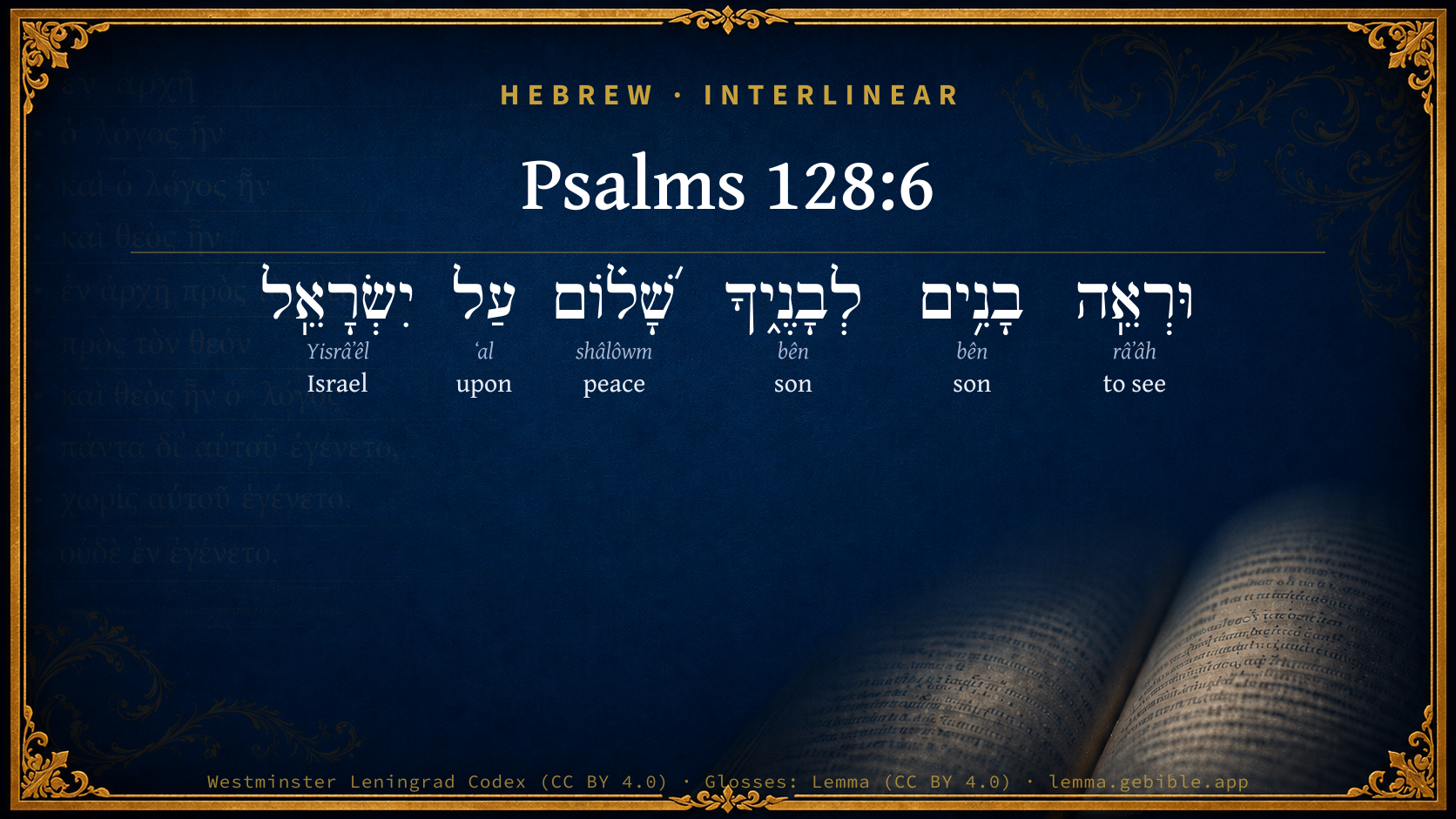
Hebrew (Westminster Leningrad Codex) Psalms 128:6 appears in the Hebrew Old Testament. The text above is from the Westminster Leningrad Codex. Each word links to its Strong’s number, a concise gloss, and parsing drawn from the Open Scriptures Hebrew Bible morphology. Click any word for its full Brown-Driver-Briggs (BDB) entry.
Download image
Cite this verse

Psalms 128:6 (World English Bible). Public Domain. Lemma interlinear Bible study tool, https://lemma.gebible.app/v/psalms/128/6.

Show BibTeX & RIS
BibTeX
RIS
English Translation
Yes, may you see your children's children. Peace be upon Israel.
World English Bible · Public Domain
Download a study sheet

One document with this verse’s original text, its word-by-word gloss line, the meaning frame, cross-references with their text, attributed commentary, and full source and license credits — printable, and it pastes into notes with its structure intact.

This verse Autodidact and up

Study sheet (.html) Plain text (.txt)

A passage Seminary Student

Up to 50 verses in one chapter. A passage sheet keeps up to 6 commentary sources and 12 cross-references per verse, in the order this page ranks them, and says so on the sheet whenever that leaves anything out. Ask for a single verse and you get the Autodidact verse sheet above.

Everything on this page stays free to read, with no account — the sheet is a download of what is already on screen, not access to it.

Want to remove ads? Support Godless Engineer
Compare translations 3

The same verse in 3 English versions, stacked beneath the original-language interlinear above. Click any original word for its lexicon entry.

Each is an independent rendering of the whole verse — the interlinear is not word-aligned to these translations.

Highlighted words mark where these versions differ — a whole-verse word diff, not a word-by-word alignment.

  • World English Bible Public Domain
    Yes, may you see your children's children. Peace be upon Israel.
  • King James Version Public Domain
    Yea, thou shalt see thy children's children, and peace upon Israel.
  • unfoldingWord Literal Text CC BY-SA 4.0
    and that you may see sons to your sons. Peace upon Israel!

unfoldingWord Literal Text — © unfoldingWord, licensed CC BY-SA 4.0. Word-aligned USFM3 via Door43 (git.door43.org/unfoldingWord/en_ult).

Versions to compare (up to 4)

3 of 4 selected

Show all 17 translations

Every available English version of this verse, each an independent rendering of the whole verse.

  • World English Bible Public Domain
    Yes, may you see your children's children. Peace be upon Israel.
  • Berean Standard Bible Public Domain
    that you may see your children’s children. Peace be upon Israel!
  • Majority Standard Bible Public Domain
    that you may see your children’s children. Peace be upon Israel!
  • King James Version Public Domain
    Yea, thou shalt see thy children's children, and peace upon Israel.
  • American Standard Version (1901) Public Domain
    Yea, see thou thy children's children. Peace be upon Israel. Psalm 129 A Song of Ascents.
  • Revised Version (1885) Public Domain
    Yea, thou shalt see thy children’s children. Peace be upon Israel.
  • Geneva Bible (1599) Public Domain
    Yea, thou shalt see thy childrens children, and peace vpon Israel.
  • Young's Literal Translation Public Domain
    And see the sons of thy sons! Peace on Israel!
  • Literal Standard Version CC BY-SA 4.0
    And see the sons of your sons! Peace on Israel!
  • Unlocked Literal Bible CC BY-SA 4.0
    May you live to see your children's children. May peace be on Israel.
  • unfoldingWord Literal Text CC BY-SA 4.0
    and that you may see sons to your sons. Peace upon Israel!
  • Darby Bible Public Domain
    And see thy children's children. Peace be upon Israel!
  • World Messianic Bible Public Domain
    Yes, may you see your children’s children. Peace be upon Israel.
  • Webster's Bible Public Domain
    Yes, thou shalt see thy children's children, and peace upon Israel.
  • Free Bible Version CC BY-SA 4.0
    May you see your children's children. May Israel be at peace!
  • Bible in Basic English Public Domain
    May you see your children's children. Peace be on Israel.
  • JPS Tanakh (1917) Public Domain
    And see thy children's children. Peace be upon Israel!

Literal Standard Version (2020), Covenant Press — licensed CC BY-SA 4.0. Text via the HelloAO Bible API (eBible.org). Unlocked Literal Bible (unfoldingWord) — licensed CC BY-SA 4.0. Text via the HelloAO Bible API (eBible.org). unfoldingWord Literal Text — © unfoldingWord, licensed CC BY-SA 4.0. Word-aligned USFM3 via Door43 (git.door43.org/unfoldingWord/en_ult). Free Bible Version, Dr. Jonathan Gallagher — licensed CC BY-SA 4.0. Text via the HelloAO Bible API (eBible.org).

Word by word

More ways to search: Search by grammar → Find every occurrence → Compare this word →

Practice this passage: Drill this verse → Learn its vocabulary →

About this verse

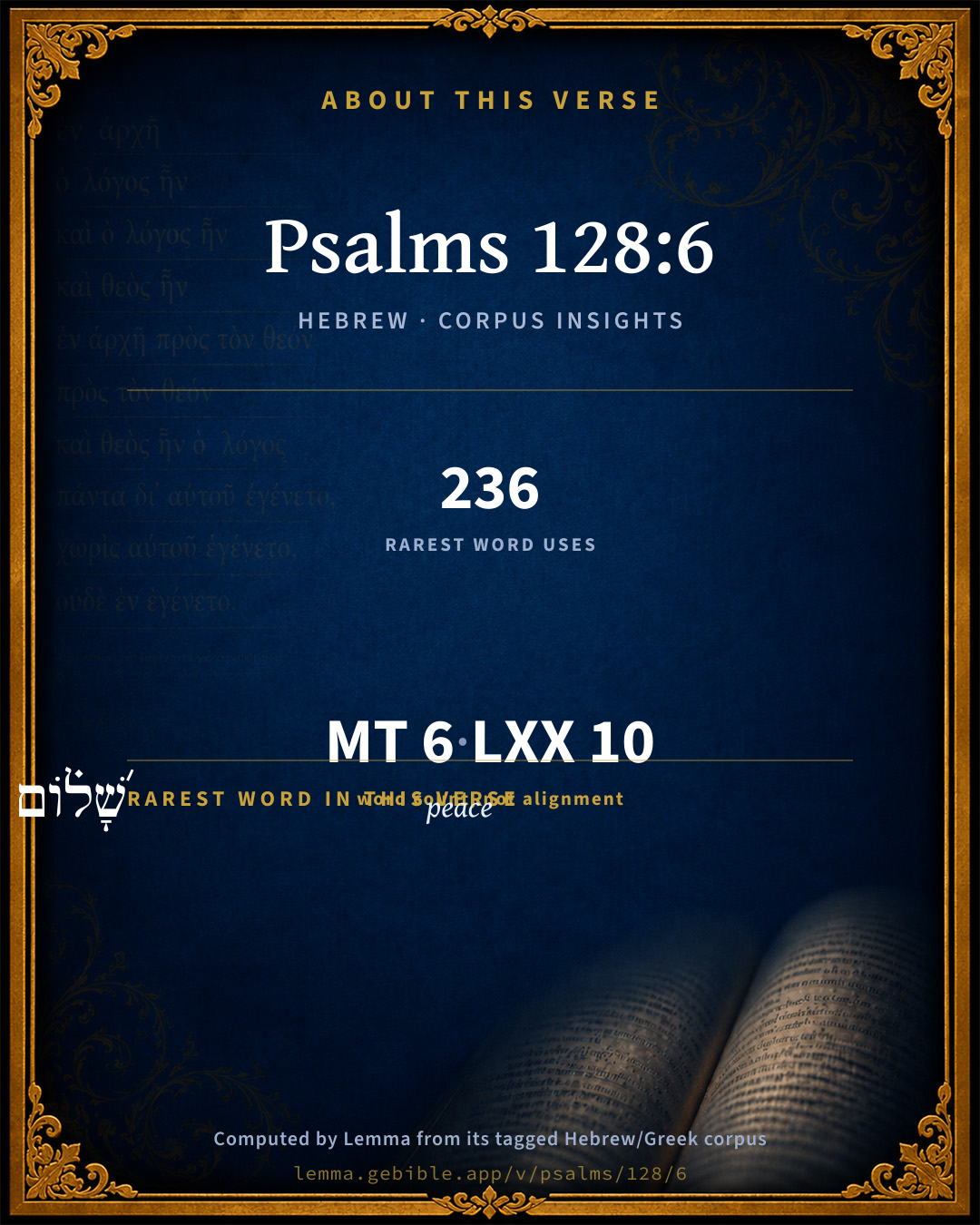
These counts appear in no published source. They are computed here, from the morphology-tagged text and Lemma’s own curated glosses. What Lemma adds →

6
words
5
distinct lemmas
Wisdom
section

Grammatical profile

  • 1 verb
  • 4 nouns
  • 1 preposition

Verb forms

  • וּרְאֵֽה Qal · Imperative

Repetition

A word recurs within this verse — often emphatic in Hebrew:

  • בָנִ֥ים son H1121 ×2

Hebrew & Septuagint length

In English translation the verse runs 11 words from the Hebrew and 11 from the Septuagint (LXX English) — the same length.

A rough comparison of the two English renderings, which tokenize alike — not a word-level alignment.

Word counts can differ between the Hebrew and the Greek without any difference in meaning — e.g. the Hebrew direct-object marker אֵת has no separate Greek word, and Greek often adds the article ὁ.

In the original languages it is 6 Hebrew tokens and 10 Greek tokens — but the two are counted differently (Hebrew bundles its prefixes and suffixes into one token; the Greek is in lemma form), so that isn’t a like-for-like length.

Cross-references

6

Topical passages linked to Psalms 128:6 in the Treasury of Scripture Knowledge — connected by theme and wording, ordered by reader-vote popularity; previews shown in the World English Bible.

  • Job 42:16 After this Job lived one hundred forty years, and saw his sons, and his sons' sons, to four generations.
  • Genesis 50:23 Joseph saw Ephraim's children to the third generation. The children also of Machir, the son of Manasseh, were born on Joseph's knees.
  • Isaiah 66:12 For thus says Yahweh, Behold, I will extend peace to her like a river, and the glory of the nations like an overflowing stream: and you shall suck [of it]; you shall be borne on the side, and shall be dandled on the knees.
  • Psalms 125:5 But as for those who turn aside to their crooked ways, Yahweh will lead them away with the workers of iniquity. Peace be on Israel.
  • Proverbs 17:6 Children's children are the crown of old men; The glory of children are their parents.
  • Galatians 1:16 to reveal his Son in me, that I might preach him among the Gentiles, I didn't immediately confer with flesh and blood,

Cross-references courtesy of OpenBible.info (CC BY 4.0).

Hebrew and Greek witnesses Masoretic Hebrew ↔ Greek Septuagint

The same verse in the two great witnesses to the Old Testament, shown verse-for-verse.

You’re reading Greek Psalm 127 (Hebrew Psalm 128). The Septuagint counts the superscription, so verse numbers can differ from the Hebrew — chapter-level alignment, not verse-by-verse. Numbering follows Rahlfs.

These are two independent witnesses, not word-aligned to each other, and the Septuagint is shown in lemma (dictionary) form.

Hebrew Psalms 128:6 Masoretic · Westminster Leningrad Codex

וּרְאֵֽה בָנִ֥ים לְבָנֶ֑יךָ שָׁ֝ל֗וֹם עַל יִשְׂרָאֵֽל

Yes, may you see your children's children. Peace be upon Israel.

World English Bible · Public Domain

Greek LXX Greek Psalm 127:6 Septuagint · lemma form

καί ὁράω υἱός ὁ υἱός σύ εἰρήνη ἐπί ὁ ἰσραήλ

And may you see your children's children. Peace be upon Israel.

LXX2012 (modern English Septuagint) · Public Domain

Hebrew: Westminster Leningrad Codex (CC BY 4.0). Greek: Septuagint (public domain); English from LXX2012 (modern English Septuagint) (Public Domain). How the Septuagint differs from the Hebrew →

Commentary

Notes on Psalms 128:6 from classic Christian and Jewish commentators (each source and its license shown beneath its notes). The classic Christian expositions comment on the surrounding passage and are grouped to its opening verse, so a note may address several verses; the Jewish commentaries on the Tanakh (Rashi and others) are per-verse, so they appear only where the commentator wrote on this verse.

Lemma curates 59 commentaries, every one of them public domain or Creative Commons licensed, each selected and text-cleaned for this edition rather than reprinted as found. About our sources →

Trapp's Complete Commentary

John Trapp

Psa 128:6 Yea, thou shalt see thy children’s children, [and] peace upon Israel.

Ver. 6. Yea, thou shalt see thy children’s children] A faithfid man shall abound with blessings, Pro 28:20, he shall have all that heart can wish or need require.

And peace upon Israel] Procured in part by thy piety and prayers.

John Trapp, A Commentary or Exposition upon All the Books of the Old and New Testament (1647–1656) — public domain. Text from a community e-Sword module.

J. A. Alexander on Psalms

Joseph Addison Alexander

6. (Psa 128:6) And see thou sons to thy sons. Peace (be) upon Israel! The first clause is a virtual promise of long life—thou shalt see thy children's children. An interesting parallel is furnished by Zec 8:4, the whole of which chapter is, indeed, a prophetic commentary on this psalm. For the meaning of the last clause see above, on Psa 125:5.

Joseph Addison Alexander, The Psalms Translated and Explained (1850) — public domain. Text from a community e-Sword module.

Adam Clarke's Commentary

Verse 6. Yea, thou shalt see thy children's children] Thou shall not die till thou have seen thy family all settled in the world, and those of them who may be married blessed with children.

And peace upon Israel.] This is the same conclusion as in Ps 125:5; and should be translated, Peace be upon Israel! May God favour his own cause, and bless all his people!

ANALYSIS OF THE HUNDRED AND TWENTY-EIGHTH PSALM

In this Psalm the prophet persuades men to fear God upon the several rewards that attend upon piety.

It is divided into three parts.

I. He describes the pious man, and pronounces him blessed, Ps 128:1.

II. He proposes the particulars of his blessing, Ps 128:2-6.

III. He gives his acclamation to it, Ps 128:4.

I. He describes the man who is to expect the blessing. Two qualities he must have: -

1. He must "fear the Lord." Fear, and not decline from him.

2. He must "walk in his ways." This is the true character of his fear.

3. This man shall be "blessed." Whether rich or poor, high or low; all such shall experience the blessing of the Lord.

II. And the blessedness consists in three particulars.

1. He shall enjoy those goods he has honestly obtained with his hands: "For thou shalt eat the labour of thine hands:" his happiness consists not in having much, but in enjoying what he has.

2. "Happy shalt thou be," &c. Able to help others, and leave to thy children.

3. Happy he shall be in his marriage, if his choice be prudent, and in the Lord: 1. "His wife shall be," &c. Fetifera, non sterilis. 2. Upon the walls of thy house. Staying at home and caring for the things of the house, while her husband is taking care abroad.

4. Happy in his children: 1. "Thy children like olive-plants." Fresh, green, spreading, fruitful, and pledges of peace: not like sharp and prickly thorns. 2. "Round about thy table." Sit, eat, and converse with thee.

III. The acclamation follows these temporal blessings: "Thus shall the man be blessed," &c. In his goods, wife, and children.

But there is a blessing far beyond these, the sum of which is, -

1. God's blessing: "The Lord shall bless thee," &c. By a federal, a Church blessing.

2. "Thou shalt see the good of Jerusalem," &c. The prosperity of the Church.

3. "Yea, thou shalt see thy children's children."

Et natos natorum, et qui nascuntur ab illis.

"Thy children's children, and those born of them."

4. "And peace upon Israel." A flourishing commonwealth and kingdom: for by peace is understood all prosperity.

Adam Clarke's Commentary on the Bible (1810–1826) — public domain. Text from a community e-Sword/MySword module.

Ellicott's Commentary for English Readers

(6) Children’s children.—Dr. Perowne illustrates from Virgil: “adspicies . . . natos natorum et qui nascentur ab illis.” (Comp. Zec_8:4-5.)

And peace . . .—The conjunction spoils the passage. The psalm concludes with the prayer, “Peace upon Israel.” (Comp. Psa_125:5.)

A Bible Commentary for English Readers, edited by Charles John Ellicott (1878–1897) — public domain. Text from a community e-Sword module.

The Cambridge Bible for Schools and Colleges

gen. ed. J. J. S. Perowne

6. May he live to a good old age and see his family perpetuated in his grandchildren. Cp. Pro_17:6, and contrast the curse, Psa_109:13.

and peace upon Israel] Though the construction of the A.V. is possible, it is better to take these words, as in Psa_125:5, as a separate clause, Peace be upon Israel.

The Cambridge Bible for Schools and Colleges (gen. ed. J. J. S. Perowne; Cambridge University Press, 1878–1918) — public domain. Text from a community e-Sword module.

Albert Barnes' Notes on the Bible

Yea, thou shalt see thy children’s children - This is a continuation of the idea of blessedness as connected with a numerous posterity - an object of so much interest to the Hebrews (see the notes at Psa 128:3), and having its foundation in our nature.

And peace upon Israel - See Psa 125:5. As the crowning blessing; a blessing above that of success in worldly affairs; above that of seeing a numerous and happy posterity. The love of God is the supreme affection in the mind of a pious man; the desire that his cause may prosper and triumph is to him a supreme desire. Man is truly and completely blessed only in religion.

Albert Barnes' Notes on the Bible (1834–1885) — public domain. Text from a community e-Sword/MySword module.

Matthew Poole's English Annotations

Not only upon Jerusalem, and the parts adjacent, but upon all the tribes and people of Israel.

Matthew Poole's English Annotations on the Holy Bible (1683–1685) — public domain. Text from a community e-Sword/MySword module.

The Treasury of David

Charles H. Spurgeon

Ver. 6. Yea, thou shalt see thy children's children. This is a great pleasure. Men live their young lives over again in their grandchildren. Does not Solomon say that "children's children are the crown of old men?" So they are. The good man is glad that a pious stock is likely to be continued; he rejoices in the belief that other homes as happy as his own will be built up wherein altars to the glory of God shall smoke with the morning and evening sacrifice. This promise implies long life, and that life rendered happy by its being continued in our offspring. It is one token of the immortality of man that he derives joy from extending his life in the lives of his descendants.

And peace upon Israel. With this sweet word Psalm 126 was closed. It is a favourite formula. Let God's own heritage be at peace, and we are all glad of it. We count it our own prosperity for the chosen of the Lord to find rest and quiet. Jacob was sorely tossed about; his life knew little of peace; but yet the Lord delivered him out of all his tribulations, and brought him to a place of rest in Goshen for a while, and afterwards to sleep with his fathers in the cave of Machpelah. His glorious Seed was grievously afflicted and at last crucified; but he has risen to eternal peace, and in his peace we dwell. Israel's spiritual descendants still share his chequered conditions, but there remains a rest for them also, and they shall have peace from the God of peace. Israel was a praying petitioner in the days of his wrestling, but he became a prevailing prince, and therein his soul found peace. Yes, all around it is true"Peace upon Israel! Peace upon Israel."

Ver. 6. Lord, let thy blessing so accompany my endeavours in their offspring, that all my sons may be Benaiahs, the Lord's building, and then they will all be Abners, their father's light; and that all my daughters may be Bethins, the Lord's daughters, and then they will all be Abigails, their father's joy. George Swinnock.

Ver. 6. Religion is as favourable for long life as for happiness. She promotes long life by destroying those evils, the tendency of which is to limit the duration of human existence. War sweeps millions into a premature grace. Men live longer in Christian than in heathen countries. They live longer in Protestant than in Roman Catholic countries. The direct effect of true religion is to increase the period of human life. "Length of days is in her right hand." N. M' Michael.

Ver. 6. Connecting this with the next Psalm we find the following in a famous Scotch divine: "Peace upon Israel." The great blessing of peace, which the Lord bath promised to his people even in this life, (for where the Lord gives mercy to any, he gives them peace also, peace and grace are inseparably joined together), this peace, I say, does not consist in this, that the people of God shall have no enemies; no, for there is an immortal and endless enmity against them. Neither does their peace consist in this, that their enemies shall not assault them; neither does it consist in this, that their enemies shall not molest or afflict them. We do but deceive ourselves if so be that we imagine, so long as we are in this our pilgrimage, and in our warfare here, if we promise to ourselves a peace of this kind; for while we live in this world, we shall still have enemies, and these enemies shall assault us, and persecute and afflict us." Alexander Henderson.

Ver. 6. Old age blessed when

1. Life has been spent in the fear of God.

2. When it is surrounded to its close by human affection.

3. When it maintains its interest in the cause of God.

W. H. J. P.

Ver. 6. (last clause). Church peaceits excellence, its enemies, its friends, its fruits.

Charles H. Spurgeon's The Treasury of David (1869–1885) — public domain. Psalms only. Text from a community e-Sword/MySword module.

Whedon's Commentary on the Bible

Daniel D. Whedon

6. So far as this may apply to the returned exiles, compare Zec_8:4-5.

Peace upon Israel—There is no and in the original, as in our English version, and it does not belong here: Peace to Israel is simply a form of parting salutation, as in Psa_125:5, having ended his psalm of blessing.

Daniel D. Whedon (gen. ed.), Commentary on the Old and New Testaments (1874–1909) — public domain. Text from a community e-Sword module.

The Pulpit Commentary

Yea, thou shalt see thy children"s children. This is mentioned as the crowning blessing granted to Job in his second period of happiness. (Job_42:16) It is here promised to the faithful generally, And peace upon Israel. This is best taken as a detached clause, like the concluding clause of Ps 125, and rendered, "Peace be upon Israel.

Length of life a recognition of family goodness.

Notice that the welfare of the family and the welfare of the state are indissolubly connected. The expression, "children"s children" is literally, "and see thou sons to thy sons." "Long life crowns all temporal favors." Solomon says that "children"s children are the crown of old men." "The good man is glad that a pious stock is likely to be continued; he rejoices in the belief that other homes as happy as his own will be built up, wherein altars to the glory of God shall smoke with the morning and evening sacrifice. This promise implies long life, and that life rendered happy by its being continued in our offspring. It is one token of the immortality of man that he derives joy from extending his life in the lives of his descendants.

I LENGTH OF LIFE IS BUT A WEARINESS UNDER SOME CONDITIONS. In itself there is no special good in long life. When a man has done his work, he is ready for his work under the next set of conditions. Bunyan may picture a "Land of Beulah," but the years of retirement, after business life is over, are seldom an unmixed and unqualified joy. The "Preacher"s" description of painful, wearying old age is often realized. Godless old age, with its crushing burden of youthful sins, is a miserable business; and even the godly man finds the waiting years wearily weighted with pain and suffering. And prolonged life is especially weary when a man outlives all his family and friends; and, after having been wrapped about, all his life, with family love, is dependent on strangers. It is one joy of family life that this seldom happens when a man has his quiver full of children.

II LENGTH OF LIFE IS BUT A BLESSING UNDER SOME CONDITIONS. There is nothing more beautiful in social life than reverent, honored, upright old age. The value of old men"s influence on us is suggested by that pathetic interest we have in their lovely white hair. Let man but keep healthy, and quick-minded to the changing interests of the passing age, and prolonged life can be nothing but a joy to him. Under the same conditions, his continuance is nothing but a joy and blessing to his family, who make him the center which holds them all in a loving and mutually helpful unity. And under the same conditions, old men are nothing but a blessing to the state, which is kept steady by the conservative goodness of its aged members. R.T.

The Pulpit Commentary (1880–1919), ed. H.D.M. Spence-Jones & Joseph S. Exell — public domain. Text from a community e-Sword module.

Rashi

Rabbi Shlomo Yitzchaki (Rashi)

And may you see children [born] to your children and they shall not come to quarrel about halitzah, [since that is performed only if there are no children,] and then there will be peace upon Israel (addendum).

children [born] to your children They will inherit the estate, and no woman will be subject to the levir [in a levirate marriage]. Then there will be peace in the world.

Rashi on the Tanakh — English translations: “The Judaica Press complete Tanach with Rashi, translated by A. J. Rosenberg” (CC BY 4.0); “Pentateuch with Rashi's commentary by M. Rosenbaum and A.M. Silbermann, 1929-1934” (public domain); “The Metsudah Tanach series, Lakewood, N.J” (CC BY 4.0); and “The Book of Joshua, Metsudah Publications, 1997” (CC BY 4.0). Text via Sefaria.

Lesson kit

Teaching starters — assembled from the data on this page, not authored interpretation. Every prompt links to the verse data it draws on. Edit before teaching.

Psalms, in the Wisdom, opens this verse with 6 words (5 distinct Hebrew lemmas). Its most distinctive word is shâlôwm (“peace”). A historical commentator’s framing appears above. Read the whole chapter for the surrounding context.

Discussion questions

  1. How does “peace” (shâlôwm) shape what this verse is saying?
  2. How does Job 42:16, which shares this passage’s theme, read alongside this verse?
  3. What does the repetition of “son” (2× in this one verse) do in this verse?
  4. These translations render this verse differently; the difference is in the English rendering, not the original. What questions does that raise?
  5. «וּרְאֵֽה» is a Qal Imperative verb. How does that grammatical form shape the action described?
  6. Compare how Trapp's Complete Commentary and J. A. Alexander on Psalms read this verse. Where do they agree or differ?

Things to notice

Reading settings

Reading text

Shown beneath each verse's original-language words.

Old Testament
Old Testament edition

Read the OT as the Masoretic Hebrew (MT) or the Greek Septuagint (LXX).

English shown for the Greek Septuagint (in the Hebrew ↔ Greek comparison).

Comparing translations? Open the Compare panel on any verse page to stack up to four side by side.