2 Samuel 17:3

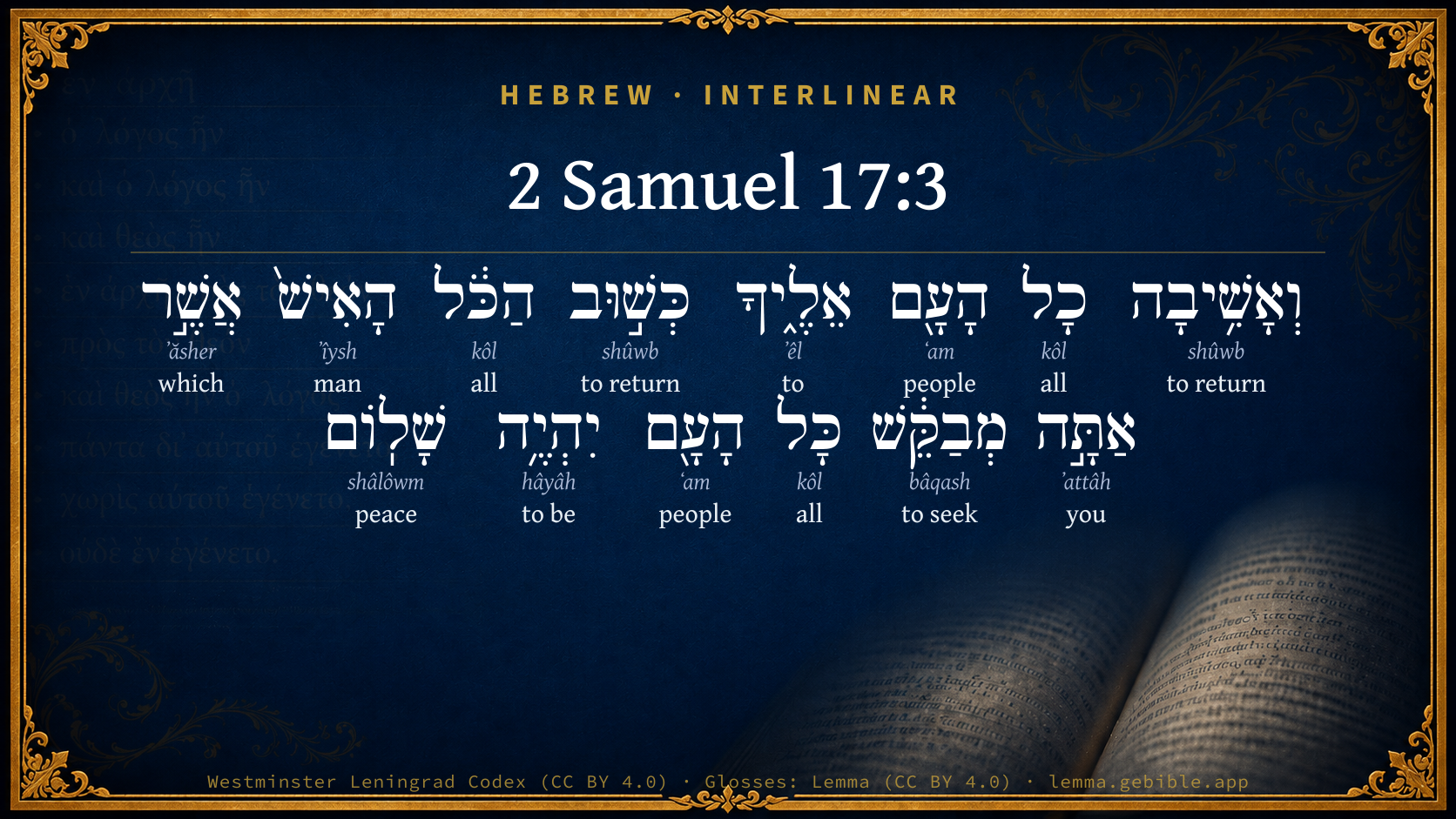
Hebrew (Westminster Leningrad Codex) 2 Samuel 17:3 appears in the Hebrew Old Testament. The text above is from the Westminster Leningrad Codex. Each word links to its Strong’s number, a concise gloss, and parsing drawn from the Open Scriptures Hebrew Bible morphology. Click any word for its full Brown-Driver-Briggs (BDB) entry.
Download image
Cite this verse

2 Samuel 17:3 (World English Bible). Public Domain. Lemma interlinear Bible study tool, https://lemma.gebible.app/v/2-samuel/17/3.

Show BibTeX & RIS
BibTeX
RIS
English Translation
and I will bring back all the people to you: the man whom you seek is as if all returned: [so] all the people shall be in peace.
World English Bible · Public Domain
Download a study sheet

One document with this verse’s original text, its word-by-word gloss line, the meaning frame, cross-references with their text, attributed commentary, and full source and license credits — printable, and it pastes into notes with its structure intact.

This verse Autodidact and up

Study sheet (.html) Plain text (.txt)

A passage Seminary Student

Up to 50 verses in one chapter. A passage sheet keeps up to 6 commentary sources and 12 cross-references per verse, in the order this page ranks them, and says so on the sheet whenever that leaves anything out. Ask for a single verse and you get the Autodidact verse sheet above.

Everything on this page stays free to read, with no account — the sheet is a download of what is already on screen, not access to it.

Want to remove ads? Support Godless Engineer
Compare translations 3

The same verse in 3 English versions, stacked beneath the original-language interlinear above. Click any original word for its lexicon entry.

Each is an independent rendering of the whole verse — the interlinear is not word-aligned to these translations.

Highlighted words mark where these versions differ — a whole-verse word diff, not a word-by-word alignment.

  • World English Bible Public Domain
    and I will bring back all the people to you: the man whom you seek is as if all returned: [so] all the people shall be in peace.
  • King James Version Public Domain
    And I will bring back all the people unto thee: the man whom thou seekest is as if all returned: so all the people shall be in peace.
  • unfoldingWord Literal Text CC BY-SA 4.0
    And I will make all of the people return to you. Like the returning of all the man whom you are seeking. All of the people will be peace.”

unfoldingWord Literal Text — © unfoldingWord, licensed CC BY-SA 4.0. Word-aligned USFM3 via Door43 (git.door43.org/unfoldingWord/en_ult).

Versions to compare (up to 4)

3 of 4 selected

Show all 18 translations

Every available English version of this verse, each an independent rendering of the whole verse.

  • World English Bible Public Domain
    and I will bring back all the people to you: the man whom you seek is as if all returned: [so] all the people shall be in peace.
  • Berean Standard Bible Public Domain
    and bring all the people back to you as a bride returning to her husband. You seek the life of only one man; then all the people will be at peace.”
  • Majority Standard Bible Public Domain
    and bring all the people back to you as a bride returning to her husband. You seek the life of only one man; then all the people will be at peace.”
  • King James Version Public Domain
    And I will bring back all the people unto thee: the man whom thou seekest is as if all returned: so all the people shall be in peace.
  • American Standard Version (1901) Public Domain
    and I will bring back all the people unto thee: the man whom thou seekest is as if all returned: `so' all the people shall be in peace.
  • Revised Version (1885) Public Domain
    and I will bring back all the people unto thee: the man whom thou seekest is as if all returned: so all the people shall be in peace.
  • Geneva Bible (1599) Public Domain
    And I will bring againe all the people vnto thee, and when all shall returne, ( the man whome thou seekest being slaine) all the people shalbe in peace.
  • Douay-Rheims (1899) Public Domain
    And I will bring back all the people, as if they were but one man: for thou seekest but one man: and all the people shall be in peace.
  • Young's Literal Translation Public Domain
    and I bring back all the people unto thee -- as the turning back of the whole `is' the man whom thou art seeking -- all the people are peace.
  • Literal Standard Version CC BY-SA 4.0
    and I bring back all the people to you—as the turning back of the whole [except] the man whom you are seeking—[then] all the people are [at] peace.”
  • Unlocked Literal Bible CC BY-SA 4.0
    I will bring back all the people to you, like a bride coming to her husband, and all the people will be at peace under you.”
  • unfoldingWord Literal Text CC BY-SA 4.0
    And I will make all of the people return to you. Like the returning of all the man whom you are seeking. All of the people will be peace.”
  • Darby Bible Public Domain
    and I will bring back all the people to thee. The man whom thou seekest is as if all returned: all the people shall be in peace.
  • World Messianic Bible Public Domain
    and I will bring back all the people to you. The man whom you seek is as if all returned. All the people shall be in peace.”
  • Webster's Bible Public Domain
    And I will bring back all the people to thee: the man whom thou seekest is as if all returned: so all the people shall be in peace.
  • Free Bible Version CC BY-SA 4.0
    and bring everybody else back to you. When everybody returns apart from the one man you're after, the whole country will be at peace.”
  • Bible in Basic English Public Domain
    And I will make all the people come back to you as a bride comes back to her husband: it is the life of only one man you are going after; so all the people will be at peace.
  • JPS Tanakh (1917) Public Domain
    and I will bring back all the people unto thee; when all shall have returned, save the man whom thou seekest, all the people will be in peace.'

Literal Standard Version (2020), Covenant Press — licensed CC BY-SA 4.0. Text via the HelloAO Bible API (eBible.org). Unlocked Literal Bible (unfoldingWord) — licensed CC BY-SA 4.0. Text via the HelloAO Bible API (eBible.org). unfoldingWord Literal Text — © unfoldingWord, licensed CC BY-SA 4.0. Word-aligned USFM3 via Door43 (git.door43.org/unfoldingWord/en_ult). Free Bible Version, Dr. Jonathan Gallagher — licensed CC BY-SA 4.0. Text via the HelloAO Bible API (eBible.org).

Word by word

More ways to search: Search by grammar → Find every occurrence → Compare this word →

Practice this passage: Drill this verse → Learn its vocabulary →

מְבַקֵּ֔שׁ
bâqash
H1245
“seeking”
Verb, Piel, Participle Active, Masculine, Singular, Absolute
Part of Speech
Verb
Stem
Piel
Form
Participle Active
Gender
Masculine
Number
Singular
State
Absolute
Full BDB Definition

Origin: a primitive root

TWOT: 276

to seek, require, desire, exact, request - (Piel) - to seek to find - to seek to secure - to seek the face - to desire, demand - to require, exact - to ask, request - (Pual) to be sought
  1. וְאָשִׁ֥יבָה shûwb H7725 “and · to return” Conjunction + Verb, Hiphil, Cohortative, 1st Person, Common, Singular
  2. כָל kôl H3605 “all of” Noun, Common, Masculine, Singular, Construct
  3. הָעָ֖ם ʻam H5971 “the · people” Particle, Definite Article + Noun, Common, Masculine, Singular, Absolute
  4. אֵלֶ֑יךָ ʼêl H413 “to · you” Preposition + Suffix, Personal, 2nd Person, Masculine, Singular
  5. כְּשׁ֣וּב shûwb H7725 “like/as · to return” Preposition + Verb, Qal, Infinitive Construct
  6. הַכֹּ֔ל kôl H3605 “the · all” Particle, Definite Article + Noun, Common, Masculine, Singular, Absolute
  7. הָאִישׁ֙ ʼîysh H376 “the · man” Particle, Definite Article + Noun, Common, Masculine, Singular, Absolute
  8. אֲשֶׁ֣ר ʼăsher H834 “which” Particle, Relative
  9. אַתָּ֣ה ʼattâh H859 “you” Pronoun, Personal, 2nd Person, Masculine, Singular
  10. כָּל kôl H3605 “all of” Noun, Common, Masculine, Singular, Construct
  11. הָעָ֖ם ʻam H5971 “the · people” Particle, Definite Article + Noun, Common, Masculine, Singular, Absolute
  12. יִהְיֶ֥ה hâyâh H1961 “to be” Verb, Qal, Imperfect, 3rd Person, Masculine, Singular
  13. שָׁלֽוֹם shâlôwm H7965 “peace” Noun, Common, Masculine, Singular, Absolute

About this verse

These counts appear in no published source. They are computed here, from the morphology-tagged text and Lemma’s own curated glosses. What Lemma adds →

14
words
10
distinct lemmas
Historical
section

Grammatical profile

  • 4 verbs
  • 7 nouns
  • 1 pronoun
  • 1 preposition
  • 1 particle

Verb forms

  • וְאָשִׁ֥יבָה Hiphil · Cohortative
  • כְּשׁ֣וּב Qal · Infinitive Construct
  • מְבַקֵּ֔שׁ Piel · Participle Active
  • יִהְיֶ֥ה Qal · Imperfect

Repetition

Words recur within this verse — often emphatic in Hebrew:

  • כָל all H3605 ×3
  • וְאָשִׁ֥יבָה to return H7725 ×2
  • הָעָ֖ם people H5971 ×2

Hebrew & Septuagint length

In English translation the verse runs 28 words from the Hebrew and 32 from the Septuagint (LXX English) — closely comparable.

A rough comparison of the two English renderings, which tokenize alike — not a word-level alignment.

Word counts can differ between the Hebrew and the Greek without any difference in meaning — e.g. the Hebrew direct-object marker אֵת has no separate Greek word, and Greek often adds the article ὁ.

Cross-references

4

Topical passages linked to 2 Samuel 17:3 in the Treasury of Scripture Knowledge — connected by theme and wording, ordered by reader-vote popularity; previews shown in the World English Bible.

  • 1 Thessalonians 5:3 For when they are saying, "Peace and safety," then sudden destruction will come on them, like birth pains on a pregnant woman; and they will in no way escape.
  • 2 Samuel 3:21 Abner said to David, I will arise and go, and will gather all Israel to my lord the king, that they may make a covenant with you, and that you may reign over all that your soul desires. David sent Abner away; and he went in peace.
  • Isaiah 48:22 There is no peace, says Yahweh, to the wicked.
  • Isaiah 57:21 There is no peace, says my God, to the wicked.

Cross-references courtesy of OpenBible.info (CC BY 4.0).

Hebrew and Greek witnesses Masoretic Hebrew ↔ Greek Septuagint

The same verse in the two great witnesses to the Old Testament, shown verse-for-verse.

These are two independent witnesses, not word-aligned to each other, and the Septuagint is shown in lemma (dictionary) form.

Hebrew 2 Samuel 17:3 Masoretic · Westminster Leningrad Codex

וְאָשִׁ֥יבָה כָל הָעָ֖ם אֵלֶ֑יךָ כְּשׁ֣וּב הַכֹּ֔ל הָאִישׁ֙ אֲשֶׁ֣ר אַתָּ֣ה מְבַקֵּ֔שׁ כָּל הָעָ֖ם יִהְיֶ֥ה שָׁלֽוֹם

and I will bring back all the people to you: the man whom you seek is as if all returned: [so] all the people shall be in peace.

World English Bible · Public Domain

Greek LXX 2 Samuel 17:3 Septuagint · lemma form

καί ἐπιστρέφω πᾶς ὁ λαός πρός σύ ὅς τρόπος ἐπιστρέφω ὁ νύμφη πρός ὁ ἀνήρ αὐτός πλήν ψυχή εἷς ἀνήρ σύ ζητέω καί πᾶς ὁ λαός εἰμί εἰρήνη

And I will bring back all the people to you, as a bride returns to her husband: only you seek the life of one man, and all the people shall have peace.

LXX2012 (modern English Septuagint) · Public Domain

On this verse, Haydock's Catholic Bible Commentary discusses the Septuagint’s reading. Read the note in Commentary ↓

Hebrew: Westminster Leningrad Codex (CC BY 4.0). Greek: Septuagint (public domain); English from LXX2012 (modern English Septuagint) (Public Domain). How the Septuagint differs from the Hebrew →

Targum (Aramaic paraphrase)

1

The Targum is the ancient Jewish Aramaic paraphrase of the Hebrew Scriptures — an interpretive translation, not the Hebrew text itself. Onkelos (literal) and Pseudo-Jonathan (expansive) render the Torah, and Jonathan the Prophets. Coverage is partial: where no permissively-licensed English translation exists for a verse, only the Aramaic is shown. This is verse-level text, not a word-by-word alignment to the Hebrew.

  1. Targum Jonathan Prophets (Joshua–Malachi)
    וְאָתִיב כָּל עַמָא לְוָתָךְ כַּד יְתוּבוּן כּוּלְהוֹן בָּתַר דְיִתְקְטֵל גַבְרָא דְאַתְּ בָּעֵי כָּל עַמָא יְהֵי שְׁלָם:

    (no public-domain English translation for this verse)

    Targum Jonathan — Aramaic: “Mikraot Gedolot” (public domain). English: “Sefaria Community Translation” (CC0 1.0 (public-domain dedication)); “London "Chaldee Paraphrase," 1871” (public domain). Text via Sefaria.

Commentary

Notes on 2 Samuel 17:3 from classic Christian and Jewish commentators (each source and its license shown beneath its notes). The classic Christian expositions comment on the surrounding passage and are grouped to its opening verse, so a note may address several verses; the Jewish commentaries on the Tanakh (Rashi and others) are per-verse, so they appear only where the commentator wrote on this verse.

Lemma curates 59 commentaries, every one of them public domain or Creative Commons licensed, each selected and text-cleaned for this edition rather than reprinted as found. About our sources →

Trapp's Complete Commentary

John Trapp

2Sa 17:3 And I will bring back all the people unto thee: the man whom thou seekest [is] as if all returned: [so] all the people shall be in peace.

Ver. 3. The man whom thou seekest.] Ah, lewd lowly! could Absalom hear his dear father’s death thus contrived and endeavoured, and approve of the plot? Certe tu non occidisti patrem, Certainly you did not kill your father, said Augustus to one that was brought before him for parricide. Lycurgus would make no law against it, as holding it impossible. But the devil had filled this man’s heart from corner to corner, as Act 5:2, and torn out thence all childlike affection.

John Trapp, A Commentary or Exposition upon All the Books of the Old and New Testament (1647–1656) — public domain. Text from a community e-Sword module.

Tyndale Open Study Notes

Tyndale Open Resources

17:3 as a bride . . . you seek: The Hebrew text has the loyalty of all the people depend on the death of David. The Greek version pictures a young wife who returns to her husband after a short quarrel.

Tyndale Open Study Notes — © Tyndale Open Resources, licensed CC BY-SA 4.0. Text via the HelloAO Bible API.

Geneva Bible (1599)

Geneva Bible translators

Meaning, David.

Geneva Bible (1599) marginal notes — public domain. Text via Bolls.life.

Adam Clarke's Commentary

Verse 3. The man whom thou seekest is as if all returned] Only secure David, and all Israel will be on thy side. He is the soul of the whole; destroy him, and all the rest will submit.

Adam Clarke's Commentary on the Bible (1810–1826) — public domain. Text from a community e-Sword/MySword module.

Ellicott's Commentary for English Readers

(3) Bring back all the people.—This evil counsellor, with artful flattery, assumes that Absalom is the rightful king, and that the people who have gone off after David only need to be brought back to their allegiance.

A Bible Commentary for English Readers, edited by Charles John Ellicott (1878–1897) — public domain. Text from a community e-Sword module.

The Cambridge Bible for Schools and Colleges

gen. ed. J. J. S. Perowne

3. the man, &c.] Lit. As the returning of all is the man whom thou seekest. The return of all the people to thee will be ensured by the removal of David. If that is effected, there will be no civil war. Ahithophel’s use of the term “return” is a subtle flattery, implying that David’s followers were deserting their lawful sovereign. But the true text is not improbably preserved by the Sept.: “And I will cause all the people to return unto thee, as the bride returneth to her husband. Only one man’s life dost thou seek, and unto all the people there shall be peace.” The defection of the people is compared to the momentary desertion of a bride, who speedily returns to her husband.

The Cambridge Bible for Schools and Colleges (gen. ed. J. J. S. Perowne; Cambridge University Press, 1878–1918) — public domain. Text from a community e-Sword module.

John Gill's Exposition

And I will bring back all the people unto thee,.... Meaning not the people only that were with David, that he would make them prisoners, and bring them with him; for he before proposed to let them make their escape; but to reduce all Israel to the obedience of Absalom at once, by executing this scheme which he had formed:

the man whom thou seekest is as if all returned; meaning David, whom he speaks of contemptibly, and whose life it seems Absalom sought, as well as his crown; and he being dead, it would be all over at once with the people; they would immediately return to their own habitations, and yield obedience to Absalom as the rightful heir and successor; all depended on his death, he intimates: from whence it appears that Abarbinel is wrong in suggesting that Absalom did not design to take away the life of his father, only to secure the kingdom to himself in his father's lifetime, who he understood had disposed of it by his will to Solomon; but here Ahithophel plainly declares the intention of Absalom, nor would he have proposed in plain terms to take away the king's life, had Absalom been averse to it; and it is plain by what follows that the thing was pleasing to him:

so all the people shall be in peace; both parties coalesce under the government of Absalom, and live peaceably under it, and so an entire end of the war.

John Gill's Exposition of the Whole Bible (1746–1763) — public domain (CC PDM 1.0). Text via the HelloAO Bible API.

Albert Barnes' Notes on the Bible

The man whom thou seekest - namely, David. Ahithophel means to say: “If I can only smite David, there will be no civil war, all the people will peaceably submit.”

Albert Barnes' Notes on the Bible (1834–1885) — public domain. Text from a community e-Sword/MySword module.

Haydock's Catholic Bible Commentary

One man. They will return with such unanimity, when their leader is cut off. (Menochius) --- David was the one man whom his son desired to kill, as the latter was the only one whom David ordered to be spared, chap. xviii. 5. (Haydock) --- Hebrew seems rather transposed: "I will bring back all the people to thee, as all the people, whom thou seekest, are returned; and all the people shall be in peace:" or, ... "when all those, whom thou desirest, shall be returned, &c. (Calmet) --- Septuagint, "as a bride returns to her husband; only the soul of one thou seekest, and peace shall be to all the people." (Haydock)

George Leo Haydock (1774–1849), Haydock's Catholic Family Bible and Commentary, 1859 edition — public domain. Excludes Psalms (Douay-Rheims chapter numbering differs from Protestant) and Deuterocanonical books (Catholic canon only).

Matthew Poole's English Annotations

The man whom thou seekest is as if all returned, i. e. the death of that man whom thou seekest to destroy is no less considerable to thee, than if all the people that follow him should desert him and return unto thee.

Matthew Poole's English Annotations on the Holy Bible (1683–1685) — public domain. Text from a community e-Sword/MySword module.

The Pulpit Commentary

The man whom thou seekest is as if all returned; Hebrew, as the return of the whole is the man whom thou seekest. Both the amendments of the text and the various translations offered are innumerable, but nothing is really more satisfactory than the literal rendering of the words, virtually given us in the Authorized Version. Naturally, Ahithophel did not wish to parade David"s death too openly. In his heart Absalom must have known that the safe possession of the kingdom could be assured him only by his father"s death, but yet he might have shrunk from publicly avowing this, and having it talked of before his courtiers as a settled purpose. One reason why he adopted the counsel of Hushai may have been his reluctance to commit parricide: for plainly the one main purpose of Ahithophel was David"s death. This thorough traitor may have seen even a tremor of alarm in Absalom"s countenance when he spake out his purpose so frankly of "smiting the king only," and may have felt that, slumbering in the besom of the son, was something of that generous spirit which had made the father condemn the Amalekite to death for boasting that he had slain Saul. At all events, he was unwilling to dilate upon so ghastly a theme, and this general reference to David, as the man whom Absalom sought, without dwelling upon the subject, is in far better taste than the coarse open villainy so unreservedly expressed in ver. 2. The reading, however, of the Septuagint has many followers: "And I will bring back all the people to thee as a bride returns to her husband, excepting the life of the one man thou seekest; and for all the people there shall be peace." Ahithophel was bad enough, but scarcely so brutal as to compare to a bridal procession the sad return of David"s mourning friends and companions in arms weeping round the corpse of their master murdered at the bidding of his own son.

The Pulpit Commentary (1880–1919), ed. H.D.M. Spence-Jones & Joseph S. Exell — public domain. Text from a community e-Sword module.

Rashi

Rabbi Shlomo Yitzchaki (Rashi)

When they all return [to you]. To you.

[Except] the man you want. You will do what you want with him and you will have him killed. And afterwords, all the people will have peace. This is a shortened verse.

Rashi on the Tanakh — English translations: “The Judaica Press complete Tanach with Rashi, translated by A. J. Rosenberg” (CC BY 4.0); “Pentateuch with Rashi's commentary by M. Rosenbaum and A.M. Silbermann, 1929-1934” (public domain); “The Metsudah Tanach series, Lakewood, N.J” (CC BY 4.0); and “The Book of Joshua, Metsudah Publications, 1997” (CC BY 4.0). Text via Sefaria.

Lesson kit

Teaching starters — assembled from the data on this page, not authored interpretation. Every prompt links to the verse data it draws on. Edit before teaching.

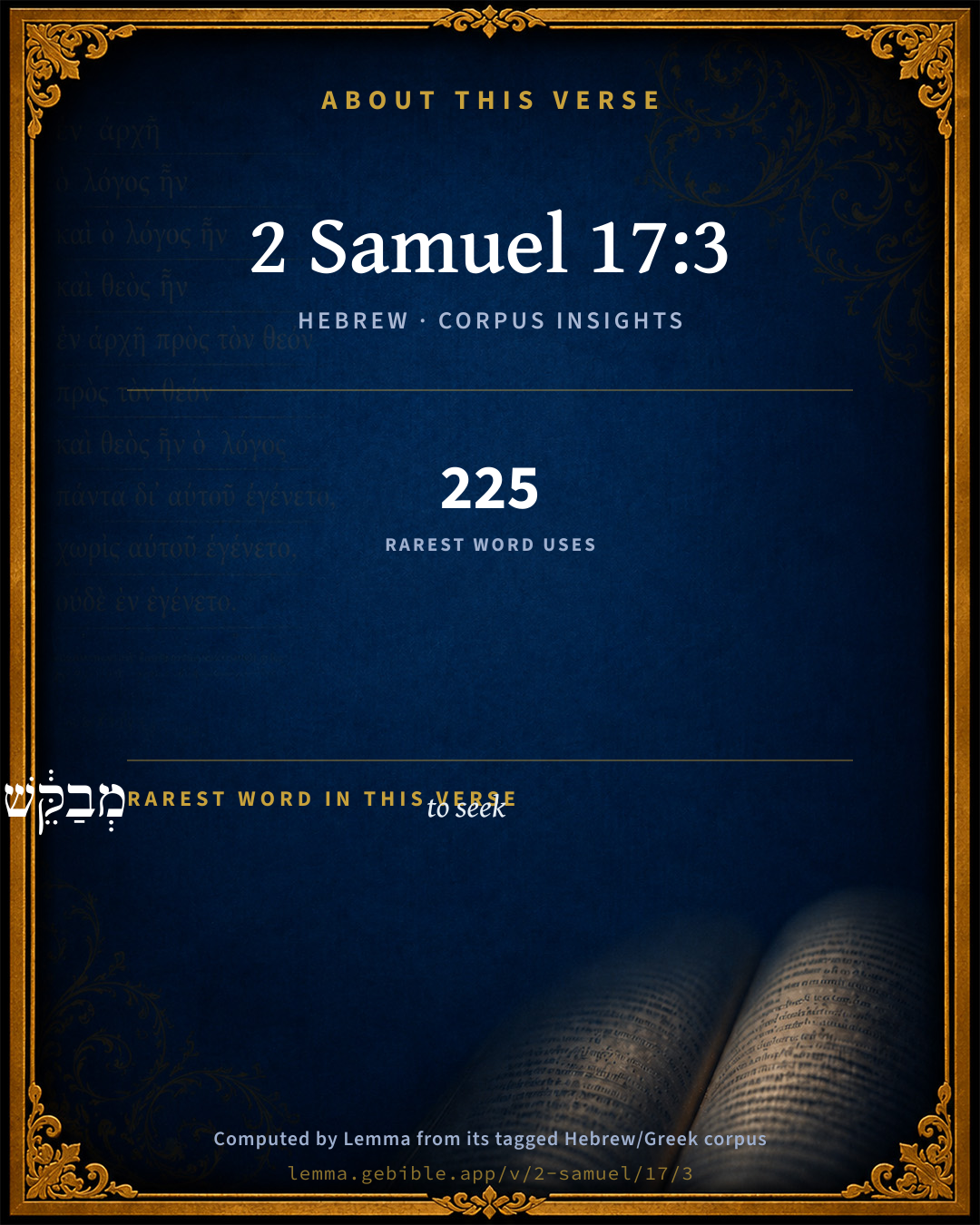
2 Samuel, in the Historical, opens this verse with 14 words (10 distinct Hebrew lemmas). Its most distinctive word is bâqash (“to seek”). A historical commentator’s framing appears above. Read the whole chapter for the surrounding context.

Discussion questions

  1. How does “to seek” (bâqash) shape what this verse is saying?
  2. 1 Thessalonians 5:3 shares this passage’s theme. How do the two illuminate each other?
  3. “all” occurs 3× in this one verse. What is the effect of the repetition?
  4. These translations render this verse differently; the difference is in the English rendering, not the original. What questions does that raise?
  5. The verb «וְאָשִׁ֥יבָה» is Hiphil Cohortative. How does its form color the action?
  6. Reading how Trapp's Complete Commentary and Tyndale Open Study Notes read this verse, where do the two commentators agree and where do they part?

Things to notice

Reading settings

Reading text

Shown beneath each verse's original-language words.

Old Testament
Old Testament edition

Read the OT as the Masoretic Hebrew (MT) or the Greek Septuagint (LXX).

English shown for the Greek Septuagint (in the Hebrew ↔ Greek comparison).

Comparing translations? Open the Compare panel on any verse page to stack up to four side by side.