2 Chronicles 18:27

Hebrew (Westminster Leningrad Codex) 2 Chronicles 18:27 appears in the Hebrew Old Testament. The text above is from the Westminster Leningrad Codex. Each word links to its Strong’s number, a concise gloss, and parsing drawn from the Open Scriptures Hebrew Bible morphology. Click any word for its full Brown-Driver-Briggs (BDB) entry.
Download image
Cite this verse

2 Chronicles 18:27 (World English Bible). Public Domain. Lemma interlinear Bible study tool, https://lemma.gebible.app/v/2-chronicles/18/27.

Show BibTeX & RIS
BibTeX
RIS
English Translation
Micaiah said, If you return at all in peace, Yahweh has not spoken by me. He said, Hear, you peoples, all of you.
World English Bible · Public Domain
Download a study sheet

One document with this verse’s original text, its word-by-word gloss line, the meaning frame, cross-references with their text, attributed commentary, and full source and license credits — printable, and it pastes into notes with its structure intact.

This verse Autodidact and up

Study sheet (.html) Plain text (.txt)

A passage Seminary Student

Up to 50 verses in one chapter. A passage sheet keeps up to 6 commentary sources and 12 cross-references per verse, in the order this page ranks them, and says so on the sheet whenever that leaves anything out. Ask for a single verse and you get the Autodidact verse sheet above.

Everything on this page stays free to read, with no account — the sheet is a download of what is already on screen, not access to it.

Want to remove ads? Support Godless Engineer
Compare translations 3

The same verse in 3 English versions, stacked beneath the original-language interlinear above. Click any original word for its lexicon entry.

Each is an independent rendering of the whole verse — the interlinear is not word-aligned to these translations.

Highlighted words mark where these versions differ — a whole-verse word diff, not a word-by-word alignment.

  • World English Bible Public Domain
    Micaiah said, If you return at all in peace, Yahweh has not spoken by me. He said, Hear, you peoples, all of you.
  • King James Version Public Domain
    And Micaiah said, If thou certainly return in peace, then hath not the LORD spoken by me. And he said, Hearken, all ye people.
  • unfoldingWord Literal Text CC BY-SA 4.0
    And Micaiah said, “If you certainly return in peace, Yahweh did not speak with me.” And he said, “Hear, O peoples, all of them!”

unfoldingWord Literal Text — © unfoldingWord, licensed CC BY-SA 4.0. Word-aligned USFM3 via Door43 (git.door43.org/unfoldingWord/en_ult).

Versions to compare (up to 4)

3 of 4 selected

Show all 18 translations

Every available English version of this verse, each an independent rendering of the whole verse.

  • World English Bible Public Domain
    Micaiah said, If you return at all in peace, Yahweh has not spoken by me. He said, Hear, you peoples, all of you.
  • Berean Standard Bible Public Domain
    But Micaiah replied, “If you ever return safely, the LORD has not spoken through me.” Then he added, “Take heed, all you people!”
  • Majority Standard Bible Public Domain
    But Micaiah replied, “If you ever return safely, the LORD has not spoken through me.” Then he added, “Take heed, all you people!”
  • King James Version Public Domain
    And Micaiah said, If thou certainly return in peace, then hath not the LORD spoken by me. And he said, Hearken, all ye people.
  • American Standard Version (1901) Public Domain
    And Micaiah said, If thou return at all in peace, Jehovah hath not spoken by me. And he said, Hear, ye peoples, all of you.
  • Revised Version (1885) Public Domain
    And Micaiah said, If thou return at all in peace, the LORD hath not spoken by me. And he said, Hear, ye peoples, all of you.
  • Geneva Bible (1599) Public Domain
    And Michaiah said, If thou returne in peace, the Lord hath not spoken by me. And he saide, Heare, all ye people.
  • Douay-Rheims (1899) Public Domain
    And Micheas said: If thou return in peace, the Lord hath not spoken by me. And he said: Hear, all ye people.
  • Young's Literal Translation Public Domain
    And Micaiah saith, `If thou dost certainly return in peace, Jehovah hath not spoken by me;' and he saith, `Hear ye, O peoples, all of them!'
  • Literal Standard Version CC BY-SA 4.0
    And Micaiah says, “If you certainly return in peace, YHWH has not spoken by me”; and he says, “Hear, O peoples, all of them!”
  • Unlocked Literal Bible CC BY-SA 4.0
    Then Micaiah said, “If you return safely, then Yahweh has not spoken by me.” Then he added, “Listen to this, all you people.”
  • unfoldingWord Literal Text CC BY-SA 4.0
    And Micaiah said, “If you certainly return in peace, Yahweh did not speak with me.” And he said, “Hear, O peoples, all of them!”
  • Darby Bible Public Domain
    And Micah said, If thou return at all in peace, Jehovah has not spoken by me. And he said, Hearken, O peoples, all of you!
  • World Messianic Bible Public Domain
    Micaiah said, “If you return at all in peace, the LORD has not spoken by me.” He said, “Listen, you people, all of you!”
  • Webster's Bible Public Domain
    And Micaiah said, If thou shalt certainly return in peace, then hath not the LORD spoken by me. And he said, Hearken, all ye people.
  • Free Bible Version CC BY-SA 4.0
    “If you do in fact return safely then the Lord has not spoken through me,” Micaiah declared. “Pay attention everyone to all I've said!”
  • Bible in Basic English Public Domain
    And Micaiah said, If you come back at all in peace, the Lord has not sent his word by me.
  • JPS Tanakh (1917) Public Domain
    And Micaiah said: 'If thou return at all in peace, the LORD hath not spoken by me.' And he said: 'Hear, ye peoples, all of you.'

Literal Standard Version (2020), Covenant Press — licensed CC BY-SA 4.0. Text via the HelloAO Bible API (eBible.org). Unlocked Literal Bible (unfoldingWord) — licensed CC BY-SA 4.0. Text via the HelloAO Bible API (eBible.org). unfoldingWord Literal Text — © unfoldingWord, licensed CC BY-SA 4.0. Word-aligned USFM3 via Door43 (git.door43.org/unfoldingWord/en_ult). Free Bible Version, Dr. Jonathan Gallagher — licensed CC BY-SA 4.0. Text via the HelloAO Bible API (eBible.org).

Word by word

More ways to search: Search by grammar → Find every occurrence → Compare this word →

Practice this passage: Drill this verse → Learn its vocabulary →

מִיכָ֔יְהוּ
Mîykâyᵉhûw
H4321
“Micaiah”
Noun, Proper
Part of Speech
Noun
Type
Proper
Full BDB Definition

Origin: abbrev. for H4322

TWOT: None

Micah or Micaiah or Michaiah = "who is like God" - an Ephraimite during the period of the judges - son of Imlah and a prophet of Samaria who predicted the defeat and death of king Ahab of Israel - son of Gemariah in the time of Jeremiah
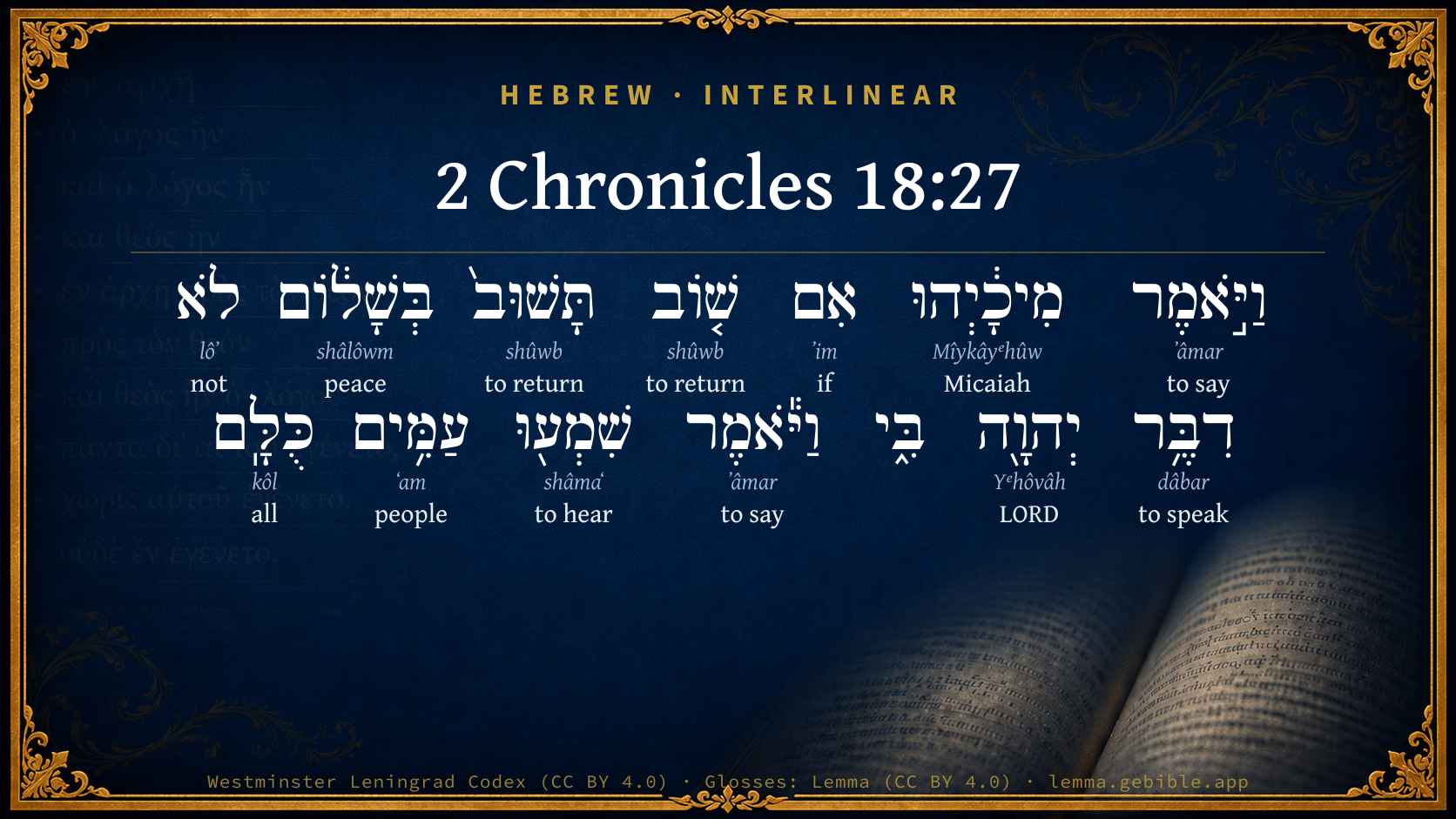
  1. וַיֹּ֣אמֶר ʼâmar H559 “and · to say” Conjunction + Verb, Qal, Sequential Imperfect, 3rd Person, Masculine, Singular
  2. אִם ʼim H518 “if” Conjunction
  3. שׁ֤וֹב shûwb H7725 “to return” Verb, Qal, Infinitive Absolute
  4. תָּשׁוּב֙ shûwb H7725 “to return” Verb, Qal, Imperfect, 2nd Person, Masculine, Singular
  5. בְּשָׁל֔וֹם shâlôwm H7965 “in/at · peace” Preposition + Noun, Common, Masculine, Singular, Absolute
  6. לֹא lôʼ H3808 “not” Particle, Negative
  7. דִבֶּ֥ר dâbar H1696 “to speak” Verb, Piel, Perfect, 3rd Person, Masculine, Singular
  8. יְהוָ֖ה Yᵉhôvâh H3068 “LORD” Noun, Proper
  9. וַיֹּ֕אמֶר ʼâmar H559 “and · to say” Conjunction + Verb, Qal, Sequential Imperfect, 3rd Person, Masculine, Singular
  10. שִׁמְע֖וּ shâmaʻ H8085 “hear” Verb, Qal, Imperative, 2nd Person, Masculine, Plural
  11. עַמִּ֥ים ʻam H5971 “peoples” Noun, Common, Masculine, Plural, Absolute
  12. כֻּלָּֽם kôl H3605 “all · their” Noun, Common, Masculine, Singular, Construct + Suffix, Personal, 3rd Person, Masculine, Plural

About this verse

These counts appear in no published source. They are computed here, from the morphology-tagged text and Lemma’s own curated glosses. What Lemma adds →

14
words
11
distinct lemmas
Historical
section

Notable vocabulary

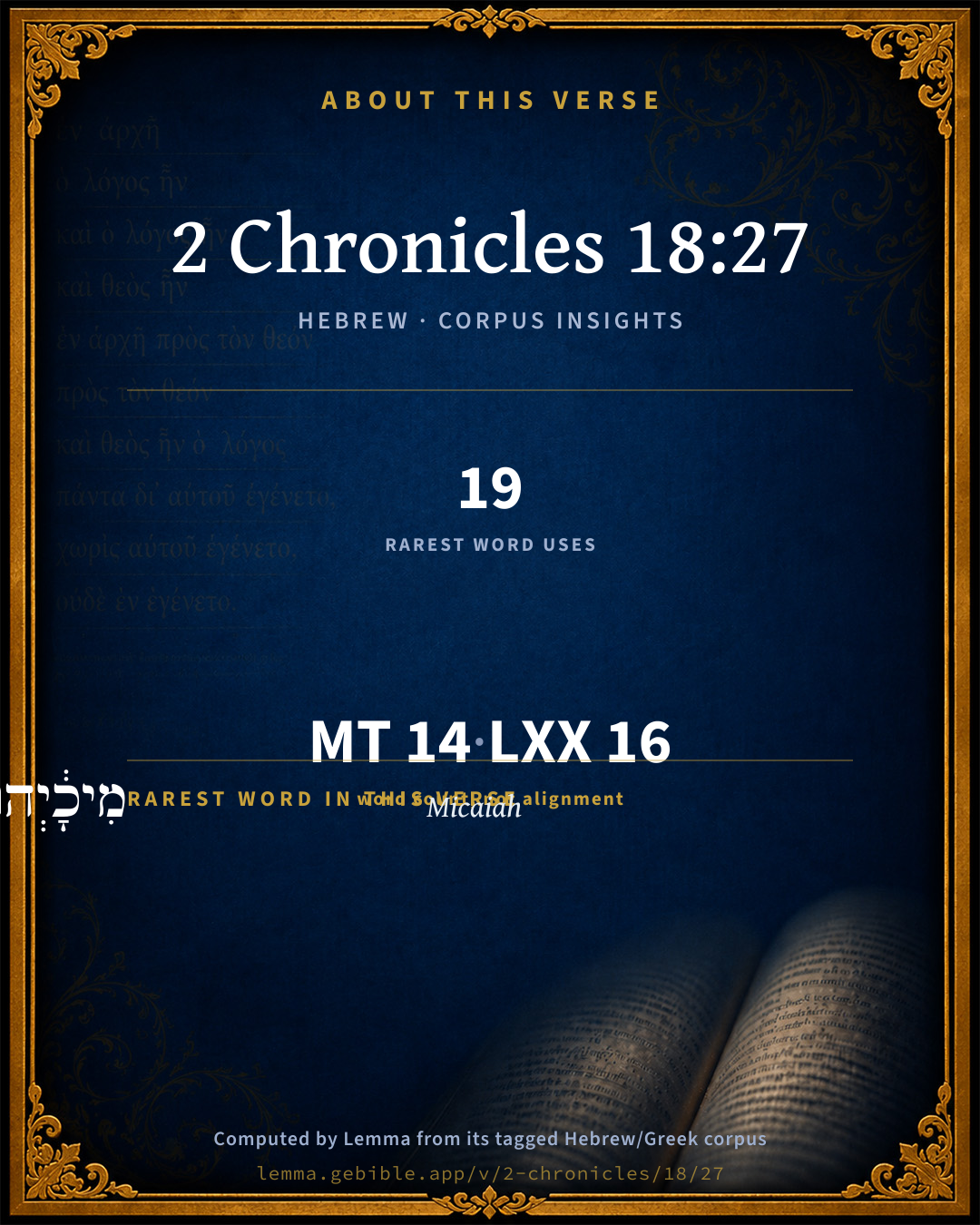
The rarest word here is מִיכָ֔יְהוּ Micaiah H4321 — appearing just 19 times in the whole Hebrew Bible.

Shared distinctive vocabulary

מִיכָ֔יְהוּ Micaiah H4321 occurs in 19 verses of the Hebrew Bible. Also found in:

Grammatical profile

  • 6 verbs
  • 5 nouns
  • 1 preposition
  • 1 conjunction
  • 1 particle

Verb forms

  • וַיֹּ֣אמֶר Qal · Sequential Imperfect
  • שׁ֤וֹב Qal · Infinitive Absolute
  • תָּשׁוּב֙ Qal · Imperfect
  • דִבֶּ֥ר Piel · Perfect
  • וַיֹּ֕אמֶר Qal · Sequential Imperfect
  • שִׁמְע֖וּ Qal · Imperative

Repetition

Words recur within this verse — often emphatic in Hebrew:

  • וַיֹּ֣אמֶר to say H559 ×2
  • שׁ֤וֹב to return H7725 ×2

Hebrew & Septuagint length

In English translation the verse runs 23 words from the Hebrew and 25 from the Septuagint (LXX English) — closely comparable.

A rough comparison of the two English renderings, which tokenize alike — not a word-level alignment.

Word counts can differ between the Hebrew and the Greek without any difference in meaning — e.g. the Hebrew direct-object marker אֵת has no separate Greek word, and Greek often adds the article ὁ.

In the original languages it is 14 Hebrew tokens and 16 Greek tokens — but the two are counted differently (Hebrew bundles its prefixes and suffixes into one token; the Greek is in lemma form), so that isn’t a like-for-like length.

Cross-references

8

Topical passages linked to 2 Chronicles 18:27 in the Treasury of Scripture Knowledge — connected by theme and wording, ordered by reader-vote popularity; previews shown in the World English Bible.

  • Numbers 16:29 If these men die the common death of all men, or if they be visited after the visitation of all men; then Yahweh hasn't sent me.
  • Amos 9:10 All the sinners of my people will die by the sword, who say, 'Evil won't overtake nor meet us.'
  • Micah 1:2 Hear, you peoples, all of you. Listen, O earth, and all that is therein: And let the Lord Yahweh be witness against you, The Lord from his holy temple.
  • Matthew 13:9 He who has ears to hear, let him hear."
  • Matthew 15:10 He summoned the multitude, and said to them, "Hear, and understand.
  • Mark 7:14 He called all the multitude to himself, and said to them, "Hear me, all of you, and understand.
  • Luke 20:45–46 In the hearing of all the people, he said to his disciples,
  • Acts 13:10–11 and said, "Full of all deceit and all cunning, you son of the devil, you enemy of all righteousness, will you not cease to pervert the right ways of the Lord?

Cross-references courtesy of OpenBible.info (CC BY 4.0).

Hebrew and Greek witnesses Masoretic Hebrew ↔ Greek Septuagint

The same verse in the two great witnesses to the Old Testament, shown verse-for-verse.

These are two independent witnesses, not word-aligned to each other, and the Septuagint is shown in lemma (dictionary) form.

Hebrew 2 Chronicles 18:27 Masoretic · Westminster Leningrad Codex

וַיֹּ֣אמֶר מִיכָ֔יְהוּ אִם שׁ֤וֹב תָּשׁוּב֙ בְּשָׁל֔וֹם לֹא דִבֶּ֥ר יְהוָ֖ה בִּ֑י וַיֹּ֕אמֶר שִׁמְע֖וּ עַמִּ֥ים כֻּלָּֽם

Micaiah said, If you return at all in peace, Yahweh has not spoken by me. He said, Hear, you peoples, all of you.

World English Bible · Public Domain

Greek LXX 2 Chronicles 18:27 Septuagint · lemma form

καί εἶπον μιχαιας ἐάν ἐπιστρέφω ἐπιστρέφω ἐν εἰρήνη οὐ λαλέω κύριος ἐν ἐγώ ἀκούω λαός πᾶς

And Michaias said, If you do at all return in peace, the Lord has not spoken by me. And he said, Hear, all you⌃ people.

LXX2012 (modern English Septuagint) · Public Domain

Hebrew: Westminster Leningrad Codex (CC BY 4.0). Greek: Septuagint (public domain); English from LXX2012 (modern English Septuagint) (Public Domain). How the Septuagint differs from the Hebrew →

Commentary

Notes on 2 Chronicles 18:27 from classic Christian and Jewish commentators (each source and its license shown beneath its notes). The classic Christian expositions comment on the surrounding passage and are grouped to its opening verse, so a note may address several verses; the Jewish commentaries on the Tanakh (Rashi and others) are per-verse, so they appear only where the commentator wrote on this verse.

Lemma curates 59 commentaries, every one of them public domain or Creative Commons licensed, each selected and text-cleaned for this edition rather than reprinted as found. About our sources →

Geneva Bible (1599)

Geneva Bible translators

Or, Micaiah.

Geneva Bible (1599) marginal notes — public domain. Text via Bolls.life.

Ellicott's Commentary for English Readers

(27) And Micaiah said.—Literally as 1Ki_22:28.

If thou certainly return.—“If thou dost return.”

And he said—i.e., Micaiah said, turning to the crowd of bystanders, and making them witnesses to his prediction.

Hearken, all ye people.—Rather, Hearken ye, O peoples all! Literally, all of them. The book of the prophet Micah opens with these very words (Mic_1:2). Hitzig thinks they were taken from that passage, and Nöldeke, that they “must be and denote an abbreviation of the entire book.” (!) Thenius, on the other hand, justly argues that the whole section before us bears indubitable marks of historical truth, and is probably an extract from the history of Jehoshaphat written by Jehu the son of Hanani (2Ch_20:34).

A Bible Commentary for English Readers, edited by Charles John Ellicott (1878–1897) — public domain. Text from a community e-Sword module.

The Cambridge Bible for Schools and Colleges

gen. ed. J. J. S. Perowne

27. If thou certainly return in peace] R.V. If thou return at all in peace (so 1 Kin.).

Hearken, all ye people] R.V. Hear, ye peoples, all of you. The “peoples” represented at this gathering were probably, Israel, Judah, Edom, and Moab. The phrase occurs in Mic_1:2.

The Cambridge Bible for Schools and Colleges (gen. ed. J. J. S. Perowne; Cambridge University Press, 1878–1918) — public domain. Text from a community e-Sword module.

Haydock's Catholic Bible Commentary

People. Mark what I say. The event will quickly prove whether I am a prophet or an impostor. H.

George Leo Haydock (1774–1849), Haydock's Catholic Family Bible and Commentary, 1859 edition — public domain. Excludes Psalms (Douay-Rheims chapter numbering differs from Protestant) and Deuterocanonical books (Catholic canon only).

The Pulpit Commentary

The courage and fidelity of Micaiah, in not deserting either his prophet-message or his prophet-Master, are admirable, and for his determined appeal to all the people, which was made in the very face of the king or kings, see again Mic_1:2.

The Pulpit Commentary (1880–1919), ed. H.D.M. Spence-Jones & Joseph S. Exell — public domain. Text from a community e-Sword module.

Lesson kit

Teaching starters — assembled from the data on this page, not authored interpretation. Every prompt links to the verse data it draws on. Edit before teaching.

2 Chronicles, in the Historical, opens this verse with 14 words (11 distinct Hebrew lemmas). Its most distinctive word is Mîykâyᵉhûw (“Micaiah”). A historical commentator’s framing appears above. Read the whole chapter for the surrounding context.

Discussion questions

  1. How does “Micaiah” (Mîykâyᵉhûw) shape what this verse is saying?
  2. 1 Kings 22:8 shares the word «Micaiah» with this verse. How do the two illuminate each other?
  3. “to say” occurs 2× in this one verse. What is the effect of the repetition?
  4. These translations render this verse differently. What is at stake in choosing one wording over another?
  5. The verb «וַיֹּ֣אמֶר» is Qal Sequential Imperfect. How does its form color the action?
  6. Reading how Geneva Bible (1599) and Ellicott's Commentary for English Readers read this verse, where do the two commentators agree and where do they part?

Things to notice

Reading settings

Reading text

Shown beneath each verse's original-language words.

Old Testament
Old Testament edition

Read the OT as the Masoretic Hebrew (MT) or the Greek Septuagint (LXX).

English shown for the Greek Septuagint (in the Hebrew ↔ Greek comparison).

Comparing translations? Open the Compare panel on any verse page to stack up to four side by side.