
Psalms 120:7

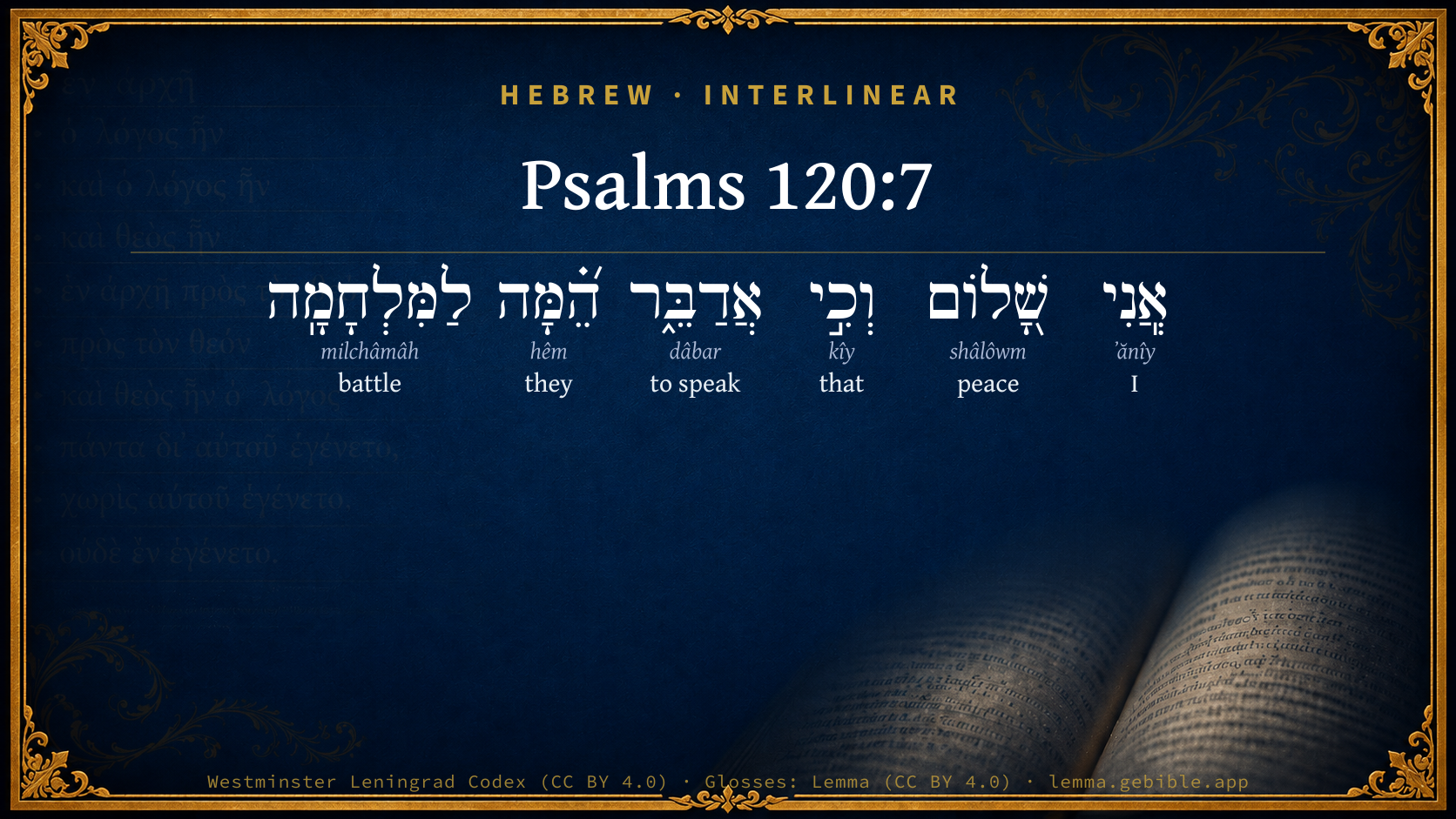
Hebrew (Westminster Leningrad Codex) Psalms 120:7 appears in the Hebrew Old Testament. The text above is from the Westminster Leningrad Codex. Each word links to its Strong’s number, a concise gloss, and parsing drawn from the Open Scriptures Hebrew Bible morphology. Click any word for its full Brown-Driver-Briggs (BDB) entry.
Download image
Cite this verse

Psalms 120:7 (World English Bible). Public Domain. Lemma interlinear Bible study tool, https://lemma.gebible.app/v/psalms/120/7.

Show BibTeX & RIS
BibTeX
RIS
English Translation
I am for peace, But when I speak, they are for war.
World English Bible · Public Domain
Download a study sheet

One document with this verse’s original text, its word-by-word gloss line, the meaning frame, cross-references with their text, attributed commentary, and full source and license credits — printable, and it pastes into notes with its structure intact.

This verse Autodidact and up

Study sheet (.html) Plain text (.txt)

A passage Seminary Student

Up to 50 verses in one chapter. A passage sheet keeps up to 6 commentary sources and 12 cross-references per verse, in the order this page ranks them, and says so on the sheet whenever that leaves anything out. Ask for a single verse and you get the Autodidact verse sheet above.

Everything on this page stays free to read, with no account — the sheet is a download of what is already on screen, not access to it.

Want to remove ads? Support Godless Engineer
Compare translations 3

The same verse in 3 English versions, stacked beneath the original-language interlinear above. Click any original word for its lexicon entry.

Each is an independent rendering of the whole verse — the interlinear is not word-aligned to these translations.

Highlighted words mark where these versions differ — a whole-verse word diff, not a word-by-word alignment.

  • World English Bible Public Domain
    I am for peace, But when I speak, they are for war.
  • King James Version Public Domain
    I am for peace: but when I speak, they are for war.
  • unfoldingWord Literal Text CC BY-SA 4.0
    I peace, but when I speak, they for war.

unfoldingWord Literal Text — © unfoldingWord, licensed CC BY-SA 4.0. Word-aligned USFM3 via Door43 (git.door43.org/unfoldingWord/en_ult).

Versions to compare (up to 4)

3 of 4 selected

Show all 18 translations

Every available English version of this verse, each an independent rendering of the whole verse.

  • World English Bible Public Domain
    I am for peace, But when I speak, they are for war.
  • Berean Standard Bible Public Domain
    I am in favor of peace; but when I speak, they want war.
  • Majority Standard Bible Public Domain
    I am in favor of peace; but when I speak, they want war.
  • King James Version Public Domain
    I am for peace: but when I speak, they are for war.
  • American Standard Version (1901) Public Domain
    I am `for' peace: But when I speak, they are for war. Psalm 121 A Song of Ascents.
  • Revised Version (1885) Public Domain
    I am for peace: but when I speak, they are for war.
  • Geneva Bible (1599) Public Domain
    I seeke peace, and when I speake thereof, they are bent to warre.
  • Douay-Rheims (1899) Public Domain
    I will praise thee with uprightness of heart, when I shall have learned the judgments of thy justice.
  • Young's Literal Translation Public Domain
    I `am' peace, and when I speak they `are' for war!
  • Literal Standard Version CC BY-SA 4.0
    I—peace, and when I speak they [are] for war!
  • Unlocked Literal Bible CC BY-SA 4.0
    I am for peace, but when I speak, they are for war.
  • unfoldingWord Literal Text CC BY-SA 4.0
    I peace, but when I speak, they for war.
  • Darby Bible Public Domain
    I [am for] peace; but when I speak, *they* [are] for war.
  • World Messianic Bible Public Domain
    I am for peace, but when I speak, they are for war.
  • Webster's Bible Public Domain
    I am for peace: but when I speak, they are for war.
  • Free Bible Version CC BY-SA 4.0
    I want peace, but when I talk of peace, they want war.
  • Bible in Basic English Public Domain
    I am for peace: but when I say so, they are for war.
  • JPS Tanakh (1917) Public Domain
    I am all peace; but when I speak, they are for war.

Literal Standard Version (2020), Covenant Press — licensed CC BY-SA 4.0. Text via the HelloAO Bible API (eBible.org). Unlocked Literal Bible (unfoldingWord) — licensed CC BY-SA 4.0. Text via the HelloAO Bible API (eBible.org). unfoldingWord Literal Text — © unfoldingWord, licensed CC BY-SA 4.0. Word-aligned USFM3 via Door43 (git.door43.org/unfoldingWord/en_ult). Free Bible Version, Dr. Jonathan Gallagher — licensed CC BY-SA 4.0. Text via the HelloAO Bible API (eBible.org).

Word by word

More ways to search: Search by grammar → Find every occurrence → Compare this word →

Practice this passage: Drill this verse → Learn its vocabulary →

About this verse

These counts appear in no published source. They are computed here, from the morphology-tagged text and Lemma’s own curated glosses. What Lemma adds →

6
words
6
distinct lemmas
Wisdom
section

Grammatical profile

  • 1 verb
  • 2 nouns
  • 2 pronouns
  • 1 conjunction

Verb forms

  • אֲדַבֵּ֑ר Piel · Imperfect

Hebrew & Septuagint length

In English translation the verse runs 12 words from the Hebrew and 20 from the Septuagint (LXX English) — closely comparable.

A rough comparison of the two English renderings, which tokenize alike — not a word-level alignment.

Word counts can differ between the Hebrew and the Greek without any difference in meaning — e.g. the Hebrew direct-object marker אֵת has no separate Greek word, and Greek often adds the article ὁ.

Cross-references

11

Topical passages linked to Psalms 120:7 in the Treasury of Scripture Knowledge — connected by theme and wording, ordered by reader-vote popularity; previews shown in the World English Bible.

  • Matthew 5:9 Blessed are the peacemakers, For they shall be called children of God.
  • Psalms 109:4 In return for my love, they are my adversaries; But I am in prayer.
  • Psalms 34:14 Depart from evil, and do good. Seek peace, and pursue it.
  • Hebrews 12:14 Follow after peace with all men, and the sanctification without which no man will see the Lord,
  • Romans 12:18 If it is possible, as much as it is up to you, be at peace with all men.
  • Psalms 35:20 For they don't speak peace, But they devise deceitful words against those who are quiet in the land.
  • Ephesians 2:14–17 For he is our peace, who made both one, and broke down the middle wall of partition,
  • 1 Samuel 24:9–11 David said to Saul, Why listen you to men's words, saying, Behold, David seeks your hurt?
  • 1 Samuel 26:2–4 Then Saul arose, and went down to the wilderness of Ziph, having three thousand chosen men of Israel with him, to seek David in the wilderness of Ziph.
  • 2 Samuel 20:19 I am of those who are peaceable and faithful in Israel: you seek to destroy a city and a mother in Israel: why will you swallow up the inheritance of Yahweh?
  • Psalms 55:20 He raises his hands against his friends. He has violated his covenant.

Cross-references courtesy of OpenBible.info (CC BY 4.0).

Hebrew and Greek witnesses Masoretic Hebrew ↔ Greek Septuagint

The same verse in the two great witnesses to the Old Testament, shown verse-for-verse.

You’re reading Greek Psalm 119 (Hebrew Psalm 120). The Septuagint counts the superscription, so verse numbers can differ from the Hebrew — chapter-level alignment, not verse-by-verse. Numbering follows Rahlfs.

These are two independent witnesses, not word-aligned to each other, and the Septuagint is shown in lemma (dictionary) form.

Hebrew Psalms 120:7 Masoretic · Westminster Leningrad Codex

אֲֽנִי שָׁ֭לוֹם וְכִ֣י אֲדַבֵּ֑ר הֵ֝֗מָּה לַמִּלְחָמָֽה

I am for peace, But when I speak, they are for war.

World English Bible · Public Domain

Greek LXX Greek Psalm 119:7 Septuagint · lemma form

μετά ὁ μισέω ὁ εἰρήνη ἐμός εἰρηνικός ὅταν λαλέω αὐτός πολεμέω ἐγώ δωρεά

I was peaceful among them that hated peace; when I spoke to them, they warred against me without a cause.

LXX2012 (modern English Septuagint) · Public Domain

Hebrew: Westminster Leningrad Codex (CC BY 4.0). Greek: Septuagint (public domain); English from LXX2012 (modern English Septuagint) (Public Domain). How the Septuagint differs from the Hebrew →

Commentary

Notes on Psalms 120:7 from classic Christian and Jewish commentators (each source and its license shown beneath its notes). The classic Christian expositions comment on the surrounding passage and are grouped to its opening verse, so a note may address several verses; the Jewish commentaries on the Tanakh (Rashi and others) are per-verse, so they appear only where the commentator wrote on this verse.

Lemma curates 59 commentaries, every one of them public domain or Creative Commons licensed, each selected and text-cleaned for this edition rather than reprinted as found. About our sources →

Trapp's Complete Commentary

John Trapp

Psa 120:7 I [am for] peace: but when I speak, they [are] for war.

Ver. 7. I am for peace] Heb. I am peace, or peaceable, as far as is possible, Rom 12:18; this was David’s motto, and must be every man’s study. But it is not peace, but party, that many men mind, Maxima pars studiorum est studium partium.

But when I speak, they are for war] They cry the alarm, being beliosi et bellicosi; salamander like, they live in the fire of contention; scorpion like, they are always putting forth the sting. Their spirits lie like that haven, Act 27:12, towards the south-west and north-west, two opposite points; neither will they be otherwise, but the more they are sought to the worse they are. This is the guise of graceless persons.

John Trapp, A Commentary or Exposition upon All the Books of the Old and New Testament (1647–1656) — public domain. Text from a community e-Sword module.

J. A. Alexander on Psalms

Joseph Addison Alexander

7. (Psa 120:7) I am peace, and when I speak, they (go) to war. The first phrase resembles I am prayer in Psa 109:4, and seems to mean, I am all peace, nothing but peace, peace itself, i. e. entirely peaceful or pacific. Speak may be an ellipsis for speak peace, a phrase repeatedly occurring in the Psalms. See above, Psa 35:20; Psa 85:8, and below, Psa 122:8. The sense will then be, whenever I desire or propose peace. If the verb be absolutely understood, the sense is that every word he utters is made an occasion of attack or conflict. The double for, in the common version of this sentence, is as incorrect as the double in of Psa 120:5, and more enfeebling to the sense. I am not only for peace, but am peace itself. They are not only for war, but arise, proceed, or address themselves to it.

Joseph Addison Alexander, The Psalms Translated and Explained (1850) — public domain. Text from a community e-Sword module.

Geneva Bible (1599)

Geneva Bible translators

He declareth what he meaneth by Meshech, and Kedar, to wit, the Israelites which had degenerate from their godly fathers, and hated and contended against the faithful.

Geneva Bible (1599) marginal notes — public domain. Text via Bolls.life.

Adam Clarke's Commentary

Verse 7. I am for peace] We love to be quiet and peaceable; but they are continually engaged in excursions of rapine and plunder. It is evident that the psalmist refers to a people like the Scenitae or wandering Arabs, who live constantly in tents, and subsist by robbery; plundering and carrying away all that they can seize. The poor captives wished them to cultivate the arts of peace, and live quietly; but they would hear of nothing but their old manner of life.

ANALYSIS OF THE HUNDRED AND TWENTIETH PSALM

The psalmist in distress -

I. Flees to God by prayer.

II. Sets forth the miseries of a foul and deceitful tongue.

III. Complains of his banishment.

I. 1. He is in distress, and cries to the Lord; the surest and best way.

2. He tells us of the success of his prayer: "God heard him."

3. Of the matter of it: "Lord, I beseech thee deliver my soul! " 1. "From lying lips." Detractions, calumnies, and defamations. 2. From "a deceitful tongue," which, under the colour of friendship, covers deceit. A detractor does his mischief openly, a flatterer secretly; so that when a deceitful tongue is joined with lying lips, the mischief is intolerable.

II. He sets forth the evil that shall fall on such deceivers and slanderers.

1. Arrows - which wound afar off, suddenly and invisibly.

2. Sharp arrows, well-headed and keen, that can pierce deeply.

3. "Sharp arrows of the mighty," shot by a strong hand, and so much the more dangerous.

4. "With coals - inflamed arrows," such as set all things on fire.

5. "With coals of juniper," which of all coals are the hottest, and keep fire the longest.

III. The psalmist complains of his banishment.

1. He laments his situation on account of the wickedness of the people among whom he sojourned.

2. They were barbarous and inhuman, enemies to piety and civility.

3. His state was the more intolerable, as it had been of long duration: "My soul hath long dwelt," c.

His disposition was quite contrary to theirs.

1. "I am for peace." I wish to live in peace, and cultivate it.

2. But when I speak of peace, they are for war They are fierce and inhuman. It was said of the Macedonians in Philip's time, Illis pacem esse bellum et bellum pacem. "To them peace was war, and war was peace." Such were the people of the provinces, among whom many of the Israelites were in captivity.

Adam Clarke's Commentary on the Bible (1810–1826) — public domain. Text from a community e-Sword/MySword module.

Ellicott's Commentary for English Readers

(7) I am for peace.—For the pregnant, “I peace,” see Note, Psa_109:3. Both pronouns, I and they, are emphatic. No doubt these verses are intended to indicate the nature of the malicious speeches mentioned in Psa_120:2-3. We imagine Israel in peculiarly difficult political relations under the Persians, possibly very soon after the Return, trying to keep in favour and peace with the ruling powers, but continually drawn into trouble by the jealousy and bitterness of other subject tribes. (See Introduction.)

A Bible Commentary for English Readers, edited by Charles John Ellicott (1878–1897) — public domain. Text from a community e-Sword module.

The Cambridge Bible for Schools and Colleges

gen. ed. J. J. S. Perowne

7. Lit. I am peace: cp. Psa_109:4, “I am prayer.”

but when I speak &c.] If I so much as speak to them, or perhaps, as P.B.V., “speak unto them thereof,” make overtures of friendship, they threaten fiercer hostility.

The Cambridge Bible for Schools and Colleges (gen. ed. J. J. S. Perowne; Cambridge University Press, 1878–1918) — public domain. Text from a community e-Sword module.

Albert Barnes' Notes on the Bible

I am for peace - Margin, “A man of peace.” Literally, “I (am) peace.” It is my nature. I desire to live in peace. I strive to do so. I do nothing to provoke a quarrel. I would do anything which would be right to pacify others. I would make any sacrifices, yield to any, demands, consent to any arrangements which would promise peace.

But when I speak - When I say anything on the subject, when I propose any new arrangements, when I suggest any changes, when I give utterance to my painful feelings, and express a desire to live differently - they will listen to nothing; they will be satisfied with nothing.

They are for war - For discord, variance, strife. All my efforts to live in peace are vain. They are determined to quarrel, and I cannot prevent it.

(a) A man in such a case should separate from such a person, if possible, as the only way of peace.

(b) If his position and relations are such that that cannot be done, then he should be careful that he does nothing himself to irritate and to keep up the strife.

(c) If all that he does or can do for peace is vain, and if his relations and position are such that he cannot separate, then he should bear it patiently - as coming from God, and as the discipline of his life. God has many ways of testing the patience and faith of his people, and there are few things which will do so more effectually than this; few situations where piety will shine more beautifully than in such a trial;

(d) He who is thus tried should look with the more earnestness of desire to another world. There is a world of peace; and the peace of heaven will be all the more grateful and blessed when we go up to it from such a scene of conflict and war.

Albert Barnes' Notes on the Bible (1834–1885) — public domain. Text from a community e-Sword/MySword module.

The Treasury of David

Charles H. Spurgeon

Ver. 7. I am for peace. Properly, "I am peace"; desirous of peace, peaceful, forbearing, in fact, peace itself.

But when I speak, they are for war. My kindest words appear to provoke them, and they are at daggers drawn at once. Nothing pleases them; if I am silent they count me morose, and if I open my mouth they cavil and controvert. Let those who dwell with such pugilistic company console themselves with the remembrance that both David and David's Lord endured the same trial. It is the lot of the saints to find foes even in their own households. Others besides David dwelt in the place of dragons. Others besides Daniel have been cast into a den of lions. Meanwhile, let those who are in quiet resting places and peaceful habitations be greatly grateful for such ease. "Deus nobis haec otia fecit": God has given us this tranquillity. Be it ours never to inflict upon others that from which we have been screened ourselves.

Ver. 7. I am for peace, etc. Jesus was a man of peace; he came into our world, and was worshipped at his nativity as the Prince of peace: there was universal peace throughout the world at the time of his birth; he lived to make peace "by the blood of his cross": he died to complete it. When he was going out of the world, he said to his disciples, "Peace I leave with you, my peace I give unto you: not as the world giveth, give I unto you. Let not your heart be troubled, neither let it be afraid": Joh 14:27. When he was risen from the dead, and made his first appearance to his disciples, he said unto them. "Peace be unto you": he is the peace maker: the Holy Ghost is the peace bringer: his gospel is the gospel of peace; it contains the peace of God which passeth all understanding. "I am for peace: but when I speak, they are for war". The bulk of the Jewish nation abhorred Christ, they were for putting him to death; to avenge which, the Lord brought the Roman army against them, and many of them were utterly destroyed. So David literally was for peace with Saul; yet, when opportunities made way for any negotiations, it was soon discovered Saul was for war, instead of peace, with him.

May we see how this, which is the introductory psalm to those fourteen which follow, styled Songs of Degrees, hath a concern with our Lord Jesus Christ; and that David the son of Jesse was in many cases a type of him, and several of his enemies, sorrows, and griefs, forerunning figures of what would befall Messiah, and come upon him. Amen. Samuel Eyles Pierce.

Ver. 7. I am for peace. Good men love peace, pray for it, seek it, pursue it, will give anything but a good conscience for it. Compare Mt 5:9; Heb 7:14: W.S. Plumer. "It is a mark of a pious man, as far as in him is, to seek peace": Arnesius. "I would not give one hour of brotherly love for a whole eternity of contention": Dr. Ruffner.

Ver. 7. When l speak, they are for war. He spoke with all respect and kindness that could be; proposed methods of accommodation; spoke reason, spoke love; but they would not so much as hear him patiently; but cried out, To arms! To arms! so fierce and implacable were they, and so bent on mischief. Such were Christ's enemies: for his love they were his adversaries; and for his good words and good works they stoned him; and if we meet with such enemies we must not think it strange, nor love peace the less for our seeking it in vain. "Be not overcome of evil", no, not of such evil as this; "but", even when thus tried, still try to "overcome evil with good". Matthew Henry.

Ver. 7. The character of the man of God. He is at peace. He is for peace. He is peace. He shall have peace.

Ver. 7.

1. Piety and peace are united.

2. So are wickedness and war.

G.R.

Charles H. Spurgeon's The Treasury of David (1869–1885) — public domain. Psalms only. Text from a community e-Sword/MySword module.

Whedon's Commentary on the Bible

Daniel D. Whedon

7. I am for peace—Hebrew, I peace. I am all peace. See this same form Psa_109:4.

When I speak, they are for war—My pacific words are construed into strategic decoys. They are so full of war and treachery that they are wholly incapable of friendly conference. The contrast between the psalmist and his enemies is only an example of the eternal dissonance between the spirit of Christ and the spirit of the world. It is worthy of remark that lying, deceit, robbery, and hostility to strangers are characteristic vices of the Arabs to this day. It may further be noticed, that David’s residence in Paran closes the bitterest part of his wandering life during the persecutions of King Saul. Thenceforward a milder light beamed on his fortunes.

Daniel D. Whedon (gen. ed.), Commentary on the Old and New Testaments (1874–1909) — public domain. Text from a community e-Sword module.

The Pulpit Commentary

I am for peace; literally, I am peace; but the meaning is as given in the Authorized Version. But when I speak (i.e. when I speak to them of peace), they are for war; i.e. they are utterly averse to peace, and are bent on continual hostility. The general history bears out this statement. There is only one apparent exception. When the Jews returned from the Captivity and began to build the temple, the Samaritans offered to join with them. (Ezr_4:2) But the Samaritan offer was, perhaps, insincere. At any rate, when it was refused, they became the most bitter opponents of the Jews.

The misery of the war-spirit to peace-lovers.

"I am for peace," is literally, "I am peace." This is my very nature; so I instinctively revolt from all this slander and quarrelling and contention. Associating the passage with the restored exiles, it may be noticed that the one thing absolutely essential to their well-being was a state of quietness and peace. They had plenty to do. Jerusalem, its houses, walls, anti temple, to rebuild. Civil and ecclesiastical order to re-establish, and a national character to gain. External peace, as well as internal peace, were absolutely essential to the complete reoccupation of their land. So we too often think that peace is the one condition on which our spiritual culture depends, and God shows us, as he showed the restored exiles, that, spite of the misery it may bring us, it is better for us to be in the midst of contentions, conflicts, and perils. But, like the psalmist, we may freely speak to God about this our trouble, and we need not change our spirit of peace-loving and peace-seeking under any external pressure. Distinguish between war and the war-spirit. It is the latter which the peace-loving man finds so trying. He can deal with actual war upon its merits, and he may be able to recognize its necessity and its beneficent mission; but the litigious, contentious, quarrelsome spirit, that is always inventing or manufacturing some occasion of difficulty, always disturbing the peace, is a painful distress to all peace-lovers.

I MISERY COMES FROM EFFORTS TO KEEP THE PEACE BEING MISAPPREHENDED. The Prayer-book Version has, "I labor for peace, but when I speak unto them thereof, they make ready to battle." Thinking he meant to start a fight.

II MISERY COMES FROM EFFORTS TO KEEP THE PEACE BEING DEFEATED. We never like to fail in things we set our hearts upon.

III MISERY COMES FROM THE MORAL ATMOSPHERE WHICH THE WAR-SPIRIT ENGENDERS. Nothing morally beautiful can flourish in that atmosphere.

IV MISERY COMES FROM THE IMPOSSIBILITY OF DOING THE THINGS WHICH REQUIRE PEACEFUL SURROUNDINGS. This is illustrated in the ease of the restored exiles, who wanted to get on with their national reconstruction work. R.T.

The Pulpit Commentary (1880–1919), ed. H.D.M. Spence-Jones & Joseph S. Exell — public domain. Text from a community e-Sword module.

Rashi

Rabbi Shlomo Yitzchaki (Rashi)

I am at peace With them.

but when I speak peacefully with them, they come to wage war with me.

Rashi on the Tanakh — English translations: “The Judaica Press complete Tanach with Rashi, translated by A. J. Rosenberg” (CC BY 4.0); “Pentateuch with Rashi's commentary by M. Rosenbaum and A.M. Silbermann, 1929-1934” (public domain); “The Metsudah Tanach series, Lakewood, N.J” (CC BY 4.0); and “The Book of Joshua, Metsudah Publications, 1997” (CC BY 4.0). Text via Sefaria.

Lesson kit

Teaching starters — assembled from the data on this page, not authored interpretation. Every prompt links to the verse data it draws on. Edit before teaching.

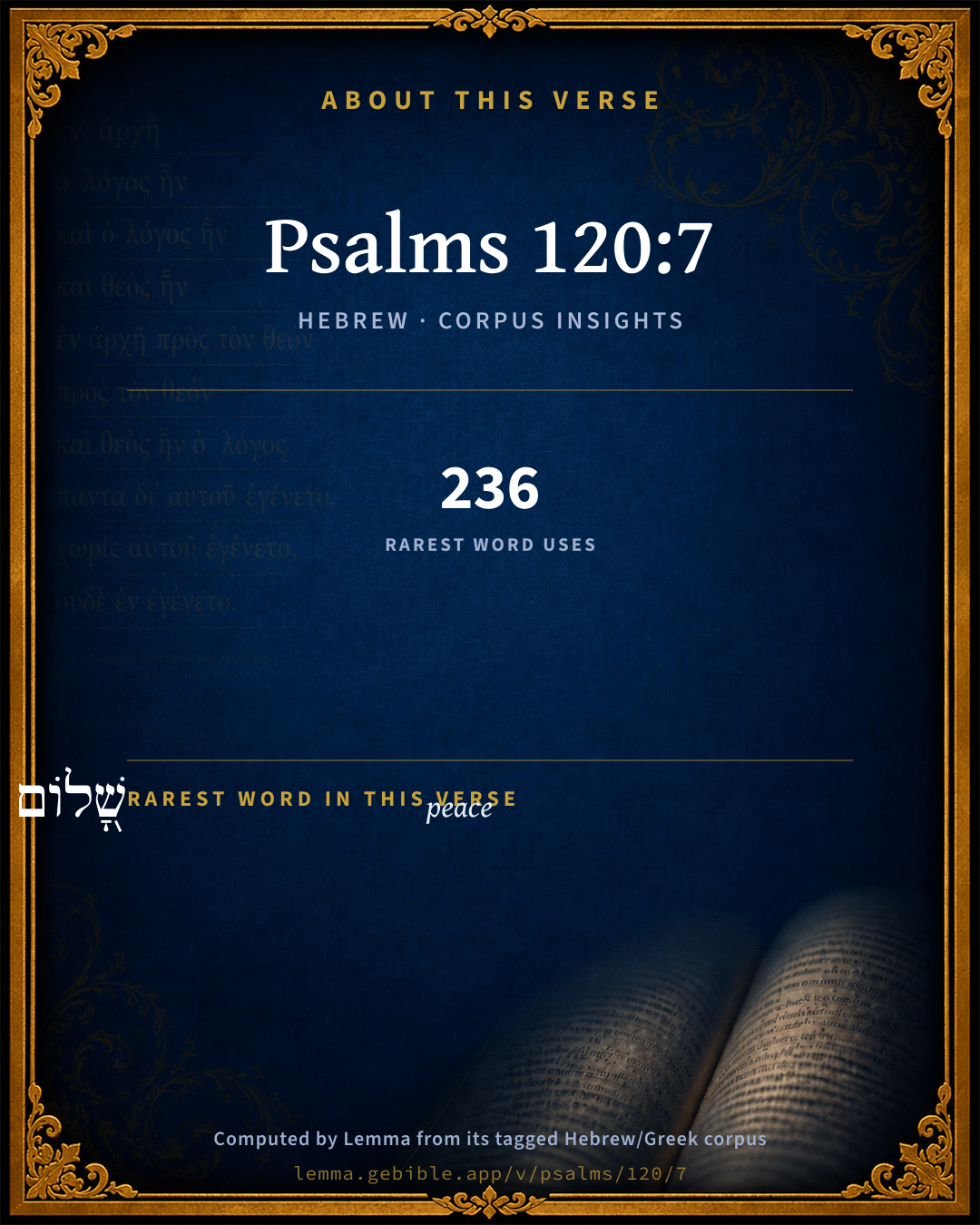
Psalms, in the Wisdom, opens this verse with 6 words (6 distinct Hebrew lemmas). Its most distinctive word is shâlôwm (“peace”). A historical commentator’s framing appears above. Read the whole chapter for the surrounding context.

Discussion questions

  1. The word shâlôwm carries the sense “peace.” How does it shape the verse?
  2. Matthew 5:9 shares this passage’s theme. How do the two illuminate each other?
  3. These translations render this verse differently. What is at stake in choosing one wording over another?
  4. The verb «אֲדַבֵּ֑ר» is Piel Imperfect. How does its form color the action?
  5. Reading how Trapp's Complete Commentary and J. A. Alexander on Psalms read this verse, where do the two commentators agree and where do they part?

Things to notice

Reading settings

Reading text

Shown beneath each verse's original-language words.

Old Testament
Old Testament edition

Read the OT as the Masoretic Hebrew (MT) or the Greek Septuagint (LXX).

English shown for the Greek Septuagint (in the Hebrew ↔ Greek comparison).

Comparing translations? Open the Compare panel on any verse page to stack up to four side by side.