Jeremiah 15:5

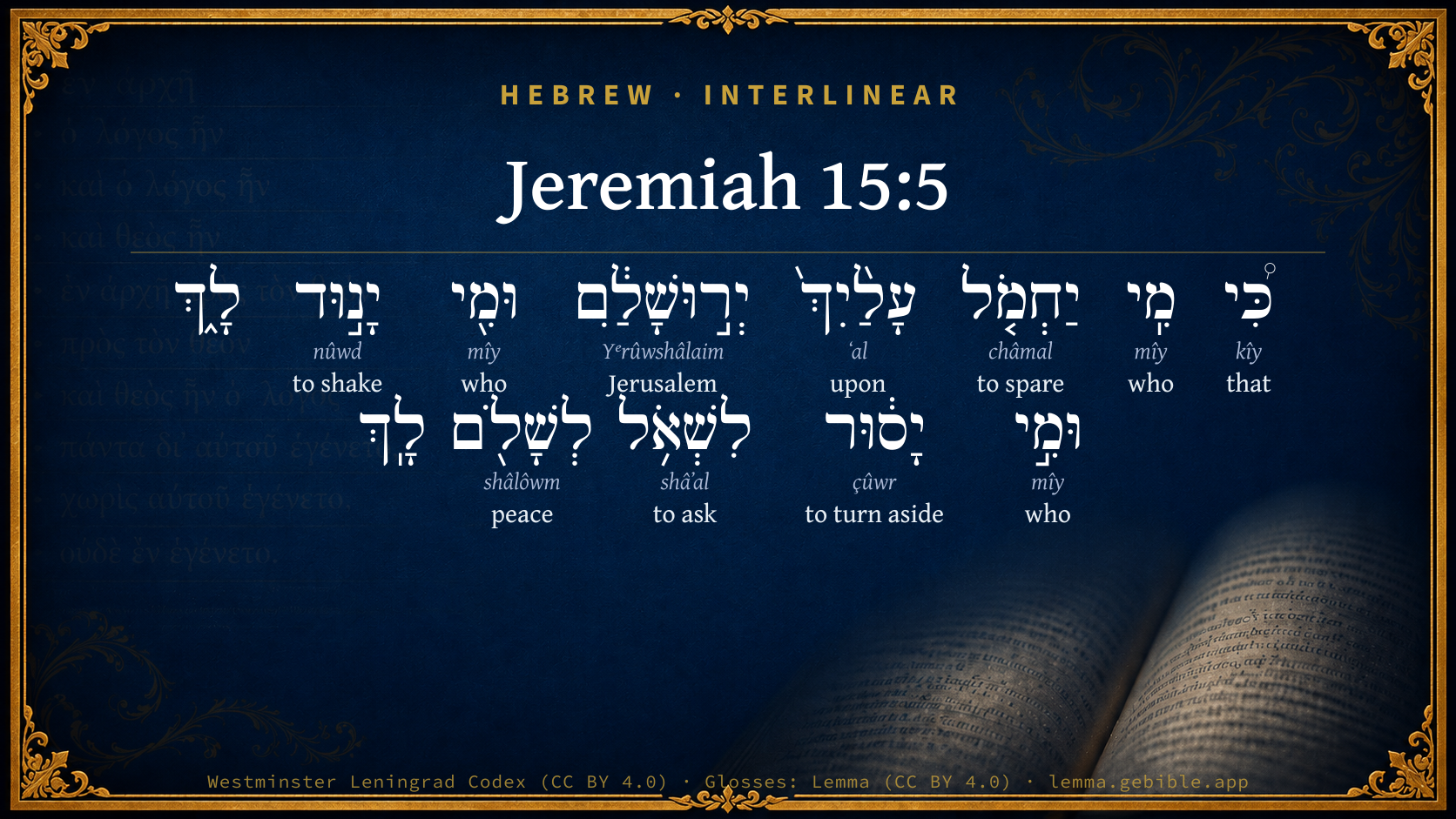
Hebrew (Westminster Leningrad Codex) Jeremiah 15:5 appears in the Hebrew Old Testament. The text above is from the Westminster Leningrad Codex. Each word links to its Strong’s number, a concise gloss, and parsing drawn from the Open Scriptures Hebrew Bible morphology. Click any word for its full Brown-Driver-Briggs (BDB) entry.
Download image
Cite this verse

Jeremiah 15:5 (World English Bible). Public Domain. Lemma interlinear Bible study tool, https://lemma.gebible.app/v/jeremiah/15/5.

Show BibTeX & RIS
BibTeX
RIS
English Translation
For who will have pity on you, Jerusalem? or who will bemoan you? or who will turn aside to ask of your welfare?
World English Bible · Public Domain
Download a study sheet

One document with this verse’s original text, its word-by-word gloss line, the meaning frame, cross-references with their text, attributed commentary, and full source and license credits — printable, and it pastes into notes with its structure intact.

This verse Autodidact and up

Study sheet (.html) Plain text (.txt)

A passage Seminary Student

Up to 50 verses in one chapter. A passage sheet keeps up to 6 commentary sources and 12 cross-references per verse, in the order this page ranks them, and says so on the sheet whenever that leaves anything out. Ask for a single verse and you get the Autodidact verse sheet above.

Everything on this page stays free to read, with no account — the sheet is a download of what is already on screen, not access to it.

Want to remove ads? Support Godless Engineer
Compare translations 3

The same verse in 3 English versions, stacked beneath the original-language interlinear above. Click any original word for its lexicon entry.

Each is an independent rendering of the whole verse — the interlinear is not word-aligned to these translations.

Highlighted words mark where these versions differ — a whole-verse word diff, not a word-by-word alignment.

  • World English Bible Public Domain
    For who will have pity on you, Jerusalem? or who will bemoan you? or who will turn aside to ask of your welfare?
  • King James Version Public Domain
    For who shall have pity upon thee, O Jerusalem? or who shall bemoan thee? or who shall go aside to ask how thou doest?
  • unfoldingWord Literal Text CC BY-SA 4.0
    For who will have compassion on you, Jerusalem, or who will grieve for you, or who will turn aside to ask about your well-being?

unfoldingWord Literal Text — © unfoldingWord, licensed CC BY-SA 4.0. Word-aligned USFM3 via Door43 (git.door43.org/unfoldingWord/en_ult).

Versions to compare (up to 4)

3 of 4 selected

Show all 18 translations

Every available English version of this verse, each an independent rendering of the whole verse.

  • World English Bible Public Domain
    For who will have pity on you, Jerusalem? or who will bemoan you? or who will turn aside to ask of your welfare?
  • Berean Standard Bible Public Domain
    Who will have pity on you, O Jerusalem? Who will mourn for you? Who will turn aside to ask about your welfare?
  • Majority Standard Bible Public Domain
    Who will have pity on you, O Jerusalem? Who will mourn for you? Who will turn aside to ask about your welfare?
  • King James Version Public Domain
    For who shall have pity upon thee, O Jerusalem? or who shall bemoan thee? or who shall go aside to ask how thou doest?
  • American Standard Version (1901) Public Domain
    For who will have pity upon thee, O Jerusalem? or who will bemoan thee? or who will turn aside to ask of thy welfare?
  • Revised Version (1885) Public Domain
    For who shall have pity upon thee, O Jerusalem? or who shall bemoan thee? or who shall turn aside to ask of thy welfare?
  • Geneva Bible (1599) Public Domain
    Who shall then haue pitie vpon thee, O Ierusalem? or who shalbe sorie for thee? or who shall go to pray for thy peace?
  • Douay-Rheims (1899) Public Domain
    For who shall have pity on thee, O Jerusalem? or who shall bemoan thee? or who shall go to pray for thy peace?
  • Young's Literal Translation Public Domain
    For who hath pity on thee, O Jerusalem? And who doth bemoan for thee? And who turneth aside to ask of thy welfare?
  • Literal Standard Version CC BY-SA 4.0
    For who has pity on you, O Jerusalem? And who bemoans for you? And who turns aside to ask of your welfare?
  • Unlocked Literal Bible CC BY-SA 4.0
    For who will have compassion for you, Jerusalem? Who will grieve for you?
  • unfoldingWord Literal Text CC BY-SA 4.0
    For who will have compassion on you, Jerusalem, or who will grieve for you, or who will turn aside to ask about your well-being?
  • Darby Bible Public Domain
    For who shall have pity upon thee, Jerusalem? and who shall bemoan thee? and who shall turn aside to ask after thy welfare?
  • World Messianic Bible Public Domain
    For who will have pity on you, Jerusalem? Who will mourn you? Who will come to ask of your welfare?
  • Webster's Bible Public Domain
    For who shall have pity upon thee, O Jerusalem? or who shall bemoan thee? or who shall go aside to ask concerning thy welfare?
  • Free Bible Version CC BY-SA 4.0
    Who will be sorry for you, Jerusalem? Who will mourn for you? Who will stop to ask you how you are?
  • Bible in Basic English Public Domain
    For who will have pity on you, O Jerusalem? and who will have sorrow for you? or who will go out of his way to see how you are?
  • JPS Tanakh (1917) Public Domain
    For who shall have pity upon thee, O Jerusalem? Or who shall bemoan thee? Or who shall turn aside to ask of thy welfare?

Literal Standard Version (2020), Covenant Press — licensed CC BY-SA 4.0. Text via the HelloAO Bible API (eBible.org). Unlocked Literal Bible (unfoldingWord) — licensed CC BY-SA 4.0. Text via the HelloAO Bible API (eBible.org). unfoldingWord Literal Text — © unfoldingWord, licensed CC BY-SA 4.0. Word-aligned USFM3 via Door43 (git.door43.org/unfoldingWord/en_ult). Free Bible Version, Dr. Jonathan Gallagher — licensed CC BY-SA 4.0. Text via the HelloAO Bible API (eBible.org).

Word by word

More ways to search: Search by grammar → Find every occurrence → Compare this word →

Practice this passage: Drill this verse → Learn its vocabulary →

יָנ֣וּד
nûwd
H5110
“to shake”
Verb, Qal, Imperfect, 3rd Person, Masculine, Singular
Part of Speech
Verb
Stem
Qal
Form
Imperfect
Person
3rd Person
Gender
Masculine
Number
Singular
Full BDB Definition

Origin: a primitive root

TWOT: 1319

to shake, waver, wander, move to and fro, flutter, show grief, have compassion on - (Qal) - to move to and fro, wander (aimlessly), take flight - to flutter - to waver, wave, shake - to show grief - to lament, condole, show sympathy - (Hiphil) - to cause to wander (aimlessly) - to make a wagging, wag (with the head) - (Hithpolel) - to move oneself to and fro, sway, totter - to shake oneself - to bemoan oneself
  1. כִּ֠י kîy H3588 “that” Conjunction
  2. מִֽי mîy H4310 “who” Particle, Interrogative
  3. יַחְמֹ֤ל châmal H2550 “to spare” Verb, Qal, Imperfect, 3rd Person, Masculine, Singular
  4. עָלַ֨יִךְ֙ ʻal H5921 “upon · you” Preposition + Suffix, Personal, 2nd Person, Feminine, Singular
  5. יְר֣וּשָׁלִַ֔ם Yᵉrûwshâlaim H3389 “Jerusalem” Noun, Proper
  6. וּמִ֖י mîy H4310 “and · who” Conjunction + Particle, Interrogative
  7. וּמִ֣י mîy H4310 “and · who” Conjunction + Particle, Interrogative
  8. יָס֔וּר çûwr H5493 “to turn aside” Verb, Qal, Imperfect, 3rd Person, Masculine, Singular
  9. לִשְׁאֹ֥ל shâʼal H7592 “to ask” Preposition + Verb, Qal, Infinitive Construct
  10. לְשָׁלֹ֖ם shâlôwm H7965 “to/for · peace” Preposition + Noun, Common, Masculine, Singular, Absolute

About this verse

These counts appear in no published source. They are computed here, from the morphology-tagged text and Lemma’s own curated glosses. What Lemma adds →

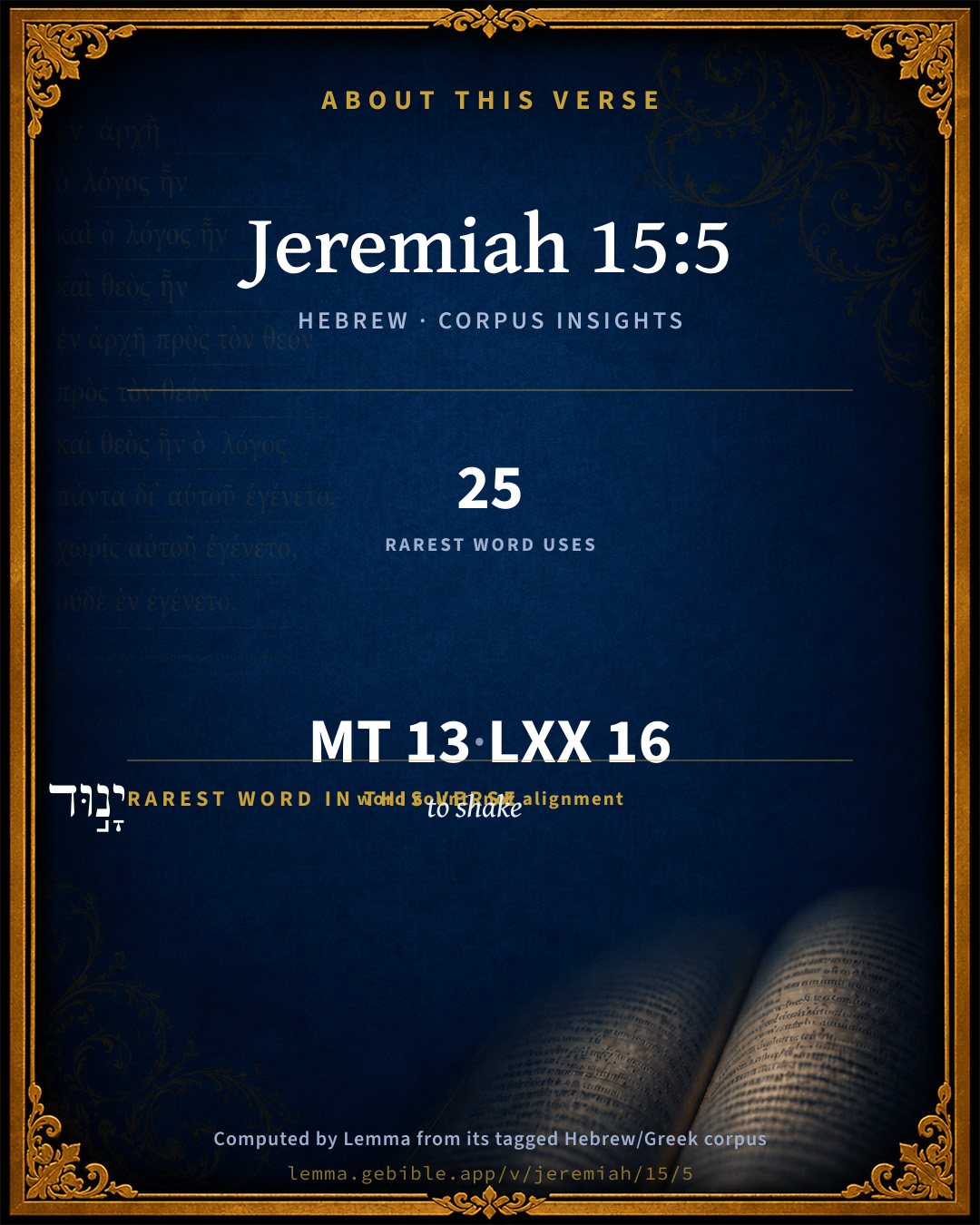
13
words
9
distinct lemmas
Prophets
section

Notable vocabulary

The rarest word here is יָנ֣וּד to shake H5110 — appearing just 25 times in the whole Hebrew Bible.

Shared distinctive vocabulary

יָנ֣וּד to shake H5110 occurs in 24 verses of the Hebrew Bible. Also found in:

Grammatical profile

  • 4 verbs
  • 2 nouns
  • 3 prepositions
  • 1 conjunction
  • 3 particles

Verb forms

  • יַחְמֹ֤ל Qal · Imperfect
  • יָנ֣וּד Qal · Imperfect
  • יָס֔וּר Qal · Imperfect
  • לִשְׁאֹ֥ל Qal · Infinitive Construct

Repetition

A word recurs within this verse — often emphatic in Hebrew:

Hebrew & Septuagint length

In the original languages it is 13 Hebrew tokens and 16 Greek tokens — but the two are counted differently (Hebrew bundles its prefixes and suffixes into one token; the Greek is in lemma form), so that isn’t a like-for-like length.

Cross-references

14

Topical passages linked to Jeremiah 15:5 in the Treasury of Scripture Knowledge — connected by theme and wording, ordered by reader-vote popularity; previews shown in the World English Bible.

  • Isaiah 51:19 These two things have happened to you. Who will bemoan you? Desolation and destruction, and the famine and the sword; how shall I comfort you?
  • Nahum 3:7 It will happen that all those who look at you will flee from you, and say, 'Nineveh is laid waste Who will mourn for her?' Where will I seek comforters for you?"
  • Jeremiah 21:7 Afterward, says Yahweh, I will deliver Zedekiah king of Judah, and his servants, and the people, even such as are left in this city from the pestilence, from the sword, and from the famine, into the hand of Nebuchadrezzar king of Babylon, and into the hand of their enemies, and into the hand of those who seek their life: and he shall strike them with the edge of the sword; he shall not spare them, neither have pity, nor have mercy.
  • Psalms 69:20 Reproach has broken my heart, and I am full of heaviness. I looked for some to take pity, but there was none; For comforters, but I found none.
  • Exodus 18:7 Moses went out to meet his father-in-law, and bowed and kissed him. They asked each other of their welfare, and they came into the tent.
  • 1 Samuel 17:22 David left his baggage in the hand of the keeper of the baggage, and ran to the army, and came and greeted his brothers.
  • 1 Samuel 25:5 David sent ten young men, and David said to the young men, Go up to Carmel, and go to Nabal, and greet him in my name:
  • Job 19:21 "Have pity on me, have pity on me, you my friends; For the hand of God has touched me.
  • Jeremiah 13:14 I will dash them one against another, even the fathers and the sons together, says Yahweh: I will not pity, nor spare, nor have compassion, that I should not destroy them.
  • Jeremiah 16:5 For thus says Yahweh, Don't enter into the house of mourning, neither go to lament, neither bemoan them; for I have taken away my peace from this people, says Yahweh, even loving kindness and tender mercies.
  • Lamentations 1:12–16 Is it nothing to you, all you who pass by? Look, and see if there be any sorrow like my sorrow, which is brought on me, With which Yahweh has afflicted [me] in the day of his fierce anger.
  • Lamentations 2:15–16 All that pass by clap their hands at you; They hiss and wag their head at the daughter of Jerusalem, [saying], Is this the city that men called The perfection of beauty, The joy of the whole earth?
  • Judges 18:15 They turned aside there, and came to the house of the young man the Levite, even to the house of Micah, and asked him of his welfare.
  • 1 Samuel 10:4 and they will greet you, and give you two loaves of bread, which you shall receive of their hand.

Cross-references courtesy of OpenBible.info (CC BY 4.0).

Hebrew and Greek witnesses Masoretic Hebrew ↔ Greek Septuagint

The same verse in the two great witnesses to the Old Testament, shown verse-for-verse.

These are two independent witnesses, not word-aligned to each other, and the Septuagint is shown in lemma (dictionary) form.

Hebrew Jeremiah 15:5 Masoretic · Westminster Leningrad Codex

כִּ֠י מִֽי יַחְמֹ֤ל עָלַ֨יִךְ֙ יְר֣וּשָׁלִַ֔ם וּמִ֖י יָנ֣וּד לָ֑ךְ וּמִ֣י יָס֔וּר לִשְׁאֹ֥ל לְשָׁלֹ֖ם לָֽךְ

For who will have pity on you, Jerusalem? or who will bemoan you? or who will turn aside to ask of your welfare?

World English Bible · Public Domain

Greek LXX Structure differs

In the Septuagint, Jeremiah is about an eighth shorter than the Hebrew and arranges its material differently — the Oracles Against the Nations (Hebrew chapters 46–51) appear in the middle of the Greek book, after 25:13. Because the chapter and verse boundaries do not line up, a verse-for-verse comparison with the Hebrew is not shown.

A verse-for-verse comparison isn’t shown here because the chapters and verses don’t line up. Switch to the LXX edition with the MT / LXX toggle above to read the Greek directly.

Hebrew: Westminster Leningrad Codex (CC BY 4.0). Greek: Septuagint (public domain); English from a public-domain English Septuagint. How the Septuagint differs from the Hebrew →

Targum (Aramaic paraphrase)

1

The Targum is the ancient Jewish Aramaic paraphrase of the Hebrew Scriptures — an interpretive translation, not the Hebrew text itself. Onkelos (literal) and Pseudo-Jonathan (expansive) render the Torah, and Jonathan the Prophets. Coverage is partial: where no permissively-licensed English translation exists for a verse, only the Aramaic is shown. This is verse-level text, not a word-by-word alignment to the Hebrew.

  1. Targum Jonathan Prophets (Joshua–Malachi)
    אֲרֵי מַן יֵחוּס עֲלָךְ יְרוּשְׁלֵם וּמַן יִדְוֵי עֲלָךְ וּמַן יְזוּר לְמִשְׁאַל לִשְׁלָמָא לָךְ:

    (no public-domain English translation for this verse)

    Targum Jonathan — Aramaic: “Mikraot Gedolot” (public domain). English: “Sefaria Community Translation” (CC0 1.0 (public-domain dedication)); “London "Chaldee Paraphrase," 1871” (public domain). Text via Sefaria.

Commentary

Notes on Jeremiah 15:5 from classic Christian and Jewish commentators (each source and its license shown beneath its notes). The classic Christian expositions comment on the surrounding passage and are grouped to its opening verse, so a note may address several verses; the Jewish commentaries on the Tanakh (Rashi and others) are per-verse, so they appear only where the commentator wrote on this verse.

Lemma curates 59 commentaries, every one of them public domain or Creative Commons licensed, each selected and text-cleaned for this edition rather than reprinted as found. About our sources →

Trapp's Complete Commentary

John Trapp

Jer 15:5 For who shall have pity upon thee, O Jerusalem? or who shall bemoan thee? or who shall go aside to ask how thou doest?

Ver. 5. Who shall bemoan thee?] Heb., Who shall come out of his place to comfort thee? Or, Who shall shake his head in commiseration to thee?

John Trapp, A Commentary or Exposition upon All the Books of the Old and New Testament (1647–1656) — public domain. Text from a community e-Sword module.

Keil & Delitzsch

C. F. Keil & F. Delitzsch

In Jer 15:5-9 we have a still further account of this appalling judgment and its causes. The grounding כּי in Jer 15:5 attaches to the central thought of Jer 15:4. The sinful people will be given up to all the kingdoms of the earth to be ill used, for no one will or can have compassion on Jerusalem, since its rejection by God is a just punishment for its rejection of the Lord (Jer 15:6). "Have pity" and "bemoan" denote loving sympathy for the fall of the unfortunate. חמל, to feel sympathy; נוּד, to lament and bemoan. סוּר, to swerve from the straight way, and turn aside or enter into any one's house; cf. Gen 19:2., Exo 3:3, etc. ל שׁאל לשׁלום, to inquire of one as to his health, cf. Exo 18:7; then: to salute one, to desire לך שׁלום, Gen 43:27; Jdg 18:15, and often. Not only will none show sympathy for Jerusalem, none will even ask how it goes with her welfare.

Jer 15:6

The reason of this treatment: because Jerusalem has dishonoured and rejected its God, therefore He now stretched out His hand to destroy it. To go backwards, instead of following the Lord, cf. Jer 7:24. This determination the Lord will not change, for He is weary of repenting. הנּחם frequently of the withdrawal, in grace and pity, of a divine decree to punish, cf. Jer 4:28, Gen 6:6., Joe 2:14, etc.

Jer 15:7

ואזרם is a continuation of ואט, Jer 15:6, and, like the latter, is to be understood prophetically of what God has irrevocably determined to do. It is not a description of what is past, an allusion to the battle lost at Megiddo, as Hitz., carrying out his priori system of slighting prophecy, supposes. To take the verbs of this verse as proper preterites, as J. D. Mich. and Ew. also do, is not in keeping with the contents of the clauses. In the first clause Ew. and Gr. translate שׁערי gates, i.e., exits, boundaries of the earth, and thereby understand the remotest lands of the earth, the four corners of extremities of the earth, Isa 11:12 (Ew.). But "gates" cannot be looked on as corners or extremities, nor are they ends or borders, but the inlets and outlets of cities. For how can a man construe to himself the ends of the earth as the outlets of it? where could one go to from there? Hence it is impossible to take הארץ of the earth in this case; it is the land of Judah. The gates of the land are either mentioned by synecdoche for the cities, cf. Mic 5:5, or are the approaches to the land (cf. Nah 3:13), its outlets and inlets. Here the context demands the latter sense. זרה, to fan, c. בּ loci, to scatter into a place, cf. Eze 12:15; Eze 30:26 : fan into the outlets of the land, i.e., cast out of the land. שׁכּל, make the people childless, by the fall in battle of the sons, the young men, cf. Eze 5:17. The threat is intensified by אבּדתּי, added as asyndeton. The last clause: from their ways, etc., subjoins the reason.

Jer 15:8-9

By the death of the sons, the women lose their husbands, and become widows. לי is the dative of sympathetic interest. "Sand of the sea" is the figure for a countless number. ימּים is poetic plural; cf. Psa 78:27; Job 6:3. On these defenceless women come suddenly spoilers, and these mothers who had perhaps borne seven sons give up the ghost and perish without succour, because their sons have fallen in war. Thus proceeds the portrayal as Hitz. has well exhibited it. על אם בּחוּר is variously interpreted. We must reject the view taken by Chr. B. Mich. from the Syr. and Arab. versions: upon mother and young man; as also the view of Rashi, Cler., Eichh., Dahl., etc., that אם means the mother-city, i.e., Jerusalem. The true rendering is that of Jerome and Kimchi, who have been followed by J. D. Mich., Hitz., Ew., Graf, and Ng.: upon the mother of the youth or young warrior. This view is favoured by the correspondence of the woman mentioned in Job 6:9 who had borne seven sons. Both are individualized as women of full bodily vigour, to lend vividness to the thought that no age and no sex will escape destruction בּצּהרים, at clear noontide, when one least looks for an attack. Thus the word corresponds with the "suddenly" of the next clause. עיר, Aramaic form for ציר, Isa 13:8, pangs. The bearer of seven, i.e., the mother of many sons. Seven as the perfect number of children given in blessing by God, cf. Sa1 2:5; Rut 4:15. "She breathes to her life," cf. Job 31:39. Graf wrongly: she sighs. The sun of her life sets (בּאה) while it is still day, before the evening of her life has been reached, cf. Amo 8:9. "Is put to shame and confounded" is not to be referred to the son, but the mother, who, bereaved of her children, goes covered with shame to the grave. The Keri בּא for בּאה is an unnecessary change, since שׁמשׁ is also construed as fem., Gen 15:17. The description closes with a glance cast on those left in life after the overthrow of Jerusalem. These are to be given to the sword when in flight before their enemies, cf. Mic 6:14.

Keil & Delitzsch — Biblical Commentary on the Old Testament (1861–1891) — public domain (CC PDM 1.0). Text via the HelloAO Bible API. (Old Testament only.)

Tyndale Open Study Notes

Tyndale Open Resources

15:5 These three questions are rhetorical—the answer is, “No one!”

Tyndale Open Study Notes — © Tyndale Open Resources, licensed CC BY-SA 4.0. Text via the HelloAO Bible API.

Jamieson, Fausset & Brown

Robert Jamieson, A. R. Fausset & David Brown

go aside . . . how thou doest--Who will turn aside (in passing by) to salute thee (to wish thee "peace")?

Jamieson, Fausset & Brown — Commentary Critical and Explanatory on the Whole Bible (1871) — public domain (CC PDM 1.0). Text via the HelloAO Bible API.

Adam Clarke's Commentary

Verse 5. Who shall go aside to ask how thou doest?] Perhaps there is not a more despised nor a more degraded people under the sun. Scarcely any one thinks himself called upon to do a kind office for a Jew. Their character is bad in society, and they are not at all solicitous to redeem it.

Adam Clarke's Commentary on the Bible (1810–1826) — public domain. Text from a community e-Sword/MySword module.

John Calvin's Commentaries

The Prophet shews here that the severe punishment of which he had spoken could not be deemed unjust, according to what those men thought who were querulous, and ever expostulated with God, and charged him with too much rigour. Lest, then, the Jews should complain, the Prophet says briefly, that all the evils which were nigh at hand were fully due, and so deserved, that they could find no pity, even among men. We know that the worst of men, when the Lord punishes them, have some to condole with them. There is no one so wicked that relatives do not favor him, and that some do not console him. But the Prophet shews that the Jews were not only inexcusable before God, but that they were undeserving of any sympathy from men.

He first says, Who will pity thee? and then, Who will console with thee? The verb. נוד, nud, means properly to give comfort by words, as when relatives, and friends, and neighbors meet together for the purpose of mourning; they hear lamentations, and join in them. But he says that no one would perform this office towards Jerusalem. He adds, in the third place, And who will turn aside? or, strictly, change place — Who will change place to enquire? or, as some render it, to pray. The verb שאל shal, means properly to ask, and hence sometimes to pray. So, many give this meaning, that there would be no one to pray for the Jews. But if we consider the construction of the sentence, we shall see that the Prophet speaks of that duty of kindness which men cultivate and observe towards one another, by enquiring of their welfare, — “Are all things well with thee?” How dost thou do? Are all things well with thee and thine?” When we thus enquire of the state of any one we shew some concern for him, for love is always solicitous for the welfare of others. The Prophet then says, “Who will turn aside to thee to enquire of thy welfare?” that is, that he may know how thou art, and what is thy state and condition.

We hence see that the Jews are here divested of every complaint, for the whole world would acknowledge them to be unworthy of any commiseration. But the Prophet does not mean that all would act cruelly towards Jerusalem, but rather shews, that such were their crimes that there was no room for courtesy, or for those acts of kindness which men of themselves perform towards one another.

John Calvin's Commentaries (1540-1563) — public domain. Text from the Calvin Translation Society English edition (1840s-50s) via the Christian Classics Ethereal Library (ccel.org). Calvin's coverage is partial (roughly two-thirds of the Bible); uncommented books and verses are honest gaps, never fabricated. The 19th-century editor's footnotes and remarks are omitted so the notes are faithfully Calvin's own voice.

Ellicott's Commentary for English Readers

(5) To ask how thou doest?—This is a fair paraphrase of the original, but it wants the Oriental colouring of the more literal to ask after thy peace. As “Peace be with thee” was the usual formula of salutation, sc.,” Is it peace?” was the equivalent for our more prosaic question, “How do you do?” (Gen_43:27; Jdg_18:15). The same phrase meets us in Exo_18:7, “They asked each other of their welfare,” literally, of their peace.

A Bible Commentary for English Readers, edited by Charles John Ellicott (1878–1897) — public domain. Text from a community e-Sword module.

John Gill's Exposition

For who shall have pity upon thee, O Jerusalem?.... The inhabitants of it; their sins being so many, and so heinous, and so aggravated, and so deserving of punishment, that none could pity their case, or have a heart of compassion towards them, or even spare reproaching them: or "who shall bemoan thee?" sympathize and condole with thee, or speak a comfortable word to thee, or seek to alleviate thy grief and sorrow: or "who shall go aside to ask how thou doest?" or "of thy peace?" (c) shall not think it worth their while to go a step out of their way, or turn into a house, and inquire of thy welfare, or salute thee.

(c) "ad petendum de pace tua", Pagninus; "ad interrogandum te de paca tua", Piscator; "sive prosperitate tua", Junius & Tremellius.

John Gill's Exposition of the Whole Bible (1746–1763) — public domain (CC PDM 1.0). Text via the HelloAO Bible API.

Haydock's Catholic Bible Commentary

Peace. All will abhor thee. (Calmet) --- "The creatures cannot be so clement as the Creator." (St. Jerome)

George Leo Haydock (1774–1849), Haydock's Catholic Family Bible and Commentary, 1859 edition — public domain. Excludes Psalms (Douay-Rheims chapter numbering differs from Protestant) and Deuterocanonical books (Catholic canon only).

Matthew Poole's English Annotations

The sum of this is, that this people should be in a most miserable, pitiless state and condition; none should regard them in the day of their calamity, nor so much as once inquire after them, or how they fared, or what they did.

Matthew Poole's English Annotations on the Holy Bible (1683–1685) — public domain. Text from a community e-Sword/MySword module.

Whedon's Commentary on the Bible

Daniel D. Whedon

5. Who shall have pity, etc. — Who if not Jeremiah? In rejecting him the people were sacrificing their last friend influential with God. How like to the after conduct of descendants of this very people in crucifying the Son of God.

Daniel D. Whedon (gen. ed.), Commentary on the Old and New Testaments (1874–1909) — public domain. Text from a community e-Sword module.

The Pulpit Commentary

For who shall have pity? or, for who can have pity, etc.? (the imperfect in its potential sense). The horror which will seize upon the spectators will effectually preclude pity. Who shall go aside? As one turns aside to call at a house. So Gen_19:2 (literally, turn aside, not "turn in").

The Pulpit Commentary (1880–1919), ed. H.D.M. Spence-Jones & Joseph S. Exell — public domain. Text from a community e-Sword module.

unfoldingWord translationNotes

Door43 World Missions Community

General Information:

Yahweh has just told them he will assign them to four groups to kill them—the sword, dogs, birds, and beasts.

For who will have compassion for you, Jerusalem? Who will grieve for you?

Yahweh uses this rhetorical question to emphasize that no one should mourn for Jerusalem. This question can be written as a statement. AT: "No one should have compassion on you, Jerusalem. No one should mourn for your destruction." (See: Rhetorical Question)

for you, Jerusalem

Here "Jerusalem" refers to the people who live there. AT: "for you people who live in Jerusalem" (See: Metonymy)

You have forsaken me ... you have gone back from me

These two phrases mean basically the same thing and emphasize that the people have, indeed, forsaken Yahweh. (See: Parallelism)

this is Yahweh's declaration

Yahweh speaks of himself by name to express the certainty of what he is declaring. See how you translated this in Jeremiah 1:8. AT: "this is what Yahweh has declared" or "this is what I, Yahweh, have declared" (See: First, Second, or Third Person)

gone back from me

"left me" or "gone away from me"

I will strike you with my hand

Here "hand" represents power. AT: "I will use my power to strike you" (See: Metonymy)

So I will winnow them with a pitchfork at the gates of the land

Here Yahweh speaks of scattering the people and causing them to leave Jersalem as if they were winnowed chaff being blown away on the wind. (See: Metaphor)

pitchfork

a farm tool with a long handle and sharp metal prongs, used especially for lifting and tossing grain in the air for winnowing

I will bereave them

"I will cause their children to die" or "I will let their enemies kill their children"

translationWords

compassion

turn

forsake

hand

mercy

winnow

gate

unfoldingWord translationNotes — © Distant Shores Media and the Door43 World Missions Community, licensed CC BY-SA 4.0. Source: git.door43.org/Door43/en_tn.

Rashi

Rabbi Shlomo Yitzchaki (Rashi)

will lament Heb. יָנוּד.

and who will turn aside to you, to turn aside from his road to you, to ask of your welfare?

Rashi on the Tanakh — English translations: “The Judaica Press complete Tanach with Rashi, translated by A. J. Rosenberg” (CC BY 4.0); “Pentateuch with Rashi's commentary by M. Rosenbaum and A.M. Silbermann, 1929-1934” (public domain); “The Metsudah Tanach series, Lakewood, N.J” (CC BY 4.0); and “The Book of Joshua, Metsudah Publications, 1997” (CC BY 4.0). Text via Sefaria.

Lesson kit

Teaching starters — assembled from the data on this page, not authored interpretation. Every prompt links to the verse data it draws on. Edit before teaching.

Jeremiah, in the Prophets, opens this verse with 13 words (9 distinct Hebrew lemmas). Its most distinctive word is nûwd (“to shake”). A historical commentator’s framing appears above. Read the whole chapter for the surrounding context.

Discussion questions

  1. How does “to shake” (nûwd) shape what this verse is saying?
  2. Genesis 4:12 shares the word «to shake» with this verse. How do the two illuminate each other?
  3. “who” occurs 3× in this one verse. What is the effect of the repetition?
  4. These translations render this verse differently; the difference is in the English rendering, not the original. What questions does that raise?
  5. The verb «יַחְמֹ֤ל» is Qal Imperfect. How does its form color the action?
  6. Reading how Trapp's Complete Commentary and Keil & Delitzsch read this verse, where do the two commentators agree and where do they part?

Things to notice

Reading settings

Reading text

Shown beneath each verse's original-language words.

Old Testament
Old Testament edition

Read the OT as the Masoretic Hebrew (MT) or the Greek Septuagint (LXX).

English shown for the Greek Septuagint (in the Hebrew ↔ Greek comparison).

Comparing translations? Open the Compare panel on any verse page to stack up to four side by side.