1 Kings 20:18

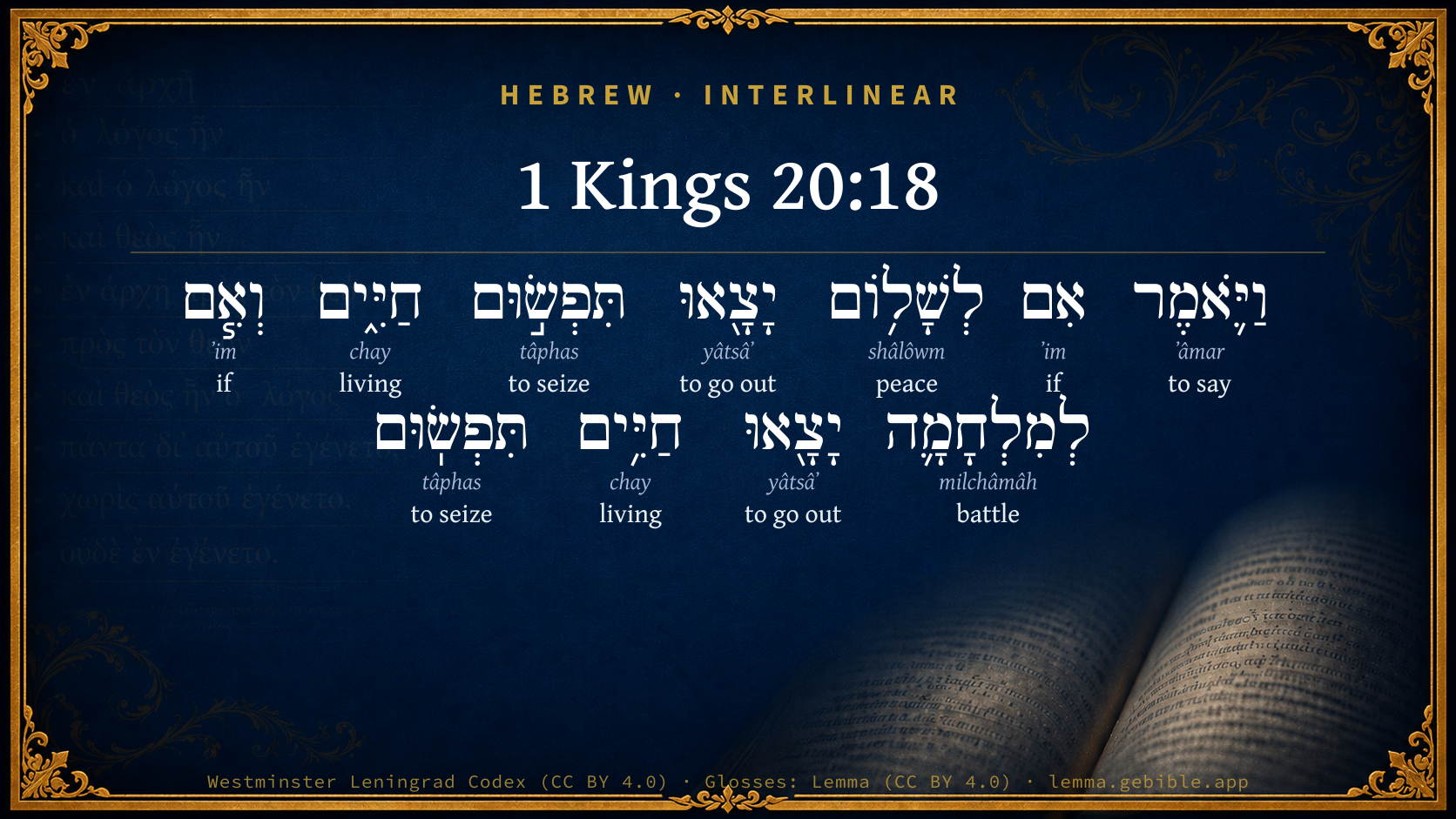
Hebrew (Westminster Leningrad Codex) 1 Kings 20:18 appears in the Hebrew Old Testament. The text above is from the Westminster Leningrad Codex. Each word links to its Strong’s number, a concise gloss, and parsing drawn from the Open Scriptures Hebrew Bible morphology. Click any word for its full Brown-Driver-Briggs (BDB) entry.
Download image
Cite this verse

1 Kings 20:18 (World English Bible). Public Domain. Lemma interlinear Bible study tool, https://lemma.gebible.app/v/1-kings/20/18.

Show BibTeX & RIS
BibTeX
RIS
English Translation
He said, Whether they are come out for peace, take them alive, or whether they are come out for war, taken them alive.
World English Bible · Public Domain
Download a study sheet

One document with this verse’s original text, its word-by-word gloss line, the meaning frame, cross-references with their text, attributed commentary, and full source and license credits — printable, and it pastes into notes with its structure intact.

This verse Autodidact and up

Study sheet (.html) Plain text (.txt)

A passage Seminary Student

Up to 50 verses in one chapter. A passage sheet keeps up to 6 commentary sources and 12 cross-references per verse, in the order this page ranks them, and says so on the sheet whenever that leaves anything out. Ask for a single verse and you get the Autodidact verse sheet above.

Everything on this page stays free to read, with no account — the sheet is a download of what is already on screen, not access to it.

Want to remove ads? Support Godless Engineer
Compare translations 3

The same verse in 3 English versions, stacked beneath the original-language interlinear above. Click any original word for its lexicon entry.

Each is an independent rendering of the whole verse — the interlinear is not word-aligned to these translations.

Highlighted words mark where these versions differ — a whole-verse word diff, not a word-by-word alignment.

  • World English Bible Public Domain
    He said, Whether they are come out for peace, take them alive, or whether they are come out for war, taken them alive.
  • King James Version Public Domain
    And he said, Whether they be come out for peace, take them alive; or whether they be come out for war, take them alive.
  • unfoldingWord Literal Text CC BY-SA 4.0
    And he said, “If they have gone out for peace, seize them alive, and if they have gone out for battle, seize them alive.”

unfoldingWord Literal Text — © unfoldingWord, licensed CC BY-SA 4.0. Word-aligned USFM3 via Door43 (git.door43.org/unfoldingWord/en_ult).

Versions to compare (up to 4)

3 of 4 selected

Show all 18 translations

Every available English version of this verse, each an independent rendering of the whole verse.

  • World English Bible Public Domain
    He said, Whether they are come out for peace, take them alive, or whether they are come out for war, taken them alive.
  • Berean Standard Bible Public Domain
    “If they have marched out in peace,” he said, “take them alive. Even if they have marched out for war, take them alive.”
  • Majority Standard Bible Public Domain
    “If they have marched out in peace,” he said, “take them alive. Even if they have marched out for war, take them alive.”
  • King James Version Public Domain
    And he said, Whether they be come out for peace, take them alive; or whether they be come out for war, take them alive.
  • American Standard Version (1901) Public Domain
    And he said, Whether they are come out for peace, take them alive, or whether they are come out for war, taken them alive.
  • Revised Version (1885) Public Domain
    And he said, Whether they be come out for peace, take them alive; or whether they be come out for war, take them alive.
  • Geneva Bible (1599) Public Domain
    And he sayde, Whether they be come out for peace, take them aliue: or whether they bee come out to fight, take them yet aliue.
  • Douay-Rheims (1899) Public Domain
    And he said: Whether they come for peace, take them alive: or whether they come to fight, take them alive.
  • Young's Literal Translation Public Domain
    And he saith, `If for peace they have come out -- catch them alive; and if for battle they have come out -- alive catch them.'
  • Literal Standard Version CC BY-SA 4.0
    And he says, “If they have come out for peace, catch them alive; and if they have come out for battle, catch them alive.”
  • Unlocked Literal Bible CC BY-SA 4.0
    Ben Hadad said, “Whether they have come out for peace or war, take them alive.”
  • unfoldingWord Literal Text CC BY-SA 4.0
    And he said, “If they have gone out for peace, seize them alive, and if they have gone out for battle, seize them alive.”
  • Darby Bible Public Domain
    And he said, Whether they be come out for peace, take them alive; or whether they be come out for war, take them alive.
  • World Messianic Bible Public Domain
    He said, “If they have come out for peace, take them alive; or if they have come out for war, take them alive.”
  • Webster's Bible Public Domain
    And he said, Whether they have come out for peace, take them alive; or whether they have come out for war, take them alive.
  • Free Bible Version CC BY-SA 4.0
    “If they're coming in peace, take them alive,” he ordered. “If they're coming to attack, take them alive.”
  • Bible in Basic English Public Domain
    And he said, If they have come out for peace, take them living, and if they have come out for war, take them living.
  • JPS Tanakh (1917) Public Domain
    And he said: 'Whether they are come out for peace, take them alive; or whether they are come out for war, take them alive.'

Literal Standard Version (2020), Covenant Press — licensed CC BY-SA 4.0. Text via the HelloAO Bible API (eBible.org). Unlocked Literal Bible (unfoldingWord) — licensed CC BY-SA 4.0. Text via the HelloAO Bible API (eBible.org). unfoldingWord Literal Text — © unfoldingWord, licensed CC BY-SA 4.0. Word-aligned USFM3 via Door43 (git.door43.org/unfoldingWord/en_ult). Free Bible Version, Dr. Jonathan Gallagher — licensed CC BY-SA 4.0. Text via the HelloAO Bible API (eBible.org).

Word by word

More ways to search: Search by grammar → Find every occurrence → Compare this word →

Practice this passage: Drill this verse → Learn its vocabulary →

תִּפְשׂ֣וּם
tâphas
H8610
“seize · them”
Verb, Qal, Imperative, 2nd Person, Masculine, Plural + Suffix, Personal, 3rd Person, Masculine, Plural
Part of Speech
Verb
Stem
Qal
Form
Imperative
Person
2nd Person
Gender
Masculine
Number
Plural
Full BDB Definition

Origin: a primitive root

TWOT: 2538

to catch, handle, lay hold, take hold of, seize, wield - (Qal) - to lay hold of, seize, arrest, catch - to grasp (in order to) wield, wield, use skilfully - (Niphal) to be seized, be arrested, be caught, be taken, captured - (Piel) to catch, grasp (with the hands)
  1. וַיֹּ֛אמֶר ʼâmar H559 “and · to say” Conjunction + Verb, Qal, Sequential Imperfect, 3rd Person, Masculine, Singular
  2. אִם ʼim H518 “if” Conjunction
  3. לְשָׁל֥וֹם shâlôwm H7965 “to/for · peace” Preposition + Noun, Common, Masculine, Singular, Absolute
  4. יָצָ֖אוּ yâtsâʼ H3318 “to go out” Verb, Qal, Perfect, 3rd Person, Common, Plural
  5. חַיִּ֑ים chay H2416 “living” Adjective, Adjective, Masculine, Plural, Absolute
  6. וְאִ֧ם ʼim H518 “and · if” Conjunction + Conjunction
  7. לְמִלְחָמָ֛ה milchâmâh H4421 “to/for · battle” Preposition + Noun, Common, Feminine, Singular, Absolute
  8. יָצָ֖אוּ yâtsâʼ H3318 “to go out” Verb, Qal, Perfect, 3rd Person, Common, Plural
  9. חַיִּ֥ים chay H2416 “living” Adjective, Adjective, Masculine, Plural, Absolute
  10. תִּפְשֽׂוּם tâphas H8610 “seize · them” Verb, Qal, Imperative, 2nd Person, Masculine, Plural + Suffix, Personal, 3rd Person, Masculine, Plural

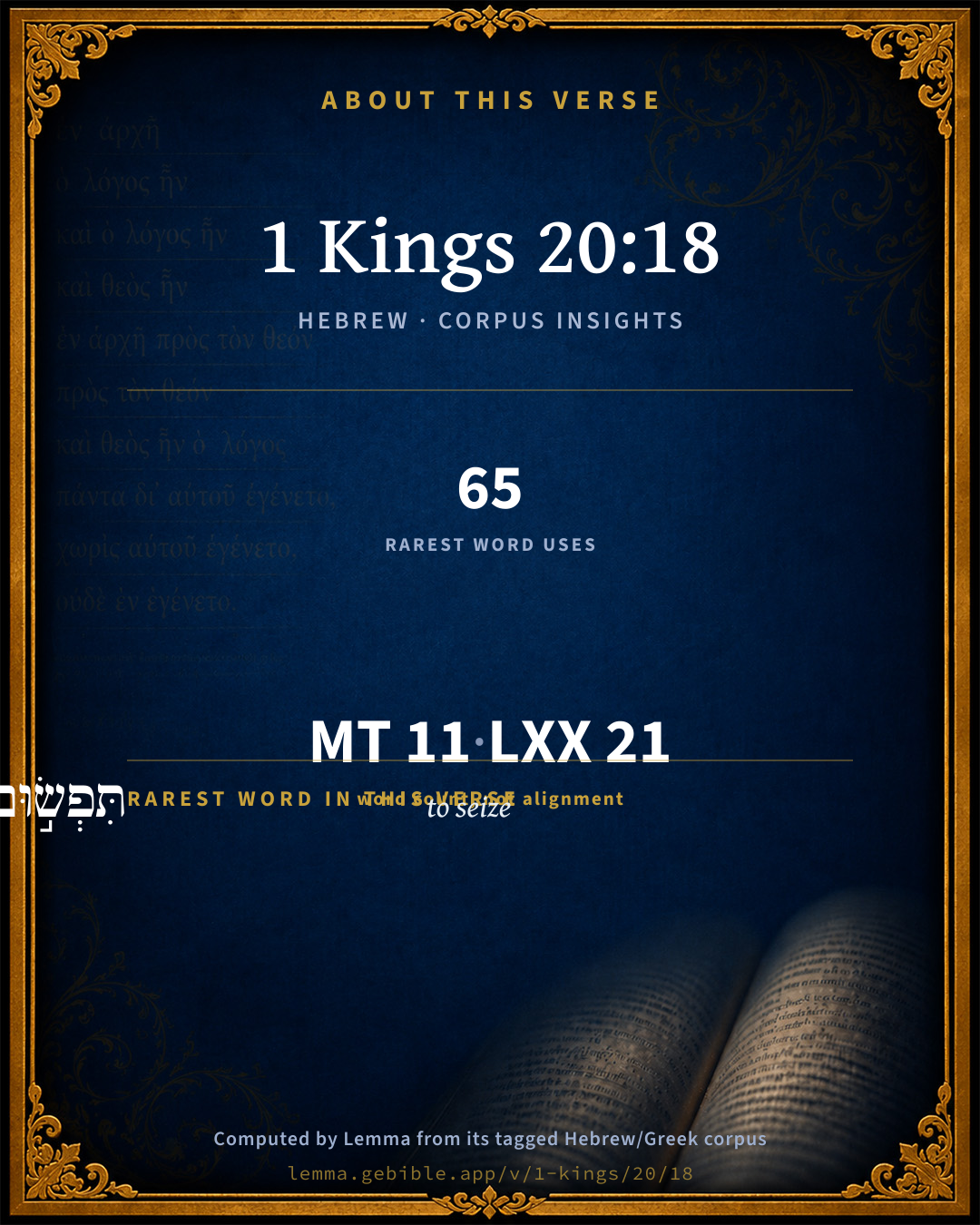
About this verse

These counts appear in no published source. They are computed here, from the morphology-tagged text and Lemma’s own curated glosses. What Lemma adds →

11
words
7
distinct lemmas
Historical
section

Grammatical profile

  • 5 verbs
  • 2 nouns
  • 2 adjectives
  • 2 conjunctions

Verb forms

  • וַיֹּ֛אמֶר Qal · Sequential Imperfect
  • יָצָ֖אוּ Qal · Perfect
  • תִּפְשׂ֣וּם Qal · Imperative
  • יָצָ֖אוּ Qal · Perfect
  • תִּפְשֽׂוּם Qal · Imperative

Repetition

Words recur within this verse — often emphatic in Hebrew:

  • יָצָ֖אוּ to go out H3318 ×2
  • תִּפְשׂ֣וּם to seize H8610 ×2
  • חַיִּ֑ים living H2416 ×2
  • אִם if H518 ×2

Hebrew & Septuagint length

In English translation the verse runs 23 words from the Hebrew and 33 from the Septuagint (LXX English) — the Septuagint runs noticeably longer here. See the side-by-side →

A rough comparison of the two English renderings, which tokenize alike — not a word-level alignment.

Word counts can differ between the Hebrew and the Greek without any difference in meaning — e.g. the Hebrew direct-object marker אֵת has no separate Greek word, and Greek often adds the article ὁ.

In the original languages it is 11 Hebrew tokens and 21 Greek tokens — but the two are counted differently (Hebrew bundles its prefixes and suffixes into one token; the Greek is in lemma form), so that isn’t a like-for-like length.

Cross-references

5

Topical passages linked to 1 Kings 20:18 in the Treasury of Scripture Knowledge — connected by theme and wording, ordered by reader-vote popularity; previews shown in the World English Bible.

  • 2 Kings 14:8–12 Then Amaziah sent messengers to Jehoash, the son of Jehoahaz son of Jehu, king of Israel, saying, Come, let us look one another in the face.
  • 1 Samuel 2:3–4 Talk no more so exceeding proudly; Don't let arrogance come out of your mouth; For Yahweh is a God of knowledge, By him actions are weighed.
  • 1 Samuel 14:11–12 Both of them disclosed themselves to the garrison of the Philistines: and the Philistines said, Behold, the Hebrews come forth out of the holes where they had hid themselves.
  • 1 Samuel 17:44 The Philistine said to David, Come to me, and I will give your flesh to the birds of the sky, and to the animals of the field.
  • Proverbs 18:12 Before destruction the heart of man is proud, But before honor is humility.

Cross-references courtesy of OpenBible.info (CC BY 4.0).

Hebrew and Greek witnesses Masoretic Hebrew ↔ Greek Septuagint

The same verse in the two great witnesses to the Old Testament, shown verse-for-verse.

Here the Septuagint runs noticeably longer than the Hebrew — LXX2012 (modern English Septuagint) 33 words vs World English Bible 23. A rough length comparison of the two English translations, not a word-level alignment — read both below.

These are two independent witnesses, not word-aligned to each other, and the Septuagint is shown in lemma (dictionary) form.

Hebrew 1 Kings 20:18 Masoretic · Westminster Leningrad Codex

וַיֹּ֛אמֶר אִם לְשָׁל֥וֹם יָצָ֖אוּ תִּפְשׂ֣וּם חַיִּ֑ים וְאִ֧ם לְמִלְחָמָ֛ה יָצָ֖אוּ חַיִּ֥ים תִּפְשֽׂוּם

He said, Whether they are come out for peace, take them alive, or whether they are come out for war, taken them alive.

World English Bible · Public Domain

Greek LXX 1 Kings 20:18 Septuagint · lemma form

ἀναἵστημι καί καταβαίνω εἰς ἀπαντή αχααβ βασιλεύς ἰσραήλ ὁ ἐν σαμαρεία ἰδού οὗτος ἐν ἀμπελών ναβουθαι ὅτι καταβαίνω ἐκεῖ κληρονομέω αὐτός

Arise, and go down to meet Achaab king of Israel, who is in Samaria, for he is in the vineyard of Nabuthai, for he has gone down there to take possession of it.

LXX2012 (modern English Septuagint) · Public Domain

Hebrew: Westminster Leningrad Codex (CC BY 4.0). Greek: Septuagint (public domain); English from LXX2012 (modern English Septuagint) (Public Domain). How the Septuagint differs from the Hebrew →

Targum (Aramaic paraphrase)

1

The Targum is the ancient Jewish Aramaic paraphrase of the Hebrew Scriptures — an interpretive translation, not the Hebrew text itself. Onkelos (literal) and Pseudo-Jonathan (expansive) render the Torah, and Jonathan the Prophets. Coverage is partial: where no permissively-licensed English translation exists for a verse, only the Aramaic is shown. This is verse-level text, not a word-by-word alignment to the Hebrew.

  1. Targum Jonathan Prophets (Joshua–Malachi)
    וַאֲמַר אִם לִשְׁלָמָא נְפַקוּ אֲחוֹדוּנוּן כַּד חַיִין וְאִם לִקְרָבָא נְפַקוּ כַּד חַיִין אֲחוֹדוּנוּן:

    (no public-domain English translation for this verse)

    Targum Jonathan — Aramaic: “Mikraot Gedolot” (public domain). English: “Sefaria Community Translation” (CC0 1.0 (public-domain dedication)); “London "Chaldee Paraphrase," 1871” (public domain). Text via Sefaria.

Commentary

Notes on 1 Kings 20:18 from classic Christian and Jewish commentators (each source and its license shown beneath its notes). The classic Christian expositions comment on the surrounding passage and are grouped to its opening verse, so a note may address several verses; the Jewish commentaries on the Tanakh (Rashi and others) are per-verse, so they appear only where the commentator wrote on this verse.

Lemma curates 59 commentaries, every one of them public domain or Creative Commons licensed, each selected and text-cleaned for this edition rather than reprinted as found. About our sources →

Trapp's Complete Commentary

John Trapp

1Ki 20:18 And he said, Whether they be come out for peace, take them alive; or whether they be come out for war, take them alive.

Ver. 18. Take them alive.] He bore himself so bold upon his great strength, that he thought there was no more to do but to take them alive. He considered not that they were Deo armati; and that himself was held fast "in the snare of the devil, being taken alive by him at his will," {2Ti 2:26} as a beast is taken in a toil. {a}

{a} εζωγρημενοι.

John Trapp, A Commentary or Exposition upon All the Books of the Old and New Testament (1647–1656) — public domain. Text from a community e-Sword module.

Adam Clarke's Commentary

Verse 18. Take them alive.] He was confident of victory. Do not slay them; bring them to me, they may give us some useful information.

Adam Clarke's Commentary on the Bible (1810–1826) — public domain. Text from a community e-Sword/MySword module.

The Cambridge Bible for Schools and Colleges

gen. ed. J. J. S. Perowne

18. take them alive] Whatever their mission might be Ben-hadad had no doubt that his followers could surround them and capture them without fighting. They could have no difficulty in overpowering so insignificant a force. Why he wished for the capture rather than the slaughter of the Israelites is not so evident. It might be only with a view of making it clear that there was no need to cut off any troops sent against them; by mere force of numbers they could overpower them and make them prisoners.

The Cambridge Bible for Schools and Colleges (gen. ed. J. J. S. Perowne; Cambridge University Press, 1878–1918) — public domain. Text from a community e-Sword module.

John Gill's Exposition

And he said, whether they be come out for peace,.... To propose terms of peace:

take them alive; make them prisoners, which was contrary to the laws of nations:

or whether they be come out for war, take them alive; he made no doubt of their being easily taken; but he would not have them be put to death, that he might examine them, and know the state of things in Samaria, and what Ahab intended to do, that he might take his measures accordingly.

John Gill's Exposition of the Whole Bible (1746–1763) — public domain (CC PDM 1.0). Text via the HelloAO Bible API.

Haydock's Catholic Bible Commentary

Alive. This he said out of contempt, and too great confidence; (Menochius) and this gave occasion to his defeat. For, while his men were endeavouring to execute his orders punctually, the Israelites cut many in pieces, and routed the rest. (Salien)

George Leo Haydock (1774–1849), Haydock's Catholic Family Bible and Commentary, 1859 edition — public domain. Excludes Psalms (Douay-Rheims chapter numbering differs from Protestant) and Deuterocanonical books (Catholic canon only).

Matthew Poole's English Annotations

He bids them not fight; for he thought they needed not to strike one stroke, and that the Israelites could not stand the first brunt.

Matthew Poole's English Annotations on the Holy Bible (1683–1685) — public domain. Text from a community e-Sword/MySword module.

Whedon's Commentary on the Bible

Daniel D. Whedon

18. Take them alive — In the folly of his drunken insolence he was confident of victory, not dreaming of any power greater than his own.

Daniel D. Whedon (gen. ed.), Commentary on the Old and New Testaments (1874–1909) — public domain. Text from a community e-Sword module.

The Pulpit Commentary

And he said, Whether they be come out for peace i.e., to negociate or to submit, take them alive; or whether they be come out for war, take them alive. We may trace in these words, possibly the influence of wine, but certainly the exasperation which Ahab"s last message had occasioned the king. So incensed is he that he will not respect the rights of ambassadors, and he is afraid lest belligerents should be slain before he can arraign them before him. Possibly he meant that they should be tortured or slain before his face.

There came a prophet" O altitudo! For years past the prophets have been proscribed, hunted, harried to death. Yet in his darkest hour, when other refuge fails him, Ahab finds a prophet at his side. God bears no grudges. It is sufficient to give us a claim upon His help that we are helpless (Psa_68:5; Hos_14:8) He "comforteth" (i.e. , strengtheneth, con fortis) "those that are cast down. (2Co_7:6) "Who can wonder enough at this unweariable mercy of God? After the fire and rain, fetched miraculously from heaven, Ahab had promised much, performed nothing, yet God will again bless and solicit him with victory; one of those prophets whom he persecuted shall comfort his dejection with the news of deliverance and triumph." This act of grace should have proved that the Lord was God, and that the prophet was His messenger. It is not in man to act thus. Thou shalt know that I am the Lord." "Not for thy righteousness or the uprightness of thine heart dost thou go in to possess their land, but for the wickedness of these nations," etc. (Deu_9:4, Deu_9:5) The drought, the fire, the great rain, none of these had convinced the king and queen. Will deliverance from the jaws of death move them? Will they believe in a God of battles? Will they recognize HIS finger in a superhuman victory?

Take them alive." "Security is the certain usher of destruction. We have never so much cause to fear as when we fear nothing" (cf. Dan_5:1, Dan_5:30; Luk_17:27; 1Th_5:3)

The Pulpit Commentary (1880–1919), ed. H.D.M. Spence-Jones & Joseph S. Exell — public domain. Text from a community e-Sword module.

John Wesley's Explanatory Notes

Take them - He bids them not fight, for he thought they needed not to strike one stroke; and that the Israelites could not stand the first brunt.

John Wesley, Explanatory Notes Upon the Whole Bible (1754–1765) — public domain. Text via the GEBible commentary corpus.

unfoldingWord translationNotes

Door43 World Missions Community

Ben Hadad said

It is understood that Ben Hadad is speaking to his soldiers. AT: "Ben Hadad said to his soldiers" (See: Ellipsis)

Whether they have ... take them

Here "they" and "them" refer to the Israelite army.

So the young officers ... the army followed

"The young Israelite officers ... the Israelite army followed"

translationWords

peace

life

unfoldingWord translationNotes — © Distant Shores Media and the Door43 World Missions Community, licensed CC BY-SA 4.0. Source: git.door43.org/Door43/en_tn.

Lesson kit

Teaching starters — assembled from the data on this page, not authored interpretation. Every prompt links to the verse data it draws on. Edit before teaching.

1 Kings, in the Historical, opens this verse with 11 words (7 distinct Hebrew lemmas). Its most distinctive word is tâphas (“to seize”). The Greek Septuagint runs longer here. A historical commentator’s framing appears above. Read the whole chapter for the surrounding context.

Discussion questions

  1. How does “to seize” (tâphas) shape what this verse is saying?
  2. 2 Kings 14:8–12 shares this passage’s theme. How do the two illuminate each other?
  3. “to go out” occurs 2× in this one verse. What is the effect of the repetition?
  4. Compared with the Hebrew, the Septuagint runs longer here. What questions does that raise?
  5. These translations render this verse differently. What is at stake in choosing one wording over another?
  6. The verb «וַיֹּ֛אמֶר» is Qal Sequential Imperfect. How does its form color the action?
  7. Reading how Trapp's Complete Commentary and Adam Clarke's Commentary read this verse, where do the two commentators agree and where do they part?

Things to notice

Reading settings

Reading text

Shown beneath each verse's original-language words.

Old Testament
Old Testament edition

Read the OT as the Masoretic Hebrew (MT) or the Greek Septuagint (LXX).

English shown for the Greek Septuagint (in the Hebrew ↔ Greek comparison).

Comparing translations? Open the Compare panel on any verse page to stack up to four side by side.