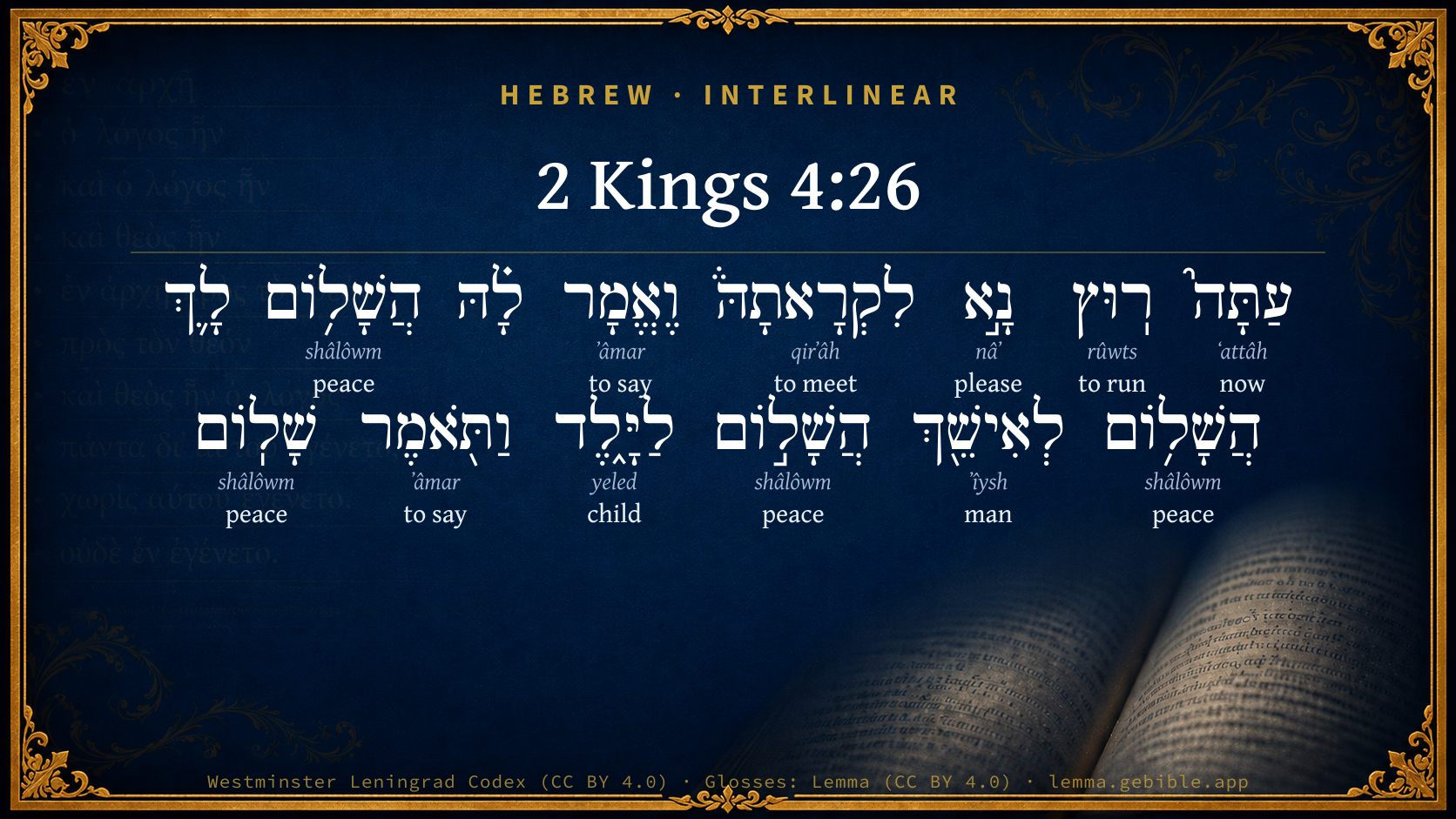
2 Kings 4:26

Hebrew (Westminster Leningrad Codex) 2 Kings 4:26 appears in the Hebrew Old Testament. The text above is from the Westminster Leningrad Codex. Each word links to its Strong’s number, a concise gloss, and parsing drawn from the Open Scriptures Hebrew Bible morphology. Click any word for its full Brown-Driver-Briggs (BDB) entry.
Download image
Cite this verse

2 Kings 4:26 (World English Bible). Public Domain. Lemma interlinear Bible study tool, https://lemma.gebible.app/v/2-kings/4/26.

Show BibTeX & RIS
BibTeX
RIS
English Translation
please run now to meet her, and ask her, Is it well with you? is it well with your husband? is it well with the child? She answered, It is well.
World English Bible · Public Domain
Download a study sheet

One document with this verse’s original text, its word-by-word gloss line, the meaning frame, cross-references with their text, attributed commentary, and full source and license credits — printable, and it pastes into notes with its structure intact.

This verse Autodidact and up

Study sheet (.html) Plain text (.txt)

A passage Seminary Student

Up to 50 verses in one chapter. A passage sheet keeps up to 6 commentary sources and 12 cross-references per verse, in the order this page ranks them, and says so on the sheet whenever that leaves anything out. Ask for a single verse and you get the Autodidact verse sheet above.

Everything on this page stays free to read, with no account — the sheet is a download of what is already on screen, not access to it.

Want to remove ads? Support Godless Engineer
Compare translations 3

The same verse in 3 English versions, stacked beneath the original-language interlinear above. Click any original word for its lexicon entry.

Each is an independent rendering of the whole verse — the interlinear is not word-aligned to these translations.

Highlighted words mark where these versions differ — a whole-verse word diff, not a word-by-word alignment.

  • World English Bible Public Domain
    please run now to meet her, and ask her, Is it well with you? is it well with your husband? is it well with the child? She answered, It is well.
  • King James Version Public Domain
    Run now, I pray thee, to meet her, and say unto her, Is it well with thee? is it well with thy husband? is it well with the child? And she answered, It is well:
  • unfoldingWord Literal Text CC BY-SA 4.0
    Now please run to meet her and say to her, ‘ welfare to you? welfare to your husband? welfare to the child?’” And she said, “Peace.”

unfoldingWord Literal Text — © unfoldingWord, licensed CC BY-SA 4.0. Word-aligned USFM3 via Door43 (git.door43.org/unfoldingWord/en_ult).

Versions to compare (up to 4)

3 of 4 selected

Show all 18 translations

Every available English version of this verse, each an independent rendering of the whole verse.

  • World English Bible Public Domain
    please run now to meet her, and ask her, Is it well with you? is it well with your husband? is it well with the child? She answered, It is well.
  • Berean Standard Bible Public Domain
    Please run out now to meet her and ask, ‘Are you all right? Is your husband all right? Is your child all right?’” And she answered, “Everything is all right.”
  • Majority Standard Bible Public Domain
    Please run out now to meet her and ask, ‘Are you all right? Is your husband all right? Is your child all right?’” And she answered, “Everything is all right.”
  • King James Version Public Domain
    Run now, I pray thee, to meet her, and say unto her, Is it well with thee? is it well with thy husband? is it well with the child? And she answered, It is well:
  • American Standard Version (1901) Public Domain
    run, I pray thee, now to meet her, and say unto her, Is it well with thee? is it well with thy husband? is it well with the child? And she answered, It is well.
  • Revised Version (1885) Public Domain
    run, I pray thee, now to meet her, and say unto her, Is it well with thee? is it well with thy husband? is it well with the child? And she answered, It is well.
  • Geneva Bible (1599) Public Domain
    Runne nowe, I say, to meete her, and say vnto her, Art thou in health? is thine husband in health? and is the child in health? And she answered, We are in health.
  • Douay-Rheims (1899) Public Domain
    Go therefore to meet her, and say to her: Is all well with thee, and with thy husband, and with thy son? and she answered: Well.
  • Young's Literal Translation Public Domain
    now, run, I pray thee, to meet her, and say to her, Is there peace to thee? is there peace to thy husband? is there peace to the lad?' and she saith, `Peace.'
  • Literal Standard Version CC BY-SA 4.0
    now please run to meet her, and say to her, Is there peace to you? Is there peace to your husband? Is there peace to the boy?” And she says, “Peace.”
  • Unlocked Literal Bible CC BY-SA 4.0
    Please run to meet her and say to her, 'Is everything alright with you and with your husband and child?'” She answered, “It is alright.”
  • unfoldingWord Literal Text CC BY-SA 4.0
    Now please run to meet her and say to her, ‘ welfare to you? welfare to your husband? welfare to the child?’” And she said, “Peace.”
  • Darby Bible Public Domain
    run now, I pray thee, to meet her, and say unto her, Is it well with thee? is it well with thy husband? is it well with the child? And she said, It is well.
  • World Messianic Bible Public Domain
    Please run now to meet her, and ask her, ‘Is it well with you? Is it well with your husband? Is it well with your child?’” She answered, “It is well.”
  • Webster's Bible Public Domain
    Run now, I pray thee, to meet her, and say to her, Is it well with thee? Is it well with thy husband? Is it well with the child? and she answered, It is well.
  • Free Bible Version CC BY-SA 4.0
    Please run to meet her and ask her, ‘Is everything fine with you, your husband, and your boy?’” “Everything's fine,” she replied.
  • Bible in Basic English Public Domain
    Go quickly to her, and on meeting her say to her, Are you well? and your husband and the child, are they well? And she said in answer, All is well.
  • JPS Tanakh (1917) Public Domain
    Run, I pray thee, now to meet her, and say unto her: Is it well with thee? is it well with thy husband? is it well with the child?' And she answered: 'It is well.'

Literal Standard Version (2020), Covenant Press — licensed CC BY-SA 4.0. Text via the HelloAO Bible API (eBible.org). Unlocked Literal Bible (unfoldingWord) — licensed CC BY-SA 4.0. Text via the HelloAO Bible API (eBible.org). unfoldingWord Literal Text — © unfoldingWord, licensed CC BY-SA 4.0. Word-aligned USFM3 via Door43 (git.door43.org/unfoldingWord/en_ult). Free Bible Version, Dr. Jonathan Gallagher — licensed CC BY-SA 4.0. Text via the HelloAO Bible API (eBible.org).

Word by word

More ways to search: Search by grammar → Find every occurrence → Compare this word →

Practice this passage: Drill this verse → Learn its vocabulary →

לַיָּ֑לֶד
yeled
H3206
“to/for the · child”
Preposition, Determined + Noun, Common, Masculine, Singular, Absolute
Part of Speech
Preposition + Noun
Type
Common
Gender
Masculine
Number
Singular
State
Absolute
Full BDB Definition

Origin: from H3205

TWOT: 867b

child, son, boy, offspring, youth - child, son, boy - child, children - descendants - youth - apostate Israelites (figuratively)
  1. עַתָּה֮ ʻattâh H6258 “now” Adverb
  2. רֽוּץ rûwts H7323 “run” Verb, Qal, Imperative, 2nd Person, Masculine, Singular
  3. נָ֣א nâʼ H4994 “please” Particle, Exhortation
  4. לִקְרָאתָהּ֒ qirʼâh H7125 “to meet · her” Preposition + Verb, Qal, Infinitive Construct + Suffix, Personal, 3rd Person, Feminine, Singular
  5. וֶאֱמָר ʼâmar H559 “and · say” Conjunction + Verb, Qal, Imperative, 2nd Person, Masculine, Singular
  6. הֲשָׁל֥וֹם shâlôwm H7965 “peace” Particle, Interrogative + Noun, Common, Masculine, Singular, Absolute
  7. הֲשָׁל֥וֹם shâlôwm H7965 “peace” Particle, Interrogative + Noun, Common, Masculine, Singular, Absolute
  8. לְאִישֵׁ֖ךְ ʼîysh H376 “to/for · man · your” Preposition + Noun, Common, Masculine, Singular, Construct + Suffix, Personal, 2nd Person, Feminine, Singular
  9. הֲשָׁל֣וֹם shâlôwm H7965 “peace” Particle, Interrogative + Noun, Common, Masculine, Singular, Absolute
  10. וַתֹּ֖אמֶר ʼâmar H559 “and · to say” Conjunction + Verb, Qal, Sequential Imperfect, 3rd Person, Feminine, Singular
  11. שָׁלֽוֹם shâlôwm H7965 “peace” Noun, Common, Masculine, Singular, Absolute

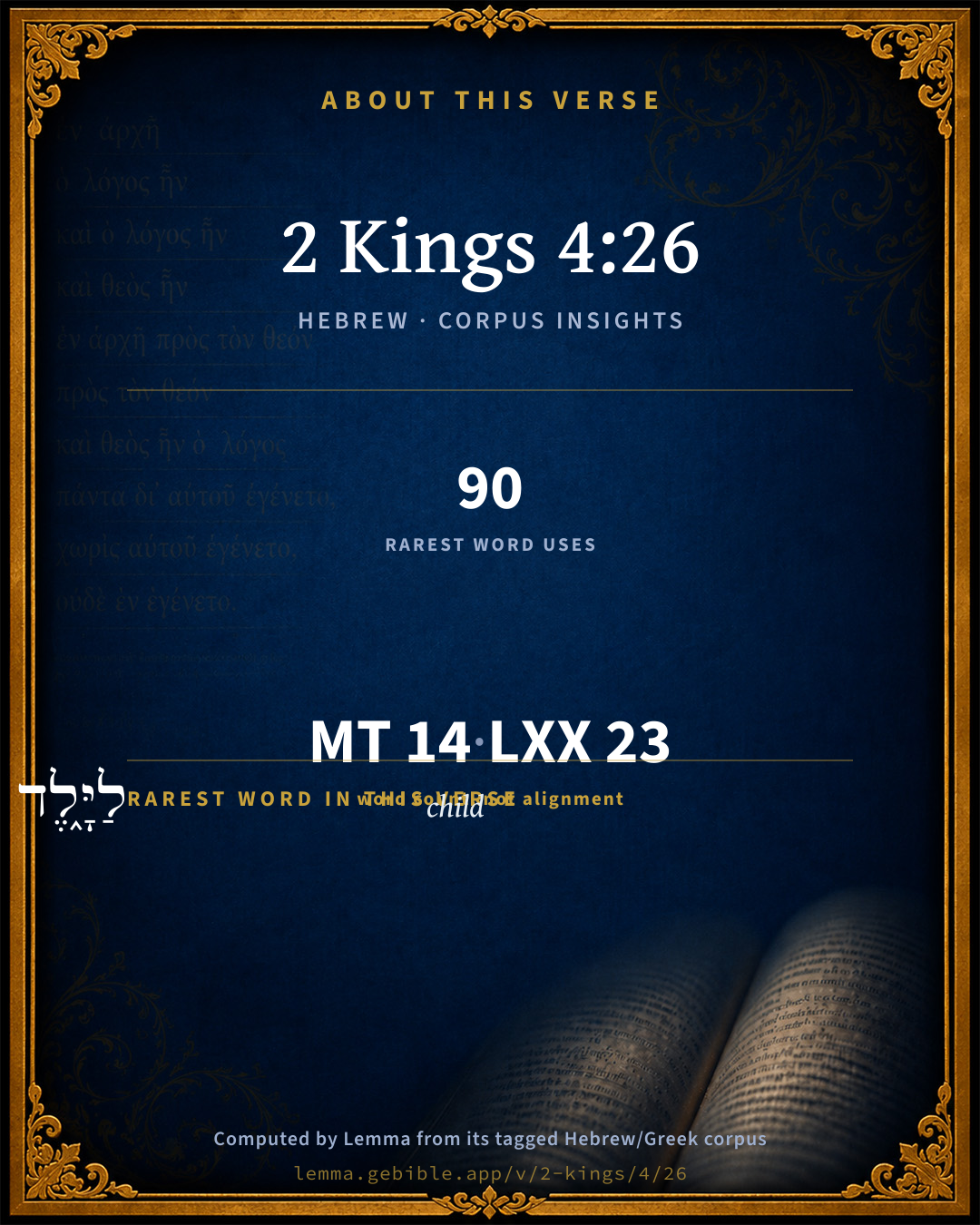
About this verse

These counts appear in no published source. They are computed here, from the morphology-tagged text and Lemma’s own curated glosses. What Lemma adds →

14
words
8
distinct lemmas
Historical
section

Grammatical profile

  • 4 verbs
  • 6 nouns
  • 2 prepositions
  • 1 adverb
  • 1 particle

Verb forms

  • רֽוּץ Qal · Imperative
  • לִקְרָאתָהּ֒ Qal · Infinitive Construct
  • וֶאֱמָר Qal · Imperative
  • וַתֹּ֖אמֶר Qal · Sequential Imperfect

Repetition

Words recur within this verse — often emphatic in Hebrew:

  • הֲשָׁל֥וֹם peace H7965 ×4
  • וֶאֱמָר to say H559 ×2

Hebrew & Septuagint length

In English translation the verse runs 31 words from the Hebrew and 32 from the Septuagint (LXX English) — closely comparable.

A rough comparison of the two English renderings, which tokenize alike — not a word-level alignment.

Word counts can differ between the Hebrew and the Greek without any difference in meaning — e.g. the Hebrew direct-object marker אֵת has no separate Greek word, and Greek often adds the article ὁ.

In the original languages it is 14 Hebrew tokens and 23 Greek tokens — but the two are counted differently (Hebrew bundles its prefixes and suffixes into one token; the Greek is in lemma form), so that isn’t a like-for-like length.

Cross-references

8

Topical passages linked to 2 Kings 4:26 in the Treasury of Scripture Knowledge — connected by theme and wording, ordered by reader-vote popularity; previews shown in the World English Bible.

  • Acts 15:36 After some days Paul said to Barnabas, "Let's return now and visit our brothers in every city in which we proclaimed the word of the Lord, to see how they are doing."
  • 1 Samuel 17:18 and bring these ten cheeses to the captain of their thousand, and look how your brothers fare, and take their pledge.
  • 2 Kings 4:23 He said, Why will you go to him today? it is neither new moon nor Sabbath. She said, It shall be well.
  • Genesis 37:14 He said to him, "Go now, see whether it is well with your brothers, and well with the flock; and bring me word again." So he sent him out of the valley of Hebron, and he came to Shechem.
  • 1 Samuel 3:18 Samuel told him every whit, and hid nothing from him. He said, It is Yahweh: let him do what seems him good.
  • Job 1:21–22 He said, "Naked I came out of my mother's womb, and naked shall I return there. Yahweh gave, and Yahweh has taken away. Blessed be the name of Yahweh."
  • Psalms 39:9 I was mute. I didn't open my mouth, Because you did it.
  • Genesis 29:6 He said to them, "Is it well with him?" They said, "It is well. See, Rachel, his daughter, is coming with the sheep."

Cross-references courtesy of OpenBible.info (CC BY 4.0).

Hebrew and Greek witnesses Masoretic Hebrew ↔ Greek Septuagint

The same verse in the two great witnesses to the Old Testament, shown verse-for-verse.

These are two independent witnesses, not word-aligned to each other, and the Septuagint is shown in lemma (dictionary) form.

Hebrew 2 Kings 4:26 Masoretic · Westminster Leningrad Codex

עַתָּה֮ רֽוּץ נָ֣א לִקְרָאתָהּ֒ וֶאֱמָר לָ֗הּ הֲשָׁל֥וֹם לָ֛ךְ הֲשָׁל֥וֹם לְאִישֵׁ֖ךְ הֲשָׁל֣וֹם לַיָּ֑לֶד וַתֹּ֖אמֶר שָׁלֽוֹם

please run now to meet her, and ask her, Is it well with you? is it well with your husband? is it well with the child? She answered, It is well.

World English Bible · Public Domain

Greek LXX 2 Kings 4:26 Septuagint · lemma form

νῦν τρέχω εἰς ἀπαντή αὐτός καί εἶπον εἰ εἰρήνη σύ εἰ εἰρήνη ὁ ἀνήρ σύ εἰ εἰρήνη ὁ παιδάριον ὁ δέ εἶπον εἰρήνη

Now run to meet her, and you shall say, Is it well with you? is it well with your husband? is it well with the child? and she said, It is well.

LXX2012 (modern English Septuagint) · Public Domain

Hebrew: Westminster Leningrad Codex (CC BY 4.0). Greek: Septuagint (public domain); English from LXX2012 (modern English Septuagint) (Public Domain). How the Septuagint differs from the Hebrew →

Targum (Aramaic paraphrase)

1

The Targum is the ancient Jewish Aramaic paraphrase of the Hebrew Scriptures — an interpretive translation, not the Hebrew text itself. Onkelos (literal) and Pseudo-Jonathan (expansive) render the Torah, and Jonathan the Prophets. Coverage is partial: where no permissively-licensed English translation exists for a verse, only the Aramaic is shown. This is verse-level text, not a word-by-word alignment to the Hebrew.

  1. Targum Jonathan Prophets (Joshua–Malachi)
    כְּעַן רְהוּט כְּעַן לָקֳדָמוּתָהּ וַאֲמַר לָהּ הַשְׁלָם לִיךְ הַשְׁלָם לְבַעֲלִיךְ הַשְׁלָם לְרַבְיָא וַאֲמַרַת שְׁלָם:

    (no public-domain English translation for this verse)

    Targum Jonathan — Aramaic: “Mikraot Gedolot” (public domain). English: “Sefaria Community Translation” (CC0 1.0 (public-domain dedication)); “London "Chaldee Paraphrase," 1871” (public domain). Text via Sefaria.

Commentary

Notes on 2 Kings 4:26 from classic Christian and Jewish commentators (each source and its license shown beneath its notes). The classic Christian expositions comment on the surrounding passage and are grouped to its opening verse, so a note may address several verses; the Jewish commentaries on the Tanakh (Rashi and others) are per-verse, so they appear only where the commentator wrote on this verse.

Lemma curates 59 commentaries, every one of them public domain or Creative Commons licensed, each selected and text-cleaned for this edition rather than reprinted as found. About our sources →

Trapp's Complete Commentary

John Trapp

2Ki 4:26 Run now, I pray thee, to meet her, and say unto her, [Is it] well with thee? [is it] well with thy husband? [is it] well with the child? And she answered, [It is] well.

Ver. 26. And she answered, It is well.] It is, or would be. Well it is howsoever for the present, and it will be better hereafter.

John Trapp, A Commentary or Exposition upon All the Books of the Old and New Testament (1647–1656) — public domain. Text from a community e-Sword module.

The Biblical Illustrator

Joseph S. Exell

2Ki_4:26

Is it well with thee?

Ministerial inquiry into the welfare of a people

I. When may it be said to be really well with any persons? Many would think it to be well with us when we have food and raiment, when our flocks and herds increase. But, if this is to be well, and we are no better than this worlds goods can make us, we are well only for time, and as it respects our frail and perishable bodies. In this sense, it was well with Dives. For it to be really well with us, we must come to things which concern the soul, and which have a reference to that eternal state whither we are going. Mark, then, what follows: It is well with us if our souls have been awakened--if we have found forgiveness--if the Lord Jesus Christ be precious to us--and if we be now walking in newness and righteousness of life.

II. Whether it be thus well with you? You may, as we have seen, be well as it respects this world and your abiding in it. But, is it well with your souls? Would it be well with you, do you think, if God were now to require your souls of you? Inquire, I pray you. Felt you ever your need of mercy? Has a sensibility of your guiltiness ever constrained you to cry for mercy? Have you, like her who had lost one of her ten pieces of silver, sought for it til you have found it? Is your heart sprinkled from an evil conscience? What do you love most? Christ or the world?--Christ or sinful pleasure?--Christ or the increase of your temporal wealth and honour?--Christ or yourself? What is your chief joy? The Christian rejoices in Christ Jesus. Is He the object of your rejoicing? In what way are you living? The way in which we live will most clearly evidence whether we have been awakened, forgiven, and I accepted in the Beloved, or not; and, consequently, whether it be well with us or not. (W. Mudge, B. A.)

It is well

Death is not a calamity to the Christian. It is well.

I. In view of the unsatisfactory nature of life. Paul would say, To live is Christ, and yet he testified, To depart and be with Christ is far better.

II. In view of the home prepared for the saved.

III. it is well with the child of God even in this life.

IV. Appeal to the living. Is it well with your soul? (Homiletic Review.)

A searching inquiry

In the late South African War, Major Child, when setting out one morning on reconnaissance duty, had a presentiment he might not return alive, and so said to a brother officer that if he fell that day he wanted written on his memorial stone just these words: Is it well with the child? It is well. It fell out as he anticipated, but death had no terrors for him, and now he lies on the veldt with this question and answer above his grave. Suppose this question put to us: Is it well with thee? Can we answer, It is well? (J. D. Jones, M. A.)

She answered, It is well.--

Submission under trial

I. The trial which the woman endured. Man is born to trouble, as the sparks fly upwards. The ills to which flesh is heir are diffused with wonderful impartiality. The palace is as much accustomed to the visits of sorrow as is the cottage. The robe of honour cannot ward off the touch of pain any more than the garment of beggary. The glittering diadem often encircles an aching brow, and the silken robe often covers a bleeding heart.

1. In her trial there was the disappointment of a strong desire. She seems to have had only one strong desire ungratified. No child had ever called her mother; she had no son to perpetuate her husbands name in Israel. The desire to be a mother was peculiarly strong in the heart of a Hebrew wife, from the national relationship to the promise, that of the seed of a woman would come the Destroyer of the serpent and the Deliverer of Jacob. This desire in the heart of the Shunammite had almost died away, when the prophet assures her she shall yet embrace a son. As the desire had been strong, so would the joy be great when the desire was realised. Who can blame her if her heart swelled with a joyful pride and a proud joy, as she clasped her baby to her breast, and pictured for him a future of happiness and honour?

2. An additional element in this womans trial was the blasting of a bright hope. What sweet and sacred hopes cluster round every cradle! We all know the power of hope, and to how large a degree hope constitutes the beauty and blessedness of human life.

3. As another element of this womans trial--her tenderest affections have been torn. Her child has been taken from her. The grief of one that mourneth for a first-born has passed into a proverb. She had lost her first-born--nay, she had lost her only child.

II. Her conduct under the trial. Notice, first:

1. She is filled with the most pungent sorrow. When trial is sent, it is designed we should feel it. There may be sorrow, there must be sorrow, under the afflictions and bereavements of life; only it should not be despondent sorrow, nor rebellious sorrow, nor murmuring sorrow, but sorrow submissive and sanctifying, like that of this woman.

2. She acquiesces in the will of God. She says, It is well. This is one of the highest achievements of Christian faith.

3. In her trial this woman cleaves to God. She does not sit down and brood over her bereavement, and nurse her grief, and indulge in the luxury of sorrow. She goes at once to consult the oracle of God.

(1) She may have gone to inquire whether there were not deliverance from her trial.

(2) She may have gone to seek strength to bear her trial. The prophet was the mouth of God to her.

(3) She may have gone to seek the sanctification of her trial. Whether this was one of the blessings she desired in going to the man of God, may be doubted; it cannot be doubted that this ought to be our main desire in going to God Himself in seasons of trial and sorrow.

III. The grounds which may produce and sustain such a course of conduct as this woman pursued. There are three grounds which may contribute to this desirable result. A consideration--

1. Of what we are who endure the trial;

2. of what He is who sends the trial; and

3. of the purpose the trial is designed to serve. (G. D. Macgregor.)

Reasons for trials

I. Affliction comes to call our sin to our remembrance, and to humble us for it beneath the cross of Jesus.

II. Another end for which God sends His heavy hand upon His children is to loose them from the world--to make them cease from the idolatry of the creature.

III. Again, another object of the trials which God sends His children is to make himself more dear to them. Dear indeed He is to all who have learned to view Him as a God of love--as the God who hath so loved the world as to send His only-begotten Son to die for it--dear is He to all of us whose souls. He has sprinkled with the blood of Christ, in whom He has revealed His Son, and whom He has made heirs, through Christ, of life eternal.

IV. A further end God has in view in laying crosses on His people is that He may conform them to their Saviour, by admitting them into the fellowship of His sufferings. If we suffer, says the apostle, we shall also reign with Him. Justly then might we feel uneasy to be the prosperous followers of a suffering Lord--light-hearted servants of a sorrowing and weeping Master.

V. But, when God makes His children acquainted with affliction, He has a purpose in His view, beyond any of the objects we have yet enumerated. He intends by it His own glory. Eminently is that glory promoted and set forth by the patience of His people in the hour of trial, and by their cheerful acquiescence in His will. The world is then compelled to see that there is truth, that there is power, in His Gospel. It is well, very well, with every child of God, however great be the fight of affliction he is called on to sustain. For look at the issue of these things! These afflictions are not everlasting. God will not always chide, neither keepeth He His anger for ever. As soon as the ends of His chastening providence are answered, the dispensation will be changed. It is well, then, with believers even in their most afflicted moments. The Shunammite spoke truth when she uttered that saying in the midst of her affliction. Christian brethren, are any of us her fellow-sufferers? (A. Roberts, M. A.)

The uses of affliction

An artist asked a friend to come to his studio to see a painting just completed. He came at the time appointed, but was shown into a dark room, and there left alone. He waited for fifteen minutes, when his friend came in, greeted him cordially, and then took him to the studio. Before he left, the artist said laughingly: I suppose you thought it queer to he left in that dark room so long? Yes, I did. Well, said the artist, I knew that if you came into my studio with the glare of the street in your eyes you could not appreciate the fine colouring of the picture. So I left you in the dark room till the glare had worn out of your eyes. So God puts His children into the dark room of affliction, so that they may be able to see the beauty of heavenly things otherwise hidden from their eyes. (Christian Commonwealth.)

The Biblical Illustrator, edited by Joseph S. Exell (c. 1880s–1900s) — public domain. Text from a community e-Sword module.

Jamieson, Fausset & Brown

Robert Jamieson, A. R. Fausset & David Brown

And she answered, It is well--Her answer was purposely brief and vague to Gehazi, for she reserved a full disclosure of her loss for the ear of the prophet himself. She had met Gehazi at the foot of the hill, and she stopped not in her ascent till she had disburdened her heavy-laden spirit at Elisha's feet. The violent paroxysm of grief into which she fell on approaching him, appeared to Gehazi an act of disrespect to his master; he was preparing to remove her when the prophet's observant eye perceived that she was overwhelmed with some unknown cause of distress. How great is a mother's love! how wondrous are the works of Providence! The Shunammite had not sought a son from the prophet--her child was, in every respect, the free gift of God. Was she then allowed to rejoice in the possession for a little, only to be pierced with sorrow by seeing the corpse of the cherished boy? Perish, doubt and unbelief! This event happened that "the works of God should be made manifest" in His prophet, "and for the glory of God."

Jamieson, Fausset & Brown — Commentary Critical and Explanatory on the Whole Bible (1871) — public domain (CC PDM 1.0). Text via the HelloAO Bible API.

Adam Clarke's Commentary

Verse 26. It is well.] How strong was her faith in God and submission to his authority! Though the heaviest family affliction that could befall her and her husband had now taken place; yet, believing that it was a dispensation of Providence which was in itself neither unwise nor unkind, she said, It is well with me, with my husband, and with my child. We may farther remark that, in her days, the doctrine of reprobate infants had not disgraced the pure religion of the God of endless compassion. She had no doubts concerning the welfare of her child, even with respect to another world; and who but a pagan or a stoic can entertain a contrary doctrine?

Adam Clarke's Commentary on the Bible (1810–1826) — public domain. Text from a community e-Sword/MySword module.

Ellicott's Commentary for English Readers

(26) Run now, I pray thee, to meet her.—This perhaps indicates the respect in which Elisha held the Shunammitess. But it may denote surprise and apprehension at an unusual visit. Hence the inquiries about each member of the family.

It is well.—She said this merely to avoid further explanation. She would open her grief to the prophet’s own ear, and to none other.

A Bible Commentary for English Readers, edited by Charles John Ellicott (1878–1897) — public domain. Text from a community e-Sword module.

The Cambridge Bible for Schools and Colleges

gen. ed. J. J. S. Perowne

26. run now, I pray thee] The R.V. puts ‘now’ last of these words, ‘I pray thee’ is closely joined with ‘run’ in the Hebrew. There is a touch of deep feeling in the action of Elisha. He knows that there must be some special reason for a visit at this unusual time, and he would learn, even before the mother is near enough for him to hear her, whether there is trouble at home which has brought her to Carmel.

And she answered, It is well] The word means, as was noted on verse 23, Peace, and we can only think that she gives this answer to Gehazi’s question, that she may avoid more words. She has no thought of deception, but her heart is too full for speech, at all events till she come into the prophet’s presence.

The Cambridge Bible for Schools and Colleges (gen. ed. J. J. S. Perowne; Cambridge University Press, 1878–1918) — public domain. Text from a community e-Sword module.

John Gill's Exposition

Run now, I pray thee, to meet her,.... In respect to her, and to know the occasion of her coming; something is the cause of it:

and say unto her, is it well with thee? is it well with thy husband? is it well with the child? has any disaster befallen thee, thy husband, or the child? are all in good health? or does any disorder attend any of them?

and she answered, it is well; as in general they were, the greatest part, she and her husband; and though the child was dead, yet, if gone to heaven, as she might hope, it was well too; and it is right to judge and say, that all that the Lord does is well: she gives a short answer to the servant, not being willing to be detained, and being desirous of telling her case to the prophet himself.

John Gill's Exposition of the Whole Bible (1746–1763) — public domain (CC PDM 1.0). Text via the HelloAO Bible API.

Haydock's Catholic Bible Commentary

Well. She declines mentioning what she wanted to the servant, in order that she might speak to the prophet in person. (Menochius) --- She might also rationally hope that the child was well in another world. (Haydock)

George Leo Haydock (1774–1849), Haydock's Catholic Family Bible and Commentary, 1859 edition — public domain. Excludes Psalms (Douay-Rheims chapter numbering differs from Protestant) and Deuterocanonical books (Catholic canon only).

Matthew Poole's English Annotations

So it was in some respects, because it was the will of a wise and good God, and therefore best for her. Or, it shall be well: though the child be dead, I doubt not by God’s blessing upon thy endeavours it shall live again, and do well. But she answers ambiguously, and briefly too, that, she might sooner come to the prophet, and more fully open her mind to him.

Matthew Poole's English Annotations on the Holy Bible (1683–1685) — public domain. Text from a community e-Sword/MySword module.

The Pulpit Commentary

Run now, I pray thee, to meet her, and say unto her, Is it well with thee? is it well with thy husband? is it well with the child? Elisha feels that there must be something the matter, to account for the Shunammite"s coming to him so unexpectedly. His anxiety is aroused, and, in his impatience to know what has happened, instead of waiting for the woman"s arrival, he bids his servant run, and ask what is the matter. Some misfortune, he supposes, must have happened either to her, or to her husband, or to the child. And she answered, It is well. She gave, as before to her husband (ver. 23), the ambiguous answer, "Peace," intending thereby merely to put off Gehazi, and not explain herself to any one but his master.

The Pulpit Commentary (1880–1919), ed. H.D.M. Spence-Jones & Joseph S. Exell — public domain. Text from a community e-Sword module.

John Wesley's Explanatory Notes

It is - So it was in some respects, because it was the will of a wise and good God, and therefore best for her. When God calls away our dearest relations by death, it becomes us to say, it is well both with us and them. It is well, for all is well that God doth: all is well with them that are gone, if they are gone to heaven. And all is well with us that stay behind, if by the affliction we are furthered in our way thither.

John Wesley, Explanatory Notes Upon the Whole Bible (1754–1765) — public domain. Text via the GEBible commentary corpus.

Rashi

Rabbi Shlomo Yitzchaki (Rashi)

And she said, “[All is] well.” This is an abbreviated verse, for it should have been written, “And he asked her, and she said, ‘We are well.’”

Rashi on the Tanakh — English translations: “The Judaica Press complete Tanach with Rashi, translated by A. J. Rosenberg” (CC BY 4.0); “Pentateuch with Rashi's commentary by M. Rosenbaum and A.M. Silbermann, 1929-1934” (public domain); “The Metsudah Tanach series, Lakewood, N.J” (CC BY 4.0); and “The Book of Joshua, Metsudah Publications, 1997” (CC BY 4.0). Text via Sefaria.

Lesson kit

Teaching starters — assembled from the data on this page, not authored interpretation. Every prompt links to the verse data it draws on. Edit before teaching.

2 Kings, in the Historical, opens this verse with 14 words (8 distinct Hebrew lemmas). Its most distinctive word is yeled (“child”). A historical commentator’s framing appears above. Read the whole chapter for the surrounding context.

Discussion questions

  1. The word yeled carries the sense “child.” How does it shape the verse?
  2. Acts 15:36 shares this passage’s theme. How do the two illuminate each other?
  3. “peace” occurs 4× in this one verse. What is the effect of the repetition?
  4. These translations render this verse differently; the difference is in the English rendering, not the original. What questions does that raise?
  5. The verb «רֽוּץ» is Qal Imperative. How does its form color the action?
  6. Reading how Trapp's Complete Commentary and The Biblical Illustrator read this verse, where do the two commentators agree and where do they part?

Things to notice

Reading settings

Reading text

Shown beneath each verse's original-language words.

Old Testament
Old Testament edition

Read the OT as the Masoretic Hebrew (MT) or the Greek Septuagint (LXX).

English shown for the Greek Septuagint (in the Hebrew ↔ Greek comparison).

Comparing translations? Open the Compare panel on any verse page to stack up to four side by side.