Deuteronomy 2:26

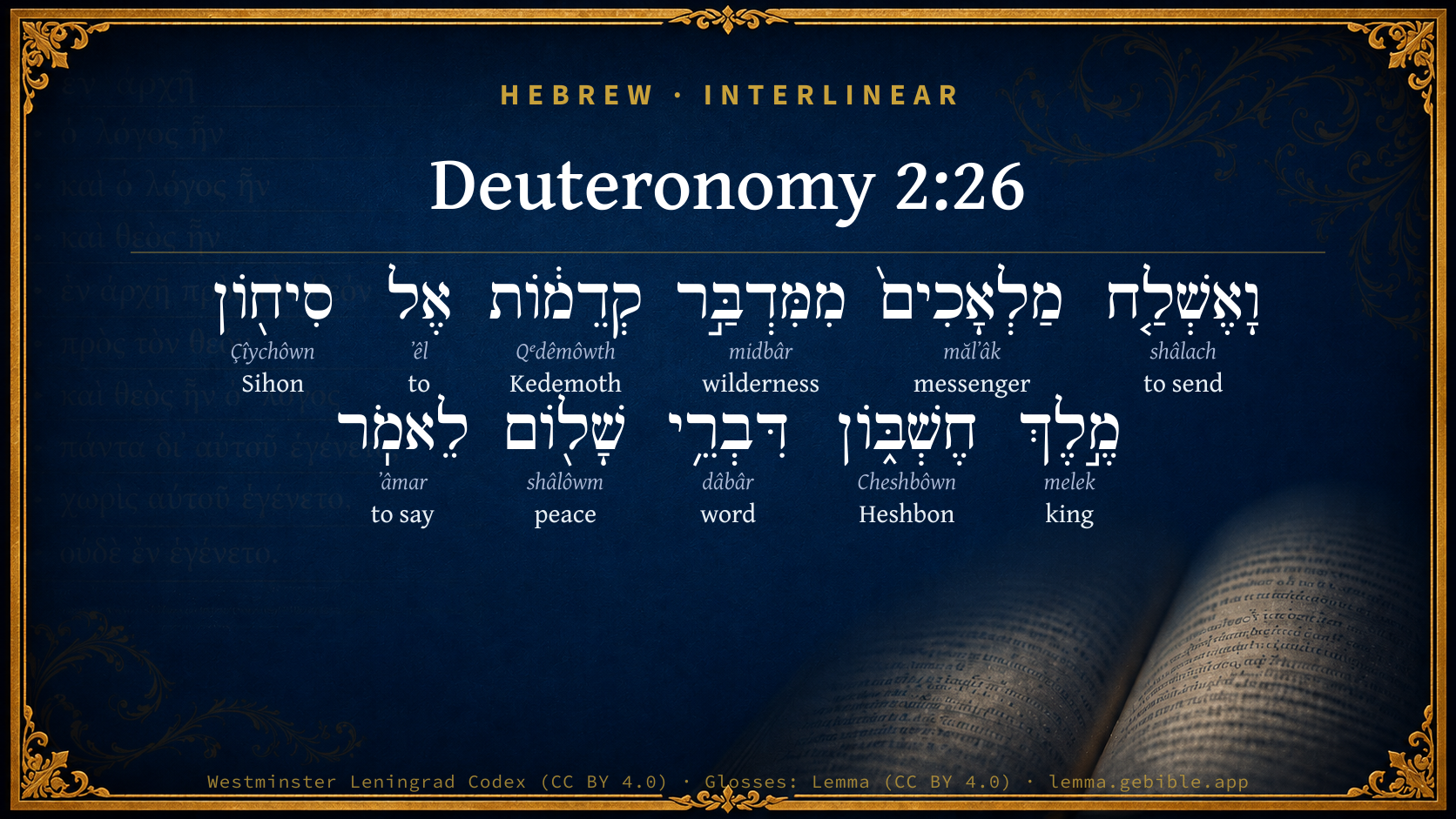
Hebrew (Westminster Leningrad Codex) Deuteronomy 2:26 appears in the Hebrew Old Testament. The text above is from the Westminster Leningrad Codex. Each word links to its Strong’s number, a concise gloss, and parsing drawn from the Open Scriptures Hebrew Bible morphology. Click any word for its full Brown-Driver-Briggs (BDB) entry.
Download image
Cite this verse

Deuteronomy 2:26 (World English Bible). Public Domain. Lemma interlinear Bible study tool, https://lemma.gebible.app/v/deuteronomy/2/26.

Show BibTeX & RIS
BibTeX
RIS
English Translation
I sent messengers out of the wilderness of Kedemoth to Sihon king of Heshbon with words of peace, saying,
World English Bible · Public Domain
Highlights
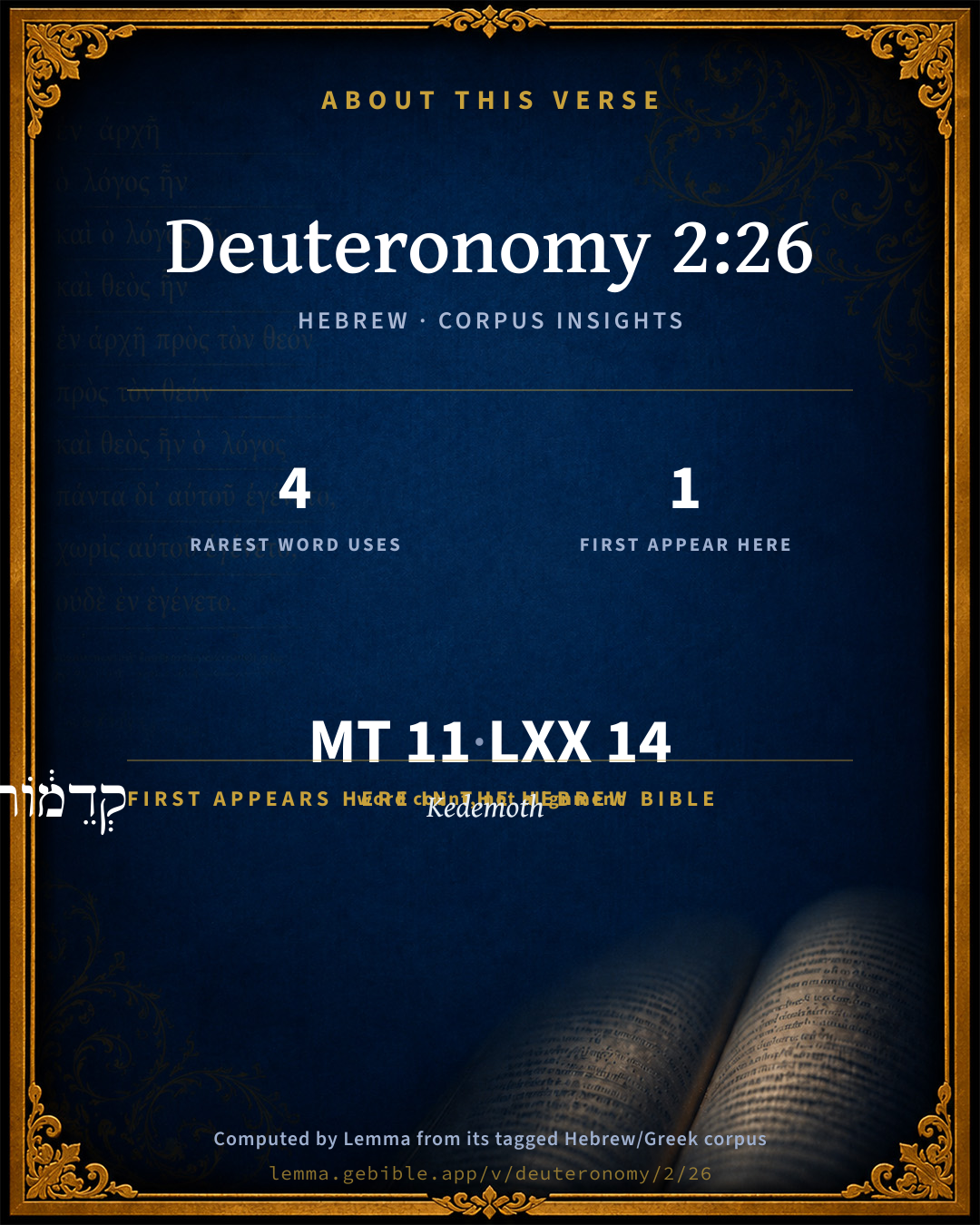
  • 1 first appearance in the Hebrew Bible
Full analysis ↓
Download a study sheet

One document with this verse’s original text, its word-by-word gloss line, the meaning frame, cross-references with their text, attributed commentary, and full source and license credits — printable, and it pastes into notes with its structure intact.

This verse Autodidact and up

Study sheet (.html) Plain text (.txt)

A passage Seminary Student

Up to 50 verses in one chapter. A passage sheet keeps up to 6 commentary sources and 12 cross-references per verse, in the order this page ranks them, and says so on the sheet whenever that leaves anything out. Ask for a single verse and you get the Autodidact verse sheet above.

Everything on this page stays free to read, with no account — the sheet is a download of what is already on screen, not access to it.

Want to remove ads? Support Godless Engineer
Compare translations 3

The same verse in 3 English versions, stacked beneath the original-language interlinear above. Click any original word for its lexicon entry.

Each is an independent rendering of the whole verse — the interlinear is not word-aligned to these translations.

Highlighted words mark where these versions differ — a whole-verse word diff, not a word-by-word alignment.

  • World English Bible Public Domain
    I sent messengers out of the wilderness of Kedemoth to Sihon king of Heshbon with words of peace, saying,
  • King James Version Public Domain
    And I sent messengers out of the wilderness of Kedemoth unto Sihon king of Heshbon with words of peace, saying,
  • unfoldingWord Literal Text CC BY-SA 4.0
    And I sent messengers from the wilderness of Kedemoth to Sihon, king of Heshbon, words of peace, saying,

unfoldingWord Literal Text — © unfoldingWord, licensed CC BY-SA 4.0. Word-aligned USFM3 via Door43 (git.door43.org/unfoldingWord/en_ult).

Versions to compare (up to 4)

3 of 4 selected

Show all 18 translations

Every available English version of this verse, each an independent rendering of the whole verse.

  • World English Bible Public Domain
    I sent messengers out of the wilderness of Kedemoth to Sihon king of Heshbon with words of peace, saying,
  • Berean Standard Bible Public Domain
    So from the Wilderness of Kedemoth I sent messengers with an offer of peace to Sihon king of Heshbon, saying,
  • Majority Standard Bible Public Domain
    So from the Wilderness of Kedemoth I sent messengers with an offer of peace to Sihon king of Heshbon, saying,
  • King James Version Public Domain
    And I sent messengers out of the wilderness of Kedemoth unto Sihon king of Heshbon with words of peace, saying,
  • American Standard Version (1901) Public Domain
    And I sent messengers out of the wilderness of Kedemoth unto Sihon king of Heshbon with words of peace, saying,
  • Revised Version (1885) Public Domain
    And I sent messengers out of the wilderness of Kedemoth unto Sihon king of Heshbon with words of peace, saying,
  • Geneva Bible (1599) Public Domain
    Then I sent messengers out of the wildernes of Kedemoth vnto Sihon King of Heshbon, with wordes of peace, saying,
  • Douay-Rheims (1899) Public Domain
    So I sent messengers from the wilderness of Cademoth to Sehon the king of Hesebon with peaceable words, saying:
  • Young's Literal Translation Public Domain
    `And I send messengers from the wilderness of Kedemoth, unto Sihon king of Heshbon, -- words of peace -- saying,
  • Literal Standard Version CC BY-SA 4.0
    And I send messengers from the wilderness of Kedemoth to Sihon king of Heshbon, [with] words of peace, saying,
  • Unlocked Literal Bible CC BY-SA 4.0
    I sent messengers from the wilderness of Kedemoth to Sihon, king of Heshbon, with words of peace, saying,
  • unfoldingWord Literal Text CC BY-SA 4.0
    And I sent messengers from the wilderness of Kedemoth to Sihon, king of Heshbon, words of peace, saying,
  • Darby Bible Public Domain
    And I sent messengers out of the wilderness of Kedemoth unto Sihon the king of Heshbon with words of peace, saying,
  • World Messianic Bible Public Domain
    I sent messengers out of the wilderness of Kedemoth to Sihon king of Heshbon with words of peace, saying,
  • Webster's Bible Public Domain
    And I sent messengers from the wilderness of Kedemoth to Sihon king of Heshbon with words of peace, saying,
  • Free Bible Version CC BY-SA 4.0
    Moses told the Israelites, “From the Kedemoth Desert I sent messengers with an offer of peace to Sihon, king of Heshbon, telling him,
  • Bible in Basic English Public Domain
    Then from the waste land of Kedemoth I sent representatives to Sihon, king of Heshbon, with words of peace, saying,
  • JPS Tanakh (1917) Public Domain
    And I sent messengers out of the wilderness of Kedemoth unto Sihon king of Heshbon with words of peace, saying:

Literal Standard Version (2020), Covenant Press — licensed CC BY-SA 4.0. Text via the HelloAO Bible API (eBible.org). Unlocked Literal Bible (unfoldingWord) — licensed CC BY-SA 4.0. Text via the HelloAO Bible API (eBible.org). unfoldingWord Literal Text — © unfoldingWord, licensed CC BY-SA 4.0. Word-aligned USFM3 via Door43 (git.door43.org/unfoldingWord/en_ult). Free Bible Version, Dr. Jonathan Gallagher — licensed CC BY-SA 4.0. Text via the HelloAO Bible API (eBible.org).

Word by word

More ways to search: Search by grammar → Find every occurrence → Compare this word →

Practice this passage: Drill this verse → Learn its vocabulary →

About this verse

These counts appear in no published source. They are computed here, from the morphology-tagged text and Lemma’s own curated glosses. What Lemma adds →

11
words
11
distinct lemmas
Pentateuch
section

Notable vocabulary

The rarest word here is קְדֵמ֔וֹת Kedemoth H6932 — appearing just 4 times in the whole Hebrew Bible.

First appearance in Scripture

This word makes its first canonical appearance in the Hebrew Bible here:

  • קְדֵמ֔וֹת Kedemoth H6932

Shared distinctive vocabulary

קְדֵמ֔וֹת Kedemoth H6932 occurs in 4 verses of the Hebrew Bible. Also found in:

Grammatical profile

  • 2 verbs
  • 8 nouns
  • 1 preposition

Verb forms

  • וָאֶשְׁלַ֤ח Qal · Sequential Imperfect
  • לֵאמֹֽר Qal · Infinitive Construct

Hebrew & Septuagint length

In English translation the verse runs 19 words from the Hebrew and 18 from the Septuagint (LXX English) — closely comparable.

A rough comparison of the two English renderings, which tokenize alike — not a word-level alignment.

Word counts can differ between the Hebrew and the Greek without any difference in meaning — e.g. the Hebrew direct-object marker אֵת has no separate Greek word, and Greek often adds the article ὁ.

In the original languages it is 11 Hebrew tokens and 14 Greek tokens — but the two are counted differently (Hebrew bundles its prefixes and suffixes into one token; the Greek is in lemma form), so that isn’t a like-for-like length.

Cross-references

7

Topical passages linked to Deuteronomy 2:26 in the Treasury of Scripture Knowledge — connected by theme and wording, ordered by reader-vote popularity; previews shown in the World English Bible.

  • Joshua 13:18 and Jahaz, and Kedemoth, and Mephaath,
  • Luke 10:5–6 Into whatever house you enter, first say, 'Peace be to this house.'
  • Luke 10:10–12 But into whatever city you enter, and they don't receive you, go out into the streets of it and say,
  • Deuteronomy 20:10–11 When you draw near to a city to fight against it, then proclaim peace to it.
  • Joshua 21:37 Kedemoth with its suburbs, and Mephaath with its suburbs; four cities.
  • Matthew 10:12–15 As you enter into the household, greet it.
  • Esther 9:30 He sent letters to all the Jews, to the hundred twenty-seven provinces of the kingdom of Ahasuerus, [with] words of peace and truth,

Cross-references courtesy of OpenBible.info (CC BY 4.0).

Hebrew and Greek witnesses Masoretic Hebrew ↔ Greek Septuagint

The same verse in the two great witnesses to the Old Testament, shown verse-for-verse.

These are two independent witnesses, not word-aligned to each other, and the Septuagint is shown in lemma (dictionary) form.

Hebrew Deuteronomy 2:26 Masoretic · Westminster Leningrad Codex

וָאֶשְׁלַ֤ח מַלְאָכִים֙ מִמִּדְבַּ֣ר קְדֵמ֔וֹת אֶל סִיח֖וֹן מֶ֣לֶךְ חֶשְׁבּ֑וֹן דִּבְרֵ֥י שָׁל֖וֹם לֵאמֹֽר

I sent messengers out of the wilderness of Kedemoth to Sihon king of Heshbon with words of peace, saying,

World English Bible · Public Domain

Greek LXX Deuteronomy 2:26 Septuagint · lemma form

καί ἀποστέλλω πρέσβυς ἐκ ὁ ἔρημος κεδαμωθ πρός σηων βασιλεύς εσεβων λόγος εἰρηνικός λέγω

And I sent ambassadors from the wilderness of Kedamoth to Seon king of Esebon with peaceful words, saying,

LXX2012 (modern English Septuagint) · Public Domain

Hebrew: Westminster Leningrad Codex (CC BY 4.0). Greek: Septuagint (public domain); English from LXX2012 (modern English Septuagint) (Public Domain). How the Septuagint differs from the Hebrew →

Targum (Aramaic paraphrase)

2

The Targum is the ancient Jewish Aramaic paraphrase of the Hebrew Scriptures — an interpretive translation, not the Hebrew text itself. Onkelos (literal) and Pseudo-Jonathan (expansive) render the Torah, and Jonathan the Prophets. Coverage is partial: where no permissively-licensed English translation exists for a verse, only the Aramaic is shown. This is verse-level text, not a word-by-word alignment to the Hebrew.

  1. Targum Onkelos Torah (Genesis–Deuteronomy)
    וּשְׁלָחִית אִזְגַדִין מִמַדְבְּרָא דִקְדֵמוֹת לְוָת סִיחוֹן מַלְכָּא דְחֶשְׁבּוֹן פִתְגָמֵי שְׁלָמָא לְמֵימָר

    (no public-domain English translation for this verse)

    Targum Onkelos — Aramaic: “Onkelos Genesis” (public domain); “Onkelos Exodus” (public domain); “Onkelos Leviticus” (public domain); “Onkelos Numbers” (public domain); “Onkelos Deuteronomy” (public domain). English: “Sefaria Community Translation” (CC0 1.0 (public-domain dedication)); “J.W. Etheridge. The Targums of Onkelos and Jonathan Ben Uzziel on the Pentateuch. London: Longmans, Green, 1862” (public domain). Text via Sefaria.

  2. Targum Pseudo-Jonathan Torah (Genesis–Deuteronomy)
    וְשַׁדָּרִית אִזְגַדִּין מִנְהַרְדָעָא דְסָמִיךְ לְמַדְבַּר קְדֵמוֹת לְוַת סִיחוֹן מַלְכָּא דֶאֱמוֹרָאֵי פִּתְגָמֵי שְׁלָם לְמֵימָר

    And I sent messengers from Nehardea, which is by the wilderness of Kedemoth, to Sihon king of the Amorites, with words of peace, saying,

    Targum Pseudo-Jonathan — Aramaic: “Targum Jonathan on Genesis” (public domain); “Targum Jonathan on Exodus” (public domain); “Targum Jonathan on Leviticus” (public domain); “Targum Jonathan on Numbers” (public domain); “Targum Jonathan on Deuteronomy” (public domain). English: “The Targum of Jonathan ben Uzziel, trans. J. W. Etheridge, London, 1862” (public domain). Text via Sefaria.

Commentary

Notes on Deuteronomy 2:26 from classic Christian and Jewish commentators (each source and its license shown beneath its notes). The classic Christian expositions comment on the surrounding passage and are grouped to its opening verse, so a note may address several verses; the Jewish commentaries on the Tanakh (Rashi and others) are per-verse, so they appear only where the commentator wrote on this verse.

Lemma curates 59 commentaries, every one of them public domain or Creative Commons licensed, each selected and text-cleaned for this edition rather than reprinted as found. About our sources →

The Cambridge Bible for Schools and Colleges

gen. ed. J. J. S. Perowne

26. And I sent messengers, etc.] E, Num_21:21, Israel sent messengers, etc.

the wilderness of Kedemoth] So only here. A Levite city Ḳedemoth, belonging to Re’uben, is given along with Yahaṣ and Mepha‘ath, P, Jos_13:18; Jos_21:37; 1Ch_6:79 [64]. The name is a plur. = East parts; it must have lain N. of Arnon on the edge of the desert. Musil (Moab, 110, 122) compares the ruins el-Meshreik, ‘The Orient,’ 7½ miles N. of W. Sa‘ideh (Deu_2:24) and looking towards the desert.

Sihon king of Heshbon] E, Num_21:21 : king of the Amorites; cp. Deu_2:26. Sîḥôn is transliterated Sîḥûn in the Ar. Pent. (ed. Lagarde) but the proper Ar. analogue is Shîḥan, a man’s name, also that of the saint venerated by the ‘Ajêlât tribe as the builder of the Ḳãri‘at Shîhan, extensive ruins on the conspicuous Jebel Shîḥân, S. of W. el-Môjeb. See the present writer in PEFQ, 1904, 371 f.; Musil, Moab. 376, 382 with citations from Abu-l-fida and Yaḳût, Ethnol. Bericht (Ar. Petr. iii.) 110, 218.

Heshbon] was his city. The mod. Ḥesbân, with ruins of the Byzantine age and a Greek inscription, near the W. edge of the Moab plateau, at the head of a glen descending to the W. Ḥesbân, and 600 ft below the town, the copious ‘Ain Ḥesban. A little S. of the latitude of Jericho, Ḥeshbôn lay on the main road, almost half-way between Arnon and Jabboḳ, a suitable site for the Amorite capital. See PEF Mem. E. Palestine, 104 ff.

26–37. The Victory over Sîḥôn

From the desert N. of Arnon Moses sent to Sîḥôn asking leave to cross his land in peace, purchasing food and water (Deu_2:26-29). Sîḥôn refused, Jehovah hardening bis spirit that he might be delivered into Israel’s hands (Deu_2:30 f.). They met at Yahaṣ and Sîḥôn was defeated (Deu_2:32 f.). Israel took his towns, put the population to the ban, but reserved cattle and spoil for themselves (Deu_2:34 f.), and occupied his land from the Arnon to Gile‘ad, and up to the Ammonite border on the Jabboḳ (Deu_2:36 f.).

The parallel JE, Num_21:21-32 (for the analysis of which into two narratives see the Comm. in this series), contains besides an old mashal or ode on the subject (Deu_2:27-30). E agrees in substance with D and there are verbal parallels, for which see below. As elsewhere D seems here based on E, with the usual variations of style and one or two details of fact.

On the relation of this section of Moses’ discourse to the preceding see introd. and notes to the latter. On the historicity of the story see the present writer’s HGHL, 662 ff.; and Early Poetry of Israel, 64 ff.

The Cambridge Bible for Schools and Colleges (gen. ed. J. J. S. Perowne; Cambridge University Press, 1878–1918) — public domain. Text from a community e-Sword module.

Trapp's Complete Commentary

John Trapp

Deu 2:26 And I sent messengers out of the wilderness of Kedemoth unto Sihon king of Heshbon with words of peace, saying,

Ver. 26. With words of peace.] So the Romans, by their heralds, sent to those that opposed or wronged them, caduceum et hastam, a proffer of peace first: For if we princes, said our Henry VII, should take every occasion that is offered, the world should never be quiet, but wearied with continual wars.

“ Cuncta prius tentanda, etc.

Truncatur et artus, -

Ut liceat reliquis securum vivere membris. ”

John Trapp, A Commentary or Exposition upon All the Books of the Old and New Testament (1647–1656) — public domain. Text from a community e-Sword module.

Joseph Benson's Commentary

Deu 2:26. I sent messengers unto Sihon — To show the prince of the Amorites that we were not aggressors, and offered no violence, and that, if he refused to grant us a passage through his land, his destruction would be of himself. Kedemoth was a city of that tract which fell to the lot of the Reubenites.

Joseph Benson's Commentary on the Old and New Testaments (1811–1818) — public domain. Text from a community e-Sword module.

Tyndale Open Study Notes

Tyndale Open Resources

2:26-37 See Num 21:21-32.

2:26 The wilderness of Kedemoth might refer to the area north of the Arnon Gorge between Dibon and Mattanah (Josh 13:18; 21:37).

Tyndale Open Study Notes — © Tyndale Open Resources, licensed CC BY-SA 4.0. Text via the HelloAO Bible API.

Ellicott's Commentary for English Readers

(26) Kedemoth.—Mentioned as a city in the plain of Jordan, belonging to Heshbon (Jos_13:18).

Words of peace.—By this message Sihon was excepted from the catalogue of the doomed kings and nations, according to the distinction drawn in Deu_20:10-11; Deu_20:15-16. He therefore brought his fate upon himself. He was offered the privileges of the Moabites whom he had conquered, and refused to accept the position.

A Bible Commentary for English Readers, edited by Charles John Ellicott (1878–1897) — public domain. Text from a community e-Sword module.

John Gill's Exposition

And I sent messengers out of the wilderness of Kedemoth,.... A city in the tribe of Reuben, and given by them to the Levites in later times, having been taken from the Amorites with others; near this lay a wilderness, which took its name from it, and seems to be the same with Jeshimon, Num 21:20. Aben Ezra takes it to be the wilderness of Matthanah, which according to Jerom (g) was situated on Arnon, twelve miles to the east of Medeba; see Num 21:18 from hence messengers were sent by Moses:

unto Sihon king of Heshbon, with words of peace; in a peaceable and respectful manner, desiring to be at peace and in friendship with him, and a continuance of it, which was done to leave him inexcusable; as afterwards a like method was ordered to be taken, when they came to any city, to proclaim peace, and if an answer of peace was given, no hostilities were to be committed, Deu 20:10,

saying; as follows.

(g) De loc. Heb. fol. 93. C.

John Gill's Exposition of the Whole Bible (1746–1763) — public domain (CC PDM 1.0). Text via the HelloAO Bible API.

Albert Barnes' Notes on the Bible

Kedemoth - literally, “Easternmost parts;” the name of a town afterward assigned to the Reubenites, and given out of that tribe to the Levites. Compare Jos 13:18; 1Ch 6:79.

Albert Barnes' Notes on the Bible (1834–1885) — public domain. Text from a community e-Sword/MySword module.

Haydock's Catholic Bible Commentary

Cademoth, "to the east," of the Arnon. There was a city of the same name on the other side of the banks, which belonged to Sehon, and was given afterwards to the Levites, 1 Paralipomenon vi. 79. (Calmet)

George Leo Haydock (1774–1849), Haydock's Catholic Family Bible and Commentary, 1859 edition — public domain. Excludes Psalms (Douay-Rheims chapter numbering differs from Protestant) and Deuterocanonical books (Catholic canon only).

Matthew Poole's English Annotations

Kedemoth; so called from a city of that name, Jos 13:18; and called Jeshimon, Num 21:20.

With words of peace; with offers of peace, which they refusing, their destruction was highly just and reasonable.

Matthew Poole's English Annotations on the Holy Bible (1683–1685) — public domain. Text from a community e-Sword/MySword module.

Whedon's Commentary on the Bible

Daniel D. Whedon

26. Kedemoth — After the conquest of the country this city was given to the tribe of Reuben. Jos_13:18. It became a Levitical place of residence. See Jos_21:37; 1Ch_6:64.

Daniel D. Whedon (gen. ed.), Commentary on the Old and New Testaments (1874–1909) — public domain. Text from a community e-Sword module.

The Pulpit Commentary

The wilderness of Kedemoth; (comp. Num_21:13) so named from the town of Kedemoth, an old Amorite town, on the right bank of the Upper Arnon; at a later period, a Levitical city in the tribe of Reuben (Jos_13:18 Jos_21:37; 1Ch_6:79) The name (from the east), signifying eastern parts, indicates that it was situated on the eastern boundary of the Amorite region, so that the desert named from it must have bordered on the great Arabian desert; it may have been on what is now the Derb cf. Haj, or Pilgrims" Road, probably, at Kal"at Balua.

Vers. 26-37. The conquest of Sihon.

Sihon, though an Amorite, was not to be unconditionally destroyed. He had, like Pharaoh, an opportunity given him of averting ruin by acceding to a most courteous and reasonable request; but, like Pharaoh in this respect also, he hardened his heart, and took the course which made his destruction inevitable. We are led to consider

I SIHON"S OPPORTUNITY. (Vers. 26-30.) It was not given him in the hope that he would avail himself of it; for it was foreseen that he would refuse it and be hardened by it. But the sinner"s hardness of heart is not a reason why the opportunity of securing his salvation should be withheld from him, or why every gracious means should not be employed to overcome his hardness. It is, indeed, necessary that this should be done, in order that the responsibility of his ruin may rest entirely on himself. It lay in the counsel of God that this king"s territory should be given to the Israelites, but only on condition of his refusal of the request made to him. It was otherwise with the gift of Canaan, which was absolute, and permitted of no overtures of peace being made to the inhabitants. Their day of grace was past: to Sihon there still remained this last momentous and decisive opportunity. The last opportunity will come some day to all who harden themselves in sin. (cf. Mat_24:37, Mat_24:38; Luk_19:42) This message of Moses to Sihon was:

1. Peaceable (ver. 26). Peaceful means should be exhausted in a cause before resorting to force. They should be exhausted even with those who are not likely to be influenced by them. This is due to the cause, due to ourselves, and due to the person approached. Men must at least have the opportunity given them of acting reasonably and generously.

2. Courteous (vers. 27, 28). No message could have been couched in more modest or conciliatory terms. A courteous tone is to be adopted towards men, even when we foresee that they will not reciprocate it.

3. Perfectly sincere. This was proved by the justness of Moses" dealings with Edom and Moab, to which he makes reference (ver. 29).

4. Justified by necessity. Only thus could they reach the land which God had given them (ver. 29).

II SIHON"S OBSTINACY. "The Lord thy God hardened his spirit, and made his heart obstinate" (ver. 30); not, indeed, by any evil influence exerted on his soul, but by giving him up to his naturally obdurate disposition, and by placing him in circumstances which he knew would have a hardening effect, though in themselves of a character fitted rather to soften.

1. The hardening of the heart, so far as it is a result of evil courses, is a work of God operating in the laws of our mental and moral mature. Sin naturally operates to blind the mind, sear the conscience, destroy the generous affections, etc. But these effects are as truly a judicial operation of God in the soul, of a punitive nature, as was the Flood, the destruction of the cities of the plain, or any other outward expression of his wrath.

2. The hardening of the heart, so far as it is the result of acts of providence, is a work of God operating in the moral government of the world. Both mercies and judgments have a hardening effect on those who refuse to be taught by them. This result, foreseen by God, may be also willed, as a just punishment for voluntary transgression; (Isa_6:9, Isa_6:10) while, as a foreseen fact, a sinner"s hardness of heart may be taken up as a link in the further development of God"s purposes.

3. The hardening of the heart, as flowing from influences which ought rather to have melted and subdued it, is a result for which the sinner himself is justly held responsible. God wills not the death of any. The mingled goodness and severity of his dealings with men are meant to lead them to repentance. But the very things which are designed to produce a softening and converting effect on souls, are those which frequently harden and sear them the discipline of sorrow, the preaching of the gospel, warnings and expostulations, etc. Hardness induced by such causes is the most invincible of all, and brands the obdurate transgressor as ripe for God"s judgments. (Pro_29:1)

III SIHON"S DESTRUCTION. (Vers. 32-87.)

1. It was stir-sought. Then Sihon came out," etc. (ver. 32). The sinner"s destruction is of his own seeking.

2. It was achieved by Divine aid, The Lord our God delivered him before us" (ver. 33). So are all spiritual victories. It is the Church"s comfort in her conflicts to know that she has this power to depend on.

3. It was total. Utterly destroyed" (ver. 34). A type of the utter destruction awaiting all who resist and oppose the Divine will; said of the Church, The nation and kingdom that will not serve thee shall perish"; (Isa_9:12) of Christ, Every soul which will not hear that prophet shall be destroyed from among the people". J.O. (Act_3:23; cf. 2Th_1:9, 2Th_1:10)

The Pulpit Commentary (1880–1919), ed. H.D.M. Spence-Jones & Joseph S. Exell — public domain. Text from a community e-Sword module.

unfoldingWord translationNotes

Door43 World Missions Community

General Information:

Moses continues to speak to the people of Israel.

I sent

Here "I" refers to Moses.

wilderness of Kedemoth

This is the name of a place near the valley of Arnon. (See: How to Translate Names)

Sihon ... Heshbon

These are the names of a man and a place. See how you translated them in Deuteronomy 1:4. (See: How to Translate Names)

with words of peace

"with my offer of peace" or "with a message from me asking for peace"

I will turn neither to the right hand nor to the left

This phrase emphasizes that they will always go in the same direction. It can be stated in positive form. "I will not change direction" or "I will always stay on the path" (See: Litotes)

translationWords

messenger

desert

king

word

peace

unfoldingWord translationNotes — © Distant Shores Media and the Door43 World Missions Community, licensed CC BY-SA 4.0. Source: git.door43.org/Door43/en_tn.

Rashi

Rabbi Shlomo Yitzchaki (Rashi)

ממדבר קדמות [AND I SENT MESSENGERS] FROM THE WILDERNESS OF KEDEMOTH — Although the Omnipresent had not commanded me to proclaim peace unto Sihon I learnt to do so from what happened in the wilderness of Sinai, i.e. from an incident that relates to the Torah which pre-existed (קדמה) the world. For when the Holy One, blessed be He, was about to give it (the Torah) to Israel, he took it round to Esau and Ishmael. It was manifest before Him that they would not accept it, but yet He opened unto them with peace. Similarly I first approached Sihon with words of peace. — Another explanation of ממדבר קדמות: Moses said to God, "I learnt this from what Thou didst say in the wilderness — from Thee Who wast in existence before (קדמת) the world. Thou couldst have sent one flash of lightning to bum up the Egyptians, but Thou didst send me from the wilderness to Pharaoh, to say gently, (Exodus 5:1) "Let my people go” (Yalkut Shimoni on Torah 764:27).

Rashi on the Tanakh — English translations: “The Judaica Press complete Tanach with Rashi, translated by A. J. Rosenberg” (CC BY 4.0); “Pentateuch with Rashi's commentary by M. Rosenbaum and A.M. Silbermann, 1929-1934” (public domain); “The Metsudah Tanach series, Lakewood, N.J” (CC BY 4.0); and “The Book of Joshua, Metsudah Publications, 1997” (CC BY 4.0). Text via Sefaria.

Lesson kit

Teaching starters — assembled from the data on this page, not authored interpretation. Every prompt links to the verse data it draws on. Edit before teaching.

Deuteronomy, in the Pentateuch, opens this verse with 11 words (11 distinct Hebrew lemmas). Its most distinctive word is Qᵉdêmôwth (“Kedemoth”). A historical commentator’s framing appears above. Read the whole chapter for the surrounding context.

Discussion questions

  1. What does “Kedemoth” (Qᵉdêmôwth) contribute to the verse as a whole?
  2. This is the first place “Kedemoth” appears in Scripture (first appears here). What does its debut here establish?
  3. How does Joshua 13:18, which shares the word «Kedemoth», read alongside this verse?
  4. The translations on this page render this verse differently — a whole-verse word diff, not a word-by-word alignment. What might account for the different wordings?
  5. «וָאֶשְׁלַ֤ח» is a Qal Sequential Imperfect verb. How does that grammatical form shape the action described?
  6. Compare how The Cambridge Bible for Schools and Colleges and Trapp's Complete Commentary read this verse. Where do they agree or differ?

Things to notice

Reading settings

Reading text

Shown beneath each verse's original-language words.

Old Testament
Old Testament edition

Read the OT as the Masoretic Hebrew (MT) or the Greek Septuagint (LXX).

English shown for the Greek Septuagint (in the Hebrew ↔ Greek comparison).

Comparing translations? Open the Compare panel on any verse page to stack up to four side by side.