
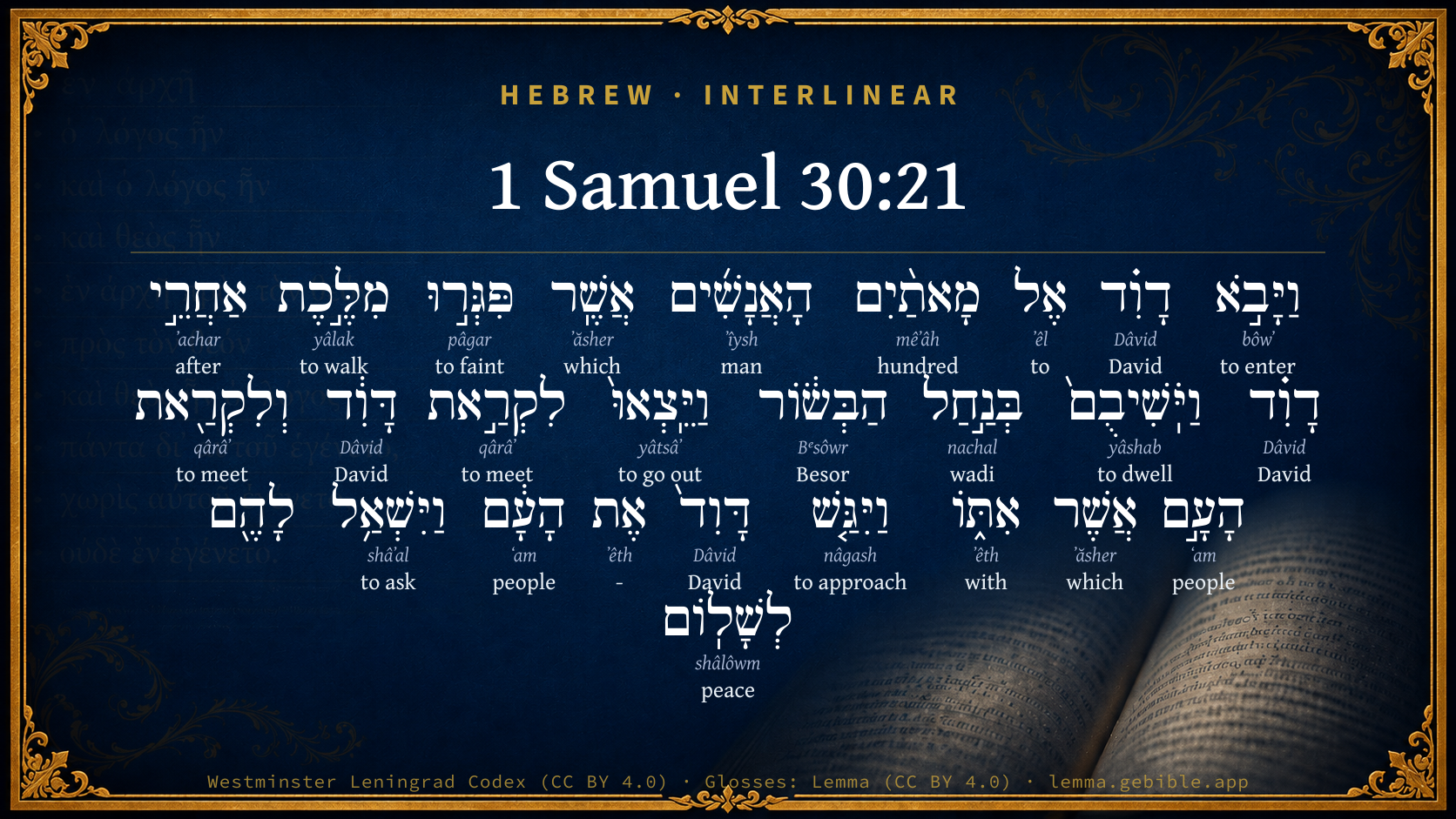
1 Samuel 30:21

Hebrew (Westminster Leningrad Codex) 1 Samuel 30:21 appears in the Hebrew Old Testament. The text above is from the Westminster Leningrad Codex. Each word links to its Strong’s number, a concise gloss, and parsing drawn from the Open Scriptures Hebrew Bible morphology. Click any word for its full Brown-Driver-Briggs (BDB) entry.
Download image
Cite this verse

1 Samuel 30:21 (World English Bible). Public Domain. Lemma interlinear Bible study tool, https://lemma.gebible.app/v/1-samuel/30/21.

Show BibTeX & RIS
BibTeX
RIS
English Translation
David came to the two hundred men, who were so faint that they could not follow David, whom also they had made to abide at the brook Besor; and they went forth to meet David, and to meet the people who were with him: and when David came near to the people, he greeted them.
World English Bible · Public Domain
Download a study sheet

One document with this verse’s original text, its word-by-word gloss line, the meaning frame, cross-references with their text, attributed commentary, and full source and license credits — printable, and it pastes into notes with its structure intact.

This verse Autodidact and up

Study sheet (.html) Plain text (.txt)

A passage Seminary Student

Up to 50 verses in one chapter. A passage sheet keeps up to 6 commentary sources and 12 cross-references per verse, in the order this page ranks them, and says so on the sheet whenever that leaves anything out. Ask for a single verse and you get the Autodidact verse sheet above.

Everything on this page stays free to read, with no account — the sheet is a download of what is already on screen, not access to it.

Want to remove ads? Support Godless Engineer
Compare translations 3

The same verse in 3 English versions, stacked beneath the original-language interlinear above. Click any original word for its lexicon entry.

Each is an independent rendering of the whole verse — the interlinear is not word-aligned to these translations.

Highlighted words mark where these versions differ — a whole-verse word diff, not a word-by-word alignment.

  • World English Bible Public Domain
    David came to the two hundred men, who were so faint that they could not follow David, whom also they had made to abide at the brook Besor; and they went forth to meet David, and to meet the people who were with him: and when David came near to the people, he greeted them.
  • King James Version Public Domain
    And David came to the two hundred men, which were so faint that they could not follow David, whom they had made also to abide at the brook Besor: and they went forth to meet David, and to meet the people that were with him: and when David came near to the people, he saluted them.
  • unfoldingWord Literal Text CC BY-SA 4.0
    And David came to the 200 men who had been too exhausted to go behind David, and they had had them stay at the wadi of Besor. And they came out to meet David and to meet the people who with him. And David approached the people and asked them about peace.

unfoldingWord Literal Text — © unfoldingWord, licensed CC BY-SA 4.0. Word-aligned USFM3 via Door43 (git.door43.org/unfoldingWord/en_ult).

Versions to compare (up to 4)

3 of 4 selected

Show all 18 translations

Every available English version of this verse, each an independent rendering of the whole verse.

  • World English Bible Public Domain
    David came to the two hundred men, who were so faint that they could not follow David, whom also they had made to abide at the brook Besor; and they went forth to meet David, and to meet the people who were with him: and when David came near to the people, he greeted them.
  • Berean Standard Bible Public Domain
    When David came to the two hundred men who had been too exhausted to follow him from the Brook of Besor, they came out to meet him and the troops with him. As David approached the men, he greeted them,
  • Majority Standard Bible Public Domain
    When David came to the two hundred men who had been too exhausted to follow him and who were left behind at the Brook of Besor, they came out to meet him and the troops with him. As David approached the men, he greeted them,
  • King James Version Public Domain
    And David came to the two hundred men, which were so faint that they could not follow David, whom they had made also to abide at the brook Besor: and they went forth to meet David, and to meet the people that were with him: and when David came near to the people, he saluted them.
  • American Standard Version (1901) Public Domain
    And David came to the two hundred men, who were so faint that they could not follow David, whom also they had made to abide at the brook Besor; and they went forth to meet David, and to meet the people that were with him: and when David came near to the people, he saluted them.
  • Revised Version (1885) Public Domain
    And David came to the two hundred men, which were so faint that they could not follow David, whom also they had made to abide at the brook Besor: and they went forth to meet David, and to meet the people that were with him: and when David came near to the people, he saluted them.
  • Geneva Bible (1599) Public Domain
    And Dauid came to the two hundreth men that were too wearie for to follow Dauid: whome they had made also to abide at the riuer Besor: and they came to meete Dauid, and to meete the people that were with him: so when Dauid came neere to the people, hee saluted them.
  • Douay-Rheims (1899) Public Domain
    And David came to the two hundred men, who being weary had stayed, and were not able to follow David, and he had ordered them to abide at the torrent Besor: and they came out to meet David, and the people that were with him. And David coming to the people saluted them peaceably.
  • Young's Literal Translation Public Domain
    And David cometh in unto the two hundred men who were too faint to go after David, and whom they cause to abide at the brook of Besor, and they go out to meet David, and to meet the people who `are' with him, and David approacheth the people, and asketh of them of welfare.
  • Literal Standard Version CC BY-SA 4.0
    And David comes to the two hundred men who were too faint to go after David, and whom they cause to abide at the Brook of Besor, and they go out to meet David, and to meet the people who [are] with him, and David approaches the people, and asks of them of welfare.
  • Unlocked Literal Bible CC BY-SA 4.0
    David came to the two hundred men who had been too weak to follow him, the ones the others had made to stay at the brook Besor. These men went ahead to meet David and the people who were with him. When David came to these people, he greeted them.
  • unfoldingWord Literal Text CC BY-SA 4.0
    And David came to the 200 men who had been too exhausted to go behind David, and they had had them stay at the wadi of Besor. And they came out to meet David and to meet the people who with him. And David approached the people and asked them about peace.
  • Darby Bible Public Domain
    And David came to the two hundred men who had been too exhausted to follow David, and whom they had left behind at the torrent Besor; and they went forth to meet David, and to meet the people that were with him; and David drew near to the people and saluted them.
  • World Messianic Bible Public Domain
    David came to the two hundred men, who were so faint that they could not follow David, whom also they had made to stay at the brook Besor; and they went out to meet David, and to meet the people who were with him. When David came near to the people, he greeted them.
  • Webster's Bible Public Domain
    And David came to the two hundred men, who were so faint that they could not follow David, whom they had made also to abide at the brook Besor: and they went forth to meet David, and to meet the people that were with him: and when David came near to the people, he saluted them.
  • Free Bible Version CC BY-SA 4.0
    When David got back to the two hundred men who had been too tired to continue with him from the Besor Valley, they came to meet him and the men with him. As David approached the men to greet them,
  • Bible in Basic English Public Domain
    And David came to the two hundred men, who because of weariness had not gone with him, but were waiting at the stream Besor: and they went out, meeting David and the people who were with him; and when they came near them, they said, How are you?
  • JPS Tanakh (1917) Public Domain
    And David came to the two hundred men, who were so faint that they could not follow David, whom also they had made to abide at the brook Besor; and they went forth to meet David, and to meet the people that were with him; and when David came near to the people, he saluted them.

Literal Standard Version (2020), Covenant Press — licensed CC BY-SA 4.0. Text via the HelloAO Bible API (eBible.org). Unlocked Literal Bible (unfoldingWord) — licensed CC BY-SA 4.0. Text via the HelloAO Bible API (eBible.org). unfoldingWord Literal Text — © unfoldingWord, licensed CC BY-SA 4.0. Word-aligned USFM3 via Door43 (git.door43.org/unfoldingWord/en_ult). Free Bible Version, Dr. Jonathan Gallagher — licensed CC BY-SA 4.0. Text via the HelloAO Bible API (eBible.org).

Word by word

More ways to search: Search by grammar → Find every occurrence → Compare this word →

Practice this passage: Drill this verse → Learn its vocabulary →

פִּגְּר֣וּ
pâgar
H6296
“to faint”
Verb, Piel, Perfect, 3rd Person, Common, Plural
Part of Speech
Verb
Stem
Piel
Form
Perfect
Person
3rd Person
Gender
Common
Number
Plural
Full BDB Definition

Origin: a primitive root

TWOT: 1732

(Piel) to be exhausted, be faint
  1. וַיָּבֹ֣א bôwʼ H935 “and · to enter” Conjunction + Verb, Qal, Sequential Imperfect, 3rd Person, Masculine, Singular
  2. דָוִ֗ד Dâvid H1732 “David” Noun, Proper
  3. אֶל ʼêl H413 “to” Preposition
  4. מָאתַ֨יִם mêʼâh H3967 “hundred” Adjective, Cardinal number, Both, Dual, Absolute
  5. הָאֲנָשִׁ֜ים ʼîysh H376 “the · men” Particle, Definite Article + Noun, Common, Masculine, Plural, Absolute
  6. אֲשֶֽׁר ʼăsher H834 “which” Particle, Relative
  7. מִלֶּ֣כֶת yâlak H3212 “from · to walk” Preposition + Verb, Qal, Infinitive Construct
  8. אַחֲרֵ֣י ʼachar H310 “after” Preposition
  9. דָוִ֗ד Dâvid H1732 “David” Noun, Proper
  10. וַיֹּֽשִׁיבֻם֙ yâshab H3427 “and · to dwell · them” Conjunction + Verb, Hiphil, Sequential Imperfect, 3rd Person, Masculine, Plural + Suffix, Personal, 3rd Person, Masculine, Plural
  11. בְּנַ֣חַל nachal H5158 “in/at · wadi of” Preposition + Noun, Common, Masculine, Singular, Construct
  12. הַבְּשׂ֔וֹר Bᵉsôwr H1308 “the · Besor” Particle, Definite Article + Noun, Proper
  13. וַיֵּֽצְאוּ֙ yâtsâʼ H3318 “and · to go out” Conjunction + Verb, Qal, Sequential Imperfect, 3rd Person, Masculine, Plural
  14. לִקְרַ֣את qârâʼ H7122 “to meet” Preposition + Verb, Qal, Infinitive Construct
  15. דָּוִ֔ד Dâvid H1732 “David” Noun, Proper
  16. וְלִקְרַ֖את qârâʼ H7122 “and · to meet” Conjunction + Preposition + Verb, Qal, Infinitive Construct
  17. הָעָ֣ם ʻam H5971 “the · people” Particle, Definite Article + Noun, Common, Masculine, Singular, Absolute
  18. אֲשֶׁר ʼăsher H834 “which” Particle, Relative
  19. אִתּ֑וֹ ʼêth H854 “with · him” Preposition + Suffix, Personal, 3rd Person, Masculine, Singular
  20. וַיִּגַּ֤שׁ nâgash H5066 “and · to approach” Conjunction + Verb, Qal, Sequential Imperfect, 3rd Person, Masculine, Singular
  21. דָּוִד֙ Dâvid H1732 “David” Noun, Proper
  22. אֶת ʼêth H853 “-” Particle, Direct Object
  23. הָעָ֔ם ʻam H5971 “the · people” Particle, Definite Article + Noun, Common, Masculine, Singular, Absolute
  24. וַיִּשְׁאַ֥ל shâʼal H7592 “and · to ask” Conjunction + Verb, Qal, Sequential Imperfect, 3rd Person, Masculine, Singular
  25. לְשָׁלֽוֹם shâlôwm H7965 “to/for · peace” Preposition + Noun, Common, Masculine, Singular, Absolute

About this verse

These counts appear in no published source. They are computed here, from the morphology-tagged text and Lemma’s own curated glosses. What Lemma adds →

27
words
20
distinct lemmas
Historical
section

Notable vocabulary

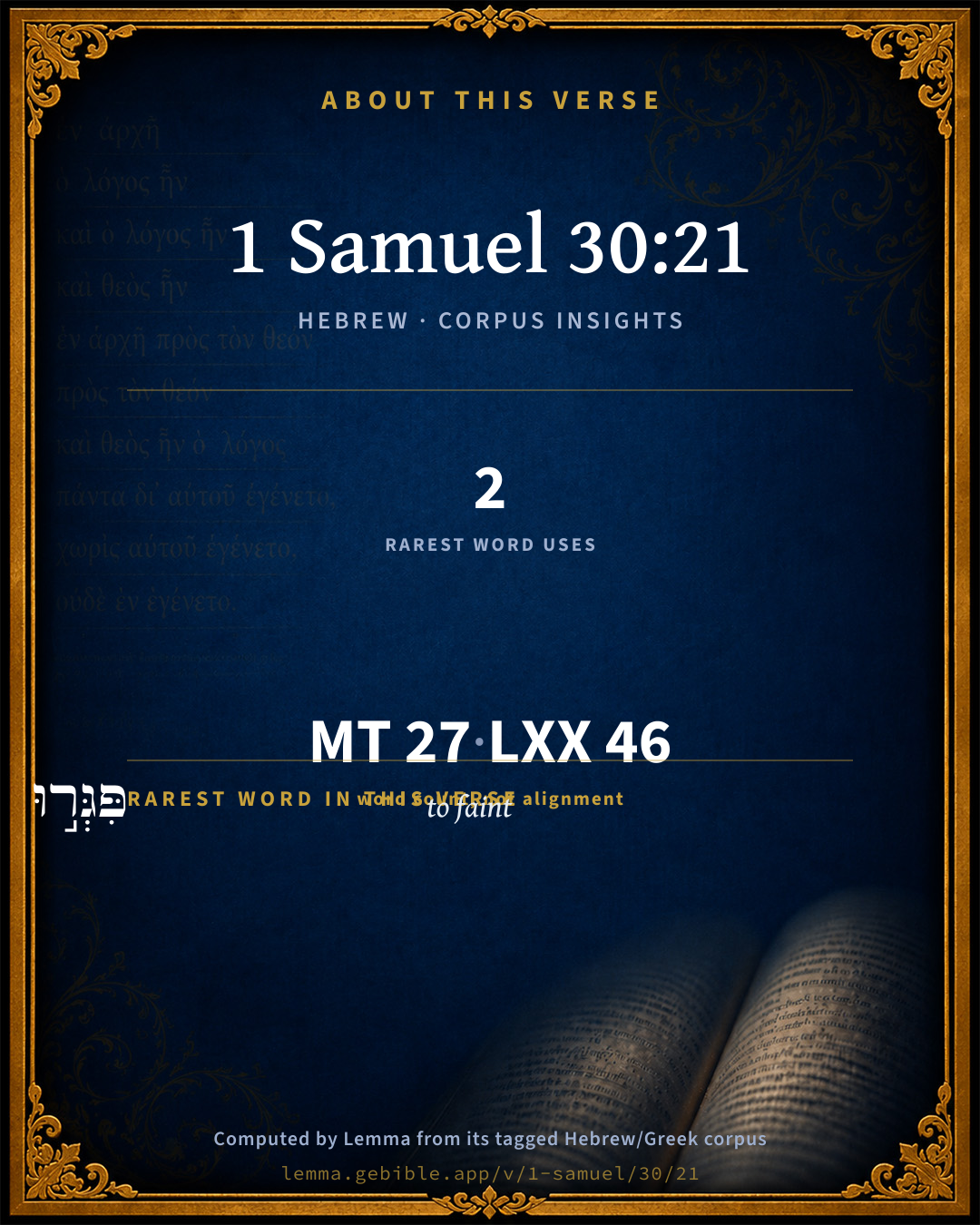
The rarest word here is פִּגְּר֣וּ to faint H6296 — appearing just 2 times in the whole Hebrew Bible.

Shared distinctive vocabulary

פִּגְּר֣וּ to faint H6296 occurs in 2 verses of the Hebrew Bible. Also found in:

Grammatical profile

  • 9 verbs
  • 10 nouns
  • 1 adjective
  • 4 prepositions
  • 3 particles

Verb forms

  • וַיָּבֹ֣א Qal · Sequential Imperfect
  • פִּגְּר֣וּ Piel · Perfect
  • מִלֶּ֣כֶת Qal · Infinitive Construct
  • וַיֹּֽשִׁיבֻם֙ Hiphil · Sequential Imperfect
  • וַיֵּֽצְאוּ֙ Qal · Sequential Imperfect
  • לִקְרַ֣את Qal · Infinitive Construct
  • וְלִקְרַ֖את Qal · Infinitive Construct
  • וַיִּגַּ֤שׁ Qal · Sequential Imperfect
  • וַיִּשְׁאַ֥ל Qal · Sequential Imperfect

Repetition

Words recur within this verse — often emphatic in Hebrew:

  • דָוִ֗ד David H1732 ×4
  • לִקְרַ֣את to meet H7122 ×2
  • הָעָ֣ם people H5971 ×2
  • אֲשֶֽׁר which H834 ×2

Hebrew & Septuagint length

In English translation the verse runs 55 words from the Hebrew and 59 from the Septuagint (LXX English) — closely comparable.

A rough comparison of the two English renderings, which tokenize alike — not a word-level alignment.

Word counts can differ between the Hebrew and the Greek without any difference in meaning — e.g. the Hebrew direct-object marker אֵת has no separate Greek word, and Greek often adds the article ὁ.

In the original languages it is 27 Hebrew tokens and 46 Greek tokens — but the two are counted differently (Hebrew bundles its prefixes and suffixes into one token; the Greek is in lemma form), so that isn’t a like-for-like length.

Cross-references

4

Topical passages linked to 1 Samuel 30:21 in the Treasury of Scripture Knowledge — connected by theme and wording, ordered by reader-vote popularity; previews shown in the World English Bible.

  • Judges 8:15 He came to the men of Succoth, and said, See Zebah and Zalmunna, concerning whom you did taunt me, saying, Are the hands of Zebah and Zalmunna now in your hand, that we should give bread to your men who are weary?
  • 1 Samuel 30:10 But David pursued, he and four hundred men; for two hundred stayed behind, who were so faint that they couldn't go over the brook Besor.
  • Hebrews 13:1 Let brotherly love continue.
  • 1 Peter 3:8 Finally, be all like-minded, compassionate, loving as brothers, tenderhearted, courteous,

Cross-references courtesy of OpenBible.info (CC BY 4.0).

Hebrew and Greek witnesses Masoretic Hebrew ↔ Greek Septuagint

The same verse in the two great witnesses to the Old Testament, shown verse-for-verse.

These are two independent witnesses, not word-aligned to each other, and the Septuagint is shown in lemma (dictionary) form.

Hebrew 1 Samuel 30:21 Masoretic · Westminster Leningrad Codex

וַיָּבֹ֣א דָוִ֗ד אֶל מָאתַ֨יִם הָאֲנָשִׁ֜ים אֲשֶֽׁר פִּגְּר֣וּ מִלֶּ֣כֶת אַחֲרֵ֣י דָוִ֗ד וַיֹּֽשִׁיבֻם֙ בְּנַ֣חַל הַבְּשׂ֔וֹר וַיֵּֽצְאוּ֙ לִקְרַ֣את דָּוִ֔ד וְלִקְרַ֖את הָעָ֣ם אֲשֶׁר אִתּ֑וֹ וַיִּגַּ֤שׁ דָּוִד֙ אֶת הָעָ֔ם וַיִּשְׁאַ֥ל לָהֶ֖ם לְשָׁלֽוֹם

David came to the two hundred men, who were so faint that they could not follow David, whom also they had made to abide at the brook Besor; and they went forth to meet David, and to meet the people who were with him: and when David came near to the people, he greeted them.

World English Bible · Public Domain

Greek LXX 1 Samuel 30:21 Septuagint · lemma form

καί παραγίγνομαι δαυίδ πρός ὁ διακόσιοι ἀνήρ ὁ ἐκλύω ὁ πορεύομαι ὀπίσω δαυίδ καί καταἵζω αὐτός ἐν ὁ χειμάρρους ὁ βοσορ καί ἐκἔρχομαι εἰς ἀπάντησις δαυίδ καί εἰς ἀπάντησις ὁ λαός ὁ μετά αὐτός καί προςἄγω δαυίδ ἕως ὁ λαός καί ἐρωτάω αὐτός ὁ εἰς εἰρήνη

And David comes to the two hundred men who were left behind that they should not follow after David, and he had caused them to remain by the brook of Bosor; and they came forth to meet David, and to meet his people with him: and David drew near to the people, and they asked him how he did.

LXX2012 (modern English Septuagint) · Public Domain

On this verse, Keil & Delitzsch discusses the Septuagint’s reading. Read the note in Commentary ↓

Hebrew: Westminster Leningrad Codex (CC BY 4.0). Greek: Septuagint (public domain); English from LXX2012 (modern English Septuagint) (Public Domain). How the Septuagint differs from the Hebrew →

Targum (Aramaic paraphrase)

1

The Targum is the ancient Jewish Aramaic paraphrase of the Hebrew Scriptures — an interpretive translation, not the Hebrew text itself. Onkelos (literal) and Pseudo-Jonathan (expansive) render the Torah, and Jonathan the Prophets. Coverage is partial: where no permissively-licensed English translation exists for a verse, only the Aramaic is shown. This is verse-level text, not a word-by-word alignment to the Hebrew.

  1. Targum Jonathan Prophets (Joshua–Malachi)
    וַאֲתָא דָוִד לְוַת מָאתָן גַבְרָא דְאִתְמְנִיעוּ מִלְמֵיזַל בָּתַר דָוִד וְאוֹתֵיבִינוּן בְּנַחֲלָא דִבְשׂוֹר וּנְפָקוּ לִקָדָמוּת דָוִד וְלִקֲֳדָמוּת עַמָא דְעִמֵיהּ וַאֲרַע דָוִד יַת עַמָא וּשְׁאִיל לְהוֹן לִשְׁלָם:

    (no public-domain English translation for this verse)

    Targum Jonathan — Aramaic: “Mikraot Gedolot” (public domain). English: “Sefaria Community Translation” (CC0 1.0 (public-domain dedication)); “London "Chaldee Paraphrase," 1871” (public domain). Text via Sefaria.

Commentary

Notes on 1 Samuel 30:21 from classic Christian and Jewish commentators (each source and its license shown beneath its notes). The classic Christian expositions comment on the surrounding passage and are grouped to its opening verse, so a note may address several verses; the Jewish commentaries on the Tanakh (Rashi and others) are per-verse, so they appear only where the commentator wrote on this verse.

Lemma curates 59 commentaries, every one of them public domain or Creative Commons licensed, each selected and text-cleaned for this edition rather than reprinted as found. About our sources →

Matthew Henry's Commentary

We have here an account of the distribution of the spoil which as taken from the Amalekites. When the Amalekites had carried away a rich booty from the land of Judah and the Philistines they spent it in sensuality, in eating, and drinking, and making merry with it; but David disposed of the spoil taken after another manner, as one that knew that justice and charity must govern us in the use we make of whatever we have in this world. What God gives us he designs we should do good with, not serve our lusts with. In the distribution of the spoil,

I. David was just and kind to those who abode by the stuff. They came forth to meet the conquerors, and to congratulate them on this success, though they could not contribute to it (Sa1 30:21); for we should rejoice in a good work done, though Providence had laid us aside and rendered us incapable of lending a hand to it. David received their address very kindly, and was so far from upbraiding them with their weakness that he showed himself solicitous concerning them. He saluted them; he asked them of peace (so the word is), enquired how they did, because he had left them faint and not well; or wished them peace, bade them be of good cheer, they should lose nothing by staying behind; for of this they seemed afraid, as perhaps David saw by their countenances.

1. There were those that opposed their coming in to share in the spoil; some of David's soldiers, probably the same that spoke of stoning him, spoke now of defrauding their brethren; they are called wicked men and men of Belial, Sa1 30:22. Let not the best of men think it strange if they have those attending them that are very bad and they cannot prevail to make them better. We may suppose that David had instructed his soldiers, and prayed with them, and yet there were many among them that were wicked men and men of Belial, often terrified with the apprehensions of death and yet wicked men still and men of Belial. These made a motion that the 200 men who abode by the stuff should only have their wives and children given them, but none of their goods. Well might they be called wicked men; for this bespeaks them, (1.) Very covetous themselves and greedy of gain; for hereby the more would fall to their share. Awhile ago they would gladly have given half their own to recover the other half, yet now that they have all their own they are not content unless they can have their brethren's too; so soon do men forget their low estate. All seek their own, and too often more than their own. (2.) Very barbarous to their brethren; for, to give them their wives and children, and not their estates, was to give them the mouths without the meat. What joy could they have of their families if they had nothing to maintain them with? Was this to do as they would be done by? Those are men of Belial indeed who delight in putting hardships upon their brethren, and care not who is starved, so they may be fed to the full.

2. David would by no means admit this, but ordered that those who tarried behind should come in for an equal share in the spoils with those that went to the battle, Sa1 30:23, Sa1 30:24. This he did, (1.) In gratitude to God. The spoil we have is that which God has given us; we have it from him, and therefore must use it under his direction as good stewards. Let this check us when we are tempted to misapply that which God has entrusted us with of this world's goods. "Nay, I must not do so with that which God has given me, not serve Satan and a base lust with those things which are not only the creatures of his power, but the gifts of his bounty. God has recompensed us by delivering the company that came against us into our hand, let not us then wrong our brethren. God has been kind to us in preserving us and giving us victory, let not us be unkind to them." God's mercy to us should make us merciful to one another. (2.) In justice to them. It was true they tarried behind; but, [1.] It was not for want of good-will to the cause or to their brethren, but because they had not strength to keep up with them. It was not their fault, but their infelicity; and therefore they ought not to suffer for it. [2.] Though they tarried behind now, they had formerly engaged many times in battle and done their part as well as the best of their brethren, and their former services must be considered now that there was something to enjoy. [3.] Even now they did good service, for they abode by the stuff, to guard that which somebody must take care of, else that might have fallen into the hands of some other enemy. Every post of service is not alike a post of honour, yet those that are in any way serviceable to the common interest, though in a meaner station, ought to share in the common advantages, as in the natural body every member has its use and therefore has its share of the nourishment. First, Thus David overruled the wicked men, and men of Belial, with reason, but with a great deal of mildness; for the force of reason is sufficient, without the force of passion. He calls them his brethren, Sa1 30:23. Superiors often lose their authority by haughtiness, but seldom by courtesy and condescension. Secondly, Thus he settled the matter for the time to come, made it a statute of his kingdom (a statute of distributions, primo Davidis - in the first year of David's reign), an ordinance of war (Sa1 30:25), that as his part is that goes down to the battle, and hazards his life in the high places of the field, so shall his be that guards the carriages. Abraham returned the spoils of Sodom to the right owners, and quitted his title to them jure belli - derived from the laws of war. If we help others to recover their right, we must not think that this alienates the property and makes it ours. God appointed that the spoil of Midian should be divided between the soldiers and the whole congregation, Num 31:27. The case here was somewhat different, but governed by the same general rule - that we are members one of another. The disciples, at first, had all things common, and we should still be ready to distribute, willing to communicate, Ti1 6:18. When kings of armies did flee apace, she that tarried at home did divide the spoil, Psa 68:12.

II. David was generous and kind to all his friends. When he had given every one his own with interest there was a considerable overplus, which David, as general, had the disposal of; probably the spoil of the tents of the Amalekites consisted much in plate and jewels (Jdg 8:24, Jdg 8:26), and these, because he thought they would but make his own soldiers proud and effeminate, he thought fit to make presents of to his friends, even the elders of Judah, Sa1 30:26. Several places are here named to which he sent of these presents, all of them in or near the tribe of Judah. The first place named is Bethel, which signifies the house of God; that place shall be first served for its name's sake; or perhaps it means not the city so called, but the place where the ark was, which was therefore the house of God. Thither David sent the first and best, to those that attended there, for his sake who is the first and best. Hebron is named last (Sa1 30:31), probably because thither he sent the residuum, which was the largest share, having an eye upon that place as fittest for his head-quarters, Sa2 2:1. In David's sending these presents observe, 1. His generosity. He aimed not to enrich himself, but to serve his country; and therefore God afterwards enriched him, and set him to rule the country he had served. It becomes gracious souls to be generous. There is that scatters, and yet increases. 2. His gratitude. He sent presents to all the places where he and his men were wont to haunt (Sa1 30:31), that is, to all that he had received kindness from, that had sheltered him and sent him intelligence or provisions. Note, Honesty, as well as honour, obliges us to requite the favours that have been done us, or at least to make a real acknowledgment of them as far as is in the power of our hand. 3. His piety. He calls his present a blessing; for no present we give to our friends will be a comfort to them but as it is made so by the blessing of God: it intimates that his prayers for them accompanied his present. He also sent it out of the spoil of the enemies of the Lord (so he calls them, not his enemies), that they might rejoice in the victory for the Lord's sake, and might join with him in thanksgivings for it. 4. His policy. He sent these presents among his countrymen to engage them to be ready to appear for him upon his accession to the throne, which he now saw at hand. A man's gift maketh room for him. He was fit to be a king who thus showed the bounty and liberality of a king. Munificence recommends a man more than magnificence. The Ziphites had none of his presents, nor the men of Keilah; and thus he showed that, though he was such a saint as not to revenge affronts, yet he was not such a fool as not to take notice of them.

Matthew Henry's Commentary on the Whole Bible (1708–1710) — public domain (CC PDM 1.0). Text via the HelloAO Bible API.

Trapp's Complete Commentary

John Trapp

1Sa 30:21 And David came to the two hundred men, which were so faint that they could not follow David, whom they had made also to abide at the brook Besor: and they went forth to meet David, and to meet the people that [were] with him: and when David came near to the people, he saluted them.

Ver. 21. That they could not follow David.] Could not, or would not. {See Trapp on "1Sa 30:10"}

John Trapp, A Commentary or Exposition upon All the Books of the Old and New Testament (1647–1656) — public domain. Text from a community e-Sword module.

The Biblical Illustrator

Joseph S. Exell

1Sa_30:21-25

And David came to the two hundred men which were so faint that they could not follow.

The statute of David for the sharing of the spoil

I. I shall begin by saying, first, that faint ones occur even in the army of our King. We have among us soldiers whose faith is real, and whose love is burning; and yet, for all that, just now their strength is weakened in the way, and they am so depressed in spirit, that they are obliged to stop behind with the baggage.

1. Possibly some of these weary ones had grown faint because they had been a good deal perplexed. David had so wrongfully entangled himself with the Philistine king, that he felt bound to go with Achish to fight against Israel. They were perplexed with their leaders movements. I do not know whether you agree with me, but I find that half-an-hours perplexity takes more out of a man than a months labour.

2. Perhaps, also, the pace was killing to these men. They made forced marches for three days from the city of Achish to Ziklag. To us there may come multiplied labours, and we faint because our strength is small.

3. Worst of all, their grief came in just then. Their wives were gone. Although, as it turned out, they were neither killed nor otherwise harmed; yet they could not tell this, and they feared the worse.

4. Perhaps, also, the force of the torrent was too much for them. In all probability the brook Besor was only a hollow place, which in ordinary times was almost dry; but in a season of great rain it filled suddenly with a rushing muddy stream, against which only strong men could stand. These men might have kept on upon dry land, but the current was too fierce for them, and they feared that it would carry them off their feet and drown them. Therefore, David gave them leave to stop there and guard the stuff.

5. Yet these fainting ones were, after all, in Davids army. Their names were in their Captains Register as much as the names of the strong.

II. These fainting ones rejoice to see their leader return.

1. David saluted the stay-at-homes. Our Kings salutations are wonderful for their heartiness. He uses no empty compliments nor vain words. Every syllable from His lips is a benediction. Every glance of His eye is an inspiration.

2. Davids courtesy was as free as it was true. When Christ comes into a company his presence makes a heavenly difference. Have you never seen an assembly listening to an orator, all unmoved and stolid? Suddenly the Holy Ghost hast fallen on the speaker, and the king himself has been visibly set forth among them in the midst of the assembly, and all have felt as if they could leap to their feet and cry, Hallelujah, hallelujah! Then hearts beat fast, and souls leap high; for where Jesus is found his presence fills the place with delight.

III. Faint ones have their leader for their advocate.

1. First, do you notice, he pleads their unity? The followers of the son of Jesse are one and inseparable. David said, Ye shall not do so, my brethren, with that which the Lord hath given us, who hath preserved us. We are all one, says David. God has given the spoil, not to you alone, but to us all. We are all one company of brothers. The unity of saints is the consolation of the feeble. One life is ours, one love is ours, one heaven shall be ours in our one Saviour.

2. David further pleaded free grace, for be said to them, Ye shall not do so, my brethren, with that which the Lord hath given us. The gift of God is eternal life. Deny not to anyone of your brethren any comfort of the covenant of grace.

3. Then he pleaded their needfulness. He said, These men abided by the stuff. No army fights well when its camp is unguarded. The kind of service which seems most commonplace among men is often the most precious unto God. Therefore, as for those who cannot come into the front places of warfare, deny them not seats of honour, since, after all, they may be doing the greater good. Remember the statute, They shall part alike.

4. Notice that David adds to his pleading a statute. He makes a statute for those who are forced to stay at home because they are faint. Blessed be the name of our Lord Jesus, He is always looking to the interests of those who have nobody else to care for them! Some of Gods people are illiterate, and they have but tittle native talent. Some dear servants of God seem always to be defeated. They seem sent to a people whose hearts are made gross and their ears dull of hearing. Some saints are constitutionally depressed and sad; they are like certain lovely ferns, which grow best under a constant drip. Well, well, the Lord will gather these beautiful ferns of the shade as well as the roses of the sun; they shall share His notice as much as the blazing sunflowers and the saddest shall rejoice with the gladdest. If lawfully detained from the field of active labour this statute stands fast forever, for you as well as for others: As his part is that goeth down to the battle, so shall his part be that tarrieth by the stuff: they shall part alike.

IV. Now, faint ones find Jesus to be their good Lord in every way. (C. H. Spurgeon.)

Tarrying by the stuff

There is an impression abroad that the great rewards of the eternal world are to be given to the great heroes, the great philanthropists, the great statesmen--the great men, the great women. My text sets forth the idea that just as great rewards will come to those who stay at home and mind their own business, just as great rewards to those who are never seen in the high places of the field, just as great rewards to those who are never heard of--garrison duty as important as duty at the front. As his part is that goeth down to the battle, so shall his part be that tarrieth by the stuff. A great many people are discouraged when they read the story of David and Joshua, and Paul and John Knox and Martin Luther; they say, Those men had special opportunities; perhaps if I had had the same opportunities I might have done just as well; but I shall never be called to command the sun and moon to stand still; I will never be called to preach on Mars Hill; I will never be called, as John Knox was, to make a queen tremble for her crimes; I will never preside over a hospital; my life is all commonplace and humdrum. And many a woman says within herself, Ah, you folks on the platform and in the pulpit are all the time talking about heroines, great women, and they were great, but they had a special opportunity; perhaps, if I had the same opportunity I might do just as well; my life is all humdrum, my life is to sew the button on, to prevent the children from being asphyxiated with the whooping cough, to keep down the family expenses, to see that the meals are ready at the right time; I get no chance, it is all humdrum, humdrum. Woman, your reward in the eternal world will be just as great as that of Florence Nightingale, who was called by the soldiers in the camp The Lady of the Lamp; because passing through the hospitals she kindled up the darkness with this lamp, and ministered to the suffering, and they all said, Here comes the lady of the lamp. Your reward in eternity will be just as great if you do your work where you are put as well as she did her work where she was put. Your reward will be just as great as that of Mrs. Hertzog, who endowed the theological seminary for the education of the young ministry. Ah, how many who had ten talents get no reward in the eternal world, and how many who had only one talent will have dominions committed to them!

1. Oh, what consolation there is there for all people who do unappreciated work! Here is a great merchant philanthropist; he is as good and generous as he is affluent; you know his name--do you know the name of his confidential clerk?--the man on whose fidelity that fortune was built up, so that he could accumulate his vast wealth and then generously distribute it? Oh, no, you dont know the name of the confidential clerk. Is he to get no reward? I tell you that in the eternal world the merchant prince, who distributed his millions will get no more reward than the confidential clerk. As his part is that goeth down to the battle, so shall his part be that tarrieth by the stuff. You know the names, I suppose, of the great presidents of railroads. Do you know the names of the brakeman, of the engineer, on whose wrist last night 300 lives hung; of the switchman, who, moving the switch three or four inches that way, and the whole train goes through in peace and families reach their homes in safety? A good many years ago a Christian woman was seen every eventide going along by the edge of the woods. She had a large family, and her neighbours said, How can this woman, with all her cares and anxieties, waste her time going along the edge of the wood at eventide? They did not find out until after her death why she went. She went there to pray for her household, and one evening, while there, she wrote that beautiful hymn sung in all our churches in America, and, I have no doubt, sung in your churches:--

I love to steal awhile away

From every cumbering care,

And spend the hours of setting day

In humble grateful prayer.

No minister of religion standing in European or American pulpit today giving out that hymn, will have more reward than that woman received for writing it.

2. There is great consolation in the subject for all those who used to be at the front in great enterprises of benevolence and religion. Why, when a subscription paper came round their name was at the top for a good big sum. When a revival came they would pray all night with the anxious. They were strong, healthy, affluent. But not now. Their fortune has collapsed, their health has gone, they are clear discouraged; they do not see how they can help Gods work any more. Nay; look at those 200 men by the brook Besor. Just shove back the sleeve and show how the muscles were twisted in the battle. Just pull aside the turban and see the scar where the battleaxe struck. Just pull aside the coat a little and see where the spear went in. They got just as much reward as those who went to the front, and you who were at the front in the old days had the health, the muscle, the high spirits for all that kind of work. God has not forgotten you.

3. What comfort this in for the aged! What have you got to do? Only to wait. Your reward will come. There is great consolation in this for all the aged ministers. I know some of them are preaching the Gospel. A man cannot preach the Gospel for fifty years without showing it in an illuminated countenance. Oh! there has got to be a readjustment of coronets; people who have no coronet in this world to be crowned; people who have great honours in this world to lose their coronet. Oh, there has got, to be a redistribution of coronets! Shall not the child have a crown? the father a crown? the mother a crown? And all ye who are doing unappreciated work the day of your reward is coming. (T. De Witt Talmage, D. D.)

.

The Biblical Illustrator, edited by Joseph S. Exell (c. 1880s–1900s) — public domain. Text from a community e-Sword module.

Joseph Benson's Commentary

1Sa 30:21-22. He saluted them — He spoke kindly to them, and did not blame them because they went no further with them. We will not give them aught of the spoil — This was the resolution of such as feared not God, nor regarded man; and it was as ungenerous and unjust as it was unkind; for their brethren had stayed behind, not from choice, but from mere necessity, being unable to travel further.

Joseph Benson's Commentary on the Old and New Testaments (1811–1818) — public domain. Text from a community e-Sword module.

Tyndale Open Study Notes

Tyndale Open Resources

30:21-31 David generously divided the spoils among those who participated in the battle and those who were too exhausted to take part.

30:21 greeted them joyfully: David did not reprimand them for not participating in the battle.

Tyndale Open Study Notes — © Tyndale Open Resources, licensed CC BY-SA 4.0. Text via the HelloAO Bible API.

Jamieson, Fausset & Brown

Robert Jamieson, A. R. Fausset & David Brown

David came to the two hundred men, which were so faint that they could not follow--This unexpected accession of spoil was nearly proving an occasion of quarrel through the selfish cupidity of some of his followers, and serious consequences might have ensued had they not been prevented by the prudence of the leader, who enacted it as a standing ordinance--the equitable rule--that all the soldiers should share alike (see Num 31:11; see on Num 31:25).

Jamieson, Fausset & Brown — Commentary Critical and Explanatory on the Whole Bible (1871) — public domain (CC PDM 1.0). Text via the HelloAO Bible API.

John Gill's Exposition

And David came to the two hundred men,.... Left at the brook Besor:

who were so faint that they could not follow David; or, as the Targum, were restrained from going over after him; either through faintness of spirits, and weakness of body, or through the order of David that they should not follow him; and which seems to receive some countenance from what follows:

whom they had made also to abide at the brook Besor; to guard the passage there, and to tarry by and keep the stuff:

and they went forth to meet David, and to meet the people that were with him; to congratulate them upon the victory they had obtained, and to see and receive their wives and children, and what portion of the spoil might be divided to them:

and when David came near to the people, he saluted them; asked them of their welfare, whether they were in better health, and recovered of their faintness and weakness, as it should seem they were, by their coming forth to meet him.

John Gill's Exposition of the Whole Bible (1746–1763) — public domain (CC PDM 1.0). Text via the HelloAO Bible API.

Matthew Poole's English Annotations

They went forth to meet David, to congratulate the victory; which, it is probable, David had sent a messenger to acquaint them with.

He saluted them; he spoke kindly to them, and did not blame them because they went no further with them.

Matthew Poole's English Annotations on the Holy Bible (1683–1685) — public domain. Text from a community e-Sword/MySword module.

The Pulpit Commentary

DAVID ENACTS A LAW FOR THE DIVISION OF THE SPOIL (vers. 21-25).

Vers. 21, 22. On returning David finds the 200 stragglers, whom they had made to abide at the brook Besor. Rather, "whom he had, made to abide," as it was David"s office to give such a command. The singular is supported by all the versions except the Chaldee, and by some MSS. David had made such men as were growing weary halt at the torrent, because it was a fit place where to collect the stragglers, and also, perhaps, because it would have required time and labour to get the baggage across. All the more wicked and worthless (see on 1Sa_1:16) members of the force now propose to give the 200, only their wives and children, and send them away with no share of the spoil. Besides the sheep and oxen given to David, there would be camels and other animals, arms, gold and silver, clothing, and other personal property.

Vers. 21-31.

The law of service.

The facts are

1. On returning to the men who had remained at Besor, some of David"s followers oppose his intention to give them a share of the spoil, and are even desirous of sending them away.

2. David resists this spirit as being inconsistent with gratitude to God forhis care and aid, and with strict justice to those who serve in humble form according to their strength.

3. David"s decision becomes a standing ordinance in Israel"s future nationallife.

4. He sends presents to the elders of cities that had befriended him duringthe days of his persecution. David"s course all through was wonderfully chequered. He had good reason for saying, "Many are the afflictions of the righteous." No sooner had he rejoiced in the triumph of victory, and was devising in his heart kind and generous deeds, than he has to experience the annoyance and pain of contending with a murmuring and mutinous spirit among his own followers. As we look at him, the "man after God"s own heart," bent on a noble mission for Israel, generous in spirit to all around, rising high above others in integrity of purpose and spiritual aspiration, and surrounded by a motley group of men, hard to control, and often low in tendency, we cannot but think of One greater, who later on stood among wayward, ignorant men, the Holy One, intent on establishing a throne never to be shaken, and wearied and wounded by the incessant "contradiction of sinners." But God teaches mankind through lessons evolved from the varied and often painful experience of his servants, and it is a consolation to them that the fires which try them should also emit light for the benefit of coming generations. There are three truths practical in bearing brought out by this part of David"s experience.

I THE DIVERSE CHARACTER OF MEN IS SEEN IN THE EFFECT OF SUCCESS UPON THEIR SPIRIT AND CONDUCT. David and his men had achieved a great success, and were returning full of the joy of victory. The record tells us nothing of the bearing of the leader and of the men on the first flush of success; no doubt the wild excitement over the spoil of many of his followers was in striking contrast with the tremulous joy which found vent in his private thanksgiving to God. But on their return to Besor, the depraved, irreligious spirit of those termed "men of Belial" appeared in the love of greed and the cruel indifference to the wants of the weary which drew forth David"s remonstrance. Success revealed the iniquity of their hearts, while it drew forth the grateful, tender qualities of David"s character. Prosperity is as real a test of what men are as is adversity. It draws forth a different set of qualities, but is not the less a means of proving and intensifying a man"s character, be it good or bad. When we say that sometimes success in commerce, literature, science, or military skill makes a man vain and scornful of others, or humble and considerate, we really mean that it has developed hidden weakness in the one case, and moral strength in the other. When the character deteriorates or improves under the influence of prosperity, it depends on casual circumstances as to bow the deterioration or improvement will manifest itself. Here the presence of feeble men unable to engage in conflict happened to be the occasion of an outburst of selfish feeling. The same occasion furnished a manifestation of kindly consideration and love of justice. While few things create in generous hearts more disgust and sorrow than the selfishness, luxurious indulgence, and purse proud bearing of men whose struggles in life have brought material success, few qualities are more admired than those of large hearted benevolence, simplicity of habit, compassion for the destitute, and the grateful, lowly spirit which ascribes all good to God, and proves the sincerity of the ascription by deeds of self-denial on behalf of others. He who can conquer prosperity is often a greater man than the conqueror of adversity. Only the spirit of him who "made himself of no reputation," who "became poor" that we "might be rich," will enable us to subdue all things to his glory (cf. Psa_73:3-12; Pro_1:32; Mar_10:23-25; Php_3:7, 8)

II THE LAW OF SERVICE IN THE KINGDOM OF GOD. The selfish spirit of some of David"s men gave occasion for the exercise of his authority in a fight royal manner, and issued in the establishment of an ordinance in relation to service in his cause which became a law in Israel, and fitly foreshadows the principle on which all service in Messiah"s kingdom is based. David would not allow the men who, through exhaustion in the hasty march, had remained at Besor to care for the bag gage to be deprived of their share of the spoil through the greed of the actual combatants. His principle was that they were all engaged in one enterprise, that their position had been determined by the circumstances of the case, and that all honour should be done them. The ruling faculty in David was beginning to bear good fruit for the poor and needy beautifully typical of One who is the Refuge and Defender of the oppressed! Considering the passage in its bearing on service in Christ"s kingdom, we may notice

1. That all his people aye equally his servants, and have their proper work. The equality in Christ"s kingdom is that of oneness of spirit, aim, and relationship to him. All true Christians are zealous for his supremacy, eager to see him triumph over powers of evil, and on the same level as servants of one Lord and Leader. They are all workers, warriors, contending in accordance with their power and position for a common issue. Every member of the body has its function in securing the purposes of the head. (1Co_12:12-14)

2. That diversity of employment is necessary to the execution of his purposes. The care of the "stuff" was as necessary in so dangerous a country as the pursuit and attack on the foe. In accomplishing the purposes of Christ on earth there are diversities of operations. The analogy of the body is used by the Apostle Paul to enforce this truth on the Church. (1Co_12:12-31) It is an instructive study to notice how the manifold agencies and gifts of the Church and of individual Christians have worked together in producing the complex result we witness in the present advanced position of Christ"s kingdom. The recognition of diversity should stimulate and encourage all, whatever their powers and opportunities.

3. That incapacity for rendering conspicuous service is compatible with quiet yet important service. Those who by Providence are hindered from fighting in the high places of the field have good work to do in a quieter form. Missionaries, popular preachers, diligent pastors, and men of high literary culture may be in the forefront; but the mothers who train children in the fear of God, fathers who live godly lives in the world, quiet, wise men who conduct religious movements, widows who east in their mite, and even sick and weary ones who in the solitude of their chamber offer daily prayers for the hosts of God render most valuable service in the common enterprise.

4. Where thee is loyalty in service, whatever its lowly form, there is to be honourable recognition. David would not overlook the claims of the feeble men in charge of the" stuff." In this he was true to the principles and precedents of Israel"s greatest leaders. (Num_31:27; Jos_22:8) In Christ"s kingdom there is to be, after his great example in the case of the widow"s mite and the hosannas of children, a recognition by all of the need and value of services apparently insignificant. This is further taught in the blessing pronounced on the giver of a cup of cold water, the mention in the day of judgment of the care bestowed on the sick and needy, and also in the equal welcome which the Lord declares he will give to the gainer of ten and two talents. The rewards of the advancing kingdom are shared in the joy and satisfaction which all true workers experience, and in the material improvement of the world consequent on its advance; and while he makes all "kings and priests" now, he will at last honour them with a vision of the glory he had with the Father before the world was. (Joh_17:24)

III THERE IS A WISE POLICY IN THE EXPRESSION OF GRATITUDE. The tenor of David"s life shows that the sending presents from the spoil taken to those who had befriended him in his time of need was the genuine expression of a grateful heart. At the same time this was coincident with a wise policy, and, in his mind, distinctly blended with it. Had the gifts been the product of a mere calculation of results, the act would only command the respect due to expediency, but having its root in feeling, it rises to a higher value. The recompense of kindnesses when occasion offers is the suggestion of a true heart, and though utilitarian ideas may not enter into the recompense, yet it is always useful in view of future contingencies. A prudent man called to a great work, is bound to prepare the way for its realisation by securing as far as possible the good will and cooperation of others.

General lessons:

1. It behoves us to be on our guard against the perils of success, and to remember that as God is a refuge from the storm, so he is a shade upon our right hand to tone down the fight of prosperity. (Psa_121:5, Psa_121:6)

2. A degree of suspicion is always proper concerning ourselves, as thereare latent evils which events may draw forth.

3. We should be careful not to disparage the services of persons seeking ina humble way to promote the glory of Christ. (Mat_18:6)

4. The chief question for each is the existence within of a spirit of loyalty toChrist; the form of service is a matter of opportunity. (Joh_21:15-17)

5. Those who render aid to the people of God in their time of distress aresure to be recompensed on earth as in heaven. (Luk_6:31-38 Luk_14:13, Luk_14:14)

Vers. 21-31. (THE BROOK BESOR, ZIKLAG.)

The fruits of victory.

When David overtook the Amalekites in the evening twilight he found them given up to riotous indulgence, undefended, and little thinking how near they were to destruction. He forthwith fell upon them, and after a severe conflict, which lasted till the evening of the next day, gained a complete victory. He "recovered all" that had been carried away. In addition he obtained much spoil, consisting of flocks and herds, and of "arms, ornaments, jewels, money, clothes, camels, accoutrements, and so on." The former were assigned to David (according to his wish, and as better adapted to the end he had in view), and driven in front of the recovered flock with the exclamation, "This is David"s spoil." The latter were carried away for distribution among his men. By his victory a crushing blow was inflicted on a bitter enemy of the people of Israel, and a great deliverance wrought for them. He evidently regarded himself as (not merely engaged in a private enterprise, but as) acting on their behalf, and carrying out God"s purpose; and his conduct after the battle was marked by

1. Considerate sympathy with the faint and weary who had been disabled from taking an active part in the conflict. "He saluted them" (ver. 21). As he had not previously urged them beyond their strength, so now he exhibited a kindly interest in them, and a marked respect toward them. His

2. heart was not lifted up by success. They had "done what they could," and formed part of his following. "They also serve who only stand and wait.

3. Strenuous resistance to the arrogant, selfish, and unjust procedure of some of his followers (ver. 22). "Rough, wild men were many among them, equally depressed in the day of adversity, and recklessly elated and insolent in prosperity. Nor is it merely the discipline which David knew how to maintain in such a band that shows us "the skilfulness of his hands" in guiding them, but the gentleness with which he dealt with them, and above all the earnest piety with which he knew how to tame their wild passions, prove the spiritual "integrity" or "perfectness of his heart (Edersheim). The spirit which these "wicked and worthless men" displayed is sometimes found even in the Church of Christ, and requires to be met with firm and uncompromising opposition. (1Pe_5:9)

1. Devout recognition of the hand of God, in bestowing whatever good is possessed, preserving from harm, and delivering from dangerous adversaries. "Ye shall not do so, my brethren, with that which the Lord hath given us," etc. (ver. 23). "Man could not boast of his own merit in obtaining these possessions" (Ewald). They were a gift of God, and should be used for his honour and the good of all. There is a higher law than that of self-interest. Men are only "stewards" (not absolute owners) of property, ability, time, influence, etc., and as such it behove, them to "be found faithful." "Freely ye have received, freely give.

2. Equitable distribution. "And who will hearken unto you in this matter?" etc. (vers. 24, 25). The course proposed was as contrary to the common convictions of men concerning what is reasonable and just as to the benevolent purpose of God. "The equity of this law appears from hence that by common consent these 200 men were left behind to look after the baggage; were part of the same body of men, linked together in the same common society; hindered by mere weariness from going to fight, which otherwise they would have done; their will was accepted for the deed; and they were in the same common danger, for if the 400 had been routed their enemies would have soon cut them off" (Patrick). "The members should have the same care one for another". (1Co_12:25)

1. Grateful acknowledgment of friendly aid during his "wanderings in the wilderness." "He sent of the spoil unto the elders of Judah, his friends," etc. (vers. 26-31). They had suffered from Amalekite raids, but it was not to make restitution for their losses so much as to testify his gratitude and strengthen their attachment. His victory enabled him to display a princely

2. munificence. It is a remarkable proof of the grateful nature of David, and his fidelity to his early friendships, as well as a curious instance of undesigned coincidence, that we find among those employed by David in offices of trust in the height of his power so many inhabitants of those obscure places where he found friends in the days of his early difficulties" ("Sp. Com.").

3. Commendable policy wise, generous, patriotic, and religious. "Behold a present" (blessing, gift) "for you of the spoil of the enemies of Jehovah." The elders of Judah and others looked to him as their future theocratic ruler. He himself felt that the time of patient waiting was nearly gone, and the time of active effort for the fulfilment of the Divine purpose concerning him well nigh come, if, indeed, the tidings of the death of Saul had not already reached him. He also foresaw that he must look for his chief support in his own tribe, and adopted the best method of securing it. "Piety without policy is too simple to be safe; policy without piety is too subtle to be good." "This was already a royal act in vivid anticipation of his impending accession to the throne. Already the crown of Israel was unmistakably though dimly visible above his head" (Krummacher). "Whilst Saul"s star sinks in the north, the star of David rises in the south, and there begins the long line of fulfilments of the prophecy concerning the Star that should come out of Jacob". (Num_24:17) (Erdmann) D.

The Pulpit Commentary (1880–1919), ed. H.D.M. Spence-Jones & Joseph S. Exell — public domain. Text from a community e-Sword module.

John Wesley's Explanatory Notes

Saluted them - He spoke kindly to them, and did not blame them because they went no further with them.

John Wesley, Explanatory Notes Upon the Whole Bible (1754–1765) — public domain. Text via the GEBible commentary corpus.

Keil & Delitzsch

C. F. Keil & F. Delitzsch

When David came back to the two hundred men whom he had left by the brook Besor (יושׁיבם, they made them sit, remain), they went to meet him and his warriors, and were heartily greeted by David.

Sa1 30:22

Then all kinds of evil and worthless men of those who had gone with David to the battle replied: "Because they have not gone with us (lit. with me, the person speaking), we will not give them any of the booty that we have seized, except to every one his wife and his children: they may lead them away, and go."

Sa1 30:23-24

David opposed this selfish and envious proposal, saying, "Do not so, my brethren, with that (את, the sign of the accusative, not the preposition; see Ewald, 329, a.: lit. with regard to that) which Jehovah hath done to us, and He hath guarded us (since He hath guarded us), and given this troop which came upon us into our hand. And who will hearken to you in this matter? But (כּי, according to the negation involved in the question) as the portion of him that went into the battle, so be the portion of him that stayed by the things; they shall share together." הורד is a copyist's error for היּרד.

Sa1 30:25

So was it from that day and forward; and he (David) made it (this regulation as to the booty) "the law and right for Israel unto this day."

Sa1 30:26-29

When David returned to Ziklag, he sent portions of the booty to the elders of Judah, to his friends, with this message: "Behold, here ye have a blessing of the booty of the enemies of Jehovah" (which we took from the enemies of Jehovah); and this he did, according to Sa1 30:31, to all the places in which he had wandered with his men, i.e., where he had wandered about during his flight from Saul, and in which he had no doubt received assistance. Sending these gifts could not fail to make the elders of these cities well disposed towards him, and so to facilitate his recognition as king after the death of Saul, which occurred immediately afterwards. Some of these places may have been plundered by the Amalekites, since they had invaded the Negeb of Judah (Sa1 30:14). The cities referred to were Bethel, - not the Bethel so often mentioned, the present Beitin, in the tribe of Benjamin, but Betheul (Ch1 4:30) or Bethul, in the tribe of Simeon (Jos 19:4), which Knobel supposes to be Elusa or el Khalasa (see at Jos 15:30). The reading Βαιθσούρ in the lxx is a worthless conjecture. Ramah of the south, which was allotted to the tribe of Simeon, has not yet been discovered (see at Jos 19:8). Jattir has been preserved in the ruins of Attir, on the southern portion of the Mountains of Judah (see at Jos 15:48). Aror is still to be seen in ruins, viz., in the foundations of walls built in enormous stones in Wady Arara, where there are many cavities for holding water, about three hours E.S.E. of Bersaba, and twenty miles to the south of Hebron (vid., Rob. Pal. ii. p. 620, and v. de Velde, Mem. p. 288). Siphmoth (or Shiphmoth, according to several MSS) is altogether unknown. It may probably be referred to again in Ch1 27:27, where Zabdi is called the Shiphmite; but it is certainly not to be identified with Sepham, on the north-east of the sea of Galilee (Num 34:10-11), as Thenius supposes. Eshtemoa has been preserved in the village of Semua, with ancient ruins, on the south-western portion of the mountains of Judah (see at Jos 15:50). Racal is never mentioned again, and is entirely unknown. The lxx have five different names instead of this, the last being Carmel, into which Thenius proposes to alter Racal. But this can hardly be done with propriety, as the lxx also introduced the Philistian Gath, which certainly does not belong here; whilst in Sa1 30:30 they have totally different names, some of which are decidedly wrong. The cities of the Jerahmeelites and Kenites were situated in the Negeb of Judah (Sa1 27:10), but their names cannot be traced.

Sa1 30:30-31

Hormah in the Negeb (Jos 15:30) is Zephath, the present Zepta, on the western slope of the Rakhma plateau (see at Jos 12:14). Cor-ashan, probably the same place as Ashan in the shephelah, upon the border of the Negeb, has not yet been discovered (see at Jos 15:42). Athach is only mentioned here, and quite unknown. According to Thenius, it is probably a mistaken spelling for Ether in the tribe of Simeon (Jos 19:7; Jos 15:43). Hebron, the present el Khulil, Abraham's city (see at Jos 10:3; Gen 23:17).

Keil & Delitzsch — Biblical Commentary on the Old Testament (1861–1891) — public domain (CC PDM 1.0). Text via the HelloAO Bible API. (Old Testament only.)

Kretzmann's Popular Commentary

Paul E. Kretzmann

The Distribution of the Spoil

v. 21. And David came to the two hundred men, which were so faint that they could not follow David, whom they had made also to abide at the brook Besor, David having given this order on account of their great exhaustion; and they went forth to meet David, and to meet the people that were with him; and when David came near to the people, he saluted them, giving them a friendly greeting, wishing them peace and happiness.

v. 22. Then answered all the wicked men and men of Belial, vain and profitless fools, of those that went with David, for even in that band there were such, and said, Because they went not with us, we will not give them ought of the spoil that we have recovered, save to every man his wife and his children, that they may lead them away and depart, literally, "But every man his wife and his children; these let them lead away and go. " They held the selfish idea that, because the two hundred had not shared in the danger, they should neither share the spoil.

v. 23. Then said David, his tactful gentleness averting a rupture in the ranks which might have become a calamity, Ye shall not do so, my brethren, with that which the Lord hath given us, who hath preserved us, and delivered the company that came against us into our hand. The success of their venture had been due entirely to Jehovah and His blessing and could, therefore, in no way be regarded as their own achievement.

v. 24. For who will hearken unto you in this matter? The majority would certainly not share their selfish sentiments. But as his part is that goeth down to the battle, so shall his part be that tarrieth by the stuff, who remains behind to watch the baggage; they shall part alike, share according to the same division.

v. 25. it was so from that day forward, that he, David, made it a statute and an ordinance for Israel unto this day. It was a rule which held as late as the time of the Maccabees, being considered just and fair to all.

v. 26. And when David came to Ziklag, he sent of the spoil, after everyone of his men had recovered what had been taken from him and other booty besides, unto the elders of Judah, even to his friends, saying, Behold a present for you, a gift of blessing, of the spoil of the enemies of the Lord;

v. 27. to them which were in Bethel, and to them which were in South Ramoth, the city of this name in the south country, and to them which were in Jattir,

v. 28. and to them which were in Aroer, and to them which were in Siphmoth, and to them which were in Eshtemoa,

v. 29. and to them which were in Rachal, and to them which were in the cities of the Jerahmeelites, and to them which were in the cities of the Kenites,

v. 30. and to them which were in Hormah, and to them which were in Chorashan, and to them which were in Athach,

v. 31. and to them which were in Hebron, and to all the places where David himself and his men were wont to haunt, who had shown kindness to him when he was a fugitive. All the cities here mentioned, some of which have been identified quite certainly, are in the southern and southwestern part of the territory of Judah. Note: If the Lord lays His blessing upon our endeavors, it behooves us to share it with others as there is need or occasion.

Paul E. Kretzmann, Popular Commentary of the Bible (1921–1924) — public domain. Text from a community e-Sword module.

unfoldingWord translationNotes

Door43 World Missions Community

two hundred

200 (See: Numbers)

the brook Besor

a small stream or creek named Besor. See how you translated this in 1 Samuel 30:9. (See: How to Translate Names)

greeted them

spoke to them in a friendly way

the booty

the goods they had taken from the enemy in battle. See how you translated this in 1 Samuel 30:16.

we have recovered

"we have regained" or "we have gotten back"

translationWords

David

evil

worthy

unfoldingWord translationNotes — © Distant Shores Media and the Door43 World Missions Community, licensed CC BY-SA 4.0. Source: git.door43.org/Door43/en_tn.

Lesson kit

Teaching starters — assembled from the data on this page, not authored interpretation. Every prompt links to the verse data it draws on. Edit before teaching.

1 Samuel, in the Historical, opens this verse with 27 words (20 distinct Hebrew lemmas). Its most distinctive word is pâgar (“to faint”). A historical commentator’s framing appears above. Read the whole chapter for the surrounding context.

Discussion questions

  1. How does “to faint” (pâgar) shape what this verse is saying?
  2. 1 Samuel 30:10 shares the word «to faint» with this verse. How do the two illuminate each other?
  3. “David” occurs 4× in this one verse. What is the effect of the repetition?
  4. These translations render this verse differently. What is at stake in choosing one wording over another?
  5. The verb «וַיָּבֹ֣א» is Qal Sequential Imperfect. How does its form color the action?
  6. Reading how Matthew Henry's Commentary and Trapp's Complete Commentary read this verse, where do the two commentators agree and where do they part?

Things to notice

Reading settings

Reading text

Shown beneath each verse's original-language words.

Old Testament
Old Testament edition

Read the OT as the Masoretic Hebrew (MT) or the Greek Septuagint (LXX).

English shown for the Greek Septuagint (in the Hebrew ↔ Greek comparison).

Comparing translations? Open the Compare panel on any verse page to stack up to four side by side.