
1 Samuel 20:13

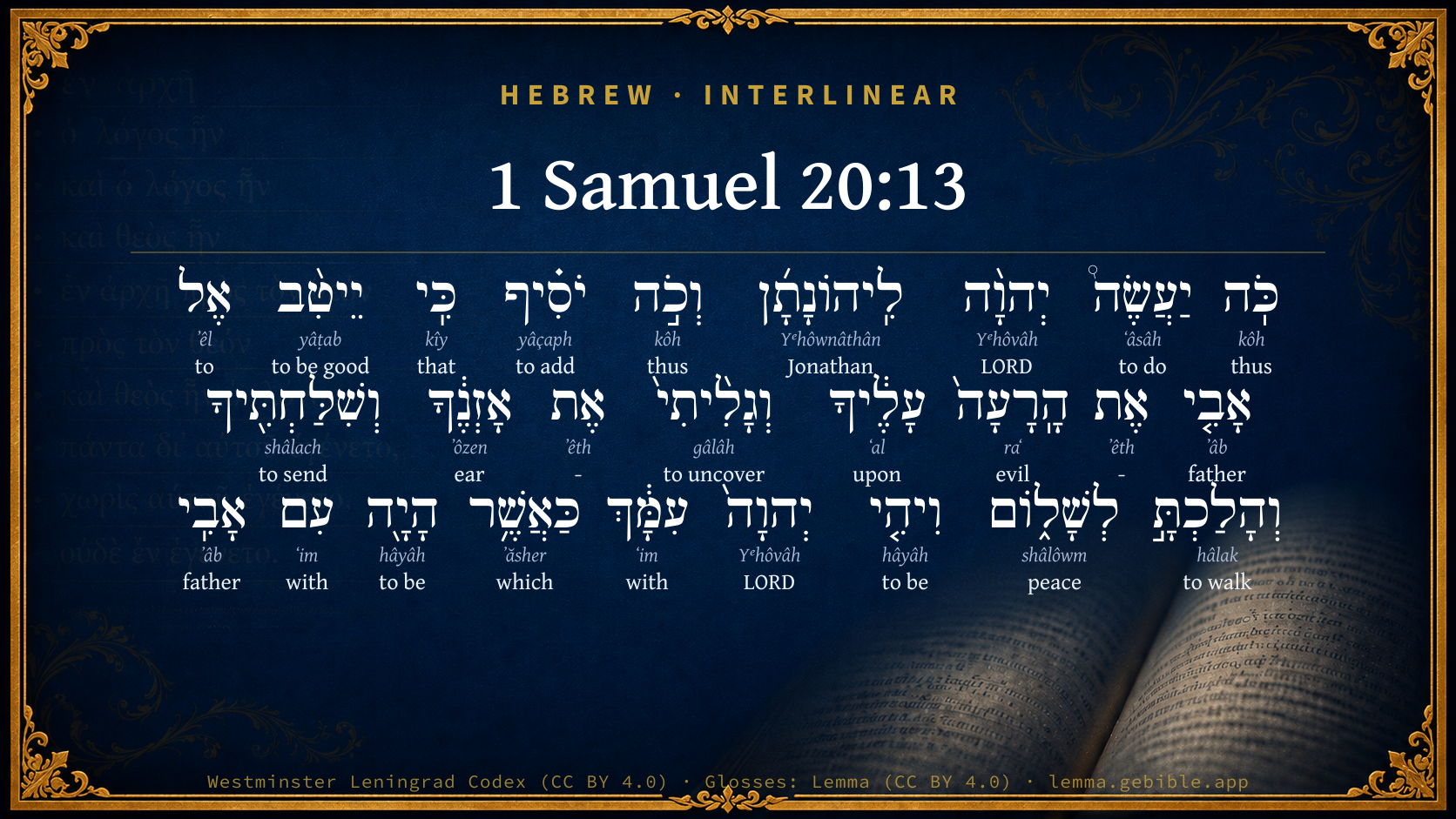
Hebrew (Westminster Leningrad Codex) 1 Samuel 20:13 appears in the Hebrew Old Testament. The text above is from the Westminster Leningrad Codex. Each word links to its Strong’s number, a concise gloss, and parsing drawn from the Open Scriptures Hebrew Bible morphology. Click any word for its full Brown-Driver-Briggs (BDB) entry.
Download image
Cite this verse

1 Samuel 20:13 (World English Bible). Public Domain. Lemma interlinear Bible study tool, https://lemma.gebible.app/v/1-samuel/20/13.

Show BibTeX & RIS
BibTeX
RIS
English Translation
Yahweh do so to Jonathan, and more also, should it please my father to do you evil, if I don't disclose it to you, and send you away, that you may go in peace: and Yahweh be with you, as he has been with my father.
World English Bible · Public Domain
Download a study sheet

One document with this verse’s original text, its word-by-word gloss line, the meaning frame, cross-references with their text, attributed commentary, and full source and license credits — printable, and it pastes into notes with its structure intact.

This verse Autodidact and up

Study sheet (.html) Plain text (.txt)

A passage Seminary Student

Up to 50 verses in one chapter. A passage sheet keeps up to 6 commentary sources and 12 cross-references per verse, in the order this page ranks them, and says so on the sheet whenever that leaves anything out. Ask for a single verse and you get the Autodidact verse sheet above.

Everything on this page stays free to read, with no account — the sheet is a download of what is already on screen, not access to it.

Want to remove ads? Support Godless Engineer
Compare translations 3

The same verse in 3 English versions, stacked beneath the original-language interlinear above. Click any original word for its lexicon entry.

Each is an independent rendering of the whole verse — the interlinear is not word-aligned to these translations.

Highlighted words mark where these versions differ — a whole-verse word diff, not a word-by-word alignment.

  • World English Bible Public Domain
    Yahweh do so to Jonathan, and more also, should it please my father to do you evil, if I don't disclose it to you, and send you away, that you may go in peace: and Yahweh be with you, as he has been with my father.
  • King James Version Public Domain
    The LORD do so and much more to Jonathan: but if it please my father to do thee evil, then I will show it thee, and send thee away, that thou mayest go in peace: and the LORD be with thee, as he hath been with my father.
  • unfoldingWord Literal Text CC BY-SA 4.0
    Thus may Yahweh do to Jonathan, and thus may he add: if harm upon you is good to my father, then I will uncover your ear and send you away so you may go in peace. And may Yahweh be with you just as he was with my father.

unfoldingWord Literal Text — © unfoldingWord, licensed CC BY-SA 4.0. Word-aligned USFM3 via Door43 (git.door43.org/unfoldingWord/en_ult).

Versions to compare (up to 4)

3 of 4 selected

Show all 18 translations

Every available English version of this verse, each an independent rendering of the whole verse.

  • World English Bible Public Domain
    Yahweh do so to Jonathan, and more also, should it please my father to do you evil, if I don't disclose it to you, and send you away, that you may go in peace: and Yahweh be with you, as he has been with my father.
  • Berean Standard Bible Public Domain
    But if my father intends to bring evil on you, then may the LORD punish me, and ever so severely, if I do not tell you and send you on your way in safety. May the LORD be with you, just as He has been with my father.
  • Majority Standard Bible Public Domain
    But if my father intends to bring evil on you, then may the LORD punish me, and ever so severely, if I do not tell you and send you on your way in safety. May the LORD be with you, just as He has been with my father.
  • King James Version Public Domain
    The LORD do so and much more to Jonathan: but if it please my father to do thee evil, then I will show it thee, and send thee away, that thou mayest go in peace: and the LORD be with thee, as he hath been with my father.
  • American Standard Version (1901) Public Domain
    Jehovah do so to Jonathan, and more also, should it please my father to do thee evil, if I disclose it not unto thee, and send thee away, that thou mayest go in peace: and Jehovah be with thee, as he hath been with my father.
  • Revised Version (1885) Public Domain
    The LORD do so to Jonathan, and more also, should it please my father to do thee evil, if I disclose it not unto thee, and send thee away, that thou mayest go in peace: and the LORD be with thee, as he hath been with my father.
  • Geneva Bible (1599) Public Domain
    The Lord doe so and much more vnto Ionathan: but if my father haue minde to doe thee euill, I will shew thee also, and sende thee away, that thou mayest goe in peace: and the Lord be with thee as he hath bene with my father.
  • Douay-Rheims (1899) Public Domain
    May the Lord do so and so to Jonathan and add still more. But if my father shall continue in malice against thee, I will discover it to thy ear, and will send thee away, that thou mayest go in peace, and the Lord be with thee, as he hath been with my father.
  • Young's Literal Translation Public Domain
    thus doth Jehovah do to Jonathan, and thus doth He add; when the evil concerning thee is good to my father, then I have uncovered thine ear, and sent thee away, and thou hast gone in peace, and Jehovah is with thee, as he was with my father;
  • Literal Standard Version CC BY-SA 4.0
    thus YHWH does to Jonathan, and thus He adds; when the evil concerning you is good to my father, then I have uncovered your ear, and sent you away, and you have gone in peace, and YHWH is with you, as he was with my father;
  • Unlocked Literal Bible CC BY-SA 4.0
    If it pleases my father to do you harm, may Yahweh do to Jonathan and more also if I do not make it known to you and send you away, so that you may go in peace. May Yahweh be with you, as he has been with my father.
  • unfoldingWord Literal Text CC BY-SA 4.0
    Thus may Yahweh do to Jonathan, and thus may he add: if harm upon you is good to my father, then I will uncover your ear and send you away so you may go in peace. And may Yahweh be with you just as he was with my father.
  • Darby Bible Public Domain
    Jehovah do so and much more to Jonathan. Should it please my father [to do] thee evil, then I will apprise thee of it, and send thee away, that thou mayest go in peace; and Jehovah be with thee, as he has been with my father.
  • World Messianic Bible Public Domain
    The LORD do so to Jonathan and more also, should it please my father to do you evil, if I don’t disclose it to you and send you away, that you may go in peace. May the LORD be with you as he has been with my father.
  • Webster's Bible Public Domain
    The LORD do so and much more to Jonathan: but if it shall please my father to do thee evil, then I will show it to thee, and send thee away, that thou mayest go in peace: and the LORD be with thee, as he hath been with my father.
  • Free Bible Version CC BY-SA 4.0
    But if my father plans to do you harm, then may the Lord punish me very severely, if I don't let you know by sending you a message so you can get away safely. May the Lord be with you, just as he was with my father.
  • Bible in Basic English Public Domain
    May the Lord's punishment be on Jonathan, if it is my father's pleasure to do you evil and I do not give you word of it and send you away so that you may go in peace: and may the Lord be with you, as he has been with my father.
  • JPS Tanakh (1917) Public Domain
    The LORD do so to Jonathan, and more also, should it please my father to do thee evil, if I disclose it not unto thee, and send thee away, that thou mayest go in peace; and the LORD be with thee, as He hath been with my father.

Literal Standard Version (2020), Covenant Press — licensed CC BY-SA 4.0. Text via the HelloAO Bible API (eBible.org). Unlocked Literal Bible (unfoldingWord) — licensed CC BY-SA 4.0. Text via the HelloAO Bible API (eBible.org). unfoldingWord Literal Text — © unfoldingWord, licensed CC BY-SA 4.0. Word-aligned USFM3 via Door43 (git.door43.org/unfoldingWord/en_ult). Free Bible Version, Dr. Jonathan Gallagher — licensed CC BY-SA 4.0. Text via the HelloAO Bible API (eBible.org).

Word by word

More ways to search: Search by grammar → Find every occurrence → Compare this word →

Practice this passage: Drill this verse → Learn its vocabulary →

לִֽיהוֹנָתָ֜ן
Yᵉhôwnâthân
H3083
“to/for · Jonathan”
Preposition + Noun, Proper
Part of Speech
Preposition + Noun
Type
Proper
Full BDB Definition

Origin: from H3068 and H5414

TWOT: None

Jonathan or Jehonathan = "Jehovah has given" - a son of king Saul and a friend of David - a son of the high priest Abiathar and the last descendant of Eli of whom we hear - a nephew of David who like David slew a giant of Gath - an uncle of David - one of David's mighty warriors - one of David's treasurers - a scribe in the time of Jeremiah - a Levite and father of Zechariah, a priest who blew the trumpet at the dedication of the wall - a son or descendant of Gershom, the son of Moses, and a priest to the tribe of Dan - a son of Kareah and a brother of Johanan; a Judaite captain after the fall of Jerusalem - another Judaite father of Peleth - father of Ebed in the time of Ezra - son of Asahel in the time of Ezra - a priest of the family of Melicu in the time of Nehemiah - son of Joiada and his successor to the high priesthood in the time of Nehemiah
  1. כֹּֽה kôh H3541 “thus” Adverb
  2. יַעֲשֶׂה֩ ʻâsâh H6213 “to do” Verb, Qal, Jussive, 3rd Person, Masculine, Singular
  3. יְהוָ֨ה Yᵉhôvâh H3068 “LORD” Noun, Proper
  4. וְכֹ֣ה kôh H3541 “and · thus” Conjunction + Adverb
  5. יֹסִ֗יף yâçaph H3254 “to add” Verb, Hiphil, Jussive, 3rd Person, Masculine, Singular
  6. כִּֽי kîy H3588 “that” Conjunction
  7. יֵיטִ֨ב yâṭab H3190 “to be good” Verb, Hiphil, Imperfect, 3rd Person, Masculine, Singular
  8. אֶל ʼêl H413 “to” Preposition
  9. אָבִ֤י ʼâb H1 “father · my” Noun, Common, Masculine, Singular, Construct + Suffix, Personal, 1st Person, Common, Singular
  10. אֶת ʼêth H853 “-” Particle, Direct Object
  11. הָֽרָעָה֙ raʻ H7451 “the · evil” Particle, Definite Article + Noun, Common, Feminine, Singular, Absolute
  12. עָלֶ֔יךָ ʻal H5921 “upon · you” Preposition + Suffix, Personal, 2nd Person, Masculine, Singular
  13. וְגָלִ֨יתִי֙ gâlâh H1540 “and · to uncover” Conjunction + Verb, Qal, Sequential Perfect, 1st Person, Common, Singular
  14. אֶת ʼêth H853 “-” Particle, Direct Object
  15. אָזְנֶ֔ךָ ʼôzen H241 “ear · your” Noun, Common, Feminine, Singular, Construct + Suffix, Personal, 2nd Person, Masculine, Singular
  16. וְשִׁלַּחְתִּ֖יךָ shâlach H7971 “and · to send · you” Conjunction + Verb, Piel, Sequential Perfect, 1st Person, Common, Singular + Suffix, Personal, 2nd Person, Masculine, Singular
  17. וְהָלַכְתָּ֣ hâlak H1980 “and · to walk” Conjunction + Verb, Qal, Sequential Perfect, 2nd Person, Masculine, Singular
  18. לְשָׁל֑וֹם shâlôwm H7965 “to/for · peace” Preposition + Noun, Common, Masculine, Singular, Absolute
  19. וִיהִ֤י hâyâh H1961 “and · to be” Conjunction + Verb, Qal, Jussive, 3rd Person, Masculine, Singular
  20. יְהוָה֙ Yᵉhôvâh H3068 “LORD” Noun, Proper
  21. עִמָּ֔ךְ ʻim H5973 “with · you” Preposition + Suffix, Personal, 2nd Person, Feminine, Singular
  22. כַּאֲשֶׁ֥ר ʼăsher H834 “like/as · which” Preposition + Particle, Relative
  23. הָיָ֖ה hâyâh H1961 “to be” Verb, Qal, Perfect, 3rd Person, Masculine, Singular
  24. עִם ʻim H5973 “with” Preposition
  25. אָבִֽי ʼâb H1 “father · my” Noun, Common, Masculine, Singular, Construct + Suffix, Personal, 1st Person, Common, Singular

About this verse

These counts appear in no published source. They are computed here, from the morphology-tagged text and Lemma’s own curated glosses. What Lemma adds →

26
words
20
distinct lemmas
Historical
section

Grammatical profile

  • 8 verbs
  • 8 nouns
  • 4 prepositions
  • 1 conjunction
  • 2 adverbs
  • 3 particles

Verb forms

  • יַעֲשֶׂה֩ Qal · Jussive
  • יֹסִ֗יף Hiphil · Jussive
  • יֵיטִ֨ב Hiphil · Imperfect
  • וְגָלִ֨יתִי֙ Qal · Sequential Perfect
  • וְשִׁלַּחְתִּ֖יךָ Piel · Sequential Perfect
  • וְהָלַכְתָּ֣ Qal · Sequential Perfect
  • וִיהִ֤י Qal · Jussive
  • הָיָ֖ה Qal · Perfect

Repetition

Words recur within this verse — often emphatic in Hebrew:

  • כֹּֽה thus H3541 ×2
  • יְהוָ֨ה LORD H3068 ×2
  • אָבִ֤י father H1 ×2
  • וִיהִ֤י to be H1961 ×2
  • עִמָּ֔ךְ with H5973 ×2

Hebrew & Septuagint length

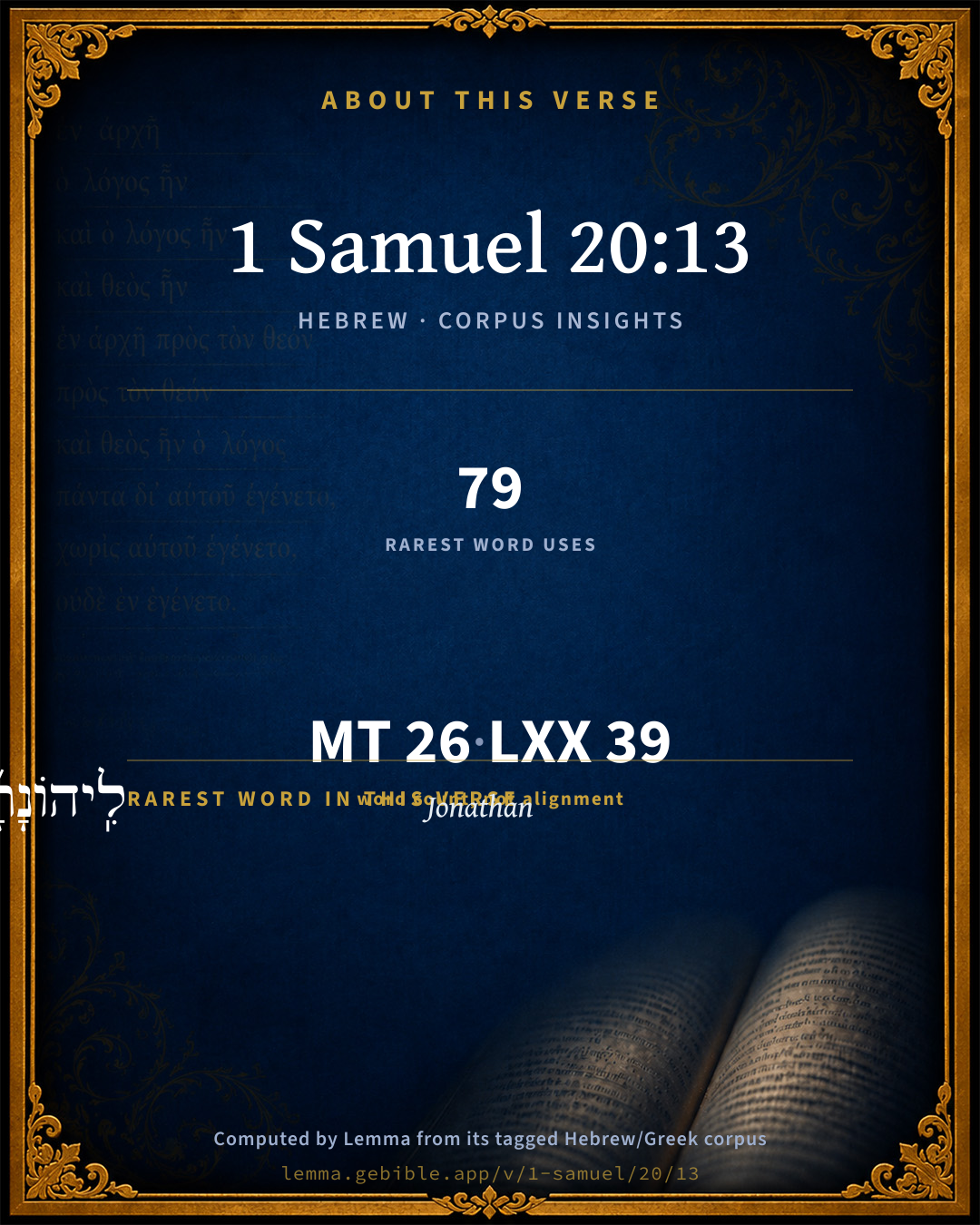
In English translation the verse runs 46 words from the Hebrew and 48 from the Septuagint (LXX English) — closely comparable.

A rough comparison of the two English renderings, which tokenize alike — not a word-level alignment.

Word counts can differ between the Hebrew and the Greek without any difference in meaning — e.g. the Hebrew direct-object marker אֵת has no separate Greek word, and Greek often adds the article ὁ.

In the original languages it is 26 Hebrew tokens and 39 Greek tokens — but the two are counted differently (Hebrew bundles its prefixes and suffixes into one token; the Greek is in lemma form), so that isn’t a like-for-like length.

Cross-references

18

Topical passages linked to 1 Samuel 20:13 in the Treasury of Scripture Knowledge — connected by theme and wording, ordered by reader-vote popularity; previews shown in the World English Bible.

  • Joshua 1:5 There shall not any man be able to stand before you all the days of your life. As I was with Moses, so I will be with you; I will not fail you, nor forsake you.
  • Ruth 1:17 where you die, will I die, and there will I be buried: Yahweh do so to me, and more also, if anything but death part you and me."
  • 1 Samuel 17:37 David said, Yahweh who delivered me out of the paw of the lion, and out of the paw of the bear, he will deliver me out of the hand of this Philistine. Saul said to David, Go, and Yahweh shall be with you.
  • 1 Chronicles 22:11 Now, my son, Yahweh be with you; and prosper you, and build the house of Yahweh your God, as he has spoken concerning you.
  • 1 Chronicles 22:16 of the gold, the silver, and the brass, and the iron, there is no number. Arise and be doing, and Yahweh be with you.
  • 1 Samuel 3:17 He said, "What is the thing that [Yahweh] has spoken to you? Please don't hide it from me. God do so to you, and more also, if you hide anything from me of all the things that he spoke to you."
  • 1 Samuel 10:7 Let it be, when these signs are come to you, that you do as occasion shall serve you; for God is with you.
  • 1 Samuel 11:6–13 The Spirit of God came mightily on Saul when he heard those words, and his anger was kindled greatly.
  • 1 Samuel 14:47 Now when Saul had taken the kingdom over Israel, he fought against all his enemies on every side, against Moab, and against the children of Ammon, and against Edom, and against the kings of Zobah, and against the Philistines: and wherever he turned himself, he put [them] to the worse.
  • 1 Samuel 18:12 Saul was afraid of David, because Yahweh was with him, and was departed from Saul.
  • 1 Samuel 25:22 God do so to the enemies of David, and more also, if I leave of all that belongs to him by the morning light so much as one man-child.
  • 2 Samuel 3:35 All the people came to cause David to eat bread while it was yet day; but David swore, saying, God do so to me, and more also, if I taste bread, or anything else, until the sun be down.
  • 2 Samuel 7:15 but my loving kindness shall not depart from him, as I took it from Saul, whom I put away before you.
  • 2 Samuel 19:13 Say you to Amasa, Aren't you my bone and my flesh? God do so to me, and more also, if you aren't captain of the host before me continually in the room of Joab.
  • 1 Kings 19:2 Then Jezebel send a messenger to Elijah, saying, So let the gods do to me, and more also, if I don't make your life as the life of one of them by tomorrow about this time.
  • 1 Kings 20:10 Ben Hadad sent to him, and said, The gods do so to me, and more also, if the dust of Samaria shall suffice for handfuls for all the people who follow me.
  • Matthew 28:20 teaching them to observe all things that I commanded you. Behold, I am with you always, even to the end of the age." Amen.
  • Philippians 4:9 The things which you learned, received, heard, and saw in me: do these things, and the God of peace will be with you.

Cross-references courtesy of OpenBible.info (CC BY 4.0).

Hebrew and Greek witnesses Masoretic Hebrew ↔ Greek Septuagint

The same verse in the two great witnesses to the Old Testament, shown verse-for-verse.

These are two independent witnesses, not word-aligned to each other, and the Septuagint is shown in lemma (dictionary) form.

Hebrew 1 Samuel 20:13 Masoretic · Westminster Leningrad Codex

כֹּֽה יַעֲשֶׂה֩ יְהוָ֨ה לִֽיהוֹנָתָ֜ן וְכֹ֣ה יֹסִ֗יף כִּֽי יֵיטִ֨ב אֶל אָבִ֤י אֶת הָֽרָעָה֙ עָלֶ֔יךָ וְגָלִ֨יתִי֙ אֶת אָזְנֶ֔ךָ וְשִׁלַּחְתִּ֖יךָ וְהָלַכְתָּ֣ לְשָׁל֑וֹם וִיהִ֤י יְהוָה֙ עִמָּ֔ךְ כַּאֲשֶׁ֥ר הָיָ֖ה עִם אָבִֽי

Yahweh do so to Jonathan, and more also, should it please my father to do you evil, if I don't disclose it to you, and send you away, that you may go in peace: and Yahweh be with you, as he has been with my father.

World English Bible · Public Domain

Greek LXX 1 Samuel 20:13 Septuagint · lemma form

ὅδε ποιέω ὁ θεός ὁ ιωναθαν καί ὅδε προςτίθημι ὅτι ἀναφέρω ὁ κακός ἐπί σύ καί ἀποκαλύπτω ὁ ὠτίον σύ καί ἐκ ἀποστέλλω σύ καί ἀποἔρχομαι εἰς εἰρήνη καί εἰμί κύριος μετά σύ καθώς εἰμί μετά ὁ πατήρ ἐγώ

God do so to Jonathan and more also: as I shall also report the evil to you, and make it known to you, and I will let you go; and you shall depart in peace, and the Lord shall be with you, as he was with my father.

LXX2012 (modern English Septuagint) · Public Domain

Hebrew: Westminster Leningrad Codex (CC BY 4.0). Greek: Septuagint (public domain); English from LXX2012 (modern English Septuagint) (Public Domain). How the Septuagint differs from the Hebrew →

Targum (Aramaic paraphrase)

1

The Targum is the ancient Jewish Aramaic paraphrase of the Hebrew Scriptures — an interpretive translation, not the Hebrew text itself. Onkelos (literal) and Pseudo-Jonathan (expansive) render the Torah, and Jonathan the Prophets. Coverage is partial: where no permissively-licensed English translation exists for a verse, only the Aramaic is shown. This is verse-level text, not a word-by-word alignment to the Hebrew.

  1. Targum Jonathan Prophets (Joshua–Malachi)
    כְּדֵין יַעֲבֵּיד יְיָ לִיהוֹנָתָן וּכְדֵין יוֹסִיף אֲרֵי גְמִירָא מִן אַבָּא לְמֵיתֵי בִישְׁתָּא עֲלָךְ וַאַחֲוֵי לָךְ וְאֶשְׁלְחִנָךְ וּתְהַךְ לִשְׁלָם וִיהֵי מֵימְרָא דַייָ בְּסַעֲדָךְ כְּמָא דַהֲוָה בְּסַעֲדֵיהּ דְאַבָּא:

    (no public-domain English translation for this verse)

    Targum Jonathan — Aramaic: “Mikraot Gedolot” (public domain). English: “Sefaria Community Translation” (CC0 1.0 (public-domain dedication)); “London "Chaldee Paraphrase," 1871” (public domain). Text via Sefaria.

Commentary

Notes on 1 Samuel 20:13 from classic Christian and Jewish commentators (each source and its license shown beneath its notes). The classic Christian expositions comment on the surrounding passage and are grouped to its opening verse, so a note may address several verses; the Jewish commentaries on the Tanakh (Rashi and others) are per-verse, so they appear only where the commentator wrote on this verse.

Lemma curates 59 commentaries, every one of them public domain or Creative Commons licensed, each selected and text-cleaned for this edition rather than reprinted as found. About our sources →

Trapp's Complete Commentary

John Trapp

1Sa 20:13 The LORD do so and much more to Jonathan: but if it please my father [to do] thee evil, then I will shew it thee, and send thee away, that thou mayest go in peace: and the LORD be with thee, as he hath been with my father.

Ver. 13. And the Lord be with thee, as he hath been with my father.] Much joy mayest thou have of the kingdom after him; and the will of the Lord be done, whatever becometh of me. See 1Sa 23:17. Pellican therefore was mistaken in thinking that Jonathan’s affection was somewhat abated toward David while he thought of the succession of the kingdom; and that therefore he was so hard of belief that his father intended mischief toward him.

John Trapp, A Commentary or Exposition upon All the Books of the Old and New Testament (1647–1656) — public domain. Text from a community e-Sword module.

Tyndale Open Study Notes

Tyndale Open Resources

20:13 may the Lord strike me: Jonathan invoked a curse upon himself to reassure David that he would keep his promise. • as he used to be with my father: Jonathan recognized that David had received the blessing from God that his father had once had. The divine favor that had brought Saul into royal office (9:14–10:1) would bring David into royal office as Saul’s replacement. Jonathan accepted this even though he was the natural successor to Saul.

Tyndale Open Study Notes — © Tyndale Open Resources, licensed CC BY-SA 4.0. Text via the HelloAO Bible API.

Geneva Bible (1599)

Geneva Bible translators

The Lord punish me most grievously.

Geneva Bible (1599) marginal notes — public domain. Text via Bolls.life.

Adam Clarke's Commentary

Verse 13. The Lord be with thee, as he hath been with my father.] From this, and other passages here it is evident that Jonathan knew that the Lord had appointed David to the kingdom.

Adam Clarke's Commentary on the Bible (1810–1826) — public domain. Text from a community e-Sword/MySword module.

The Cambridge Bible for Schools and Colleges

gen. ed. J. J. S. Perowne

13. The Lord do so, &c.] See on 1Sa_3:17.

the Lord be with thee, &c.] Cp. 1Sa_18:12. Jonathan already foresees David’s destiny, as is clear from the following verses. See also 1Sa_23:17.

The Cambridge Bible for Schools and Colleges (gen. ed. J. J. S. Perowne; Cambridge University Press, 1878–1918) — public domain. Text from a community e-Sword module.

John Gill's Exposition

The Lord do so and much more to Jonathan,.... Recompense evil more than can be thought of and expressed, should he neglect to inform David of the good disposition of Saul unto him:

but if it please my father to do thee evil; if he seems determined upon it to take away thy life:

then I will show it thee; not by a messenger, by whom it would not be safe to communicate it, lest by that means Saul would know where he was, and come and slay him; but Jonathan would come himself, and acquaint him with it:

and send thee away, that thou mayest go in peace; give him leave, and advise him to depart, and provide for his own safety, adding his blessing on him, and prayer for him:

and the Lord be with thee, as he hath been with my father; in the beginning of his reign, giving him counsel and advice in all things, and victory over his enemies, succeeding and prospering him in whatsoever he engaged in; the Targum is,"the Word of the Lord be for thy help, &c.''

Jonathan seemed to be fully apprized that David was to succeed in the kingdom.

John Gill's Exposition of the Whole Bible (1746–1763) — public domain (CC PDM 1.0). Text via the HelloAO Bible API.

Haydock's Catholic Bible Commentary

Father, at the beginning of his reign. Jonathan foresees that David will be his father’s successor. (Calmet) --- Hence he commends himself and family to his protection. (Menochius)

George Leo Haydock (1774–1849), Haydock's Catholic Family Bible and Commentary, 1859 edition — public domain. Excludes Psalms (Douay-Rheims chapter numbering differs from Protestant) and Deuterocanonical books (Catholic canon only).

Matthew Poole's English Annotations

The Lord give thee that honour and success in all thy affairs which he hath given to my father. Jonathan undoubtedly knew of Samuel’s final and irrevocable sentence of Saul’s rejection from the kingdom, and of the substitution of some other person after God’s own heart in his stead; and that David was this person he might strongly suspect, (that which even Saul suspected,) both from his eminent piety, and wisdom, and valour, and universal worth, and from the great things which God had done, both by him and for him, in preserving and advancing him by such unusual methods; and it is most likely that Jonathan did ask David about it, and that David did faithfully inform him of the whole truth, as may be gathered both from the words here following, and from 1Sa 23:17. And that the knowledge hereof did not raise jealousy, and envy, and rage in him, who was the next heir of the crown, as it did in his father, must be ascribed to Jonathan’s piety towards God, to whose disposal he cheerfully submitted himself, and to his sincere friendship to David, in whose happiness he rejoiced as in his own.

Matthew Poole's English Annotations on the Holy Bible (1683–1685) — public domain. Text from a community e-Sword/MySword module.

Whedon's Commentary on the Bible

Daniel D. Whedon

13. The Lord be with thee, as he hath been with my father — These words, according to Keil, express the presentiment in Jonathan’s soul that David was yet to occupy the throne of Israel. This conviction is expressed more clearly in the next two verses. We may believe that Saul had now fully made up his mind that David was his rival for the throne; that he was the man after God’s own heart of whom Samuel had told him; and perhaps the fact that Samuel had anointed him at Beth-lehem was now generally known. Jonathan’s entering, with all these facts before him, into a solemn covenant with the house of David, and with no animosity, no jealousy, no harsh words, but still loving his rival as his own soul, is the most marvellous instance of human friendship and tenderness with which the records of our race acquaint us.

Daniel D. Whedon (gen. ed.), Commentary on the Old and New Testaments (1874–1909) — public domain. Text from a community e-Sword module.

Rashi

Rabbi Shlomo Yitzchaki (Rashi)

So may Adonoy do to Yonoson. The Holy One, Blessed is He, when I question my father, and find that he is favorable toward you, if I do not [send word] through a messenger and reveal to you, for good I am able to reveal. But if it pleases my father to do evil to you, that I will not reveal [by messenger], lest my father find out your whereabouts, but I will personally reveal it to you.

Rashi on the Tanakh — English translations: “The Judaica Press complete Tanach with Rashi, translated by A. J. Rosenberg” (CC BY 4.0); “Pentateuch with Rashi's commentary by M. Rosenbaum and A.M. Silbermann, 1929-1934” (public domain); “The Metsudah Tanach series, Lakewood, N.J” (CC BY 4.0); and “The Book of Joshua, Metsudah Publications, 1997” (CC BY 4.0). Text via Sefaria.

Lesson kit

Teaching starters — assembled from the data on this page, not authored interpretation. Every prompt links to the verse data it draws on. Edit before teaching.

1 Samuel, in the Historical, opens this verse with 26 words (20 distinct Hebrew lemmas). Its most distinctive word is Yᵉhôwnâthân (“Jonathan”). A historical commentator’s framing appears above. Read the whole chapter for the surrounding context.

Discussion questions

  1. What does “Jonathan” (Yᵉhôwnâthân) contribute to the verse as a whole?
  2. Joshua 1:5 shares this passage’s theme. How do the two illuminate each other?
  3. “thus” occurs 2× in this one verse. What is the effect of the repetition?
  4. The translations on this page render this verse differently — a whole-verse word diff, not a word-by-word alignment. What might account for the different wordings?
  5. The verb «יַעֲשֶׂה֩» is Qal Jussive. How does its form color the action?
  6. Reading how Trapp's Complete Commentary and Tyndale Open Study Notes read this verse, where do the two commentators agree and where do they part?

Things to notice

Reading settings

Reading text

Shown beneath each verse's original-language words.

Old Testament
Old Testament edition

Read the OT as the Masoretic Hebrew (MT) or the Greek Septuagint (LXX).

English shown for the Greek Septuagint (in the Hebrew ↔ Greek comparison).

Comparing translations? Open the Compare panel on any verse page to stack up to four side by side.