
Numbers 6:26

Hebrew (Westminster Leningrad Codex) Numbers 6:26 appears in the Hebrew Old Testament. The text above is from the Westminster Leningrad Codex. Each word links to its Strong’s number, a concise gloss, and parsing drawn from the Open Scriptures Hebrew Bible morphology. Click any word for its full Brown-Driver-Briggs (BDB) entry.
Download image
Cite this verse

Numbers 6:26 (World English Bible). Public Domain. Lemma interlinear Bible study tool, https://lemma.gebible.app/v/numbers/6/26.

Show BibTeX & RIS
BibTeX
RIS
English Translation
Yahweh lift up his face toward you, And give you peace.'
World English Bible · Public Domain
Download a study sheet

One document with this verse’s original text, its word-by-word gloss line, the meaning frame, cross-references with their text, attributed commentary, and full source and license credits — printable, and it pastes into notes with its structure intact.

This verse Autodidact and up

Study sheet (.html) Plain text (.txt)

A passage Seminary Student

Up to 50 verses in one chapter. A passage sheet keeps up to 6 commentary sources and 12 cross-references per verse, in the order this page ranks them, and says so on the sheet whenever that leaves anything out. Ask for a single verse and you get the Autodidact verse sheet above.

Everything on this page stays free to read, with no account — the sheet is a download of what is already on screen, not access to it.

Want to remove ads? Support Godless Engineer
Compare translations 3

The same verse in 3 English versions, stacked beneath the original-language interlinear above. Click any original word for its lexicon entry.

Each is an independent rendering of the whole verse — the interlinear is not word-aligned to these translations.

Highlighted words mark where these versions differ — a whole-verse word diff, not a word-by-word alignment.

  • World English Bible Public Domain
    Yahweh lift up his face toward you, And give you peace.'
  • King James Version Public Domain
    The LORD lift up his countenance upon thee, and give thee peace.
  • unfoldingWord Literal Text CC BY-SA 4.0
    May Yahweh lift up his face to you and may he put peace to you.”’

unfoldingWord Literal Text — © unfoldingWord, licensed CC BY-SA 4.0. Word-aligned USFM3 via Door43 (git.door43.org/unfoldingWord/en_ult).

Versions to compare (up to 4)

3 of 4 selected

Show all 18 translations

Every available English version of this verse, each an independent rendering of the whole verse.

  • World English Bible Public Domain
    Yahweh lift up his face toward you, And give you peace.'
  • Berean Standard Bible Public Domain
    may the LORD lift up His countenance toward you and give you peace.’
  • Majority Standard Bible Public Domain
    may the LORD lift up His countenance toward you and give you peace.’
  • King James Version Public Domain
    The LORD lift up his countenance upon thee, and give thee peace.
  • American Standard Version (1901) Public Domain
    Jehovah lift up his countenance upon thee, and give thee peace.
  • Revised Version (1885) Public Domain
    The LORD lift up his countenance upon thee, and give thee peace.
  • Geneva Bible (1599) Public Domain
    The Lord lift vp his coutenance vpon thee, and giue thee peace.
  • Douay-Rheims (1899) Public Domain
    The Lord turn his countenance to thee, and give thee peace.
  • Young's Literal Translation Public Domain
    `Jehovah lift up His countenance upon thee, and appoint for thee -- peace.
  • Literal Standard Version CC BY-SA 4.0
    YHWH lift up His countenance on you, || And appoint for you—peace.
  • Unlocked Literal Bible CC BY-SA 4.0
    May Yahweh look on you with favor and give you peace.”'
  • unfoldingWord Literal Text CC BY-SA 4.0
    May Yahweh lift up his face to you and may he put peace to you.”’
  • Darby Bible Public Domain
    Jehovah lift up his countenance upon thee, and give thee peace.
  • World Messianic Bible Public Domain
    The LORD lift up his face toward you, and give you peace.’
  • Webster's Bible Public Domain
    The LORD lift up his countenance upon thee, and give thee peace.
  • Free Bible Version CC BY-SA 4.0
    May the Lord watch over you and give you peace.’
  • Bible in Basic English Public Domain
    May the Lord's approval be resting on you and may he give you peace.
  • JPS Tanakh (1917) Public Domain
    The LORD lift up His countenance upon thee, and give thee peace.

Literal Standard Version (2020), Covenant Press — licensed CC BY-SA 4.0. Text via the HelloAO Bible API (eBible.org). Unlocked Literal Bible (unfoldingWord) — licensed CC BY-SA 4.0. Text via the HelloAO Bible API (eBible.org). unfoldingWord Literal Text — © unfoldingWord, licensed CC BY-SA 4.0. Word-aligned USFM3 via Door43 (git.door43.org/unfoldingWord/en_ult). Free Bible Version, Dr. Jonathan Gallagher — licensed CC BY-SA 4.0. Text via the HelloAO Bible API (eBible.org).

Word by word

More ways to search: Search by grammar → Find every occurrence → Compare this word →

Practice this passage: Drill this verse → Learn its vocabulary →

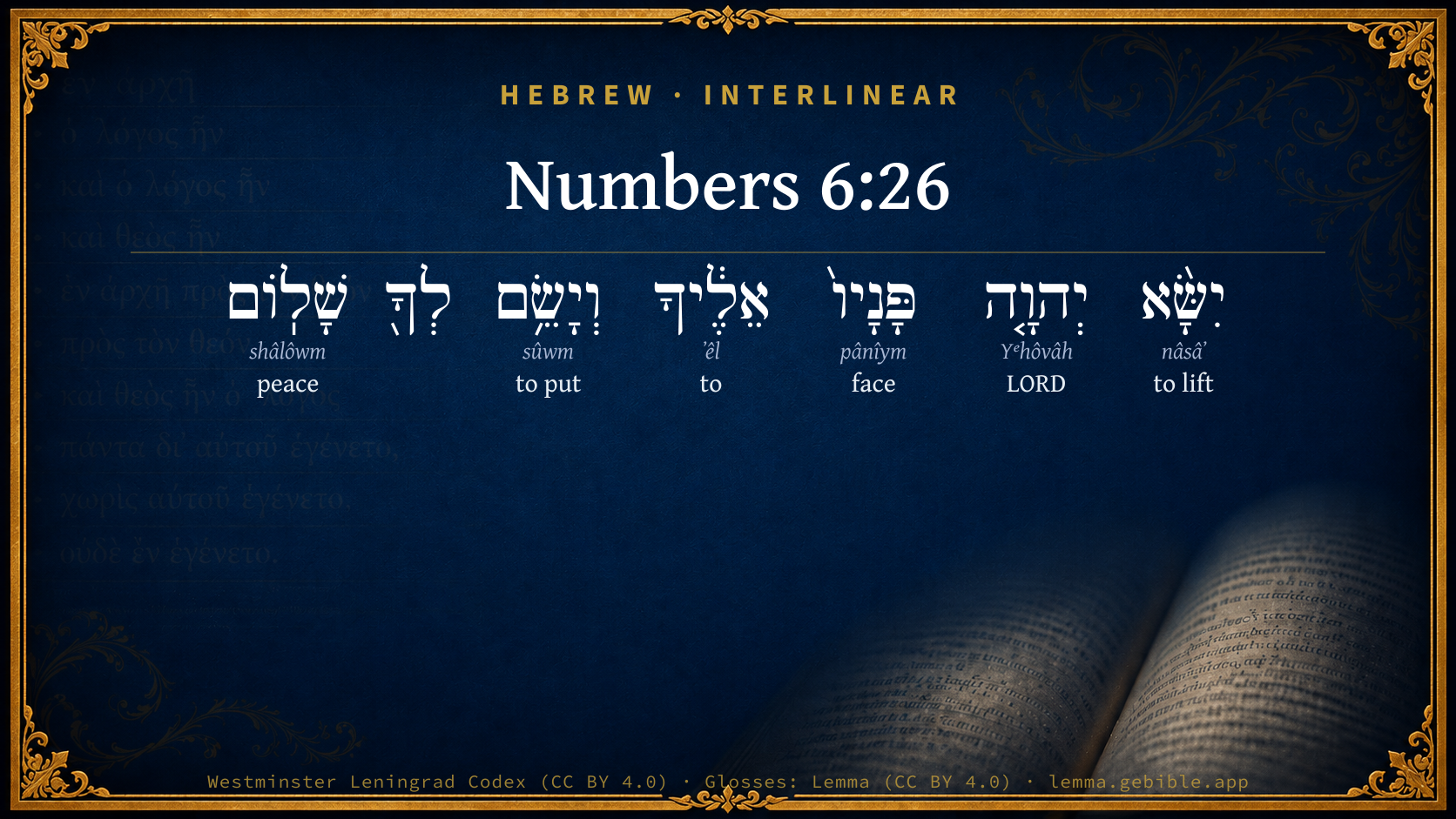
שָׁלֽוֹם
shâlôwm
H7965
“peace”
Noun, Common, Masculine, Singular, Absolute
Part of Speech
Noun
Type
Common
Gender
Masculine
Number
Singular
State
Absolute
Full BDB Definition

Origin: from H7999

TWOT: 2401a

completeness, soundness, welfare, peace - completeness (in number) - safety, soundness (in body) - welfare, health, prosperity - peace, quiet, tranquillity, contentment - peace, friendship - of human relationships - with God especially in covenant relationship - peace (from war) - peace (as adjective)
  1. יִשָּׂ֨א nâsâʼ H5375 “to lift” Verb, Qal, Jussive, 3rd Person, Masculine, Singular
  2. יְהוָ֤ה Yᵉhôvâh H3068 “LORD” Noun, Proper
  3. פָּנָיו֙ pânîym H6440 “face(s) · his” Noun, Common, Both, Plural, Construct + Suffix, Personal, 3rd Person, Masculine, Singular
  4. אֵלֶ֔יךָ ʼêl H413 “to · you” Preposition + Suffix, Personal, 2nd Person, Masculine, Singular
  5. וְיָשֵׂ֥ם sûwm H7760 “and · to put” Conjunction + Verb, Qal, Jussive, 3rd Person, Masculine, Singular

About this verse

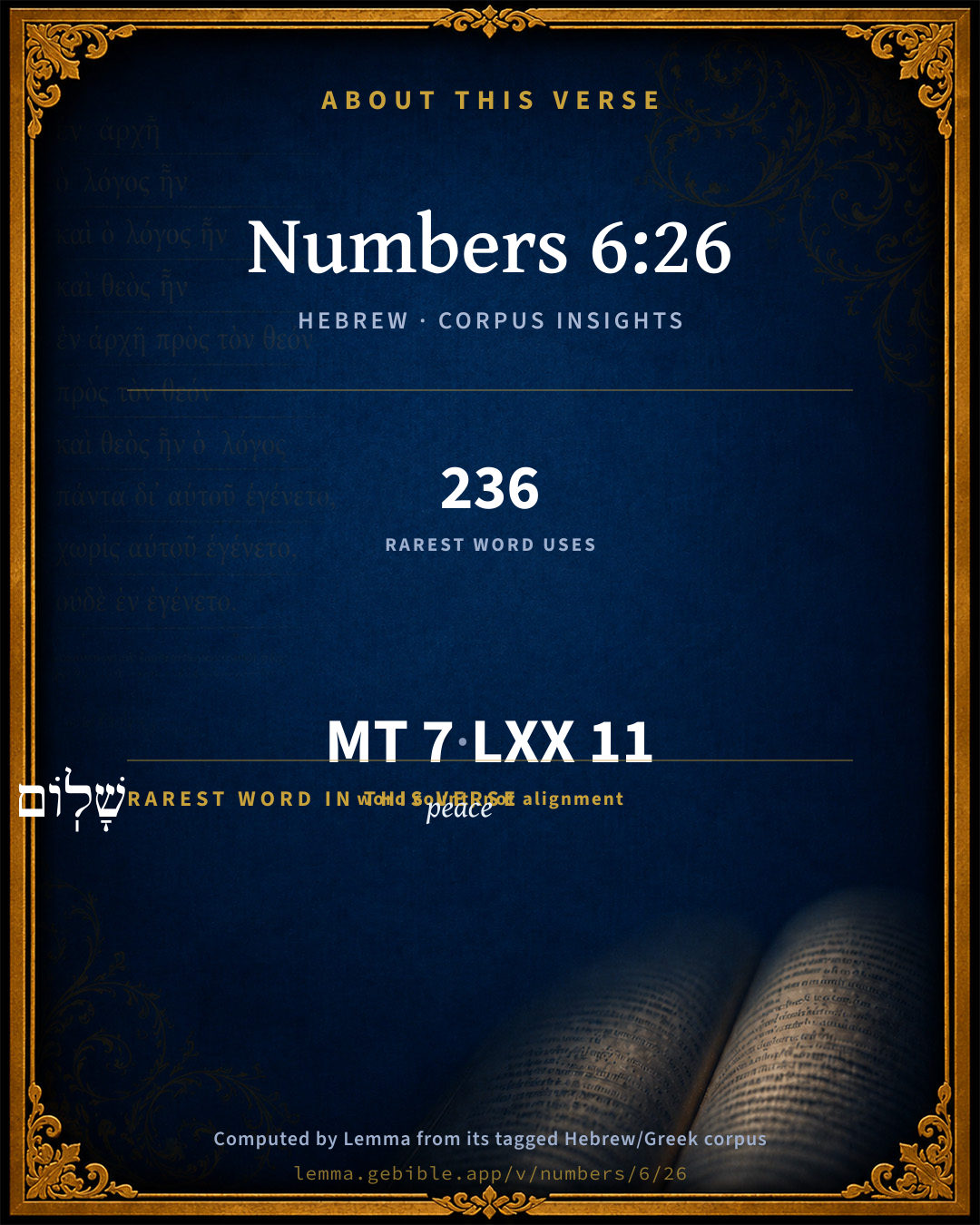
These counts appear in no published source. They are computed here, from the morphology-tagged text and Lemma’s own curated glosses. What Lemma adds →

7
words
6
distinct lemmas
Pentateuch
section

Grammatical profile

  • 2 verbs
  • 3 nouns
  • 2 prepositions

Verb forms

  • יִשָּׂ֨א Qal · Jussive
  • וְיָשֵׂ֥ם Qal · Jussive

Hebrew & Septuagint length

In English translation the verse runs 11 words from the Hebrew and 12 from the Septuagint (LXX English) — closely comparable.

A rough comparison of the two English renderings, which tokenize alike — not a word-level alignment.

Word counts can differ between the Hebrew and the Greek without any difference in meaning — e.g. the Hebrew direct-object marker אֵת has no separate Greek word, and Greek often adds the article ὁ.

In the original languages it is 7 Hebrew tokens and 11 Greek tokens — but the two are counted differently (Hebrew bundles its prefixes and suffixes into one token; the Greek is in lemma form), so that isn’t a like-for-like length.

Cross-references

24

Topical passages linked to Numbers 6:26 in the Treasury of Scripture Knowledge — connected by theme and wording, ordered by reader-vote popularity; previews shown in the World English Bible.

  • Psalms 4:6 Many say, "Who will show us any good?" Yahweh, let the light of your face shine on us.
  • Psalms 29:11 Yahweh will give strength to his people. Yahweh will bless his people with peace.
  • 2 Thessalonians 3:16 Now may the Lord of peace himself give you peace at all times in all ways. The Lord be with you all.
  • Romans 15:13 Now may the God of hope fill you with all joy and peace in believing, that you may abound in hope, in the power of the Holy Spirit.
  • John 16:33 I have told you these things, that in me you may have peace. In the world you have oppression; but cheer up! I have overcome the world."
  • Isaiah 26:3 You will keep [him] in perfect peace, [whose] mind [is] stayed [on you]; because he trusts in you.
  • Acts 2:28 You made known to me the ways of life. You will make me full of gladness with your presence.'
  • Romans 15:33 Now the God of peace be with you all. Amen.
  • Psalms 42:5 Why are you in despair, my soul? Why are you disturbed within me? Hope in God! For I shall still praise him for the saving help of his presence.
  • John 20:21 Jesus therefore said to them again, "Peace be to you. As the Father has sent me, even so I send you."
  • Philippians 4:7 And the peace of God, which surpasses all understanding, will guard your hearts and your thoughts in Christ Jesus.
  • Psalms 37:37 Mark the perfect man, and see the upright, For there is a future for the man of peace.
  • Psalms 89:15 Blessed are the people who learn to acclaim you. They walk in the light of your presence, Yahweh.
  • Isaiah 26:12 Yahweh, you will ordain peace for us; for you have also worked all our works for us.
  • Luke 2:14 "Glory to God in the highest, On earth peace, good will toward men."
  • John 14:27 Peace I leave with you. My peace I give to you; not as the world gives, give I to you. Don't let your heart be troubled, neither let it be fearful.
  • John 20:26 After eight days again his disciples were inside, and Thomas was with them. Jesus came, the doors being locked, and stood in the midst, and said, "Peace be to you."
  • Psalms 44:3 For they didn't get the land in possession by their own sword, Neither did their own arm save them; But your right hand, and your arm, and the light of your face, Because you were favorable to them.
  • Isaiah 57:19 I create the fruit of the lips: Peace, peace, to him who is far off and to him who is near, says Yahweh; and I will heal him.
  • Micah 5:5 He will be our peace when Assyria invades our land, And when he marches through our fortresses, Then we will raise against him seven shepherds, And eight leaders of men.
  • Acts 10:36 The word which he sent to the children of Israel, preaching good news of peace by Jesus Christ--he is Lord of all--
  • Ephesians 2:14–17 For he is our peace, who made both one, and broke down the middle wall of partition,
  • Romans 5:1 Being therefore justified by faith, we have peace with God through our Lord Jesus Christ;
  • Ephesians 6:23 Peace be to the brothers, and love with faith, from God the Father and the Lord Jesus Christ.

Cross-references courtesy of OpenBible.info (CC BY 4.0).

Hebrew and Greek witnesses Masoretic Hebrew ↔ Greek Septuagint

The same verse in the two great witnesses to the Old Testament, shown verse-for-verse.

These are two independent witnesses, not word-aligned to each other, and the Septuagint is shown in lemma (dictionary) form.

Hebrew Numbers 6:26 Masoretic · Westminster Leningrad Codex

יִשָּׂ֨א יְהוָ֤ה פָּנָיו֙ אֵלֶ֔יךָ וְיָשֵׂ֥ם לְךָ֖ שָׁלֽוֹם

Yahweh lift up his face toward you, And give you peace.'

World English Bible · Public Domain

Greek LXX Numbers 6:26 Septuagint · lemma form

ἐπιαἴρω κύριος ὁ πρόσωπον αὐτός ἐπί σύ καί δίδωμι σύ εἰρήνη

the Lord lift up his countenance upon you, and give you peace.

LXX2012 (modern English Septuagint) · Public Domain

On this verse, The Pulpit Commentary discusses the Septuagint’s reading. Read the note in Commentary ↓

Hebrew: Westminster Leningrad Codex (CC BY 4.0). Greek: Septuagint (public domain); English from LXX2012 (modern English Septuagint) (Public Domain). How the Septuagint differs from the Hebrew →

Targum (Aramaic paraphrase)

2

The Targum is the ancient Jewish Aramaic paraphrase of the Hebrew Scriptures — an interpretive translation, not the Hebrew text itself. Onkelos (literal) and Pseudo-Jonathan (expansive) render the Torah, and Jonathan the Prophets. Coverage is partial: where no permissively-licensed English translation exists for a verse, only the Aramaic is shown. This is verse-level text, not a word-by-word alignment to the Hebrew.

  1. Targum Onkelos Torah (Genesis–Deuteronomy)
    יִסַב יְיָ אַפֵּהּ לְוָתָךְ וִישַׁוֵי לָךְ שְׁלָם

    (no public-domain English translation for this verse)

    Targum Onkelos — Aramaic: “Onkelos Genesis” (public domain); “Onkelos Exodus” (public domain); “Onkelos Leviticus” (public domain); “Onkelos Numbers” (public domain); “Onkelos Deuteronomy” (public domain). English: “Sefaria Community Translation” (CC0 1.0 (public-domain dedication)); “J.W. Etheridge. The Targums of Onkelos and Jonathan Ben Uzziel on the Pentateuch. London: Longmans, Green, 1862” (public domain). Text via Sefaria.

  2. Targum Pseudo-Jonathan Torah (Genesis–Deuteronomy)
    יַסְבַּר יְיָ סְבַר אַפּוֹי לָךְ בִּצְלוּתָךְ וִישַׁוֵי עֲלָךְ שְׁלַם בְּכָל תְּחוּמָךְ

    The Lord lift up His countenance upon thee in thy prayer, and grant thee peace in thy end.

    Targum Pseudo-Jonathan — Aramaic: “Targum Jonathan on Genesis” (public domain); “Targum Jonathan on Exodus” (public domain); “Targum Jonathan on Leviticus” (public domain); “Targum Jonathan on Numbers” (public domain); “Targum Jonathan on Deuteronomy” (public domain). English: “The Targum of Jonathan ben Uzziel, trans. J. W. Etheridge, London, 1862” (public domain). Text via Sefaria.

Commentary

Notes on Numbers 6:26 from classic Christian and Jewish commentators (each source and its license shown beneath its notes). The classic Christian expositions comment on the surrounding passage and are grouped to its opening verse, so a note may address several verses; the Jewish commentaries on the Tanakh (Rashi and others) are per-verse, so they appear only where the commentator wrote on this verse.

Lemma curates 59 commentaries, every one of them public domain or Creative Commons licensed, each selected and text-cleaned for this edition rather than reprinted as found. About our sources →

Tyndale Open Study Notes

Tyndale Open Resources

6:26 God’s favor—the display of his face, or countenance—refers to his approval and special attention (cp. Ps 30:7). Divine peace (Hebrew shalom) is not just the absence of conflict or violence; God’s peace brings complete well-being, health, and wholeness.

Tyndale Open Study Notes — © Tyndale Open Resources, licensed CC BY-SA 4.0. Text via the HelloAO Bible API.

John Gill's Exposition

And they shall put my name upon the children of Israel,.... Call them by his name, the people of the Lord; call upon the name of the Lord to bless them, and pronounce the blessing on them in the name of the Lord, in or by the name Jehovah, as Jarchi, three times used in this form of blessing:

and I will bless them; really and truly bless them bless them with blessings indeed; with all sorts of blessings temporal and spiritual; with solid and substantial ones; and such are blessed, and will remain so, their blessings are irrevocable and irreversible; and unless the Lord blesses, in vain do the priests bless, or any of his ministers pronounce a blessing; theirs lies in words and wishes, his in real facts; they can only pray and wish for the blessing, it is he only that can give it, and can ratify and confirm what they declare and pronounce, according to his revealed word. Some refer the relative "them" to the priests, as if the sense was, I will bless the priests that bless Israel, for God will bless them that bless his people; but Aben Ezra thinks it belongs both to Israel, and to the priests, that God would confirm and establish the blessing of the priests pronounced on Israel, and bless the priests also, who needed the divine blessing as well as the people, and being found in the way of their duty, might expect it: the Targum of Jonathan is,"I will bless them in my Word;''his essential Word, Christ, in whom his chosen ones are blessed with all spiritual blessings, and who is the promised seed, in whom all nations of the earth shall be blessed.

Next: Numbers Chapter 7

John Gill's Exposition of the Whole Bible (1746–1763) — public domain (CC PDM 1.0). Text via the HelloAO Bible API.

Haydock's Catholic Bible Commentary

Turn. With loving mercy, may he comfort and protect thee. (Menochius)

George Leo Haydock (1774–1849), Haydock's Catholic Family Bible and Commentary, 1859 edition — public domain. Excludes Psalms (Douay-Rheims chapter numbering differs from Protestant) and Deuterocanonical books (Catholic canon only).

Matthew Poole's English Annotations

i.e. Look upon thee with a cheerful and pleasant countenance, as one that is reconciled to thee, and well pleased with thee and thy offerings and services. See of this phrase Psa 4:6; Pro 16:15. To this is opposed the falling and the casting down of the countenance, of which see Gen 4:5,6; Job 29:24. Or, regard, protect, and help thee. Compare Psa 33:18.

Peace with God, and with thy own conscience, and with all men, and all prosperity, which is comprehended under this word.

Matthew Poole's English Annotations on the Holy Bible (1683–1685) — public domain. Text from a community e-Sword/MySword module.

Whedon's Commentary on the Bible

Daniel D. Whedon

26. Lift up his countenance — Look at. This phrase is used by David to denote Jehovah’s deliverance of men out of their distresses. Psa_4:6; Psa_21:6; Psa_33:18.

Give thee peace — This is not a mere negative blessing, exemption from unrest and warfare; but, like the peace that Christ left as a legacy to believers, it includes all blessing of a positive kind, all well-being. See especially Joh_14:27, note. The Targum adds, “peace in thy end.

And they shall bestow the benediction of my name upon the children of Israel, and I, by my word, will bless them.” The threefold structure of this benediction, copied by St. Paul in the so-called apostolic benediction, suggests that it was a designed adumbration of the Trinity so clearly revealed in the New Testament. The Fathers and early theologians urged this as a proof text of this profound Christian mystery, which rests upon abundant and undoubted scriptural proofs. As the threefold repetition expresses the thought as strongly as possible, so this triune blessing calls down the fulness of grace enfolded in that absolute Being, Jehovah, which in the Christian dispensation is unfolded through the Father, Son, and Holy Spirit.

“Eternal Sun of righteousness,

Display thy beams divine,

And cause the glories of thy face

Upon my heart to shine.

“

Lift up thy countenance serene,

And let thy happy child

Behold, without a cloud between,

The Godhead reconciled.” — C. Wesley.

Daniel D. Whedon (gen. ed.), Commentary on the Old and New Testaments (1874–1909) — public domain. Text from a community e-Sword module.

The Pulpit Commentary

The Lord lift up his countenance upon thee. Eparai to proswpon autou epi se , Septuagint. This clause seems to repeat the last in a somewhat stronger form, as implying more personal and individual attention from the Lord. His face shines upon all that love him, as the sun shines wherever no clouds intervene; but his face is lifted up to that soul for which he has a more special regard. la, acn seems to mean the same thing as acn or syci. (Gen_43:29, anableqav toiv ufyalmoiv autou ; Gen_44:21) To lift up the eyes or the face upon any one is to look upon that one with peculiar and tender interest. And give thee peace (shalom). This peace, being the perfect fruit in experience of the grace which comes from God, forms the climax and conclusion of the benediction.

The Pulpit Commentary (1880–1919), ed. H.D.M. Spence-Jones & Joseph S. Exell — public domain. Text from a community e-Sword module.

John Wesley's Explanatory Notes

Lift up his countenance - That is, look upon thee with a chearful and pleasant countenance, as one that is well pleased with thee and thy services. Peace - Peace with God, with thy own conscience, and with all men; all prosperity is comprehended under this word.

John Wesley, Explanatory Notes Upon the Whole Bible (1754–1765) — public domain. Text via the GEBible commentary corpus.

Rashi

Rabbi Shlomo Yitzchaki (Rashi)

ישא ה' פניו אליך THE LORD LIFT UP HIS COUNTENANCE UPON THEE — This expresses the idea: May He suppress His anger (Numbers Rabbah 11:7)).

Rashi on the Tanakh — English translations: “The Judaica Press complete Tanach with Rashi, translated by A. J. Rosenberg” (CC BY 4.0); “Pentateuch with Rashi's commentary by M. Rosenbaum and A.M. Silbermann, 1929-1934” (public domain); “The Metsudah Tanach series, Lakewood, N.J” (CC BY 4.0); and “The Book of Joshua, Metsudah Publications, 1997” (CC BY 4.0). Text via Sefaria.

Lesson kit

Teaching starters — assembled from the data on this page, not authored interpretation. Every prompt links to the verse data it draws on. Edit before teaching.

Numbers, in the Pentateuch, opens this verse with 7 words (6 distinct Hebrew lemmas). Its most distinctive word is shâlôwm (“peace”). A historical commentator’s framing appears above. Read the whole chapter for the surrounding context.

Discussion questions

  1. What does “peace” (shâlôwm) contribute to the verse as a whole?
  2. Psalms 4:6 shares this passage’s theme. How do the two illuminate each other?
  3. These translations render this verse differently. What is at stake in choosing one wording over another?
  4. The verb «יִשָּׂ֨א» is Qal Jussive. How does its form color the action?
  5. Reading how Tyndale Open Study Notes and John Gill's Exposition read this verse, where do the two commentators agree and where do they part?

Things to notice

Reading settings

Reading text

Shown beneath each verse's original-language words.

Old Testament
Old Testament edition

Read the OT as the Masoretic Hebrew (MT) or the Greek Septuagint (LXX).

English shown for the Greek Septuagint (in the Hebrew ↔ Greek comparison).

Comparing translations? Open the Compare panel on any verse page to stack up to four side by side.