Judges 8:9

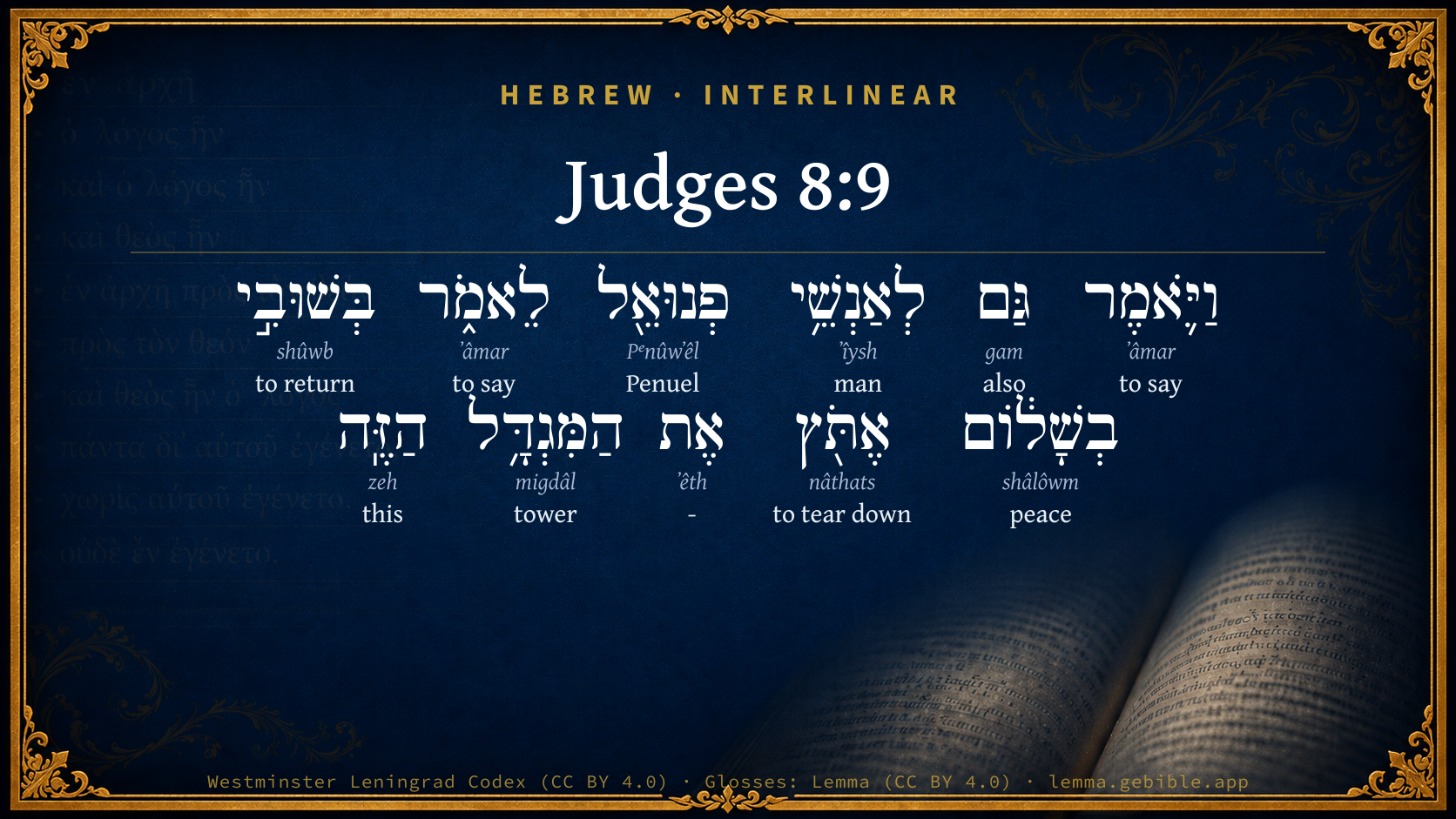
Hebrew (Westminster Leningrad Codex) Judges 8:9 appears in the Hebrew Old Testament. The text above is from the Westminster Leningrad Codex. Each word links to its Strong’s number, a concise gloss, and parsing drawn from the Open Scriptures Hebrew Bible morphology. Click any word for its full Brown-Driver-Briggs (BDB) entry.
Download image
Cite this verse

Judges 8:9 (World English Bible). Public Domain. Lemma interlinear Bible study tool, https://lemma.gebible.app/v/judges/8/9.

Show BibTeX & RIS
BibTeX
RIS
English Translation
He spoke also to the men of Penuel, saying, When I come again in peace, I will break down this tower.
World English Bible · Public Domain
Download a study sheet

One document with this verse’s original text, its word-by-word gloss line, the meaning frame, cross-references with their text, attributed commentary, and full source and license credits — printable, and it pastes into notes with its structure intact.

This verse Autodidact and up

Study sheet (.html) Plain text (.txt)

A passage Seminary Student

Up to 50 verses in one chapter. A passage sheet keeps up to 6 commentary sources and 12 cross-references per verse, in the order this page ranks them, and says so on the sheet whenever that leaves anything out. Ask for a single verse and you get the Autodidact verse sheet above.

Everything on this page stays free to read, with no account — the sheet is a download of what is already on screen, not access to it.

Want to remove ads? Support Godless Engineer
Compare translations 3

The same verse in 3 English versions, stacked beneath the original-language interlinear above. Click any original word for its lexicon entry.

Each is an independent rendering of the whole verse — the interlinear is not word-aligned to these translations.

Highlighted words mark where these versions differ — a whole-verse word diff, not a word-by-word alignment.

  • World English Bible Public Domain
    He spoke also to the men of Penuel, saying, When I come again in peace, I will break down this tower.
  • King James Version Public Domain
    And he spake also unto the men of Penuel, saying, When I come again in peace, I will break down this tower.
  • unfoldingWord Literal Text CC BY-SA 4.0
    And he said also to the men of Penuel, saying, “In my returning in peace, I will tear down this tower.”

unfoldingWord Literal Text — © unfoldingWord, licensed CC BY-SA 4.0. Word-aligned USFM3 via Door43 (git.door43.org/unfoldingWord/en_ult).

Versions to compare (up to 4)

3 of 4 selected

Show all 18 translations

Every available English version of this verse, each an independent rendering of the whole verse.

  • World English Bible Public Domain
    He spoke also to the men of Penuel, saying, When I come again in peace, I will break down this tower.
  • Berean Standard Bible Public Domain
    So Gideon told the men of Penuel, “When I return in triumph, I will tear down this tower!”
  • Majority Standard Bible Public Domain
    So Gideon told the men of Penuel, “When I return in triumph, I will tear down this tower!”
  • King James Version Public Domain
    And he spake also unto the men of Penuel, saying, When I come again in peace, I will break down this tower.
  • American Standard Version (1901) Public Domain
    And he spake also unto the men of Penuel, saying, When I come again in peace, I will break down this tower.
  • Revised Version (1885) Public Domain
    And he spake also unto the men of Penuel, saying, When I come again in peace, I will break down this tower.
  • Geneva Bible (1599) Public Domain
    And he sayd also vnto the men of Penuel, When I come againe in peace, I will breake downe this towre.
  • Douay-Rheims (1899) Public Domain
    He said therefore to them also: When I shall return a conqueror in peace, I will destroy this tower.
  • Young's Literal Translation Public Domain
    And he speaketh also to the men of Penuel, saying, `In my turning back in peace, I break down this tower.'
  • Literal Standard Version CC BY-SA 4.0
    And he also speaks to the men of Penuel, saying, “In my turning back in peace, I break down this tower.”
  • Unlocked Literal Bible CC BY-SA 4.0
    He spoke also to the men of Peniel and said, “When I come again in peace, I will pull down this tower.”
  • unfoldingWord Literal Text CC BY-SA 4.0
    And he said also to the men of Penuel, saying, “In my returning in peace, I will tear down this tower.”
  • Darby Bible Public Domain
    And he said to the men of Penu'el, "When I come again in peace, I will break down this tower."
  • World Messianic Bible Public Domain
    He spoke also to the men of Penuel, saying, “When I come again in peace, I will break down this tower.”
  • Webster's Bible Public Domain
    And he spoke also to the men of Penuel, saying, When I come again in peace, I will break down this tower.
  • Free Bible Version CC BY-SA 4.0
    So he told them, “When I return victorious, I'll demolish this tower!”
  • Bible in Basic English Public Domain
    So he said to the men of Penuel, When I come back in peace, I will have this tower broken down.
  • JPS Tanakh (1917) Public Domain
    And he spoke also unto the men of Penuel, saying: 'When I come back in peace, I will break down this tower.'

Literal Standard Version (2020), Covenant Press — licensed CC BY-SA 4.0. Text via the HelloAO Bible API (eBible.org). Unlocked Literal Bible (unfoldingWord) — licensed CC BY-SA 4.0. Text via the HelloAO Bible API (eBible.org). unfoldingWord Literal Text — © unfoldingWord, licensed CC BY-SA 4.0. Word-aligned USFM3 via Door43 (git.door43.org/unfoldingWord/en_ult). Free Bible Version, Dr. Jonathan Gallagher — licensed CC BY-SA 4.0. Text via the HelloAO Bible API (eBible.org).

Word by word

More ways to search: Search by grammar → Find every occurrence → Compare this word →

Practice this passage: Drill this verse → Learn its vocabulary →

פְנוּאֵ֖ל
Pᵉnûwʼêl
H6439
“Penuel”
Noun, Proper
Part of Speech
Noun
Type
Proper
Full BDB Definition

Origin: from H6437 and H410

TWOT: None

Penuel or Peniel = "facing God" - a Benjamite, son of Shashak, brother of Iphedeiah of the family of Saul (noun proper masculine) - son of Hur, father of Gedor, and a descendant of Judah (noun proper masculine) - the place named by Jacob when he wrestled with God and located on the north bank of the Jabbok close to the Jordan (noun proper locative)
  1. וַיֹּ֛אמֶר ʼâmar H559 “and · to say” Conjunction + Verb, Qal, Sequential Imperfect, 3rd Person, Masculine, Singular
  2. גַּם gam H1571 “also” Particle, Accusative
  3. לְאַנְשֵׁ֥י ʼîysh H376 “to/for · men of” Preposition + Noun, Common, Masculine, Plural, Construct
  4. לֵאמֹ֑ר ʼâmar H559 “to say” Preposition + Verb, Qal, Infinitive Construct
  5. בְּשׁוּבִ֣י shûwb H7725 “in/at · to return · me” Preposition + Verb, Qal, Infinitive Construct + Suffix, Personal, 1st Person, Common, Singular
  6. בְשָׁל֔וֹם shâlôwm H7965 “in/at · peace” Preposition + Noun, Common, Masculine, Singular, Absolute
  7. אֶתֹּ֖ץ nâthats H5422 “to tear down” Verb, Qal, Imperfect, 1st Person, Common, Singular
  8. אֶת ʼêth H853 “-” Particle, Direct Object
  9. הַמִּגְדָּ֥ל migdâl H4026 “the · tower” Particle, Definite Article + Noun, Common, Both, Singular, Absolute
  10. הַזֶּֽה zeh H2088 “the · this” Particle, Definite Article + Pronoun, Demonstrative, Masculine, Singular

About this verse

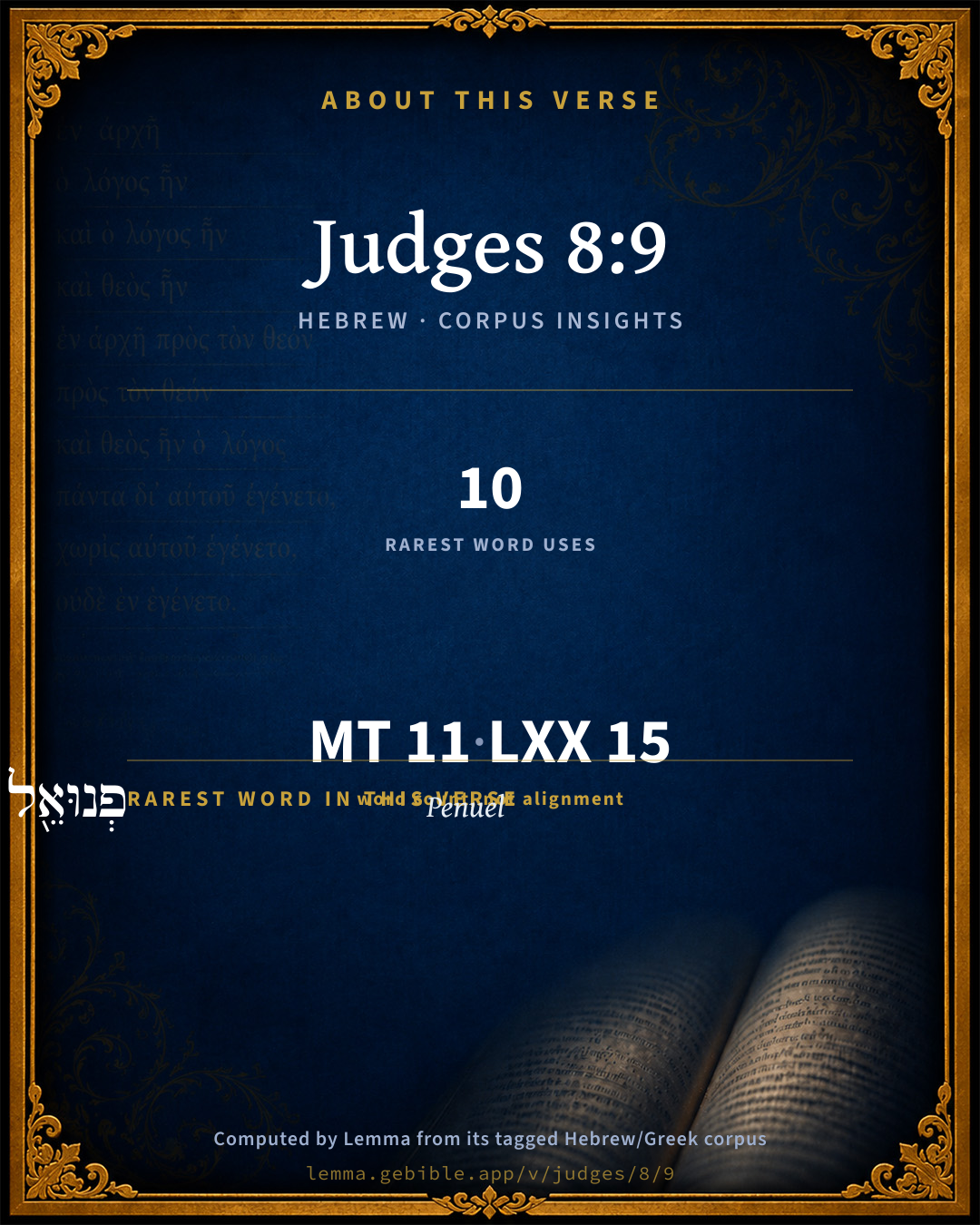
These counts appear in no published source. They are computed here, from the morphology-tagged text and Lemma’s own curated glosses. What Lemma adds →

11
words
10
distinct lemmas
Historical
section

Notable vocabulary

The rarest word here is פְנוּאֵ֖ל Penuel H6439 — appearing just 10 times in the whole Hebrew Bible.

Shared distinctive vocabulary

פְנוּאֵ֖ל Penuel H6439 occurs in 8 verses of the Hebrew Bible. Also found in:

Grammatical profile

  • 4 verbs
  • 4 nouns
  • 1 pronoun
  • 2 particles

Verb forms

  • וַיֹּ֛אמֶר Qal · Sequential Imperfect
  • לֵאמֹ֑ר Qal · Infinitive Construct
  • בְּשׁוּבִ֣י Qal · Infinitive Construct
  • אֶתֹּ֖ץ Qal · Imperfect

Repetition

A word recurs within this verse — often emphatic in Hebrew:

  • וַיֹּ֛אמֶר to say H559 ×2

Hebrew & Septuagint length

In English translation the verse runs 21 words from the Hebrew and 19 from the Septuagint (LXX English) — closely comparable.

A rough comparison of the two English renderings, which tokenize alike — not a word-level alignment.

Word counts can differ between the Hebrew and the Greek without any difference in meaning — e.g. the Hebrew direct-object marker אֵת has no separate Greek word, and Greek often adds the article ὁ.

In the original languages it is 11 Hebrew tokens and 15 Greek tokens — but the two are counted differently (Hebrew bundles its prefixes and suffixes into one token; the Greek is in lemma form), so that isn’t a like-for-like length.

Cross-references

2

Topical passages linked to Judges 8:9 in the Treasury of Scripture Knowledge — connected by theme and wording, ordered by reader-vote popularity; previews shown in the World English Bible.

  • Judges 8:17 He broke down the tower of Penuel, and killed the men of the city.
  • 1 Kings 22:27–28 and say, Thus says the king, Put this fellow in the prison, and feed him with bread of affliction and with water of affliction, until I come in peace.

Cross-references courtesy of OpenBible.info (CC BY 4.0).

Hebrew and Greek witnesses Masoretic Hebrew ↔ Greek Septuagint

The same verse in the two great witnesses to the Old Testament, shown verse-for-verse.

These are two independent witnesses, not word-aligned to each other, and the Septuagint is shown in lemma (dictionary) form.

Hebrew Judges 8:9 Masoretic · Westminster Leningrad Codex

וַיֹּ֛אמֶר גַּם לְאַנְשֵׁ֥י פְנוּאֵ֖ל לֵאמֹ֑ר בְּשׁוּבִ֣י בְשָׁל֔וֹם אֶתֹּ֖ץ אֶת הַמִּגְדָּ֥ל הַזֶּֽה

He spoke also to the men of Penuel, saying, When I come again in peace, I will break down this tower.

World English Bible · Public Domain

Greek LXX Judges 8:9 Septuagint · lemma form

καί εἶπον γεδεων πρός ἀνήρ φανουηλ ἐν ἐπιστροφή ἐγώ μετά εἰρήνη ὁ πύργος οὗτος κατασκάπτω

And Gedeon said to the men of Phanuel, When I return in peace, I will break down this tower.

LXX2012 (modern English Septuagint) · Public Domain

Hebrew: Westminster Leningrad Codex (CC BY 4.0). Greek: Septuagint (public domain); English from LXX2012 (modern English Septuagint) (Public Domain). How the Septuagint differs from the Hebrew →

Targum (Aramaic paraphrase)

1

The Targum is the ancient Jewish Aramaic paraphrase of the Hebrew Scriptures — an interpretive translation, not the Hebrew text itself. Onkelos (literal) and Pseudo-Jonathan (expansive) render the Torah, and Jonathan the Prophets. Coverage is partial: where no permissively-licensed English translation exists for a verse, only the Aramaic is shown. This is verse-level text, not a word-by-word alignment to the Hebrew.

  1. Targum Jonathan Prophets (Joshua–Malachi)
    וַאֲמַר אַף לֶאֱנָשֵׁי פְּנוּאֵל לְמֵימַר כַּד אֵיתוּב בִּשְׁלָם אֶתְרַע יַת מַגְדְלָא הָדֵין:

    (no public-domain English translation for this verse)

    Targum Jonathan — Aramaic: “Mikraot Gedolot” (public domain). English: “Sefaria Community Translation” (CC0 1.0 (public-domain dedication)); “London "Chaldee Paraphrase," 1871” (public domain). Text via Sefaria.

Commentary

Notes on Judges 8:9 from classic Christian and Jewish commentators (each source and its license shown beneath its notes). The classic Christian expositions comment on the surrounding passage and are grouped to its opening verse, so a note may address several verses; the Jewish commentaries on the Tanakh (Rashi and others) are per-verse, so they appear only where the commentator wrote on this verse.

Lemma curates 59 commentaries, every one of them public domain or Creative Commons licensed, each selected and text-cleaned for this edition rather than reprinted as found. About our sources →

Trapp's Complete Commentary

John Trapp

Jdg 8:9 And he spake also unto the men of Penuel, saying, When I come again in peace, I will break down this tower.

Ver. 9. I will break down this tower.] Whereon you bear yourselves so bold as if there were no coming at you; as if you were out of the reach of God’s rod and man’s revenge.

John Trapp, A Commentary or Exposition upon All the Books of the Old and New Testament (1647–1656) — public domain. Text from a community e-Sword module.

Geneva Bible (1599)

Geneva Bible translators

Having gotten the victory.

Geneva Bible (1599) marginal notes — public domain. Text via Bolls.life.

Jamieson, Fausset & Brown

Robert Jamieson, A. R. Fausset & David Brown

he spake . . ., When I come again in peace, I will break down this tower--Intent on the pursuit, and afraid of losing time, he postponed the merited vengeance till his return. His confident anticipation of a triumphant return evinces the strength of his faith; and his specific threat was probably provoked by some proud and presumptuous boast, that in their lofty watchtower the Penuelites would set him at defiance.

Jamieson, Fausset & Brown — Commentary Critical and Explanatory on the Whole Bible (1871) — public domain (CC PDM 1.0). Text via the HelloAO Bible API.

Adam Clarke's Commentary

Verse 9. I will break down this tower.] Probably they had not only denied him, but insultingly pointed to a tower in which their chief defense lay; and intimated to him that he might do his worst, for they could amply defend themselves.

Adam Clarke's Commentary on the Bible (1810–1826) — public domain. Text from a community e-Sword/MySword module.

Ellicott's Commentary for English Readers

(9) When I come again in peace.—Comp. 1Ki_22:27.

I will break down this tower.—If the strength of their citadel emboldened them to refuse food to Gideon’s fainting warriors, it would also have helped to protect them against the dreaded vengeance of Midian.

A Bible Commentary for English Readers, edited by Charles John Ellicott (1878–1897) — public domain. Text from a community e-Sword module.

John Gill's Exposition

In a threatening way, as he had spoken to the men of Succoth: saying, when I come again in peace: having conquered all his enemies, and delivered Israel from their bondage, and restored peace and prosperity to them, of which he had no doubt:

I will break down this tower; pointing to it and which stood in their city, and in which they placed their confidence; and when he threatened them, boasted of it as their security.

John Gill's Exposition of the Whole Bible (1746–1763) — public domain (CC PDM 1.0). Text via the HelloAO Bible API.

Haydock's Catholic Bible Commentary

Tower; on the strength of which they ventured to treat him with insolence. Phanuel, "the face of God," (Genesis xxxii. 33,) was near the Jaboc. (Menochius)

George Leo Haydock (1774–1849), Haydock's Catholic Family Bible and Commentary, 1859 edition — public domain. Excludes Psalms (Douay-Rheims chapter numbering differs from Protestant) and Deuterocanonical books (Catholic canon only).

Matthew Poole's English Annotations

Your confidence in which makes you thus proud and presumptuous. He implies that he would afterwards destroy their persons, as is expressed, Jdg 8:17.

Matthew Poole's English Annotations on the Holy Bible (1683–1685) — public domain. Text from a community e-Sword/MySword module.

John Wesley's Explanatory Notes

Your tower - Your confidence in which makes you thus proud and presumptuous.

John Wesley, Explanatory Notes Upon the Whole Bible (1754–1765) — public domain. Text via the GEBible commentary corpus.

Lesson kit

Teaching starters — assembled from the data on this page, not authored interpretation. Every prompt links to the verse data it draws on. Edit before teaching.

Judges, in the Historical, opens this verse with 11 words (10 distinct Hebrew lemmas). Its most distinctive word is Pᵉnûwʼêl (“Penuel”). A historical commentator’s framing appears above. Read the whole chapter for the surrounding context.

Discussion questions

  1. The word Pᵉnûwʼêl carries the sense “Penuel.” How does it shape the verse?
  2. How does Genesis 32:30, which shares the word «Penuel», read alongside this verse?
  3. What does the repetition of “to say” (2× in this one verse) do in this verse?
  4. These translations render this verse differently; the difference is in the English rendering, not the original. What questions does that raise?
  5. «וַיֹּ֛אמֶר» is a Qal Sequential Imperfect verb. How does that grammatical form shape the action described?
  6. Compare how Trapp's Complete Commentary and Geneva Bible (1599) read this verse. Where do they agree or differ?

Things to notice

Reading settings

Reading text

Shown beneath each verse's original-language words.

Old Testament
Old Testament edition

Read the OT as the Masoretic Hebrew (MT) or the Greek Septuagint (LXX).

English shown for the Greek Septuagint (in the Hebrew ↔ Greek comparison).

Comparing translations? Open the Compare panel on any verse page to stack up to four side by side.