
Isaiah 59:8

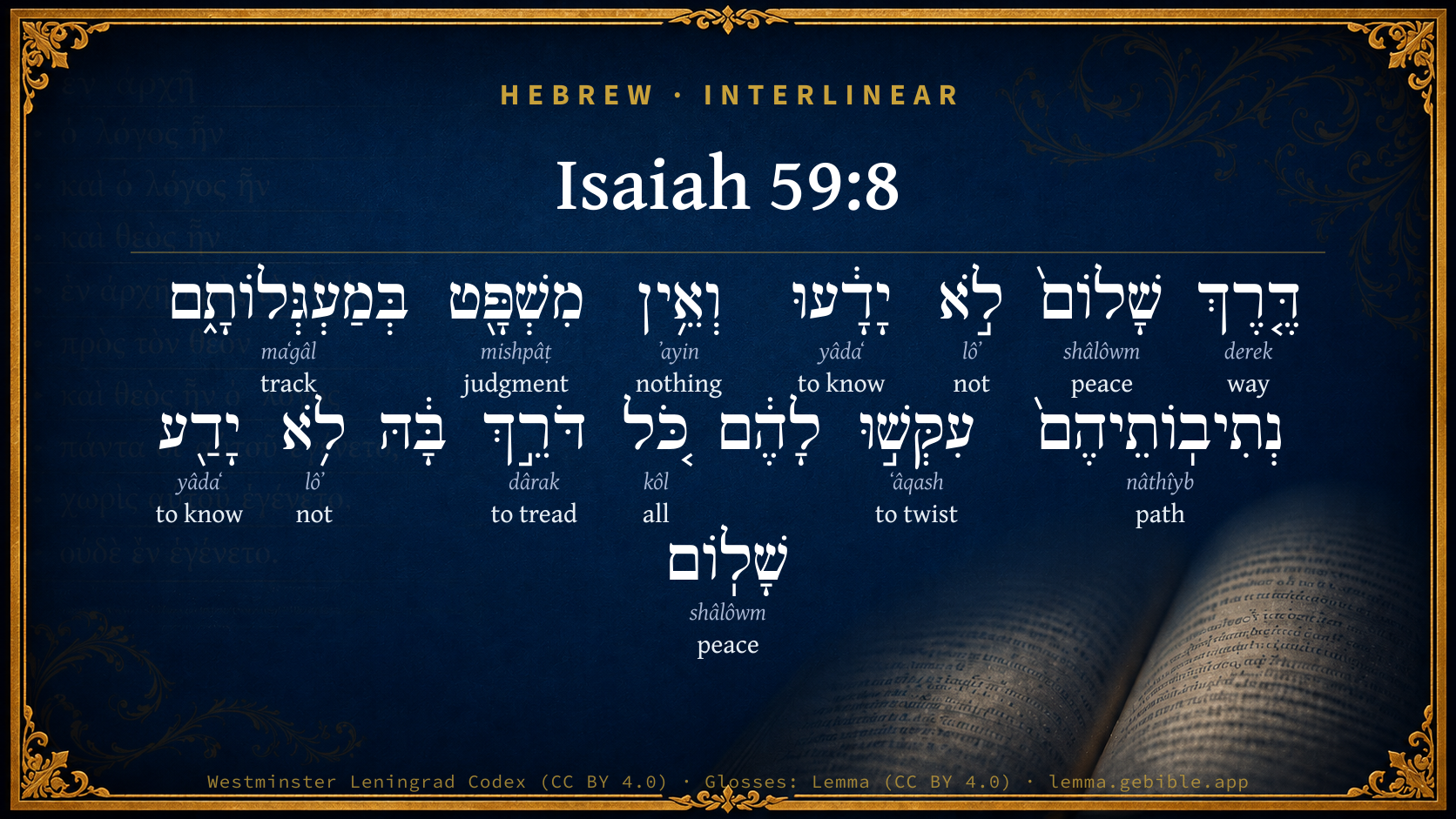
Hebrew (Westminster Leningrad Codex) Isaiah 59:8 appears in the Hebrew Old Testament. The text above is from the Westminster Leningrad Codex. Each word links to its Strong’s number, a concise gloss, and parsing drawn from the Open Scriptures Hebrew Bible morphology. Click any word for its full Brown-Driver-Briggs (BDB) entry.
Download image
Cite this verse

Isaiah 59:8 (World English Bible). Public Domain. Lemma interlinear Bible study tool, https://lemma.gebible.app/v/isaiah/59/8.

Show BibTeX & RIS
BibTeX
RIS
English Translation
The way of peace they don't know; and there is no justice in their goings: they have made them crooked paths; whoever goes therein does not know peace.
World English Bible · Public Domain
Download a study sheet

One document with this verse’s original text, its word-by-word gloss line, the meaning frame, cross-references with their text, attributed commentary, and full source and license credits — printable, and it pastes into notes with its structure intact.

This verse Autodidact and up

Study sheet (.html) Plain text (.txt)

A passage Seminary Student

Up to 50 verses in one chapter. A passage sheet keeps up to 6 commentary sources and 12 cross-references per verse, in the order this page ranks them, and says so on the sheet whenever that leaves anything out. Ask for a single verse and you get the Autodidact verse sheet above.

Everything on this page stays free to read, with no account — the sheet is a download of what is already on screen, not access to it.

Want to remove ads? Support Godless Engineer
Compare translations 3

The same verse in 3 English versions, stacked beneath the original-language interlinear above. Click any original word for its lexicon entry.

Each is an independent rendering of the whole verse — the interlinear is not word-aligned to these translations.

Highlighted words mark where these versions differ — a whole-verse word diff, not a word-by-word alignment.

  • World English Bible Public Domain
    The way of peace they don't know; and there is no justice in their goings: they have made them crooked paths; whoever goes therein does not know peace.
  • King James Version Public Domain
    The way of peace they know not; and there is no judgment in their goings: they have made them crooked paths: whosoever goeth therein shall not know peace.
  • unfoldingWord Literal Text CC BY-SA 4.0
    They do not know the way of peace, and there is no justice in their tracks. They have made their paths crooked for themselves; everyone treading on it does not know peace. q1

unfoldingWord Literal Text — © unfoldingWord, licensed CC BY-SA 4.0. Word-aligned USFM3 via Door43 (git.door43.org/unfoldingWord/en_ult).

Versions to compare (up to 4)

3 of 4 selected

Show all 18 translations

Every available English version of this verse, each an independent rendering of the whole verse.

  • World English Bible Public Domain
    The way of peace they don't know; and there is no justice in their goings: they have made them crooked paths; whoever goes therein does not know peace.
  • Berean Standard Bible Public Domain
    The way of peace they have not known, and there is no justice in their tracks. They have turned them into crooked paths; no one who treads on them will know peace.
  • Majority Standard Bible Public Domain
    The way of peace they have not known, and there is no justice in their tracks. They have turned them into crooked paths; no one who treads on them will know peace.
  • King James Version Public Domain
    The way of peace they know not; and there is no judgment in their goings: they have made them crooked paths: whosoever goeth therein shall not know peace.
  • American Standard Version (1901) Public Domain
    The way of peace they know not; and there is no justice in their goings: they have made them crooked paths; whosoever goeth therein doth not know peace.
  • Revised Version (1885) Public Domain
    The way of peace they know not; and there is no judgment in their goings: they have made them crooked paths; whosoever goeth therein doth not know peace.
  • Geneva Bible (1599) Public Domain
    The way of peace they knowe not, and there is none equitie in their goings: they haue made them crooked paths: whosoeuer goeth therein, shall not knowe peace.
  • Douay-Rheims (1899) Public Domain
    They have not known the way of peace, and there is no judgment in their steps: their paths are become crooked to them, every one that treadeth in them, knoweth no peace.
  • Young's Literal Translation Public Domain
    A way of peace they have not known, And there is no judgment in their paths, Their paths they have made perverse for themselves, No treader in it hath known peace.
  • Literal Standard Version CC BY-SA 4.0
    They have not known a way of peace, || And there is no judgment in their paths, || They have made their paths perverse for themselves, || None treading in it has known peace.
  • Unlocked Literal Bible CC BY-SA 4.0
    The way of peace they do not know, and there is no justice in their paths. They have made crooked paths; whoever travels these paths does not know peace.
  • unfoldingWord Literal Text CC BY-SA 4.0
    They do not know the way of peace, and there is no justice in their tracks. They have made their paths crooked for themselves; everyone treading on it does not know peace. q1
  • Darby Bible Public Domain
    the way of peace they know not, and there is no judgment in their goings; they have made their paths crooked: whoso goeth therein knoweth not peace.
  • World Messianic Bible Public Domain
    They don’t know the way of peace; and there is no justice in their ways. They have made crooked paths for themselves; whoever goes in them doesn’t know peace.
  • Webster's Bible Public Domain
    The way of peace they know not; and there is no judgment in their goings: they have made them crooked paths: whoever goeth therein shall not know peace.
  • Free Bible Version CC BY-SA 4.0
    They don't know how to live in peace; they're not straight and fair with others. Their way is totally crooked, and anyone who follows them won't experience any peace.
  • Bible in Basic English Public Domain
    They have no knowledge of the way of peace, and there is no sense of what is right in their behaviour: they have made for themselves ways which are not straight; whoever goes in them has no knowledge of peace.
  • JPS Tanakh (1917) Public Domain
    The way of peace they know not, and there is no right in their goings; they have made them crooked paths, whosoever goeth therein doth not know peace.

Literal Standard Version (2020), Covenant Press — licensed CC BY-SA 4.0. Text via the HelloAO Bible API (eBible.org). Unlocked Literal Bible (unfoldingWord) — licensed CC BY-SA 4.0. Text via the HelloAO Bible API (eBible.org). unfoldingWord Literal Text — © unfoldingWord, licensed CC BY-SA 4.0. Word-aligned USFM3 via Door43 (git.door43.org/unfoldingWord/en_ult). Free Bible Version, Dr. Jonathan Gallagher — licensed CC BY-SA 4.0. Text via the HelloAO Bible API (eBible.org).

Word by word

More ways to search: Search by grammar → Find every occurrence → Compare this word →

Practice this passage: Drill this verse → Learn its vocabulary →

עִקְּשׁ֣וּ
ʻâqash
H6140
“to twist”
Verb, Piel, Perfect, 3rd Person, Common, Plural
Part of Speech
Verb
Stem
Piel
Form
Perfect
Person
3rd Person
Gender
Common
Number
Plural
Full BDB Definition

Origin: a primitive root

TWOT: 1684

to be perverse, twist, pervert, make crooked, prove perverse, declare perverse - (Niphal) to be crooked - (Piel) to twist, distort, pervert, make crooked - (Hiphil) to declare crooked - (Qal) perverse
  1. דֶּ֤רֶךְ derek H1870 “way of” Noun, Common, Both, Singular, Construct
  2. שָׁלוֹם֙ shâlôwm H7965 “peace” Noun, Common, Masculine, Singular, Absolute
  3. לֹ֣א lôʼ H3808 “not” Particle, Negative
  4. יָדָ֔עוּ yâdaʻ H3045 “to know” Verb, Qal, Perfect, 3rd Person, Common, Plural
  5. וְאֵ֥ין ʼayin H369 “and · nothing” Conjunction + Particle, Negative
  6. מִשְׁפָּ֖ט mishpâṭ H4941 “judgment” Noun, Common, Masculine, Singular, Absolute
  7. בְּמַעְגְּלוֹתָ֑ם maʻgâl H4570 “in/at · tracks · their” Preposition + Noun, Common, Masculine, Plural, Construct + Suffix, Personal, 3rd Person, Masculine, Plural
  8. נְתִיבֽוֹתֵיהֶם֙ nâthîyb H5410 “paths · their” Noun, Common, Both, Plural, Construct + Suffix, Personal, 3rd Person, Masculine, Plural
  9. כֹּ֚ל kôl H3605 “all of” Noun, Common, Masculine, Singular, Construct
  10. דֹּרֵ֣ךְ dârak H1869 “treading” Verb, Qal, Participle Active, Masculine, Singular, Absolute
  11. לֹ֥א lôʼ H3808 “not” Particle, Negative
  12. יָדַ֖ע yâdaʻ H3045 “to know” Verb, Qal, Perfect, 3rd Person, Masculine, Singular
  13. שָׁלֽוֹם shâlôwm H7965 “peace” Noun, Common, Masculine, Singular, Absolute

About this verse

These counts appear in no published source. They are computed here, from the morphology-tagged text and Lemma’s own curated glosses. What Lemma adds →

16
words
11
distinct lemmas
Prophets
section

Notable vocabulary

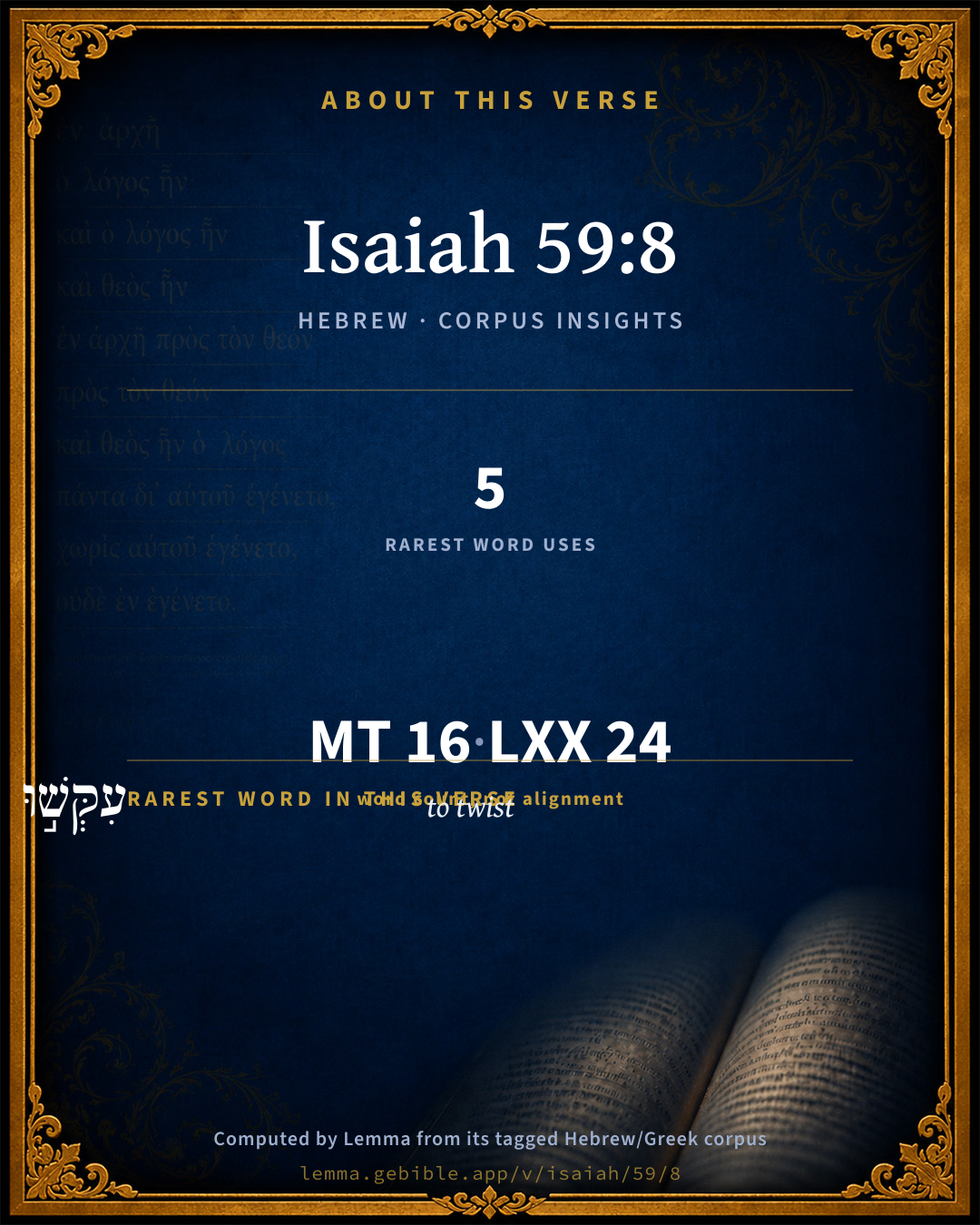
The rarest word here is עִקְּשׁ֣וּ to twist H6140 — appearing just 5 times in the whole Hebrew Bible.

Shared distinctive vocabulary

עִקְּשׁ֣וּ to twist H6140 occurs in 5 verses of the Hebrew Bible. Also found in:

Grammatical profile

  • 4 verbs
  • 7 nouns
  • 2 prepositions
  • 3 particles

Verb forms

  • יָדָ֔עוּ Qal · Perfect
  • עִקְּשׁ֣וּ Piel · Perfect
  • דֹּרֵ֣ךְ Qal · Participle Active
  • יָדַ֖ע Qal · Perfect

Repetition

Words recur within this verse — often emphatic in Hebrew:

  • שָׁלוֹם֙ peace H7965 ×2
  • יָדָ֔עוּ to know H3045 ×2
  • לֹ֣א not H3808 ×2

Hebrew & Septuagint length

In English translation the verse runs 28 words from the Hebrew and 29 from the Septuagint (LXX English) — closely comparable.

A rough comparison of the two English renderings, which tokenize alike — not a word-level alignment.

Word counts can differ between the Hebrew and the Greek without any difference in meaning — e.g. the Hebrew direct-object marker אֵת has no separate Greek word, and Greek often adds the article ὁ.

In the original languages it is 16 Hebrew tokens and 24 Greek tokens — but the two are counted differently (Hebrew bundles its prefixes and suffixes into one token; the Greek is in lemma form), so that isn’t a like-for-like length.

Cross-references

15

Topical passages linked to Isaiah 59:8 in the Treasury of Scripture Knowledge — connected by theme and wording, ordered by reader-vote popularity; previews shown in the World English Bible.

  • Isaiah 57:20–21 But the wicked are like the troubled sea; for it can't rest, and its waters cast up mire and dirt.
  • Romans 3:17 The way of peace, they haven't known."
  • Psalms 58:1–2 Do you indeed speak righteousness, silent ones? Do you judge blamelessly, you sons of men?
  • Isaiah 5:7 For the vineyard of Yahweh of Hosts is the house of Israel, And the men of Judah his pleasant plant: And he looked for justice, but, behold, oppression; For righteousness, but, behold, a cry of distress.
  • Luke 1:79 To shine on those who sit in darkness and the shadow of death; To guide our feet into the way of peace."
  • Jeremiah 5:1 Run you back and forth through the streets of Jerusalem, and see now, and know, and seek in the broad places of it, if you can find a man, if there are any who does justly, who seeks truth; and I will pardon her.
  • Hosea 4:1–2 Hear the word of Yahweh, you children of Israel; For Yahweh has a charge against the inhabitants of the land: "Indeed there is no truth, Nor goodness, Nor knowledge of God in the land.
  • Matthew 23:23 "Woe to you, scribes and Pharisees, hypocrites! For you tithe mint, dill, and cumin, and have left undone the weightier matters of the law: justice, mercy, and faith. But you ought to have done these, and not to have left the other undone.
  • Psalms 125:5 But as for those who turn aside to their crooked ways, Yahweh will lead them away with the workers of iniquity. Peace be on Israel.
  • Proverbs 2:15 Who are crooked in their ways, And wayward in their paths:
  • Proverbs 28:18 Whoever walks blamelessly is kept safe; But one with perverse ways will fall suddenly.
  • Isaiah 48:22 There is no peace, says Yahweh, to the wicked.
  • Isaiah 59:14–15 Justice is turned away backward, and righteousness stands afar off; for truth is fallen in the street, and uprightness can't enter.
  • Amos 6:1–6 Woe to those who are at ease in Zion, And to those who are secure on the mountain of Samaria, The notable men of the chief of the nations, To whom the house of Israel come!
  • Proverbs 3:17 Her ways are ways of pleasantness. All her paths are peace.

Cross-references courtesy of OpenBible.info (CC BY 4.0).

Hebrew and Greek witnesses Masoretic Hebrew ↔ Greek Septuagint

The same verse in the two great witnesses to the Old Testament, shown verse-for-verse.

These are two independent witnesses, not word-aligned to each other, and the Septuagint is shown in lemma (dictionary) form.

Hebrew Isaiah 59:8 Masoretic · Westminster Leningrad Codex

דֶּ֤רֶךְ שָׁלוֹם֙ לֹ֣א יָדָ֔עוּ וְאֵ֥ין מִשְׁפָּ֖ט בְּמַעְגְּלוֹתָ֑ם נְתִיבֽוֹתֵיהֶם֙ עִקְּשׁ֣וּ לָהֶ֔ם כֹּ֚ל דֹּרֵ֣ךְ בָּ֔הּ לֹ֥א יָדַ֖ע שָׁלֽוֹם

The way of peace they don't know; and there is no justice in their goings: they have made them crooked paths; whoever goes therein does not know peace.

World English Bible · Public Domain

Greek LXX Isaiah 59:8 Septuagint · lemma form

καί ὁδός εἰρήνη οὐ οἶδα καί οὐ εἰμί κρίσις ἐν ὁ ὁδός αὐτός ὁ γάρ τρίβος αὐτός διαστρέφω ὅς διαὁδεύω καί οὐ οἶδα εἰρήνη

and the way of peace they know not, neither is there judgment in their ways; for their paths by which they go are crooked, and they know not peace.

LXX2012 (modern English Septuagint) · Public Domain

On this verse, Adam Clarke's Commentary discusses the Septuagint’s reading. Read the note in Commentary ↓

Hebrew: Westminster Leningrad Codex (CC BY 4.0). Greek: Septuagint (public domain); English from LXX2012 (modern English Septuagint) (Public Domain). How the Septuagint differs from the Hebrew →

Targum (Aramaic paraphrase)

1

The Targum is the ancient Jewish Aramaic paraphrase of the Hebrew Scriptures — an interpretive translation, not the Hebrew text itself. Onkelos (literal) and Pseudo-Jonathan (expansive) render the Torah, and Jonathan the Prophets. Coverage is partial: where no permissively-licensed English translation exists for a verse, only the Aramaic is shown. This is verse-level text, not a word-by-word alignment to the Hebrew.

  1. Targum Jonathan Prophets (Joshua–Malachi)
    אוֹרַח שְׁלָמָא לָא יָדְעִין וְלֵית דִינָא בִּמְהָכֵיהוֹן שְׁבִילֵיהוֹן עֲקִימוּ לְהוֹן כָּל דְדָרִיךְ בְּהוֹן לָא יְדַע שְׁלָמָא:

    The way of peace they know not; and there is no justice in their ways, they have perverted their ways: whoever goeth therein shall not know peace.

    Targum Jonathan — Aramaic: “Mikraot Gedolot” (public domain). English: “Sefaria Community Translation” (CC0 1.0 (public-domain dedication)); “London "Chaldee Paraphrase," 1871” (public domain). Text via Sefaria.

Commentary

Notes on Isaiah 59:8 from classic Christian and Jewish commentators (each source and its license shown beneath its notes). The classic Christian expositions comment on the surrounding passage and are grouped to its opening verse, so a note may address several verses; the Jewish commentaries on the Tanakh (Rashi and others) are per-verse, so they appear only where the commentator wrote on this verse.

Lemma curates 59 commentaries, every one of them public domain or Creative Commons licensed, each selected and text-cleaned for this edition rather than reprinted as found. About our sources →

Trapp's Complete Commentary

John Trapp

Isa 59:8 The way of peace they know not; and [there is] no judgment in their goings: they have made them crooked paths: whosoever goeth therein shall not know peace.

Ver. 8. The way of peace they know not.] Like salamanders, they love to live in the fire of contention, to swim against the stream with the trout, to sow sedition, as the devil, &c.

Shall not know peace.] Shall not know what it meaneth.

John Trapp, A Commentary or Exposition upon All the Books of the Old and New Testament (1647–1656) — public domain. Text from a community e-Sword module.

Jamieson, Fausset & Brown

Robert Jamieson, A. R. Fausset & David Brown

peace--whether in relation to God, to their own conscience, or to their fellow men (Isa 57:20-21).

judgment--justice.

crooked--the opposite of "straightforward" (Pro 2:15; Pro 28:18).

Jamieson, Fausset & Brown — Commentary Critical and Explanatory on the Whole Bible (1871) — public domain (CC PDM 1.0). Text via the HelloAO Bible API.

Adam Clarke's Commentary

Verse 8. Whosoever goeth therein shall not know peace - "Whoever goeth in them knoweth not peace"] For בה bah, singular, read בם bam, plural, with the Septuagint, Syriac, Vulgate, and Chaldee. The ה he is upon a rasure in one MS. Or, for נתיבתיהם nethibotheyhem, plural, we must read נתיבתם nethibatham, singular, as it is in an ancient MS., to preserve the grammatical concord. - L.

Adam Clarke's Commentary on the Bible (1810–1826) — public domain. Text from a community e-Sword/MySword module.

The Cambridge Bible for Schools and Colleges

gen. ed. J. J. S. Perowne

8. judgment here means right (R.V. marg.).

goings] tracks, a common word in the Book of Proverbs.

they have made them &c.] they have made their paths crooked. Cf. Pro_2:15; Pro_10:9; Pro_28:18.

whosoever goeth therein] i.e. makes common cause with them.

The Cambridge Bible for Schools and Colleges (gen. ed. J. J. S. Perowne; Cambridge University Press, 1878–1918) — public domain. Text from a community e-Sword module.

John Gill's Exposition

The way of peace they know not,.... Neither the way of peace with God, supposing it is to be made by man, and not by Christ; and are ignorant of the steps and methods taken to procure it; nor do they know the way of peace of conscience, or how to attain to that which is true and solid; nor the way to eternal peace and happiness, which is alone by Christ, and the Gospel of peace reveals, to which they are strangers; nor the way of peace among men, which they are unconcerned about, and do not seek after, make use of no methods to promote, secure, and establish it; but all the reverse:

and there is no judgment in their goings; no justice in their actions, in their dealings with men; no judgment in their religious duties, which are done without any regard to the divine rule, or without being able to give a reason for them; they have no judgment in matters of doctrine or worship; they have no discerning of true and false doctrines, and between that which is spiritual and superstitious in worship; they have no knowledge of the word of God, which should be their guide both in faith and practice; but this they do not attend unto:

they have made them crooked paths: they have devised paths and modes of worship of their own, in which they walk, and which they observe, that are not according to the rule of the word; but deviate from it; and so may be said to be crooked, as not agreeable to that:

whosoever goeth therein shall not know peace; the way of peace with God, as before; or he shall not have any experience of true, solid, and substantial peace in his own conscience now, and shall not attain to eternal peace hereafter.

John Gill's Exposition of the Whole Bible (1746–1763) — public domain (CC PDM 1.0). Text via the HelloAO Bible API.

Albert Barnes' Notes on the Bible

The way of peace they know not - The phrase ‘way of peace’ may denote either peace of conscience, peace with God, peace among themselves, or peace with their fellow-men. Possibly it may refer to all these; and the sense will be, that in their whole lives they were strangers to true contentment and happiness. From no quarter had they peace, but whether in relation to God, to their own consciences, to each other, or to their fellow-men, they were involved in continual strife and agitation (see the notes at Isa 57:20-21).

And there is no judgment in their goings - Margin, ‘Right.’ The sense is, that there was no justice in their dealings. there was no disposition to do right. They were full of selfishness, falsehood, oppression, and cruelty.

They have made them crooked paths - A crooked path is an emblem of dishonesty, fraud, deceit. A straight path is an emblem of sincerity, truth, honesty, and uprightness (see Psa 125:5; Pro 2:15; and the notes at Isa 40:4). The idea is, that their counsels and plans were perverse and evil. We have a similar expression now when we say of a man that he is ‘straightforward,’ meaning that he is an honest man.

Albert Barnes' Notes on the Bible (1834–1885) — public domain. Text from a community e-Sword/MySword module.

Haydock's Catholic Bible Commentary

Peace, or prosperity. They quarrel with all, and ruin themselves, Psalm xiii.

George Leo Haydock (1774–1849), Haydock's Catholic Family Bible and Commentary, 1859 edition — public domain. Excludes Psalms (Douay-Rheims chapter numbering differs from Protestant) and Deuterocanonical books (Catholic canon only).

Matthew Poole's English Annotations

The way of peace they know not; they are of such turbulent spirits, living in such continual contentions and discords, that, breaking in pieces the very bonds of society, they neither know,

1. How to make and keep peace; neither,

2. Do they feel or enjoy the sweet fruits of it; and therefore by consequence,

3. They take not the course that leads to prosperity and happiness. They are not friends to peace.

There is no judgment, i.e. no justice, equity, faith, or integrity, which are the foundation of judgment,

in their goings; as paths did note their habitual way or manner of living, so goings do signify their actual progress in that way, or their works; thus Job 14:16.

They have made them crooked paths; they walk by no rule, which should discover the crooked from the straight; they are full of unevennesses and uncertainties, contrary to what David speaks, Psa 26:12. The LXX. render it perverse. Moses joins them both together, Deu 32:5; and so doth Solomon, speaking what wisdom shall deliver from, Pro 2:15; and it stands in opposition to them that walk uprightly, Pro 28:18. It may note,

1. Their hypocrisy, that pretend one thing and do another, that oppress under a pretence of justice. Or,

2. Their professed and owned irregularities and deviations from the rule of justice. Shall not know peace, i.e. shall not experience it; whosoever do as they do will be turbulent and perverse, as they are, and have as little peace within, or happiness without, as they have, Isa 57:21. They shall be poisoned by having converse with them, as in Isa 59:5, which the next words do intimate.

Matthew Poole's English Annotations on the Holy Bible (1683–1685) — public domain. Text from a community e-Sword/MySword module.

The Pulpit Commentary

The way of peace they know not. They have no desire for "peace," and neither "seek" it nor "ensue" it. (1Pe_3:11) Peace can only be obtained through righteousness. (Isa_32:17) There is no judgment in their goings; rather, no justice no recognition of other men"s rights, no endeavour to observe right in their own acts and proceedings. (comp. ver. 4; and see also Isa_1:17, Isa_1:21, 23 3:14, 15, etc.) They have made them crooked paths. (comp. Pro_2:15 Pro_10:9 Pro_28:6) The way that leadeth to life is straight. They have wandered from it, and made for themselves "crooked" paths, which can only lead to destruction. In such paths there neither is nor can be "peace."

The Pulpit Commentary (1880–1919), ed. H.D.M. Spence-Jones & Joseph S. Exell — public domain. Text from a community e-Sword module.

John Wesley's Explanatory Notes

The way of peace - They live in continual contentions, and discords. Judgment - No justice, equity, faith, or integrity.

John Wesley, Explanatory Notes Upon the Whole Bible (1754–1765) — public domain. Text via the GEBible commentary corpus.

Keil & Delitzsch

C. F. Keil & F. Delitzsch

Their whole nature is broken up into discord. "The way of peace they know not, and there is no right in their roads: they make their paths crooked: every one who treads upon them knows no peace." With דּרך, the way upon which a man goes, the prophet uses interchangeably (here and in Isa 59:7) מסלּה, a high-road thrown up with an embankment; מעגּל (with the plural in ı̂m and ôth), a carriage-road; and נתיבה, a footpath formed by the constant passing to and fro of travellers. Peaceable conduct, springing form a love of peace, and aiming at producing peace, is altogether strange to them; no such thing is to be met with in their path as the recognition of practice of right: they make their paths for themselves (להם, dat. ethicus), i.e., most diligently, twisting about; and whoever treads upon them (bâh, neuter, as in Isa 27:4), forfeits all enjoyment of either inward or outward peace. Shâlōm is repeated significantly, in Isaiah's peculiar style, at the end of the verse. The first strophe of the prophecy closes here: it was from no want of power or willingness on the part of God, that He had not come to the help of His people; the fault lay in their own sins.

Keil & Delitzsch — Biblical Commentary on the Old Testament (1861–1891) — public domain (CC PDM 1.0). Text via the HelloAO Bible API. (Old Testament only.)

J. A. Alexander on Isaiah

Joseph Addison Alexander

“The way of peace they have not known, and there is no justice in their paths; their courses they have rendered crooked for them; every one walking in them knows not peace.” The obvious and simple meaning is, that their lives are not pacific but contentious. The erroneous principle involved in all specific interpretations is refuted by the comprehensive sense which the apostle puts upon the words in the passage which has been already cited (Rom 3:15-17).

Joseph Addison Alexander, The Prophecies of Isaiah (1846–1847; New York: Scribner, 1870–1878) — public domain. Text from a community e-Sword module.

Rashi

Rabbi Shlomo Yitzchaki (Rashi)

and there is no justice in their paths That is to say that in their paths there is nothing judged truly according to its law.

they have made themselves crooked paths They made their road crooked for themselves.

Rashi on the Tanakh — English translations: “The Judaica Press complete Tanach with Rashi, translated by A. J. Rosenberg” (CC BY 4.0); “Pentateuch with Rashi's commentary by M. Rosenbaum and A.M. Silbermann, 1929-1934” (public domain); “The Metsudah Tanach series, Lakewood, N.J” (CC BY 4.0); and “The Book of Joshua, Metsudah Publications, 1997” (CC BY 4.0). Text via Sefaria.

Ibn Ezra

Rabbi Abraham ibn Ezra

Their paths that were well known before (as straight), are now crooked. Whosoever goeth therein, that is, he who walks in their ways, and learns from them.

Ibn Ezra on the Tanakh — English translations: “Sefaria Community Translation” (CC0 1.0 (public-domain dedication)); “Yalkut, Sifsei Chachomim Chumash, Metsudah Publications, 2009” (CC BY 4.0); and “Commentary of Ibn Ezra on Isaiah - trans. by M. Friedlander, 1873” (public domain). Text via Sefaria.

Lesson kit

Teaching starters — assembled from the data on this page, not authored interpretation. Every prompt links to the verse data it draws on. Edit before teaching.

Isaiah, in the Prophets, opens this verse with 16 words (11 distinct Hebrew lemmas). Its most distinctive word is ʻâqash (“to twist”). A historical commentator’s framing appears above. Read the whole chapter for the surrounding context.

Discussion questions

  1. The word ʻâqash carries the sense “to twist.” How does it shape the verse?
  2. How does Job 9:20, which shares the word «to twist», read alongside this verse?
  3. What does the repetition of “peace” (2× in this one verse) do in this verse?
  4. These translations render this verse differently; the difference is in the English rendering, not the original. What questions does that raise?
  5. «יָדָ֔עוּ» is a Qal Perfect verb. How does that grammatical form shape the action described?
  6. Compare how Trapp's Complete Commentary and Jamieson, Fausset & Brown read this verse. Where do they agree or differ?

Things to notice

Reading settings

Reading text

Shown beneath each verse's original-language words.

Old Testament
Old Testament edition

Read the OT as the Masoretic Hebrew (MT) or the Greek Septuagint (LXX).

English shown for the Greek Septuagint (in the Hebrew ↔ Greek comparison).

Comparing translations? Open the Compare panel on any verse page to stack up to four side by side.