
2 Samuel 15:27

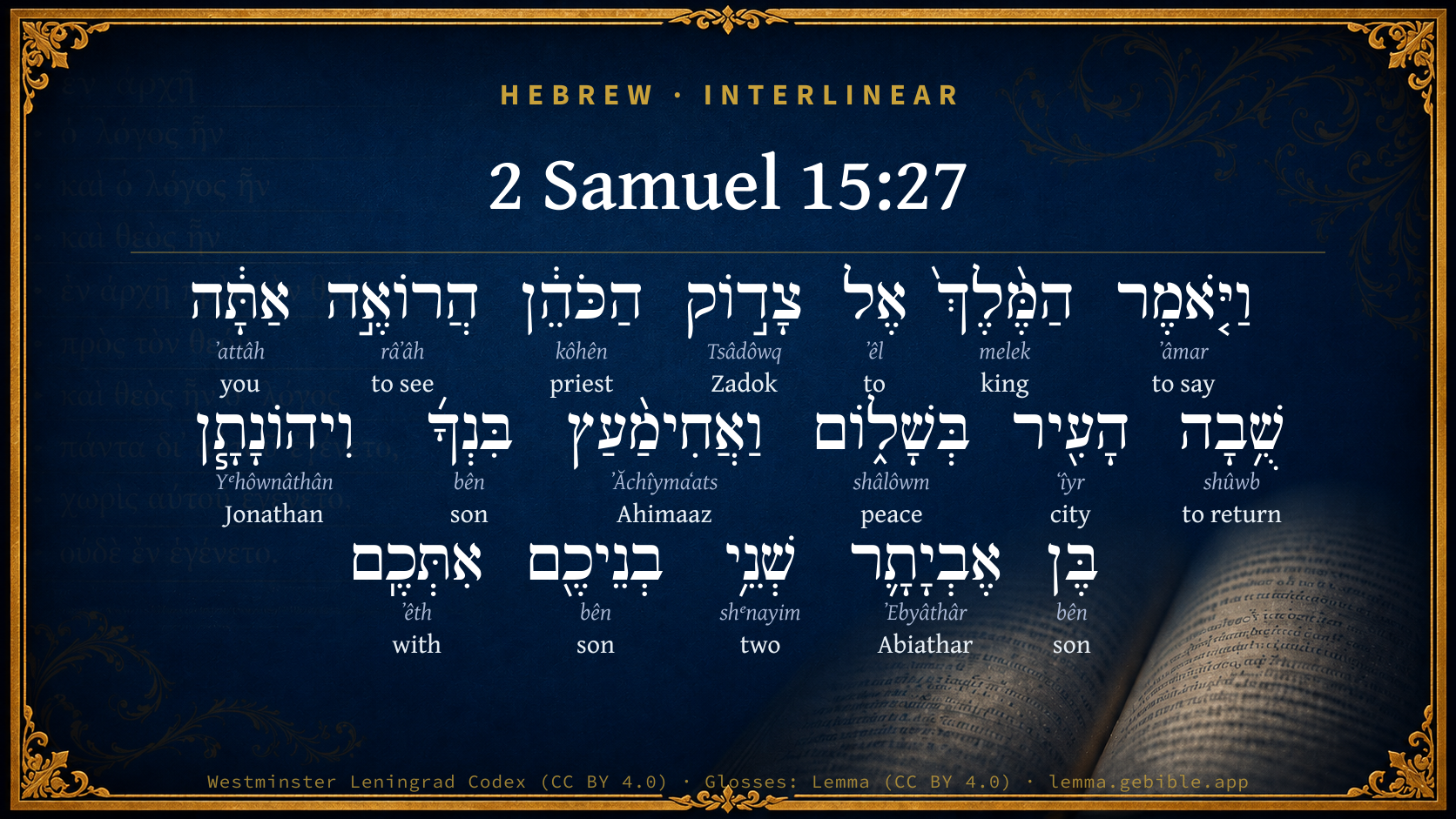
Hebrew (Westminster Leningrad Codex) 2 Samuel 15:27 appears in the Hebrew Old Testament. The text above is from the Westminster Leningrad Codex. Each word links to its Strong’s number, a concise gloss, and parsing drawn from the Open Scriptures Hebrew Bible morphology. Click any word for its full Brown-Driver-Briggs (BDB) entry.
Download image
Cite this verse

2 Samuel 15:27 (World English Bible). Public Domain. Lemma interlinear Bible study tool, https://lemma.gebible.app/v/2-samuel/15/27.

Show BibTeX & RIS
BibTeX
RIS
English Translation
The king said also to Zadok the priest, "Aren't you a seer? Return into the city in peace, and your two sons with you, Ahimaaz your son, and Jonathan the son of Abiathar.
World English Bible · Public Domain
Download a study sheet

One document with this verse’s original text, its word-by-word gloss line, the meaning frame, cross-references with their text, attributed commentary, and full source and license credits — printable, and it pastes into notes with its structure intact.

This verse Autodidact and up

Study sheet (.html) Plain text (.txt)

A passage Seminary Student

Up to 50 verses in one chapter. A passage sheet keeps up to 6 commentary sources and 12 cross-references per verse, in the order this page ranks them, and says so on the sheet whenever that leaves anything out. Ask for a single verse and you get the Autodidact verse sheet above.

Everything on this page stays free to read, with no account — the sheet is a download of what is already on screen, not access to it.

Want to remove ads? Support Godless Engineer
Compare translations 3

The same verse in 3 English versions, stacked beneath the original-language interlinear above. Click any original word for its lexicon entry.

Each is an independent rendering of the whole verse — the interlinear is not word-aligned to these translations.

Highlighted words mark where these versions differ — a whole-verse word diff, not a word-by-word alignment.

  • World English Bible Public Domain
    The king said also to Zadok the priest, "Aren't you a seer? Return into the city in peace, and your two sons with you, Ahimaaz your son, and Jonathan the son of Abiathar.
  • King James Version Public Domain
    The king said also unto Zadok the priest, Art not thou a seer? return into the city in peace, and your two sons with you, Ahimaaz thy son, and Jonathan the son of Abiathar.
  • unfoldingWord Literal Text CC BY-SA 4.0
    And the king said to Zadok the priest, “Are you seeing? Return the city in peace, and Ahimaaz your son and Jonathan the son of Abiathar, your two sons, with you.

unfoldingWord Literal Text — © unfoldingWord, licensed CC BY-SA 4.0. Word-aligned USFM3 via Door43 (git.door43.org/unfoldingWord/en_ult).

Versions to compare (up to 4)

3 of 4 selected

Show all 18 translations

Every available English version of this verse, each an independent rendering of the whole verse.

  • World English Bible Public Domain
    The king said also to Zadok the priest, "Aren't you a seer? Return into the city in peace, and your two sons with you, Ahimaaz your son, and Jonathan the son of Abiathar.
  • Berean Standard Bible Public Domain
    The king also said to Zadok the priest, “Are you not a seer? Return to the city in peace—you with your son Ahimaaz, and Abiathar with his son Jonathan.
  • Majority Standard Bible Public Domain
    The king also said to Zadok the priest, “Are you not a seer? Return to the city in peace—you with your son Ahimaaz, and Abiathar with his son Jonathan.
  • King James Version Public Domain
    The king said also unto Zadok the priest, Art not thou a seer? return into the city in peace, and your two sons with you, Ahimaaz thy son, and Jonathan the son of Abiathar.
  • American Standard Version (1901) Public Domain
    The king said also unto Zadok the priest, Art thou `not' a seer? return into the city in peace, and your two sons with you, Ahimaaz thy son, and Jonathan the son of Abiathar.
  • Revised Version (1885) Public Domain
    The king said also unto Zadok the priest, Art thou not a seer? return into the city in peace, and your two sons with you, Ahimaaz thy son, and Jonathan the son of Abiathar.
  • Geneva Bible (1599) Public Domain
    The King sayde againe vnto Zadok the Priest, Art not thou a Seer? returne into the citie in peace, and your two sonnes with you: to wit, Ahimaaz thy sonne, and Ionathan the sonne of Abiathar.
  • Douay-Rheims (1899) Public Domain
    And the king said to Sadoc the priest: O seer, return into the city in peace: and let Achimaas thy son, and Jonathan the son of Abiathar, your two sons, be with you.
  • Young's Literal Translation Public Domain
    And the king saith unto Zadok the priest, `Art thou a seer? turn back to the city in peace, and Ahimaaz thy son, and Jonathan son of Abiathar, your two sons with you;
  • Literal Standard Version CC BY-SA 4.0
    And the king says to Zadok the priest, “Are you a seer? Return to the city in peace, and your son Ahimaaz, and Jonathan son of Abiathar, your two sons with you;
  • Unlocked Literal Bible CC BY-SA 4.0
    The king also said to Zadok the priest, “Are you not a seer? Return into the city in peace, and your two sons with you, Ahimaaz your son, and Jonathan son of Abiathar.
  • unfoldingWord Literal Text CC BY-SA 4.0
    And the king said to Zadok the priest, “Are you seeing? Return the city in peace, and Ahimaaz your son and Jonathan the son of Abiathar, your two sons, with you.
  • Darby Bible Public Domain
    And the king said to Zadok the priest, Thou art the seer: return into the city in peace, and your two sons with you, Ahimaaz thy son, and Jonathan the son of Abiathar.
  • World Messianic Bible Public Domain
    The king said also to Zadok the priest, “Aren’t you a seer? Return into the city in peace, and your two sons with you, Ahimaaz your son and Jonathan the son of Abiathar.
  • Webster's Bible Public Domain
    The king said also to Zadok the priest, Art not thou a seer? return into the city in peace, and your two sons with you, Ahimaaz thy son, and Jonathan the son of Abiathar.
  • Free Bible Version CC BY-SA 4.0
    The king also told Zadok the priest, “You understand the situation, don't you? Go back to the city safely with your son Ahimaaz, and also Jonathan, son of Abiathar. You and Abiathar take both of your sons back with you.
  • Bible in Basic English Public Domain
    The king said further to Zadok the priest, See, you and Abiathar are to go back to the town in peace, with your two sons, Ahimaaz, your son, and Jonathan, the son of Abiathar.
  • JPS Tanakh (1917) Public Domain
    The king said also unto Zadok the priest: 'Seest thou? return into the city in peace, and your two sons with you, Ahimaaz thy son, and Jonathan the son of Abiathar.

Literal Standard Version (2020), Covenant Press — licensed CC BY-SA 4.0. Text via the HelloAO Bible API (eBible.org). Unlocked Literal Bible (unfoldingWord) — licensed CC BY-SA 4.0. Text via the HelloAO Bible API (eBible.org). unfoldingWord Literal Text — © unfoldingWord, licensed CC BY-SA 4.0. Word-aligned USFM3 via Door43 (git.door43.org/unfoldingWord/en_ult). Free Bible Version, Dr. Jonathan Gallagher — licensed CC BY-SA 4.0. Text via the HelloAO Bible API (eBible.org).

Word by word

More ways to search: Search by grammar → Find every occurrence → Compare this word →

Practice this passage: Drill this verse → Learn its vocabulary →

וַאֲחִימַ֨עַץ
ʼĂchîymaʻats
H290
“and · Ahimaaz”
Conjunction + Noun, Proper
Part of Speech
Conjunction + Noun
Type
Proper
Full BDB Definition

Origin: from H251 and the equivalent of H4619

TWOT: None

Ahimaaz = "my brother is anger (wrath)" - father-in-law of Saul - Zadok's son who aided David during Absalom's rebellion - a supply officer of Solomon
  1. וַיֹּ֤אמֶר ʼâmar H559 “and · to say” Conjunction + Verb, Qal, Sequential Imperfect, 3rd Person, Masculine, Singular
  2. הַמֶּ֨לֶךְ֙ melek H4428 “the · king” Particle, Definite Article + Noun, Common, Masculine, Singular, Absolute
  3. אֶל ʼêl H413 “to” Preposition
  4. צָד֣וֹק Tsâdôwq H6659 “Zadok” Noun, Proper
  5. הַכֹּהֵ֔ן kôhên H3548 “the · priest” Particle, Definite Article + Noun, Common, Masculine, Singular, Absolute
  6. הֲרוֹאֶ֣ה râʼâh H7200 “the · seeing” Particle, Definite Article + Verb, Qal, Participle Active, Masculine, Singular, Absolute
  7. אַתָּ֔ה ʼattâh H859 “you” Pronoun, Personal, 2nd Person, Masculine, Singular
  8. שֻׁ֥בָה shûwb H7725 “return · toward” Verb, Qal, Imperative, 2nd Person, Masculine, Singular + Suffix, Demonstrative
  9. הָעִ֖יר ʻîyr H5892 “the · city” Particle, Definite Article + Noun, Common, Feminine, Singular, Absolute
  10. בְּשָׁל֑וֹם shâlôwm H7965 “in/at · peace” Preposition + Noun, Common, Masculine, Singular, Absolute
  11. בִּנְךָ֜ bên H1121 “son · your” Noun, Common, Masculine, Singular, Construct + Suffix, Personal, 2nd Person, Masculine, Singular
  12. וִיהוֹנָתָ֧ן Yᵉhôwnâthân H3083 “and · Jonathan” Conjunction + Noun, Proper
  13. בֶּן bên H1121 “son of” Noun, Common, Masculine, Singular, Construct
  14. אֶבְיָתָ֛ר ʼEbyâthâr H54 “Abiathar” Noun, Proper
  15. שְׁנֵ֥י shᵉnayim H8147 “two” Adjective, Cardinal number, Masculine, Dual, Construct
  16. בְנֵיכֶ֖ם bên H1121 “sons · your” Noun, Common, Masculine, Plural, Construct + Suffix, Personal, 2nd Person, Masculine, Plural
  17. אִתְּכֶֽם ʼêth H854 “with · you” Preposition + Suffix, Personal, 2nd Person, Masculine, Plural

About this verse

These counts appear in no published source. They are computed here, from the morphology-tagged text and Lemma’s own curated glosses. What Lemma adds →

18
words
16
distinct lemmas
Historical
section

Notable vocabulary

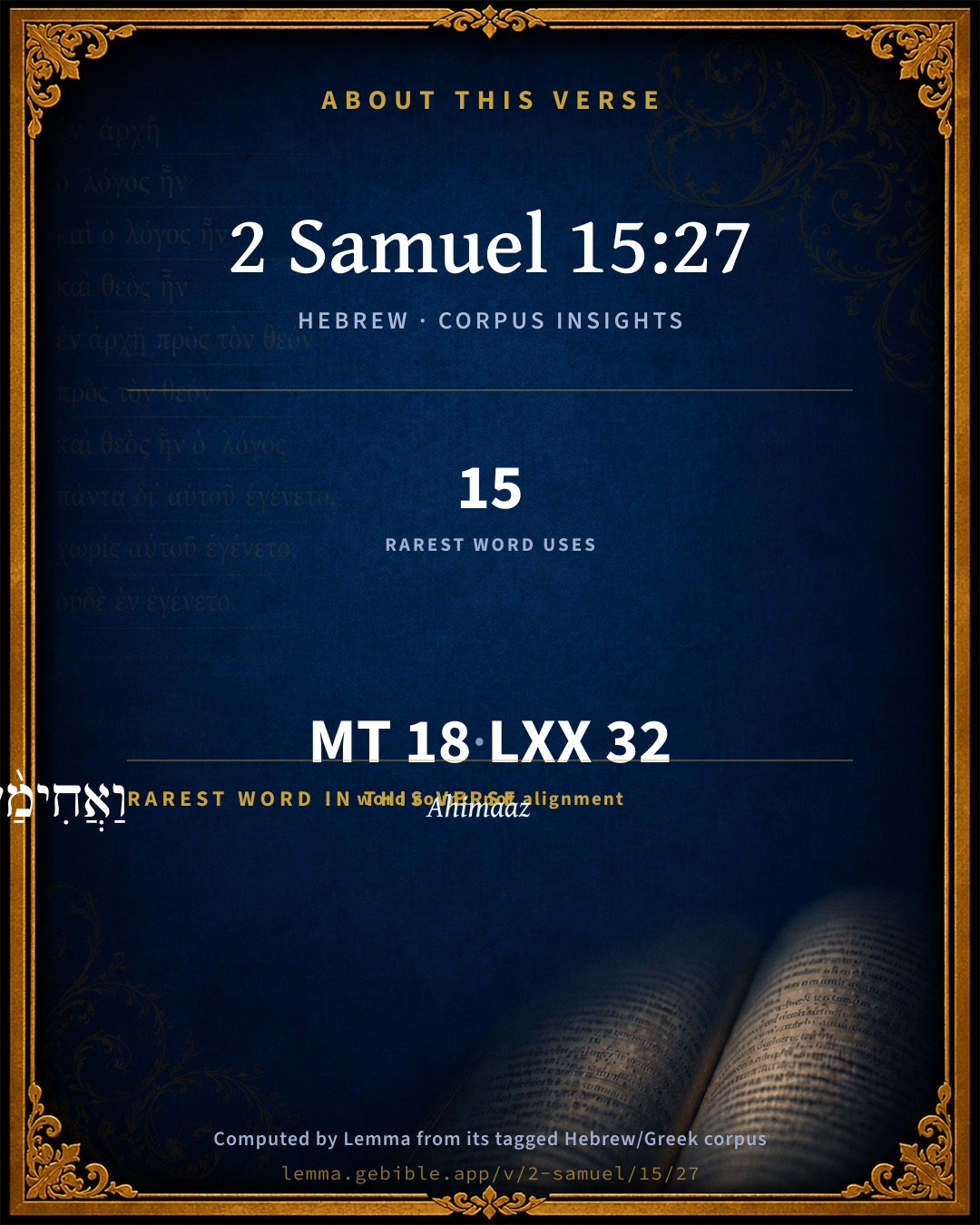
The rarest word here is וַאֲחִימַ֨עַץ Ahimaaz H290 — appearing just 15 times in the whole Hebrew Bible.

Shared distinctive vocabulary

וַאֲחִימַ֨עַץ Ahimaaz H290 occurs in 15 verses of the Hebrew Bible. Also found in:

Grammatical profile

  • 3 verbs
  • 11 nouns
  • 1 adjective
  • 1 pronoun
  • 2 prepositions

Verb forms

  • וַיֹּ֤אמֶר Qal · Sequential Imperfect
  • הֲרוֹאֶ֣ה Qal · Participle Active
  • שֻׁ֥בָה Qal · Imperative

Repetition

A word recurs within this verse — often emphatic in Hebrew:

  • בִּנְךָ֜ son H1121 ×3

Hebrew & Septuagint length

In English translation the verse runs 33 words from the Hebrew and 32 from the Septuagint (LXX English) — closely comparable.

A rough comparison of the two English renderings, which tokenize alike — not a word-level alignment.

Word counts can differ between the Hebrew and the Greek without any difference in meaning — e.g. the Hebrew direct-object marker אֵת has no separate Greek word, and Greek often adds the article ὁ.

In the original languages it is 18 Hebrew tokens and 32 Greek tokens — but the two are counted differently (Hebrew bundles its prefixes and suffixes into one token; the Greek is in lemma form), so that isn’t a like-for-like length.

Cross-references

6

Topical passages linked to 2 Samuel 15:27 in the Treasury of Scripture Knowledge — connected by theme and wording, ordered by reader-vote popularity; previews shown in the World English Bible.

  • 1 Samuel 9:9 (In earlier times in Israel, when a man went to inquire of God, thus he said, Come, and let us go to the seer; for he who is now called a Prophet was before called a Seer.)
  • 2 Samuel 17:17 Now Jonathan and Ahimaaz were staying by En Rogel; and a maid-servant used to go and tell them; and they went and told king David: for they might not be seen to come into the city.
  • 2 Samuel 15:34 but if you return to the city, and tell Absalom, I will be your servant, O king; as I have been your father's servant in time past, so will I now be your servant; then will you defeat for me the counsel of Ahithophel.
  • 2 Samuel 15:36 Behold, they have there with them their two sons, Ahimaaz, Zadok's son, and Jonathan, Abiathar's son; and by them you shall send to me everything that you shall hear.
  • 2 Samuel 24:11 When David rose up in the morning, the word of Yahweh came to the prophet Gad, David's seer, saying,
  • 1 Chronicles 25:5 All these were the sons of Heman the king's seer in the words of God, to lift up the horn. God gave to Heman fourteen sons and three daughters.

Cross-references courtesy of OpenBible.info (CC BY 4.0).

Hebrew and Greek witnesses Masoretic Hebrew ↔ Greek Septuagint

The same verse in the two great witnesses to the Old Testament, shown verse-for-verse.

These are two independent witnesses, not word-aligned to each other, and the Septuagint is shown in lemma (dictionary) form.

Hebrew 2 Samuel 15:27 Masoretic · Westminster Leningrad Codex

וַיֹּ֤אמֶר הַמֶּ֨לֶךְ֙ אֶל צָד֣וֹק הַכֹּהֵ֔ן הֲרוֹאֶ֣ה אַתָּ֔ה שֻׁ֥בָה הָעִ֖יר בְּשָׁל֑וֹם וַאֲחִימַ֨עַץ בִּנְךָ֜ וִיהוֹנָתָ֧ן בֶּן אֶבְיָתָ֛ר שְׁנֵ֥י בְנֵיכֶ֖ם אִתְּכֶֽם

The king said also to Zadok the priest, "Aren't you a seer? Return into the city in peace, and your two sons with you, Ahimaaz your son, and Jonathan the son of Abiathar.

World English Bible · Public Domain

Greek LXX 2 Samuel 15:27 Septuagint · lemma form

καί εἶπον ὁ βασιλεύς ὁ σαδωκ ὁ ἱερεύς ὁράω σύ ἐπιστρέφω εἰς ὁ πόλις ἐν εἰρήνη καί αχιμαας ὁ υἱός σύ καί ιωναθαν ὁ υἱός αβιαθαρ ὁ δύο υἱός σύ μετά σύ

And the king said to Sadoc the priest, Behold, you shall return to the city in peace, and Achimaas your son, and Jonathan the son of Abiathar, your two sons with you.

LXX2012 (modern English Septuagint) · Public Domain

On this verse, Haydock's Catholic Bible Commentary discusses the Septuagint’s reading. Read the note in Commentary ↓

Hebrew: Westminster Leningrad Codex (CC BY 4.0). Greek: Septuagint (public domain); English from LXX2012 (modern English Septuagint) (Public Domain). How the Septuagint differs from the Hebrew →

Targum (Aramaic paraphrase)

1

The Targum is the ancient Jewish Aramaic paraphrase of the Hebrew Scriptures — an interpretive translation, not the Hebrew text itself. Onkelos (literal) and Pseudo-Jonathan (expansive) render the Torah, and Jonathan the Prophets. Coverage is partial: where no permissively-licensed English translation exists for a verse, only the Aramaic is shown. This is verse-level text, not a word-by-word alignment to the Hebrew.

  1. Targum Jonathan Prophets (Joshua–Malachi)
    וַאֲמַר מַלְכָּא לְצָדוֹק כַּהֲנָא חֶזְוַיָא אַתְּ תּוּב לְקַרְתָּא בִּשְׁלָם וַאֲחִימַעַץ בְּרָךְ וִיהוֹנָתָן בַּר אֶבְיָתָר תְּרֵין בְּנֵיכוֹן עִמְכוֹן:

    (no public-domain English translation for this verse)

    Targum Jonathan — Aramaic: “Mikraot Gedolot” (public domain). English: “Sefaria Community Translation” (CC0 1.0 (public-domain dedication)); “London "Chaldee Paraphrase," 1871” (public domain). Text via Sefaria.

Commentary

Notes on 2 Samuel 15:27 from classic Christian and Jewish commentators (each source and its license shown beneath its notes). The classic Christian expositions comment on the surrounding passage and are grouped to its opening verse, so a note may address several verses; the Jewish commentaries on the Tanakh (Rashi and others) are per-verse, so they appear only where the commentator wrote on this verse.

Lemma curates 59 commentaries, every one of them public domain or Creative Commons licensed, each selected and text-cleaned for this edition rather than reprinted as found. About our sources →

Trapp's Complete Commentary

John Trapp

2Sa 15:27 The king said also unto Zadok the priest, [Art not] thou a seer? return into the city in peace, and your two sons with you, Ahimaaz thy son, and Jonathan the son of Abiathar.

Ver. 27. Art not thou a seer?] i.e., A prophet. {1Sa 9:9} And is it not, therefore, fit that thou shouldst abide with the people to teach and instruct them in the will of God according to thine office especially, since in so doing, thou mayst also do me singular good service?

John Trapp, A Commentary or Exposition upon All the Books of the Old and New Testament (1647–1656) — public domain. Text from a community e-Sword module.

Joseph Benson's Commentary

2Sa 15:27. Art thou not a seer? Return into the city in peace — “It should seem from hence,” says Delaney, “that Zadok was a prophet: however, as a priest, he was a teacher; and as such, bound to stay with his people in the greatest exigencies, and instruct them in their duty: besides that, by staying to do his duty to his people, he might also do good offices to his prince.” Indeed, the word ראה, roeh, here rendered seer, means also a seeing, discerning and observing man: an interpretation which suits well with the present state of David’s mind and affairs. As if he had said, Thou art a wise man, fit to make observations on what is passing in Jerusalem, and to give me information thereof. Accordingly David concerted a plan, both with Zadok and Abiathar, of corresponding with him, and sending him intelligence of all his enemies’ measures by their sons, Ahimaaz and Jonathan.

Joseph Benson's Commentary on the Old and New Testaments (1811–1818) — public domain. Text from a community e-Sword module.

Tyndale Open Study Notes

Tyndale Open Resources

15:27 Ahimaaz and Jonathan supported David during Absalom’s coup d’etat by serving as his secret messengers (see 15:36; 17:17-22).

Tyndale Open Study Notes — © Tyndale Open Resources, licensed CC BY-SA 4.0. Text via the HelloAO Bible API.

Adam Clarke's Commentary

Verse 27. Art not thou a seer? return into the city in peace] That is, As thou art the only organ of the public worship, that worship cannot be carried on without thee; and as thou art the priest of God, thou hast no cause to fear for thy personal safety: the nation has not abandoned their God, though they have abandoned their king. It appears also, that he wished these priests, by means of their sons, Ahimaaz the son of Zadok, and Jonathan the son of Abiathar, to send him frequent intelligence of the motions and operations of the enemy.

Adam Clarke's Commentary on the Bible (1810–1826) — public domain. Text from a community e-Sword/MySword module.

Ellicott's Commentary for English Readers

(27) Art not thou a seer?—The Hebrew is difficult, and must be translated either. Art thou a seer? or, with a very slight change in a vowel, as an address, Thou seer. Zadok is so called because he was now in some sort to fulfil the office of a prophet in guiding David’s course, and also in making known to him the events taking place in Jerusalem which would show God’s will concerning him. Nothing is said in any part of this narrative of Nathan and Gad, both of whom were certainly still living (2Sa_24:11; 2Sa_24:13-14; 1Ki_1:11).

Your two sons with you.—Zadok only has been mentioned, and probably Abiathar was not present at the moment, but David shows by this way of speaking that he means to address them both.

A Bible Commentary for English Readers, edited by Charles John Ellicott (1878–1897) — public domain. Text from a community e-Sword module.

The Cambridge Bible for Schools and Colleges

gen. ed. J. J. S. Perowne

27. Art not thou a seer] An obscure expression variously explained. (1) Art thou a seer? The high-priest is supposed to be called a seer, because he received divine revelations by means of the Urim and Thummim; but there is no trace of such a use of the term elsewhere. (2) Dost thou see? i.e. understand: an untenable rendering. (3) The Vulg. gives different vowels to the consonants, and renders, O seer, return, &c. (4) The Sept. reads, See! thou shalt return, which requires but a small change in the Heb. text, and is probably the best solution of the difficulty.

The Cambridge Bible for Schools and Colleges (gen. ed. J. J. S. Perowne; Cambridge University Press, 1878–1918) — public domain. Text from a community e-Sword module.

John Gill's Exposition

And the king said unto Zadok the priest, art not thou a seer?.... A prophet, as well as a priest; see Sa1 9:9; or a seeing, knowing, man; one that can penetrate into men and things, and so might be of more service to David at Jerusalem than with him: wherefore he said to him:

return into the city in peace; to the city of Jerusalem with peace, quietness, and satisfaction of mind; where he doubted not, at least hoped and wished, he would be in safety and prosperity, being one of the Lord's priests:

and your two sons with you, Ahimaaz thy son, and Jonathan the son of Abiathar; the one was of the line of Eleazar, and the other of the line of Ithamar.

John Gill's Exposition of the Whole Bible (1746–1763) — public domain (CC PDM 1.0). Text via the HelloAO Bible API.

Albert Barnes' Notes on the Bible

Art not those a seer? - If the text be correct, the sense would be, “Art thou not a seer? therefore go back to the city, and observe, and certify me of what thou seest” 2Sa 15:28. Others, by a slight alteration of the original text, read “Art not thou a chief” (priest), etc.

Albert Barnes' Notes on the Bible (1834–1885) — public domain. Text from a community e-Sword/MySword module.

Haydock's Catholic Bible Commentary

Seer, supposing he was high priest, along with Abiathar, he might be thus addressed as one who consulted God by the ephod, as he might also, if he presided over the prophets, like Chonenias, 1 Paralipomenon xv. 22. (Dionysius) (Menochius) --- Hebrew, "Art not thou a seer?" a prudent man, who may be of greater service to me in the city; (Haydock; or) seest thou not "the state of my affairs?" Septuagint, "See and return." Follow my advice, or then act as your own wisdom dictates. (Calmet)

George Leo Haydock (1774–1849), Haydock's Catholic Family Bible and Commentary, 1859 edition — public domain. Excludes Psalms (Douay-Rheims chapter numbering differs from Protestant) and Deuterocanonical books (Catholic canon only).

Matthew Poole's English Annotations

The king said also unto Zadok; either because Abiathar was gone from him, 2Sa 15:24, and not yet returned; or because David put more confidence in Zadok.

A seer, i.e. either,

1. A prophet, for such were called seers, 1Sa 9:9; 2Sa 24:11; Amo 7:12. And such he may be called, either because he really had the gift of prophecy or because as the name of prophets is sometimes given to those who had not prophetical gifts, but were only officers and minsters devoted to and employed in God’s worship and service, as 1Sa 10:5, &c.; 1Ki 18:4,13; compare 1Ch 25:1-3; so it is reasonable that the name of seers be extended to the same latitude; and therefore he may properly and fitly be called a

seer, as he was with and under Abiathar the chief governor of the house and worship of God; who, by his office, was to instruct and direct the people in those matters, whereby he had many opportunities both of sifting out Absalom’s counsels, and of minding the people of their duty to David, as he saw opportunity: which sense suits well with David’s scope and design. Or,

2. A seeing, or discerning, or observing man; for so the Hebrew verb raah is oft used. And this suits well with David’s mind: Thou art a wise man, and therefore fit to manage this great business, which requires prudence and secrecy.

In peace; as men of peace, giving over all thoughts of war, and devoting yourselves entirely to God’s service.

Matthew Poole's English Annotations on the Holy Bible (1683–1685) — public domain. Text from a community e-Sword/MySword module.

Whedon's Commentary on the Bible

Daniel D. Whedon

27. Art not thou a seer — Luther, after the Vulgate, renders the words as an exclamation, Thou seer! On the word, see 1Sa_9:9. As seer he could best serve the king by remaining in Jerusalem, and thence secretly sending him word of all that might be of advantage to him to know.

Daniel D. Whedon (gen. ed.), Commentary on the Old and New Testaments (1874–1909) — public domain. Text from a community e-Sword module.

The Pulpit Commentary

Art thou (not) a seer? Both the Authorized Version and the Revised Version evade the difficulty of this passage by inserting the word "not." It is one of the merits of the Revised Version that usually it does not take these liberties. But "Art thou a seer?" is meaningless; and the attempts, moreover, to show that Zadok was a seer fail entirely in proof. The receiving revelations by Urim and Thummim was a priestly, and not a prophetic, function. Without altering the text, the words may be correctly translated, "Seest thou?" This was probably a colloquial phrase, of which the Septuagint gives the sense by rendering it in the imperative, "See;" while the Syriac, regarding it as an expletive, boldly omits it.

The Pulpit Commentary (1880–1919), ed. H.D.M. Spence-Jones & Joseph S. Exell — public domain. Text from a community e-Sword module.

John Wesley's Explanatory Notes

A seer - A seeing, discerning, or observing man: for so the Hebrew verb raah is often used. And this suits well with David's mind: Thou art a wise man, and therefore fit to manage this great business, which requires prudence and secrecy.

John Wesley, Explanatory Notes Upon the Whole Bible (1754–1765) — public domain. Text via the GEBible commentary corpus.

unfoldingWord translationNotes

Door43 World Missions Community

Ahimaaz

This is the name of a man. (See: How to Translate Names)

Abiathar

See how you translated this man's name in 2 Samuel 8:17.

Are you not a seer?

This rhetorical question is used to rebuke Zadok and can be translated as a statement. AT: "You will be able to find out what is happening." (See: Rhetorical Question)

See

Here this word means for the listener to pay attention to what is said next. AT: "Listen"

until word comes from you

This refers to him sending a messenger to the king. AT: "until you send a messenger to me to inform me" (See: Metonymy)

to inform me

Here the king implies he is to receive a message informing him about what is happening in Jerusalem. AT: "to tell me what is happening in Jerusalem" (See: Assumed Knowledge and Implicit Information)

translationWords

priest

prophet

Jonathan

Arabah

word

unfoldingWord translationNotes — © Distant Shores Media and the Door43 World Missions Community, licensed CC BY-SA 4.0. Source: git.door43.org/Door43/en_tn.

Rashi

Rabbi Shlomo Yitzchaki (Rashi)

If you see this [as right]. I you see this as a good idea, "return to the city etc.

Your two sons with you. It will be in their power to inform me what they hear in the king's palace. And based on what they inform me I can escape.

Rashi on the Tanakh — English translations: “The Judaica Press complete Tanach with Rashi, translated by A. J. Rosenberg” (CC BY 4.0); “Pentateuch with Rashi's commentary by M. Rosenbaum and A.M. Silbermann, 1929-1934” (public domain); “The Metsudah Tanach series, Lakewood, N.J” (CC BY 4.0); and “The Book of Joshua, Metsudah Publications, 1997” (CC BY 4.0). Text via Sefaria.

Lesson kit

Teaching starters — assembled from the data on this page, not authored interpretation. Every prompt links to the verse data it draws on. Edit before teaching.

2 Samuel, in the Historical, opens this verse with 18 words (16 distinct Hebrew lemmas). Its most distinctive word is ʼĂchîymaʻats (“Ahimaaz”). A historical commentator’s framing appears above. Read the whole chapter for the surrounding context.

Discussion questions

  1. The word ʼĂchîymaʻats carries the sense “Ahimaaz.” How does it shape the verse?
  2. 1 Samuel 14:50 shares the word «Ahimaaz» with this verse. How do the two illuminate each other?
  3. “son” occurs 3× in this one verse. What is the effect of the repetition?
  4. These translations render this verse differently. What is at stake in choosing one wording over another?
  5. The verb «וַיֹּ֤אמֶר» is Qal Sequential Imperfect. How does its form color the action?
  6. Reading how Trapp's Complete Commentary and Joseph Benson's Commentary read this verse, where do the two commentators agree and where do they part?

Things to notice

Reading settings

Reading text

Shown beneath each verse's original-language words.

Old Testament
Old Testament edition

Read the OT as the Masoretic Hebrew (MT) or the Greek Septuagint (LXX).

English shown for the Greek Septuagint (in the Hebrew ↔ Greek comparison).

Comparing translations? Open the Compare panel on any verse page to stack up to four side by side.