
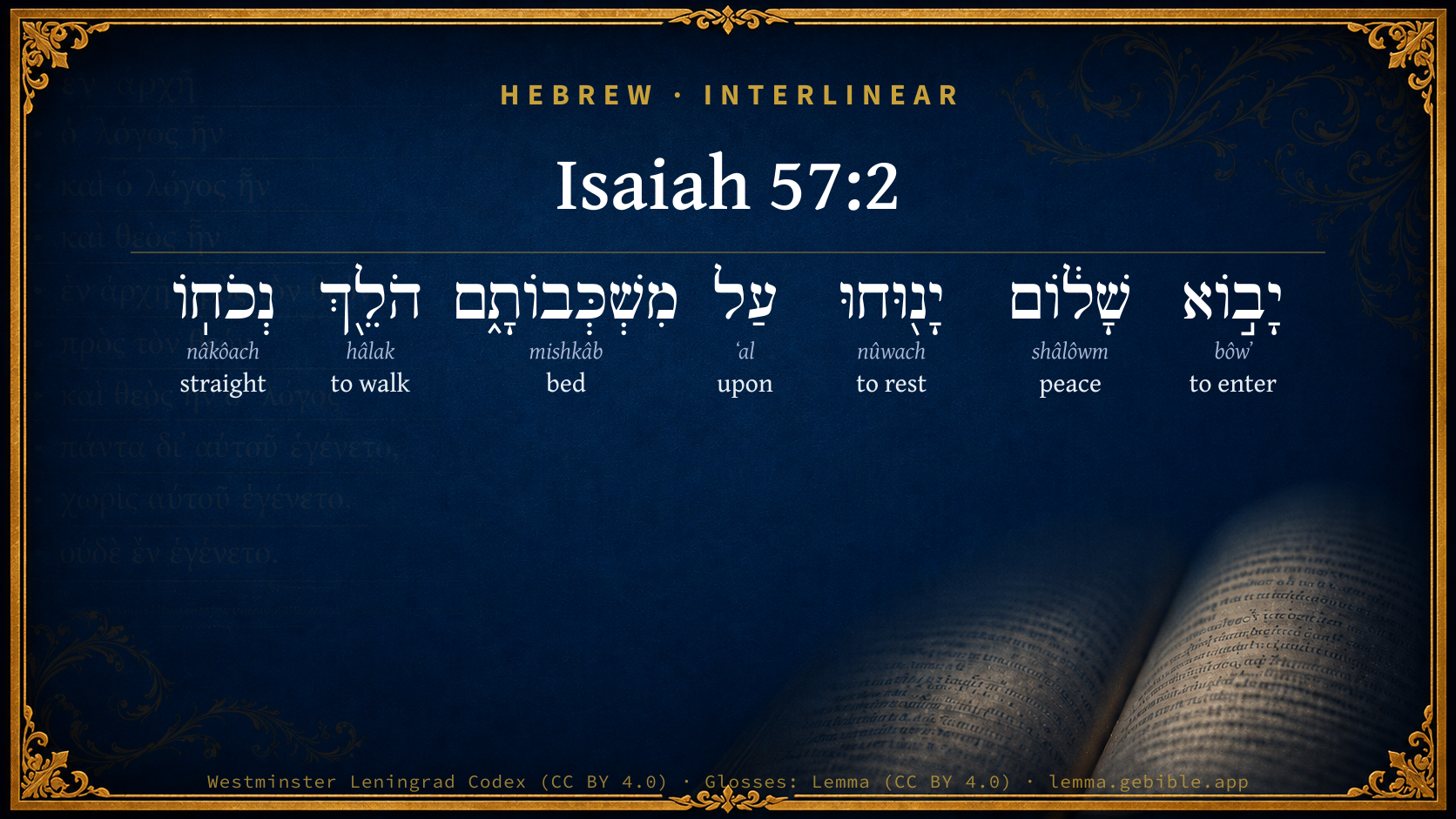
Isaiah 57:2

Hebrew (Westminster Leningrad Codex) Isaiah 57:2 appears in the Hebrew Old Testament. The text above is from the Westminster Leningrad Codex. Each word links to its Strong’s number, a concise gloss, and parsing drawn from the Open Scriptures Hebrew Bible morphology. Click any word for its full Brown-Driver-Briggs (BDB) entry.
Download image
Cite this verse

Isaiah 57:2 (World English Bible). Public Domain. Lemma interlinear Bible study tool, https://lemma.gebible.app/v/isaiah/57/2.

Show BibTeX & RIS
BibTeX
RIS
English Translation
He enters into peace; they rest in their beds, each one who walks in his uprightness.
World English Bible · Public Domain
Download a study sheet

One document with this verse’s original text, its word-by-word gloss line, the meaning frame, cross-references with their text, attributed commentary, and full source and license credits — printable, and it pastes into notes with its structure intact.

This verse Autodidact and up

Study sheet (.html) Plain text (.txt)

A passage Seminary Student

Up to 50 verses in one chapter. A passage sheet keeps up to 6 commentary sources and 12 cross-references per verse, in the order this page ranks them, and says so on the sheet whenever that leaves anything out. Ask for a single verse and you get the Autodidact verse sheet above.

Everything on this page stays free to read, with no account — the sheet is a download of what is already on screen, not access to it.

Want to remove ads? Support Godless Engineer
Compare translations 3

The same verse in 3 English versions, stacked beneath the original-language interlinear above. Click any original word for its lexicon entry.

Each is an independent rendering of the whole verse — the interlinear is not word-aligned to these translations.

Highlighted words mark where these versions differ — a whole-verse word diff, not a word-by-word alignment.

  • World English Bible Public Domain
    He enters into peace; they rest in their beds, each one who walks in his uprightness.
  • King James Version Public Domain
    He shall enter into peace: they shall rest in their beds, each one walking in his uprightness.
  • unfoldingWord Literal Text CC BY-SA 4.0
    He enters peace, they rest on their beds, the one walking his uprightness. q1

unfoldingWord Literal Text — © unfoldingWord, licensed CC BY-SA 4.0. Word-aligned USFM3 via Door43 (git.door43.org/unfoldingWord/en_ult).

Versions to compare (up to 4)

3 of 4 selected

Show all 18 translations

Every available English version of this verse, each an independent rendering of the whole verse.

  • World English Bible Public Domain
    He enters into peace; they rest in their beds, each one who walks in his uprightness.
  • Berean Standard Bible Public Domain
    Those who walk uprightly enter into peace; they find rest, lying down in death.
  • Majority Standard Bible Public Domain
    Those who walk uprightly enter into peace; they find rest, lying down in death.
  • King James Version Public Domain
    He shall enter into peace: they shall rest in their beds, each one walking in his uprightness.
  • American Standard Version (1901) Public Domain
    He entereth into peace; they rest in their beds, each one that walketh in his uprightness.
  • Revised Version (1885) Public Domain
    He entereth into peace; they rest in their beds, each one that walketh in his uprightness.
  • Geneva Bible (1599) Public Domain
    Peace shall come: they shall rest in their beds, euery one that walketh before him.
  • Douay-Rheims (1899) Public Domain
    Let peace come, let him rest in his bed that hath walked in his uprightness.
  • Young's Literal Translation Public Domain
    He entereth into peace, they rest on their beds, `Each' is going straightforward.
  • Literal Standard Version CC BY-SA 4.0
    He enters into peace, they rest on their beds, || [Each] is going straightforward.
  • Unlocked Literal Bible CC BY-SA 4.0
    He enters into peace; they rest in their beds, those who walk in their uprightness.
  • unfoldingWord Literal Text CC BY-SA 4.0
    He enters peace, they rest on their beds, the one walking his uprightness. q1
  • Darby Bible Public Domain
    He entereth into peace: they rest in their beds, [each one] that hath walked in his uprightness.
  • World Messianic Bible Public Domain
    He enters into peace. They rest in their beds, each one who walks in his uprightness.
  • Webster's Bible Public Domain
    He shall enter into peace: they shall rest in their beds, each one walking in his uprightness.
  • Free Bible Version CC BY-SA 4.0
    Those who follow what's right rest in peace; they find rest as they lie down in death.
  • Bible in Basic English Public Domain
    They are at rest in their last resting-places, every one going straight before him.
  • JPS Tanakh (1917) Public Domain
    He entereth into peace, they rest in their beds, each one that walketh in his uprightness.

Literal Standard Version (2020), Covenant Press — licensed CC BY-SA 4.0. Text via the HelloAO Bible API (eBible.org). Unlocked Literal Bible (unfoldingWord) — licensed CC BY-SA 4.0. Text via the HelloAO Bible API (eBible.org). unfoldingWord Literal Text — © unfoldingWord, licensed CC BY-SA 4.0. Word-aligned USFM3 via Door43 (git.door43.org/unfoldingWord/en_ult). Free Bible Version, Dr. Jonathan Gallagher — licensed CC BY-SA 4.0. Text via the HelloAO Bible API (eBible.org).

Word by word

More ways to search: Search by grammar → Find every occurrence → Compare this word →

Practice this passage: Drill this verse → Learn its vocabulary →

About this verse

These counts appear in no published source. They are computed here, from the morphology-tagged text and Lemma’s own curated glosses. What Lemma adds →

7
words
7
distinct lemmas
Prophets
section

Notable vocabulary

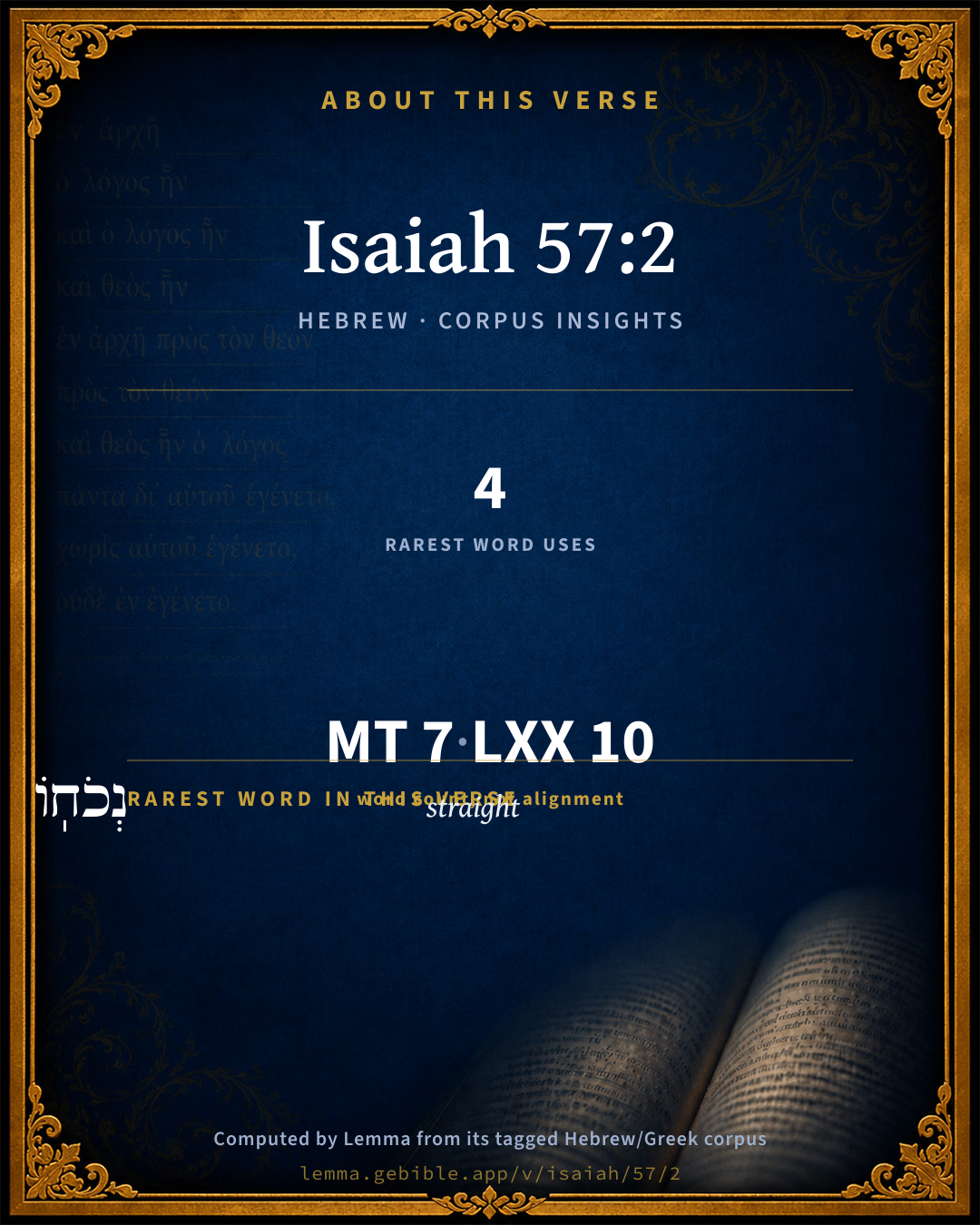
The rarest word here is נְכֹחֽוֹ straight H5228 — appearing just 4 times in the whole Hebrew Bible.

Shared distinctive vocabulary

נְכֹחֽוֹ straight H5228 occurs in 4 verses of the Hebrew Bible. Also found in:

Grammatical profile

  • 3 verbs
  • 2 nouns
  • 1 adjective
  • 1 preposition

Verb forms

  • יָב֣וֹא Qal · Imperfect
  • יָנ֖וּחוּ Qal · Imperfect
  • הֹלֵ֖ךְ Qal · Participle Active

Hebrew & Septuagint length

In English translation the verse runs 16 words from the Hebrew and 14 from the Septuagint (LXX English) — closely comparable.

A rough comparison of the two English renderings, which tokenize alike — not a word-level alignment.

Word counts can differ between the Hebrew and the Greek without any difference in meaning — e.g. the Hebrew direct-object marker אֵת has no separate Greek word, and Greek often adds the article ὁ.

In the original languages it is 7 Hebrew tokens and 10 Greek tokens — but the two are counted differently (Hebrew bundles its prefixes and suffixes into one token; the Greek is in lemma form), so that isn’t a like-for-like length.

Cross-references

16

Topical passages linked to Isaiah 57:2 in the Treasury of Scripture Knowledge — connected by theme and wording, ordered by reader-vote popularity; previews shown in the World English Bible.

  • Revelation 14:13 I heard the voice from heaven saying, "Write, 'Blessed are the dead who die in the Lord from now on.'" "Yes," says the Spirit, "that they may rest from their labors; for their works follow with them."
  • 2 Corinthians 5:1 For we know that if the earthly house of our tent is dissolved, we have a building from God, a house not made with hands, eternal, in the heavens.
  • Job 3:17 There the wicked cease from troubling; There the weary are at rest.
  • Luke 2:29 "Now you are releasing your servant, Master, According to your word, in peace;
  • Ecclesiastes 12:7 And the dust returns to the earth as it was, And the spirit returns to God who gave it.
  • 2 Corinthians 5:8 We are of good courage, I say, and are willing rather to be absent from the body, and to be at home with the Lord.
  • 2 Chronicles 16:14 They buried him in his own tombs, which he had hewn out for himself in the city of David, and laid him in the bed which was filled with sweet odors and various kinds [of spices] prepared by the perfumers' are: and they made a very great burning for him.
  • Matthew 25:21 "His lord said to him, 'Well done, good and faithful servant. You have been faithful over a few things, I will set you over many things. Enter into the joy of your lord.'
  • Luke 7:50 He said to the woman, "Your faith has saved you. Go in peace."
  • Ezekiel 32:25 They have set her a bed in the midst of the slain with all her multitude; her graves are round about her; all of them uncircumcised, slain by the sword; for their terror was caused in the land of the living, and they have borne their shame with those who go down to the pit: he is put in the midst of those who are slain.
  • Luke 16:22 It happened that the beggar died, and that he was carried away by the angels to Abraham's bosom. The rich man also died, and was buried.
  • Philippians 1:23 But I am in a dilemma between the two, having the desire to depart and be with Christ, which is far better.
  • Genesis 17:1 When Abram was ninety-nine years old, Yahweh appeared to Abram, and said to him, "I am God Almighty. Walk before me, and be blameless.
  • Isaiah 14:18 All the kings of the nations, all of them, sleep in glory, everyone in his own house.
  • Isaiah 26:7 The way of the just is uprightness: you that are upright do direct the path of the just.
  • Luke 1:6 They were both righteous before God, walking blamelessly in all the commandments and ordinances of the Lord.

Cross-references courtesy of OpenBible.info (CC BY 4.0).

Hebrew and Greek witnesses Masoretic Hebrew ↔ Greek Septuagint

The same verse in the two great witnesses to the Old Testament, shown verse-for-verse.

These are two independent witnesses, not word-aligned to each other, and the Septuagint is shown in lemma (dictionary) form.

Hebrew Isaiah 57:2 Masoretic · Westminster Leningrad Codex

יָב֣וֹא שָׁל֔וֹם יָנ֖וּחוּ עַל מִשְׁכְּבוֹתָ֑ם הֹלֵ֖ךְ נְכֹחֽוֹ

He enters into peace; they rest in their beds, each one who walks in his uprightness.

World English Bible · Public Domain

Greek LXX Isaiah 57:2 Septuagint · lemma form

εἰμί ἐν εἰρήνη ὁ ταφή αὐτός αἴρω ἐκ ὁ μέσος

His burial shall be in peace: he has been removed out of the way.

LXX2012 (modern English Septuagint) · Public Domain

On this verse, Adam Clarke's Commentary discusses the Septuagint’s reading. Read the note in Commentary ↓

Hebrew: Westminster Leningrad Codex (CC BY 4.0). Greek: Septuagint (public domain); English from LXX2012 (modern English Septuagint) (Public Domain). How the Septuagint differs from the Hebrew →

Targum (Aramaic paraphrase)

1

The Targum is the ancient Jewish Aramaic paraphrase of the Hebrew Scriptures — an interpretive translation, not the Hebrew text itself. Onkelos (literal) and Pseudo-Jonathan (expansive) render the Torah, and Jonathan the Prophets. Coverage is partial: where no permissively-licensed English translation exists for a verse, only the Aramaic is shown. This is verse-level text, not a word-by-word alignment to the Hebrew.

  1. Targum Jonathan Prophets (Joshua–Malachi)
    יְהָכוּן שְׁלָם יְנוּחוּן עַל אֲתַר בֵּית מִשְׁכָּבֵיהוֹן עָבְדֵי אוֹרַיְתֵהּ:

    They shall enter into peace; they shall rest in the place of their beds, those that do His law.

    Targum Jonathan — Aramaic: “Mikraot Gedolot” (public domain). English: “Sefaria Community Translation” (CC0 1.0 (public-domain dedication)); “London "Chaldee Paraphrase," 1871” (public domain). Text via Sefaria.

Commentary

Notes on Isaiah 57:2 from classic Christian and Jewish commentators (each source and its license shown beneath its notes). The classic Christian expositions comment on the surrounding passage and are grouped to its opening verse, so a note may address several verses; the Jewish commentaries on the Tanakh (Rashi and others) are per-verse, so they appear only where the commentator wrote on this verse.

Lemma curates 59 commentaries, every one of them public domain or Creative Commons licensed, each selected and text-cleaned for this edition rather than reprinted as found. About our sources →

Trapp's Complete Commentary

John Trapp

Isa 57:2 He shall enter into peace: they shall rest in their beds, [each one] walking [in] his uprightness.

Ver. 2. He shall enter into peace,] i.e., Into heaven, where the righteous - however looked upon as lost {Isa 57:1} - shall have "life and peace," {Rom 8:6} joy and bliss, {Mat 25:21; Mat 25:23} rest and peace, {Rev 14:13} and this απαρτι amodo, strait upon it so soon as ever they are dead; from henceforth forthwith their souls have happiness inconceivable. As for their bodies,

They shall rest in their beds.] So their graves are called, by an elegant metaphor, like as the bier that carrieth to it is called matteh, a couch, {2Sa 3:31} the burying place, a dormitory, {a} or place to sleep in, and the resurrection an awakening. {Psa 17:15} To this bed Moses went up when his Father bade. He died ad os Iehovae according to the word of God, {Deu 34:5} which the Jewish doctors {b} expound as though God did take away his soul with a kiss, like as the loving mother kisseth the child, and then layeth it down to sleep. Rhodingus, a Dutch divine, when he perceived he should die, desired to be laid in another bed, which he called his bed of rest, and upon which he had long before written this verse - {c}

“ Ut somnus mortis, sic lectus imago sepulchri. ”

In this short bed of the grave shall be laid up the infinite miseries of many years; the bodies of the saints shall, by rotting, be refined, their precious dust preserved, till at last it arise incorruptible. O dieculam illam!

Each one walking in his uprightness.] Or, Walking before him, or right over against him; that is, keeping equipage with him, as when one friend walketh with another.

{a} κοιμητηριον.

{b} Maimonid.

{c} Melch. Adam.

John Trapp, A Commentary or Exposition upon All the Books of the Old and New Testament (1647–1656) — public domain. Text from a community e-Sword module.

The Biblical Illustrator

Joseph S. Exell

Isa_57:2

He shall enter into peace

The believer in life, death, and eternity

Taking them together, the words of the text will lead us to contemplate the child of God--

I.

IN THE STRENGTH AND VIGOUR OF LIFE.

II. IN THE SUFFERING AND THE ARTICLE OF DEATH.

III. IN THE CONSEQUENCES OF DISSOLUTION, AS THEY AFFECT BOTH BODY AND SOUL. (J. Haslegrave, M. A.)

A glimmering of New Testament consolation

Here is a glimmering of the consolation in the New Testament, that the death of the righteous man is better than the present life, because it is the entrance into peace. (F. Delitzsch, D. D.)

The Biblical Illustrator, edited by Joseph S. Exell (c. 1880s–1900s) — public domain. Text from a community e-Sword module.

Tyndale Open Study Notes

Tyndale Open Resources

57:2 The wicked would not be able to rest in peace (57:21).

Tyndale Open Study Notes — © Tyndale Open Resources, licensed CC BY-SA 4.0. Text via the HelloAO Bible API.

Geneva Bible (1599)

Geneva Bible translators

The soul of the righteous shall be in joy, and their body shall rest in the grave unto the time of the resurrection, because they walked before the Lord.

Geneva Bible (1599) marginal notes — public domain. Text via Bolls.life.

Jamieson, Fausset & Brown

Robert Jamieson, A. R. Fausset & David Brown

Or, "he entereth into peace"; in contrast to the persecutions which he suffered in this world (Job 3:13, Job 3:17). The Margin not so well translates, "he shall go in peace" (Psa 37:37; Luk 2:29).

rest--the calm rest of their bodies in their graves (called "beds," Ch2 16:14; compare Isa 14:18; because they "sleep" in them, with the certainty of awakening at the resurrection, Th1 4:14) is the emblem of the eternal "rest" (Heb 4:9; Rev 14:13).

each one walking in . . . uprightness--This clause defines the character of those who at death "rest in their beds," namely, all who walk uprightly.

Jamieson, Fausset & Brown — Commentary Critical and Explanatory on the Whole Bible (1871) — public domain (CC PDM 1.0). Text via the HelloAO Bible API.

Adam Clarke's Commentary

Verse 2. He shalt enter into peace - "He shall go in peace"] יבוא שלום yabo shalom; the expression is elliptical, such as the prophet frequently uses. The same sense is expressed at large and in full terms, Ge 15:15: ואתה תבא אל אבותיך בשלום veattah libbo al abotheycha beshalom, "and thou shalt go to thy fathers in peace."

They shall rest in their beds, each one walking in his uprightness - "He shall rest in his bed; even the perfect man."] This obscure sentence is reduced to a perfectly good sense, and easy construction by an ingenious remark of Dr. Durell. He reads ינוח על משכבו תם yanuach al mishcabo tam, "the perfect man shall rest in his bed." Two MSS. (one of them ancient) have ינוח yanuach, singular; and so the Vulgate renders it, requiescat, "he shall rest." The verb was probably altered to make it plural, and so consistent with what follows, after the mistake had been made in the following words, by uniting משכבו mishcabo and תם tam into one word. See Merrick's Annotations on the Psalms, Addenda; where the reader will find that J. S. Moerlius, by the same sort of correction, and by rescuing the adjective תם tam, which had been swallowed up in another word in the same manner, has restored to a clear sense a passage before absolutely unintelligible: -

למו חרצבות אין כי

lemo chartsubboth ein ki

אולם ובריא תם

ulam ubari tham

"For no distresses happen to them;

Perfect and firm is their strength."

Ps 73:4.

To follow on my application of this to our Lord: - HE, the JUST ONE, shall enter into peace - the peaceable, prosperous possession of the glorious mediatorial kingdom. They shall rest upon their beds - the hand of wrong and oppression can reach these persecuted followers of Christ no more. (But see below.) The perfect man walking in his uprightness. This may be considered as a general declaration. The separated spirit, though disunited from its body, walking in conscious existence in the paradise of God, reaping the fruit of righteousness. The word which we render their beds, משכבותם mishkebotham, the learned bishop supposes to be two words; and to be compounded of משכבו mishkabo, his bed, and תם tam, the upright or perfect man. This is the reading both of the Syriac and Vulgate, and it is favoured by the Chaldee: and one of De Rossi's MS. has משכבו mishkabo, his bed, without the word תם tam, which has been added by a later hand. Bishop Lowth, as we have seen, adopts this separation of the word and for ינוחו yanuchu, they shall rest, reads ינוה yanuach, he shall rest, which is supported by two of Dr. Kennicott's MSS., and by the Vulgate, Septuagint, and Arabic. The word תם tam, taken from משכבותם mishkebotham, should begin the latter clause of the verse; and then the interpolated words, each one, which our translators supplied, may be very well spared. The verse may be then read and paraphrased thus; -

He shall enter into peace: he shall rest upon his bed;

The perfect man walking in his uprightness.

The bed must signify the grave; the walking in uprightness after death, the conscious existence of the happy spirit, and its eternal progression in happiness and perfection: נכחו nechochol straight before him; proceeding into the unlimited extent of eternal glory, increasing in happiness, and increasing in perfection.

My old MS. Bible translates very nervously: -

The rigtwise man perishith,

And there is not that bethinke in his herte.

And men of mercy ben gedrid,

For there is not that understonde:

From the face forsoth of malice,

Gedreid is the rigtwise.

Cumm pese: reste it in his bed

That geede in his rigt rewlinge.

It has been often remarked that, previously to the execution of God's judgments upon a wicked place, he has removed good men from it, that they might not suffer with the wicked. When great and good men are removed by death, or otherwise, from any place, the remaining inhabitants have much cause to tremble.

Adam Clarke's Commentary on the Bible (1810–1826) — public domain. Text from a community e-Sword/MySword module.

Ellicott's Commentary for English Readers

(2) He shall enter into peace . . .—Notice- able as presenting the brighter side of the dim thoughts of Israel as to the life behind the veil, and so far contrasted with Hezekiah’s shrinking fear. (Comp. Job_3:17.) For the righteous there was peace in death as in life. For the wicked there was peace in neither (Isa_57:21).

They shall rest in their beds.—The “bed” is obviously the grave, the thought following naturally on that of death being as the sleep “after life’s fitful fever.” (Eze_32:25.)

Each one walking in his uprightness.—Better, every one who has walked straight before him—has taken, i.e., the straight path of duty (Isa_30:21.)

A Bible Commentary for English Readers, edited by Charles John Ellicott (1878–1897) — public domain. Text from a community e-Sword module.

The Cambridge Bible for Schools and Colleges

gen. ed. J. J. S. Perowne

2. Render with R.V. (and marg.) He entereth into peace; they rest in their beds, each one that walked straight before him. The “peace” and “rest” spoken of are those of the grave (Job_3:13 ff.), the “bed” is the bier or coffin; cf. 2Ch_16:14; Eze_32:25. The same word is used of the sarcophagus in the Phœnician inscription of Eshmunazar (“the lid of this bed”).

“After life’s fitful fever he sleeps well.”

The same feeling is expressed with great pathos in an eloquent passage of the book of Job (Isa_3:13 ff.). It is a sentiment that has appealed to the human mind in all ages; but to the O.T. believers it brought no relief from the shuddering recoil from death expressed in other passages, nowhere more forcibly than in the words of Job himself.

each one that walked, &c.] i.e. every one who led a simple, straightforward, upright life; cf. Pro_4:25-27. The clause is an extension of the subject of the sentence.

The Cambridge Bible for Schools and Colleges (gen. ed. J. J. S. Perowne; Cambridge University Press, 1878–1918) — public domain. Text from a community e-Sword module.

John Gill's Exposition

He shall enter into peace,.... Or "shall go in peace" (d); the righteous man goes in peace now; he has peace from his justifying righteousness; he has peace through believing in Christ; he has peace in, though not from, his obedience and holiness of life; and he has peace in the midst of the many trials he is exercised with; and he goes out of the world in peace, with great serenity and tranquillity of mind, as Simeon desired he might, having views of an interest in Christ, and in the glories of another world; and as soon as he is departed from hence he enters into peace, into a state where there is everything that makes for peace; there is the God of peace; there is Christ, the Prince of peace; there is the Spirit, whose fruit is peace; and there are the angels of peace, and good men, the sons of peace: and there is nothing there to disturb their peace, no sin within, nor Satan's temptations without, nor any wicked men to annoy and molest them; and there is everything that can come under the notion of peace and prosperity; for the happiness of this state is signified by riches, by glory and honour, by a kingdom, and by a paradise; and into this state the righteous may be said to enter immediately upon death, which is no other than stepping out of one world into another; and this they enter into as into a house, as it really is, a house not made with hands, eternal in the heavens; and, entering into it, they take possession of it, and for ever enjoy it:

they shall rest in their beds, their souls in the bosom of Abraham, in the arms of Jesus; their bodies in the grave, which is a bed unto them, where they lie down and sleep, till they are awaked at the resurrection; and where they rest from all toil and labour, from all diseases and distempers, pains and tortures, and from all persecuting enemies; see Rev 14:13,

each one walking in his uprightness; in the righteousness of Christ, and in the shining robes of immortality and glory, and in perfect purity and holiness: or, "before him" (e); before God, in the sight or presence of him, and by sight, and not by faith, as now. Though this is by some considered as the character of the righteous man in life, so Aben Ezra; and then the sense is, that he that walks in his uprightness, in the uprightness or righteousness of Christ, and by faith on him; that walks uprightly in his life and conversation before God, and "before himself"; following the rule before him, and walking according to the rule of the Gospel, and in the ordinances of it blameless, when he comes to die, he enters into peace and rest. And to this sense is the Targum, which paraphrases it,

"that are doers of his law;''

see Rom 2:13. In the Talmud (f) it is interpreted of that peace and happiness righteous men enter into when they die.

(d) "ibit in pace", Gataker. (e) "coram eo", Pagninus, Montanus, Vatablus, Calvin; "ante se", Cocceius, Vitringa. (f) T. Bab. Cetubot, fol. 104. 1.

John Gill's Exposition of the Whole Bible (1746–1763) — public domain (CC PDM 1.0). Text via the HelloAO Bible API.

Albert Barnes' Notes on the Bible

He shall enter into peace - Lowth, ‘He shall go in peace.’ So the margin. Vulgate, ‘Peace shall come.’ Septuagint, ‘His sepulture (ἡ ταφὴ αὐτοῦ hē taphē autou) shall be in peace.’ The idea is, that by his death the righteous man shall enter into rest. He shall get away from conflict, strife, agitation, and distress. This may either refer to the peaceful rest of the grave, or to that which awaits the just in a better world. The direct meaning here intended is probably the former, since the grave is often spoken of as a place of rest. Thus Job Job 3:17, speaking of the grave, says:

There the wicked cease from troubling; And there the weary be at rest.

The connection here seems also to demand the same sense, as it is immediately added, ‘they shall rest in their beds.’ The grave is a place of peace:

Nor pain, nor grief, nor anxious fear,

Invade thy bounds; no mortal woes

Can reach the peaceful sleeper here,

While angels watch the soft repose.

- Watts

At the same time it is true that the dying saint ‘goes in peace!’ He has calmness in his dying, as well as peace in his grave. He forgives all who have injured him; prays for all who have persecuted him; and peacefully and calmly dies. He lies in a peaceful grave - often represented in the Scriptures as a place of repose, where the righteous ‘sleep’ in the hope of being awakened in the morning of the resurrection. He enters into the rest of heaven - the world of perfect and eternal repose. No persecution comes there; no trial awaits him there; no calamity shall meet him there. Thus, in all respects, the righteous leave the world in peace; and thus death ceases to be a calamity, and this most dreaded of all evils is turned into the highest blessing.

They shall rest in their beds - That is, in their graves.

Each one walking in his uprightness - Margin, ‘Before him.’ The word נכח nakkoch means “straight, right,” and is used of one who walks straight forward. It here means an upright man, who is often represented as walking in a straight path in opposition to sinners, who are represented as walking in crooked ways Psa 125:5; Pro 2:15; Isa 59:8; Phi 2:15. The sense here is, that all who are upright shall leave the world in peace, and rest quietly in their graves.

Albert Barnes' Notes on the Bible (1834–1885) — public domain. Text from a community e-Sword/MySword module.

Haydock's Catholic Bible Commentary

Bed. The grave which affords rest to the virtuous, Josias, &c. (Calmet)

George Leo Haydock (1774–1849), Haydock's Catholic Family Bible and Commentary, 1859 edition — public domain. Excludes Psalms (Douay-Rheims chapter numbering differs from Protestant) and Deuterocanonical books (Catholic canon only).

Matthew Poole's English Annotations

He shall enter into peace; this just and merciful man shall enter into a state of peace and rest, where he shall be out of the reach of the approaching miseries. Or, He shall go (to wit, to his fathers, as it is fully expressed, Gen 15:15; or, he shall die; going being put for dying, as 1Ch 17:11, compared with 2Sa 7:12; Job 10:21; 14:20; Luk 22:22, and elsewhere) in peace. They; just men. Here is a sudden change of the number, which is very frequent in the prophets. In their beds; in their graves, which are not unfitly called their beds, or sleeping houses, as their death is commonly called sleep in Scripture. Walking; or, that walketh or did walk, i.e. live. In his uprightness; in a sincere and faithful discharge of his duties to God and men. Or, before him, i.e. before God, according to the usual phrase of Scripture, as Gen 17:1; 1Ki 2:4; 8:25. For God is oft understood where he is not expressed, but only designed by this or the like pronoun, as Gen 15:13, and elsewhere.

Matthew Poole's English Annotations on the Holy Bible (1683–1685) — public domain. Text from a community e-Sword/MySword module.

The Pulpit Commentary

He shall enter into peace. Not merely into "stillness" or "silence", (Psa_115:17) but into "peace," or, as the word might be rendered (Cheyne), "a state of peace." There is, no doubt, primarily, a contrast to the awful troubles which the survivors will have to encounter" (Hengstenberg); but perhaps this contrast is not all that is meant. The "peace" is positive rather than negative, or it would scarcely be a consolation to any one. They shall rest in their beds; or, upon their beds. This expression seems to imply a consciousness of rest, and so a certain enjoyment of it. Each one walking in his uprightness; rather, whosoever hath walked uprightly, or in a straight path. (see Pro_4:25-27) The phrase is an equivalent for "the righteous" of ver. 1, and refers to the life on earth of those who have gone down into silence, not to their life after they have reached the silent shore. Of that life the evangelical prophet is not commissioned to give us any information.

The Pulpit Commentary (1880–1919), ed. H.D.M. Spence-Jones & Joseph S. Exell — public domain. Text from a community e-Sword module.

John Wesley's Explanatory Notes

He - This just and merciful man shall enter into a state of rest, where he shall be out of the reach of the approaching miseries. They - just men. Here is a sudden change of the number, which is very frequent in the prophets. Beds - In their graves, which are not unfitly called their beds, as their death is commonly called sleep in scripture.

John Wesley, Explanatory Notes Upon the Whole Bible (1754–1765) — public domain. Text via the GEBible commentary corpus.

J. A. Alexander on Isaiah

Joseph Addison Alexander

“He shall go in peace (or enter into peace), they shall rest upon their beds, walking straight before him.” The alternation of the singular and plural shows that the subject of the sentence is a collective person. The explanation commonly approved is that which makes the last phrase an additional description of the righteous, as one walking in his uprightness. It seems to be added as a kind of afterthought, to limit what immediately precedes, and preclude its application to all the dead without distinction. The ‘peace’ and ‘rest’ here meant are those of the body in the grave and of the soul in heaven; the former being frequently referred to as a kind of pledge and adumbration of the latter.

Joseph Addison Alexander, The Prophecies of Isaiah (1846–1847; New York: Scribner, 1870–1878) — public domain. Text from a community e-Sword module.

Rashi

Rabbi Shlomo Yitzchaki (Rashi)

He shall come in peace for so says the Holy One, blessed be He, Let this righteous man come to his forefathers in peace, and let him not see the evil.

they shall rest in their resting place when the evil occurs, he who was walking נְכֹחוֹ, in his uprightness. Comp. (Amos 3:10) “To act rightly (נְכֹחָה).”

Rashi on the Tanakh — English translations: “The Judaica Press complete Tanach with Rashi, translated by A. J. Rosenberg” (CC BY 4.0); “Pentateuch with Rashi's commentary by M. Rosenbaum and A.M. Silbermann, 1929-1934” (public domain); “The Metsudah Tanach series, Lakewood, N.J” (CC BY 4.0); and “The Book of Joshua, Metsudah Publications, 1997” (CC BY 4.0). Text via Sefaria.

Ibn Ezra

Rabbi Abraham ibn Ezra

יבא שלום He shall enter into peace, etc. The righteous shall come in peace to his grave; comp. Thou shalt die in peace (Jer. 34:5); And thou shalt go to thy fathers in peace (Gen. 15:15).

ינוחו על משכבותם הלך נכחו They that walk before Him, shall rest in their beds. Comp. אחרי יי אלהיכם תלכו ye shall walk after the Lord your God (Deut. 13:5). Some explain the verse thus: Peace and tranquillity shall come to them, and they that walk, etc.

נִכְחוֹ ═ נְכֹחוֹ Before Him. The form of nouns varies.

Ibn Ezra on the Tanakh — English translations: “Sefaria Community Translation” (CC0 1.0 (public-domain dedication)); “Yalkut, Sifsei Chachomim Chumash, Metsudah Publications, 2009” (CC BY 4.0); and “Commentary of Ibn Ezra on Isaiah - trans. by M. Friedlander, 1873” (public domain). Text via Sefaria.

Lesson kit

Teaching starters — assembled from the data on this page, not authored interpretation. Every prompt links to the verse data it draws on. Edit before teaching.

Isaiah, in the Prophets, opens this verse with 7 words (7 distinct Hebrew lemmas). Its most distinctive word is nâkôach (“straight”). A historical commentator’s framing appears above. Read the whole chapter for the surrounding context.

Discussion questions

  1. How does “straight” (nâkôach) shape what this verse is saying?
  2. How does 2 Samuel 15:3, which shares the word «straight», read alongside this verse?
  3. The translations on this page render this verse differently — a whole-verse word diff, not a word-by-word alignment. What might account for the different wordings?
  4. «יָב֣וֹא» is a Qal Imperfect verb. How does that grammatical form shape the action described?
  5. Compare how Trapp's Complete Commentary and The Biblical Illustrator read this verse. Where do they agree or differ?

Things to notice

Reading settings

Reading text

Shown beneath each verse's original-language words.

Old Testament
Old Testament edition

Read the OT as the Masoretic Hebrew (MT) or the Greek Septuagint (LXX).

English shown for the Greek Septuagint (in the Hebrew ↔ Greek comparison).

Comparing translations? Open the Compare panel on any verse page to stack up to four side by side.