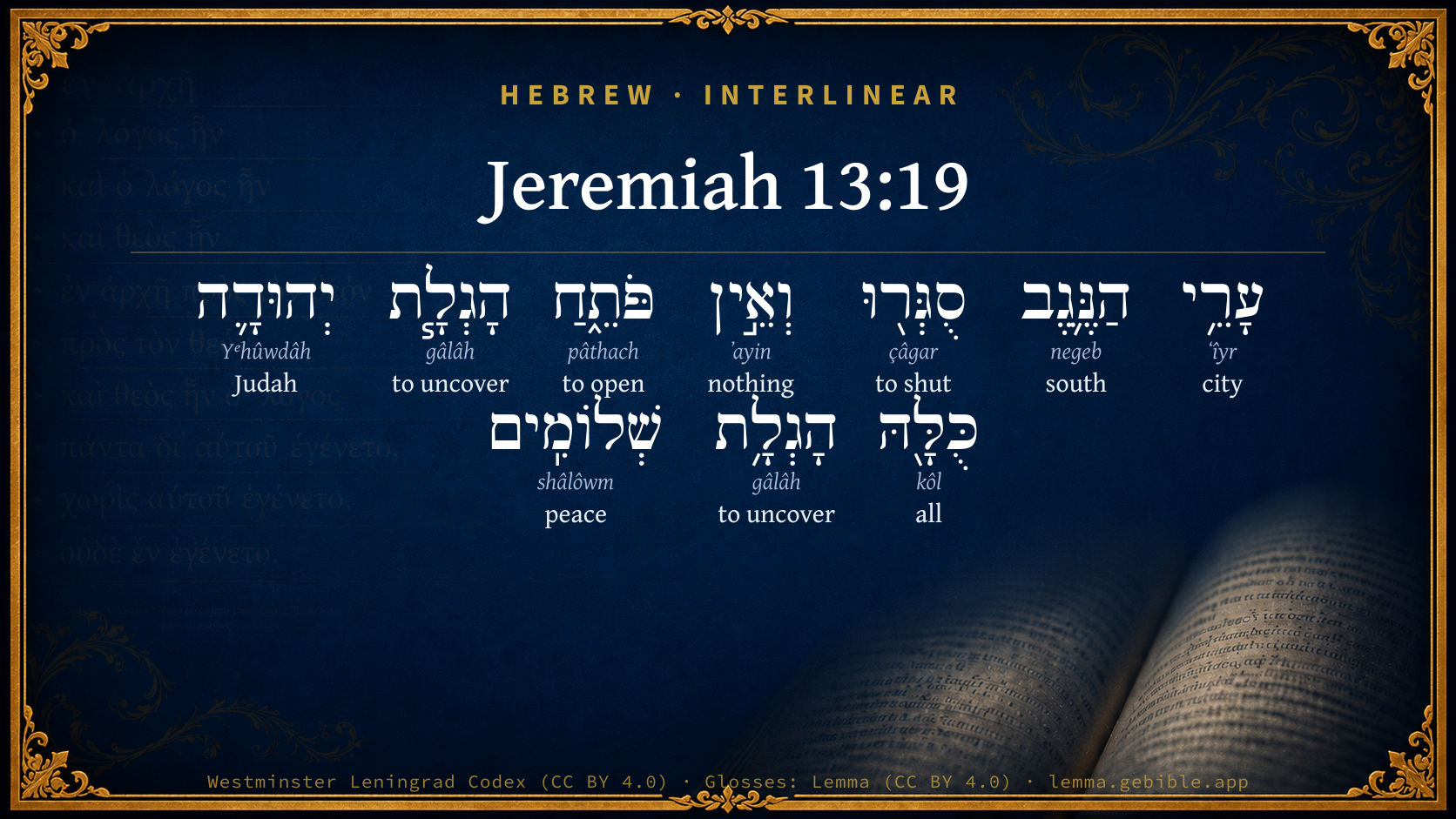
Jeremiah 13:19

Hebrew (Westminster Leningrad Codex) Jeremiah 13:19 appears in the Hebrew Old Testament. The text above is from the Westminster Leningrad Codex. Each word links to its Strong’s number, a concise gloss, and parsing drawn from the Open Scriptures Hebrew Bible morphology. Click any word for its full Brown-Driver-Briggs (BDB) entry.
Download image
Cite this verse

Jeremiah 13:19 (World English Bible). Public Domain. Lemma interlinear Bible study tool, https://lemma.gebible.app/v/jeremiah/13/19.

Show BibTeX & RIS
BibTeX
RIS
English Translation
The cities of the South are shut up, and there is none to open them: Judah is carried away captive, all of it; it is wholly carried away captive.
World English Bible · Public Domain
Download a study sheet

One document with this verse’s original text, its word-by-word gloss line, the meaning frame, cross-references with their text, attributed commentary, and full source and license credits — printable, and it pastes into notes with its structure intact.

This verse Autodidact and up

Study sheet (.html) Plain text (.txt)

A passage Seminary Student

Up to 50 verses in one chapter. A passage sheet keeps up to 6 commentary sources and 12 cross-references per verse, in the order this page ranks them, and says so on the sheet whenever that leaves anything out. Ask for a single verse and you get the Autodidact verse sheet above.

Everything on this page stays free to read, with no account — the sheet is a download of what is already on screen, not access to it.

Want to remove ads? Support Godless Engineer
Compare translations 3

The same verse in 3 English versions, stacked beneath the original-language interlinear above. Click any original word for its lexicon entry.

Each is an independent rendering of the whole verse — the interlinear is not word-aligned to these translations.

Highlighted words mark where these versions differ — a whole-verse word diff, not a word-by-word alignment.

  • World English Bible Public Domain
    The cities of the South are shut up, and there is none to open them: Judah is carried away captive, all of it; it is wholly carried away captive.
  • King James Version Public Domain
    The cities of the south shall be shut up, and none shall open them: Judah shall be carried away captive all of it, it shall be wholly carried away captive.
  • unfoldingWord Literal Text CC BY-SA 4.0
    The cities of the Negev are shut up, and there is not one opening. All of Judah has been exiled, she has been wholly exiled.’”

unfoldingWord Literal Text — © unfoldingWord, licensed CC BY-SA 4.0. Word-aligned USFM3 via Door43 (git.door43.org/unfoldingWord/en_ult).

Versions to compare (up to 4)

3 of 4 selected

Show all 18 translations

Every available English version of this verse, each an independent rendering of the whole verse.

  • World English Bible Public Domain
    The cities of the South are shut up, and there is none to open them: Judah is carried away captive, all of it; it is wholly carried away captive.
  • Berean Standard Bible Public Domain
    The cities of the Negev have been shut tight, and no one can open them. All Judah has been carried into exile, wholly taken captive.
  • Majority Standard Bible Public Domain
    The cities of the Negev have been shut tight, and no one can open them. All Judah has been carried into exile, wholly taken captive.
  • King James Version Public Domain
    The cities of the south shall be shut up, and none shall open them: Judah shall be carried away captive all of it, it shall be wholly carried away captive.
  • American Standard Version (1901) Public Domain
    The cities of the South are shut up, and there is none to open them: Judah is carried away captive, all of it; it is wholly carried away captive.
  • Revised Version (1885) Public Domain
    The cities of the South are shut up, and there is none to open them: Judah is carried away captive all of it; it is wholly carried away captive.
  • Geneva Bible (1599) Public Domain
    The cities of the South shall be shut vp, and no man shall open them: all Iudah shall be caried away captiue: it shall be wholy caried away captiue.
  • Douay-Rheims (1899) Public Domain
    The cities of the south are shut up, and there is none to open them: all Juda is carried away captive with an entire captivity.
  • Young's Literal Translation Public Domain
    The cities of the south have been shut up, And there is none opening, Judah hath been removed -- all of her, She hath been removed completely --
  • Literal Standard Version CC BY-SA 4.0
    The cities of the south have been shut up, || And there is none opening, || Judah has been removed—all of her, || She has been completely removed—
  • Unlocked Literal Bible CC BY-SA 4.0
    The cities in the Negev will be shut up, with no one to open them. All Judah will be taken captive, completely taken captive.
  • unfoldingWord Literal Text CC BY-SA 4.0
    The cities of the Negev are shut up, and there is not one opening. All of Judah has been exiled, she has been wholly exiled.’”
  • Darby Bible Public Domain
    The cities of the south are shut up, and there is none to open [them]; all Judah is carried away captive: it is wholly carried away captive.
  • World Messianic Bible Public Domain
    The cities of the South are shut up, and there is no one to open them. Judah is carried away captive: all of them. They are wholly carried away captive.
  • Webster's Bible Public Domain
    The cities of the south shall be shut up, and none shall open them; Judah shall be carried away captive all of it, it shall be wholly carried away captive.
  • Free Bible Version CC BY-SA 4.0
    The towns in the Negev are surrounded; no one can get through to them. The whole of Judah has been taken away into exile, everyone has been exiled.
  • Bible in Basic English Public Domain
    The towns of the south are shut up, and there is no one to make them open: Judah is taken away as prisoners; all Judah is taken away as prisoners.
  • JPS Tanakh (1917) Public Domain
    The cities of the South are shut up, and there is none to open them; Judah is carried away captive all of it; it is wholly carried away captive.

Literal Standard Version (2020), Covenant Press — licensed CC BY-SA 4.0. Text via the HelloAO Bible API (eBible.org). Unlocked Literal Bible (unfoldingWord) — licensed CC BY-SA 4.0. Text via the HelloAO Bible API (eBible.org). unfoldingWord Literal Text — © unfoldingWord, licensed CC BY-SA 4.0. Word-aligned USFM3 via Door43 (git.door43.org/unfoldingWord/en_ult). Free Bible Version, Dr. Jonathan Gallagher — licensed CC BY-SA 4.0. Text via the HelloAO Bible API (eBible.org).

Word by word

More ways to search: Search by grammar → Find every occurrence → Compare this word →

Practice this passage: Drill this verse → Learn its vocabulary →

סֻגְּר֖וּ
çâgar
H5462
“to shut”
Verb, Pual, Perfect, 3rd Person, Common, Plural
Part of Speech
Verb
Stem
Pual
Form
Perfect
Person
3rd Person
Gender
Common
Number
Plural
Full BDB Definition

Origin: a primitive root

TWOT: 1462

to shut, close - (Qal) - to shut - to close, close up - closed up, closely joined, shut up - (Niphal) - to be shut up - to be shut or closed - (Piel) to shut up, deliver up - (Pual) to be shut up - (Hiphil) - to deliver up - to shut up, imprison
  1. עָרֵ֥י ʻîyr H5892 “cities of” Noun, Common, Feminine, Plural, Construct
  2. הַנֶּ֛גֶב negeb H5045 “the · south” Particle, Definite Article + Noun, Common, Masculine, Singular, Absolute
  3. וְאֵ֣ין ʼayin H369 “and · nothing” Conjunction + Particle, Negative
  4. פֹּתֵ֑חַ pâthach H6605 “opening” Verb, Qal, Participle Active, Masculine, Singular, Absolute
  5. הָגְלָ֧ת gâlâh H1540 “to uncover” Verb, Hophal, Perfect, 3rd Person, Feminine, Singular
  6. יְהוּדָ֛ה Yᵉhûwdâh H3063 “Judah” Noun, Proper
  7. כֻּלָּ֖הּ kôl H3605 “all · her” Noun, Common, Masculine, Singular, Construct + Suffix, Personal, 3rd Person, Feminine, Singular
  8. הָגְלָ֥ת gâlâh H1540 “to uncover” Verb, Hophal, Perfect, 3rd Person, Feminine, Singular
  9. שְׁלוֹמִֽים shâlôwm H7965 “peace” Noun, Common, Masculine, Plural, Absolute

About this verse

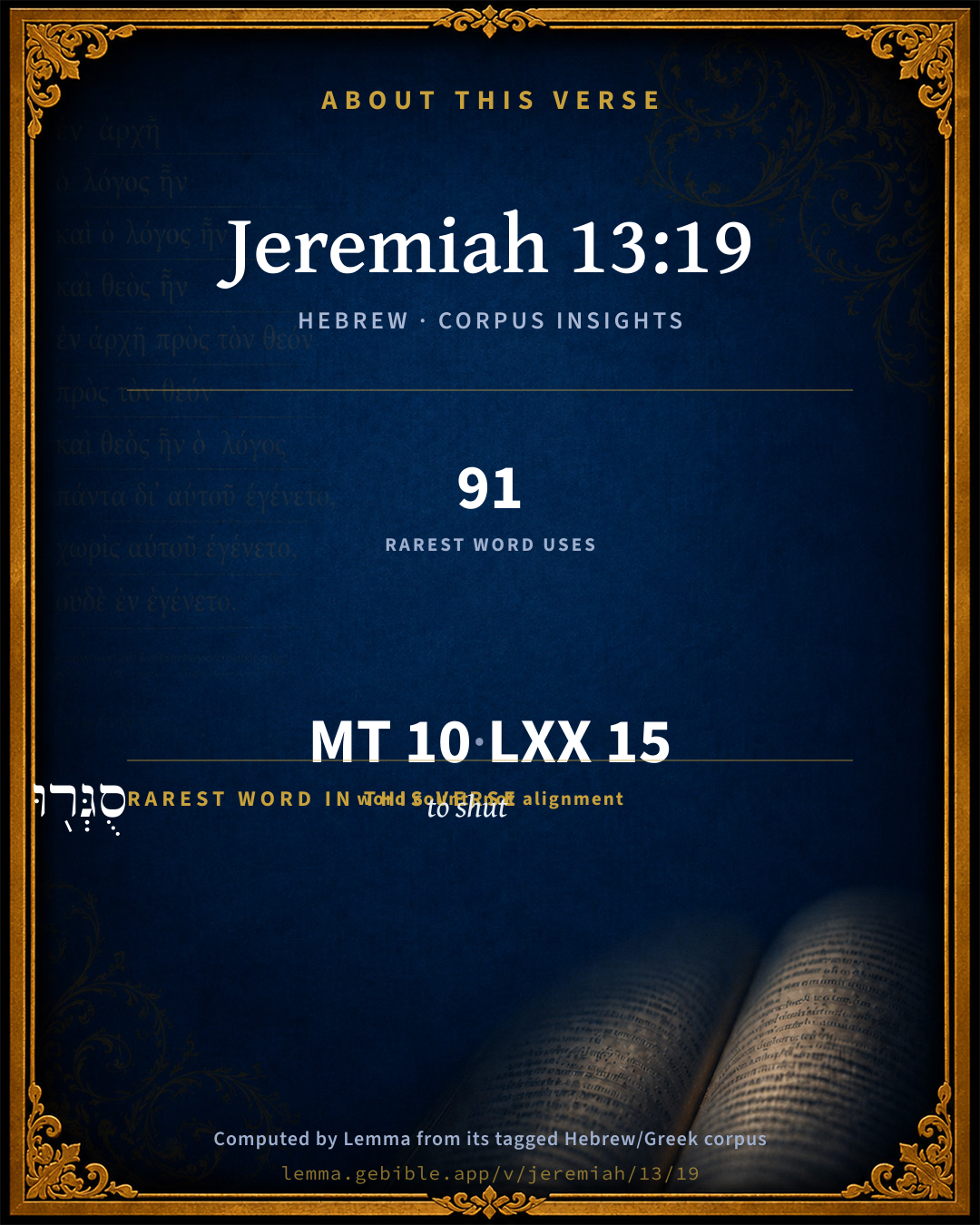
These counts appear in no published source. They are computed here, from the morphology-tagged text and Lemma’s own curated glosses. What Lemma adds →

10
words
9
distinct lemmas
Prophets
section

Grammatical profile

  • 4 verbs
  • 5 nouns
  • 1 particle

Verb forms

  • סֻגְּר֖וּ Pual · Perfect
  • פֹּתֵ֑חַ Qal · Participle Active
  • הָגְלָ֧ת Hophal · Perfect
  • הָגְלָ֥ת Hophal · Perfect

Repetition

A word recurs within this verse — often emphatic in Hebrew:

  • הָגְלָ֧ת to uncover H1540 ×2

Hebrew & Septuagint length

In the original languages it is 10 Hebrew tokens and 15 Greek tokens — but the two are counted differently (Hebrew bundles its prefixes and suffixes into one token; the Greek is in lemma form), so that isn’t a like-for-like length.

Cross-references

14

Topical passages linked to Jeremiah 13:19 in the Treasury of Scripture Knowledge — connected by theme and wording, ordered by reader-vote popularity; previews shown in the World English Bible.

  • Jeremiah 52:27 The king of Babylon struck them, and put them to death at Riblah in the land of Hamath. So Judah was carried away captive out of his land.
  • Deuteronomy 28:52 They shall besiege you in all your gates, until your high and fortified walls come down, in which you trusted, throughout all your land; and they shall besiege you in all your gates throughout all your land, which Yahweh your God has given you.
  • 2 Kings 25:21 The king of Babylon struck them, and put them to death at Riblah in the land of Hamath. So Judah was carried away captive out of his land.
  • Jeremiah 39:9 Then Nebuzaradan the captain of the guard carried away captive into Babylon the residue of the people who remained in the city, the deserters also who fell away to him, and the residue of the people who remained.
  • Jeremiah 52:30 in the three and twentieth year of Nebuchadrezzar Nebuzaradan the captain of the guard carried away captive of the Jews seven hundred forty-five persons: all the persons were four thousand and six hundred.
  • Leviticus 26:31–33 I will lay your cities waste, and will bring your sanctuaries to desolation, and I will not take delight in the sweet fragrence of your offerings.
  • Deuteronomy 28:15 But it shall come to pass, if you will not listen to the voice of Yahweh your God, to observe to do all his commandments and his statutes which I command you this day, that all these curses shall come on you, and overtake you.
  • Deuteronomy 28:64–68 Yahweh will scatter you among all peoples, from the one end of the earth even to the other end of the earth; and there you shall serve other gods, which you have not known, you nor your fathers, even wood and stone.
  • Joshua 18:5 They shall divide it into seven portions: Judah shall abide in his border on the south, and the house of Joseph shall abide in their border on the north.
  • Job 12:14 Behold, he breaks down, and it can't be built again; He imprisons a man, and there can be no release.
  • Jeremiah 17:26 They shall come from the cities of Judah, and from the places round about Jerusalem, and from the land of Benjamin, and from the lowland, and from the hill-country, and from the South, bringing burnt offerings, and sacrifices, and meal-offerings, and frankincense, and bringing [sacrifices of] thanksgiving, to the house of Yahweh.
  • Jeremiah 20:4 For thus says Yahweh, Behold, I will make you a terror to yourself, and to all your friends; and they shall fall by the sword of their enemies, and your eyes shall see it; and I will give all Judah into the hand of the king of Babylon, and he shall carry them captive to Babylon, and shall kill them with the sword.
  • Jeremiah 33:13 In the cities of the hill-country, in the cities of the lowland, and in the cities of the South, and in the land of Benjamin, and in the places about Jerusalem, and in the cities of Judah, shall the flocks again pass under the hands of him who numbers them, says Yahweh.
  • Ezekiel 20:46–47 Son of man, set your face toward the south, and drop [your word] toward the south, and prophesy against the forest of the field in the South;

Cross-references courtesy of OpenBible.info (CC BY 4.0).

Hebrew and Greek witnesses Masoretic Hebrew ↔ Greek Septuagint

The same verse in the two great witnesses to the Old Testament, shown verse-for-verse.

These are two independent witnesses, not word-aligned to each other, and the Septuagint is shown in lemma (dictionary) form.

Hebrew Jeremiah 13:19 Masoretic · Westminster Leningrad Codex

עָרֵ֥י הַנֶּ֛גֶב סֻגְּר֖וּ וְאֵ֣ין פֹּתֵ֑חַ הָגְלָ֧ת יְהוּדָ֛ה כֻּלָּ֖הּ הָגְלָ֥ת שְׁלוֹמִֽים

The cities of the South are shut up, and there is none to open them: Judah is carried away captive, all of it; it is wholly carried away captive.

World English Bible · Public Domain

Greek LXX Structure differs

In the Septuagint, Jeremiah is about an eighth shorter than the Hebrew and arranges its material differently — the Oracles Against the Nations (Hebrew chapters 46–51) appear in the middle of the Greek book, after 25:13. Because the chapter and verse boundaries do not line up, a verse-for-verse comparison with the Hebrew is not shown.

A verse-for-verse comparison isn’t shown here because the chapters and verses don’t line up. Switch to the LXX edition with the MT / LXX toggle above to read the Greek directly.

On this verse, The Cambridge Bible for Schools and Colleges discusses the Septuagint’s reading. Read the note in Commentary ↓

Hebrew: Westminster Leningrad Codex (CC BY 4.0). Greek: Septuagint (public domain); English from a public-domain English Septuagint. How the Septuagint differs from the Hebrew →

Targum (Aramaic paraphrase)

1

The Targum is the ancient Jewish Aramaic paraphrase of the Hebrew Scriptures — an interpretive translation, not the Hebrew text itself. Onkelos (literal) and Pseudo-Jonathan (expansive) render the Torah, and Jonathan the Prophets. Coverage is partial: where no permissively-licensed English translation exists for a verse, only the Aramaic is shown. This is verse-level text, not a word-by-word alignment to the Hebrew.

  1. Targum Jonathan Prophets (Joshua–Malachi)
    קִרְוֵי דָרוֹמָא אִתְאַחִידוּ וְלֵית דְפָּתַח גְלוֹ דְבֵית יְהוּדָה כּוּלְהוֹן גָלוּ שְׁלֵימָא אִתְקַבְּלוּ תוּשְׁלִימַת עוֹבָדֵיכוֹן:

    (no public-domain English translation for this verse)

    Targum Jonathan — Aramaic: “Mikraot Gedolot” (public domain). English: “Sefaria Community Translation” (CC0 1.0 (public-domain dedication)); “London "Chaldee Paraphrase," 1871” (public domain). Text via Sefaria.

Commentary

Notes on Jeremiah 13:19 from classic Christian and Jewish commentators (each source and its license shown beneath its notes). The classic Christian expositions comment on the surrounding passage and are grouped to its opening verse, so a note may address several verses; the Jewish commentaries on the Tanakh (Rashi and others) are per-verse, so they appear only where the commentator wrote on this verse.

Lemma curates 59 commentaries, every one of them public domain or Creative Commons licensed, each selected and text-cleaned for this edition rather than reprinted as found. About our sources →

Trapp's Complete Commentary

John Trapp

Jer 13:19 The cities of the south shall be shut up, and none shall open [them]: Judah shall be carried away captive all of it, it shall be wholly carried away captive.

Ver. 19. The cities of the south shall be shut up,] i.e., The cities of Egypt, whither ye think to flee, shall be shut up against you, through fear of the Chaldees.

John Trapp, A Commentary or Exposition upon All the Books of the Old and New Testament (1647–1656) — public domain. Text from a community e-Sword module.

Joseph Benson's Commentary

Jer 13:19-21. The cities of the south, &c. — The cities of Judah, which lay in the southern part of Canaan, shall be straitly besieged by the enemy, so that there shall be no going in and out; or shall be deserted by the inhabitants. Or, as some think, the cities of Egypt are intended, from whence the Jews expected succour. These should fail them, and they should find no access to them. Lift up your eyes, &c. — He speaks as if their enemies were even then upon their march, nay, so near, that if they did but lift up their eyes and look, they might see them coming. Where is the flock that was given thee? — He streaks to the king, representing him under the idea of a shepherd, and the people under that of a flock. Or rather, as the pronouns are feminine, he addresses the daughter of Judah, that is, the city or state. “What wilt thou say, when the Lord shall demand of thee an account of the people committed to thy trust? What wilt thou answer when the sovereign monarch shall see dissipated, diminished, weakened, destroyed, thy beautiful flock,” or, as צאן תפארתךְrather signifies, the flock of thy glory. In the multitude of people, says Solomon, is the king’s honour. What wilt thou say when he shall punish thee? — Thou wilt have nothing to say, but be wholly confounded, when God shall visit thee by this sore judgment. Or, when Nebuchadnezzar’s army, sent by God, shall visit thee. For thou hast taught them to be captains, &c. — Houbigant renders it, “Since thou hast made them expert against thee, and hast drawn them upon thine own head;” and Blaney, more literally, “Seeing it is thou that teachest them to be rulers in chief over thee.” “Thou hast frequently called them to thy succour, and taught them the way to thy country, whereof they dreamed not before; and not only thus, but by accumulating crimes upon crimes, and filling up the measure of thine iniquity, thou hast drawn down the vengeance of heaven, and put thyself in the power of the Chaldeans.” See Calmet. Some have understood the alliances, contracted heretofore with the Assyrians by Ahaz, and the conduct of Hezekiah toward the ambassadors of the king of Babylon, to be here alluded to. “But I rather think,” says Blaney, “that the wicked manners of the people are principally designed; which put them out of the protection of Almighty God, and rendered them an easy conquest to any enemy that came against them. Thus they taught their enemies to oppress, and to be lords over them; against whom, but for their own faults, they might have maintained their security and independence.”

Joseph Benson's Commentary on the Old and New Testaments (1811–1818) — public domain. Text from a community e-Sword module.

Geneva Bible (1599)

Geneva Bible translators

That is, of Judah, which lieth Southward from Babylon.

Geneva Bible (1599) marginal notes — public domain. Text via Bolls.life.

Jamieson, Fausset & Brown

Robert Jamieson, A. R. Fausset & David Brown

cities of the south--namely, south of Judea; farthest off from the enemy, who advanced from the north.

shut up--that is, deserted (Isa 24:10); so that none shall be left to open the gates to travellers and merchants again [HENDERSON]. Rather, shut up so closely by Nebuchadnezzar's forces, sent on before (Kg2 24:10-11), that none shall be allowed by the enemy to get out (compare Jer 13:20).

wholly--literally, "fully"; completely.

Jamieson, Fausset & Brown — Commentary Critical and Explanatory on the Whole Bible (1871) — public domain (CC PDM 1.0). Text via the HelloAO Bible API.

Adam Clarke's Commentary

Verse 19. The cities of the south shall be shut up] Not only the cities of the north, the quarter at which the Chaldeans entered, but the cities of the south also; for he shall proceed from one extremity of the land to the other, spreading devastation every where, and carrying off the inhabitants.

Adam Clarke's Commentary on the Bible (1810–1826) — public domain. Text from a community e-Sword/MySword module.

John Calvin's Commentaries

By the cities of the south, almost all understand the cities of the tribe of Judah, whose portion was towards the south; and by the cities being shut up, they consider that what is meant is, that they would be forsaken; for they say, that cities are open when they are frequented. But I am con- strained here also to take another view. I take the cities of the south to have been those of Egypt; for we know that the Jews looked there for a refuge, whenever they were attacked by the Assyrians or the Chaldeans. Since then they thought that Egypt would be to them a sort of an asylum, the Prophet declares that all these cities would be closed against them, and that there would be no one to open them; as though he had said, “The Lord will drive you out, and will prevent you to take refuge there.”

He would doubtless have spoken more clearly had he meant the cities of Judah; and besides, as he was at Jerusalem, this way of speaking must have been ambiguous, and even improper; and we shall find him presently speaking of the Assyrians as being in the north. He now then warns them, that Egypt would be closed against them, though they at the same time expected that they would be safe there, and that an easily-borne exile was in their power. As then they foolishly trusted that they would be received by the Egyptians, the Prophet says, that the gates would be closed, and that there would be no one to open them. It then follows, carried away wholly has been Judah, carried away completely; that is, “Ye shall all be led away into Assyria and Babylon;” which is the north country, according to what afterwards follows, —

John Calvin's Commentaries (1540-1563) — public domain. Text from the Calvin Translation Society English edition (1840s-50s) via the Christian Classics Ethereal Library (ccel.org). Calvin's coverage is partial (roughly two-thirds of the Bible); uncommented books and verses are honest gaps, never fabricated. The 19th-century editor's footnotes and remarks are omitted so the notes are faithfully Calvin's own voice.

Ellicott's Commentary for English Readers

(19) The cities of the south.—The term thus rendered (the Negeb) is throughout the Old Testament used for a definite district, stretching from Mount Halak northward to a line south of Engedi and Hebron. The strategy of Nebuchadnezzar’s attack (as it had been of Sennacherib’s, 2Ki_18:13) was to blockade the cities of this region, and then, when they were cut off from sending assistance, to attack Jerusalem.

Shall be shut up . . . shall be carried away.—Both verbs should be in the present tense, are shut up, is carried away.

A Bible Commentary for English Readers, edited by Charles John Ellicott (1878–1897) — public domain. Text from a community e-Sword module.

The Cambridge Bible for Schools and Colleges

gen. ed. J. J. S. Perowne

19. the South] Heb. the Negeb, a barren region in the S. of Judah (see Gen_12:9 mg.), whose cities are named Jos_15:21-32. The sense is: none shall escape, not even those most remote from the point at which the invader from the north (Jer_13:20) enters the land.

it is wholly, etc.] We may make a very probable correction in MT., and so (with LXX) render an entire captivity.

The Cambridge Bible for Schools and Colleges (gen. ed. J. J. S. Perowne; Cambridge University Press, 1878–1918) — public domain. Text from a community e-Sword module.

John Gill's Exposition

Lift up your eyes, and behold them that come from the north,.... There are a Keri and a Cetib of the words "lift up" and "behold"; they are written in the singular number, and may be considered as directed to the king, as the words following are; and they are read in the plural number, the state and whole body of the people being called upon to observe the Chaldean army, which came from the north; and is represented as on the march, just at hand to invade, besiege, take, and carry them captive. The Septuagint version renders it, "lift up thine eyes, O Jerusalem"; and the Arabic version, "O Israel: where is the flock that was given thee, thy beautiful flock?" that is, the people, as the Targum interprets it, which were committed to the care and charge of the king, as sheep into the hands of a shepherd; and were a fine body of people, chosen of God and precious, distinguished above all others by wholesome and righteous laws and statutes, and special privileges; a people who were a kingdom of priests, a holy nation, and a peculiar people, the glory of the whole earth; but now carried, or about to be carried, captive. It is no unusual thing to represent a king as a shepherd, and his people as a flock, guided, governed, and protected by him, and who is accountable for his trust to the King of kings; see Psa 78:71.

.

Jeremiah 13:21

jer 13:21

jer 13:21

jer 13:21What will thou say when he shall punish thee?.... Or, "visit upon thee" (f); that is, either when God shall punish thee for thy sins, thou canst bring no charge of injustice against him, or murmur and repine at the punishment inflicted on thee; so Jarchi; to which agrees the Targum,

"when he shall visit on thee thy sin;''

or else, to which the following words seem to incline, when the enemy shall visit upon thee; so Kimchi and Abarbinel, when the Chaldeans shall come upon thee, and pay thee a visit, an unwelcome one; yet who wilt thou have to blame but thyself? so the Septuagint and Arabic versions render it, "when they shall visit thee"; these words are directed, not to the king, nor to the queen neither; but to the body of the people, the Jewish state, represented as a woman; who, upon consideration of things past, would have a great deal of reason to reflect upon themselves for what they had done in former times, which had led on to their ruin and destruction:

(for thou hast taught them to be captains, and as chief over thee;) the Jews showed the Assyrians the way into their country, used them to come thither, and taught them how to conquer them, and be masters over them; or, "hast taught them against thee" (g); to thy hurt and detriment, to be captains or governors;

for an head, to have the rule over them: this was done by Ahaz, when he sent to Tiglathpileser king of Assyria to come and save him out of the hands of the kings of Syria and Israel, Kg2 16:7 and by Hezekiah, when he showed the messengers of the king of Babylon all his treasures; these were invitations and temptations to come and plunder them:

shall not sorrows take thee as a woman in travail? denoting the suddenness of their calamities; the sharpness and severity of them; and that they would be inevitable, and could not be prevented.

(f) "quando visitabit super te"; Cocceius; "quum visitaverit super te", Schmidt. (g) "docuisti istos contra te", Piscator.

John Gill's Exposition of the Whole Bible (1746–1763) — public domain (CC PDM 1.0). Text via the HelloAO Bible API.

Albert Barnes' Notes on the Bible

Shall be shut up - Rather, “are shut up, and no man openeth them.” The cities of the Negeb, the southern district of Judah, are blockaded, with no one to raise the siege. The captivity was the inevitable result of the capture of the fortified towns. An army entering from the north would march along the Shefelah, or fertile plain near the seacoast, and would capture the outlying cities, before it attacked Jerusalem, almost inaccessible among the mountains.

Judah shall be ... - Translate, “Judah is ...”

Albert Barnes' Notes on the Bible (1834–1885) — public domain. Text from a community e-Sword/MySword module.

Haydock's Catholic Bible Commentary

South, belonging to Juda; (Calmet) or Egypt will afford no protection. (Tournemine) (Chap. xxxvii. 3, 10.)

George Leo Haydock (1774–1849), Haydock's Catholic Family Bible and Commentary, 1859 edition — public domain. Excludes Psalms (Douay-Rheims chapter numbering differs from Protestant) and Deuterocanonical books (Catholic canon only).

Matthew Poole's English Annotations

Either the cities of Judah which lay southward from Chaldea, and therefore their enemies in the next verse are said to come from the north, and this great evil is said to have come from the north; or (as some would have it) the cities of Egypt, which lay yet more southward, so as the Egyptians should neither come with sufficient force to raise the siege, nor should there be any sanctuary or refuge for them in Egypt, but they should certainly be wholly carried into captivity.

Matthew Poole's English Annotations on the Holy Bible (1683–1685) — public domain. Text from a community e-Sword/MySword module.

Whedon's Commentary on the Bible

Daniel D. Whedon

19. Cities of the south — The region south of Jerusalem.

Shut up — Not necessarily by siege, nor by ruins which shall block up the entrances, but by being uninhabited.

20

Lift up — The verb is feminine, indicating Jerusalem as the object of address. The flock are the dependent cities lying about her.

Daniel D. Whedon (gen. ed.), Commentary on the Old and New Testaments (1874–1909) — public domain. Text from a community e-Sword module.

The Pulpit Commentary

The rendering of the Authorized Version is substantially right, as the events referred to are obviously future. The tense, however, in the Hebrew, is the perfect viz. that of prophetic certitude. Jeremiah sees it all in prophetic vision, as if it were actually taking place. The cities of the south; i.e. of the dry, southern country of Judah, called the Negebshall be are shut upi.e. blocked up with ruins (as Isa_24:10) and none shall open them (openeth them), because all Judah will have been carried captive. (For fulfillment, see Jer_34:7)

The Pulpit Commentary (1880–1919), ed. H.D.M. Spence-Jones & Joseph S. Exell — public domain. Text from a community e-Sword module.

John Wesley's Explanatory Notes

The cities - The cities of Judah lay southward from Chaldea.

John Wesley, Explanatory Notes Upon the Whole Bible (1754–1765) — public domain. Text via the GEBible commentary corpus.

Rashi

Rabbi Shlomo Yitzchaki (Rashi)

The cities of the South are shut up before those coming upon them from the north [i.e.,] the cities of Eretz Israel are shut up because of fear of Nebuchadnezzar.

she was exiled peacefully Jehoiachin will not wage war, but he will come out peacefully, and he will exile them. Another interpretation. שלומים (gueredon in O.F.), reprisal. That is to say: she was exiled as the recompense for their iniquity. And Jonathan rendered in this manner: the recompense of their sins was received.

Rashi on the Tanakh — English translations: “The Judaica Press complete Tanach with Rashi, translated by A. J. Rosenberg” (CC BY 4.0); “Pentateuch with Rashi's commentary by M. Rosenbaum and A.M. Silbermann, 1929-1934” (public domain); “The Metsudah Tanach series, Lakewood, N.J” (CC BY 4.0); and “The Book of Joshua, Metsudah Publications, 1997” (CC BY 4.0). Text via Sefaria.

Lesson kit

Teaching starters — assembled from the data on this page, not authored interpretation. Every prompt links to the verse data it draws on. Edit before teaching.

Jeremiah, in the Prophets, opens this verse with 10 words (9 distinct Hebrew lemmas). Its most distinctive word is çâgar (“to shut”). A historical commentator’s framing appears above. Read the whole chapter for the surrounding context.

Discussion questions

  1. What does “to shut” (çâgar) contribute to the verse as a whole?
  2. How does Jeremiah 52:27, which shares this passage’s theme, read alongside this verse?
  3. What does the repetition of “to uncover” (2× in this one verse) do in this verse?
  4. The translations on this page render this verse differently — a whole-verse word diff, not a word-by-word alignment. What might account for the different wordings?
  5. «סֻגְּר֖וּ» is a Pual Perfect verb. How does that grammatical form shape the action described?
  6. Compare how Trapp's Complete Commentary and Joseph Benson's Commentary read this verse. Where do they agree or differ?

Things to notice

Reading settings

Reading text

Shown beneath each verse's original-language words.

Old Testament
Old Testament edition

Read the OT as the Masoretic Hebrew (MT) or the Greek Septuagint (LXX).

English shown for the Greek Septuagint (in the Hebrew ↔ Greek comparison).

Comparing translations? Open the Compare panel on any verse page to stack up to four side by side.