
Isaiah 60:17

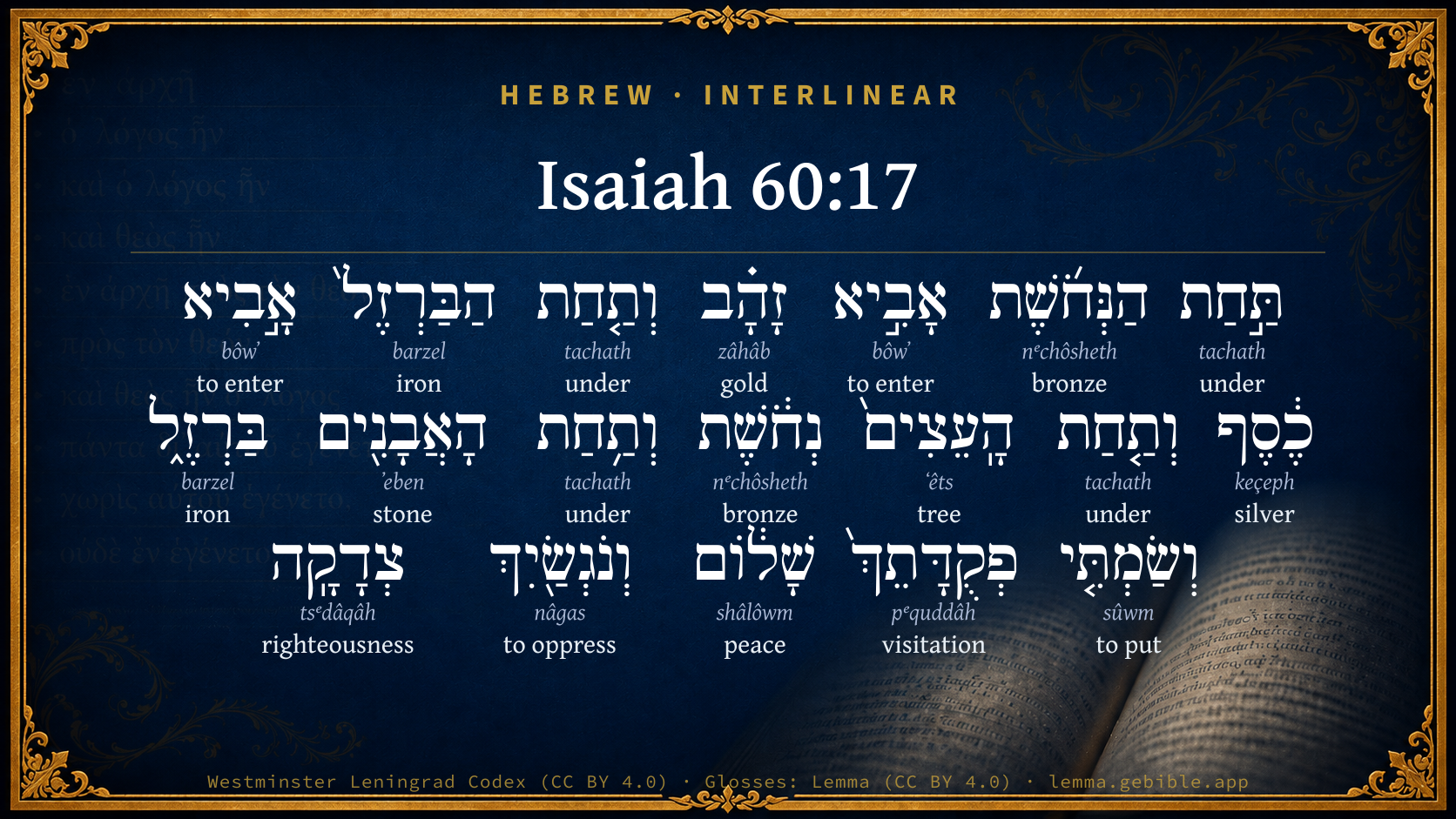
Hebrew (Westminster Leningrad Codex) Isaiah 60:17 appears in the Hebrew Old Testament. The text above is from the Westminster Leningrad Codex. Each word links to its Strong’s number, a concise gloss, and parsing drawn from the Open Scriptures Hebrew Bible morphology. Click any word for its full Brown-Driver-Briggs (BDB) entry.
Download image
Cite this verse

Isaiah 60:17 (World English Bible). Public Domain. Lemma interlinear Bible study tool, https://lemma.gebible.app/v/isaiah/60/17.

Show BibTeX & RIS
BibTeX
RIS
English Translation
For brass I will bring gold, and for iron I will bring silver, and for wood brass, and for stones iron. I will also make your officers peace, and righteousness your ruler.
World English Bible · Public Domain
Download a study sheet

One document with this verse’s original text, its word-by-word gloss line, the meaning frame, cross-references with their text, attributed commentary, and full source and license credits — printable, and it pastes into notes with its structure intact.

This verse Autodidact and up

Study sheet (.html) Plain text (.txt)

A passage Seminary Student

Up to 50 verses in one chapter. A passage sheet keeps up to 6 commentary sources and 12 cross-references per verse, in the order this page ranks them, and says so on the sheet whenever that leaves anything out. Ask for a single verse and you get the Autodidact verse sheet above.

Everything on this page stays free to read, with no account — the sheet is a download of what is already on screen, not access to it.

Want to remove ads? Support Godless Engineer
Compare translations 3

The same verse in 3 English versions, stacked beneath the original-language interlinear above. Click any original word for its lexicon entry.

Each is an independent rendering of the whole verse — the interlinear is not word-aligned to these translations.

Highlighted words mark where these versions differ — a whole-verse word diff, not a word-by-word alignment.

  • World English Bible Public Domain
    For brass I will bring gold, and for iron I will bring silver, and for wood brass, and for stones iron. I will also make your officers peace, and righteousness your ruler.
  • King James Version Public Domain
    For brass I will bring gold, and for iron I will bring silver, and for wood brass, and for stones iron: I will also make thy officers peace, and thine exactors righteousness.
  • unfoldingWord Literal Text CC BY-SA 4.0
    Instead of bronze, I will bring gold, and instead of iron, I will bring silver, and instead of wood, bronze, and instead of stones, iron. And I will appoint peace your governor and righteousness your rulers.

unfoldingWord Literal Text — © unfoldingWord, licensed CC BY-SA 4.0. Word-aligned USFM3 via Door43 (git.door43.org/unfoldingWord/en_ult).

Versions to compare (up to 4)

3 of 4 selected

Show all 18 translations

Every available English version of this verse, each an independent rendering of the whole verse.

  • World English Bible Public Domain
    For brass I will bring gold, and for iron I will bring silver, and for wood brass, and for stones iron. I will also make your officers peace, and righteousness your ruler.
  • Berean Standard Bible Public Domain
    Instead of bronze I will bring you gold; I will bring silver in place of iron, bronze instead of wood, and iron instead of stones. I will appoint peace as your governor and righteousness as your ruler.
  • Majority Standard Bible Public Domain
    Instead of bronze I will bring you gold; I will bring silver in place of iron, bronze instead of wood, and iron instead of stones. I will appoint peace as your governor and righteousness as your ruler.
  • King James Version Public Domain
    For brass I will bring gold, and for iron I will bring silver, and for wood brass, and for stones iron: I will also make thy officers peace, and thine exactors righteousness.
  • American Standard Version (1901) Public Domain
    For brass I will bring gold, and for iron I will bring silver, and for wood brass, and for stones iron. I will also make thy officers peace, and thine exactors righteousness.
  • Revised Version (1885) Public Domain
    For brass I will bring gold, and for iron I will bring silver, and for wood brass, and for stones iron: I will also make thy officers peace, and thine exactors righteousness.
  • Geneva Bible (1599) Public Domain
    For brasse will I bring golde, and for yron will I bring siluer, and for wood brasse, and for stones yron. I will also make thy gouernement peace, and thine exactours righteousnesse.
  • Douay-Rheims (1899) Public Domain
    For brass I will bring gold, and for iron I will bring silver: and for wood brass, and for stones iron: and I will make thy visitation peace, and thy overseers justice.
  • Young's Literal Translation Public Domain
    Instead of the brass I bring in gold, And instead of the iron I bring in silver, And instead of the wood brass, And instead of the stone iron, And I have made thy inspection peace, And thy exactors righteousness.
  • Literal Standard Version CC BY-SA 4.0
    Instead of the bronze I bring in gold, || And instead of the iron I bring in silver, || And instead of the wood bronze, || And instead of the stone iron, || And I have made your inspection peace, || And your exactors righteousness.
  • Unlocked Literal Bible CC BY-SA 4.0
    Instead of bronze I will bring gold, instead of iron I will bring silver; instead of wood, bronze, and instead of stones, iron. I will appoint peace as your governors, and justice your rulers.
  • unfoldingWord Literal Text CC BY-SA 4.0
    Instead of bronze, I will bring gold, and instead of iron, I will bring silver, and instead of wood, bronze, and instead of stones, iron. And I will appoint peace your governor and righteousness your rulers.
  • Darby Bible Public Domain
    For bronze I will bring gold, and for iron I will bring silver, and for wood bronze, and for stones iron; and I will make thine officers peace, and thy rulers righteousness.
  • World Messianic Bible Public Domain
    For bronze I will bring gold; for iron I will bring silver; for wood, bronze, and for stones, iron. I will also make peace your governor, and righteousness your ruler.
  • Webster's Bible Public Domain
    For brass I will bring gold, and for iron I will bring silver, and for wood brass, and for stones iron: I will also make thy officers peace, and thy exactors righteousness.
  • Free Bible Version CC BY-SA 4.0
    I will bring you gold instead of bronze, silver instead of iron, bronze instead of wood, and iron instead of stone. I will appoint Peace as your watchman, and Goodness as your leader.
  • Bible in Basic English Public Domain
    In place of brass, I will give gold, and for iron silver, and for wood brass, and for stones iron: and I will make Peace your judge, and Righteousness your overseer.
  • JPS Tanakh (1917) Public Domain
    For brass I will bring gold, and for iron I will bring silver, and for wood brass, and for stones iron; I will also make thy officers peace, and righteousness thy magistrates.

Literal Standard Version (2020), Covenant Press — licensed CC BY-SA 4.0. Text via the HelloAO Bible API (eBible.org). Unlocked Literal Bible (unfoldingWord) — licensed CC BY-SA 4.0. Text via the HelloAO Bible API (eBible.org). unfoldingWord Literal Text — © unfoldingWord, licensed CC BY-SA 4.0. Word-aligned USFM3 via Door43 (git.door43.org/unfoldingWord/en_ult). Free Bible Version, Dr. Jonathan Gallagher — licensed CC BY-SA 4.0. Text via the HelloAO Bible API (eBible.org).

Word by word

More ways to search: Search by grammar → Find every occurrence → Compare this word →

Practice this passage: Drill this verse → Learn its vocabulary →

וְנֹגְשַׂ֖יִךְ
nâgas
H5065
“and · oppressing · you”
Conjunction + Verb, Qal, Participle Active, Masculine, Plural, Construct + Suffix, Personal, 2nd Person, Feminine, Singular
Part of Speech
Conjunction + Verb
Stem
Qal
Form
Participle Active
Gender
Masculine
Number
Plural
State
Construct
Full BDB Definition

Origin: a primitive root

TWOT: 1296

to press, drive, oppress, exact, exert demanding pressure - (Qal) - to press, drive - to exact - driver, taskmaster, ruler, oppressor, tyrant, lord, exactor of tribute (participle) - (Niphal) to be hard pressed
  1. תַּ֣חַת tachath H8478 “under” Preposition
  2. הַנְּחֹ֜שֶׁת nᵉchôsheth H5178 “the · bronze” Particle, Definite Article + Noun, Common, Feminine, Singular, Absolute
  3. אָבִ֣יא bôwʼ H935 “to enter” Verb, Hiphil, Imperfect, 1st Person, Common, Singular
  4. זָהָ֗ב zâhâb H2091 “gold” Noun, Common, Masculine, Singular, Absolute
  5. וְתַ֤חַת tachath H8478 “and · under” Conjunction + Preposition
  6. הַבַּרְזֶל֙ barzel H1270 “the · iron” Particle, Definite Article + Noun, Common, Masculine, Singular, Absolute
  7. אָ֣בִיא bôwʼ H935 “to enter” Verb, Hiphil, Imperfect, 1st Person, Common, Singular
  8. כֶ֔סֶף keçeph H3701 “silver” Noun, Common, Masculine, Singular, Absolute
  9. וְתַ֤חַת tachath H8478 “and · under” Conjunction + Preposition
  10. הָֽעֵצִים֙ ʻêts H6086 “the · trees” Particle, Definite Article + Noun, Common, Masculine, Plural, Absolute
  11. נְחֹ֔שֶׁת nᵉchôsheth H5178 “bronze” Noun, Common, Feminine, Singular, Absolute
  12. וְתַ֥חַת tachath H8478 “and · under” Conjunction + Preposition
  13. הָאֲבָנִ֖ים ʼeben H68 “the · stones” Particle, Definite Article + Noun, Common, Feminine, Plural, Absolute
  14. בַּרְזֶ֑ל barzel H1270 “iron” Noun, Common, Masculine, Singular, Absolute
  15. וְשַׂמְתִּ֤י sûwm H7760 “and · to put” Conjunction + Verb, Qal, Sequential Perfect, 1st Person, Common, Singular
  16. פְקֻדָּתֵךְ֙ pᵉquddâh H6486 “visitation · your” Noun, Common, Feminine, Singular, Construct + Suffix, Personal, 2nd Person, Feminine, Singular
  17. שָׁל֔וֹם shâlôwm H7965 “peace” Noun, Common, Masculine, Singular, Absolute
  18. צְדָקָֽה tsᵉdâqâh H6666 “righteousness” Noun, Common, Feminine, Singular, Absolute

About this verse

These counts appear in no published source. They are computed here, from the morphology-tagged text and Lemma’s own curated glosses. What Lemma adds →

19
words
13
distinct lemmas
Prophets
section

Notable vocabulary

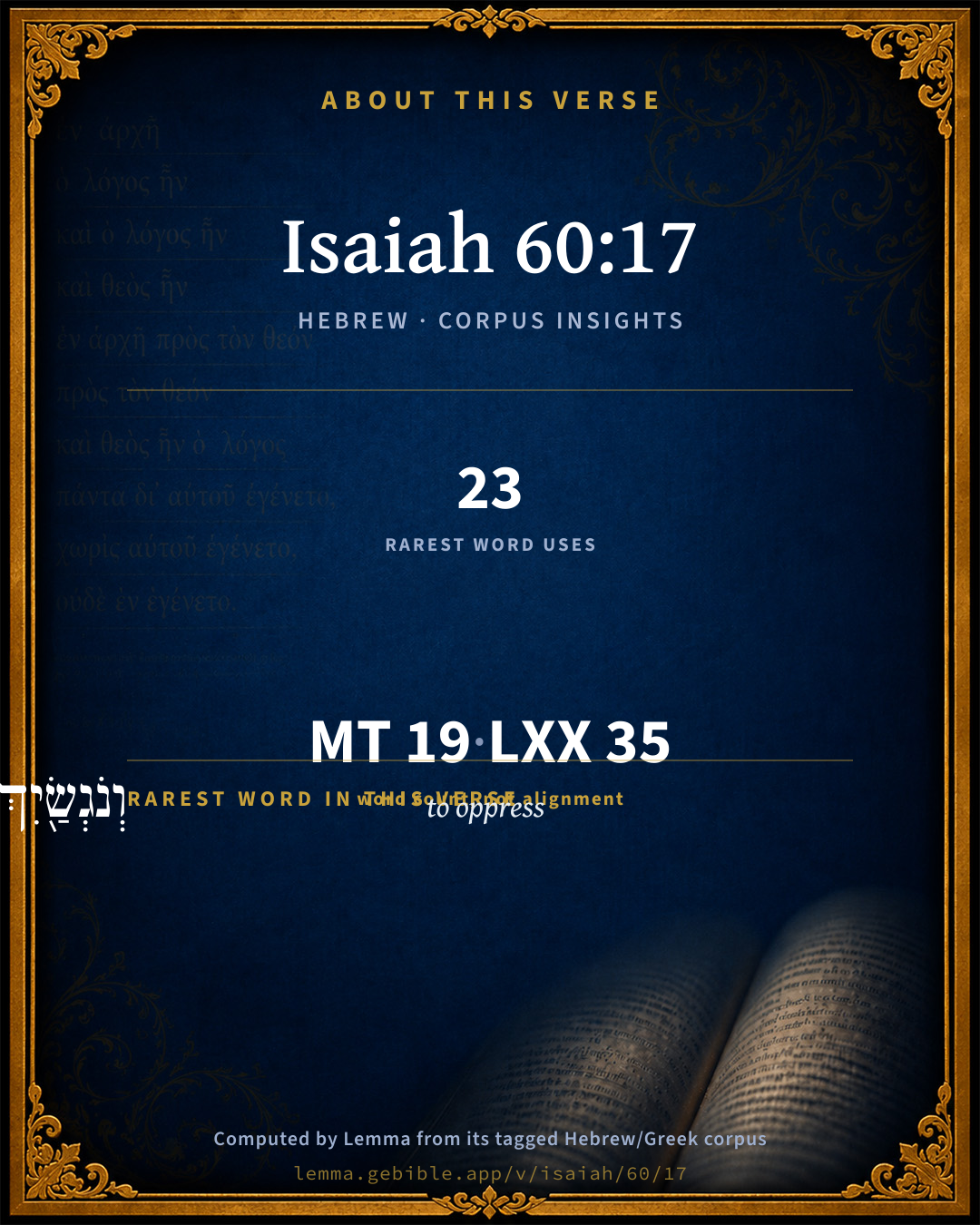
The rarest word here is וְנֹגְשַׂ֖יִךְ to oppress H5065 — appearing just 23 times in the whole Hebrew Bible.

Shared distinctive vocabulary

וְנֹגְשַׂ֖יִךְ to oppress H5065 occurs in 23 verses of the Hebrew Bible. Also found in:

Grammatical profile

  • 4 verbs
  • 11 nouns
  • 4 prepositions

Verb forms

  • אָבִ֣יא Hiphil · Imperfect
  • אָ֣בִיא Hiphil · Imperfect
  • וְשַׂמְתִּ֤י Qal · Sequential Perfect
  • וְנֹגְשַׂ֖יִךְ Qal · Participle Active

Repetition

Words recur within this verse — often emphatic in Hebrew:

  • תַּ֣חַת under H8478 ×4
  • הַנְּחֹ֜שֶׁת bronze H5178 ×2
  • אָבִ֣יא to enter H935 ×2
  • הַבַּרְזֶל֙ iron H1270 ×2

Hebrew & Septuagint length

In English translation the verse runs 32 words from the Hebrew and 41 from the Septuagint (LXX English) — closely comparable.

A rough comparison of the two English renderings, which tokenize alike — not a word-level alignment.

Word counts can differ between the Hebrew and the Greek without any difference in meaning — e.g. the Hebrew direct-object marker אֵת has no separate Greek word, and Greek often adds the article ὁ.

In the original languages it is 19 Hebrew tokens and 35 Greek tokens — but the two are counted differently (Hebrew bundles its prefixes and suffixes into one token; the Greek is in lemma form), so that isn’t a like-for-like length.

Cross-references

7

Topical passages linked to Isaiah 60:17 in the Treasury of Scripture Knowledge — connected by theme and wording, ordered by reader-vote popularity; previews shown in the World English Bible.

  • Hebrews 11:40 God having provided some better thing concerning us, so that apart from us they should not be made perfect.
  • Isaiah 30:26 Moreover the light of the moon shall be as the light of the sun, and the light of the sun shall be sevenfold, as the light of seven days, in the day that Yahweh binds up the hurt of his people, and heals the stroke of their wound.
  • Isaiah 1:26 I will restore your judges as at the first, And your counselors as at the beginning. Afterward you shall be called 'The city of righteousness, A faithful town.'
  • Zechariah 12:8 In that day Yahweh will defend the inhabitants of Jerusalem. He who is feeble among them at that day will be like David, and the house of David will be like God, like the angel of Yahweh before them.
  • 1 Kings 10:21–27 All king Solomon's drinking vessels were of gold, and all the vessels of the house of the forest of Lebanon were of pure gold: none were of silver; it was nothing accounted of in the days of Solomon.
  • 2 Peter 3:13 But, according to his promise, we look for new heavens and a new earth, in which dwells righteousness.
  • Isaiah 32:1–2 Behold, a king shall reign in righteousness, and princes shall rule in justice.

Cross-references courtesy of OpenBible.info (CC BY 4.0).

Hebrew and Greek witnesses Masoretic Hebrew ↔ Greek Septuagint

The same verse in the two great witnesses to the Old Testament, shown verse-for-verse.

These are two independent witnesses, not word-aligned to each other, and the Septuagint is shown in lemma (dictionary) form.

Hebrew Isaiah 60:17 Masoretic · Westminster Leningrad Codex

תַּ֣חַת הַנְּחֹ֜שֶׁת אָבִ֣יא זָהָ֗ב וְתַ֤חַת הַבַּרְזֶל֙ אָ֣בִיא כֶ֔סֶף וְתַ֤חַת הָֽעֵצִים֙ נְחֹ֔שֶׁת וְתַ֥חַת הָאֲבָנִ֖ים בַּרְזֶ֑ל וְשַׂמְתִּ֤י פְקֻדָּתֵךְ֙ שָׁל֔וֹם וְנֹגְשַׂ֖יִךְ צְדָקָֽה

For brass I will bring gold, and for iron I will bring silver, and for wood brass, and for stones iron. I will also make your officers peace, and righteousness your ruler.

World English Bible · Public Domain

Greek LXX Isaiah 60:17 Septuagint · lemma form

καί ἀντί χαλκοῦς φέρω σύ χρυσίον ἀντί δέ σίδηρος φέρω σύ ἀργύριον ἀντί δέ ξύλον φέρω σύ χαλκός ἀντί δέ λίθος σίδηρος καί δίδωμι ὁ ἄρχων σύ ἐν εἰρήνη καί ὁ ἐπισκοπός σύ ἐν δικαιοσύνη

And for brass I will bring you gold, and for iron I will bring you silver, and instead of wood I will bring you brass, and instead of stones, iron; and I will make your princes peaceful, and your overseers righteous.

LXX2012 (modern English Septuagint) · Public Domain

On this verse, Trapp's Complete Commentary discusses the Septuagint’s reading. Read the note in Commentary ↓

Hebrew: Westminster Leningrad Codex (CC BY 4.0). Greek: Septuagint (public domain); English from LXX2012 (modern English Septuagint) (Public Domain). How the Septuagint differs from the Hebrew →

Targum (Aramaic paraphrase)

1

The Targum is the ancient Jewish Aramaic paraphrase of the Hebrew Scriptures — an interpretive translation, not the Hebrew text itself. Onkelos (literal) and Pseudo-Jonathan (expansive) render the Torah, and Jonathan the Prophets. Coverage is partial: where no permissively-licensed English translation exists for a verse, only the Aramaic is shown. This is verse-level text, not a word-by-word alignment to the Hebrew.

  1. Targum Jonathan Prophets (Joshua–Malachi)
    חֲלַף נְחָשָׁא דִבְזוֹ מִנִיךְ יְרוּשְׁלֵם אַיְתֵי דַהֲבָא וַחֲלַף בַּרְזְלָא אַיְתֵי כַסְפָּא וַחֲלַף אָעַיָא נְחָשָׁא וַחֲלַף אַבְנַיָא בַּרְזְלָא וַאֲשַׁוֵי פַּרְנָסָךְ שְׁלַם וְשִׁלְטוּנַיִךְ בְּזָכוּ:

    For the brass which they spoiled thee of, o Jerusalem, I will bring gold, and for the iron I will bring silver, and for the wood brass, and for the stones iron: I will also make thy pastors peace, and thy rulers righteousness.

    Targum Jonathan — Aramaic: “Mikraot Gedolot” (public domain). English: “Sefaria Community Translation” (CC0 1.0 (public-domain dedication)); “London "Chaldee Paraphrase," 1871” (public domain). Text via Sefaria.

Commentary

Notes on Isaiah 60:17 from classic Christian and Jewish commentators (each source and its license shown beneath its notes). The classic Christian expositions comment on the surrounding passage and are grouped to its opening verse, so a note may address several verses; the Jewish commentaries on the Tanakh (Rashi and others) are per-verse, so they appear only where the commentator wrote on this verse.

Lemma curates 59 commentaries, every one of them public domain or Creative Commons licensed, each selected and text-cleaned for this edition rather than reprinted as found. About our sources →

Trapp's Complete Commentary

John Trapp

Isa 60:17 For brass I will bring gold, and for iron I will bring silver, and for wood brass, and for stones iron: I will also make thy officers peace, and thine exactors righteousness.

Ver. 17. For brass I will brlng gold,] i.e., I will beautify my Church with far greater gifts of my Spirit than now. The New Jerusalem (which signifieth, say some, the state of the Church in this world), when it shall be refined to the utmost, is all of gold, and these golden times are yet to come.

Thine exactors.] Or, Overseers; thy bishops, say the Septuagint.

John Trapp, A Commentary or Exposition upon All the Books of the Old and New Testament (1647–1656) — public domain. Text from a community e-Sword module.

The Biblical Illustrator

Joseph S. Exell

Isa_60:17

For brass I will bring gold

The kingdom of God

This passage occurs amid the glowing prophecies concerning the millennial kingdom.

It has, however, its application to the kingdom in its present state.

I. THE KINGDOM OF CHRIST RECOGNIZES DIFFERENT GRADES, QUALITIES, VALUES, USES. Each of these is most effective in its own place. We would much sooner commit ourselves to a vessel of steel than to one whose hull was made of gold. No greater calamity could happen to the world than to turn all substances into gold. In the Church variety of talent and gifts, differences of classes are essential to prosperity. God never repeats-Himself. Equality is impossible, and if possible would be disastrous.

II. ALL THINGS TAKE ON ENHANCED VALUE IN THE KINGDOM OF GOD. For brass I will bring gold, etc. Wherever the Church of Christ comes, instantly all things leap into higher value--property, schools, trade, institutions, government, the family, the individual. You may interrogate in just four different directions--Nature, the Rational World, Sin, the Kingdom. Nature replies: I change nothing. I furnish the ore; I cannot bring out the metal; I cant change even the place of a stone. Rational World replies: I can change the shapes, the places, the combinations of things, but I cannot change the substances. I cannot turn iron into silver, wood into brass, stones into iron. Sin rises in its black monstrosity, and says: Yes, I have power to change. I can reach up, lay my hand on the twenty-two carat gold and drag it down to silver; I can drag the silver down to brass, the brass to iron, the iron to stone, the stone to wood, the wood I can burn with the torch of hate, and scatter the ashes on the red-hot floor of hell--I can do that! Sin can drag the genius or the archangel down to the abyss of a hopeless hades. It is only the Kingdom that can say: Everything I touch shall increase in value. I can take even the devils outcasts and change them into burning seraphs.

III. THIS ENHANCEMENT OF VALUES IS BY AND THROUGH SUCCESSIVE GRADES--wood, stone, iron, brass, silver, gold. Gods method of working is by development through grades. There is no such thing as reaching perfection at a bound. It is a walk, a race--meaning steady progress by steps.

IV. THE DIVINE AGENCY IS EMPHASIZED. I will bring. Transformations in human nature are effected through Divine power and grace. (A. McE. Wylie.)

The golden age

The golden age of humanity is in the future. This age is here represented as so far excelling all future ages as gold excels brass. Morally this may include three things.

I. THAT FOR PRACTICAL ATHEISM THERE WILL BE GODLINESS.

II. THAT FOR DOMINANT MATERIALISM THERE WILL BE SPIRITUALITY.

III. THAT FOR CONTROLLING SELFISHNESS THERE WILL BE BENEVOLENCE. (Homilist.)

The wonderful exchange

This seems like a very unthrifty kind of commerce. It promises only the most speedy and utter bankruptcy. Surely one making such an offer must have great treasures, and great love. There must be a perfect confidence that there can be no exhaustion of treasure, nor any exhaustion in the delight of perpetually giving others the best end of the bargain. No one can have such confidence and feeling but God. It is God, the infinite, who proposes to give gold for brass. It is just what He is constantly doing in nature, giving out the best for the worst. God always sees and seeks the highest possible thing in every nature. And He wants us to catch His penetrative insight. Eye hath not seen, nor ear heard, nor the heart of man conceived the glories God hath prepared for those who love Him. But God is constantly trying to reveal them unto us by His Spirit. He is ever trying to give us gold for brass, and silver for iron. This ought to be good news for man. He is always willing to get the best end of a bargain. Now there are various kinds of life, and many degrees of each kind. There is what is known as physical, mental, emotional and spiritual life. Evidently there is life that is as clay, as ore, as iron, as brass, as silver, as gold. God all the time offers to every man to change his hard iron of life into brass his brass into silver, his silver into gold. How does He propose to do it? On precisely the principles that man acts in every-day life. Indeed, God has made it impossible for men to succeed at all in the life that now is, except in the laws that give success in the life to come. Just as man gives muscle for bread, or exertion of muscle that all the delights of life may be his, just as he gives a few midnights So study that he may be everlastingly wise, just as he gives self-denial that he may have exuberance of strength, just as he gives all the things that he hath, in order that he may keep his life, so God always asks your iron when He would give brass, asks your brass when He would give silver, asks your silver when He would give gold tried in the fire, that you may be rich, and have crowns of eternal glory. The trouble with men is they give their muscle for bread, but will not give iron to God for brass. I think it is a statement capable of vindication, that God does not enrich by legacy, but by exchange. Every one that is endowed is in great peril. Look at the great heroes that God has made in our history: they fill the earth and rise into the skies. Were they endowed? Not one, except with faculties; they had to develop their virtues. So in the case of all moral greatness. God gives the Conditions, the opportunities; but man must work with God. Did the human soul that Christ associated with Himself submit to this plan of development, and especially did the Son of God, begotten in holiness and perfection, submit Himself to this law that has been applied to all men? If this shall be answered in the affirmative, we must conclude that there is no other possible way to greatness and road to perfection. It is evident at first glance, that the man Christ Jesus constantly accepted this law. He was obedient to His parents, giving up His will to them. His announced principle of life was: I came not to do My own will, but the will of Him that sent Me. He gave up the riches of silver, anal for our sakes became poor. He vacated the throne of the universe and became Seryant of servants of men. The Lord of life became obedient unto death, even the death of the Cross. He gave up all silver, brass, iron, stones, and wood. Was there any gold in return Wherefore, because of this, God hath highly exalted Him. There can be no mistake. We see plainly the way to highest strength of character and greatest height of glory. It is not the way of present gratification, of selfishness, of the pursuit of personal and family ends, but a giving up of personal good for Gods higher good, a selling of lower for higher. Once God opened the windows of heaven and poured out water enough to drown a world. Then He takes that great deluge of abundance and makes it an emblem of the abundance of spiritual blessings.

Bring the tithes into the storehouse, the little tenths of daily gain, and see if I will not open the windows of heaven and pour you out a blessing that there shall not be room enough to receive it. (Homiletic Review.)

The Biblical Illustrator, edited by Joseph S. Exell (c. 1880s–1900s) — public domain. Text from a community e-Sword module.

Whedon's Commentary on the Bible

Daniel D. Whedon

17. In the first part of Isa_60:17, the material of which the city is built is the allegorical subject.

For brass I will bring gold… for iron… silver… for wood brass… for stones iron — In Solomon’s day (1Ki_10:21; 1Ki_10:27) civilization so rapidly advanced that in the above terms it was made a type, as here used, of advancing improvements evermore in Zion’s city. Gold in place of brass, silver in place of iron, etc., signify ever-growing preciousness in all that pertains to the temple of holy Zion. Compare Rev_21:10-21.

Thy officers peace — Better, Thy magistracy shall be peace. The term characterizing it shall be “peace;” shall be, in other words, order, truth, love. These shall mark the whole of Zion’s government.

Thy exactors — Not tyrants or tyranny, but justice, equity absolute.

Daniel D. Whedon (gen. ed.), Commentary on the Old and New Testaments (1874–1909) — public domain. Text from a community e-Sword module.

Tyndale Open Study Notes

Tyndale Open Resources

60:17-20 These verses portray Zion’s future grandeur (cp. Rev 21:10–22:4).

60:17 gold . . . silver . . . bronze . . . iron: These metals are for adornment and strength (cp. 54:11; Rev 21:15-21). • Peace and righteousness will bring harmony and blessing among people and with God.

Tyndale Open Study Notes — © Tyndale Open Resources, licensed CC BY-SA 4.0. Text via the HelloAO Bible API.

Geneva Bible (1599)

Geneva Bible translators

Thy governors shall love thee, and seek thy wealth and prosperity.

Geneva Bible (1599) marginal notes — public domain. Text via Bolls.life.

Jamieson, Fausset & Brown

Robert Jamieson, A. R. Fausset & David Brown

Poetically, with figurative allusion to the furniture of the temple; all things in that happy age to come shall be changed for the better.

exactors--namely, of tribute.

righteousness--All rulers in restored Jerusalem shall not only be peaceable and righteous, but shall be, as it were, "peace" and "righteousness" itself in their administration.

Jamieson, Fausset & Brown — Commentary Critical and Explanatory on the Whole Bible (1871) — public domain (CC PDM 1.0). Text via the HelloAO Bible API.

Ellicott's Commentary for English Readers

(17) For brass I will bring gold . . . The material wealth of the days of Solomon (1Ki_10:21-27) furnishes another element in the picture of the ideal city, but with this striking difference: that there the “officers” and “exactors” of the king had been instruments of oppression (1Ki_12:4), while now they were to be the very embodiment of righteousness, and, in the widest sense, of “peace,” and, therefore, of prosperity.

A Bible Commentary for English Readers, edited by Charles John Ellicott (1878–1897) — public domain. Text from a community e-Sword module.

The Cambridge Bible for Schools and Colleges

gen. ed. J. J. S. Perowne

17. For brass … gold &c.] Cf. ch. Isa_9:10; 1Ki_10:21; 1Ki_10:27, and the opposite experience, 1Ki_14:26 f.

I will also make, &c.] Render: and I will appoint Peace as thy government, and Righteousness as thy ruler. The word for officers is an abstract noun (like “management” or “magistracy”) used in a concrete sense; exactors is a plural of majesty, precisely as in ch. Isa_3:12. Its use here is an oxymoron; it denotes a tyrannous, arbitrary ruler (see on ch. Isa_53:7), the idea conveyed being that the tyranny of the present shall be replaced by the genial rule of Righteousness. In other words, Peace and Righteousness (personified qualities, as ch. Isa_59:14) shall be the governing powers in the new Jerusalem. The other rendering, “I will make thy governors peaceful” &c. (so virtually the LXX.) is grammatically possible, but yields a sense feeble and unsatisfying.

17, 18. The inner order and security of the commonwealth shall correspond to its material splendour,—a double contrast to its present (or past) condition.

The Cambridge Bible for Schools and Colleges (gen. ed. J. J. S. Perowne; Cambridge University Press, 1878–1918) — public domain. Text from a community e-Sword module.

John Gill's Exposition

For brass I will bring gold, and for iron I will bring silver, and for wood brass, and for stones iron,.... By "wood and stones" may be meant the Old Testament dispensation; by the "brass and iron" the present Gospel dispensation; and by "silver and gold" the latter day glory; by "silver" the spiritual reign of Christ in his church; and by "gold" his personal reign in the New Jerusalem; which is said to be all of pure gold, and even the very street of it, Rev 21:18, now, as far as brass and iron exceed wood and stones, so far the Gospel dispensation exceeds the legal one; the one being the shadow, the other the substance; the one having carnal ordinances, which are done away; the other spiritual ones, which remain; and as far as silver and gold exceed brass and iron, so far the glory of the latter day will exceed the present state of things, in clear light, in spiritual grace and strength, in purity of doctrine and worship, in holiness of life, and in love, peace, and unity; and as far as gold exceeds silver, so far, and much more, will the personal reign of Christ, which will be perfectly glorious, exceed the spiritual one. There may be an allusion to the times of Solomon, a type of Christ, Kg1 10:27. This, by some Jewish writers (f), is applied to the times of the Messiah they yet expect. The Targum is,

"for the brass which they spoiled thee of, O Jerusalem, I will bring gold, &c.''

I will also make thine officers peace; civil magistrates shall be men of peaceable dispositions, who shall promote peace and unity in kingdoms, states, cities, towns, and neighbourhoods; they shall be properly justices of peace; they will answer to their office, and the title of it. Church officers or ministers of the word shall publish the Gospel of peace in the clearest manner; and the peace of God shall rule in the hearts of all the saints; there will be abundance of temporal and of spiritual peace, promoted by each of the officers of church and state; see Psa 72:7,

and thine exactors righteousness; even tax gatherers, who used to be the worst of people for injustice and oppression, these shall do nothing but what is right and just; nor will there be any reason to complain of them. The Septuagint render it "bishops" or "overseers" (g), pastors of churches, who shall be truly ministers of righteousness; preach up the doctrine of justification by Christ's righteousness; and instruct persons to live soberly, righteously, and godly.

(f) Caphtor Uperah, fol. 57. 2. (g)

John Gill's Exposition of the Whole Bible (1746–1763) — public domain (CC PDM 1.0). Text via the HelloAO Bible API.

Albert Barnes' Notes on the Bible

For brass I will bring gold - This commences the description of the happy times when the Gentiles should be led to embrace the true religion, and when the wealth of the world would be consecrated to the service of the true God. The idea is, that all things would be changed for the better. The golden age should come; and a change from the calamities to which reference had been made by the prophet, would take place as great as if, in all purposes of life, gold should be used where brass is commonly used; and silver where iron is commonly used; and brass where wood is used; and iron where stones are used. Calvin supposes, not improbably, that allusion is here made to the temple, and that, in describing the future glory of the church, the prophet says that the change would be as glorious as if, in all places where brass and iron and wood and stone had been used, gold and silver and brass and iron should be respectively used in their places. The Chaldee renders this, ‘Instead of the brass which they took away from thee, O Jerusalem, I will bring gold; and instead of the iron I will bring silver; and instead of the wood, brass; and instead of the stones, iron.’ Jarchi, Kimchi, and Grotius, accord with this interpretation. But it is probably designed as a poetical description of the glory of the future age, and of the great changes which would take place in human society under the influence of the gospel. No one can doubt that the gospel produces these changes; and that the changes of society caused by the gospel are as beautiful and striking as though gold and silver should be substituted for brass and iron, and brass and iron for wood and stone. Such changes shall yet take place everywhere on the earth; and the world shall ye be beautified, enriched, and adorned by the prevalence of the true religion.

I will also make thy officers peace - Thy officers shall be appointed to promote peace and shall secure it. The sense is, that wars would be ended, and that universal concord and harmony would prevail in the church under the guidance of those appointed to administer to its affairs (compare Isa 2:4; Isa 9:6). The word ‘officers,’ here denotes those who should be appointed to superintend the affairs of the church (from פקד pâqad), to visit, review, superintend, oversee), and refers here to all who should be appointed to rule in the church. The word itself may be applicable either to civil magistrates or to the ministers of religion. The Septuagint renders it, Ἄρχοντα Archontas - ‘Rulers,’ and they translate the passage, ‘I will give thy rulers in peace’ ἐν εἰρήνη en eirēnē).

And thine exactors - They who should exact, or collect tribute or taxes. The word from which the noun used here is derived (נגשׂ nâgas'), means “to urge, impel, drive” - hence the noun ‘taskmaster’ - ἐργοδιώκτης ergodiōktēs (Exo 3:7; Job 3:18); then to urge a debtor, to exact a debt; then to rule or have dominion; to appoint and exact taxes, etc. Here it refers to magistrates, and it means that they would be mild and equal in their exactions.

Righteousness - They shall not lay unequal or oppressive burdens; they shall not oppress in the collection of taxes. The idea is, that righteousness would prevail in every department of the church and the state.

Albert Barnes' Notes on the Bible (1834–1885) — public domain. Text from a community e-Sword/MySword module.

Haydock's Catholic Bible Commentary

Visitation. Septuagint, "give thy chiefs in peace, and thy bishops in justice." St. Clement of Rome (ad Corinthians) reads, "I will appoint their bishops in justice, and their deacons in faith." (Calmet) --- The Scripture thus specifies the name and duties of the pastors of the Church (St. Jerome)

George Leo Haydock (1774–1849), Haydock's Catholic Family Bible and Commentary, 1859 edition — public domain. Excludes Psalms (Douay-Rheims chapter numbering differs from Protestant) and Deuterocanonical books (Catholic canon only).

Matthew Poole's English Annotations

For brass I will bring gold: here is the effect of the former promise, Thy poverty shall be turned to riches, all things shall be altered for the best; an allusion to the days of Solomon, when gold was as brass: thus, on the contrary, when they change for the worse in the state, it useth to be expressed by the like metaphors, Isa 21; Isa 22; Isa 23.

I will also make thy officers peace, i.e. loving, meek, and peaceable; the abstract put for the concrete, as is usual, whether you understand it of under officers, they shall be officers of peace, or of governors, thou shalt have a peaceable government, as it was made good to them under Ezra, Nehemiah, Zorobabel, and such like.

And thine exactors righteousness; most righteous, as before peace for peaceable. The church is not freed from taxes and payments, that is given by Christ and Peter unto Caesar, but it shall be without oppression and grinding; no more than is necessary, and not exacted rigorously. Though all these were made good in their return out of Babylon, yet doth it more properly relate to the meliorating of the church under the gospel, wherein instead of carnal ceremonies, she had spiritual ordinances, which is the scope of the apostle, Heb 9, and larger measures of the Holy Spirit, and should have such officers as would speak peace to the consciences, by discovering the complete and perfect righteousness of him who fulfilled all righteousness.

Matthew Poole's English Annotations on the Holy Bible (1683–1685) — public domain. Text from a community e-Sword/MySword module.

The Pulpit Commentary

For brass I will bring gold; rather, for copper. "Brass" was an alloy little known to the Oriental nations. The general idea is that the glorious age of Solomon would return, (1Ki_10:21, 1Ki_10:27) and Zion be as resplendent and as wealthy as in his time. The material splendour is, no doubt, throughout the whole description, typical in the main of spiritual glories and excellences. I will also make thy officers peace, and thine exactors righteousness. "Peace" and "righteousness" are here personified; and the declaration is that they shall bear rule in the community whereof the prophet is speaking. (comp, Isa_32:16, Isa_32:17)

The Pulpit Commentary (1880–1919), ed. H.D.M. Spence-Jones & Joseph S. Exell — public domain. Text from a community e-Sword module.

John Wesley's Explanatory Notes

For brass - An allusion to the days of Solomon, when gold was as brass. Peace - Loving, meek, and peaceable. Righteousness - Most righteous. Such even thy tax-gatherers shall be.

John Wesley, Explanatory Notes Upon the Whole Bible (1754–1765) — public domain. Text via the GEBible commentary corpus.

Keil & Delitzsch

C. F. Keil & F. Delitzsch

The outward and inward beauty of the new Jerusalem is now depicted by the materials of her structure, and the powers which prevail within her. "For copper I bring gold, and for iron I bring silver, and for wood copper, and for stones iron, and make peace thy magistracy, and righteousness thy bailiffs. Injustice is no more seen in thy land, wasting and destruction in thy borders; and thou callest salvation thy walls, and renown thy gates." Wood and stone are not used at all in the building of the new Jerusalem. Just as in the time of Solomon silver was counted as nothing (Kg1 10:21) and had only the value of stones (Kg1 10:27), so here Jehovah gives her gold instead of copper, silver instead of iron; whilst copper and iron are so despised with this superabundance of the precious metals, that they take the place of such building materials as wood and stones. Thus the city will be a massive one, and not even all of stone, but entirely built of metal, and indestructible not only by the elements, but by all kinds of foes. The allegorical continuation of the prophecy shows very clearly that the prophet does not mean his words to be taken literally. The lxx, Saad., and others, are wrong in adopting the rendering, "I make thy magistracy peace," etc.; since shâlōm and tsedâqâh are not accusatives of either the predicate or the object, but such personifications as we are accustomed to in Isaiah (vid., Isa 32:16-17; Isa 59:14; cf., Isa 45:8). Jehovah makes peace its pequddâh, i.e., its "overseership" (like gebhūrâh, heroship, in Isa 3:25, and ‛ezrâh, helpership, in Isa 31:2), or magistracy; and righteousness its bailiffs. The plural נגשׂיך is no disproof of the personification; the meaning is, that tsedâqâh (righteousness) is to Jerusalem what the whole body of civil officers together are: that is to say, righteousness is a substitute for the police force in every form. Under such magistracy and such police, nothing is ever heard within the land, of which Jerusalem is the capital, of either châmâs, i.e., a rude and unjust attack of the stronger upon the weaker, or of shōd, i.e., conquest and devastation, and shebher, i.e., dashing to pieces, or breaking in two. It has walls (Isa 60:10); but in truth "salvation," the salvation of its God, is regarded as its impregnable fortifications. It has gates (Isa 60:11) but tehillâh, the renown that commands respect, with which Jehovah has invested it, is really better than any gate, whether for ornament or protection.

Keil & Delitzsch — Biblical Commentary on the Old Testament (1861–1891) — public domain (CC PDM 1.0). Text via the HelloAO Bible API. (Old Testament only.)

J. A. Alexander on Isaiah

Joseph Addison Alexander

“Instead of brass (or copper) I will bring gold, and instead of iron I will bring silver, and instead of wood brass, and instead of stones iron, and I will place (or make) thy government peace and thy rulers righteousness.” The thought which is naturally suggested by the words is that all things shall be changed for the better. The change described is not a change in kind, (i.e., from bad to good, but in degree, (i.e., from good to better; because the same things which appear to be rejected in the first clause are expressly promised in the second)). See a similar gradation in Isa 30:26; Zec 14:20; 1Co 3:12; 1Co 15:41. The last clause resolves the figure into literal expressions, and thus shows that the promise has respect not to money, but to moral advantages. Pequtha properly means office, magistracy, government, here put for those who exercise it, like nobility, ministry, and other terms in English. (Compare the Hebrew of Eze 9:1; 2Ki 11:18). Nogesim, which has commonly a bad sense, is here used for magistrates or rulers in general, for the purpose of suggesting, that instead of tyrants or exactors the people should now be under equitable government.

Joseph Addison Alexander, The Prophecies of Isaiah (1846–1847; New York: Scribner, 1870–1878) — public domain. Text from a community e-Sword module.

unfoldingWord translationNotes

Door43 World Missions Community

General Information:

Yahweh continues speaking to the people of Israel.

instead of wood, bronze, and instead of stones, iron

Yahweh will give more valuable building materials to them now. AT: "instead of wood, I will bring bronze, and instead of stones, I will bring iron" (See: Ellipsis)

I will appoint peace as your governors, and justice your rulers

Yahweh describes "peace" and "justice" as human rulers. This means there will be complete peace and justice in the land of Israel. (See: Personification)

Violence will no longer be heard in your land

This can be stated in active form. AT: "There will no longer be reports of violence in your land" (See: Active or Passive)

but you will call your walls Salvation, and your gates Praise

The physical objects have the names of spiritual qualities. The city of Jerusalem will be a safe place, and the people there will praise Yahweh. (See: Metonymy)

translationWords

bronze

gold

silver

peace

govern

just

rule

save

gate

unfoldingWord translationNotes — © Distant Shores Media and the Door43 World Missions Community, licensed CC BY-SA 4.0. Source: git.door43.org/Door43/en_tn.

Rashi

Rabbi Shlomo Yitzchaki (Rashi)

Instead of the copper that they took from you.

and I will make your officers peace [Jonathan renders:] And I will make your officers peace and your rulers with righteousness.

פְקֻדָּתֵךְ Your appointed officers. Our Rabbis stated: The officers who came upon you in your exile and the rulers who pressed you will be counted for you as peace and charity (Baba Bathra 9a). [That is, the money they have exacted from you will be counted as charity.]

Rashi on the Tanakh — English translations: “The Judaica Press complete Tanach with Rashi, translated by A. J. Rosenberg” (CC BY 4.0); “Pentateuch with Rashi's commentary by M. Rosenbaum and A.M. Silbermann, 1929-1934” (public domain); “The Metsudah Tanach series, Lakewood, N.J” (CC BY 4.0); and “The Book of Joshua, Metsudah Publications, 1997” (CC BY 4.0). Text via Sefaria.

Ibn Ezra

Rabbi Abraham ibn Ezra

I will bring gold. That is, I shall induce the nations to bring the gold, or, and that is perhaps better—I shall bring thee the value of gold; (or, the value of the gold of nations.) Copper is better than iron, it is therefore contrasted with gold.

פקודתך Thy officers. Lit., the men of thy office (אנשי פקודתך). Comp. פקיד officer. The men, who distribute the taxes.

I will make thine officers peace. They will collect the taxes in peace.

And thine exactors righteousness. They will exact the money with righteousness.

Ibn Ezra on the Tanakh — English translations: “Sefaria Community Translation” (CC0 1.0 (public-domain dedication)); “Yalkut, Sifsei Chachomim Chumash, Metsudah Publications, 2009” (CC BY 4.0); and “Commentary of Ibn Ezra on Isaiah - trans. by M. Friedlander, 1873” (public domain). Text via Sefaria.

Lesson kit

Teaching starters — assembled from the data on this page, not authored interpretation. Every prompt links to the verse data it draws on. Edit before teaching.

Isaiah, in the Prophets, opens this verse with 19 words (13 distinct Hebrew lemmas). Its most distinctive word is nâgas (“to oppress”). A historical commentator’s framing appears above. Read the whole chapter for the surrounding context.

Discussion questions

  1. How does “to oppress” (nâgas) shape what this verse is saying?
  2. How does Exodus 3:7, which shares the word «to oppress», read alongside this verse?
  3. What does the repetition of “under” (4× in this one verse) do in this verse?
  4. The translations on this page render this verse differently — a whole-verse word diff, not a word-by-word alignment. What might account for the different wordings?
  5. «אָבִ֣יא» is a Hiphil Imperfect verb. How does that grammatical form shape the action described?
  6. Compare how Trapp's Complete Commentary and The Biblical Illustrator read this verse. Where do they agree or differ?

Things to notice

Reading settings

Reading text

Shown beneath each verse's original-language words.

Old Testament
Old Testament edition

Read the OT as the Masoretic Hebrew (MT) or the Greek Septuagint (LXX).

English shown for the Greek Septuagint (in the Hebrew ↔ Greek comparison).

Comparing translations? Open the Compare panel on any verse page to stack up to four side by side.