Psalms 35:27

Hebrew (Westminster Leningrad Codex) Psalms 35:27 appears in the Hebrew Old Testament. The text above is from the Westminster Leningrad Codex. Each word links to its Strong’s number, a concise gloss, and parsing drawn from the Open Scriptures Hebrew Bible morphology. Click any word for its full Brown-Driver-Briggs (BDB) entry.
Download image
Cite this verse

Psalms 35:27 (World English Bible). Public Domain. Lemma interlinear Bible study tool, https://lemma.gebible.app/v/psalms/35/27.

Show BibTeX & RIS
BibTeX
RIS
English Translation
Let them shout for joy and be glad, who favor my righteous cause. Yes, let them say continually, "Yahweh be magnified, Who has pleasure in the prosperity of his servant!"
World English Bible · Public Domain
Download a study sheet

One document with this verse’s original text, its word-by-word gloss line, the meaning frame, cross-references with their text, attributed commentary, and full source and license credits — printable, and it pastes into notes with its structure intact.

This verse Autodidact and up

Study sheet (.html) Plain text (.txt)

A passage Seminary Student

Up to 50 verses in one chapter. A passage sheet keeps up to 6 commentary sources and 12 cross-references per verse, in the order this page ranks them, and says so on the sheet whenever that leaves anything out. Ask for a single verse and you get the Autodidact verse sheet above.

Everything on this page stays free to read, with no account — the sheet is a download of what is already on screen, not access to it.

Want to remove ads? Support Godless Engineer
Compare translations 3

The same verse in 3 English versions, stacked beneath the original-language interlinear above. Click any original word for its lexicon entry.

Each is an independent rendering of the whole verse — the interlinear is not word-aligned to these translations.

Highlighted words mark where these versions differ — a whole-verse word diff, not a word-by-word alignment.

  • World English Bible Public Domain
    Let them shout for joy and be glad, who favor my righteous cause. Yes, let them say continually, "Yahweh be magnified, Who has pleasure in the prosperity of his servant!"
  • King James Version Public Domain
    Let them shout for joy, and be glad, that favour my righteous cause: yea, let them say continually, Let the LORD be magnified, which hath pleasure in the prosperity of his servant.
  • unfoldingWord Literal Text CC BY-SA 4.0
    Let them shout for joy and be glad, those delighting in my righteousness, and let them say continually, “Let Yahweh be great, the delighting in the peace of his servant.”

unfoldingWord Literal Text — © unfoldingWord, licensed CC BY-SA 4.0. Word-aligned USFM3 via Door43 (git.door43.org/unfoldingWord/en_ult).

Versions to compare (up to 4)

3 of 4 selected

Show all 18 translations

Every available English version of this verse, each an independent rendering of the whole verse.

  • World English Bible Public Domain
    Let them shout for joy and be glad, who favor my righteous cause. Yes, let them say continually, "Yahweh be magnified, Who has pleasure in the prosperity of his servant!"
  • Berean Standard Bible Public Domain
    May those who favor my vindication shout for joy and gladness; may they always say, “Exalted be the LORD who delights in His servant’s well-being.”
  • Majority Standard Bible Public Domain
    May those who favor my vindication shout for joy and gladness; may they always say, “Exalted be the LORD who delights in His servant’s well-being.”
  • King James Version Public Domain
    Let them shout for joy, and be glad, that favour my righteous cause: yea, let them say continually, Let the LORD be magnified, which hath pleasure in the prosperity of his servant.
  • American Standard Version (1901) Public Domain
    Let them shout for joy, and be glad, that favor my righteous cause: Yea, let them say continually, Jehovah be magnified, Who hath pleasure in the prosperity of his servant.
  • Revised Version (1885) Public Domain
    Let them shout for joy, and be glad, that favour my righteous cause: yea, let them say continually, The LORD be magnified, which hath pleasure in the prosperity of his servant.
  • Geneva Bible (1599) Public Domain
    But let them be ioyful and glad, that loue my righteousnesse: yea, let them say alway, Let the Lord be magnified, which loueth the prosperitie of his seruant.
  • Douay-Rheims (1899) Public Domain
    Let them rejoice and be glad, who are well pleased with my justice, and let them say always: The Lord be magnified, who delights in the peace of his servant.
  • Young's Literal Translation Public Domain
    They sing and rejoice, who are desiring my righteousness, And they say continually, `Jehovah is magnified, Who is desiring the peace of His servant.'
  • Literal Standard Version CC BY-SA 4.0
    They sing and rejoice, who are desiring my righteousness, || And they continually say, “YHWH is magnified, || Who is desiring the peace of His servant.”
  • Unlocked Literal Bible CC BY-SA 4.0
    Let those who desire my vindication shout for joy and be glad; may they say continually, “Yahweh be praised, he who delights in the welfare of his servant.”
  • unfoldingWord Literal Text CC BY-SA 4.0
    Let them shout for joy and be glad, those delighting in my righteousness, and let them say continually, “Let Yahweh be great, the delighting in the peace of his servant.”
  • Darby Bible Public Domain
    Let them exult and rejoice that delight in my righteousness; and let them say continually, Jehovah be magnified, who delighteth in the prosperity of his servant.
  • World Messianic Bible Public Domain
    Let those who favor my righteous cause shout for joy and be glad. Yes, let them say continually, “May the LORD be magnified, who has pleasure in the prosperity of his servant!”
  • Webster's Bible Public Domain
    Let them shout for joy, and be glad, that favor my righteous cause: yes, let them say continually, Let the LORD be magnified, who hath pleasure in the prosperity of his servant.
  • Free Bible Version CC BY-SA 4.0
    Instead let those who are pleased I've been vindicated celebrate and shout for joy. Let them always say, “How great is the Lord! He is happy when his servants live in peace and have what they need.”
  • Bible in Basic English Public Domain
    Let those who are on my side give cries of joy; let them ever say, The Lord be praised, for he has pleasure in the peace of his servant.
  • JPS Tanakh (1917) Public Domain
    Let them shout for joy, and be glad, that delight in my righteousness; yea, let them say continually: 'Magnified be the LORD, who delighteth in the peace of His servant.'

Literal Standard Version (2020), Covenant Press — licensed CC BY-SA 4.0. Text via the HelloAO Bible API (eBible.org). Unlocked Literal Bible (unfoldingWord) — licensed CC BY-SA 4.0. Text via the HelloAO Bible API (eBible.org). unfoldingWord Literal Text — © unfoldingWord, licensed CC BY-SA 4.0. Word-aligned USFM3 via Door43 (git.door43.org/unfoldingWord/en_ult). Free Bible Version, Dr. Jonathan Gallagher — licensed CC BY-SA 4.0. Text via the HelloAO Bible API (eBible.org).

Word by word

More ways to search: Search by grammar → Find every occurrence → Compare this word →

Practice this passage: Drill this verse → Learn its vocabulary →

חֲפֵצֵ֪י
châphêts
H2655
“delighting of”
Adjective, Adjective, Masculine, Plural, Construct
Part of Speech
Adjective
Type
Adjective
Gender
Masculine
Number
Plural
State
Construct
Full BDB Definition

Origin: from H2654

TWOT: 712a

desiring, delighting in, having pleasure in
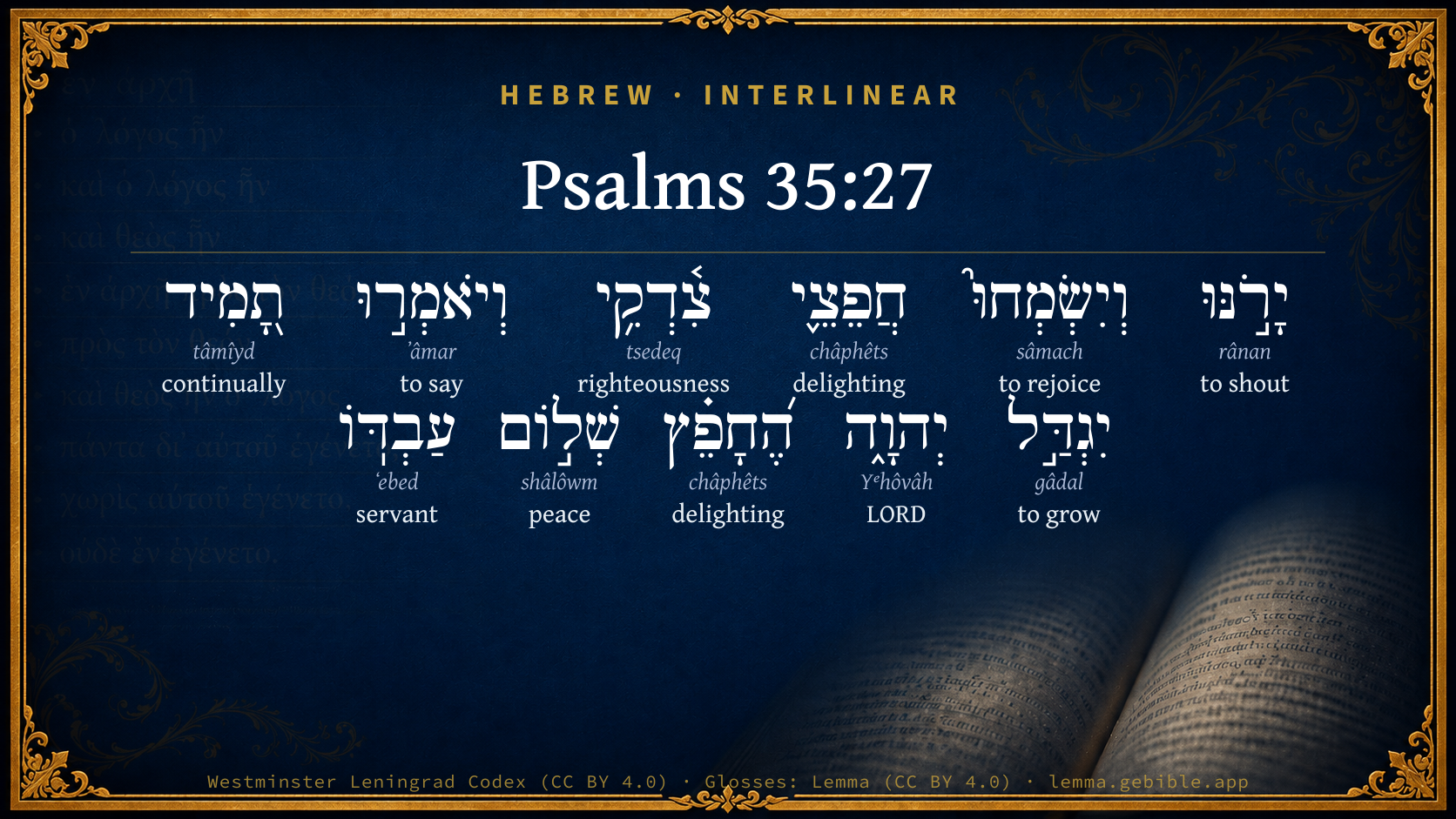
  1. יָרֹ֣נּוּ rânan H7442 “to shout” Verb, Qal, Imperfect, 3rd Person, Masculine, Plural
  2. וְיִשְׂמְחוּ֮ sâmach H8055 “and · to rejoice” Conjunction + Verb, Qal, Imperfect, 3rd Person, Masculine, Plural
  3. צִ֫דְקִ֥י tsedeq H6664 “righteousness · my” Noun, Common, Masculine, Singular, Construct + Suffix, Personal, 1st Person, Common, Singular
  4. וְיֹאמְר֣וּ ʼâmar H559 “and · to say” Conjunction + Verb, Qal, Imperfect, 3rd Person, Masculine, Plural
  5. תָ֭מִיד tâmîyd H8548 “continually” Noun, Common, Masculine, Singular, Absolute
  6. יִגְדַּ֣ל gâdal H1431 “to grow” Verb, Qal, Imperfect, 3rd Person, Masculine, Singular
  7. יְהוָ֑ה Yᵉhôvâh H3068 “LORD” Noun, Proper
  8. הֶ֝חָפֵ֗ץ châphêts H2655 “the · delighting” Particle, Definite Article + Adjective, Adjective, Masculine, Singular, Absolute
  9. שְׁל֣וֹם shâlôwm H7965 “peace of” Noun, Common, Masculine, Singular, Construct
  10. עַבְדּֽוֹ ʻebed H5650 “servant · his” Noun, Common, Masculine, Singular, Construct + Suffix, Personal, 3rd Person, Masculine, Singular

About this verse

These counts appear in no published source. They are computed here, from the morphology-tagged text and Lemma’s own curated glosses. What Lemma adds →

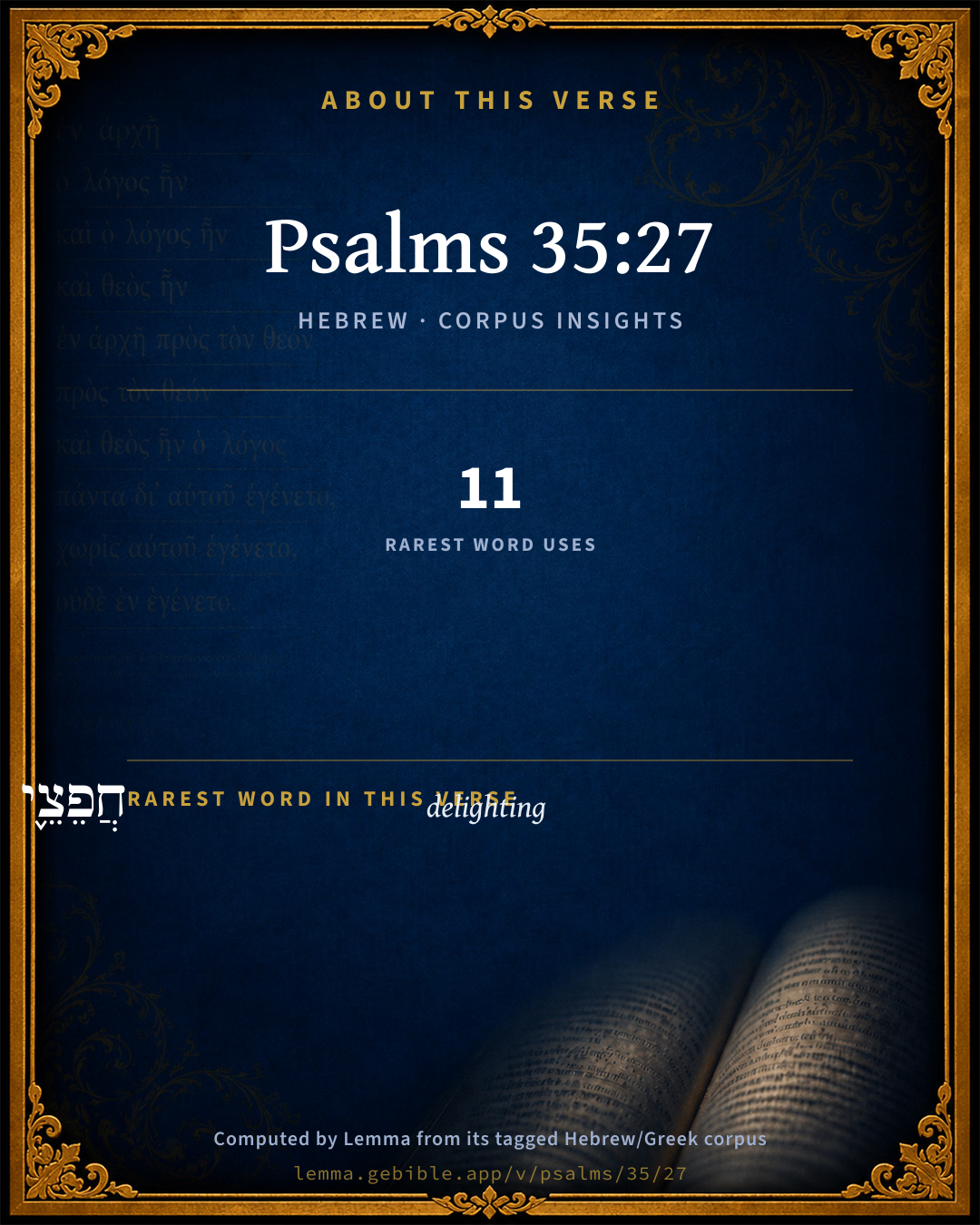
11
words
10
distinct lemmas
Wisdom
section

Notable vocabulary

The rarest word here is חֲפֵצֵ֪י delighting H2655 — appearing just 11 times in the whole Hebrew Bible.

Shared distinctive vocabulary

חֲפֵצֵ֪י delighting H2655 occurs in 10 verses of the Hebrew Bible. Also found in:

Grammatical profile

  • 4 verbs
  • 5 nouns
  • 2 adjectives

Verb forms

  • יָרֹ֣נּוּ Qal · Imperfect
  • וְיִשְׂמְחוּ֮ Qal · Imperfect
  • וְיֹאמְר֣וּ Qal · Imperfect
  • יִגְדַּ֣ל Qal · Imperfect

Repetition

A word recurs within this verse — often emphatic in Hebrew:

  • חֲפֵצֵ֪י delighting H2655 ×2

Hebrew & Septuagint length

In English translation the verse runs 30 words from the Hebrew and 27 from the Septuagint (LXX English) — closely comparable.

A rough comparison of the two English renderings, which tokenize alike — not a word-level alignment.

Word counts can differ between the Hebrew and the Greek without any difference in meaning — e.g. the Hebrew direct-object marker אֵת has no separate Greek word, and Greek often adds the article ὁ.

Cross-references

18

Topical passages linked to Psalms 35:27 in the Treasury of Scripture Knowledge — connected by theme and wording, ordered by reader-vote popularity; previews shown in the World English Bible.

  • Jeremiah 32:40–41 and I will make an everlasting covenant with them, that I will not turn away from following them, to do them good; and I will put my fear in their hearts, that they may not depart from me.
  • Psalms 149:4 For Yahweh takes pleasure in his people. He crowns the humble with salvation.
  • Psalms 40:16 Let all those who seek you rejoice and be glad in you. Let such as love your salvation say continually, "Let Yahweh be exalted!"
  • Zephaniah 3:17 Yahweh, your God, is in the midst of you, a mighty one who will save. He will rejoice over you with joy. He will rest in his love. He will rejoice over you with singing.
  • Proverbs 8:18 With me are riches, honor, Enduring wealth, and prosperity.
  • Psalms 70:4 Let all those who seek you rejoice and be glad in you. Let those who love your salvation continually say, "Let God be exalted!"
  • Psalms 142:7 Bring my soul out of prison, That I may give thanks to your name. The righteous will surround me, For you will be good to me.
  • Psalms 147:11 Yahweh takes pleasure in those who fear him, In those who hope in his loving kindness.
  • John 16:22 Therefore you now have sorrow, but I will see you again, and your heart will rejoice, and no one will take your joy away from you.
  • 1 Corinthians 12:26 When one member suffers, all the members suffer with it. Or when one member is honored, all the members rejoice with it.
  • Psalms 132:16 Her priests I will also clothe with salvation. Her saints will shout aloud for joy.
  • Zephaniah 3:14 Sing, daughter of Zion! Shout, Israel! Be glad and rejoice with all your heart, daughter of Jerusalem.
  • Romans 12:15 Rejoice with those who rejoice. Weep with those who weep.
  • Psalms 9:4 For you have maintained my just cause. You sit on the throne judging righteously.
  • Psalms 32:11 Be glad in Yahweh, and rejoice, you righteous! Shout for joy, all you who are upright in heart!
  • Psalms 68:3 But let the righteous be glad. Let them rejoice before God. Yes, let them rejoice with gladness.
  • Psalms 132:9 Let your priest be clothed with righteousness. Let your saints shout for joy!"
  • Isaiah 66:10–11 Rejoice you with Jerusalem, and be glad for her, all you who love her: rejoice for joy with her, all you who mourn over her;

Cross-references courtesy of OpenBible.info (CC BY 4.0).

Hebrew and Greek witnesses Masoretic Hebrew ↔ Greek Septuagint

The same verse in the two great witnesses to the Old Testament, shown verse-for-verse.

You’re reading Greek Psalm 34 (Hebrew Psalm 35). The Septuagint counts the superscription, so verse numbers can differ from the Hebrew — chapter-level alignment, not verse-by-verse. Numbering follows Rahlfs.

These are two independent witnesses, not word-aligned to each other, and the Septuagint is shown in lemma (dictionary) form.

Hebrew Psalms 35:27 Masoretic · Westminster Leningrad Codex

יָרֹ֣נּוּ וְיִשְׂמְחוּ֮ חֲפֵצֵ֪י צִ֫דְקִ֥י וְיֹאמְר֣וּ תָ֭מִיד יִגְדַּ֣ל יְהוָ֑ה הֶ֝חָפֵ֗ץ שְׁל֣וֹם עַבְדּֽוֹ

Let them shout for joy and be glad, who favor my righteous cause. Yes, let them say continually, "Yahweh be magnified, Who has pleasure in the prosperity of his servant!"

World English Bible · Public Domain

Greek LXX Greek Psalm 34:27 Septuagint · lemma form

ἀγαλλιάομαι καί εὐφραίνω ὁ θέλω ὁ δικαιοσύνη ἐγώ καί εἶπον διά πᾶς μεγαλύνω ὁ κύριος ὁ θέλω ὁ εἰρήνη ὁ δοῦλος αὐτός

Let them that rejoice in my righteousness exult and be glad: and let them say continually, The Lord be magnified, who desire the peace of his servant.

LXX2012 (modern English Septuagint) · Public Domain

Hebrew: Westminster Leningrad Codex (CC BY 4.0). Greek: Septuagint (public domain); English from LXX2012 (modern English Septuagint) (Public Domain). How the Septuagint differs from the Hebrew →

Commentary

Notes on Psalms 35:27 from classic Christian and Jewish commentators (each source and its license shown beneath its notes). The classic Christian expositions comment on the surrounding passage and are grouped to its opening verse, so a note may address several verses; the Jewish commentaries on the Tanakh (Rashi and others) are per-verse, so they appear only where the commentator wrote on this verse.

Lemma curates 59 commentaries, every one of them public domain or Creative Commons licensed, each selected and text-cleaned for this edition rather than reprinted as found. About our sources →

Trapp's Complete Commentary

John Trapp

Psa 35:27 Let them shout for joy, and be glad, that favour my righteous cause: yea, let them say continually, Let the LORD be magnified, which hath pleasure in the prosperity of his servant.

Ver. 27. Let them shout for joy, &c.] He concludeth with hearty prayer for the Church, as he doth in various other psalms.

That favour thy righteous cause] Though perhaps they dare do no more than inwardly favour it and by their prayers to God promote it.

Let them say continually, &c.] Let them have continual cause to praise God for this sweet property, that he delighteth in his people’s prosperity, and afflicts them not from his heart, nor grieveth the children of men, but for their greatest good, Lam 3:35.

John Trapp, A Commentary or Exposition upon All the Books of the Old and New Testament (1647–1656) — public domain. Text from a community e-Sword module.

The Biblical Illustrator

Joseph S. Exell

Psa_35:27-28

Let them shout for joy, and be glad, that favour my righteous cause.

Sympathy with the godly

1. It is one mark of godliness amongst many others, to befriend the cause of Christ, and to further it in the person of His saints suffering for righteousness, with their best affection, for here they are described by being the favourers of their righteous cause.

2. In the persecution of the godly for the cause of Gods truth and true religion, all the godly are concerned; and as they partake of the sufferings with others under Christ the Head, so shall they partake of the joy of the victory, and outgate which shall be exceeding joyful at last.

3. The troubles of the godly are not so many, but room is left for sometimes prosperity, for God loveth the prosperity of His servants, to wit, as it may conduce to His purpose and their good.

4. When any of the godly are delivered from their persecutors, all the rest of the godly are bound as they understand of it, to set forth the power of God, and His love and bounty manifested and forthcoming to His people.

6. Whatsoever opposition the enemies of Christ and of the godly shall make, Christ shall keep up the open profession of true Doctrine, which manifesteth the righteousness of God; leading men to eternal life, and bringing glory to God; for this is the undertaking of the type and of Christ represented by him, after the hottest contest between him and the wicked enemies. (D. Dickson.)

Let the Lord be magnified.--

Magnifying God

I. here is Gods feeling towards mans welfare. He has pleasure in his prosperity. This proves to us--

1. Gods interest in our existence.

2. Gods goodwill towards our state.

3. Gods evident willingness to help.

II. here is mans true well-being--Prosperity. The true prosperity of a soul is its spiritual vitality, and this manifests itself--

1. By an ever-growing love towards religious exercises.

2. By a deepening apprehension of Divine realities. That which was dark becomes light; that which was obscure stands out in living reality.

3. By an increasing delight in Christian work. A prosperous soul is active in the performance of acts of charity and kindness.

4. By an increasing development of a Christlike character. The prosperous Christian grows, and becomes daily more like Christ in thought, word, and action.

5. By a constant accession of peace, contentment, and joy.

III. here is mans manifest duty--Let the Lord be magnified. It is a blessed privilege to have a God who is well disposed to His people. The imaginary gods of the heathen were always ill-disposed. They were gods of cruelty, malevolence, and evil, who needed to be propitiated by many a cruel rite. What a glorious idea we have of God! One who has pleasure in the prosperity of His people. He delights to see them happy and growing in grace, and all good gifts. He will not that any should be lost. Surely, then, we ought to magnify Him--in our words and songs of praise; in our lives and example; in our characters and sacrifice. We should give our whole time and energy and strength to His work. (Homilist.)

.

Psa_36:1-12

The Biblical Illustrator, edited by Joseph S. Exell (c. 1880s–1900s) — public domain. Text from a community e-Sword module.

J. A. Alexander on Psalms

Joseph Addison Alexander

27. (Psa 35:27) Let them shout (or sing) and rejoice—the desirers of my righteousness and let them always say, Great is (or be) Jehovah, the (God) willing (or desiring) the peace of his servant! The sentence may be brought into closer conformity to our idiom by adopting a relative construction. "Let them rejoice who desire my righteousness," i.e. my justification, who desire to see me practically justified by God's providential dealings with me.—Let them always say, i.e. always have occasion so to do, which is virtually wishing that the peace or prosperity of Jehovah's servant may be perpetual. The verbal adjective in both these clauses means desiring, with a strong implication of complacency or satisfaction in the object, and therefore really includes the two ideas of desire and delight.—The righteousness or justification of the first clause is an obvious antithesis to the evil, hurt, or injury of Psa 35:26, and no less obviously identical, or at least coincident, with the peace or welfare of the last clause here.

Joseph Addison Alexander, The Psalms Translated and Explained (1850) — public domain. Text from a community e-Sword module.

Geneva Bible (1599)

Geneva Bible translators

That at least favor my right, though they be not able to help me.

He exhorteth the Church to praise God for the deliverance of his servants, and for the destruction of his adversaries.

Geneva Bible (1599) marginal notes — public domain. Text via Bolls.life.

Jamieson, Fausset & Brown

Robert Jamieson, A. R. Fausset & David Brown

favour . . . cause--delight in it, as vindicated by Thee.

Let the Lord, &c.--Let Him be greatly praised for His care of the just.

Jamieson, Fausset & Brown — Commentary Critical and Explanatory on the Whole Bible (1871) — public domain (CC PDM 1.0). Text via the HelloAO Bible API.

Adam Clarke's Commentary

Verse 27. Let them shout for joy and be glad] While my enemies are confounded, let my friends exult in the Lord; and let them all praise him for his marvellous kindness to me.

Adam Clarke's Commentary on the Bible (1810–1826) — public domain. Text from a community e-Sword/MySword module.

John Calvin's Commentaries

27. Let those who favor my righteous cause rejoice and be glad. These two expressions, which are rendered in the optative mood, might have been translated with equal propriety in the future tense; but as this is a matter of little consequence, I leave it undecided. David here extols the deliverance which he asks of God, and exults in the results which should flow from it; namely, that it would be an occasion of general rejoicing and good hope to all the godly, while at the same time it would stir them up to celebrate the praises of God. He attributes to all the faithful the credit of desiring, that as an innocent man his righteous cause should be maintained. David, it is true, was the object of almost universal hatred among the simple and unsuspecting, who were imposed upon by false and unjust reports made concerning him; but it is certain that there were among the people some who formed a just and impartial estimate of things, and who were sorely grieved that a holy man, and one too whose benevolence was well known, should have been so unjustly and so wrongfully oppressed. And surely the common feelings of humanity require, that when we see men unjustly oppressed and afflicted, if we are not able to help them, we should at least pity them. When David uses the language, Jehovah be magnified, his design seems to be tacitly to set this in opposition to the pride of the wicked, of which he made mention above. As they presume in the pride, of their hearts, and by their insolent and overbearing conduct, to obscure, as far as in them lies, the divine glory, so may the faithful, on the other hand, with good reason present the prayer that God would shine forth in the majesty of his character, and demonstrate in very deed that he exercises a special care over all his servants, and takes a peculiar pleasure in their peace. Finally, the Psalmist again declares, in the conclusion of the psalm, his resolution to celebrate in appropriate praises the righteousness of God, by which he had been preserved and delivered.

John Calvin's Commentaries (1540-1563) — public domain. Text from the Calvin Translation Society English edition (1840s-50s) via the Christian Classics Ethereal Library (ccel.org). Calvin's coverage is partial (roughly two-thirds of the Bible); uncommented books and verses are honest gaps, never fabricated. The 19th-century editor's footnotes and remarks are omitted so the notes are faithfully Calvin's own voice.

The Cambridge Bible for Schools and Colleges

gen. ed. J. J. S. Perowne

27. Cp. Psa_40:16.

that favour my righteous cause] Lit. that delight in my righteousness; that welcome the vindication of my innocence.

which hath pleasure in the prosperity of his servant] More exactly, which delighteth (2Sa_15:26; Psa_18:19; Psa_22:8) in the welfare (lit. peace) of his servant.

The Cambridge Bible for Schools and Colleges (gen. ed. J. J. S. Perowne; Cambridge University Press, 1878–1918) — public domain. Text from a community e-Sword module.

John Gill's Exposition

Let them shout for joy, and be glad, that favour my righteous cause,.... The cause of David was a righteous cause, he having done no iniquity, or anything criminal against Saul his enemy, who persecuted him; and there were some that favoured his cause, as Jonathan, Saul's son, and a few others of rank and figure; but the greatest part were mean and despicable, Sa1 22:2; and so the cause of Christ and of his people, which is one, is a righteous cause, which no one need to be ashamed of, and is worth suffering for; though those that favour it are for the most part the poor and base and weak things of the world: but when this cause prospers they rejoice and are glad, as they do at the happiness of every particular saint; for if one member is honoured, all the rest rejoice with it;

yea, let them say continually, the Lord be magnified; let them continually ascribe greatness, give honour and glory, to him,

which hath pleasure in the prosperity of his servant; meaning either himself, who was a servant of the Lord, not only by creation, but by grace; and who had his times both of temporal and spiritual prosperity; which were owing to the good will and pleasure of God, and to the delight and complacency he had in him, being a man after his own heart, raised up to fulfil his will; and since this prosperity did not arise from any desert of his, he would have all the glory of it given to God: or else he intends the Messiah, his antitype, who, as Mediator, is the servant of the Lord; of his choosing, calling, and sending; whose commands he diligently and faithfully obeyed; from whom he had his work, and also his reward: his prosperity lies in the work of redemption succeeding in his hands; in his exaltation at the right hand of God; and in the spread of his Gospel in the world, and the efficacy of it to the conviction of sinners; and in the establishment and increase of his kingdom and interest; on which account the Lord's name is to be magnified and glorified, who delights in him as his servant, and in his prosperity; and the rather this is to be done, since the saints have an interest in him as a Prince and a Saviour: or anyone of the servants of the Lord may be understood; or however it is applicable to anyone of them, who, through the power of divine grace upon them, are made willing to serve the Lord with reverence and godly fear; who are his Hephzibah, in whom is all his delight and pleasure, Isa 62:4; who rejoices over them to do them good: and hence flows all the spiritual prosperity they enjoy, on account of which glory is to be given to God by them and all the saints that know it, Psa 34:1.

John Gill's Exposition of the Whole Bible (1746–1763) — public domain (CC PDM 1.0). Text via the HelloAO Bible API.

Albert Barnes' Notes on the Bible

Let them shout for joy - That is, Let me be delivered; let my friends see that God is on my side, and that they have occasion to rejoice in his merciful interposition in my behalf.

That favor my righteous cause - Margin, as in Hebrew, “my righteousness.” The reference is to those who considered his cause a just one, and who were his friends.

Yea, let them say continually - Let this be a constant subject of grateful reflection - a perpetual source of joy to them - that God has interposed in my behalf, and has shown that my cause was a just one.

Let the Lord be magnified - Be regarded as great, exalted, glorious. Let the effect be to elevate their conceptions of the character of God by the fact that he has thus interposed in a righteous cause, and has shown that he is the friend of the wronged and the oppressed.

Which hath pleasure in the prosperity of his servant - Who delights to make his friends prosperous and happy, Let them see that this is the character of God, and let them thus be led to rejoice in him evermore.

Albert Barnes' Notes on the Bible (1834–1885) — public domain. Text from a community e-Sword/MySword module.

Matthew Poole's English Annotations

That favour my righteous cause; that wish well to it, although they want either strength or courage to plead it.

Magnified, i.e. exalted and praised for his righteousness, and truth, and goodness manifested in my deliverance. Mine enemies’ great design is to magnify themselves, Psa 35:26, but my chief desire is that God may be magnified.

Matthew Poole's English Annotations on the Holy Bible (1683–1685) — public domain. Text from a community e-Sword/MySword module.

The Treasury of David

Charles H. Spurgeon

Verse 27. ["Let them shout for joy, and be glad, that favour my righteous cause."] Even those who could not render him active aid, but in their hearts favoured him, David would have the Lord reward most abundantly. Men of tender heart set great store by the good wishes and prayers of the Lord's people. Jesus also prizes those whose hearts are with his cause. The day is coming when shouts of victory shall be raised by all who are on Christ's side, for the battle will turn, and the foes of truth shall be routed. ["Yea, let them say continually, Let the Lord be magnified."] He would have their gladness contributory to the divine glory; they are not to shout to David's praise, but for the honour of Jehovah. Such acclamations may fitly be continued throughout time and eternity. ["Which hath pleasure in the prosperity of his servant."] They recognised David as the Lord's servant, and saw with pleasure the Lord's favour to him. We can have no nobler title than "servant of God," and no greater reward than for our Master to delight in our prosperity. What true prosperity may be we are not always best able to judge. We must leave that in Jesus' hand; he will not fail to rule all things for our highest good.

"For by his saints it stands confessed,

That what he does is always best."

[Verse] 27. See how the hearts of the saints have been drawn out against their persecutors. Prayers are the arms that in times of persecution the saints have still had recourse to. The Romans being in great distress were put so hard to it, that they were fain to take the weapons out of the temple of their gods to fight with their enemies, and so they overcame them: so when the people of God have been hard put to it by reason of afflictions and persecutions, the weapons that they have fled to have been prayers and tears, and with these they have overcome their persecutors. [Thomas Brooks.]

[Verse] 27 ([last clause]). What is that prosperity in which the Lord hath pleasure?

Charles H. Spurgeon's The Treasury of David (1869–1885) — public domain. Psalms only. Text from a community e-Sword/MySword module.

Whedon's Commentary on the Bible

Daniel D. Whedon

27. That favour—Take pleasure in, delight in, not by favouritism, but for righteousness.

My righteous cause—Hebrew, my righteousness.

Prosperity of his servant—Righteousness could not be otherwise than by defending and delivering the righteous, and this always implies the defeat and punishment of the wicked. The prosperity of David was the essential condition of just administration in the case. If justice is not always promptly executed for the righteous, it has the pledge of eternal Truth that it shall be in the final result, and hence the doctrine which faith accepts, of a future judgment.

The closing verse is an expression of faith in the final result, which should be the theme of continued praise.

Daniel D. Whedon (gen. ed.), Commentary on the Old and New Testaments (1874–1909) — public domain. Text from a community e-Sword module.

The Pulpit Commentary

Let them shout for joy, and be glad, that favour my righteous cause. When David"s enemies are "ashamed and put to confusion" (ver. 26), his friends will naturally "shout for joy, and be glad." This they will do, partly, out of sympathy; partly because their own interests are bound up with those of their leader. Had Saul captured David when he "hunted him upon the mountains," the fate of David"s followers would have been death or exile. Yea, let them say continually, Let the Lord be magnified, which hath pleasure in the prosperity of his servant; literally, in the peace of his servant. God desires that David"s present troubles should cease, and that he should enjoy a time of rest and tranquillity. This was granted him, to some extent, at Ziklag, (1Sa_27:4-7) but more fully when he came into his kingdom. (2Sa_5:1-16)

The Pulpit Commentary (1880–1919), ed. H.D.M. Spence-Jones & Joseph S. Exell — public domain. Text from a community e-Sword module.

Keil & Delitzsch

C. F. Keil & F. Delitzsch

Those who wish that David's righteousness may be made manifest and be avenged are said to take delight in it. When this takes place, Jahve's righteousness is proved. יגדּל, let Him be acknowledged and praised as great, i.e., let Him be magnified! David desires that all who remain true to him may thus speak; and he, on his part, is determined to stir up the revelation of God's righteousness in his heart, and to speak of that of which his heart is full (Psa 71:24).

Keil & Delitzsch — Biblical Commentary on the Old Testament (1861–1891) — public domain (CC PDM 1.0). Text via the HelloAO Bible API. (Old Testament only.)

unfoldingWord translationNotes

Door43 World Missions Community

my vindication

Here "vindication" refers to Yahweh proclaiming or judging the psalmist innocent.

may they say continually

"may they always say"

Yahweh be praised

This can be stated in active form. AT: "Let us praise Yahweh" (See: Active or Passive)

who delights in

"who is happy with" or "who is glad for"

welfare

well-being, happiness

tell of your justice

The abstract noun "justice" can be stated as "right." AT: "proclaim that you act in the right way" (See: Abstract Nouns)

translationWords

joy

praise

servant

just

unfoldingWord translationNotes — © Distant Shores Media and the Door43 World Missions Community, licensed CC BY-SA 4.0. Source: git.door43.org/Door43/en_tn.

Lesson kit

Teaching starters — assembled from the data on this page, not authored interpretation. Every prompt links to the verse data it draws on. Edit before teaching.

Psalms, in the Wisdom, opens this verse with 11 words (10 distinct Hebrew lemmas). Its most distinctive word is châphêts (“delighting”). A historical commentator’s framing appears above. Read the whole chapter for the surrounding context.

Discussion questions

  1. What does “delighting” (châphêts) contribute to the verse as a whole?
  2. How does 1 Kings 13:33, which shares the word «delighting», read alongside this verse?
  3. What does the repetition of “delighting” (2× in this one verse) do in this verse?
  4. These translations render this verse differently. What is at stake in choosing one wording over another?
  5. «יָרֹ֣נּוּ» is a Qal Imperfect verb. How does that grammatical form shape the action described?
  6. Compare how Trapp's Complete Commentary and The Biblical Illustrator read this verse. Where do they agree or differ?

Things to notice

Reading settings

Reading text

Shown beneath each verse's original-language words.

Old Testament
Old Testament edition

Read the OT as the Masoretic Hebrew (MT) or the Greek Septuagint (LXX).

English shown for the Greek Septuagint (in the Hebrew ↔ Greek comparison).

Comparing translations? Open the Compare panel on any verse page to stack up to four side by side.