
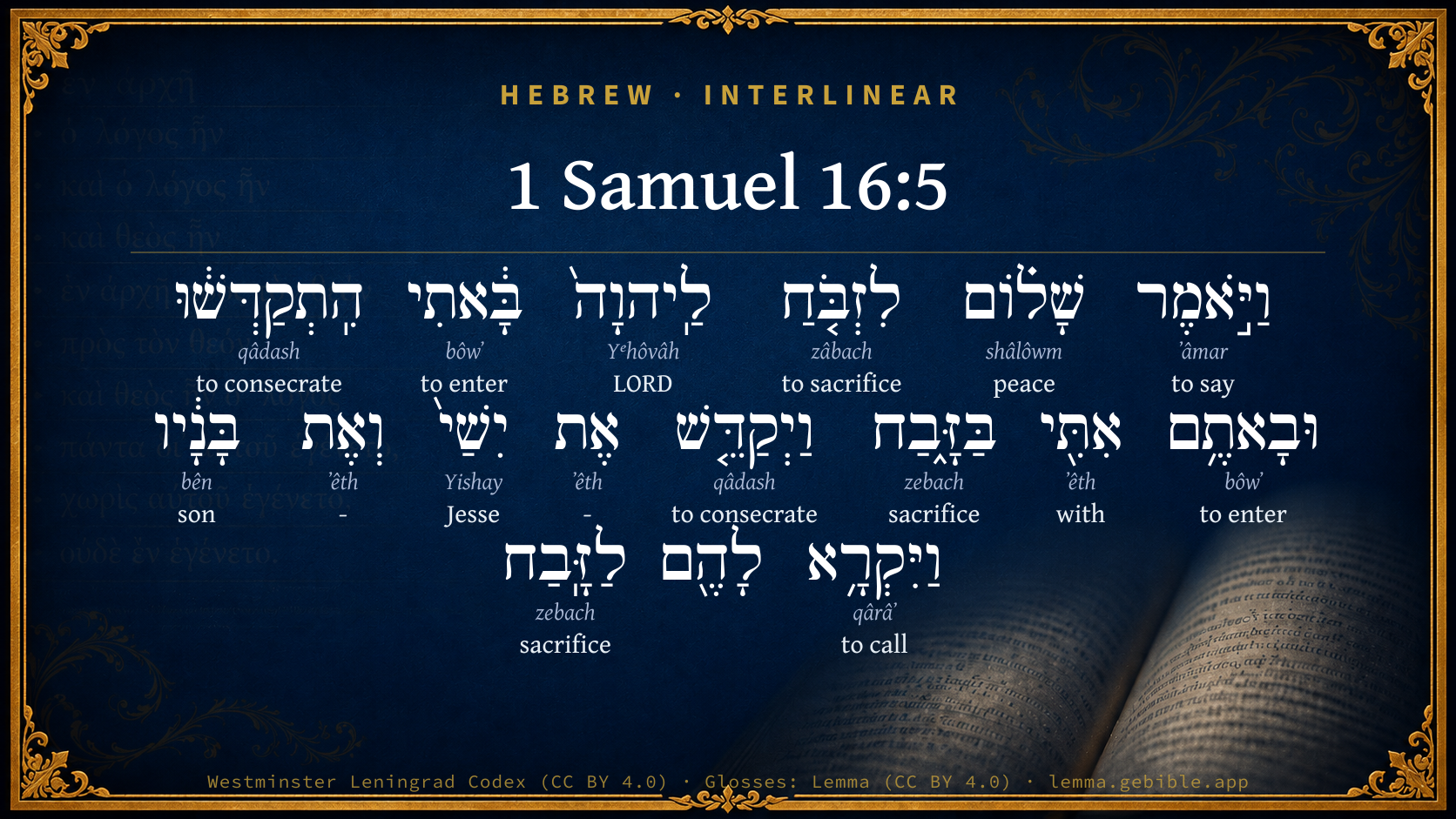
1 Samuel 16:5

Hebrew (Westminster Leningrad Codex) 1 Samuel 16:5 appears in the Hebrew Old Testament. The text above is from the Westminster Leningrad Codex. Each word links to its Strong’s number, a concise gloss, and parsing drawn from the Open Scriptures Hebrew Bible morphology. Click any word for its full Brown-Driver-Briggs (BDB) entry.
Download image
Cite this verse

1 Samuel 16:5 (World English Bible). Public Domain. Lemma interlinear Bible study tool, https://lemma.gebible.app/v/1-samuel/16/5.

Show BibTeX & RIS
BibTeX
RIS
English Translation
He said, Peaceably; I am come to sacrifice to Yahweh: sanctify yourselves, and come with me to the sacrifice. He sanctified Jesse and his sons, and called them to the sacrifice.
World English Bible · Public Domain
Download a study sheet

One document with this verse’s original text, its word-by-word gloss line, the meaning frame, cross-references with their text, attributed commentary, and full source and license credits — printable, and it pastes into notes with its structure intact.

This verse Autodidact and up

Study sheet (.html) Plain text (.txt)

A passage Seminary Student

Up to 50 verses in one chapter. A passage sheet keeps up to 6 commentary sources and 12 cross-references per verse, in the order this page ranks them, and says so on the sheet whenever that leaves anything out. Ask for a single verse and you get the Autodidact verse sheet above.

Everything on this page stays free to read, with no account — the sheet is a download of what is already on screen, not access to it.

Want to remove ads? Support Godless Engineer
Compare translations 3

The same verse in 3 English versions, stacked beneath the original-language interlinear above. Click any original word for its lexicon entry.

Each is an independent rendering of the whole verse — the interlinear is not word-aligned to these translations.

Highlighted words mark where these versions differ — a whole-verse word diff, not a word-by-word alignment.

  • World English Bible Public Domain
    He said, Peaceably; I am come to sacrifice to Yahweh: sanctify yourselves, and come with me to the sacrifice. He sanctified Jesse and his sons, and called them to the sacrifice.
  • King James Version Public Domain
    And he said, Peaceably: I am come to sacrifice unto the LORD: sanctify yourselves, and come with me to the sacrifice. And he sanctified Jesse and his sons, and called them to the sacrifice.
  • unfoldingWord Literal Text CC BY-SA 4.0
    And he said, “ peace. I have come to sacrifice to Yahweh. Consecrate yourselves and come with me to the sacrifice.” And he consecrated Jesse and his sons, and he invited them to the sacrifice.

unfoldingWord Literal Text — © unfoldingWord, licensed CC BY-SA 4.0. Word-aligned USFM3 via Door43 (git.door43.org/unfoldingWord/en_ult).

Versions to compare (up to 4)

3 of 4 selected

Show all 18 translations

Every available English version of this verse, each an independent rendering of the whole verse.

  • World English Bible Public Domain
    He said, Peaceably; I am come to sacrifice to Yahweh: sanctify yourselves, and come with me to the sacrifice. He sanctified Jesse and his sons, and called them to the sacrifice.
  • Berean Standard Bible Public Domain
    “In peace,” he replied. “I have come to sacrifice to the LORD. Consecrate yourselves and come with me to the sacrifice.” Then he consecrated Jesse and his sons and invited them to the sacrifice.
  • Majority Standard Bible Public Domain
    “In peace,” he replied. “I have come to sacrifice to the LORD. Consecrate yourselves and come with me to the sacrifice.” Then he consecrated Jesse and his sons and invited them to the sacrifice.
  • King James Version Public Domain
    And he said, Peaceably: I am come to sacrifice unto the LORD: sanctify yourselves, and come with me to the sacrifice. And he sanctified Jesse and his sons, and called them to the sacrifice.
  • American Standard Version (1901) Public Domain
    And he said, Peaceably; I am come to sacrifice unto Jehovah: sanctify yourselves, and come with me to the sacrifice. And he sanctified Jesse and his sons, and called them to the sacrifice.
  • Revised Version (1885) Public Domain
    And he said, Peaceably: I am come to sacrifice unto the LORD: sanctify yourselves, and come with me to the sacrifice. And he sanctified Jesse and his sons, and called them to the sacrifice.
  • Geneva Bible (1599) Public Domain
    And he answeared, Yea: I am come to doe sacrifice vnto the Lord: sanctifie your selues, and come with me to the sacrifice. And he sanctified Ishai and his sonnes, and called them to the sacrifice.
  • Douay-Rheims (1899) Public Domain
    And he said: It is peaceable: I am come to offer sacrifice to the Lord, be ye sanctified, and come with me to the sacrifice. And he sanctified Isai and his sons, and called them to the sacrifice.
  • Young's Literal Translation Public Domain
    and he saith, `Peace; to sacrifice to Jehovah I have come, sanctify yourselves, and ye have come in with me to the sacrifice;' and he sanctifieth Jesse and his sons, and calleth them to the sacrifice.
  • Literal Standard Version CC BY-SA 4.0
    And he says, “Peace; I have come to sacrifice to YHWH, sanctify yourselves, and you have come in with me to the sacrifice”; and he sanctifies Jesse and his sons, and calls them to the sacrifice.
  • Unlocked Literal Bible CC BY-SA 4.0
    He said, “In peace; I have come to sacrifice to Yahweh. Prepare to set yourselves apart and come with me to the sacrifice.” Then he set apart Jesse and his sons and invited them to the sacrifice.
  • unfoldingWord Literal Text CC BY-SA 4.0
    And he said, “ peace. I have come to sacrifice to Yahweh. Consecrate yourselves and come with me to the sacrifice.” And he consecrated Jesse and his sons, and he invited them to the sacrifice.
  • Darby Bible Public Domain
    And he said, Peaceably: I am come to sacrifice to Jehovah. Hallow yourselves, and come with me to the sacrifice. And he hallowed Jesse and his sons, and called them to the sacrifice.
  • World Messianic Bible Public Domain
    He said, “Peaceably; I have come to sacrifice to the LORD. Sanctify yourselves, and come with me to the sacrifice.” He sanctified Jesse and his sons, and called them to the sacrifice.
  • Webster's Bible Public Domain
    And he said, Peaceably: I have come to sacrifice to the LORD: sanctify yourselves, and come with me to the sacrifice. And he sanctified Jesse and his sons, and called them to the sacrifice.
  • Free Bible Version CC BY-SA 4.0
    “Yes, I come in peace,” he replied. “I have come to sacrifice to the Lord. Purify yourselves and come with me to the sacrifice.” He purified Jesse and his sons and invited them to the sacrifice.
  • Bible in Basic English Public Domain
    And he said, In peace: I have come to make an offering to the Lord: make yourselves clean and come with me to make the offering. And he made Jesse and his sons clean, and sent for them to be present at the offering.
  • JPS Tanakh (1917) Public Domain
    And he said: 'Peaceably; I am come to sacrifice unto the LORD; sanctify yourselves and come with me to the sacrifice.' And he sanctified Jesse and his sons, and called them to the sacrifice.

Literal Standard Version (2020), Covenant Press — licensed CC BY-SA 4.0. Text via the HelloAO Bible API (eBible.org). Unlocked Literal Bible (unfoldingWord) — licensed CC BY-SA 4.0. Text via the HelloAO Bible API (eBible.org). unfoldingWord Literal Text — © unfoldingWord, licensed CC BY-SA 4.0. Word-aligned USFM3 via Door43 (git.door43.org/unfoldingWord/en_ult). Free Bible Version, Dr. Jonathan Gallagher — licensed CC BY-SA 4.0. Text via the HelloAO Bible API (eBible.org).

Word by word

More ways to search: Search by grammar → Find every occurrence → Compare this word →

Practice this passage: Drill this verse → Learn its vocabulary →

יִשַׁי֙
Yishay
H3448
“Jesse”
Noun, Proper
Part of Speech
Noun
Type
Proper
Full BDB Definition

Origin: from the same as H3426

TWOT: 926

Jesse = "I possess" - son of Boaz and the father of king David
  1. וַיֹּ֣אמֶר ʼâmar H559 “and · to say” Conjunction + Verb, Qal, Sequential Imperfect, 3rd Person, Masculine, Singular
  2. שָׁל֗וֹם shâlôwm H7965 “peace” Noun, Common, Masculine, Singular, Absolute
  3. לִזְבֹּ֤חַ zâbach H2076 “to sacrifice” Preposition + Verb, Qal, Infinitive Construct
  4. לַֽיהוָה֙ Yᵉhôvâh H3068 “to/for · LORD” Preposition + Noun, Proper
  5. בָּ֔אתִי bôwʼ H935 “to enter” Verb, Qal, Perfect, 1st Person, Common, Singular
  6. הִֽתְקַדְּשׁ֔וּ qâdash H6942 “consecrate” Verb, Hithpael, Imperative, 2nd Person, Masculine, Plural
  7. וּבָאתֶ֥ם bôwʼ H935 “and · to enter” Conjunction + Verb, Qal, Sequential Perfect, 2nd Person, Masculine, Plural
  8. אִתִּ֖י ʼêth H854 “with · me” Preposition + Suffix, Personal, 1st Person, Common, Singular
  9. בַּזָּ֑בַח zebach H2077 “in/at the · sacrifice” Preposition, Determined + Noun, Common, Masculine, Singular, Absolute
  10. וַיְקַדֵּ֤שׁ qâdash H6942 “and · to consecrate” Conjunction + Verb, Piel, Sequential Imperfect, 3rd Person, Masculine, Singular
  11. אֶת ʼêth H853 “-” Particle, Direct Object
  12. וְאֶת ʼêth H853 “and · -” Conjunction + Particle, Direct Object
  13. בָּנָ֔יו bên H1121 “sons · his” Noun, Common, Masculine, Plural, Construct + Suffix, Personal, 3rd Person, Masculine, Singular
  14. וַיִּקְרָ֥א qârâʼ H7121 “and · to call” Conjunction + Verb, Qal, Sequential Imperfect, 3rd Person, Masculine, Singular
  15. לַזָּֽבַח zebach H2077 “to/for the · sacrifice” Preposition, Determined + Noun, Common, Masculine, Singular, Absolute

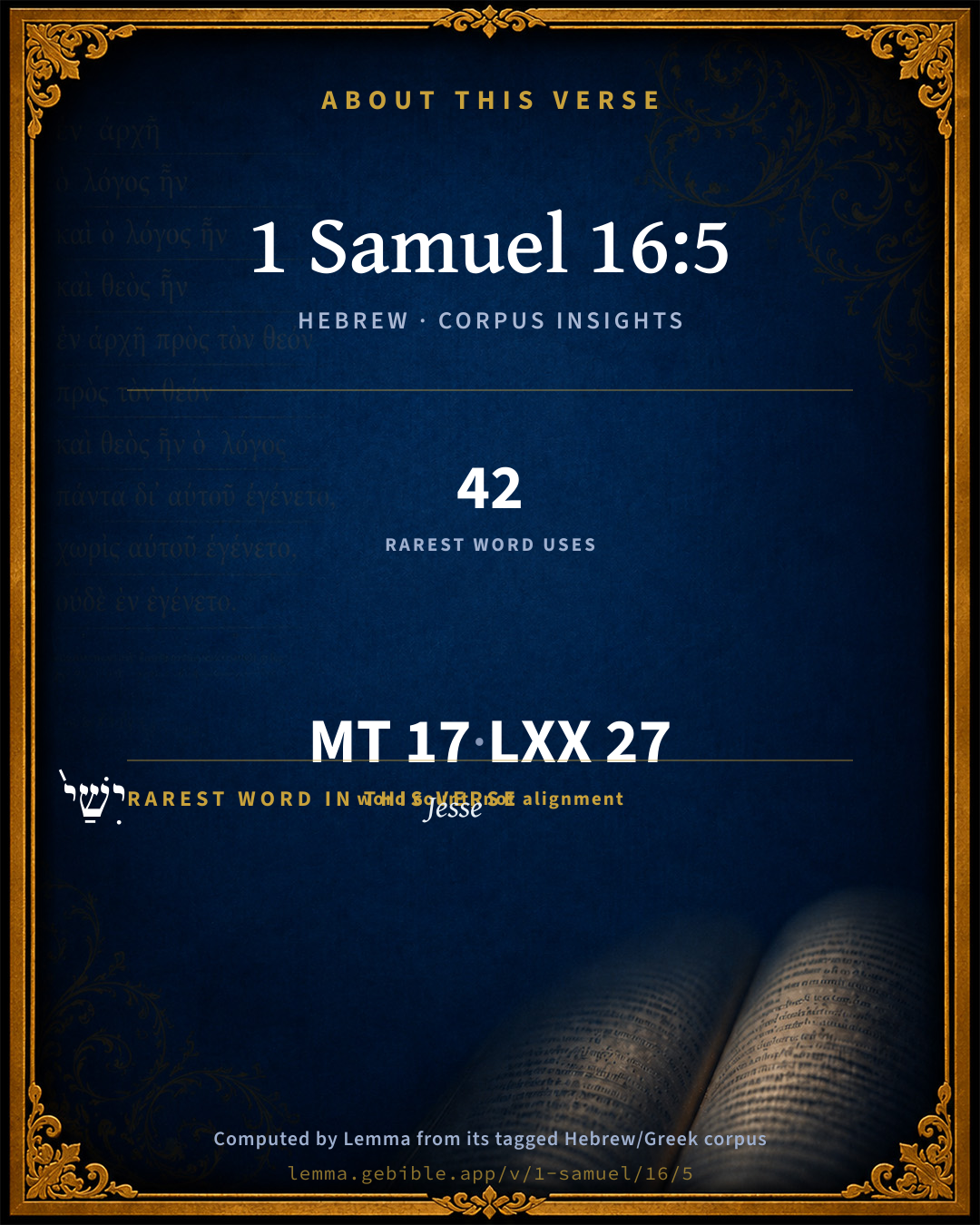
About this verse

These counts appear in no published source. They are computed here, from the morphology-tagged text and Lemma’s own curated glosses. What Lemma adds →

17
words
12
distinct lemmas
Historical
section

Shared distinctive vocabulary

יִשַׁי֙ Jesse H3448 occurs in 39 verses of the Hebrew Bible. Also found in:

Grammatical profile

  • 7 verbs
  • 6 nouns
  • 2 prepositions
  • 2 particles

Verb forms

  • וַיֹּ֣אמֶר Qal · Sequential Imperfect
  • לִזְבֹּ֤חַ Qal · Infinitive Construct
  • בָּ֔אתִי Qal · Perfect
  • הִֽתְקַדְּשׁ֔וּ Hithpael · Imperative
  • וּבָאתֶ֥ם Qal · Sequential Perfect
  • וַיְקַדֵּ֤שׁ Piel · Sequential Imperfect
  • וַיִּקְרָ֥א Qal · Sequential Imperfect

Repetition

Words recur within this verse — often emphatic in Hebrew:

  • בָּ֔אתִי to enter H935 ×2
  • הִֽתְקַדְּשׁ֔וּ to consecrate H6942 ×2
  • בַּזָּ֑בַח sacrifice H2077 ×2

Hebrew & Septuagint length

In English translation the verse runs 31 words from the Hebrew and 34 from the Septuagint (LXX English) — closely comparable.

A rough comparison of the two English renderings, which tokenize alike — not a word-level alignment.

Word counts can differ between the Hebrew and the Greek without any difference in meaning — e.g. the Hebrew direct-object marker אֵת has no separate Greek word, and Greek often adds the article ὁ.

In the original languages it is 17 Hebrew tokens and 27 Greek tokens — but the two are counted differently (Hebrew bundles its prefixes and suffixes into one token; the Greek is in lemma form), so that isn’t a like-for-like length.

Cross-references

11

Topical passages linked to 1 Samuel 16:5 in the Treasury of Scripture Knowledge — connected by theme and wording, ordered by reader-vote popularity; previews shown in the World English Bible.

  • Exodus 19:10 Yahweh said to Moses, "Go to the people, and sanctify them today and tomorrow, and let them wash their garments,
  • Leviticus 20:7–8 "'Sanctify yourselves therefore, and be holy; for I am Yahweh your God.
  • Joshua 3:5 Joshua said to the people, Sanctify yourselves; for tomorrow Yahweh will do wonders among you.
  • Exodus 19:14–15 Moses went down from the mountain to the people, and sanctified the people; and they washed their clothes.
  • Joshua 7:13 Up, sanctify the people, and say, Sanctify yourselves against tomorrow: for thus says Yahweh, the God of Israel, There is a devoted thing in the midst of you, Israel; you can not stand before your enemies, until you take away the devoted thing from among you.
  • 1 Corinthians 11:28 But let a man examine himself, and so let him eat of the bread, and drink of the cup.
  • Numbers 11:8 The people went about, and gathered it, and ground it in mills, or beat it in mortars, and boiled it in pots, and made cakes of it: and the taste of it was as the taste of fresh oil.
  • 2 Chronicles 30:17–20 For there were many in the assembly who had not sanctified themselves: therefore the Levites had the charge of killing the Passovers for everyone who was not clean, to sanctify them to Yahweh.
  • Job 1:5 It was so, when the days of their feasting had run their course, that Job sent and sanctified them, and rose up early in the morning, and offered burnt offerings according to the number of them all. For Job said, "It may be that my sons have sinned, and renounced God in their hearts." Thus did Job continually.
  • Psalms 26:2–6 Examine me, Yahweh, and prove me. Try my heart and my mind.
  • Joel 2:16 Gather the people. Sanctify the assembly. Assemble the elders. Gather the children, and those who suck the breasts. Let the bridegroom go forth from his room, And the bride out of her chamber.

Cross-references courtesy of OpenBible.info (CC BY 4.0).

Hebrew and Greek witnesses Masoretic Hebrew ↔ Greek Septuagint

The same verse in the two great witnesses to the Old Testament, shown verse-for-verse.

These are two independent witnesses, not word-aligned to each other, and the Septuagint is shown in lemma (dictionary) form.

Hebrew 1 Samuel 16:5 Masoretic · Westminster Leningrad Codex

וַיֹּ֣אמֶר שָׁל֗וֹם לִזְבֹּ֤חַ לַֽיהוָה֙ בָּ֔אתִי הִֽתְקַדְּשׁ֔וּ וּבָאתֶ֥ם אִתִּ֖י בַּזָּ֑בַח וַיְקַדֵּ֤שׁ אֶת יִשַׁי֙ וְאֶת בָּנָ֔יו וַיִּקְרָ֥א לָהֶ֖ם לַזָּֽבַח

He said, Peaceably; I am come to sacrifice to Yahweh: sanctify yourselves, and come with me to the sacrifice. He sanctified Jesse and his sons, and called them to the sacrifice.

World English Bible · Public Domain

Greek LXX 1 Samuel 16:5 Septuagint · lemma form

καί εἶπον εἰρήνη θύω ὁ κύριος ἥκω ἁγιάζω καί εὐφραίνω μετά ἐγώ σήμερον καί ἁγιάζω ὁ ιεσσαι καί ὁ υἱός αὐτός καί καλέω αὐτός εἰς ὁ θυσία

And he said, Peaceably: I am come to sacrifice to the Lord. Sanctify yourselves, and rejoice with me this day: and he sanctified Jessae and his sons, and he called them to the sacrifice.

LXX2012 (modern English Septuagint) · Public Domain

Hebrew: Westminster Leningrad Codex (CC BY 4.0). Greek: Septuagint (public domain); English from LXX2012 (modern English Septuagint) (Public Domain). How the Septuagint differs from the Hebrew →

Targum (Aramaic paraphrase)

1

The Targum is the ancient Jewish Aramaic paraphrase of the Hebrew Scriptures — an interpretive translation, not the Hebrew text itself. Onkelos (literal) and Pseudo-Jonathan (expansive) render the Torah, and Jonathan the Prophets. Coverage is partial: where no permissively-licensed English translation exists for a verse, only the Aramaic is shown. This is verse-level text, not a word-by-word alignment to the Hebrew.

  1. Targum Jonathan Prophets (Joshua–Malachi)
    וַאֲמַר שְׁלָם לְדַבָּחָא קֳדָם יְיָ אָתֵיתִי אִזְדַמָנוּ וְתֵיעֲלוּן עִמִי לְשֵׁירוּתָא וְזַמֵין יַת יִשַׁי וְיַת בְּנוֹהִי וּקְרָא לְהוֹן לְנִכְסַת קוּדְשָׁא:

    (no public-domain English translation for this verse)

    Targum Jonathan — Aramaic: “Mikraot Gedolot” (public domain). English: “Sefaria Community Translation” (CC0 1.0 (public-domain dedication)); “London "Chaldee Paraphrase," 1871” (public domain). Text via Sefaria.

Commentary

Notes on 1 Samuel 16:5 from classic Christian and Jewish commentators (each source and its license shown beneath its notes). The classic Christian expositions comment on the surrounding passage and are grouped to its opening verse, so a note may address several verses; the Jewish commentaries on the Tanakh (Rashi and others) are per-verse, so they appear only where the commentator wrote on this verse.

Lemma curates 59 commentaries, every one of them public domain or Creative Commons licensed, each selected and text-cleaned for this edition rather than reprinted as found. About our sources →

Trapp's Complete Commentary

John Trapp

1Sa 16:5 And he said, Peaceably: I am come to sacrifice unto the LORD: sanctify yourselves, and come with me to the sacrifice. And he sanctified Jesse and his sons, and called them to the sacrifice.

Ver. 5. I am come to sacrifice unto the Lord.] This prophets might do, either upon occasion, or without, for the blessing and comfort of certain places and cities. See 1Sa 9:12.

Sanctify yourselves.] By washing your garments; {Exo 19:14-15} but especially your hearts: {Isa 1:16} prepare yourselves both legally and spiritually.

And called them to the sacrifice.] And to the feast that followed the sacrifice with part of the peace offering, kept, likely, at the house of Jesse.

John Trapp, A Commentary or Exposition upon All the Books of the Old and New Testament (1647–1656) — public domain. Text from a community e-Sword module.

Joseph Benson's Commentary

1Sa 16:5. I am come to sacrifice unto the Lord — That was one intention of his coming; and though there was another, namely, to anoint one of Jesse’s sons to be king, he was not bound to declare it. For where there are two ends of any action, a person may, without any injury to truth, declare the one and conceal the other. Thus Moses did when he told Pharaoh they must go and sacrifice to God in the wilderness; but suppressed their intention to march to the land of Canaan. This is set in a clear light by Dr. Waterland: — “As to Samuel pretending a sacrifice, it was a just pretence, and a true one; for he did offer sacrifice, as God had commanded him, 1Sa 16:5. And what if he had a further intention? was he bound to declare all he knew, or to disclose to every man the whole of his errand? Secrecy is of great use in all important business; and the concealing one design by going upon another, to prevent giving offence, or doing other worse mischief, is as righteous and as laudable a practice as the drawing a curtain to keep off spies. The making one good design the cover for a better is doing two good things at once; and both in a proper way; and though men have been blamed, and very justly, for using acts of religion as a cloak for iniquity, yet I have never heard that there could be any thing amiss in performing one act of obedience toward God in order to facilitate the performance of another.” — See Scrip. Vind., p. 95.

He sanctified Jesse and his sons — It seems evident that there was something peculiar in Jesse’s invitation. For, first, both he and his sons were invited, whereas the others were only invited for their own persons. Secondly, the different phrase here used, that he sanctified these, when he only bade the others sanctify themselves, argues a singular care of Samuel in their sanctification. Which makes it probable that the rest were only to join with them in the act of sacrificing; but these, and only these, were invited to feast upon the remainders of the sacrifices.

Joseph Benson's Commentary on the Old and New Testaments (1811–1818) — public domain. Text from a community e-Sword module.

Tyndale Open Study Notes

Tyndale Open Resources

16:5 Purify yourselves: Self-purification included bathing and abstaining from sexual intercourse (see Exod 19:10-15; cp. Gen 35:2-4). • The sacrifice likely took place the following morning (see Num 11:18; Josh 3:5; 7:13-14). • Samuel performed the purification rite for Jesse and his sons to make sure they were ready for the sacrifice and for the anointing of the new king (cp. Exod 19:10; Josh 3:5).

Tyndale Open Study Notes — © Tyndale Open Resources, licensed CC BY-SA 4.0. Text via the HelloAO Bible API.

Jamieson, Fausset & Brown

Robert Jamieson, A. R. Fausset & David Brown

sanctify yourselves--by the preparations described (Exo 19:14-15). The elders were to sanctify themselves. Samuel himself took the greatest care in the sanctification of Jesse's family. Some, however, think that the former were invited only to join in the sacrifice, while the family of Jesse were invited by themselves to the subsequent feast.

Jamieson, Fausset & Brown — Commentary Critical and Explanatory on the Whole Bible (1871) — public domain (CC PDM 1.0). Text via the HelloAO Bible API.

Adam Clarke's Commentary

Verse 5. Sanctify yourselves] Change your clothes, and wash your bodies in pure water, and prepare your minds by meditation, reflection, and prayer; that, being in the spirit of sacrifice, ye may offer acceptably to the Lord.

Adam Clarke's Commentary on the Bible (1810–1826) — public domain. Text from a community e-Sword/MySword module.

Ellicott's Commentary for English Readers

(5) Peaceably: I am come to sacrifice.—The answer at once re-assured the villagers. He had simply come to perform the usual rite of sacrifice among them. The reasons of his coming were unknown, but his mission was one alone of blessing. There was nothing unusual in his sanctifying Jesse and his sons. This was evidently the principal family in the place, and the village sheik and his sons would be the fittest persons to assist in preparing for, and then carrying out, the sacrificial rites.

A Bible Commentary for English Readers, edited by Charles John Ellicott (1878–1897) — public domain. Text from a community e-Sword module.

The Cambridge Bible for Schools and Colleges

gen. ed. J. J. S. Perowne

5. sanctify yourselves] By the usual ceremonial purifications, such as washing the body and clothes, the outward symbols of spiritual preparation. See Gen_35:2; Exo_19:10 ff. The Sept. adds, “and rejoice with me this day.”

And he sanctified, &c.] In the case of Jesse’s family Samuel super-intended the necessary purification himself. This gave him the opportunity of a private interview with them in Jesse’s house, at which David’s anointing took place. The sacrifice appears to have followed afterwards.

The Cambridge Bible for Schools and Colleges (gen. ed. J. J. S. Perowne; Cambridge University Press, 1878–1918) — public domain. Text from a community e-Sword module.

John Gill's Exposition

And he said, peaceably I am come to sacrifice unto the Lord,.... Which he could say with truth, it being one end of his coming, though not the only one for which he came, and which he was not obliged to tell:

sanctify yourselves, and come with me to the sacrifice; prepare themselves for it, which was done by washing their garments, &c. and then attend with him, and assist him in the sacrifice:

and he sanctified Jesse and his sons, and called them to the sacrifice; he ordered them to sanctify themselves; he distinguished them from the rest of the inhabitants, and invited them to partake of the feast, the remainder of the peace offerings.

John Gill's Exposition of the Whole Bible (1746–1763) — public domain (CC PDM 1.0). Text via the HelloAO Bible API.

Haydock's Catholic Bible Commentary

Sanctified, prepared by aspersions, washing, and continence, Exodus xix 14. What sorts of uncleanness excluded from the feast, are specified, Leviticus xxii. (Menochius) --- Samuel arrived in the evening, and announced that sacrifice would be offered the ensuing morning. (Tirinus)

George Leo Haydock (1774–1849), Haydock's Catholic Family Bible and Commentary, 1859 edition — public domain. Excludes Psalms (Douay-Rheims chapter numbering differs from Protestant) and Deuterocanonical books (Catholic canon only).

Matthew Poole's English Annotations

Sanctify yourselves; prepare yourselves in the manner expressed, Exo 19:14,15.

To the sacrifice, Heb. in the sacrifice, i.e. join with me in this act of worshipping God, and offering this sacrifice, thereby to give thanks for the blessings you have received from him, and to pray for what you want. It seems evident fiat there was something peculiar in Jesse’s invitation. For, first, Both he and his sons were invited, whereas the others are only invited for their own persons. Secondly, The different phrase here used, that he sanctified these, when he only bade the other sanctify themselves, argues a singular care and agency of Samuel in their sanctification; (unless we should say, He sanctified them, is no more but that he caused them to be sanctified; that is, these in particular amongst others;) which makes it probable that the rest were only to join with him in the act of sacrificing; but these, and only these, were invited to feast upon the remainders of the sacrifice; which feast is here called a sacrifice, as it is above, 1Sa 16:3. And the only inconvenience of this interpretation is, that the word sacrifice is taken in different senses in the same verse, which is no unusual thing. See Mat 8:22. And this difference may possibly be intimated by the differing prepositions prefixed to the same word, the first being bazzabach, and the latter lazzabach. Howsoever, that only Jesse and his sons were present at the feast may seem probable, from Samuel’s design of privacy, and from the following relation.

Matthew Poole's English Annotations on the Holy Bible (1683–1685) — public domain. Text from a community e-Sword/MySword module.

Whedon's Commentary on the Bible

Daniel D. Whedon

5. I am come to sacrifice — A purpose the same as that which led him to the city were he first met Saul. See notes on 1Sa_9:6; 1Sa_9:12.

Sanctify yourselves — According to the directions of the law, by change of clothes, washings, and abstinence. See Exo_19:10-15.

Jesse and his sons — For these particularly the sacrifice was intended, and it is probable, from the acts and words of Samuel on this occasion, that he privately informed Jesse of his object to anoint one of his sons, but it nowhere appears that Jesse was informed of David’s royal destiny. Though the prophet may have told him of his purpose to anoint one of his sons, he did not acquaint him with the object of that anointing, but left it for the developments of providence to show.

Daniel D. Whedon (gen. ed.), Commentary on the Old and New Testaments (1874–1909) — public domain. Text from a community e-Sword module.

John Wesley's Explanatory Notes

He sanctified - It seems evident that there was something peculiar in Jesse's invitation. For first, both he and his sons were invited, whereas the others were only invited for their own persons. Secondly, the different phrase here used, that he sanctified these, when he only bade the other sanctify themselves; argues a singular care of Samuel in their sanctification. Which makes it probable, that the rest were only to join with them in the act of sacrificing; but these, and only these, were invited to feast upon the remainders of the sacrifices.

John Wesley, Explanatory Notes Upon the Whole Bible (1754–1765) — public domain. Text via the GEBible commentary corpus.

Lesson kit

Teaching starters — assembled from the data on this page, not authored interpretation. Every prompt links to the verse data it draws on. Edit before teaching.

1 Samuel, in the Historical, opens this verse with 17 words (12 distinct Hebrew lemmas). Its most distinctive word is Yishay (“Jesse”). A historical commentator’s framing appears above. Read the whole chapter for the surrounding context.

Discussion questions

  1. What does “Jesse” (Yishay) contribute to the verse as a whole?
  2. Ruth 4:17 shares the word «Jesse» with this verse. How do the two illuminate each other?
  3. “to enter” occurs 2× in this one verse. What is the effect of the repetition?
  4. These translations render this verse differently. What is at stake in choosing one wording over another?
  5. The verb «וַיֹּ֣אמֶר» is Qal Sequential Imperfect. How does its form color the action?
  6. Reading how Trapp's Complete Commentary and Joseph Benson's Commentary read this verse, where do the two commentators agree and where do they part?

Things to notice

Reading settings

Reading text

Shown beneath each verse's original-language words.

Old Testament
Old Testament edition

Read the OT as the Masoretic Hebrew (MT) or the Greek Septuagint (LXX).

English shown for the Greek Septuagint (in the Hebrew ↔ Greek comparison).

Comparing translations? Open the Compare panel on any verse page to stack up to four side by side.