Psalms 55:21

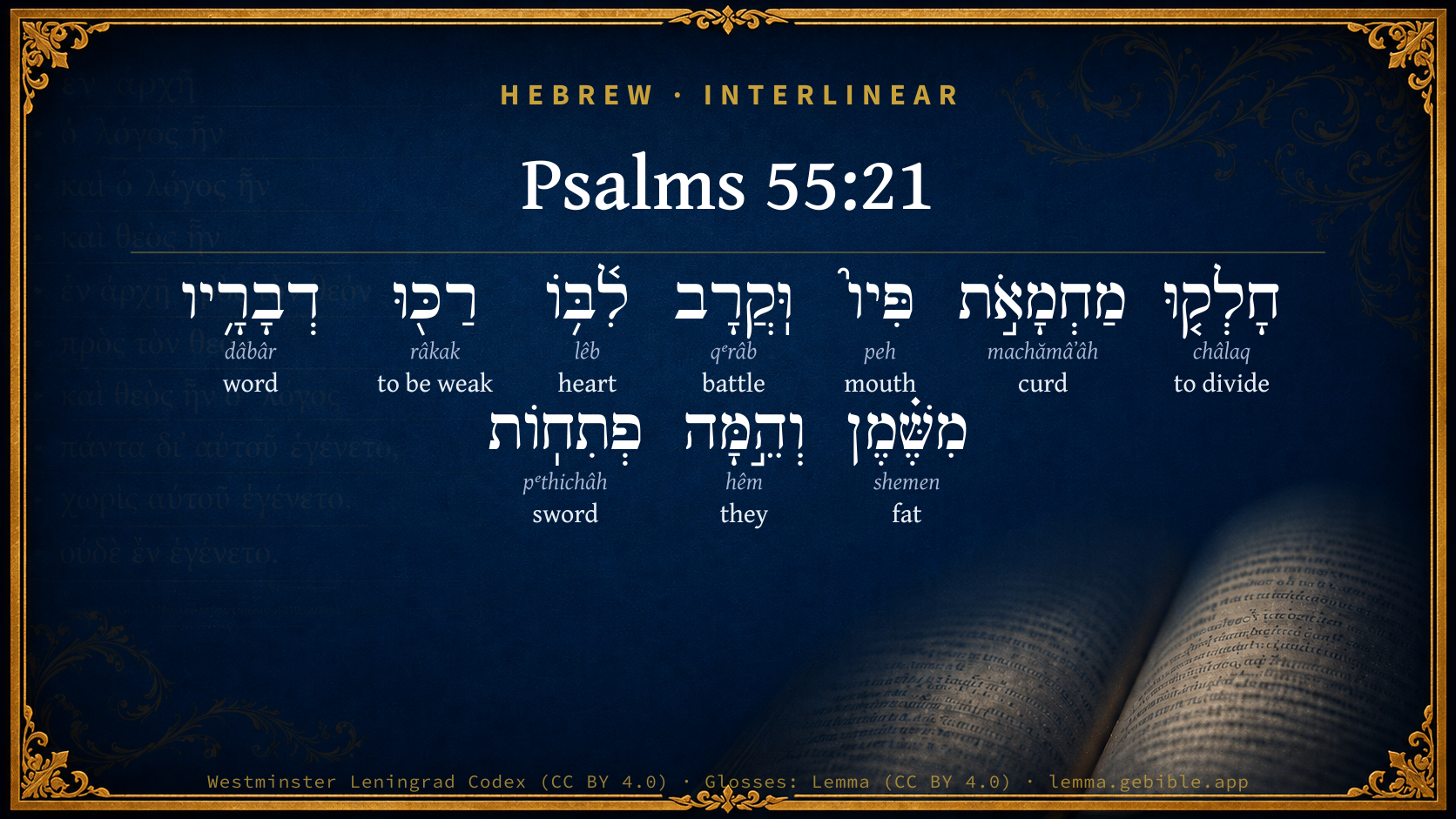
Hebrew (Westminster Leningrad Codex) Psalms 55:21 appears in the Hebrew Old Testament. The text above is from the Westminster Leningrad Codex. Each word links to its Strong’s number, a concise gloss, and parsing drawn from the Open Scriptures Hebrew Bible morphology. Click any word for its full Brown-Driver-Briggs (BDB) entry.
Download image
Cite this verse

Psalms 55:21 (World English Bible). Public Domain. Lemma interlinear Bible study tool, https://lemma.gebible.app/v/psalms/55/21.

Show BibTeX & RIS
BibTeX
RIS
English Translation
His mouth was smooth as butter, But his heart was war. His words were softer than oil, Yet they were drawn swords.
World English Bible · Public Domain
Highlights
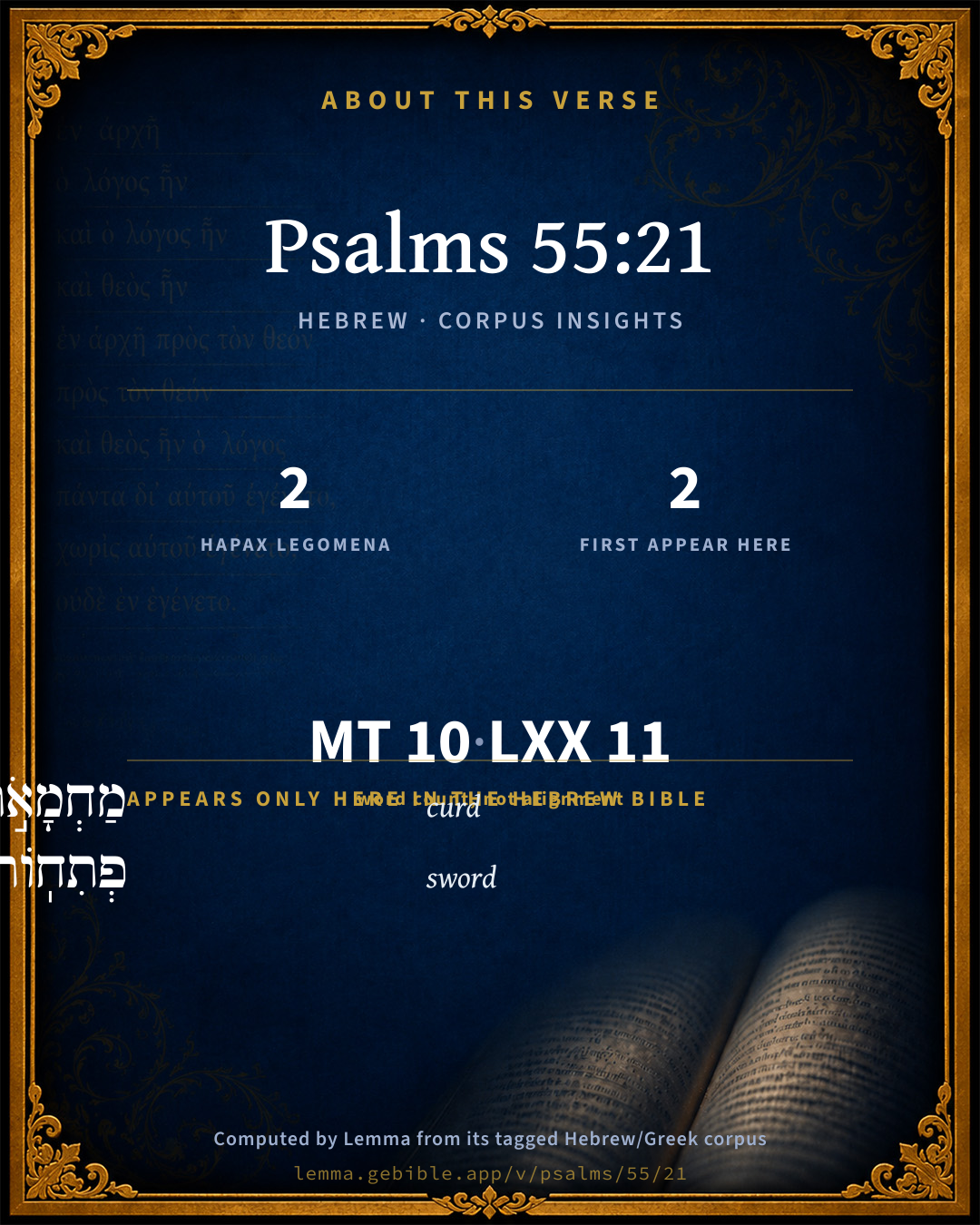
  • 2 hapax legomena — only here in the Hebrew Bible
  • 2 first appearances in the Hebrew Bible
Full analysis ↓
Download a study sheet

One document with this verse’s original text, its word-by-word gloss line, the meaning frame, cross-references with their text, attributed commentary, and full source and license credits — printable, and it pastes into notes with its structure intact.

This verse Autodidact and up

Study sheet (.html) Plain text (.txt)

A passage Seminary Student

Up to 50 verses in one chapter. A passage sheet keeps up to 6 commentary sources and 12 cross-references per verse, in the order this page ranks them, and says so on the sheet whenever that leaves anything out. Ask for a single verse and you get the Autodidact verse sheet above.

Everything on this page stays free to read, with no account — the sheet is a download of what is already on screen, not access to it.

Want to remove ads? Support Godless Engineer
Compare translations 3

The same verse in 3 English versions, stacked beneath the original-language interlinear above. Click any original word for its lexicon entry.

Each is an independent rendering of the whole verse — the interlinear is not word-aligned to these translations.

Highlighted words mark where these versions differ — a whole-verse word diff, not a word-by-word alignment.

  • World English Bible Public Domain
    His mouth was smooth as butter, But his heart was war. His words were softer than oil, Yet they were drawn swords.
  • King James Version Public Domain
    The words of his mouth were smoother than butter, but war was in his heart: his words were softer than oil, yet were they drawn swords.
  • unfoldingWord Literal Text CC BY-SA 4.0
    The curds of his mouth were smooth, but his heart war. His words were softer than oil, but they unsheathed.

unfoldingWord Literal Text — © unfoldingWord, licensed CC BY-SA 4.0. Word-aligned USFM3 via Door43 (git.door43.org/unfoldingWord/en_ult).

Versions to compare (up to 4)

3 of 4 selected

Show all 18 translations

Every available English version of this verse, each an independent rendering of the whole verse.

  • World English Bible Public Domain
    His mouth was smooth as butter, But his heart was war. His words were softer than oil, Yet they were drawn swords.
  • Berean Standard Bible Public Domain
    His speech is smooth as butter, but war is in his heart. His words are softer than oil, yet they are swords unsheathed.
  • Majority Standard Bible Public Domain
    His speech is smooth as butter, but war is in his heart. His words are softer than oil, yet they are swords unsheathed.
  • King James Version Public Domain
    The words of his mouth were smoother than butter, but war was in his heart: his words were softer than oil, yet were they drawn swords.
  • American Standard Version (1901) Public Domain
    His mouth was smooth as butter, But his heart was war: His words were softer than oil, Yet were they drawn swords.
  • Revised Version (1885) Public Domain
    His mouth was smooth as butter, but his heart was war: his words were softer than oil, yet were they drawn swords.
  • Geneva Bible (1599) Public Domain
    The wordes of his mouth were softer then butter, yet warre was in his heart: his words were more gentle then oyle, yet they were swordes.
  • Douay-Rheims (1899) Public Domain
    He shall redeem my soul in peace from them that draw near to me: for among many they were with me.
  • Young's Literal Translation Public Domain
    Sweeter than honey hath been his mouth, And his heart `is' war! Softer have been his words than oil, And they `are' drawn `swords'.
  • Literal Standard Version CC BY-SA 4.0
    His mouth has been sweeter than honey, || And his heart [is] war! His words have been softer than oil, || And they [are] drawn [swords].
  • Unlocked Literal Bible CC BY-SA 4.0
    His mouth was smooth as butter, but his heart was hostile; his words were softer than oil, yet they were actually drawn swords.
  • unfoldingWord Literal Text CC BY-SA 4.0
    The curds of his mouth were smooth, but his heart war. His words were softer than oil, but they unsheathed.
  • Darby Bible Public Domain
    Smooth were the milky [words] of his mouth, but his heart was war; his words were softer than oil, yet are they drawn swords.
  • World Messianic Bible Public Domain
    His mouth was smooth as butter, but his heart was war. His words were softer than oil, yet they were drawn swords.
  • Webster's Bible Public Domain
    \\55:20\\He hath put forth his hands against such as are at peace with him: he hath broken his covenant.
  • Free Bible Version CC BY-SA 4.0
    What he says is as smooth as butter, but inside he plans war; his words are as soothing as oil, but they cut like sharp swords.
  • Bible in Basic English Public Domain
    The words of his mouth were smoother than butter, but war was in his heart; his words were softer than oil, but they were sharp swords.
  • JPS Tanakh (1917) Public Domain
    (55-22) Smoother than cream were the speeches of his mouth, but his heart was war; his words were softer than oil, yet were they keen-edged swords.

Literal Standard Version (2020), Covenant Press — licensed CC BY-SA 4.0. Text via the HelloAO Bible API (eBible.org). Unlocked Literal Bible (unfoldingWord) — licensed CC BY-SA 4.0. Text via the HelloAO Bible API (eBible.org). unfoldingWord Literal Text — © unfoldingWord, licensed CC BY-SA 4.0. Word-aligned USFM3 via Door43 (git.door43.org/unfoldingWord/en_ult). Free Bible Version, Dr. Jonathan Gallagher — licensed CC BY-SA 4.0. Text via the HelloAO Bible API (eBible.org).

Word by word

More ways to search: Search by grammar → Find every occurrence → Compare this word →

Practice this passage: Drill this verse → Learn its vocabulary →

מַחְמָאֹ֣ת
machămâʼâh
H4260
“curds of”
Noun, Common, Feminine, Plural, Construct
Part of Speech
Noun
Type
Common
Gender
Feminine
Number
Plural
State
Construct
Full BDB Definition

Origin: a denominative from H2529

TWOT: 1182

curd-like, smooth, unctuous, hypocritical - words of flattery (figuratively)
  1. חָלְק֤וּ châlaq H2505 “to divide” Verb, Qal, Perfect, 3rd Person, Common, Plural
  2. פִּיו֮ peh H6310 “mouth · his” Noun, Common, Masculine, Singular, Construct + Suffix, Personal, 3rd Person, Masculine, Singular
  3. וּֽקֲרָב qᵉrâb H7128 “and · battle” Conjunction + Noun, Common, Masculine, Singular, Absolute
  4. לִ֫בּ֥וֹ lêb H3820 “heart · his” Noun, Common, Masculine, Singular, Construct + Suffix, Personal, 3rd Person, Masculine, Singular
  5. רַכּ֖וּ râkak H7401 “to be weak” Verb, Qal, Perfect, 3rd Person, Common, Plural
  6. דְבָרָ֥יו dâbâr H1697 “words · his” Noun, Common, Masculine, Plural, Construct + Suffix, Personal, 3rd Person, Masculine, Singular
  7. מִשֶּׁ֗מֶן shemen H8081 “from · fat” Preposition + Noun, Common, Masculine, Singular, Absolute
  8. וְהֵ֣מָּה hêm H1992 “and · they” Conjunction + Pronoun, Personal, 3rd Person, Masculine, Plural
  9. פְתִחֽוֹת pᵉthichâh H6609 “swords” Noun, Common, Feminine, Plural, Absolute

About this verse

These counts appear in no published source. They are computed here, from the morphology-tagged text and Lemma’s own curated glosses. What Lemma adds →

10
words
10
distinct lemmas
Wisdom
section

Notable vocabulary

2 hapax legomena — words that appear only here in the entire Hebrew Bible:

  • מַחְמָאֹ֣ת curd H4260
  • פְתִחֽוֹת sword H6609

First appearance in Scripture

These words make their first canonical appearance in the Hebrew Bible here:

  • מַחְמָאֹ֣ת curd H4260
  • פְתִחֽוֹת sword H6609

Shared distinctive vocabulary

רַכּ֖וּ to be weak H7401 occurs in 8 verses of the Hebrew Bible. Also found in:

Grammatical profile

  • 2 verbs
  • 7 nouns
  • 1 pronoun

Verb forms

  • חָלְק֤וּ Qal · Perfect
  • רַכּ֖וּ Qal · Perfect

Hebrew & Septuagint length

In English translation the verse runs 22 words from the Hebrew and 25 from the Septuagint (LXX English) — closely comparable.

A rough comparison of the two English renderings, which tokenize alike — not a word-level alignment.

Word counts can differ between the Hebrew and the Greek without any difference in meaning — e.g. the Hebrew direct-object marker אֵת has no separate Greek word, and Greek often adds the article ὁ.

In the original languages it is 10 Hebrew tokens and 11 Greek tokens — but the two are counted differently (Hebrew bundles its prefixes and suffixes into one token; the Greek is in lemma form), so that isn’t a like-for-like length.

Cross-references

13

Topical passages linked to Psalms 55:21 in the Treasury of Scripture Knowledge — connected by theme and wording, ordered by reader-vote popularity; previews shown in the World English Bible.

  • Psalms 57:4 My soul is among lions. I lie among those who are set on fire, Even the sons of men, whose teeth are spears and arrows, And their tongue a sharp sword.
  • Proverbs 5:3–4 For the lips of an adulteress drip honey. Her mouth is smoother than oil,
  • Psalms 28:3 Don't draw me away with the wicked, With the workers of iniquity who speak peace with their neighbors, But mischief is in their hearts.
  • Proverbs 26:28 A lying tongue hates those it hurts; And a flattering mouth works ruin.
  • Psalms 12:2 Everyone lies to his neighbor. They speak with flattering lips, and with a double heart.
  • Psalms 64:3 Who sharpen their tongue like a sword, And aim their arrows, deadly words,
  • Proverbs 26:24–26 A malicious man disguises himself with his lips, But he harbors evil in his heart.
  • Luke 20:20–21 They watched him, and sent out spies, who pretended to be righteous, that they might trap him in something he said, so as to deliver him up to the power and authority of the governor.
  • Psalms 62:4 They fully intend to throw him down from his lofty place. They delight in lies. They bless with their mouth, but they curse inwardly. Selah.
  • Proverbs 12:18 There is one who speaks rashly like the piercing of a sword, But the tongue of the wise heals.
  • Matthew 26:25 Judas, who betrayed him, answered, "It isn't me, is it, Rabbi?" He said to him, "You said it."
  • Psalms 59:7 Behold, they spew with their mouth. Swords are in their lips, "For," they say, "who hears us?"
  • John 13:2 After supper, the devil having already put into the heart of Judas Iscariot, Simon's son, to betray him,

Cross-references courtesy of OpenBible.info (CC BY 4.0).

Hebrew and Greek witnesses Masoretic Hebrew ↔ Greek Septuagint

The same verse in the two great witnesses to the Old Testament, shown verse-for-verse.

You’re reading Greek Psalm 54 (Hebrew Psalm 55). The Septuagint counts the superscription, so verse numbers can differ from the Hebrew — chapter-level alignment, not verse-by-verse. Numbering follows Rahlfs.

These are two independent witnesses, not word-aligned to each other, and the Septuagint is shown in lemma (dictionary) form.

Hebrew Psalms 55:21 Masoretic · Westminster Leningrad Codex

חָלְק֤וּ מַחְמָאֹ֣ת פִּיו֮ וּֽקֲרָב לִ֫בּ֥וֹ רַכּ֖וּ דְבָרָ֥יו מִשֶּׁ֗מֶן וְהֵ֣מָּה פְתִחֽוֹת

His mouth was smooth as butter, But his heart was war. His words were softer than oil, Yet they were drawn swords.

World English Bible · Public Domain

Greek LXX Greek Psalm 54:21 Septuagint · lemma form

ἐκτείνω ὁ χείρ αὐτός ἐν ὁ ἀποδίδωμι βεβηλόω ὁ διαθήκη αὐτός

They were scattered at the anger of his countenance, and his heart drew near them. His words were smoother than oil, yet are they darts.

LXX2012 (modern English Septuagint) · Public Domain

On this verse, Ellicott's Commentary for English Readers discusses the Septuagint’s reading. Read the note in Commentary ↓

Hebrew: Westminster Leningrad Codex (CC BY 4.0). Greek: Septuagint (public domain); English from LXX2012 (modern English Septuagint) (Public Domain). How the Septuagint differs from the Hebrew →

Commentary

Notes on Psalms 55:21 from classic Christian and Jewish commentators (each source and its license shown beneath its notes). The classic Christian expositions comment on the surrounding passage and are grouped to its opening verse, so a note may address several verses; the Jewish commentaries on the Tanakh (Rashi and others) are per-verse, so they appear only where the commentator wrote on this verse.

Lemma curates 59 commentaries, every one of them public domain or Creative Commons licensed, each selected and text-cleaned for this edition rather than reprinted as found. About our sources →

Trapp's Complete Commentary

John Trapp

Psa 55:21 [The words] of his mouth were smoother than butter, but war [was] in his heart: his words were softer than oil, yet [were] they drawn swords.

Ver. 21. The words of his mouth were smoother than butter] Full finely he could soothe and smooth me up, while he was my counsellor, with his pithanology.

Mel in ore, verba lactis:

Fel in corde, fraus in factis.

But war was in his heart] Heb. His heart was war. So in another psalm David saith of himself, "I am peace"; but when I speak of it, they are for war.

His words were softer than oil] So were Joab’s to Amasa; Judas’s to Christ; Cambyses’ to his brother whom he slew; Andronicus’s to his nobles, put to death by him, while he wept over them, as if he had been the most sorrowfull man alive. Whereupon the historian crieth out, Oh deep dissimulation and crocodile’s tears, &c.! The wiser sort deemed Andronicus’s praisings to be the beginnings of a man’s disgrace; his bounty, his undoing, and his kindness, his death.

John Trapp, A Commentary or Exposition upon All the Books of the Old and New Testament (1647–1656) — public domain. Text from a community e-Sword module.

J. A. Alexander on Psalms

Joseph Addison Alexander

22. (Psa 55:21) Smooth are the butterings of his mouth, and (yet) war (is in) his heart; soft are his words, more than oil, and (yet even) they are drawn (swords). To the charge of violence he adds that of treacherous hypocrisy, thus amplifying the laconic phrase oppression and deceit, in Psa 55:11 above. The English Bible, following some older versions, assimilates the clauses by making both comparative, smoother than butter, softer than oil. But in order to sustain this construction of the first clause, it is necessary to change the pointing of one Hebrew word, and to supply another as the nominative of the plural verb, which cannot without violence agree with mouth. The letter prefixed to the first noun is a part of it, and not a particle meaning than or more than, and the whole word denotes preparations of butter, cream, or rather curdled milk, which is the meaning of the primitive noun. As to the adversative use of and in both these clauses, see above, on Psa 55:13. War (is in) his heart, or still more simply, because not requiring the insertion of the particle, war (is) his heart, i.e. his cherished wish and purpose. The word translated war is a poetical term, the same that is employed above in Psa 55:18. In the last clause, even is supplied as well as yet, in order to convey, as far as possible, the emphasis of the Hebrew pronoun. And they themselves, i. e. the very oily words just mentioned, are drawn swords. This last expression is in Hebrew properly an adjective or participial form, but is specifically used in application to the sword, as brandished is in English, and so comes to be employed absolutely or as a substantive, expressing the entire complex idea of drawn swords, as weapons of attack, ready for use or on the point of being used forthwith.

Joseph Addison Alexander, The Psalms Translated and Explained (1850) — public domain. Text from a community e-Sword module.

Adam Clarke's Commentary

Verse 21. Were smoother than butter] He was a complete courtier, and a deep, designing hypocrite besides. His words were as soft as butter, and as smooth as oil, while he meditated war; and the fair words which were intended to deceive, were intended also to destroy: they were drawn swords. This is a literal description of the words and conduct of Absalom, as we learn from the inspired historian, 2Sa 15:2, c. He was accustomed to wait at the gate question the persons who came for justice and judgment; throw out broad hints that the king was negligent of the affairs of his kingdom, and had not provided an effective magistracy to administer justice among the people, and added that if he were appointed judge in the land, justice should be done to all. He bowed also to the people, and kissed them; and thus he stole the hearts of the men of Israel. See the passages referred to above.

Adam Clarke's Commentary on the Bible (1810–1826) — public domain. Text from a community e-Sword/MySword module.

Ellicott's Commentary for English Readers

(21) The words of his mouth.—The ancient versions and the grammatical anomalies point to a corruption of the text. Read, Smoother than butter is his face. The reading face for mouth is suggested by the LXX., though their version has wandered far from the text even thus amended.

Drawn swords.—The comparison of the tongue to a sword is frequent; that of the words themselves not so usual, but apt. We may compare Shakespeare’s

“I will speak daggers to her, but use none.”—Hamlet.

A Bible Commentary for English Readers, edited by Charles John Ellicott (1878–1897) — public domain. Text from a community e-Sword module.

The Cambridge Bible for Schools and Colleges

gen. ed. J. J. S. Perowne

21. The words of his mouth were smoother than butter] This rendering, though supported by some of the Ancient Versions and commended by the parallelism (smoother than butter—softer than oil), cannot be got out of the text as it stands. This means literally,

Smooth were the buttery words of his mouth.

But an easy emendation gives the sense, His mouth [LXX, face] was smoother than butter. Smoothness is the Heb. term for false and hypocritical flattery, as we speak of a ‘smooth-faced’ or ‘smooth-tongued’ rogue. Cp. Psa_5:9; Psa_12:2-3.

but war was in his heart] R.V., but his heart was war.

softer than oil] Cp. “smoother than oil” (Pro_5:3), of flattering and delusive speeches.

drawn swords] Ready to stab their victim to the heart. Cp. Psa_52:2, note.

The Cambridge Bible for Schools and Colleges (gen. ed. J. J. S. Perowne; Cambridge University Press, 1878–1918) — public domain. Text from a community e-Sword module.

John Gill's Exposition

Cast thy burden upon the Lord,.... These are either the words of the Holy Ghost to David, according to Jarchi; or of David to his own soul in distress, and may be directed to any good man in like circumstances. The word rendered "burden" signifies a gift and so the words are translated by many, "cast thy gift upon the Lord" (f); what he has given in a way of providence and of grace, acknowledge him to be the author of it; pray for a continuance of mercies, and for fresh supplies, and expect them; and also what he gives in a way of trial, the cross, with all afflictions and troubles: which sense seems most agreeable to the context; and these may be said to be "the gift" of God, as the cup of sorrow Christ drank of is said to be "given" him by his Father, Joh 18:11. These are given by the Lord to bring his people to a sense of sin, and acknowledgment of it; to humble them for it, and cause them to return from it; and to try their graces: and then do they cast them upon him, when they acknowledge them as coming from him; wait the removal of them in his time; desire a sanctified use of them, and expect deliverance from them by him. Or the sense is, whatever thou desirest should be given thee by the Lord, cast it on him; that is, leave it with him to do as he pleases, who works all things after the counsel of his own will. The Targum renders it,

"cast thy hope upon the Lord;''

as an anchor on a good bottom, to which hope is compared, Heb 6:19. This is done when persons make the Lord the object of their hope, and expect all from him they hope to enjoy here and hereafter. The Septuagint version is, "cast thy care upon the Lord"; of thy body, and all the temporal concerns of thy family, and everything relating thereunto; and of thy soul, and its everlasting welfare and salvation; see Pe1 5:7. But Jarchi, Aben Ezra, and Kimchi, interpret the word by "thy burden", which is learnt from the use of it in the Arabic language. The Rabbins did not know the meaning of the word, till one of them heard an Arabian merchant say (g),

"take up "thy burden", and cast it upon the camels.''

The burden here meant is either the burden of afflictions, which is sometimes very heavy; see Job 6:23; no affliction is joyous, but grievous; but some are heavier in their own kind and nature than others, and become so through the multiplicity of them, as in the case of Job; or through the long continuance of them, and especially when attended with the hidings of God's face, or with the temptations of Satan: or else the burden of sin and corruption, which is an heavy burden, and a very disagreeable one; under which the saints groan, and by which they are hindered in running their Christian race, and which they are like to carry with them to their graves; their only relief under it is to look to Christ, who has borne it and took it away; which may be meant by casting it on the Lord:

and he shall sustain thee; in being, both natural and spiritual; and supply with all things necessary both to the temporal and spiritual life, and support under all trials and difficulties;

he shall never suffer the righteous to be moved; to be shaken and stagger so as to fall, especially totally and finally; for the words may be rendered, "he shall never suffer the righteous to be moved for ever" (h); or so to be moved by their afflictions as to desert the cause in which they are engaged; nor shall they ever be moved by men or devils, or anything whatever, from their spiritual estate, in which they are by grace; nor from the love of God and covenant of grace; nor out of the hands of Christ; nor from their state of justification, adoption, and sanctification.

(f) "donum tuum", Montanus; "quicquid dat tibi", Junius & Tremellius, Piscator. (g) T. Bab. Roshhashanah, fol. 26. 2. Megillah, fol. 18. 1. Bereshit Rabba, s. 79. fol 69. 4. (h) "in aeternum", Musculus, Gussetius, p. 460. "perpetuo", Tigurine version, Lutherus, Gejerus; so Ainsworth.

John Gill's Exposition of the Whole Bible (1746–1763) — public domain (CC PDM 1.0). Text via the HelloAO Bible API.

Albert Barnes' Notes on the Bible

The words of his mouth were smoother than butter - Prof. Alexander renders this, “Smooth are the butterings of his mouth.” This is in accordance with the Hebrew, but the general meaning is well expressed in our common version. The idea is, that he was a hypocrite; that his professions of friendship were false; that he only used pleasant words - words expressive of friendship and love - to deceive and betray. We have a similar expression when we speak of “honeyed words,” or “honeyed accents.” This would apply to Ahithophel, and it will apply to thousands of similar cases in the world.

But war was in his heart - He was base, treacherous, false. He was really my enemy, and was ready, when any suitable occasion occurred, to show himself to be such.

His words were softer than oil - Smooth, pleasant, gentle. He was full of professions of love and kindness.

Yet were they drawn swords - As swords drawn from the scabbard, and ready to be used. Compare Psa 28:3; Psa 57:4.

Albert Barnes' Notes on the Bible (1834–1885) — public domain. Text from a community e-Sword/MySword module.

Matthew Poole's English Annotations

He covered his treasonable and bloody design with fair and flattering speeches.

Drawn swords; pernicious in their design and consequences.

Matthew Poole's English Annotations on the Holy Bible (1683–1685) — public domain. Text from a community e-Sword/MySword module.

The Treasury of David

Charles H. Spurgeon

Ver. 21. The words of his mouth were smoother than butter. He lauded and larded the man he hoped to devour. He buttered him with flattery and then battered him with malice. Beware of a man who has too much honey on his tongue; a trap is to be suspected where the bait is so tempting. Soft, smooth, oily words are most plentiful where truth and sincerity are most scarce.

But war was in his heart. He brought forth butter in a lordly dish, but he had a tent pin ready for the temples of his guest. When heart and lip so widely differ, the man is a monster, and those whom he assails are afflicted indeed.

His words were softer than oil. Nothing could be more unctuous and fluent, there were no objectionable syllables, no jars or discords, his words were as yielding as the best juice of the olive;

yet were they drawn swords, rapiers unsheathed, weapons brandished for the fray. Ah! base wretch, to be cajoling your victim while intending to devour him! entrapping him as if he were but a beast of prey; surely, such art thou thyself.

Ver. 21. The words of his mouth were smoother than butter, etc. Of this complexion are the cant of hypocrites, the charity of bigots and fanatics, the benevolence of atheists, the professions of the world, the allurements of the flesh, and the temptations of Satan, when he thinks proper to appear in the character of an angel of light. George Horne, 1730-1792.

Ver. 21. Butter. The Eastern butter is by no means like the solid substance, which is known by that name in these colder climates; but is liquid and flowing as appears from different passages in Scripture, particularly Job 29:6 20:17; and as is confirmed by the accounts of modern travellers; so that in fact it more resembles "cream, "which Vitringa says is the genuine sense of the word here used. Richard Mant, 1776-1849.

Ver. 21. To avoid all difficulties, the readiest expedient is to receive the Septuagint rendering of wqlx diemerisyhsan, they were, or are divided, viz., the members of the wicked man there spoken of, they are at great distance one from the other; wyk tamxm, butter their mouth, or their mouth is butter, wklkrqw and war their heart, or their heart is war; and this seems to be the fairest rendering of it. Henry Hammond, 1605-1660.

Ver. 21. A feigned friend is much like a crocodile who, when he smiles, poisons; and when he weepeth, devoureth; or the hyaena, having the voice of a man and the mind of a wolf, speaking like a friend and devouring like a fiend; or the flattering sirens that sweetly sing the sailor's wreck; or the fowler's pipe that pleasantly playeth the bird's death; or the bee, who carrieth honey in her mouth and a sting in her tail; or the box tree, whose leaves are always green, but the seeds poison. So his countenance is friendly and his words pleasant, but his intent dangerous, and his deeds unwholesome.

His fetch is to flatter, to catch what he can;

His purpose obtained, a fig for his man. L. Wright, 1616.

Ver. 21. The words of his mouth were smoother than butter, but war was in his heart: his words were softer than oil, yet were they drawn swords. Well, when I came to the justice again, there was Mr. Foster, of Bedford, who coming out of another room, and seeing me by the light of the candle, for it was dark night when I came thither, he said unto me, "Who is there? John Bunyan?" with much seeming affection, as if he would have leaped in my neck and kissed me, (A right Judas.), which made me somewhat wonder that such a man as he, with whom I had so little acquaintance, and, besides, that had ever been a close opposer of the ways of God, should carry himself so full of love to me, but afterwards when I saw what he did, it caused me to remember those sayings, Their tongues were softer than oil, yet were they drawn swords, and again, "Beware of men, "etc. When I had answered him that, blessed be God, I was well, he said, "What is the occasion of your being here?" or to that purpose. To whom I answered that I was at a meeting of people a little way off, intending to speak a word of exhortation to them; but the justice hearing thereof (said I) was pleased to send his warrant to fetch me before him, etc.

John Bunyan. In relation to J.B.'s imprisonment: written by himself. Offor's edit., Vol. 1. p. 52.

Ver. 21. (first clause). --

Smooth are his words, his voice as honey sweet,

Yet war was in his heart, and dark deceit. Moschus (B.C. 250.)

Ver. 21. The hypocrite's mouth.

1. It has many words.

2. They are only from his mouth.

3. They are very smooth.

4. They conceal rather than reveal his purpose.

5. They are cutting and killing.

6. They will kill himself.

Psalms 55:22*

Charles H. Spurgeon's The Treasury of David (1869–1885) — public domain. Psalms only. Text from a community e-Sword/MySword module.

Whedon's Commentary on the Bible

Daniel D. Whedon

21. The words of his mouth were smoother than butter—It would seem from this verse that Ahithophel had for a long time concealed from David his real purpose of revenge by his courtly address. This exactly suits the view suggested in note on Psa_55:12, which see.

Daniel D. Whedon (gen. ed.), Commentary on the Old and New Testaments (1874–1909) — public domain. Text from a community e-Sword module.

The Pulpit Commentary

The words of his mouth wore smoother than butter; literally, smooth were the butters of his mouth i.e. , his flattering utterances. But war was in his heart; literally, but his heart was war. His words were softer than oil, yet were they drawn swords; i.e. keen, cutting according to our own idiom, "like daggers."

The Pulpit Commentary (1880–1919), ed. H.D.M. Spence-Jones & Joseph S. Exell — public domain. Text from a community e-Sword module.

Rashi

Rabbi Shlomo Yitzchaki (Rashi)

He stretched forth his hands This refers to Ahithophel the wicked.

He stretched forth Heb. שלח, tandit or tondet in Old French, stretched forth, tendait in modern French.

against him who was at peace with him Heb. בשלמיו, against him who was tranquil and at peace with him.

Rashi on the Tanakh — English translations: “The Judaica Press complete Tanach with Rashi, translated by A. J. Rosenberg” (CC BY 4.0); “Pentateuch with Rashi's commentary by M. Rosenbaum and A.M. Silbermann, 1929-1934” (public domain); “The Metsudah Tanach series, Lakewood, N.J” (CC BY 4.0); and “The Book of Joshua, Metsudah Publications, 1997” (CC BY 4.0). Text via Sefaria.

Lesson kit

Teaching starters — assembled from the data on this page, not authored interpretation. Every prompt links to the verse data it draws on. Edit before teaching.

Psalms, in the Wisdom, opens this verse with 10 words (10 distinct Hebrew lemmas). Its most distinctive word is machămâʼâh (“curd”). A historical commentator’s framing appears above. Read the whole chapter for the surrounding context.

Discussion questions

  1. How does “curd” (machămâʼâh) shape what this verse is saying?
  2. 2 words here appear nowhere else in the Hebrew Bible. Why might the author reach for such rare wording?
  3. 2 words make their first appearance in Scripture here. What does this debut establish?
  4. How does Deuteronomy 20:3, which shares the word «to be weak», read alongside this verse?
  5. These translations render this verse differently. What is at stake in choosing one wording over another?
  6. «חָלְק֤וּ» is a Qal Perfect verb. How does that grammatical form shape the action described?
  7. Compare how Trapp's Complete Commentary and J. A. Alexander on Psalms read this verse. Where do they agree or differ?

Things to notice

Reading settings

Reading text

Shown beneath each verse's original-language words.

Old Testament
Old Testament edition

Read the OT as the Masoretic Hebrew (MT) or the Greek Septuagint (LXX).

English shown for the Greek Septuagint (in the Hebrew ↔ Greek comparison).

Comparing translations? Open the Compare panel on any verse page to stack up to four side by side.