
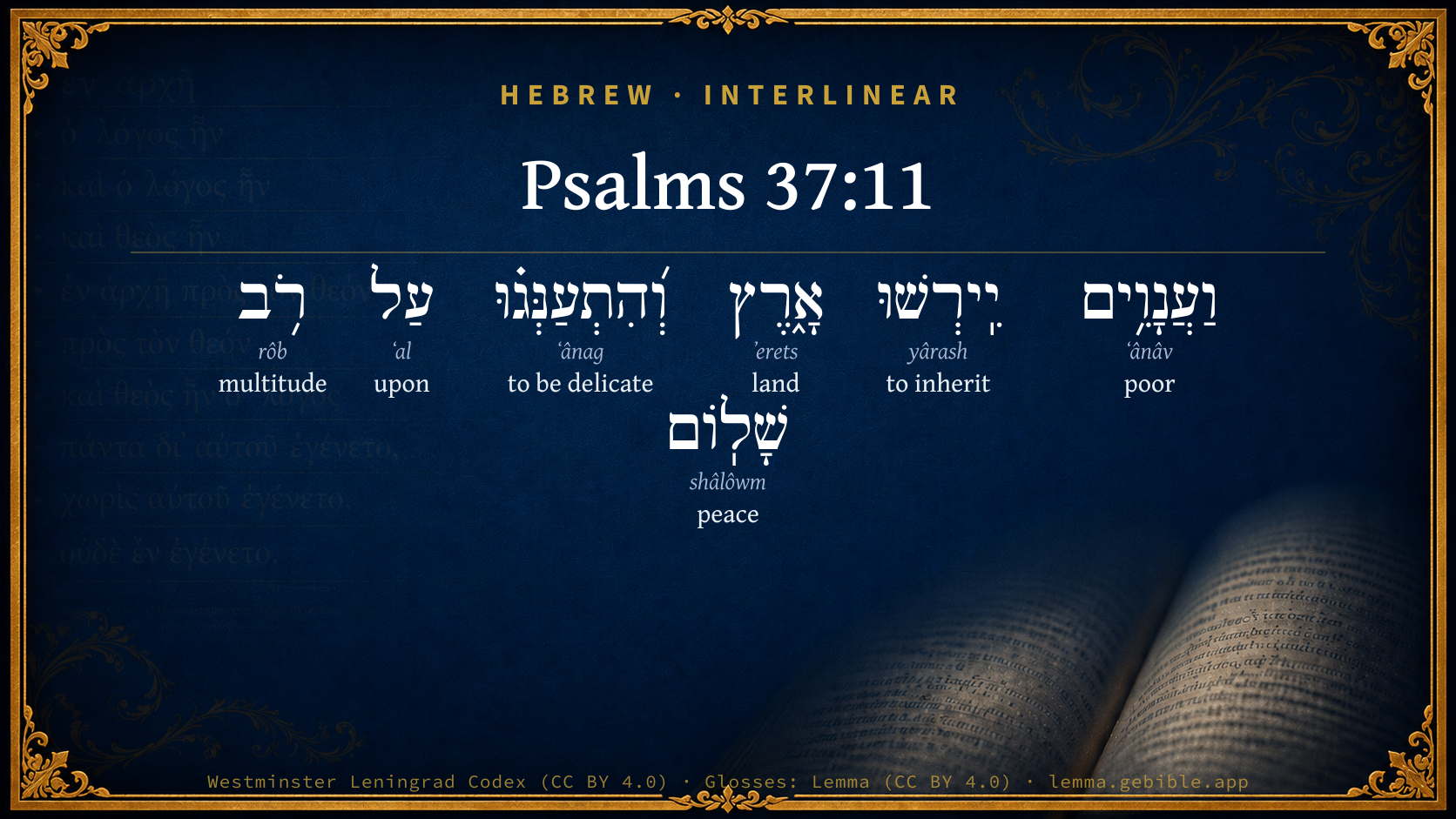
Psalms 37:11

Hebrew (Westminster Leningrad Codex) Psalms 37:11 appears in the Hebrew Old Testament. The text above is from the Westminster Leningrad Codex. Each word links to its Strong’s number, a concise gloss, and parsing drawn from the Open Scriptures Hebrew Bible morphology. Click any word for its full Brown-Driver-Briggs (BDB) entry.
Download image
Cite this verse

Psalms 37:11 (World English Bible). Public Domain. Lemma interlinear Bible study tool, https://lemma.gebible.app/v/psalms/37/11.

Show BibTeX & RIS
BibTeX
RIS
English Translation
But the humble shall inherit the land, And shall delight themselves in the abundance of peace.
World English Bible · Public Domain
Download a study sheet

One document with this verse’s original text, its word-by-word gloss line, the meaning frame, cross-references with their text, attributed commentary, and full source and license credits — printable, and it pastes into notes with its structure intact.

This verse Autodidact and up

Study sheet (.html) Plain text (.txt)

A passage Seminary Student

Up to 50 verses in one chapter. A passage sheet keeps up to 6 commentary sources and 12 cross-references per verse, in the order this page ranks them, and says so on the sheet whenever that leaves anything out. Ask for a single verse and you get the Autodidact verse sheet above.

Everything on this page stays free to read, with no account — the sheet is a download of what is already on screen, not access to it.

Want to remove ads? Support Godless Engineer
Compare translations 3

The same verse in 3 English versions, stacked beneath the original-language interlinear above. Click any original word for its lexicon entry.

Each is an independent rendering of the whole verse — the interlinear is not word-aligned to these translations.

Highlighted words mark where these versions differ — a whole-verse word diff, not a word-by-word alignment.

  • World English Bible Public Domain
    But the humble shall inherit the land, And shall delight themselves in the abundance of peace.
  • King James Version Public Domain
    But the meek shall inherit the earth; and shall delight themselves in the abundance of peace.
  • unfoldingWord Literal Text CC BY-SA 4.0
    But the meek will inherit the land and will delight themselves over an abundance of peace.

unfoldingWord Literal Text — © unfoldingWord, licensed CC BY-SA 4.0. Word-aligned USFM3 via Door43 (git.door43.org/unfoldingWord/en_ult).

Versions to compare (up to 4)

3 of 4 selected

Show all 18 translations

Every available English version of this verse, each an independent rendering of the whole verse.

  • World English Bible Public Domain
    But the humble shall inherit the land, And shall delight themselves in the abundance of peace.
  • Berean Standard Bible Public Domain
    But the meek will inherit the land and delight in abundant prosperity.
  • Majority Standard Bible Public Domain
    But the meek will inherit the land and delight in abundant prosperity.
  • King James Version Public Domain
    But the meek shall inherit the earth; and shall delight themselves in the abundance of peace.
  • American Standard Version (1901) Public Domain
    But the meek shall inherit the land, And shall delight themselves in the abundance of peace.
  • Revised Version (1885) Public Domain
    But the meek shall inherit the land; and shall delight themselves in the abundance of peace.
  • Geneva Bible (1599) Public Domain
    But meeke men shall possesse the earth, and shall haue their delite in the multitude of peace.
  • Douay-Rheims (1899) Public Domain
    But the meek shall inherit the land, and shall delight in abundance of peace.
  • Young's Literal Translation Public Domain
    And the humble do possess the land, And they have delighted themselves In the abundance of peace.
  • Literal Standard Version CC BY-SA 4.0
    And the humble possess the land, || And they have delighted themselves || In the abundance of peace.
  • Unlocked Literal Bible CC BY-SA 4.0
    But the meek will inherit the land and will delight in great prosperity.
  • unfoldingWord Literal Text CC BY-SA 4.0
    But the meek will inherit the land and will delight themselves over an abundance of peace.
  • Darby Bible Public Domain
    But the meek shall possess the land, and shall delight themselves in the abundance of prosperity.
  • World Messianic Bible Public Domain
    But the humble shall inherit the land, and shall delight themselves in the abundance of peace.
  • Webster's Bible Public Domain
    But the meek shall inherit the earth; and shall delight themselves in the abundance of peace.
  • Free Bible Version CC BY-SA 4.0
    The humble will own the land; they will live there happily, in peace and prosperity.
  • Bible in Basic English Public Domain
    But the gentle will have the earth for their heritage; they will take their delight in peace without measure.
  • JPS Tanakh (1917) Public Domain
    But the humble shall inherit the land, and delight themselves in the abundance of peace.

Literal Standard Version (2020), Covenant Press — licensed CC BY-SA 4.0. Text via the HelloAO Bible API (eBible.org). Unlocked Literal Bible (unfoldingWord) — licensed CC BY-SA 4.0. Text via the HelloAO Bible API (eBible.org). unfoldingWord Literal Text — © unfoldingWord, licensed CC BY-SA 4.0. Word-aligned USFM3 via Door43 (git.door43.org/unfoldingWord/en_ult). Free Bible Version, Dr. Jonathan Gallagher — licensed CC BY-SA 4.0. Text via the HelloAO Bible API (eBible.org).

Word by word

More ways to search: Search by grammar → Find every occurrence → Compare this word →

Practice this passage: Drill this verse → Learn its vocabulary →

About this verse

These counts appear in no published source. They are computed here, from the morphology-tagged text and Lemma’s own curated glosses. What Lemma adds →

7
words
7
distinct lemmas
Wisdom
section

Notable vocabulary

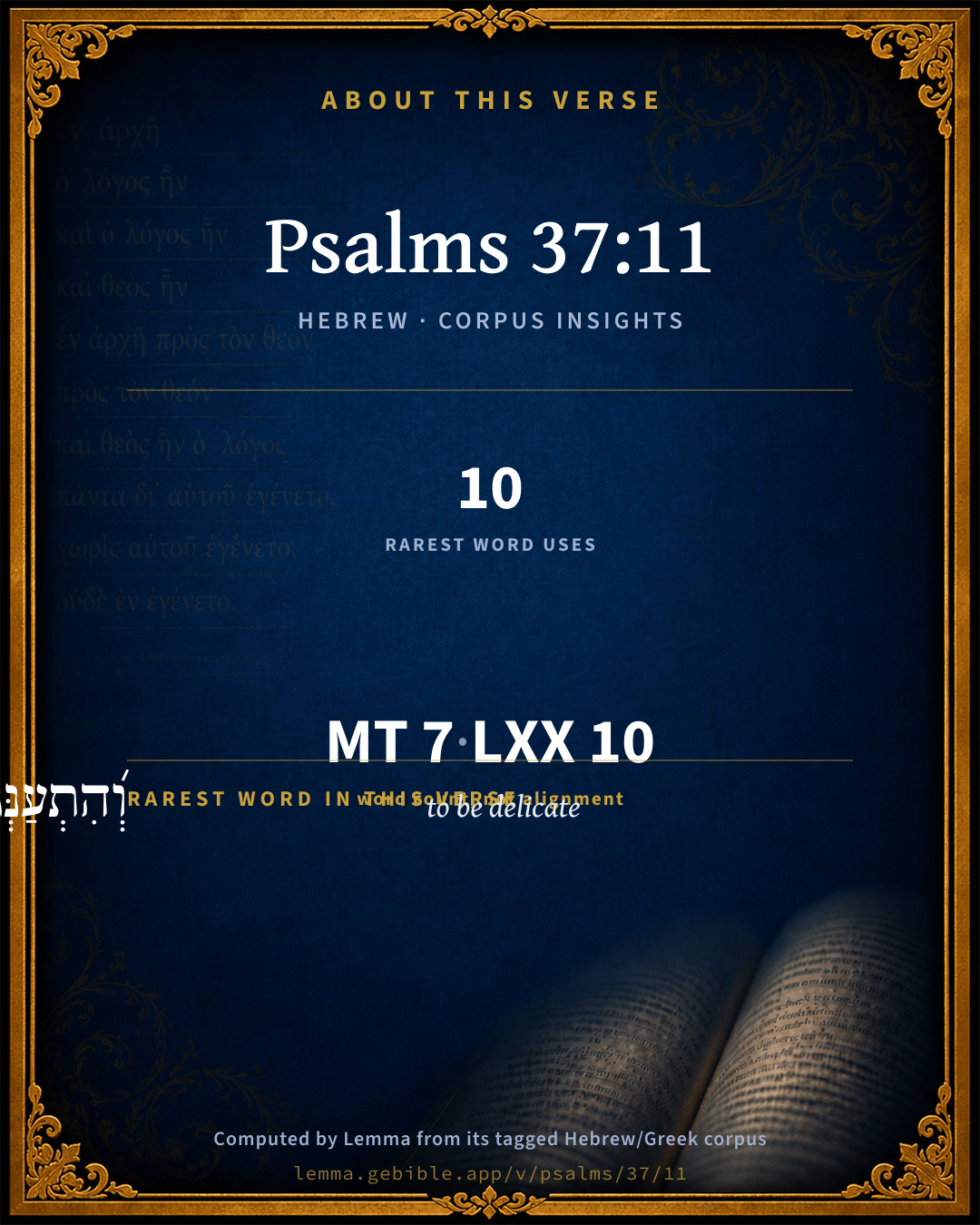
The rarest word here is וְ֝הִתְעַנְּג֗וּ to be delicate H6026 — appearing just 10 times in the whole Hebrew Bible.

Shared distinctive vocabulary

וְ֝הִתְעַנְּג֗וּ to be delicate H6026 occurs in 10 verses of the Hebrew Bible. Also found in:

Grammatical profile

  • 2 verbs
  • 3 nouns
  • 1 adjective
  • 1 preposition

Verb forms

  • יִֽירְשׁוּ Qal · Imperfect
  • וְ֝הִתְעַנְּג֗וּ Hithpael · Sequential Perfect

Hebrew & Septuagint length

In English translation the verse runs 16 words from the Hebrew and 16 from the Septuagint (LXX English) — the same length.

A rough comparison of the two English renderings, which tokenize alike — not a word-level alignment.

Word counts can differ between the Hebrew and the Greek without any difference in meaning — e.g. the Hebrew direct-object marker אֵת has no separate Greek word, and Greek often adds the article ὁ.

In the original languages it is 7 Hebrew tokens and 10 Greek tokens — but the two are counted differently (Hebrew bundles its prefixes and suffixes into one token; the Greek is in lemma form), so that isn’t a like-for-like length.

Cross-references

13

Topical passages linked to Psalms 37:11 in the Treasury of Scripture Knowledge — connected by theme and wording, ordered by reader-vote popularity; previews shown in the World English Bible.

  • Matthew 5:5 Blessed are the gentle, For they shall inherit the earth.
  • Isaiah 26:3 You will keep [him] in perfect peace, [whose] mind [is] stayed [on you]; because he trusts in you.
  • Galatians 5:22–23 But the fruit of the Spirit is love, joy, peace, patience, kindness, goodness, faithfulness,
  • James 3:13 Who is wise and understanding among you? Let him show by his good conduct that his deeds are done in gentleness of wisdom.
  • Psalms 119:165 Those who love your law have great peace. Nothing causes them to stumble.
  • Philippians 4:7 And the peace of God, which surpasses all understanding, will guard your hearts and your thoughts in Christ Jesus.
  • Isaiah 48:18 Oh that you had listened to my commandments! then had your peace been as a river, and your righteousness as the waves of the sea:
  • 1 Timothy 6:11 But you, man of God, flee these things, and follow after righteousness, godliness, faith, love, patience, and gentleness.
  • Psalms 36:8 They shall be abundantly satisfied with the abundance of your house. You will make them drink of the river of your pleasures.
  • Psalms 72:7 In his days, the righteous shall flourish, And abundance of peace, until the moon is no more.
  • Isaiah 57:18–21 I have seen his ways, and will heal him: I will lead him also, and restore comforts to him and to his mourners.
  • John 14:27 Peace I leave with you. My peace I give to you; not as the world gives, give I to you. Don't let your heart be troubled, neither let it be fearful.
  • James 1:21 Therefore, putting away all filthiness and overflowing of wickedness, receive with humility the implanted word, which is able to save your souls.

Cross-references courtesy of OpenBible.info (CC BY 4.0).

Hebrew and Greek witnesses Masoretic Hebrew ↔ Greek Septuagint

The same verse in the two great witnesses to the Old Testament, shown verse-for-verse.

You’re reading Greek Psalm 36 (Hebrew Psalm 37). The Septuagint counts the superscription, so verse numbers can differ from the Hebrew — chapter-level alignment, not verse-by-verse. Numbering follows Rahlfs.

These are two independent witnesses, not word-aligned to each other, and the Septuagint is shown in lemma (dictionary) form.

Hebrew Psalms 37:11 Masoretic · Westminster Leningrad Codex

וַעֲנָוִ֥ים יִֽירְשׁוּ אָ֑רֶץ וְ֝הִתְעַנְּג֗וּ עַל רֹ֥ב שָׁלֽוֹם

But the humble shall inherit the land, And shall delight themselves in the abundance of peace.

World English Bible · Public Domain

Greek LXX Greek Psalm 36:11 Septuagint · lemma form

ὁ δέ πραΰς κληρονομέω γῆ καί κατατρύφάω ἐπί πλῆθος εἰρήνη

But the meek shall inherit the earth; and shall delight themselves in the abundance of peace.

LXX2012 (modern English Septuagint) · Public Domain

On this verse, The Cambridge Bible for Schools and Colleges discusses the Septuagint’s reading. Read the note in Commentary ↓

Hebrew: Westminster Leningrad Codex (CC BY 4.0). Greek: Septuagint (public domain); English from LXX2012 (modern English Septuagint) (Public Domain). How the Septuagint differs from the Hebrew →

Commentary

Notes on Psalms 37:11 from classic Christian and Jewish commentators (each source and its license shown beneath its notes). The classic Christian expositions comment on the surrounding passage and are grouped to its opening verse, so a note may address several verses; the Jewish commentaries on the Tanakh (Rashi and others) are per-verse, so they appear only where the commentator wrote on this verse.

Lemma curates 59 commentaries, every one of them public domain or Creative Commons licensed, each selected and text-cleaned for this edition rather than reprinted as found. About our sources →

Trapp's Complete Commentary

John Trapp

Psa 37:11 But the meek shall inherit the earth; and shall delight themselves in the abundance of peace.

Ver. 11. But the meek shall inherit the earth] Our Saviour (and probably from hence) saith the same, Mat 5:5. {See Trapp on "Mat 5:5"} {See Trapp on "Psa 37:9"}

And shall delight themselves in the abundance of peace] Because cured of the fret, and well content with their present condition; hence that ευθυμια, rectitude of mind, the mother of all true mirth; when the wicked are in a perpetual disquietude, στασιαζει γαρ αυτων η φυχη, they are never at rest.

John Trapp, A Commentary or Exposition upon All the Books of the Old and New Testament (1647–1656) — public domain. Text from a community e-Sword module.

J. A. Alexander on Psalms

Joseph Addison Alexander

11. (Psa 37:11) And the humble as in Psa 37:4, above.—In abundance, or increase, the infinitive of a verb which means to be increased or multiplied, and which occurs above, in Psa 3:2 (1).—Of peace, in the wide sense of prosperity, well-being, as opposed to want and suffering, and not merely of repose or quiet, as opposed to strife and perturbation.

Joseph Addison Alexander, The Psalms Translated and Explained (1850) — public domain. Text from a community e-Sword module.

Tyndale Open Study Notes

Tyndale Open Resources

37:11 The Lord is the author of peace (85:10)—he brings peace to a chaotic world (29:11; 37:11; 85:8; 147:14). His wisdom guides the lowly into the way of peace (119:165; Matt 5:5).

Tyndale Open Study Notes — © Tyndale Open Resources, licensed CC BY-SA 4.0. Text via the HelloAO Bible API.

Jamieson, Fausset & Brown

Robert Jamieson, A. R. Fausset & David Brown

peace--includes prosperity.

Jamieson, Fausset & Brown — Commentary Critical and Explanatory on the Whole Bible (1871) — public domain (CC PDM 1.0). Text via the HelloAO Bible API.

Adam Clarke's Commentary

Verse 11. But the meek] ענוים anavim, the afflicted, the poor Jewish captives.

Shall inherit the earth] ארץ arets, the land of Judea, given by God himself as an inheritance to their fathers, and to their posterity for ever. See Ps 37:9.

Adam Clarke's Commentary on the Bible (1810–1826) — public domain. Text from a community e-Sword/MySword module.

Ellicott's Commentary for English Readers

(11) Shall inherit.—A repetition of Psa_37:3.—Better, are heirs of the land, i.e., Canaan. Christ’s Beatitude (see Mat_5:3, N. Test. Commentary) widens the promise and lifts it to a higher level. The quiet, unpretending, contented servant of God gets more true blessedness out of the earth, and so more truly possesses it, than the ungodly, though they be lords of broad acres.

A Bible Commentary for English Readers, edited by Charles John Ellicott (1878–1897) — public domain. Text from a community e-Sword module.

The Cambridge Bible for Schools and Colleges

gen. ed. J. J. S. Perowne

11. The promise is reaffirmed in a larger sense in the beatitude of Mat_5:5, the language of which reproduces the rendering of the LXX here: οἱ δὲ πρᾳεῖς κληρονομήσουσιν γῆν.

in the abundance of peace] Cp. Psa_72:7; Psa_119:165; Isa_32:17.

The Cambridge Bible for Schools and Colleges (gen. ed. J. J. S. Perowne; Cambridge University Press, 1878–1918) — public domain. Text from a community e-Sword module.

John Gill's Exposition

The wicked plotteth against the just,.... Forms schemes to make him uneasy, uncomfortable, and unhappy:

and gnasheth upon him with his teeth: which expresses his malice and hatred, as David's enemies did upon him, Psa 35:16; and Stephen's, Act 7:54.

John Gill's Exposition of the Whole Bible (1746–1763) — public domain (CC PDM 1.0). Text via the HelloAO Bible API.

Albert Barnes' Notes on the Bible

But the meek shall inherit the earth - See the notes at Psa 37:3. On the meaning of the word here rendered “meek,” see the notes at Psa 9:12, where it is rendered “humble.” The word properly denotes those who are afflicted, distressed, needy; then, those who are of humble rank in life; then, the mild, the gentle, the meek. The term here is a general one to denote those who are the friends of God, considered as meek, mild, gentle, humble, in contradistinction from the wicked who are proud and haughty; perhaps also, in this connection, in contrast with the wicked as prosperous in life. It was probably this passage that the Saviour quoted in Mat 5:5.

And shall delight themselves -

(a) Shall “prefer” what is here referred to as the source of their happiness, or as in accordance with the desires of their hearts;

(b) shall “find” actual delight or happiness in this.

Though not rich and prospered in this world as the wicked often are, yet they will have their own sources of enjoyment, and will find happiness in what they prefer.

In the abundance of peace - In abundant peace. In the tranquility and quietness in which they spend their lives, in contrast with the jealousies, the contentions, and the strifes which exist among the wicked even when prosperous. They will have peace with God Psa 29:11; Psa 85:8; Psa 119:165; Rom 5:1; they will have peace in their own consciences; they will have peace in the calmness of a quiet and contented spirit; they will have peace with those around them, as they have no passions to gratify, and no object to secure, which will excite the envy, or stir up the wrath, of others.

Albert Barnes' Notes on the Bible (1834–1885) — public domain. Text from a community e-Sword/MySword module.

Matthew Poole's English Annotations

The meek, i.e. the godly, who are frequently thus called, as Psa 22:26; 149:4; those who patiently bear God’s afflicting hand, and meekly pass by injuries from ungodly men. The abundance of peace; partly of outward peace and prosperity, which God in his due time will give them; and principally of inward peace and satisfaction of mind, in the sense of God’s favour, and the assurance of his own endless happiness.

Matthew Poole's English Annotations on the Holy Bible (1683–1685) — public domain. Text from a community e-Sword/MySword module.

The Treasury of David

Charles H. Spurgeon

Ver. 11. But the meek shall inherit the earth. Above all others they shall enjoy life. Even if they suffer, their consolations shall overtop their tribulations. By inheriting the land is meant obtaining covenant privileges and the salvation of God. Such as are truly humble shall take their lot with the rest of the heirs of grace, to whom all good things come by a sacred birthright. And shall delight themselves in the abundance of peace. Peace they love and peace they shall have. If they find not abundance of gold, abundance of peace will serve their turn far better. Others find joy in strife, and thence arises their misery in due time, but peace leads on to peace, and the more a man loves it the more shall it come to him. In the halcyon period of the latter days, when universal peace shall make glad the earth, the full prophetic meaning of words like these will be made plain.

Ver. 11. The meek shall inherit the earth. In the meantime, they, and they only, possess the present earth, as they go toward the kingdom of heaven, by being humble, and cheerful, and content with what their good God has allotted them. They have no turbulent, repining, vexatious thoughts that they deserve better; nor are vexed when they see others possessed of more honour, or more riches, than their wise God has allotted for their share. But they possess what they have with a meek and contented quietness; such a quietness as makes their very dreams pleasing, both to God and themselves. Isaak Walton (1593-1683), in "The Complete Angler."

Ver. 11. The meek. What is thy Beloved more than any other beloved? It is spoken to the spouse. So what is meekness more than any other virtues? We may say, here is synecdoche speciei, one particular taken for the general, one virtue for all the rest. Or the effect is put for the cause; because meekness is one of the principal and chiefest parts of holiness. But if you will give me leave to conjecture, the Holy Ghost may seem in this promise at once to show the condition of the church, and to comfort her; and because being laid hard at on every side, she stands in need of this virtue more than any other, to fit and fashion the reward to the virtue, to cherish and exalt it in us with the promise of something beyond our expectation, even the inheritance of the earth. And indeed what fitter reward can there be of meekness? What more fit and just than that they who have been made the anvil for injuries to beat on, who have been viri perpessitii, as Seneca speaks of Socrates, men of great sufferance, who have suffered not only their goods to be torn from them by oppression and wrong, but their reputations to be wounded with the sharp razor of detraction, and have withstood the shock of all spectantibus similes, with the patience of a looker on, should be raised and comforted with a promise of that which their meekness gave up to the spoil; and that by the providence of God which loves to thwart the practice of the world, they should be made heirs even of those possessions which the hand of violence hath snatched from them. Anthony Farindon, B.D., 1596-1658.

Ver. 11. Not the hot stirring spirits who bustle for the world shall have it, but the meek, who are thrust up and down from corner to corner, and hardly suffered to remain anywhere quietly in it. This earth, which they seem most deprived of, they only shall have and enjoy. When the Lord hath made it worth the having, then none shall have it but they. They shall inherit the earth. The earth is the Lord's; these are the children of the Lord, and they shall inherit this earth. When the Lord taketh it into his own possession and enjoyment, they shall succeed him in the possession and enjoyment of it. It is their right, and shall descend unto them by right, by inheritance. It is the Lord's right, and by the Lord shall descend to them as their right. They cannot yet have it, for the Lord hath it not yet; but when the Lord hath it, it shall fairly descend to them. This accursed earth they shall never have, but when it is taken into the hands of the Lord, and blessed by the Lord, then it shall be theirs, then it shall be inherited by the children of blessing. John Pennington.

Ver. 11. And shall delight themselves in the abundance of peace. Surely when the glory of the Lord covers the earth, and all the kingdoms of this world become the kingdoms of the Prince of Peace, and the wicked one is rooted out, we may well expect peace in rich abundance. W. Wilson.

Ver. 11. The meek man's delight, or "the harvest of a quiet eye."

Psalms 37:12*

Charles H. Spurgeon's The Treasury of David (1869–1885) — public domain. Psalms only. Text from a community e-Sword/MySword module.

Whedon's Commentary on the Bible

Daniel D. Whedon

11. The meek shall inherit the earth—Quoted by our Lord, (Mat_5:5,) where the Greek γη (ge) stands for the Hebrew ארצ, (arets,) both generic terms, signifying earth, land, country, etc. The word occurs six times in this psalm, and is three times translated land, (land of Palestine,) and three times earth. There is no rule for determining whether the former or the latter rendering should be given but by the context, but the restricted sense of land, as the abode of the covenant people, would seem more probable here, particularly as the sovereign control of that country was the great point in dispute between the Jews and the nations, and was the standing sign of the reward of righteousness to the Hebrews. Our Lord’s quotation, given above, might have also been intended to admonish the Jews that the character necessary to perpetuate their abode in their native soil was the condition of heirship to his kingdom.

Daniel D. Whedon (gen. ed.), Commentary on the Old and New Testaments (1874–1909) — public domain. Text from a community e-Sword module.

The Pulpit Commentary

But the meek shall inherit the earth. This prophecy is endorsed by our Lord. (Mat_5:5) It has only had occasional fulfilment hitherto, notably in Moses, the meekest man of his day; (Num_12:3) to some extent in St. Louis and other great saints, whose influence has been world-wide, as St. Francis d"Assisi, St. Francis Xavier, St. Carlo Boromeo, and others. And shall delight themselves in the abundance of peace. Being men of peace, the meek, when they "inherit the earth," will establish universal peace (Isa_2:4 Isa_11:6-9 Isa_65:25 Eze_34:25) and "delight in the abundance of it". (comp. Psa_72:7)

The Pulpit Commentary (1880–1919), ed. H.D.M. Spence-Jones & Joseph S. Exell — public domain. Text from a community e-Sword module.

John Wesley's Explanatory Notes

But - Those who patiently bear God's afflicting hand, and meekly pass by injuries. Peace - Partly of outward peace and prosperity, which God in his due time will give them: but principally of inward peace, in the sense of God's favour and the assurance of endless happiness.

John Wesley, Explanatory Notes Upon the Whole Bible (1754–1765) — public domain. Text via the GEBible commentary corpus.

unfoldingWord translationNotes

Door43 World Missions Community

the meek

This refers to the people who are meek. AT: "the meek people" (See: Nominal Adjectives)

will inherit the land

The possession of the land is spoken of as if it will be received as an inheritance. See how you translated this in Psalms 37:9. AT: "will receive the land as their own possession" or "will live safely in the land" (See: Metaphor)

The wicked man

This does not refer to a specific man. It refers to wicked people in general. AT: "The wicked person" (See: Generic Noun Phrases)

the righteous

This does not refer to specific people. This refers to people who are righteous. AT: "the righteous person" (See: Nominal Adjectives)

grinds his teeth

The wicked man hates the righteous person so much that he grinds his teeth together to show his anger. (See: Symbolic Language)

his day is coming

It is implied that "his day" will be a day of judgment. AT: "the day is coming when Yahweh will judge and punish him" or "the day is coming when Yahweh will judge and punish the wicked person" (See: Assumed Knowledge and Implicit Information)

translationWords

meek

inherit

righteous

lord

day of the Lord

unfoldingWord translationNotes — © Distant Shores Media and the Door43 World Missions Community, licensed CC BY-SA 4.0. Source: git.door43.org/Door43/en_tn.

Lesson kit

Teaching starters — assembled from the data on this page, not authored interpretation. Every prompt links to the verse data it draws on. Edit before teaching.

Psalms, in the Wisdom, opens this verse with 7 words (7 distinct Hebrew lemmas). Its most distinctive word is ʻânag (“to be delicate”). A historical commentator’s framing appears above. Read the whole chapter for the surrounding context.

Discussion questions

  1. The word ʻânag carries the sense “to be delicate.” How does it shape the verse?
  2. Deuteronomy 28:56 shares the word «to be delicate» with this verse. How do the two illuminate each other?
  3. The translations on this page render this verse differently — a whole-verse word diff, not a word-by-word alignment. What might account for the different wordings?
  4. The verb «יִֽירְשׁוּ» is Qal Imperfect. How does its form color the action?
  5. Reading how Trapp's Complete Commentary and J. A. Alexander on Psalms read this verse, where do the two commentators agree and where do they part?

Things to notice

Reading settings

Reading text

Shown beneath each verse's original-language words.

Old Testament
Old Testament edition

Read the OT as the Masoretic Hebrew (MT) or the Greek Septuagint (LXX).

English shown for the Greek Septuagint (in the Hebrew ↔ Greek comparison).

Comparing translations? Open the Compare panel on any verse page to stack up to four side by side.