Isaiah 57:19

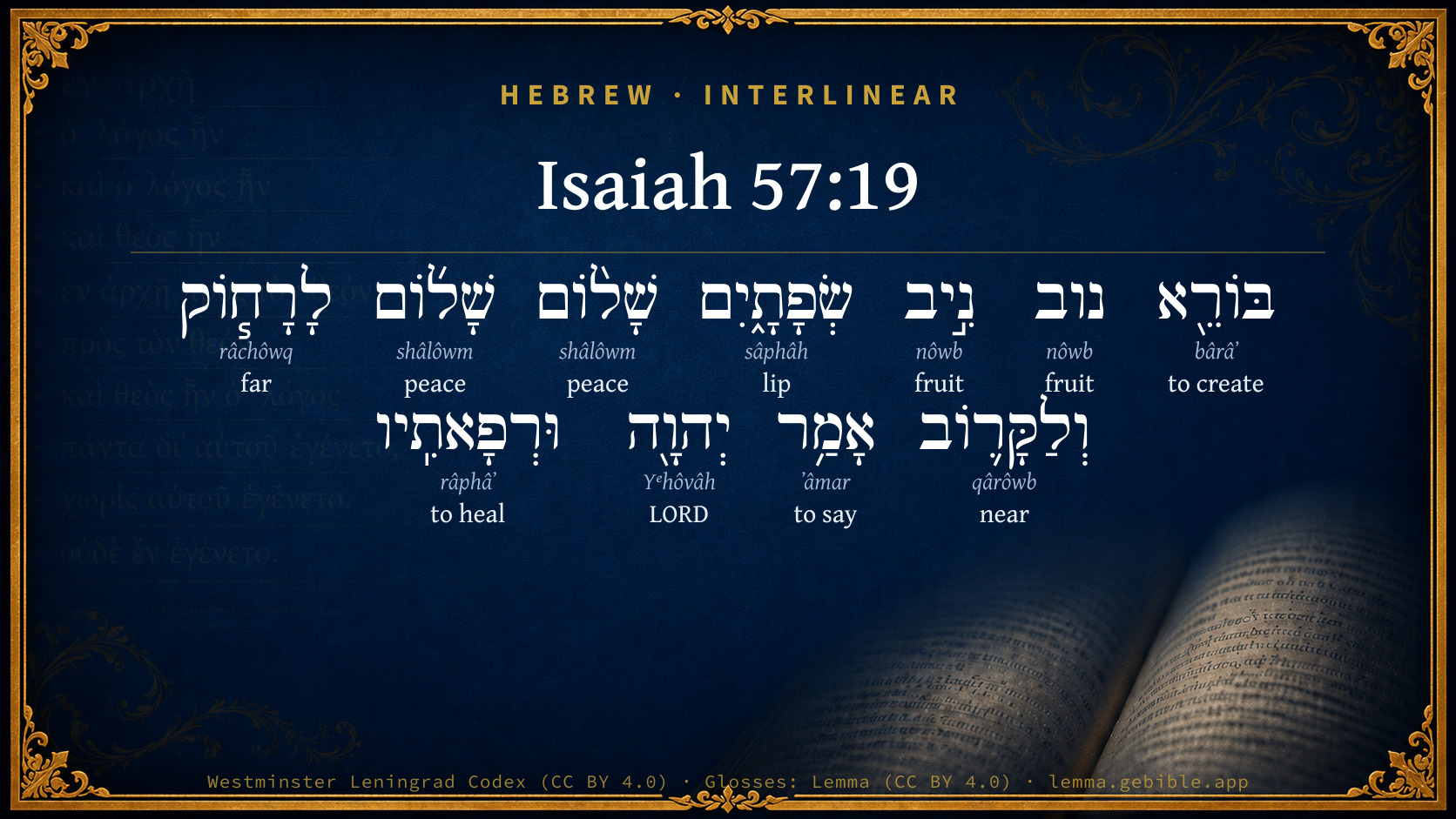
Hebrew (Westminster Leningrad Codex) Isaiah 57:19 appears in the Hebrew Old Testament. The text above is from the Westminster Leningrad Codex. Each word links to its Strong’s number, a concise gloss, and parsing drawn from the Open Scriptures Hebrew Bible morphology. Click any word for its full Brown-Driver-Briggs (BDB) entry.
Download image
Cite this verse

Isaiah 57:19 (World English Bible). Public Domain. Lemma interlinear Bible study tool, https://lemma.gebible.app/v/isaiah/57/19.

Show BibTeX & RIS
BibTeX
RIS
English Translation
I create the fruit of the lips: Peace, peace, to him who is far off and to him who is near, says Yahweh; and I will heal him.
World English Bible · Public Domain
Highlights
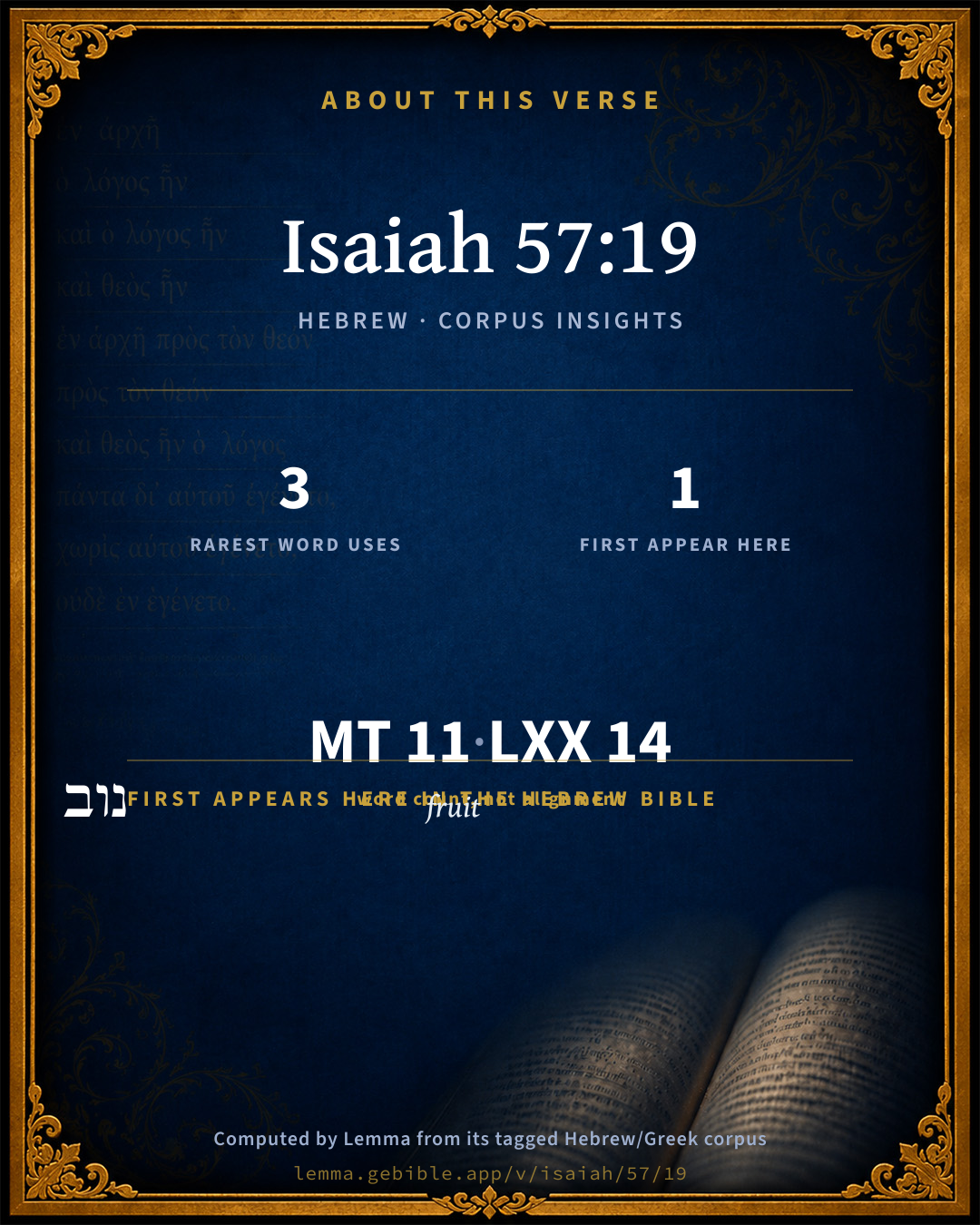
  • 1 first appearance in the Hebrew Bible
Full analysis ↓
Download a study sheet

One document with this verse’s original text, its word-by-word gloss line, the meaning frame, cross-references with their text, attributed commentary, and full source and license credits — printable, and it pastes into notes with its structure intact.

This verse Autodidact and up

Study sheet (.html) Plain text (.txt)

A passage Seminary Student

Up to 50 verses in one chapter. A passage sheet keeps up to 6 commentary sources and 12 cross-references per verse, in the order this page ranks them, and says so on the sheet whenever that leaves anything out. Ask for a single verse and you get the Autodidact verse sheet above.

Everything on this page stays free to read, with no account — the sheet is a download of what is already on screen, not access to it.

Want to remove ads? Support Godless Engineer
Compare translations 3

The same verse in 3 English versions, stacked beneath the original-language interlinear above. Click any original word for its lexicon entry.

Each is an independent rendering of the whole verse — the interlinear is not word-aligned to these translations.

Highlighted words mark where these versions differ — a whole-verse word diff, not a word-by-word alignment.

  • World English Bible Public Domain
    I create the fruit of the lips: Peace, peace, to him who is far off and to him who is near, says Yahweh; and I will heal him.
  • King James Version Public Domain
    I create the fruit of the lips; Peace, peace to him that is far off, and to him that is near, saith the LORD; and I will heal him.
  • unfoldingWord Literal Text CC BY-SA 4.0
    creating the fruit of the lips. Peace, peace to the faraway and to the near,” says Yahweh, “and I will heal him.

unfoldingWord Literal Text — © unfoldingWord, licensed CC BY-SA 4.0. Word-aligned USFM3 via Door43 (git.door43.org/unfoldingWord/en_ult).

Versions to compare (up to 4)

3 of 4 selected

Show all 18 translations

Every available English version of this verse, each an independent rendering of the whole verse.

  • World English Bible Public Domain
    I create the fruit of the lips: Peace, peace, to him who is far off and to him who is near, says Yahweh; and I will heal him.
  • Berean Standard Bible Public Domain
    bringing praise to their lips. Peace, peace to those far and near,” says the LORD, “and I will heal them.”
  • Majority Standard Bible Public Domain
    bringing praise to their lips. Peace, peace to those far and near,” says the LORD, “and I will heal them.”
  • King James Version Public Domain
    I create the fruit of the lips; Peace, peace to him that is far off, and to him that is near, saith the LORD; and I will heal him.
  • American Standard Version (1901) Public Domain
    I create the fruit of the lips: Peace, peace, to him that is far off and to him that is near, saith Jehovah; and I will heal him.
  • Revised Version (1885) Public Domain
    I create the fruit of the lips: Peace, peace, to him that is far off and to him that is near, saith the LORD; and I will heal him.
  • Geneva Bible (1599) Public Domain
    I create the fruite of the lips, to be peace: peace vnto them that are farre off, and to them that are neere, sayth the Lord: for I will heale him.
  • Douay-Rheims (1899) Public Domain
    I created the fruit of the lips, peace, peace to him that is far off, and to him that is near, said the Lord, and I healed him.
  • Young's Literal Translation Public Domain
    Producing the fruit of the lips, `Peace, peace,' to the far off, and to the near, And I have healed him, said Jehovah.
  • Literal Standard Version CC BY-SA 4.0
    Producing the fruit of the lips, || Peace, peace, to the far off, and to the near, || And I have healed him,” said YHWH.
  • Unlocked Literal Bible CC BY-SA 4.0
    and I create the fruit of the lips. Peace, peace, to those who are far off and to those who are near—says Yahweh—I will heal them.
  • unfoldingWord Literal Text CC BY-SA 4.0
    creating the fruit of the lips. Peace, peace to the faraway and to the near,” says Yahweh, “and I will heal him.
  • Darby Bible Public Domain
    I create the fruit of the lips: peace, peace to him [that is] afar off, and to him [that is] nigh, saith Jehovah; and I will heal him.
  • World Messianic Bible Public Domain
    I create the fruit of the lips: Peace, peace, to him who is far off and to him who is near,” says the LORD; “and I will heal them.”
  • Webster's Bible Public Domain
    I create the fruit of the lips; Peace, peace to him that is far off, and to him that is near, saith the LORD; and I will heal him.
  • Free Bible Version CC BY-SA 4.0
    so they will be able to say thank you. The Lord declares, Peace, peace, to those who are far away and those who are near. I will heal you.
  • Bible in Basic English Public Domain
    I will give the fruit of the lips: Peace, peace, to him who is near and to him who is far off, says the Lord; and I will make him well.
  • JPS Tanakh (1917) Public Domain
    Peace, peace, to him that is far off and to him that is near, saith the LORD that createth the fruit of the lips; and I will heal him.

Literal Standard Version (2020), Covenant Press — licensed CC BY-SA 4.0. Text via the HelloAO Bible API (eBible.org). Unlocked Literal Bible (unfoldingWord) — licensed CC BY-SA 4.0. Text via the HelloAO Bible API (eBible.org). unfoldingWord Literal Text — © unfoldingWord, licensed CC BY-SA 4.0. Word-aligned USFM3 via Door43 (git.door43.org/unfoldingWord/en_ult). Free Bible Version, Dr. Jonathan Gallagher — licensed CC BY-SA 4.0. Text via the HelloAO Bible API (eBible.org).

Word by word

More ways to search: Search by grammar → Find every occurrence → Compare this word →

Practice this passage: Drill this verse → Learn its vocabulary →

נוב
nôwb
H5108
“fruit of”
Noun, Common, Masculine, Singular, Construct
Part of Speech
Noun
Type
Common
Gender
Masculine
Number
Singular
State
Construct
Full BDB Definition

Origin: from H5107

TWOT: 1318a , 1318b

fruit
  1. בּוֹרֵ֖א bârâʼ H1254 “creating” Verb, Qal, Participle Active, Masculine, Singular, Absolute
  2. נִ֣יב nôwb H5108 “fruit of” Noun, Common, Masculine, Singular, Construct
  3. שְׂפָתָ֑יִם sâphâh H8193 “lips” Noun, Common, Feminine, Dual, Absolute
  4. שָׁל֨וֹם shâlôwm H7965 “peace” Noun, Common, Masculine, Singular, Absolute
  5. שָׁל֜וֹם shâlôwm H7965 “peace” Noun, Common, Masculine, Singular, Absolute
  6. לָרָח֧וֹק râchôwq H7350 “to/for the · far” Preposition, Determined + Adjective, Adjective, Masculine, Singular, Absolute
  7. וְלַקָּר֛וֹב qârôwb H7138 “and · to/for the · near” Conjunction + Preposition, Determined + Adjective, Adjective, Masculine, Singular, Absolute
  8. אָמַ֥ר ʼâmar H559 “to say” Verb, Qal, Perfect, 3rd Person, Masculine, Singular
  9. יְהוָ֖ה Yᵉhôvâh H3068 “LORD” Noun, Proper
  10. וּרְפָאתִֽיו râphâʼ H7495 “and · to heal · him” Conjunction + Verb, Qal, Sequential Perfect, 1st Person, Common, Singular + Suffix, Personal, 3rd Person, Masculine, Singular

About this verse

These counts appear in no published source. They are computed here, from the morphology-tagged text and Lemma’s own curated glosses. What Lemma adds →

11
words
9
distinct lemmas
Prophets
section

Notable vocabulary

The rarest word here is נוב fruit H5108 — appearing just 3 times in the whole Hebrew Bible.

First appearance in Scripture

This word makes its first canonical appearance in the Hebrew Bible here:

Shared distinctive vocabulary

נוב fruit H5108 occurs in 2 verses of the Hebrew Bible. Also found in:

Grammatical profile

  • 3 verbs
  • 6 nouns
  • 2 adjectives

Verb forms

  • בּוֹרֵ֖א Qal · Participle Active
  • אָמַ֥ר Qal · Perfect
  • וּרְפָאתִֽיו Qal · Sequential Perfect

Repetition

Words recur within this verse — often emphatic in Hebrew:

  • נוב fruit H5108 ×2
  • שָׁל֨וֹם peace H7965 ×2

Hebrew & Septuagint length

In English translation the verse runs 28 words from the Hebrew and 24 from the Septuagint (LXX English) — closely comparable.

A rough comparison of the two English renderings, which tokenize alike — not a word-level alignment.

Word counts can differ between the Hebrew and the Greek without any difference in meaning — e.g. the Hebrew direct-object marker אֵת has no separate Greek word, and Greek often adds the article ὁ.

In the original languages it is 11 Hebrew tokens and 14 Greek tokens — but the two are counted differently (Hebrew bundles its prefixes and suffixes into one token; the Greek is in lemma form), so that isn’t a like-for-like length.

Cross-references

15

Topical passages linked to Isaiah 57:19 in the Treasury of Scripture Knowledge — connected by theme and wording, ordered by reader-vote popularity; previews shown in the World English Bible.

  • Acts 2:39 For to you is the promise, and to your children, and to all who are far off, even as many as the Lord our God will call to himself."
  • Hebrews 13:15 Through him, then, let us offer up a sacrifice of praise to God continually, that is, the fruit of lips which make confession to his name.
  • Luke 2:14 "Glory to God in the highest, On earth peace, good will toward men."
  • Luke 10:5–6 Into whatever house you enter, first say, 'Peace be to this house.'
  • Acts 10:36 The word which he sent to the children of Israel, preaching good news of peace by Jesus Christ--he is Lord of all--
  • Ephesians 6:19 on my behalf, that utterance may be given to me in opening my mouth, to make known with boldness the mystery of the Gospel,
  • Luke 21:15 for I will give you a mouth and wisdom which all your adversaries will not be able to withstand or to contradict.
  • Exodus 4:11–12 Yahweh said to him, "Who made man's mouth? Or who makes one mute, or deaf, or seeing, or blind? Isn't it I, Yahweh?
  • Isaiah 6:7 He touched my mouth with it, and said, "Behold, this has touched your lips; and your iniquity is taken away, and your sin forgiven."
  • Hosea 14:2 Take words with you, and return to Yahweh. Tell him, "Forgive all our sins, And accept that which is good: So we offer like bulls our lips.
  • Matthew 10:13 If the household is worthy, let your peace come on it, but if it isn't worthy, let your peace return to you.
  • 2 Corinthians 5:20–21 We are therefore ambassadors on behalf of Christ, as though God were entreating by us. We beg you on behalf of Christ, be reconciled to God.
  • Colossians 4:3–4 praying together for us also, that God may open to us a door for the word, to speak the mystery of Christ, for which I am also in bonds;
  • Mark 16:15 He said to them, "Go into all the world, and preach the Gospel to the whole creation.
  • Ephesians 2:14–17 For he is our peace, who made both one, and broke down the middle wall of partition,

Cross-references courtesy of OpenBible.info (CC BY 4.0).

Hebrew and Greek witnesses Masoretic Hebrew ↔ Greek Septuagint

The same verse in the two great witnesses to the Old Testament, shown verse-for-verse.

These are two independent witnesses, not word-aligned to each other, and the Septuagint is shown in lemma (dictionary) form.

Hebrew Isaiah 57:19 Masoretic · Westminster Leningrad Codex

בּוֹרֵ֖א נוב נִ֣יב שְׂפָתָ֑יִם שָׁל֨וֹם שָׁל֜וֹם לָרָח֧וֹק וְלַקָּר֛וֹב אָמַ֥ר יְהוָ֖ה וּרְפָאתִֽיו

I create the fruit of the lips: Peace, peace, to him who is far off and to him who is near, says Yahweh; and I will heal him.

World English Bible · Public Domain

Greek LXX Isaiah 57:19 Septuagint · lemma form

εἰρήνη ἐπί εἰρήνη ὁ μακράν καί ὁ ἐγγύς εἰμί καί εἶπον κύριος ἰάομαι αὐτός

peace upon peace to them that are far off, and to them that are near: and the Lord has said, I will heal them.

LXX2012 (modern English Septuagint) · Public Domain

On this verse, Keil & Delitzsch discusses the Septuagint’s reading. Read the note in Commentary ↓

Hebrew: Westminster Leningrad Codex (CC BY 4.0). Greek: Septuagint (public domain); English from LXX2012 (modern English Septuagint) (Public Domain). How the Septuagint differs from the Hebrew →

Targum (Aramaic paraphrase)

1

The Targum is the ancient Jewish Aramaic paraphrase of the Hebrew Scriptures — an interpretive translation, not the Hebrew text itself. Onkelos (literal) and Pseudo-Jonathan (expansive) render the Torah, and Jonathan the Prophets. Coverage is partial: where no permissively-licensed English translation exists for a verse, only the Aramaic is shown. This is verse-level text, not a word-by-word alignment to the Hebrew.

  1. Targum Jonathan Prophets (Joshua–Malachi)
    דִבְרָא מַמְלַל סִפְוָן בְּפוּם כָּל אֱנָשָׁא אֲמַר נְבִיָא שְׁלָמָא יִתְעֲבֵד לְצַדִיקַיָא דִנְטָרוּ אוֹרַיְתִי מִלְקָדְמִין וּשְׁלָמָא יִתְעֲבֵד לְתָבַיָא דְתָבוּ לְאוֹרַיְתָא קָרִיב אֲמַר יְיָ וְאֶשְׁבּוֹק לְהוֹן:

    The prophet saith: He that creates the speech in the lips of every man, peace shall be wrought for the righteous, who have kept my law of old, and peace shall be wrought out for the penitent, who return to my law. It is at hand that I will pardon them, saith the Lord.

    Targum Jonathan — Aramaic: “Mikraot Gedolot” (public domain). English: “Sefaria Community Translation” (CC0 1.0 (public-domain dedication)); “London "Chaldee Paraphrase," 1871” (public domain). Text via Sefaria.

Commentary

Notes on Isaiah 57:19 from classic Christian and Jewish commentators (each source and its license shown beneath its notes). The classic Christian expositions comment on the surrounding passage and are grouped to its opening verse, so a note may address several verses; the Jewish commentaries on the Tanakh (Rashi and others) are per-verse, so they appear only where the commentator wrote on this verse.

Lemma curates 59 commentaries, every one of them public domain or Creative Commons licensed, each selected and text-cleaned for this edition rather than reprinted as found. About our sources →

Trapp's Complete Commentary

John Trapp

Isa 57:19 I create the fruit of the lips; Peace, peace to [him that is] far off, and to [him that is] near, saith the LORD; and I will heal him.

Ver. 19. I create the fruit of the lips,] i.e., I speak peace to my people by the mouths of my faithful ministers, applying and setting home the promises; and this I do most magnificently and mightily.

Peace, peace.] See on Isa 26:3.

John Trapp, A Commentary or Exposition upon All the Books of the Old and New Testament (1647–1656) — public domain. Text from a community e-Sword module.

The Biblical Illustrator

Joseph S. Exell

Isa_57:19

I create the fruit of the lips

Peace, peace

I.

THE GRAND SUBJECT OF HE GOSPEL PROCLAMATION. Peace, peace! saith the Lord. It implies a state of previous enmity and quarrel: a state of alarm and disquietude: and a remedy for both.

1. And does not the message of the Gospel find us in a state of enmity? We are not only by nature children of wrath, but by voluntary choice we have rebelled against our God.

2. And in a state of alarm and disquietude?

II. THE UNLIMITED OFFER OF ITS BENEFITS. To him that is far off, and to him that is near, Peace, peace, saith the Lord.

1. In respect of outward privileges, the Jewish Church was near, and all other nations were far off.

2. In respect of moral character, some may be thought nearer to God, some further off; and still no difference is made.

3. In respect of inward experience, again, some may feel discouraged by the idea that others have greater nearness to God than themselves.

4. In respect of local distance, God is still no respecter of persons. He orders that His Gospel be preached in all the world.

III. THE HOLY CHANGE INVARIABLY CONNECTED WITH THE RECEPTION OF THEM. I will heal him. (J. Jowett, M. A.)

The fruit of the lips

Our text tells us that God creates the fruit of the lips; but this must be understood, of course, with a reservation. He does not create the fruit of the lips as we commonly see it, but the good fruit, the true fruit, the fruit worth gathering. Because the natural fruit is so evil it needs the Creator again to step m, and make us new creatures, and our fruit new also, or else it will remain so bad that the verdict upon it must be Vanity of vanities, all is vanity. And what is that fruit which the Creator produces from a source which is naturally so barren?

1. The sacrifice of thanksgiving (Heb_13:15). The fruit of the lips which God creates should be, above all things, praise.

2. Prayer.

3. Testimony.

4. There is one renowned topic upon which the lips ought always to be able to speak, and that is summed up in the two words, Peace, peace. From the mouth of truth should come kisses of peace, words of peace, the breath of peace. This is the best lip-salve--Peace, peace. Nothing can so sweeten the breath as Peace, peace. Nothing can so flavour the palate and delight the heart as this Peace, peace, felt within, and breathed without. No teeth of ivory, nor lips of coral, are complete in loveliness till over all there glistens the brightness of peace. Fierce speech becomes not loveliness, and threatening and clamour destroy beauty, but the charm of the lips is peace. (C. H. Spurgeon.)

Rare fruit

We shall employ these words--

I. AS THE CRY OF THE AWAKENED. When men are awakened by the grace of God into a consciousness of their true condition they find themselves at war with God and at war with their own consciences, and consequently they begin to cry, Peace, peace: longing eagerly to end the dreadful conflict in which they find themselves engaged. Then there visits the man one who knowingly whispers, You need not disturb yourself. These things are not so. Do you not know that these are all bugbears of a past generation? We men of modern thought have made great discoveries, and changed all the fears of our benighted ancestors into a brave unbelief. You can live at ease. Do not fret yourself about sin, or heaven, or hell, or eternity. Vain are these stale scepticisms, the man is too much in earnest to be drugged with such soporifics. Boastful unbelief has small power over an agonized soul. God Himself has convinced this man of sin, of righteousness, and of judgment, and though he tries to disbelieve he cannot. Mr. Worldly Wiseman calls upon him, with his friend Dr. Legality, and his assistant-surgeon Mr. Civility, and these try their Balm of Conceit and Plaister of Natural Goodness. But if God has been dealing with this man, he will say, But I am not right. I feel that I deserve the wrath of God, and that goodness is not in me. No, the leprosy lies deep within, and no outward form can cleanse away the deep-seated pollution.

II. THIS IS THE ANSWER OF THE SAVIOUR. It is the fruit of the Saviours lips. He comes to a soul and says, Peace, peace. Did you ever see Him as dying of sin? If you have never seen Him with the eye of faith you do not know what peace means. But did you ever see Christ as He is risen from the dead? Here is another vision of consolation, another fount of peace. Did you ever see Jesus as He sits there triumphant at the Lord Gods fight hand? A poor, tried spirit is greatly comforted by that sight. If I were to go on picturing our glorious Lord Jesus Christ in any and all of His relationships to us, we should in each case hear Him say, Peace, peace.

III. AS THE SONG OF THE TRUE BELIEVER. He who has really, seen Christ, and placed his trust in Him, can now sing, Peace, peace, peace.

IV. THIS SHOULD BE THE MOTTO OF EVERY BELIEVER.

1. This should be his spirit and desire in the Church, Peace, peace.

2. We should labour to carry out the, same quiet spirit in the family. When you get home do not change Peace, peace, into scolding and nagging. If it be possible, as much as lieth in you, live peaceably with all men.

3. When peace reigns in your own family, go into the world with the same watchword--Peace, peace. Do not set dogs by the ears, but tame lions and tigers. Compose differences, and make people friends.

4. What a difference there will be when this is taken up among all Christian sects--when there shall be no more envying and strife between this denomination and that, but each one shall be saying in Christs name, We are brethren--peace, peace. (C. H. Spurgeon.)

The Biblical Illustrator, edited by Joseph S. Exell (c. 1880s–1900s) — public domain. Text from a community e-Sword module.

Joseph Benson's Commentary

Isa 57:19-21. I create — I will, by my almighty power, in a wonderful manner produce; the fruit of the lips — Praise and thanksgiving, termed the fruit of the lips, Hos 14:2; Heb 13:15. God creates this fruit of the lips, by giving new subjects and causes of thanksgiving, by his mercies conferred on those among his people, who acknowledge and bewail their transgressions, and return to him. Peace, peace, &c. — Here we have the great subject of thanksgiving, reconciliation with God, pardon and peace offered to them that are nigh, and to them that are afar off; not only to the Jew, but also to the Gentile, as St. Paul more than once applies those terms, Eph 2:13; Eph 2:17. See also Act 2:39. The doubling of the word signifies the certainty and excellence of this peace. But though this peace be freely offered to all without exception, yet all will not partake of it, for the wicked are like the troubled sea, &c. — Their minds are restless, being perpetually hurried with their own lusts and passions, and with guilt, and the dread of divine vengeance. There is no peace to the wicked — Though they may have as great a share of outward prosperity as the best men have, yet they have no share in this inward, spiritual, and everlasting peace. The forty-eighth chapter ends with the same declaration; to express the exclusion of the impenitent and unbelieving from the benefit of the foregoing promises.

Joseph Benson's Commentary on the Old and New Testaments (1811–1818) — public domain. Text from a community e-Sword module.

The Preacher's Complete Homiletical Commentary

Joseph S. Exell (gen. ed.)

THE PEACE OF GOD

Isa_57:19-20. Peace, peace to him that is far off, and to him that is near, &c.

There was a time when man’s religion was the religion of spontaneous innocence: the only religion open to him now is the religion of penitence. This makes the Gospel bear the character of a system of cure. It is not a work of improvement for a nature already good, but a remedy for a nature diseased. It is a healing process. There is one thing all want and seek—peace. The world has said “peace, peace!” and they find that there is “no peace.” There are two ways of seeking peace, two promises made to the craving heart, the same in words but opposed in meaning—the world’s and Christ’s. The world proposes to fulfil her promise by gratifying nature; the Gospel by expelling nature. The world’s method is: “Gratify your desires; indulge them.” If there were no other world, no conscience, this would be wise and well. The peace which Christ proclaims is different—the healing of a disordered heart; not giving the reins to desires, but mastering them; placing the whole soul under the discipline of the Cross.

In considering the promise which comes from the lips of God, we shall examine two connected subjects contained in these verses.

I. THE STRUGGLE OF AN EARNEST SOUL TOWARDS PEACE.

The first step is made by treading on the ruins of human pride. One source of restlessness is an overweening estimate of self. The Gospel crushes that spirit. At the foot of the Cross there is no room for pride. Merit is impossible before God. We are not claimants for reward, only suppliants for life, a life forfeited by guilt. Learn this first how much you deserve on God’s earth, and if it should turn out that you deserve nothing and have received little, then calculate whether you have been defrauded. When we have passed through the first humbling smart of that conviction, content to stand unclothed before God, without one claim except the righteousness of Christ, we have made one step toward peace.

The second step toward peace is the attainment of a spirit of reconciliation. If there were nothing else to make men wretched, uncertainty regarding their future destinies would be enough. There is no peace in prospect of eternity, unless there is something more than a guess that God is loving us. This peace is for two classes.

1. For those who have remained through life “near” to God. Such are spoken of as the ninety-nine just persons, and are represented by the Elder Son in the parable. Their religious growth has been quiet, regular, steady. Nurtured in religious families, they have imbibed the atmosphere of religion without knowing how, and so they go on loving God, till duty becomes a habit and religion the very element of life. The rapture that comes from pardoned guilt is like the fire-rocket, streaming and blazing; but the peace of him who has lived “near” to God is like the quiet steady lustre of the light-house lamp.

2. This peace is for those who are “far off,” who have lived long in the alienation of guilt. It seems as if the joy of returning to God had in it something richer than the peace which belongs to consistent obedience. There is the fatted calf, the robe, and the ring. After all, for most of us this is the only Gospel. One here and there has lived near to God from childhood, but the majority of us have lived far enough from Him at some period. We want a Gospel for the guilty. It is not the having been “far off” that makes peace impossible (Rom_5:1).

The last step toward peace is the attainment of a spirit of active obedience. It is not the dread of hell alone that makes men miserable. We cannot be happy except in keeping God’s commandments. Make a man sure of heaven, and leave him unhumbled, impure, selfish—he is a wretch still. Disobedience is misery. God’s remedy is to write His law on the heart, so that we love Christ, and love what Christ commands.

II. REASONS WHICH EXCLUDE THE GUILTY HEART FROM PEACE. Two are assigned.

1. The heart’s own inward restlessness. Man’s spirit is like a vast ocean. A pond may be without a ripple, but the sea cannot rest. So it is with the soul.

2. The influences acting on the soul. The sea rests not because of the attraction of the heavenly bodies. In us there is a tide of feeling (Gal_5:17). Partly the impossibility of rest arises from outward circumstances. There are winds that sweep the ocean’s surface. So with man there are circumstances that fret and discompose. The man who has not peace in himself can never get it from circumstances. Place him where you will he carries an unquiet heart.

3. The power of memory to recall the past with remorse. “Its waters cast up mire and dirt” Memory brings to light what has been buried in it, as sea casts up wreck and broken rock. Navies may sink in it, but the planks stranded on the shore tell the tale of shipwreck So with deeds and thoughts. There are tempests that will bring them up some day. This is the worst torment of the impenitent.

CONCLUSION.—

1. Mark the connection between peace and cure. Only the blood of Christ can give the sinner peace.

2. No amount of sin bars the way to peace.—F. W. Robertson, M.A.: The Christian at Work, Feb. 1881.

I. The nature of the blessing which is proclaimed in the Gospel: “Peace, peace.”

1. There is war between God and man, but the Gospel proclaims peace.

2. There is war between the higher and lower principles of human nature. Appetite and passion against reason and conscience. A divided heart.

II. The persons to whom the blessings proclaimed in the Gospel is offered. “To him that is afar off and to him that is near.”

1. In respect of religious privileges. Gentiles and Jews.

2. In respect of social advantages. Members of worldly and of religious families.

3. In respect of moral character. The profligate and the respectable.

4. In respect of local distance. The field is the world.

III. The influence of the blessing proclaimed in the Gospel on its recipient.

1. It is beneficial in its operations. Not hurting, not deadening, not teaching or helping merely.

2. It is individual in its efficiency.

3. It is Divine in its agency.

IV. The practical issue.

1. The fruit of the lips is thanksgiving (Heb_13:15).

2. God creates the occasion and the disposition.—G. Brookes: Outlines, pp. 143, 144.

The Preacher's Complete Homiletical Commentary (gen. ed. Joseph S. Exell; Funk & Wagnalls, c. 1892) — public domain (pre-1929). A full-Bible homiletical/sermon-outline anthology covering 65 of 66 books (2 John is absent from the source module). Text from a community e-Sword module.

Keil & Delitzsch

C. F. Keil & F. Delitzsch

But when the redemption comes, it will divide Israel into two halves, with very different prospects. "Creating fruit of the lips; Jehovah saith, 'Peace, peace to those that are far off, and to those that are near; and I heal it.' But the wicked are like the sea that is cast up for it cannot rest, and its waters cast out slime and mud. There is no peace, saith my God, for the wicked." The words of God in Isa 57:19 are introduced with an interpolated "inquit Jehova" (cf., Isa 45:24, and the ellipsis in Isa 41:27); and what Jehovah effects by speaking thus is placed first in a determining participial clause: "Creating fruit (נוב = נוּב, נוב, keri ניב) of the lips," καρπὸν χείλεων (lxx, Heb 13:15), i.e., not of His own lips, to which בּורא would be inapplicable, but the offering of praise and thanksgiving springing from human lips (for the figure, see Psychol. p. 214, trans.; and on the root נב, to press upon forward): "Jehovah saith shâlōm, shâlōm," i.e., lasting and perfect peace (as in Isa 26:3), "be the portion of those of my people who are scattered far and near" (Isa 43:5-7; Isa 49:12; compare the application to heathen and Jews in Eph 2:17); "and I heal it" (viz., the nation, which, although scattered, is like one person in the sight of God). But the wicked, who persist in the alienation from God inherited from the fathers, are incapable of the peace which God brings to His people: they are like the sea in its tossed and stormy state (נגרשׁ pausal third pers. as an attributive clause). As this cannot rest, and as its waters cast out slime and mud, so has their natural state become one of perpetual disturbance, leading to the uninterrupted production of unclean and ungodly thoughts, words, and works. Thus, then, there is no peace for them, saith my God. With these words, which have even a more pathetic sound here than in Isa 48:22, the prophet seals the second book of his prophecies. The "wicked" referred to are not the heathen outside Israel, but the heathen, i.e., those estranged from God, within Israel itself.

The transition form the first to the second half of this closing prophecy is formed by ואמר in Isa 57:14. In the second half, from Isa 57:11, we find the accustomed style of our prophet; but in Isaiah 56:9-57:11a the style is so thoroughly different, that Ewald maintains that the prophet has here inserted in his book a fragment from some earlier writer of the time of Manasseh. But we regard this as very improbable. It is not required by what is stated concerning the prophets and shepherds, for the book of Ezekiel clearly shows that the prophets and shepherds of the captivity were thus debased. Still less does what is stated concerning the early death of the righteous require it; for the fundamental idea of the suffering servant of Jehovah, which is peculiar to the second book, is shadowed forth therein. Nor by what is affirmed as to the idolatrous conduct of the people; for in the very centre (Isa 57:4) the great mass of the people are reproached for their contemptuous treatment of the servants of Jehovah. Nor does the language itself force us to any such conjecture, for Isa 53:1-12 also differs from the style met with elsewhere; and yet (although Ewald regards it as an earlier, borrowed fragment) it must be written by the author of the whole, since its grandest idea finds its fullest expression there. At the same time, we may assume that the prophet described the idolatry of the people under the influences of earlier models. If he had been a prophet of the captives after the time of Isaiah, he would have rested his prophecies on Jeremiah and Ezekiel. For just as Isa 51:18. has the ring of the Lamentations of Jeremiah, so does Isa 57:3. resemble in many respects the earlier reproaches of Jeremiah (compare Jer 5:7-9, Jer 5:29; Jer 9:8, with the expression, "Should I rest satisfied with this?"); also Jer 2:25 (נואשׁ), Jer 2:20; Jer 3:6, Jer 3:13 ("upon lofty mountains and under green trees"); also the night scene in Ezek 23.

Keil & Delitzsch — Biblical Commentary on the Old Testament (1861–1891) — public domain (CC PDM 1.0). Text via the HelloAO Bible API. (Old Testament only.)

Tyndale Open Study Notes

Tyndale Open Resources

57:19 words of praise: God’s redemption should bring a response of praise from its recipients. • both near and far: Both Gentiles and Jews are included (see 56:3; John 10:16; Eph 2:17).

Tyndale Open Study Notes — © Tyndale Open Resources, licensed CC BY-SA 4.0. Text via the HelloAO Bible API.

Geneva Bible (1599)

Geneva Bible translators

As well to him that is in captivity as to him that remaineth at home.

That is, I frame the speech and words of my messengers which shall bring peace.

Geneva Bible (1599) marginal notes — public domain. Text via Bolls.life.

Jamieson, Fausset & Brown

Robert Jamieson, A. R. Fausset & David Brown

fruit of . . . lips--that is, thanksgivings which flow from the lips. I make men to return thanks to Me (Hos 14:2; Heb 13:15).

Peace, peace--"perfect peace" (see Isa 26:3, Margin; Joh 14:27). Primarily, the cessation of the trouble s now afflicting the Jews, as formerly, under the Babylonian exile. More generally, the peace which the Gospel proclaims both to Israel "that is near," and to the Gentiles who are "far off" (Act 2:39; Eph 2:17).

Jamieson, Fausset & Brown — Commentary Critical and Explanatory on the Whole Bible (1871) — public domain (CC PDM 1.0). Text via the HelloAO Bible API.

Adam Clarke's Commentary

Verse 19. I create the fruit of the lips] "The sacrifice of praise," saith St. Paul, Heb 13:15, "is the fruit of the lips." God creates this fruit of the lips, by giving new subject and cause of thanksgiving by his mercies conferred on those among his people, who acknowledge and bewail their transgressions, and return to him. The great subject of thanksgiving is peace-reconciliation and pardon, offered to them that are nigh, and to them that are afar off, not only to the Jew, but also to the Gentile, as St. Paul more than once applies those terms, Eph 2:13; Eph 2:17. See also Ac 2:39.

Peace to him that is far off - "That is, to the penitent; and to him that is near, i.e., the righteous." - Kimchi.

Adam Clarke's Commentary on the Bible (1810–1826) — public domain. Text from a community e-Sword/MySword module.

Ellicott's Commentary for English Readers

(19) The fruit of the lips . . .—The words point primarily to the praise and thanksgiving of the pardoned penitent (comp. Hos_14:2; Heb_13:15), but include also all true utterances of the wise of heart (Pro_10:31). All these alike have their origin in the creative fiat of Jehovah, which proclaims “peace” (i.e., salvation) to all, whether near or far, Jews in Jerusalem, or Jews in exile, or (as in Eph_2:17) the Gentiles whose distance was that of spiritual remoteness. The message of healing is for all.

A Bible Commentary for English Readers, edited by Charles John Ellicott (1878–1897) — public domain. Text from a community e-Sword module.

The Cambridge Bible for Schools and Colleges

gen. ed. J. J. S. Perowne

19. I create the fruit of the lips] Better, creating fruit of the lips, continuing Isa_57:18. “Fruit of the lips” means praise and thanksgiving, as Hos_14:2 (R.V. marg.); Heb_13:15. Jehovah will create this, cause it to spring forth spontaneously, from those who experience His lovingkindness.

Peace, peace &c.] Peace, peace to the far off and to the near! an exclamation, like Isa_57:21. The contrast of the “far off” and the “near” is probably that between the Jews still in exile, and those who have returned and are “near” to Jerusalem (cf. ch. Isa_56:8).

The Cambridge Bible for Schools and Colleges (gen. ed. J. J. S. Perowne; Cambridge University Press, 1878–1918) — public domain. Text from a community e-Sword module.

John Gill's Exposition

I create the fruit of the lips,.... Which is praise and thanksgiving, Heb 13:16 that is, give occasion of it, afford matter for it, by restoring comforts to the church and its mourners, as in the preceding verse; and by giving peace, as in all the following words. The Targum renders it,

"the speech of the lips in the mouth of all men;''

as if it respected that blessing of nature, speech, common to all mankind: whereas this is a blessing of grace, peculiar to some that share in the above blessings; and it may be restrained to Gospel ministers, the fruit of whose lips is the Gospel of peace; or the word preaching peace by Christ; the word of reconciliation committed to them; the subject of their ministry, as follows:

peace, peace to him that is far off, and to him that is near, saith the Lord; peace with God, made by Christ, is the fruit of Jehovah the Father's lips, who promised it in covenant, on condition of Christ's shedding his blood to make it; whence the covenant is called the covenant of peace; and spoke of it in prophecy, as what should be obtained by Christ the peacemaker; and peace of conscience flowing from it is the fruit of Christ's lips, who promised to give it to, and leave it with, his disciples; and that they should have it in him, when they had tribulation in the world; and who also by his apostles went and

preached peace to them that were afar off, and to them that were nigh; having first made it by the blood of his cross, Eph 2:17 in which place there seems a manifest reference to this passage, when the Gospel was preached to the Jews that were near; to them in Judea first, from whence it first came; and then to the Gentiles that were afar off, as well as the dispersed Jews in distant countries; and in the latter day, to which this prophecy refers, it will be preached far and near, even all the world over; when the earth will be filled with the knowledge of the Gospel of peace, through the ministry of a set of men raised up by the Lord, created for that purpose, and eminently furnished for such service; the effect of which will be great spiritual peace in the hearts of God's people, and much concord, unity, and love among them, as well as there will be an abundance of external peace and prosperity; and when nations shall learn war no more. This Kimchi and Ben Melech take to be yet future, and what will be after the war of Gog and Magog: "and I will heal them"; of all their soul sicknesses and maladies; of all their divisions and declensions; of their carnality and earthly mindedness, before complained of; and even of all their sins and backslidings; and restore them to perfect health in their souls, and in their church state.

John Gill's Exposition of the Whole Bible (1746–1763) — public domain (CC PDM 1.0). Text via the HelloAO Bible API.

Albert Barnes' Notes on the Bible

I create the fruit of the lips - The Chaldee and Syriac render this, ‘The words of the lips.’ The ‘fruit’ of the lips is that which the lips produce, that is, words; and the reference here is doubtless to offerings of praise and thanksgiving. See Heb 13:15; where the phrase, ‘fruit of the lips’ (καρπὸς χειλέων karpos cheileōn), is explained to mean praise. Compare Hos 14:2, where the expression, ‘we will render the calves of the lips,’ means that they would offer praise. The sense here is, that God bestowed such blessings as made thanksgiving proper, and thus, he ‘created the fruit of the lips.’

Peace, peace - The great subject of the thanksgiving would be peace. The peace here referred to probably had a primary reference to the cessation of the calamities which would soon overwhelm the Jewish nation, and their restoration again to their own land. But the whole strain of the passage also shows that the prophet had a more general truth in his view, and that he refers to that peace which would diffuse joy among all who were far off, and those who were near. Paul evidently alludes to this passage in Eph 2:14-17. Thus understood, the more general reference is to the peace. which the Messiah would introduce, and which would lay the foundation for universal rejoicing and praise (compare the notes at Isa 2:4; Isa 9:5).

To him that is far off - Applied by the apostle Paul to the Gentiles, who are represented as having been far off from God, or as aliens or strangers to him Eph 2:17.

And to him that is near - That is, to the Jewish people Eph 2:17, represented as having been comparatively near to God in the enjoyment of religious privileges.

Albert Barnes' Notes on the Bible (1834–1885) — public domain. Text from a community e-Sword/MySword module.

Haydock's Catholic Bible Commentary

Lips. Whatever they could ask, so that they might sing canticles. All should be content. He alludes to the liberation of the captives, which was near, and to the redemption of mankind far off. (Calmet)

George Leo Haydock (1774–1849), Haydock's Catholic Family Bible and Commentary, 1859 edition — public domain. Excludes Psalms (Douay-Rheims chapter numbering differs from Protestant) and Deuterocanonical books (Catholic canon only).

Matthew Poole's English Annotations

I create, I will by my almighty power and in a wonderful manner produce,

the fruit of the lips; Peace: either,

1. Praise or thanksgiving, which is called the fruit of our lips, Hos 14:2; Heb 13:15, and peace: or rather,

2. That peace which is not wrought by men’s hands, but only by God’s lips or word; peace with God, and in a man’s own conscience, which God hath promised to his people, and which he hath published and offered to all sorts of men by the preaching of the prophets, and especially of the apostles; as may be gathered both from the object of this peace in the following words, and by the exclusion of all wicked men from this peace, Isa 57:20-21.

Peace: the doubling of the word signifies the certainty and abundance of this peace.

To him that is far off, and to him that is near; to the Gentiles, who are far from God and from salvation, Act 2:38,39; Eph 2:12, &c., as well as to the Jews, who are called a people near unto God, Psa 148:14.

Matthew Poole's English Annotations on the Holy Bible (1683–1685) — public domain. Text from a community e-Sword/MySword module.

Whedon's Commentary on the Bible

Daniel D. Whedon

19. I create the fruit of the lips — The language of expressive penitence and grateful praise. These are said to come from God as a consequence of this healing, which he doeth.

Peace, peace — He lays striking emphasis on the word peace, because it is real peace, in contrast with that heretofore promised by the false prophets.

To him that is far off — This refers to the dispersed of Israel; possibly, the converted Gentile is also included: both classes, from this time on, are under gospel influences.

Daniel D. Whedon (gen. ed.), Commentary on the Old and New Testaments (1874–1909) — public domain. Text from a community e-Sword module.

The Pulpit Commentary

I create the fruit of the lips; literally, creating the fruit of the lips. The clause is best attached to the preceding verse. By his tender treatment of the wanderers, God brings forth fruit from their lips in the shape of praise and thanksgiving. Peace, peace; or, perfect peace, as in Isa_26:3. Judah"s prophets were apt to say to her, Peace, peace," when there was no peace. (Jer_6:14 Jer_8:11 Eze_13:10) Isaiah is now commissioned to give the promise from the mouth of God. (Joh_14:27 Joh_20:21, Joh_20:26) To him that is far off, and to him that is near; i.e. either "to both the Gentiles and the Jews," or "to both the scattered members of the Jewish body" (Isa_11:11 Isa_43:5, Isa_43:6) "and the collected nation in Canaan."

The Pulpit Commentary (1880–1919), ed. H.D.M. Spence-Jones & Joseph S. Exell — public domain. Text from a community e-Sword module.

John Wesley's Explanatory Notes

I create - I will by my almighty power produce. Peace - That peace which is not wrought by mens hands, but only by God's lips or word. The doubling of the word signifies the certainty and abundance this peace. Far off - To the Gentiles who are far from God, as well as to the Jews, who are called a people near unto God, Psalm 1xlviii, 14.

John Wesley, Explanatory Notes Upon the Whole Bible (1754–1765) — public domain. Text via the GEBible commentary corpus.

J. A. Alexander on Isaiah

Joseph Addison Alexander

“Creating the fruit of the lips, Peace, peace to the far off and to the near, saith Jehovah, and I heal him.” The ‘fruit or product of the lips’ is speech, and ‘creating’ as usual implies almighty power and a new effect. By the ‘far and near’ some understand the Jews and Gentiles; (compare Act 10:34-36; Eph 2:17) others, all the Jews wherever scattered (Isa 43:5-7; Isa 49:12). The Targum makes the distinction an internal one, the just who have kept the law, who have returned to it by sincere repentance. Some understand the words as abolishing all difference between the earlier and later converts, an idea similar to that embodied in our Savior’s parable of the laborers in the vineyard.

Joseph Addison Alexander, The Prophecies of Isaiah (1846–1847; New York: Scribner, 1870–1878) — public domain. Text from a community e-Sword module.

Rashi

Rabbi Shlomo Yitzchaki (Rashi)

[I] create the speech of the lips I create for him a new manner of speech. In contrast to the trouble that befell him, and everyone was degrading him, they will call, “Peace, peace.”

to the far and to the near Both are equal; he who aged and was accustomed to My Torah and My worship from his youth, and he who drew near now, just recently to repent of his evil way. Said the Lord, “I will heal him of his malady and of his sins.”

Rashi on the Tanakh — English translations: “The Judaica Press complete Tanach with Rashi, translated by A. J. Rosenberg” (CC BY 4.0); “Pentateuch with Rashi's commentary by M. Rosenbaum and A.M. Silbermann, 1929-1934” (public domain); “The Metsudah Tanach series, Lakewood, N.J” (CC BY 4.0); and “The Book of Joshua, Metsudah Publications, 1997” (CC BY 4.0). Text via Sefaria.

Ibn Ezra

Rabbi Abraham ibn Ezra

בורא The Creator. It is generally explained to refer to God, and the verb אמר said is supplied. Were it allowed to depart from the common explanation, I should suggest to take בורא in the sense of decreeing; comp. ובורא חשך (45:7).

ניב Fruit Comp. תנובות fruits (Deut. 32:13). By fruit of the lips the speech is meant. The meaning of the whole verse is: Proclaim, Peace, peace to him that is far off, and to him that is near; announce, that the Lord has already saved Israel, because ורפאתיו I have indeed healed him.

Ibn Ezra on the Tanakh — English translations: “Sefaria Community Translation” (CC0 1.0 (public-domain dedication)); “Yalkut, Sifsei Chachomim Chumash, Metsudah Publications, 2009” (CC BY 4.0); and “Commentary of Ibn Ezra on Isaiah - trans. by M. Friedlander, 1873” (public domain). Text via Sefaria.

Lesson kit

Teaching starters — assembled from the data on this page, not authored interpretation. Every prompt links to the verse data it draws on. Edit before teaching.

Isaiah, in the Prophets, opens this verse with 11 words (9 distinct Hebrew lemmas). Its most distinctive word is nôwb (“fruit”). A historical commentator’s framing appears above. Read the whole chapter for the surrounding context.

Discussion questions

  1. The word nôwb carries the sense “fruit.” How does it shape the verse?
  2. This is the first place “fruit” appears in Scripture (first appears here). What does its debut here establish?
  3. How does Malachi 1:12, which shares the word «fruit», read alongside this verse?
  4. What does the repetition of “fruit” (2× in this one verse) do in this verse?
  5. These translations render this verse differently; the difference is in the English rendering, not the original. What questions does that raise?
  6. «בּוֹרֵ֖א» is a Qal Participle Active verb. How does that grammatical form shape the action described?
  7. Compare how Trapp's Complete Commentary and The Biblical Illustrator read this verse. Where do they agree or differ?

Things to notice

Reading settings

Reading text

Shown beneath each verse's original-language words.

Old Testament
Old Testament edition

Read the OT as the Masoretic Hebrew (MT) or the Greek Septuagint (LXX).

English shown for the Greek Septuagint (in the Hebrew ↔ Greek comparison).

Comparing translations? Open the Compare panel on any verse page to stack up to four side by side.