
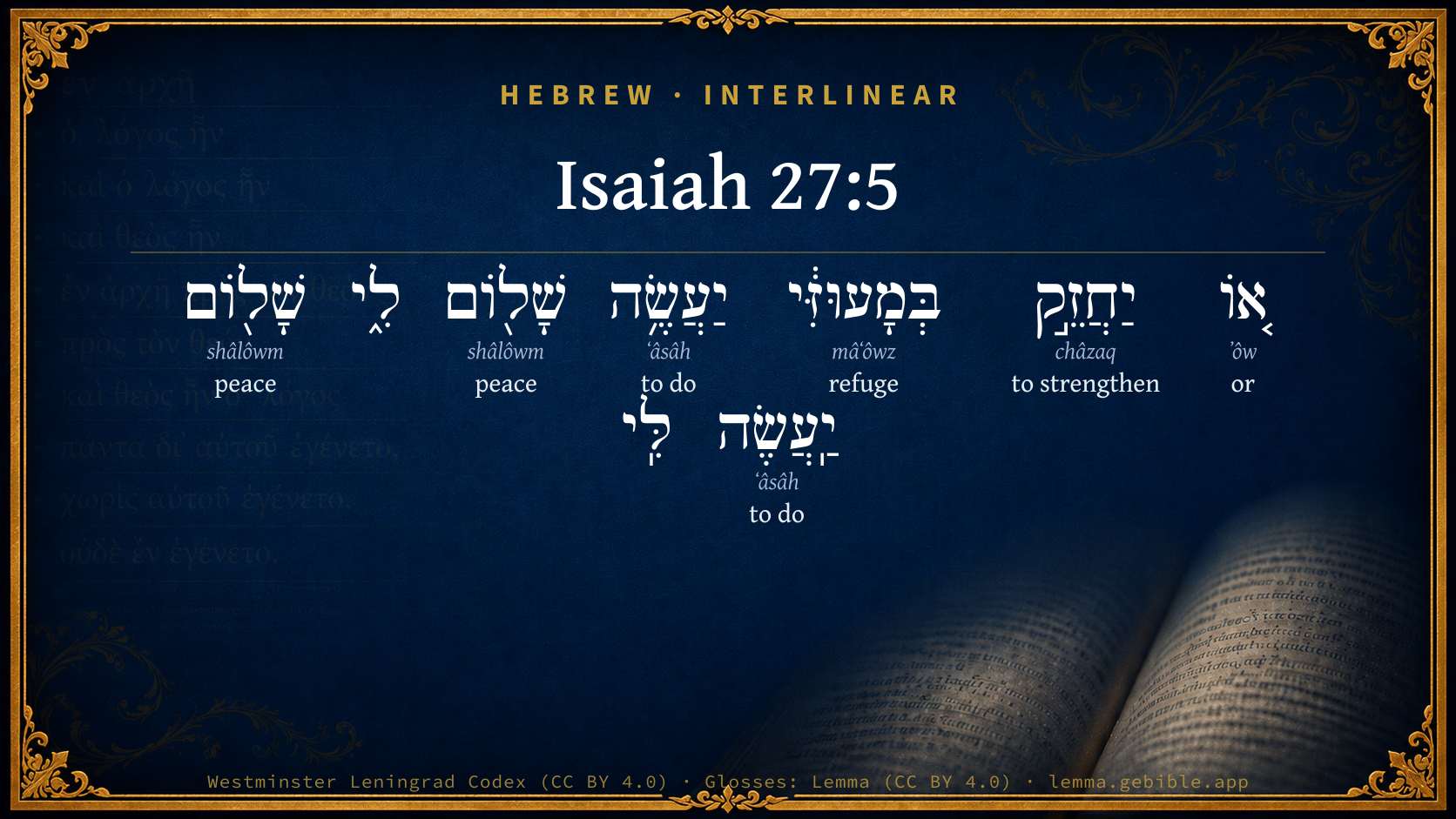
Isaiah 27:5

Hebrew (Westminster Leningrad Codex) Isaiah 27:5 appears in the Hebrew Old Testament. The text above is from the Westminster Leningrad Codex. Each word links to its Strong’s number, a concise gloss, and parsing drawn from the Open Scriptures Hebrew Bible morphology. Click any word for its full Brown-Driver-Briggs (BDB) entry.
Download image
Cite this verse

Isaiah 27:5 (World English Bible). Public Domain. Lemma interlinear Bible study tool, https://lemma.gebible.app/v/isaiah/27/5.

Show BibTeX & RIS
BibTeX
RIS
English Translation
Or else let him take hold of my strength, that he may make peace with me; [yes], let him make peace with me.
World English Bible · Public Domain
Download a study sheet

One document with this verse’s original text, its word-by-word gloss line, the meaning frame, cross-references with their text, attributed commentary, and full source and license credits — printable, and it pastes into notes with its structure intact.

This verse Autodidact and up

Study sheet (.html) Plain text (.txt)

A passage Seminary Student

Up to 50 verses in one chapter. A passage sheet keeps up to 6 commentary sources and 12 cross-references per verse, in the order this page ranks them, and says so on the sheet whenever that leaves anything out. Ask for a single verse and you get the Autodidact verse sheet above.

Everything on this page stays free to read, with no account — the sheet is a download of what is already on screen, not access to it.

Want to remove ads? Support Godless Engineer
Compare translations 3

The same verse in 3 English versions, stacked beneath the original-language interlinear above. Click any original word for its lexicon entry.

Each is an independent rendering of the whole verse — the interlinear is not word-aligned to these translations.

Highlighted words mark where these versions differ — a whole-verse word diff, not a word-by-word alignment.

  • World English Bible Public Domain
    Or else let him take hold of my strength, that he may make peace with me; [yes], let him make peace with me.
  • King James Version Public Domain
    Or let him take hold of my strength, that he may make peace with me; and he shall make peace with me.
  • unfoldingWord Literal Text CC BY-SA 4.0
    Or let it take hold of my refuge; let it make peace with me; peace, let it make with me.”

unfoldingWord Literal Text — © unfoldingWord, licensed CC BY-SA 4.0. Word-aligned USFM3 via Door43 (git.door43.org/unfoldingWord/en_ult).

Versions to compare (up to 4)

3 of 4 selected

Show all 18 translations

Every available English version of this verse, each an independent rendering of the whole verse.

  • World English Bible Public Domain
    Or else let him take hold of my strength, that he may make peace with me; [yes], let him make peace with me.
  • Berean Standard Bible Public Domain
    Or let them lay claim to My protection; let them make peace with Me—yes, let them make peace with Me.”
  • Majority Standard Bible Public Domain
    Or let them lay claim to My protection; let them make peace with Me—yes, let them make peace with Me.”
  • King James Version Public Domain
    Or let him take hold of my strength, that he may make peace with me; and he shall make peace with me.
  • American Standard Version (1901) Public Domain
    Or else let him take hold of my strength, that he may make peace with me; `yea', let him make peace with me.
  • Revised Version (1885) Public Domain
    Or else let him take hold of my strength, that he may make peace with me; yea, let him make peace with me.
  • Geneva Bible (1599) Public Domain
    Or will he feele my strength, that he may make peace with me, and be at one with me?
  • Douay-Rheims (1899) Public Domain
    Or rather shall it take hold of my strength, shall it make peace with me, shall it make peace with me?
  • Young's Literal Translation Public Domain
    Or -- he doth take hold on My strength, He doth make peace with Me, Peace he doth make with Me.
  • Literal Standard Version CC BY-SA 4.0
    Or—he takes hold on My strength, || [That] he makes peace with Me, || [And] he makes peace with Me.”
  • Unlocked Literal Bible CC BY-SA 4.0
    unless they grasp my protection and make peace with me; let them make peace with me.
  • unfoldingWord Literal Text CC BY-SA 4.0
    Or let it take hold of my refuge; let it make peace with me; peace, let it make with me.”
  • Darby Bible Public Domain
    Or let him take hold of my strength; let him make peace with me: [yea,] let him make peace with me.
  • World Messianic Bible Public Domain
    Or else let him take hold of my strength, that he may make peace with me. Let him make peace with me.”
  • Webster's Bible Public Domain
    Or let him take hold of my strength, that he may make peace with me, and he shall make peace with me.
  • Free Bible Version CC BY-SA 4.0
    Otherwise they should come to me for protection. They should make their peace with me, yes, make their peace with me.
  • Bible in Basic English Public Domain
    Or let him put himself under my power, and make peace with me.
  • JPS Tanakh (1917) Public Domain
    Or else let him take hold of My strength, that he may make peace with Me; yea, let him make peace with Me.

Literal Standard Version (2020), Covenant Press — licensed CC BY-SA 4.0. Text via the HelloAO Bible API (eBible.org). Unlocked Literal Bible (unfoldingWord) — licensed CC BY-SA 4.0. Text via the HelloAO Bible API (eBible.org). unfoldingWord Literal Text — © unfoldingWord, licensed CC BY-SA 4.0. Word-aligned USFM3 via Door43 (git.door43.org/unfoldingWord/en_ult). Free Bible Version, Dr. Jonathan Gallagher — licensed CC BY-SA 4.0. Text via the HelloAO Bible API (eBible.org).

Word by word

More ways to search: Search by grammar → Find every occurrence → Compare this word →

Practice this passage: Drill this verse → Learn its vocabulary →

בְּמָעוּזִּ֔י
mâʻôwz
H4581
“in/at · refuge · my”
Preposition + Noun, Common, Masculine, Singular, Construct + Suffix, Personal, 1st Person, Common, Singular
Part of Speech
Preposition + Noun
Type
Common
Gender
Masculine
Number
Singular
State
Construct
Full BDB Definition

Origin: from H5810

TWOT: 1578a

place or means of safety, protection, refuge, stronghold - place of safety, fastness, harbour, stronghold - refuge (of God) (figuratively) - human protection (figuratively)
  1. א֚וֹ ʼôw H176 “or” Conjunction
  2. יַחֲזֵ֣ק châzaq H2388 “to strengthen” Verb, Hiphil, Imperfect, 3rd Person, Masculine, Singular
  3. יַעֲשֶׂ֥ה ʻâsâh H6213 “to do” Verb, Qal, Imperfect, 3rd Person, Masculine, Singular
  4. שָׁל֖וֹם shâlôwm H7965 “peace” Noun, Common, Masculine, Singular, Absolute
  5. שָׁל֖וֹם shâlôwm H7965 “peace” Noun, Common, Masculine, Singular, Absolute
  6. יַֽעֲשֶׂה ʻâsâh H6213 “to do” Verb, Qal, Imperfect, 3rd Person, Masculine, Singular

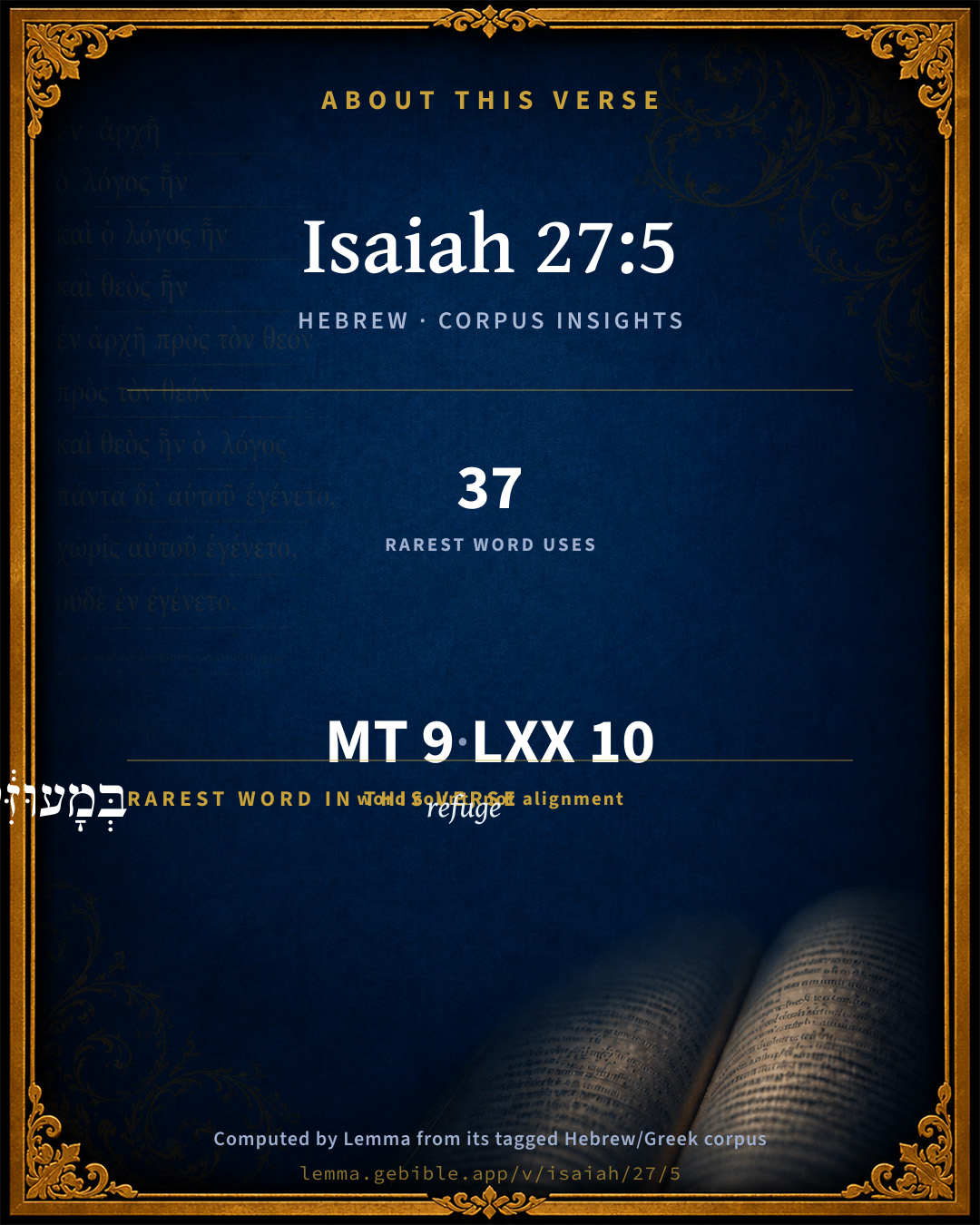
About this verse

These counts appear in no published source. They are computed here, from the morphology-tagged text and Lemma’s own curated glosses. What Lemma adds →

9
words
5
distinct lemmas
Prophets
section

Shared distinctive vocabulary

בְּמָעוּזִּ֔י refuge H4581 occurs in 35 verses of the Hebrew Bible. Also found in:

Grammatical profile

  • 3 verbs
  • 3 nouns
  • 2 prepositions
  • 1 conjunction

Verb forms

  • יַחֲזֵ֣ק Hiphil · Imperfect
  • יַעֲשֶׂ֥ה Qal · Imperfect
  • יַֽעֲשֶׂה Qal · Imperfect

Repetition

Words recur within this verse — often emphatic in Hebrew:

  • יַעֲשֶׂ֥ה to do H6213 ×2
  • שָׁל֖וֹם peace H7965 ×2

Hebrew & Septuagint length

In English translation the verse runs 23 words from the Hebrew and 21 from the Septuagint (LXX English) — closely comparable.

A rough comparison of the two English renderings, which tokenize alike — not a word-level alignment.

Word counts can differ between the Hebrew and the Greek without any difference in meaning — e.g. the Hebrew direct-object marker אֵת has no separate Greek word, and Greek often adds the article ὁ.

In the original languages it is 9 Hebrew tokens and 10 Greek tokens — but the two are counted differently (Hebrew bundles its prefixes and suffixes into one token; the Greek is in lemma form), so that isn’t a like-for-like length.

Cross-references

19

Topical passages linked to Isaiah 27:5 in the Treasury of Scripture Knowledge — connected by theme and wording, ordered by reader-vote popularity; previews shown in the World English Bible.

  • Job 22:21 "Acquaint yourself with him, now, and be at peace. Thereby good shall come to you.
  • Isaiah 25:4 For you have been a stronghold to the poor, a stronghold to the needy in his distress, a refuge from the storm, a shade from the heat, when the blast of the awesome ones is as a storm against the wall.
  • Ephesians 2:16–17 and might reconcile them both in one body to God through the cross, having killed the hostility thereby.
  • Joshua 10:6 The men of Gibeon sent to Joshua to the camp to Gilgal, saying, Don't slack your hand from your servants; come up to us quickly, and save us, and help us: for all the kings of the Amorites that dwell in the hill-country are gathered together against us.
  • Isaiah 26:3–4 You will keep [him] in perfect peace, [whose] mind [is] stayed [on you]; because he trusts in you.
  • Isaiah 45:24 Only in Yahweh, it is said of me, is righteousness and strength; even to him shall men come; and all those who were incensed against him shall be disappointed.
  • Isaiah 56:2 Blessed is the man who does this, and the son of man who holds it fast; who keeps the Sabbath from profaning it, and keeps his hand from doing any evil.
  • Isaiah 57:19 I create the fruit of the lips: Peace, peace, to him who is far off and to him who is near, says Yahweh; and I will heal him.
  • Ezekiel 34:25–26 I will make with them a covenant of peace, and will cause evil animals to cease out of the land; and they shall dwell securely in the wilderness, and sleep in the woods.
  • Hosea 2:18–20 In that day I will make a covenant for them with the animals of the field, And with the birds of the sky, And with the creeping things of the ground. I will break the bow, the sword, and the battle out of the land, And will make them lie down safely.
  • 2 Corinthians 5:19–21 namely, that God was in Christ reconciling the world to himself, not reckoning to them their trespasses, and having committed to us the word of reconciliation.
  • Colossians 1:20–21 and through him to reconcile all things to himself, by him, whether things on the earth, or things in the heavens, having made peace through the blood of his cross.
  • Hebrews 6:18 that by two immutable things, in which it is impossible for God to lie, we may have a strong encouragement, who have fled for refuge to take hold of the hope set before us.
  • Joshua 9:24–25 They answered Joshua, and said, Because it was certainly told your servants, how that Yahweh your God commanded his servant Moses to give you all the land, and to destroy all the inhabitants of the land from before you; therefore we were sore afraid for our lives because of you, and have done this thing.
  • Isaiah 64:7 There is none who calls on your name, who stirs up himself to take hold of you; for you have hid your face from us, and have consumed us by means of our iniquities.
  • Luke 19:42 saying, "If you, even you, had known today the things which belong to your peace! But now, they are hidden from your eyes.
  • Romans 5:1–10 Being therefore justified by faith, we have peace with God through our Lord Jesus Christ;
  • Luke 13:34 "Jerusalem, Jerusalem, that kills the prophets, and stones those who are sent to her! How often I wanted to gather your children together, like a hen gathers her own brood under her wings, and you refused!
  • Luke 14:32 Or else, while the other is yet a great way off, he sends an envoy, and asks for conditions of peace.

Cross-references courtesy of OpenBible.info (CC BY 4.0).

Hebrew and Greek witnesses Masoretic Hebrew ↔ Greek Septuagint

The same verse in the two great witnesses to the Old Testament, shown verse-for-verse.

These are two independent witnesses, not word-aligned to each other, and the Septuagint is shown in lemma (dictionary) form.

Hebrew Isaiah 27:5 Masoretic · Westminster Leningrad Codex

א֚וֹ יַחֲזֵ֣ק בְּמָעוּזִּ֔י יַעֲשֶׂ֥ה שָׁל֖וֹם לִ֑י שָׁל֖וֹם יַֽעֲשֶׂה לִּֽי

Or else let him take hold of my strength, that he may make peace with me; [yes], let him make peace with me.

World English Bible · Public Domain

Greek LXX Isaiah 27:5 Septuagint · lemma form

βοάω ὁ ἐνοἰκέω ἐν αὐτός ποιέω εἰρήνη αὐτός ποιέω εἰρήνη

I am burnt up; they that dwell in her shall cry, Let us make peace with him, let us make peace,

LXX2012 (modern English Septuagint) · Public Domain

Hebrew: Westminster Leningrad Codex (CC BY 4.0). Greek: Septuagint (public domain); English from LXX2012 (modern English Septuagint) (Public Domain). How the Septuagint differs from the Hebrew →

Targum (Aramaic paraphrase)

1

The Targum is the ancient Jewish Aramaic paraphrase of the Hebrew Scriptures — an interpretive translation, not the Hebrew text itself. Onkelos (literal) and Pseudo-Jonathan (expansive) render the Torah, and Jonathan the Prophets. Coverage is partial: where no permissively-licensed English translation exists for a verse, only the Aramaic is shown. This is verse-level text, not a word-by-word alignment to the Hebrew.

  1. Targum Jonathan Prophets (Joshua–Malachi)
    אִם יִתְקְפוּן בְּפִתְגָמֵי אוֹרַיְתִי אִתְעֲבֵיד שְׁלָמָא לְהוֹן מִכְּעַן שְׁלָמָא יִתְעֲבֵיד לְהוֹן:

    If they would lay hold on the words of my law, peace would be made with them; henceforth peace would be made with them.

    Targum Jonathan — Aramaic: “Mikraot Gedolot” (public domain). English: “Sefaria Community Translation” (CC0 1.0 (public-domain dedication)); “London "Chaldee Paraphrase," 1871” (public domain). Text via Sefaria.

Commentary

Notes on Isaiah 27:5 from classic Christian and Jewish commentators (each source and its license shown beneath its notes). The classic Christian expositions comment on the surrounding passage and are grouped to its opening verse, so a note may address several verses; the Jewish commentaries on the Tanakh (Rashi and others) are per-verse, so they appear only where the commentator wrote on this verse.

Lemma curates 59 commentaries, every one of them public domain or Creative Commons licensed, each selected and text-cleaned for this edition rather than reprinted as found. About our sources →

Trapp's Complete Commentary

John Trapp

Isa 27:5 Or let him take hold of my strength, [that] he may make peace with me; [and] he shall make peace with me.

Ver. 5. Or let him take hold of my strength,] i.e., Of mine arm, wherewith I am about to smite him, or to throw the fire of my wrath at him; let him by true repentance appease me, as submitting Abigail once did angry David; let him but meet me with entreaties of peace, and he shall have peace, yea, he shall be sure of it. See Job 22:21. {See Trapp on "Job 22:21"} To run into God is the way to escape sin, as to close and get in with him that would strike you doth avoid the blow.

John Trapp, A Commentary or Exposition upon All the Books of the Old and New Testament (1647–1656) — public domain. Text from a community e-Sword module.

The Biblical Illustrator

Joseph S. Exell

Isa_27:5

Let him take hold of My strength

Taking hold of the Divine strength

I.

THE INVITATION. Let him take hold of My strength. This becomes an imperative duty--a duty universal in its application.

II. THE REASON of this invitation--that he may make peace with Me.

1. Observe how very unselfish it is, if we may so call it with reverence, on the part of God. It is not that He Himself may be benefited, but that the sinner might.

2. Consider, too, the cogency of this reason, resting as it does in that which all men most need, and most of us long for--peace.

3. Regard also the sublimity of this reason--peace with God.

III. THE POSITIVE ASSURANCE, or the certainty of the promise. And he shall make peace with Me. Nothing shall prevent it. Comply with the conditions, and then all is certain. Even the greatest enemies to God among men are permitted to make peace with Him. (W. Horwood.)

Man, seizing the strength of Omnipotence

Some substitute the word protection for strength here, and suppose the words refer to the horns of the altar which fugitives often laid hold of as an asylum. But the refuge of safety for any moral intelligence is nothing without Gods strength. For an insignificant creature like man to lay hold upon the strength of Omnipotence seems at first not only an absurd, but a blasphemous thought, and yet the thought is not without support in the Word of God. What meaneth the expression, Let Me alone, Moses, etc.?

I. It is POSSIBLE for man to lay hold on the strength of Omnipotence. In what does the real strength of a moral intelligence consist? Not in material bulk or muscle, if he has them; but in the leading disposition of his heart. This is the soul of strength, the sap in the oak, the steam in the engine, the vis in the muscle. He that can take hold of this in a man takes hold of his strength. Vanity is the leading disposition in some men; and if you would take hold of their strength you must flatter them. By adulation you will grasp them body and soul. Greed is the leading disposition in others. Avarice controls them, works their thoughts, and concentrates their energies. Minister to this greed and you will take hold of their strength, you will have them in your hands. Philanthropy is, thank God, the leading disposition of others. Present to them the claims of down-trodden slaves, of broken-hearted widows and starving orphans, and you will take hold of their strength. Now, the leading disposition of God, if I may so say, is benevolence. He not only loves, but is love. He, therefore, who appeals to His compassion takes hold of His strength. See how Omnipotence halted as Abraham prayed. See how in Christ it stood still on the road when two blind beggars said, Jesus, Thou Son of David, have mercy upon me. Thus let the poor sinner go stricken in penitence and appeal in all his misery to the Great Father, and he will take hold of His strength.

II. It is NECESSARY for man to lay hold on the strength of Omnipotence. The only hope of sinful, dying man is to appeal to Gods compassion. If My people which are called by My name shall humble themselves and pray, and seek My face, and turn from their wicked ways; then will I hear from heaven, and will forgive their sin. Ye shall seek Me and find Me when ye search for Me with all your heart. Elijah prayed, and God unsealed the heavens for him. Stephen prayed, and the Father drew the curtains of the invisible world and revealed to him the Son of God in all His glory. (Homilist.)

Seizing the strength of the Almighty

How can a man take hold on the strength of God? The following facts may give meaning to the phrase.

I. The pleading of the PROMISE OF ONE WHO IS FAITHFUL will take hold of his strength. If a man of incorruptible truthfulness were to make me a promise, and I pleaded the fulfilment of that promise, should I not, in a very emphatic sense, take hold of his strength in pleading it before him? I should seize not his mere limbs or any particular faculty, but himself, his inflexible sense of truthfulness.

II. The pleading of a RIGHT CLAIM TO ONE WHO IS RIGHTEOUS will take hold of his strength. If you have a righteous claim upon a righteous man you lay hold of him by urging it. You do not want law with such a man to enforce your obligation. He yields it by the necessity of his nature. There are claims which all moral beings who are commanded to love God with their hearts, souls, and strength have upon Him.

III. The pleading of MISERY TO ONE THAT IS LOVING will take hold of his strength. Thus the cry of a babe will take hold of the strength of a father, though he be the commander of armies, or the monarch of mighty peoples. By suffering and sorrow you can take hold of the most noble men on earth, and the most noble are the most loving. (Homilist.)

Strength taken hold of

Coriolanus was a mighty man. He is thus described by Shakespeare: The tartness of his face sours ripe grapes. When he walks he moves like an engine, and the ground shrinks before his treading. He is able to pierce a corset with his eye, talks like a knell, and his hum is a battery. He sits in his state as a thing made for Alexander. What he bids be done is finished with his bidding. He wants nothing of a god but eternity, and a heaven to throne in. And yet his mother and wife, by appealing to the love in his nature, took hold of his strength; and hence we hear him exclaim, Ladies, you deserve to have a temple built you. All the swords in Italy and her confederate arms could not have made this peace. (Homilist.)

The Biblical Illustrator, edited by Joseph S. Exell (c. 1880s–1900s) — public domain. Text from a community e-Sword module.

MacLaren's Expositions of Holy Scripture

Alexander MacLaren

Isaiah

THE GRASP THAT BRINGS PEACE

Isa 27:5.

Lyrical emotion makes the prophet’s language obscure by reason of its swift transitions from one mood of feeling to another. But the main drift here is discernible. God is guarding Israel, His vineyard, and before Him its foes are weak as ‘thorns and briers,’ whose end is to be burned. With daring anthropomorphism, the prophet puts into God’s mouth a longing for the enemies to measure their strength against His, a warrior’s eagerness for the fight. But at once this martial tone gives place to the tender invitation of the text, and the infinite divine willingness to be reconciled to the enemy speaks wooingly and offers conditions of peace. All this has universal application to our relations to God.

I. The Hostility.

That our relations with God are ‘strained,’ and that men are ‘enemies of God,’ is often repelled as exaggeration, if not as directly false. And, no doubt, the Scripture representation has often been so handled as to become caricature rather than portraiture. Scripture does not deny the lingering presence in men of goodness, partial and defective, nor does it assert that conscious antagonism to God is active in godless men. But it does assert that ‘God is not in all their thoughts,’ and that their wills are ‘not subject to the law of God.’ And in such a case as man’s relations to God, indifference and forgetfulness cannot but rest upon divergence of will and contrast of character. Why do men ‘not like to retain God in their knowledge, ‘but because they feel that the thought of Him would spoil the feast, like the skeleton in the banqueting chamber? Beneath the apparent indifference lie opposition of will, meeting God’s ‘Thou shalt’ with man’s ‘I will not’; opposition of moral nature, impurity shrinking from perfect purity; opposition of affection, the warmth of human love being diverted to other objects than God.

II. The entreating Love that is not turned aside by hostility.

The antagonism is wholly on man’s part.

True, man’s opposition necessarily turns certain sides of the divine character to present a hostile front to him. Not only God’s physical attributes, if we may so call them, but the moral attributes which guide the energies of these, namely, His holiness and His righteousness, and the acts of His sovereignty which flow from these, must be in opposition to the man who has set himself in opposition to God. ‘The face of the Lord is against them that do evil.’ If it were not, He would not be God.

But still, God’s love enfolds all men in its close and tender clasp. As the context says, in close connection with the threat to burn the briers and thorns, ‘Fury is not in Me.’ Man’s hostility does not rouse God’s. He wars against the sin because He still loves the sinner. His love ‘must come with a rod,’ but, at the same time, it comes ‘with the spirit of meekness.’ It gives its enemy all that it can; but it cannot give all that it would.

He stoops to sue for our amity. It is the creditor who exhausts beseechings on His debtor, so much does He wish to ‘agree with His adversary quickly.’ The tender pleading of the Apostle was but a faint echo of the marvellous condescension of God, when he, ‘in God’s stead, besought: ‘Be ye reconciled to God.’

III. The grasp which ends alienation.

The word for ‘strength’ here means a stronghold or fortified place, which serves as an asylum or refuge. There may be some mingling of an allusion to the fugitive’s taking hold of the horns of the altar, and so being safe from the vengeance of his pursuers. If we may take this double metaphor as implied in the text, it vividly illustrates the essence of the faith which brings us into peace with God. That faith is the flight of the soul to God, and, in another aspect, it is the clinging of the soul to Him. How much more these two metaphors tell of the real nature of faith than many a theological treatise! They speak of the urgency of the peril from which it seeks deliverance. A fugitive with the hot breath of the avenger of blood panting behind him, and almost feeling the spear-point in his back, would not let the grass grow under his feet. They speak of the energetic clutch of faith, as that of the man gripping the horns of the altar. They suggest that faith is something much more vital than intellectual assent or credence, namely, an act of the whole man realising his need and casting himself on God.

And they set in clear light what is the connection between faith and salvation. It is not the hand that grasps the altar that secures safety, but the altar itself. It is not the flight to the fortress, but the massive walls themselves, which keeps those who hunt after the fugitive at bay. It is not my faith, but the God on whom my faith fastens, that brings peace to my conscience.

IV. The peace that this grasp brings.

In Christ God has ‘put away all His wrath, and turned Himself from the fierceness of His anger.’ And He was in Christ, reconciling the world to Himself. It is a one-sided warfare that men wage with Him, and when we abandon our opposition to Him, the war is ended. We might say that God, clasped by faith and trusted in and loved, is the asylum from God opposed and feared. His moral nature must be against evil, but faith unites us to Jesus, and, by union with Him, we receive the germ of a nature which has no affinity with evil, and which God wholly delights in and loves. To those who live by the life, and growingly bear the image of His Son, the divine Nature turns a face all bright and favouring, and His moral and physical attributes are all enlisted on their side. The fortress looks grim to outsiders gazing up at its strong walls and frowning battlements, but to dwellers within, these give security, and in its inmost centre is a garden, with flowers and a springing fountain, whither the noise of fighting never penetrates. We have but to cease to be against Him, and to grasp the facts of His love as revealed in the Cross of Christ, the sacrifice who taketh away the sin of the world, and we are at peace with God. Being at peace with Him, the discords of our natures warring against themselves are attuned into harmony, and we are at peace within. And when God and we are at one, and we are at one with ourselves, then all things will be on our side, and will work together for good. To such a man the ancient promise will be fulfilled: ‘Thou shalt be in league with the stones of the field, and the beasts of the field shall be at peace with thee.’

Alexander MacLaren, Expositions of Holy Scripture (1904–1910) — public domain. Text from a community e-Sword module.

Tyndale Open Study Notes

Tyndale Open Resources

27:5 God expects all his people to turn to him and to trust him for help. • Let them make peace with me is God’s offer of reconciliation for his people.

Tyndale Open Study Notes — © Tyndale Open Resources, licensed CC BY-SA 4.0. Text via the HelloAO Bible API.

Geneva Bible (1599)

Geneva Bible translators

He marveleth that Israel will not come by gentleness, except God make them to feel his rods, and so bring them unto him.

Geneva Bible (1599) marginal notes — public domain. Text via Bolls.life.

Jamieson, Fausset & Brown

Robert Jamieson, A. R. Fausset & David Brown

Or--Else; the only alternative, if Israel's enemies wish to escape being "burnt together."

strength--rather, "the refuge which I afford" [MAURER]. "Take hold," refers to the horns of the altar which fugitives often laid hold of as an asylum (Kg1 1:50; Kg1 2:28). Jesus is God's "strength," or "refuge" which sinners must repair to and take hold of, if they are to have "peace" with God (Isa 45:24; Rom 5:1; Eph 2:14; compare Job 22:21).

Jamieson, Fausset & Brown — Commentary Critical and Explanatory on the Whole Bible (1871) — public domain (CC PDM 1.0). Text via the HelloAO Bible API.

Adam Clarke's Commentary

Verse 5. Or - "Ah"] For או o I read אוי oi, as it was at first in a MS. The י yod was easily lost, being followed by another י yod.

Adam Clarke's Commentary on the Bible (1810–1826) — public domain. Text from a community e-Sword/MySword module.

Ellicott's Commentary for English Readers

(5) Or let him take hold of my strength.—Or, Let him lay hold on my fortress: let him make peace with Me. The thought implied is that even the enemies of Jehovah, if repentant, may find in Him “their castle and deliverer.” To them, too, there is the gracious invitation to make peace.

A Bible Commentary for English Readers, edited by Charles John Ellicott (1878–1897) — public domain. Text from a community e-Sword module.

The Cambridge Bible for Schools and Colleges

gen. ed. J. J. S. Perowne

5. Or let him take hold, &c.] Else must he take hold of my strength: lit. “my stronghold” or asylum: cf. 1Ki_1:50; 1Ki_2:28. The figure is relinquished; the idea expressed being that unconditional surrender to Jehovah on the part of the ungodly is the only alternative to his annihilation.

The two last clauses let him make peace … differ only in the order of words, and should be translated alike (see R.V.).

The Cambridge Bible for Schools and Colleges (gen. ed. J. J. S. Perowne; Cambridge University Press, 1878–1918) — public domain. Text from a community e-Sword module.

John Gill's Exposition

Or let him take hold of my strength,.... Not on the law, as the Targum and Kimchi; but on Christ, as Jerom rightly interprets it; who is the strength and power of God, the man of his right hand he has made strong for himself; a strong tower, as the word signifies, a rock of defence, to whom saints may betake themselves, and be safe; in him they have righteousness and strength; in him is everlasting strength. The sense is, let the people of God, any and everyone of them, when afflicted and chastised by him particularly, and are ready to conclude that he is wroth with them, and is dealing with them in hot displeasure; let such look to Christ, and lay hold, and a strong hold, on him by faith, which will be greatly to their advantage and support. The Targum and Jarchi render translated "or", by "if"; and then the words are to be read thus, "if he will", or "should, take hold of my strength", or fortress (s); or, as some render them, "O that he would (t)", &c.; it follows,

that he may make peace with me, and he shall make peace with me; or rather, "he shall make peace with me, peace shall he make with me". The phrase is doubled for the certainty of it; and the meaning is, not that the believer who lays hold by faith on Christ, Jehovah's strength, shall make peace with him; which is not in the power of any person to do, no, not the believer by his faith, repentance, or good works; but Christ the power of God, on whom he lays hold, he shall make peace, as he has, by the blood of his cross, and as the only peacemaker; and hereby the believer may see himself reconciled to God, and at peace with him; and therefore may comfortably conclude, under every providence, that there is no fury in God towards him.

(s) "si prehenderit munitionem meam", Noldius. (t) "Utiuam, O si apprehenderit munitionem meam", Forerius.

John Gill's Exposition of the Whole Bible (1746–1763) — public domain (CC PDM 1.0). Text via the HelloAO Bible API.

Albert Barnes' Notes on the Bible

Or let him - The Hebrew word rendered here or (או 'ô) means “unless;” and the sense is, the enemies of the Jewish people shall be completely destroyed as briers are by fire, “unless” they flee to God for a refuge.

Take hold of my strength - That is, let the enemy take hold of me to become reconciled to me. The figure here is taken probably from the act of fleeing to take hold of the horns of the altar for refuge when one was pursued (compare 1Ki 1:50; 1Ki 2:28).

That he may make peace with me - With me as the guardian of the vineyard. If this were done they would be safe.

And he shall make peace with me - That is, even the enemy of me and of my vineyard “may” be permitted to make peace with me. Learn,

(1) That God is willing to be reconciled to his enemies.

(2) That peace must be obtained by seeking his protection; by submitting to him, and laying hold of his strength.

(3) That if this is not done, his enemies must be inevitably destroyed.

(4) He will defend his people, and no weapon that is formed against them shall prosper.

Albert Barnes' Notes on the Bible (1834–1885) — public domain. Text from a community e-Sword/MySword module.

Matthew Poole's English Annotations

Or, or if at any time fury be, or seem to be, in me against my vineyard or people,

let him, my people, as is clearly implied from the following words; for there is no peace to those who are not God’s people, or to the wicked, Isa 57:21, and is expressed in the following verse; take hold of my strength, i.e. take hold of my arm, which is metonymically strength, and stay it from giving the blow, not by force, which is impossible, but by humble submission and earnest supplication. Or, strengthen himself, or be strong, (as this word properly signifies, and is elsewhere used,) by my strength; not by his own strength, which he will oppose to mine, but by my strength, which he may by humble and frequent prayers not only restrain from doing him hurt, but effectually engage to assist him, and do him good. He seems to allude to that history of Jacob’s wrestling with the angel of God, Gen 32:28, which he could never have done but by a strength received from God.

That he may make peace with me; that instead of opposing me, he may in this manner reconcile himself to me. Or, and

he shall make peace with me, as the same words are rendered in the next clause; which may be repeated to assure them of that great and important favour, that God would make peace with them. Or the words may be rendered in both clauses, let him make peace with me, yea, let him make peace with me; this future verb being taken imperatively, as the other is in the former clause of the verse.

Matthew Poole's English Annotations on the Holy Bible (1683–1685) — public domain. Text from a community e-Sword/MySword module.

The Pulpit Commentary

Or let him take hold of my strength. There is another alternative. If the "thorns and the briars" are not prepared to contend in battle against God, let them adopt a different course. Let them "lay hold of God"s strength," place themselves under his protection, and make their appeal to him, and see if they cannot "make their peace with him." A truly evangelical invitation! The enemies of God are entreated to cease from striving against him, and are taught that the door of repentance is still open to them. God is willing to be reconciled even to his enemies. Let them make peace with him, make peace with him. The reiteration constitutes an appeal of extreme earnestness and tenderness, which none could reject but the utterly impenitent.

Taking hold of God"s strength.

How can man take hold of God"s strength? The answer depends on the kind of strength which God is putting forth; and his strength is manifold. He is strong

I IN WISDOM, and the effectuating power which results therefrom. It is in virtue of his wisdom that the elements of nature have their various attributes, and the processes of nature their constant laws that seeds sprout, and shrubs and trees bear flower and fruit; that living bodies grow, and minds advance, and souls mature. We take hold of God"s strength of wisdom when we do our human, instrumental part in these his workings when we plough and sow and weed; when we observe and study; when we use the privileges of devotion.

II IN MAGNANIMITY. God is strong indeed in this grace. Provoked by everything in man that is fitted to arouse his anger, he has withheld his retributive hand. (Psa_103:10) He has not sentenced us to eternal exile; he has continued his loving-kindnesses even to the most obdurate and rebellious. (Mat_5:45) He has shown himself willing to receive again the sons and daughters that have wandered farthest away from his home. We take hold of this his strength when we avail ourselves of his merciful overtures, and hasten in penitence and faith to his feet.

III IN COMPASSION. God is strong in pity. "Like as a father pitieth his children, so he pitieth," etc. His commiseration, his tenderness, his parental responsiveness to our various sorrows, is quick, is immediate, is perfect; there is great strength of loving sympathy in Jesus Christ. (Heb_4:15) We take hold of his strength when, in our dark days, in our heavier sorrows, we unburden our hearts to him, realize the fullness of his compassion, make our earnest, confident appeal for his sympathy and succor.

IV IN UPHOLDING POWER. In such a world as this with all its allurements and its dangers, with such a nature as is ours with all its frailty, there is required great power to preserve us in our integrity and to build us up on the foundation of our faith. But God is able to do this; he is able to "make us stand", (Rom_14:4) to "keep us from falling, and present us faultless," etc. (Jud_1:24). We take hold of his strength when we act with such obedience and wisdom that we place ourselves in the path where that power is acting the path of reflection, of moral safety, of Christian fellowship, of worship, of holy activity.

V IN TRANSFORMING POWER. It is impossible for us to make even Divine truth effectual to the regeneration of a sinful soul. But God is mightier than we; the things which are impossible to us are possible to him. (Mat_19:26) His strength is not unequal even to the softening of the hard heart, the bending of the proud and stubborn will, even of the hardest and haughtiest of souls. We take hold of this his strength when we faithfully plead with our fellow-men that they should return to God, and when we earnestly plead with God that he should put into exercise that renewing and transforming energy. C.

Making peace with God.

The Rev. T.Toiler gives a very striking illustration of the figure used in this verse. He says, "I think I can convey the meaning of this passage so that every one may understand it, by what has taken place within my own family. One of my little children had committed a fault, for which I thought it my duty to chastise him. I called him to me, explained to him the evil of what he had done, and told him how grieved I was that I must punish him for it. He heard me in silence, and then rushed into my arms and burst into tears. I would sooner have cut off my arm than have then struck him for his fault; he had taken hold of my strength, and he had made peace with me." God, with whom sinful man is at war, alone can make peace; but he can, and he will. "We are ambassadors for Christ, as though God did beseech you by us: we pray you in Christ"s stead, be ye reconciled to God." The text is suggestive of what would be understood as a simple gospel sermon," and the main lines may be as follows:

I PEACE IS BROKEN BETWEEN MAN AND GOD. Right and comfortable relations depend on man"s submission and obedience. Self-will and rebelliousness break up those relations. Man is God"s child; peace depends on obedience. Man is God"s servant; peace depends on doing the Master"s will. The essence of sin is willfulness.

II GOD IS ABLE TO RESTORE THE BROKEN PEACE. He may be able as a matter of sovereignty; but it is more interesting to us to know that he is able through a scheme of peace-making which he has himself devised and carried out in the Person of his Son. "His own arm has brought salvation." Such aspects of the great atoning work may be here dwelt upon as most commend themselves to the preacher.

III GOD ACTUALLY OFFERS RESTORATION OF THE BROKEN PEACE. He asks us to "lay hold of his strength;" he invites us to "come and reason with him;" he even grieves, over our hesitancy, saying, Why Will ye die, O house of Israel? why will ye die? God hath offered to us given to us life, and this life is in his Son.

IV THEY MUST BE RIGHT-HEARTED WHO SEEK TO MAKE PEACE WITH GOD. What is included in right-heartedness?

1. Humility.

2. Sense of sin.

3. Penitence.

4. Sign of earnestness in putting away sin.

5. Forsaking of self-trusts.

6. Fervent desire.

7. Whole-heartedness of purpose.

"Ye shall seek me, and find me, when ye seek for me with your whole heart. R.T.

The Pulpit Commentary (1880–1919), ed. H.D.M. Spence-Jones & Joseph S. Exell — public domain. Text from a community e-Sword module.

John Wesley's Explanatory Notes

Or - Or if at any time fury seem to be in me against my people. Let him - My people. Take hold - Which he may by humble prayer not only restrain from doing him hurt, but engage to do him good.

John Wesley, Explanatory Notes Upon the Whole Bible (1754–1765) — public domain. Text via the GEBible commentary corpus.

J. A. Alexander on Isaiah

Joseph Addison Alexander

“Or let him lay hold of my strength and make peace with me; peace let him make with me.” The verbs are properly indefinite (let one take hold etc.) but referring to the enemy described in the preceding verse as thorns and briers. The word translated ‘strength’ commonly denotes ‘a strong place or fortress’, and is here understood by most interpreters to signify a refuge or asylum, with allusion to the practice of laying hold upon the altar. The alternative presented to the enemy is that of destruction or submission. If the thorns and briers of v. 4 be referred to the internal condition of the church, this may be understood as having reference to the church itself, which is then called upon to make its peace with God as the only means of escaping further punishment.

Joseph Addison Alexander, The Prophecies of Isaiah (1846–1847; New York: Scribner, 1870–1878) — public domain. Text from a community e-Sword module.

Rashi

Rabbi Shlomo Yitzchaki (Rashi)

If they would grasp My fortress (אוֹ), lit., or they would grasp My fortress,) an expression of ‘if.’ Comp. “(Ex. 21:36) If (אוֹ) it was known that he was a goring ox.” If My people grasp My fortress, i.e., My Torah, that they seek no other fortress but My fortress, then they shall grant Me peace, to calm My thoughts and My ire which trouble Me because I do not avenge Myself upon My adversaries, and I will, indeed, take revenge from them.

they would make peace for Me from the standard of justice, so that it will be unable to accuse and to say, “Why are these different from those?” (I.e., Why are the Jews different from the other nations?)

Rashi on the Tanakh — English translations: “The Judaica Press complete Tanach with Rashi, translated by A. J. Rosenberg” (CC BY 4.0); “Pentateuch with Rashi's commentary by M. Rosenbaum and A.M. Silbermann, 1929-1934” (public domain); “The Metsudah Tanach series, Lakewood, N.J” (CC BY 4.0); and “The Book of Joshua, Metsudah Publications, 1997” (CC BY 4.0). Text via Sefaria.

Ibn Ezra

Rabbi Abraham ibn Ezra

Or let him take hold, etc. Or let the Israelites take hold of my strength, then I shall not have war with them—comp. the Lord hath been like an enemy (Lam. 2:5)—

nor with other nations, for the sake of Israel; this double peace is indicated by the repetition of the words he will make peace unto me.

R. Moses Hakkohen explains these two verses in the following way: Fury is not in me, what I am going to say, I shall not say with fury. מי יתנני וגו׳ Who would give me—comp. נתתני thou hast given me (Judges 1:15)—the briers and thorns of the vineyard! I would go through them, etc.; that is, if they do not remove the wicked men of Israel, I will slay them all; or let him take hold of my strength, etc., then Jacob shall take root.—

I think that God is not represented as speaking in these two verses, as is the case in many passages of this book—we need only refer to the preceding chapter, verses 18 and 19 —but the men of Judah, after having heard God’s promise, I the Lord will keep it, lest he visit it, are introduced, saying, We do not declare with fury, that if the enemy should come to turn the vineyard into a place of briers and thorns, we should kill ourselves. Comp. And Ezekiel shall be, instead of And I shall be (Ez. 25:24), And Samuel, instead of And myself (1 Sam. 12:11); As he hath done, instead of As I have done (Lev. 8:34); במלחמה in war, is to be joined with מי יתנני who would turn me in this way: If one should come to turn me by war into a place of briers and thorns, etc. או יחזק Or if He would strengthen my stronghold, etc., to give me the strengthening promise that He will be in peace with me, and so should the enemy be, then Jacob would take root, etc. I am compelled to explain in this way by the phrase, He will make peace unto me, because it is God alone that maketh peace.

Ibn Ezra on the Tanakh — English translations: “Sefaria Community Translation” (CC0 1.0 (public-domain dedication)); “Yalkut, Sifsei Chachomim Chumash, Metsudah Publications, 2009” (CC BY 4.0); and “Commentary of Ibn Ezra on Isaiah - trans. by M. Friedlander, 1873” (public domain). Text via Sefaria.

Lesson kit

Teaching starters — assembled from the data on this page, not authored interpretation. Every prompt links to the verse data it draws on. Edit before teaching.

Isaiah, in the Prophets, opens this verse with 9 words (5 distinct Hebrew lemmas). Its most distinctive word is mâʻôwz (“refuge”). A historical commentator’s framing appears above. Read the whole chapter for the surrounding context.

Discussion questions

  1. How does “refuge” (mâʻôwz) shape what this verse is saying?
  2. How does Judges 6:26, which shares the word «refuge», read alongside this verse?
  3. What does the repetition of “to do” (2× in this one verse) do in this verse?
  4. These translations render this verse differently; the difference is in the English rendering, not the original. What questions does that raise?
  5. «יַחֲזֵ֣ק» is a Hiphil Imperfect verb. How does that grammatical form shape the action described?
  6. Compare how Trapp's Complete Commentary and The Biblical Illustrator read this verse. Where do they agree or differ?

Things to notice

Reading settings

Reading text

Shown beneath each verse's original-language words.

Old Testament
Old Testament edition

Read the OT as the Masoretic Hebrew (MT) or the Greek Septuagint (LXX).

English shown for the Greek Septuagint (in the Hebrew ↔ Greek comparison).

Comparing translations? Open the Compare panel on any verse page to stack up to four side by side.